300 Quilts · Patterns by Elizabeth of OPQuilt · Shine: The Circles Quilt

I Hear America Singing • Quilt Finish

Where does patriotism come from? The title for my quilt, “I Hear America Singing,” is from a poem by poet Walt Whitman. Today he might have been considered a type of patriotic American — one who saw and acknowledged the multitudes of regular Americans — and heard them sing their song of daily work (poem is at end of post).
“The United States themselves are essentially the greatest poem,” said Whitman, and the poem, written in 1860 and published shortly before Lincoln’s inauguration, was a celebratory poem, lauding you and I — she and him, and those people over there. Karen Swallow Prior, in an article from The Atlantic, makes the observation that “Whitman’s claim stemmed from a belief that both poetry and democracy derive their power from their ability to create a unified whole out of disparate parts—a notion that is especially relevant at a time when America feels bitterly divided.” She goes on to say that:

“Notably, Whitman’s grammar (“the United States are”) signals his understanding of the country as a plural noun—not one uniform body, but a union of disparate parts. Whitman was centrally concerned with the American experiment in democracy and its power to produce “out of many, one,” even at as great a cost as the Civil War and the faltering Reconstruction. Whitman thus celebrates in his work the many kinds of individuals who make up a society as well as the tensions that bring individuals together in a variegated community.”
As Whitman asserts later in the preface to his Leaves of Grass:

The genius of the United States is not best or most in its executives or legislatures, nor in its ambassadors or authors or colleges or churches or parlors, nor even in its newspapers or inventors … but always most in the common people.
We often think that the ideal of “patriot” has an affiliation with war: the machines of war, the fighting and dying and the slogans and the confrontations, which leads in the end to the cemeteries of war, with honoring our war dead. We make that connection easily because we honor those who fought for our freedoms. I acknowledge them and am grateful for them. However, if it is defined only this way, it’s easy to feel separated from the idea of being a patriot, from patriotism, and make “them” responsible for the well-being of our country.

So on this Fourth of July, I wanted to emphasize a different sort of connection to patriot. That it is not found in going to war. It’s not in defined battles. It’s in us, the people. It’s in our going out of our way to take care of our neighbors, with their varied songs and carols and labor and daily work. It’s in going to that daily work, from the work of masons and shipbuilders and deckhands and mothering and washing and sewing: “Each singing what belongs to him or her and to none else.”
Stephan Cushman noted, “Although we hear the words “patriot,” “patriotic,” and “patriotism” all around us … we do not have many useful public models for combining genuine celebration of the United States with constructive criticism of it.”  Cushman gives a nod to the idea that “patriot” is a formal label that can be worn on one’s chest. But after noting that Whitman used that word sparingly in his volume of poetry Leaves of Grass, Cushman goes on to say:

“Different readers might offer different explanations for the paucity of direct references to patriotism in Whitman’s writing, but one that feels plausible to me is that someone so deeply engaged in celebrating various aspects of the United States, and in identifying himself with his image or images of an American ethos, had little need or ability to separate himself from that celebration and objectify it with an abstract term like “patriotism.” Or, to put the matter more bluntly and reductively, Whitman was too busy celebrating himself and his country, and insisting on the connections between them, to spend much time crowing self-righteously about how patriotic he was and how deeply he believed in the value of patriotism.”

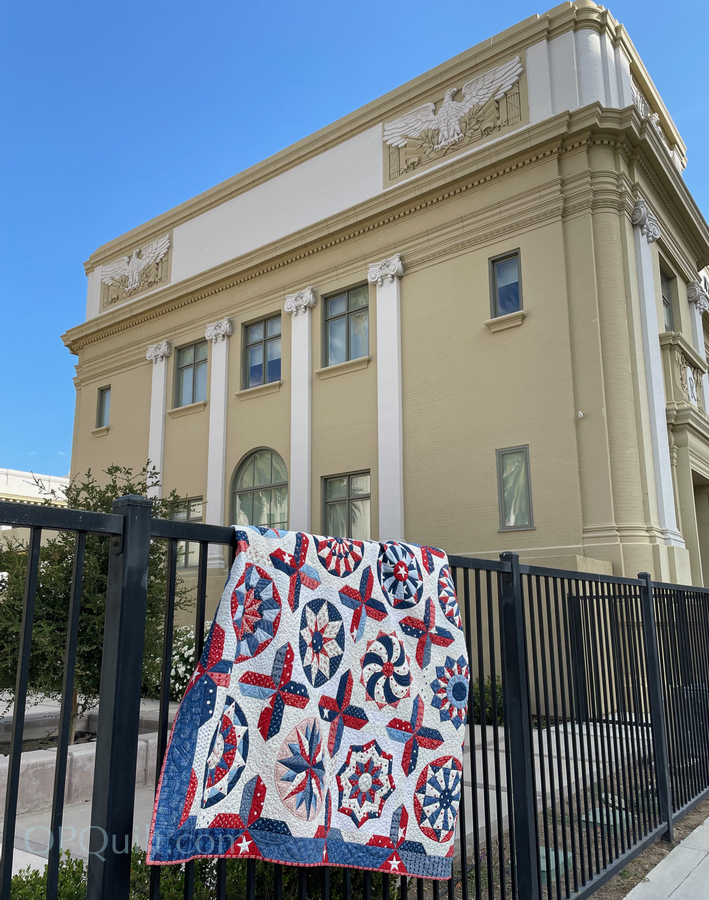
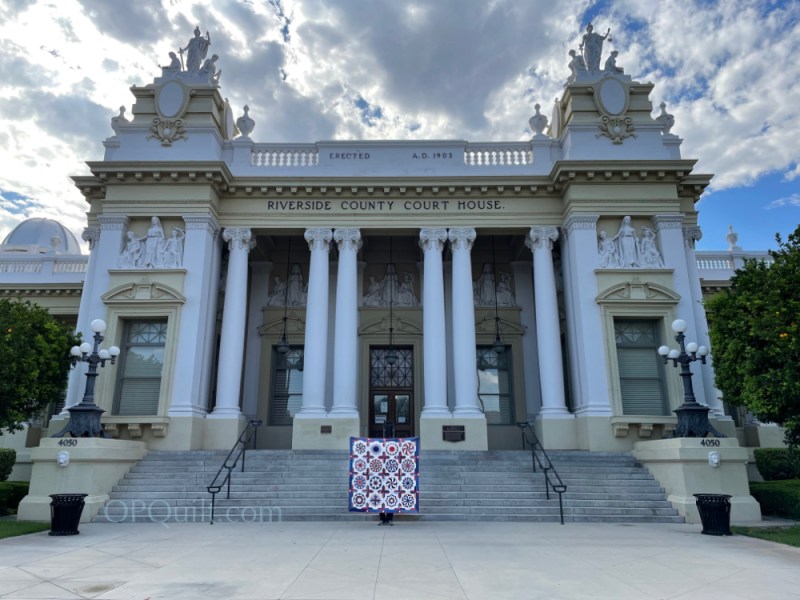
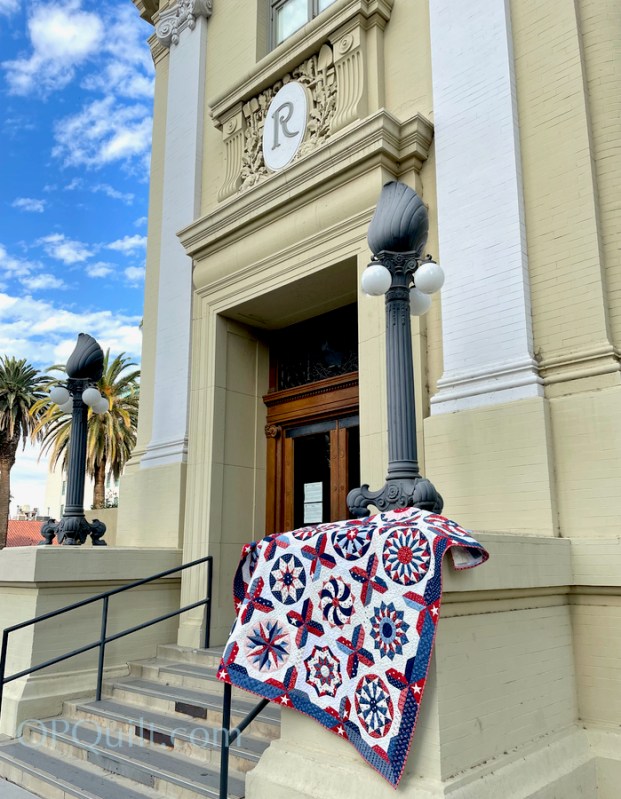
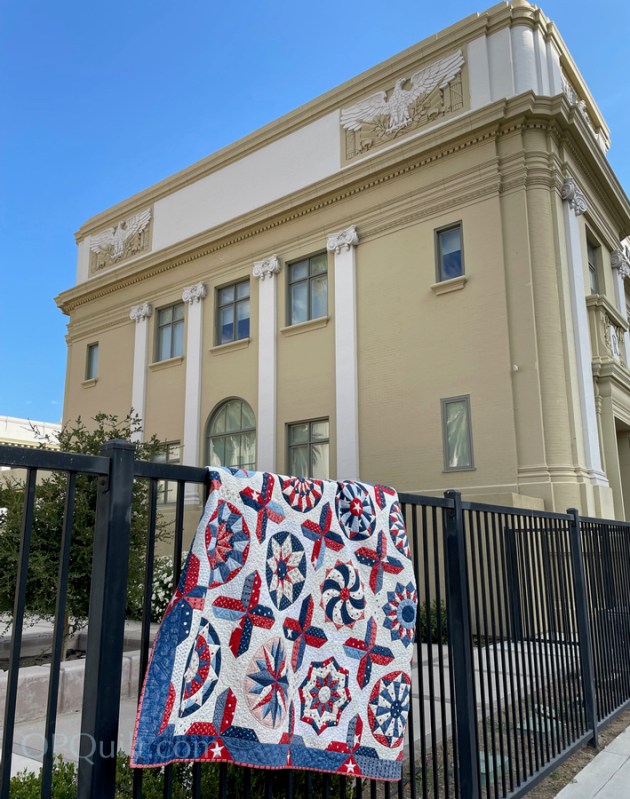
Perhaps the greatest patriotism is in seeing each other, in realizing how alike we are and how dissimilar we are, making us figure out how to negotiate, how to keep the peace, how to be respectful. This is why one reason my husband and I photographed this quilt at our county’s 1903 Courthouse, a place administering and honoring those laws that are part of the the thousand daily comprises we make to keep our country stable and thriving. We also chose this place because it’s also really beautiful, with its craftmanship intact; this place generates in me that old-fashioned kind of feeling of pride, and yes, of patriotism.
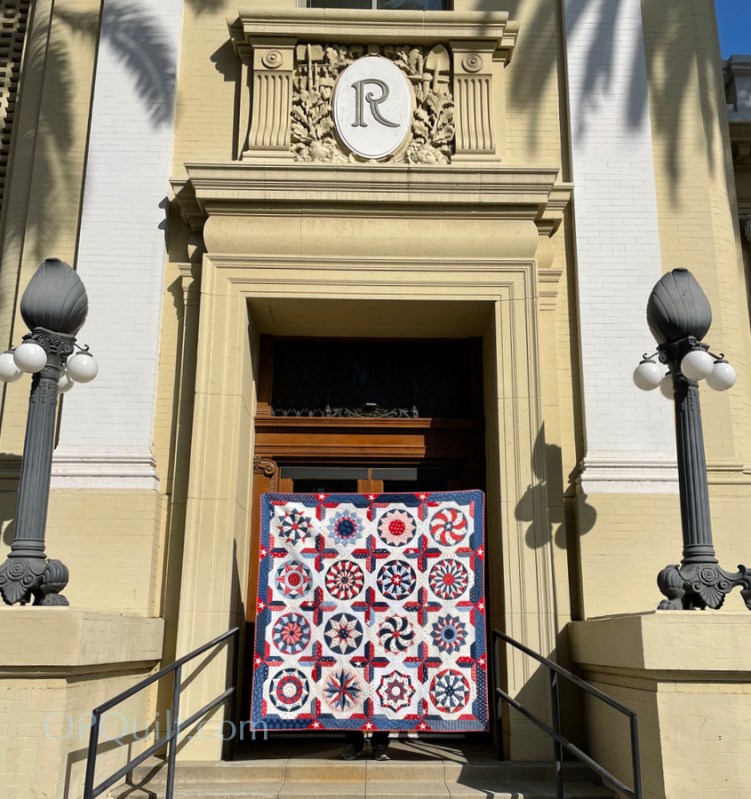
As I have traveled around the world, I have found patriots in all countries, loyal to the carols they hear around them, fiercely proud of what makes their country the best one ever. It would indeed be a great world if we could all think like that, seeing this similarity as something that can unite.

Finally, Swallow Prior brings another gentle affirmation for this idea of America as a poem by mentioning Harvard professor Elaine Scarry, who “describes the importance of multiple viewpoints, arguments, and counterarguments to ‘political assembly,’ [and wonders] how ‘will one hear the nuances of even this debate unless one also makes oneself available to the songs of birds or poets?’ The basis of poetry is precisely those connections forged between different elements, different voices, and different perspectives. In envisioning the United States as “the greatest poem,” Whitman links the essence of poetry, which is unity within diversity, to the essence of democracy.”

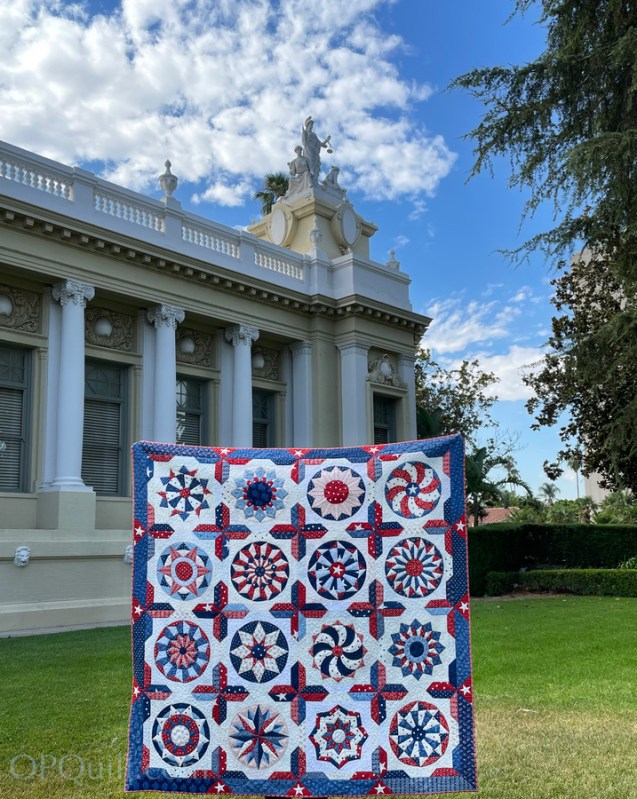
I am a patriot of the singing kind, the poetry kind. I will always love America. And so I present to you my quilt, I Hear America Singing, a celebration of that great American poem that Whitman believed us to be.
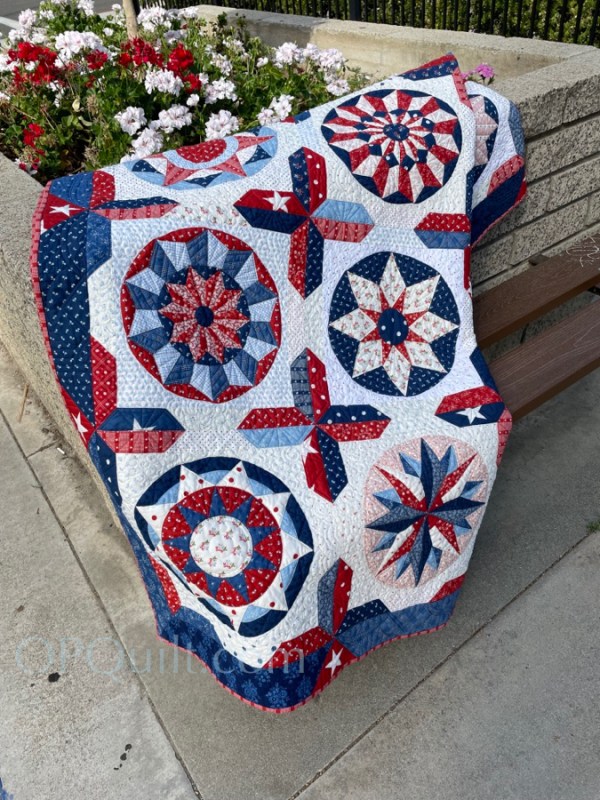
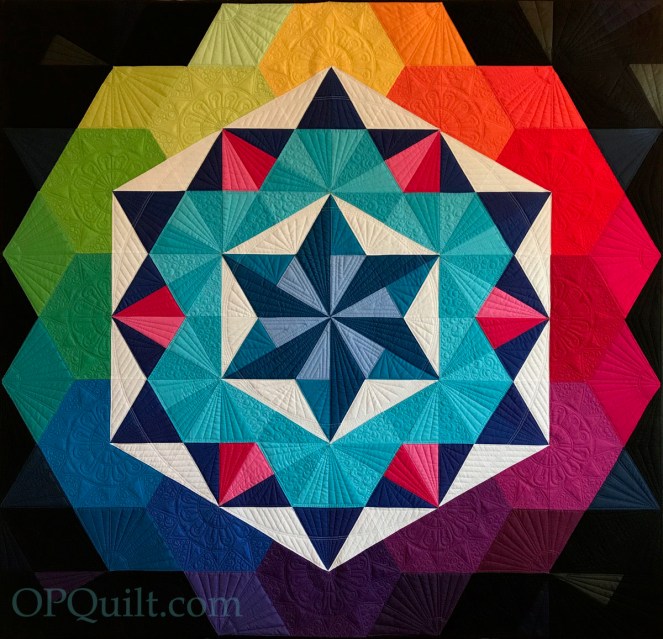
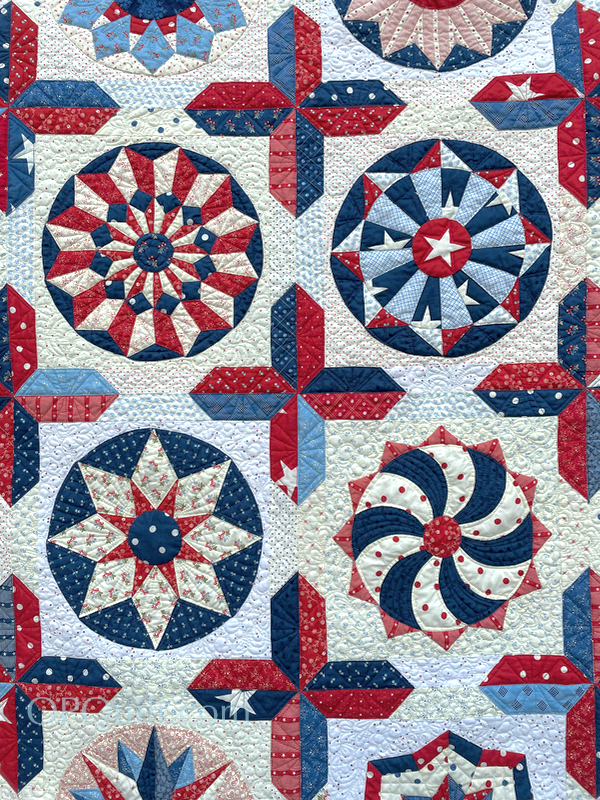
I Hear America Singing
Quilt #252
68″ square
Many of the English paper-pieced blocks for this quilt are available free here on this blog. Other blocks and the finishing instructions are in my pattern shop.
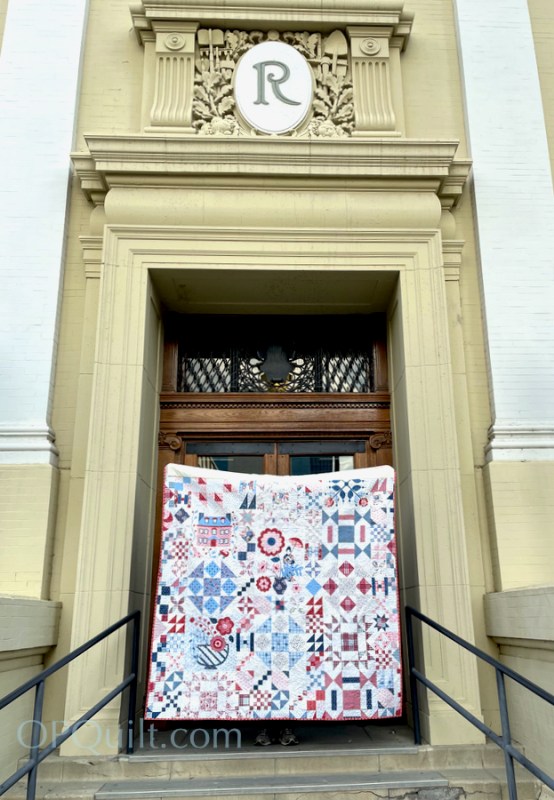
The backing was a printed sateen cotton from the designers Minick and Simpson, using the prints from the front of the quilt. The label was attached later and is not visible.
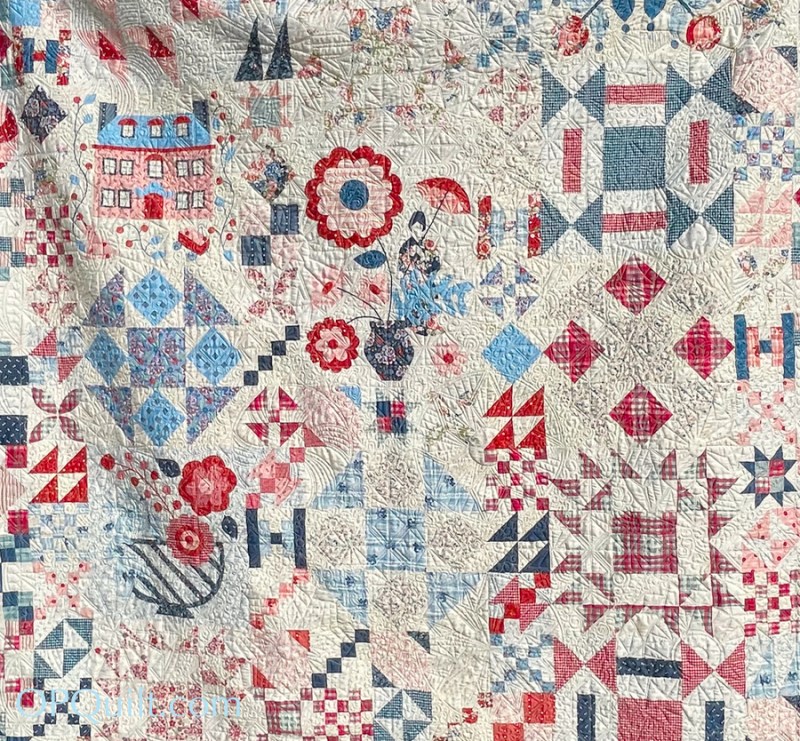
There’s a lot of quilting in this quilt!

Other posts about this quilt, and the blocks that I designed, are found above in the tab Shine: The Circles Quilt.

I Hear America Singing, by Walt Whitman

I hear America singing, the varied carols I hear,
Those of mechanics, each one singing his as it should be blithe and strong,
The carpenter singing his as he measures his plank or beam,
The mason singing his as he makes ready for work, or leaves off work,
The boatman singing what belongs to him in his boat, the deckhand singing on the steamboat deck,
The shoemaker singing as he sits on his bench, the hatter singing as he stands,
The wood-cutter’s song, the ploughboy’s on his way in the morning, or at noon intermission or at sundown,
The delicious singing of the mother, or of the young wife at work, or of the girl sewing or washing,
Each singing what belongs to him or her and to none else,
The day what belongs to the day—at night the party of young fellows, robust, friendly,
Singing with open mouths their strong melodious songs.
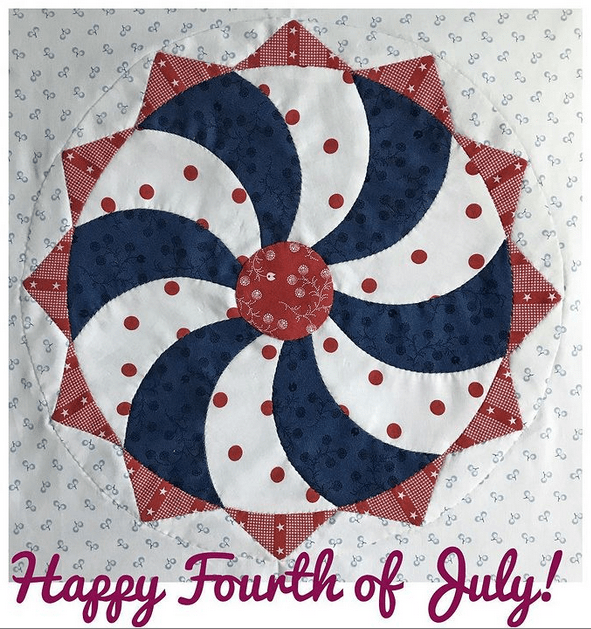
Happy Fourth of July, everyone!
The above Instagram post is from July 2020, when I began this journey.
#ihearamericasinging_quilt
300 Quilts · Patterns by Elizabeth of OPQuilt · Quilts

Sun and Sea • New Pattern

How long do you keep owing someone a favor? Do you give up after a month? A year?
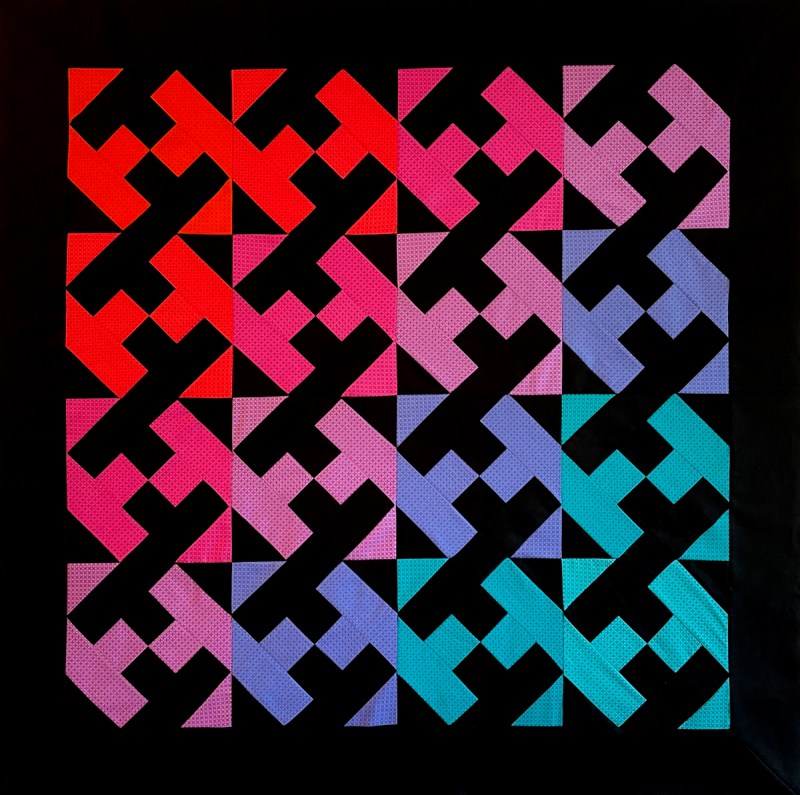
About FIVE years ago, Michael contacted me for a pattern for one of my quilts: an older one called Sun, Falling Into Sea.

He didn’t say exactly what he liked about it, but he wanted a pattern for this quilt just as it was. I am not completely flakey: I had sent him the blocks for the center, but last month he contacted me (such patience!) again asking for the pattern. Those of you who know me long-term won’t even blink when I say, well, I should do a couple more different versions. First up is Happy Valley.

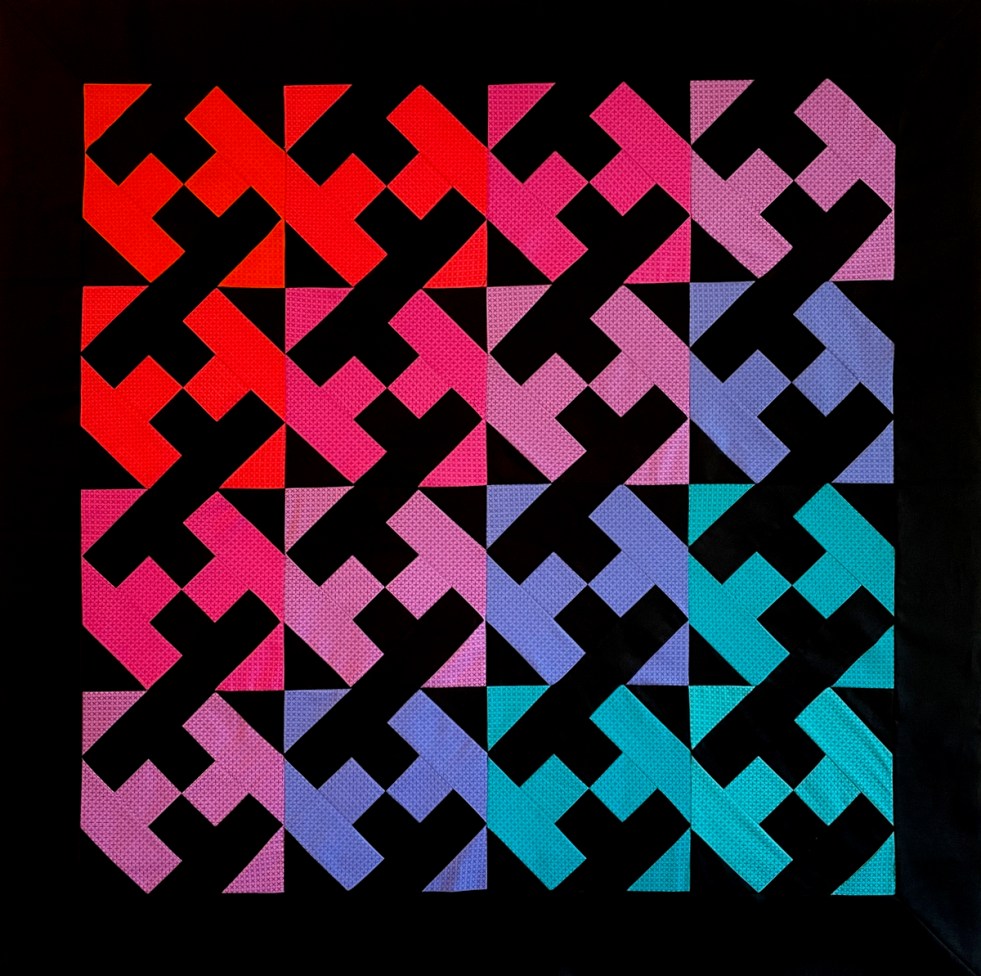
Happy Valley, with its limited spectrum of colors and a black background, is named for the place where I grew up. We all called it Happy Valley because it seemed like nothing wrong could ever happen. Or if it did, we’d deny it to our death.

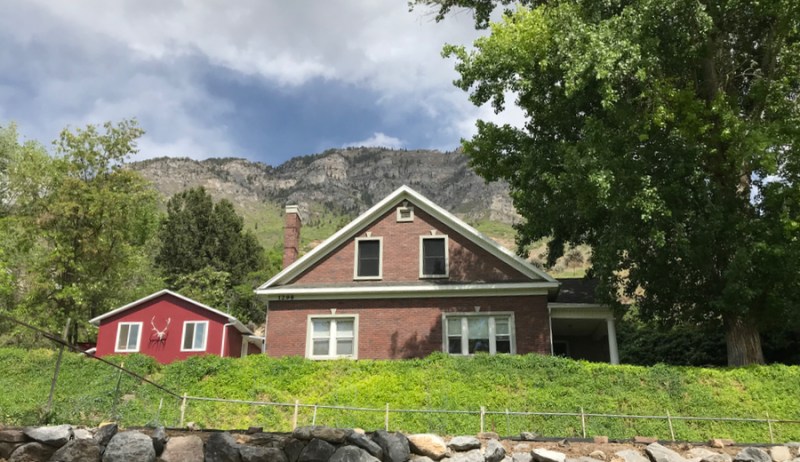
I recently visited my childhood home, and that name was just floating around in my head, as I drafted the pattern in the car the long way home from that place. Ignore the red garage with the antlers. When I lived there, the garage was a falling-down thing in the back. My bedroom was one of those two upper story bedroom windows; there were seven children and we traded around a lot. We were the furthermost house up the hill, with those glorious mountains behind us. I could go on and on about my little childhood stories, but we’ll leave it here.

For this quilt, I dipped my toe into Reels on Instagram and had fun making this little movie. (Sound on!) It’s also on my feed a couple shots back, if you would rather see it that way.

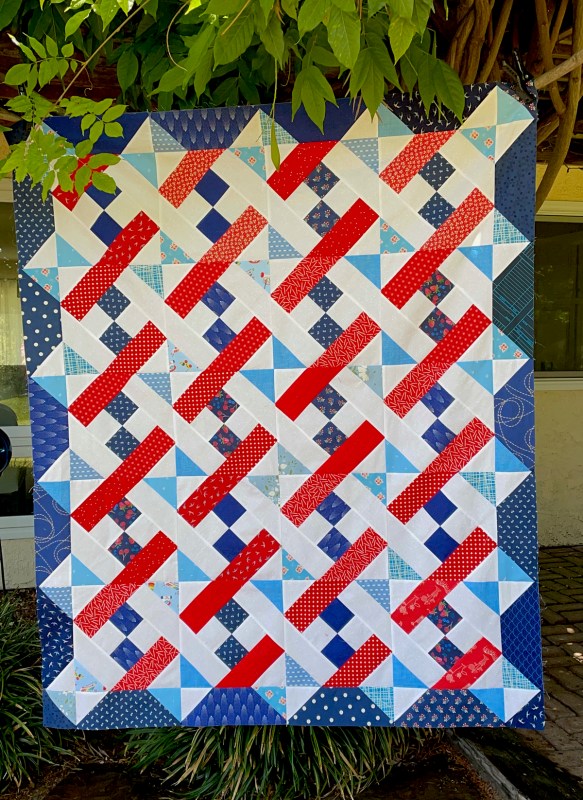
This coloration is called Summer Snowcone, because — of course — with its red, white, navy and sky blue it just says summer fun. I added a different kind of border around this one, and you can make this as large (add more blocks and more border blocks) or small as you want to. I chose this size to be a little table cover for us this summer.

I posted this pattern up on my PayHip site, and within minutes the ever-patient Michael had purchased and downloaded it. I hope it works out for him, and that it was worth the wait. Those of you with sharp eyes may have noticed I set up a little discount for anything in my shop, with the launch of this pattern. Use this code to get 15% off:

I did put this up on my Index of Quilts, but it’s kind of cheating, I say, if its not quilted. Well, it will have to be a place holder until I do get it quilted. And that’s another reason to celebrate: Happy Valley appropriately puts me at the significant milestone of 250 quilts. Summer Snowcone is coming in at #251. Cheating, yes, but I couldn’t resist!

Here’s to your Happy Valley, and to the first Summer Snowcone. But let’s do a giveaway or two, too!

UPDATE: GIVEAWAY IS NOW CLOSED. THANK YOU TO ALL WHO ENTERED!

The first giveaway is a free Sun and Sea pattern from my pattern shop. If you are the winner, I’ll send you a coupon just for you to use to get your free downloadable pattern, plus, I will send you a gift card to Pineapple Fabrics, so you can pick up 1 1/2 yards of white Painter’s Palette Cotton Solids to help you get started on your Summer Snowcone quilt.

The second giveaway is a free Sun and Sea pattern from my pattern shop. If you are the winner, I’ll send you a coupon just for you to use to get your free downloadable pattern, plus, I will send you a gift card to Pineapple Fabrics, so you can pick up 1 1/2 yards of black Painter’s Palette Cotton Solids to help you get started on your Happy Valley quilt.

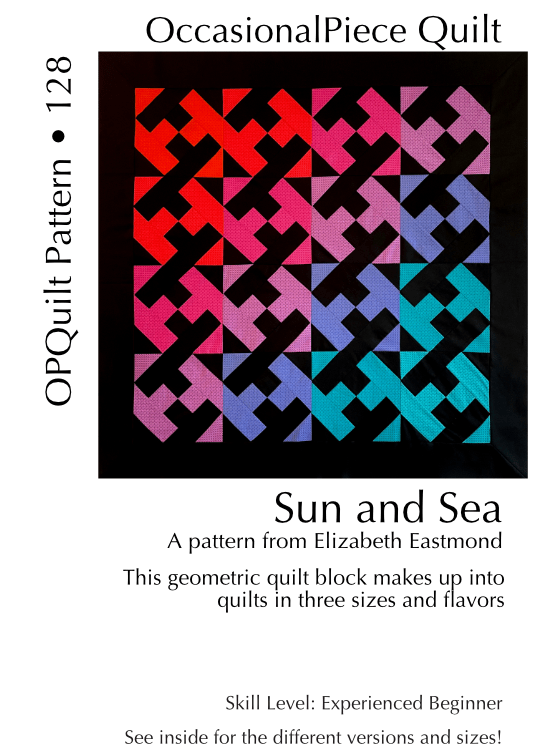
(If you head to my pattern shop to the Sun and Sea Pattern, you can click in the upper righthand corner to download a Preview file that gives an overview of the three different flavors of Sun and Sea quilts, plus yardage requirements.)

To enter: tell me your favorite memory from your childhood that involves summer. I love reading what you write, so enter to win!

(Happy Grandchildren)

Guild Visits · Something to Think About

Who Gets to Make Art?

I’ve been thinking a lot lately about our world of quilts, and by that I don’t mean the larger world–just our own little world. I’ve made some hideous quilts, some use-up-this-fabric quilts (above), some quilts I consider my best masterpieces. Our own little world is echoed out into our guilds, our social media, our quilt shows, publications and then it echoes back to us in terms of the materials we can use. It’s a cycle, a circle, but at the nub of it is that one quilter looking at her one stack of fabrics, or the sketch she made while waiting at the doctor’s office and seeing the print on the back of the chairs. It could be she was messing around with a traditional block, or created one of her own. And from that nub, that spark, hopefully art begins.

from here

I’ve been thinking about this because of an article by Guy Trebay (found while cleaning out) where he asks straight off, “Who gets to make art?” Written about the International Folk Art Market in Santa Fe, it is an interesting overview of this age-old question.

from here

Do you get to create art? Do I? Or is it only relegated to that famous quilter that is all over Instagram? The lady who has her face on the ads of the sewing machine you like? Does more fame equal more entitlement to call it art? And then there is the pressure from the outside world, debating forever and ever if making a quilt is a craft or an art?

from here

Trebay attributes this question to Luke Syson, and says that “In asking [this question], Mr. Syson was adding his voice to a growing chorus of museum professionals who are challenging traditional hierarchies of art production. He was talking, in this instance, about the obscure craft of scrimshaw, subject of a fine study show at the Fitzwilliam, but more broadly about the importance of recognizing and celebrating those gifted artists whose work is so often relegated to the stepchild status of crafts.”

from here

Luke Syson, now the director of the Fitzwilliam Museum at the University of Cambridge (Britain), shares his experience of having to address some of his biases about what iconic art is in his TEDTalk, which he titled “How I learned to stop worrying and love “useless” art.” It’s worth a listen, if you have a few minutes. In that afore-mentioned Instagram post about scrimshaw art, he asks “Who gets to be an artist?” In the text he writes ” I thought about the scrimshanders then – working class, almost entirely anonymous, using their time to making things that were beautiful and that documented their lives. Amateurs, yet completely excluded from the world of leisure that this word implies. But I’m guessing there was a collectors market for these objects early on – that these were a sideline rather than simply the making of personal souvenirs.”

Which leads me to think about the anonymity of women, making their art for years and years, hidden in plain sight. They were making that which was beautiful to them, and which represented their lives. And yes, amateurs, all. We’ll leave this discussion here, with a quote from Trevor Bell:

“Art condenses the experience we all have as human beings, and, by forming it, makes it significant. We all have an in-built need for harmony and the structures that create harmony. Basically, art is an affirmation of life.”

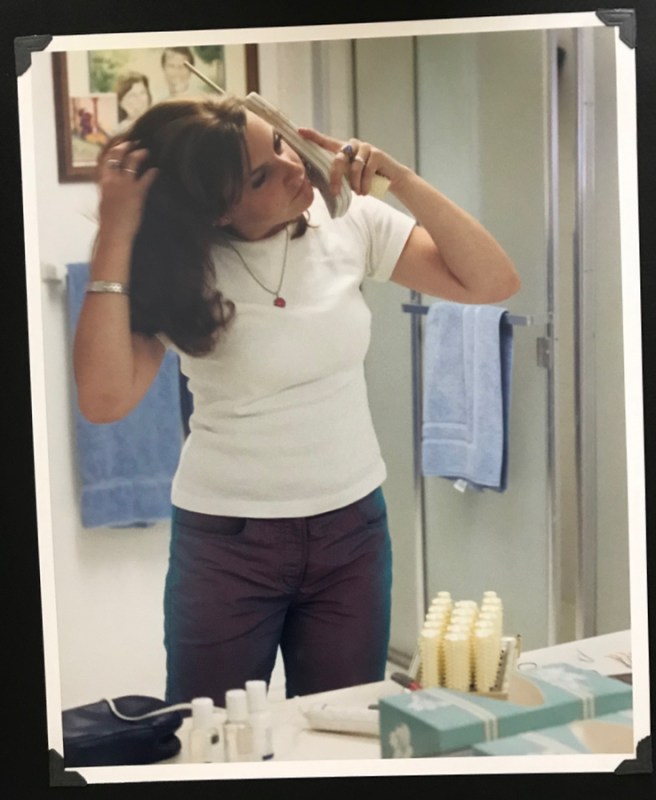
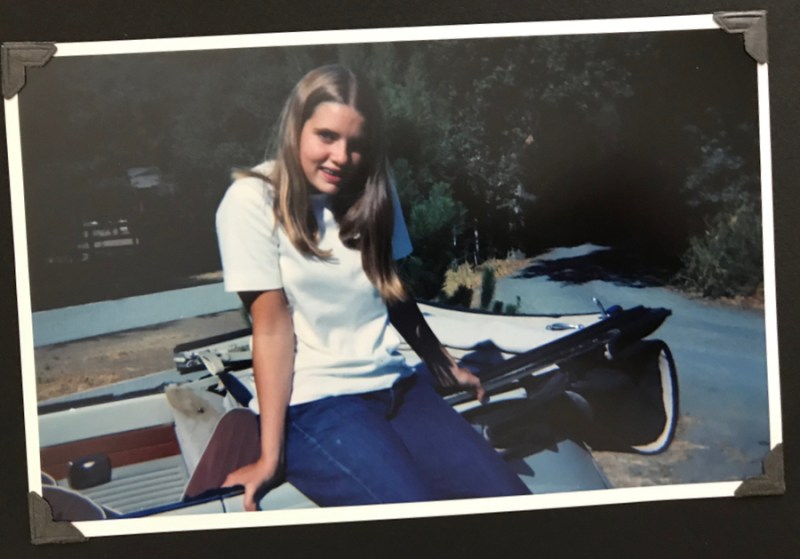
Today is Mother’s Day. My mother is on the left (c. 1948), my daughter (named after her) is shown in the center in a photo from high school (c. 1998). (I sent this photo to her when she complained about one of her children being always on her phone.) I’m on the right (c. 1972).

My mother made art: seven of us. She never quilted. She read. She never painted, as did my father. She did do dishes, laundry, dressed elegantly, organized us, kept us going. I owe her everything, and as she approaches her 93rd birthday, this Mother’s Day I celebrate her as a different kind of unsung, ungalleried, un-media-ed, unknown sort of artist, but she was significant and affirmed us all.

I’ll be in my happy place this week, hanging out with the Orange Grove Quilters. We’re making Merrion Square in our Workshop. If you want to hear my program of Abecedary of Quilts or participate in a live/online workshop, please contact Pat (the Workshop Chairman) at workshops@orangegrovequiltersguild.com or drop me a note (and I’ll check with Pat). I love teaching this little quilt, as there are as many different quilts and there are quilters. Each one makes this little village their own.

And as life moves on, it seems this will probably be the last time I teach this class. Let me know if you are interested.

Happy Quilting! (turn the sound on)

300 Quilts · Patterns by Elizabeth of OPQuilt · Quilts

Criss-Cross Color • Quilt Finish

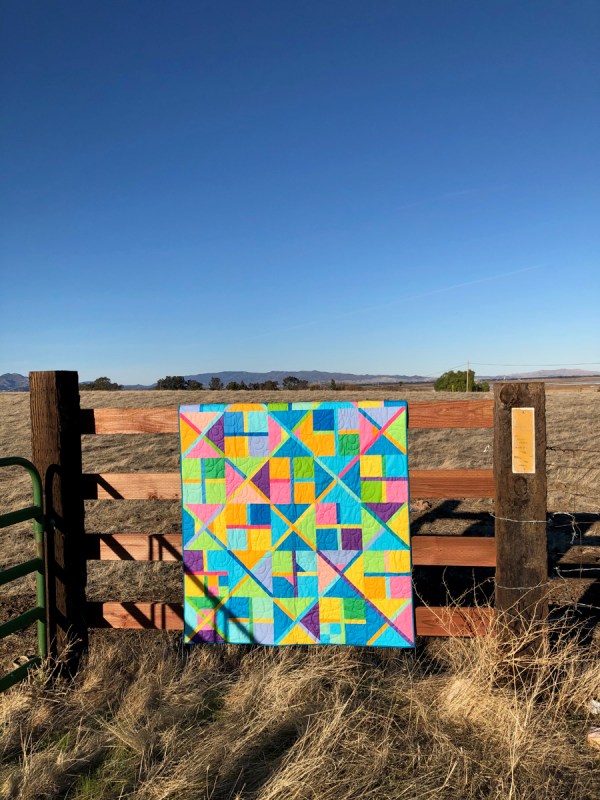
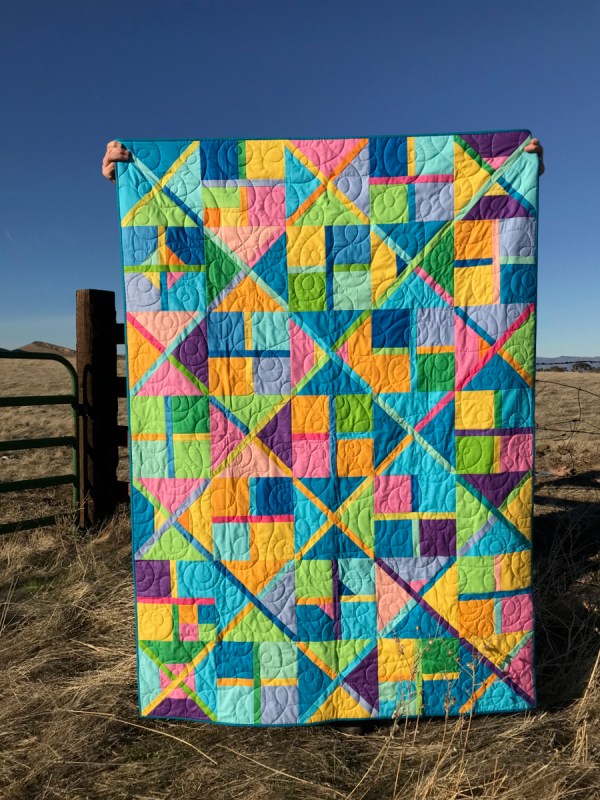
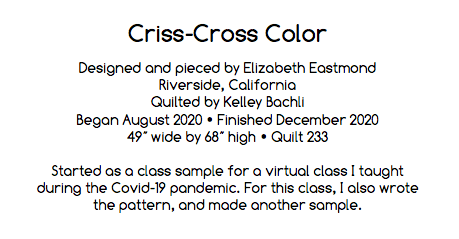
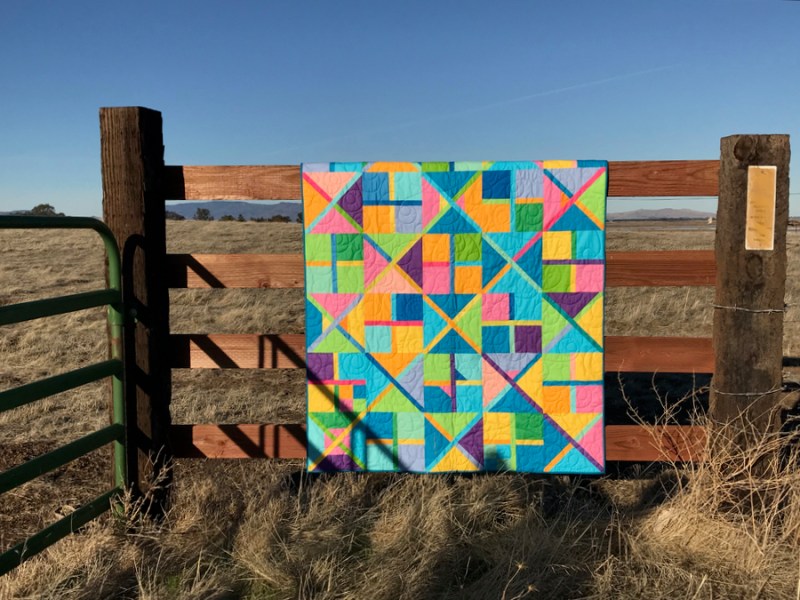
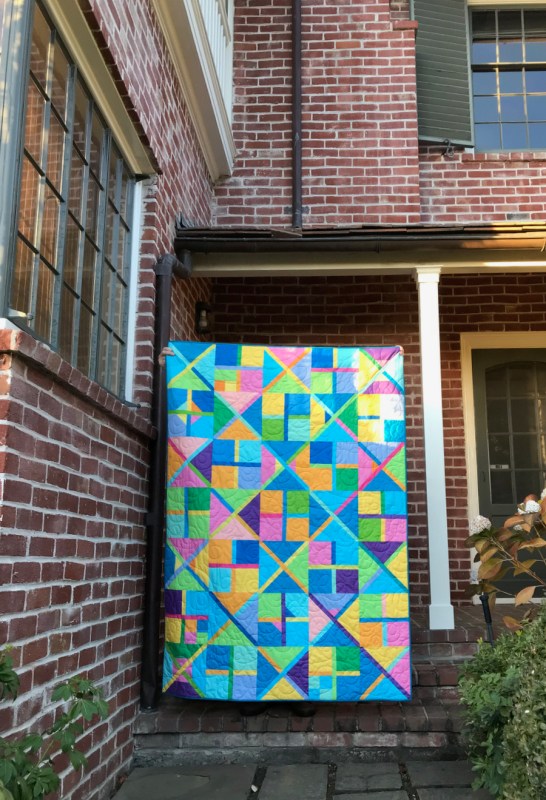
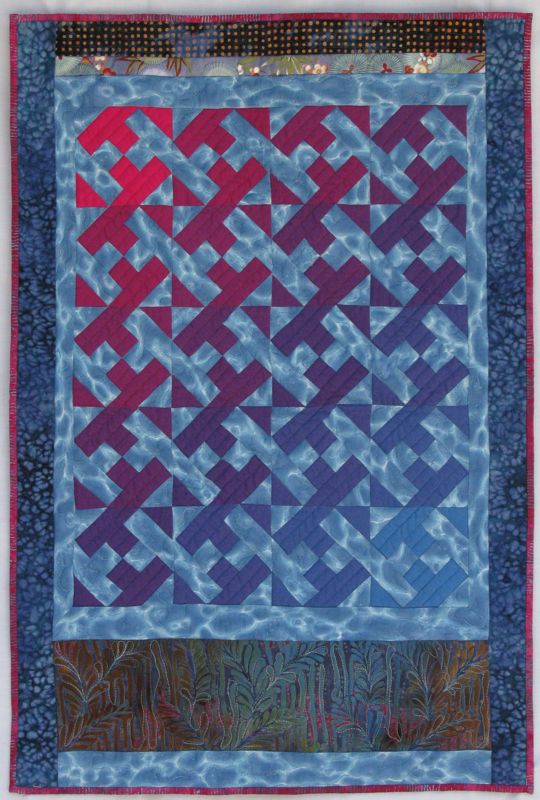
Criss-Cross Color, quilt no. 233
49″ wide by 68″ high

The quilting by Kelley of Wolf Girl Quilts really looks lovely in this light.

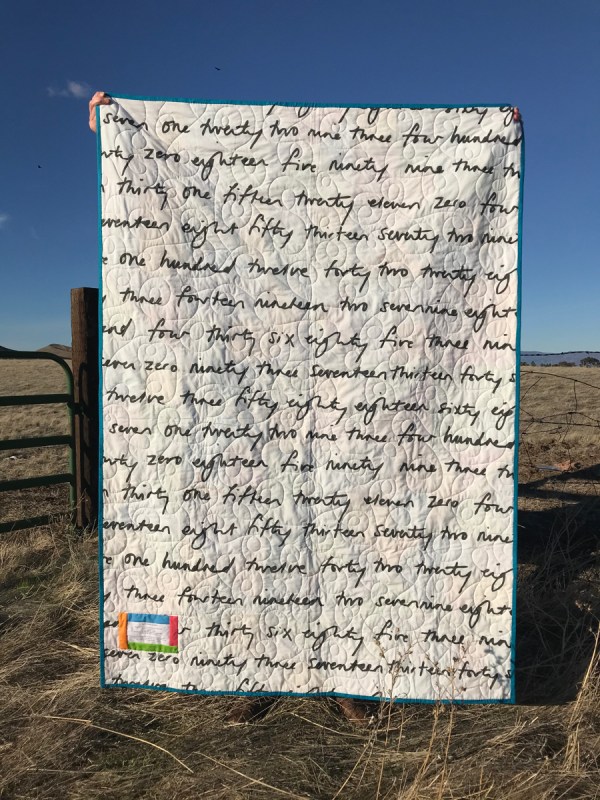
IKEA fabric, from back in the day: a series of numbers. It was what I had.

the label

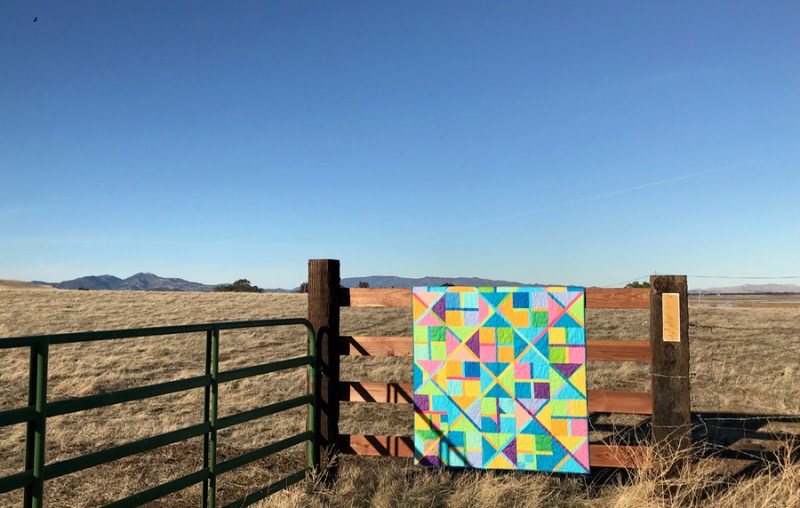
All photographs above by my husband or I, taken from a frontage road on the 680 freeway, to the west of Grizzly Bay and the Goodyear Slough, on Lopes Road near the Bay Area in Northern California. I like how the shadows are playing with the quilt in this image.

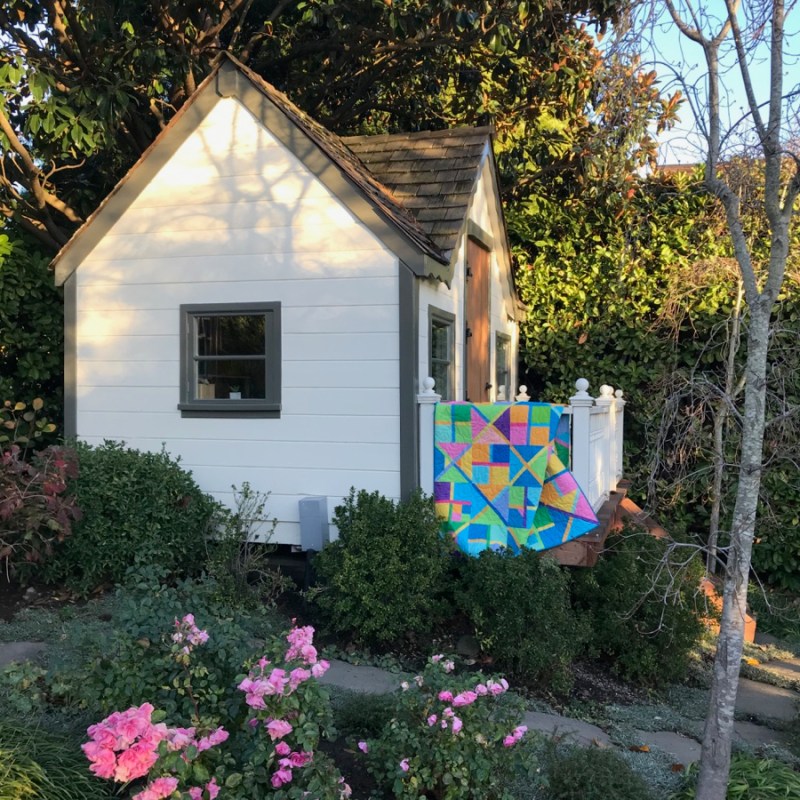
These last two photos were not taken on Lopes Road, but at my brother’s, as I knew they had a picturesque playhouse from when their girls were tiny.

I listed this as Quilt #233, as I got over-eager when the quilt top was done. Kelley, a long-armer friend, did the fabulous loopy quilting texture on the quilt. It’s been a good series for me, challenging me to think differently about color, texture and size.

The pattern is sold in my pattern shop on PayHip. There is a discount running on this pattern right now, until January 15th, if you are interested in purchasing it. Details are at the pattern shop.

Other Posts about the Criss-Cross series of quilts:
Criss-Cross Color, completed top, Criss-Cross Autumn, and the follow-up to the workshop
Criss-Cross Autumn
Christmas Criss-Cross, quilt finish
Criss-Cross, the genesis