Free Download · Quilts · Something to Think About

Small Stuff at the Bowers Museum Quilt Exhibit

Efficiency is ruining your happiness.

Or so says Atlantic podcaster Charlie Warzel about Ian Bogost’s new book, “The Small Stuff: How to Lead a More Gratifying Life, and why the tiny rituals, sensory pleasures, and routine interactions we tend to overlook may be the very things that make us feel connected—to one another, to the world around us, and to ourselves.” (gift link to podcast transcript).

Template-pieced Crazy Quilt, c. 1890

Writer Ian Bogost “makes the case that some of our societal obsessions—self-optimization, career satisfaction, this constant fixation on whether we are adequately happy or not—those are all aimed at the Big Stuff. But our lives are actually dominated by the Small Stuff: the [messing] around that gives texture to our days. This, he argues, is good news, because the Small Stuff is abundant, and it’s actually much easier to notice, to control. And doing so can bring us a sense of genuine gratification, the kind that so many of our technologies just automate away” (source above).
As I’ve been feeling disconnected in more ways than one, I was intrigued. So when I went to an exhibit at the Bowers Museum in Santa Ana with these ideas swirling in my brain, I decided to slow down, to look, to notice, to see the Small Stuff in the quilts.
If you are like me, you usually hit a quilt show, camera in hand and have a rhythm: take the big photo of the quilt, take the detail shot, take a snapshot of the title card and move along. While I started that way, I made a decision to not be so efficient. To notice the details.

Star of Bethlehem quilt with broderie purse

The title card points out that in this quilt from the 1820s-1830s, the use of broderie perse, or the appliquéd chintz cut-outs, may have been a technique to manage the expense of printed cotton, grown and made in America, but then shipped to England to be printed…and then shipped back again to the United States.

The lights were dim in the galleries, so the resolution on some of these photos is very low. But I was fascinated by these two yellows against that Prussian blue center.

Inscribed Mariner’s Compass Quilt, c. 1850

Here, in another medallion quilt, is that color again.

On the right side of the quilt, the binding matches the background. But not on the left.

Rose Wreath Quilt, c. 1850

This Rose Wreath quilt has Turkey red fabric, so named because the process for obtaining the color from madder root was originally developed in the region of Turkey. As I have noted in other writing on this website, we really don’t know how people in the past constructed and lived their lives except in the broadest strokes and outlines. Were they excited to have this red? Did they pre-wash like we do? (probably)

(Sorry for the blurry shot — the low light was a challenge, but I knew it helped preserve the quilts and fabrics.)

These vines, on opposite sides of the quilt, were not symmetrical, but instead echoed each other, curving in exactly the same way. Usually we see those vines mirrored. One hallmark of Turkey red is that it leaves the cotton fibers more vulnerable to abrasion and wear, as you can see here on the edges of the quilt.

Around the perimeter were some displays; one included this Mail Order Fabric Sample card, from Montgomery Ward & Co, c. 1926. Okay, that’s a century ago.

Centennial Handkerchief Quilt, by Sarah Angelina Andrews Whitman and Gertrude Spurr Whiman, c. 1883.

I loved the combination of quilt patterns: the handkerchiefs and panel in the center, the orange peel blocks interspersed with squares on the diagonal, with squares set diagonally around the border. According the title card, “Sarah Whitman collected the handkerchiefs during her visit to the Philadelphia Centennial Exposition, and made the quilt with her young daughter’s help a few years later.”

This one really caught my eye with all the variety of colors on the sawtooth blocks. My mind was whirling with possibilities that the quilter had tried, but was disappointed to read that they were all originally the same color (but two different fabrics). The title card says that “laundering the quilt in an alkaline detergent at some later point caused the blue dye to fade from only some of the green fabrics, leaving the yellow behind.” I still think it’s very cool, but I wonder how the quilter felt. The quilt is from somewhere between 1840-1910. And check out that outside border — I suppose that had the Detergent Blues, too.

Details from 1) Square within Squares quilt, c. 1980; 2) Log Cabin Quilt, 1880s (made in silk and wool); and 3) Redwork Quilt (1890-1910).

Glorified Nine Patch Quilt, 1930s to 1940s

The nine-patch is a favorite block of mine, but this one was quite “glorified,” if by that you mean “making someone or something seem more important or better than they are.”

What interested me here was how those pointy outer corners were laid on the bias, as shown by the diagonal lines in this print (well, one wasn’t, but the rest were). Was that a design choice, or because it would be easier to piece the curve on the bias?

Here it is again. I think the bold stripes lend some pizazz to the 1930s prints.

Keeping in line with the idea of messing around and enjoying it as I go, I decided to play their Make a Quilt Pattern game.

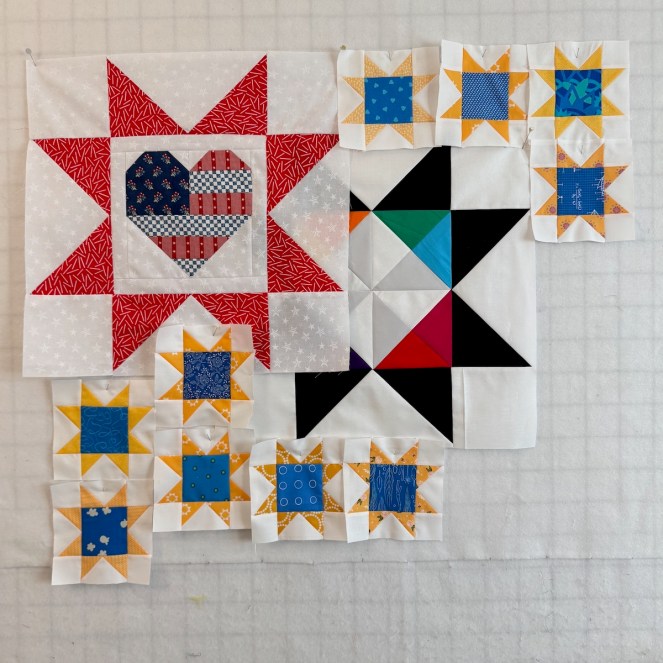
I did the first one on the left, then discovered I could switch a couple of the sawtooth points and get the second (shown here on an angle).

The last room was filled with more contemporary quilts. The exhibit, The American Quilt: Cloth and Commerce, runs through August 30th, if you are in the area. More information can be found on their website.

In one corner of the last room, you could color in a block and slap it up into their frames. I chose the “Fan Block,” then said, to heck with Fans, and went to town as if it were a New York Beauty, drawing lines to make it more interesting (mine is just above the arrow). I was in my element:

New York Beauties (from here)

THE END is by Janet Tranbarger, a well-known local quilter.

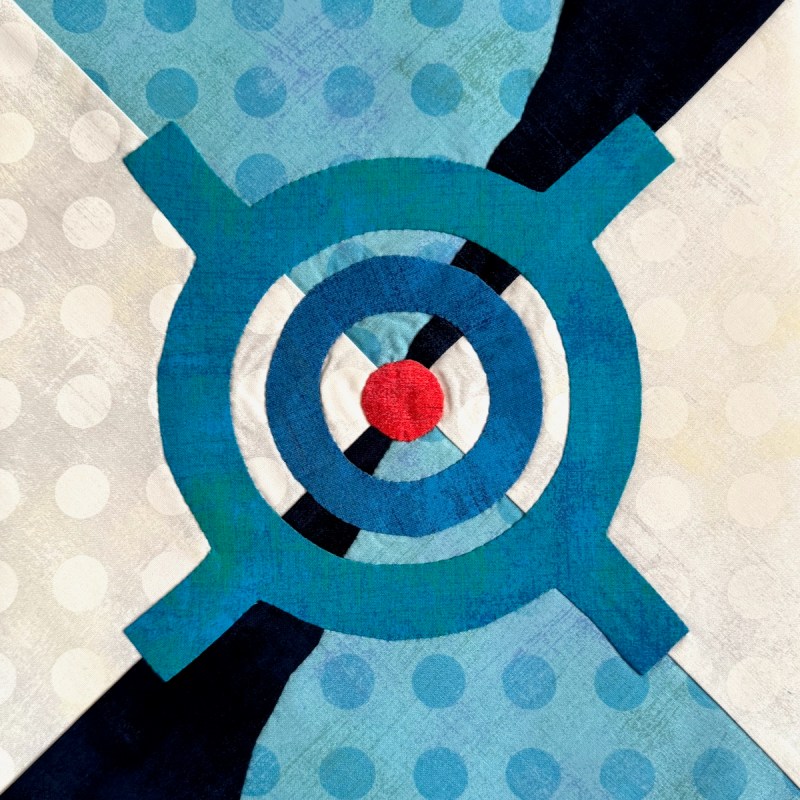
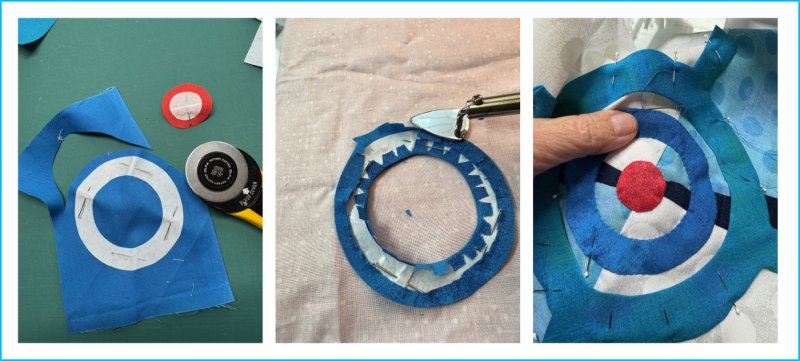
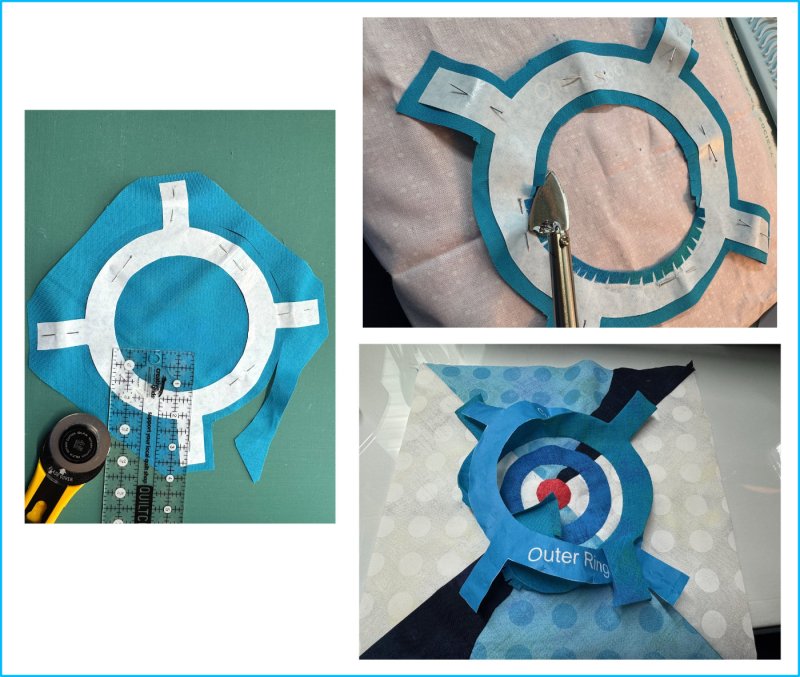
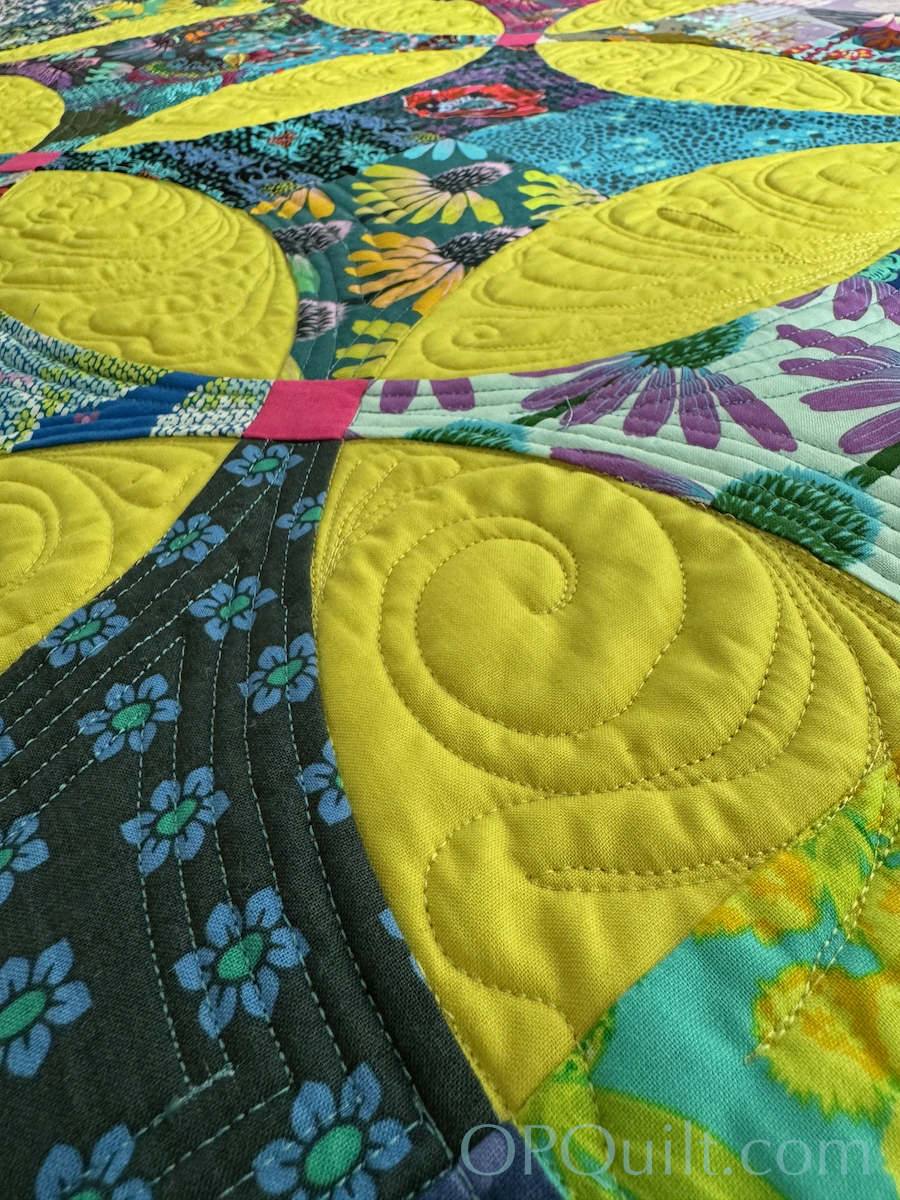
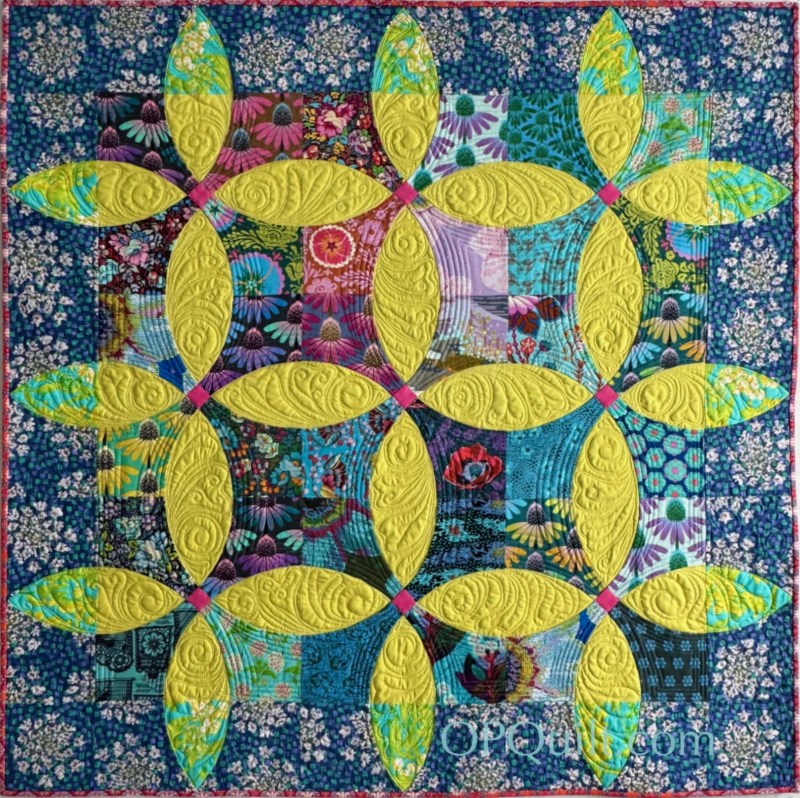
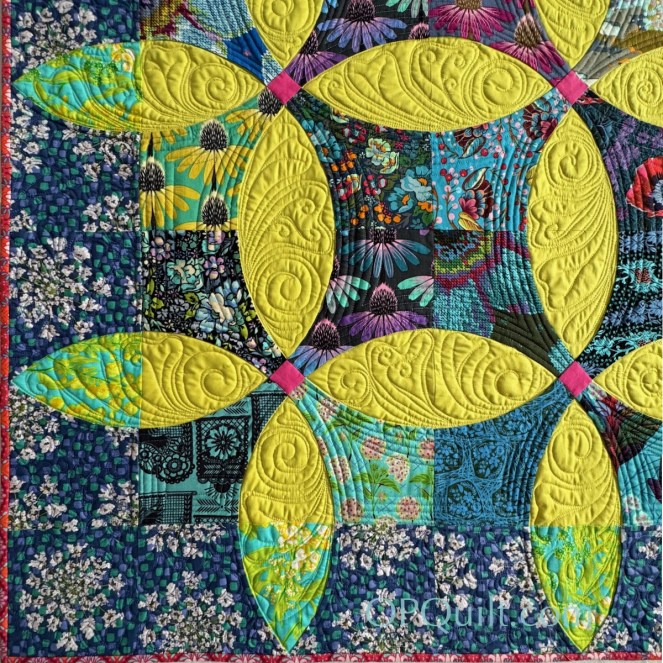
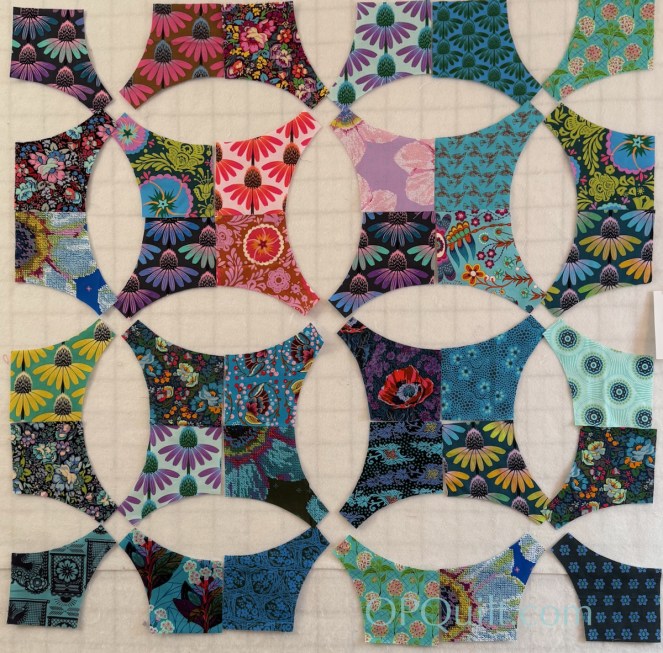
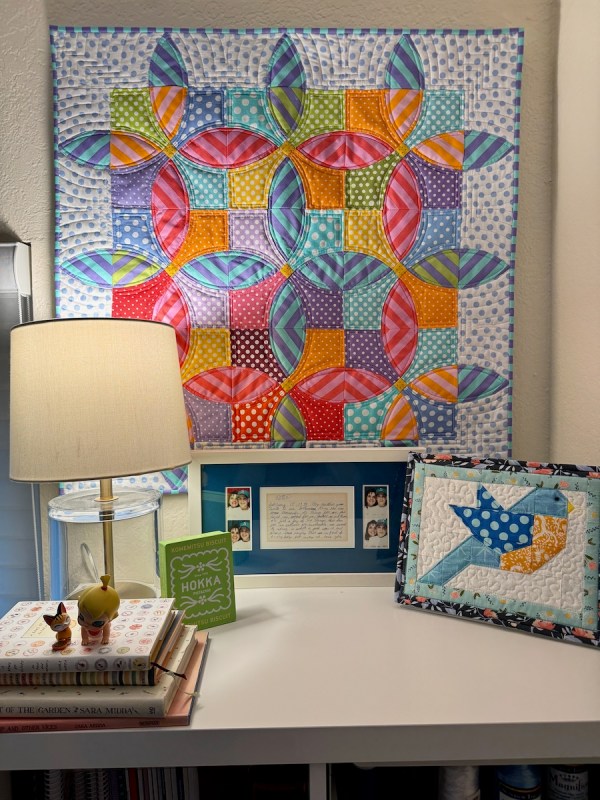
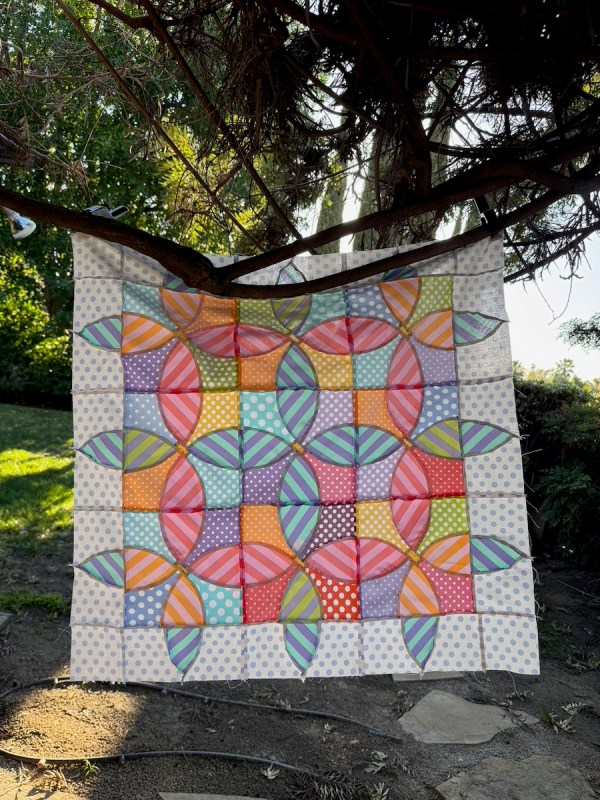
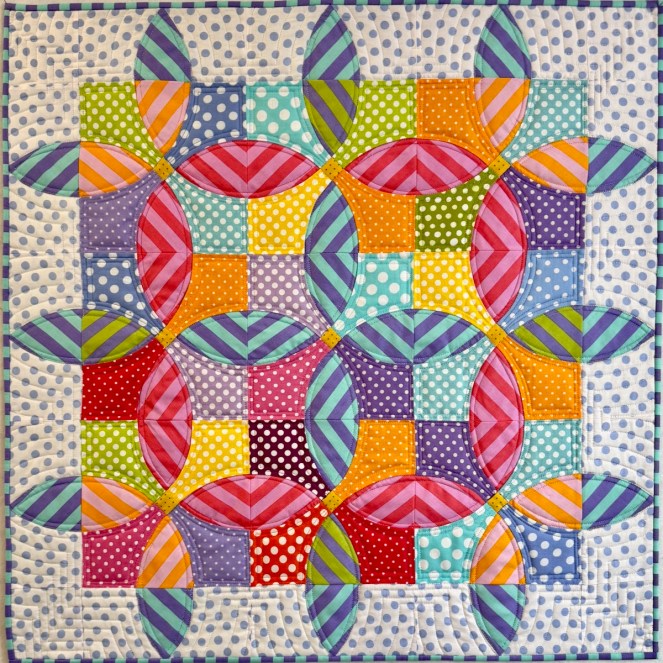
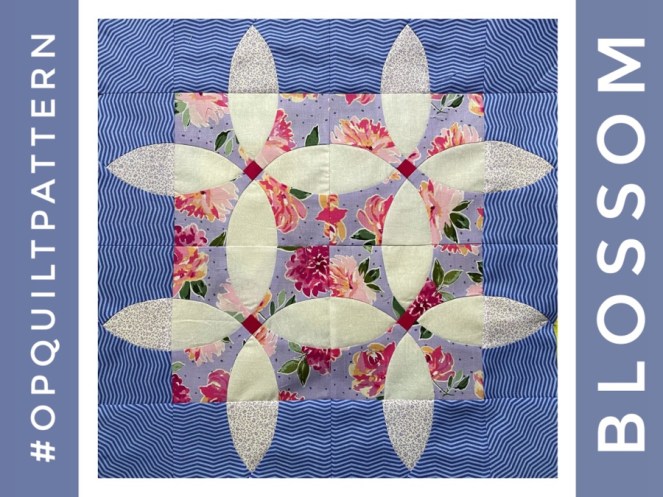
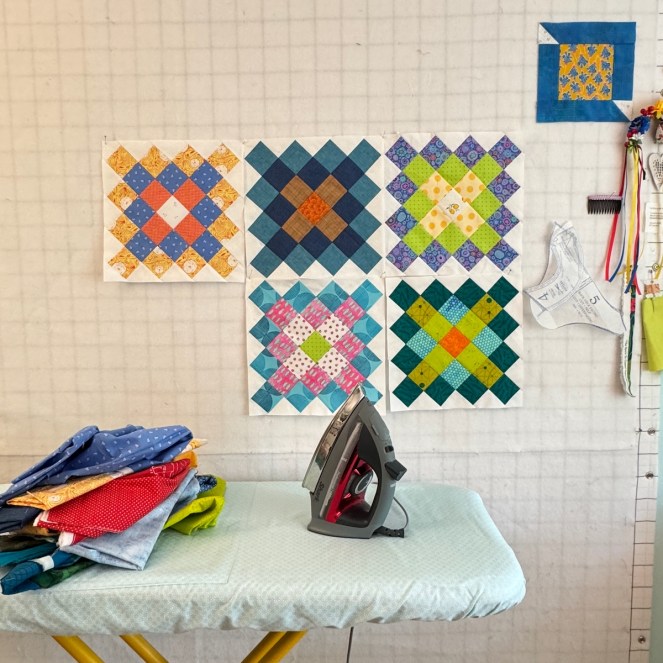
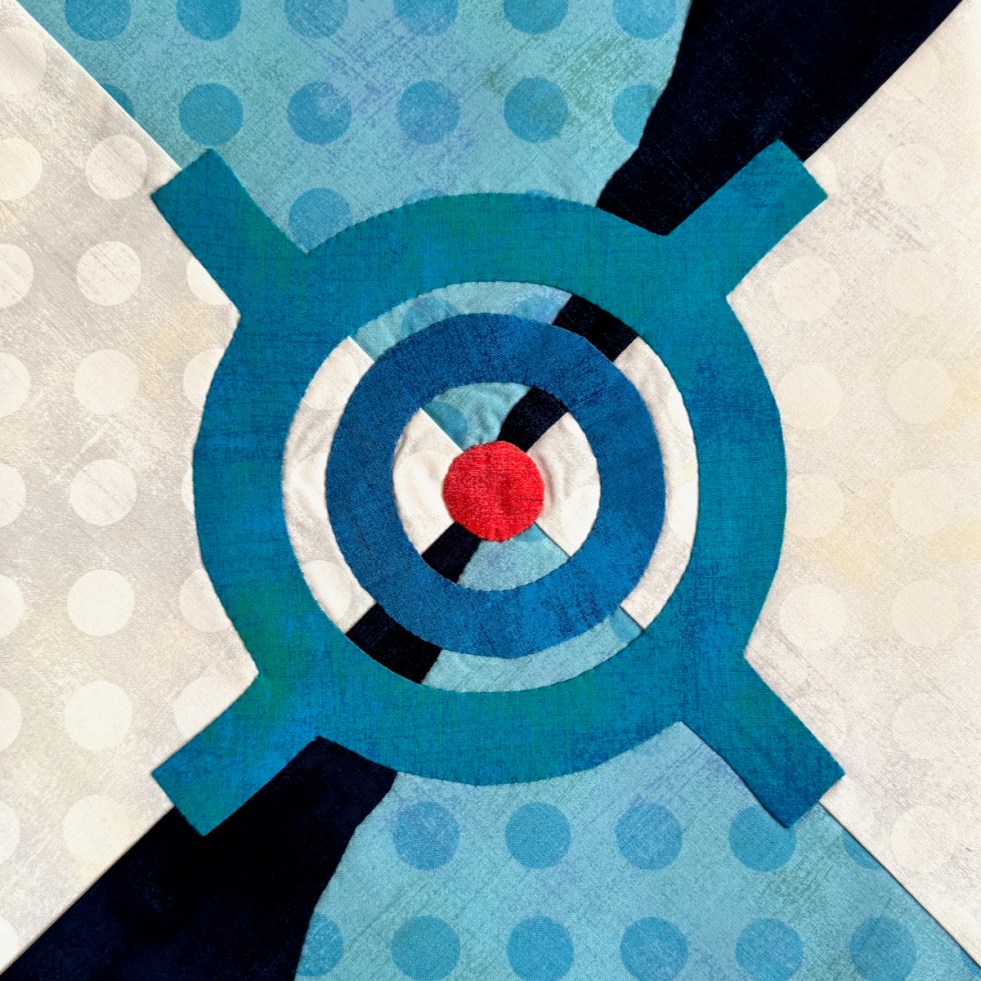
So I found the glorified nine-patch block in the Brackman, and one of its names is Circle upon Circle. I tried it out. This one finishes at 8 1/2″ inches. I’ve got a larger version I want to try (12″) but for now, here’s a free download from my day of doing Small Stuff.

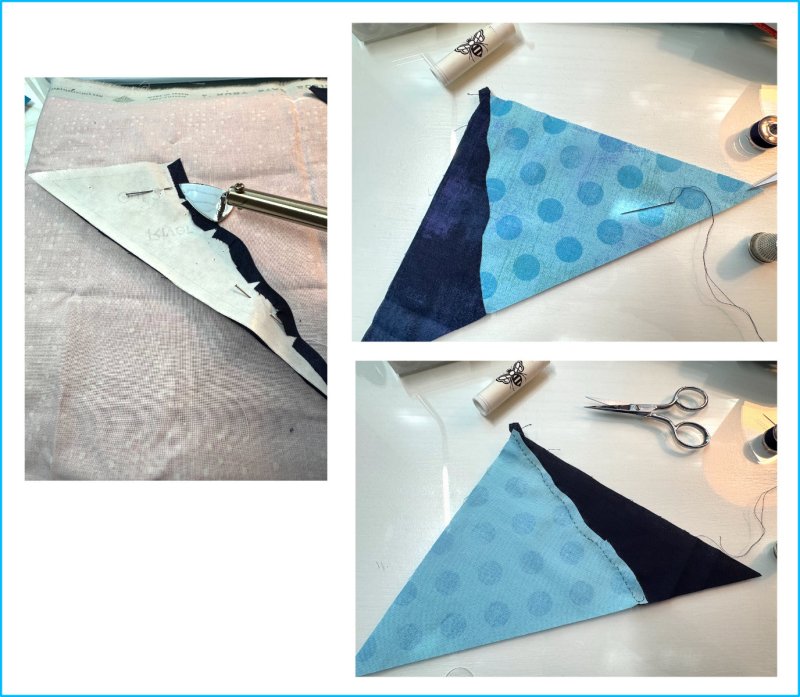
To be truthful, I have no idea how you would put this thing together. Maybe try it as an EPP? Or just be really clever about how you’d sew on the ovals to the fancy nine-patches? Whatever, it’s free to download, if you want it.

Last two quilts:

Rose of Sharon — or — Whig Rose Quilt, 1850 – 1870 (possibly Missouri)

The title card said this is made of three different dyed fabrics: 1) “poison green,” an arsenic-based dye; 2) “Turkey red;” 3) and “cheddar,” a dye created with chromate pigment which yields a bright orange similar to the color of the cheese.

Snowball Quilt, detail (1920s): rayon, silk and wool

The title card noted that “The Treaty of Versailles, which was signed in 1919 to end World War I, included a clause that required Germany to share synthetic dye secrets with the Allied Powers as part of war reparations….The brightly colored patchwork in this quilt indicates that it was likely made after these dyes had become more prevalent in American fabrics.”

I couldn’t get close enough to see for sure, but I’m betting those stitches around the outside edges of the snowballs are done by machine. I’m also guessing that they “snowballed” quarter-circles onto black squares, then sewed them together. You can see some of the disjoint seams here and there.

Final word, from author Ian Bogost (I’d recommend listening to the whole podcast, or reading the transcript):

“So the idea is that we have become disconnected from our sensory lives. That’s sort of the thesis of the book. And this happened slowly over years and decades. It happened in part because of technology, but not entirely because of technology. And we kind of didn’t notice that that was happening. And we maybe, we blamed smartphones instead of a whole host of other factors. But the result is that we feel disconnected, you know? Like, decoupled from the world that we live in, from the physical world.

And that connection, that sensory connection where you engage with the world with your senses, which is what I call gratification: We’ve lost a lot of that. We forgot about it. We were too busy optimizing, planning for the future, trying to make our lives more purposeful or happier, that we forgot how to be gratified. And that’s what I think we should reclaim.”

I did my best to reclaim some Small Stuff, to forget the bigger issues that led me find refuge in this lovely museum, and to get lost in the world of quilts.

Quilt Patterns · Quilt-A-Long · Quilts · Something to Think About

The Friction of a Hawaiian Quilt Block

Occasionally in Adam Mastroianni’s substack there are these fascinating-makes-me-think-or-go-aha sorts of observations. His missive this week happened to coincide with two other events: a couple of days at the beach and the making of a Hawaiian quilt block.

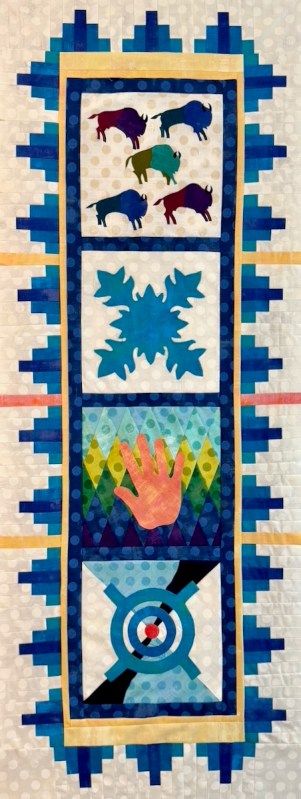
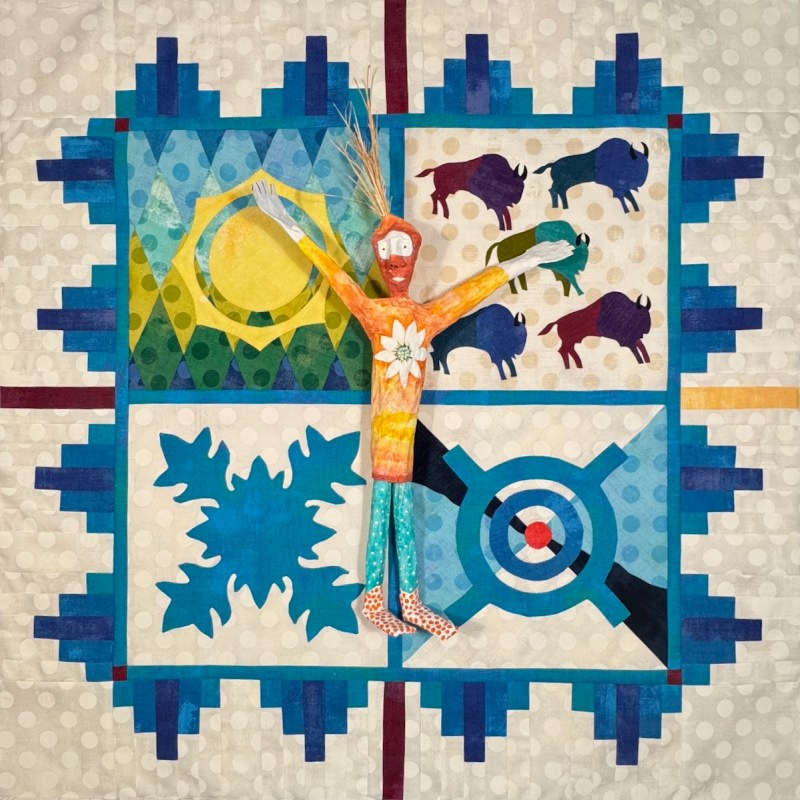
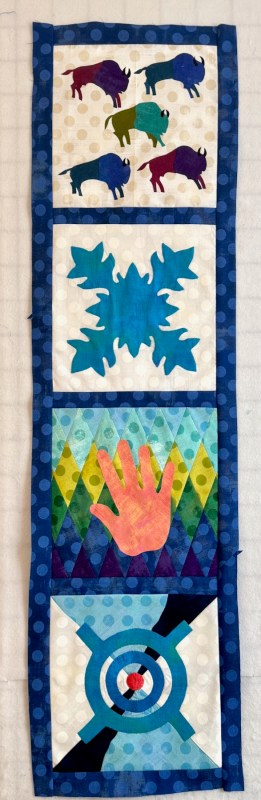
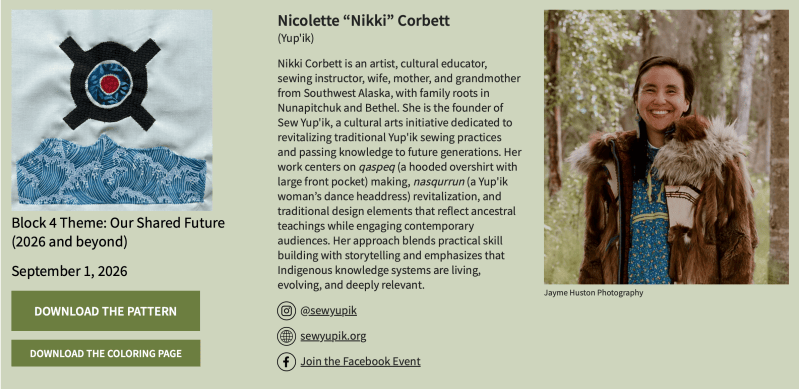
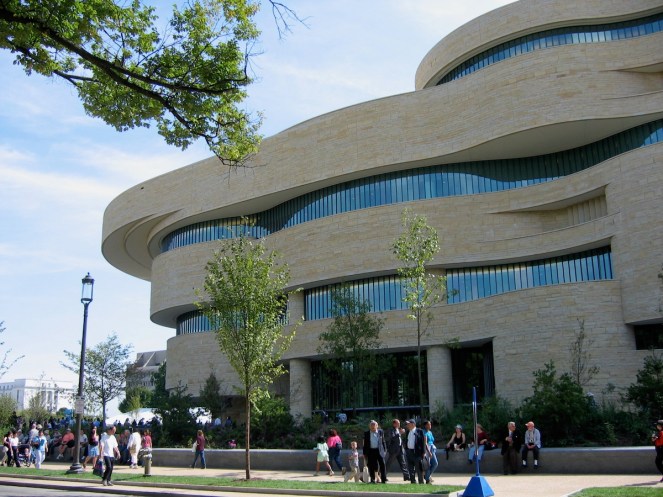
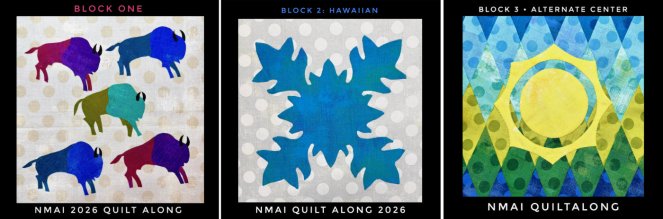
First, the quilt block. I posted I was starting this Hawaiian style of quilting and immediately a couple of quilters commented that it was a total fail for them, didn’t like it, tried and never doing it again. But it was Block Two of the Smithsonian’s National Museum of the Indian quilt-a-long and since I already had finished the first block, I was determined to try the second. I also have never attempted a Hawaiian Block.

Second, the days at the beach came about because one of my sons was bringing his family to Oceanside, and I asked if my husband and I could tag along for part of their trip, and then the other son, who lives in the area, also joined us. Their dog Misa is above; she hated their pool when they first moved in to their new house, but now, she loves it. (Misa, too, is a part of this.)

Back to Mastroianni. He writes “The internet gives every social trend a pair of rocket-powered roller skates, speeding it toward its…final form. On Twitter, for instance, memes go from punchy to passé in a matter of days rather than decades. But if we could play culture on 1x speed rather than 10x speed, if we had time to screw around with different strategies before the game reached its cutthroat stage, we might have discovered different paths entirely….Instead, in a hyper-competitive marketplace of ideas, we end up with the same few memes, all done to death” (source is above).

We quilters have also been subjected to this rocket-powered roller skates. How many rainbow-ordered quilts have you seen in the last few years? How many quilts have you seen that really don’t need a pattern because they are so simple — but somehow they are everywhere and we all make one? Sometimes it is because we all read the same Instagram posts, or that the pattern writers are counting on the viral effect of social media to send sales skyrocketing. Fair. It’s a marketplace. But I can’t tell you how many guild show-and-tell nights I have sat through where every quilt somehow resembles the one before it, or the one before that.

Mastroianni calls this “de-frictioning.” He describes it like this: “We’ve forgotten how much time people in the past spent consuming content that they didn’t actually want to consume: the unskippable clunker of a song that came in the middle of an album, the late-night infomercial that you sat through because there was nothing else on, the magazine you read cover-to-cover in the waiting room….Each new media technology reduces this friction…they all allow us to spend more time with the content that we supposedly desire. And what happens when this friction goes away?”

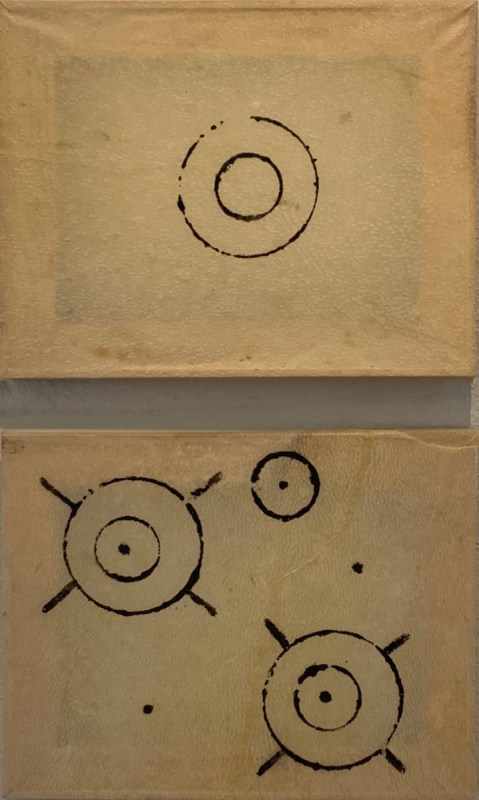
Two Russian artists, Kolmar and Melamid, decided to find out, and interviewed people in many countries about what their most wanted painting was, and what was their least wanted painting. Here’s USA’s (source via Mastroianni):

If you were to interview quilters what their most wanted quilt block was, and what their least, what would we see? We would probably see what they were seeing the most. If they saw a lot of printed panel quilts, they may be looking for their favorite panel. If you were at a modern guild, you might get something abstract or perhaps boldly colored. We tend to go with what we see, what we are used to.

The weird thing was that so many people’s “most” pictures were similar, but their “least” pictures were quite different and interesting. Mastroianni notes that “people are capable of acquiring more interesting tastes, if you give them the chance. This is the work art does for us—it stretches our desires, rather than merely satisfying them.”

And this is the work that the little bit of friction of a new project can also do.

So what to do when a quilt-a-long comes into your view and it is a Hawaiian quilt block? Or you are moved into a house that has a swimming pool and you have never been in one before?

Or you go to the beach and get out of your regular routine and you see a group of beginning surfers feel the friction in the few inches of whitewater high up on the shore?

Then instead of sitting there like a lump, you reach into your bag and carefully pull out the pinned Hawaiian block, and really get going on it. No, it’s not perfect. You probably won’t make it again. But you don’t want to read the magazines you brought, the family is all at lunch and you are guarding their stuff, so you thread your needle and get going, and by the end of the day, and after good conversations and an occasional walk on the beach, the block may have a certain coconut suntan-lotion fragrance and perhaps some sea salt spray, but it’s mostly finished.

Another deviation from my usual.

And here’s where I got my quilter roller skates on and skated right into the sameness, but this time, happily so. More info here, and how to get her free pattern. Audrey is looking for more, so make one and send it off!

Quilts

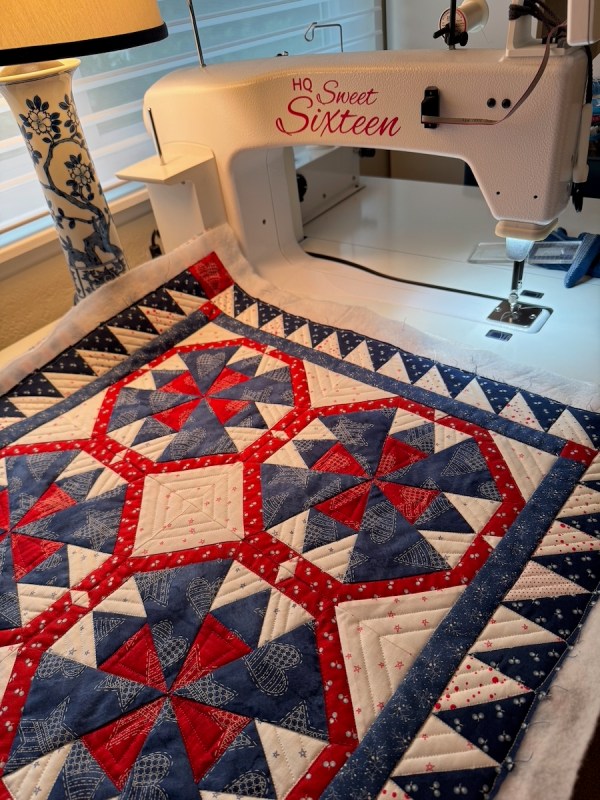
Sweet Land of Liberty, Redux • Free Pattern for Fourth!

According to Merriam-Webster Dictionary: “In English, redux describes things that have been brought back—metaphorically, that is.” So I’m bringing back this quilt from about ten years ago, as I had a request from Sue for information about this pattern.

I noodled around on here, but noticed it wasn’t really a pattern, just a loose set of instructions embedded in three different blog posts, as I made while I was recovering from shoulder surgery. I took on the challenge to get its ready, and spent the 3rd of July redrawing the pattern, typing up the instructions, figuring out the wording.

So Happy Independence Day with a free pattern, on this the day we signed the Declaration of Independence 250 years ago.

Download it now for free here, as soon it will live in my pattern shop for a small price, as it’s a PatternLite pattern. You can find it here when that happens.

Happy Fourth of July, everyone!

And when was the original?

300 and Beyond · Free Download · Free Quilt Pattern · Quilts · Red, White and Blue

The Betsy Ross Quilt • Quilt Finish for America250

It’s a big, fancy year for the United States, this 250th celebration of those men in white powdered wigs slaving through the heat of Philadelphia in 1776, trying to figure out how not to have a king, but something else. As Honest Abe Lincoln described it 87 years later, we wanted a government “of the people, by the people, for the people.” The three documents that were eventually crafted, the Declaration of Independence, the Constitution, and the Bill of Rights are known collectively as the Charters of Freedom. And so we celebrate this beginning.

We’ve done this celebrating before.

The first one I remember was in 1976, and it was the summer of the Bicentennial (200 years). This is about all I can recollect: a picnic with my toddler.

This year, the Semiquincentennial (250), that son will be celebrating the 4th with his family of five in another state, and hopefully they will remember more than a picnic.

When starting a government, or a marriage, or a school, or any great endeavor, there might be some failures. According to noted historian, Joseph J. Ellis, author of The Great Contradiction: The Tragic Side of the American Founding, there were “two unquestionably horrific tragedies the founders oversaw: the failure to end slavery, and the failure to avoid Indian removal” (Kindle, p. 8). Ellis’ book discusses these contradictions, and we are still grappling with these today. Between 1500 and 1800, while “five times as many Africans as Europeans were carried to the New World” (ibid., 13), only a small portion of that diaspora was carried to North America, making us a predominantly white nation of interlopers on the Native Americans who lived here.

Those aren’t the only mistakes we’ve made.

Thomas Jefferson declared in The Declaration of Independence: “We hold these truths to be self evident, that all men are created equal, that they are endowed by their Creator with certain inalienable Rights, that among these are Life, Liberty, and the pursuit of Happiness.” This year, we celebrate that, but I do keep wondering: are we moving towards that beautiful idea, or away from it? And with all the examinations and navel-gazing, maybe we can acknowledge that we aren’t perfect as a nation, but that we generally are pretty amazing?

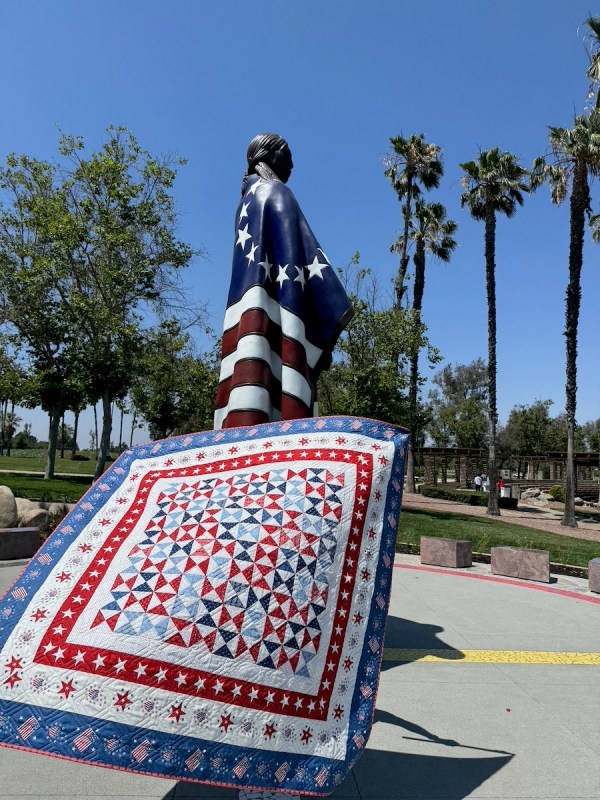
While I try to hold all these disparate thoughts in my tiny brain — for this 250th celebration, I made a quilt.

My childhood nickname was Betsy, so of course I loved this panel for the back.

This is Quilt #317 and many of the details are on the label. I actually had a different title, but this week decided I wanted to call it The Betsy Ross Quilt. So I made a new label and took off the first one:

(Photography location scout and quilt holder is my saintly husband.)

Washington Monument

So this year it will be probably a more contemplative celebration, given the tensions in our national dialogue. I like people on both sides of that dialogue, but my overriding desire is to see how we can care for each other — the people — rather than just going for power or for ruling over the populace. There’s a reason why those Founding Fathers eschewed the idea of a king, and I kind of think they knew what they were doing. The dialogue — fraught as it may be — will continue.

Samuel Adams, 250 years ago this year, was on to something:

Freedom of Thought and the Right of Private Judgment in Matters of Conscience, direct their course to this Happy Country.

While I don’t have any great answers about how we make our way to that Happy Country, I just know I want us to keep trying. As a quilter, I honor that spirit of making mistakes, recognizing them and unpicking a few stitches in the process, so I’ve put out all my red, white and blue quilts around the house to jolly things up over here. To celebrate well.

I hope you do too.

Information on some of the Quilts

• The large quilt with EPP circles is I Hear America Singing. Most of the circles patterns are free here on the website.

• Tiny Star free download of pattern (and instructions) found here: https://opquilt.com/2018/07/03/happy-fourth-of-july-2018/

• The post about Betsy’s Creation, my version of the flag quilt, talks about America (of course), with a link to free download and instructions to make the quilt.

Blog post about the star quilt (with flags in jars on top), has instructions and free download for that mini-quilt.

Monuments and Sights in Washington, D.C.

My husband once had a year-long sabbatical with the Department of State, and I got to know that beautiful city well. Here’s the George Washington Monument in November, when the late fall sunlight turns it golden, taken from the World War II Memorial.

This quote, on the side of the Supreme Court, gets at that delicate balance between just being right vs. recognizing that our liberty needs to be guarded by justice.

My favorite memorial of all was the Lincoln Memorial, especially when I could catch it at odd times, when all the tired tourists had gone home.

Below are some paintings on the ceiling of the Capitol Building (in addition to the Samuel Adams quote, above) that remind me how we stitched our country together: