300 and Beyond · Appliqué · Patterns by Elizabeth of OPQuilt

Kraków Circles

I have this line of patterns I call PatternLite. Usually they start out as just a block I’m kind of doodling around with and want to share. Then I decide I want to make it, and take a lot of photos, and work out some helps and aids and tips and tricks, and before I know it, it has blossomed into a full-fledged — or at least partly-fledged — pattern.

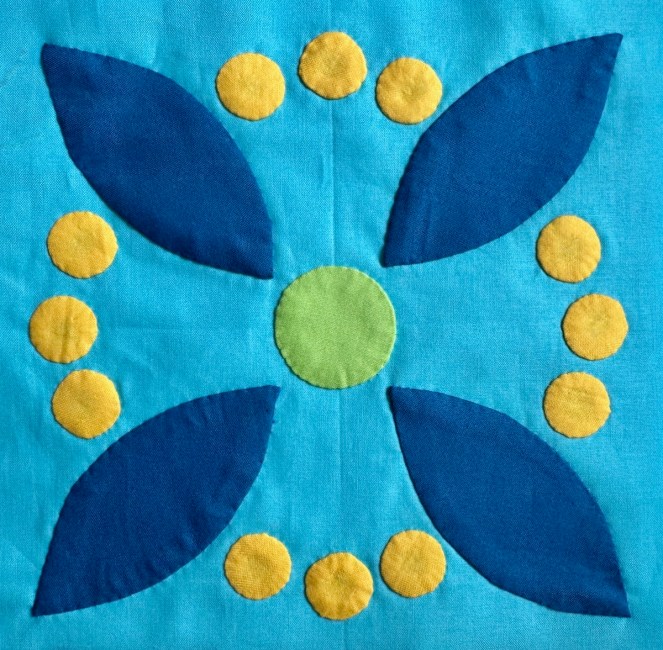
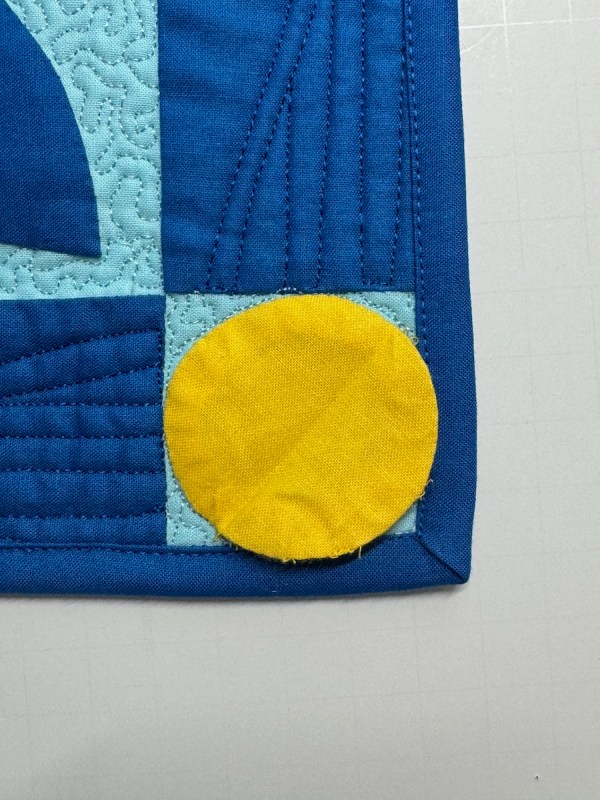
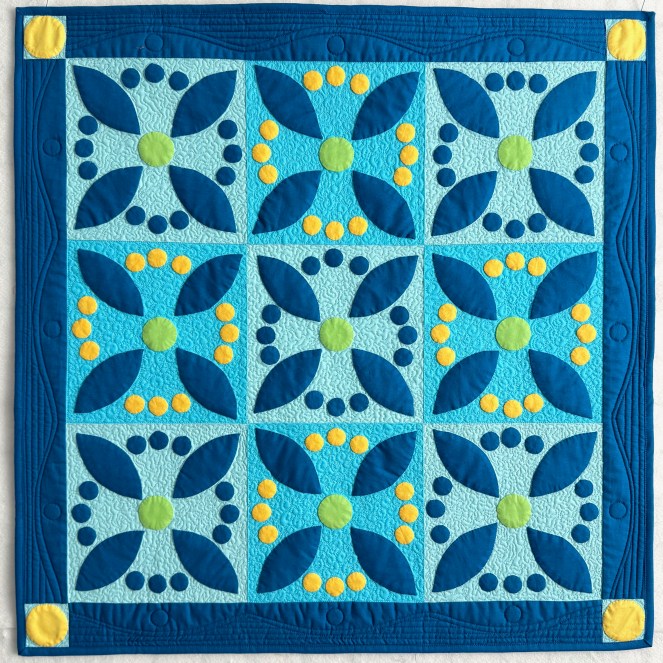
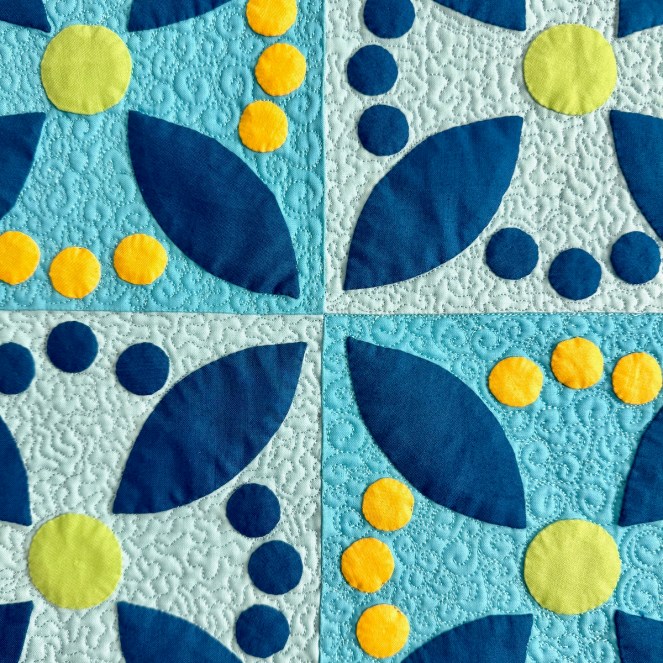
Kraków Circle started out as a free block on the post about my visit to that city, and touring all the churches. Then I thought it might be interested to try out Sharon Keightley’s circle method, since there are bunch of little circles in this design. And then I added a different view, different color way, and so on. Here’s my first stab at the little circles:

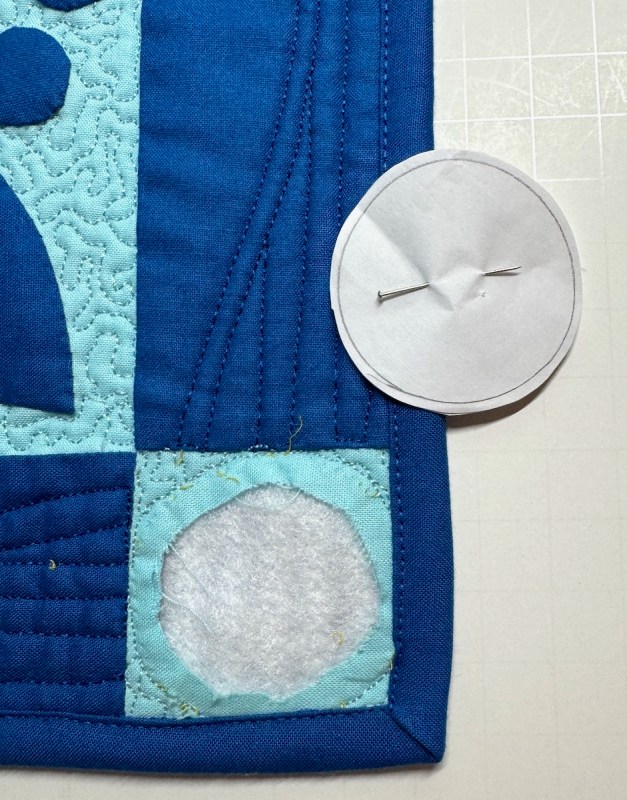
She has you use a long pin as your handle, and then using the shiny side of freezer paper, you ease up the fabric, ironing to make it stick (Iink is below) I usually do the gather-stitch around the outside, and then slip in a plastic circle and press, with some spray starch. That just did not work on these little orbs:

You can see how over-full they are. The first try with this, it took me about five minutes and the circle was a bit of a mess. But after about 7 or 8 tries, they were nice and round, so I re-did the gather-circles.

Here’s my one-minute video and I hope inserting the video works! (I’m trying something new.) I know there is a little bump on the circle’s outside, but when I appliqué that, I can ease it in with my needle.

Here’s Sharon’s version of making circles. And she also has a version for the petal shapes, too, found on her page of Appliqué Video Tutorials.

I use Painter’s Palette Solids, purchased from here. This has been my go-to color scheme for years, ever since this quilt, but I was happy to see that it also drew on the stained-glass windows from Krakòw.

I bagged the pieces for the blocks, so I wouldn’t get lost.

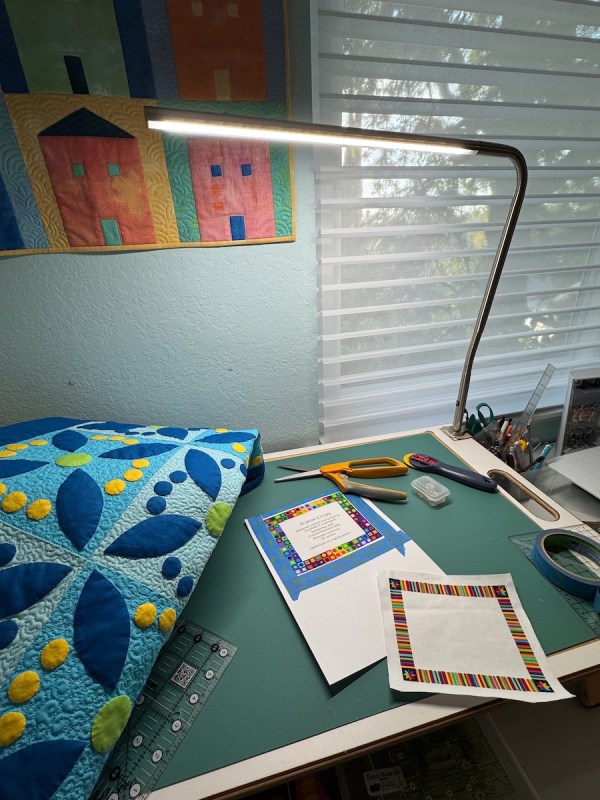
I made a placement guide for the block, which is included in the pattern. I also added a print-a-ton-of-circles-at-once page, at the end.

I printed that page onto freezer paper, the how-to shown on this post. Sometimes, I chunked the 12 circle sections together, layered them up carefully, stapled the pages together, and then cut them out.

I also folded the freezer paper into smaller pieces, layering it up, then traced on a petal. Staple the layers so they won’t shift, as shown.

In the pattern, I give the tips for tracing the placement guide, and here, I’ve slipped the block underneath, taping it into place. (The placement guide is pinned to a board, but you could also tape it to a workspace.)

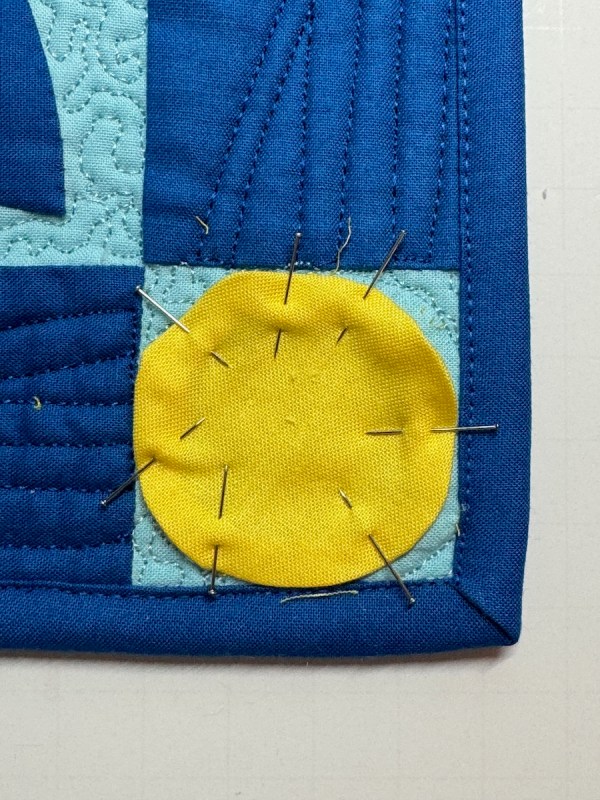
One all pinned into place, and another ready to come off the pinboard.

I was listening to a book, so I can’t tell you how long it took me to appliquè these all in place (maybe 90 minutes?) but it didn’t feel tedious, as the circles had been prepared.

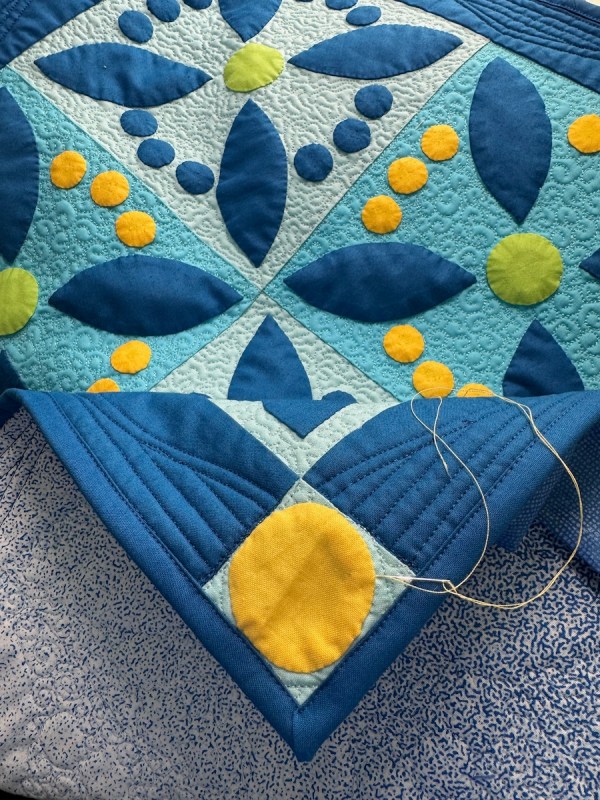
I flipped over the block when I was finished, and cut out a small circle from the back — and slipped the paper out. Sharon Keightley suggests that cutting it out in a circle (instead of just cutting a slash) will keep the quilt back more intact.

I slipped out the freezer paper from the larger pieces as I appliquéd them.

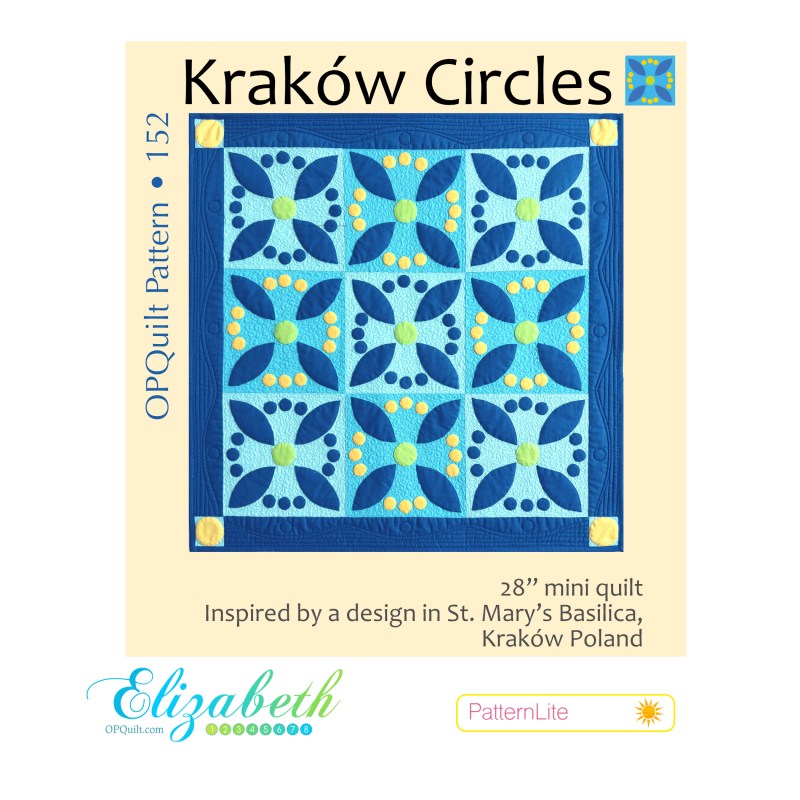
Here’s the thumbnail of the pattern: it grew from 3 pages to nine. However, I’ve still priced it as a PatternLite — less than a slice of pizza, a pot of basil from Trader Joe’s (ask me how I know), or a Kouign Amann pastry from a bakery in Kraków.

If you like to make circles, here you go–

Pattern can be purchased in my PayHip Pattern Shop. If you have the introductory version, this one may be more helpful.

Other related posts:

Quilting and the Churches of Kraków

When You Can’t Create You Can Work

300 and Beyond · Quilt-A-Long · Quilts

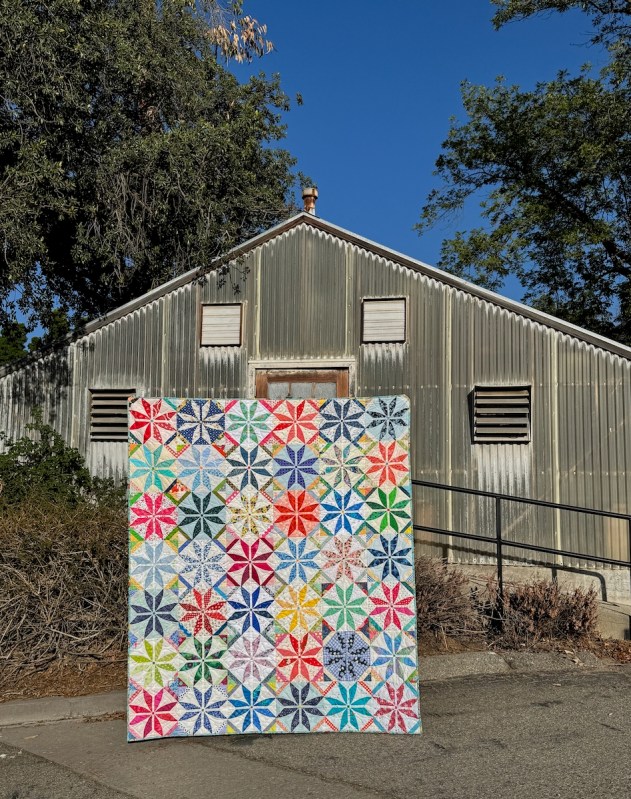
Flying Through Rainbows

In a series of interviews with new poets, they each expressed their confusion, discussed their work ethic, and acknowledged the daily drudgery — and joy — of being able to create and work. (See some quotes, below.) Do I wish I’d saved the source information for my series of quotes from these young poets at the beginning of their career? Yes, but knowing the internet, it is probably gone. I copied and pasted them into my digital calendar, and they pop up like clockwork every January. Fitting. We all begin creating at the beginning.

We seem to go full-steam in January, the new year giving us a fresh start. But lately, on Bluesky and Instagram, I am hearing often how the well some quilters usually dip into has run dry, that their “sewjo” or “mojo” is just not there. Is it because we are tired of winter? Or that we have early spring fever? Or just that creativity runs in spurts, and we have to step away every once in a while and get back to “real life” with its rainbows, as well as its tornadoes and sudden squalls?

In a slightly related idea, my husband’s father hung crystals in his window so they could flash rainbows around in random ways when the sun came shining through. Today, as my hands fly over the keyboard, typing this post, rainbows are dancing on my fingers, courtesy of two crystals hanging in our window right now from my husband.

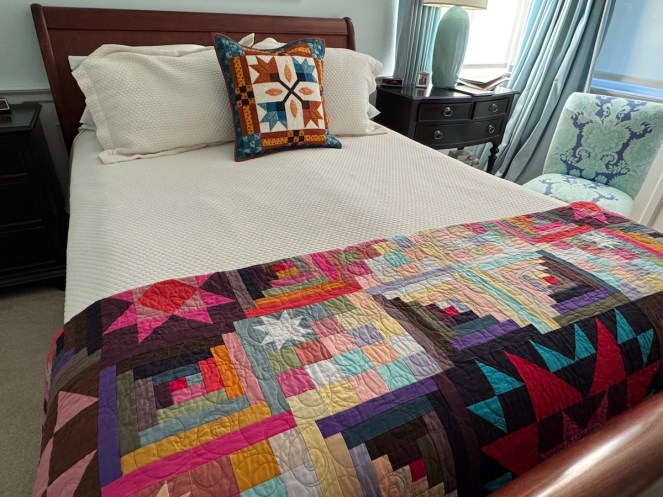
Carol and I made a pact to apply our rotary cutters to fabric and our noses to the grindstone and Make This Quilt: Posh Penelope by Sew Kind of Wonderful. While I usually like to be sewing my own designs, this year, this level of drama, this level of chaos has sent me to “let go of the pressure to be innovative,” as Jane Freilicher puts it (qtd. in Emily Skillings, below). We committed to making four blocks per month.

But even in creating between someone else’s lines, there is room for fabric choice, pawing through the stash or scraps — for as Carol noted this week, all our fabrics are soon going to cost a bazillion dollars — and this month, I went for blues. I thought the blues might calm down the riot of colors I had going on, with their steady approach. After all blue is the color overhead in our sky and of the water that surrounds us and we’ve been crazy for blue way before Yves Klein first mixed up a batch of his trademark Klein Blue. Klein noted that:

“Blue has no dimensions. It is beyond the dimensions of which other colors partake.” Fascinated by … it, [he made] …roughly 300 monochrome paintings in his signature International Klein Blue” (qtd. in article linked above).

(These blues read a bit more red-blue, or purple.)

All of these notes are to say, take a look at these young poets’ advice on if you get “quilter’s block,” or “writer’s block” and just give it time. Take a break to breathe in some of the blue overhead, or swim in the watery blue. Or catch a rainbow on your keyboard, courtesy of a defracting hung crystal.

Block by block, I’m making a quilt. I’m up to 23, and the goal is 42.

Advice if you are going to make this pattern: Do more than one block at a time. Do…like four. It’s easy, but complicated, and better if you don’t have to remember all the bits every time. And I say, make the “petal blocks” but before you sew it all up with the sashing, choose your itty-bitty center then, when you can see if it needs a pop, or if it’s okay to just have a fabric from one of the petals. Or do as Carol is, using a single fabric in all the centers. Hers is a black and white linear pattern, and it looks great.

Now I’ll put these all away in their box until next month, along with a a few scraps and bits and bobs, and it will wait for me until next time. After all, as Fatimah Asgha notes, “you’re on no one else’s timeline.”

One Last Thing

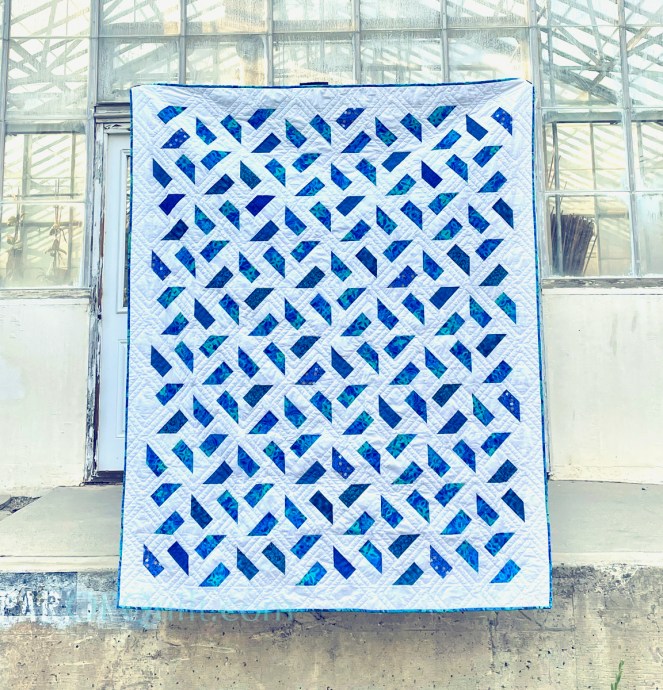
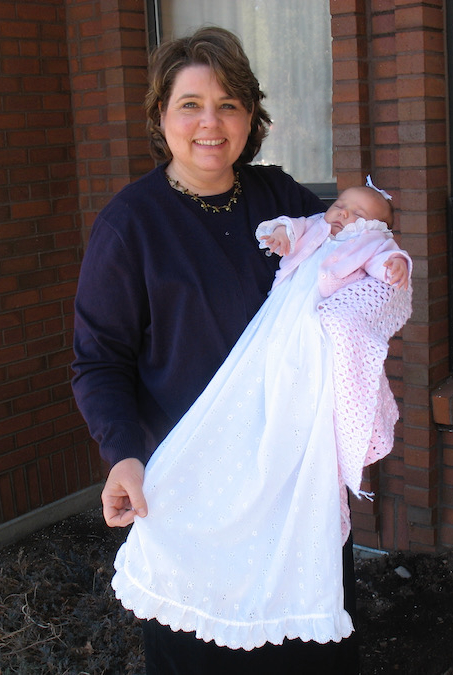
A friend had a new baby boy and I made them a quilt.

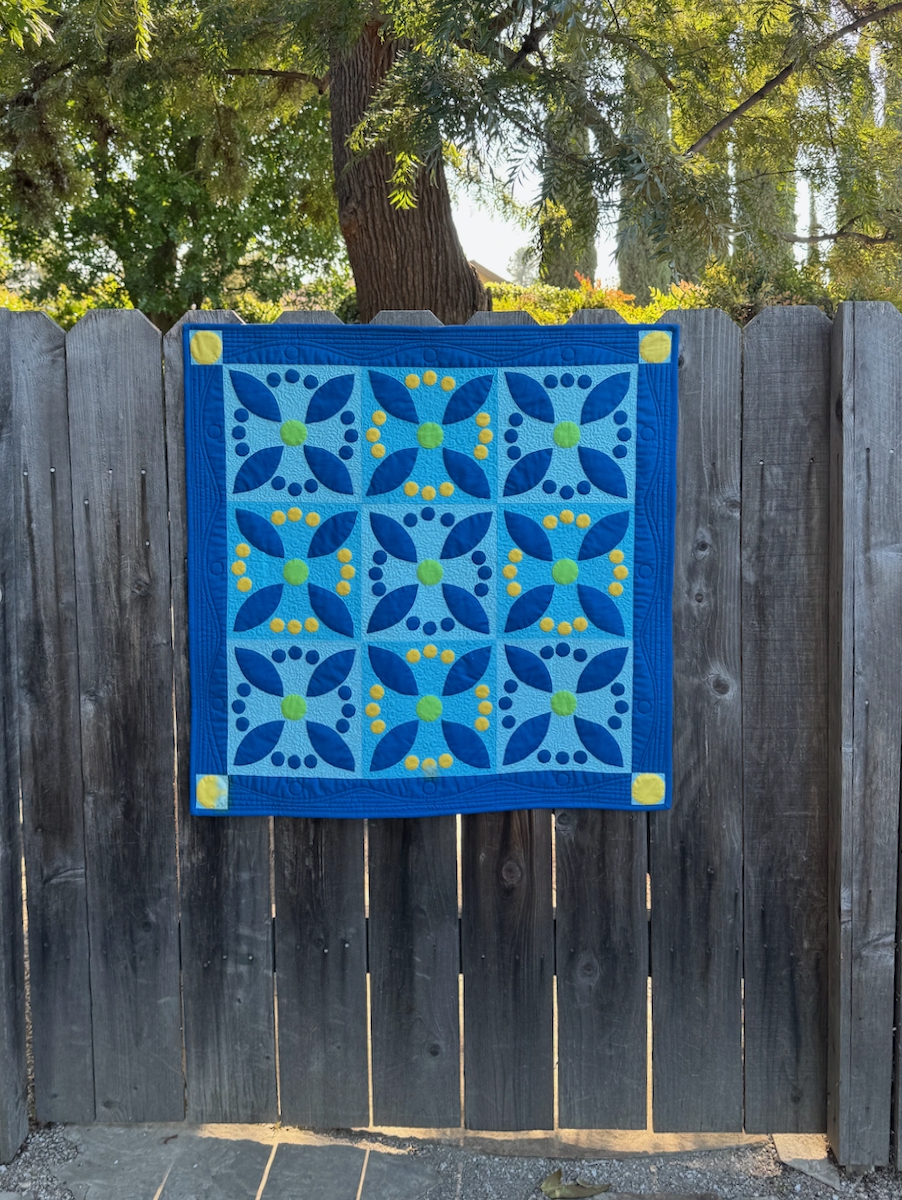
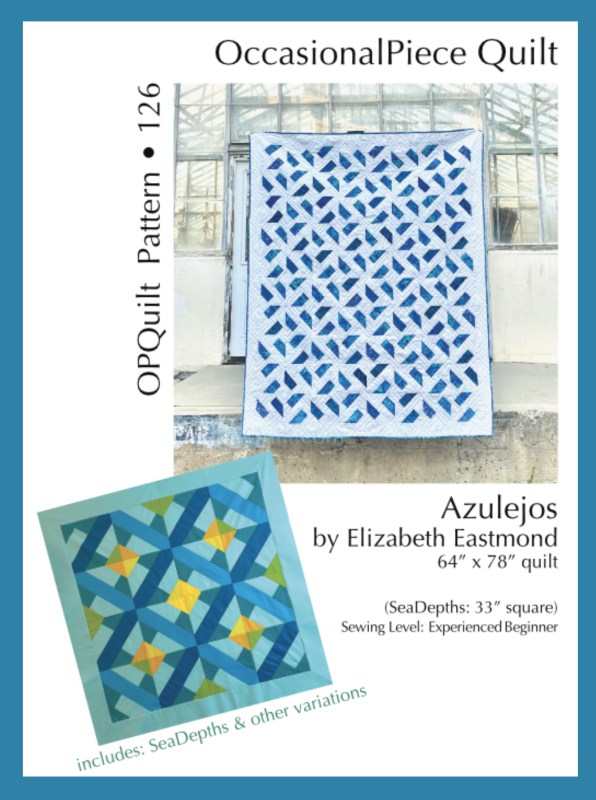
Pattern is Azulejos, from my pattern shop on PayHip. I just used fewer blocks to make it baby-sized. (And she gave permission for the photo.)

Emily Skillings–
One question I am still grappling with is how to negotiate a balance between “innovation,” constraint, and intuition. The painter Jane Freilicher put it best, I think, when she said, “To strain after innovation, to worry about being on ‘the cutting edge’ (a phrase I hate), reflects a concern for a place in history or one’s career rather than the authenticity of one’s painting.” There’s also, I think, a quieter quote somewhere about her letting go of the pressure to be innovative, and that she felt she could really paint after that, but I can’t seem to find it anywhere.
This sounds a little strange, but I like to think of my life so far as a writer as a kind of oscillation between states of openness and movement and states of stillness and solitude. There are islands of production, productivity, and then pockets of…nothing. I think I am grateful to my depression in this way, in that it often forces me to be still.

Phillip B. Williams–
Writer’s Block Remedy: I go for months without writing and then write nonstop for about a month or so. An impasse for me is a sign that I simply have nothing to say, and that is fine. I had to learn that it was fine not to write. As far as what keeps me going, I’m still not sure. Something just clicks on and stays on until it runs its course.

Mario Chard–
Writer’s block remedy: The impasse is never with the writing itself; it is with the reasons to keep going.

Fatimah Asghar–
Writer’s block remedy: I take a break. I think that if you bang your head against the wall trying to create, you’re going to resent the process of creation. Usually when you reach an impasse it’s a signal to move on to another thing. Maybe you haven’t slept in a while. Maybe you need some time to ponder, to just stare at the wall. Maybe you need to live, truly be alive for a little and not near a computer [or sewing machine]. Maybe you need to read, see, watch—to refill your well.

Advice: I’d say you’re on no one else’s timeline.

Solmaz Sharif–
Writer’s Block Remedy: If the causes are perfectionistic, I pull out the collected poems of a poet I greatly admire and flip through to remind myself how many mediocre poems their oeuvre contains. It is my duty, I remind myself, to write even those mediocre, messy poems. These failures are the ones that create openings in the conversation for subsequent writers and poets to enter—I’m not trying to kill the conversation, after all. I pull out journals—André Gide’s, Franz Kafka’s, Susan Sontag’s—to remind myself how long the process is and how often the sense of failure or impasse hits. I watch a movie. Advice: Write a book you want to fight for. Fight for it.
I don’t have answers about “how to be an artist”; I’m not trying to make it sound like I do. But I do want to have that conversation. What do you want to do as a writer in the world? What do you see the arc of your writing life to be?

My corollary: Make the quilt you want to fight for. Fight for it. Acknowledge the arc of your quilting life.

300 and Beyond · First Monday Sew-day · Quilt-A-Long · Quilts

A Life Full of Yes

Candy Clark, who has just published a book of Polaroid photographs of her younger life with the Hollywood stars of her era noted in a recent article that looking backward to this time wasn’t “necessarily a bad thing. I found out who I was putting this book together,” she said. “It’s a life full of a lot of yes.”

And then I saw this. Here.

And I said yes.

And with that, I met a whole other world of quilters, who do hand-sewing, EPP, have repro in their stash, spend a year to make 900+ wee little blocks, and think nothing of it. They say yes on an enormous scale.

Thank you Taryn, for introducing me to another leg of the three-legged quilting stool: traditional, modern, and art. I don’t know quite where I fit into that schematic, and it’s not like I’ve not known about traditional, but really…I haven’t known about this.

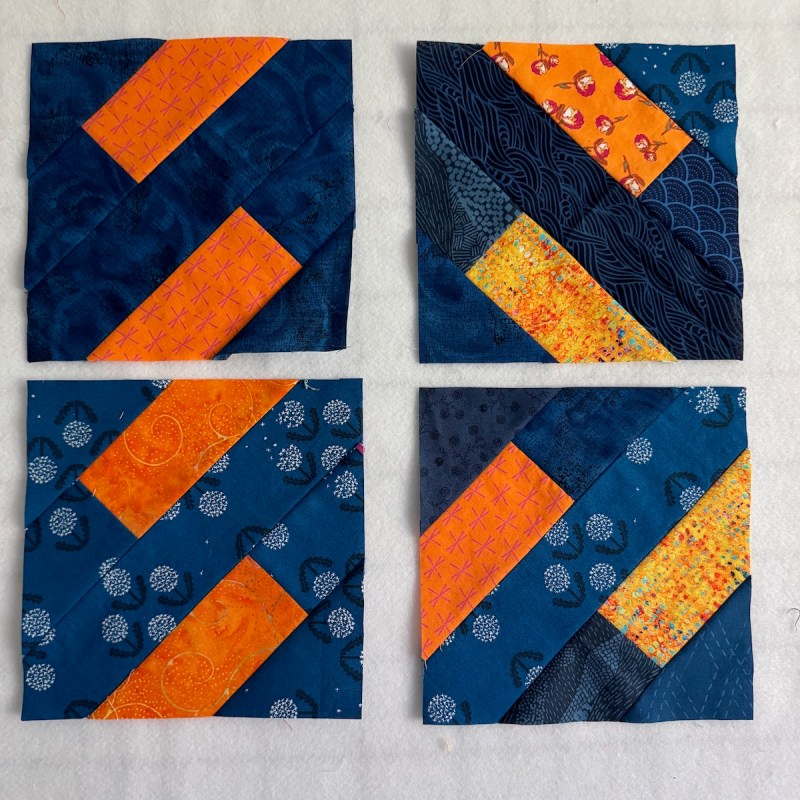
Gladi’s blocks drew me in (1); Anna has used EPP for her blocks (2); Susan hand-pieces hers and they travel with her, and writes the location where the block was sewn. I’ve been looking for a travel project, and so this intrigues me. I might say yes to this.

My tiny start (click arrows to advance the slides):

Initially, I’m trying it out with freezer paper, but I might use all methods of construction. I like the idea of carrying it around for a bit, but I also like sitting at the machine and sewing, too. Here’s the little video I put up this week showing my enthusiasm. Whether it be for this new project, or an enthusiasm for avoiding all the tasks I had on my To-Do List that day, I don’t know.

Before the pandemic hit, we had a little beginner’s sewing group going (called First Monday Sew-day — more beginner lessons are found at the link). I did samples of all every size of the Square-in-a-Square blocks in yellow and blue then sewed them up into a table runner ( so this is not my first Thrift/Economy Block rodeo). Here is the free downloadable 2-page handout we gave out to help the group learn to sew these blocks, with lots of sizes:

illustration of the front page

And below is the free downloadable Economy Blocks handout to go along with this version of Taryn’s wonderful gathering of happy quilters. The first page has some tips and tricks for freezer paper piecing, if you haven’t tried it before:

NOTE: This does not in any way replace Taryn’s handout, nor include you in the group of quilters she has gathered (use the Instagram links above). The pages with all the blocks, however, may also prove useful if you are using paper-piecing, as you can print off more blocks at once. I put it up here in case you might find what I worked up helpful in any way. As always, I include my request: Please do not print off millions for friends, but instead, send them here to download their own copies. Thank you.
I figure if I decided to do EPP, I can print out the page of blocks onto heavier paper, and use that. For the record, I’m making 3″ blocks, as the smaller size is just too much for my tiny brain to process right now.
Lastly, I had fun watching this video of Karen, from Just Get It Done Quilts make these blocks in three different ways. She’s amazing! And please note my tip for keeping the freezer paper on the block in my Economy Blocks handout (above).

I know this is being published a bit earlier than usual, but I’m heading out to see these cuties, now mostly all-grown. See you when I return!

300 and Beyond · Family Quilts · Quilt Finish · Quilts

Two Quilt Finishes • March 2025

What is this mess? My exploded Orphan Quilt Box. I’ve been putting things in here for nearly two decades (the little airplane blocks are for my grandson’s baby quilt, and he just went off to college), and it was time to excavate and see what to toss and what to keep.

I pretty much threw out all blocks with red fabric. I love reds, but that color of fabric went through a hard time for a while, bleeding every time it was used. I started to test the blocks one-by-one, but then just tossed them all. What’s that old song say? Know when to hold ’em and know when to throw ’em away. Yep.

I found several blocks that were orphans of a different quilt. Baby Hurren is getting a little sibling, and we don’t know yet whether it’s a boy or a girl, so I tried to make a jolly quilt that could go either way for his mother. (I need to change out the February quilt behind it.) Here’s a wee pattern for it on my pattern shop–for a tiny price!

A simple outlining of the blocks did the trick. It was a fun project to sew while we feel like we are watching our world collapse. (Baby Hurren’s mom is Canadian, and I feel like I need to apologize all the time.) The last time I felt this chaotic was when I had three teenagers living at home.

Now to switch gears: when we stayed in my daughter’s home last time, in our room were these cute cactus pots. In fact there were several of them. So yes, that cactus quilt you’ve seen being made is to hang out in this room, which has huge shelves on one side, filled with pillows and blankets and quilts, as the teen uses the room to watch movies with her friends, and to hang out (it also has a small kitchenette, complete with microwave and fridge — Teen Haven!). I thought this next quilt could join them all:

She’s received it now, so I can post about it.

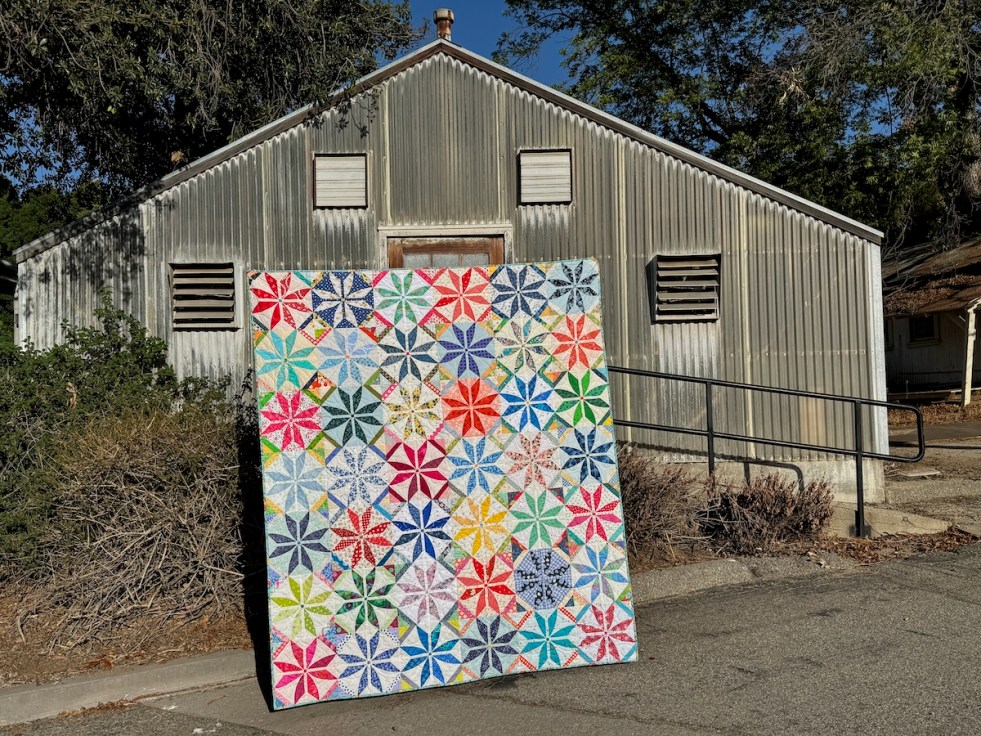
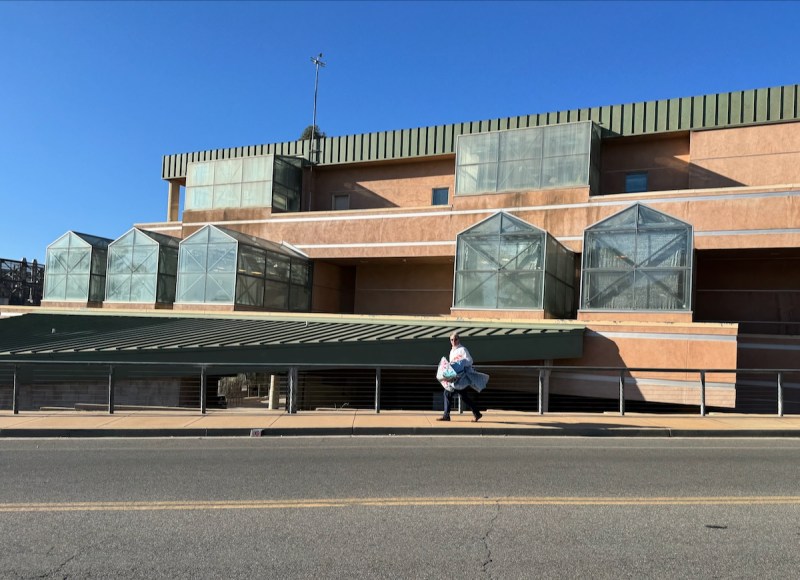
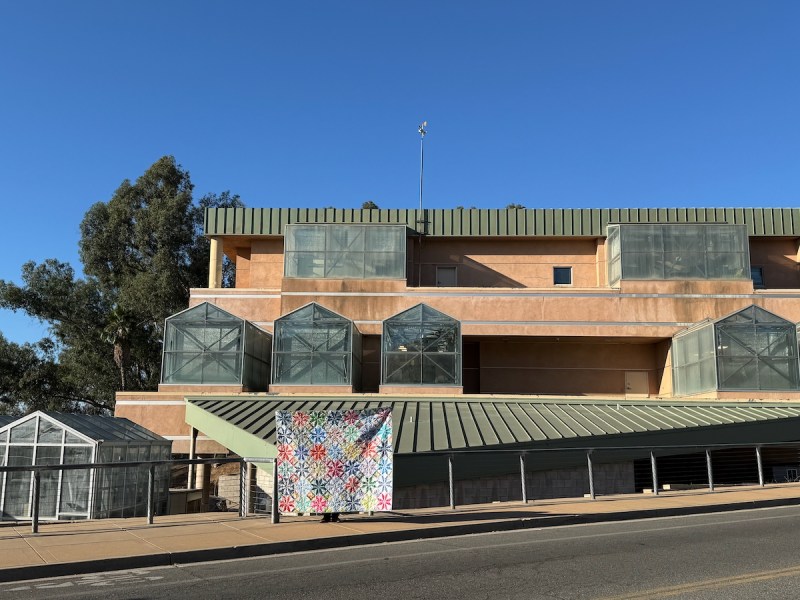
We took Kingman Cacti out to a neighboring street where the cacti were in wild profusion.

It was a dance…close enough to get the quilt with the cactus forest, yet far enough so as not to get stuck. And to get a photo with an almost-in-bloom yellow cactus flower (in the upper left).

Thanks, always, to my Quilt-Holding Husband, Dave. He suggested the location and it was perfect.

I tried a new-to-me edge-to-edge pattern: Edgy from Intelligent Quilter. I like how it almost looks sharp-edged and then it doesn’t. I make a diagram so my quilter knows my preference on size:

I have two or three long-armers I’ve used over time, and Nancy is new; we are still getting used to each other’s vibe. She really rocked this one — I’m so happy how it turned out.

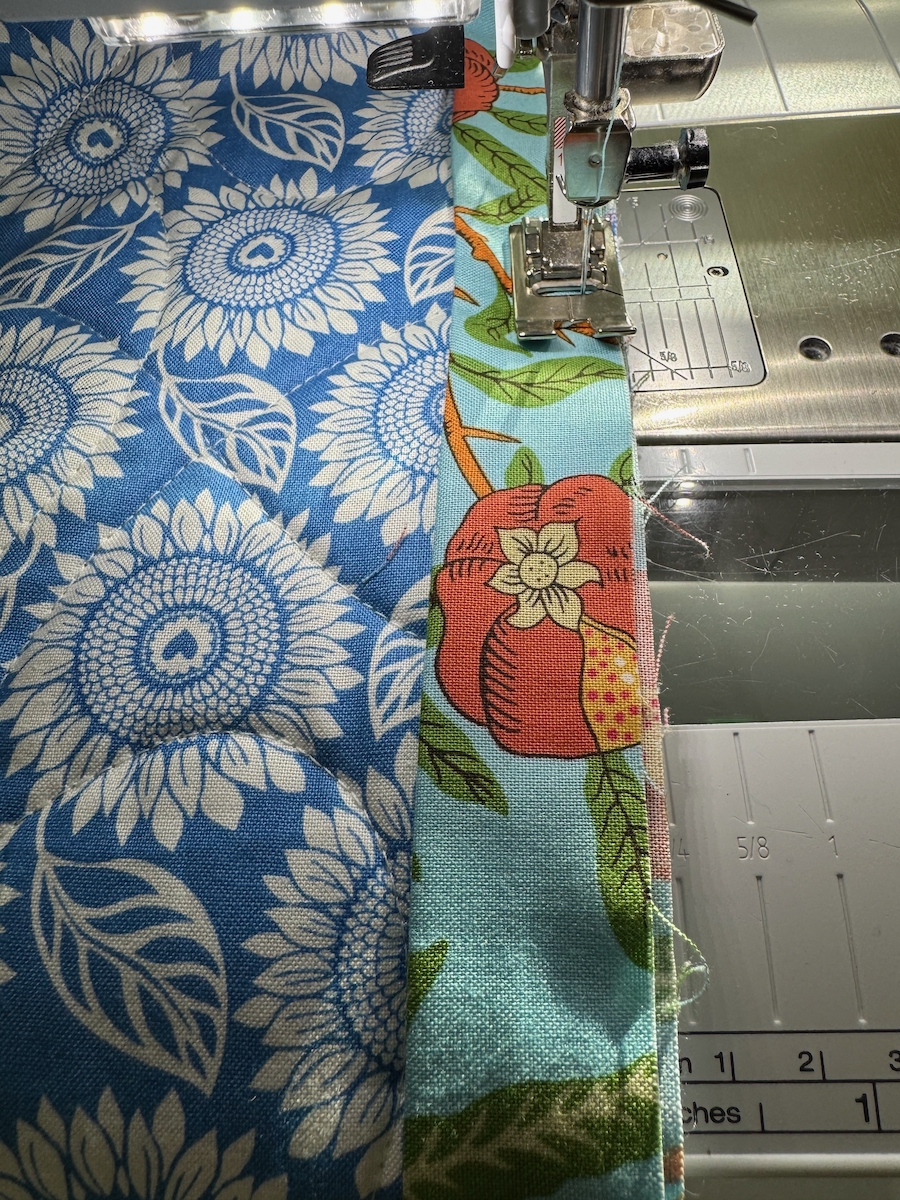
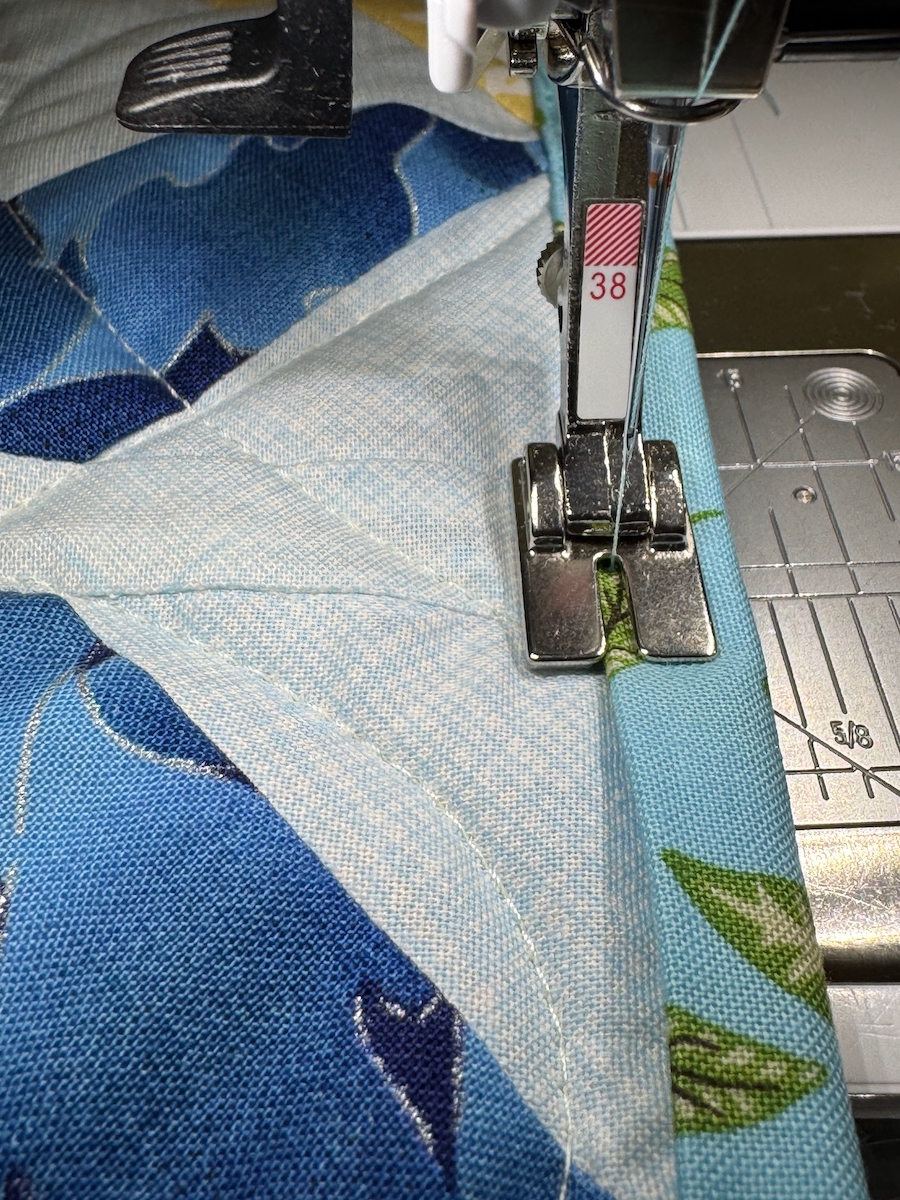
My friend Lisa is teaching me how to do binding by machine (shown here being attached to the back). I’ve started using it on quilts I think will get a lot of abuse/use as I’m hoping it will make them nice and sturdy. I think I’m getting the hang of it.

The cactus quilt in process–so many tiny pieces! And the quilt “packages” all wrapped up in selvages, with the edges to go at the top all marked with a removable and reusable tag. Yes, that’s my selvage quilt on the left, and the next post will feature that one, and that’s all I’ll say about that. Baby Hurren is Quilt #303 and Kingman Cacti is Quilt #304. I’m not trying to hit a goal or anything. Writing them down on my Quilt Index is more about keeping track.

And since this will publish the weekend of March 9th, Happy Daylight Savings Time Day, haha. I’m a morning person, and the thought of being dragged back to dark mornings is not a fun one. The sun will do what it does, and I’ll get up when I want — the blessings of not having to awaken to an alarm.

A reminder: turn your clocks forward on Saturday when you go to bed–

More posts on the Kingman Cacti quilt:

Incomplete

Back of the binding

Front of the binding