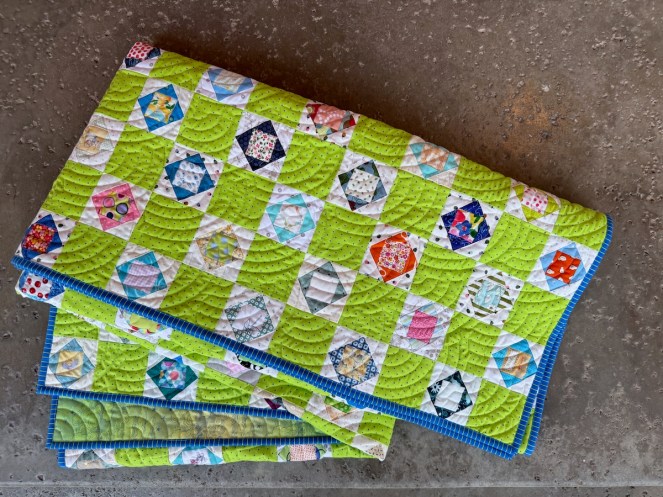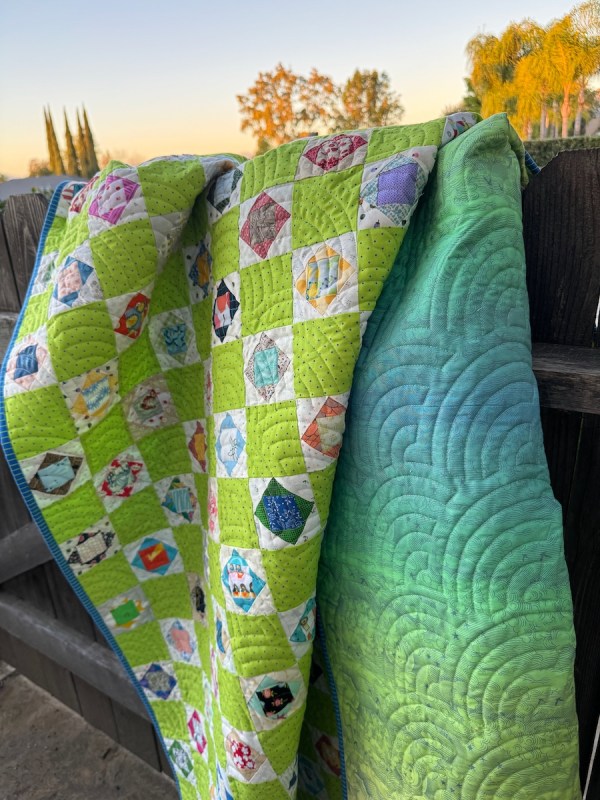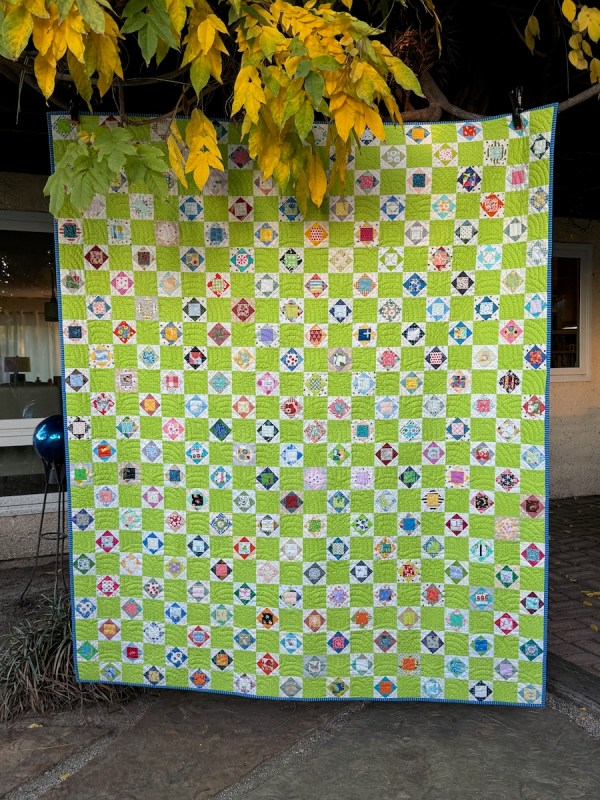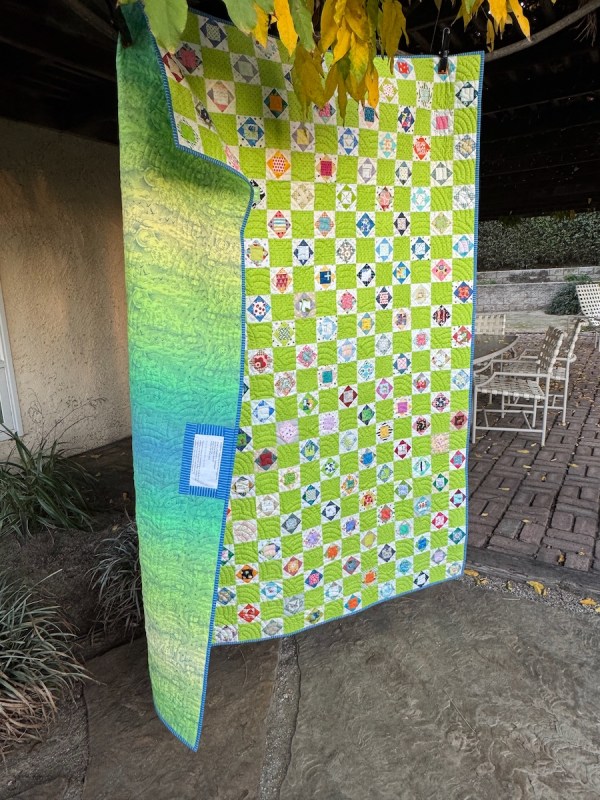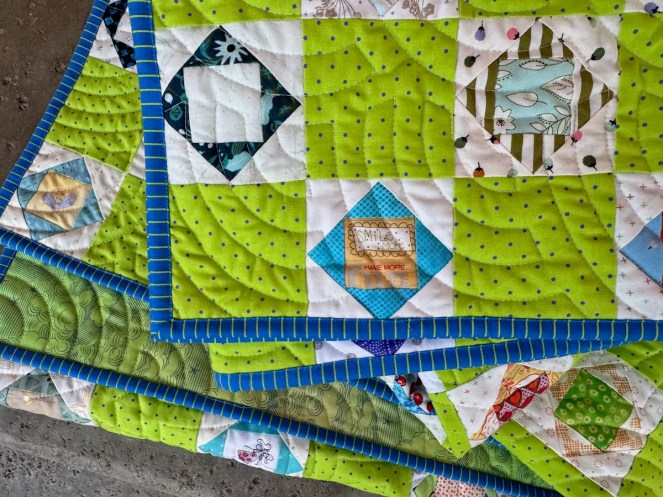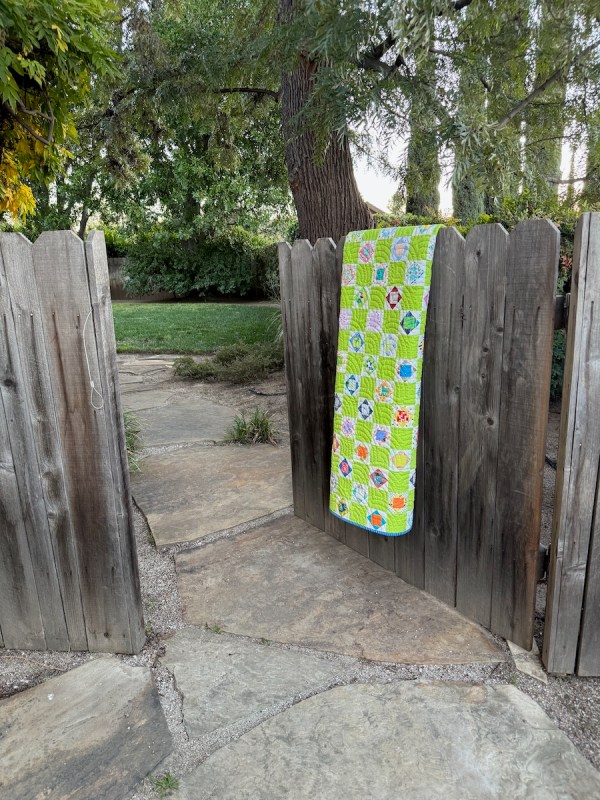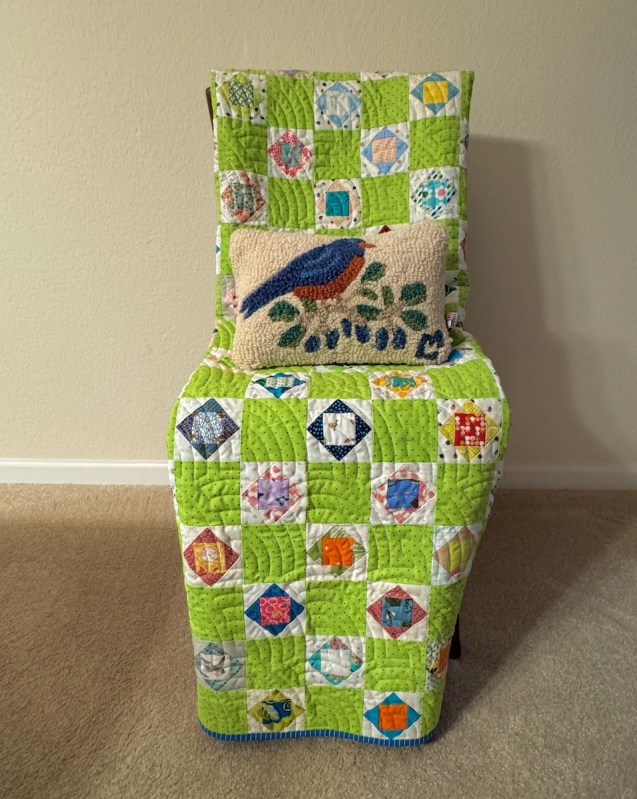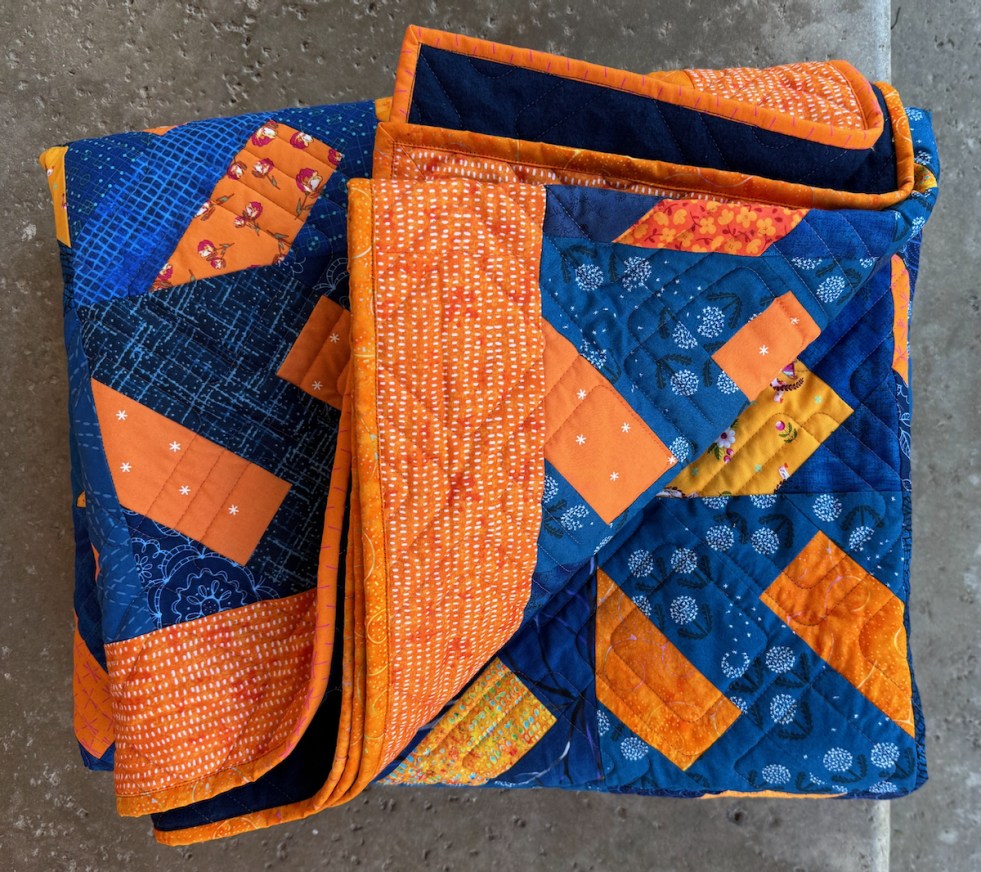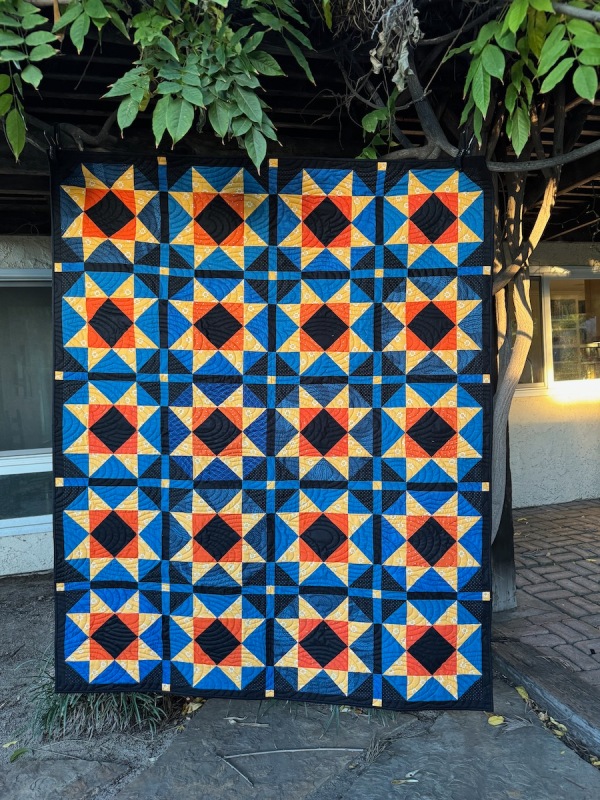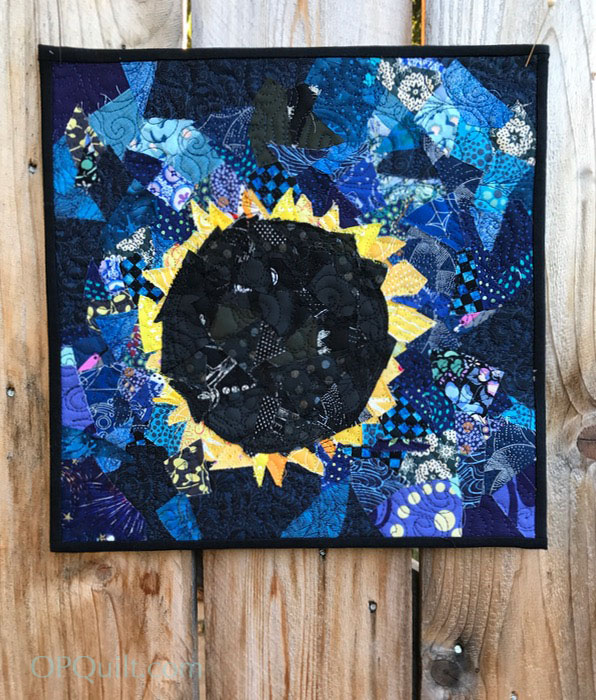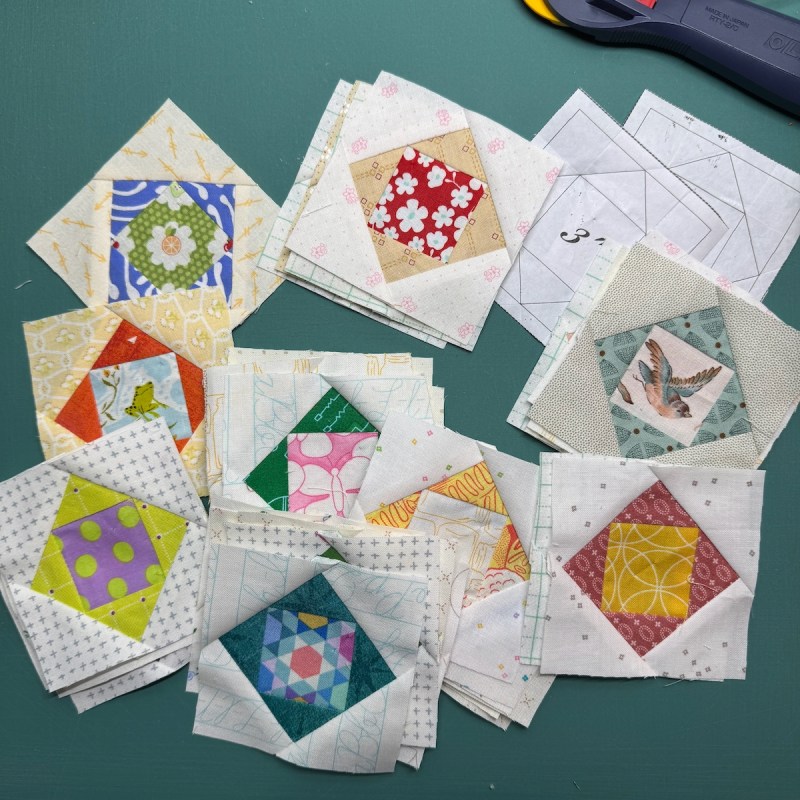
This is Posh Penelope’s birthday: I’m thinking somewhere around the 19th of January in the Time of the Masks, aka, 2022. We slid Road to California under the 2020 wire, then it was cancelled/online/whatever in 2021, and in 2022, we all showed up in our masks, terrified of anyone coughing. But we’d had two vaccines by this point, and so our confidence was high.
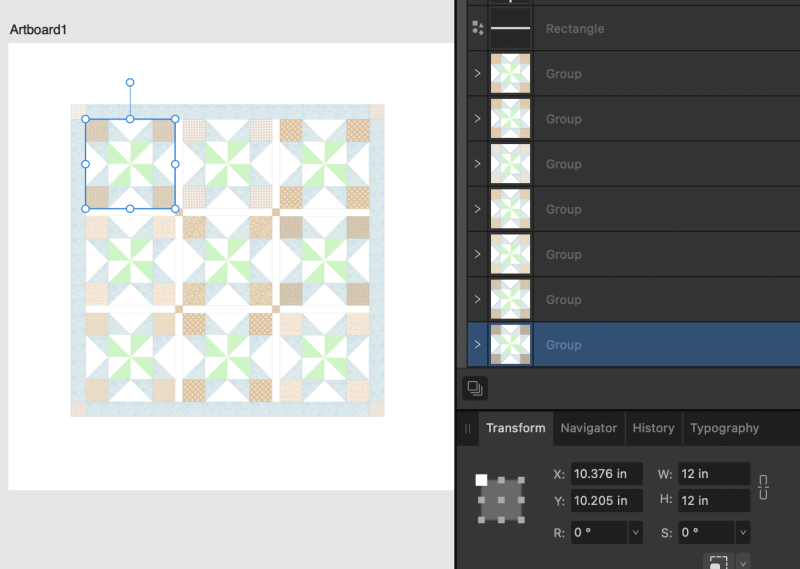
Here’s that block now.
Stained glass version.
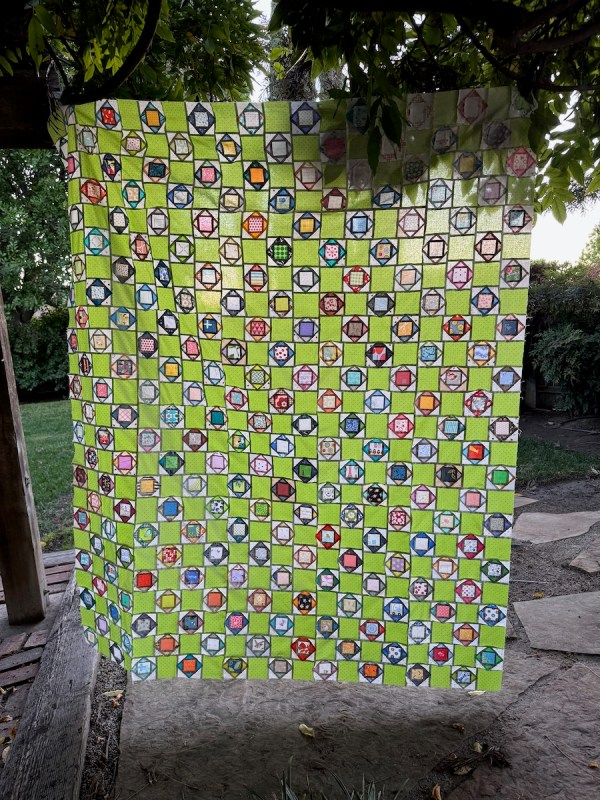
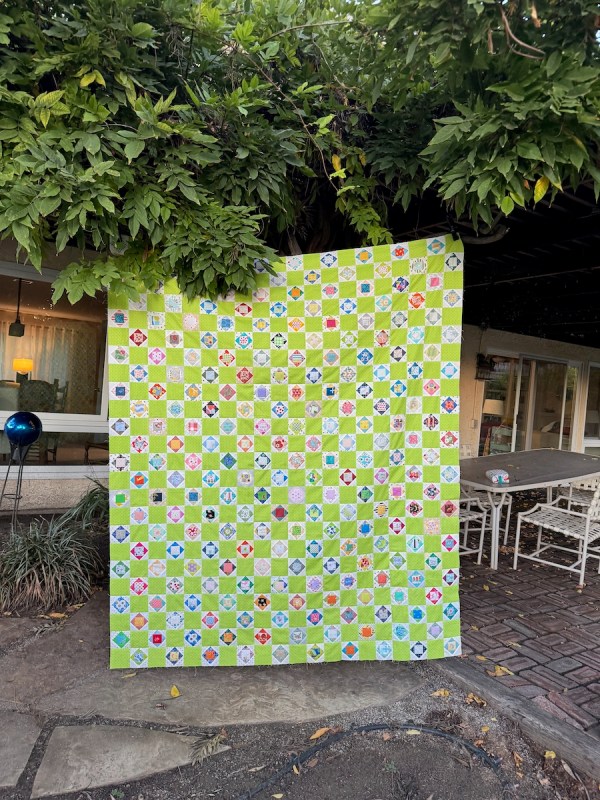
I finished piecing the top August 11th at 8 p.m. in the evening. No masks. Just me and my DH, who was downstairs watching some shows, but I felt like staying upstairs and pushing through to the end.
Some seams matched up very nicely. And some did not, but I’m not reworking it.
I went hunting today for ideas on:
a) Do I want borders?
b) Do I want to send this out to be quilted?
c) Can I tackle this FMQ by myself, since I have the rulers?
d) How long do I want this quilt hanging around unfinished?
I found this anonymous block and my heart went out to this quilter. This can be very tough to piece together.
Answers: a) not particularly; a bound edge is just fine b) most likely c) Yes, but then you-know-what will freeze over before I finish d) Kind of want to get this one wrapped up, yes, I do.
This is what it looked like on the morning of August 12th, up on the pinwall in my sewing room. My Polish floral headband is hanging up over another relic of the Covid-era.
And since I finished the top in August and this thing needs a new name, going forward it will be called Summer Flowers. And here’s a little doggerel for you, from M. M. Ballou (aka Maturin Murray Ballou):
Sweet letters of the angel tongue, I’ve loved ye long and well, And never have failed in your fragrance sweet To find some secret spell,– A charm that has bound me with witching power, For mine is the old belief, That midst your sweets and midst your bloom, There’s a soul in every leaf!
Other Posts about this Quilt: (Given how many there are, it’s really time to get this one finished!)
Maybe. Maybe Victor Vasarely got there first in the art world, but I’m guessing the origin of circles on squares, or even squircles on squares, may have come from all the mending the first woman did on her children’s clothes. Just a hunch. I really have no way of knowing this, but when my friend Dot mentioned the artist Vasarely as being reminiscent of our #backtosquircles project, I believe she was on to something. Have fun looking at his art.
My Tips and Tricks
Caveat: If you would rather fold laundry or scrub out the bathroom than do hand appliqué, I have a post on how to do nearly invisible appliqué on machine, using monofilament thread. It’s quick! It’s easy!
Back to the method I used *this time.* (I might change it next time.)
To cut out the shape: I would often iron on my freezer paper version of the pattern (I just printed it directly from the pattern). Other times I would just use a pin. Always I used my rotary cutter to slice around the fabric, and usually I was working with four layers of one polkadot fabric. (I learned in this project how many many many polkadot fabrics I have.)
In my past appliqué lives I have always cut out a bunch of the shapes out of freezer paper and pressed the fabric onto that. I would place shiny side up, and nudge the edges onto the shiny stuff and they would generally stick. When it was cool, I would take the pattern out and use it again.
This time I tried Old School Methods: spray some spray starch into the lid, and using a small brush, stroke it around.
Like this.
You can just see where it’s damp from the starch. Don’t use too much. I always lay down a piece of cloth on my ironing board to catch the dribbles.
Place a template (here I used mylar and punched holes in it — more on that later), pressing the corners and sides up over the template. The starch should dry and hold it in place. Let it cool, then remove the template. Duh.
I finger press some marks at the centers.
Then I arrange the cooled, pressed squircle by eye and pin it down. Sorry if this is repetitive for you experts — feel free to leave a comment if you have more tips; this is always helpful!
Sometimes you’ll get a little bump out. That just means underneath the seam allowance has its knickers in a twist. As you stitch along to this spot, with your needle, sweep the seam allowance away from the bump (in the directions of the arrows) and it should ease up and smooth out.
Sometimes I just put four pins.
Other times that squircle isn’t going anywhere.
I use the Thread Conditioner from Riley Acres, and I like the Super Bobs Bright Thread Collection. Rachel uses her own bees’ beeswax to make the conditioner, and I like how it feels, and it never gets hard.
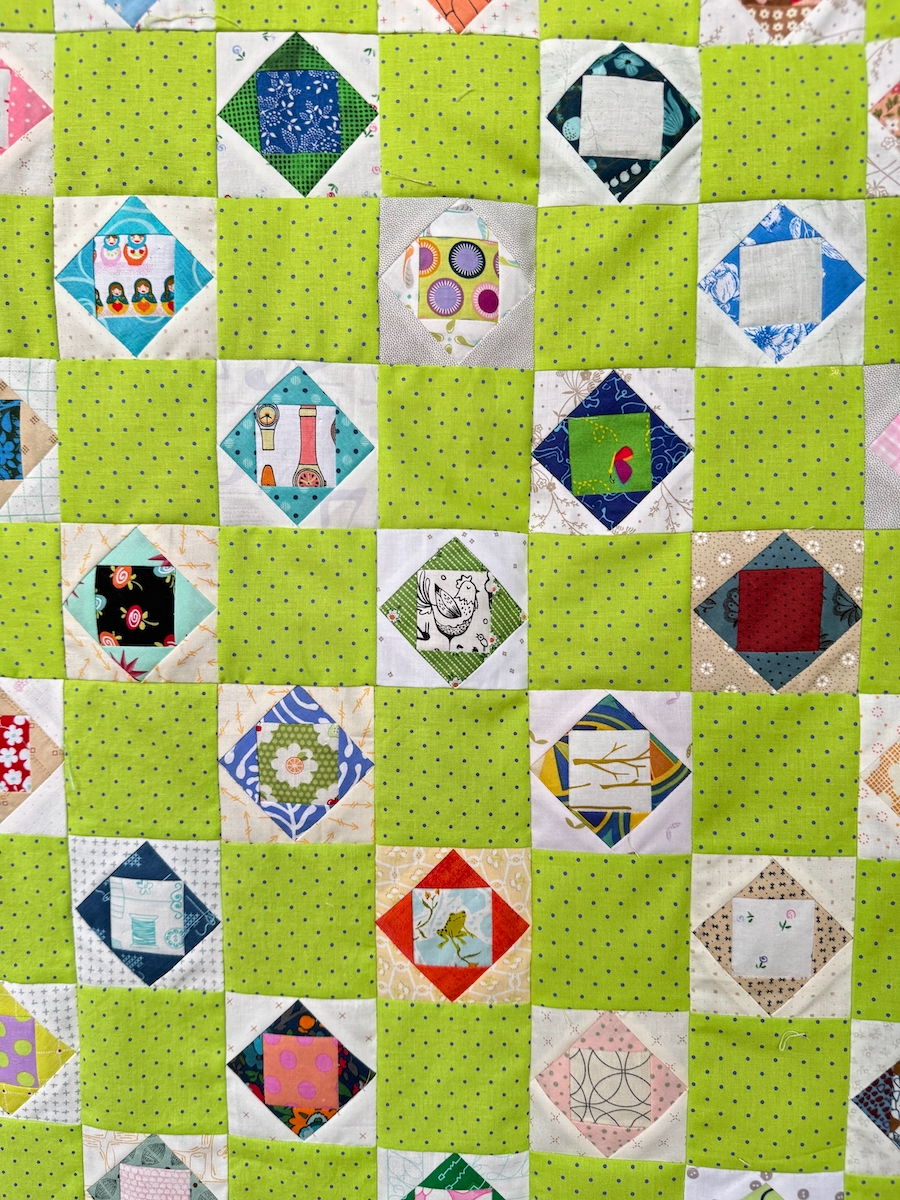
I’ve sort of started evaluating my polkadots for this project. The ones on the left are rejects. The ones in the middle I was thinking about, but in the end, I only used the ones on the right: regularish-shaped dots, with not too much else going on.
Twenty-two done. I’m ahead of schedule, happily.
I made you a chart to keep track of our squircles. I added it to the pattern, and tweaked the pattern a bit, if you want to download it again:
The mylar sheets can be found on the Great Store in the Sky, and I just slipped the pattern underneath and traced it off with a fine Sharpie marker. The Mylar cut easily with scissors. I punch holes in my Mylar so the steam doesn’t build up and warp the template. Although with the starch, I didn’t use steam this go round.
This little project will sink into the background for a while, so I promise, no more squircles posts for a while. But the pattern (free!) and the tips and tricks will stay here on the website for your use.
keyword search term on this site: squircles hashtag on Instagram: #backtosquircles
You knew this was coming, right? After you saw that last post about squircles, I’ll bet you knew I’d go hunting and fall down a rabbit hole. You are very perceptive.
This is a squircle grapefruit from designer Tai Tan. I found it on Dribble, which is also a website I didn’t know about before.
A squircle is not a rounded square, apparently. There is some design technique that can explain it, and it has to do with the flat edges. In a rounded square there are flat edges. In a squircle, they may LOOK flat, but they are every-so-slightly rounded (from here). John Uttley also has a nice grid of squircles to admire, and here’s more to see if you want.
Lisa, my quilty friend in the previous post, was as happy as I was with these quilts, so we thought we cook up a project. It went like this: 1st idea: make blocks and swap 2nd idea: swap backgrounds but still do your own appliqué 3rd idea: set up a challenge to do *so many* each month, and check in with each other.
Third time’s the charm. We’re doing a Squircle Challenge. So I went looking and besides the designers, I found some quilters:
Marla Varner’s blog, Penny Lane, feels like the OG.
I did an image search and was able to source this image to Zippy Quilts, my friend Mary’s blog. This quilt alternated squares on squares, and squircles on squares. It was made by Carolyn Brown.
Last quilt I found was from Amanda Jean Nyberg’s website, and she calls it “dot your i’s quilt.” This is different because of the low-value backgrounds.
So here’s the story. I started the PatternLite with using a 5″ block (5 1/2″ with seam allowance) and that’s the first one in the pattern. But then in my stash box, way in the back of the closet, I found a stack of Charm Squares in Painter’s Palette Solids, my favorite brand. The 4″ squircle just looked too crowded.
So I redrew the squircle, to be more squircle-y, with slightly rounded sides. Then I resized it to fit — making it a 3 1/2″ (finished) size. That seemed to fit the backgrounds much better. So you have two sizes and two shapes in the free pattern.
I spotted my purple/lime green polka dot fabric at the top of this photo of Machelle Preston’s quilt, in the current Springville Quilt Show (see previous post).
I have been hoarding collecting polka dots for years now. This is why: Come A-Round, from earlier in my making (Quilt #90).
However…I noticed that I seem to have plenty more dotty fabrics, so why not use them again, borrowing Machelle’s idea?
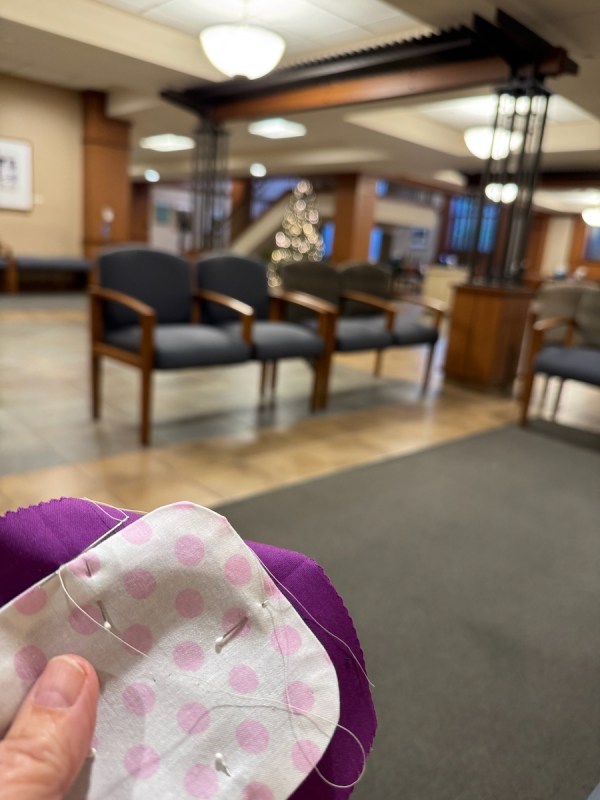
So here are the first three, courtesy of one of those sleepless nights that come along once in a while (if you haven’t seen Melanie, you are missing out). Now I just have about 177 more to go, but don’t worry, in the pattern there are two sizes (the 5-inch requires fewer blocks), and a helpful chart so you don’t panic. Just tote this project around to doctor’s offices, pick it up while watching TV, or while you are hiding from your family in a quiet room.
Because we dreamed this collaboration up in August, and everyone’s going back to school, that’s our theme. Our hashtag is #backtosquircle, a play on Back To School. We have an easy schedule, for who needs more pressure in their lives? The drill:
choose your block size/quilt size
make a bunch
every 20 blocks made, post it up on Instagram with our hashtag #backtosquircle (if you use that social)
take it slowly!
Here’s your free 5-page Squircles handout. It has the templates for the 5″ blocks, for a 4″ block and some basic directions.
You know the usual: send your friends over here to download it, rather than making copies for them.
The Meaning of Round Corners (with this great line: “In interface design, the rounded rectangle is sometimes called “the happy rectangle”.) I can always use some more happy in my life.
Adrian Zumbrunnen, a human interface designer, wrote recently about how “Blooma Zeigarnik [on the right] and her professor of Gestalt psychology were having coffee at a bustling restaurant…While waiting for the check, the two eagerly discussed an odd observation they both made. Somehow waiters seem to better recall bills that were still open than the ones that had been settled. It seemed like the moment a bill was paid, it vanished from the waiters’ memory. Based on this simple insight, Zeigarnik conducted a series of experiments that showed that unfinished tasks loom larger than finished ones.”
As I was fascinated by this idea, and after chasing down a few rabbit holes (see complete bibliography at the end), I came to learn that the unfinished has a certain power that finished items do not.
The term for this is the Zeigarnik Effect.
This is not hot news for quilters.
Joshua Everts defines it as the “power of unfinished business or interrupted or uncompleted activity to hold a privileged place in memory,” in other words, those undone tasks just won’t leave us alone. He notes that they “create a cognitive burden, weigh more heavily on the mind, and are more easily recalled than completed tasks.”
In another unsigned article, it states that the “Zeigarnik Effect explains why people are haunted by unfulfilled goals and may be more apt to recall what they haven’t achieved than what they have. Some have speculated that the cognitive burden of unfinished work causes some to see themselves negatively and contributes to such problems as impostor syndrome.”
But while it is not hot news for us, the people who coined the term UFO (Un-Finished Object), how do these unfinished objects affect us?
Zumbrunnen notes that “Unfinished tasks lead to cognitive tension, a feeling of restlessness and discomfort that makes us seek closure and come back to it again and again. This effect goes beyond remembering individual items on a bill. It affects whether we achieve our goals, our creative output, and how we pay attention.”
Carol and I were discussing our progress on our Posh Penelope blocks, and I wrote:
Public Service Announcement:
Another Public Service Announcement: The Zeigarnik effect should not be confused with the Ovsiankina effect, an urge to complete tasks previously initiated. Maria Ovsiankina, a colleague of Zeigarnik, investigated the effect of task interruption on the tendency to resume the task at the next opportunity.
Yes, let’s not confuse the two, although maybe what I was experiencing this week was more of the Ovsiankina effect? Nah. I’ve been working on this Posh Penelope quilt for forever, like since 2020. In my mind, the Ovsiankina effect is more like finishing making dinner. Or changing loads of laundry.
Yet Another Public Service Announcement: What does the Zeigarnik Effect teach us about multitasking? The Zeigarnik Effect makes a powerful case against multitasking. Focusing on one task at a time will avert intrusive thoughts of unfinished work that will only create delays in finishing all the tasks. Completion of each task approached sequentially instead of simultaneously will clear mental space for the next task.
Will you please stop with these Public Service Announcements: Yes. But you should know that taking the first step on a project, no matter how small, can create enough tension when the task is interrupted to motivate the resumption of the task, doing an end-run around procrastination. (I can’t help you if you are addicted to your phone. That’s a whole other blog post.)
So I cut out the rest of the Posh Penelope blocks. Over the next few days, I’ll get to the sewing. Understanding that having this project hanging over my head (like an anvil) was in reality stopping my creative work, helped me get going in going forward.
Other Interesting ideas from Everts to aid in managing these open-ended tasks are: •• Create intentional closure points in ongoing projects. Even if an initiative isn’t fully complete, establishing clear milestones allows your mind to experience completion moments. •• Develop systematic ways to document and track progress. This helps reduce the mental load while maintaining awareness of important tasks. •• Practice regular “mind clearing” sessions. Whether through journaling, team reviews, or simple list-making, giving your brain regular opportunities to process and organize open loops is crucial.
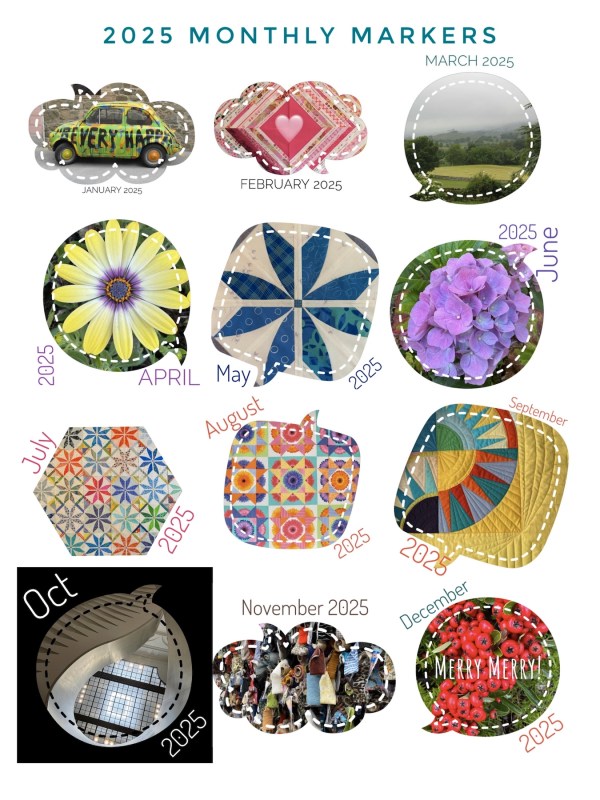
Reading this helped me understand the value of placing little labels (or “intentional closure points”) on my ongoing progress. With the BOM, it will run one year, so I know I’ll be finished with the blocks in December, and the quilt some time after that. With the quilting on my New York Beauties quilt, I mark the days so I know what I have completed as I want to finish this by early fall. With the Posh Penelope blocks, I made a chart to “document and track progress,” coloring in squares. These small signposts help me manage the tension that Zeigarnik identified, and keeps my quilting projects from torturing me with their incomplete state.