Free Download · PatternLite · Quilt Patterns · Quilt-A-Long · Quilts · Tutorial

Oh, Granny! • Granny Square Sewalong 2026

Head’s Up: Tutorial Ahead!

Just for fun’s sake, I decided to do an Instagram search for samples of the ever ubiquitous and pretty famous Granny Squares quilt because the marvelous Carol Gillen and I wanted to do another quilt-a-long with each other in 2026. (I think this will be our third?) We invite you to join in if you want. First up: the eye candy. I put a conglomeration of links afterwards, and each image is named with the Instagrammer (right-click on any photo to see it in a new tab, and you’ll see the “name” that way, along with the number showing what slide it is).

I think there must have been a lot of Granny Square quilts made in 2020, as a lot of the pictures are from around then.

A bunch of Instagram links that have the quilt, but which don’t necessarily correspond one-to-one to the above gallery:

jandideanolieandevieshesewsseamssatomi_quiltssugarbeequiltszbinden6 prairiequiltcolatimerlanequiltstiltingplanetlyrebird_lambgina_tell_threadgraffitihappylittlecottage1penelopehandmadepdxanniepdxannie (again)alisongamm (tiny blocks)quiltingkarosimplegirlsimplelifesharonhollanddesignssekephart (a new method)maureencracknell (block) • maureencracknell (full quilt)

From what I saw, there are two basic kinds: the three-squares-across version and the four-squares-across version — an iteration of the original. (Ignore the photo above with six blocks across; that maker may be an overachiever and she freely admits she only made this one block. And while I admire the quilter who did hers by EPP [shown in the top row], we’re doing Old School Piecing.)

The “OG” Granny Square is the block on the upper left. We also call the one on the upper right a Granny Square, but the original name (according to Brackman) is the Garden Patch block, published in Quilt World in the mid-1970s; the color placement does differ slightly.

I saw a lot of posts, and websites, and perused videos, but I never found the source of the urban legend that says that the center of the block represents the baby, the next row represented the mother (the baby had four mothers?) and the next row was the grandmother (now this child has 8 grandmothers?). Wherever that came from it certainly wasn’t on the radar of quilt historian Barbara Brackman. The block in her book (the Bible of quilt blocks) is called Grandmother’s Pride, and hails from around the 1930s, from a mail order source called Home Art Studios.

crocheted granny square, from here

Another blogger had it the other way: the center is the grandmother, the four surrounding blocks are her daughters, and then on to grandchildren. Okey, dokey. I think the origin of this quilt square might have come from a quilter who was trying to mimic the ubiquitous crocheted granny squares whose first origins are from the 1880s, but I have no way of knowing.

On to the making. Here’s a slideshow with pictures of my first test sample:

Three-square row blocks using 2 1/2″ squares trims out to be 9 1/8″ which is a block size I can work with.

Here’s the test sample for the 4-square block, again using squares cut to 2 1/2″ EXCEPT FOR THE WHITE BACKGROUNDS, which I cut differently (info in the free handout, below):

The dimension after trimming is 12″ square. Again, while it feels counter-intuitive to not know the finished size of a block when you begin, it’s probably easier to figure out what size square you want to work with and cut those, and then figure out the dimension of the final block once it’s all trimmed up.

I give you more dimensions and block sizes in the PatternLite Download, which for a while, is free. After that, it will move to my Pattern Shop and will probablymaybepossibly retail for less than a fancy drink in your favorite restaurant.
So download it now, while it’s free.

Another Hint: color is the thing. Decide what you want in the middle (light, dark?) and in each surrounding row. I did like the quilts that had different colorations, so sometimes you could see crosses going across the block. Two ways to put it together: sashed? Not sashed? A million different tutorials out there in Quiltland. Once Carol and I get rolling, we’ll probably post up our ideas, but for now, let’s just get started on making blocks.

We’ll probably start somewhere in May-ish? We haven’t decided yet. We’ll put it up on my least favorite-which-used-to-be-a-favorite social media, Instagram. Here are our addresses: Carol and Elizabeth. I’ll also post my blocks up on BlueSky, too, and Carol has Threads. Which block am I going to sew? I’m learning towards the 4-square version, although the 3-square version is also tempting.

Final Throught: Hashtags appear to be pretty useless now in Meta’s world However, I will be tagging my posts for organizational reasons: #ohgrannysquare2026 It might be easier just to follow us on Instagram, Threads or BlueSky or type in the words Oh Granny Square and let’s hope for the best!

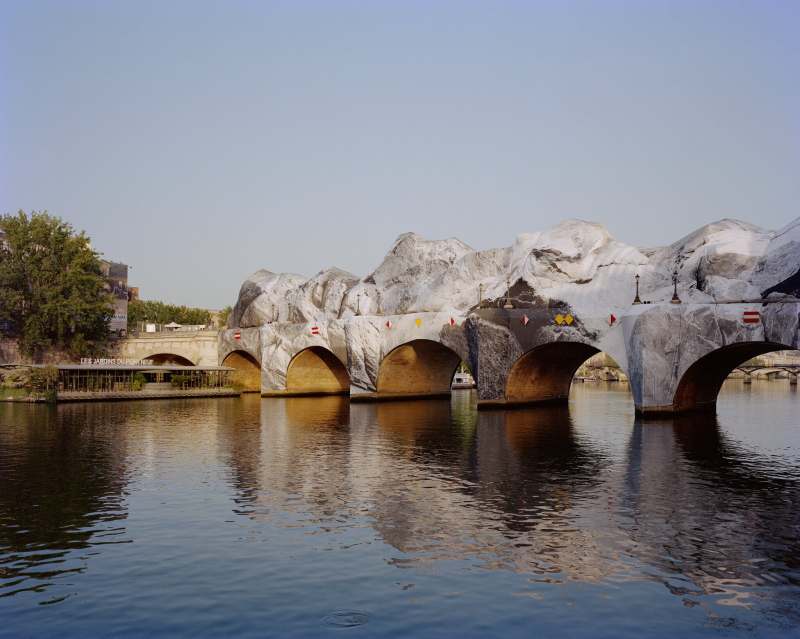
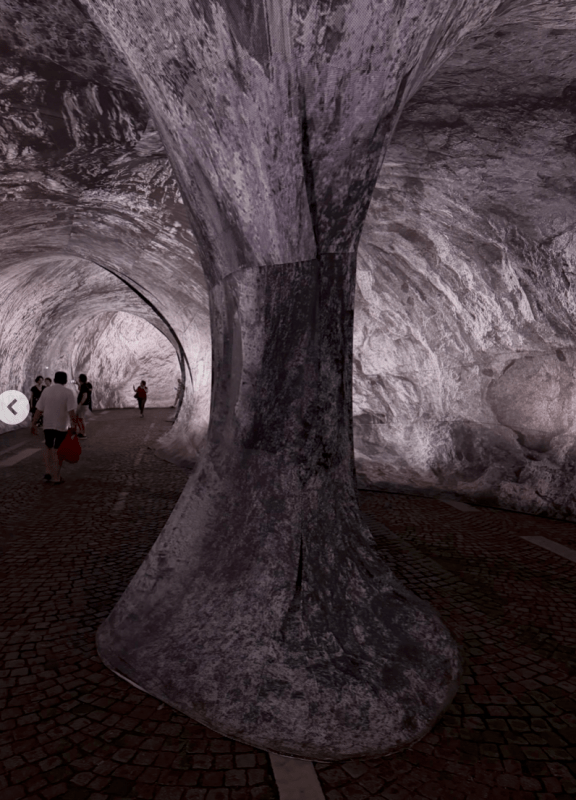
And just for the record, Granny Squares seem to be making a comeback. Here are two I saw while in France last week:

Happy Sewing!

What Were The Other Sew-A-Longs?

Pumpkins, 2021

Posh Penelope, where all three of us (Carol, Linda and I) nearly lost our minds, 2025

300 and Beyond · Quilts · Red, White and Blue

Houston, We Have a Quilt Top.

It started here.

I sewed as I watched and listened to the Artemis II crew do their moon flyby, thrilling me and everyone here on earth. This quilt is supposed to be paying homage to our Constitution at the ripe old age of 250, but now the red, white and blue also now honors these four astronauts, and will be linked in memory to this wonderful week. And that lower right photo? That’s at the Goldstone Deep Space Center in the high desert in California. We visited there last year, and were happy to find out that Goldstone was assisting with the tracking.

I did Yvonne’s trick (aptly her blog name is Quilting Jet Girl). When she slices the quarter-square triangles again, she carefully aligns the ruler with the seam to get a perfect perpendicular slice at that point. I followed this tutorial, a link courtesy of Carol, but there are many hourglass tutorials out there. After seeing Carol’s rendition of this quilt, I purchased a digital version of the pattern here.

Meanwhile, I keep watching the NASA Artemis II feed from Mission Control Center in Houston:

And sewing.

And watching, and sewing.

Finished the quilt top today, one day before the landing over here on the West Coast. Yes, I’ll be watching not only the live NASA feed, but also the skies to the West to see if I can see anything. I’m hopeful.

Stained glass view. It’s about 72″ square.

View from inside the house towards the arbor where I photograph a lot of my quilts.

Happy Landing, Artemis II. Godspeed!

300 and Beyond · PatternLite · Patterns by Elizabeth of OPQuilt · Quilt Finish · Quilt Patterns · Quilts

Pursuit of Craft with Spring Dots & Stripes • Quilt Finish

One of the challenges in our modern life is to deal with disruptions, distractions, and never letting us have a minute without someone telling us the five steps to a better life, to better breathing, to being a better whatever. Or as tech, culture and political writer Derek Thompson observed on his podcast Plain English, these voices tell you “everything is figureoutable. And if I just listen to these five steps, I can figure out all my life’s problems” (from here).

But for me, I escape to quilting to not figure everything out. I mean, yes, sometimes just cranking out on a pattern and whipping up a quilt is a good time and I like that as much as anyone. But hopefully, as Thompson noted, “you can have intimacy with a craft.” The challenge “is if we are constantly being distracted or interrupted, it’s hard to find that intimacy. It’s hard to get into the slipstream or the pocket of a creative project” (same source as above).

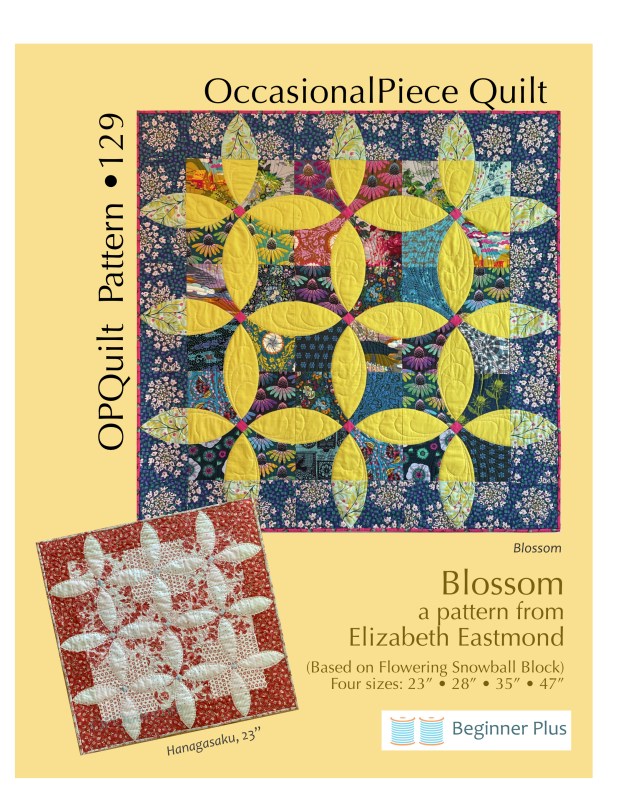
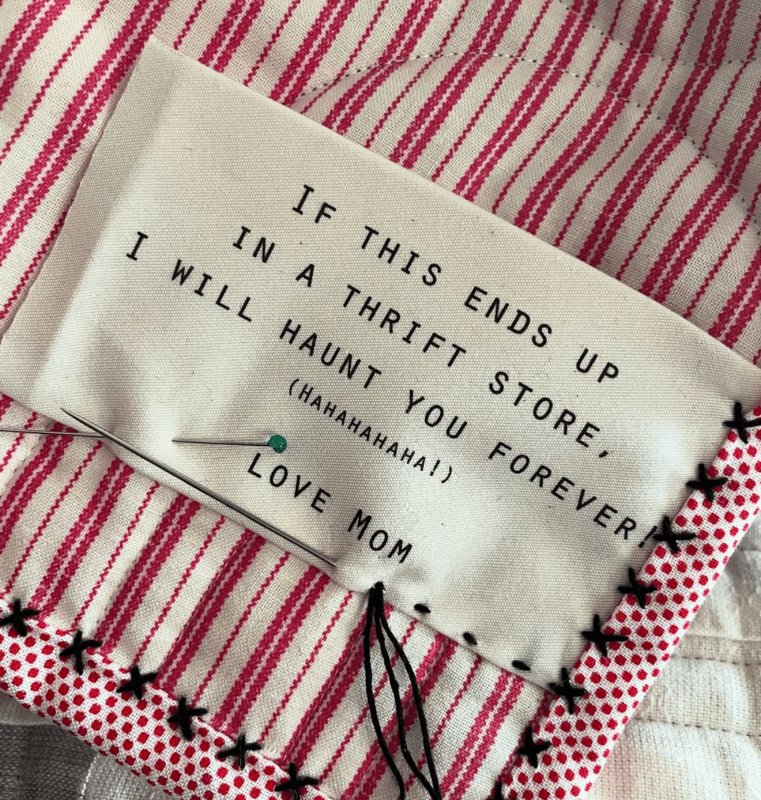
I like my pursuit of my craft. Of taking a well-known-to-me pattern like my Blossom, and seeing what I can do with it that sends me into discovery, of finding a new way to see what I’ve seen before. Because, really, haven’t we all seen it all before: make a cut, stitch a seam, sew it together, quilt it, and don’t forget the label?

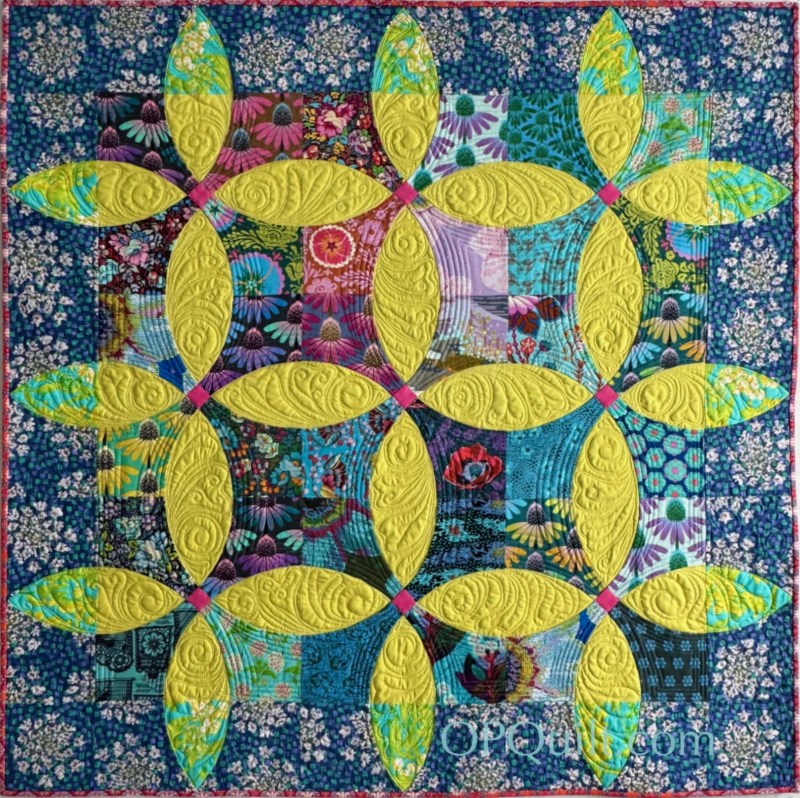
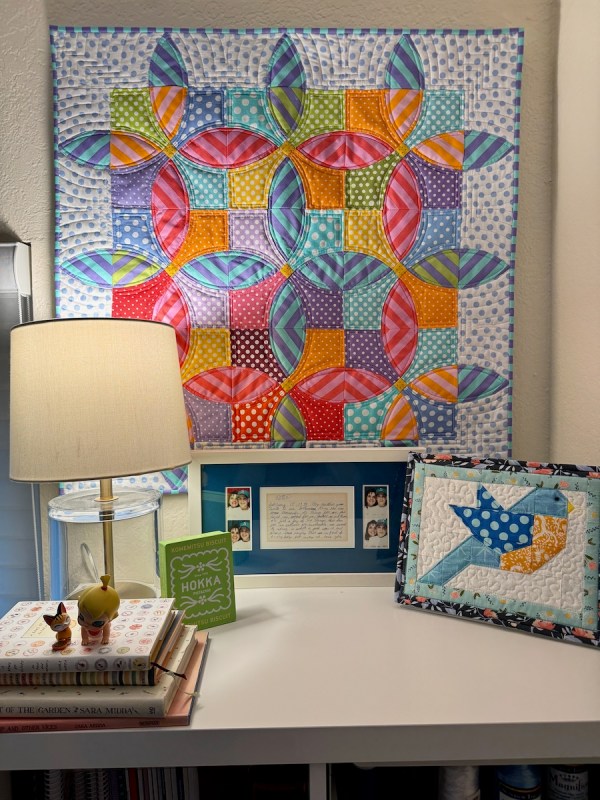
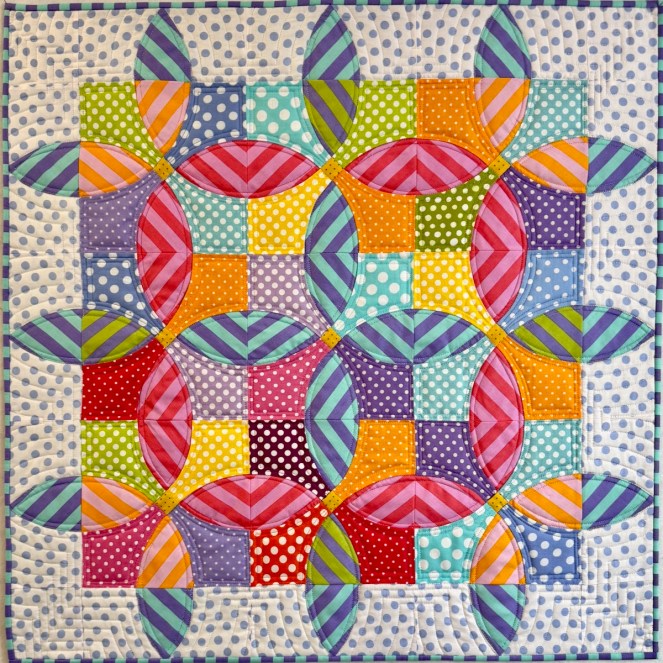
For this quilt (Spring Dots & Stripes), I chose to work with just two elements:
• dots and stripes (had to be white dots on bright colors),
• Tula’s Tent Stripes (in only four colorways).

It was this challenge that coaxed me into flow.

What is flow? The Czech psychologist Mihaly Csikszentmihalyi coined the word “flow” to refer to the psychological state of optimal performance.

“He recalled in an interview how he would watch painters in their studios and how he was fascinated by their ability to forget everything while working. He was also surprised by what happened when they were done: They’d finish a work of art, and instead of enjoying it…they would put it against the wall and start a new painting. They weren’t really interested in the finished painting. What these artists were after, Csikszentmihalyi realized, wasn’t the finished work itself but the experience of full immersion and absorption in the act of creation” (from here).

To understand it better, I watched several videos online, and liked the one from John Spencer, titled “What is Flow Theory?” He highlighted it like this (click arrows to advance):

Since no matter what I tried, the slides kept getting out of order, the basics are:

  1. The task has to be intrinsically rewarding;
  2. The task has to have clear goals and a sense of progress;
  3. Clear and immediate feedback is critical;
  4. It’s a balance between the challenge of the task and the set of skills needed to complete it; and
  5. The person in the flow state has an intense focus on the present.

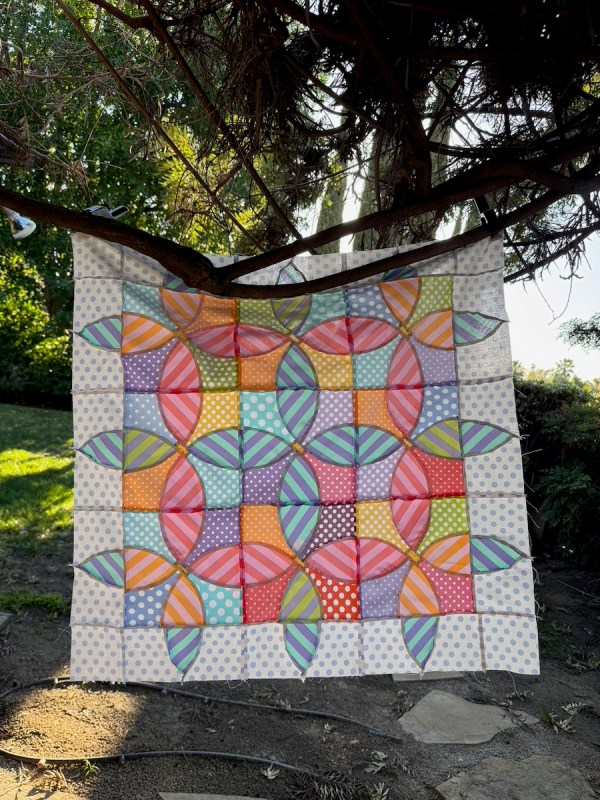
I cut out pieces in certain colors — the ones I thought I would want — and started putting them up on the design wall. And then in an a-ha! moment, I could see that I could group them differently to create a pattern of interest. Maybe that came from trial and error, maybe it came from being in the flow? I was able to discover a different way as I grouped the petals into colors, cutting and discarding and pinning up and sewing, as I ignored all that was going on around me.

I took the finished quilt out into the garden for some photos this week.

Side Note: I’ve decided there are two categories of fabric design that I don’t like on the front of my quilts: the first is sharp things, like anything on this fabric. The second is insects, so these often end up on the back. (Cute small bee prints are the exception.)

I needed a mini-quilt of just the right size to fit in a specific space (photo near the end), and it needed to be spring colors.

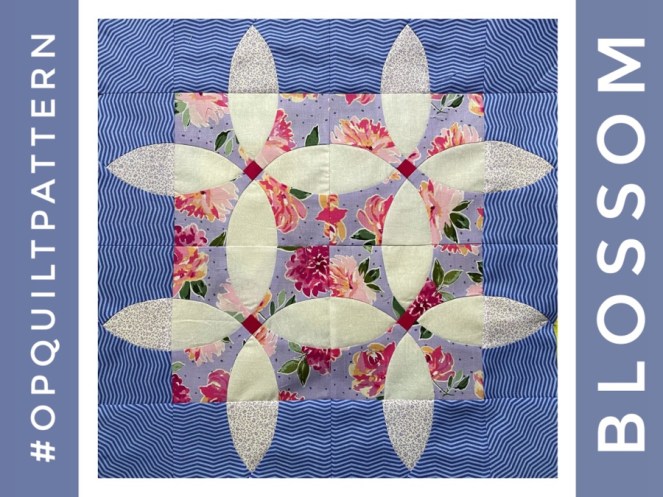
So when I turned to the Blossom pattern (which in turn has it beginnings in the traditional Flowering Snowball block), I didn’t have the right size. Because…

…last spring I discovered that over half of my computer files were corrupted. Not a virus. Just gone (it’s complicated). And 50 percent of those were my more recent pattern files. So many patterns that I’d written could never be updated. Unless…unless…I recreated all the missing, corrupted files to revise the pattern. Like this one:

So I have been busy re-drawing the files I lost, and while I was at it, adding a new size (7″ block), and re-writing the pattern. If you’ve purchased Blossom from me before, you can go to the email you received with the pattern and re-download it. And for those who haven’t made one of my patterns, and want to try it, I put it on sale for a few days if you want to grab it now in my pattern shop.

This a photo of another quilt, Aerial Beacon, that is stuck in re-write-land. I was about a month away from the release when I discovered the corrupt files. Talk about a way to stop the flow! I’ve slowly been re-creating this one, too. (Slowly is the operative word here, but it’s coming.)
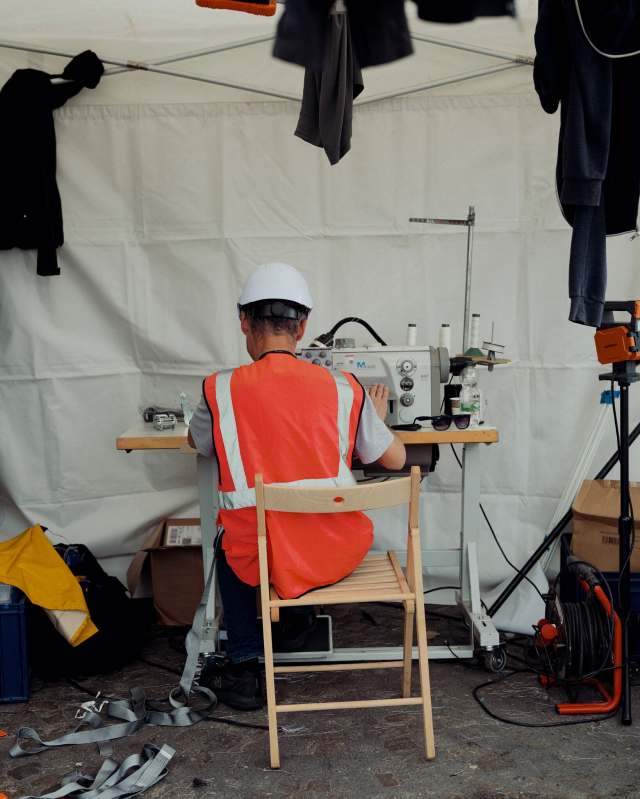
Yes, I should have had it done by now, but this is what I call a “reverse flow” task. All those glowing ideals in the list in the beginning have their counterpart: discovering and ferreting out and crying inside over lost work and then redoing the lost work, I would say are just about the opposite of the bliss of being in the flow.
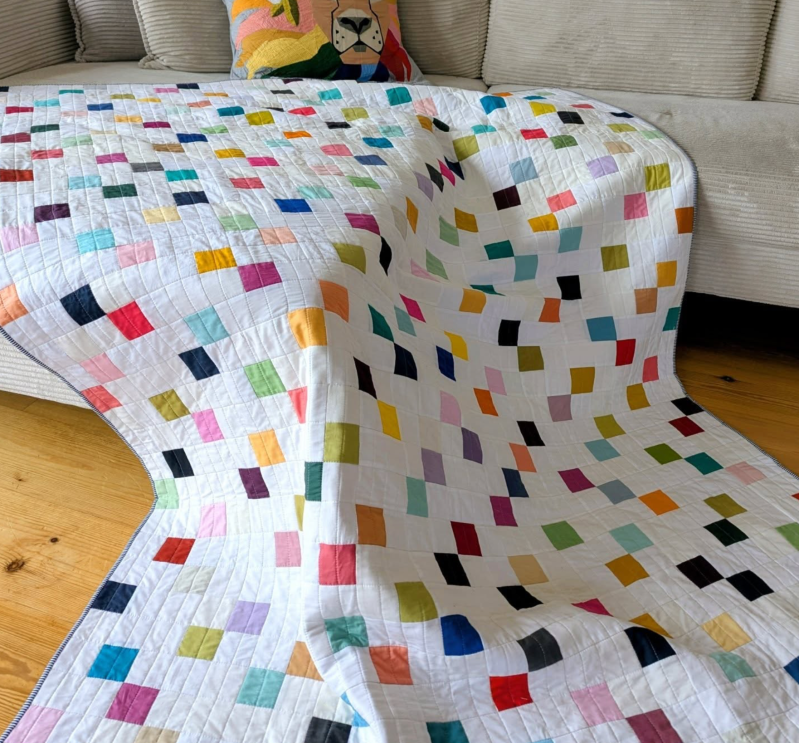
Since I was in the Blossom flow, I re-made the larger 12-inch block version as well, especially since I found that outer border fabric at Road to California this year. It’s in the needs-to-be-quilted stack.

Quilt #316 • 28″ square, shown in that space where I needed a quilt

I’ll let this paragraph from Mihaly Csikszentmihalyi’s book, flow The Psychology of Optimal Experience, close up this post:

I wish you all a week of flow, of enjoyable quilting, and a most happy Easter–

Other posts about Blossom, the pattern and quilts:

The newly updated Blossom Pattern (on sale), can be purchased in my pattern shop.

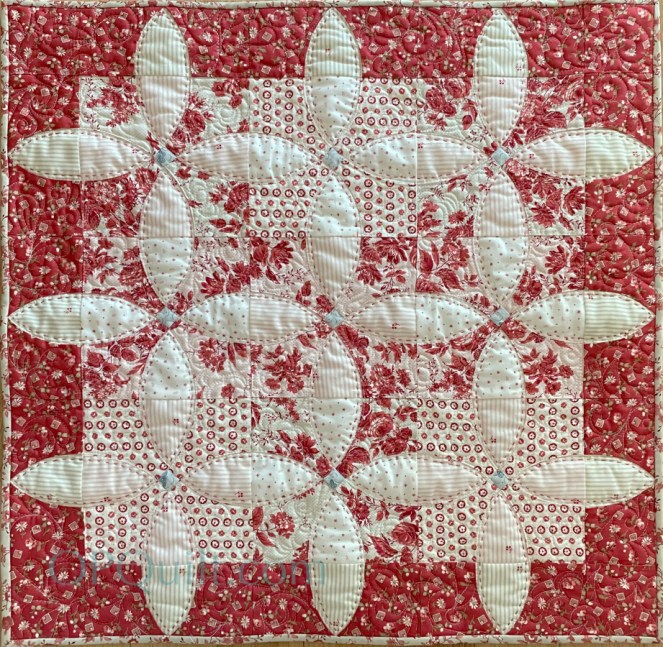
6″ block version: Hanagasaku, made in honor of the Olympics held in Japan

Hanagasaku: Flowering Rings • Quilt Finish

For a while I was a traveling quilter, teaching and visiting at Guilds in Southern California. During the covid shutdown, I taught several classes of this pattern, and the one above is Robin’s quilt — a study in the tones of autumn — a very successful one! You can read about her quilt here, and more, if interested.

Lastly, a post about how I moved from the simple traditional block to the larger quilt is found in this post.

I think Easter is a good time to sit in the garden.

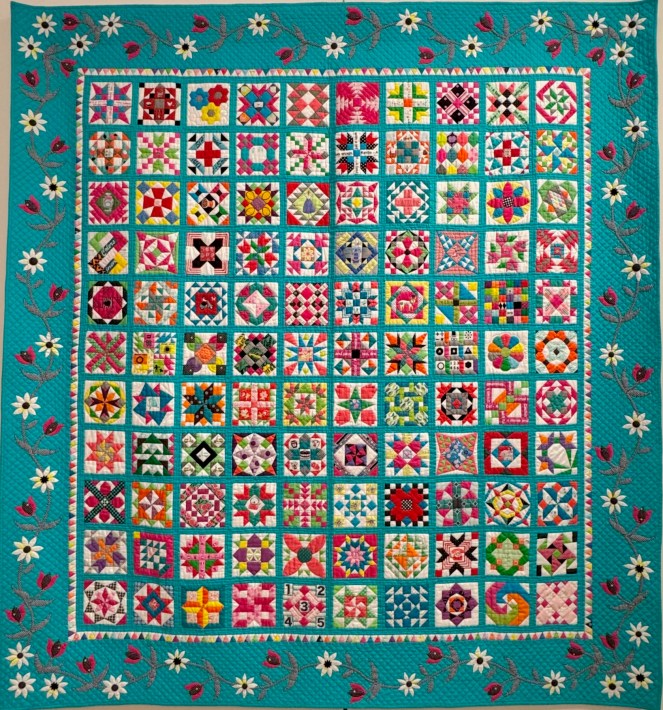
300 and Beyond · Creating · Free Download · Free Quilt Pattern · Journal Entry · Quilt Finish · Quilts · SAHRR 2026

Earth Was Once A Garden Place • Quilt Finish

One Sunday morning, mulling over the stunning news from the day before, I drove to church along a residential road. I had a view of the low mountain range in my city, the hills turned verdant green from the winter rains. The sun was bright and clear, the sight was glorious. A favorite hymn was playing as the choir sang “This earth was once a garden place, With all her glories common.”

The song finished, I went into church, but the idea of a place so beautiful and fresh lingered.

I wrote in my journal that night: “All day I couldn’t help but think about Eden, and how much we mortals seem to have missed the boat. To live with ‘glories common’ would be the best….I thought then — realized then — that perhaps it was I who was below my best abilities in bringing about ‘all glories common.’ “

I paused, reflecting: the best of the earth, the most beautiful flowers, the clearest streams and tallest mountains — our glories. Shared all together, without rancor, viciousness, greed, cruelty and just plain old revenge and stubbornness. It felt like too big of a task; I closed my journal and went to bed.

With this experience as backdrop, I sat in the quilting room the next morning, trying to tackle one of the prompts in the Stay At Home Round Robin. I knew I wanted to figure out how to write those words of the hymn, and to let this quilt be a garden quilt, a reminder that I could bring about my own version of Eden in pieces, in bits, in my best moments. I struggled with the “how to” of the words, working it out letter by letter. Many times I was discouraged. With encouragement from friends and from my always-supportive husband, I finally finished and pinned the word borders up around the existing quilt.

Then I looked at the center: it didn’t work at all. So I took that out, went to remake a new one but couldn’t find the pattern. So I drafted up my own, remade the center and carried on. (There’s a metaphor here somewhere, I think.)

So here it is: Earth Was Once A Garden Place. And it can be again, day by day, moment by moment, with gallons of forgiveness, bushels of forbearance, and volumes of truth and charity. It’s that dailiness that can be the hardest: to not cuss out the driver who cut you off, to be more patient with those you live with, to speak up when necessary and to find stamina to do the hard tasks in our lives. I often turn to quilting to have a respite, as well as to be a part of a community of others who are exercising their creativity, planting their seeds, growing their quilts and creations.

Over time, working steadily at the task, we may yet find a way to have our glories common–

Earth Was Once a Garden Place Greatest Hits

First, a huge thank you to the co-hosts of the SAHRR for 2026 (names and links at end of post). It was wonderful! The final Link-Up Party of all the participants’ quilts can be viewed *here.*

Beginning: choosing the center
Round 1: Hourglass
Round 2: Double
Round 2, Part 2: I made it a Double
Round 3: Animal Kingdom
Round 4: Curves
Round 5: Two Color
Round 6: Quilter’s Choice

This is the SAHRR 2026 Final Quilt.
I’ve revised and cleaned-up the free tip sheets I made for this journey, plus a couple more new ones for the final quilt. Click to download. Please do not copy or digitally distribute, but send anyone who wants one to this website to get their own. (NOTE: The tip sheets will live here on this post; the earlier versions will soon be removed.)

Many thanks.


#1 Free Download: Double Square Border


#2 Free Download: Trees for the Neighborhood
(Houses are from my pattern Merrion Square Mini Quilt, enlarged to the size of the finished trees)


#3 Free Download: Curved Leaves All Around, aka Orange Peel Blocks


#4 Free Download: Making Letters/Words


#5 Free Download: Center Propeller Block 9″


Quilt # 315, 62″ square

The founder of the Stay at Home Round Robin is Gail. The other cohosts are listed below: