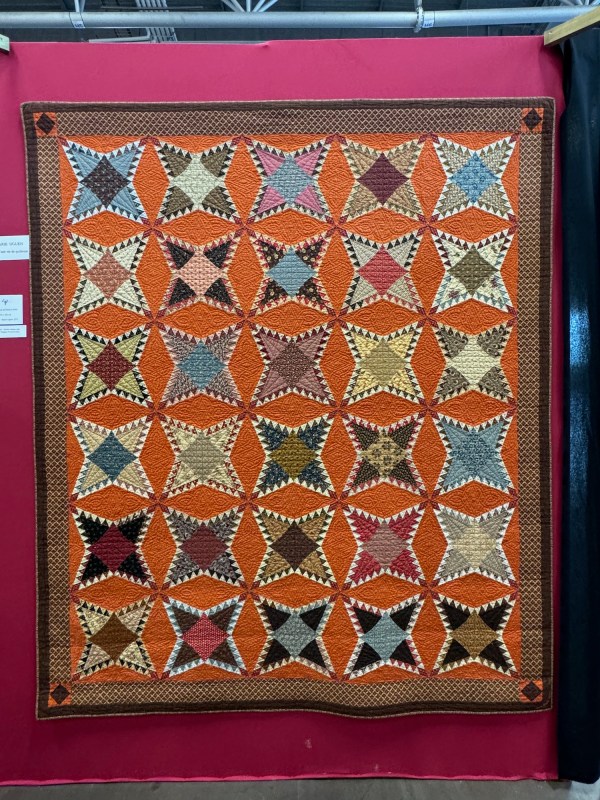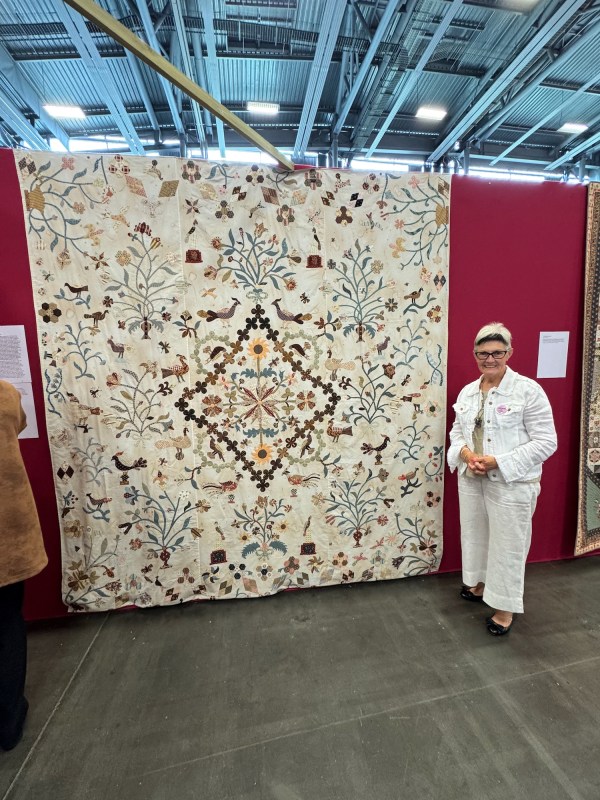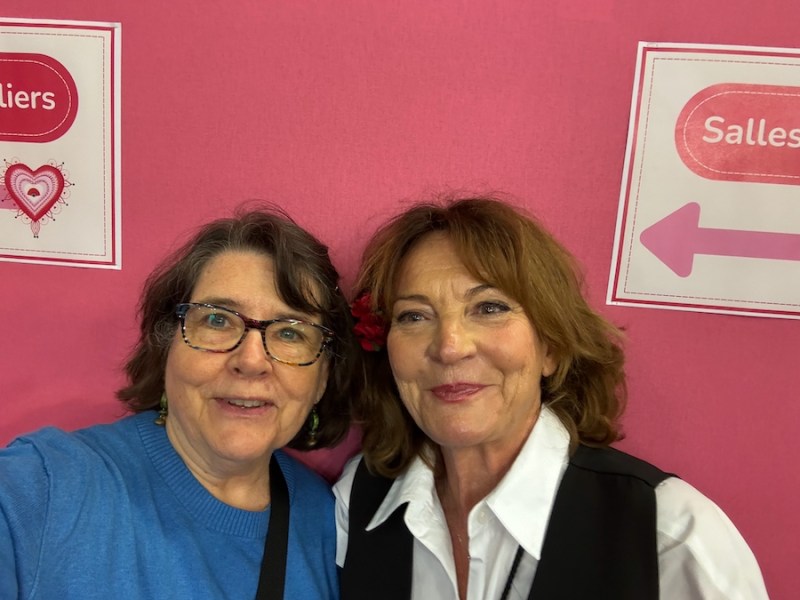
Museums · Sewing · Textiles & Fabric · Travels

All Quilty Roads Lead to Liberty

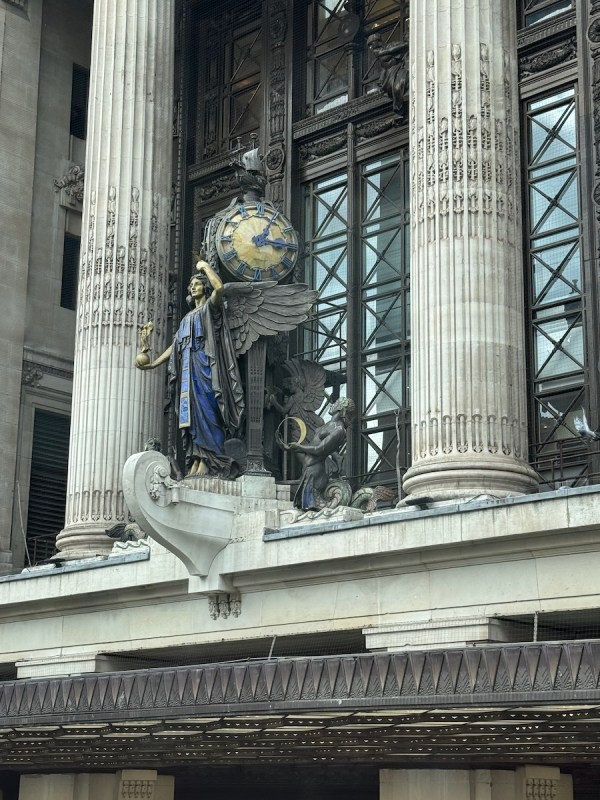
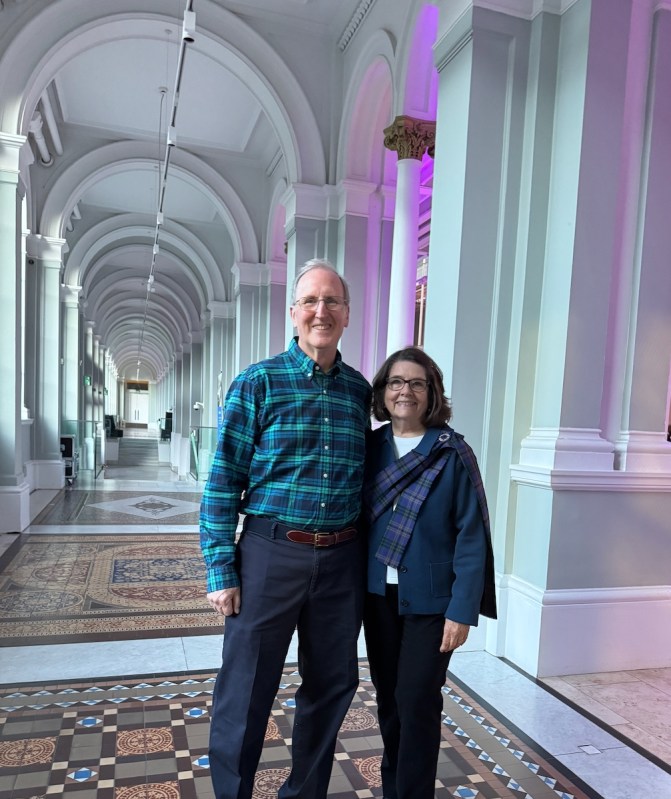
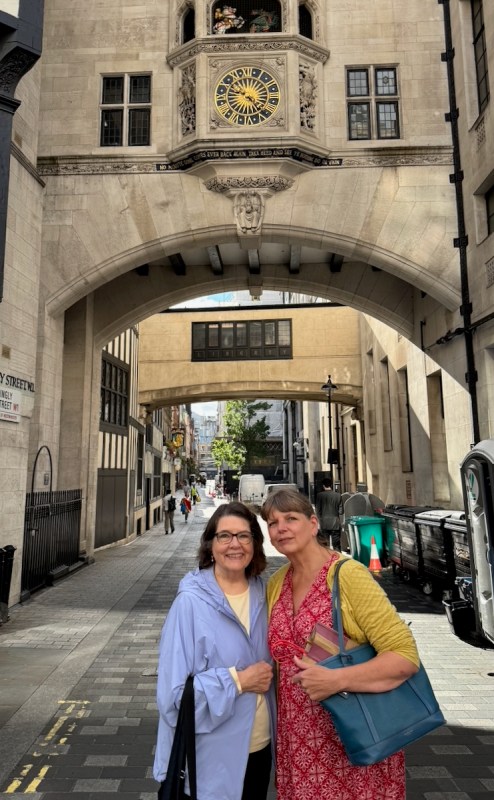
That’s Janine and I, up there under the Liberty Arch.
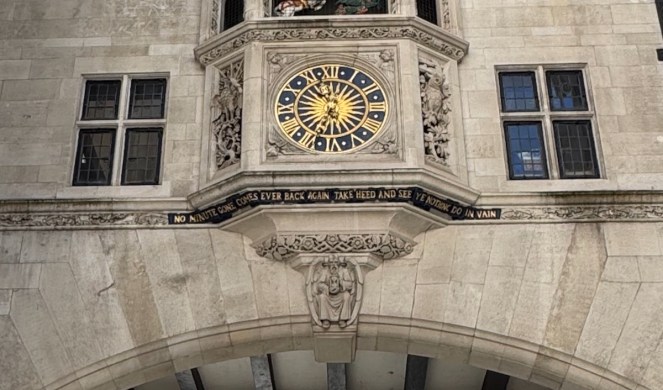
Apparently all roads lead to Liberty of London if you are traveling to England. Janine, of Rainbow Hare, has also written about meeting up a stranger (that’s me!) from the US in the great city on the Thames, and has a wonderful overview of that store. She called her blog post A Grand Day Out, and it was!
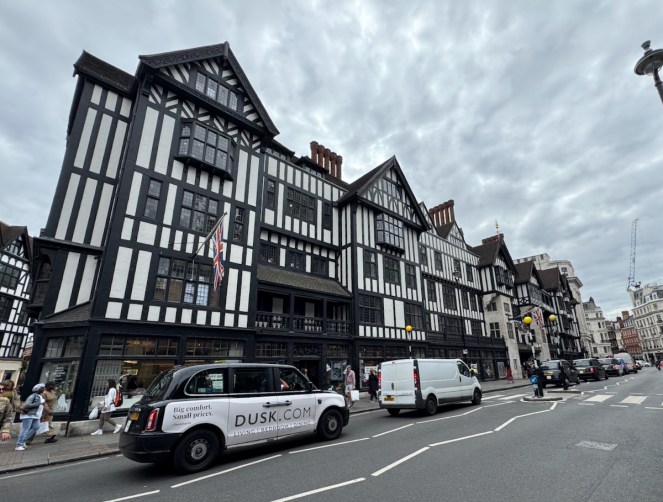
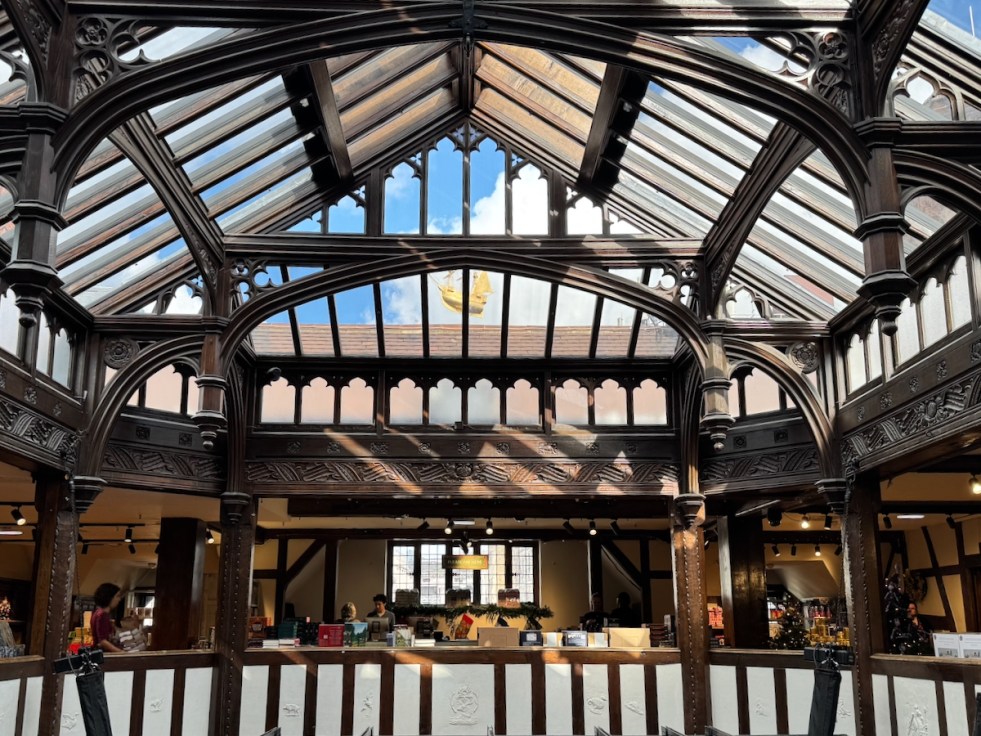
I learned from Janine’s blog that it has the idea of a ship at its origins, and I can see it in the timbered and half-timbered exterior (from a ship!) and interior:
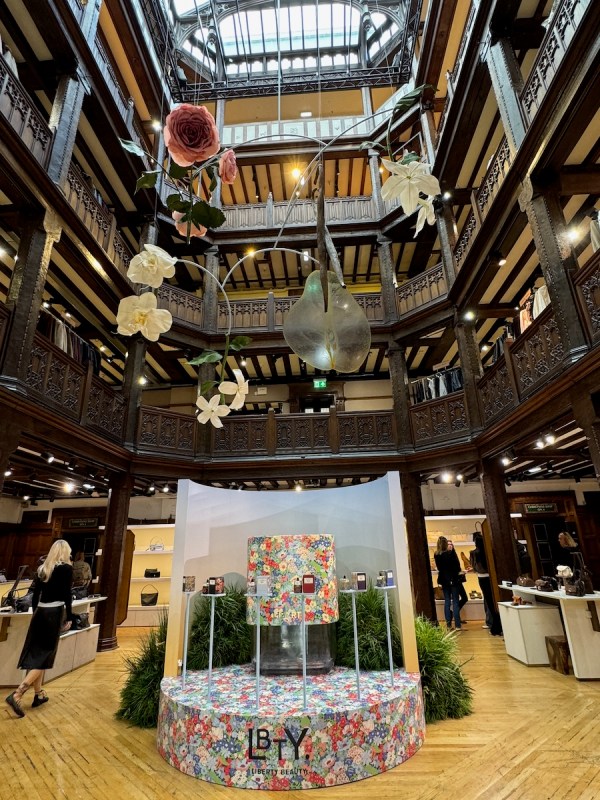
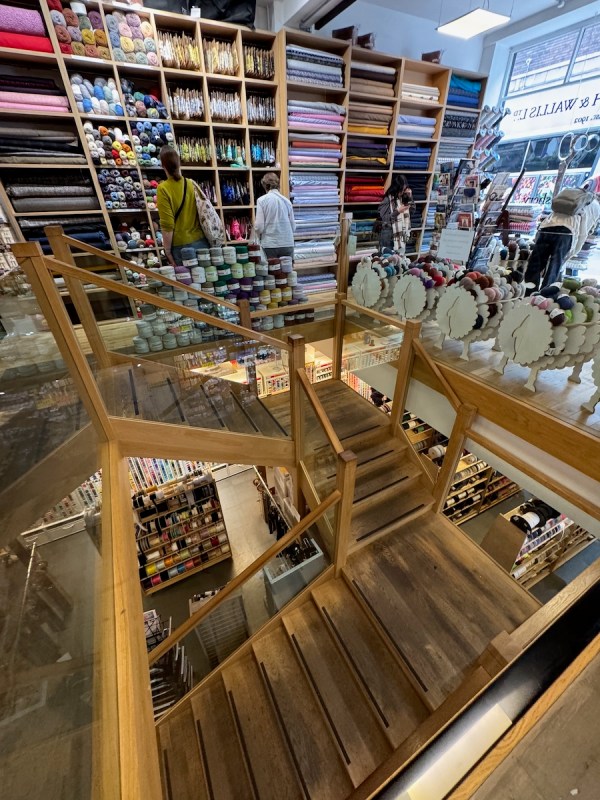
I didn’t quite figure out the floor plan, but basically there are central atriums and so many beautiful goods for sale.
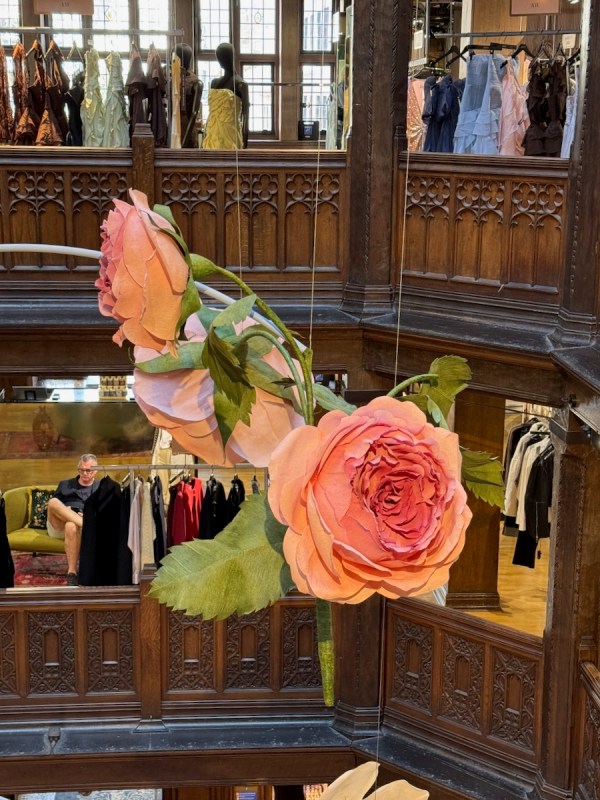
These are from the first central atrium we entered. That giant rose with all its petals made me wonder how they crafted it. Magic, I think.
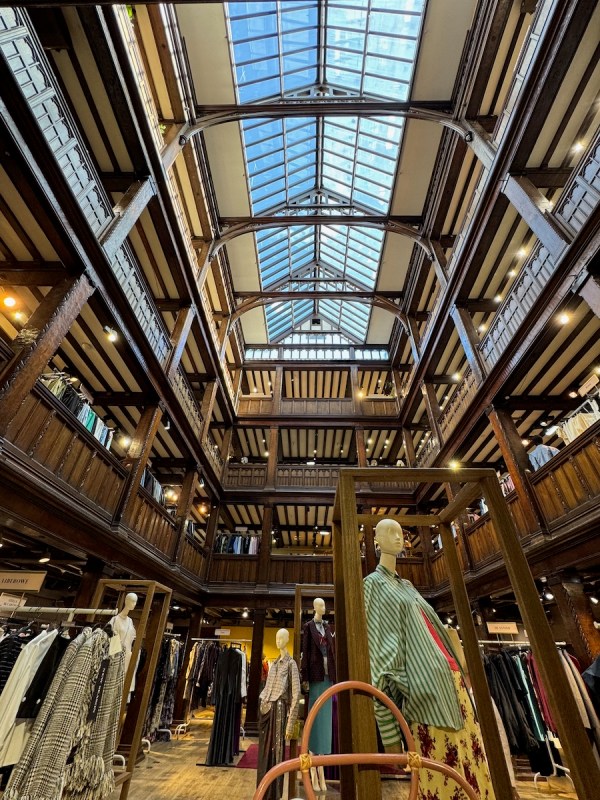
Another atrium. They don’t just sell Tana Lawn or fabric, but being quilters, Janine and I made a beeline for that section, with one quick stop on the fourth floor to see the (new) Christmas displays).
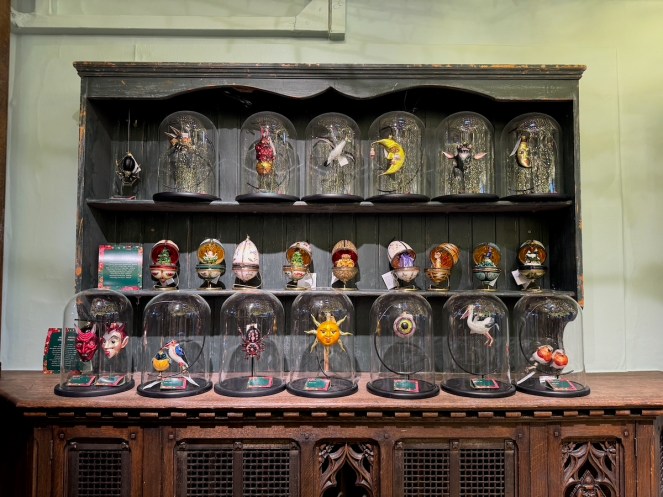
Eyeball ornament?
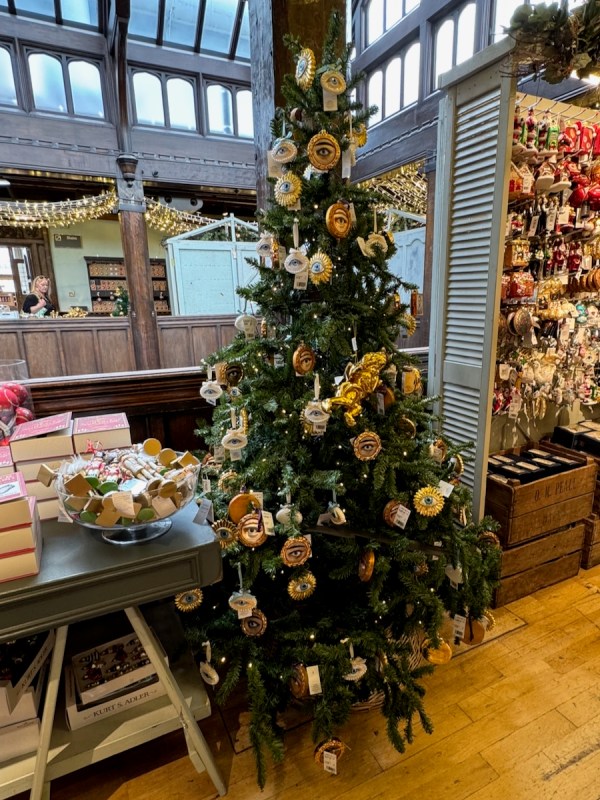
And…eyeball tree. Must have been some current bit of culture I missed out on.
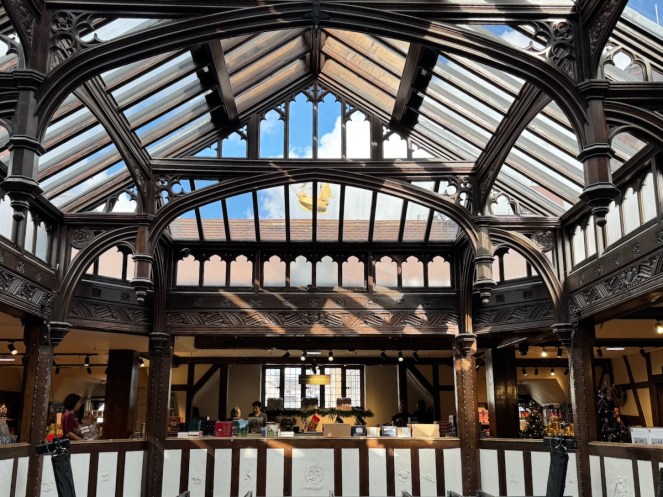
Love seeing their golden ship weathervane through the skylight. [Truth: Janine spotted it first. It is totally the best to go to a store with a fellow blogger. They see things you don’t, and visa versa, and we “see” so much more!] Okay, time to go down one flight of stairs (we were always looking for the stairs) to the fabric floor.
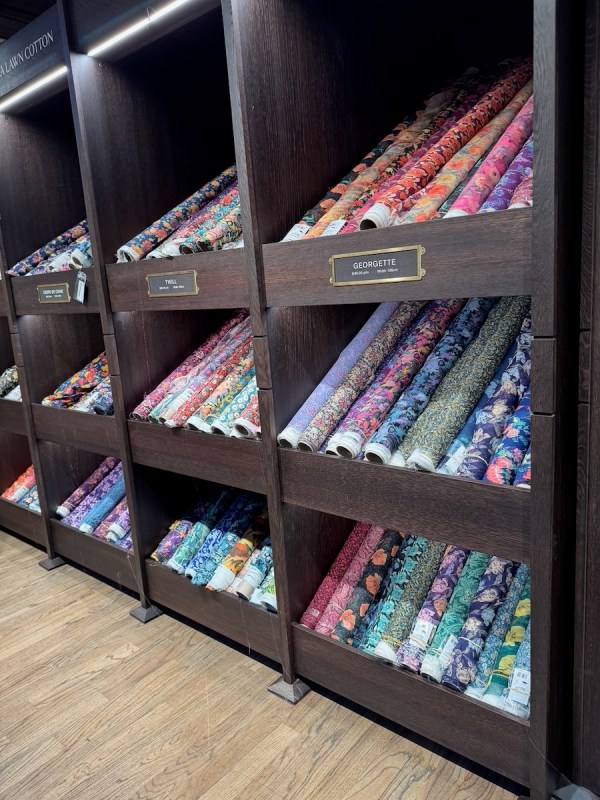
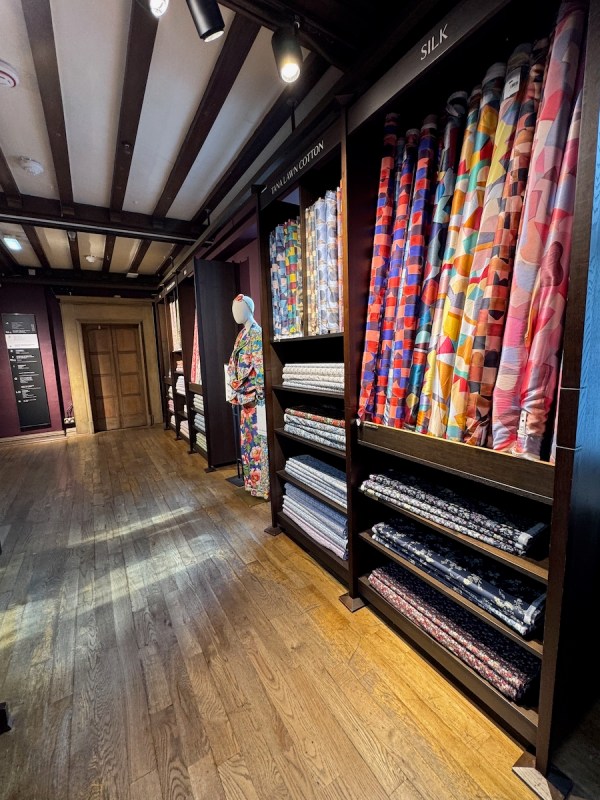
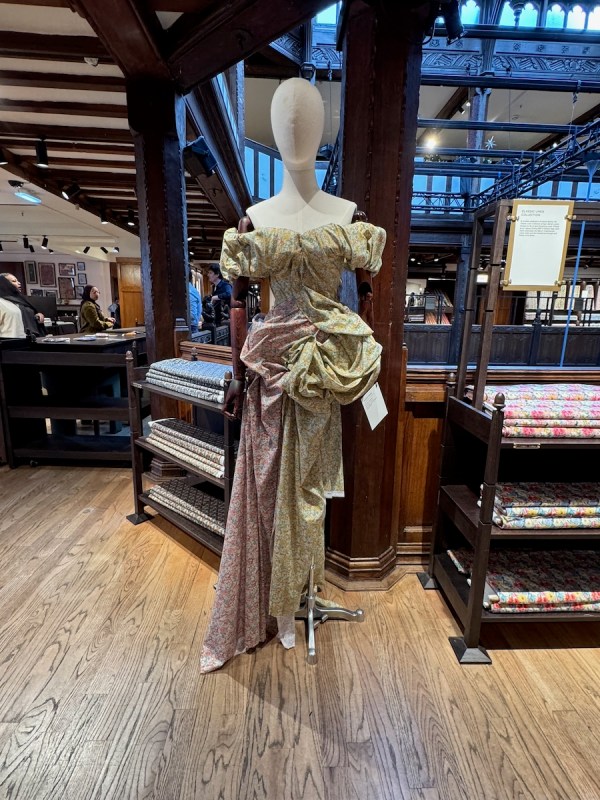
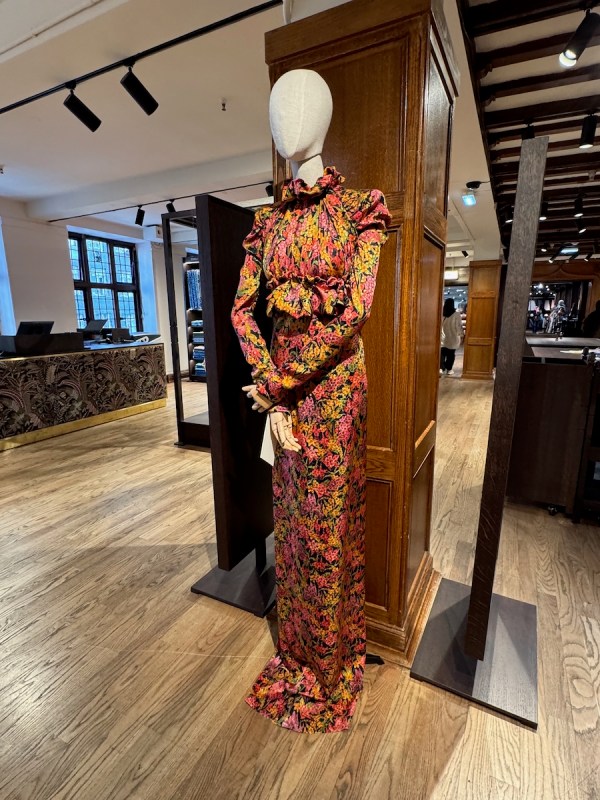
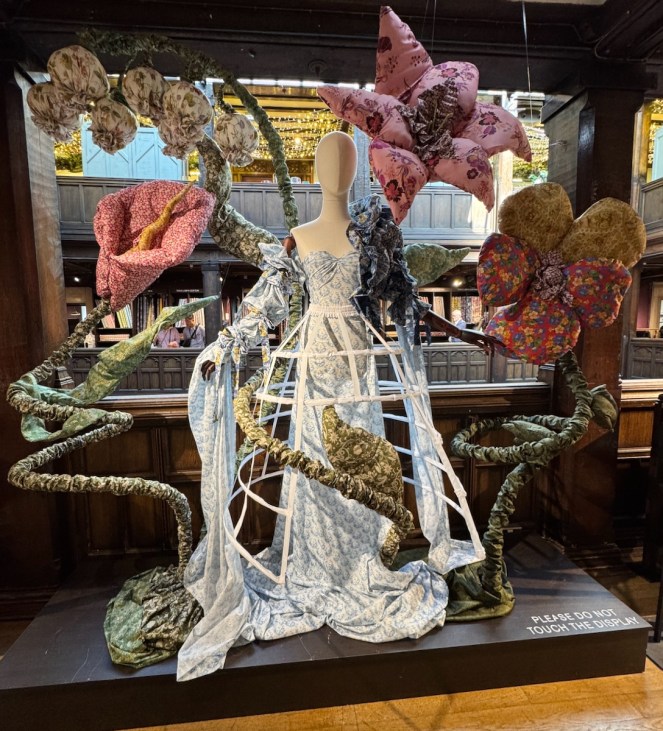
I saw some of this, too, in Paris, where they drape the mannequins in yardage and ruffles to show you a dress in their exquisite fabrics.
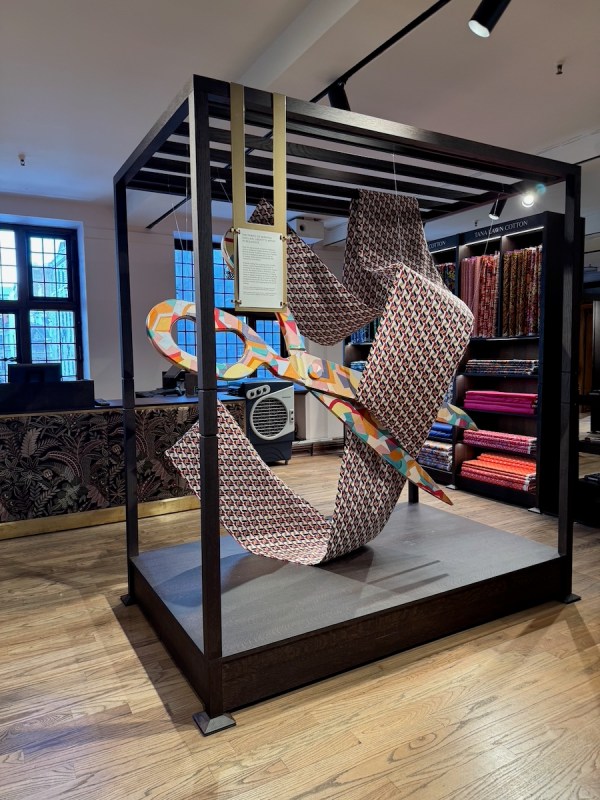
We were moving so fast, I didn’t get a chance to read about this display of giant scissors.
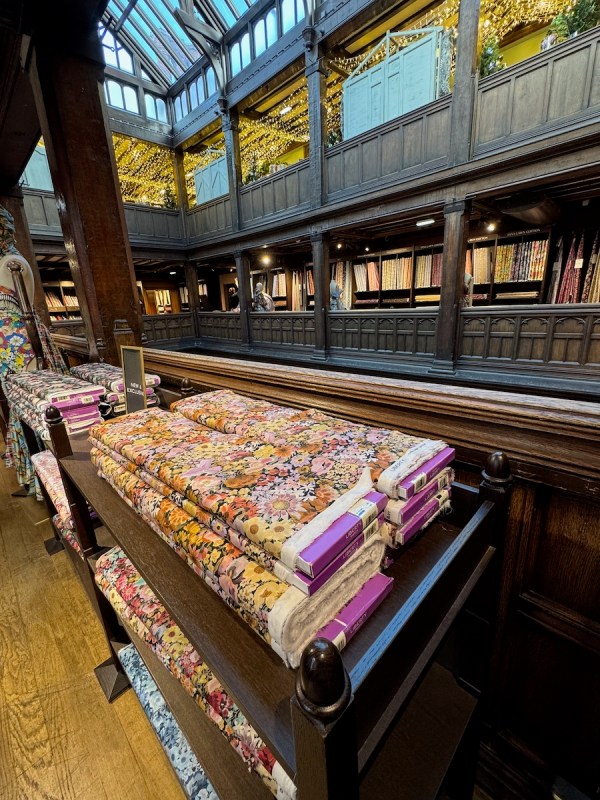
With the open atriums you can see all the festive Christmas lights. It would be so fun to be in London at Christmas. (next trip, haha)
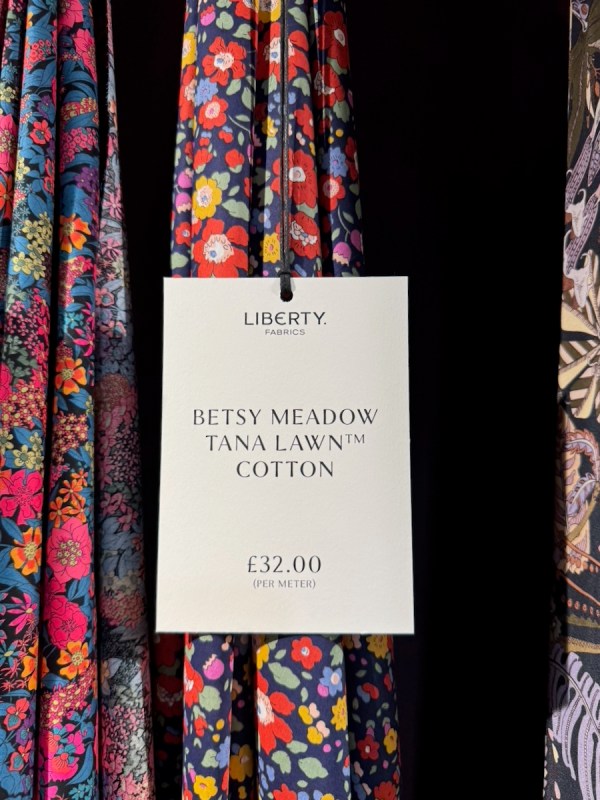
Knowing I would be overwhelmed by it all, before I left home, I did some “pre-shopping,” browsing their website and choosing one print of Tana Lawn — only one — to purchase. I showed the young man (with the fabulous brooch on his shoulder) my photo of what I wanted, and he took me right to the yardage. One meter, please.
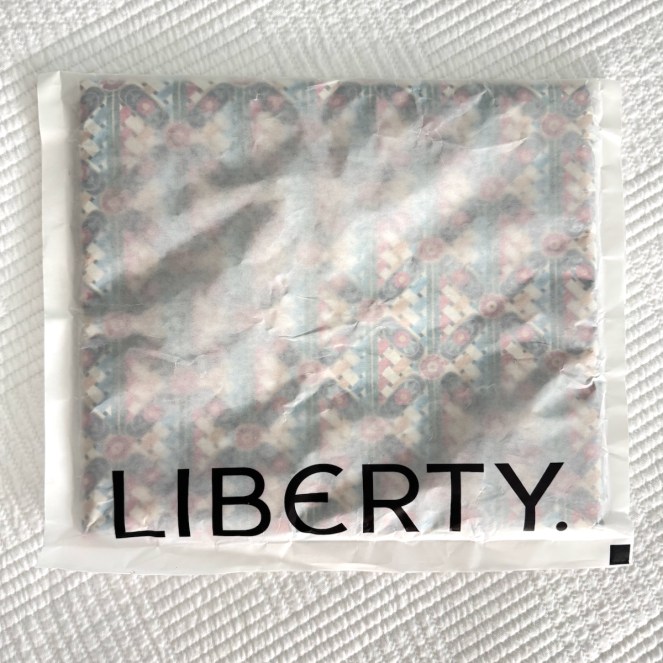
It’s for a secret project later on this year, so here’s the slightly disguised view. We also combed through their boxes of “scraps” or remnants, and I picked up a lovely floral clip-dot:
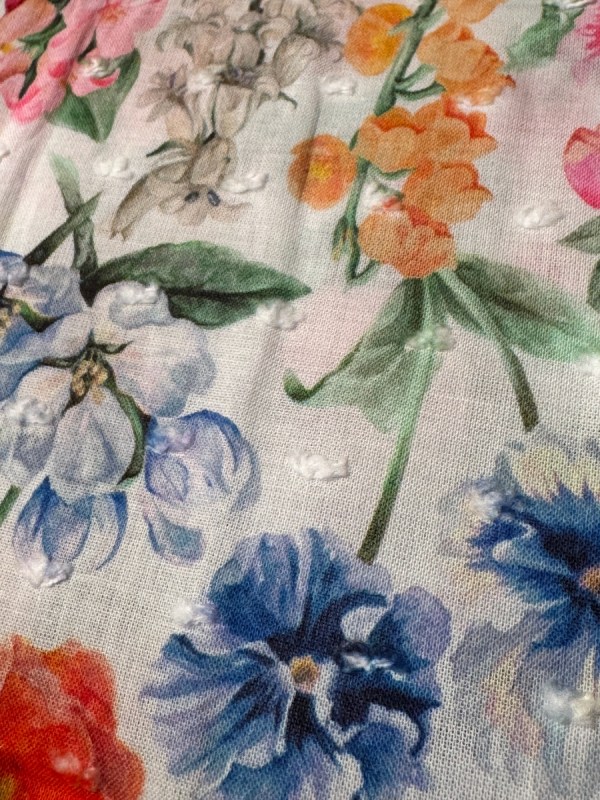
I learned about this way back in the day when I took my textiles classes in college. We know it now as “dotted swiss” but that fabric really that is little dots of glue and bits of fluff.

Above is the “true” dotted swiss: a long thread is carried during the weaving and then clipped short to create those little dots. Then it is printed afterwards, which is why some dots are blue or red or green. This is one of the beauties of Liberty: you can find the traditional fabrics.

While we were looking for stairs, we ran into a few other interesting Liberty tidbits:
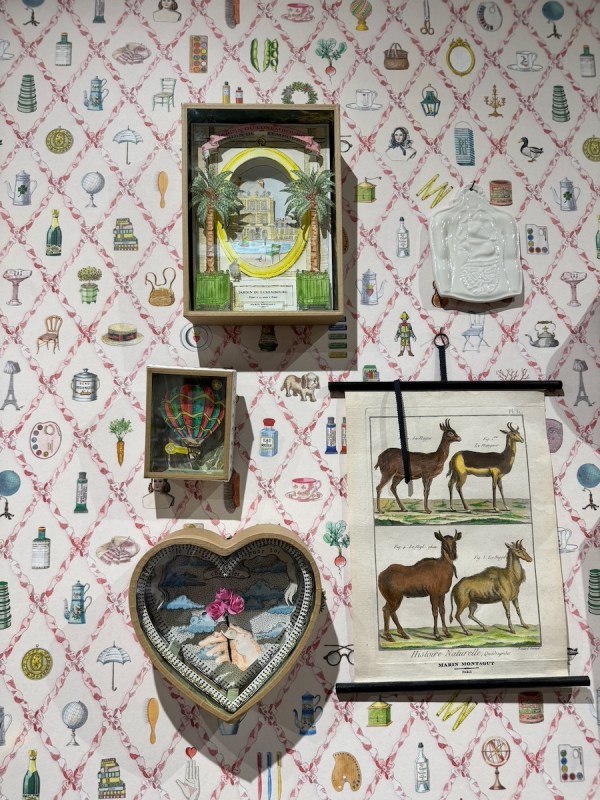
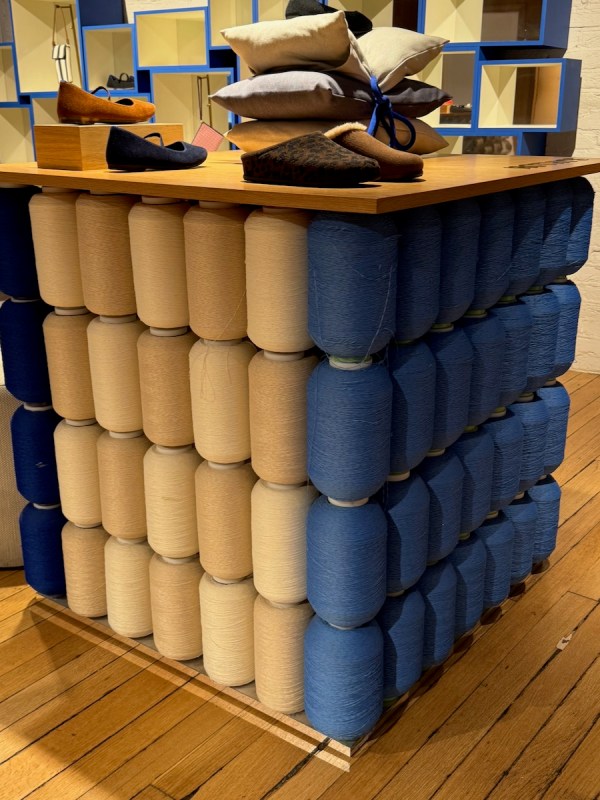
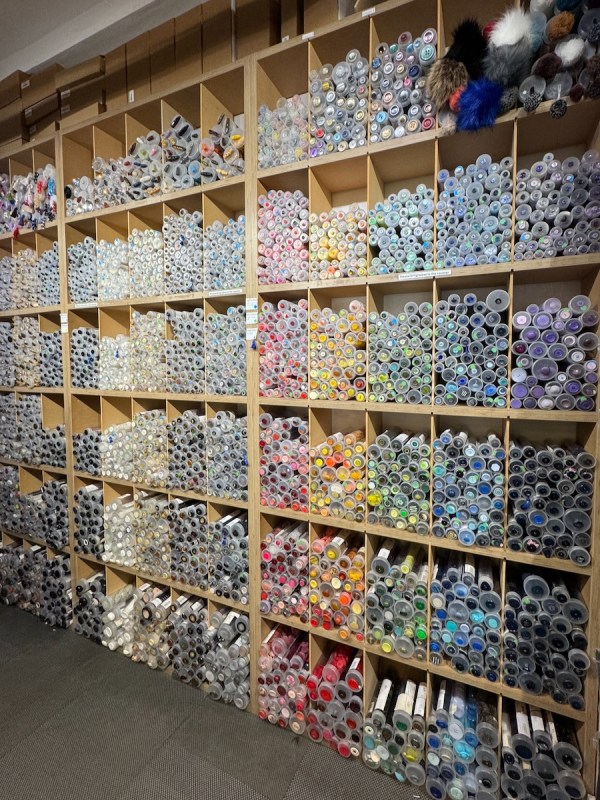
What your fabrics are made from: spools of yarns.
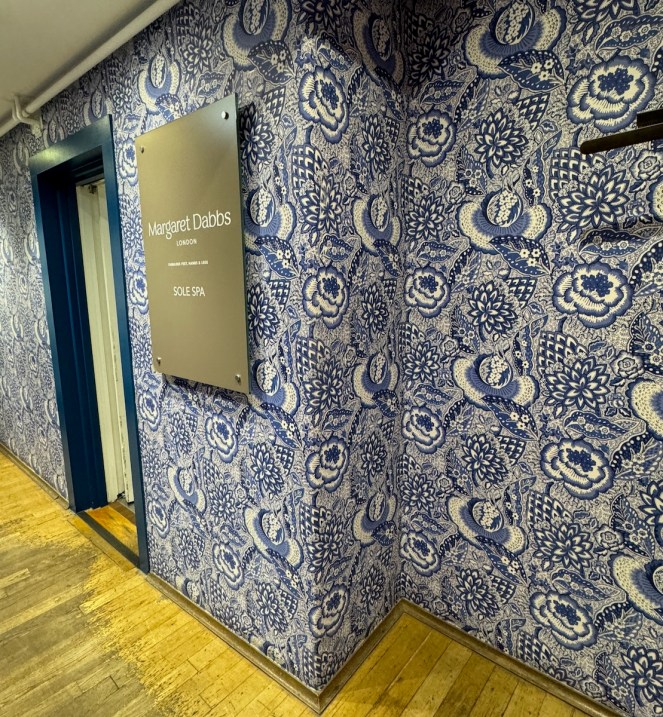
The “Sole Spa” for “fabulous hands, feet, and legs.”
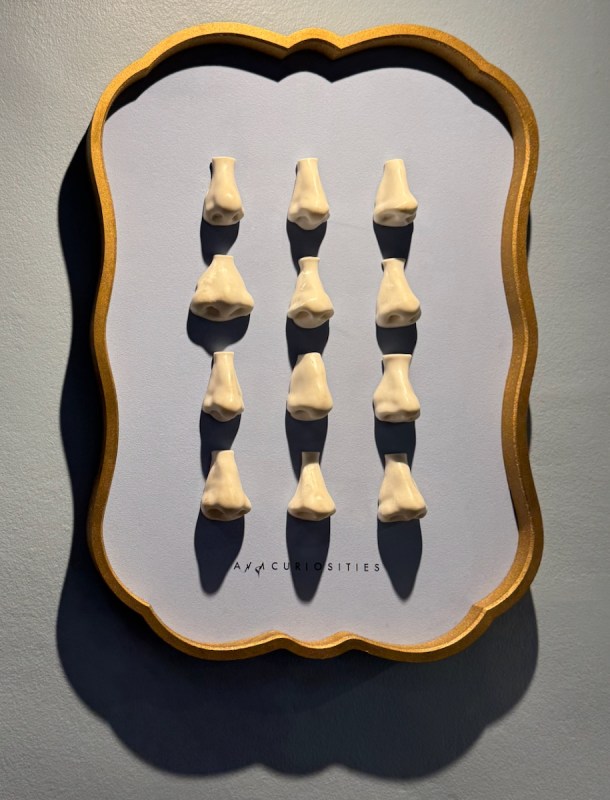
No(se) comment.
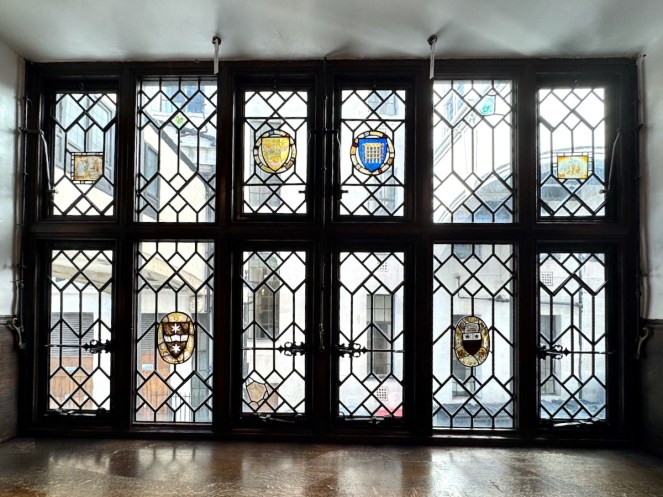
Stained glass in one of the stairwells.
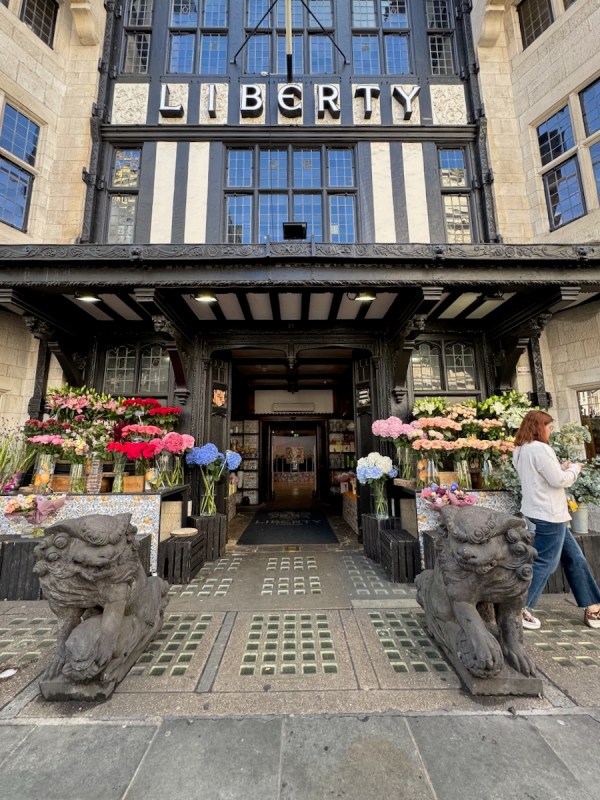
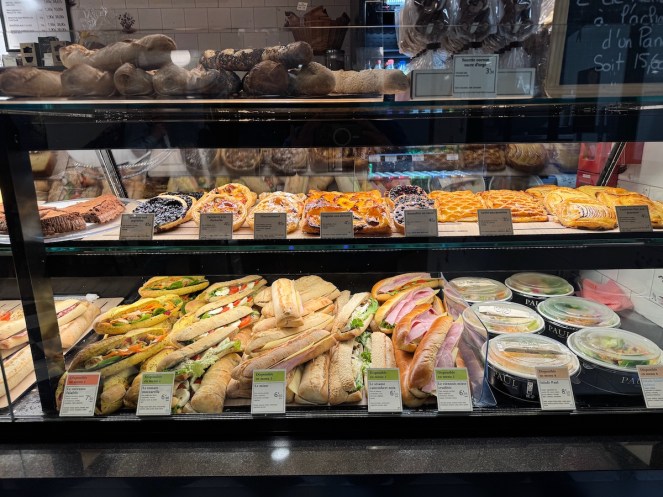
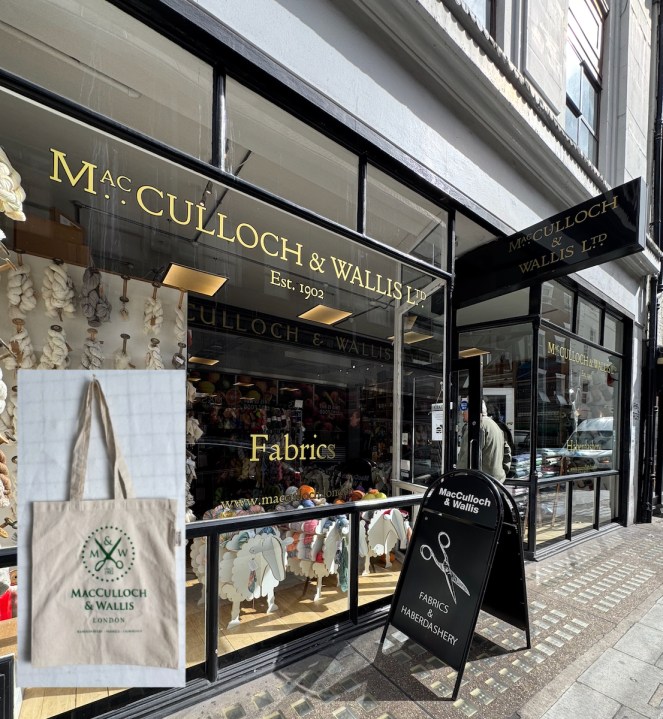
And then out! We grabbed some lunch at Pret (which used to be called Pret A Manger) then walked over to MacCulloch & Wallis Ltd, another sewing store.
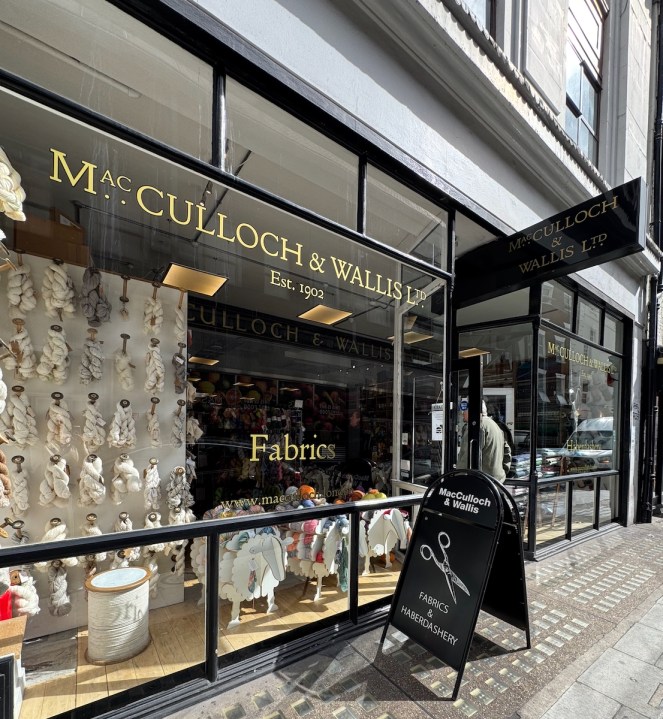
What is haberdashery? In America, we’ve adapted it to mean mens’ clothing, but the original meaning, from Chaucerian times:

“a haberdasher is a business or person who sells fabric and small articles for sewing, dressmaking and knitting, such as buttons, ribbons and zips” (from here)

Here’s some haberdashery eye candy, for those of us in the States still mourning the loss of the JoAnn’s stores:
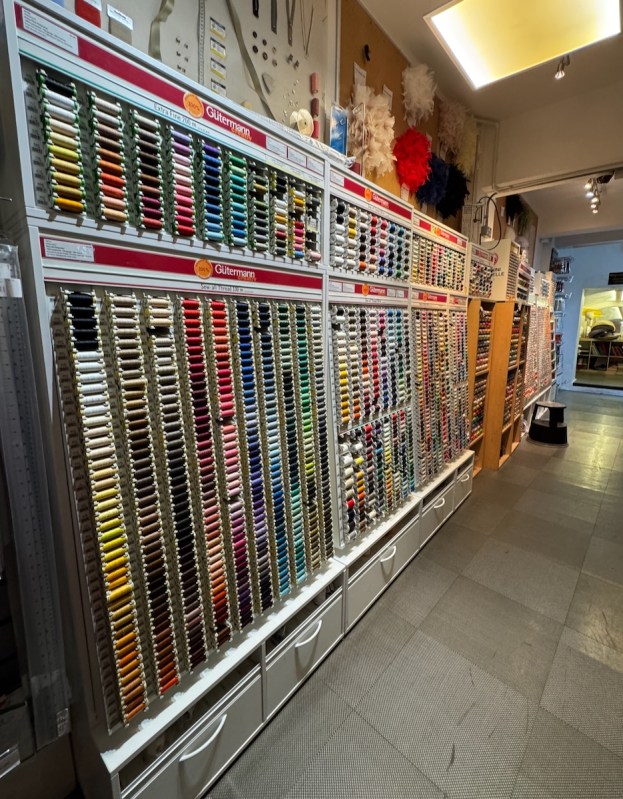
Yes, I bought buttons. And some elastic to replace some in my half-slip that had worn out, which led Janine to take me to Marks and Spencer Department Store next to find a “half-petticoat.” A great adventure! And why did we ever change out the word petticoat for “slip”? Or the word “haberdashery” to “notions”? We really have to reclaim these words!
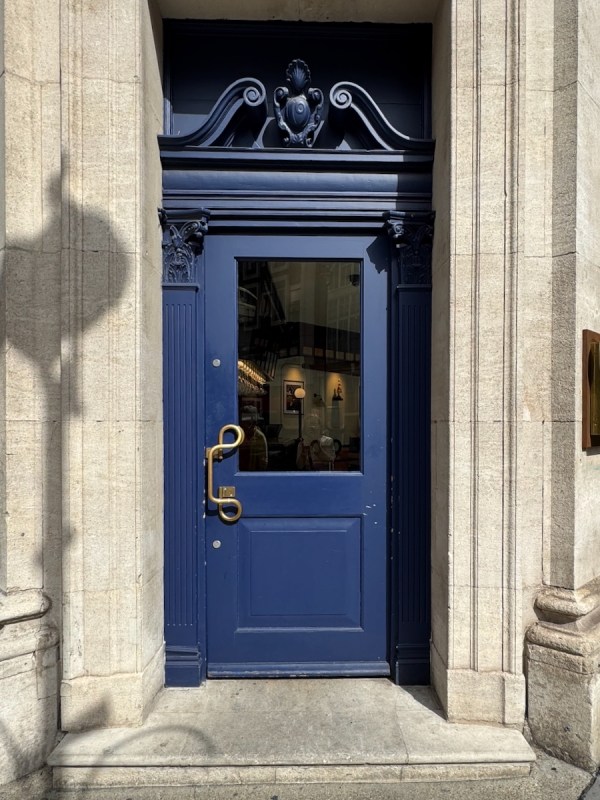
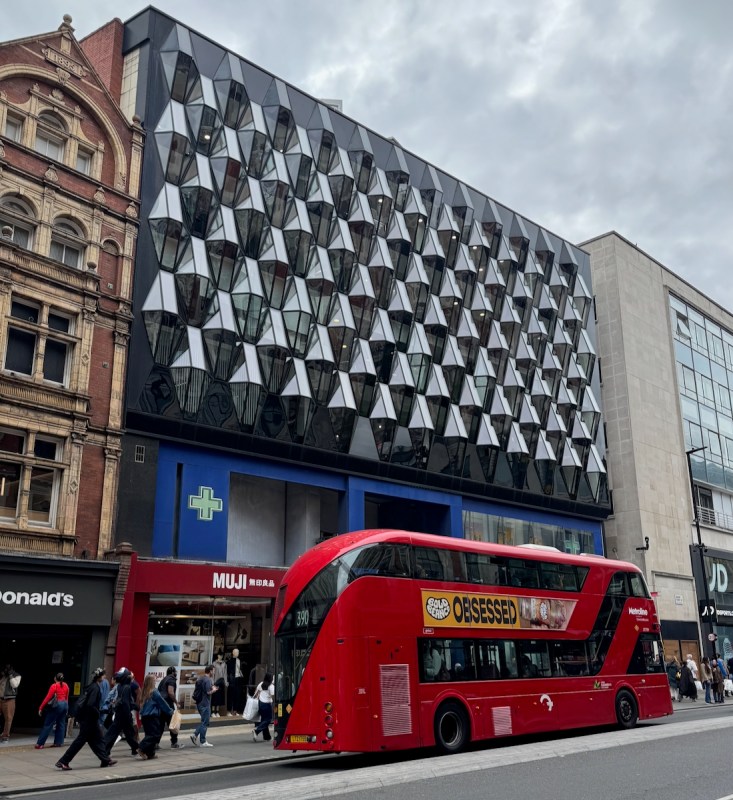
Some London sights.

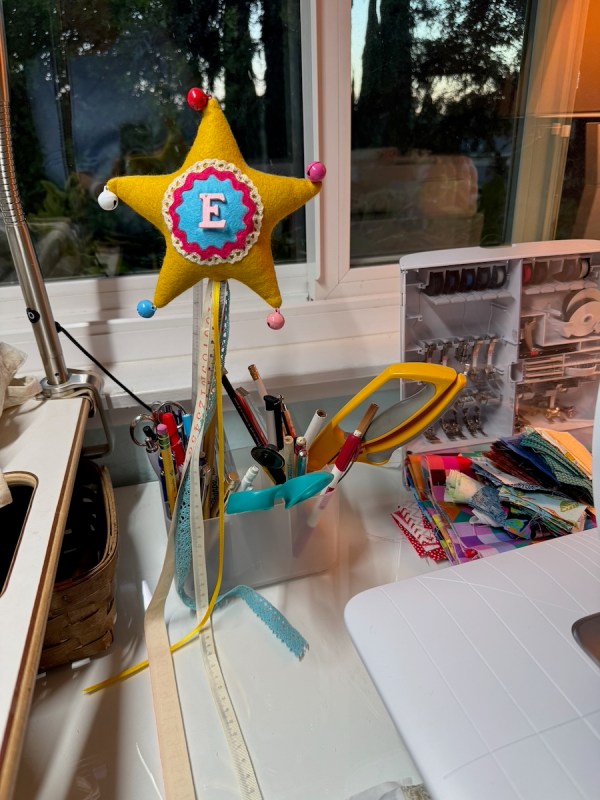
After a restorative beverage at McDonalds (no judging, it was right next door), she took off to the train station to head back to her lovely English countryside. But she left me a great present in the form of a magic wand:
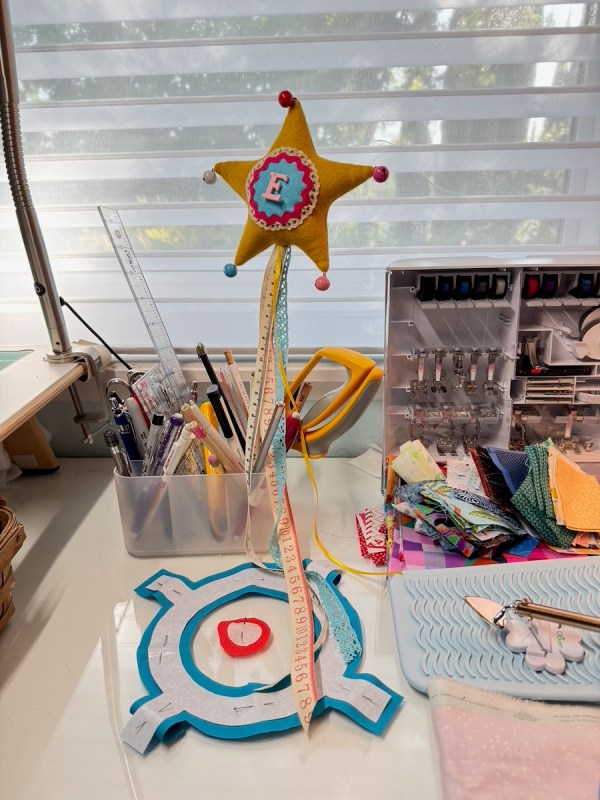
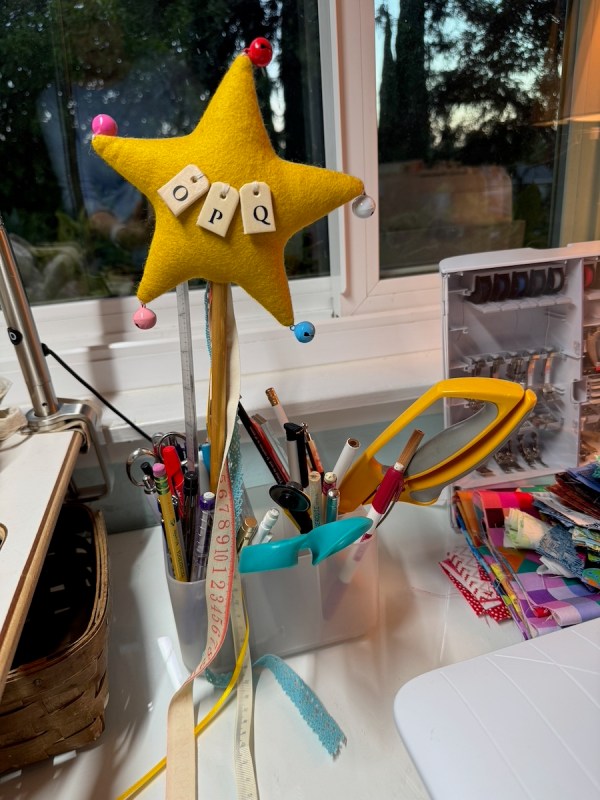
I put it in my scissors-and-pens container when I got home; when I sew on my machine, I can hear the little bells jingle. A treasure, from the hands of Janine.

When we were at MacCulloch & Wallis Ltd, we each got a tote bag with our purchase. Which leads me to confess I have a true love of tote bags. And Scotland and London feed that habit as they are Very Serious about no plastic bags. Maybe if we here in America had all these cute bags, we’d get rid of our plastic bags, too (except for special necessary occasions). Here’s most of the bags I toted home:
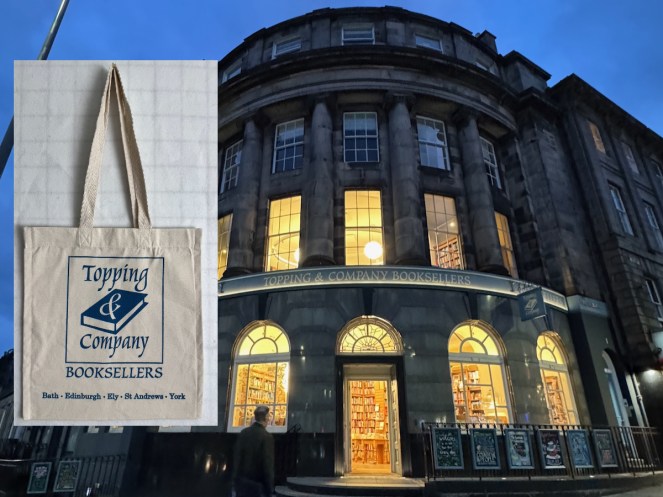
Topping & Company was the beautiful bookshop right around the corner from our flat in Edinburgh

Detour Story:
When I was chatting with the clerk at Topping and Co. bookstore, telling him how much I enjoyed being in his shop, I mentioned that it was not like our bookshops at home. He asked me what they were like. And I said well, most of the things in the bookstores are not books. He then said the owner made a calculated decision to not even let pens be sold in the store because if pens come in, then you have to have journals and if you have journals, you have to have stationary, and so on. The whole place is just gloriously filled with books, along with a couple of racks of greeting cards, but that’s it.
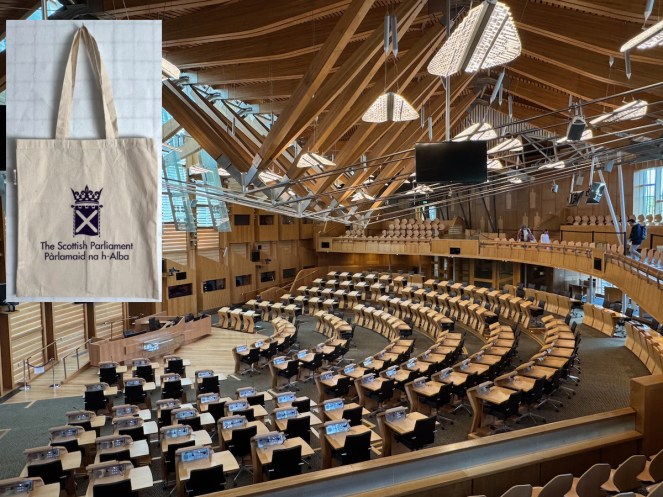
Scottish Parliament Building (another tote). The deal in that gift shop is this: you can buy a paper bag for £1. Or you can buy a cloth tote bag for £2. That’s a no-brainer to someone who loves textiles.
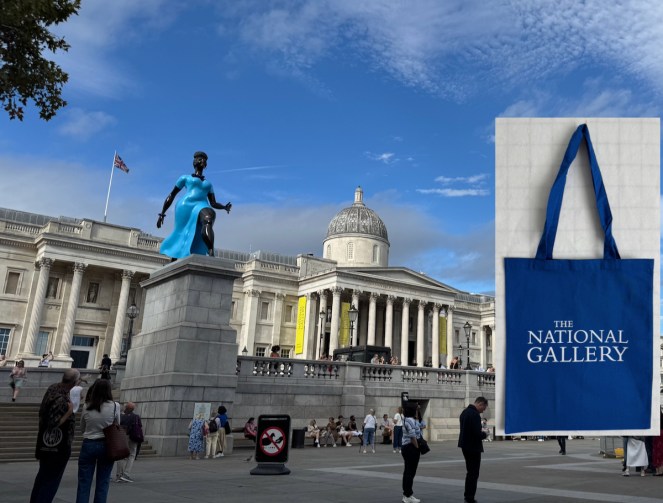
National Gallery of Art (London) Some of the art is posted here.
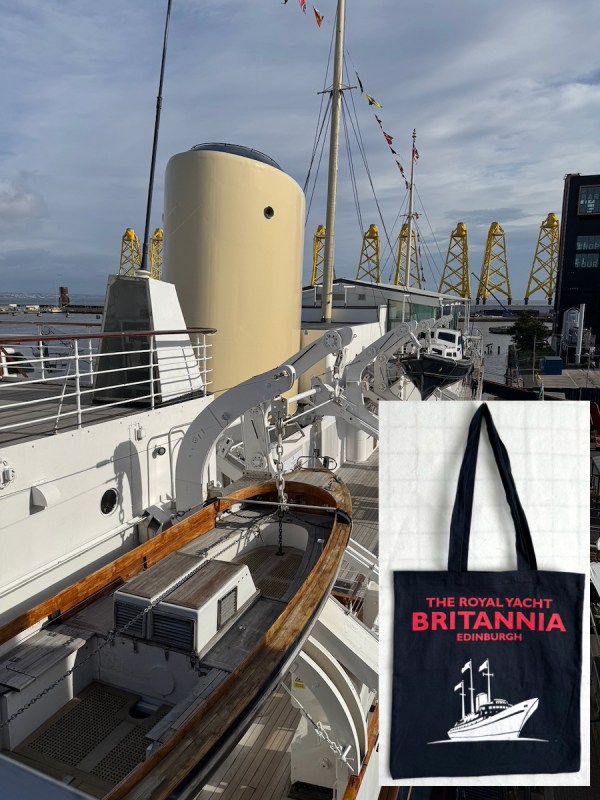
The Royal Yacht Brittania, Queen Elizabeth’s decommissioned yacht, AKA Corgi City. I carried this bag around after that, but turned inside out so it wasn’t sooooo obvious I was a tourist.
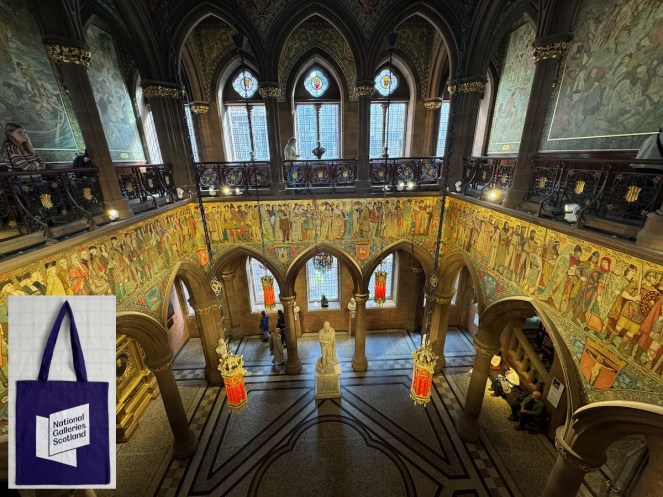
National Galleries of Scotland (there are actually four of these linked museums, but they all share the same style of tote bag). Here’s a post about the tiled floors in the National Museum of Scotland. Above is the inner atrium of the National Portrait Gallery.
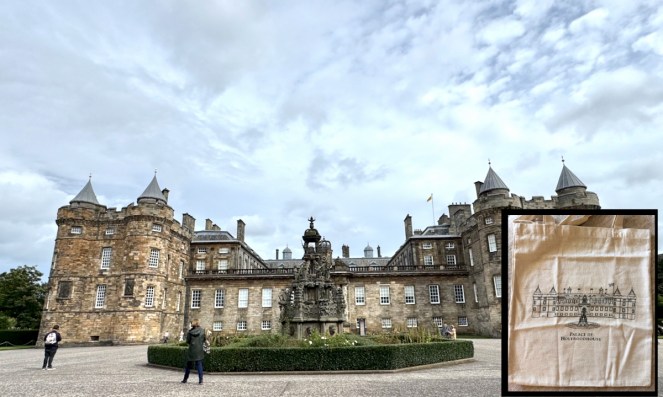
Holyroodhouse Palace. I was there on the “special day.” If I coughed up a bunch more £-notes, I could see the Queen’s Royal Apartments. I met some a mother and daughter who’d come up from Essex just to tour these rooms. I asked them “Do we like Camilla now?” Oh, yes, was the reply. “And how about your most recent returning royal, Prince Harry and his wife?” The two women looked at each other and shook their heads, saying something about how they need to keep their heads down and be proper royals. And in true British fashion, both of these women’s middle names were Elizabeth.
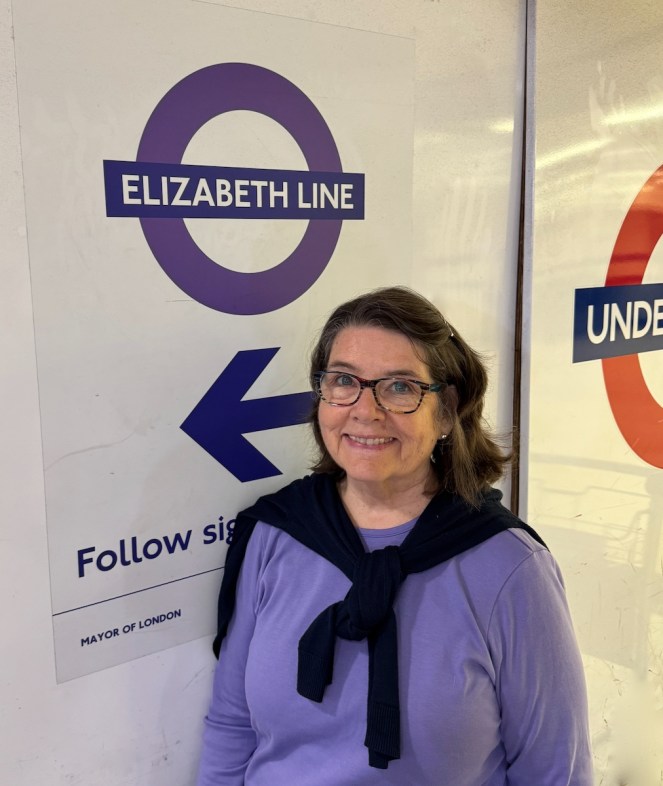
Last photo from London, in the Heathrow airport. I never did ride on the Elizabeth underground.

Next trip!

Bonus Tote Bags:
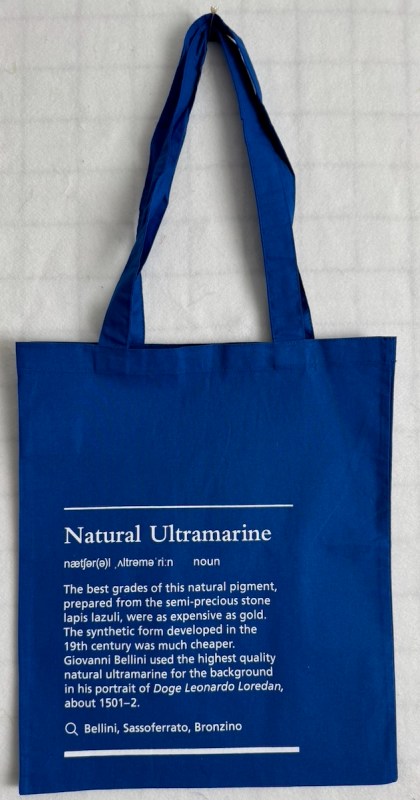
Backside of the National Gallery in London bag. Somewhere in the millions of title cards I read while going through museums, there was a line about what will we do when we don’t have museums to learn from? I loved that they were teaching me even on a tote bag.
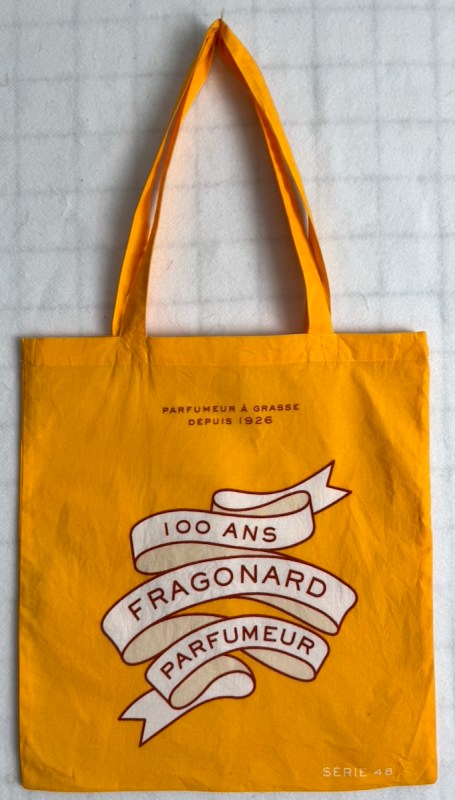
As fellow lovers-of-cloth, you will understand when I tell you that I grabbed this from the tray in the hallway with someone’s garbage from their take-out dinner. I dumped out their cartons (neatly) and took it back to our hotel room. This heroic rescue made us just late enough that we had to run to catch our bus. #worthit
Travels

Scotland and the Tartan Adventure

This past couple of weeks I’ve been traveling in Scotland, with a coda of several days in London. In Scotland, we stayed in Edinburgh where my husband had two scientific conferences which kept him (and us) tethered. We were fine with that, knowing how one can really explore a city if you are in it for a while. I’d done this before with Berlin, and now looked forward to exploring this city.

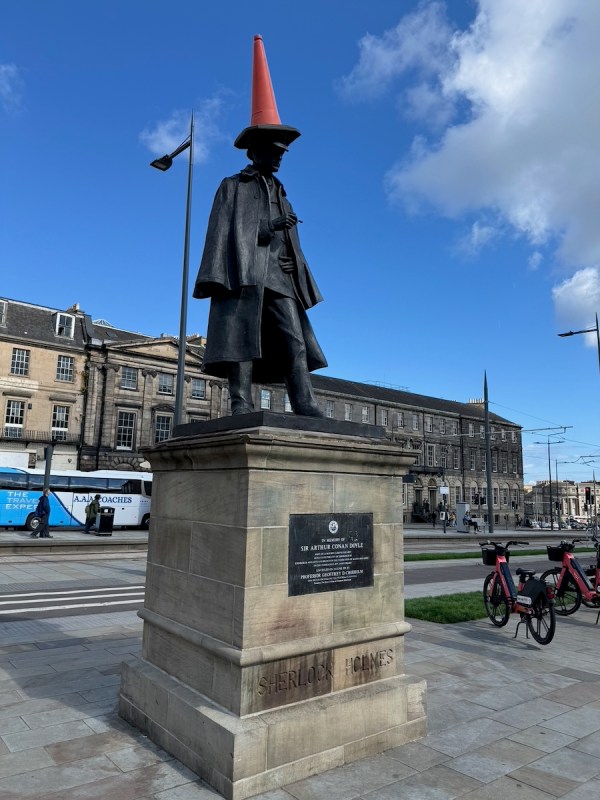
And…I wanted to buy some tartan. Or plaid, if you want to call it that (great article on that idea). We arrived in Edinburgh, took the tram to our hotel and were greeted with Conan Doyle’s statue with a cone on his head. I started laughing, but since my husband hadn’t seen much of the Tartan Army’s invasion of Boston during the World Cup this summer, he didn’t quite get the joke. I loved it. Welcome to Scotland!
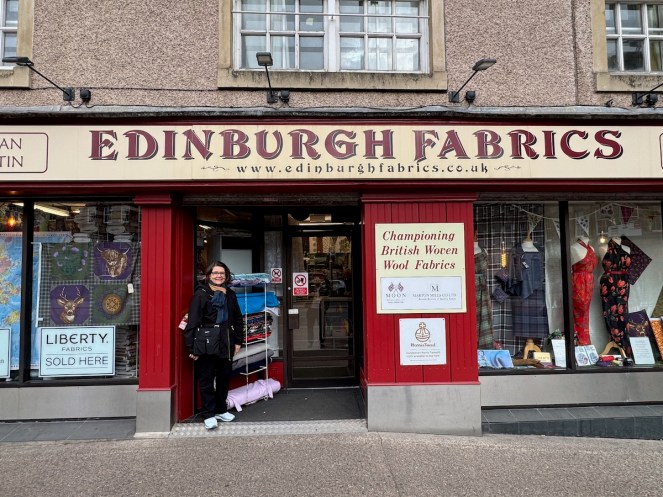
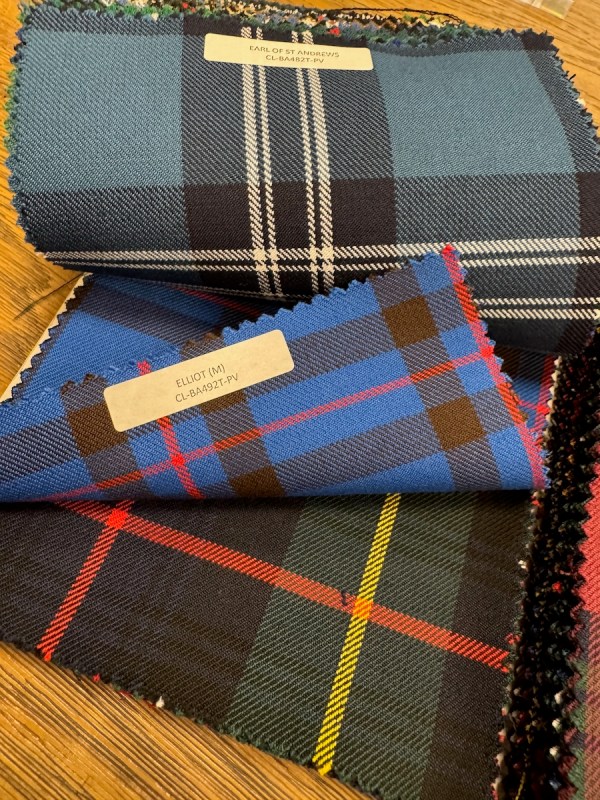
The next day, our first foray to a fabric store was to Edinburgh fabrics. I was on a tartan hunt, and I wanted blue tartan.

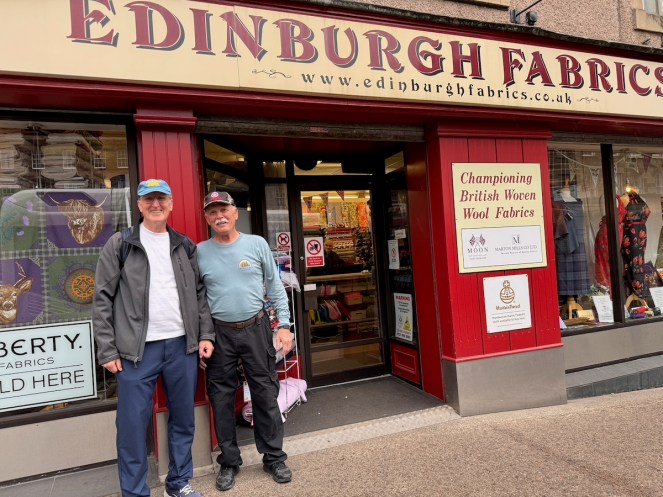
We took a bus from our hotel (really well sited; details at the end) and in a few minutes we were there: Edinburgh Fabrics. I was not interested in the acrylic or polyester versions which I’d heard were in a lot of shops on the Royal Mile, but only 100% wool tartans from Scotland. I’ve been sewing with wool my whole life, so even though I now live in a warm climate, I wanted the traditional cloth.

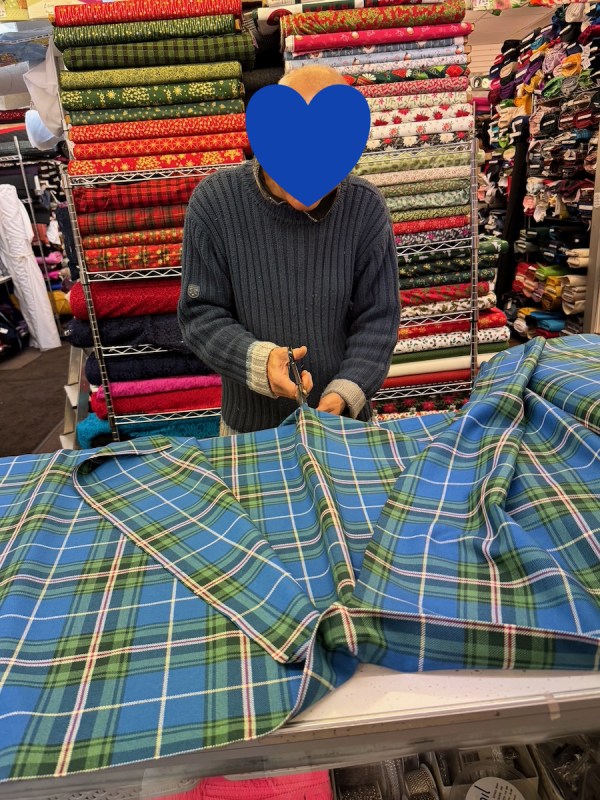
I promised the fabric-cutting guy I wouldn’t post his picture.

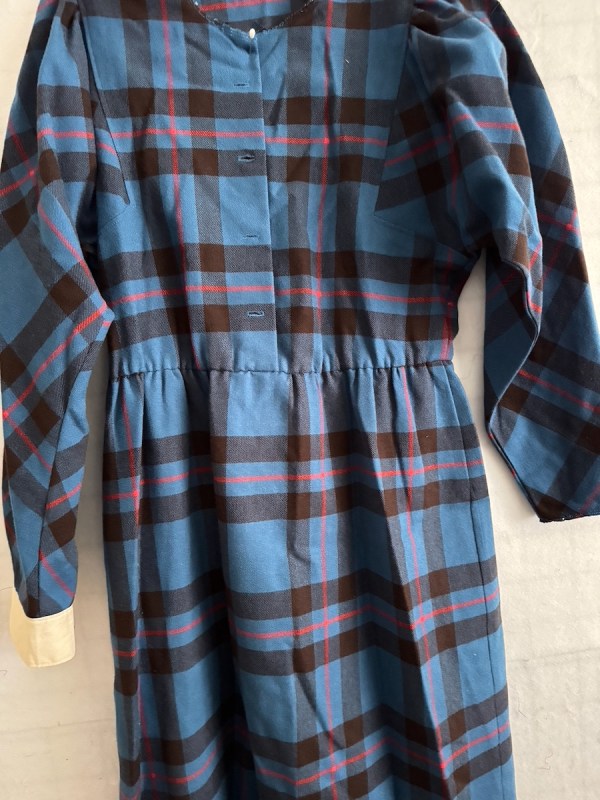
Pretty quickly, I found the blue I wanted. I purchased a meter of wool, knowing that with its width, I could make a skirt. But the idea in the back of my mind was this dress:

I purchased that wool ages ago and made the dress. In cleaning out (and preparing for this trip) I found the dress again, and decided if I took it apart (one cuff and the collar are already gone; next is to separate the skirt part from the bodice part) and then augment the top with well-placed other pieces of tartan, I might get a jacket out of it. This is all in the fuzzy planning stage; stay tuned.

When I went back outside, I met the man in the blue T-shirt. His wife and her friend were inside the shop (I’d seen them picking bolts of fabric) and we struck up a conversation with him (my husband is on the left). He was cracking jokes left and right about quilters and stopping at shops. We were laughing at so many of them in complete agreement and understanding. The two couples were from the USA (the other man was in a car, driving around since they couldn’t find a parking place) and had been traveling around for 4 weeks…and stopping at every quilt/fabric shop. My kind of people!

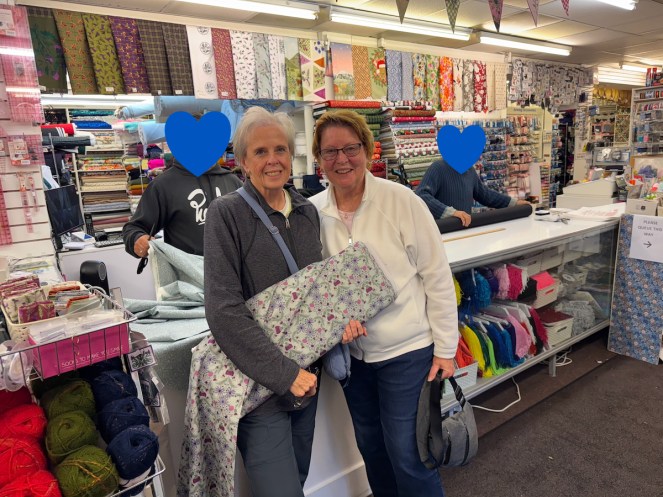
So I ran back in the shop and took a photo of these lovely quilters. Wish we had more time to compare notes.

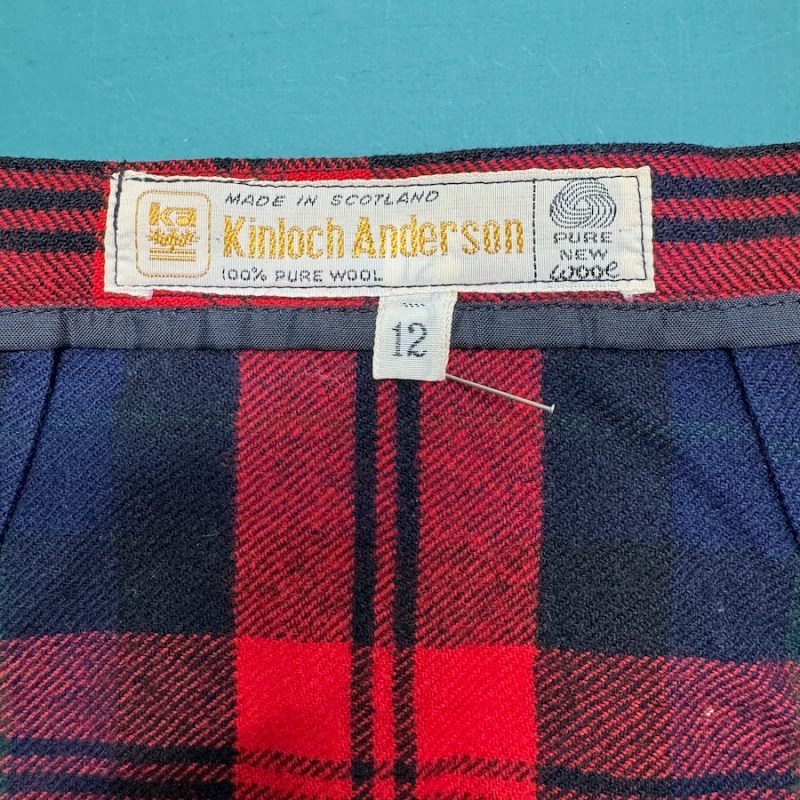
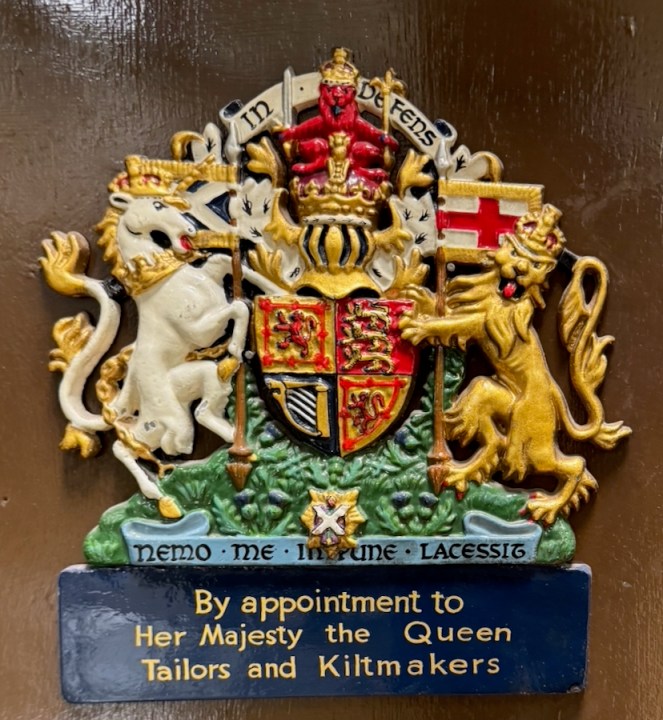
But the real experience I was after was a visit to Kinloch Anderson, all because of this skirt (also found in while cleaning out). I’d purchased it ages ago, the same time as the tartan plaid above, and I was interested in getting another as a souvenir for my time in Scotland.

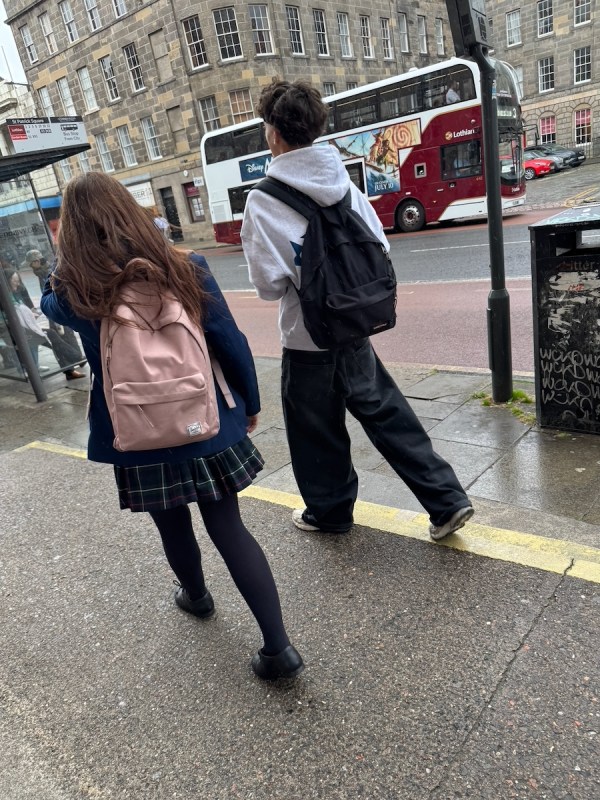
(Tartans are worn for many school uniforms, like this kilt skirt on the young woman)

To visit them you get on their website and make an appointment. I did that about three weeks before I left, and we had an email conversation with what I was looking for, what I was interested in buying. So the next day, my husband and I got on the tram and went to Leith, right next door to Edinburgh.

Even though the tram was a bit late, and it was a drippy rainy day, the woman who greeted us was charming and kind and put me right at ease. We talked over our options, and she told me they had kilts I could order, or they had “kilt skirts” for purchase there, but I couldn’t choose the tartan — had to pick from what they had.

(from a display in the front)

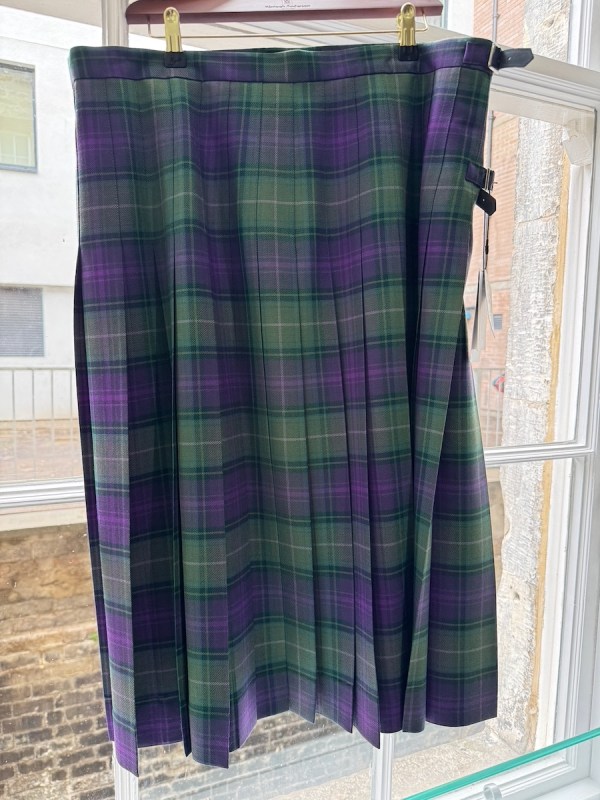
I immediately fell in love with a soft green and purple skirt and tried it on. My husband thought it looked great, too. The woman helping me was ready to help me choose a tartan, get the fabric ordered from the weavers, but I told I liked this one, and would take it. I’d also done some research on the vagaries and mysteries of our country’s erratic tariffs and knew I could be paying a hefty sum on top of the shipping. It was a huge unknown.

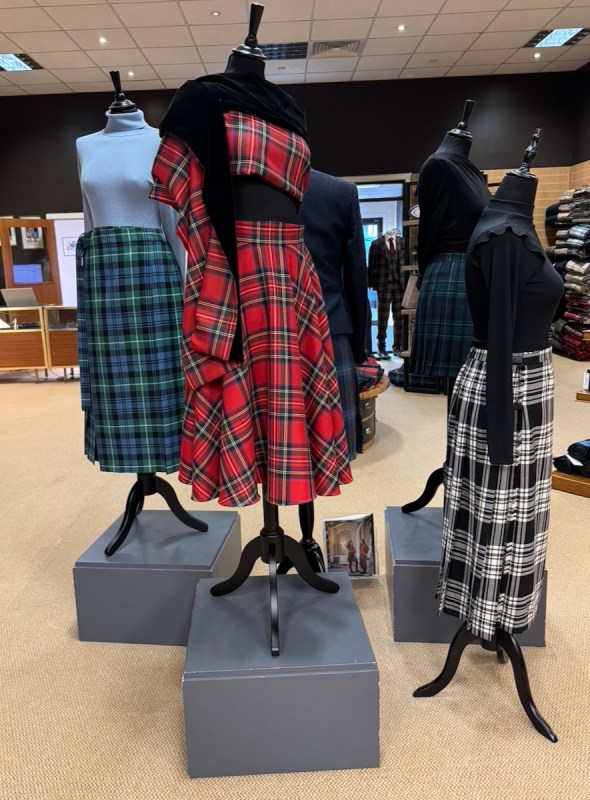
We discussed this, and she was also aware of this limitation. For me that was a huge part of my decision to buy the kilt skirt right then. (The drape of it is shown in the black/white plaid on the right. They had two other styles, shown in the blue/green and the red.)

So what is the different between a kilt and a kilt skirt? The amount of yardage, for one.

(my husband took this photo in their small display room; right-click to open in a new tab, then click to enlarge)

A true kilt has about over eight yards of fabric. That is one reason why it swings so wonderfully when the wearer moves. I forgot how much was in a kilt skirt, but I think it’s more like around three yards, a dramatic difference in the amount of fabric, but also the weight of the garment. There are also varying weights of the wools; mine was a lighter weight.

Mine was mid-calf length, not short like this one. At this point, my husband took off to go get breakfast and walk around Leith, a picturesque town, so we said good-bye.

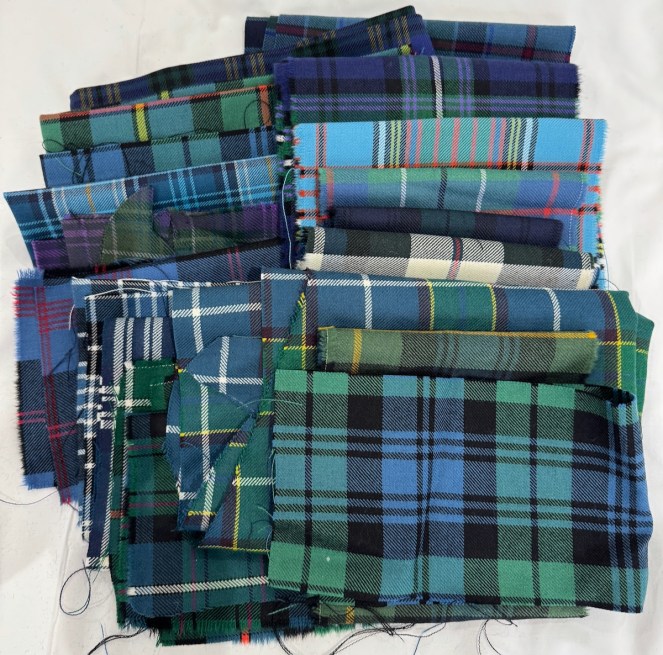
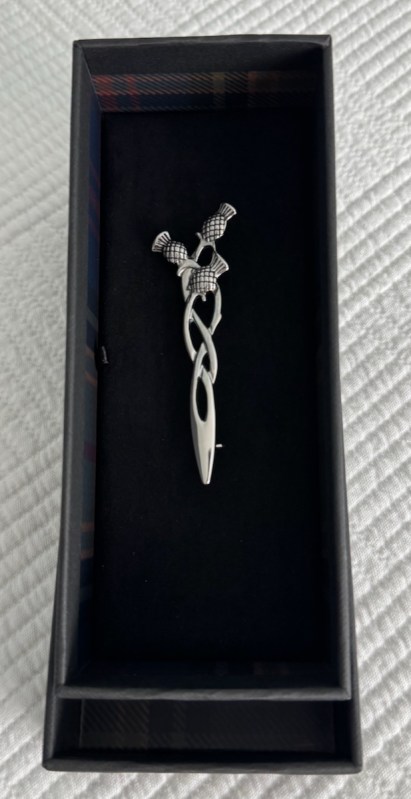
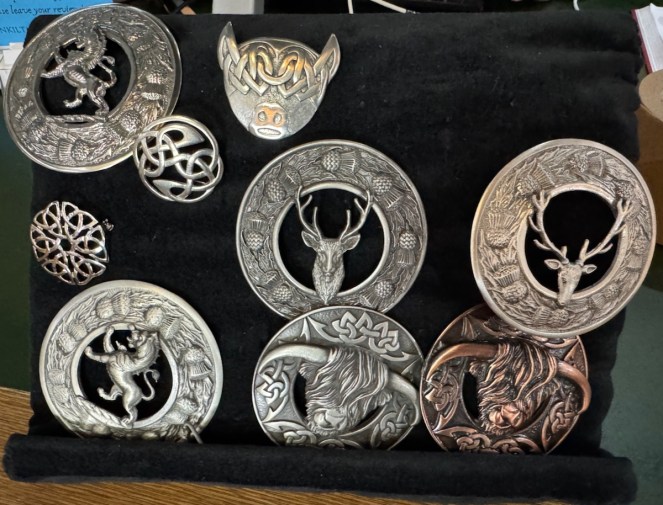
The woman who was helping me was ready to wrap up the sale, but I also wanted a kilt pin, a fancy one. So we went to an adjoining bay off the main room, and I chose one. Then she thought I was done, but I’d also read about their scrap bags. (I’m a quilter through and through.) She said she was the one to be choosing the size and color, so what did I want? Blues, of course, and about “this big,” as I held my hands in the approximate size. She left to go find the scraps, leaving me to explore in the area we’d started.

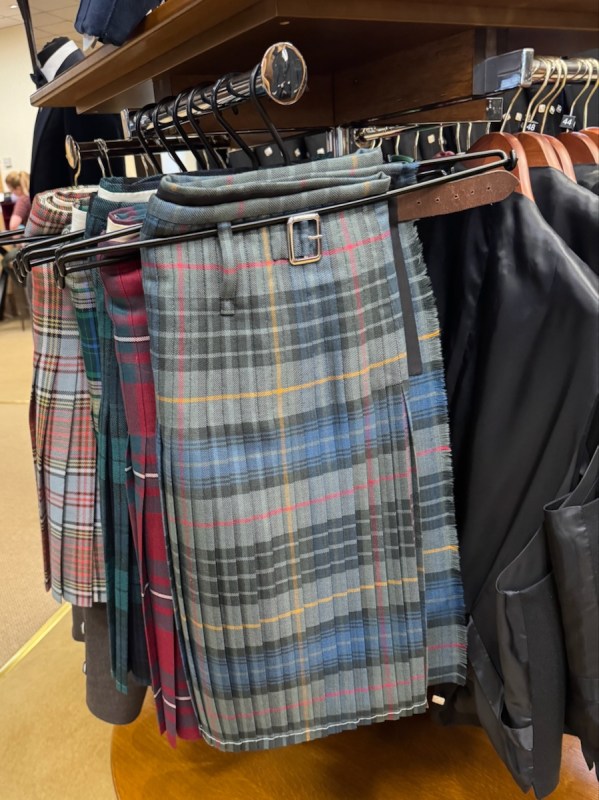
I found a true kilt. No dainty skirt hanger clips for this one.

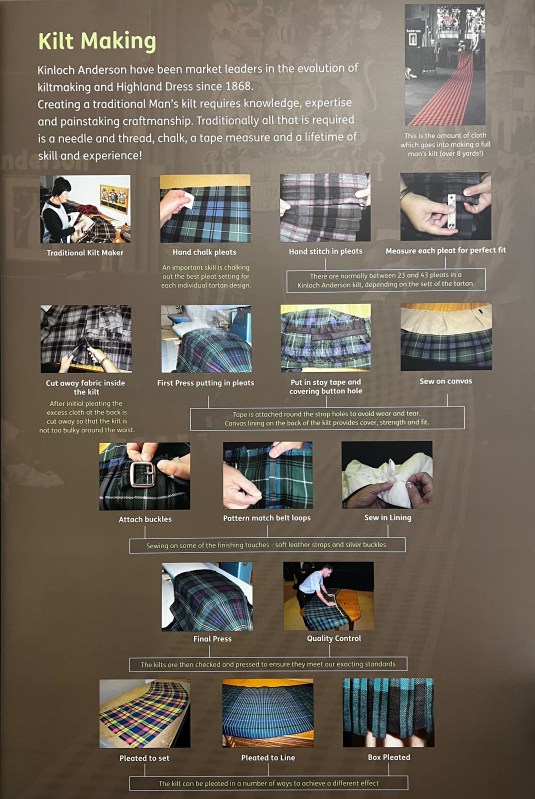
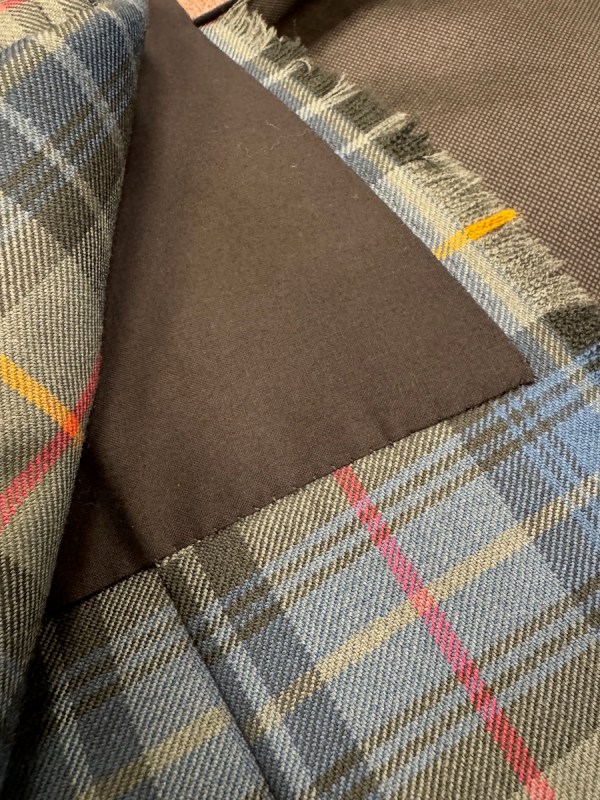
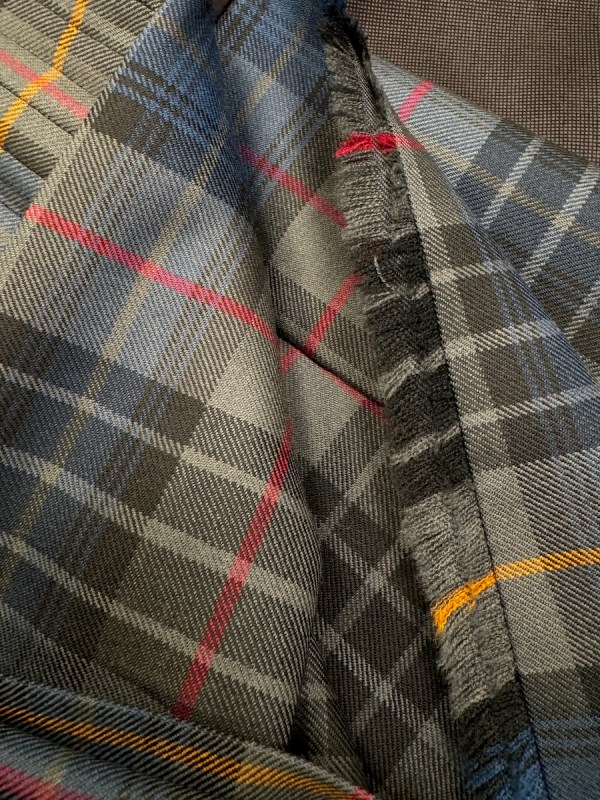
I hefted it off the rack and laid it on the table. I was interested in seeing the construction.

I loved the hand-stitching on the above inner panel, and the neat edge treatment with the 1-inch fringe. I carefully replaced it on the rack.

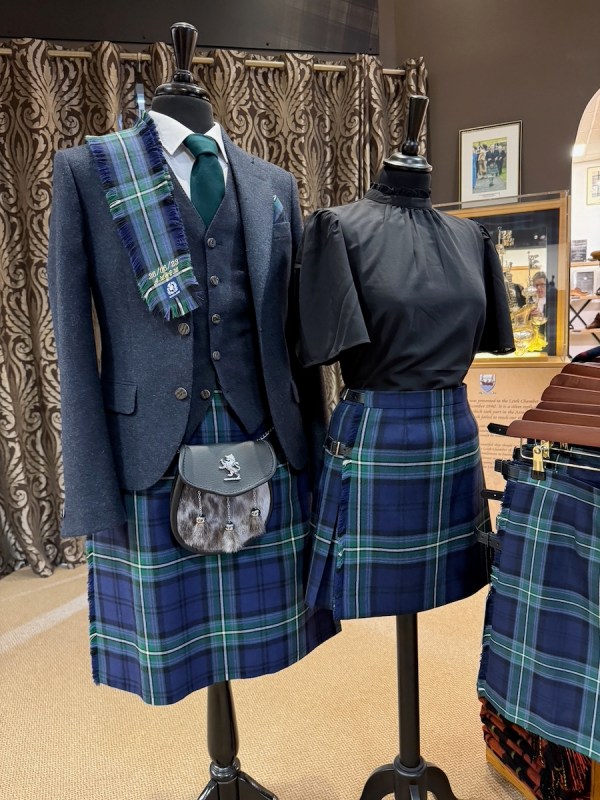
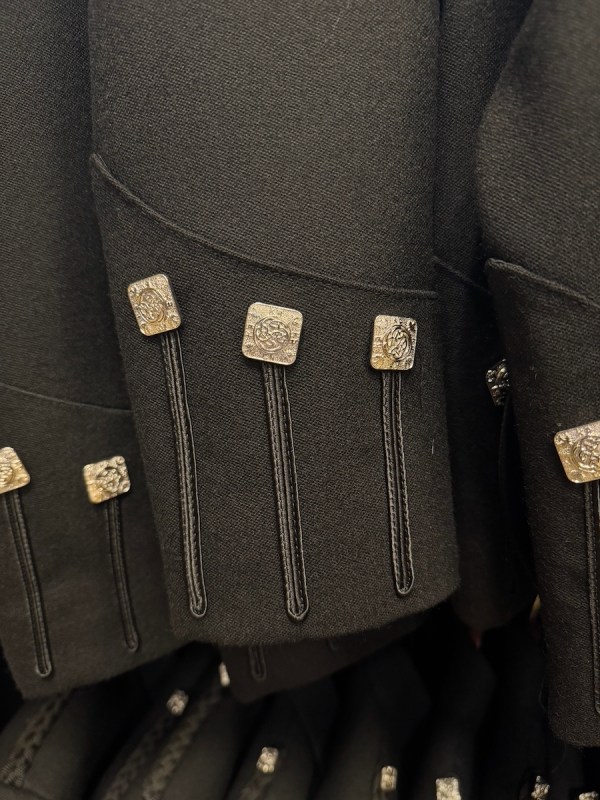
They made and supplied all parts of a kilt outfit, from the jackets to the kilts to the stockings and shirts and accessories. I loved these snazzy and elegant cuffs on one of the jackets for men.

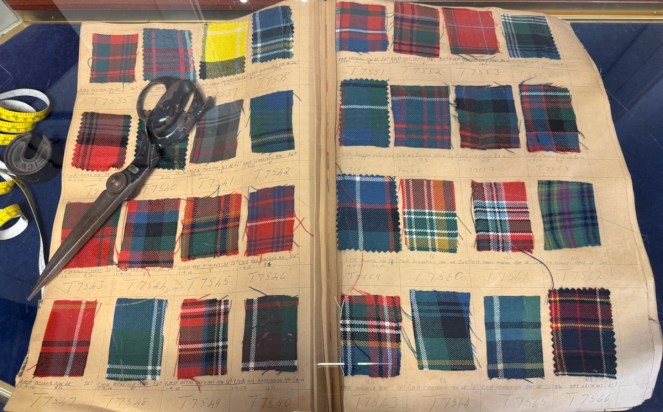
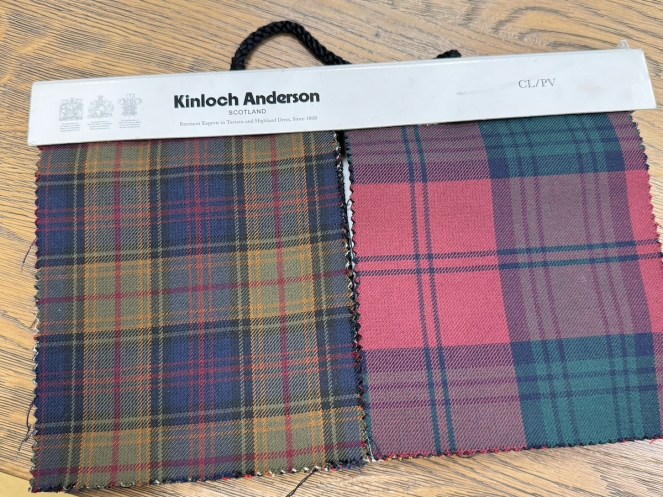
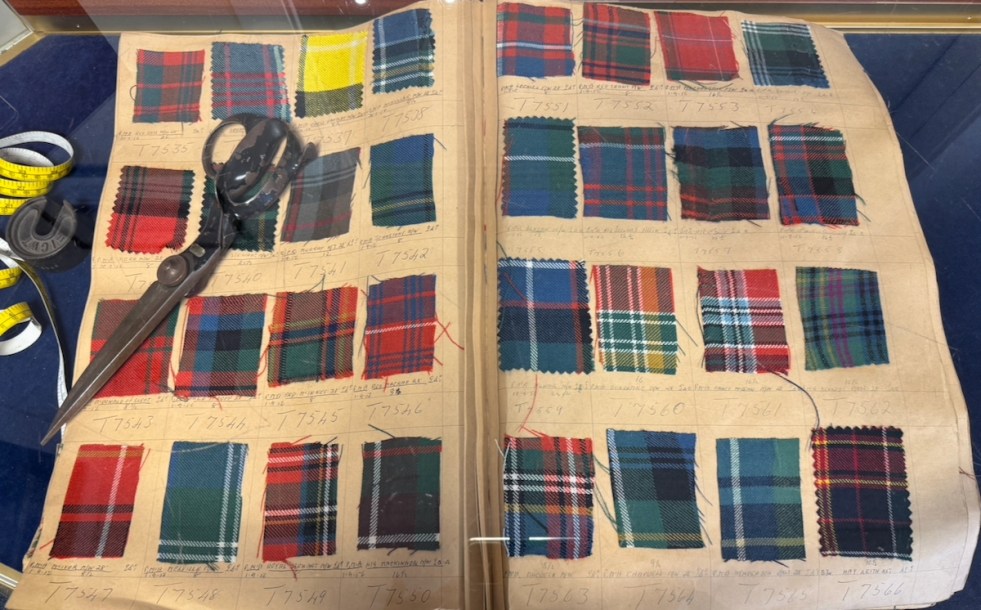
They had many books of tartan samples.

This one reminded me of my dress. I can’t remember the details of the purchase of that tartan fabric long ago, as we were all using cameras and film and didn’t document our lives to the extent that we do now.

She came back with two scrap-bags full of tartans in blue. I was in heaven! I can really have fun remaking my dress bodice into a jacket, if I can just figure out how, with some leftovers for other various projects.

My husband returned from his walkabout, and we chose two ties for him in two different tartans, one Christmasy in red and green, and one in blues (of course).

This is my twined thistle style of kilt pin, even though they included a more traditional pin with the skirt.

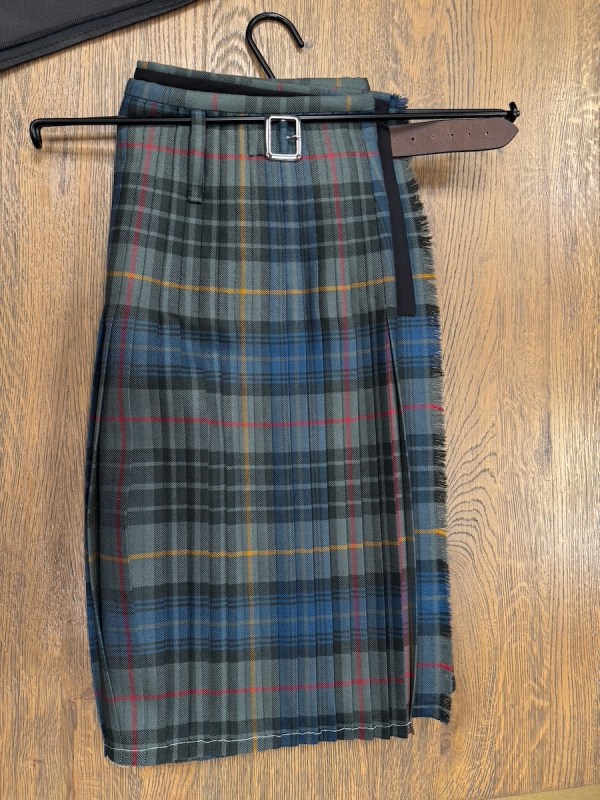
She brought out a beautiful skirt hanger and a garment bag, and we took it back to our hotel where I hung it up in the window to take a photo. This tartan’s name is “Kinloch Anderson Heather,” the skirt a midi-length.

I had one more kilt-related experience in the next couple of days. Again, I’d done some research about high quality shops to visit, as it’s generally acknowledged that the stuff on the touristy Royal Mile isn’t of high quality. Beside the one mentioned above, there was another I knew about:

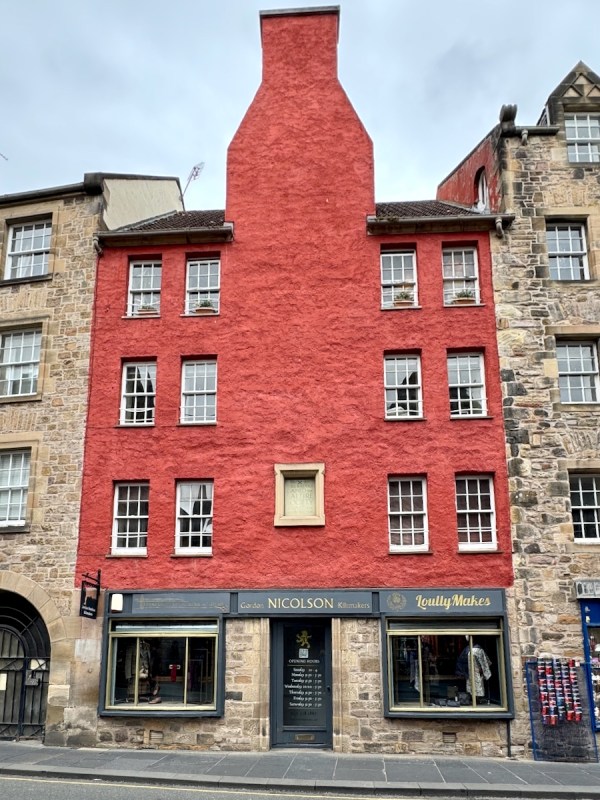
Gordon Nicolson, on the end of the Royal Mile near the Parliament and Holyrood Castle. (As with Kinloch Anderson, I asked for permission to take photographs.)

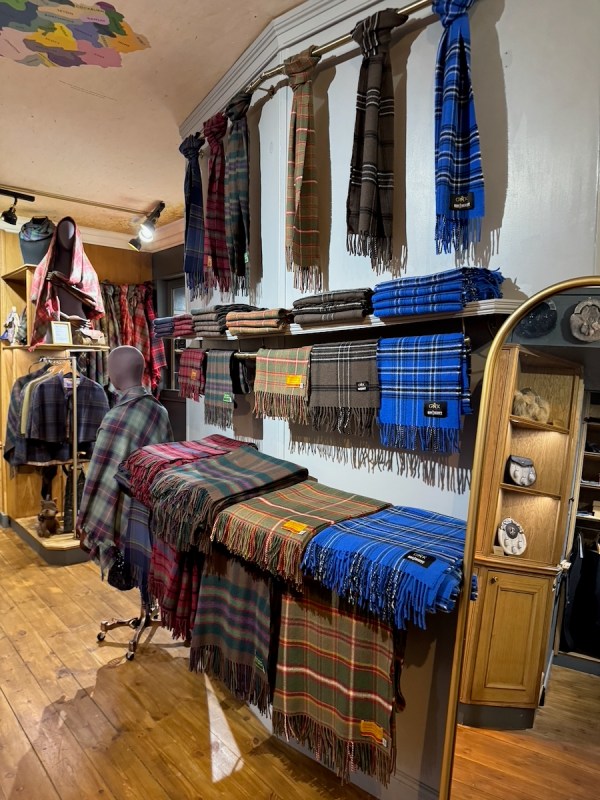
Tartans everywhere in scarves, but they also make custom kilts as well as do rentals for weddings, as does Kinloch Anderson.

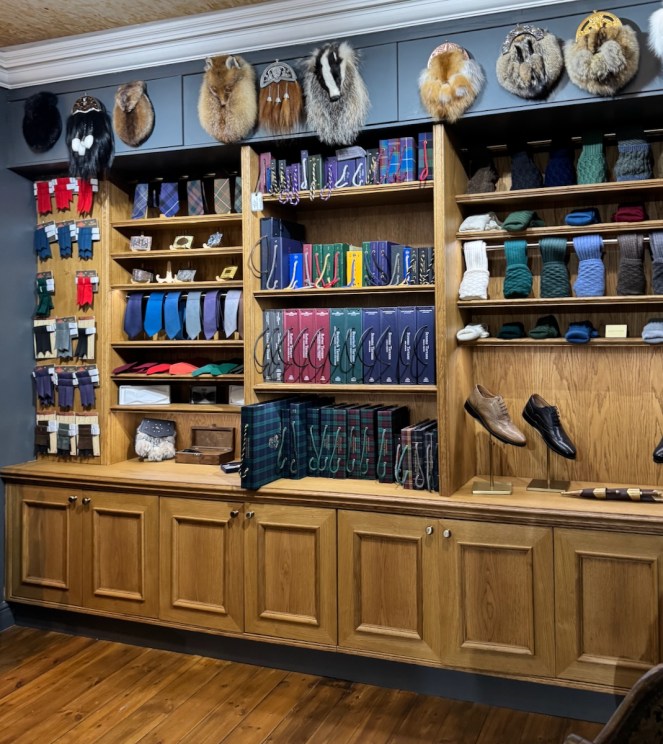
The black and white sporran, above, is not a skunk — like I made the mistake of blurting out loud — but is a badger. Remember that kilts have their origins in the hunting and military skill of the highlanders, and project that image.

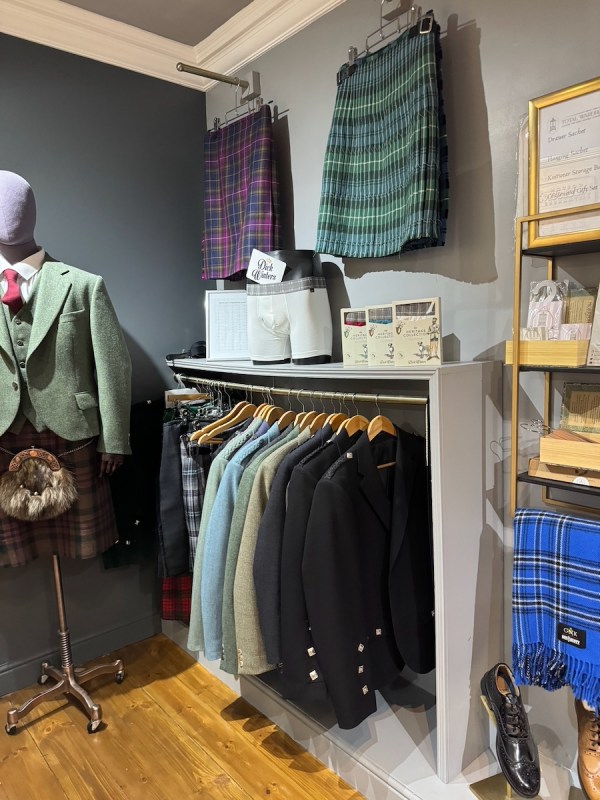
Upon seeing the Dick Winters (above, on the shelf), the age-old question has been resolved.

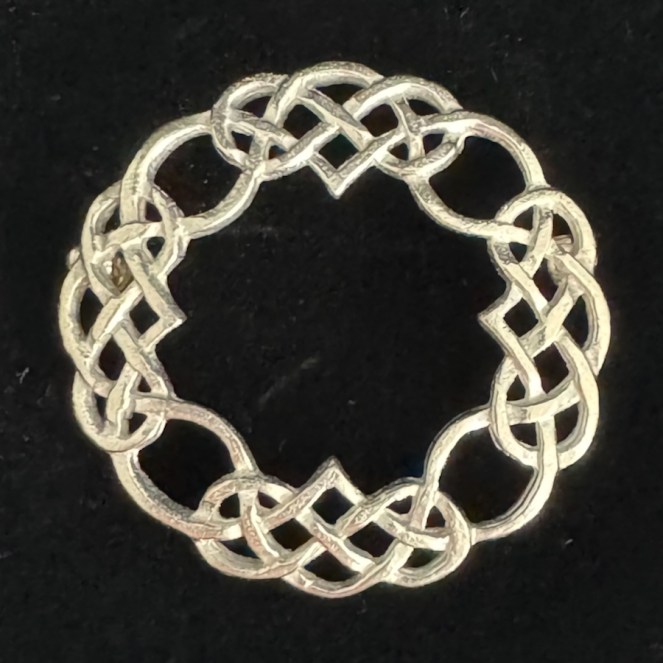
I was there to look for a circle brooch or pin, as I wanted to wear it to the gala dinner at the end of the conference, with a sash (I’d found a long length of tartan in my scrap bag that I could use as a scarf).

I chose an intertwined circle Celtic-knot style. (And in case you were going to ask, I’m probably the only one in the world who has not seen the film series Outlander.)

There was quite a bit of tartan wearing that night, and no one said anything to me, so I guess I looked okay. The venue was the National Museum of Scotland. I put up a post about the floors here.

(at Kinloch Anderson)

Here are the details:

Edinburgh Fabrics
Open 10 AM -7 p.m. Monday through Saturday
12-14 St Patrick Square, Edinburgh EH8 9EZ

Kinloch Anderson
4 Dock St, Leith, Edinburgh EH6 6EY, UK
Their Website This has their address, hours and a link to click for an appointment. They really aren’t too set up for walk-ins, but will try to accommodate you (but please do try to schedule yourself).

Gordon Nicolson
189 Canongate, The Royal Mile, Edinburgh, EH8 8BN
Their Website. You’ll love all the photos and tips and details, and they also prefer that you schedule an appointment. They do NOT sell scraps, but instead re-use them for accessories in their shop (I purchased a small tartan zipper bag), or donate them to charities.

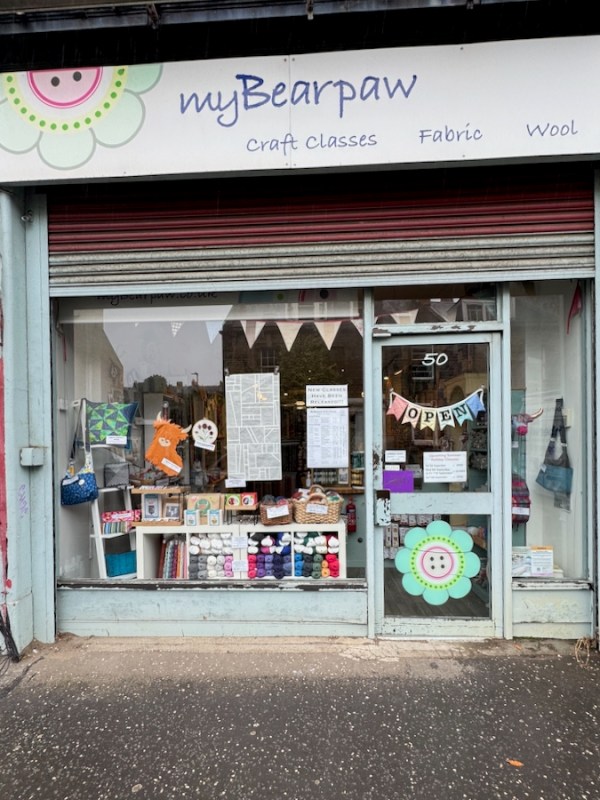
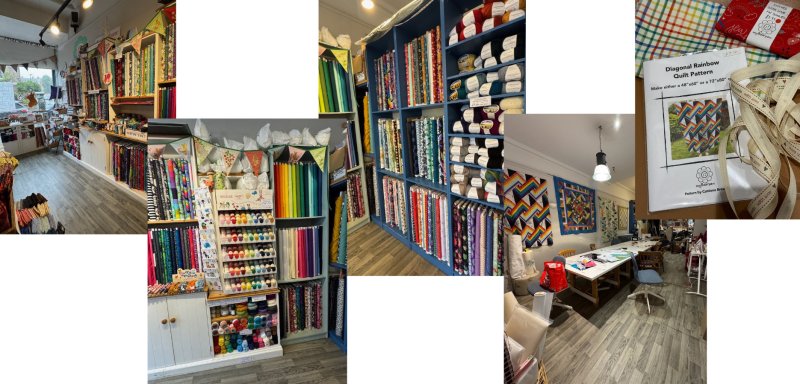
While this post is mainly about my tartan adventure, I did also visit a quilt shop:
My Bear Paw
Website
Open Wednesday through Saturday from 10-5
50 Lochrin Buildings, Gilmore Place, Edinburgh, Midlothian

I purchased her original quilt pattern, a meter of checked fabric, trim and a FQ.

We stayed in the eastern side of the city at Forth House by Supercity Aparthotels, at 6 Broughton St Ln, Edinburgh EH1 3LY. It was a block from the large St. James Quarter (a mall) that has a great ramen place inside, as well as good shopping. It was served well by multiple bus stations and a tram stop.

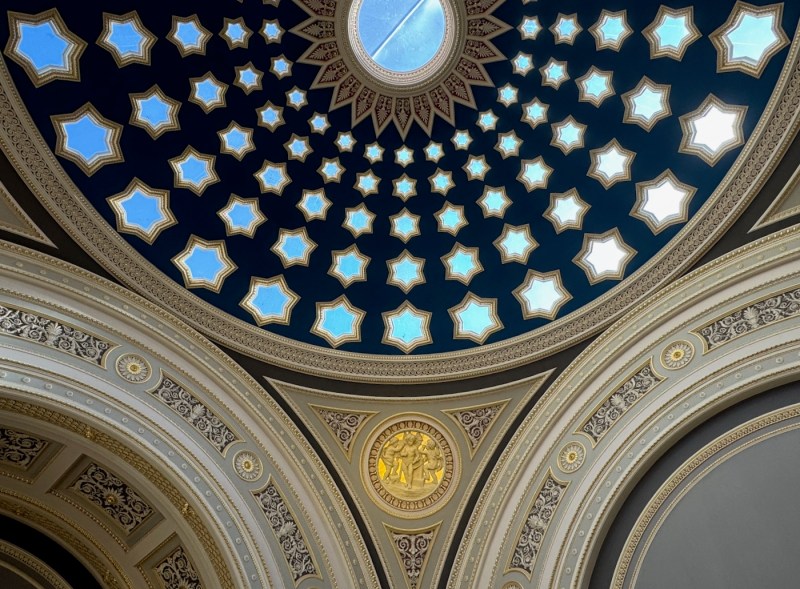
Bank of Scotland Ceiling • St. Andrew Square

Publications · Quilt Shows · Quilts · Travels

Pour l’Amour du Fils • Quilt Show in Nantes, France 2026

I’d read about this quilt show — For the Love of Thread — in the QuiltMania magazines for years. This year my husband and I were finally able to travel to Nantes and attend the show.

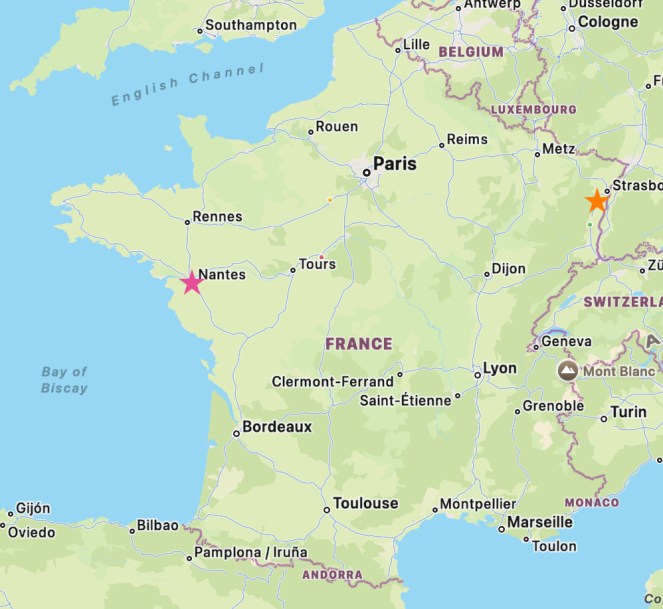
First, some basics: Nantes (pink star) is in Western France, near the Atlantic side of things; most people head to Paris, which is north-central France. The orange star is in Eastern France, and that’s where the Carrefour European Patchwork Show that’s held in the villages of Val D’argent is located. There are commercial tours to both shows, but we were able to plan and travel there ourselves. The Nantes show is held in April; the Carrefour is held in September. (Just do a web search if you are trying to find tours.)

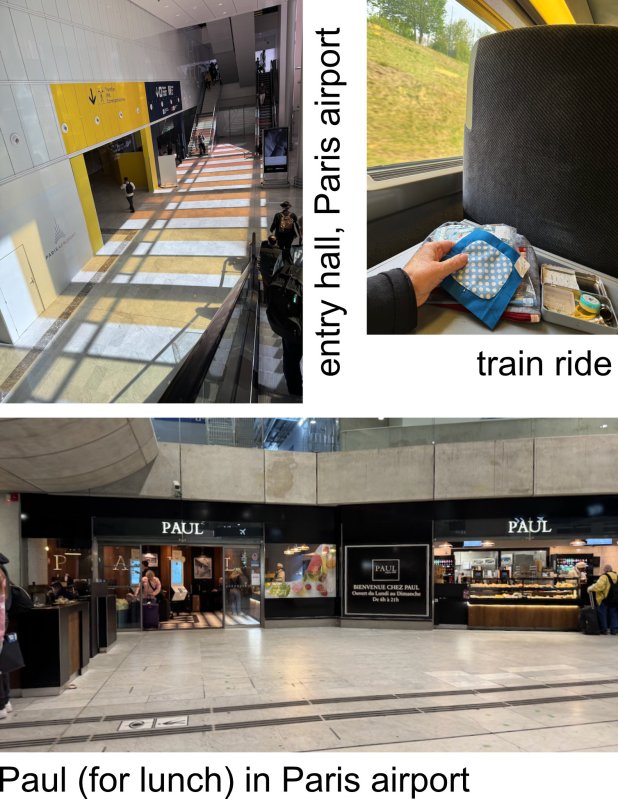
Having traveled to other parts of France, Nantes was a total surprise to both of us — a delightful surprise. It’s the sixth largest city in this country, and has a different flavor than other regions we’ve visited. We arrived at Paris Charles De Gaulle airport at about 1 p.m., then took a train across the country (train left at about 5 p.m. and arrived in Nantes about 3 hours later). This gave us time at the airport to clear customs, catch a bit of lunch, check out the convenience store for chocolate (I’m crazy about the chocolate in France, even the drugstore variety), and then catch our train. While in Nantes, we stayed within walking distance of the Gare (or train station), which also allowed us to catch the tram to the quilt show the next morning.

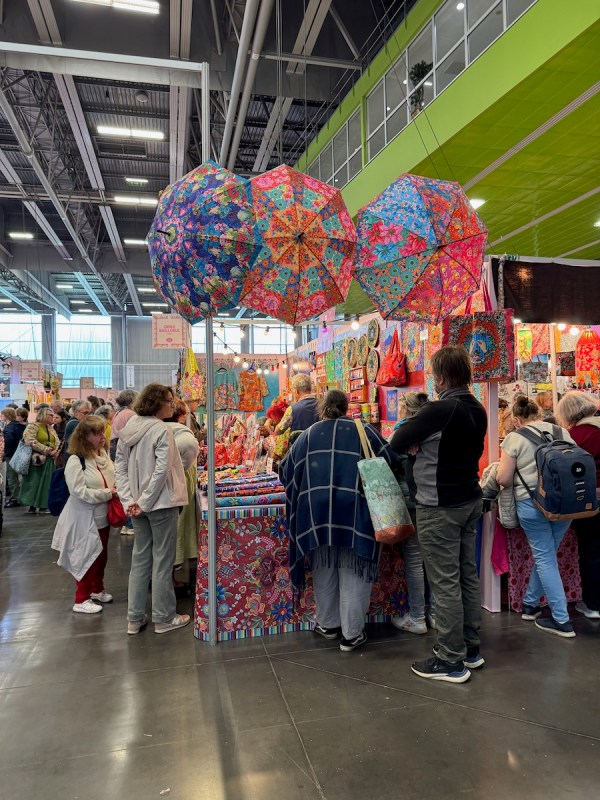
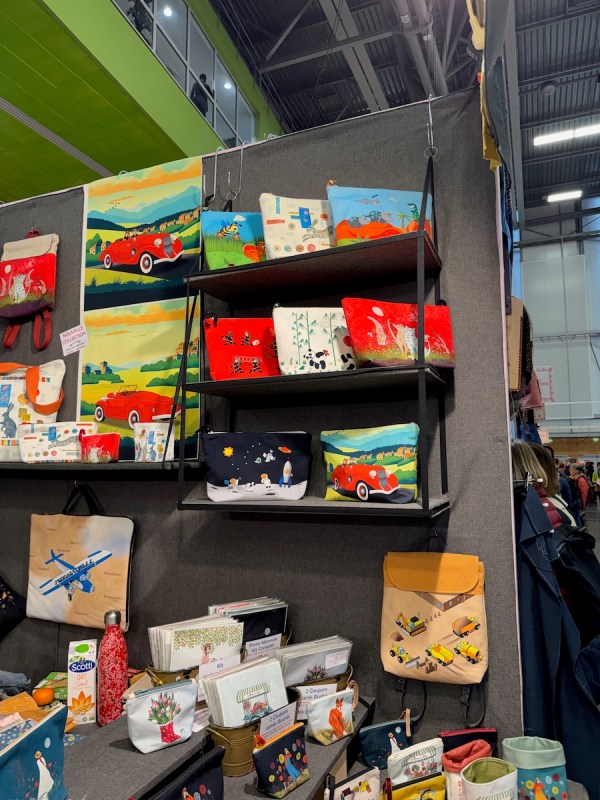
We checked with the hotel clerk, who confirmed what we planned and after buying our tickets, we got on the tram with other women, carrying interesting bags and totes (a sure giveaway for a quilter). I saw so many interesting bags and totes while there, that I made a video.

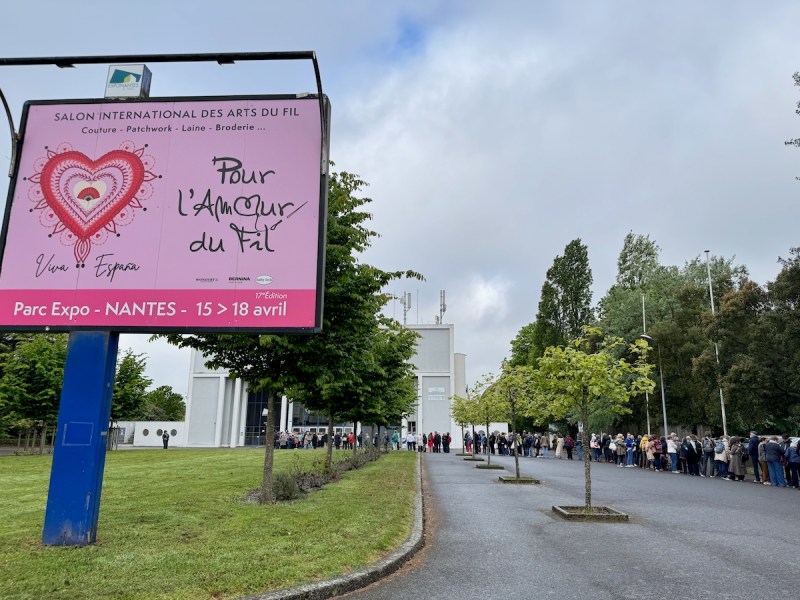
After riding for a bit, wondering how we would figure out where to go when we got off the tram, a woman (I later learned her name was Sylvaine), got on the tram and started doing embroidery, so we struck up a conversation. After about a 20-minute ride, she walked us over from the tram when it arrived at the convention center, or Parc Expo. The quilters were already lining up a few minutes early.

[Note: Here’s a link to a collection of photos of people I met this day.]

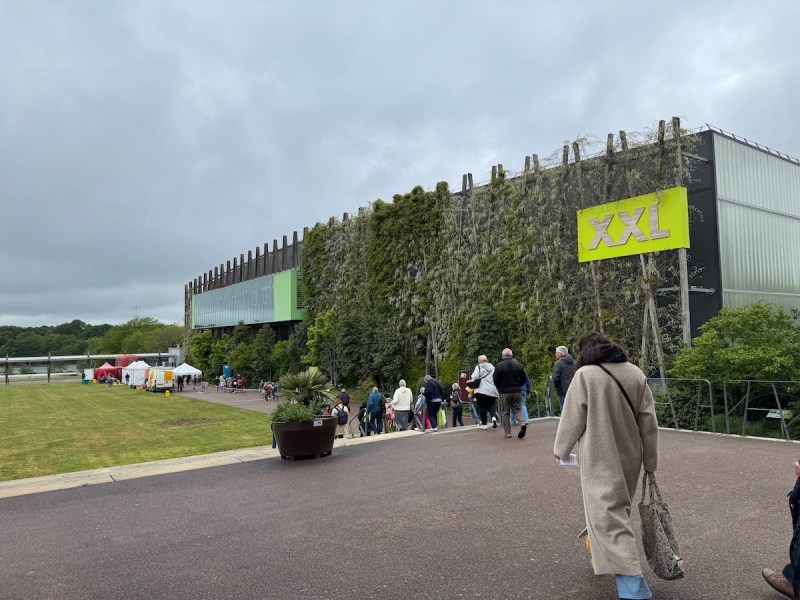
We came in the main door (in the white building in the first photo) where they checked our bags, and walked out the other side. We followed the crowds as they walked over to this building, where the quilt show was being held. The white tents you see are the lunch places. We showed our tickets, got our wristbands (we had purchased a two-day ticket), and were in!

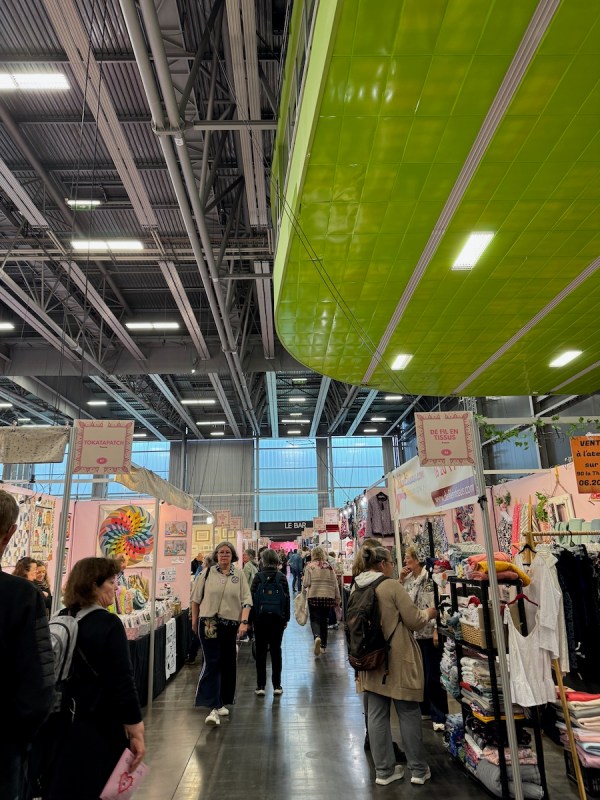
[Hope this video works…] Yes, everything’s in French, but fabric and smiles are a universal language. Most of the booth vendors spoke English as did many of the guest artists (many were from Australia), so I didn’t have a problem. Even buying tickets at the tram stop you can switch to English, and I kept Google Translate handy on my phone for places I needed to know the language.

The guitarist was in front of The Red Dress, and both were beautiful. Haven’t heard about The Red Dress? I hadn’t either until I went to the show’s website before the show and read about it.

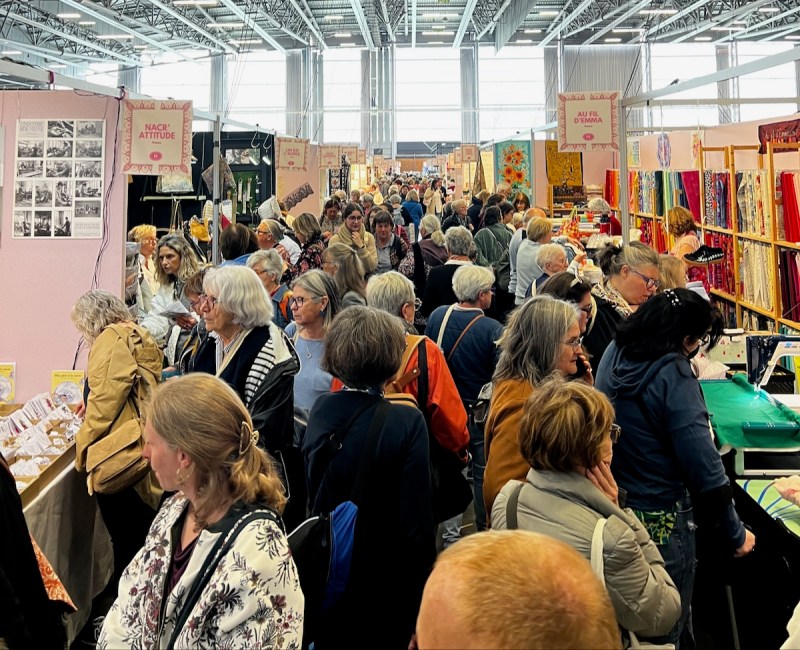
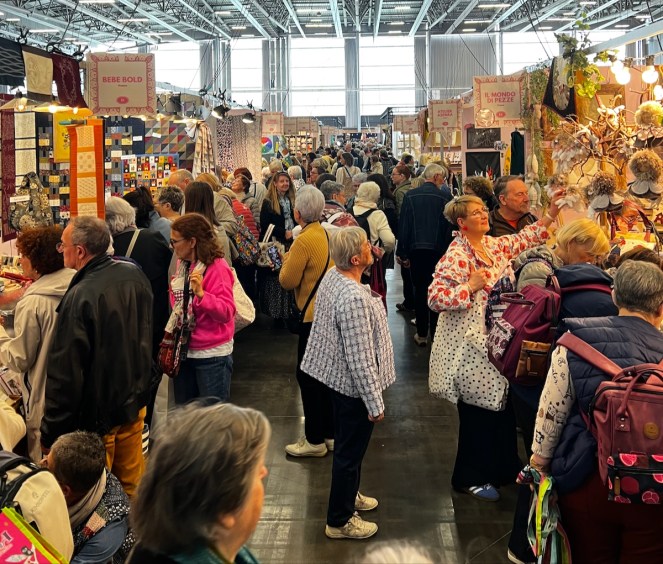
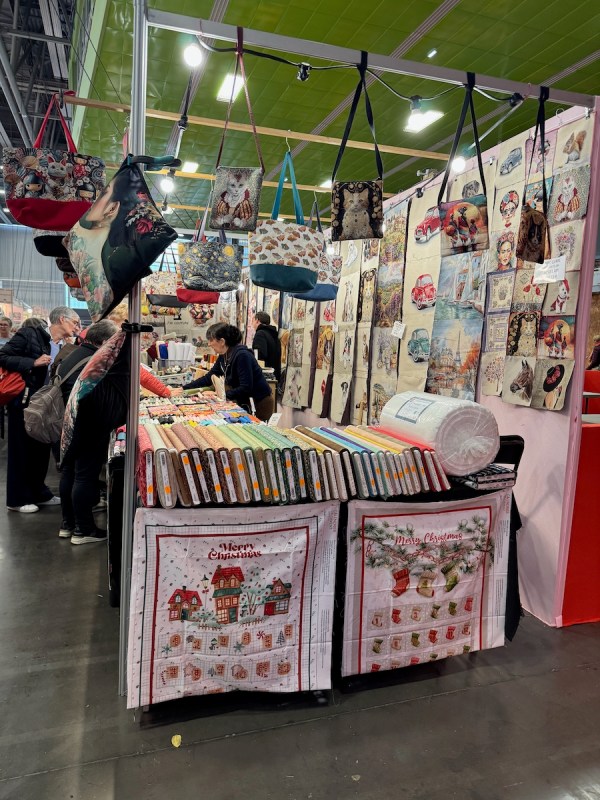
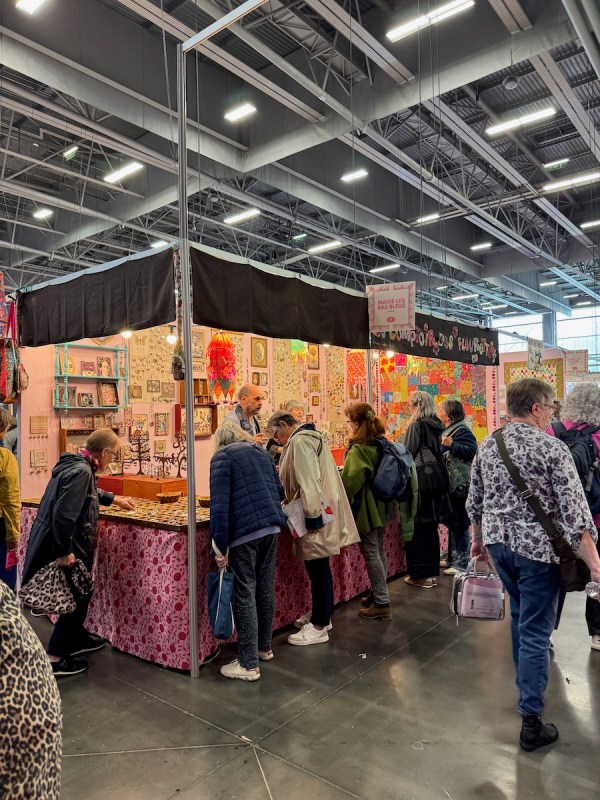
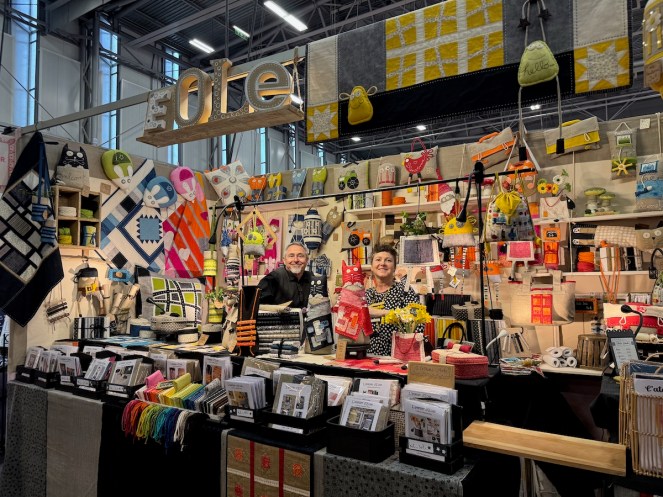
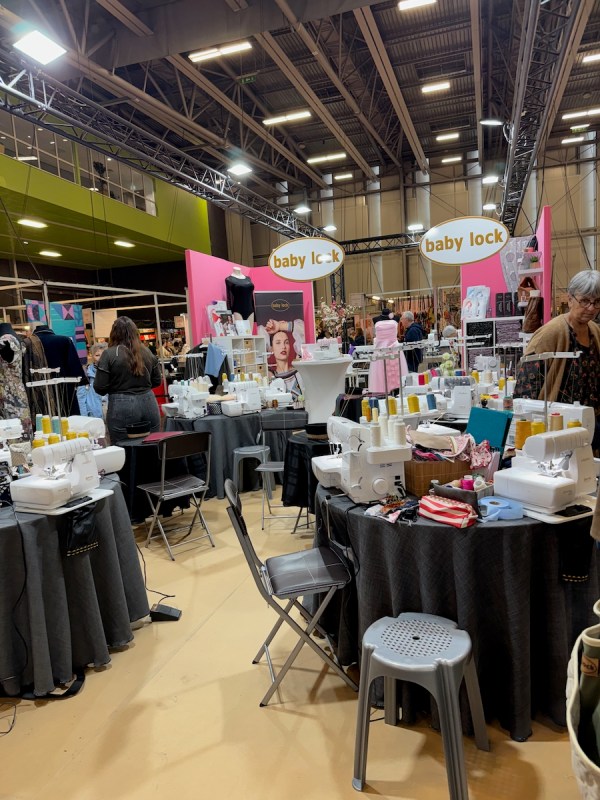
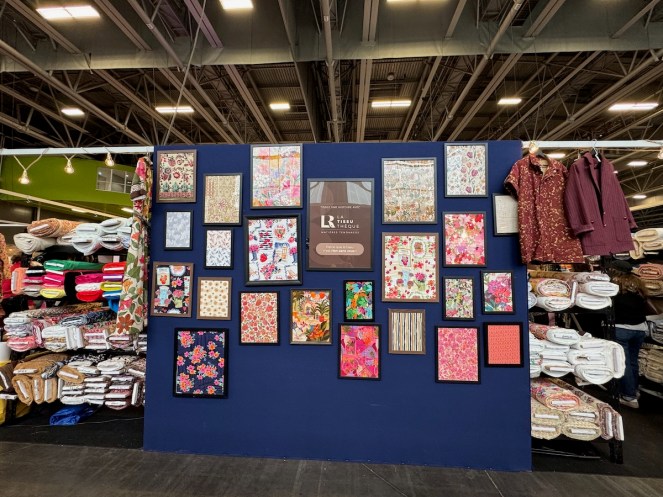
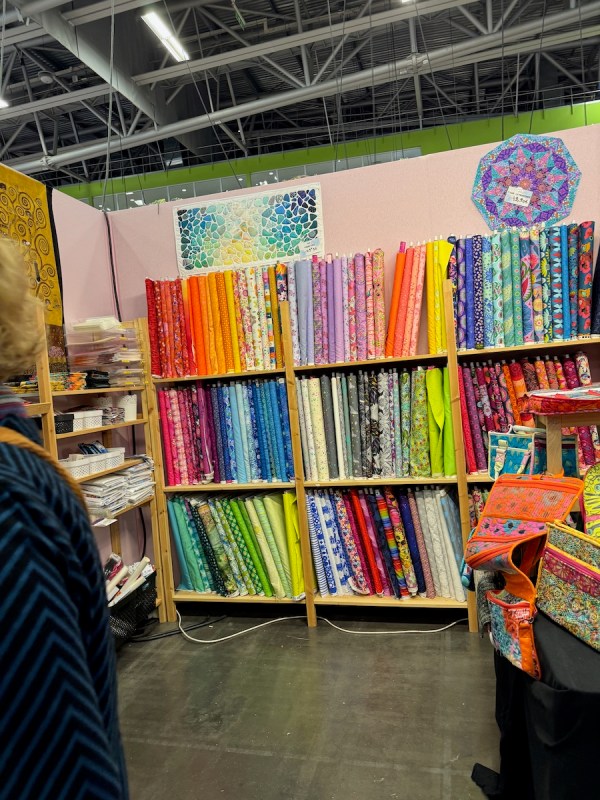
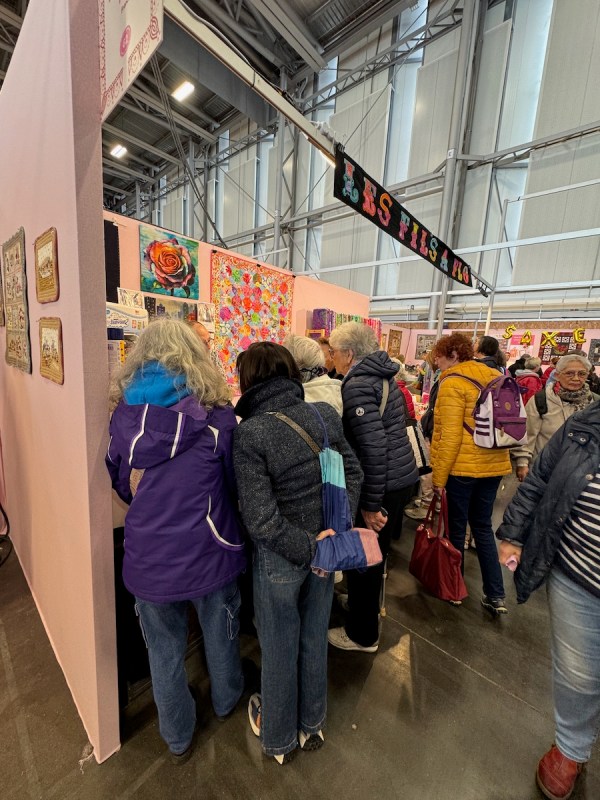
The photo on the left was when we first arrived, when the show opened. The photo on the right was taken after lunch. Quilters had arrived! But it wasn’t just quilters: it was embroiderers, sewists, crocheters, purse and bag makers, and I even saw a jewelry booth. Here’s a slide show of the vendors; click to advance the images:

Note: except for a few crowd shots and candids, I received permission to take photographs.

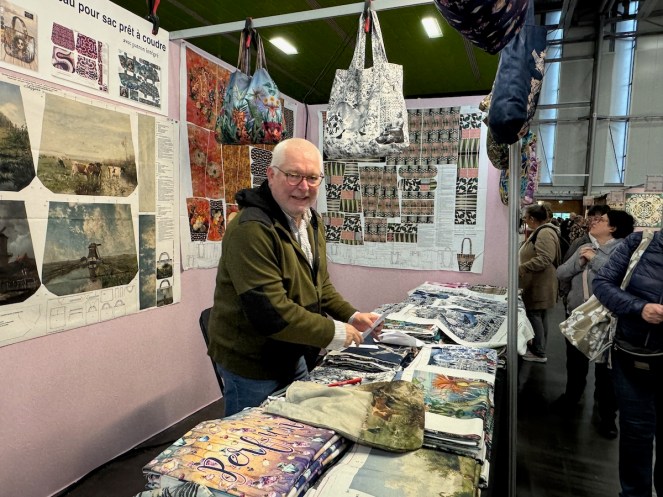
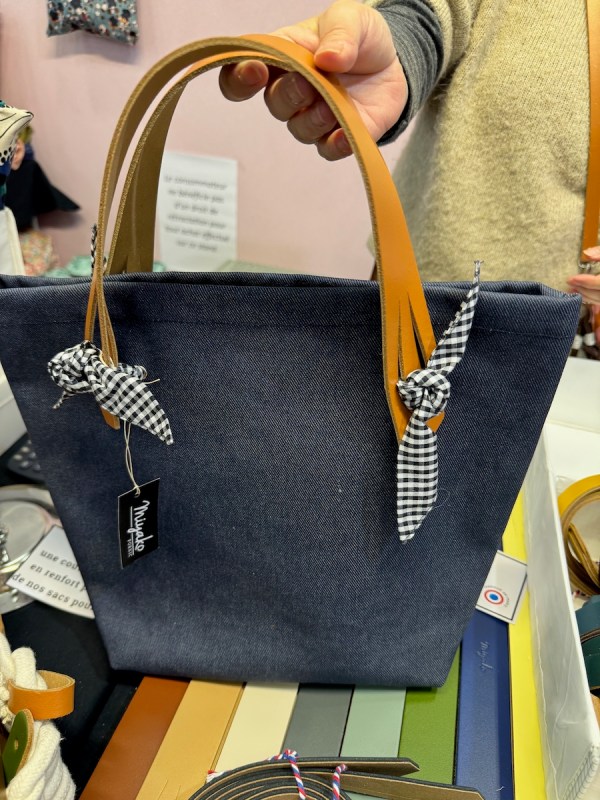
I saw so many beautiful things and purchased a few, here and there. Here’s something I didn’t see: pre-cuts. That whole American-merchandising thing seems to be missing from here as well. The vendors are small, specific, art-driven, and some of the things they sell are kits, new ideas (like the leather handles from Miyako that you can move from bag to bag, instead of having to have one handle per one bag — genius). But unfortunately, because of the tariffs here in the US, it is nearly prohibitive to ship to the US market for many of these vendors, but I can sometimes find them on ETSY or other small marketplaces.

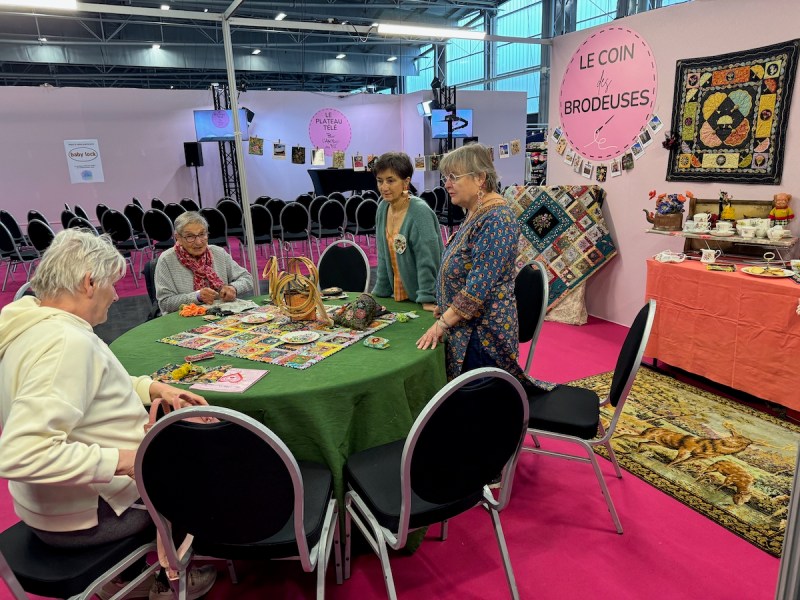
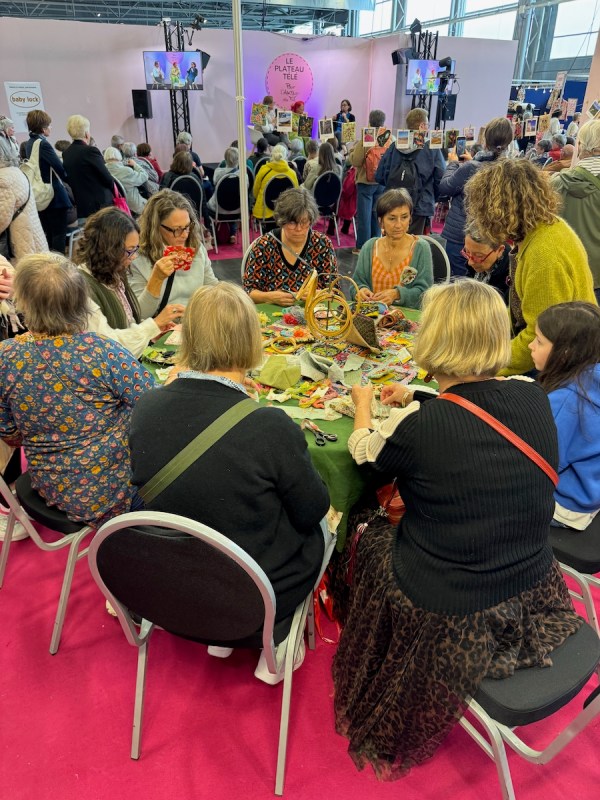
In several places around the show are make-and-take tables. This was the embroidery table. On the left, at the opening; on the right, after lunch. It was popular!

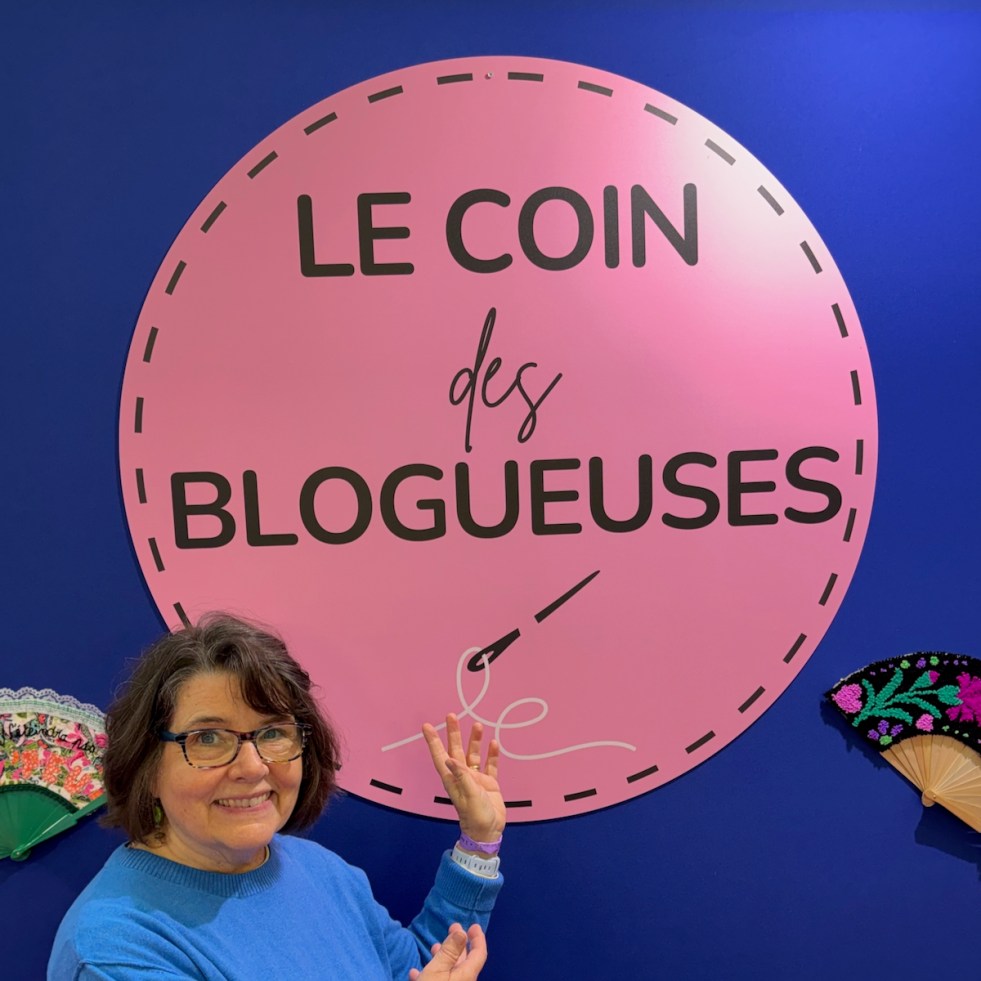
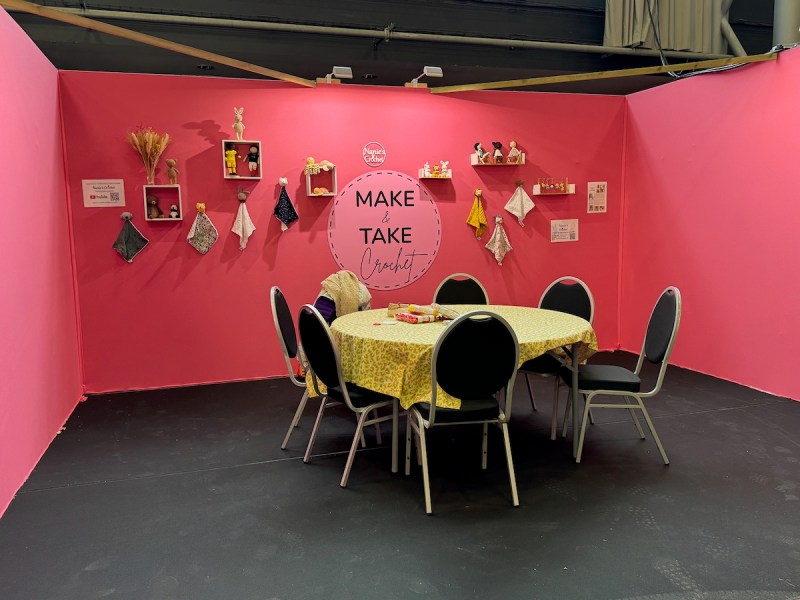
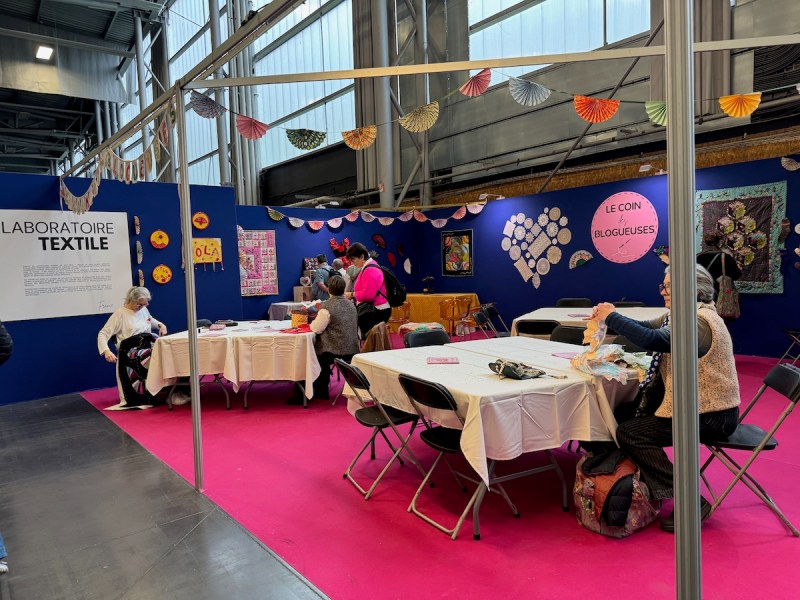
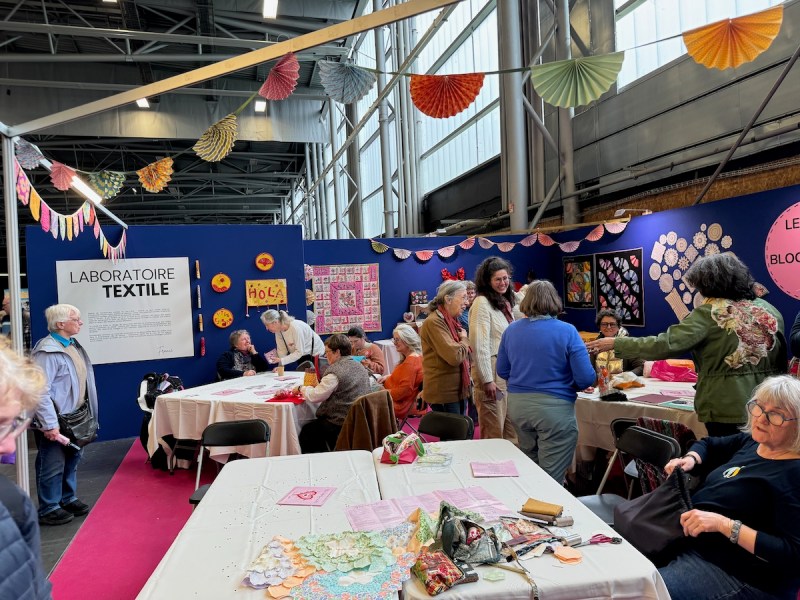
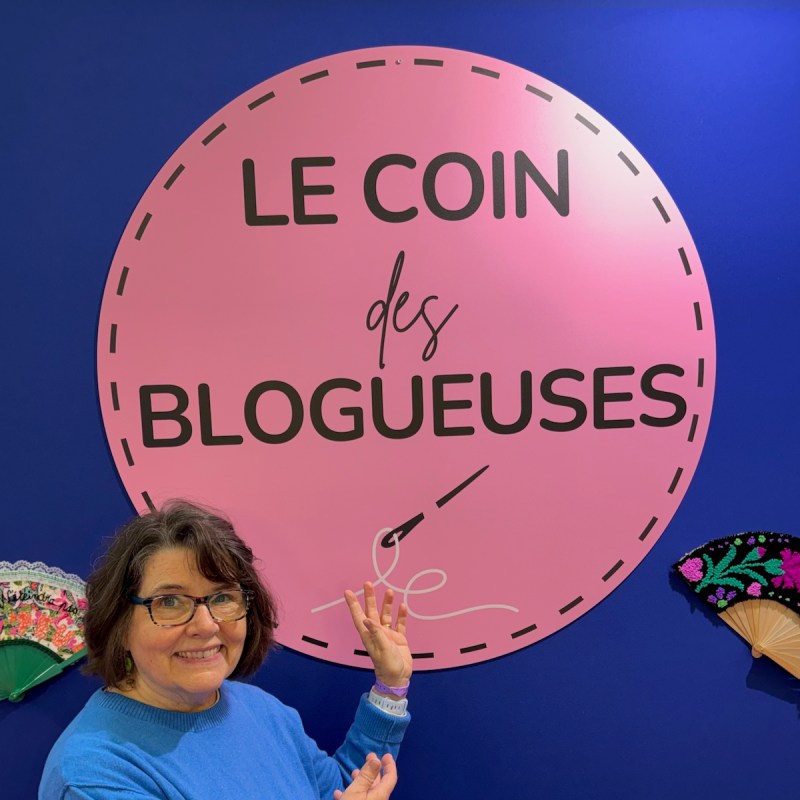
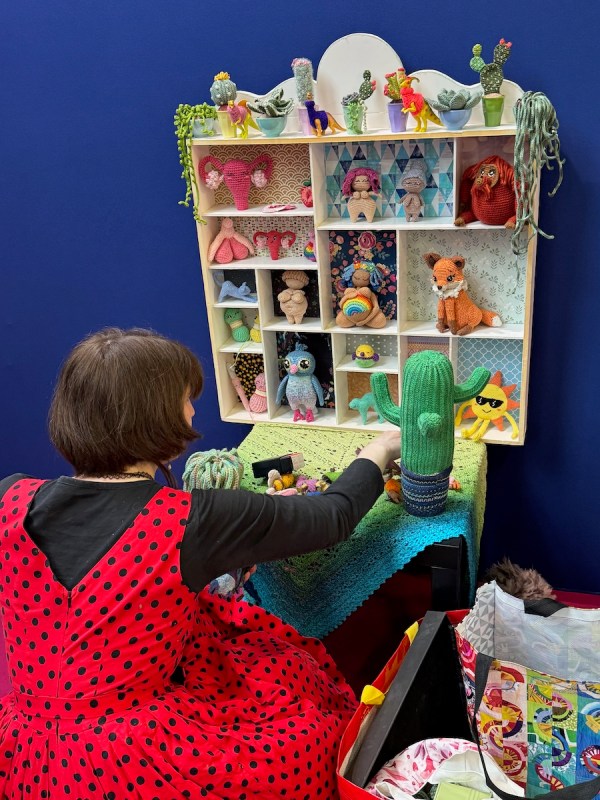
The crochet table, top left. The “Corner for the Bloggers” are the other three photos…and me! It got busier and busier as the day went on. When my husband was tired of following me around, he retreated here.

The crocheter setting up a display. It was fascinating to see. There were four or five booths for those who liked to crochet.

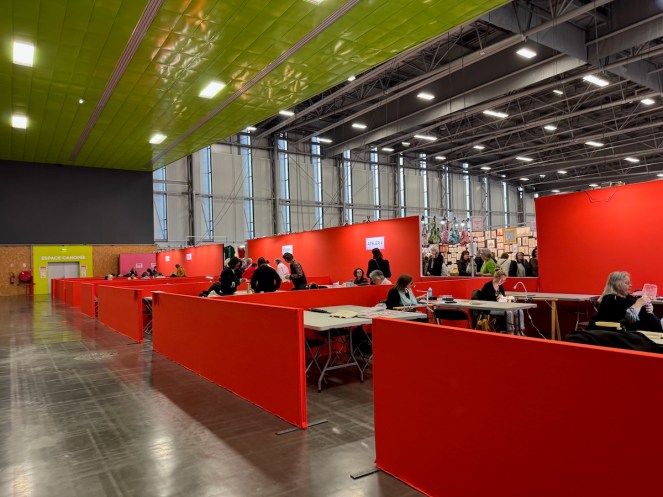
On one side of the Vendors Hall were the “classrooms.” These were surprisingly quiet, and I saw several classes in session.

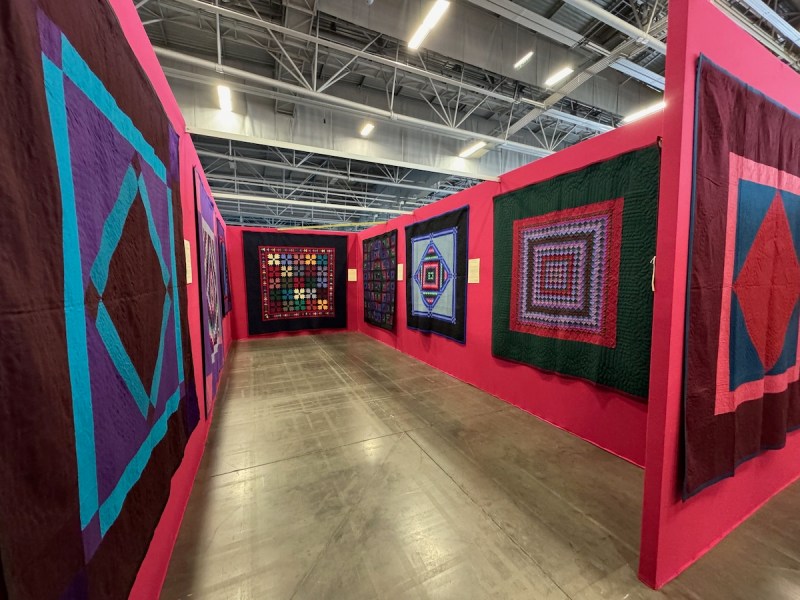
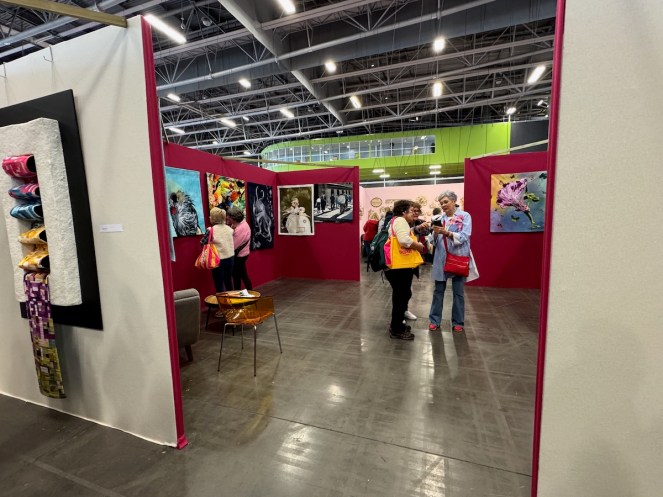
On the other side of the Vendor Hall were the quilt displays, rooms created out of movable walls, done in brilliant colors. I used my Google Translate on some of the signs. Sometimes I even used my Husband Translate (he speaks French).

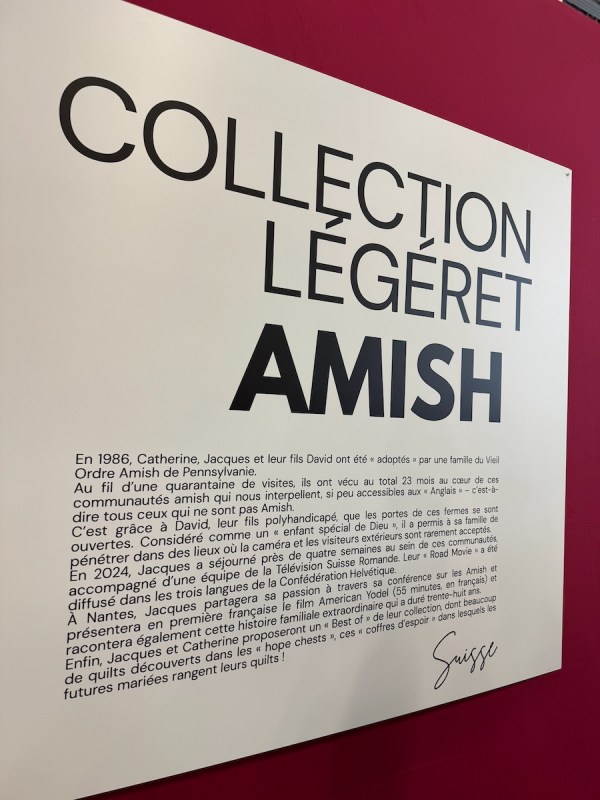
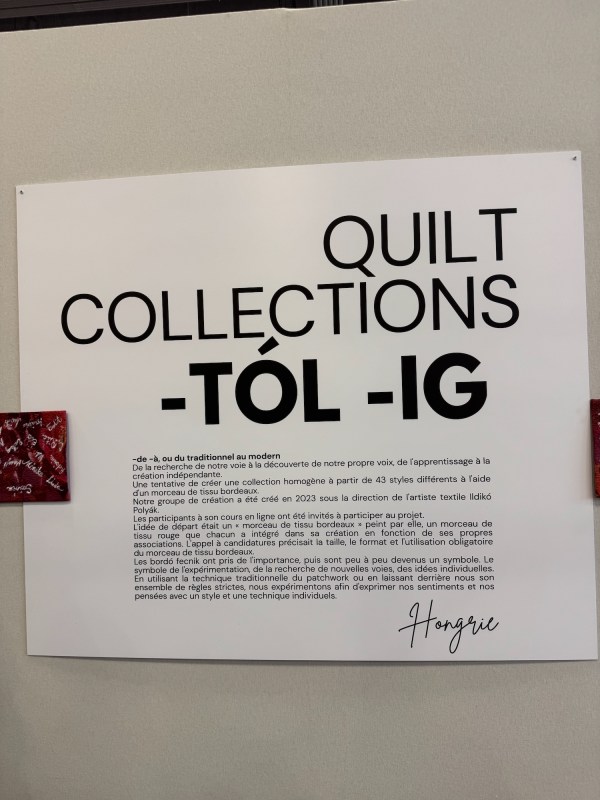
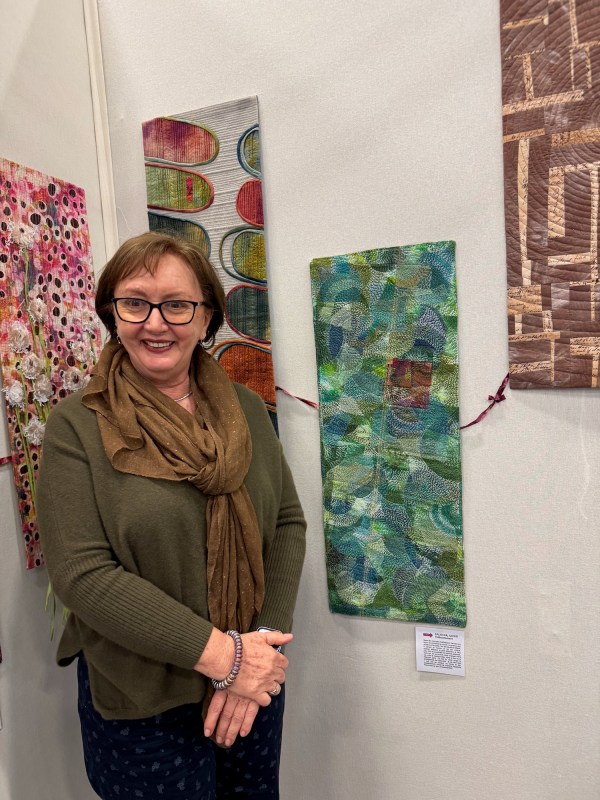
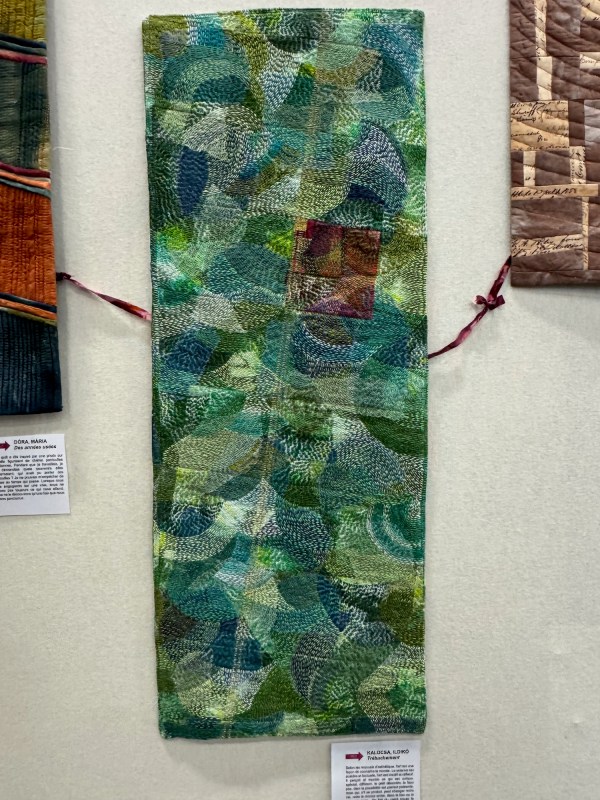
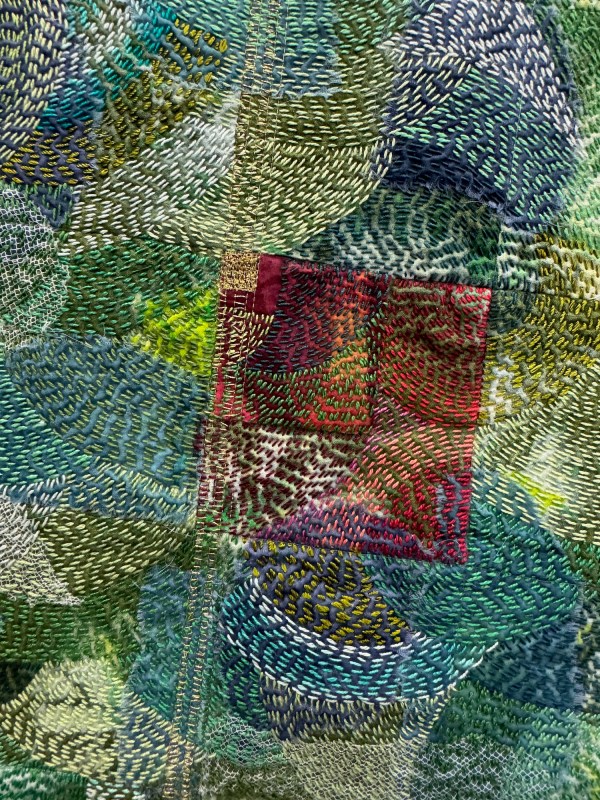
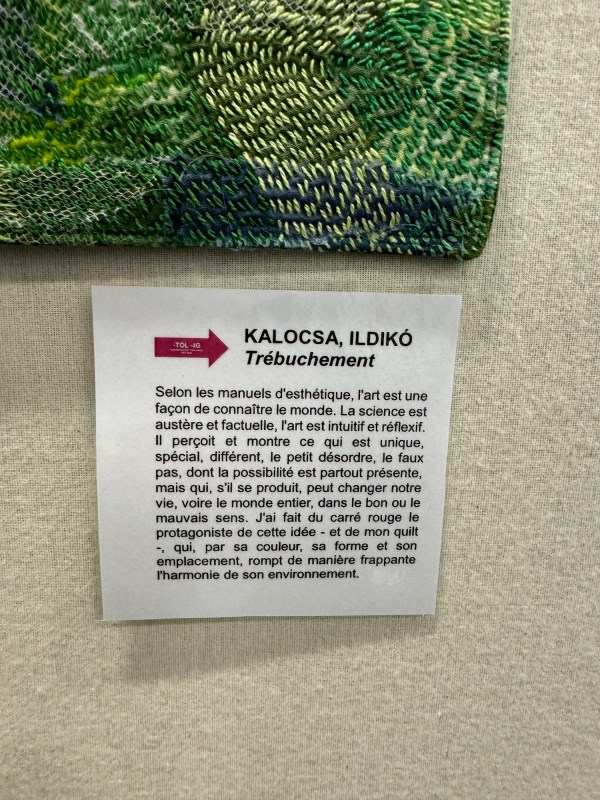
This exhibit was Collections, from Hungary. We talked to this quilter, Ildikó Kalocsa, about her work, and thanked her for coming to France. I loved the texture in her work. We also asked her about Hungary’s recent elections, and she said “Oh, we are so happy!” It was evident in her smile.

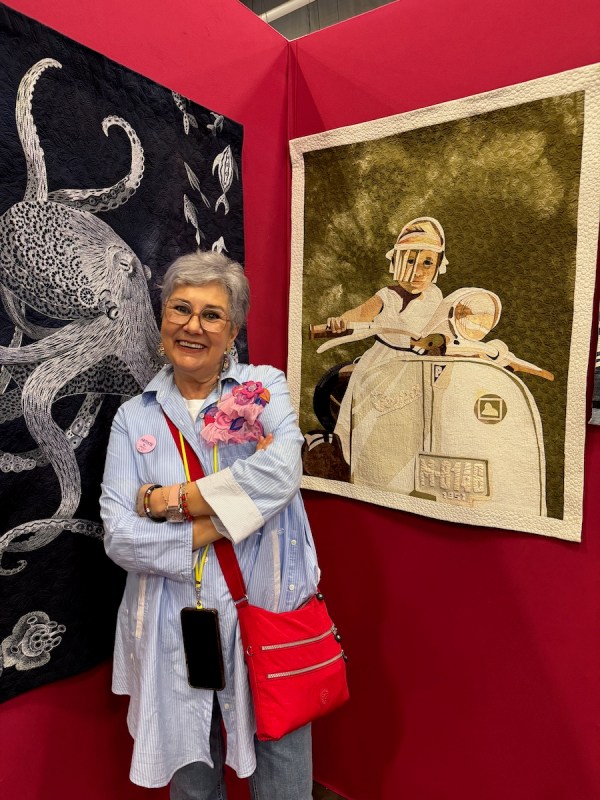
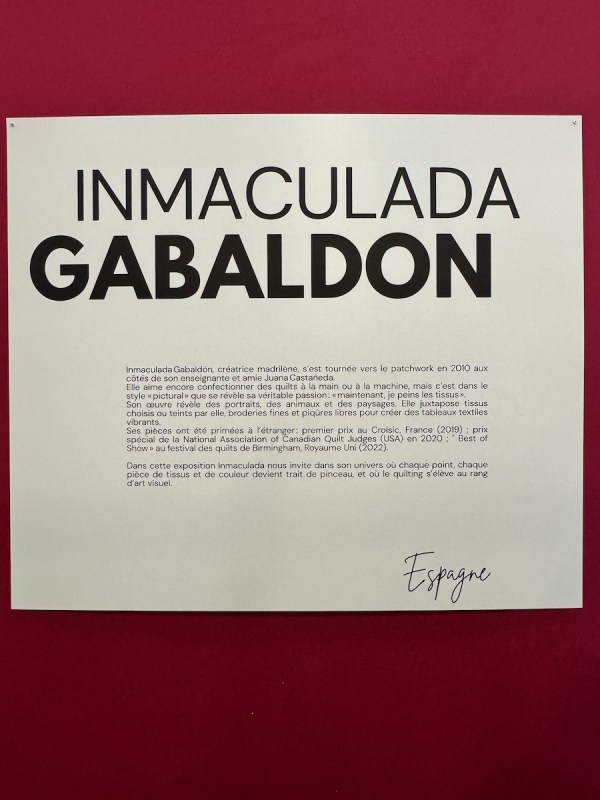
Slideshow for Inmaculada Gabaldon, from Spain (photos on this post were taken both by my husband and I):

Click to advance the images. She does all her own quilting on a domestic machine, not a long arm. In the photo I took of her, she chose the background, and it was a photo of herself as a child. The last photo is of me in an adjoining “room” looking back toward the main hall, with Inmaculada talking with quilters.

I put up a couple more slideshows on Instagram:

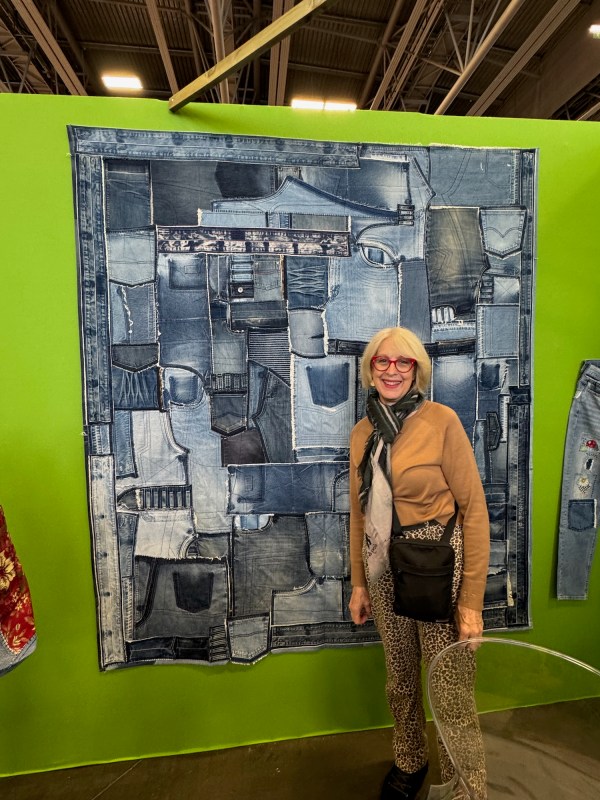
Denim by Elisabeth Dubbelde

She is known for her denim work, as well as recycling to keep the fabrics out of the landfill.

Quilts En Rêve

I’ve followed them on Instagram, as they make beautifully perfect quilts, many by hand. They are interested in reproductions of antique quilts.

Carolyn Konig

Carolyn was a joy to visit with, welcoming and happy to answer questions about her unique approach to doing her reproduction quilts: she actually has the background fabric printed to mimic the spots and bits and discolorations of antique quilts, and uses it when she makes her reproductions. (Carolyn on Instagram) If you go to her website, you can order some.

Finally, it was time to leave, but not before I tried to find Carol Veillon and thank her.

I felt invisible in the quilt world until Carol, in her magazine QuiltMania, published a quilt of mine that was hanging in the Road to California Show, where I first met her. She is kind and charming and encouraged me to continue submitting. I had several more published by her and every time it was like Christmas had come.

I thanked her for this, and for her kindness towards me, and grabbed a quick photo as she was incredibly busy. She is someone who had made a different in our quilting world, for all of us.

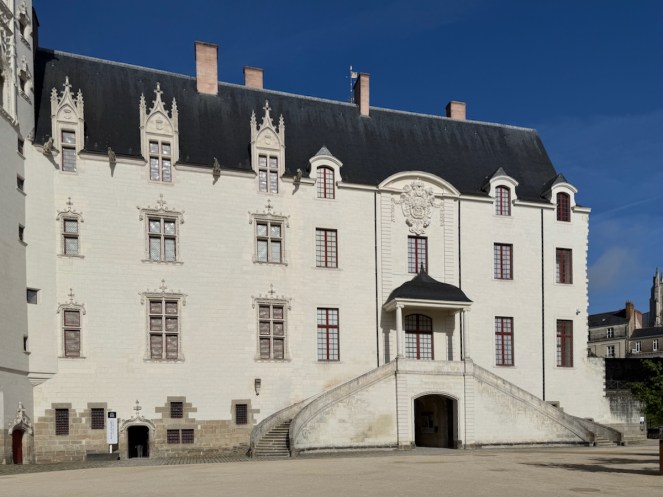
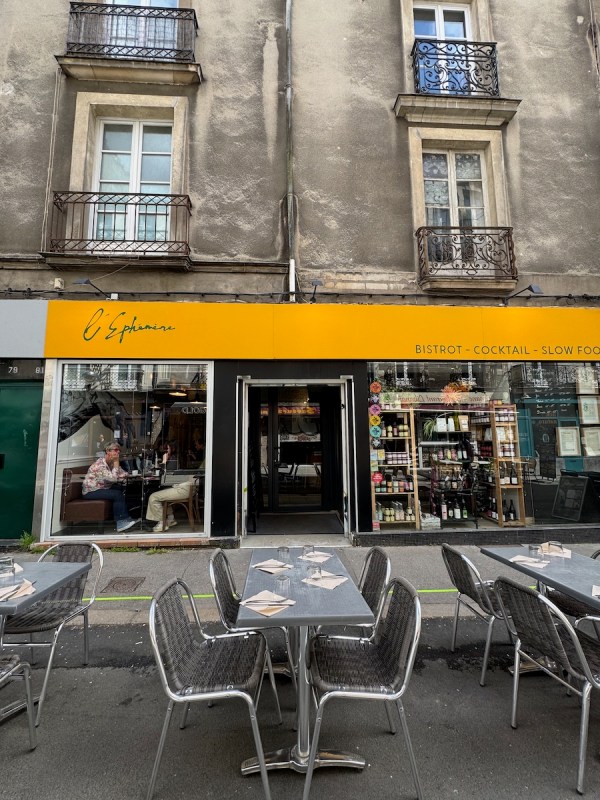
We walked back to the tram, and as we rode back to our hotel, were joined by families, strollers, children, mothers, teenagers; it was a far cry from the quiet ride in the morning. I will probably post the quilts I did take photos of here and there as I go forward, but I can’t leave this post without giving you some photos of Nantes.

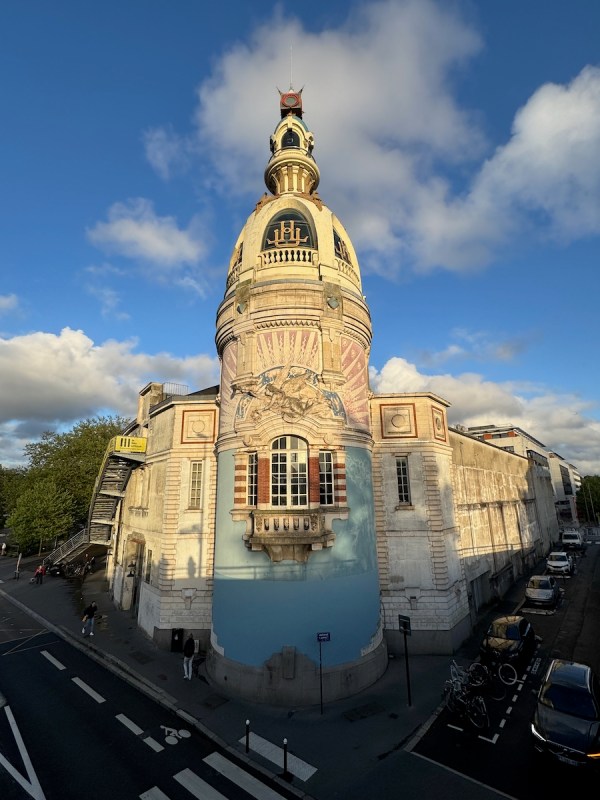
The old LU biscuit factory, around the corner from the Gare, taken in sunset.

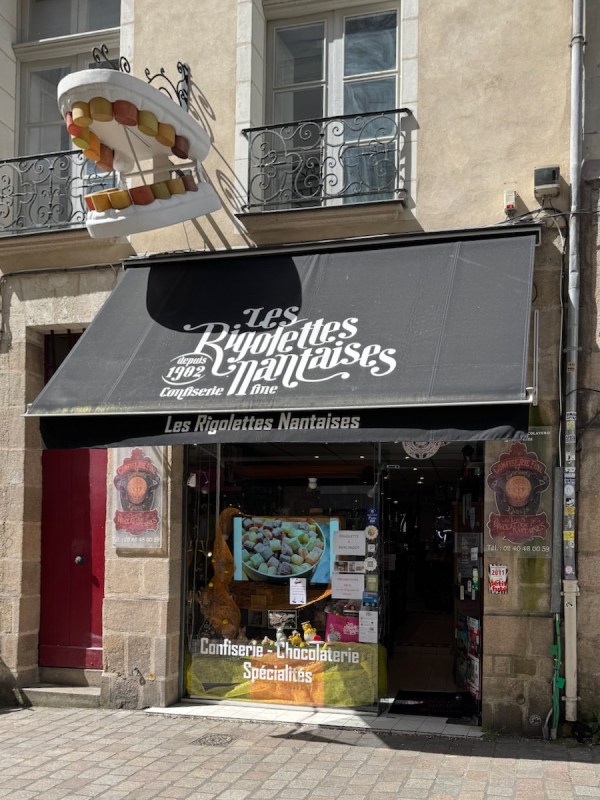
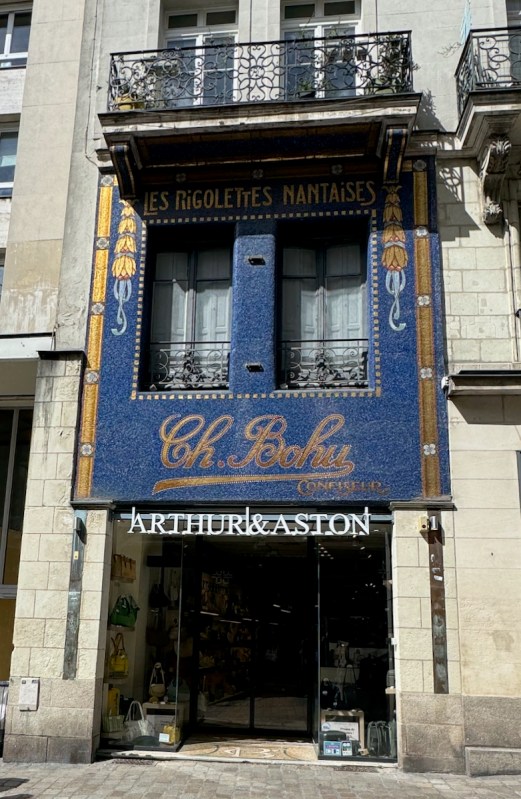
A store selling the town sweets: Les Rigolettes Nantaises. They seem like hard round little candies, but once in your mouth the outer hard shell dissolves and they are chewey and delicious. They come in five traditional flavors: lemon, raspberry, blackcurrant, mandarin, and pineapple.

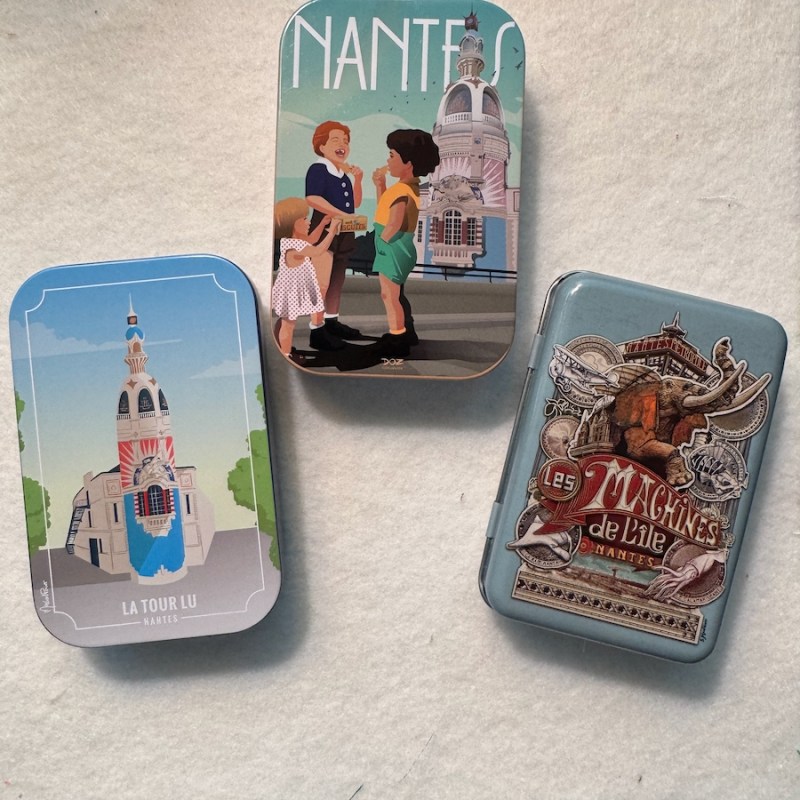
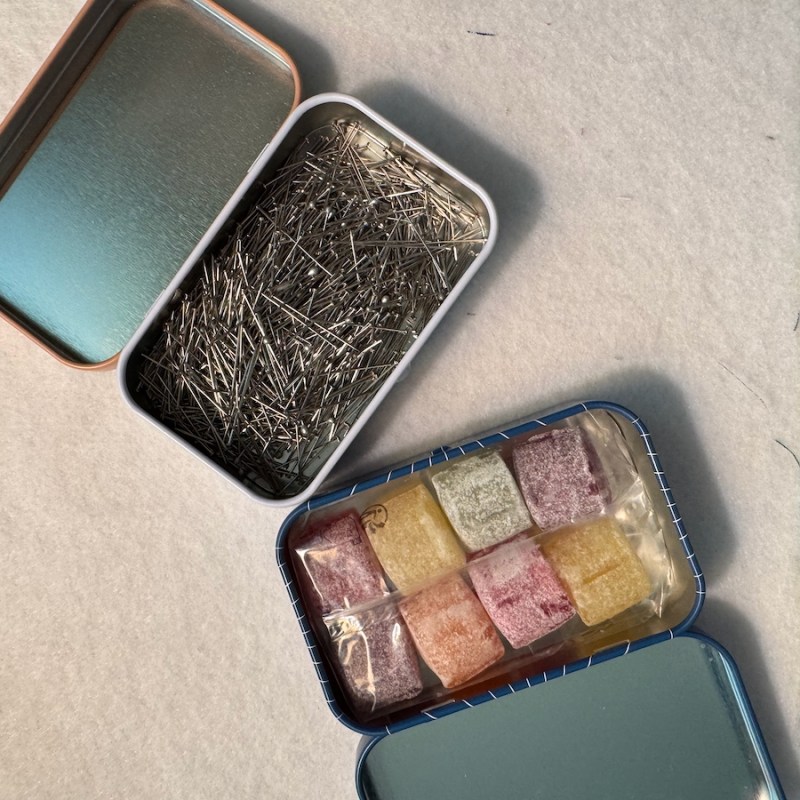
They come in these charming tins (well, the elephant was a different candy), and I’ve already repurposed one for straight pins.

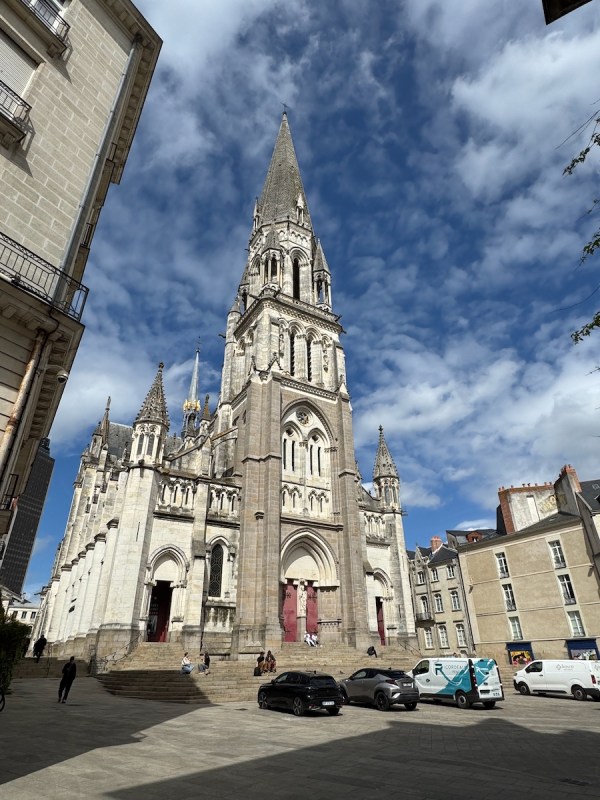
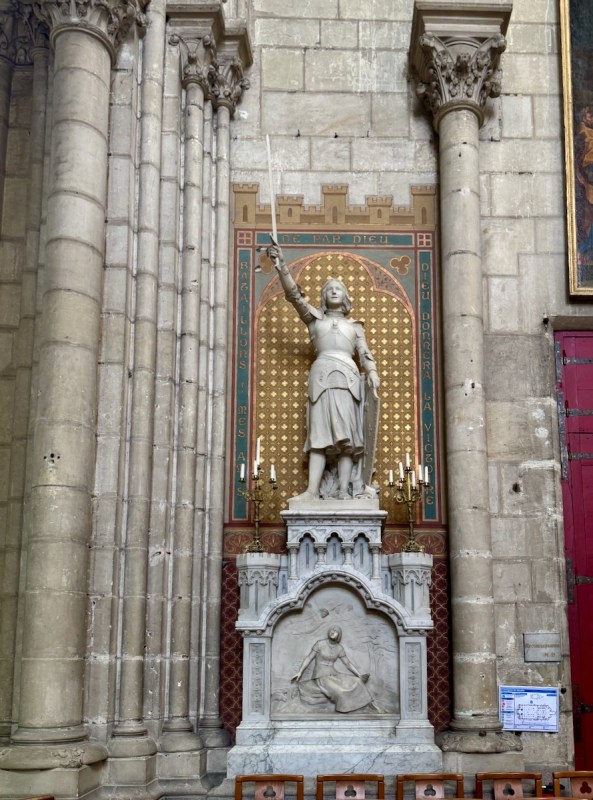
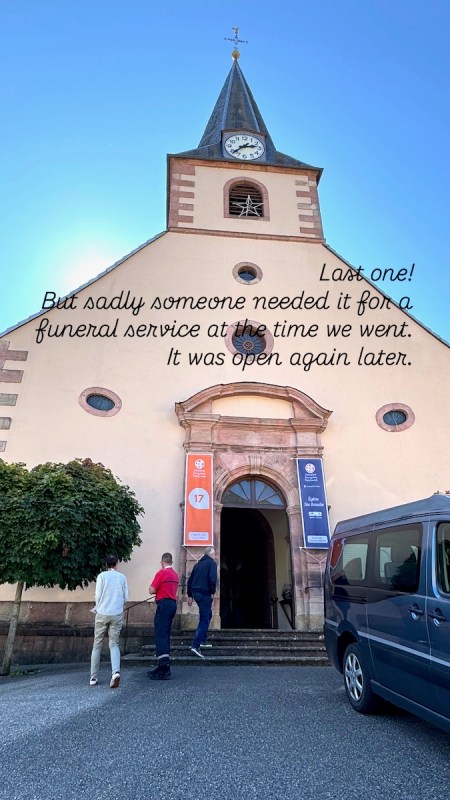
Joan of Arc is big around here. This statue inside the church is dedicated to her, as she hails from Orléans, which is up the road a bit in the Loire Valley.

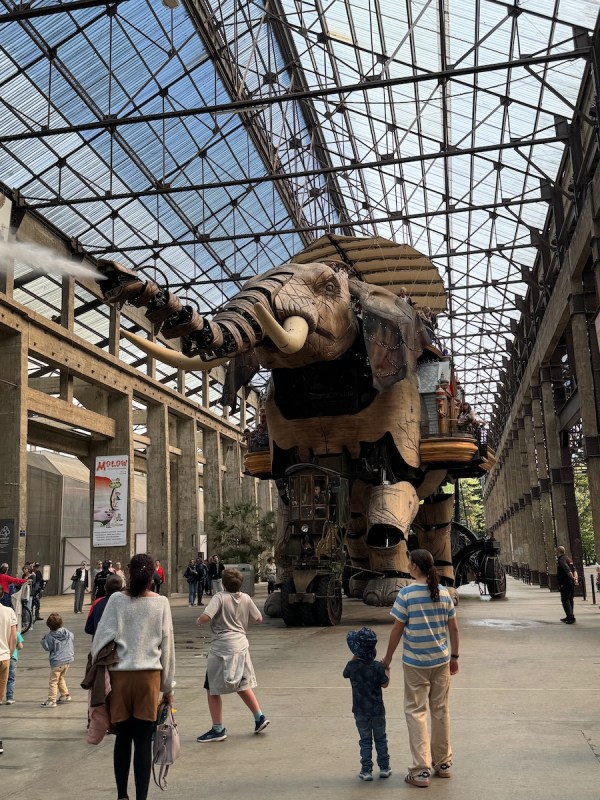
The Elephant, one of “Les Machines” on the small island in the Loire River adjacent to the city center. A huge mechanical creation, it moves slowly around as it takes a walk, squirting tourists and children with water. We had a great time seeing this.

A few more sights (click to advance):

And what did I take away from the quilt show?

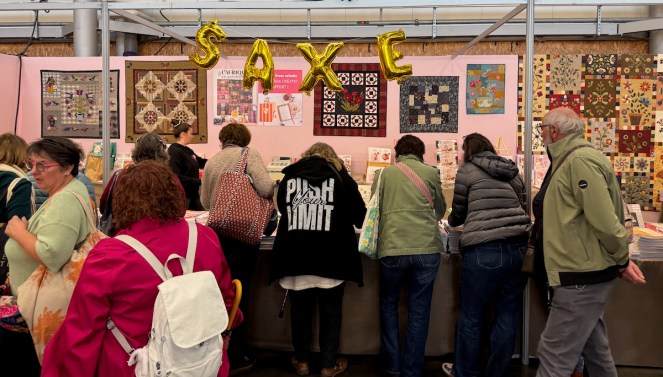
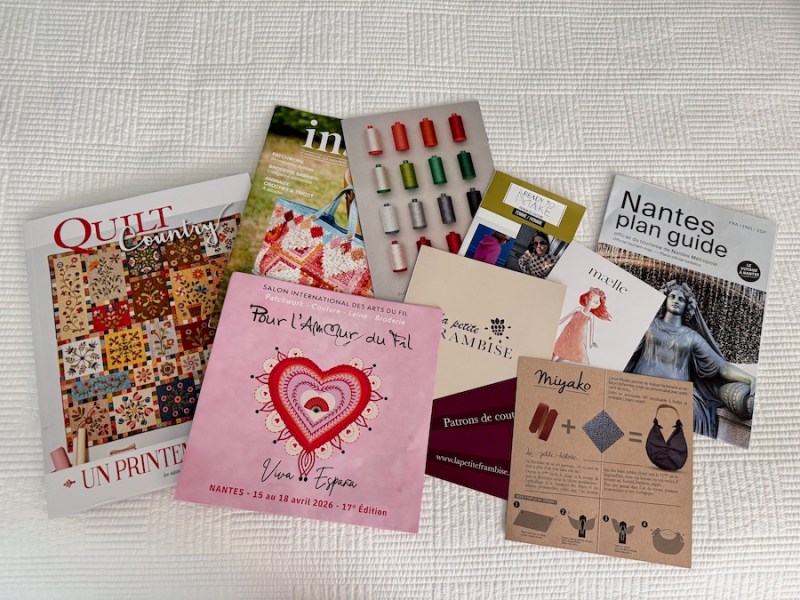
  1. A book from the SAXE bookseller booth, and some fliers
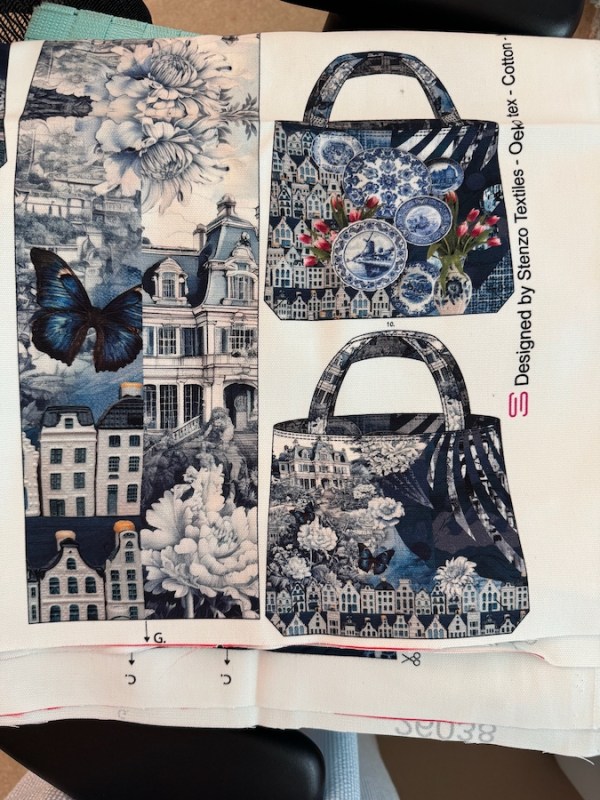
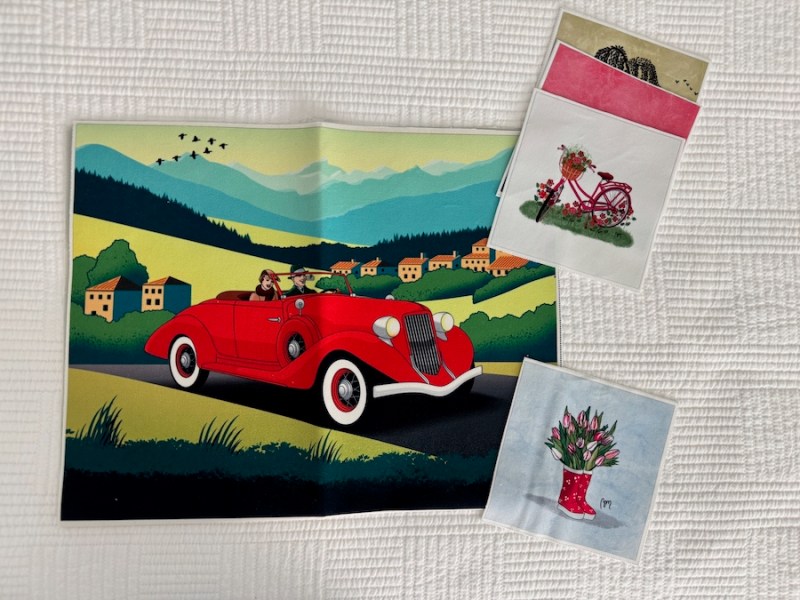
  2. a preprinted canvas to make a bag (Stenzo Textiles)
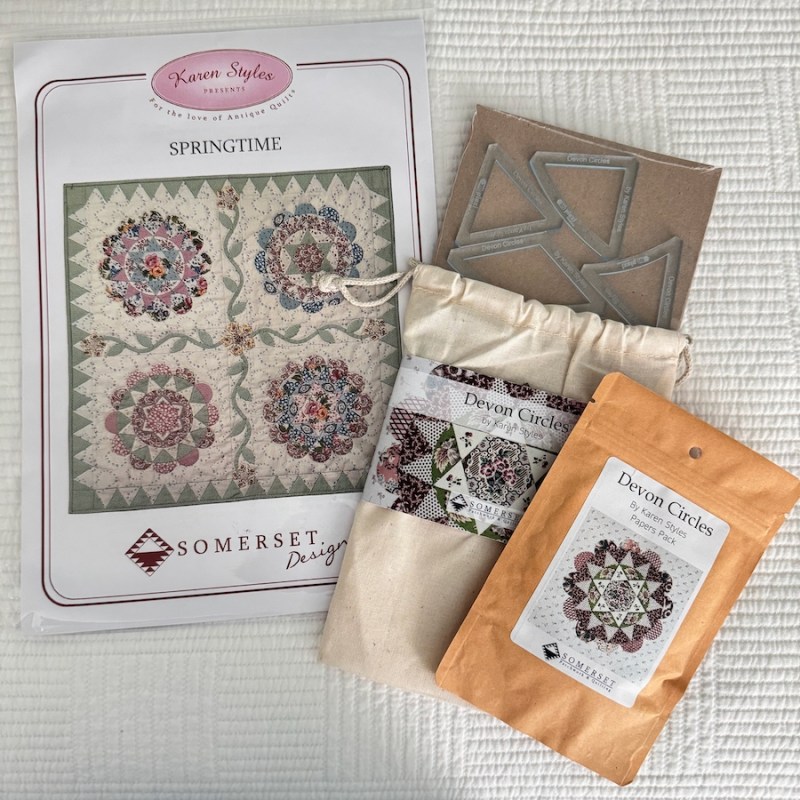
  3. sweet mini-quilt with papers and templates (Somerset Designs)
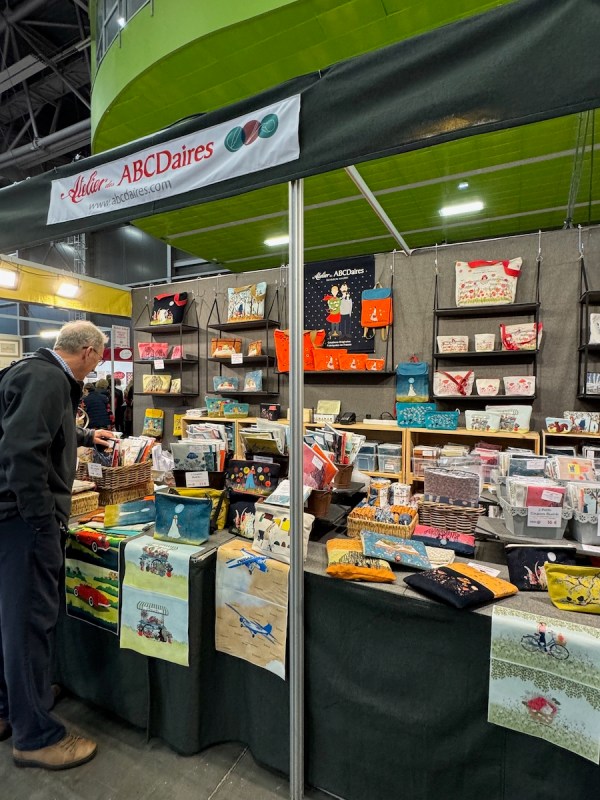
  4. a panel to make a small bag (ABCDaires), a favorite
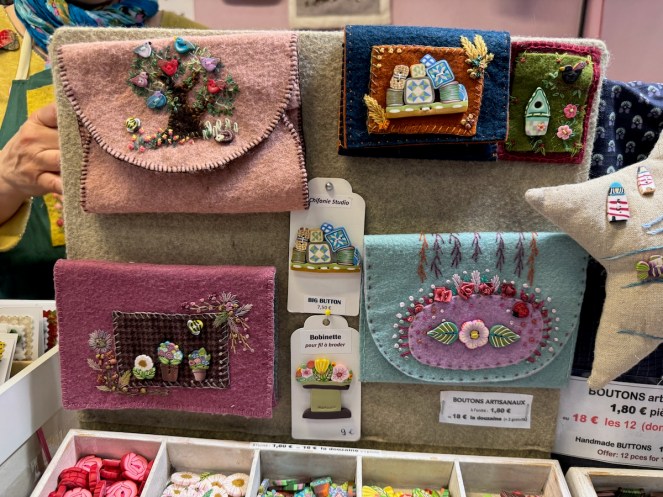
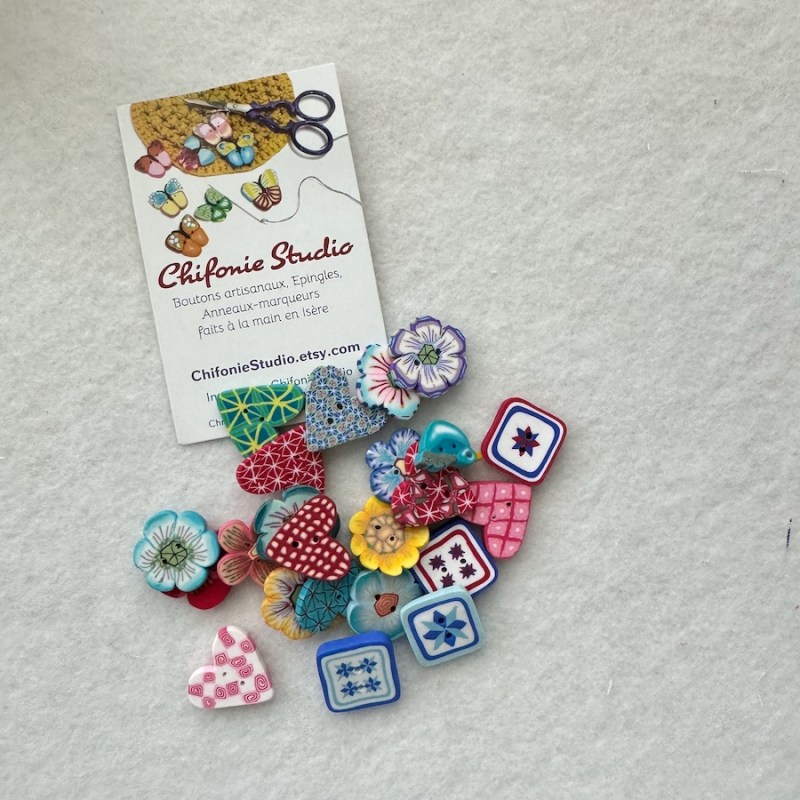
  5. buttons from Chifonie Studio

My suitcase is compact so while the purchases are small, the memories are huge!

QM published quilts:
Riverside Sawtooth (in QuiltMania)
Elizabeth’s Lollipops (in QuiltMania: a photograph from a quilt show, but I’m counting it!)
Crossroads (in Simply Moderne)
Santa’s Night Ride (in Simply Vintage)

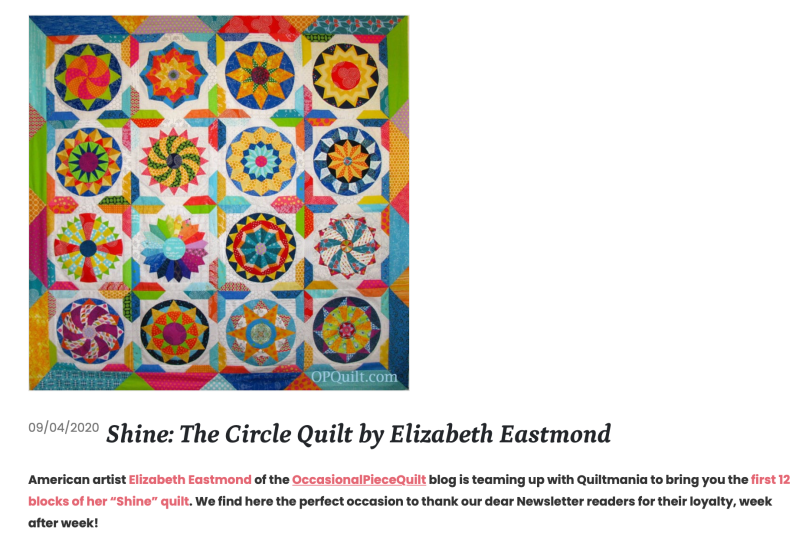
During the pandemic, I agreed to let them share my blocks with readers of the QuiltMania newsletter. The patterns have now come home to stay, and most are free (see tab, above).

Carrefour Quilt Show · European Patchwork Meeting · Quilt Shows · Quilts · Travels

Carrefour VI: RachelDaisy Dodd, Ruth De Voss, Lorena Uriarte, Diane First, France Patchwork & Ulla Hoppe

This is the sixth, and final post about the Carrefour European Patchwork show 2025. The post covers:

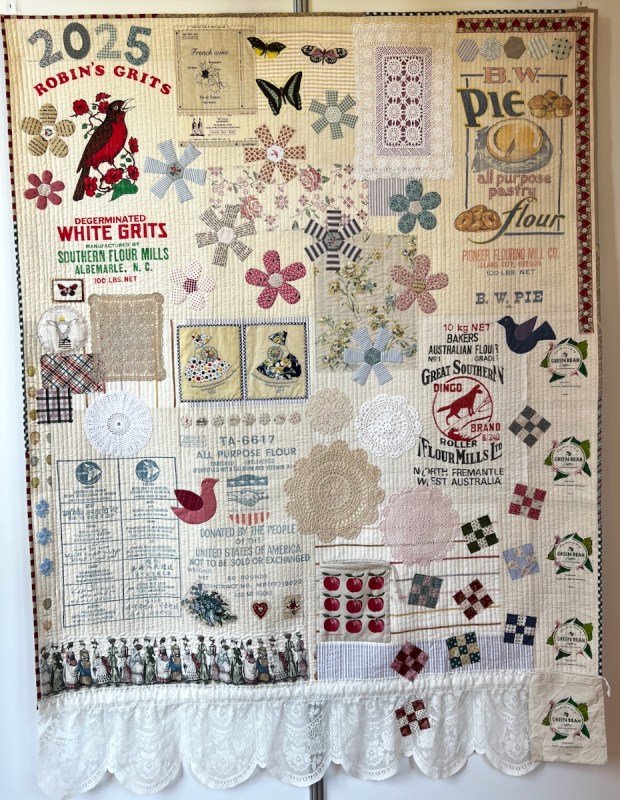
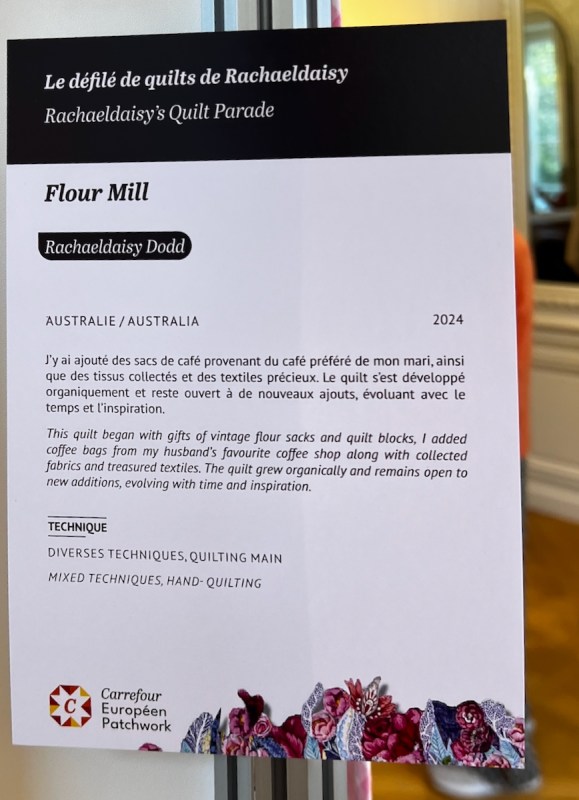
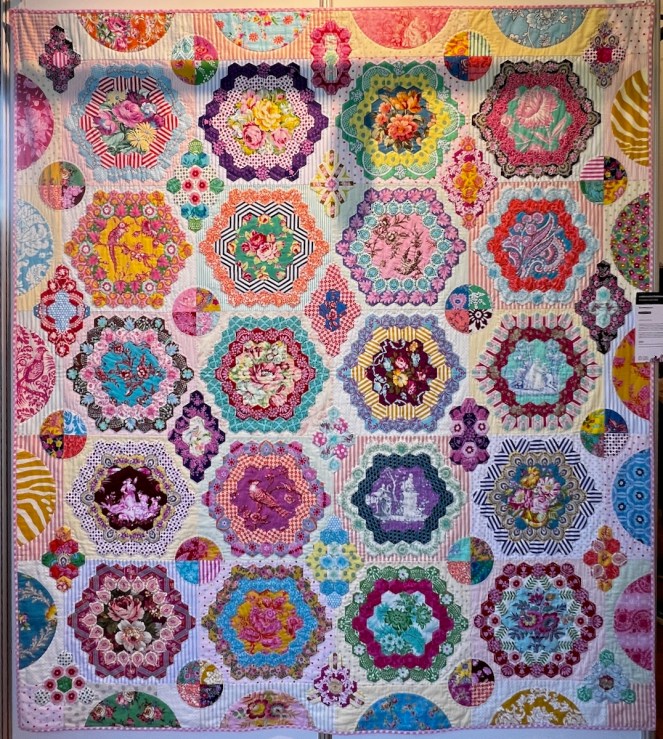
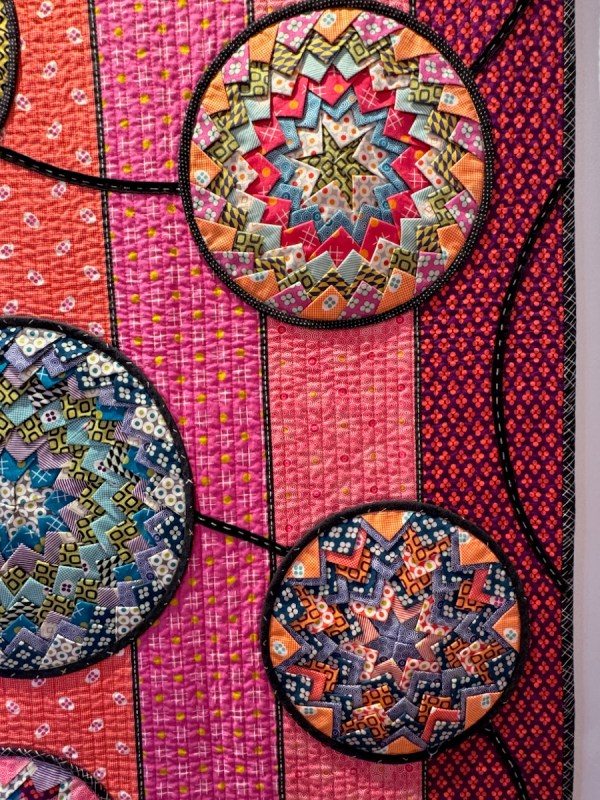
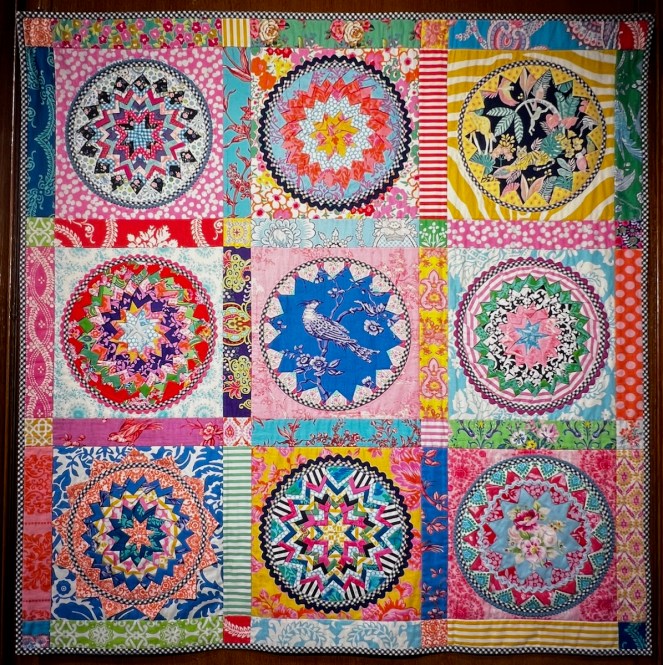
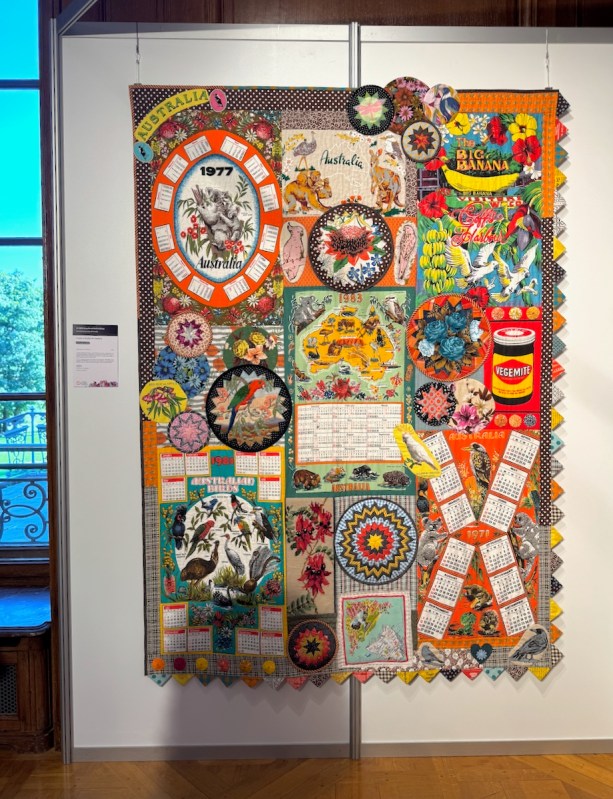
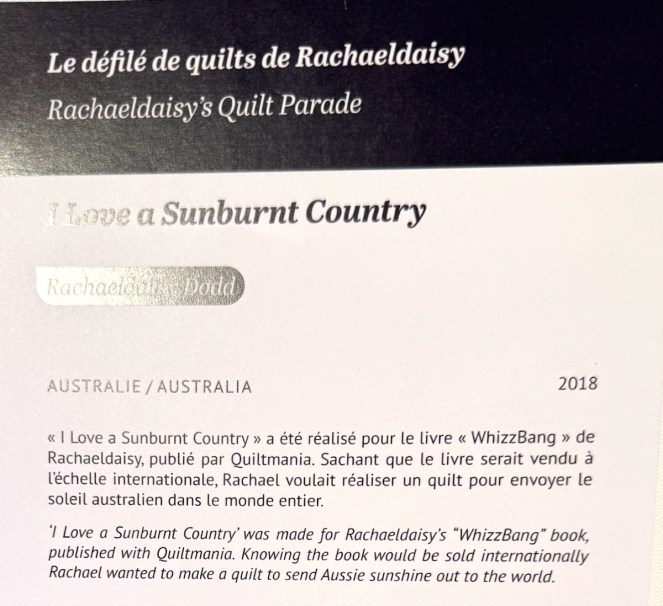
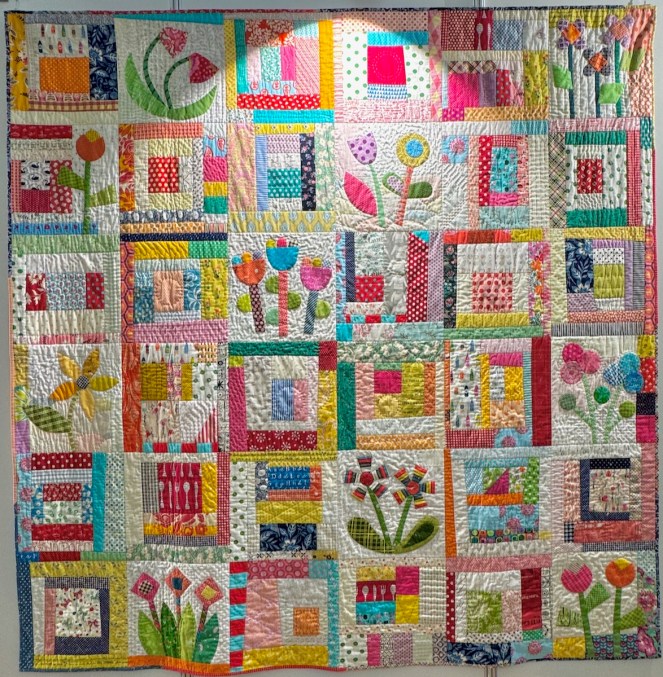
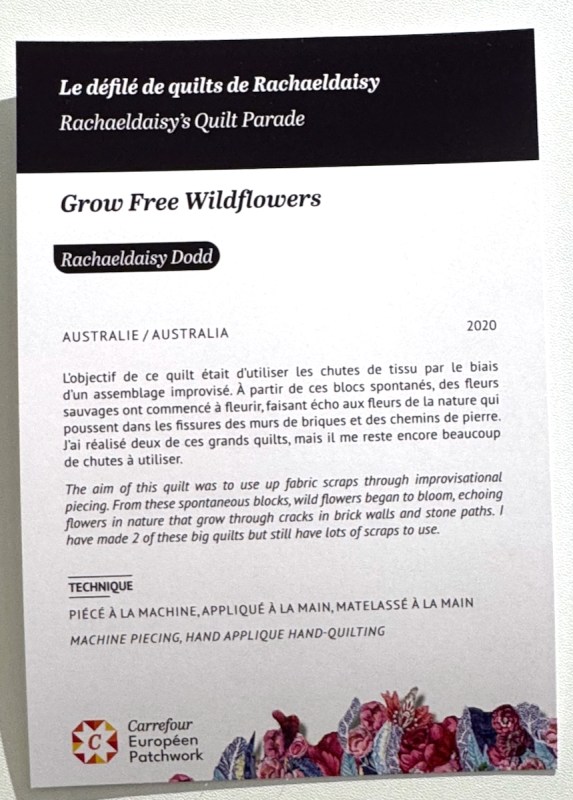
• Venue 13: Villa Burrus, with RachaelDaisy Dodd
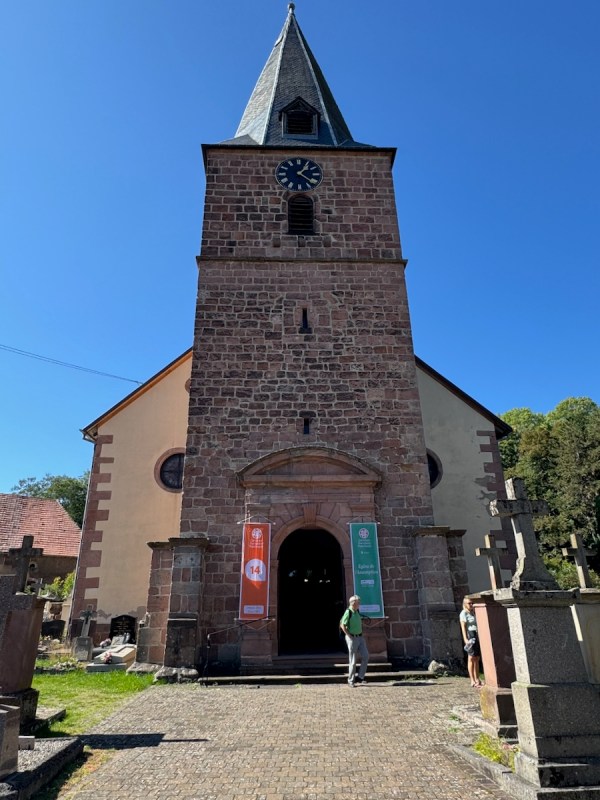
• Venue 14: Église de l’Assomption, with Ruth De Vos
• Venue 15: Salle Polyvalente, with Lorena Uriarte, Dianne Firth, ASL Liépvre, EQA, France Patchwork
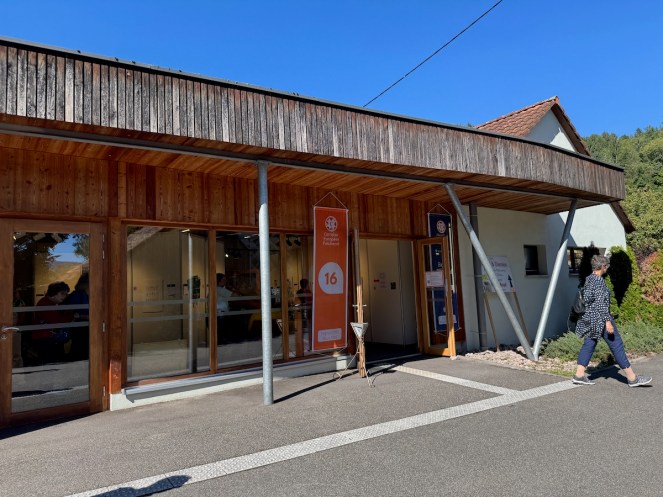
• Venue 16: Ulla Hoppe

I have a main Carrefour Quilt Show page that lists all the posts of all the meetings I’ve gone to, and includes the posts from this year too. If I haven’t mentioned it before, you might enjoy these posts more if seen on a desktop computer or even a tablet. Cell phones re-format the layout and can sometimes do strange things to how it looks on the screen.

If you are interested in going to Carrefour, I wrote two posts for them about our travel, and how we put the trip together. You can find them here and here. Their main website is HERE, where you can subscribe to their newsletter (scroll to the bottom).

Thank you so much for reading and traveling along with me by way of these posts. Enjoy!

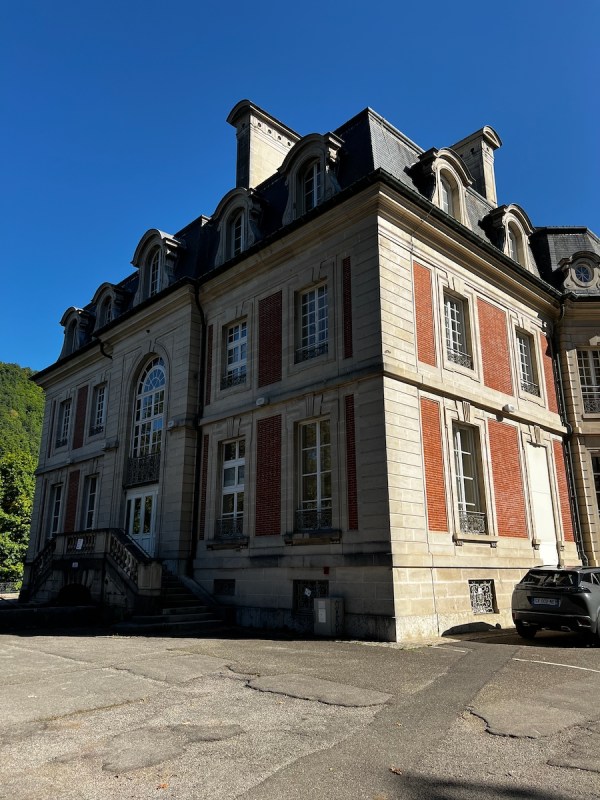
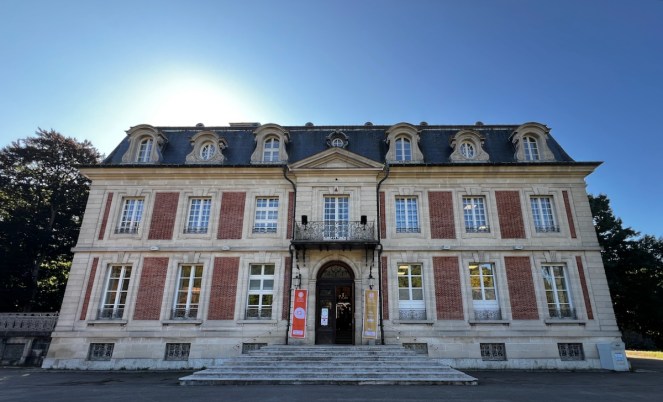
This venue, Villa Burrus, was just a few short steps from the Party Room (Salle Des Fêtes, from the previous post) and although we’ve been to Carrefour twice before, it was new to us.

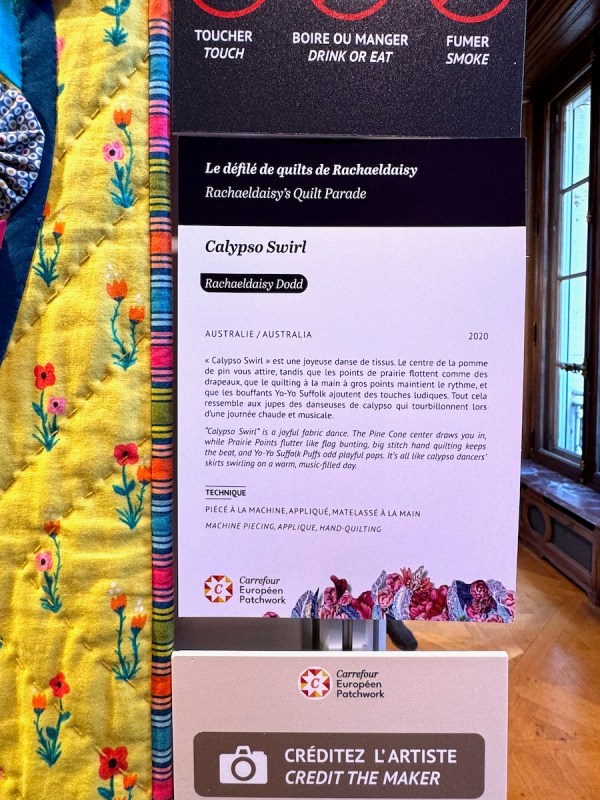
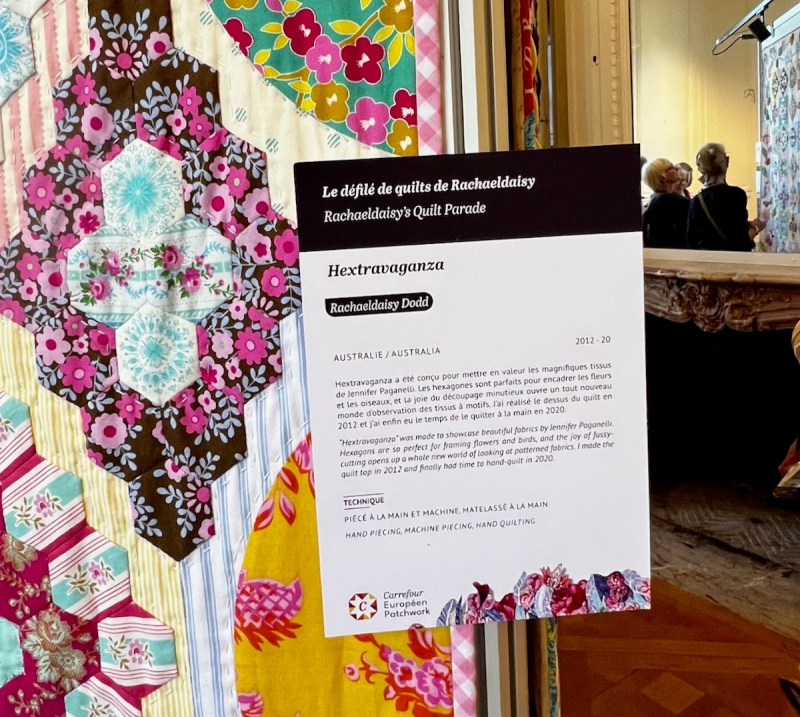
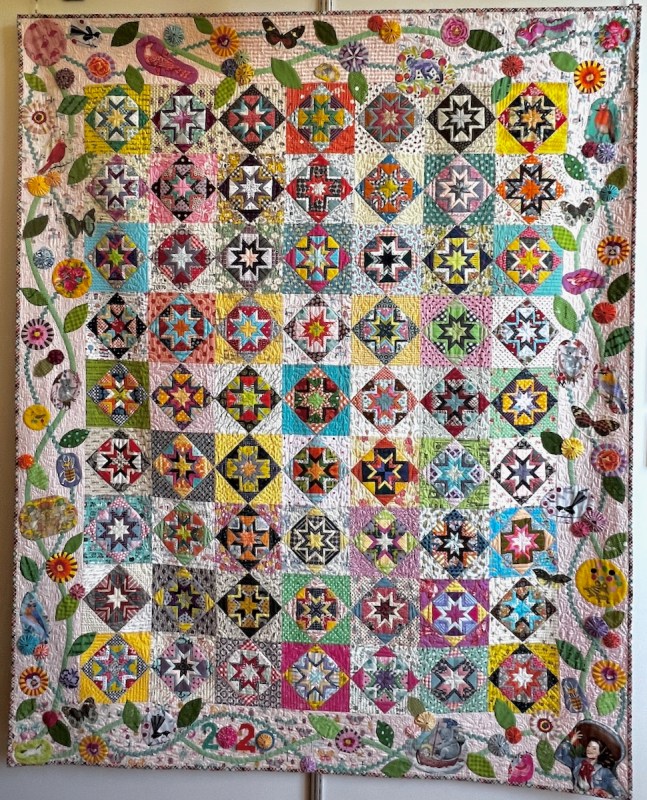
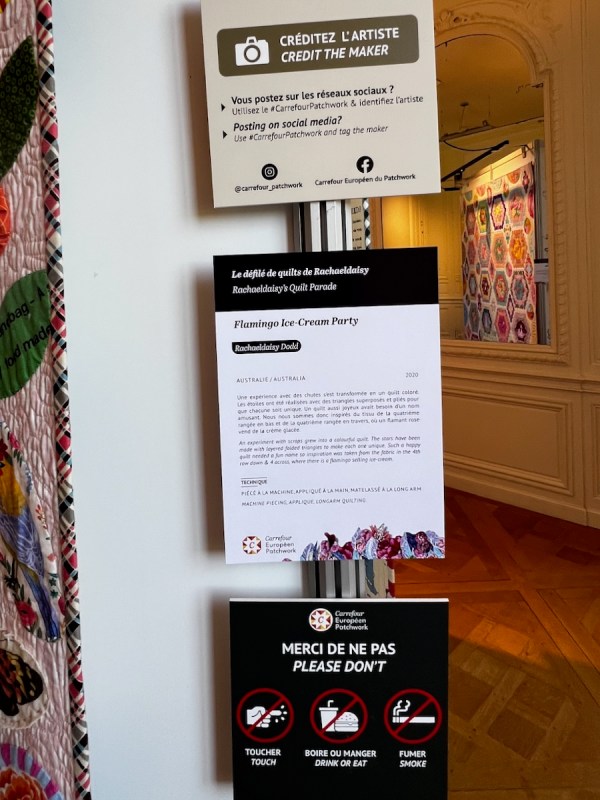
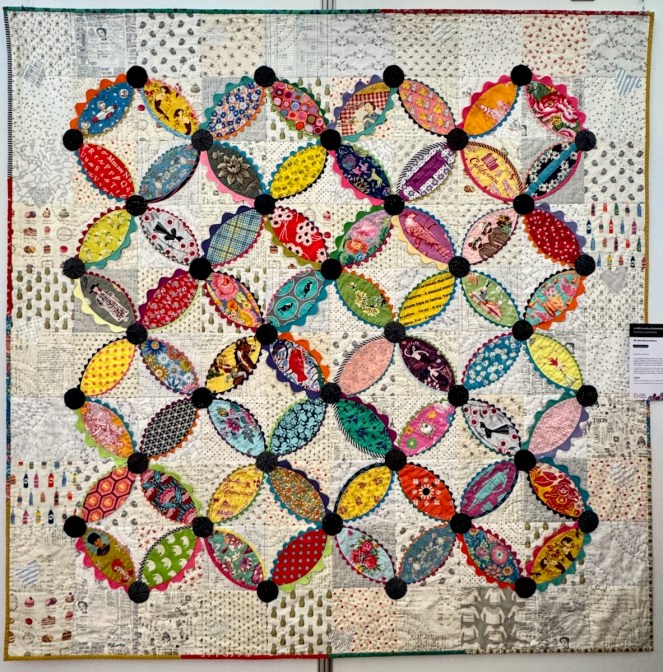
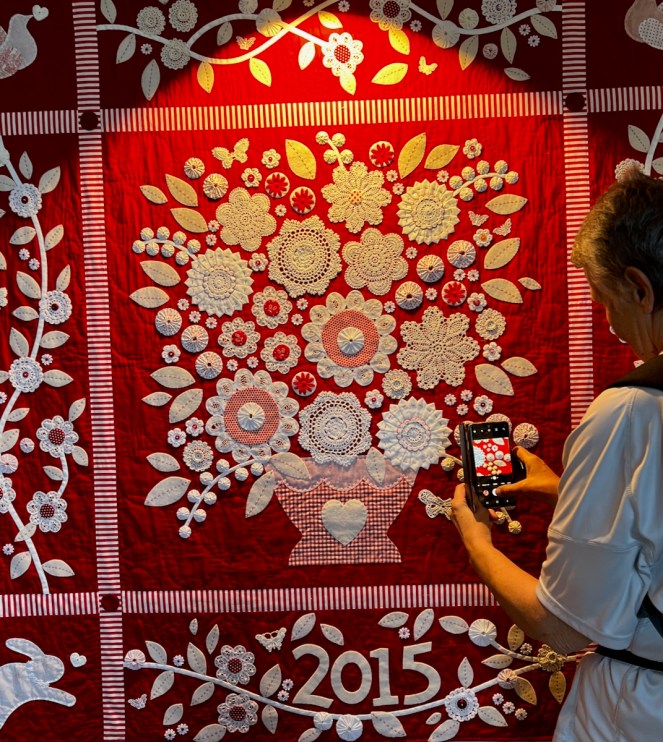
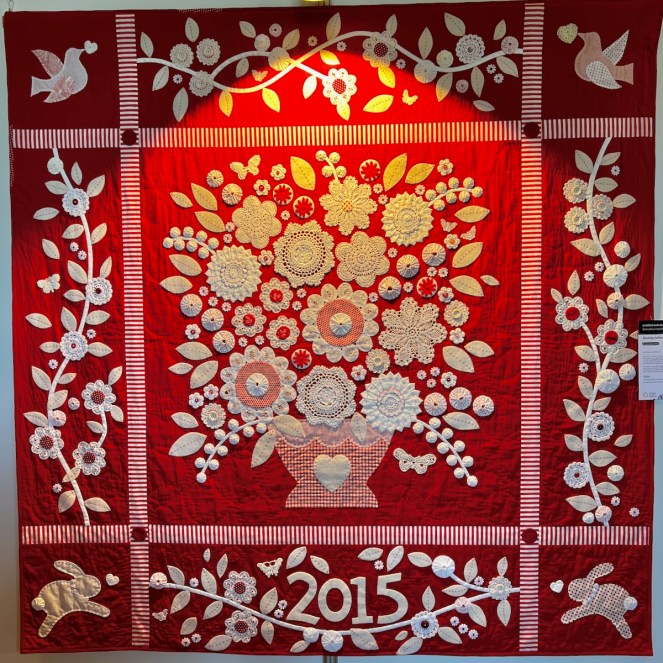
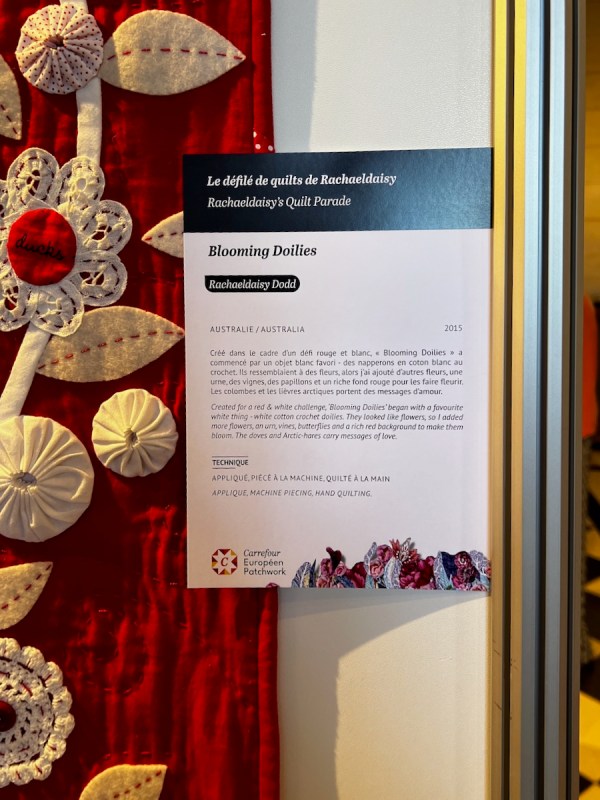
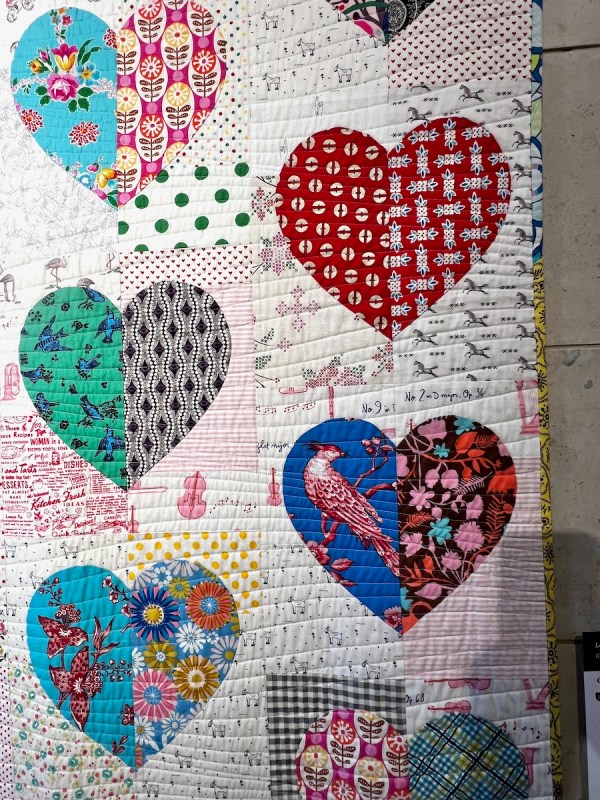
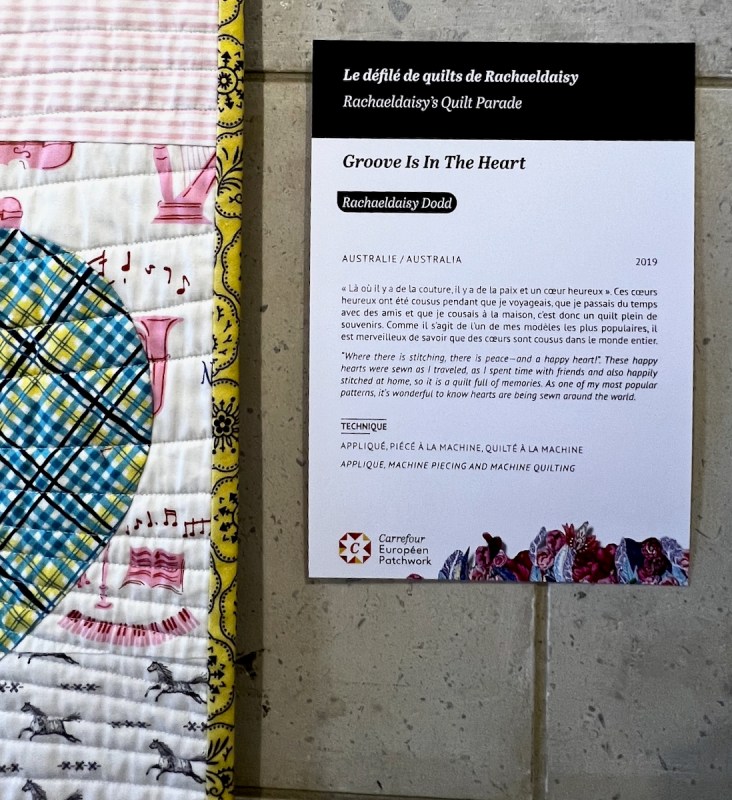
Sited on Le Parc de las Villa Burrus, this mansion was built in 1900, at least as I can figure out for the literature we picked up was all in French, printed for their Patrimonie — or Heritage — Days, when many buildings are open to the public. Whatever its origins, it was a great place to see quilts, and RachaelDaisy Dodd had her solo exhibit here.

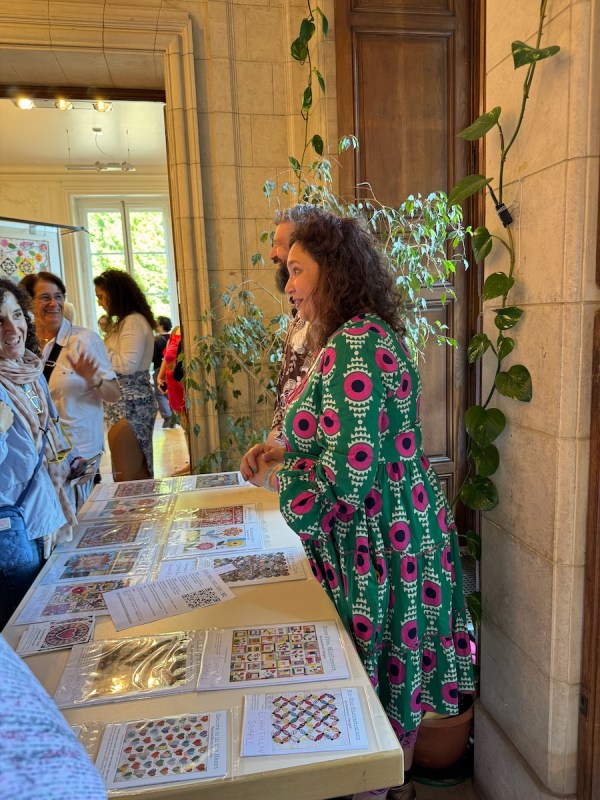
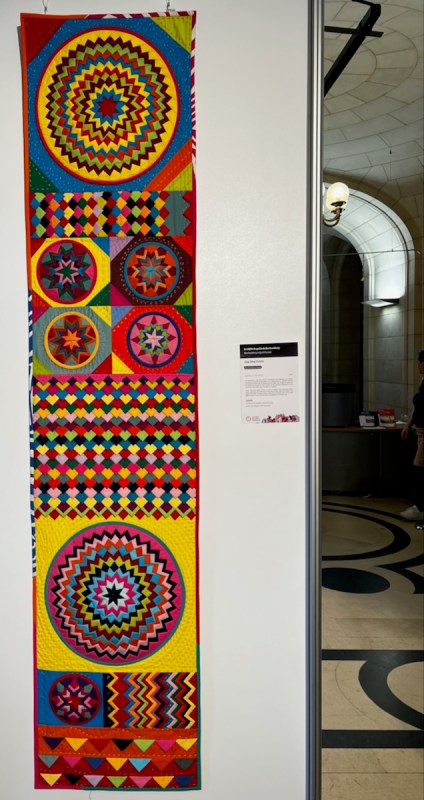
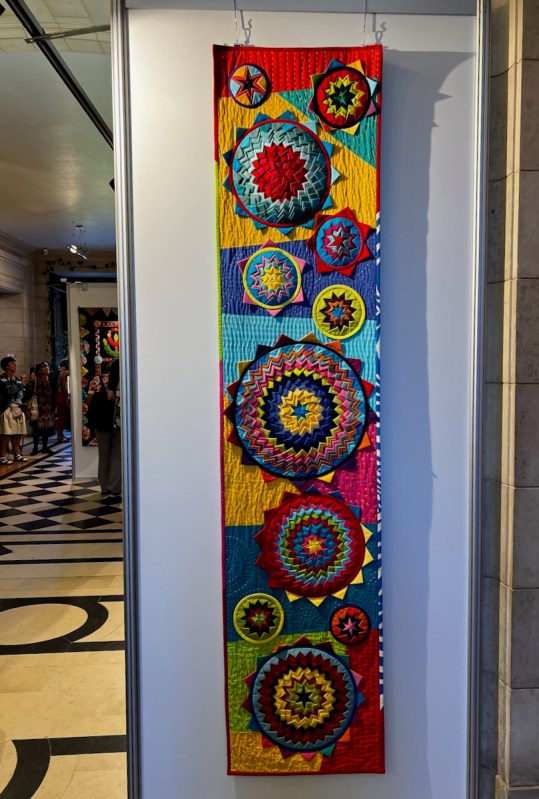
She was always thronged by, and visiting with, quilters, so I’m afraid I didn’t get the best photos of her. But her we go with some of her quilts.

In the front hallway, just across from where her table was, and I apologize, but I have no title card for this.

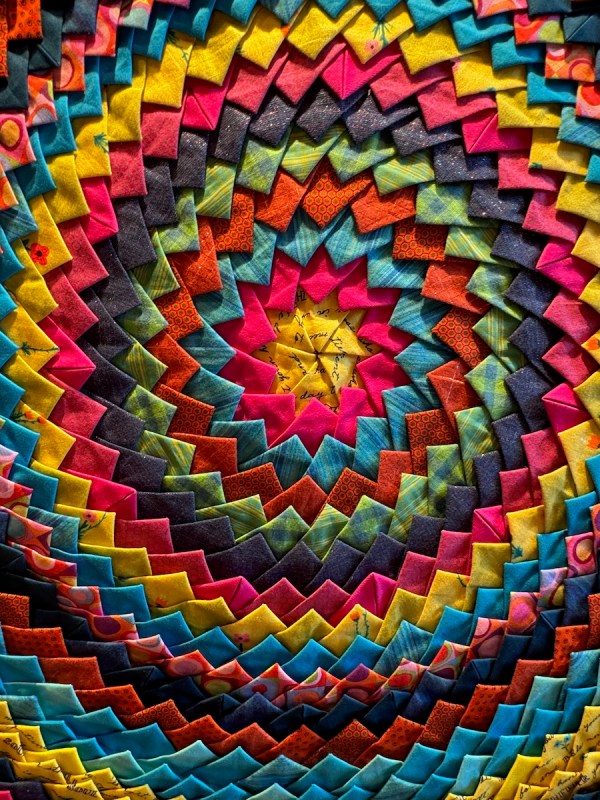
Her signature is a variation of the pine cone (or pine burr) block.

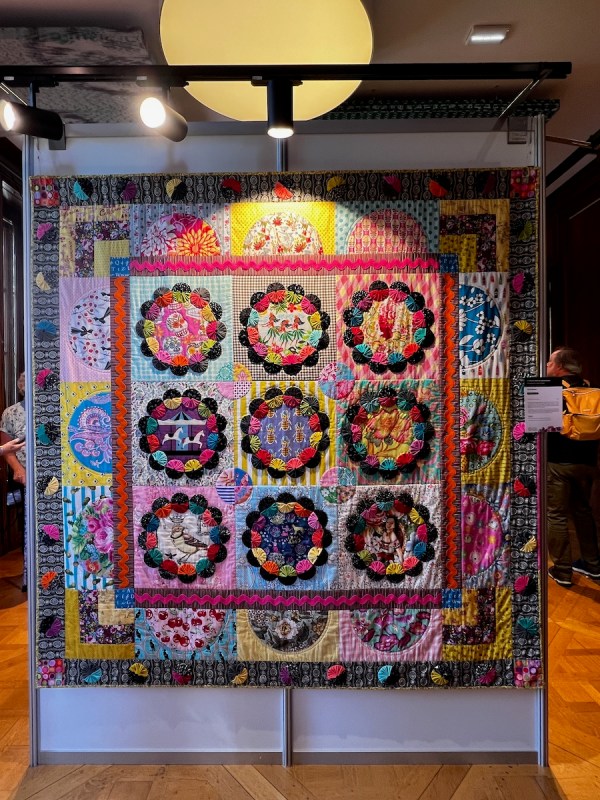
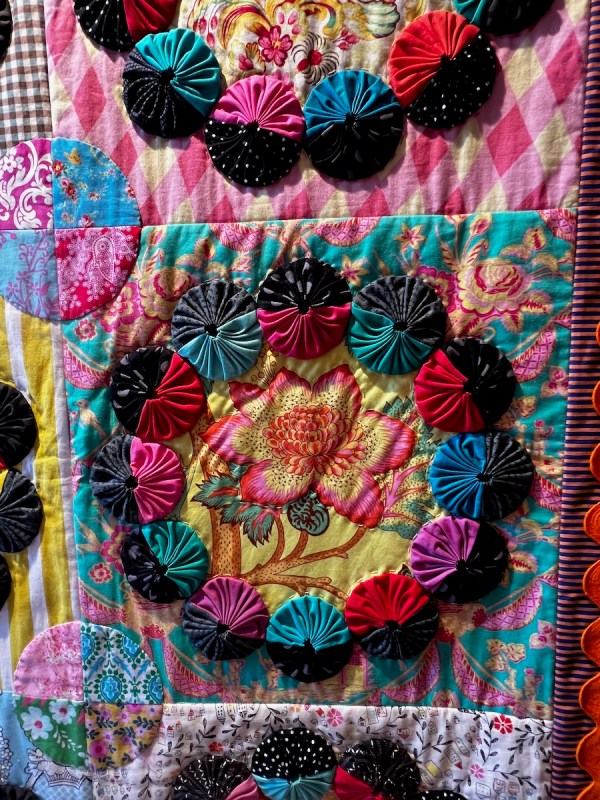
Followed by another motif she commonly uses: the yo-yo, a gathered circle with the gathers on the top.

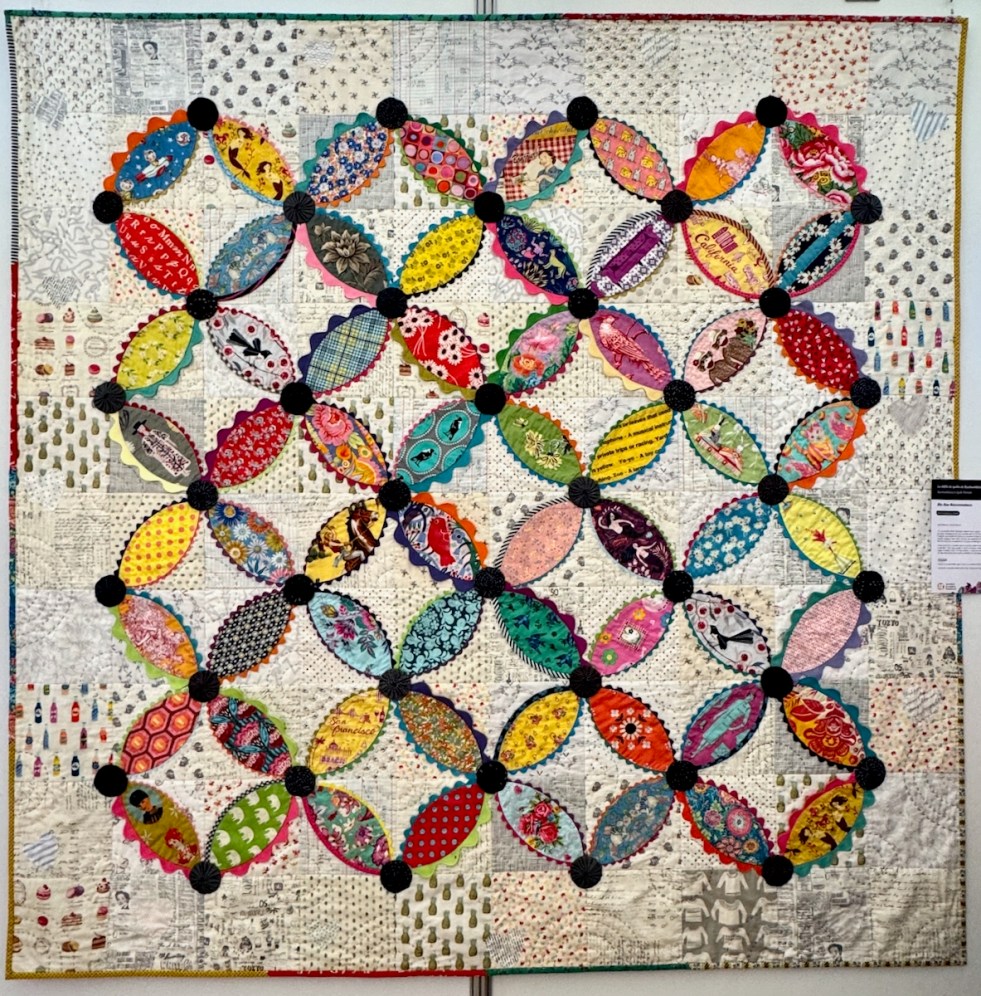
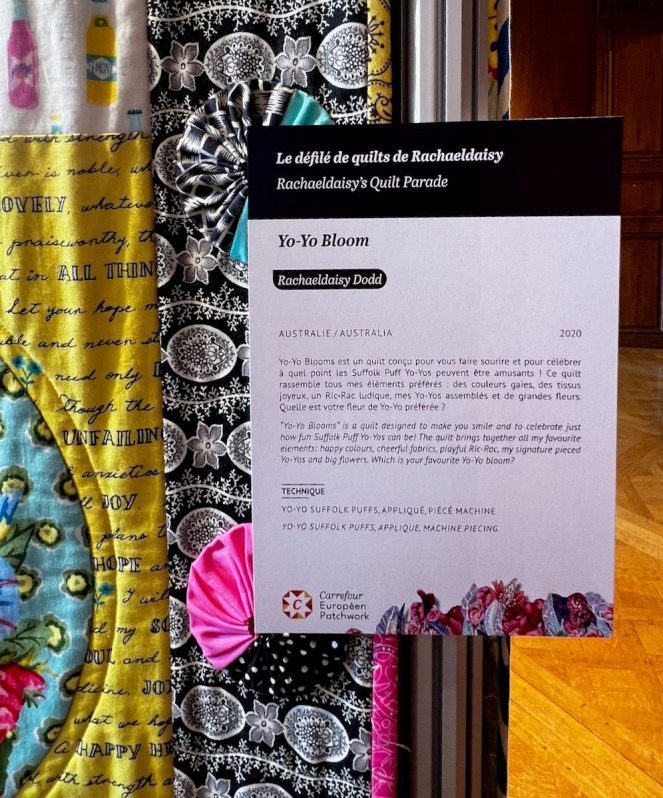
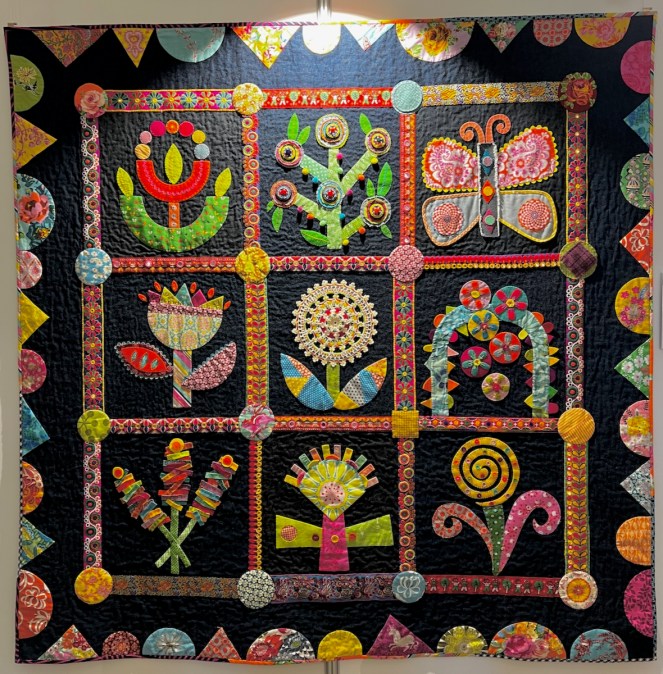
Title: Yo-Yo Bloom
Title Card: “Yo-Yo Blooms is a quilt designed to make you smile and to celebrate just how fun Suffolkd Puff Yo-Yos can be! The quilt brings together all my favorite elements: happy colors, cheerful fabrics, playful Ric-Rac, my signature pieced Yo-Yos and big flowers. Which is your favorite Yo-Yo bloom?”
Technique: Yo-Yo Suffolk Puffs, Appliqué, Machine Piecing.

Fun and funky shapes that delight.

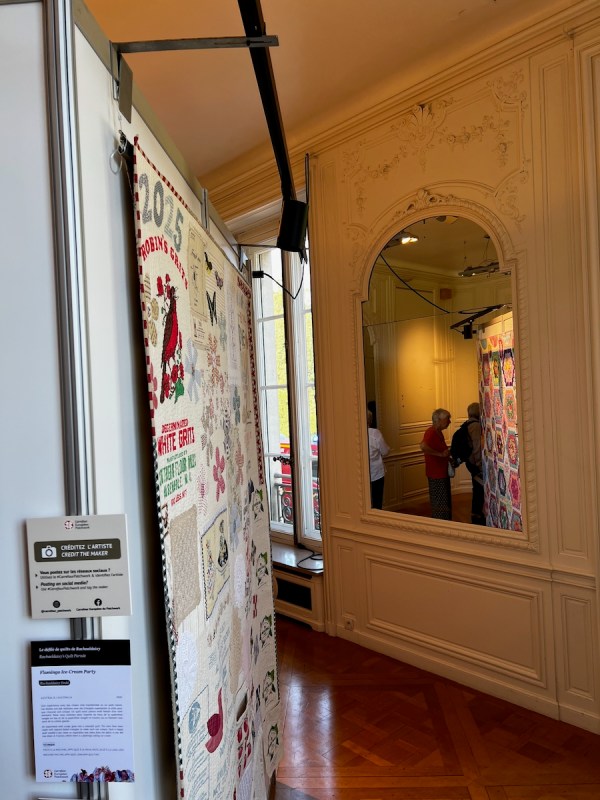
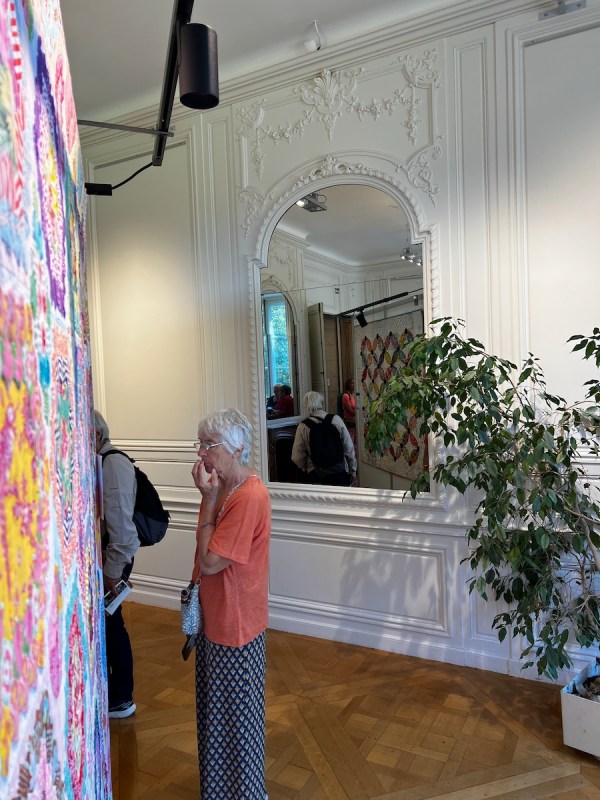
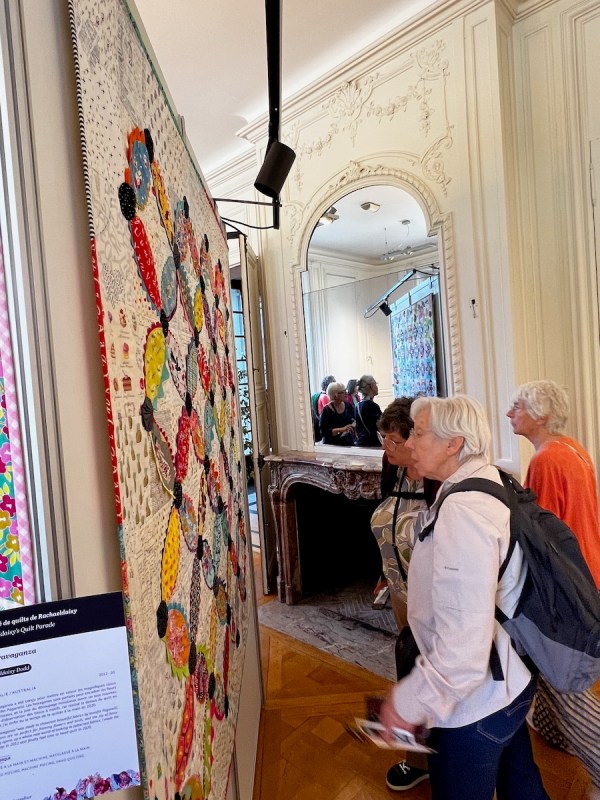
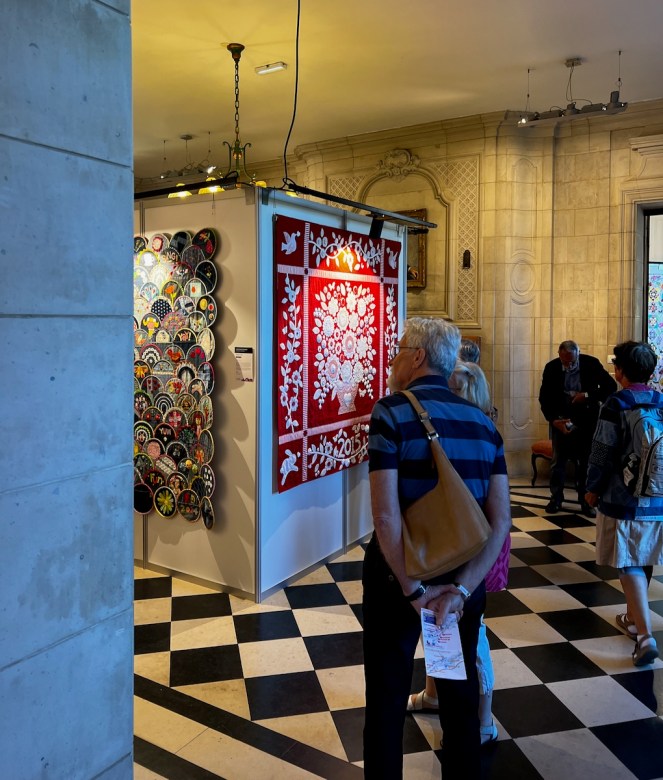
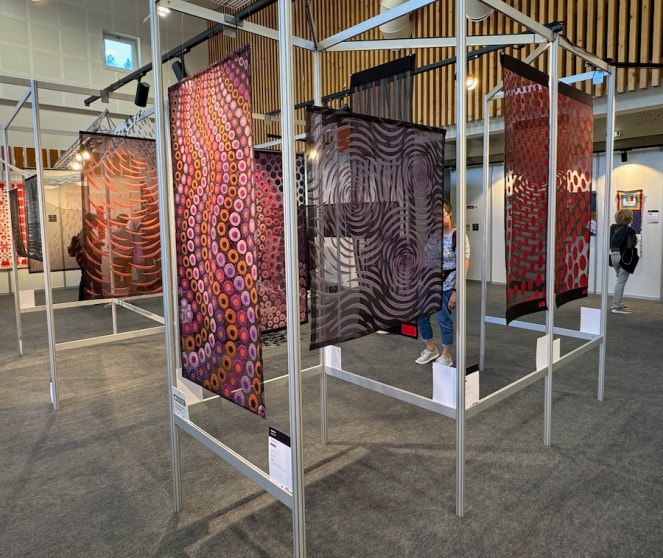
Several rooms held her quilts, with large moveable frameworks. In the next room, the frame was set up in the center, and the large mirrors and windows and her quilts all echoed with pattern and color.

Click to enlarge.

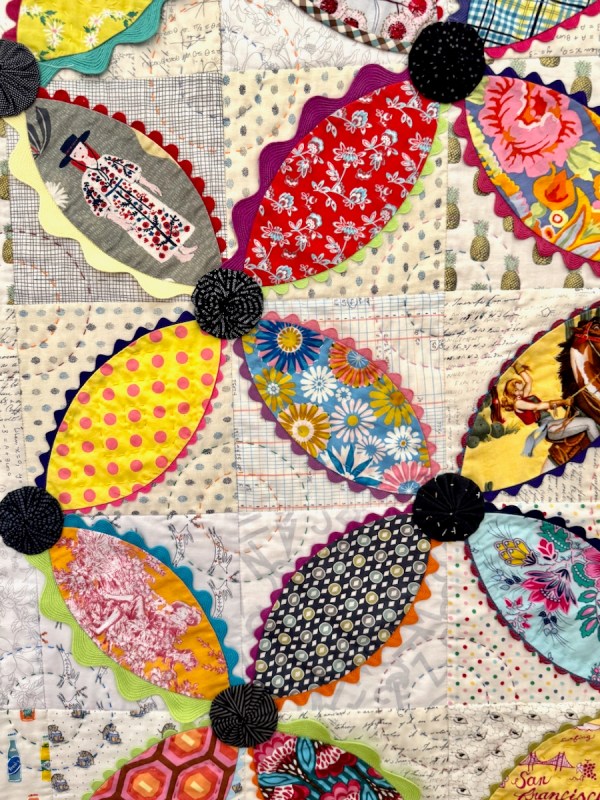
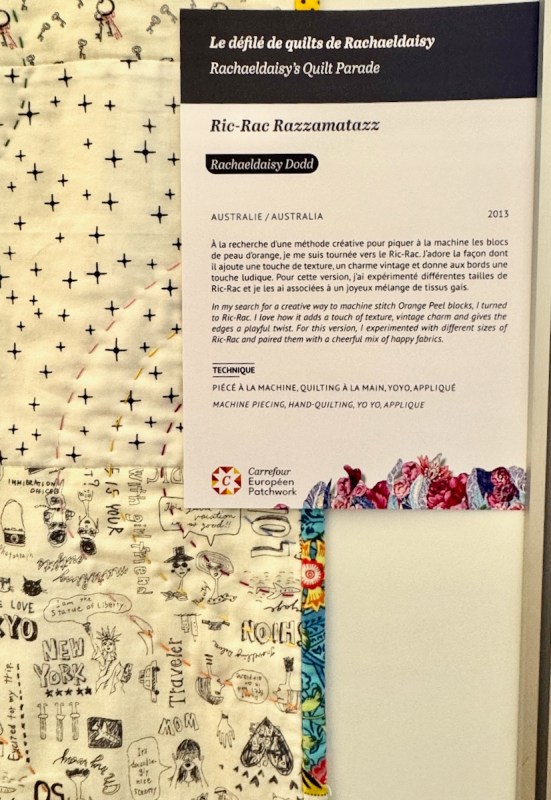
Where does she get all her ric-rac? I think a lot of it is vintage, as she alludes to in her title card.

This one was always hard to get a photograph of. I also kind of liked that the man is carrying his wife’s (his??) purse.

Yo-yos galore, along with doilies and appliqué; she is not a minimalist, and I love it all.

Apologies: no title card. But what do you think? Did she quilt the background, and then add the giant circular pine burr blocks afterwards? My brain is always whirling with questions at these shows.

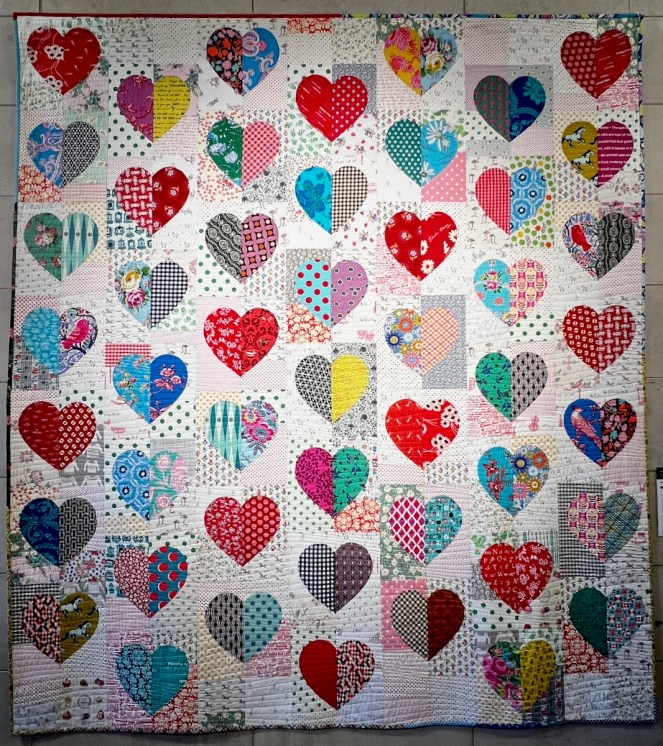
Another scrap quilt, another inspiration.

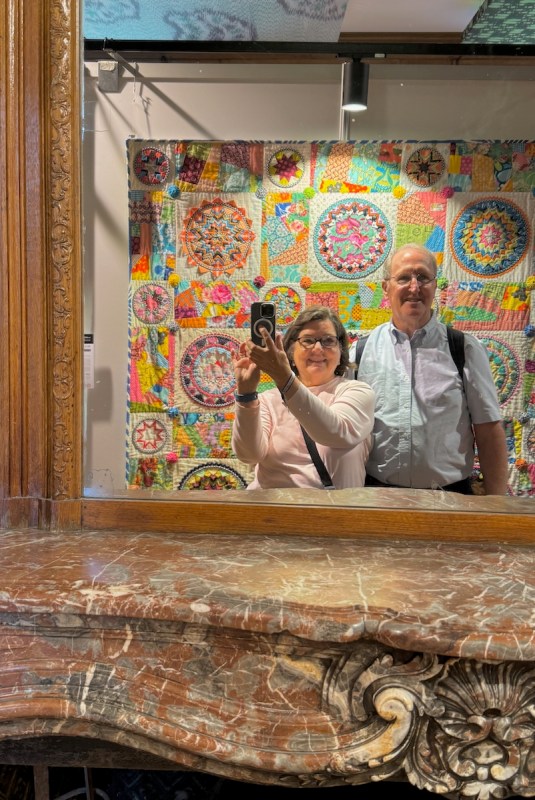
A couple of random tourists, haha.

I just saw a smaller version of this on my friend’s IG feed. Link. Makes me want to put it in the queue for a handwork project while traveling to Pour l’Amour du Fills in Nantes in 2016.

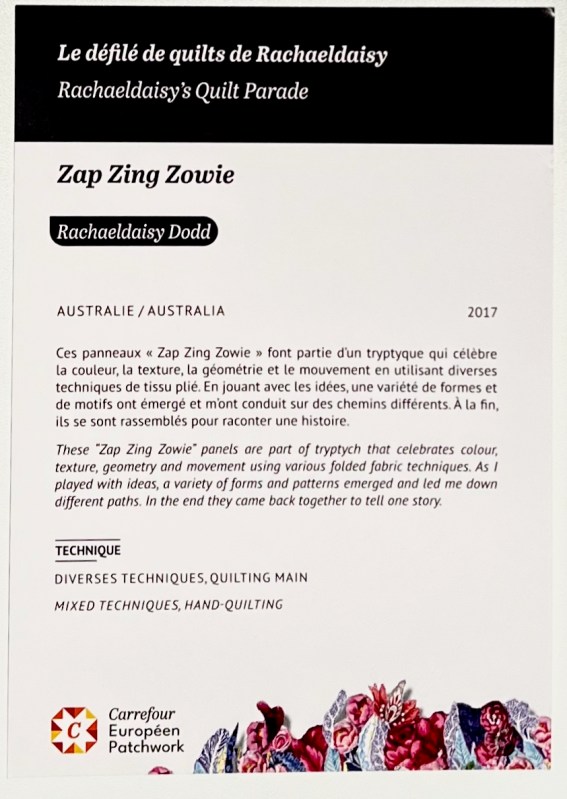
We only noticed two of the triptych of quilts. Click to enlarge the title cards and banner quilts. These were hanging by the entry/exit hall, and we were on our way out.

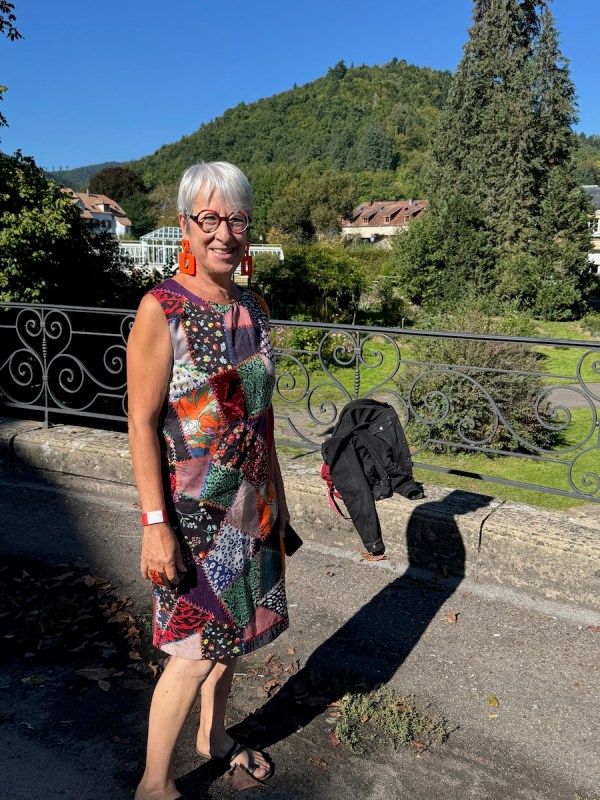
Loved her dress. I need to get a patchwork-appropriate dress for quilt shows.

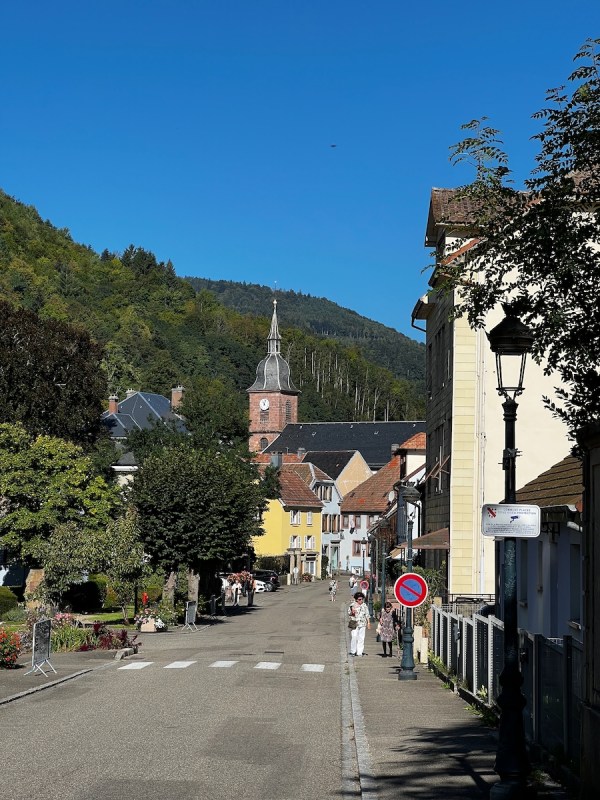
The small towns of Val d’Argent; we are currently in Sainte Croix-aux-Mines, heading to Lièpvre. The church above is Église St. Nicolas, venue 11, written about in the previous Carrefour post.

This reminds us that this portion of France went back and forth between Germany and France several times. If you’ve traveled in this area, it gives you an appreciation for the diverse, yet subtle differences between these neighboring countries (and add in Switzerland, too).

Venue 14: Église de l’Assomption, with Ruth De Vos

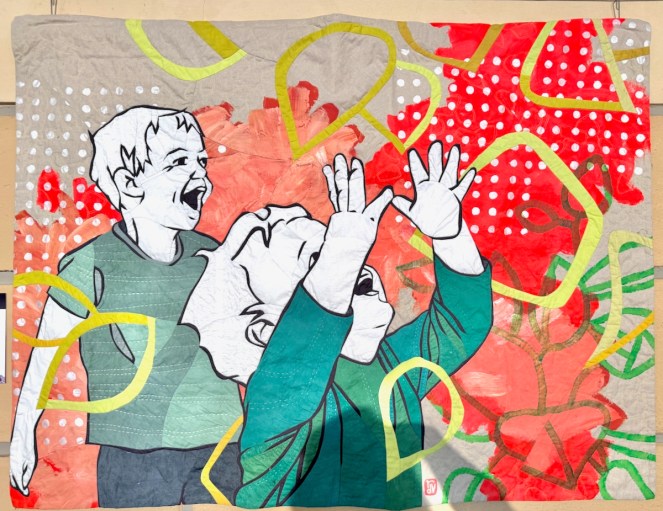
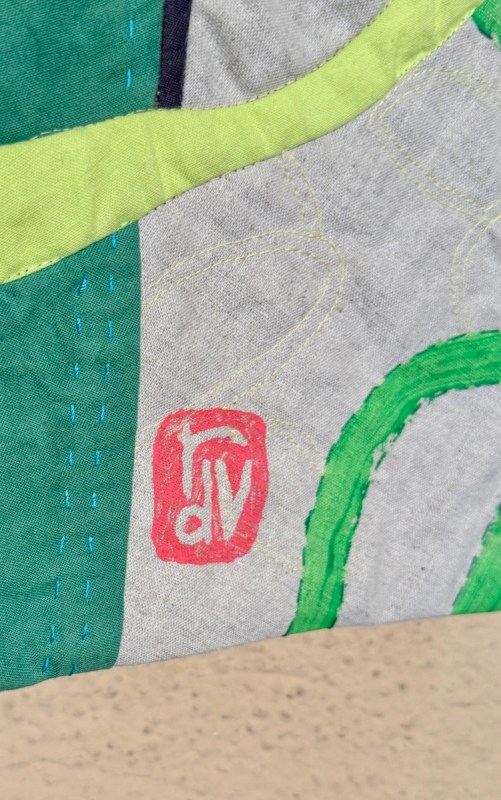
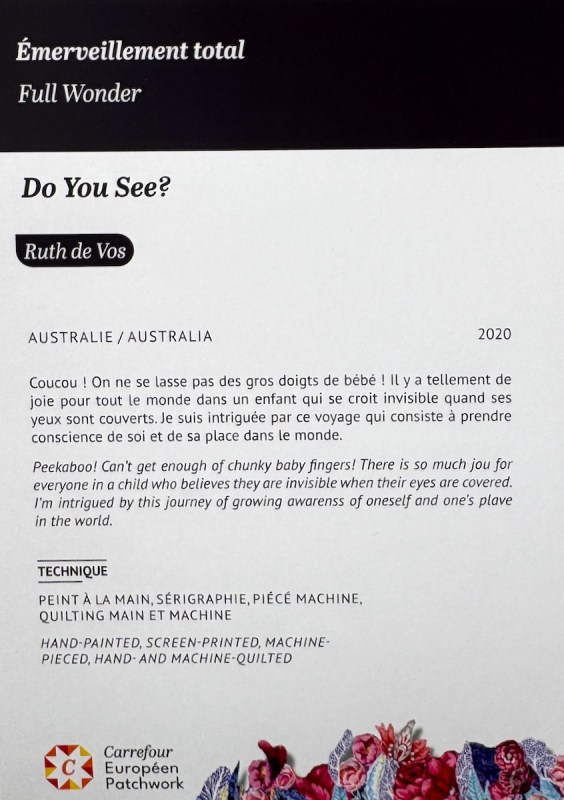
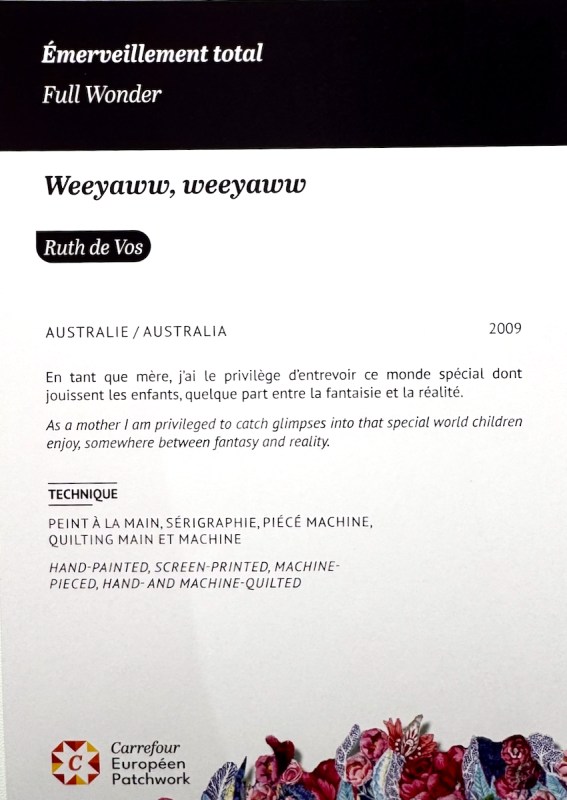
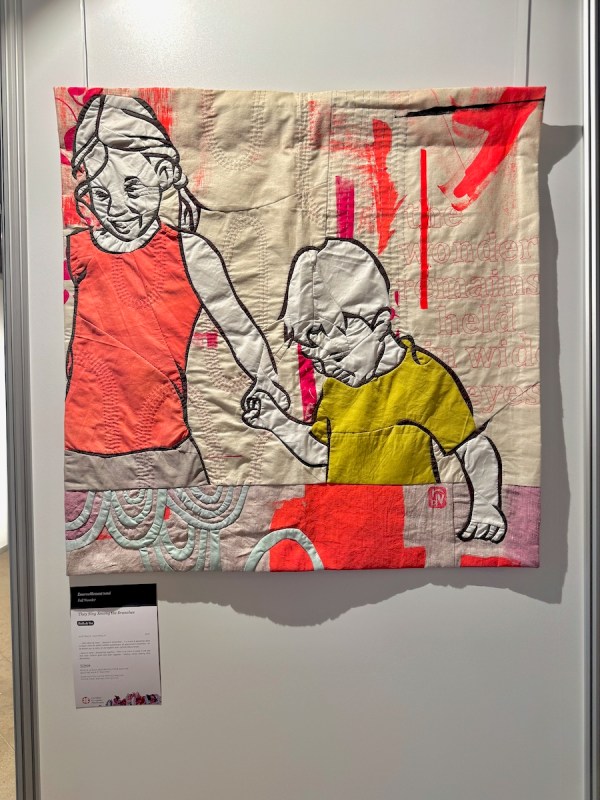
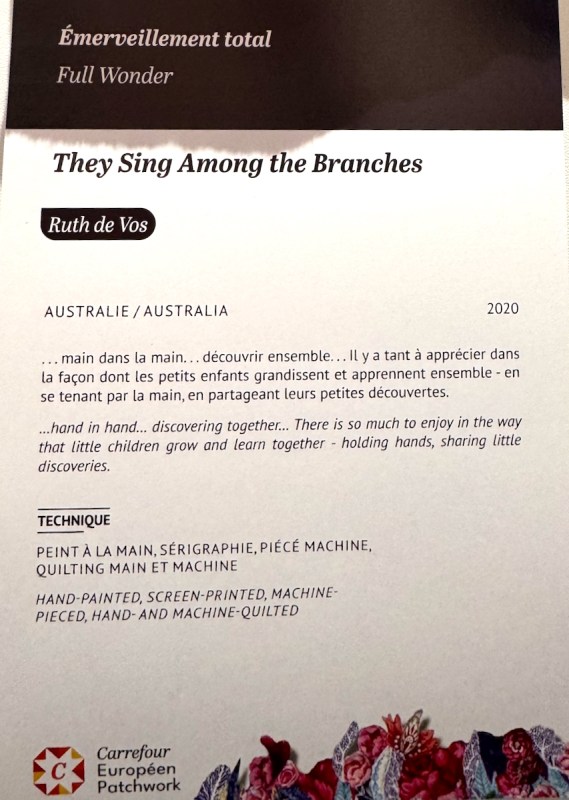
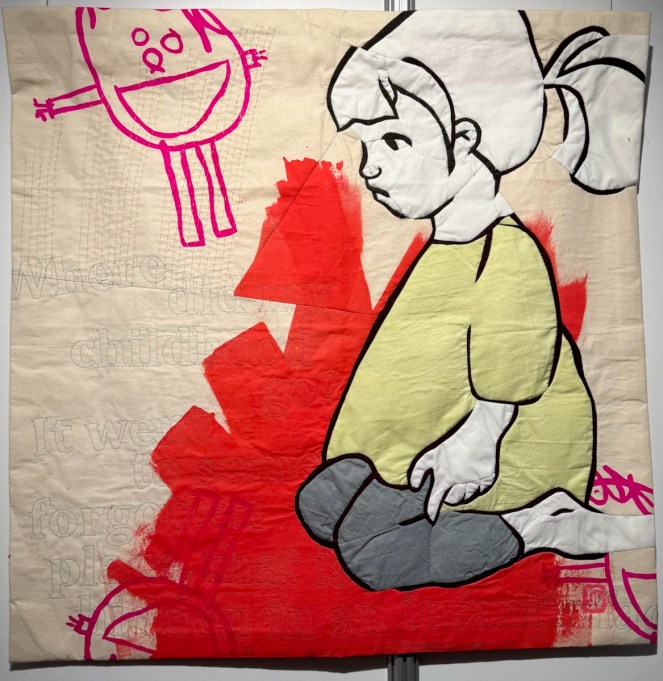
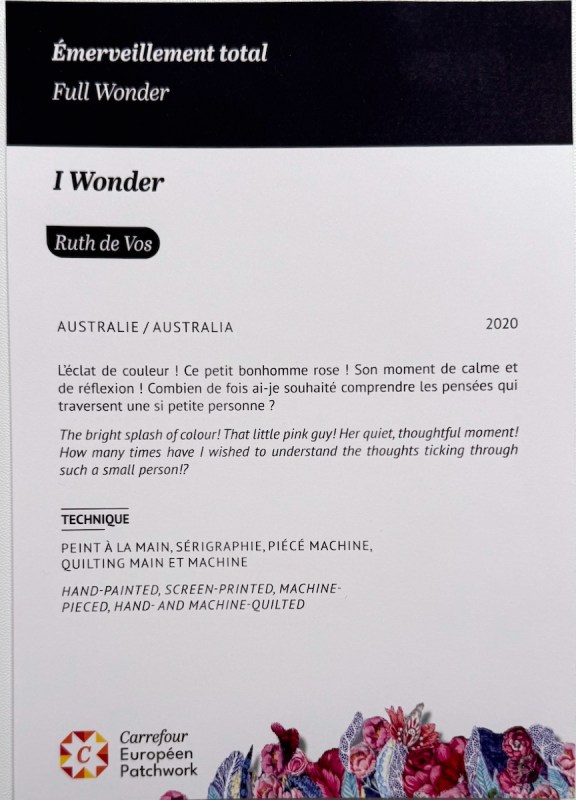
A small church in the town of Lièpvre, one of two sites in this village. Inside were new works from Ruth De Voss, she of flower fame. You can find her on Instagram @ruthdevosart.

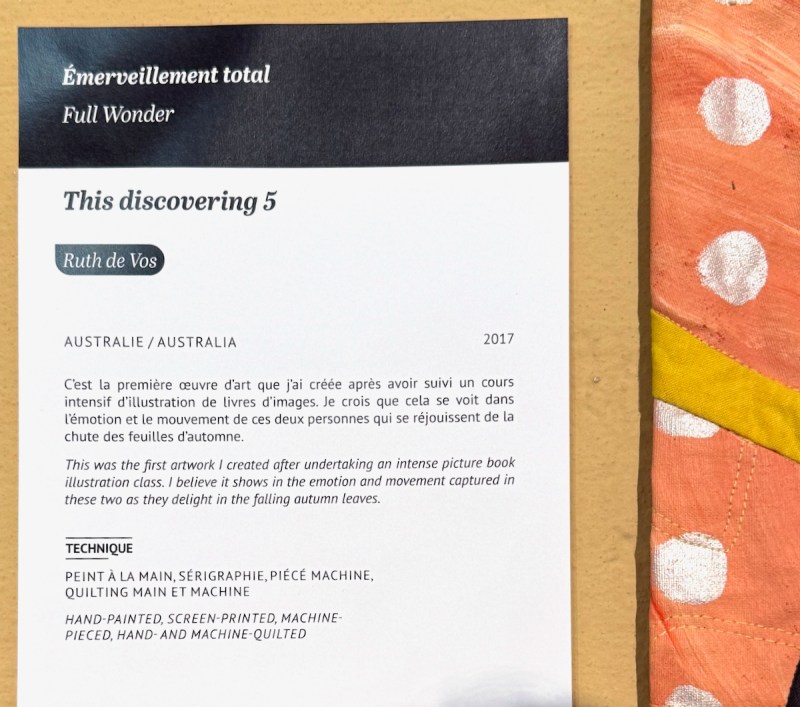
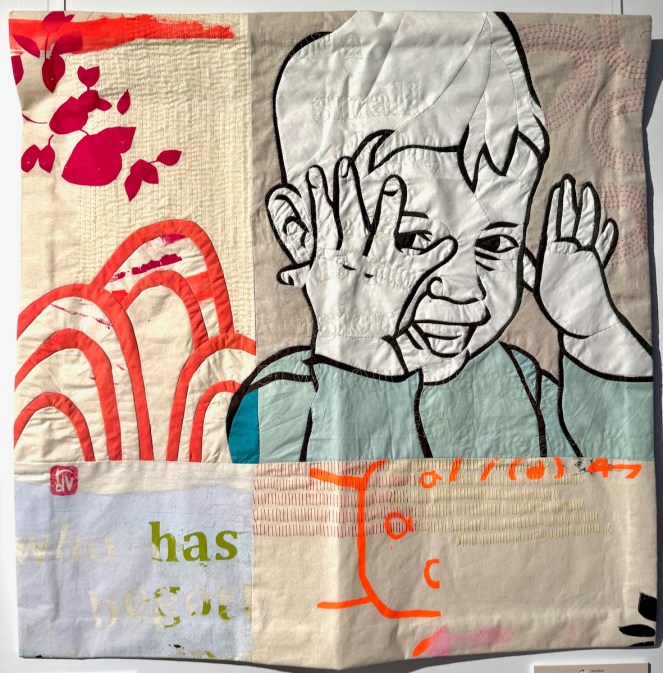
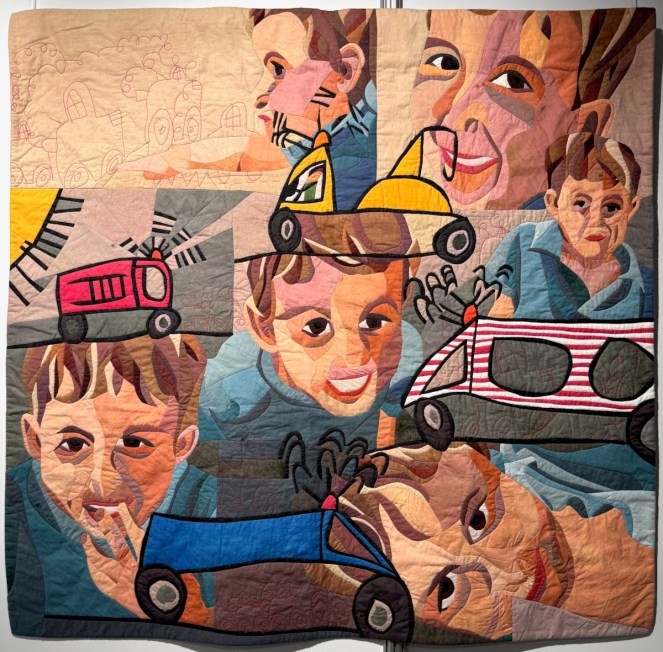
Now she has turned her piecing and printing and surface decoration skills from flowers to children. Her children, which I loved. Many women seem to avoid this side of their lives, and often in the art world they are expected to, but De Voss celebrates it.

(click to enlarge) The church had many of her art pieces; I’m only showing a selection. They were colorful, drawn with strong lines.

Click on small arrows to advance this slideshow to see more of her pieces.

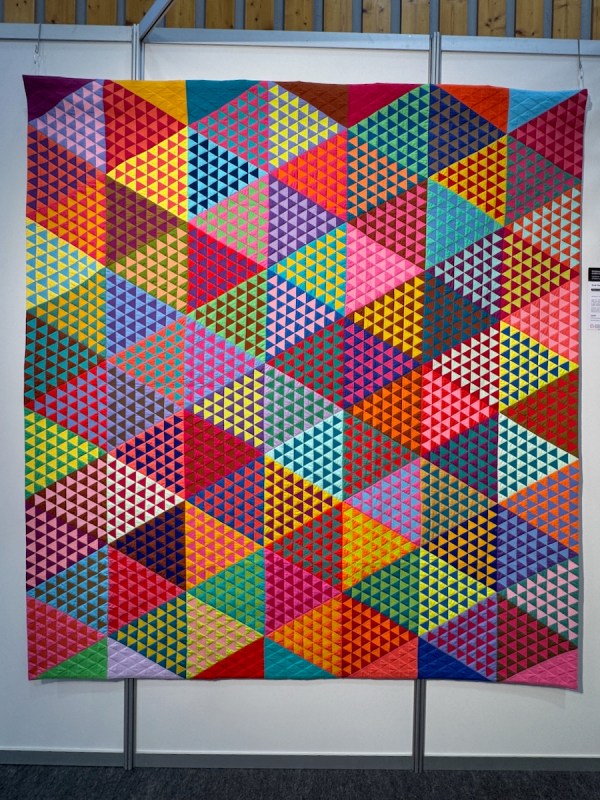
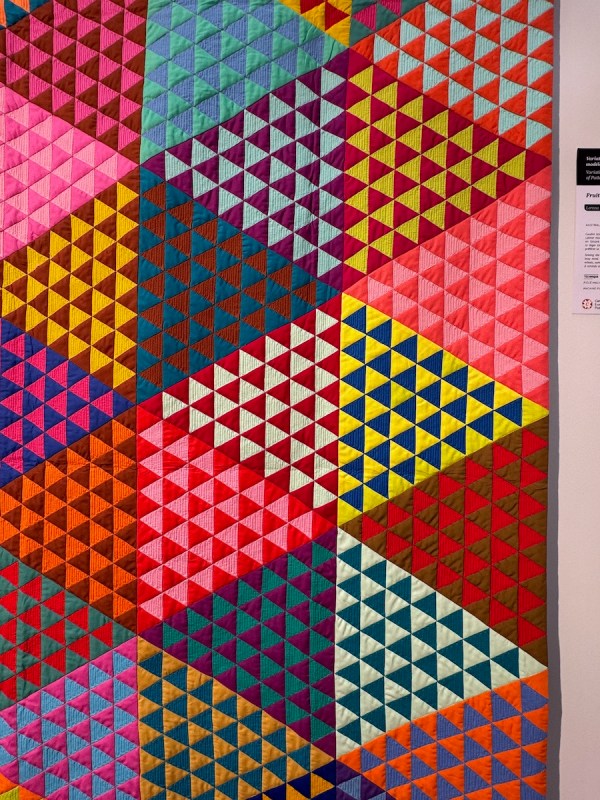
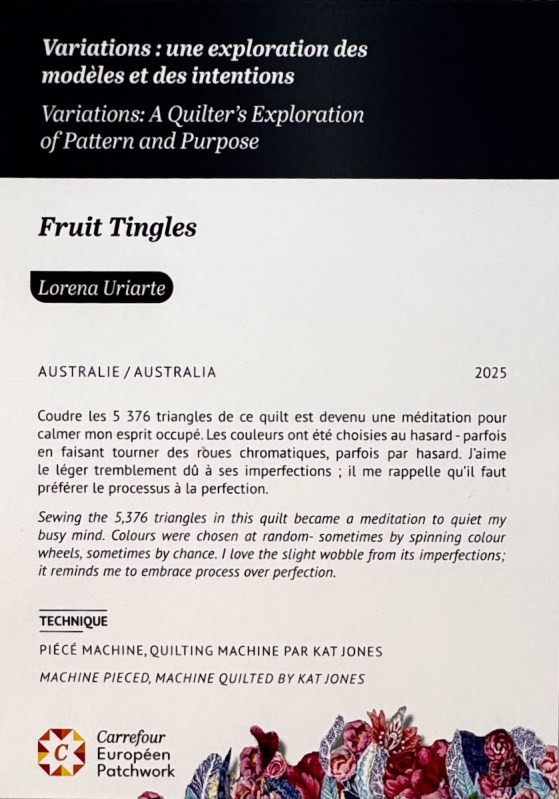
Venue 15: Salle Polyvalente, with Lorena Uriarte, Dianne Firth, ASL Liépvre, EQA, France Patchwork

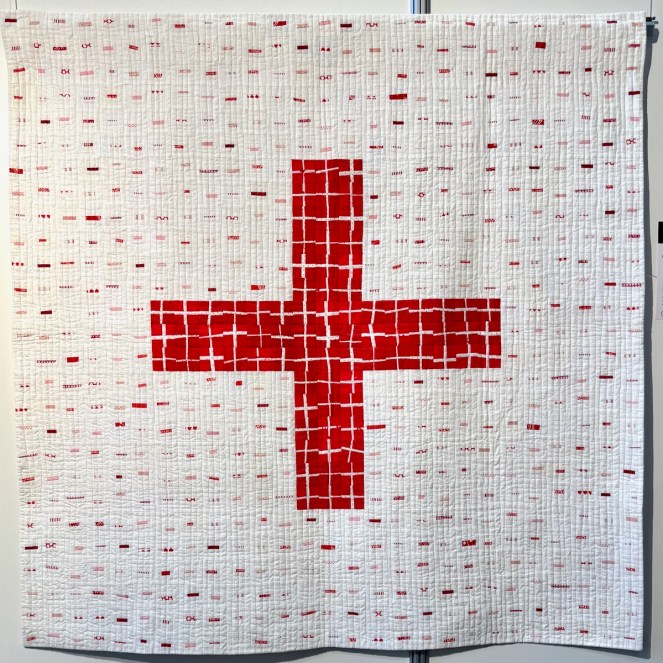
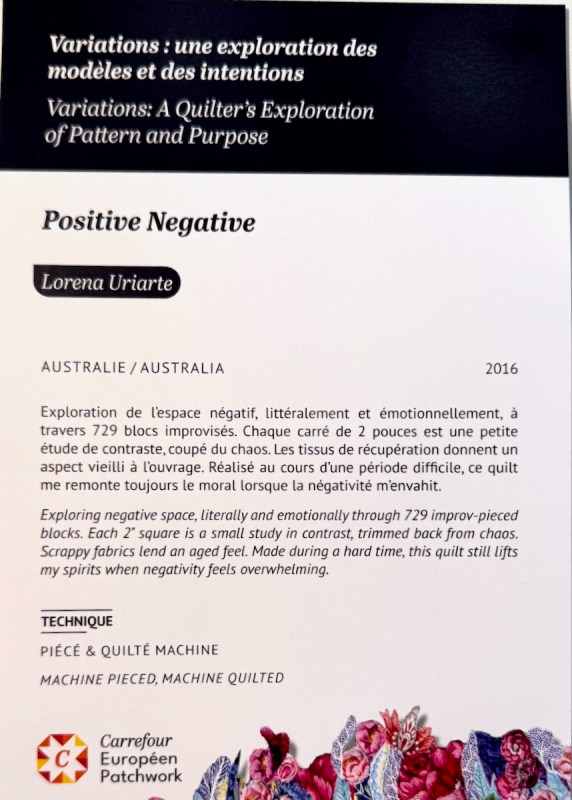
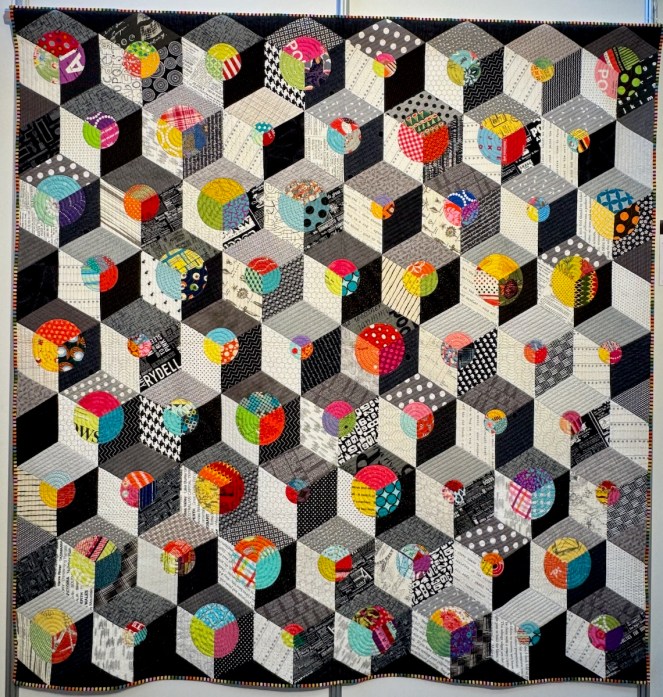
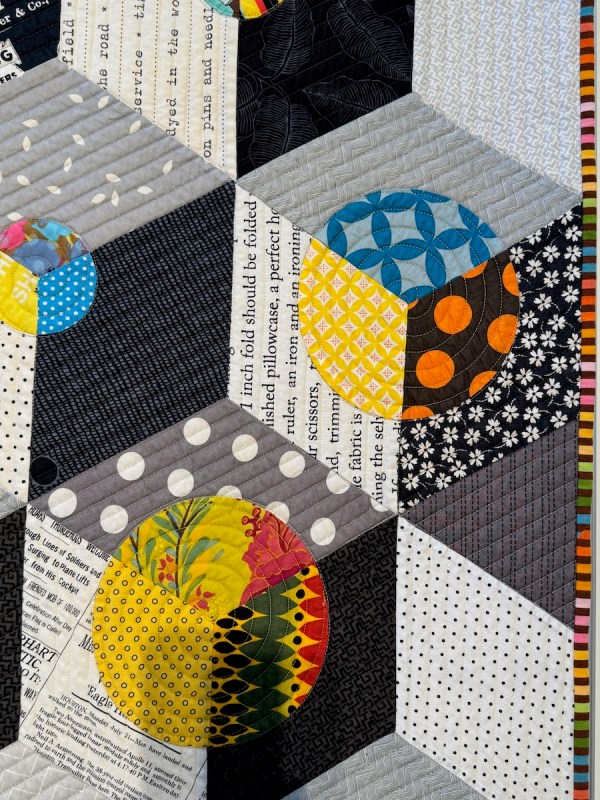
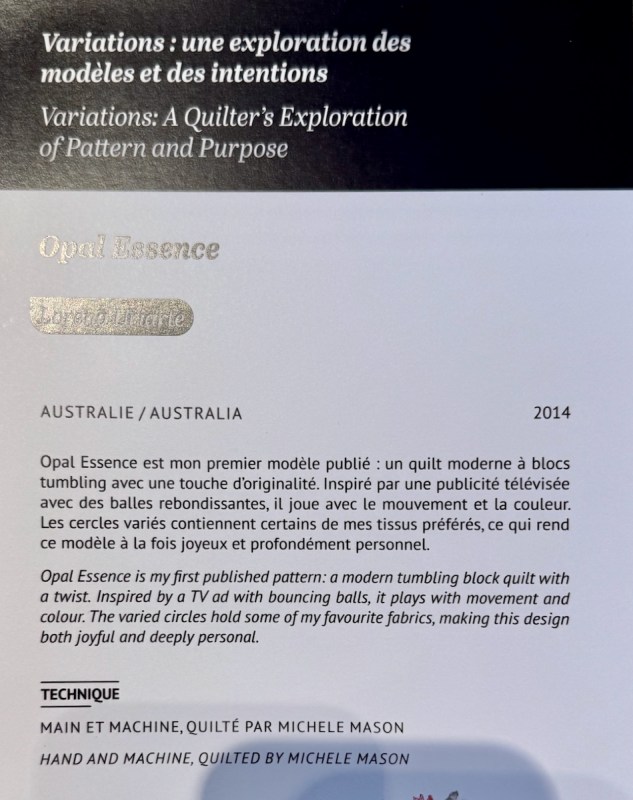
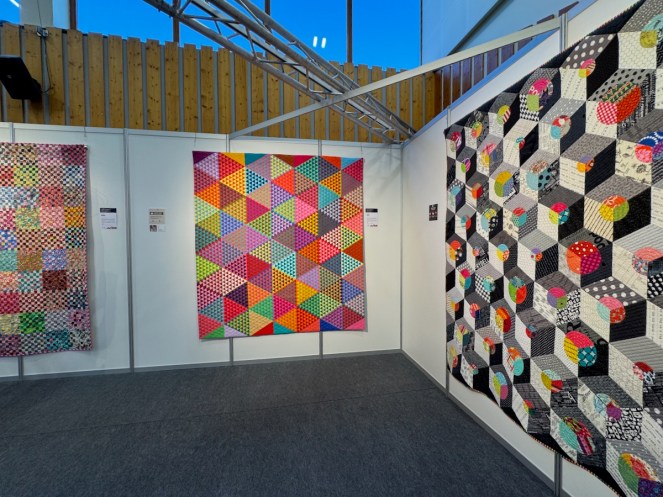
Lorena Uriarte is a well-known Australian quilter, who has been active in teaching, making patterns, and championing good design in quilts for years. You can follow her on Instagram @lorena_in_syd, as well as enjoy her quilts, below.

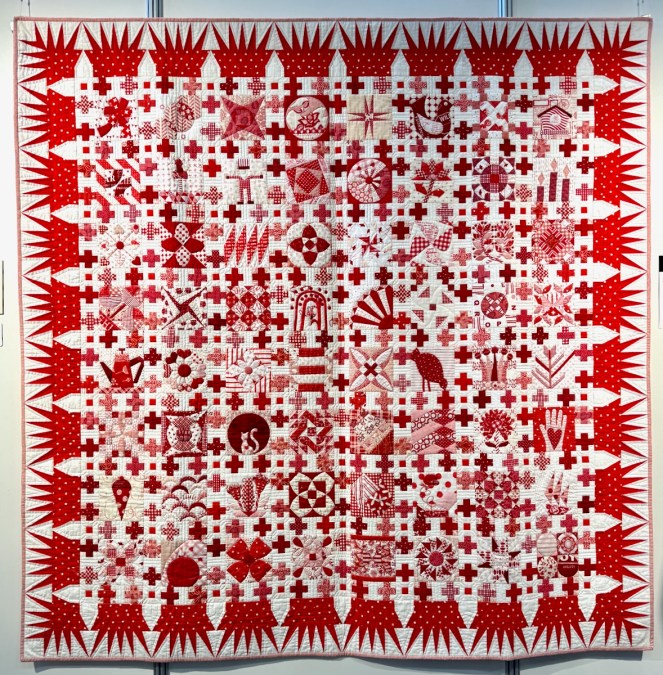
Title: Wingdings: A Variety of Symbols
Title Card: This quilt “is my red and white interpretation of Chuck Nohara’s Symbol Quilt Using self-drafter blocks from her book 2001 New Patchwork patterns, I explored every piecing technique to create a playful and personal visual language.”
Techniques: Hand and Machine; Quilted by Michele Mason

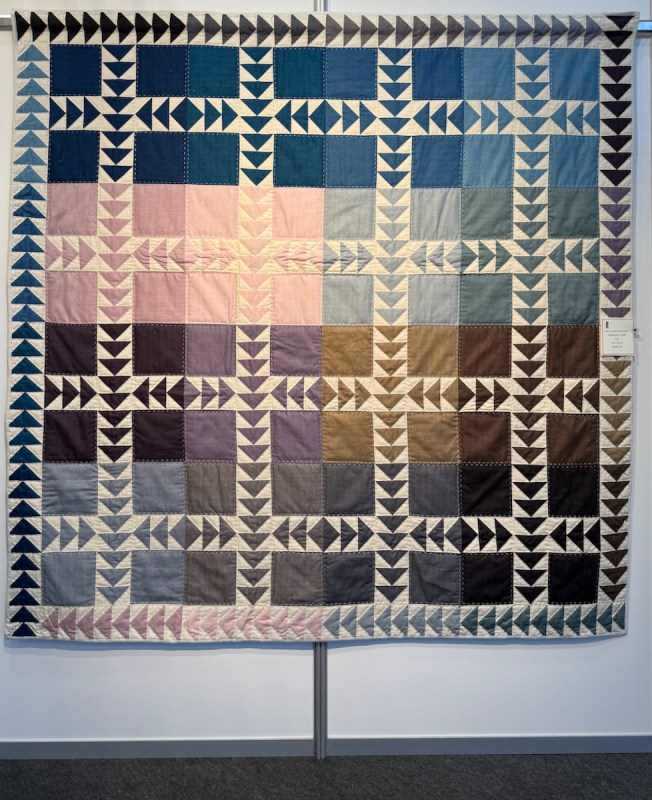
She had a range of her quilts hanging in this venue; they had a bold and colorful impact.

France Patchwork, and others

As always, France Patchwork, the national quilting guild, had a few quilts on display.

“France Patchwork is the French quilting guild, with over 6,000 members. Founded in 1984 and still thriving thanks to its volunteers, its mission is to promote quilting and its various forms through competitions, Friendship Days, and a quarterly magazine: Les Nouvelles de France Patchwork (from website).

They can be found on Instagram @france_patchwork_news. Happily this year I was there early enough to snag one of their tote bags. (One can never have too many tote bags!)

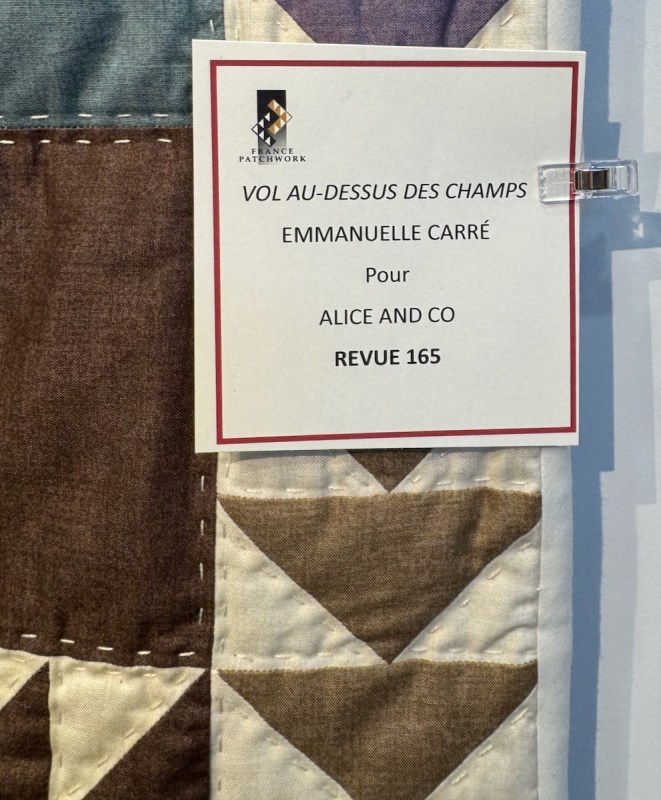
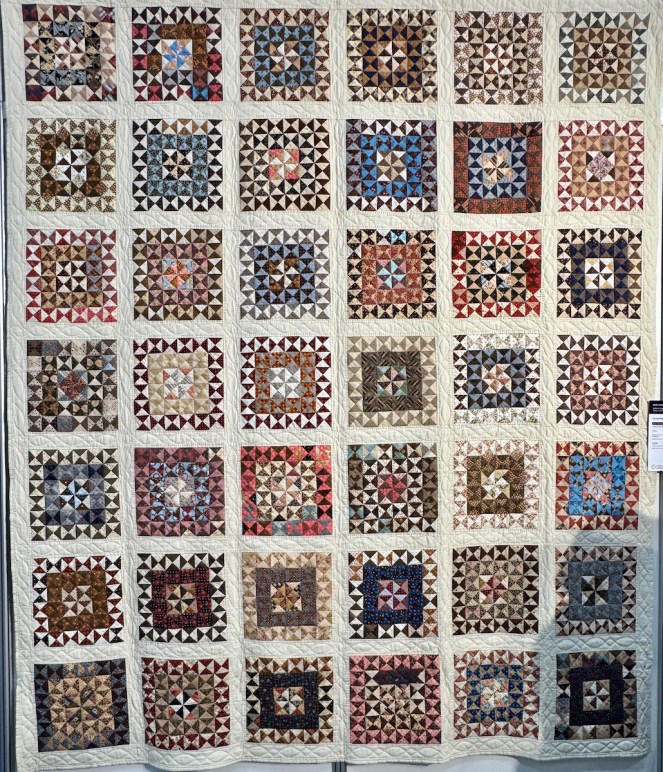
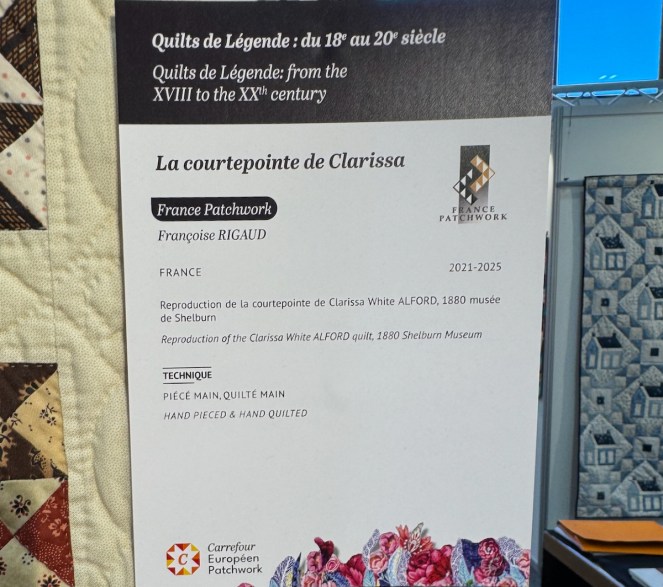
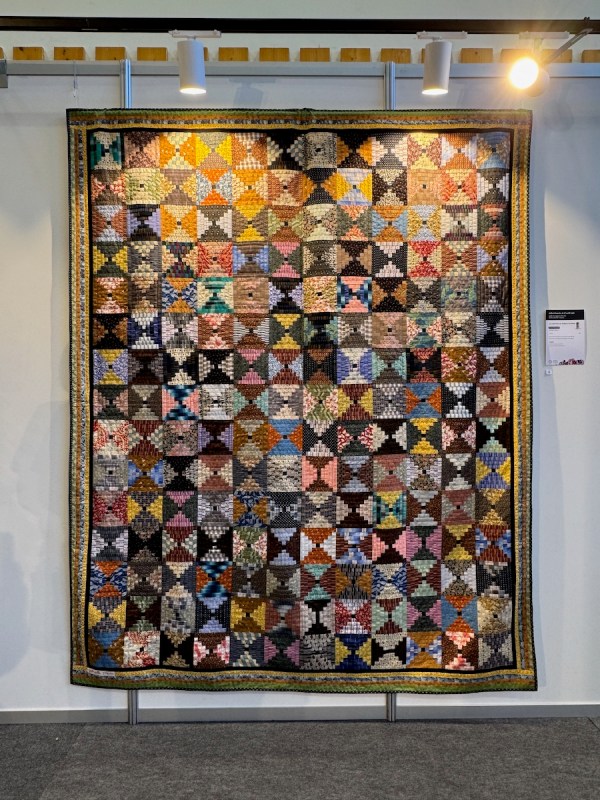
The quilting is done by hand, with heavier thread, and is more spare. I believe these quilts are the cover quilts for their magazine, Les Nouvelles, but I can’t find any working links to their magazine or their organization, beyond the Instagram account.

I wonder if Françoise Rigaud is with the group quilt_en_reve on Instagram? If so, they always do such beautiful work in making reproductions of antique quilts. They had a display in 2024 at Carrefours, and I wrote about them here.

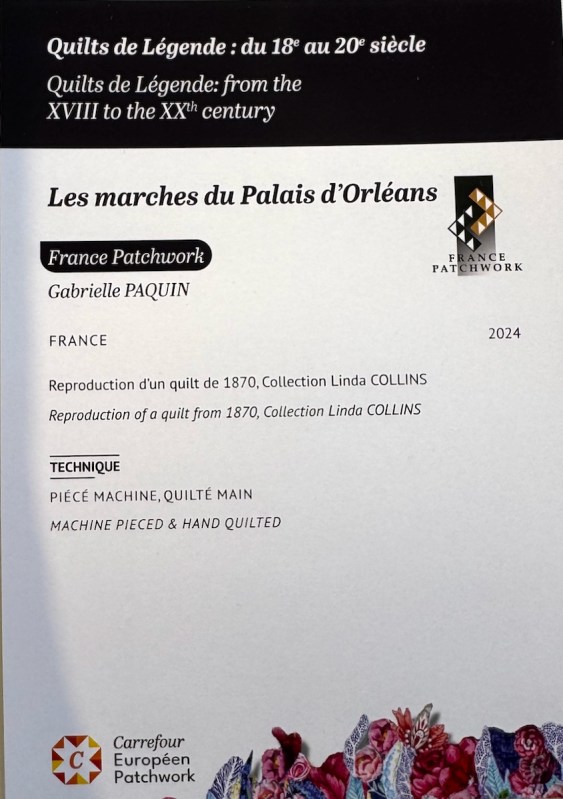
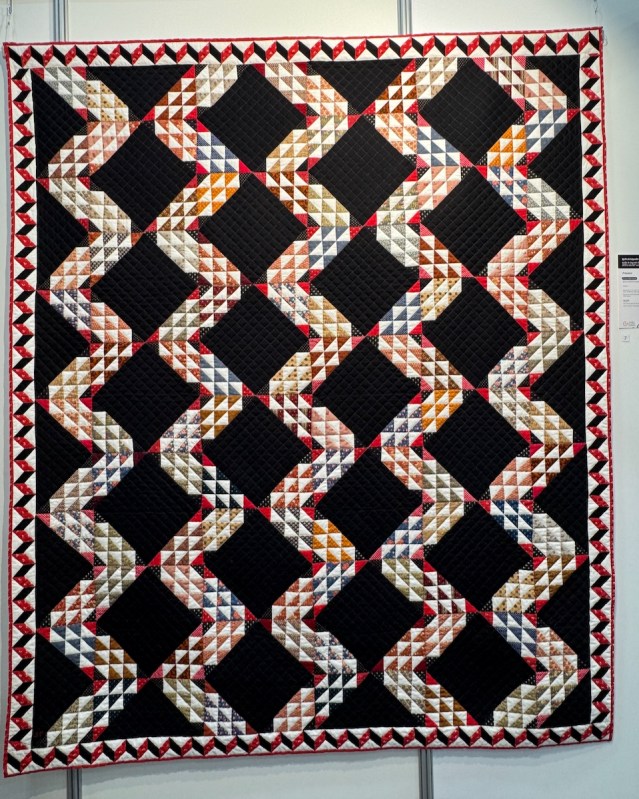
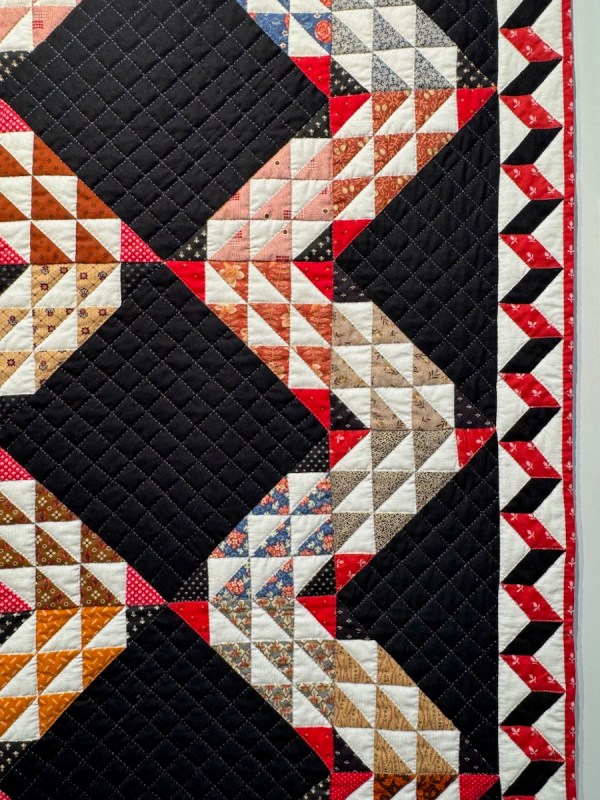
I loved the use of that ombre fabric in the one block. Gabrielle Paquin is a favorite of mine; I saw her the first time I went to Carrefour (link) and began to see I had a lot to discover and learn about our beloved patchwork.

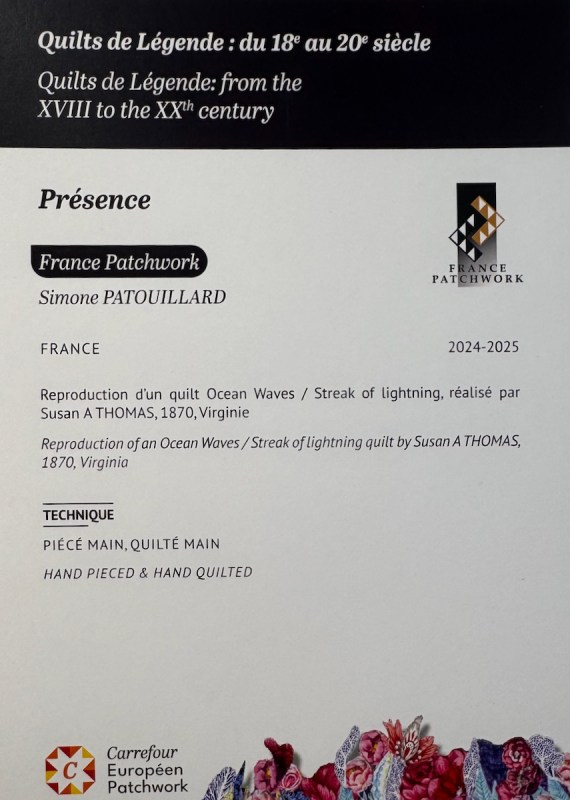
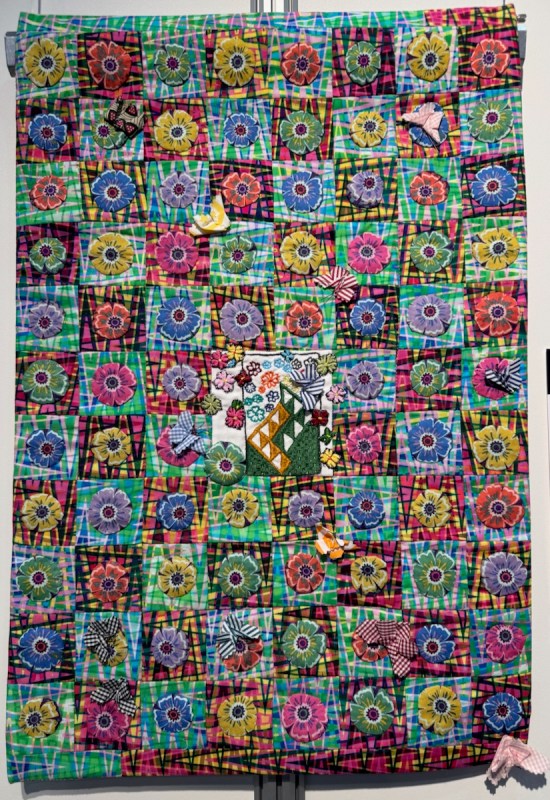
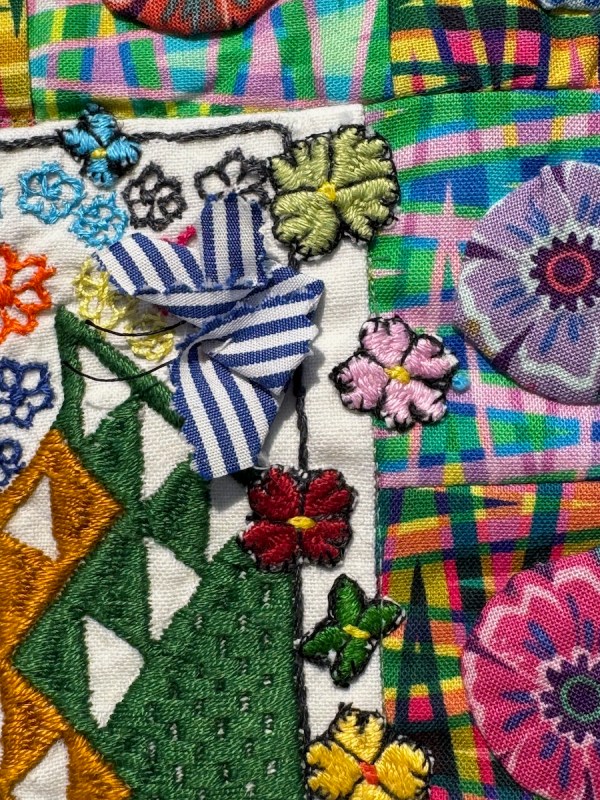
I recognized the France Patchwork logo in the center of the quilt.

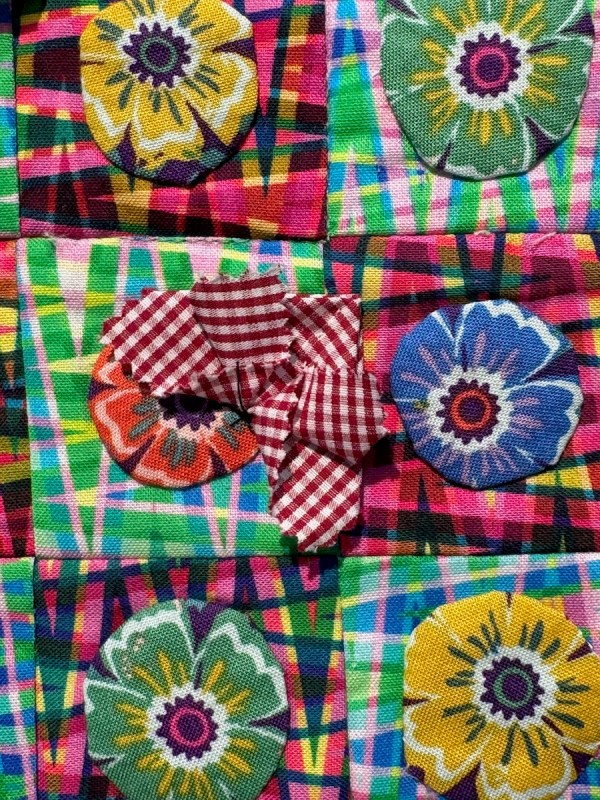
And I loved the combination of appliqué and these interesting little butterflies.

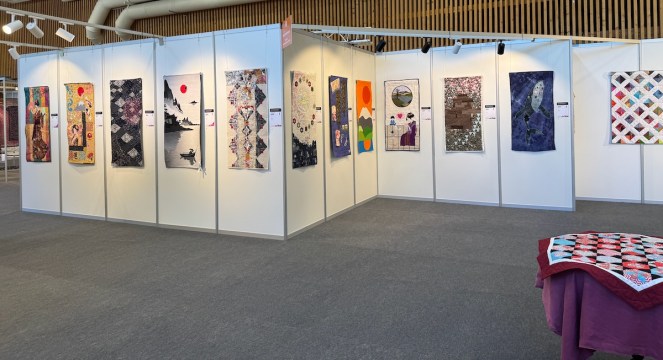
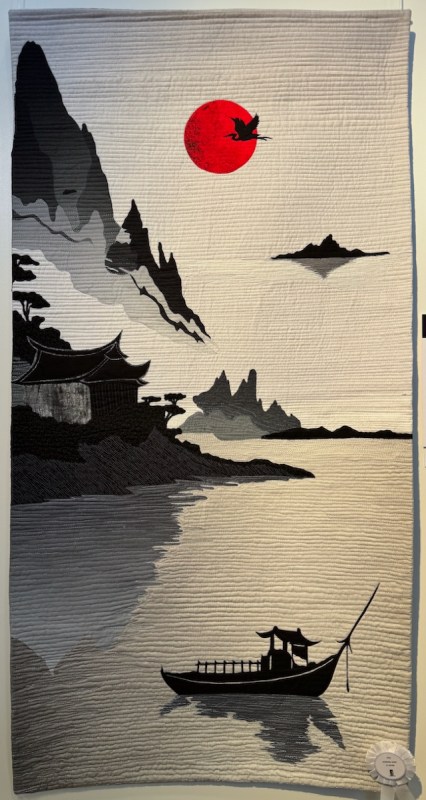
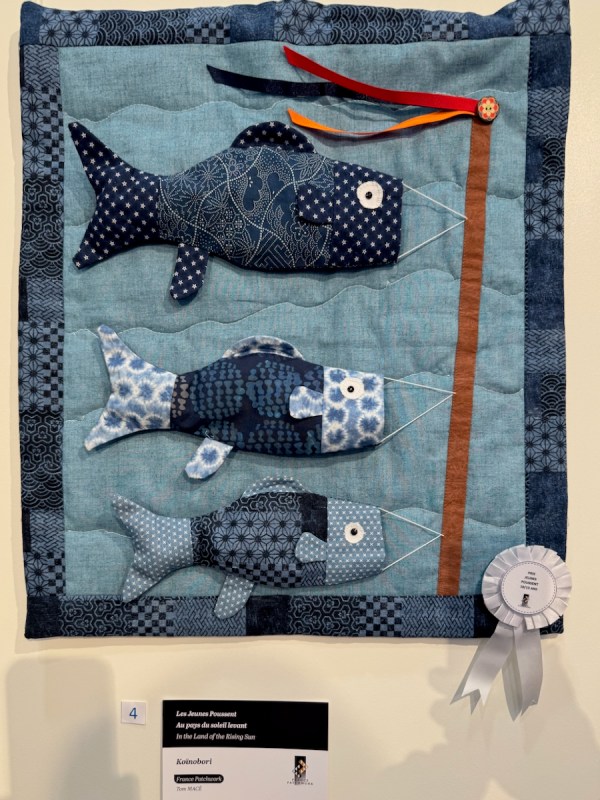
A tribute to Japan, from France Patchwork.

Title: Koïnobori
Artist: Tom Mace, France
This is from the category of “Les Jeunes Poussent” in the grouping In the Land of the Rising Sun, and was in the age group of 10-13 years old. (Literally it translates to “The Youth Are Growing.”)

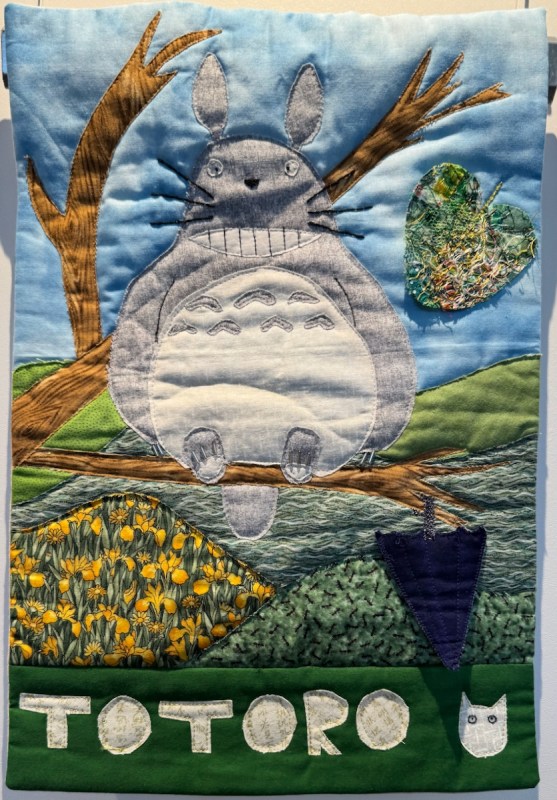
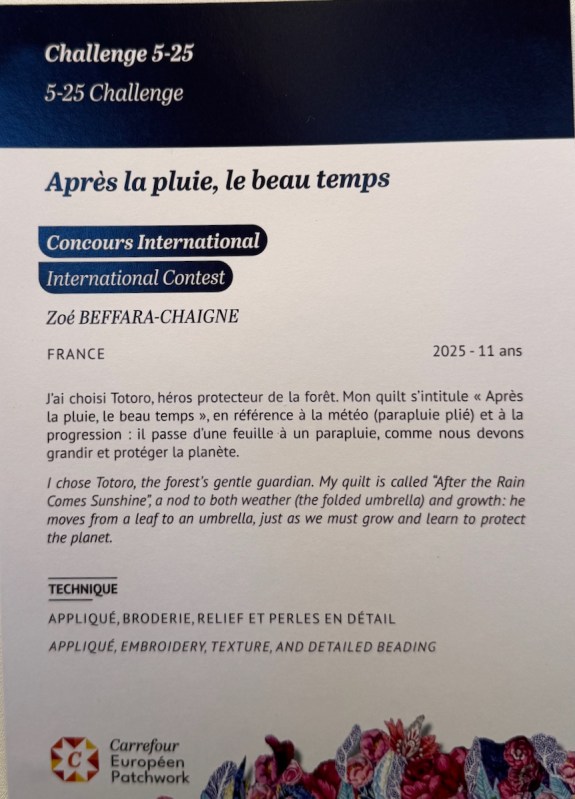
The Challenge 5-25 was to encourage the interest of the youth. The website says:

“For the 30th anniversary of the European Patchwork Meeting event, we’re inviting budding artists and young prodigies to take part in the “HEROES” competition, inspired by those people and characters they admire, on screen or in real life.

The challenge is to create a patchwork quilt: a work made up of different pieces of fabric, illustrating the theme of heroes. Think of everyday heroes and heroines, cartoon characters, bright colors and comic books for inspiration!”

Diane Firth

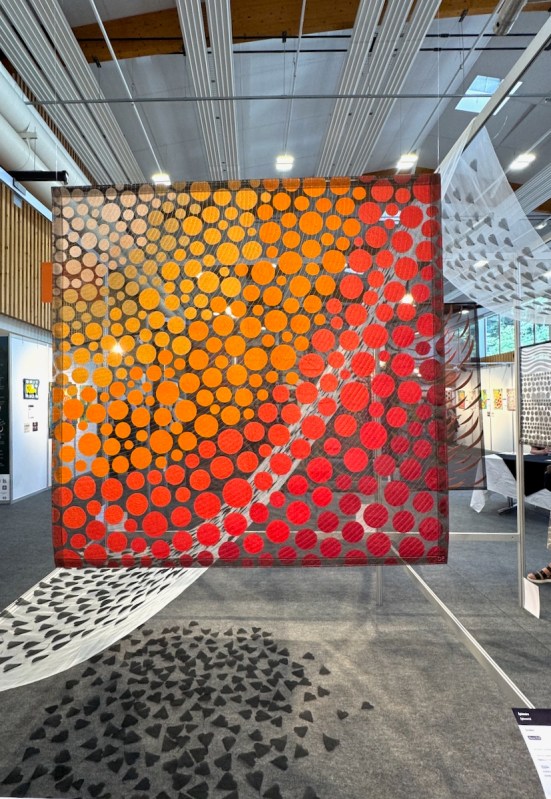
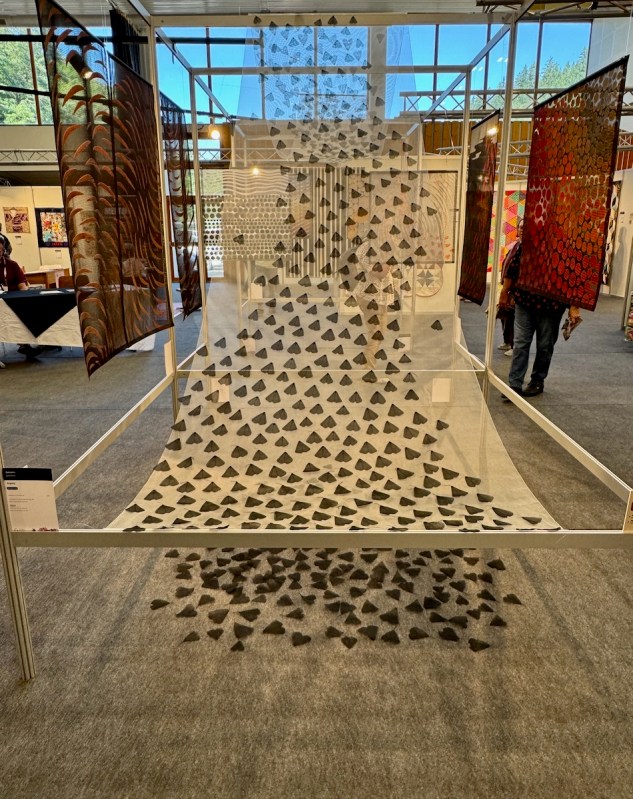
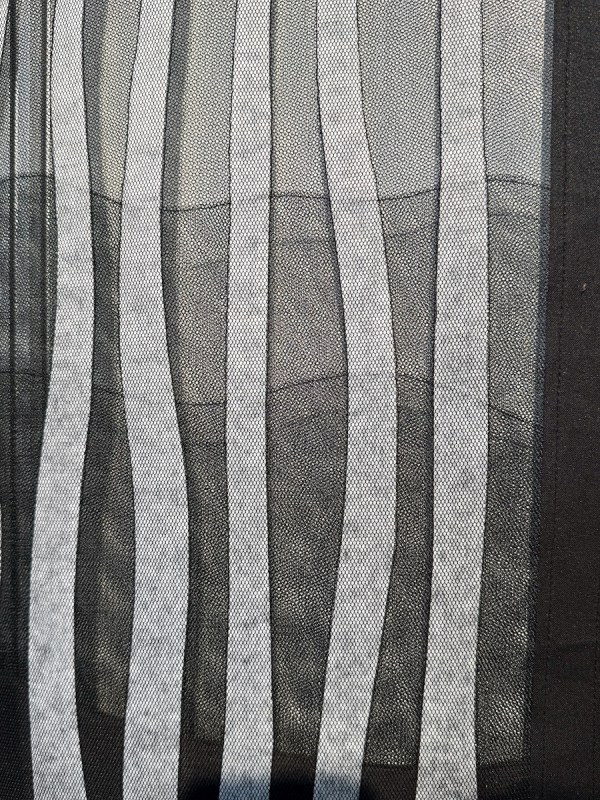
And now, for a complete change of pace in quilting, here are some transparent quilts made by Diane Firth, of Australia. This is titled Scatter, which was inspired by the dispersal of seeds.” The title card also notes, under techique, “Assembled and Machine stitched on Bernina 770.”

Title: Bogong
Description: The moths emerge from the black soils
Technique: Machine and hand-stitched

Bogong is a type of moth.

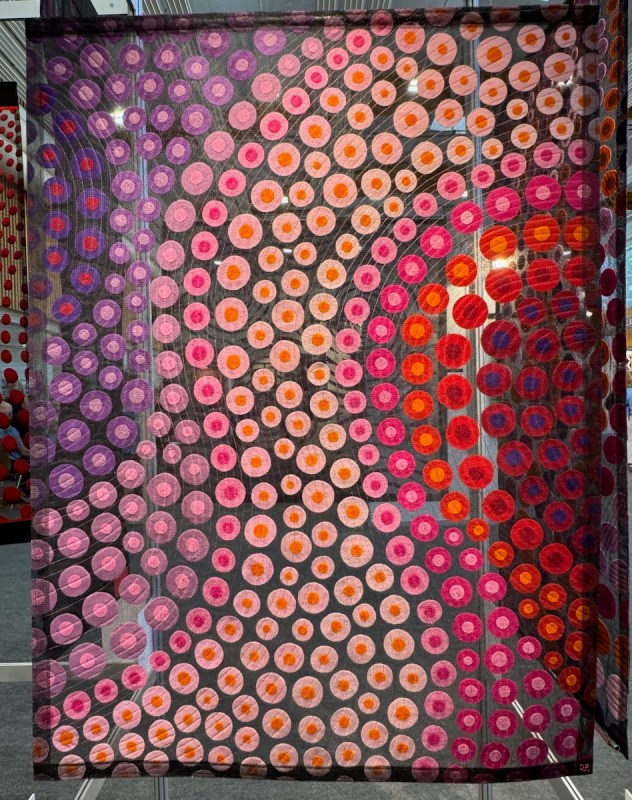
Title: Floriade #4
Description: Floral Abundance
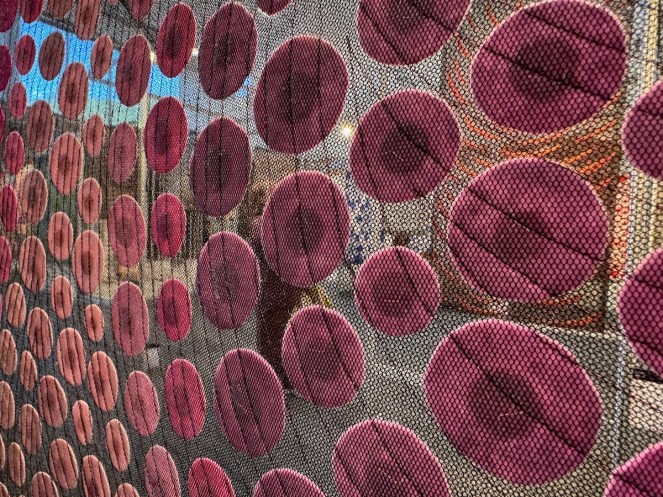
This black mesh netting was in several of her pieces, holding the circles (which looked like felt) in place. The Carrefour website says this about Diane: “Dianne Firth, a quilter for almost 50 years, is a landscape architect and academic. She exhibits regularly in juried exhibitions and her works are held in public and private collections around the world.” The OZquilt Network has a page about her where you can read more.

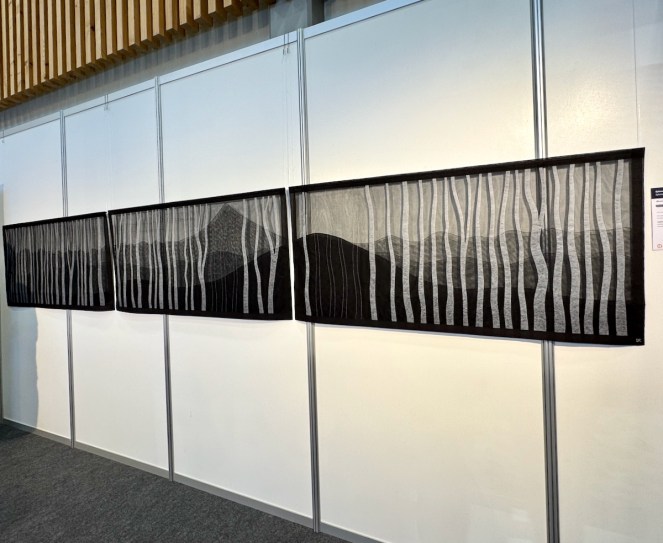
Title: Black Mountain
Description: An exploration of changing landform
This is one of the larger pieces, but the entire display was intriguing and again made me ask the question about what is a quilt? Clearly, hers has three layers, but it is so inventive and structural.

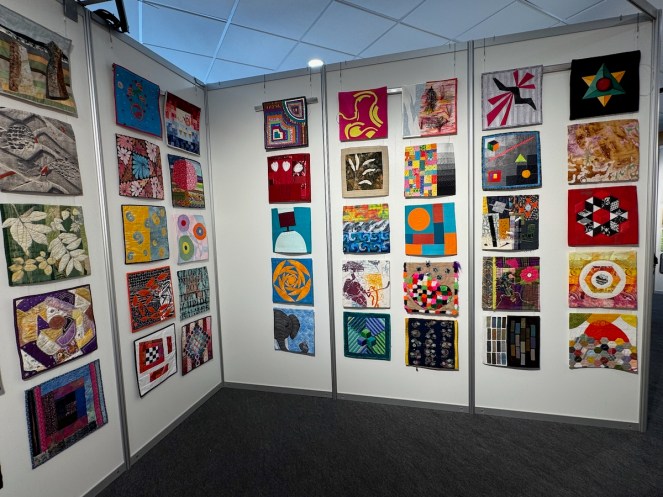
EQA: European Quilters Association: Contrasts (2025 Exhibit)

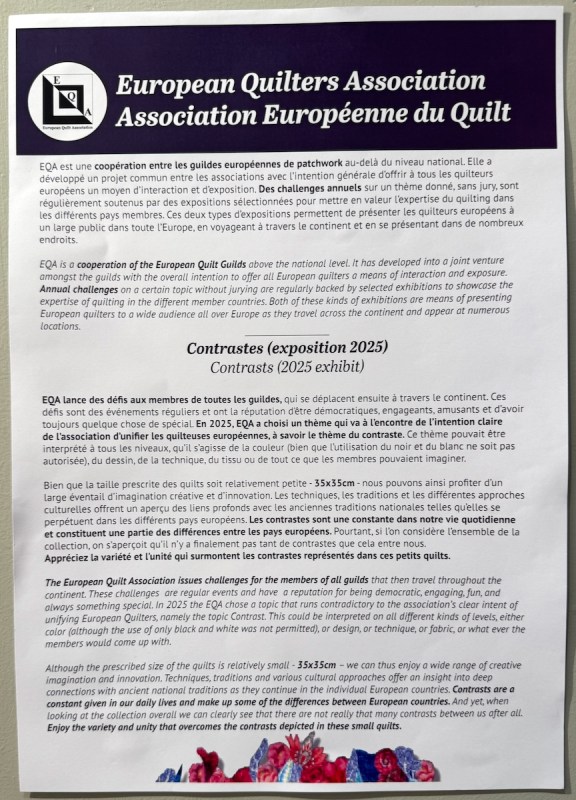
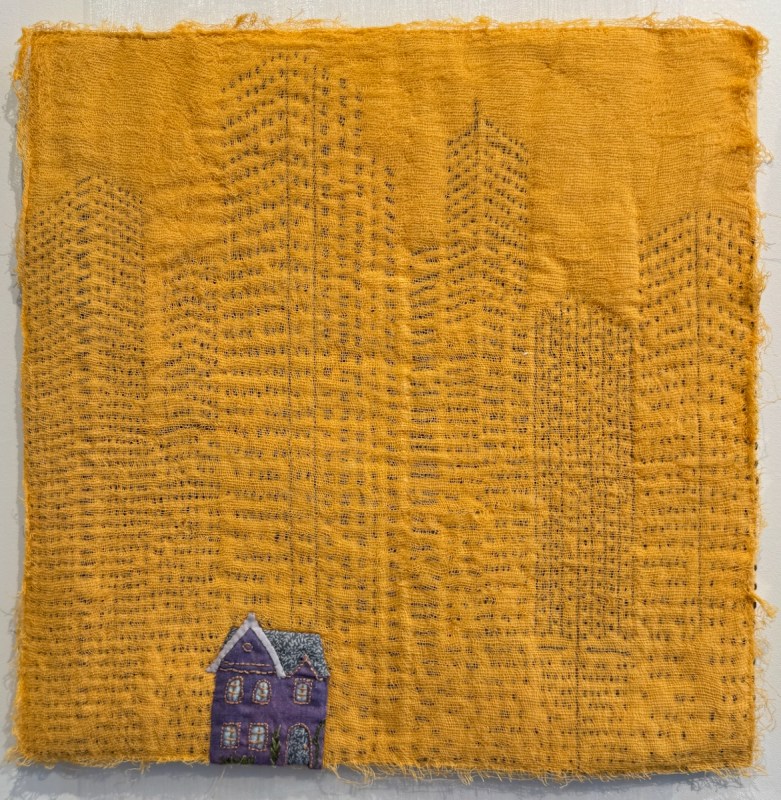
The EQA is a cooperation between the European quilt guilds, and has a yearly challenge of small quilts (35 cm square, which is about 14 inches). As always, I spent a lot of time looking at the artworks. Here’s the Challenge:

(If you right-click to open this in another tab, it may enlarge for you.) What intrigued me was the line in the last paragraph: “Contrasts are a constant given in our daily lives and make up some of the differences between European countries. And yet, when looking at the collection overall we can clearly see that there are not really that many contrast between us after all.”

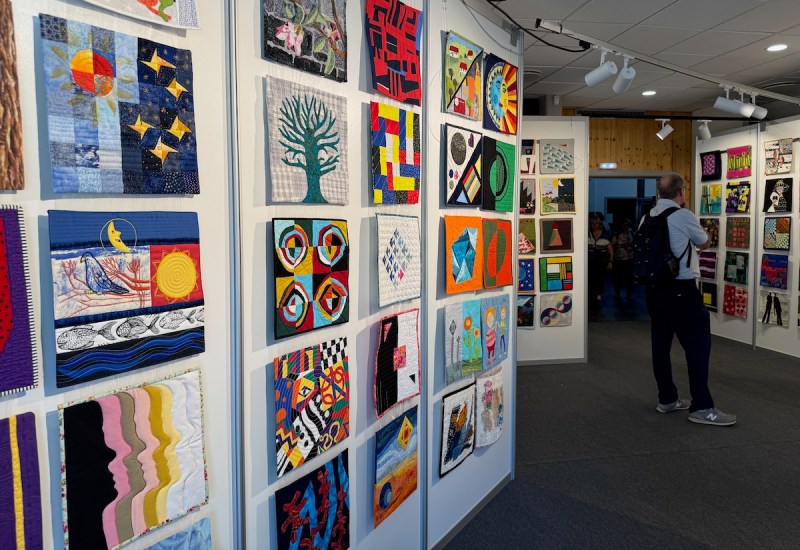
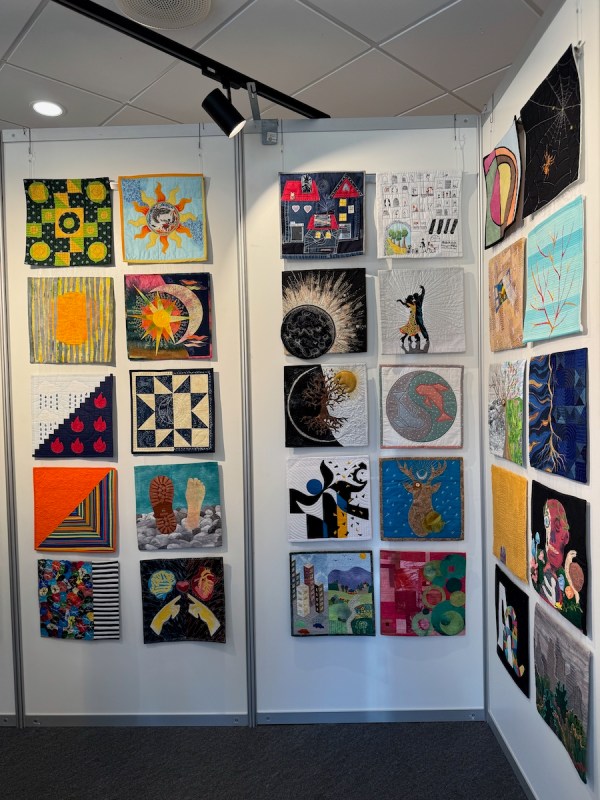
Here are a few of the many, many wonderful quilts.

After this, we leave the venue and try to decide if we hungry, as this year…they have a full lunch service just outside. Tempting, but we went to the market at the edge of town, grabbed something and drove to Rombach-Le-Franc, the last town. We parked outside the Espace Raymond Hestin, and ate our shared lunch in the car, in the shade as the day had grown hotter.

We were on the last two venues of the show. We’d started the day before, and went through the vendors and other spaces in Sainte Marie-aux-Mines, then headed to Saint Croix-aux-Mines and got to Venue 12, before calling it day and driving back to Colmar.

We got up early the second day, picked up again with the Australian quilters in Venue 12, and progressing through the show. Now, eating lunch there in the parking lot, we talked about if we’d be back next year (no), and what we liked and didn’t like. My husband is a great partner in this adventure and I regularly talk quilting with him. Many of the photos you’ve seen have been taken by him.

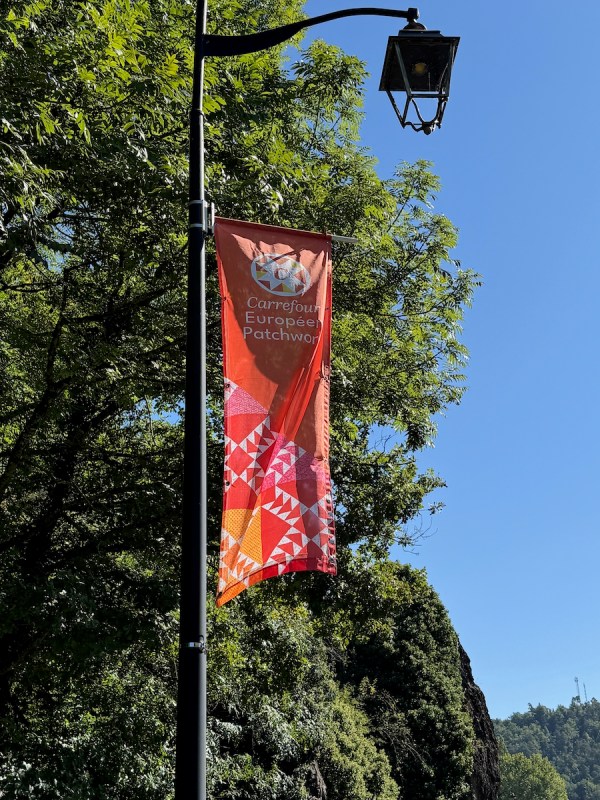
Along the road to Romach-le-Franc. We tried for this three times, pulling U-turns to double back to get the wind just right in the banner.

Venue 16: Ulla Hoppe

Here we go! This venue is quite small, and while there were a couple of exhibits there, I’ll mention only one.

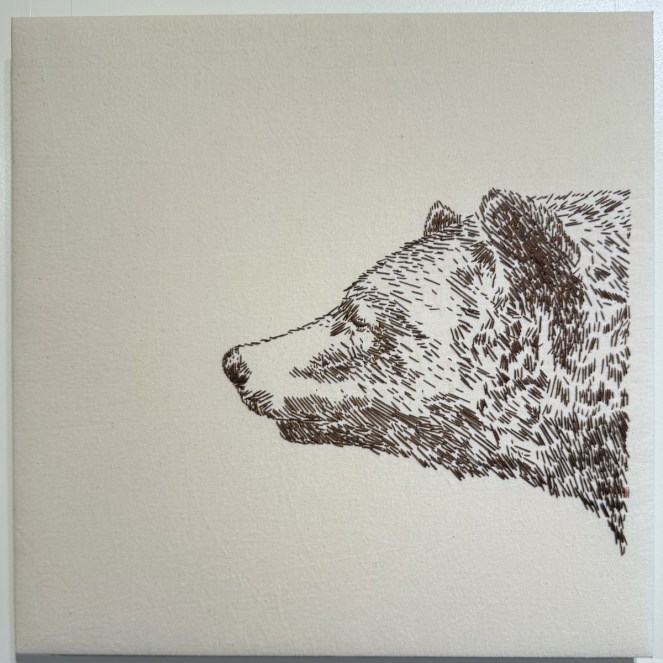
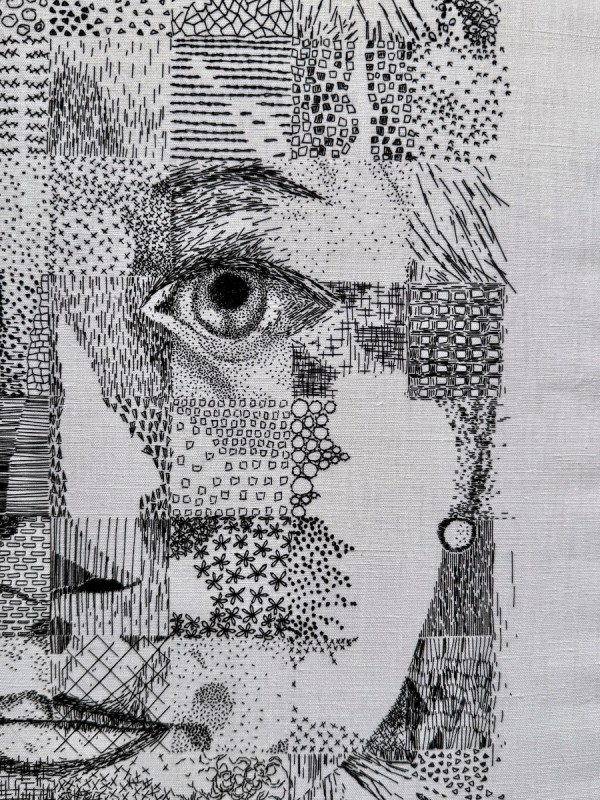
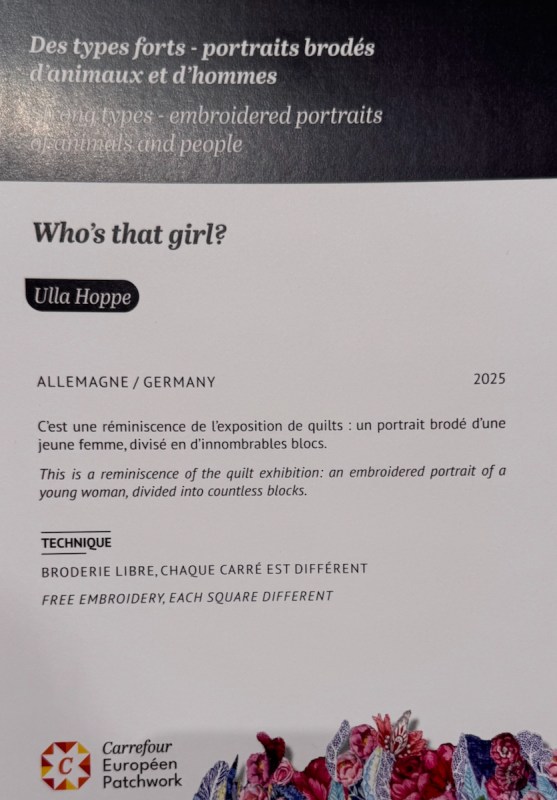
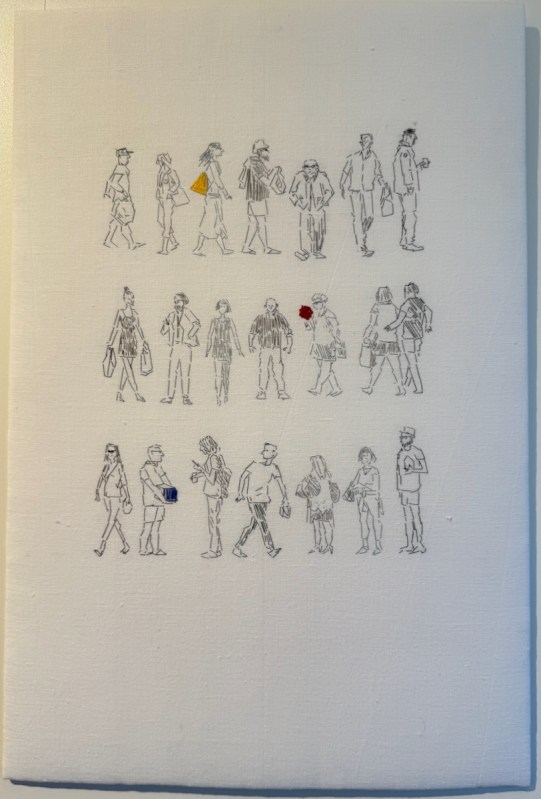
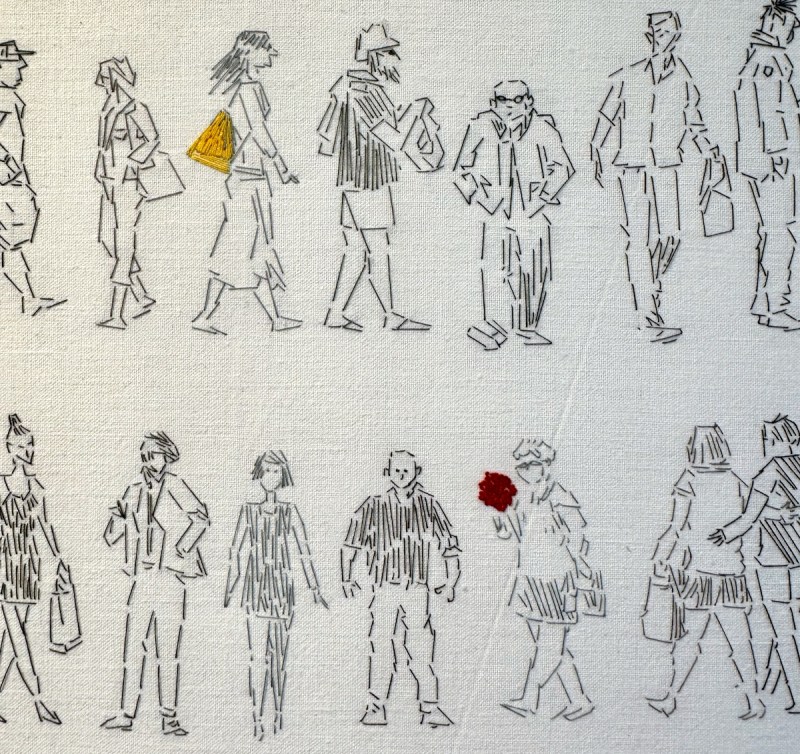
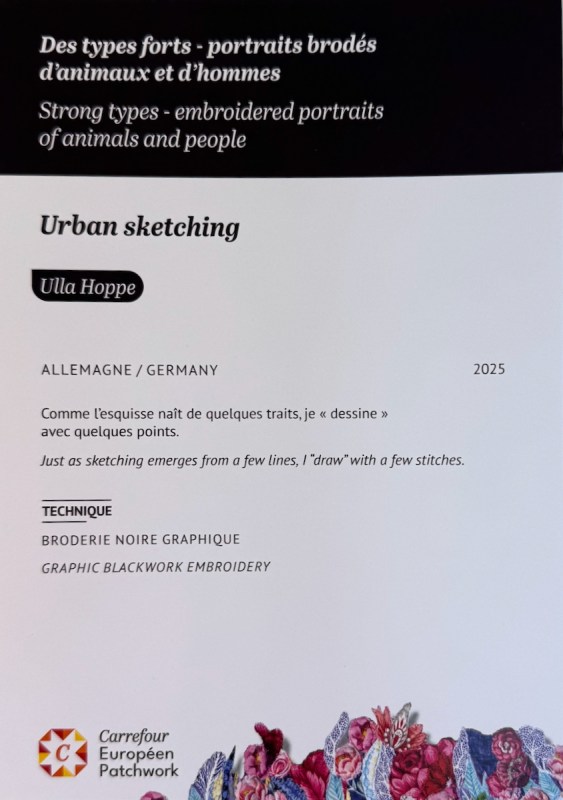
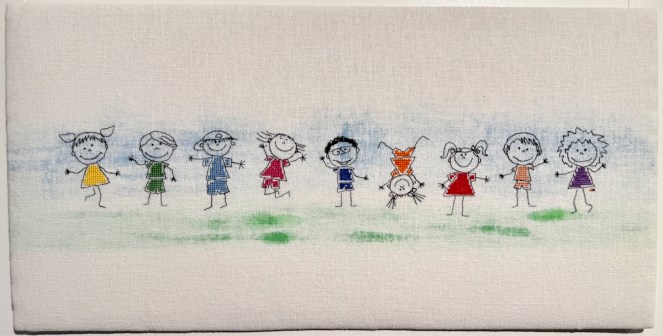
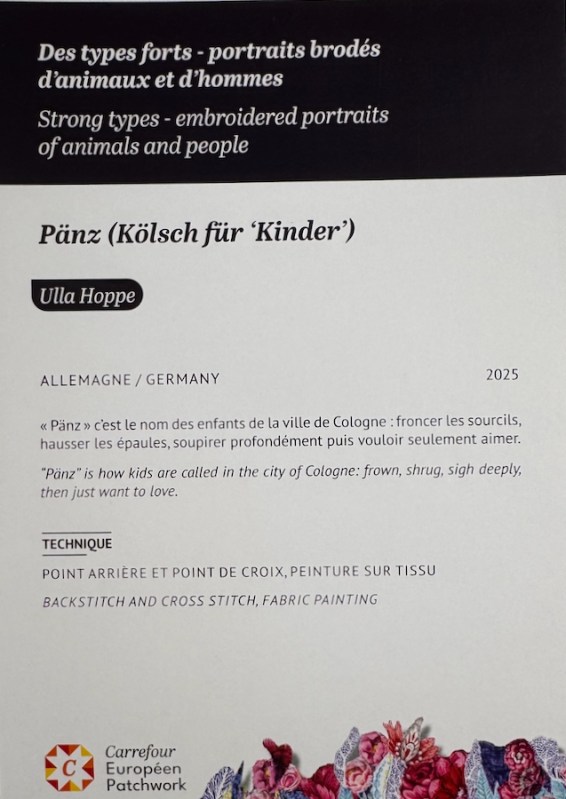
Ulla Hoppe, from Germany, was exhibiting her stitching, embroidery. Not quilting, but I thought it was amazing.

The range of blackwork stitches really brings the complexity of the young woman into focus: aren’t we all full of discreet “countless blocks?”

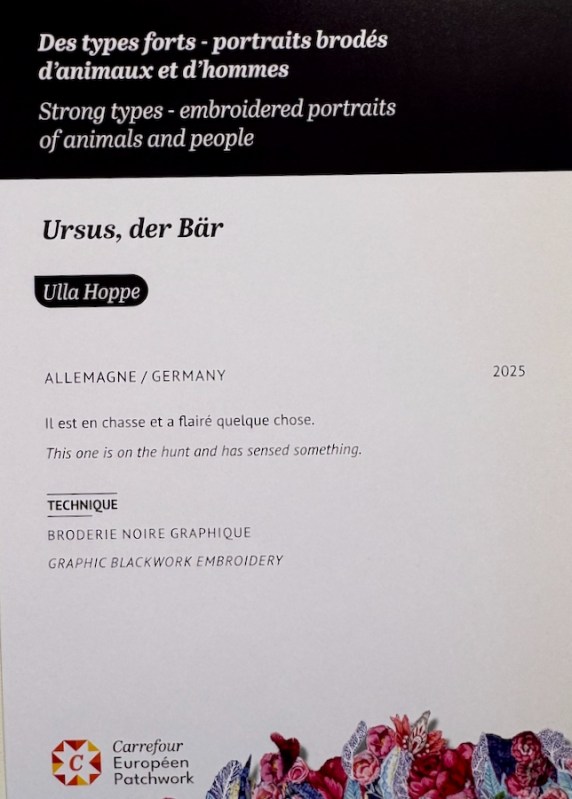
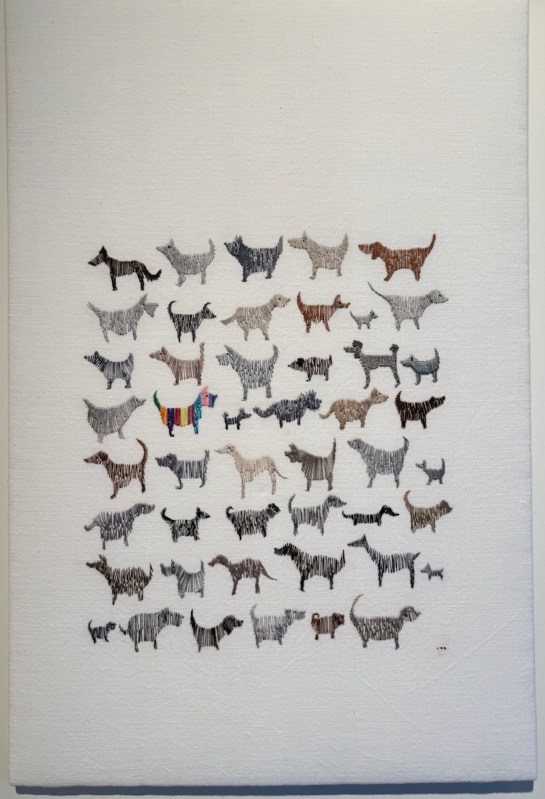
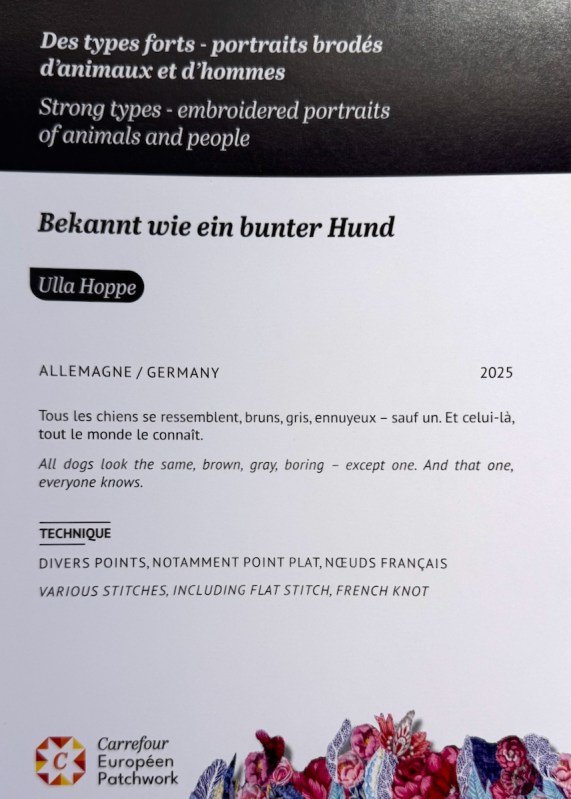
I loved the title of this piece.

“That one” lives across the street from me!

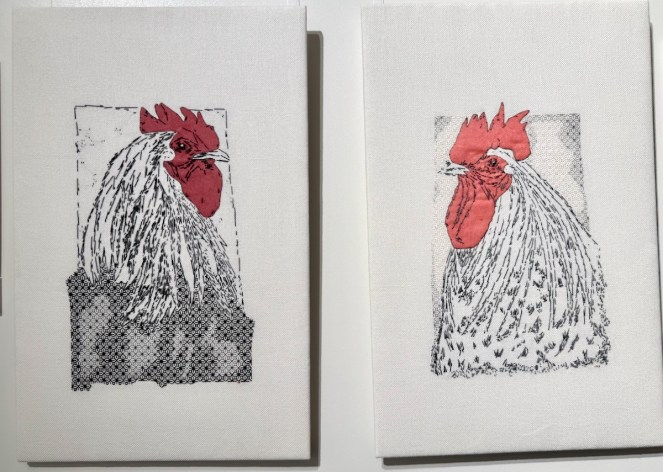
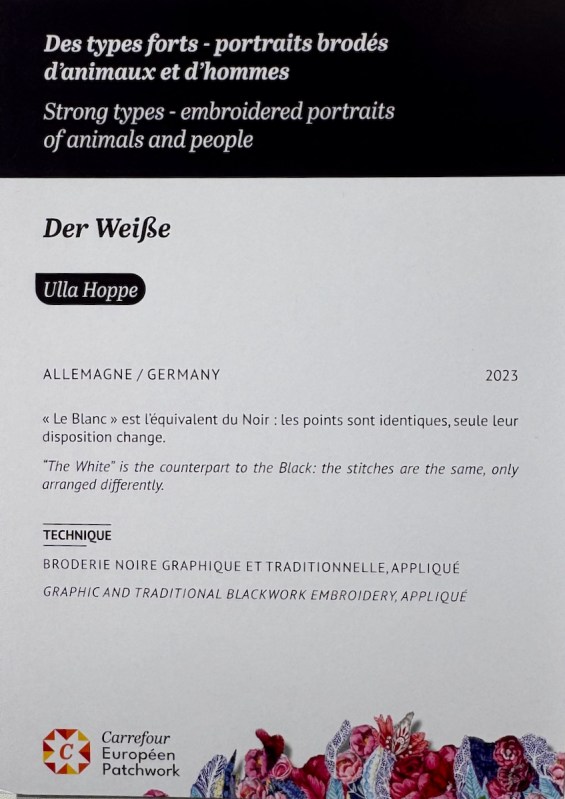
What is notable in this one is the inversion of the stitches, although done in different colors: what is foreground in the black rooster’s image is background in the white rooster’s image. (If you open it in a “new tab” it will be enlarged.)

You can find her on Instagram @ulla_stickt

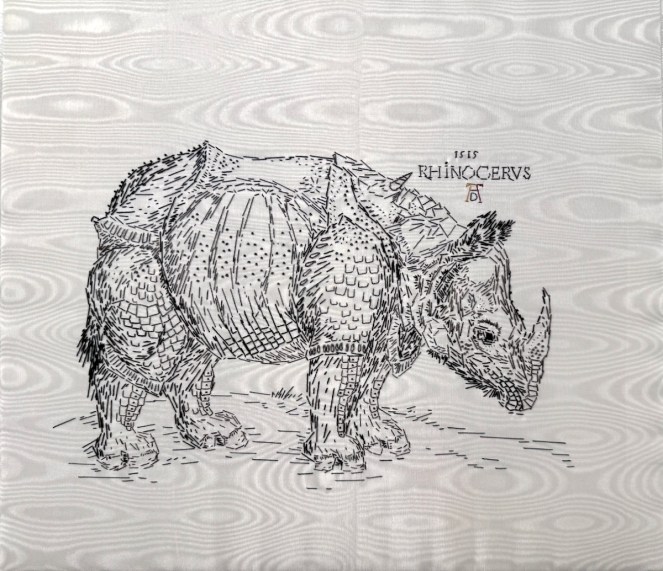
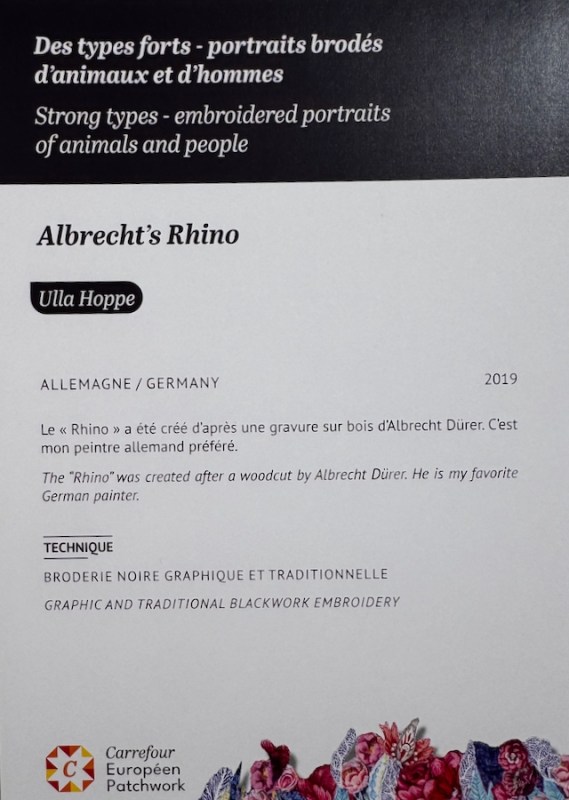
She even stitched in Dürer’s insignia. Last one:

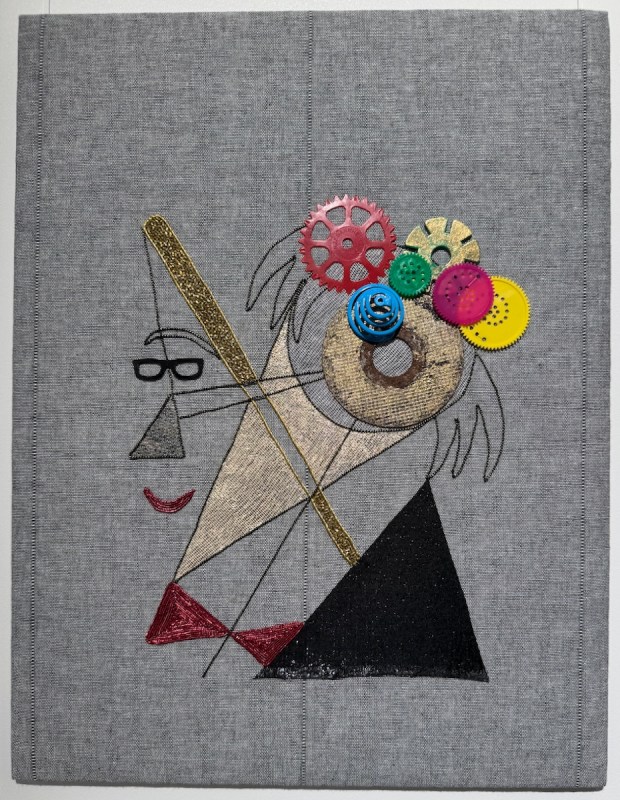
Title: Der Nobelpreisträger
Artist: Ulla Hoppe, Germany
Description: Nobel Prize winners: often “grey eminences,” yet crowned with gold.
Technique: Gold embroidery, collage, partially gilded

Alas! We could come back in two hours, but alas! alas! we wanted to see another small town on the way home, so we missed seeing Fabia Diniz. We missed a LOT! I went onto the Carrefour website and downloaded this:

I hesitate to put a link because I know they change their website a lot. But head to her Instagram, and click on her Story, Carrefour, and you’ll see her story about coming to France, along with some of her creations.

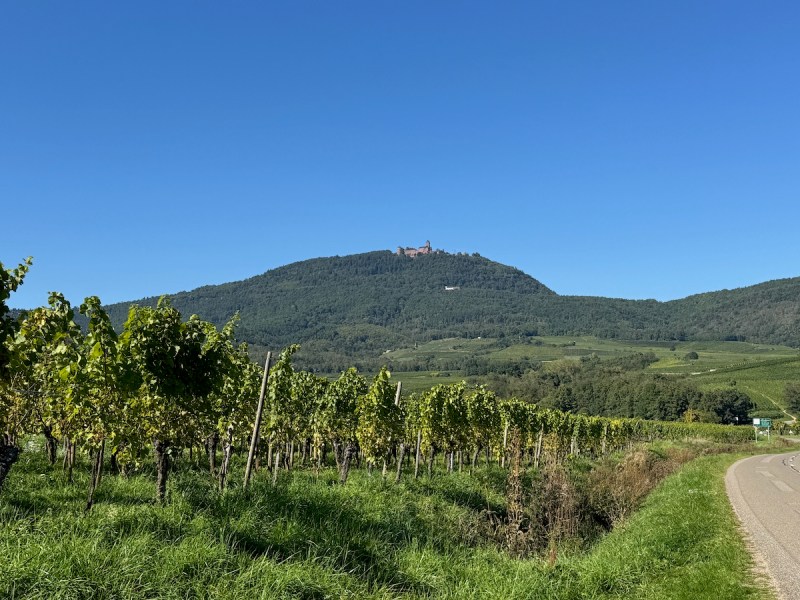
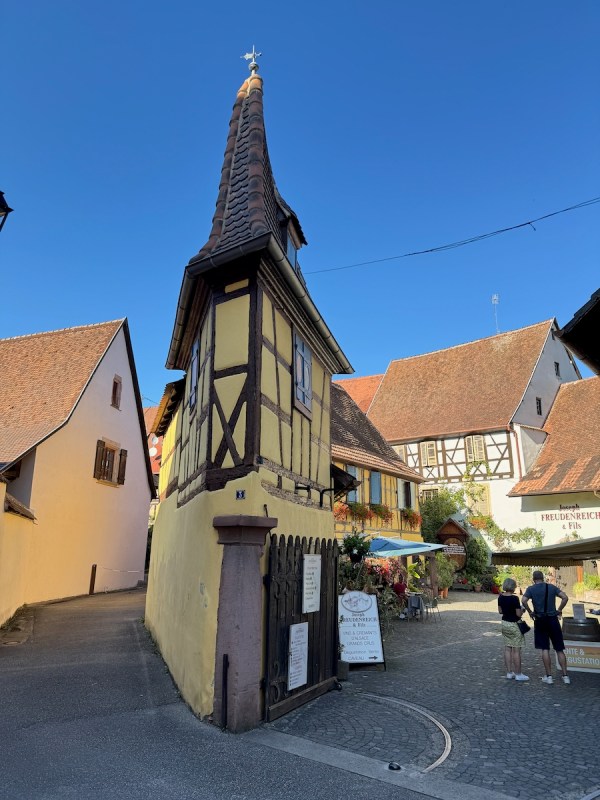
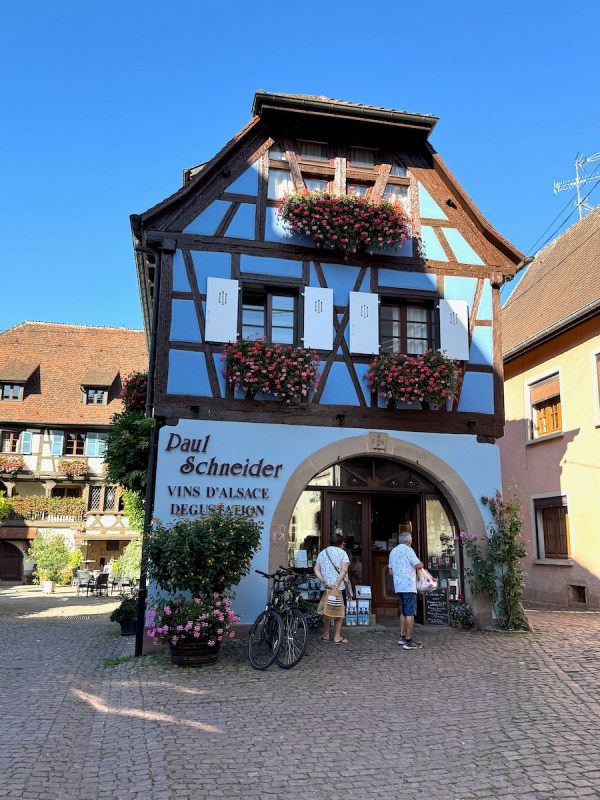
We drove over the hill, and back down into the next valley on our way to Equisheim.

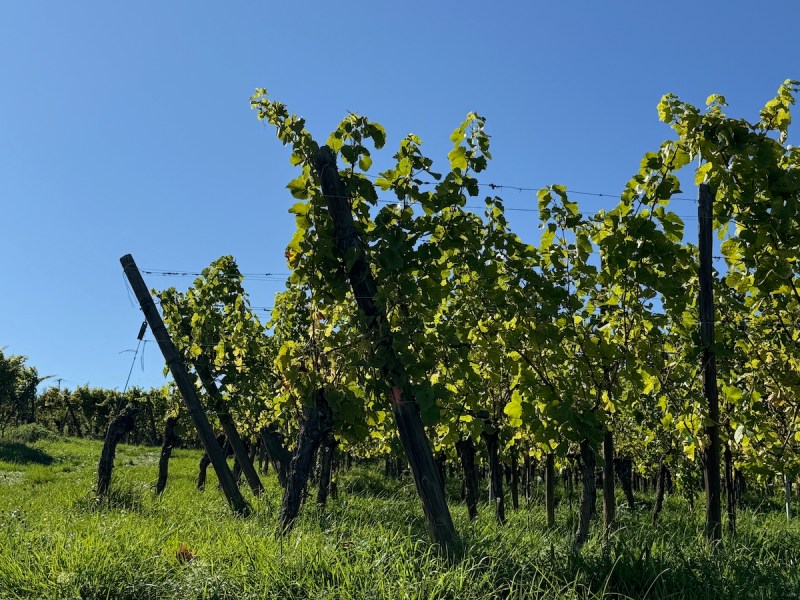
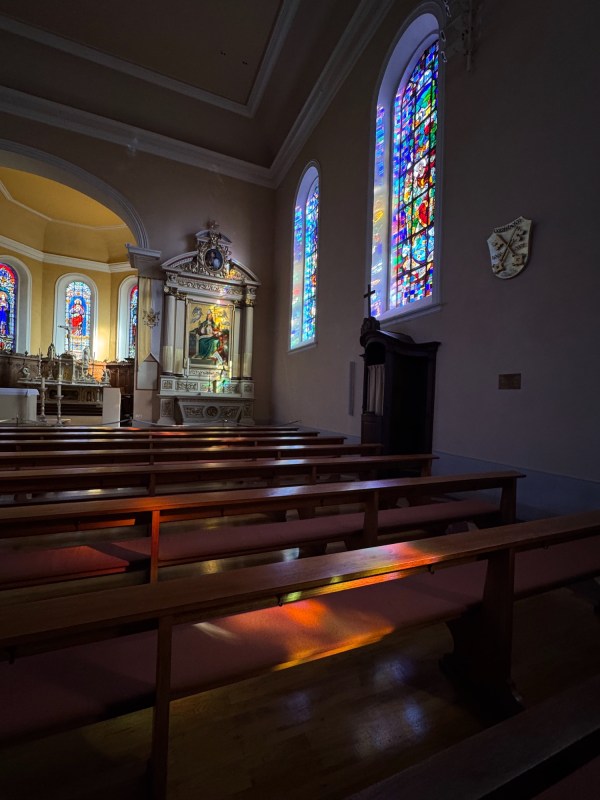
And this is where we’ll leave our adventure, where the light was just right at the end of the day.