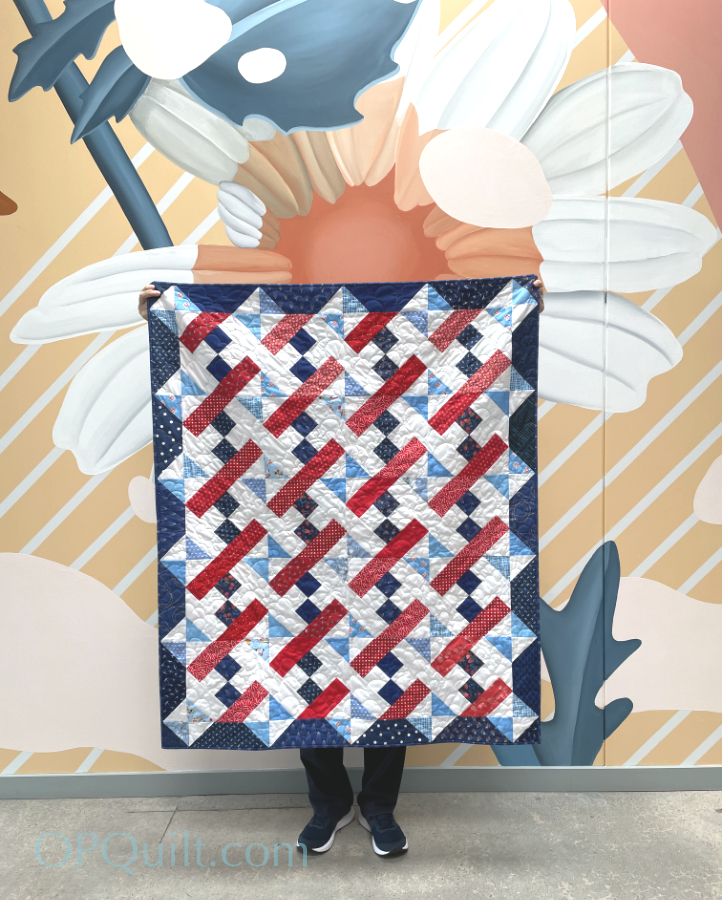
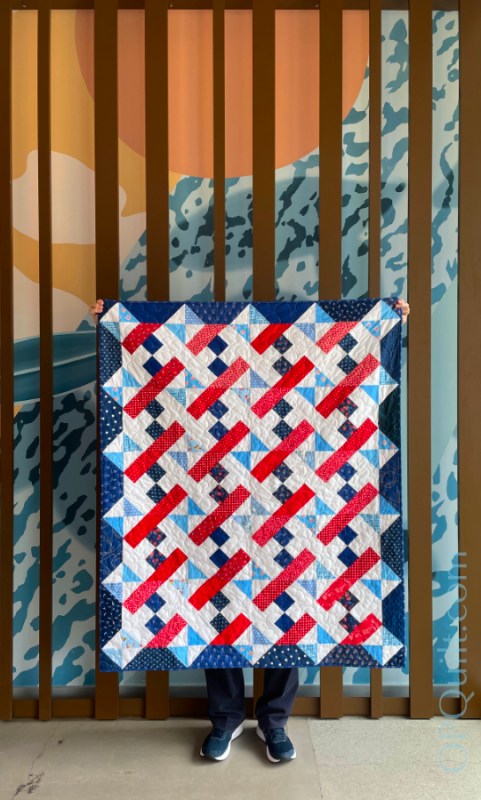
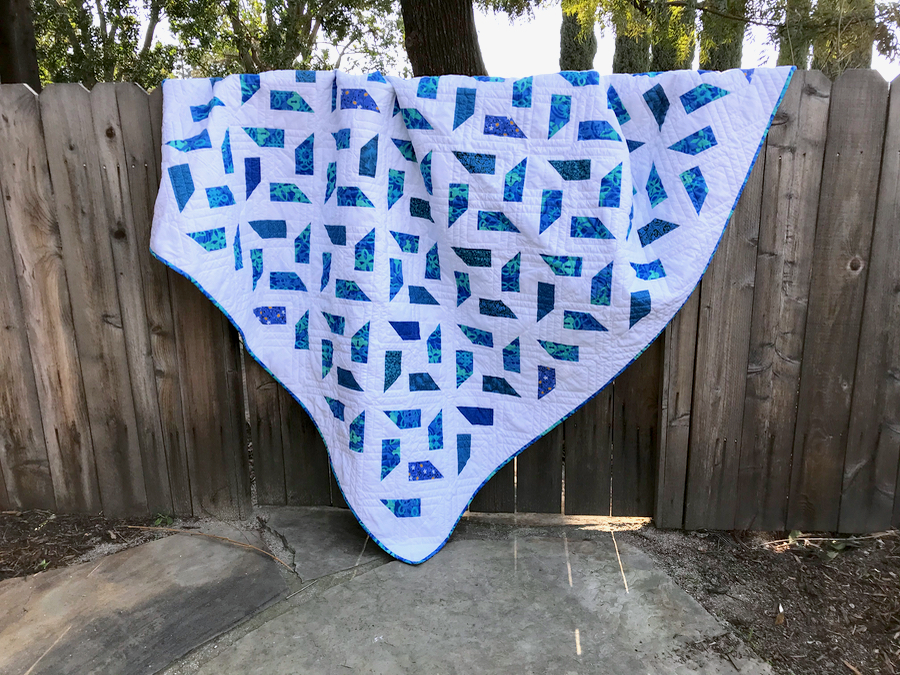
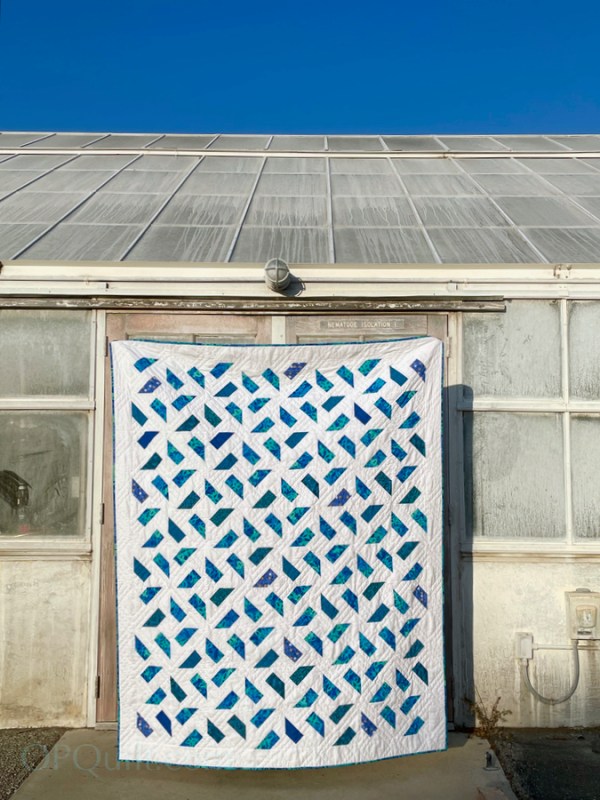
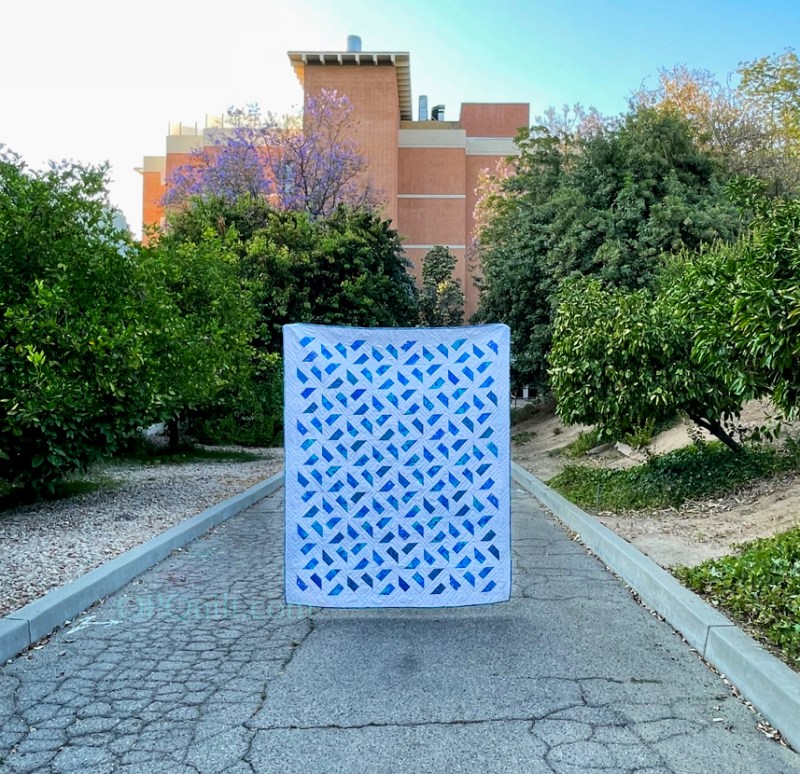
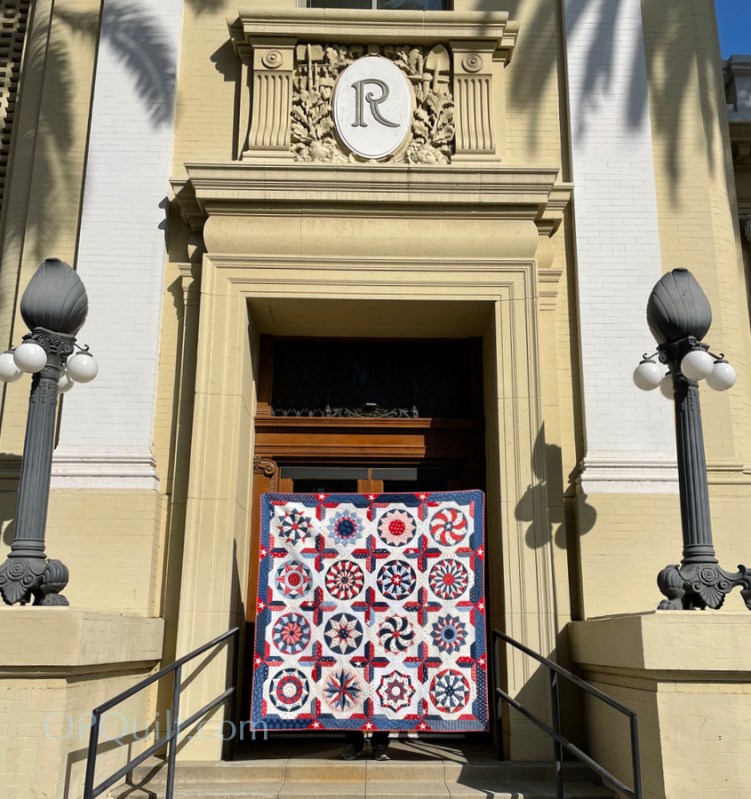
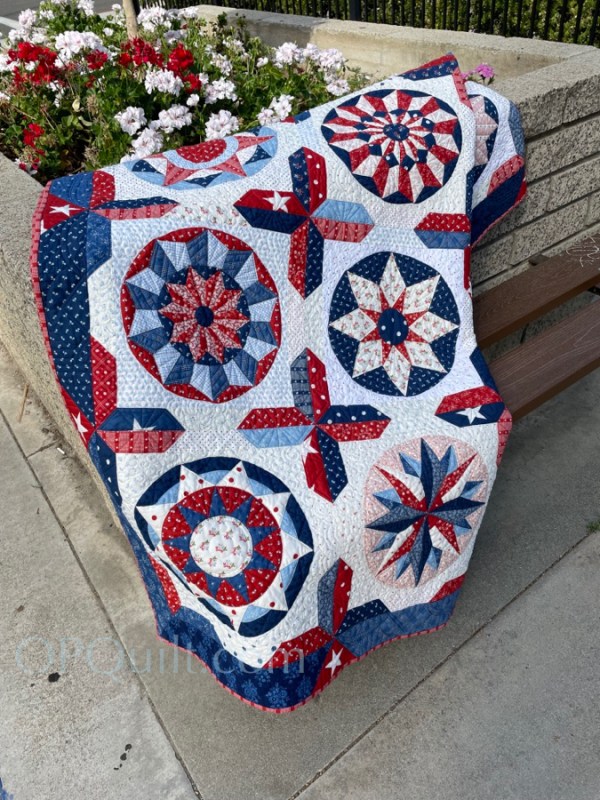
Summer Snowcone, variation of Sun and Sea Pattern Quilt #251 48″ wide x 56″ high
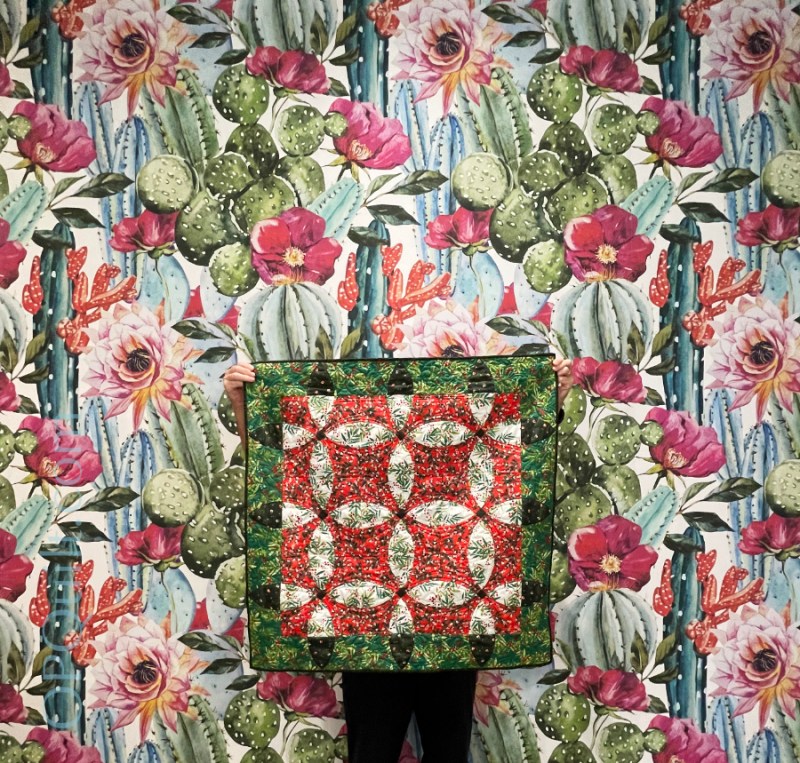
Advent, previously shown but what a cool backdrop of flowers. It was in the women’s bathroom, but I couldn’t resist. (I propped open the door and we were in and out in under 60 seconds, and no one was there.) And yes, I have the best quilt-holding husband on the planet.
The drive to meet our son for lunch was about 90 minutes, and I wanted to finish sewing down the hanging sleeve on Advent and the binding on Summer Snowcone, so we had them along. When I saw that painted hallway, I grabbed the quilts out of the car for photographs.
Photographed in the hallway at City Tacos, Sorrento Valley near San Diego. Since my son’s a working man, we drive to see him and his girlfriend. A good day out.
Website of Interest: A project to make a kimono representing every nation was recently completed. The website groups the kimono by continent, and then you can navigate to the country you want to see. Of course I went to see America, then copied and pasted the text into Google Translate.
Their caption, translated:
The image of a country consisting of 50 states called "United States" is expressed by "state flowers". Designed with the national symbol "President" as "American Eagle". Baseball, American football, Hollywood movies, and the goddess of freedom, which Americans love, are studded in the state flowers, and the great presidents Lincoln and Kennedy are represented by statues and Apollo programs.
I love that Abraham Lincoln is right up there with the “goddess of freedom (which Americans love) as well as baseball and Hollywood. When they say “goddess of freedom” I think they mean the Statue of Liberty. But so cool that they included all the state flowers.
I’m now going to go waste a lot of time thinking about how I should get more stuff done. But hey! it’s Labor Day Weekend and we honor the concept of Labor by relaxing, barbecuing and not doing anything.
“Fashion is not ‘art’, because the latter is sufficient in itself while the former always has a purpose, a function, a use. Recognizing the differences is the first step to instructing mutual listening, made up of curiosity, enthusiasm, and respect. This listening needs time, just like Haute Couture and ultimately also like art. In fact, the maturation of the project was slow, a rhythm perhaps unusual for our world but just and intimate for the world that I would like to.” -Pierpaolo Piccioli (from here)
And if you understood that, then you are more experienced than I in the language of haute couture–the clothing, the dresses, the fashion that is more concept than something you would hang in your closet. But just like the movie The Devil Wore Prada in that withering scene where Meryl Streep’s character critiques Ann Hamilton’s sweater, the fashion houses often tilt us to what’s coming in shape, in color and in what we’ll be wearing post-pandemic when we finally decide to crawl into stores and buy ourselves some clothes.
It’s also very likely that we’ll be seeing some influences on the colors we use in our quilts, or maybe even the shapes we’ll experiment with (if you are a half-way, non-traditional quilter). Or not.
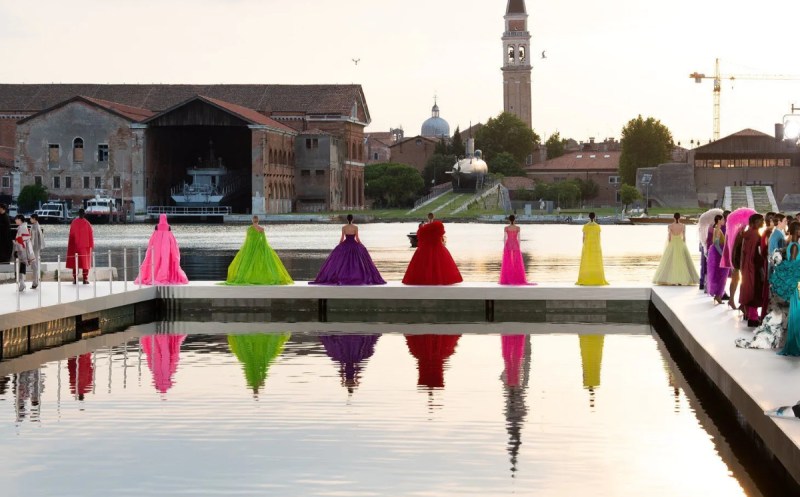
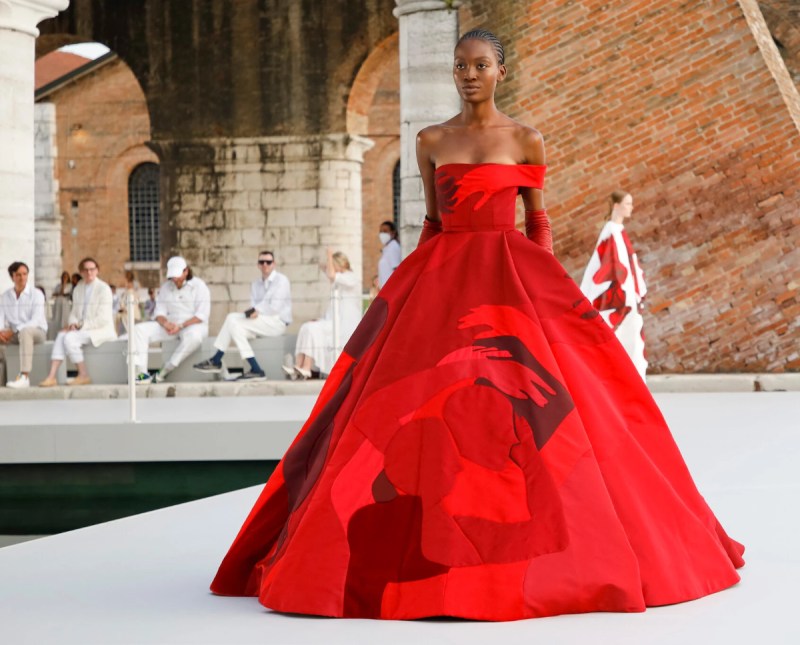
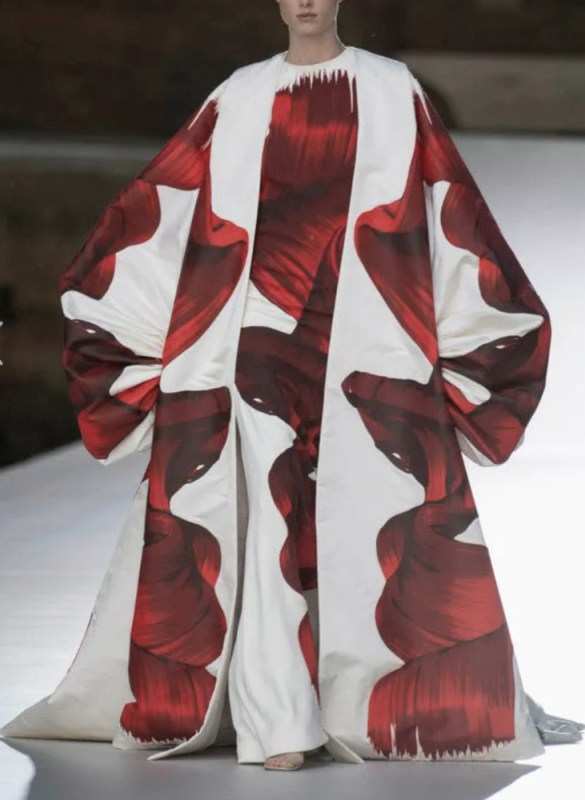
So I was pretty amazed by the colors put together by the designer for Valentino, Pierpaolo Piccioli, and while I can’t pretend to really absorb what he said (above), I do speak the language of color, and thought you might like to see some of his designs, shown recently in the magical city of Venice, Italy. The contrast between that very old city with its own recent struggles with over-tourism, pollution and dwindling residents is a perfect contrast and foil to the glamorous, hand-sewn clothing made with extraordinary precision with pricey fabrics.
As Vanessa Friedman of the New York Times wrote: “[The designer Piccioli] has been conversing with contemporary artists — about their work, sure, but mostly about life in general, process, emotion, what turns them on — thinking about how to integrate their points of commonality in cloth…The result — shown at sunset beneath the brick arches of the former shipbuilding yard of Venice, with water lapping at the edges of the runway…was as powerful an argument for the interconnectedness of time, human connection and creativity as anything fashion has produced. The lushness of Mr. Piccioli’s palette — as a designer, he is the best colorist since Yves Saint Laurent — was on full display; so was his throwaway elegance, and his generosity. Not just to his atelier (his show notes name-checked the individuals who sewed each garment [italics are mine]) but to the bodies that will wear the clothes.”
In the above image, I see scale: large shapes on a larger garment, then those same large shapes on a more narrow profile of a dress. The designer plays with scale in many of his other pieces, using different shapes to emphasize different parts of the body, and different lines (like those flowing hats!).
I also see a lot of color blocking: large swaths of color against slivers of color (a bit of scale, again), causing each to accent the other. This collection is not about fussy little prints. Mostly I see lush, elegant and rich, deep colors:
This palette is missing the mint of the shirt. Sure, it’s a metallic shimmer of color and hard to catch, but that really makes this grouping, in my mind.
In this one, the palette generator is capturing a lot of the background, but it’s that’s slice of bubble-gum pink against those deep coral trousers which really caught my eye. The grey isn’t those flat greys we are used to seeing in our quilting fabrics, but a soft mellow gray, warmed up slightly, but not heading towards taupe or green-gray — maybe a deep off-white?
Orchid appears to be heading our way, but a vivid hue of that color, especially when paired with bright jungle green.
While the palette generator captured a lot of the background (I don’t see that pinky brown anywhere on the model), this palette is a “be-still-my-heart” series of shades for me as I love aqua blue. But it’s a new take on that–a refreshing deeper shade.
Now to shift gears from haute couture to the nuts and bolts of my life lately:
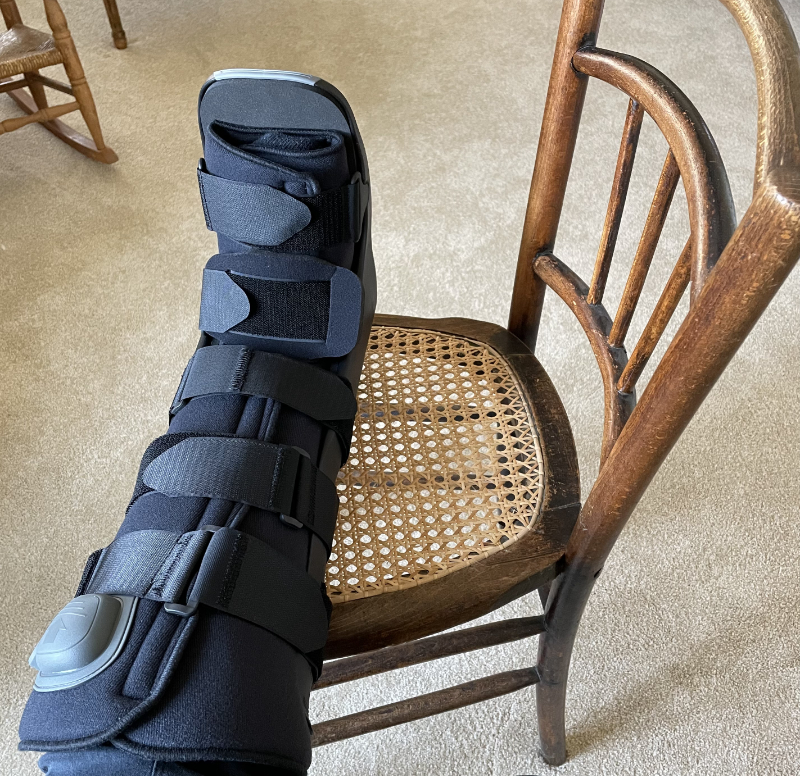
How about some velcro bolts? This is the boot they gave me to wear while my ankle heals. I hate it for a variety of good and not-so-good reasons (would it kill them to add some color?). The doctor okayed my getting around the house without it, so I’ve just decided to ace-bandage-wrap my ankle for protection, stay off it, and stay home. What’s four more weeks of pandemic quarantine?
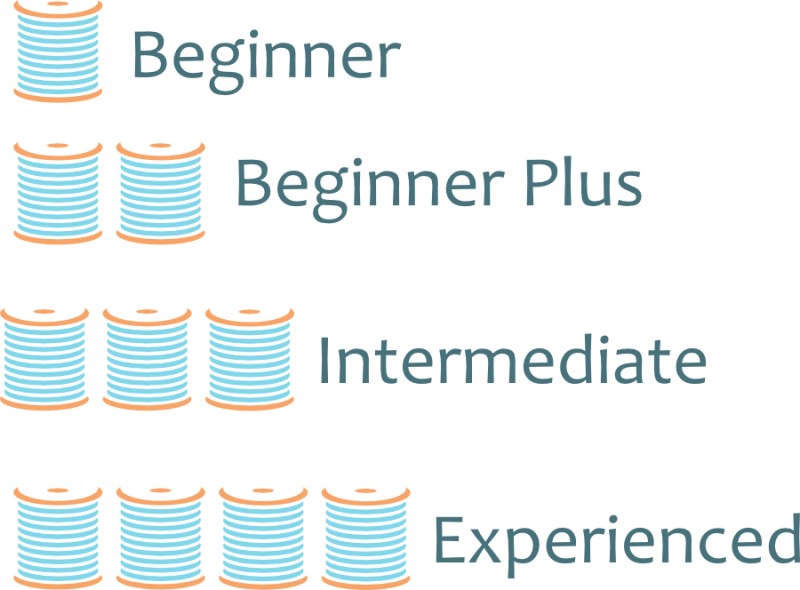
Very proud of this: I drew the spools up by hand. Well, digital hand. Yes, it’s in my favorite color (aqua blue). I have found lately that getting the hang of a few tools in my Affinity Designer has opened up new worlds for me in terms of satisfaction with my work; it was a bit of a struggle at first, but a bit smoother sailing now. And why did I make these?
I didn’t like the nuts-and-boltsy (notice how I’m stretching the metaphor) look of BEFORE as it was too chunky and disparate. I also wanted something as well that would indicate degree of difficulty at a glance. So, I made spools. And I like how the shop looks now.
This is the new display pattern front. I still have a few things left to do, but have finished most. PayHip upgraded some of their marketplace tools, so I thought it was a good time for me to fuss around a bit, too.
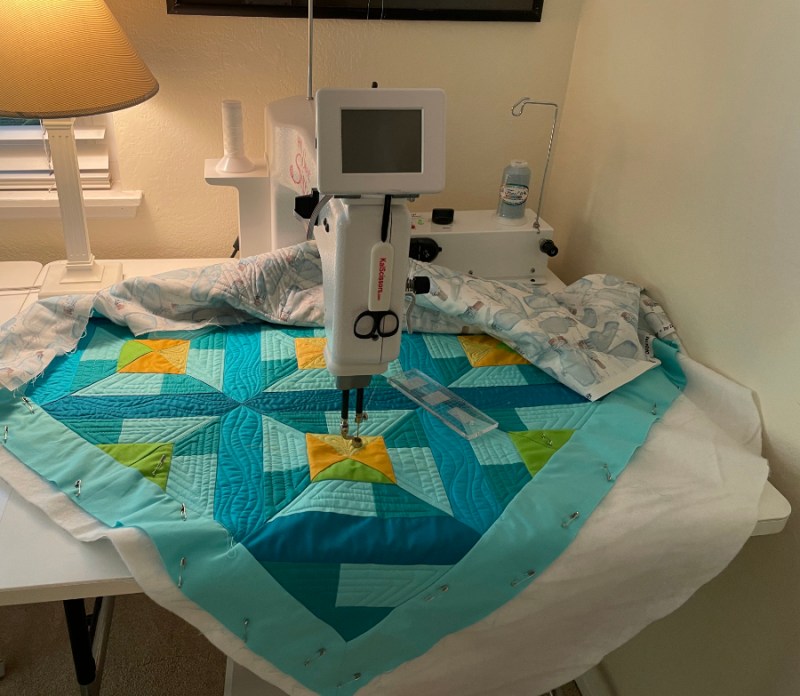
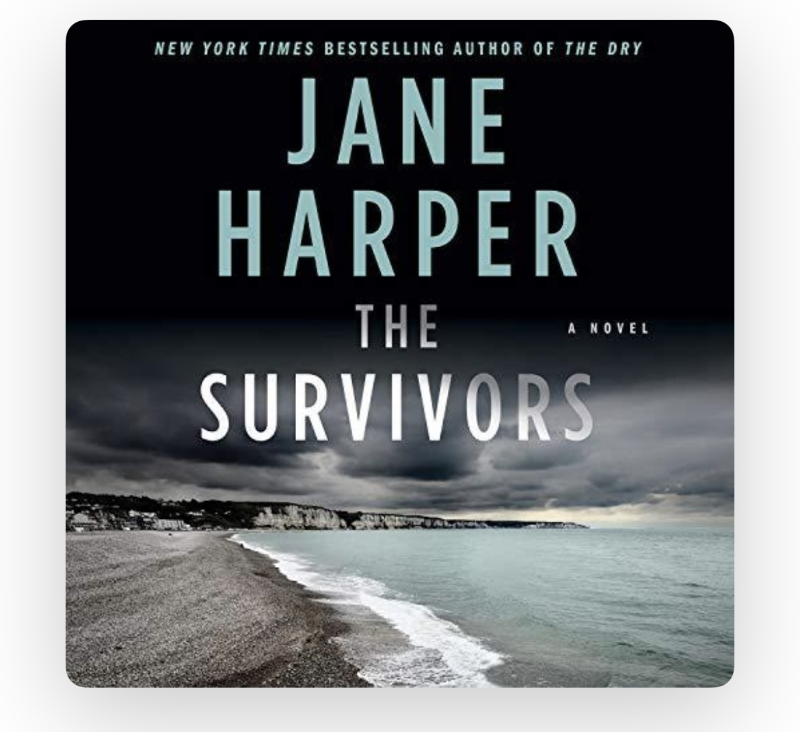
Quilting SeaDepths (a variation of Azulejos) in spurts, while listening to this:
I like how the themes overlap: the ocean in Harper’s book with the theme of SeaDepths on my newest quilt. I can hardly wait to go upstairs and quilt. I’ve listened to two of her others: The Dry and The Lost Man and loved both of those. I will reserve my review on this until I finish it (5 more hours). While I listen, I think of Susan of PatchNPlay, and her trip to Tasmania. I can’t wait to show off the backing I chose for this quilt.
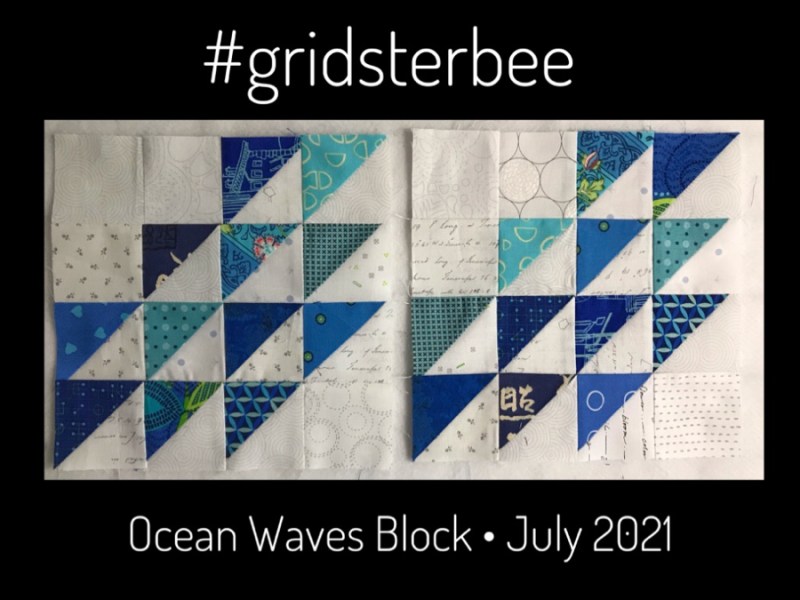
Lastly, there seems to something in the zeitgeist here, but truth! Patti chose this without knowing all the other watery connections I’ve just mentioned. If you jump on this link, you can see a lot of the blocks she’s received, all laid out together. I love how nice they all play together.
And that’s it for today. Happy July, Happy Not Wearing My Boot, and Happy Quilting!
There’s this interesting explanation in a Wrinkle in Time, or at least I remember it and hope it’s there, where the main character tries to help the children understand this concept of a shortcut in time, and she demonstrates it with a string and a crawling ant. Or maybe that’s not in the book at all, and I just remember if from somewhere, but at any rate, the point is that I’ve had a wrinkle in time with this quilt.
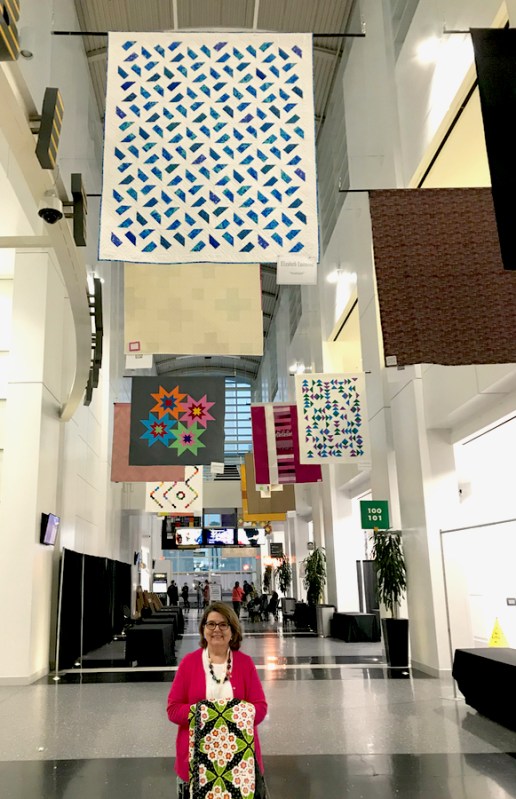
This photo was taken in January 2020 at the end of Road to California, where my quilt Azulejos hung in a special exhibit at Road to California. It was this one that recently prompted Catherine H, a reader, to get in touch with me asking for the pattern. I’d made several stabs at it, but now I really buckled down to writing. So there’s the shortcut — a bridging of time from January 2020 to July 2022 — a shortcut not unlike those found in novels with children (and where were their mothers??) and IKEA warehouses, where you are trying to get out of there and pay for all your impulse purchases, and yet you still have to go through chairs and desks and lighting and rugs…unless you can find the shortcut.
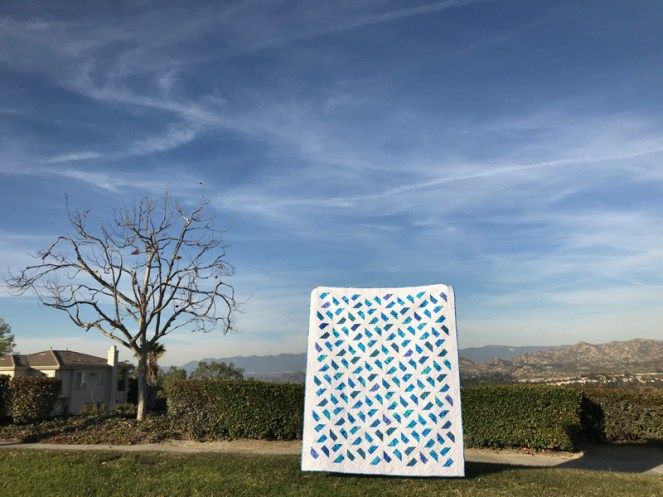
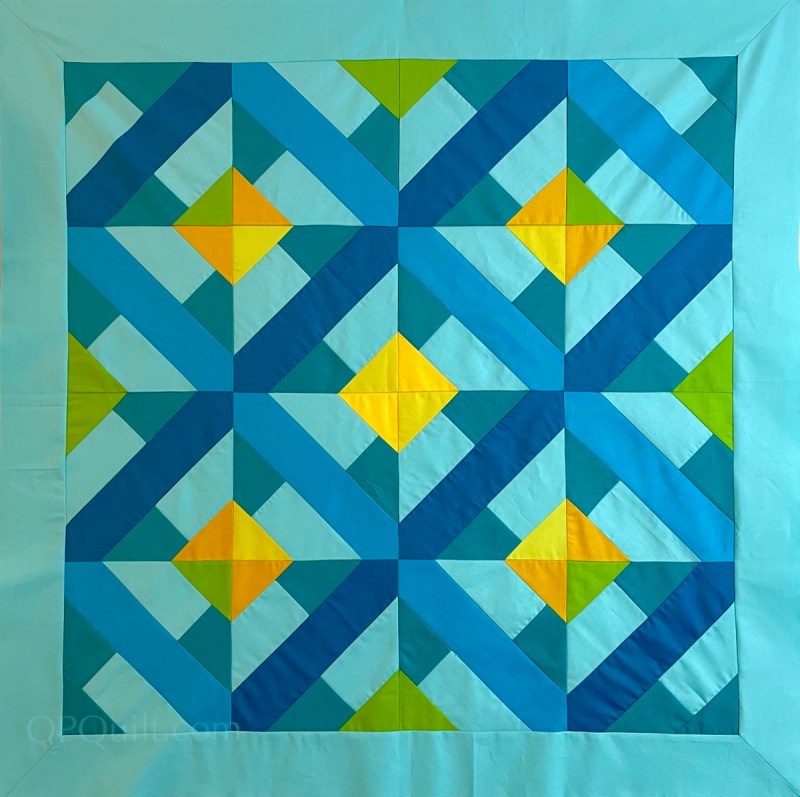
I had some other ideas about what this pattern could do though, so got busy and made this blue/yellow/aqua/sea/glints of sun wallhanging, calling it SeaDepths. I had fun making it in solids:
It’s still a flimsy, though. Looking forward to sandwiching it together and getting to the quilting.
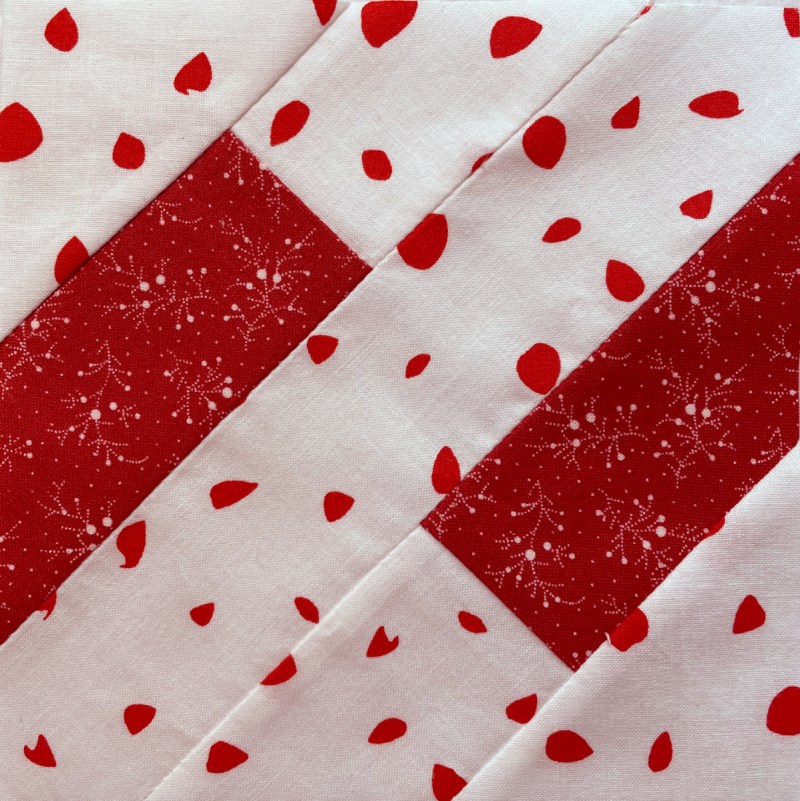
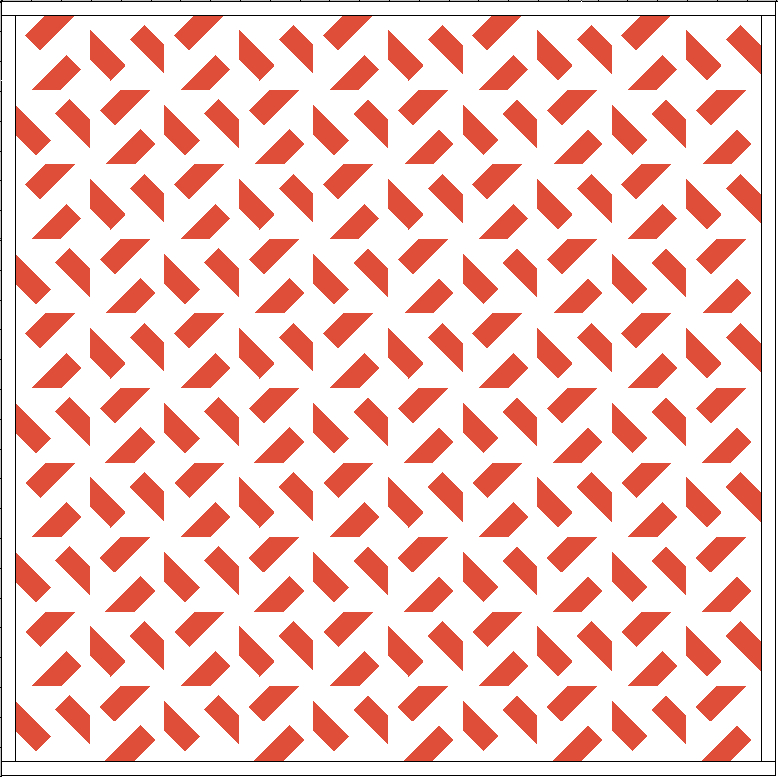
This block was supposed to be another version of the pattern, done up in scrappy red-and-white, like this sketch shows:
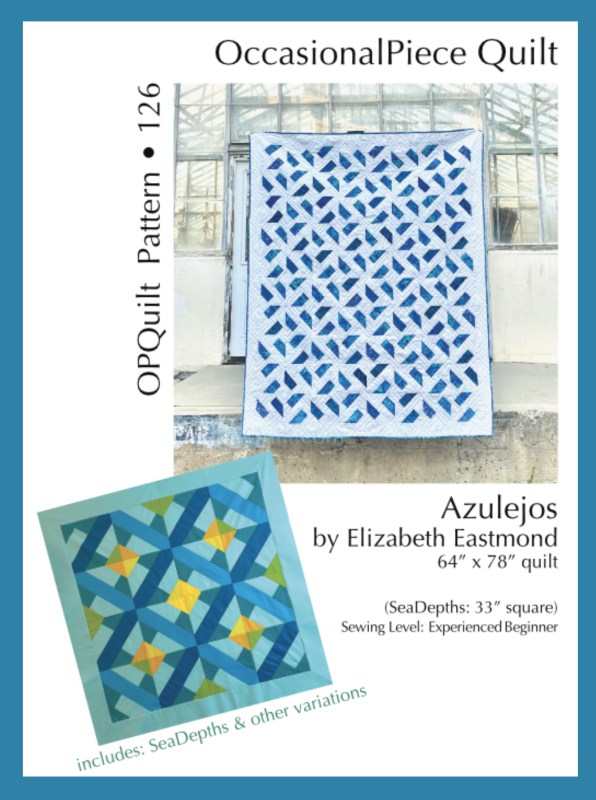
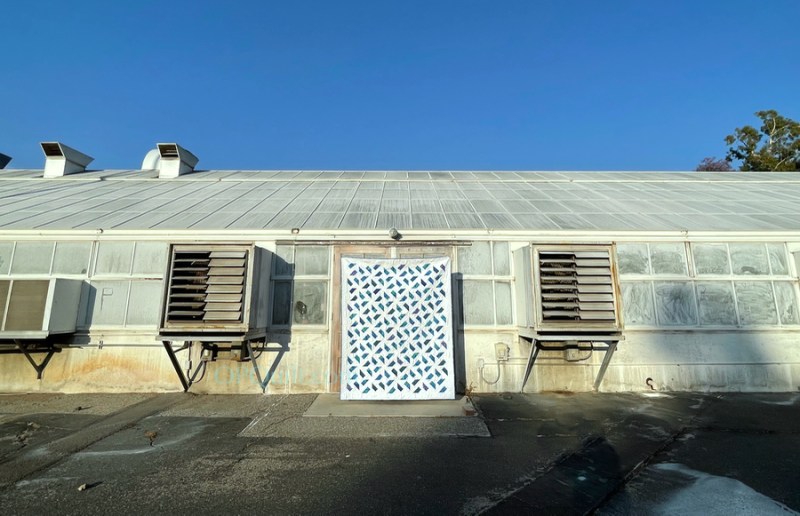
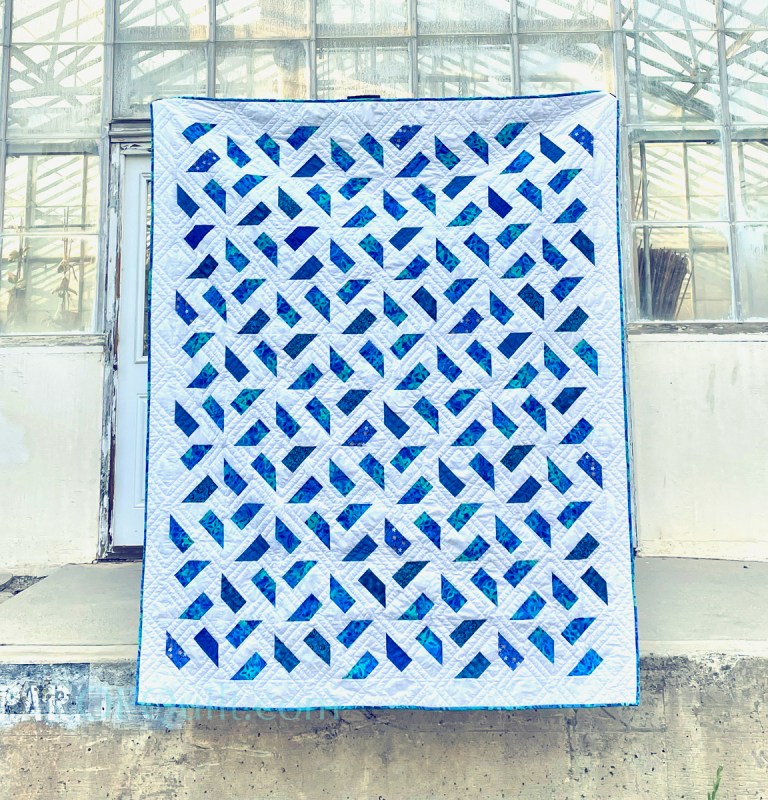
But, alas, the sprained ankle/broken bone/cast-or-boot-or-what problem persisted, so instead of sewing up a storm at the machine (it’s a quick and easy pattern, with the cleverness in how you trim it up), I kept my foot up and edited photos of an earlier photo shoot of the first rendition of Azulejos, with photos taken near some of the old greenhouses and lab buildings for our university:
It has a basic set of instructions for the version of Azulejos above, as well as SeaDepths. I illustrate two other versions, one in Cheddar and Indigo, and the one you saw above in scrappy red/white. Or at least that’s how I evisioned it. So three sizes, three versions, two sizes of block templates and a wall-hanging. Not bad for one pattern, I’d say. A free downloadable Preview sheet on PayHip will give you the rundown.
The technical name for this shortcut between two different times is an Einstein-Rosen bridge, more colloquially known as a wormhole. Jody Foster, in her role as a scientist who hunted for “little green men” on a SETI project, famously traveled in one in the movie Contact, a film I can watch over and over again. Actually I have a whole collection of space movies, from the goofy one that got me through grad school, Galaxy Quest, to Interstellar.
Sometimes I have my own version of an Einstein-Rosen bridge when I un-earth an older project, abandoned for lack of time or interest (or both) and when I come back to it, I find it interesting or even something that juices up creative connections. When I first made Azulejos, I thought it was a one and done, as it was the shapes in the quilt that interested me. Then, taking it up two years later, I found my way to other variations and then to SeaDepths, whose colors I could get out of my mind. It was like there was a wormhole between those two variations.
I’m always surprised when a creative journey takes these kinds of twists and turns. It usually happens when I try to box something in, with a dismissive, “Oh, I know all about that,” with a sniff and a tilt of the head. To counter this attitude of immediately sizing something up prematurely, Xavier Encinas noted that “If there is something I’m learning over the years it is this: Take your time while setting up your ideas and take time to distance yourself from what you have done.” So maybe completing this pattern, finding the missing link to getting it done took some distance.
Where does patriotism come from? The title for my quilt, “I Hear America Singing,” is from a poem by poet Walt Whitman. Today he might have been considered a type of patriotic American — one who saw and acknowledged the multitudes of regular Americans — and heard them sing their song of daily work (poem is at end of post).
“The United States themselves are essentially the greatest poem,” said Whitman, and the poem, written in 1860 and published shortly before Lincoln’s inauguration, was a celebratory poem, lauding you and I — she and him, and those people over there. Karen Swallow Prior, in an article from The Atlantic, makes the observation that “Whitman’s claim stemmed from a belief that both poetry and democracy derive their power from their ability to create a unified whole out of disparate parts—a notion that is especially relevant at a time when America feels bitterly divided.” She goes on to say that:
“Notably, Whitman’s grammar (“the United States are”) signals his understanding of the country as a plural noun—not one uniform body, but a union of disparate parts. Whitman was centrally concerned with the American experiment in democracy and its power to produce “out of many, one,” even at as great a cost as the Civil War and the faltering Reconstruction. Whitman thus celebrates in his work the many kinds of individuals who make up a society as well as the tensions that bring individuals together in a variegated community.”
As Whitman asserts later in the preface to his Leaves of Grass:
The genius of the United States is not best or most in its executives or legislatures, nor in its ambassadors or authors or colleges or churches or parlors, nor even in its newspapers or inventors … but always most in the common people.
We often think that the ideal of “patriot” has an affiliation with war: the machines of war, the fighting and dying and the slogans and the confrontations, which leads in the end to the cemeteries of war, with honoring our war dead. We make that connection easily because we honor those who fought for our freedoms. I acknowledge them and am grateful for them. However, if it is defined only this way, it’s easy to feel separated from the idea of being a patriot, from patriotism, and make “them” responsible for the well-being of our country.
So on this Fourth of July, I wanted to emphasize a different sort of connection to patriot. That it is not found in going to war. It’s not in defined battles. It’s in us, the people. It’s in our going out of our way to take care of our neighbors, with their varied songs and carols and labor and daily work. It’s in going to that daily work, from the work of masons and shipbuilders and deckhands and mothering and washing and sewing: “Each singing what belongs to him or her and to none else.”
Stephan Cushman noted, “Although we hear the words “patriot,” “patriotic,” and “patriotism” all around us … we do not have many useful public models for combining genuine celebration of the United States with constructive criticism of it.” Cushman gives a nod to the idea that “patriot” is a formal label that can be worn on one’s chest. But after noting that Whitman used that word sparingly in his volume of poetry Leaves of Grass, Cushman goes on to say:
“Different readers might offer different explanations for the paucity of direct references to patriotism in Whitman’s writing, but one that feels plausible to me is that someone so deeply engaged in celebrating various aspects of the United States, and in identifying himself with his image or images of an American ethos, had little need or ability to separate himself from that celebration and objectify it with an abstract term like “patriotism.” Or, to put the matter more bluntly and reductively, Whitman was too busy celebrating himself and his country, and insisting on the connections between them, to spend much time crowing self-righteously about how patriotic he was and how deeply he believed in the value of patriotism.”
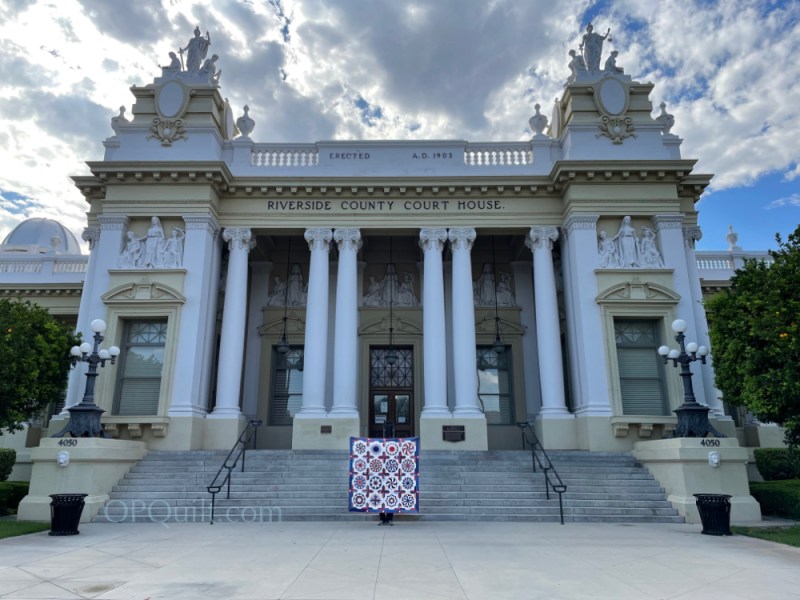
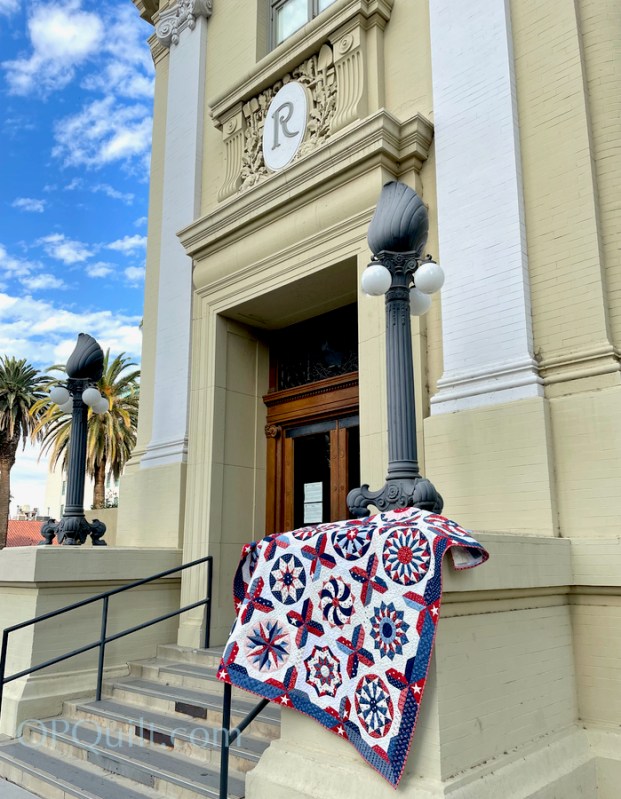
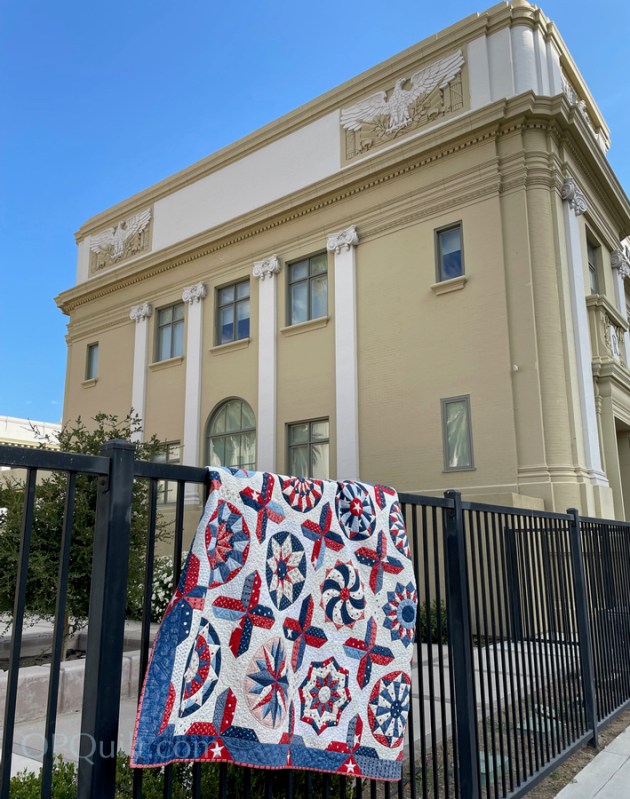
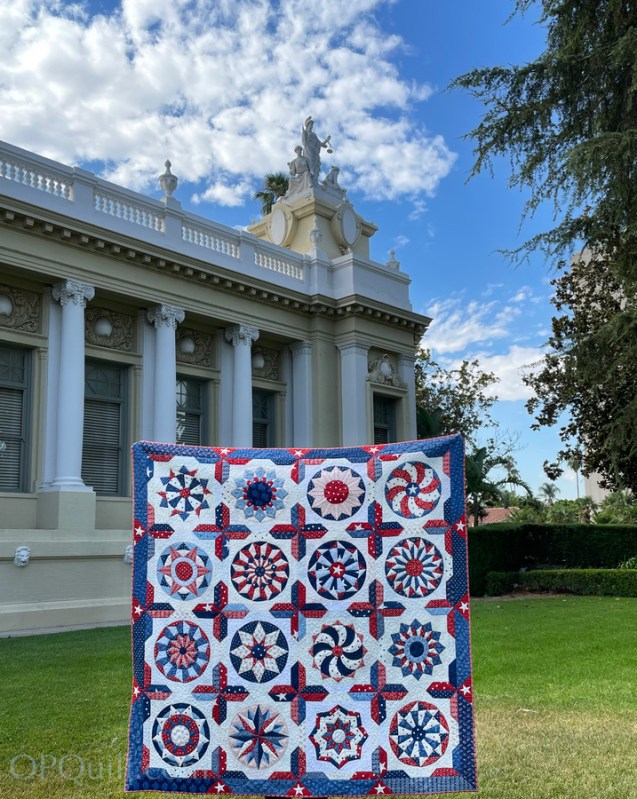
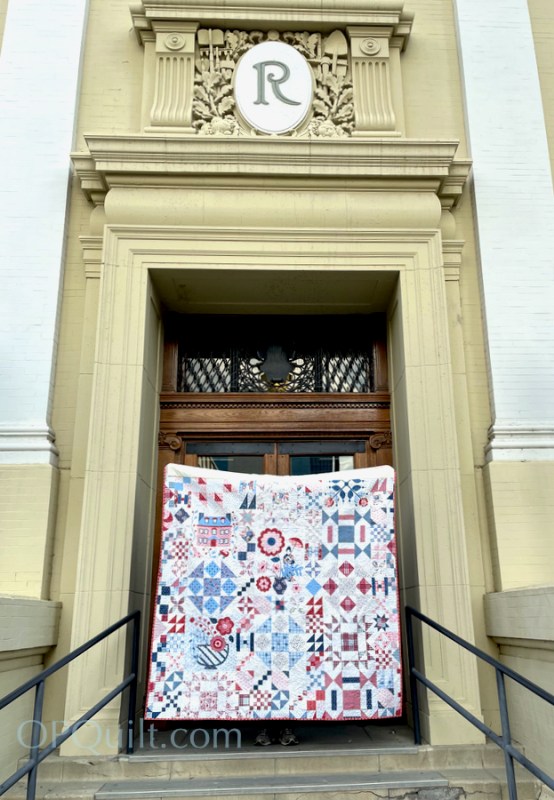
Perhaps the greatest patriotism is in seeing each other, in realizing how alike we are and how dissimilar we are, making us figure out how to negotiate, how to keep the peace, how to be respectful. This is why one reason my husband and I photographed this quilt at our county’s 1903 Courthouse, a place administering and honoring those laws that are part of the the thousand daily comprises we make to keep our country stable and thriving. We also chose this place because it’s also really beautiful, with its craftmanship intact; this place generates in me that old-fashioned kind of feeling of pride, and yes, of patriotism.
As I have traveled around the world, I have found patriots in all countries, loyal to the carols they hear around them, fiercely proud of what makes their country the best one ever. It would indeed be a great world if we could all think like that, seeing this similarity as something that can unite.
Finally, Swallow Prior brings another gentle affirmation for this idea of America as a poem by mentioning Harvard professor Elaine Scarry, who “describes the importance of multiple viewpoints, arguments, and counterarguments to ‘political assembly,’ [and wonders] how ‘will one hear the nuances of even this debate unless one also makes oneself available to the songs of birds or poets?’ The basis of poetry is precisely those connections forged between different elements, different voices, and different perspectives. In envisioning the United States as “the greatest poem,” Whitman links the essence of poetry, which is unity within diversity, to the essence of democracy.”
I am a patriot of the singing kind, the poetry kind. I will always love America. And so I present to you my quilt, I Hear America Singing, a celebration of that great American poem that Whitman believed us to be.
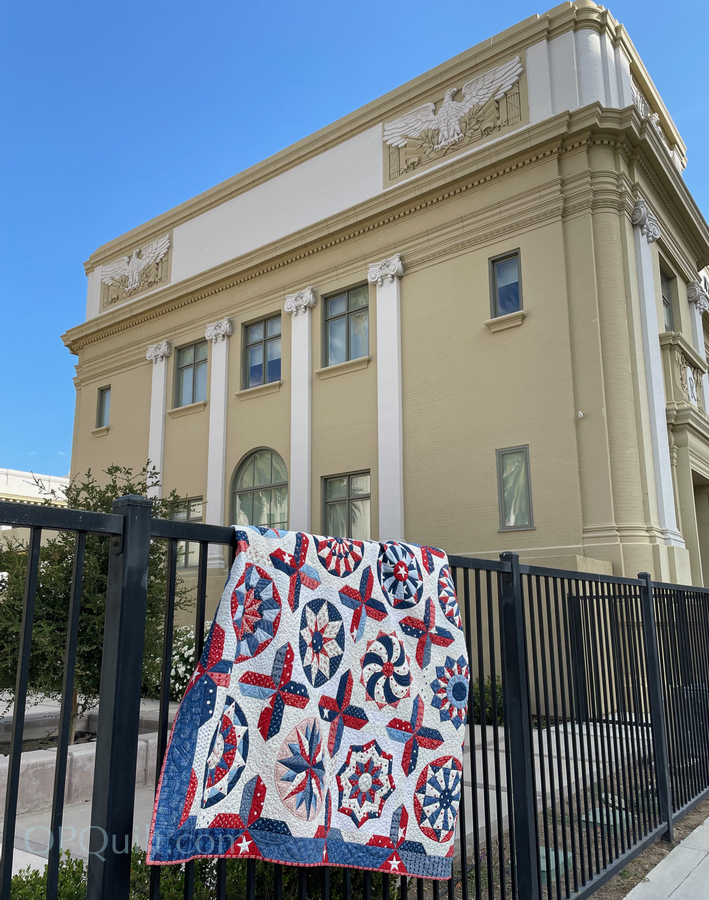
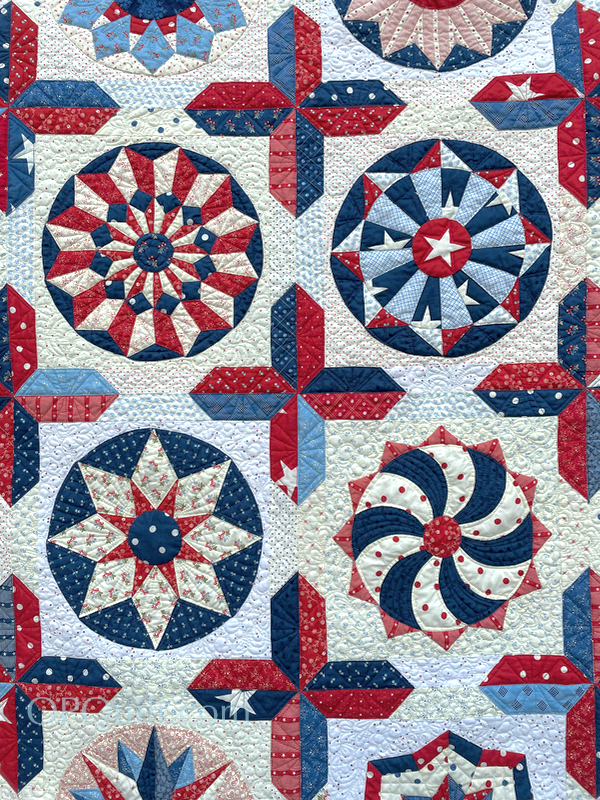
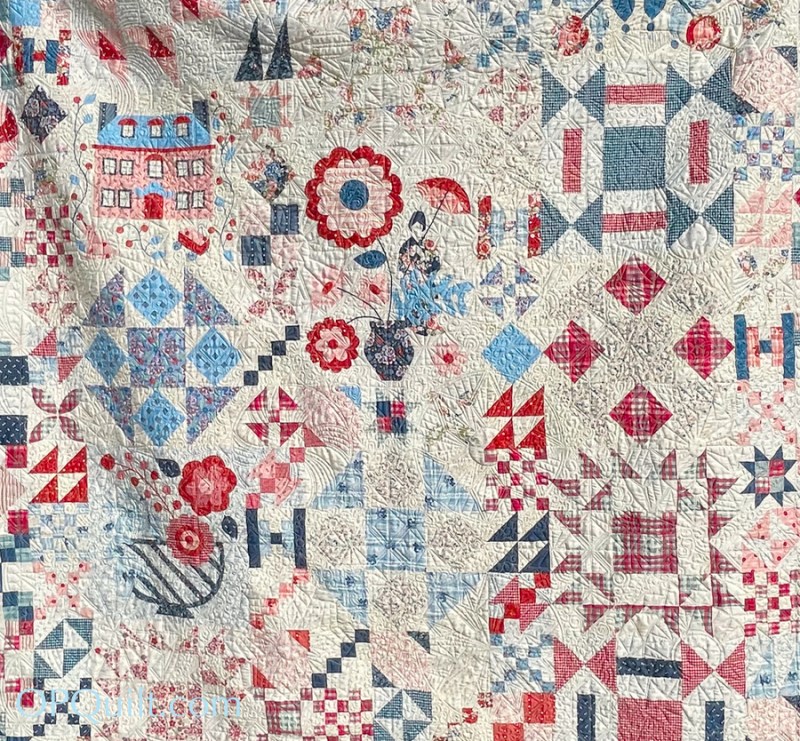
I Hear America Singing Quilt #252 68″ square Many of the English paper-pieced blocks for this quilt are available free here on this blog. Other blocks and the finishing instructions are in my pattern shop.
The backing was a printed sateen cotton from the designers Minick and Simpson, using the prints from the front of the quilt. The label was attached later and is not visible.
There’s a lot of quilting in this quilt!
Other posts about this quilt, and the blocks that I designed, are found above in the tab Shine: The Circles Quilt.
I Hear America Singing, by Walt Whitman
I hear America singing, the varied carols I hear, Those of mechanics, each one singing his as it should be blithe and strong, The carpenter singing his as he measures his plank or beam, The mason singing his as he makes ready for work, or leaves off work, The boatman singing what belongs to him in his boat, the deckhand singing on the steamboat deck, The shoemaker singing as he sits on his bench, the hatter singing as he stands, The wood-cutter’s song, the ploughboy’s on his way in the morning, or at noon intermission or at sundown, The delicious singing of the mother, or of the young wife at work, or of the girl sewing or washing, Each singing what belongs to him or her and to none else, The day what belongs to the day—at night the party of young fellows, robust, friendly, Singing with open mouths their strong melodious songs.
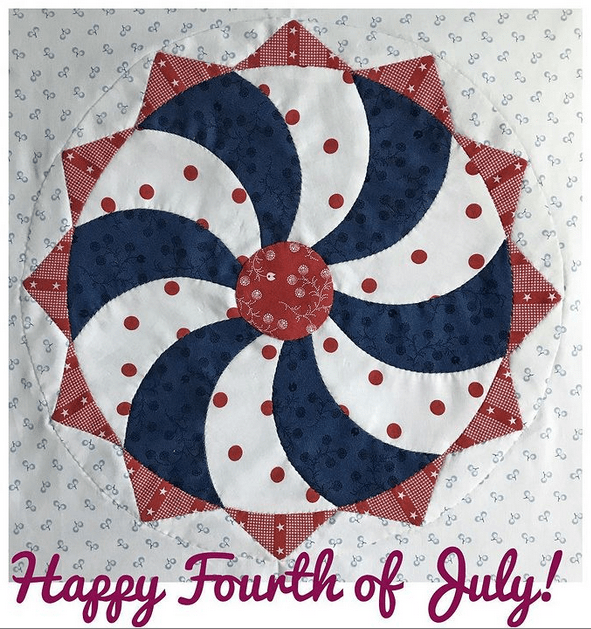
Happy Fourth of July, everyone! The above Instagram post is from July 2020, when I began this journey. #ihearamericasinging_quilt