300 Quilts · Family Quilts · Free Quilt Pattern · Patterns by Elizabeth of OPQuilt

Keagan’s Quilt • Quilt Finish

The year 1666 was the first recorded use of the word “minimal.” That was also the year, according to the Merriam-Webster Time Traveller feature, where the word “pandemic” was first turned up.

I looked it up because I was thinking about Minimalism — a word that showed up much later, in 1926 (the same year as estrogen, garlic salt, preemie and trick-or-treat) — and is defined as a style or technique (as in music, literature, or design) that is characterized by extreme spareness and simplicity.

[And speaking of words, did you know that “fewtrils” was one of the words in the final rounds of the recent Spelling Bee? It means things of little value and first showed up in 1750, the same year as frosting, steering wheel and unimportant. I totally have to use fewtrils again.] I digress, but be warned, I have the Spelling Bee on my mind today.

Modern quilters seem to love this style. Gimme a bunch of squares, a field of white and we are in business. So I was surprised to note that my granddaughter Keagan was also a lover of minimalism, when she asked me to make her a quilt for her queen-sized college bed. I found out from her mother that Keagan is also an avid follower of a famous trendy store, so I wasn’t too surprised when, as we began to trade photos of possible quilts, that this one showed up. I tracked the origins of this one using Google Photo search, and sure enough–it’s listed in that famous trendy store, is made in India, and is hand-stitched. We are all familiar with these quilts.

Keagan’s only requirement besides: minimalistic, gray with touches of forest green, and queen-sized, was “snuggly.” I sent the completed quilt top, with some cotton-wool batting (pre-washed) to Wolf Girl Quilts, and she sent it back a couple of days ago, all finished.

Since breaking my ankle, I’ve had a few more hours of down-time, and since my past self was very kind to my future self, I had the binding all cut out and ready to go. So I sewed it all down yesterday: broken/sprained ankle up on a camp stool on the left, while the right foot worked the sewing machine pedal on the right. Today we took it out for photos, with Dave moving around, me gimping around (no cast on the foot, yes, the referral and call are in to ortho, I just keep it elevated except when I’m out photographing quilts).

The back is all white: Painter’s Palette Solids. I ordered a whole bolt of that stuff.

We usually use a contraption of two clamps held out on sticks, but the sticks broke, so the quilt is in the washer (we kept meaning to put on sturdier sticks…). I’ll press it lightly, wrap it up and mail it off to one of my two granddaughters headed for college this year!
Keagan’s Quilt
Quilt No. 253
Began April 18, with designs showing how it will drape on the bed (below)
Finished July 9, 2021
89″ wide x 92″ long (approximate)

I worked it up in Affinity Designer. There is no pattern, but you can figure out the gist of it from what’s in the sketch above.

Apparently “snuggly” is not a word, but “snuggle” is. It showed up in 1687, along with birdhouse, trigonometric and yawner. I hope all these words haven’t been a real yawner for you, but just in case…I’ll stop this post here.

Happy Quilting!

300 Quilts · Patterns by Elizabeth of OPQuilt · Shine: The Circles Quilt

I Hear America Singing • Quilt Finish

Where does patriotism come from? The title for my quilt, “I Hear America Singing,” is from a poem by poet Walt Whitman. Today he might have been considered a type of patriotic American — one who saw and acknowledged the multitudes of regular Americans — and heard them sing their song of daily work (poem is at end of post).

“The United States themselves are essentially the greatest poem,” said Whitman, and the poem, written in 1860 and published shortly before Lincoln’s inauguration, was a celebratory poem, lauding you and I — she and him, and those people over there. Karen Swallow Prior, in an article from The Atlantic, makes the observation that “Whitman’s claim stemmed from a belief that both poetry and democracy derive their power from their ability to create a unified whole out of disparate parts—a notion that is especially relevant at a time when America feels bitterly divided.” She goes on to say that:

“Notably, Whitman’s grammar (“the United States are”) signals his understanding of the country as a plural noun—not one uniform body, but a union of disparate parts. Whitman was centrally concerned with the American experiment in democracy and its power to produce “out of many, one,” even at as great a cost as the Civil War and the faltering Reconstruction. Whitman thus celebrates in his work the many kinds of individuals who make up a society as well as the tensions that bring individuals together in a variegated community.”

As Whitman asserts later in the preface to his Leaves of Grass:

The genius of the United States is not best or most in its executives or legislatures, nor in its ambassadors or authors or colleges or churches or parlors, nor even in its newspapers or inventors … but always most in the common people.

We often think that the ideal of “patriot” has an affiliation with war: the machines of war, the fighting and dying and the slogans and the confrontations, which leads in the end to the cemeteries of war, with honoring our war dead. We make that connection easily because we honor those who fought for our freedoms. I acknowledge them and am grateful for them. However, if it is defined only this way, it’s easy to feel separated from the idea of being a patriot, from patriotism, and make “them” responsible for the well-being of our country.

So on this Fourth of July, I wanted to emphasize a different sort of connection to patriot. That it is not found in going to war. It’s not in defined battles. It’s in us, the people. It’s in our going out of our way to take care of our neighbors, with their varied songs and carols and labor and daily work. It’s in going to that daily work, from the work of masons and shipbuilders and deckhands and mothering and washing and sewing: “Each singing what belongs to him or her and to none else.”

Stephan Cushman noted, “Although we hear the words “patriot,” “patriotic,” and “patriotism” all around us … we do not have many useful public models for combining genuine celebration of the United States with constructive criticism of it.”  Cushman gives a nod to the idea that “patriot” is a formal label that can be worn on one’s chest. But after noting that Whitman used that word sparingly in his volume of poetry Leaves of Grass, Cushman goes on to say:

“Different readers might offer different explanations for the paucity of direct references to patriotism in Whitman’s writing, but one that feels plausible to me is that someone so deeply engaged in celebrating various aspects of the United States, and in identifying himself with his image or images of an American ethos, had little need or ability to separate himself from that celebration and objectify it with an abstract term like “patriotism.” Or, to put the matter more bluntly and reductively, Whitman was too busy celebrating himself and his country, and insisting on the connections between them, to spend much time crowing self-righteously about how patriotic he was and how deeply he believed in the value of patriotism.”

Perhaps the greatest patriotism is in seeing each other, in realizing how alike we are and how dissimilar we are, making us figure out how to negotiate, how to keep the peace, how to be respectful. This is why one reason my husband and I photographed this quilt at our county’s 1903 Courthouse, a place administering and honoring those laws that are part of the the thousand daily comprises we make to keep our country stable and thriving. We also chose this place because it’s also really beautiful, with its craftmanship intact; this place generates in me that old-fashioned kind of feeling of pride, and yes, of patriotism.

As I have traveled around the world, I have found patriots in all countries, loyal to the carols they hear around them, fiercely proud of what makes their country the best one ever. It would indeed be a great world if we could all think like that, seeing this similarity as something that can unite.

Finally, Swallow Prior brings another gentle affirmation for this idea of America as a poem by mentioning Harvard professor Elaine Scarry, who “describes the importance of multiple viewpoints, arguments, and counterarguments to ‘political assembly,’ [and wonders] how ‘will one hear the nuances of even this debate unless one also makes oneself available to the songs of birds or poets?’ The basis of poetry is precisely those connections forged between different elements, different voices, and different perspectives. In envisioning the United States as “the greatest poem,” Whitman links the essence of poetry, which is unity within diversity, to the essence of democracy.”

I am a patriot of the singing kind, the poetry kind. I will always love America. And so I present to you my quilt, I Hear America Singing, a celebration of that great American poem that Whitman believed us to be.

I Hear America Singing
Quilt #252
68″ square
Many of the English paper-pieced blocks for this quilt are available free here on this blog. Other blocks and the finishing instructions are in my pattern shop.

The backing was a printed sateen cotton from the designers Minick and Simpson, using the prints from the front of the quilt. The label was attached later and is not visible.

There’s a lot of quilting in this quilt!

Other posts about this quilt, and the blocks that I designed, are found above in the tab Shine: The Circles Quilt.

I Hear America Singing, by Walt Whitman

I hear America singing, the varied carols I hear,
Those of mechanics, each one singing his as it should be blithe and strong,
The carpenter singing his as he measures his plank or beam,
The mason singing his as he makes ready for work, or leaves off work,
The boatman singing what belongs to him in his boat, the deckhand singing on the steamboat deck,
The shoemaker singing as he sits on his bench, the hatter singing as he stands,
The wood-cutter’s song, the ploughboy’s on his way in the morning, or at noon intermission or at sundown,
The delicious singing of the mother, or of the young wife at work, or of the girl sewing or washing,
Each singing what belongs to him or her and to none else,
The day what belongs to the day—at night the party of young fellows, robust, friendly,
Singing with open mouths their strong melodious songs.

Happy Fourth of July, everyone!
The above Instagram post is from July 2020, when I began this journey.
#ihearamericasinging_quilt

Digital/Virtual World · Shine: The Circles Quilt · This-and-That

Abecedary • Late June 2021

A is for Abecedary, or a way of organizing this post.

It’s also the name of my Lecture I present to Guilds, and I’m coming up on my last Abecedary of Quilts lecture next month (a milestone). And by the way, today I might skip a few letters. Subtitle: This and That • June 2021.

B is for bibimbap

which is a favorite summer dish, shown here on my placemat made out of Simone’s fabric, back when we supported her in her fabric launch. In the Before Times.

B is for Bunny ears.

C is for Criss-Cross. Fun to see Kathy’s finished quilt on the Glendale Quilt guild’s IG account.

E is for exclamation points, for which I often use too many and always have to edit them out.

F is for feet on Instagram, specifically feet on quilts. Seems there are strong feelings about this.

I is for new ironing board cover.

1. I always leave lots of padding, but maybe shuffle them around. This is multiple year stack-up of padding.
2. My pattern has me lay the ironing board down on some fabric then draw an outline about 3″ away from the edge. No precision needed. I then make a separate “hood” for the top, by duplicating the upper portion. No reason. It’s just the way my most favorite commercial ironing board cover was made, way back in the day, and I’ve just continued it. I sew it on the top part, RST, then flip it. It’s tricky to get the casing around those edges, and I always find myself unpicking bits here and there to get the drawstring through. Don’t judge me by my underneath-the-ironing-board-cover business.
3. I slap an interfaced square on the lower edge and put in two buttonholes (for drawstrings), making sure they are closer to the raw edge. Make a hem of about an inch of fabric all the way around and stitch it down, doing your best. No, I don’t finish the raw edge. Why should I? After that, slide through some sort of long string-y thing (not yarn or string). The best one I’ve found is to use two packages of seam tape, seamed together and overstitched. I’ve re-used it over and over.
4. The underneath, after I’ve pulled it all up into place, and tucked in the strings.
5. My newest gig is to sew on a giant rectangle, right in the middle (pink arrows). I just tuck the edges under after pinning, and topstitch it down. Yes, I fit the board with this after laying the cover on, but before drawing up the string. Why this? When it gets grunge-y after constant use, I unpick the stitches and yippee! Fresh and clean ironing board surface.

K is for Kitchen Sink Cookies.

You can find this recipe on my daughter’s new website, Sweet Mac Shop, made and launched this last month for her macaron-baking efforts.

L is for Leisa.

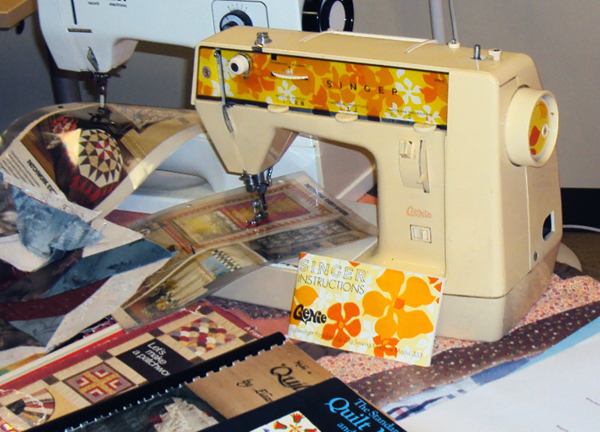
She’s coming up on the one year anniversary of her stem cell transplant and we are celebrating by taping up a quilt (left side of the photo) for her niece. She had this little quilt of mine out on her antique sewing machine, so I took some time to re-acquainted with an artifact from an early day.

This was one of my earlier attempts at Home, Sweet Home, using a Lemoyne Star in the center, which is a juggling act all the way around (my pattern has an easier method).

It’s like old home week, visiting these fabrics once again.

L is also for Link Tree.

This is what people see when you set up a space to list a series of links off of Instagram. Typically you put it where your ONE available link address is, thereby giving you way more links. Michelle, a brand stategist, often has little tips in her stories about how to make our online life easier, and more clever. One day she had a tip about creating a Link Tree in Canva, a website that will assist you in design tasks.

But then I got to thinking: can’t I do this on my own, using a page from my own website? Since I know her IRL, I asked her and she said “Yep, you can.”

I use WordPress for my blogging software, and they use Blocks for text, images and anything on the page, I colored my Blocks in different colors, wrote my text, and since I didn’t give the page a title, it has a naturally short web address.

Voilá! My very own Link Tree that I can change at a moment’s notice.

N is for Northern Star Quilters’ Guild.

I just finished teaching Criss-Cross and presenting my Abecedary of Quilts lecture to a wonderful group of quilters all the way across the country in New York state. What wonders of our era, to be in California and NY at the same time.

O is for Obama.

I’m almost done listening to the first part of his memoirs, and boy, have I learned a lot about government. A brilliant writer, with an easy-going style. His strong character traits, as well as some of his flaws, do come out in this book, but what I’ve appreciated learning is the bits of history he builds in to each international incident: it gives me a fuller appreciation for the difficulties of managing the expectations of the presidency in both foreign affairs and domestic. Love him or hate him, a lot can be learned by listening to, or reading this book. You’ll learn more about how bills are passed — and blocked — by taking the time to hear from a former president.

P is for pre-wash your red fabrics.

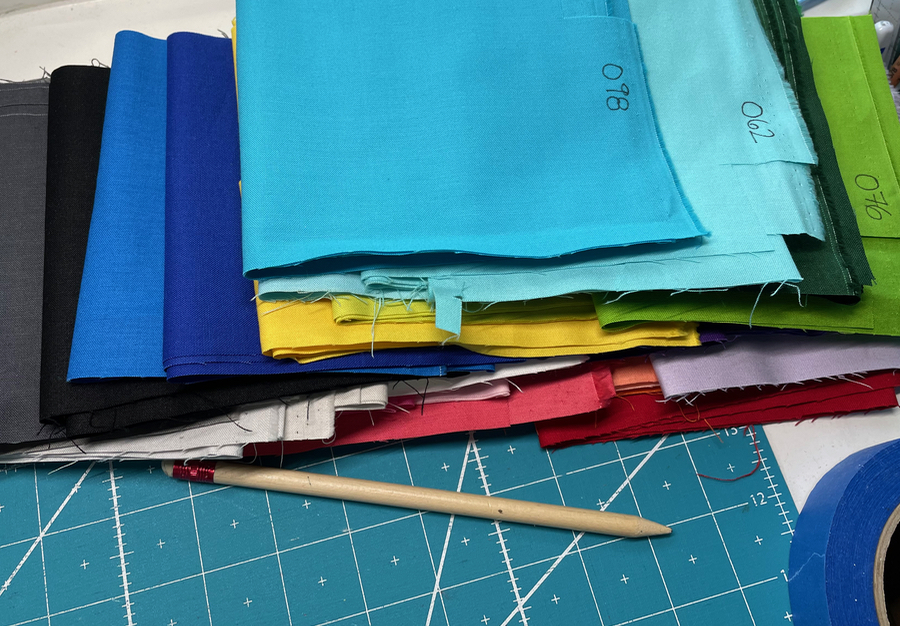
After they come out damp from the dryer, I press them and let them dry on the guestroom bed. This was in preparation for my Summer Snowcone Quilt. I don’t always pre-wash all my fabrics, but I ALWAYS pre-wash the reds.

S is for Shine, the red, white and blue version.

My goal is to get this done by the end of next week, in preparation for the Fourth of July. I have now finished most of the white thread, most of the red thread, most of the blue thread. Next up is light-blue thread, and then going back for borders and finishing touches.

W is for Writing Patterns.

Next up is Azulejos, a pattern to be made from a quilt finished in the Before Times. This pattern is almost done. I use Affinity Software (Affinity Designer, Affinity Photo and Affinity Publisher) and for the last while they’ve been offering a smoking hot deal at 50% off. (Hooray! No more chained-to-Adobe-subscription prices, although they do have excellent software.)

Well, that is ending soon, on the 30th of June. If you have a hankering to design, or to tweak your photos, or other creative uses, head to Affinity by Serif and pick up your copies before it goes off sale. I’ve written about this before and I will again. It’s a great set of software apps for creatives Creative Peoples Creative People and Quilters. It will take you some time to get to know it, I won’t lie, especially if you have no Adobe experience. I had never used Illustrator by Adobe, but I purchased Affinity’s Designer. I had to do a bit of research here and there, but they have a great series of tutorials (I went through them all and Took Notes), a hefty online design community, a comprehensive online manual and even a hardcover book, that walks you through lessons on how to use it. I was up and running fairly quickly, and continue to learn new things.

Speaking of sales, get this, too. QuiltFolk. Ending Soon, and all that stuff.

V is for a sad move for Viking Sewing Machines.

Somehow I never think it is a good sign when equity firms own our sewing machines. We recently lost one good tool when QuiltPro, a favorite design software (it used vectors, not lines) was purchased by a corporation, and let it slide into nothingness. Admittedly, it is still around and functioning for Windows machines, just not on Macs. Superior Threads was also sold, and I miss talking to my favorite help person on the line, although the threads themselves are still the high quality threads I know and love. And now these three sewing firms. I’m somewhat encouraged by the last line of the announcement, but not much.

Z is for Zee End.
Happy Beginning of Summer!

300 Quilts · PatternLite · Patterns by Elizabeth of OPQuilt

The Flowering Snowball Block Grows Up

Now where were we?

I think we left the Flowering Snowball block here:

Don’t get me wrong…that was a good place to leave it, and I still might try to make this version of it, but the idea that I should do one in Anna Maria Horner fabrics just wouldn’t leave me alone. Thanks to Patti, I just had to give it a go.

First draft, using 12″ blocks from the PatternLite Flowering Snowball pattern:

The finished quilt center:

For some time I was stumped on what to do for a border. I try to subscribe to the Ruth McDowell school of sneaking in a border if you can, that is, having it be integral to your quilt, but not the same as the quilt.

I tried to do that with Summer Snowcone.

As well as a version of it with Sawtoothmania.

I looked at the center section for a long time, and was bothered that the tips of the petals were cut off. So I had the idea to extend the petals, re-draw a new border piece and see where that took me.

First draft of border, using the petals I’d originally cut for the center (but in the end, chose the warm yellow-green instead):

This is still an AMH fabric, called One Mile Radiant, a lovely design with Queen Anne’s lace all over it. I’d show you what it looks like, but I cut it all up.

(Aren’t we supposed to do that with fabric?)

The white was ho-hum, just didn’t sing it for me. So I auditioned different colors of solids: medium purple, light periwinkle and deep pink.
But as I said to Carol, “That dark pink on the left just looks like freshly manicured fingernails to me.”
And then she said, “Once you see that, you just can’t un-see it.”

Reject.

The smart and handsome youngest son and his brilliant and lovely girlfriend came yesterday for an early Father’s Day lunch (which is why this post is late but that’s a good reason), and they graciously posed in front of Sunny Flowers just before Dave (DH) suggested they go up to the sewing room to help me with my conundrum of freshly painted fingernails. They were like, what?

But then I showed them the stack of AMH and started flipping through the bits, and one of these two said, What about that one? pointing to what is now front and center.
I think that might work, I said.
We all agreed (by now Dave had joined us) that the tips of those leaves were like an extension of the yellow-green and that the pink bits echoed the center of the larger flowers in the quilt.

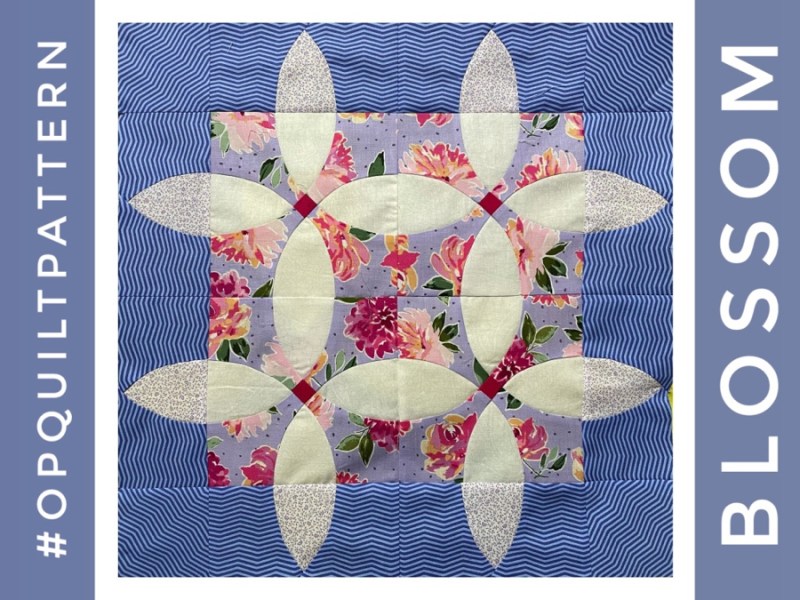
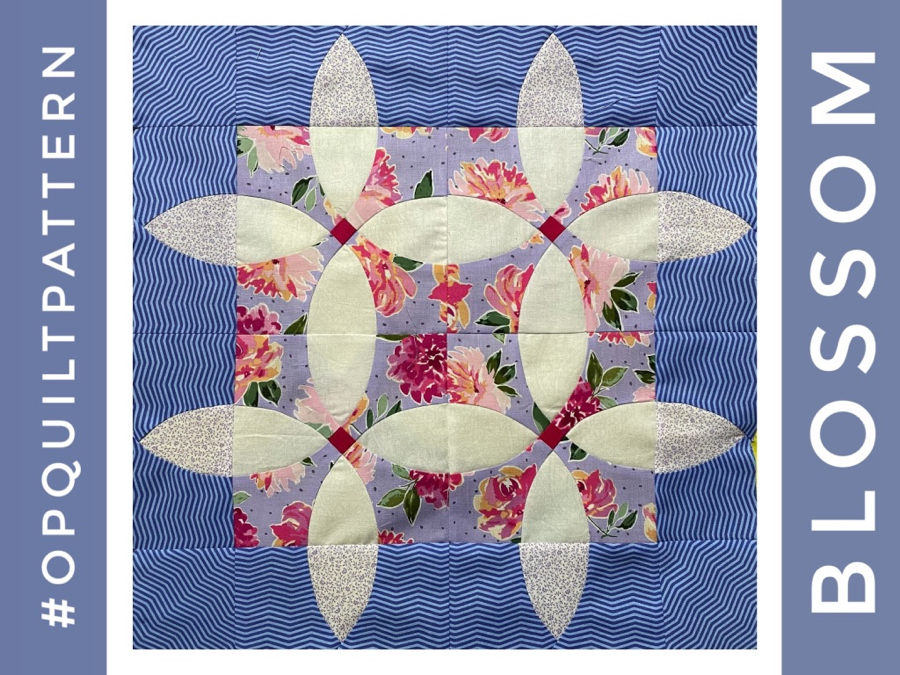
So, after church today, we went out back to the pavilion and park and took a few pictures, before heading home to celebrate Father’s Day. As usual, Dave was my Quilt Holder Supreme. My newest pattern, Blossom, contains all the parts for this quilt, as well as three other sizes, including that original border block.

Happy Father’s Day to the man who married me and four children, all at once, and raised us all.

The day my husband became a father to four children. He’s a keeper.

I was also fortunate enough to have a magnificent father, who raised me, as well as being surrounded by many fine fathers: brothers, brothers-in-law, our sons, friends we know — all men who are doing their best to influence their families for good.

Happy Father’s Day, everyone!

Our grandchildren: a long time ago in a galaxy far far away.