This teeny quilt on a frame was inspired by two things: this March pillow from Stash Fabrics (from Riley Blake’s Year of Pillows).
And because a dear friend of mine, who is by all rights and purposes is Irish (even though she was born and raised in the United States), has had a bad dose of it this year, and I didn’t want her to be forgotten on her favorite day. She’s the one who would hand out pots of shamrocks to her friends on St. Patrick’s Day. She and her husband have also gone to Ireland about a dozen times, and I never tire of her bopping out with phrases in the way they say them in Ireland. She gardens like no one else, loves saints and sinners and babies and her family with a fierce love, including her friends in that welcoming aura.
While I machine appliquéd the hearts on the pillow, I decided that for such a small project, I would fuse the hearts on.
I put a light crease at the halfway mark — both ways — to get those hearts perfectly centered.
A simple topstitch with green thread, then a white echo, then stipple everywhere else. I’ve learned not to get too “over-the-top” on the quilting with these tiny quilts: the design is the most important, not the quilting.
I cut my binding strips 1 1/2″ wide and use the single-fold binding technique (post is also found in the Tutorials, Techniques, and Freebies, above). I use a glue stick to get it into place, then topstitch down the binding 1/4″ away from the edge and no farther. This ensures that you can slide your picture frame into the pocket on the back.
This month is what I call a supporting month in the Heart’s Garden Mystery QAL. Of course you can figure out that flowers will be planted here next go-round, and so you’ll keep that in mind as you create your garden beds for them to grow in. There are three borders: the first inner one with large blocks and corner birds; a second one of interesting bits; and finally, a third one for stability and delineation for what’s coming next. All things rest on your creation this month, but first! some eye candy from Part 2 from Joan, Lisa and Susan:
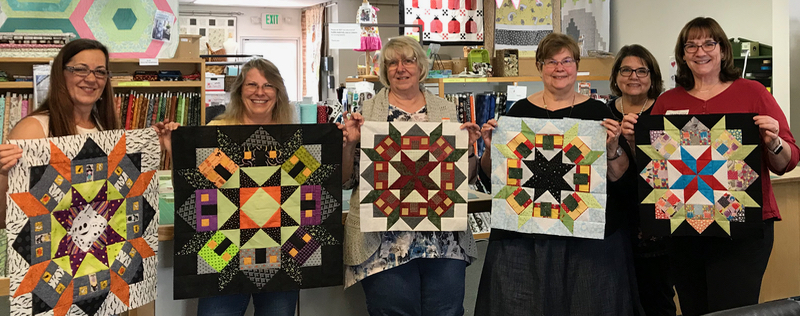
Joan has put a butterfly in the center. Lisa (middle) also fussy cut her center and the striped border is really perfect. Susan decided to create a four-patch in the background of her Part 2 as she didn’t have any one piece of fabric that she liked. I’m really enjoying the creativity of these quilters!
This month includes making four sparrows in the garden.
I made more samples out of scraps to refine the pattern, but most of the fabrics I’m working with are Sherri and Chelsi’s line of Sincerely Yours, with a lot of warm pinks, reds and fun neutrals. After seeing the quilters above, I now want to remake it in something different.
Then the rest is cutting small bits, creating a background for what comes in Part 4–easy, peasy, right? I know it’s hard to create without knowing the future of a design, and my hat is off to Joan, Lisa and Susan for giving this mystery a go. As I mentioned in the last post, it was a bit of a mystery to me, too, after I scrapped the design of what I’d been headed toward and reworked it into a medallion quilt, but now I’m full steam ahead.
Here’s the front of this month’s installment. Parts 1 and 2 have come down, but all parts will be available in a stand-alone pattern, for sale in mid-summer. Our Instagram hashtag:
[UPDATE: The pattern is for sale in my online pattern shop.] Hope you enjoy making this third part. If you can post them on Instagram they will be fun to see! P.S. If you can’t manage another project, feel free to download for another time.
Happy Quilting!
P.S. This is how I feel about Daylight Savings Time.
I just made a little video about machine appliqué that you can find on YouTube (click above image to watch). It’s not glamorous, I’m not an expert, but most of the important technique about how I do machine appliqué is there in my few minutes of total glory. (haha) While I was making it, I was thinking about gathering all my thoughts about appliqué..so I did.
TIPS & TRICKS
I use MonoPoly as the top thread. I use both their Clear and their Smoke, depending on what colors of fabrics I’m working with. The smoke (as their website says) is a reduced sheen invisible thread.
I use SoFine polyester thread (also from Superior) in the bobbin, and a very fine needle — size 12 is preferred.
Slow down your sewing machine speed if you can.
This clay tool, Mudshark from Mudtools, is one of my favorite stiletto tools for working with machine appliqué. It’s easier for me to hold and the tip is quite long. I also just like the colors. I bought it in the Smithsonian Museum after seeing an exhibit about Michael Sherrill. I figured if he used it and got such beautiful work, then I was going to lean in on his skills and start using it myself.
Stitch settings: Length 1.4, width 1.3 The zig-zag should just catch one side of the folded appliqué piece (green) and then the (white) background:
This quilt was done with all machine appliqué, and was mentioned in my video.
PREPPING THE APPLIQUÉ
I cut all my shapes to the finished size, then cut the fabric 3/16″ (a fat one-quarter inch) bigger all the way around. I use the freezer paper shiny-side up, and with a hot iron, “adhere” the seam allowances to the waxy side of the paper while moving my iron in an arc-like motion.
(NOTE: I don’t always wash my wallhangings, so don’t like a lot of glue and starch on them, but for Useable Quilts, she has some great ideas.)
HAND APPLIQUÉ
The only thing I have to offer up about hand appliqué is to think of the folded edge of the appliqué as the frosting inside a macaron, the background being the lower cookie layer and the appliqué itself being the top. Try to bring your needle out of the frosting, then poke it back down in the background just below. Run the needle for about 3/16″ (fat one-quarter-inch) underneath the background, then bring it back out through the frosting (the fold of the appliqué piece). There are many more talented people out there who can explain it better than I, but that’s how I think about it. (I know Jill Finley has a one-hour class on appliqué on her website if you are interested.)
So many organizational systems do not account for a trip to the fabric store, where immediately I have to reshuffle, re-prioritize not only my To Do List, but also my sewing room. I have five red tabs in my Get To Work Book and they read To Do 1, To Do 2 and so on to the fifth one. I have half-filled lists in my quilting planner. A lot is crossed off using my yellow highlighter, but when your organizational lists get out of control, how do you organize and get things done?
Research: I read this article which suggests compiling four different types of lists: Master, Monthly, Weekly, Daily (he describes them on the site). Lisa Jackson recommends a service called WorkFlowy under the post title of A Tool for Organizing Your Brain. Bette has declared this the Year of Focus and has organized segments of the year dedicated to her sewing goals. Sherri of A Quilting Life has a good planner for quilting goals.
And here’s my classic Goals List from over two decades ago. I should frame this–what an ambitious woman I used to be! (I’ve abandoned housework, physical fitness goals and scrapbooks — but did complete most of the quilts in the list. I also got the children raised.)
As we’ve noticed, our lives have shifted underneath us. We kept going, but perhaps our outlook changed, our friendships dwindled or expanded. I liked Brad Stulberg’s article, where he writes:
“Many of us felt seen when, last April, the organizational psychologist Adam Grant wrote of languishing, “a sense of stagnation and emptiness … as if you’re muddling through your days, looking at your life through a foggy windshield.” There was a relief in having a name for our experience, and a kind of solace in realizing that we weren’t alone in experiencing it. But now, nearly a year later, as with just about everything related to Covid, we’re sick of languishing too.”
Perhaps that’s why when I went to QuiltCon in February, I tried to find things to give me a spark. I loved my two classes from Cassandra Beaver and Verushka Zarate, and enjoyed the lectures. It was fun to see people again in the wild, but there were some interesting moments of confusion in identifying people because we were all masked. And perhaps that’s why — when I went into a real-live quilt shop in Phoenix, and maybe because they gave QuiltCon-ers 20% off, I snapped up a range of beautiful colored semi-solids. Some one in line asked me what I was going to do with all those, all I say was, “We’re supposed to have a plan before we buy?”
Perhaps I was exhibiting Stulberg’s mention of “behavioral activation…based on the idea that action can create motivation, especially when you’re in a rut.” He writes:
“The challenge with behavioral activation is mustering enough energy to start acting on the things that matter to you: Make that phone call, schedule that walk with friends, write that email, get off social media and start on the creative project you’ve been procrastinating on. This may sound simple, but when you are languishing, simple does not mean easy.
“But a mind-set shift can be a powerful tool. When you feel down, unmotivated or apathetic, you can give yourself permission to feel those feelings but not dwell on them or take them as destiny. Instead, you shift the focus to getting started with what you have planned in front of you, taking your feelings, whatever they may be, along for the ride. Doing so gives you the best chance at improving your mood.”
So To Do lists can sometimes become exercises in bloodless planning, an attempt to get organized (which is why my planner often has blank spaces). But walking into a fabric shop now becomes behavioral activation. That, we can all get behind.
So my To Do lists are more random. This was going to be my year of Focus, a la Bette, but then I started the Heart’s Garden Mystery Quilt-A-Long, which I had all sketched out. And which I totally scrubbed after Step One and rebuilt it anew. Which was no where on my Yearly To Do List. Here’s my first sketch:
Yep. Pretty hideous, excepting those EPP circles. I even got the birds around the border, but they look more like quail, than sparrows or finches. I’ve been working on writing up Part 3, which is coming next week, and part of that is making birds over and over, as I perfect the pattern:
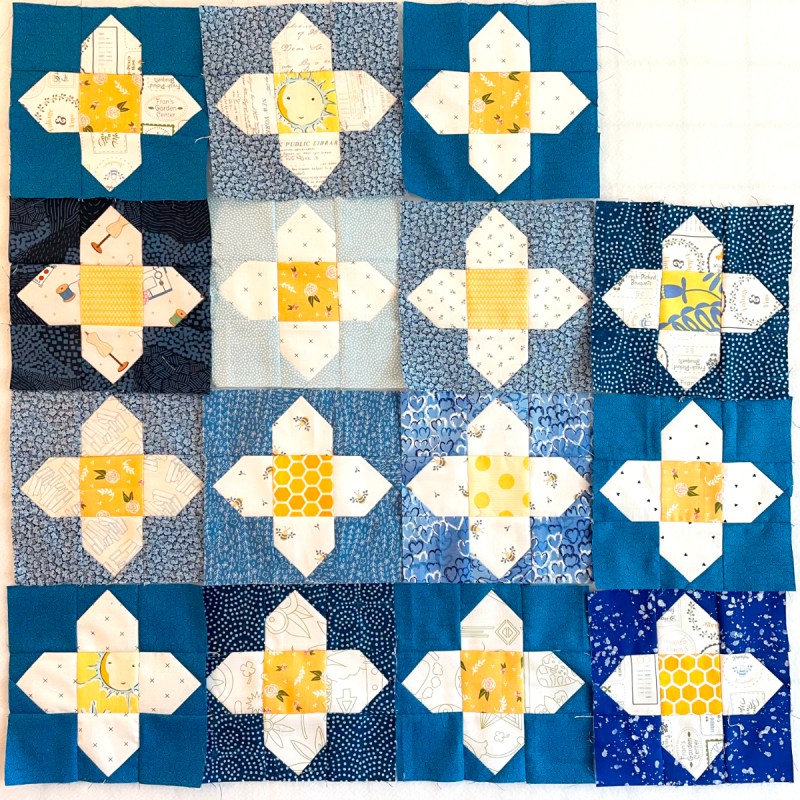
blue and yellow blocks, for Ukraine (from Hearts Garden pattern)
So I write — and cross off — “sparrows” on my To Do List, and wander back into the sewing room for some pleasant Behavioral Activation. I wish the same for you.