Free Quilt Pattern · Gridsters

Scrappy Radiant Star

scrappy radiant star_1

Mary, of NeedledMom, chose this block for her June turn as Queen Bee of the Gridsters.  Originally found on Wombat Quilts website as a free illustration, I redrew the block to Mary’s specified 6-inch (finished) size.  Four of these blocks are put together to make Mary’s larger 12-inch block.

scrappy radiant star_2

Scrappy Radiant Star Illustration

Click on the download PDF file here:

Scrappy Radiant Star

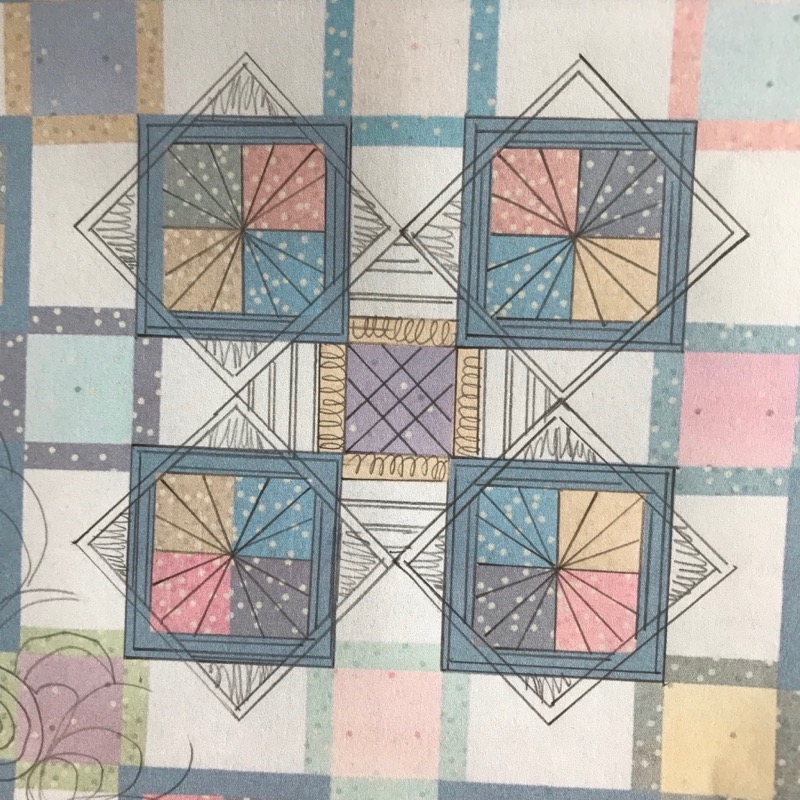
You’ll need four copies to make one 12-inch block, as shown below:

scrappy radiant star_4
sketch I made to keep the colors organized

Notice there are FIVE colors per Mary’s larger block.  Four corners have the same color, which when sewn together make that center star.  But in looking at the way she designed it, the colors are to be distributed throughout the quilt.  You can see her initial thinking about this version on this blog post (where you’ll also get a glimpse into her gardens and cooking.  I love reading her blog).

Peek Marys Chart
Just a peek–download below.

Mary gave me permission to post the chart she drew up to keep her ideas straight.  You can download this as a PDF:Mary’s Chart_ June Gridster Bee

You can see that she’s diagrammed the main stars (in the center), and the secondary stars in the corners.  We Gridsters each chose two blocks, identifying our choices using her coding on the sides and are now sending them to her.

scrappy radiant star_5

To further my tributes to Mary today, I’m making her bread recipe to go with my version of Italian Wedding Soup.

Have fun making these blocks!

Free Quilt Pattern · Tiny Quilts

Bluebird of Quiltiness

Bluebird Tiny Quilt_1

Another Tiny Quilt was hatched today, and its this Bluebird of Quiltiness.  Based on a 1-1/2″ block size, I figured it out and made it up, finishing it with the perfect faceted black bead for the eye.  There are multiple patterns out there for pieced birds, but here’s mine: LIttle Bird_OPQuilt.com

Bluebird on Nest

Here’s another one, in case you want to make a bird on a nest for your next Tiny Quilt.  Grab the PDF file here: Nested Bird pattern and have fun making another little Tiny Quilt.  (I have a listing of all the Tiny Quilts on this blog, in case you’re interested.)

After you create the bird (with, or without nest), then you sew on borders until it’s large enough.  See the first Tiny Quilt for more instructions.

Wanting to finish this today made me leave the house, avoid the parking lot also known as our Memorial Day freeway gridlock, just to get over to WalMart to buy a landscape-oriented frame. It’s those cheesy plastic frames, nothing fancy.   To modify this one, I laid the frame down on my quilt, traced around it, and used those lines to create the backing and put the binding on.

Sing Stitchery_1

I also finished this bird-themed stitchery, purchase eons ago at Primitive Gatherings.  I took it with me to Berlin, but finished it up here.  Now to find a frame for this.

Pinned Quilts_1

The other day I pin-basted three wall-sized quilts, and started stitching on the first one:Quilting with no direction

Right.  I have no idea what I’m doing, but I’m having fun.  I think am hoping it will make more sense when I get the whole thing done.  Stay tuned; it will be long while, as I still limit my daily quilting minutes.

Bindings Needed_1

And the three quilts came back from Cathy of CJ Designs, my quilter.  One is in Active Binding Mode downstairs by the TV, and two (above) are waiting for binding.  The whirly-gig backed quilt is also waiting for more quilting along the borders.  The fun thing was that I’ve had a number quilts done by her, and so I hit the magic number and the last one was done for free.  It’s her way of saying thank you to her customers.  (Thank you, Cathy!)

Mom and her quilt

But I’m leaving all this behind this next week, as I head up to my Mother’s to help celebrate her 91st birthday.  (I do like to remind her that if you turn the numbers upside down, she’s a girl of 16.)  She’s shown above with about the only quilt I can remember her making: a cross-stitched top which was sent out to be hand-quilted.

Happy Birthday, Mom!

Mom on young birthday SM
Mom, around age 12, holding her birthday cake
EPP · Free Quilt Pattern · Quilts

EPPing again with French General

Sometime ago, I glimpsed this quilt in an Instagram feed:

The description says it’s from the North Country of England, so I’ve taken to calling it the North Country Patchwork Quilt.  The more I looked at it, the more I liked how those red squares just kind of blended into the background on the outer rings, but floated over the foreground in the middle.

I tried to convince my husband to buy it.  That was funny, as he made some comment about didn’t we have enough quilts?  Seriously, he’s nearly perfect, but in the end, I decided to go ahead and make it.

too much to do.jpeg

Because I sure need another project.

But the project I need is a hand project, really–one that can be toted around in the car.  I finished my hexies project, and I finished (thankfully) my millefiore quilt, so now what am I going to do on long car rides?  Just sit there?

Car from the past.jpg

So I drew up the block, working between two different pieces of software: QuiltPro and Affinity Designer, and have created this pattern (click on the following link for free PDF file): North Country Patchwork Quilt

This quilt has 624 pieces in it, and if you divide that by four, you’d have to print out gazillions of the pattern page. So here are my tips for making that go more quickly:

Print off several of the free North Country Patchwork Quilt page.  Like 10.

Stack each printed page with about 4-5 plain pieces of paper.  Staple them together inside the pieces, as shown on the left.

Cut them apart in chunks, like the image on the right, using an old rotary cutter that you’ve dedicated to paper; or, a guillotine paper cutter; or, your paper scissors.

Then further cut them into the individual shapes: a honeycomb and a square.  Remove the staples.

That ought to get you started. No, I didn’t use cardstock, but I had some 24 lb printing paper that I used.  And yes, I’m gluing the fabric to these pieces of paper.   I used this paper when I did my Shine EPP quilt (most blocks are free on this blog) and it worked out just fine.  Repeat this process as you need to.

vivelafrance-hyb-fan_1.jpg

I’m going to vary from the fabrics in the original quilt, as I fell in love with this Vive La France line of fabrics from French General.  I’m over the moon for those dusky blues and strong reds.

I worked out some variations of this quilt in QuiltPro software, and they vary by how much of a border is around the central rectangle.  Here they are:

I also had some fun with putting the blocks in more contemporary colors (lower left), but decided I didn’t like that version.  The top three are sort of in the colors of the original quilt and it looks like to me, it was someone who was making do with cast-offs from her household clothing, as well as men’s shirtings.  But I’m anxious to get going and trying this out in the Vive La France fabrics.

I have no idea how I’m going to sew this together, but I will be concentrating on those arms that come into an X, and somehow I’ll do the red square.

Lastly, a reminder to pre-wash your fabrics: working with reds can be tricky.

three-year calendar.png

See you in a couple years!

Free Quilt Pattern · Gridsters · Tutorial

Basket Block Tutorial • February 2018 • (Gridster Bee Month for Me!)

gridsters-250-buttonx

I belong to an online bee called the Gridsters, and February is my month to choose a block that my beemates make for me.  You can find all our work on Instagram, using the hashtag #gridsterbee. 

Basket_8

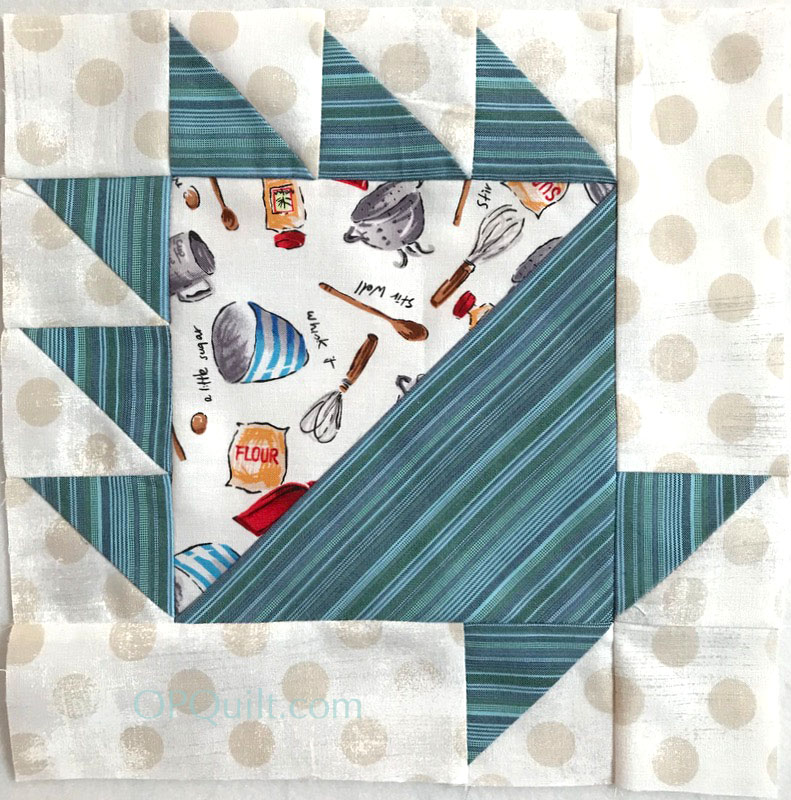
I chose a basket block.

Basket_food fabrics

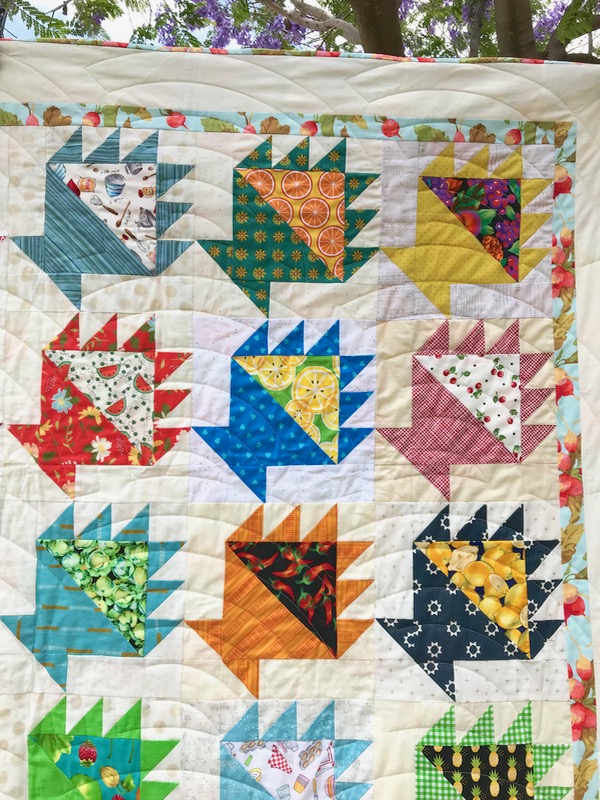
I also have been saving food-themed fabrics forever for a basket block quilt with the baskets full of food beginning at least a couple of decades ago, and continuing as I picked up a food fabric here and there.

I was also inspired to make basket blocks by Barb, of Fun With Barb and Kelly of Pinkadot who decided to do it together; their tutorials are on each of the links, above.  I upsized the basket block to 10 inches in size, so the making would go faster.  (You’d think with all the quilts in this house, I would have enough twin-sized, but I don’t, so I’ve already decided that’s the size it will be.)

If you want to join in with me, or Barb and Kelly, in making baskets, I’d suggest we follow their request to tag our Instagram photos with #basketswu [Baskets Sew With Us]. (Gridsters please tag them also with #gridsterbee.)

For the Gridster Bee

I’ve sent you some food fabrics; please use those for the A section of your blocks.  I don’t care what you use for the basket–it can match, it can contrast, it can coordinate, it can clash–choose what you think creates the look you want.  You can use small scale prints, large prints, florals, novelties, checks, whatever.

For the low-volume background, use these types of fabrics:

Basket_low volumes YES
They are a range of creamy-toned fabrics, without strong secondary designs.

Avoid these types:

Basket_low volumes NO

Solid in creams is okay, but avoid white, grey, tan, beige, white-on-white (I really don’t like beige for this quilt, but understand the limitations of our stashes–just do your best).  Many of the above fabrics have strong motifs and patterns, so reject those too.  Basically, I want the background to recede without being dull or same-same.

Basket Tutorial

Basket Block_ESE
Not to size, for reference only–please use the PDF link below.

Here’s my cutting sheet for this tutorial, in PDF form, but the usual requests apply here–don’t print off a million copies for your mother and your friends, but please send them here to get their own: Basket Block 10 inch_OPQuilt

Basket_1
All my basket pieces laid out.

First, make the Half Square Triangles.

[Background:  One method is from Alyce, and she has a nice chart if you want to figure out your own eight-way Half-square Triangles.  However, I also have a different chart on this post which came from Jeni Baker, who encourages the use of a bigger initial square.  That means for us (and especially if you like to trim your HSTs) you would begin with a 6″ block, which is what I’ve specified on the cutting chart. BTW, her book on triangles is a good one to have in your library. ]Basket_2
Place one 6″ background square and one 6″ basket square right sides together. Mark two diagonal lines, and sew 1/4″ on either side of the marked lines.  On the left is the pieces with the sewn diagonals.  Press it flat to settle down the wrinkles, which you see on the right.

Basket_4b
I moved mine apart to demo this; leave yours close together.

Cut on marked lines.  Now without moving your squares, cut on mid-lines, crossing the centers, as shown below.  Press, with seam allowance to the dark side, trimming out dark fabric, if necessary, so it doesn’t show through.  Trim to 2-1/2″ inches square.

Basket_3
Make center half-square triangle (piece A-1):  Place a food fabric (measuring 6-7/8″ square) onto a basket square (same size), drawing a diagonal line, then stitching on either side of that line.  Press, then cut on marked line, then press towards the basket.  You’ll have an extra center to toss into your Random Patches Box.  (You do have one of those, don’t you?)

Press seam allowance ALWAYS towards basket, to give that dimensional look that something is IN the basket.  Now trim that center to 6-1/2″.

Basket_5
Here are all the pieces, laid out.  I chose a stripe to demo, so you can see the direction the stripes go.  If you use the eight-at-a-time half-square triangle method, you’ll have no problem getting the stripes in the small half-square triangles go the direction you want.  Yes, I did cut the 6-7/8″ square (basket) on the bias, so I could have the stripes go across the unit.

Basket_5a
I made two blocks at once; one had a light center, and one had a dark center.

Stitch together the three small half-square triangle pieces; press in the direction they want to go, which is usually toward the flat triangle piece.

Basket_5b
Stitch one 2-1/2″ block onto one unit (shown in upper left corner).  It helps to arrange your square as you go, so you get everything all sorted out right.

Basket_5c
Sew the first three-unit “basket handle” to the center HST, as shown on the left.  Press seams away from basket, even though they don’t want to go there, again to preserve the illusion that something is in your basket.

Basket_6
Sew the second three-unit “handle” with the C square to the center unit, as shown.  I pressed the square C-block toward the three-triangle unit so that the seams would nest neatly when I arrived at this step.

Basket_7
Create basket stand by sewing one of your small HST to the D-rectangle.  Pay attention to which direction the triangles are going.  Stitch this first unit onto the basket.

Repeat with second HST and D-rectangle.  Sew ONE of the C (2-1/2″ squares) to ONE of the basket stand units.  Stitch this onto the existing basket.

Basket_9
And you are done!

There are lots of fun ways I can finish this basket quilt:

Basket Setting
from here

I like this setting, with all those energetic chevrons in between the baskets.

Looks like red is a pretty popular color for setting these blocks.  I have more basket ideas on my Pinterest site, if you want to see more block settings.  (I’ve been collecting these ideas for ages.)

Thanks to the Gridsters for making me baskets this month, and I hope you all have fun making a few for yourselves.