
300 and Beyond · First Monday Sew-day · Quilt Finish · Quilt-A-Long · Quilts · Something to Think About

Gathering Up All The Fragments • Quilt Finish

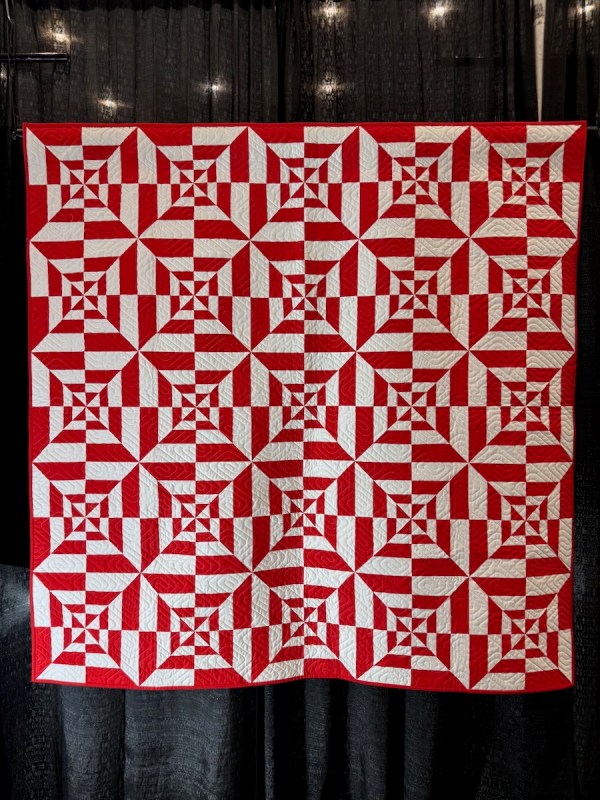
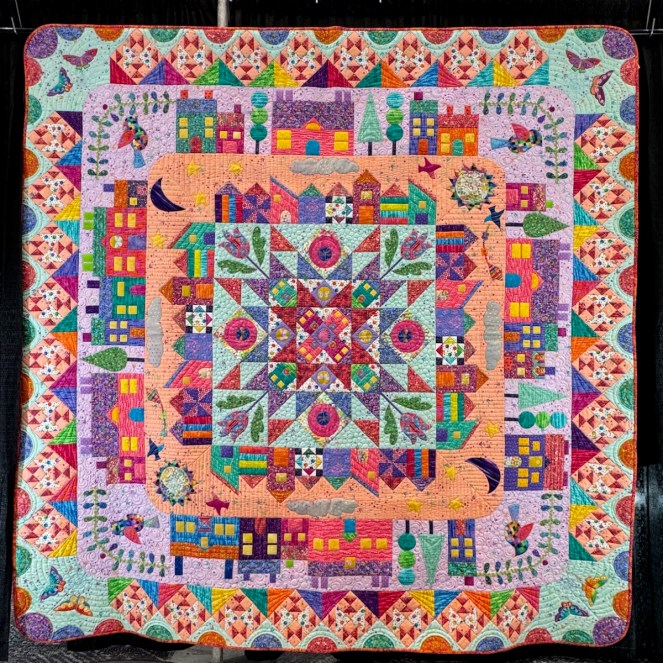
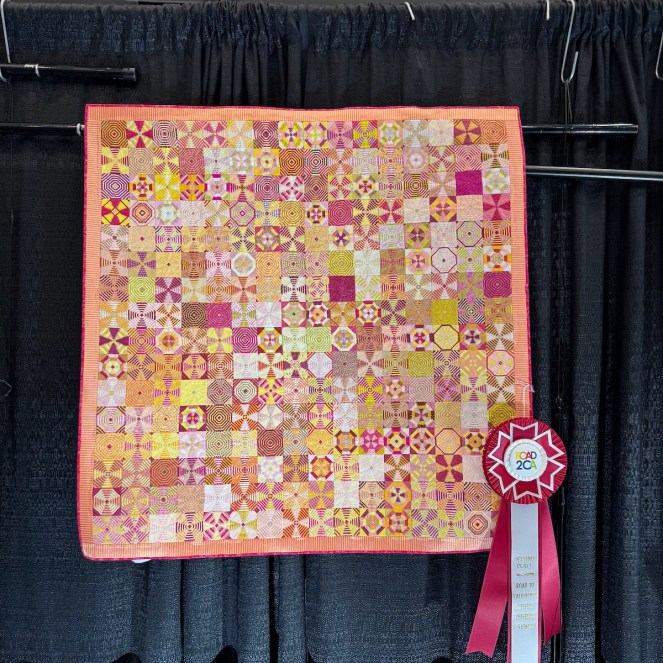
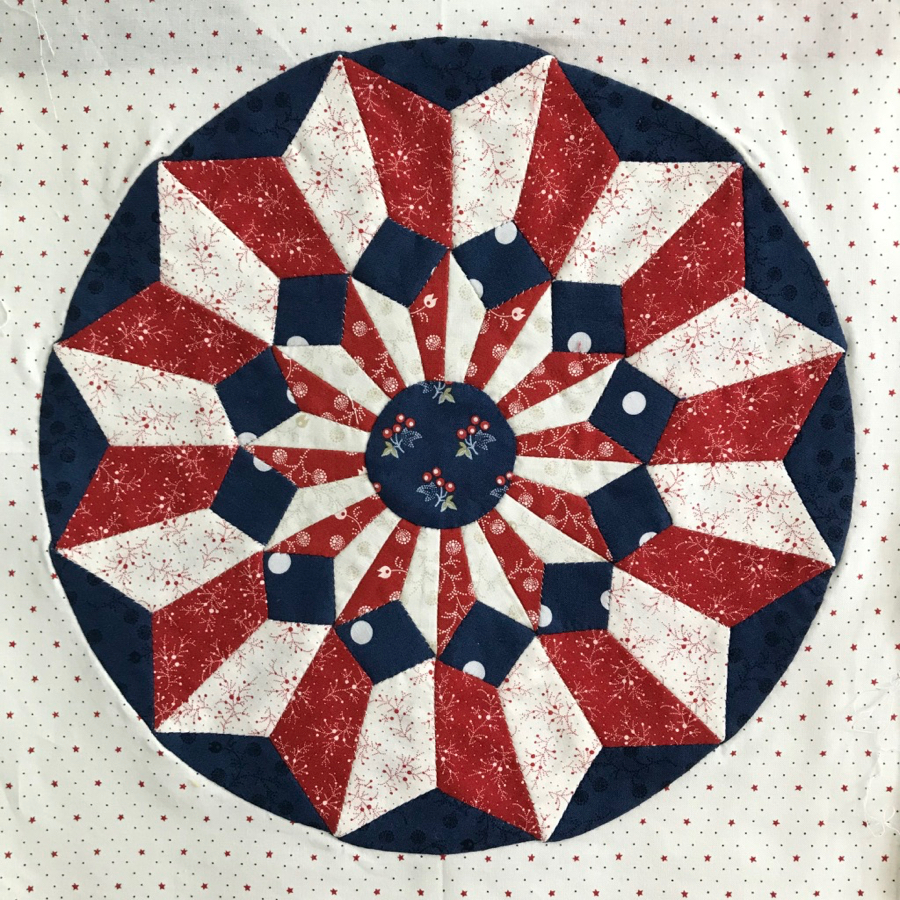
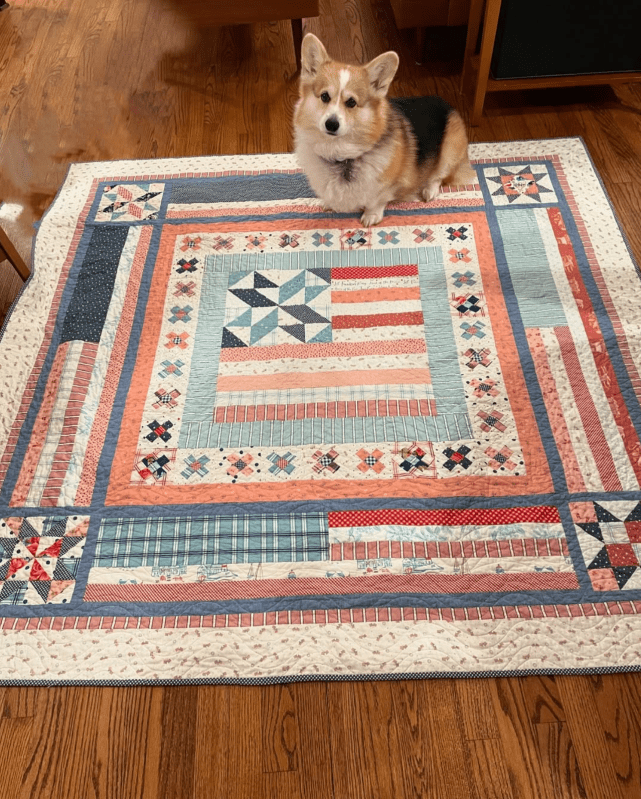
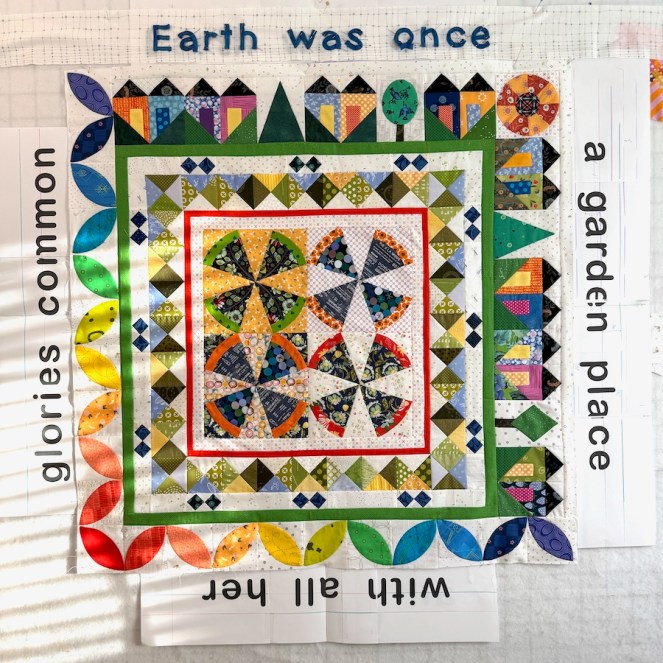
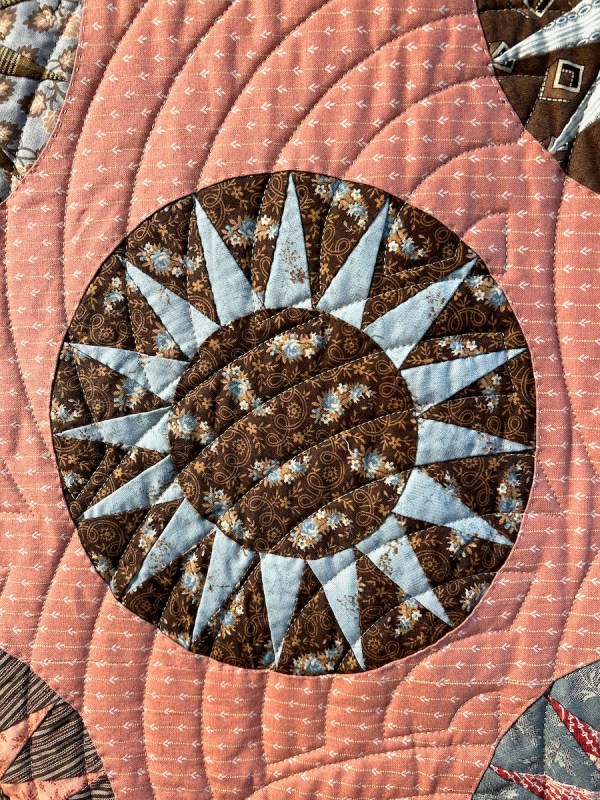
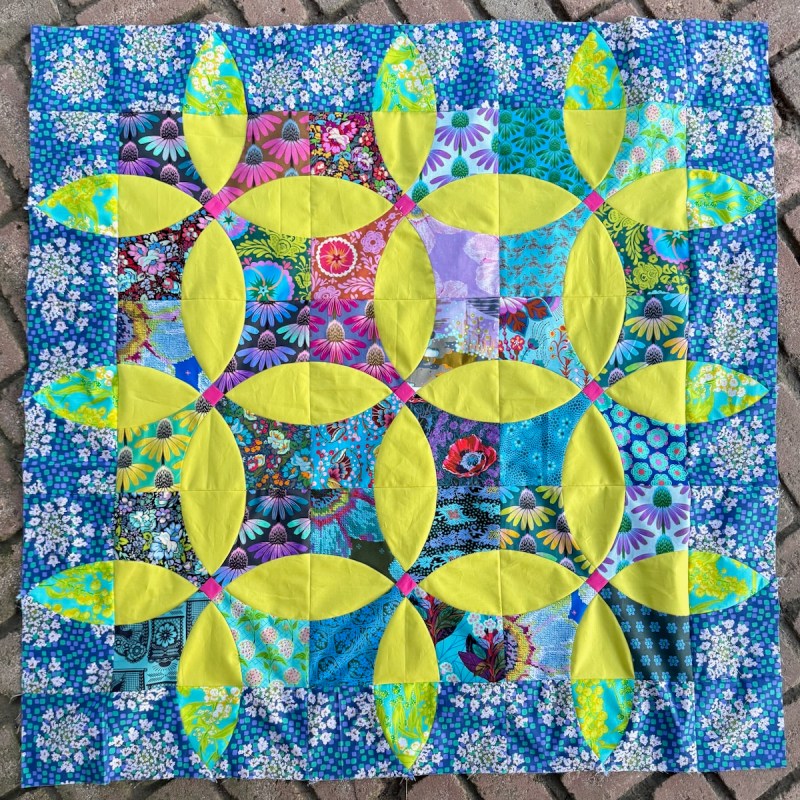
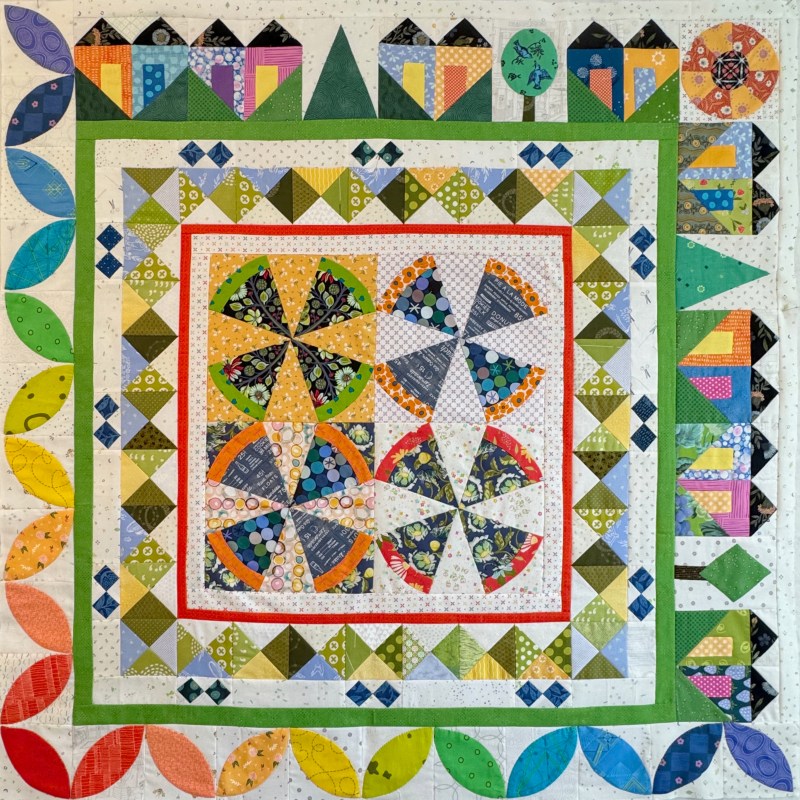
The etymology of the Economy Block is — as are many popular quilt blocks — complicated. According to Barbara Brackman’s Encyclopedia of Pieced Quilt Patterns, it’s titled Economy Patch by Carrie Hall and Rose Kretsinger around 1935. It’s also called the This and That block, in the Kansas City Star around 1944 (you know this is a favorite phrase). And more recently, it’s been known as the Thrift Block as when Taryn of ReproQuiltLover hosted the recent #scrappymeetsthriftchallenge. I have mentioned before that this year I had been making things that helped me make things: quilt-a-longs, Block of the Month, group projects, and so forth. And so this one joined the line-up, and I finished it this week.

I needed a title for this quilt, and since in early 2020 I had taught it to a small beginning quilt group as the Economy Block, so I went with that name (although many now call it Square in a Square).

Full quilt title: Economy: Gathering Up All The Fragments.

Economy, as we think about it, means thrift. Saving. Making do with less. The exchange of goods. A dollar is worth something and everything is for sale (as the old saying goes). But the idea of economy, says one wag, is really an enigmata**:

  • Enigmata refers to things that are puzzling, mysterious, or riddles
  • OR, a puzzling or inexplicable occurrence or situation
  • OR, a person of puzzling or contradictory character.
  • OR, a saying, picture, etc., containing a hidden meaning; riddle.

The title of this quilt comes from yet another riddle: the poet Emily Dickinson’s punctuation and shape of her small poems. Some think it began with this:

“‘Preserve the backs of old letters to write upon,’” wrote Lydia Maria Child in The Frugal Housewife, a book Dickinson’s father obtained for her mother when Emily was born. It opens: “‘The true economy of housekeeping is simply the art of gathering up all the fragments, so that nothing be lost. I mean fragments of time as well as materials.’” (from a review by Jen Bervin, titled Studies in Scale).

On one of her envelopes, Dickinson wrote: “Excuse | Emily and | her Atoms | The North | Star is | of small | fabric | but it | implies | much | presides | yet” (fragment A 636 /636a).

Like a star is small…but it is its own world.
Or an atom is small… but contains worlds.
Or fragments of fabrics are small…but put them together and they make a quilt.

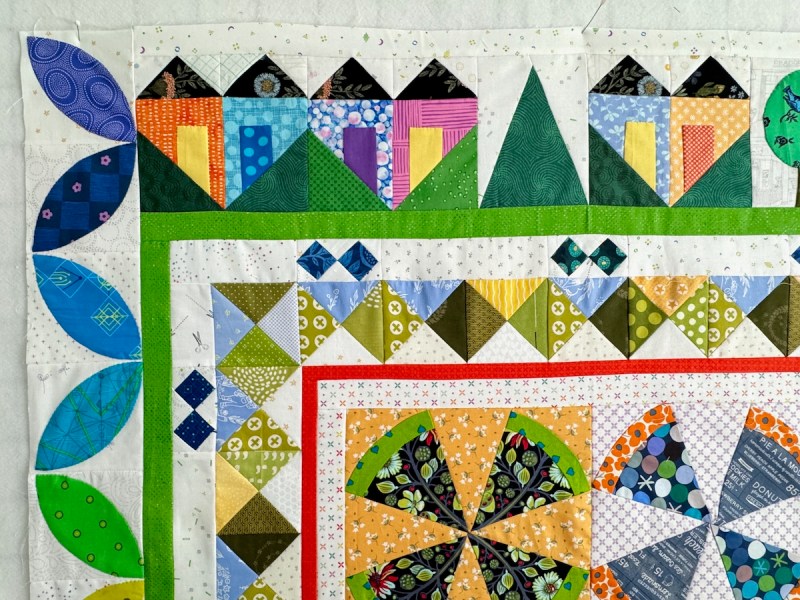
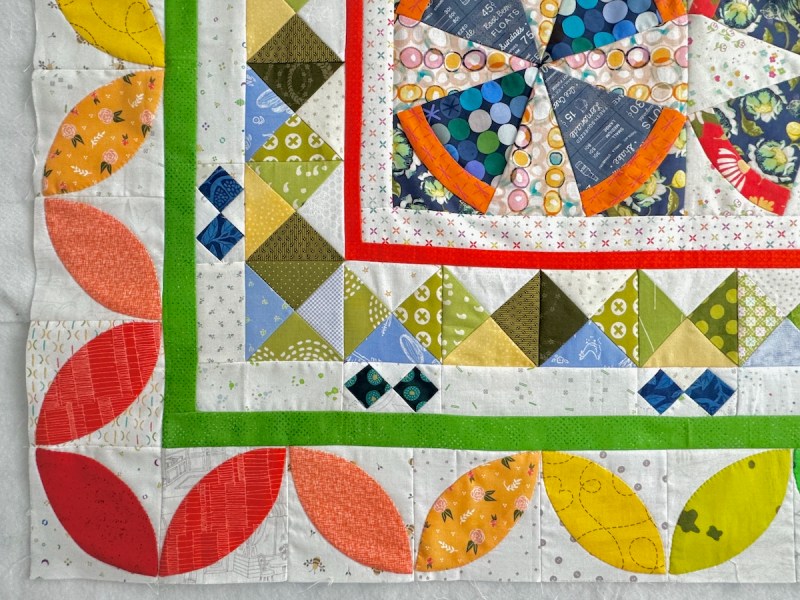
In pulling fragments for this quilt, I opened bag after bag of small scraps from a decade ago, cut into 2 1/2″ squares or 3″ squares, as it had been recommended to me to do that in order to “use up your scraps.” Finally, I was using them up, so this quilt is as much a record of an era, as it is a complication of “gathering up all the fragments.”

Backing/binding is fabric from Tula Pink, and the quilting is the Continuous Baptist Fan, by Urban Elementz.

Quilt-making is an enigmata, isn’t it? We take our scraps, our fragments, cut them smaller, sew them back together to make something that expresses an idea or a sentiment. And we quilters do it over and over, saving scraps, repeating the process “so that nothing be lost.”

This is Quilt #312, and the last for 2025, as there are no more fragments of time to add to the calendar. I will, however, try to get up another post or two of the beautiful Carrefour quilts, but no promises.

I do promise, however, to make merry the rest of the month and be of good cheer!

Other Posts about this quilt and its process

The Economy Block was in the series First Monday Sew-days, which has morphed to the title Beginning Quilters. There are a raft of free handouts here.

A Life Full of Yes (which includes the free pattern for this quilt block)

If I Do This, Can I Do That?

This and That • August 2025 (and a rant about AI)

This and That • November 2025

NOTE: I put the quilt label on the side, as it doesn’t matter which is the top or which is the bottom. It’s really a great size for naps: 60″ x 72.” I use BlockBase+, which is basically Brackman’s book, but in digital form. I also have her book in paper form, too. I’ve been thinking a lot about my quilt tools, such as the software and book, so will try to note them here on the blog as they’ve been used.

**Apologies to Honkai: Star Rail fans, who see Enigmata as something a bit different. And there is more on Enigmata writings by ancient figures, if you are curious.

300 and Beyond · Patterns by Elizabeth of OPQuilt · Quilt Finish · Quilts · Something to Think About

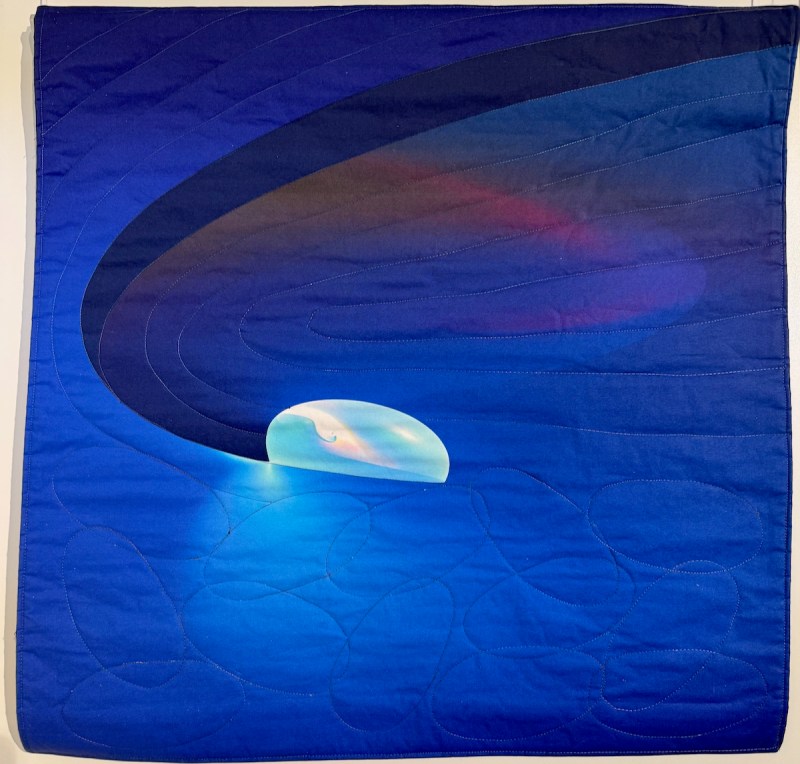
Quilt Finish: Orange Sprite Phenomenon

The Blue and Cheddar quilt is finished, bound, and sent off to the recipient. If it were to have a name and a label, I would call it this:

This is Quilt #311 in my Quilt Index.

I titled it this because of a celestial event. A rare celestial event.

This is called a red sprite phenomenon, when when lightning flashes above thunderstorms, creating a spikey flash of red light high in the sky. By using cheddar and deep blue, the quilt pays tribute to this transient luminous event: an orange sprite phenomenon. (photo) You can read more about it in this gifted article from the New York Times.

Hawthorne Supply Company was having a sale on Kaufman’s navy blue flannel. I ordered two packs for the back, washed them up. They are so thick and yummy, they are almost like chamois. My quilter, Nancy, did an awesome job on the quilting, with the pattern Diagonal Plaid Bias Cut from Urban Elementz. We used a copper MicroQuilter thread (Superior Threads) on the front and a coordinating thread on the back.

Our wisteria was dropping leaves this week, so here’s the requisite “fall” shot from Southern California. The blue fabrics are just ones I had in the stash, a full spectrum of rich, deep colors. Every so often, I feel like a label would interrupt the quilt back, and not that important (no lectures, please), so I leave it off. This happens like (wait for it) once in a blue moon.

I have long been fascinated by celestial events.

We’ve attended an annular eclipse, a solar eclipse, and a recent total solar eclipse.

When I was first married to my husband, we took our children up and stayed at his parents’ house for a week; one night was a star shower. I spread out a quilt on the grass in the backyard and watched the shooting stars. Since we were pretty much newlyweds (he married me and my four children, saving us all), I wonder what his parents and family thought. But he came and joined me on the grass, on the quilt, and we star-gazed together.

I was fascinated by what Jonny Thomson said this week on his Instagram account about the Korean idea of in-yun. It is not the first time I’ve run across this philosophy, and he described it well:

Imagine you pass somebody in the park and say, you nod, you smile, and you go back to your life. Then, a few days later, you notice the same person behind you in the supermarket. According to the Korean idea of in-yun, something important is happening here. In-yun means fate, but it really means the fate between people and relationships….[E]ssentially, it says that if you see a stranger more than once, it is not just a coincidence. That is the universe trying to tell you something. It is trying to say that here is someone important, they have something to teach you.

The French philosopher Gabriel Marcel argued that we should live our lives in a state of disponibilité, which means that we are ready to be at the disposal of the world.** If you stop seeing events as irrelevant accidents, but as messages, then you start to see the world as an opportunity. If you live your life ready to be helped, and ready to be changed, you will be. In-yun is the philosophical version of the crossing paths theory. It says that if somebody comes into your life, it is for a reason. If something keeps happening to you again, and again, and again, the universe is telling you that there is something to learn.

I’ve had more than a few things that have taught me to stay curious, to live in a state of disponibilité (or availability, as I understand it). Quilting, and the constant rate of discovery that happens in any quilt — from choice of fabrics, to colors, to inspiration — seems to match that idea for me, and I enjoy diving into a new project, and I enjoy finishing up. I also enjoy the quilters I meet, the quilters who teach me, my correspondence with all of you who read my blog, learning from every writer.

And so when my desire to rework my Azulejos pattern kept coming back around, and then I read about red sprites…well, that connection propelled me to this place. I hope the person who receives this gift will enjoy it as much as I enjoyed making it. I had fond thoughts of him (my son-in-law) as I worked on it.

UPDATE: He likes it!!

Stay curious, everyone–

**Availability of mind, thought; state of availability, according to this French dictionary page, which I asked Google to translate into English.

Yes, I once did make, not one eclipse quilt, but two!

And an artsy eclipse quilt:

Carrefour Quilt Show · European Patchwork Meeting · Quilts

Carrefour III: SAQA, Aotearoa Quilters, Libs Elliot, Esther Delgado, Caroline Simm, and the OZQuilt Network

This post covers:

• Venue 6: Espace des Tisserands, with OZQuilt Network, Libs Elliot, Caroline Simm, Esther Delgado, and the Aotearoa Quilters

I have a main Carrefour Quilt Show page that lists all the posts of all the meetings I’ve gone to, and includes the posts from this year too.

This exhibit place, call the Espace des Tisserands, is sort of like your town’s gym and event center, all in one. In the following photos, you’ll see some of the basketball hoops (drawn up) as well as all the partitions that Carrefour brought in to subdivide the large space. At the front door, they sold us booklets, stickers, and it was where we could pick up our tickets. Because I had done some writing for the Carrefour European Patchwork Blog, they had two wristband passes waiting for my husband and I, and I am grateful for Carrefour for providing these for me.

If you haven’t figure out yet what this is all about, every year in a small town in the Val D’Argent (Silver Valley), the Carrefour Patchwork Show is spread out over several small towns, and exhibit in event centers, churches, and other places. Plan now for September 17-20, 2026!

SAQA (Studio Art Quilt Associates) had a large area in Espace Tissurands. They also had companion interviews on Textile Talks with three of the artists who exhibited in France, and it’s worth a look to get the background on their work, and especially the giant blue lobster.

So much texture and that beautiful blue color, and I loved this piece for how interesting and surprising it was.

I’m showing these in random order; not all of the exhibit will be shown.

Once in a Blue Moon, by Lorraine Woodruff-Long, was “made entirely from repurposed men’s blue shirting.” First she made a giant Log Cabin block, then she cut it up and re-arranged it, while taking the Biscotti Quilt workshop with Brandon Wulff.

Indigo and the Murex: I lightened this as much as I could, but not so much you might miss the intense saturation of three kinds of indigo blue dye: (on the left) Isatis is European woad, and on the right, the stroblianthes curia hails from Asia. In the center, the Murex branders seashell is from the Mediterranean sea, and the artist, Carol Anne Grotrian, writes on her title card that the dye from this animal has a similar chemistry and is nearly identical molecule to the indigo plants.

Urban Grafiti, by Alison Charlton

(Note: photographs were taken by both my husband and I.)

MiJoo Jin, from South Korea; The Bond of Blue Flowers.

(Click to enlarge photos.)

Love You x2, by Joanna Ellis. Unfortunately, the title card photo was so blurry it’s difficult to read (the hazard of a quilt show!), but the artist does mention the Celtic knot, quilted into the center, which symbolizes a love that never ends–in this case, between a grandson and his grandfather.

I loved the shibori technique, coupled with the small one-inch hexagons. The smaller folded hexagons attached here and there bring to life the idea she writes about: “Blue as an emotion is always changing.”

Another creature! And so many blues and so many textures, not only in the Blue-Headed Tree Agama, but also in the quilting in the background..

Last one in the blue series for this post.

The SAQA blue quilts were sort of over in the far upper left of this building.

This is what greeted us when we came in: this triptych of folded and hanging quilts.

Esther Pico had quite a few quilts, and this is the title card from the one in the center of this group (unfortunately, no photos of the other title cards).

Turning to my right, I see this quilt, of the artist (maybe?) peeking out between the leaves of her plant.

And then just beyond the shy woman with the plant, was this burst of floral energy! We took more than a few photos:

This is how it looked most of the time: a place to gather with friends and to study and look at all those blossoms!

This is a piece from Linda Steele who belongs to the Ozquilt Network (OZQN), an Australian organization for art quilters and those interested in art quilts (from the catalogue). Tropicana is the title, and she writes: “I happened to be at a bird sanctuary at feeding time, and I was delighted to have birds flying all around me.” It’s not a huge piece, and I realize that this time many of the quilts did not have their dimensions listed, so it makes it hard to visualize the relative sizes (sorry).

This is also a smaller piece. It’s by Dianne Firth (also with OZQN) and is titled Evening. It was done with torn-strip appliqué, machine stitching and quilting. She writes: “Each evening the sky takes on a different characters. Sometimes it is clear and serene while at other times it takes on a brilliant display of red and orange.”

Julie Haddrick makes a keen (and startling) observation about the different mammals that are now gone.

Below is a collection of quilts by Caroline Simm, who lives in Western Australia, and who has been quilting for over two decades. She likes to use mixed media, art quilting, and collage.

This was a larger quilt, with complex construction and collage.

(Click in order to enlarge to read details.)

A design by Ruth deVos, who also has her own exhibit here!

Sammy. He was the mascot of the show, as shown by the T-shirts below. Details are in Simm’s IG post.

Click to see how Simm layers in different fabrics to bring out the texture in Sammy’s beard.

A trio of smaller quilts, now, of the wildlife in Australia and also by Caroline Simm.

In the far right, in the corner of the Espace des Tissurands, was a small exhibit with quilts by Libs Elliott. She was not there when we visited (probably teaching or speaking).

Are you still with me? Now some quilts from the Aotearoa Quilters, and as a treat, they gave me one of their giveaway pens (I’m big on souvenir pens). This organization is the only quilting group in New Zealand, “that operates at a national level. The principal objective of Aotearoa Quilters is to promote the art and craft of patchwork and quilting within New Zealand” (from the catalogue).

You could almost reach out and pet this cat.

Arden’s piece was a favorite of mine, with the different materials and that fabulous binding.

Organized Chaos, by Sheryl Madigan.

I love all the “hidden” piecing in here, in the background, in the figures, in the halo. So many interesting parts to study.

Oh, I want to meet this bird!

Here are two quilts constructed in the same way: with parts made by several quilters, and a band of pieced fabric at the top.

I love how I could learn about this area of New Zealand, just from studying the images.

While this quilt had the pieced bands at the top, it was not made in strips. It was, however, made by a group of quilters.

And now one that really caught my eye, to close out this post. I know this post was long, but there was a lot in this exhibit building, and I liked that it was all grouped together. So I kept it that way in writing it up.

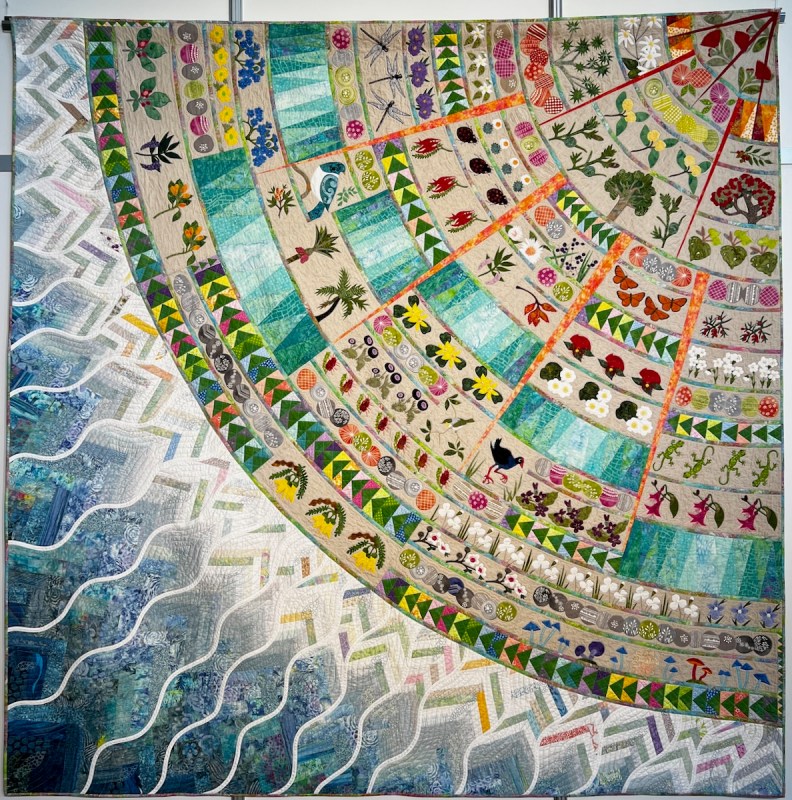
Chris McDonald: My Little Corner of the World

She writes: “My Little Corner of the World refers to New Zealand’s location in the South Pacific Region. My quilt represents both land and sea. The flora and fauna which are featured are all native to NZ and are but a tiny number of the interesting species found here. Inspired by the Japanese quilter Harumi Asada.”

It was pieced, appliquéd, embroidered, and used the quilt-as-you-go method. Here are some more photos:

Thank you for reading about these quilts. It was a lot to take in, but so much beautiful work. I’m turning the comments off on this post, as it came on the heels of the other one. You can always reach me by leaving a comment on any post; I’ll see it.

Carrefour Quilt Show · European Patchwork Meeting · Quilts

Carrefour II: Lois Parish Evans, Ina Statescu, AFHAM, and ValPatch Quilters

This post covers:

• Venue 2: Osmont Pavillion, with Lois Parish Evans
• Venue 3: Église St. Louis, with Ina Statescu
• Venue 4: Église des Chaînes, with the French Ananbaptist and Mennonite History Society (AFHAM)
• Venue 5: Temple Réformé, with the ValPatch Quilters

I have a main Carrefour Quilt Show page that lists all the posts of all the meetings I’ve gone to, and includes the posts from this year too.

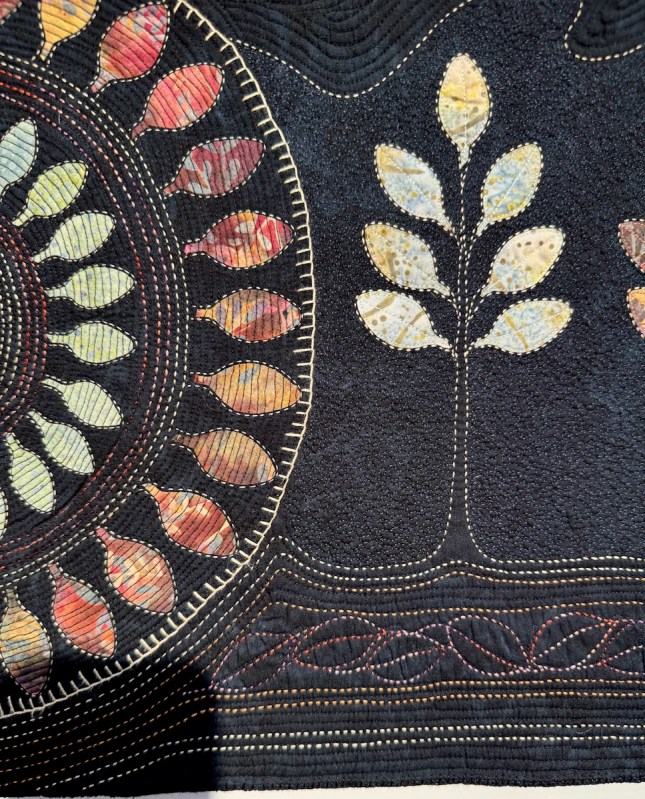
Lois Parish Evans, a quilter from New Zealand, has the skills to make a small, densely quilted piece come alive with design and stitching. I included the title cards after each piece to provide her thoughts and techniques. I also loved the way she finished the edges of some pieces: with blanket stitching, instead of traditional binding.

If you want to see further details, click to enlarge the photos.

I loved the festive colors in this mandala. And the next one is a veritable horticulture index, with all the different shapes of leaves…but still in reds and greens.

I was also intrigued by the insertion of thread lace in some of the cutouts. The title of this is Red Alert For Going Green. She writes: “We are at a critical point for going green. Using a variety of green leaves as a symbol for nature, against a red alert square and with some ‘dissappearing’ leaves, I have sought to portray the strength of the danger that our planet faces. Red alert means it is time to take action.” This was made in 2020.

Leaves? Trees? Reflections?

Reflected Light, 2022

Even though she was working in a series, the two pieces project different moods, given the colors.

I thought the use of hand-stitching completed all the machine stitching, especially that teensy meander in the background,

I fell in love with this one.

Her use of repetition, and drawing the trees in geometric shapes only enhances the feeling of being in nature.

Click to enlarge the photo on the left to see the complete mandala.

A different kind of small quilt, this time, with fabrics on a black background.

It’s easy to see that her attention to detail really elevates this work of art. I love the wafting of the breeze, the feathers on the fronds and the intricate reflections of the rock.

Her work is timeless, and intriguing. I realized that working in small scale can really open up ideas that would simply be overly repetitious if done in a large quilt (like all the stippling, or the hand stitching). It was a pleasure to meet her!

We come out of the Osmont Pavilion (Venue 2) and head up to Église St. Louis. I’m very appreciative of their good signage!

This is one of my favorite venues, with its beautiful stained glass art, in a light and bright old church. Ina Statescu, a Franco-Romanian artist, is exhibiting here. She uses a variety of shapes and materials in her artwork. Before we get to some of the smaller pieces, let me show her main work, up near the altar area.

I think my husband shot this photo (he’s taller), or maybe he did the next one. All I want to say is that he was a partner in picture-taking, throughout all of Carrefour.

Title card for Chemin de Lumière, which translates to Path of Light. Notice it took her four years for this one, and while I can’t give you complete detail (we were roped off from getting closer), here are a few detail photos:

Click to enlarge. Her technique is so interesting, with longer and varied threads and intricate embroidery.

Many of her quilts just had numbers on them, without title cards.

Please forgive the cell phone shadows. This coloring is very subtle, but exquisite.

Many years of people ascending to the choir loft bring a patina to the stairs.

Her colors are not contrasty, nor vivid, but are quieter in their intensity, such as the yellow and green pieces, above.

Saints watch over the quilts (one of the perks in exhibiting in a church, I suppose), the one above being St Therese of Lisieux. (A reader wrote to say that her brown habit is the clue.) I love the juxtaposition of the more traditional church iconography and art with the contemporary quilts.

In some ways, Statescu’s pieces remind me of Rothko, with great fields of color.

Then out we go into the sunshine (it was a fairly hot day) to head to the next location.

This church is just down the street, and holds the exhibit for the French Ananbaptist and Mennonite History Society (AFHAM), a society dedicated to the Anabaptists and Mennonites from France in honoring their heritage and past. It traditionally exhibits a large collection of traditional Amish quilts, and this year it carried on the same.

Love those red ceilings!

An exhibit at the front, with more traditional quilts. I would have loved to seen that variation on a churn dash hung up, as the subtle color shifts were fascinating.

That quilt is just made more interesting with that lower right variation. (Did they run out of cloth?)

Facing the organ loft.

To honor their Anabaptist/Mennonite heritage, at the Carrefour main building they had this buggy, with sheaves of corn.

Out the door to Venue 5, the Temple Réformé, another church. I include these photos of the town just to remind myself I’m in France, in a series of small towns and at a quilt show!

We walk down, and hang a right at this driveway.

ValPatch is a local association (the visitor’s guide says) “from the Silver Valley (Val D’Argent)” which is comprised of the the towns Sainte Marie-aux-Mines, Sainte Croix-aux-Mines, Lièpvre, and Rombach-le-Franc. Twenty friends “regularly meet up and share their passion for all textile arts. Some of the members have been quilting for over thirty years. They all have different backgrounds and experiences in the textile industry, which leads them to make pieces in a variety of styles” (from show catalogue).

I love this group, and was happy to see they were selling small items for sale. I bought this little owl and Michelline, the maker, agreed to pose for a photo for me.

Owls were their theme this year, with the focus being on autumn.

I loved seeing what the quilters in this area were making. I used to belong to a group here of about 20, but we have dwindled down to just a handful and no longer meet together. (I miss them!)
A happy, convivial group!

Now, out the door and onto the next venue which exhibits the SAQA collection, and others. It will be in the next post about Carrefour.

Hope you all had a lovely Thanksgiving, if you celebrated, and are ready to think about your end-of-year sewing and parties and gifting and surviving the holidays.

How many days until Christmas? (I don’t think I want to know!)
Michelline’s owl

I did some more decorating:
Stella di Natale is up, along with a tiny quilt (free pattern for this).