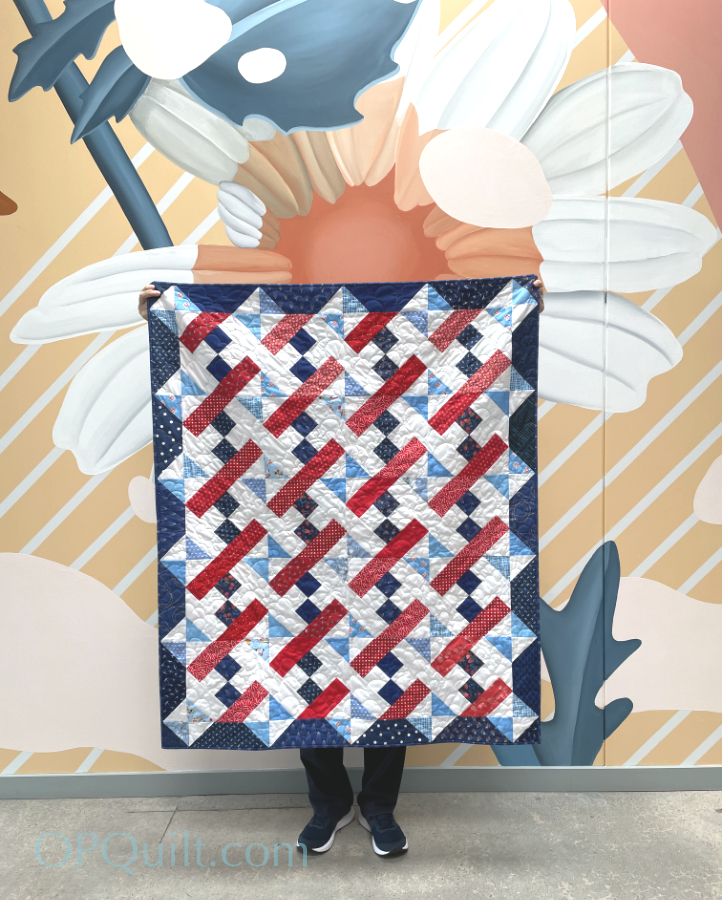
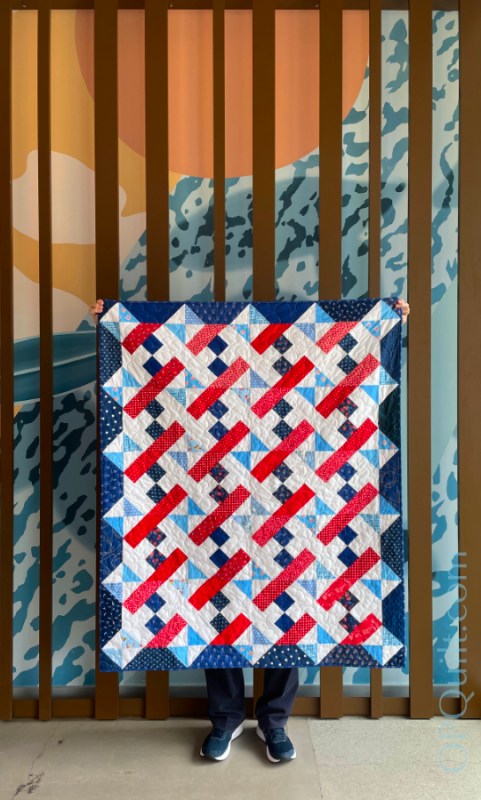
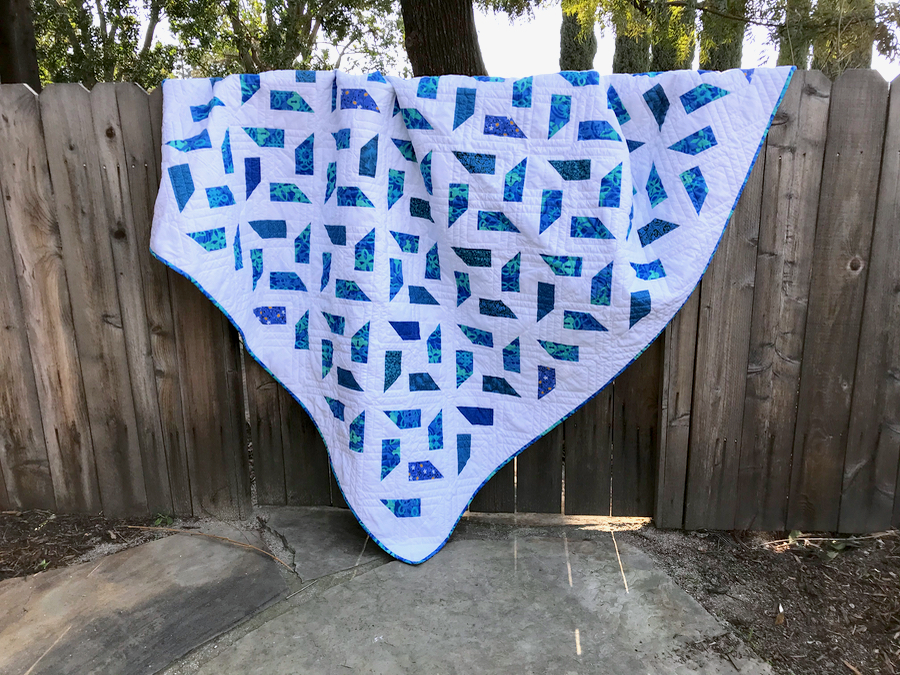
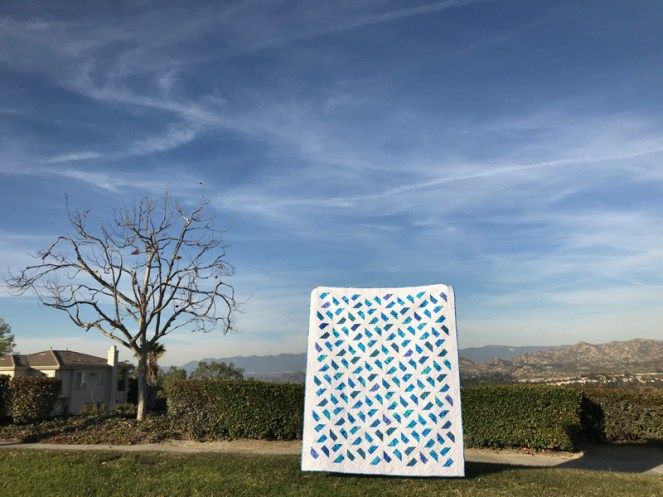
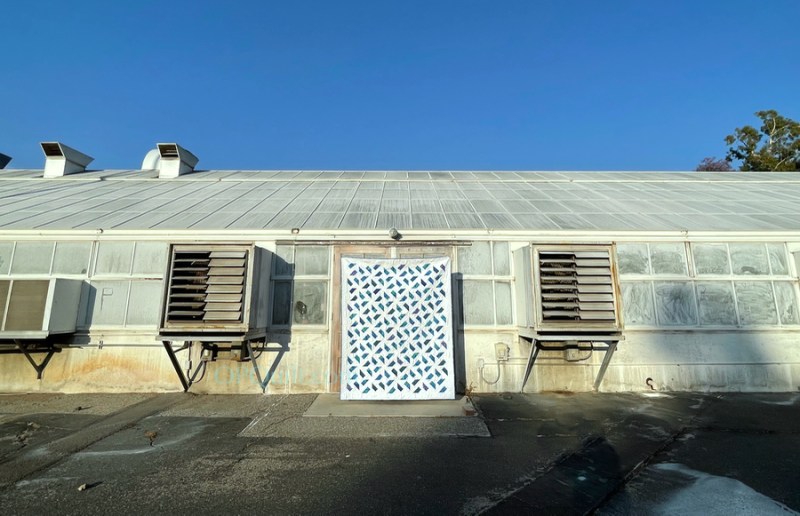
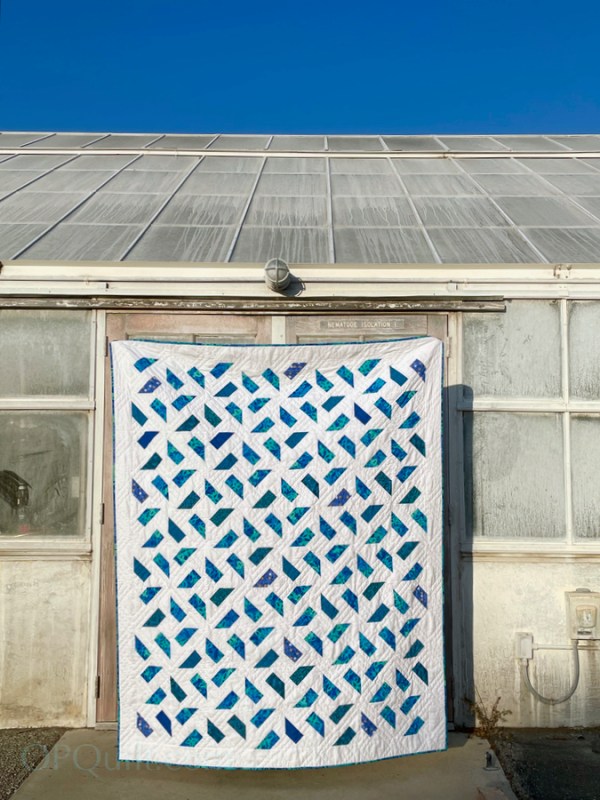
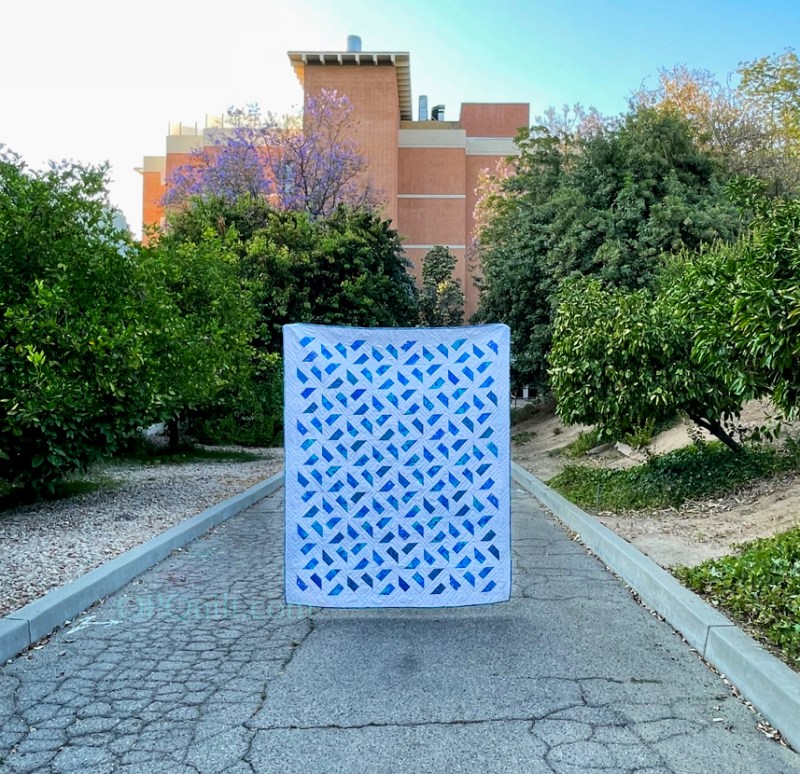
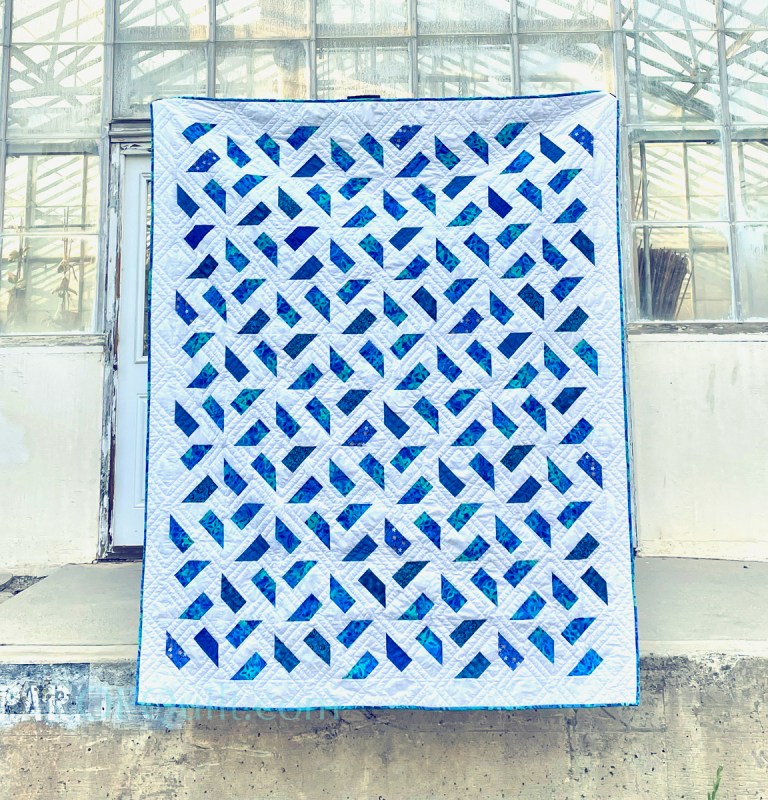
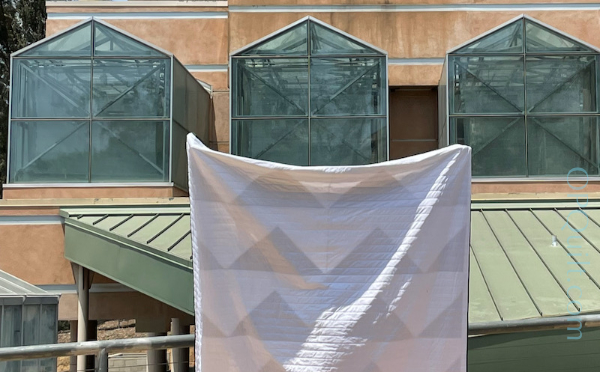
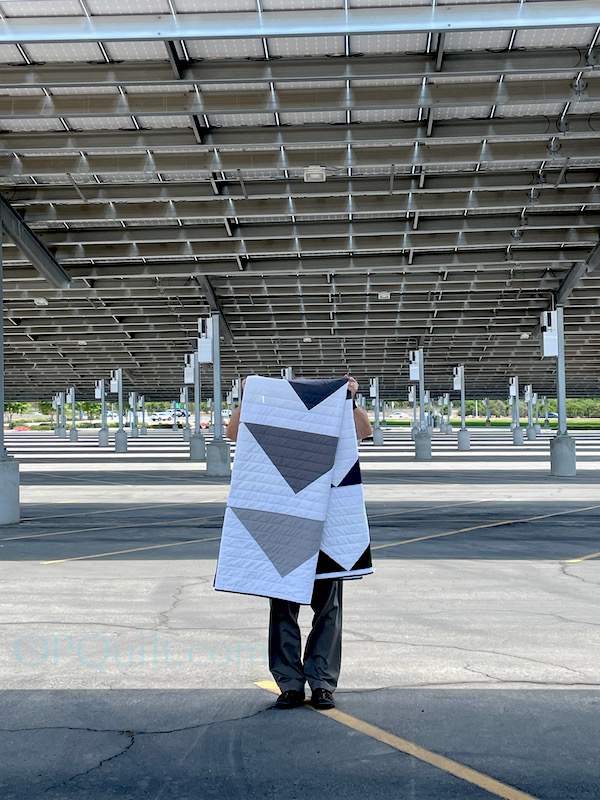
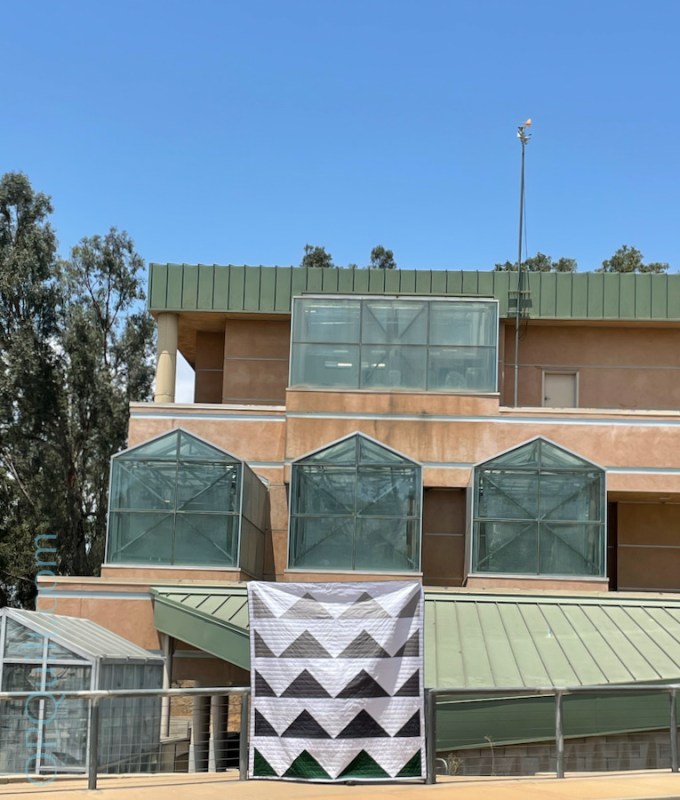
Summer Snowcone, variation of Sun and Sea Pattern Quilt #251 48″ wide x 56″ high
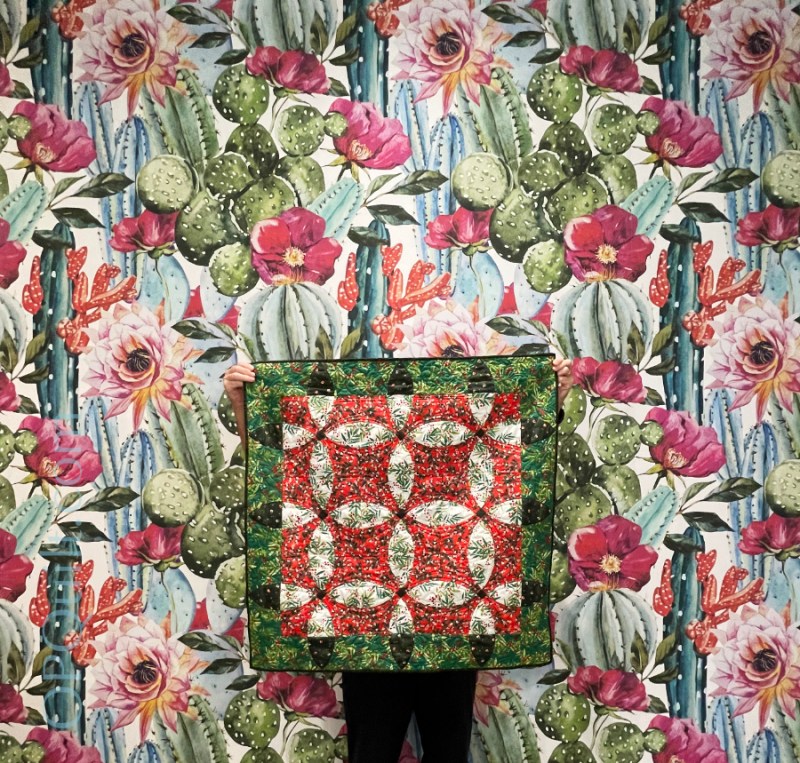
Advent, previously shown but what a cool backdrop of flowers. It was in the women’s bathroom, but I couldn’t resist. (I propped open the door and we were in and out in under 60 seconds, and no one was there.) And yes, I have the best quilt-holding husband on the planet.
The drive to meet our son for lunch was about 90 minutes, and I wanted to finish sewing down the hanging sleeve on Advent and the binding on Summer Snowcone, so we had them along. When I saw that painted hallway, I grabbed the quilts out of the car for photographs.
Photographed in the hallway at City Tacos, Sorrento Valley near San Diego. Since my son’s a working man, we drive to see him and his girlfriend. A good day out.
Website of Interest: A project to make a kimono representing every nation was recently completed. The website groups the kimono by continent, and then you can navigate to the country you want to see. Of course I went to see America, then copied and pasted the text into Google Translate.
Their caption, translated:
The image of a country consisting of 50 states called "United States" is expressed by "state flowers". Designed with the national symbol "President" as "American Eagle". Baseball, American football, Hollywood movies, and the goddess of freedom, which Americans love, are studded in the state flowers, and the great presidents Lincoln and Kennedy are represented by statues and Apollo programs.
I love that Abraham Lincoln is right up there with the “goddess of freedom (which Americans love) as well as baseball and Hollywood. When they say “goddess of freedom” I think they mean the Statue of Liberty. But so cool that they included all the state flowers.
I’m now going to go waste a lot of time thinking about how I should get more stuff done. But hey! it’s Labor Day Weekend and we honor the concept of Labor by relaxing, barbecuing and not doing anything.
Do you ever finish a quilt, but not quite finish it? Like forget the label? Or find scraps that needed to be put away from a quilt that is two years old? Or do you have tasks that still await you even as you transfer them from list to list to list? Or do you add tasks to your list of things to get done? Or do you feel like you spend so much time working off your list that you have no time to think, to create, to play, to imagine?
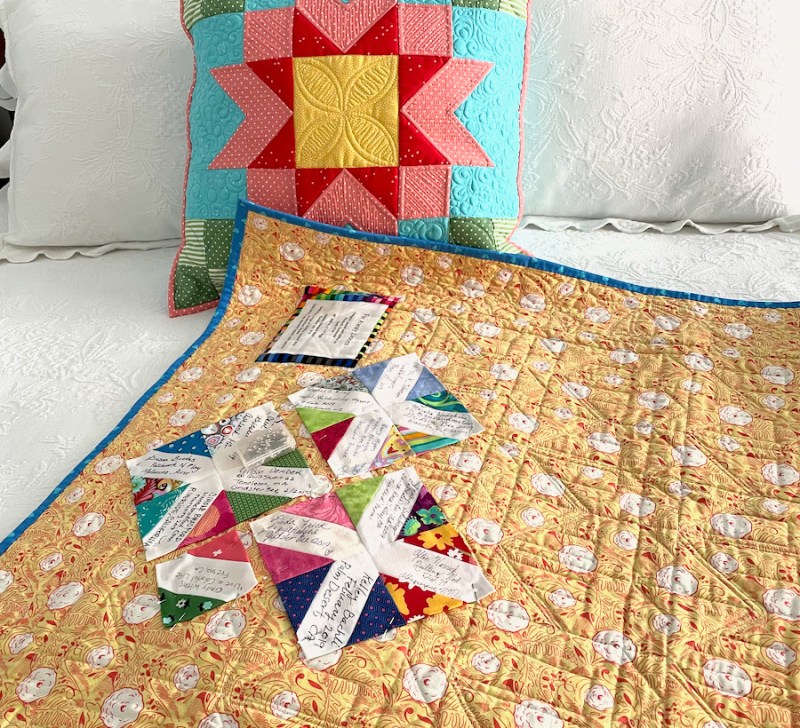
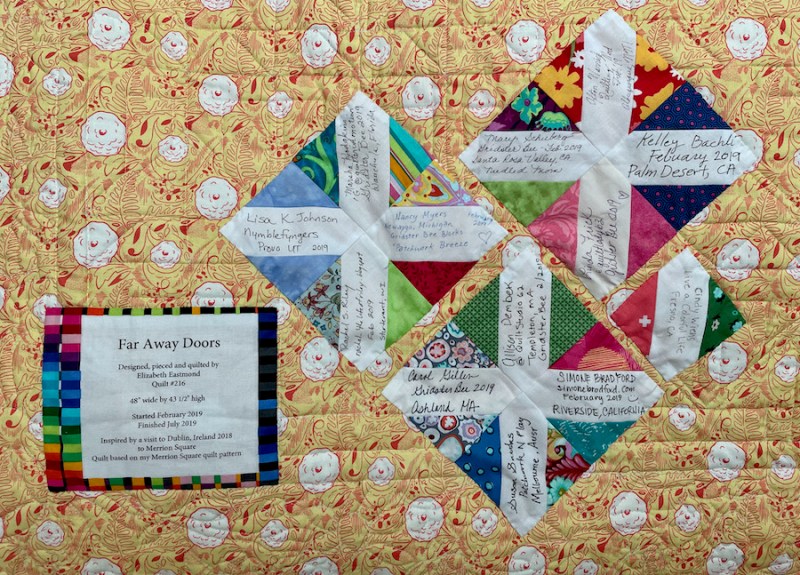
Signature Blocks: lost, then found, then lost again, and now found once more!
All of these are types of things that plague creatives, as we are known now. The list is endless, and we can keep adding to it. I was quite intrigued, then, with Mark McGuiness’s solution: a 3″ x 3″ Post-It Note. Actually, he uses two of them. On the first one — as outlined in this article from 99U — he writes one main task in the upper left corner, and then adds the rest of the day’s chores to the Post-It Note. Since it is only 3″ by 3″ it can’t get overrun. McGuiness writes: “But what about all the rest? All the phone calls, emails, and requests that come in during the day? Not to mention all the new ideas that pop into my head as I work? Good question. There’s a place for all of these things, and that place is the second Post-It on the stack, a.k.a. my to-do list for tomorrow.”
He then quotes Mark Forster, noting the idea of an “open” and “closed” list. The first Post-It Note is closed. The second one, is open.
Signature blocks sewn together, then pinned onto the back of the quilt
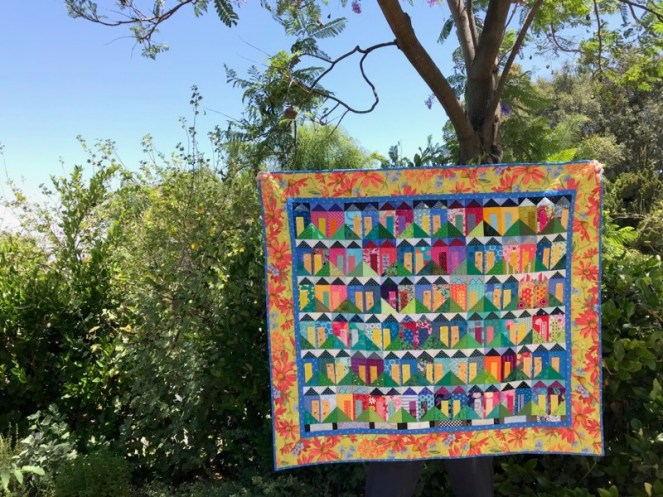
Here are some of the things I did this week that were on my list, putting together disparate parts of my life. I made this quilt with the help of the Gridster Bee, but had misplaced the signature blocks. And then when I would find the signature blocks, I couldn’t remember which quilt they went to. But we put a new shelf in our closet to hold the stack of quilts, and in the shuffling, I was able to put the two together.
I did the bulk of the little houses on the front of the quilt, but it’s fun to look at all the different houses my bee-mates and others sent to me. I often keep my quilts hanging up around my house, because I enjoy them finished.
That is something that Janet Choi might appreciate: “The simple act of pausing to reflect and acknowledge your efforts provides valuable boosts of motivation, focus, and insight that would otherwise be lost amidst your busy day.” It’s like the other side of the To Do List…it’s the Done List.
“Your done list acts as a signpost, a manifestation of all that day’s hard work. This flips an overwhelmed mindset into action mode to correct course, learn from mistakes, and ultimately make better progress” (Choi).
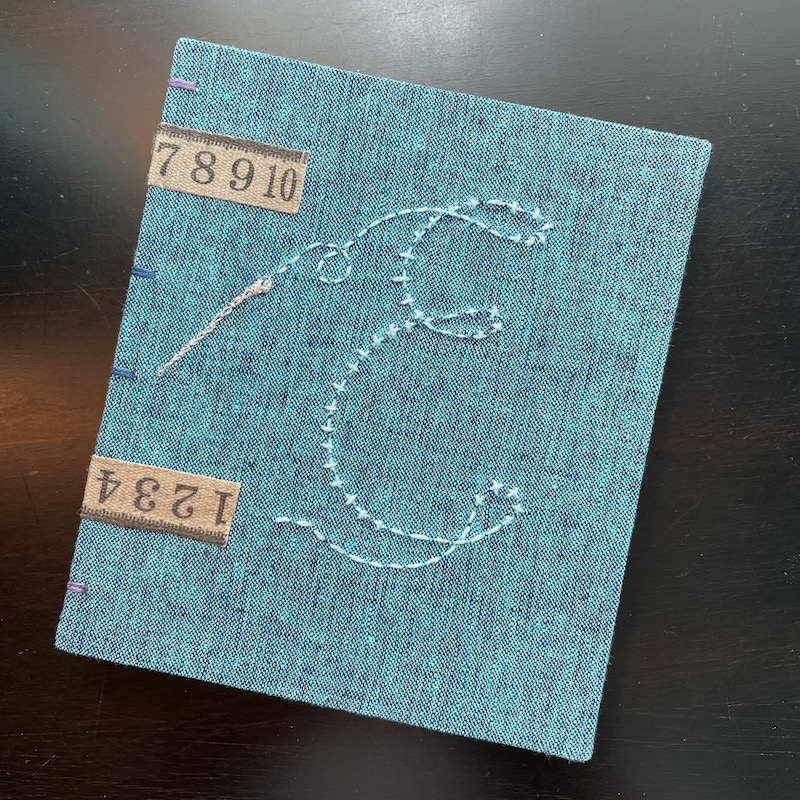
I tend to write my “Dones” at the end of the day in my journal, made for me by Amy, an artisan book maker. I was in a workshop of hers at Camp Create, and she made me this. It’s a treasure, but not only for what it is: it holds a lot of my Dones, but I also like reading backwards to find out what I thought about things a year ago, or even a month. Although I don’t write every day, I write enough that there is a general trend.
I also write my Quilt Dones up on my master Quilt Index at the top of this page, cataloging them on this blog, and then listing them one by one. I know several of you have started a Quilt Index of your own, judging by my emails.
Choi says to count our smaller wins, too: “Don’t wait until you’ve hit big goals like completing a project or getting a promotion — which happen only occasionally and make it difficult to appreciate small but important advancements. Don’t dismiss all the smaller things that fill out your days and are building up in the long run.”
Which brings me to this: the little rotary cutter in the illustration above. I was making images for my new workshop, Blossom, and I always like to have a visual header as to what is going on in the paragraph where it links to the instructional video, and gives tips. I had the scissors in my digital image file, but when I went hunting for a rotary cutter, I thought: I could make my own. So I did. I have the how-to’s below for those of you who are so inclined (including a video!), but for the rest of you, I leave you with this: I hope you will now not only consider not only a To-Do List, but also a Done List. Isn’t that why we started quilting in the first place? To have things stay done?
Happy Quilting!
How to Make a Digital Rotary Cutter in Affinity Designer, by a Verified Amateur.
Start the program. Open an artboard. If that already feels like a foreign language, an artboard is basically just a big scratch pad. I can open multiple artboards in one file and save them all under one name. So I can have a scratchpad for rotary cutter, a scratchpad for a quilt block, etc.
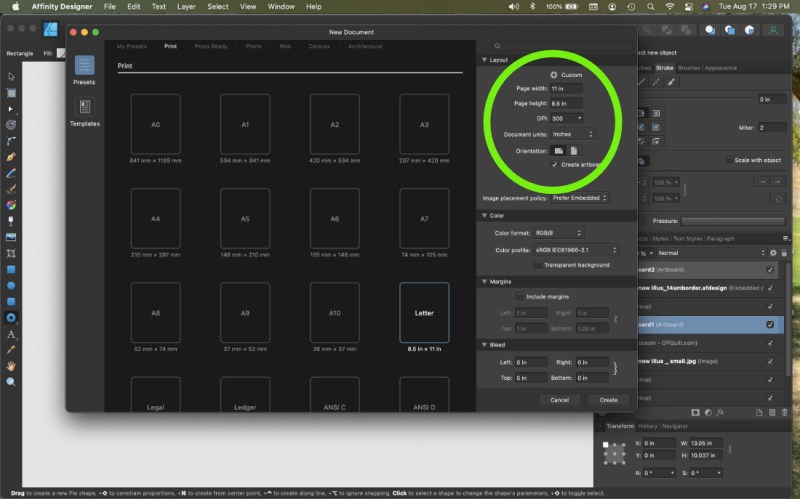
Open Affinity Designer, click on “New.” A screen will show up with lots of sizes to choose from. I usually go with 9 x 11 as I can always resize it, but it fits on my laptop screen neatly. I choose “inches” not pixels from the set-up screen and I like mine sideways, so I click on Landscape. Don’t forget to click “Create Artboard.”
3. And then I realized I would be writing a book, so instead, I made a video.
And then I uploaded the video to YouTube, where you can watch it. (And I do not know why the full-screen version is blurry. Working on that.)
It runs about six minutes, if you have that much time. Of course, it took me three Google searches to figure out how to record from screen (pretty nifty, once you learn it), then I uploaded into iMovie so I could cut off the end where I keep saying, “How do I stop recording this?” over and over all the while critiquing my voice. I then uploaded titles on the front and back and even a little Title Card saying Thank You For Watching. Yes, sirree. I’m a rank amateur trying to act professional.
But there you go. Obviously I should have majored in graphic design in college, but that was some years ago when it was Photoshop Version 1.0. (Now, I’ve left Adobe behind and moved over to Affinity where there are NO monthly subscription fees. I’m just saying.)
Illustration from Newest Project…coming in October
I’m most excited about how Affinity Designer now has a gazadget that will let me automatically draw quarter-inch seam allowances around any shape I make (called a Contour Tool). So, so happy with this!
There’s this interesting explanation in a Wrinkle in Time, or at least I remember it and hope it’s there, where the main character tries to help the children understand this concept of a shortcut in time, and she demonstrates it with a string and a crawling ant. Or maybe that’s not in the book at all, and I just remember if from somewhere, but at any rate, the point is that I’ve had a wrinkle in time with this quilt.
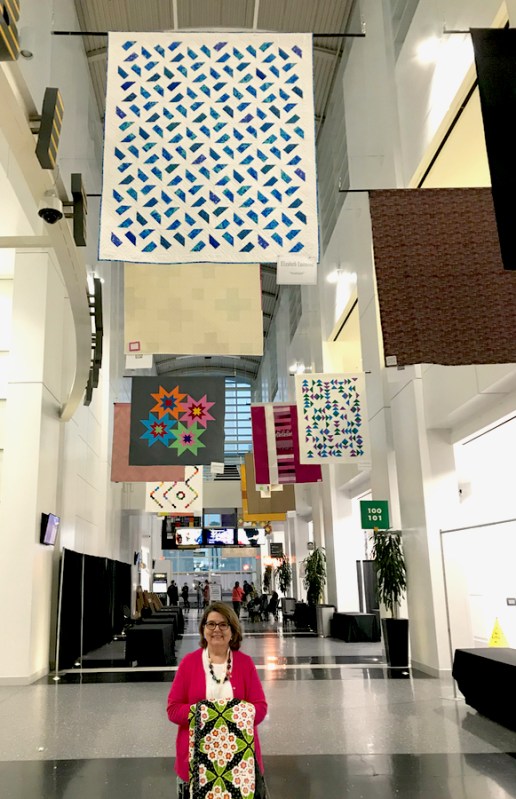
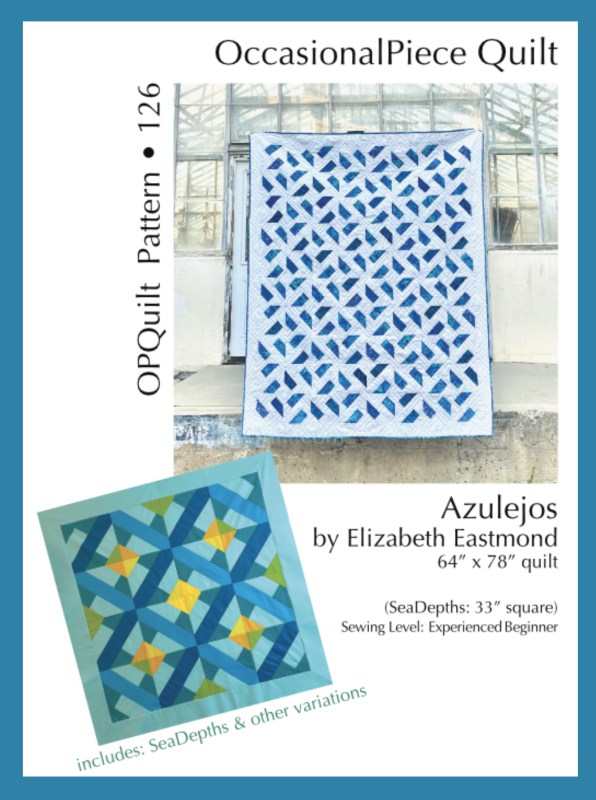
This photo was taken in January 2020 at the end of Road to California, where my quilt Azulejos hung in a special exhibit at Road to California. It was this one that recently prompted Catherine H, a reader, to get in touch with me asking for the pattern. I’d made several stabs at it, but now I really buckled down to writing. So there’s the shortcut — a bridging of time from January 2020 to July 2022 — a shortcut not unlike those found in novels with children (and where were their mothers??) and IKEA warehouses, where you are trying to get out of there and pay for all your impulse purchases, and yet you still have to go through chairs and desks and lighting and rugs…unless you can find the shortcut.
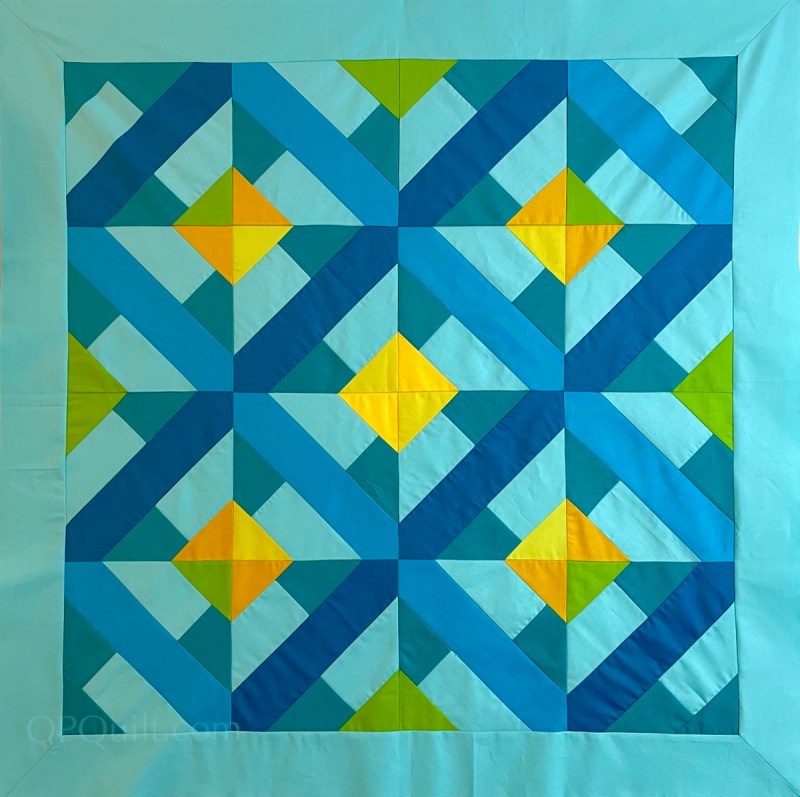
I had some other ideas about what this pattern could do though, so got busy and made this blue/yellow/aqua/sea/glints of sun wallhanging, calling it SeaDepths. I had fun making it in solids:
It’s still a flimsy, though. Looking forward to sandwiching it together and getting to the quilting.
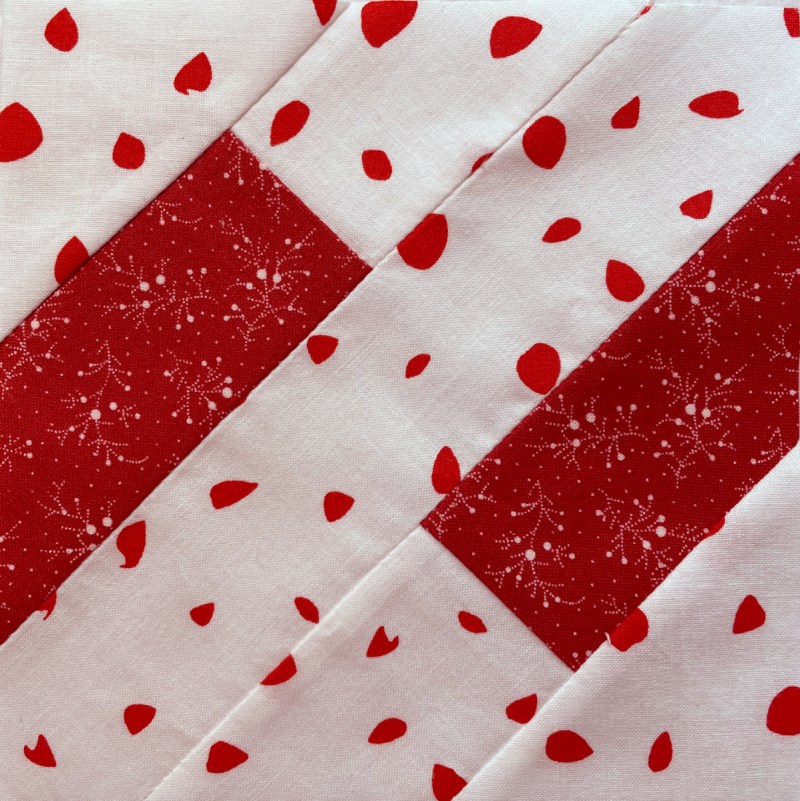
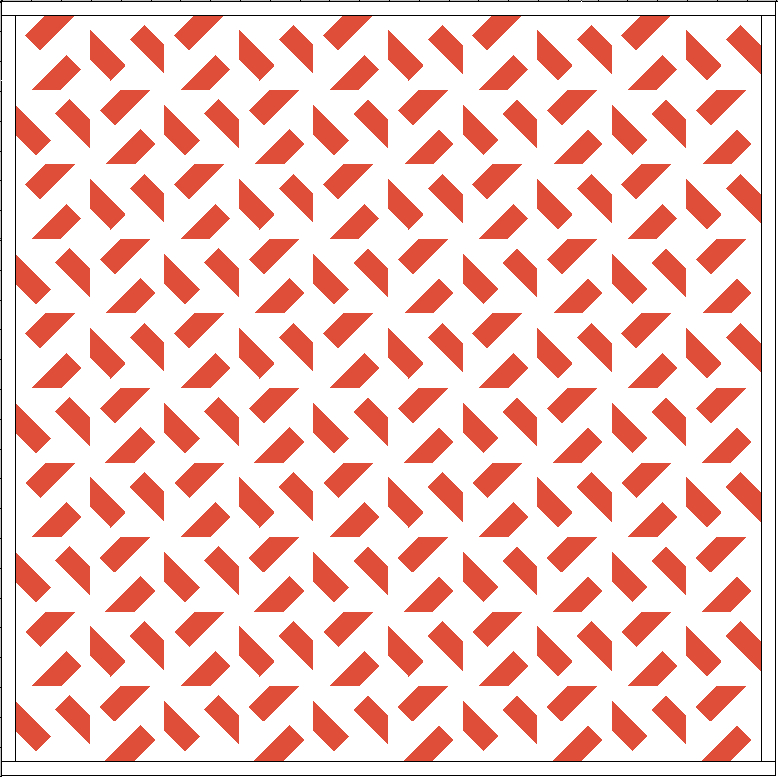
This block was supposed to be another version of the pattern, done up in scrappy red-and-white, like this sketch shows:
But, alas, the sprained ankle/broken bone/cast-or-boot-or-what problem persisted, so instead of sewing up a storm at the machine (it’s a quick and easy pattern, with the cleverness in how you trim it up), I kept my foot up and edited photos of an earlier photo shoot of the first rendition of Azulejos, with photos taken near some of the old greenhouses and lab buildings for our university:
It has a basic set of instructions for the version of Azulejos above, as well as SeaDepths. I illustrate two other versions, one in Cheddar and Indigo, and the one you saw above in scrappy red/white. Or at least that’s how I evisioned it. So three sizes, three versions, two sizes of block templates and a wall-hanging. Not bad for one pattern, I’d say. A free downloadable Preview sheet on PayHip will give you the rundown.
The technical name for this shortcut between two different times is an Einstein-Rosen bridge, more colloquially known as a wormhole. Jody Foster, in her role as a scientist who hunted for “little green men” on a SETI project, famously traveled in one in the movie Contact, a film I can watch over and over again. Actually I have a whole collection of space movies, from the goofy one that got me through grad school, Galaxy Quest, to Interstellar.
Sometimes I have my own version of an Einstein-Rosen bridge when I un-earth an older project, abandoned for lack of time or interest (or both) and when I come back to it, I find it interesting or even something that juices up creative connections. When I first made Azulejos, I thought it was a one and done, as it was the shapes in the quilt that interested me. Then, taking it up two years later, I found my way to other variations and then to SeaDepths, whose colors I could get out of my mind. It was like there was a wormhole between those two variations.
I’m always surprised when a creative journey takes these kinds of twists and turns. It usually happens when I try to box something in, with a dismissive, “Oh, I know all about that,” with a sniff and a tilt of the head. To counter this attitude of immediately sizing something up prematurely, Xavier Encinas noted that “If there is something I’m learning over the years it is this: Take your time while setting up your ideas and take time to distance yourself from what you have done.” So maybe completing this pattern, finding the missing link to getting it done took some distance.
The year 1666 was the first recorded use of the word “minimal.” That was also the year, according to the Merriam-Webster Time Traveller feature, where the word “pandemic” was first turned up.
I looked it up because I was thinking about Minimalism — a word that showed up much later, in 1926 (the same year as estrogen, garlic salt, preemie and trick-or-treat) — and is defined as a style or technique (as in music, literature, or design) that is characterized by extreme spareness and simplicity.
[And speaking of words, did you know that “fewtrils” was one of the words in the final rounds of the recent Spelling Bee? It means things of little value and first showed up in 1750, the same year as frosting, steering wheel and unimportant. I totally have to use fewtrils again.] I digress, but be warned, I have the Spelling Bee on my mind today.
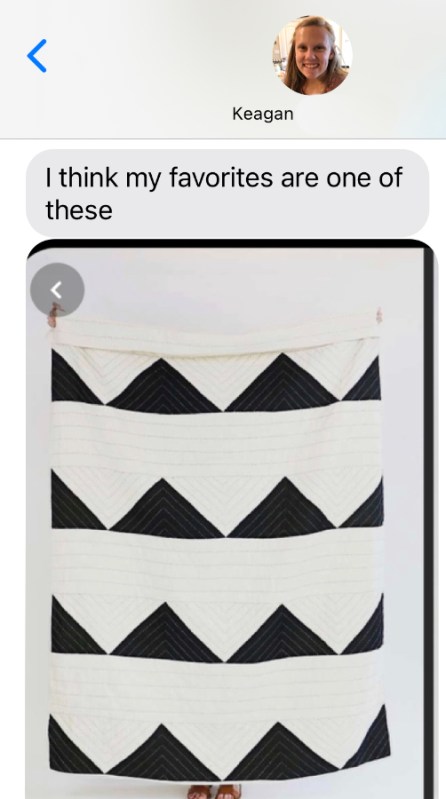
Modern quilters seem to love this style. Gimme a bunch of squares, a field of white and we are in business. So I was surprised to note that my granddaughter Keagan was also a lover of minimalism, when she asked me to make her a quilt for her queen-sized college bed. I found out from her mother that Keagan is also an avid follower of a famous trendy store, so I wasn’t too surprised when, as we began to trade photos of possible quilts, that this one showed up. I tracked the origins of this one using Google Photo search, and sure enough–it’s listed in that famous trendy store, is made in India, and is hand-stitched. We are all familiar with these quilts.
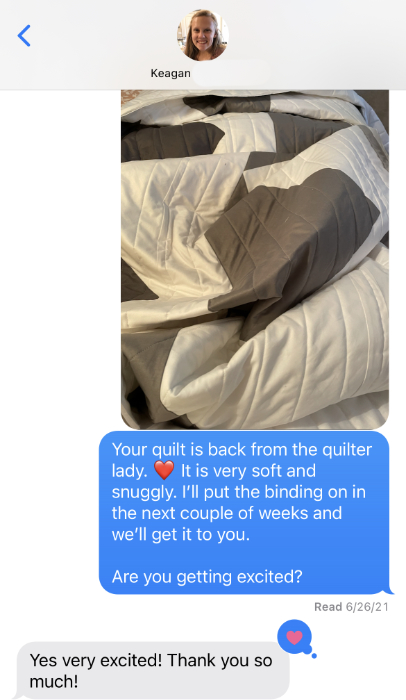
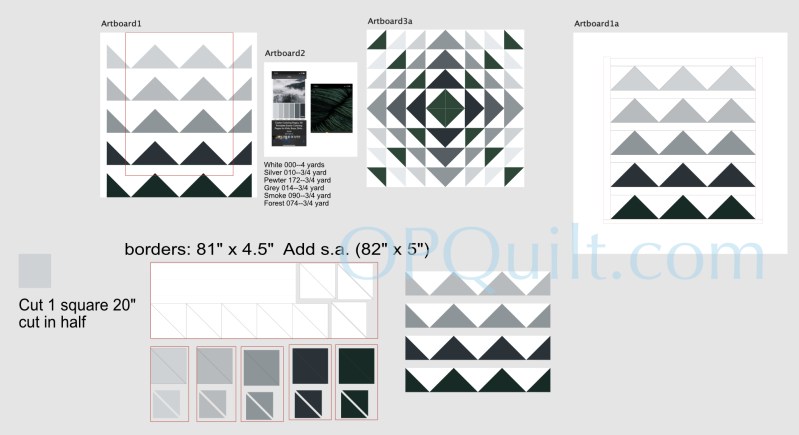
Keagan’s only requirement besides: minimalistic, gray with touches of forest green, and queen-sized, was “snuggly.” I sent the completed quilt top, with some cotton-wool batting (pre-washed) to Wolf Girl Quilts, and she sent it back a couple of days ago, all finished.
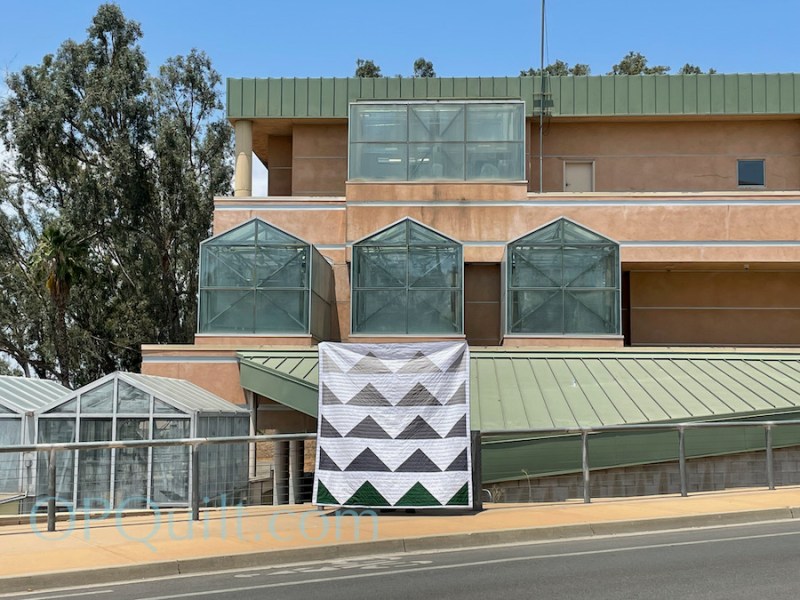
Since breaking my ankle, I’ve had a few more hours of down-time, and since my past self was very kind to my future self, I had the binding all cut out and ready to go. So I sewed it all down yesterday: broken/sprained ankle up on a camp stool on the left, while the right foot worked the sewing machine pedal on the right. Today we took it out for photos, with Dave moving around, me gimping around (no cast on the foot, yes, the referral and call are in to ortho, I just keep it elevated except when I’m out photographing quilts).
The back is all white: Painter’s Palette Solids. I ordered a whole bolt of that stuff.
We usually use a contraption of two clamps held out on sticks, but the sticks broke, so the quilt is in the washer (we kept meaning to put on sturdier sticks…). I’ll press it lightly, wrap it up and mail it off to one of my two granddaughters headed for college this year!
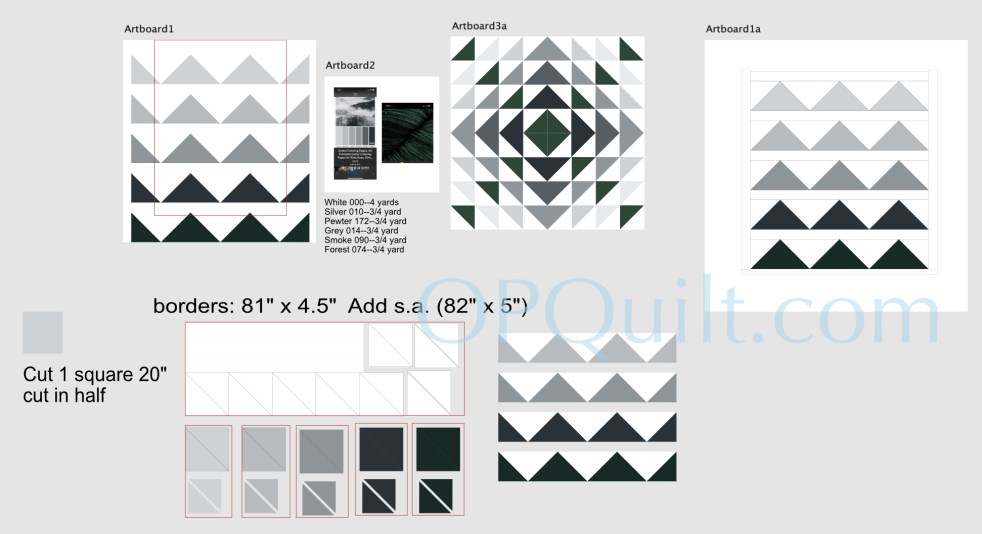
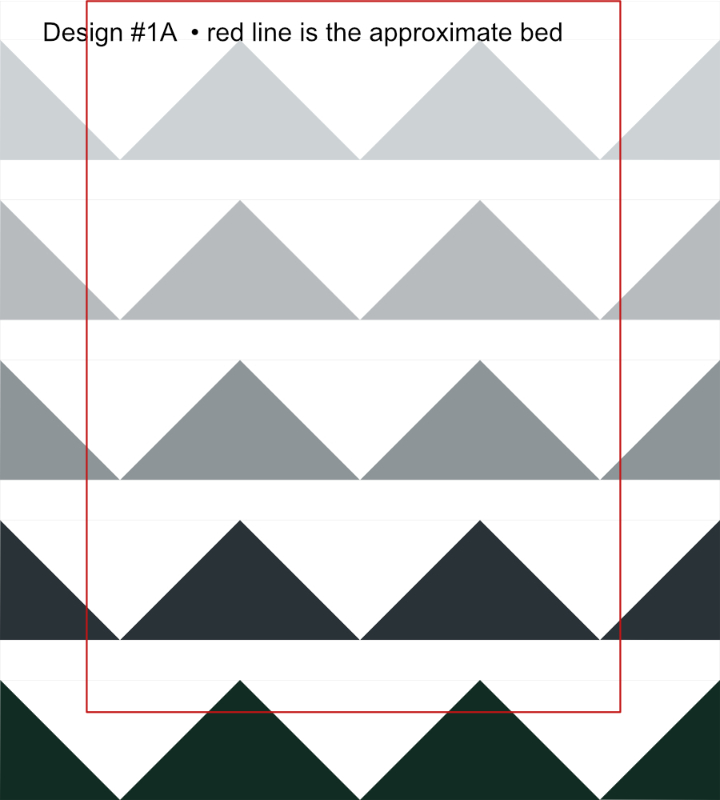
Keagan’s Quilt Quilt No. 253 Began April 18, with designs showing how it will drape on the bed (below) Finished July 9, 2021 89″ wide x 92″ long (approximate)
I worked it up in Affinity Designer. There is no pattern, but you can figure out the gist of it from what’s in the sketch above.
Apparently “snuggly” is not a word, but “snuggle” is. It showed up in 1687, along with birdhouse, trigonometric and yawner. I hope all these words haven’t been a real yawner for you, but just in case…I’ll stop this post here.