

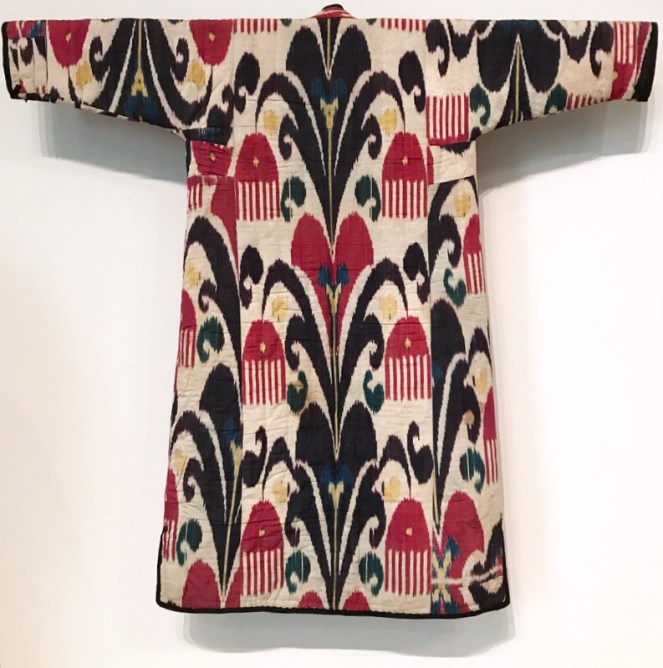
Among the most colorful clothing in the word, ikat robes — which hail primarily from the “the Stans,” or Central Asia — employ “creative use of scale, proportion, and orientation.” They are created by dying the warp (or vertical) threads of silk and cotton, sometimes multiple times.

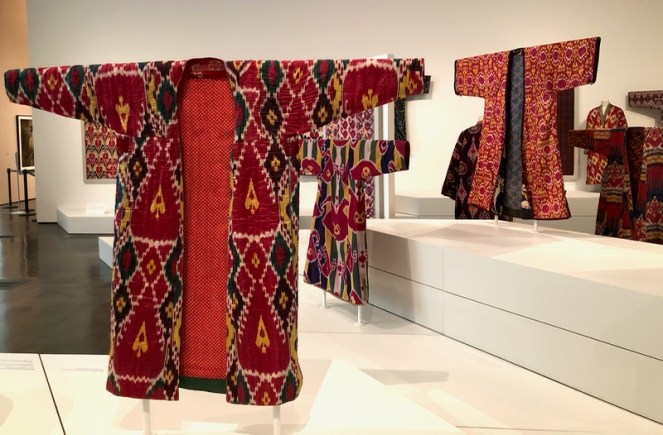
This past week, my husband and I had a chance to head into Los Angeles County Museum of Art (LACMA) to see this collection. Here’s the notice in the gallery:


This photo of a Tajik Wedding ritual (1865-1872) shows the rich patterns of both men and women in their ikat robes. I did a Google Image search, which has lots of results, but these older robes, as shown in LACMA, are rarer now. In that Image search, I saw lots of machine-made ikats, which don’t have the subtlety of the hand-dyed.
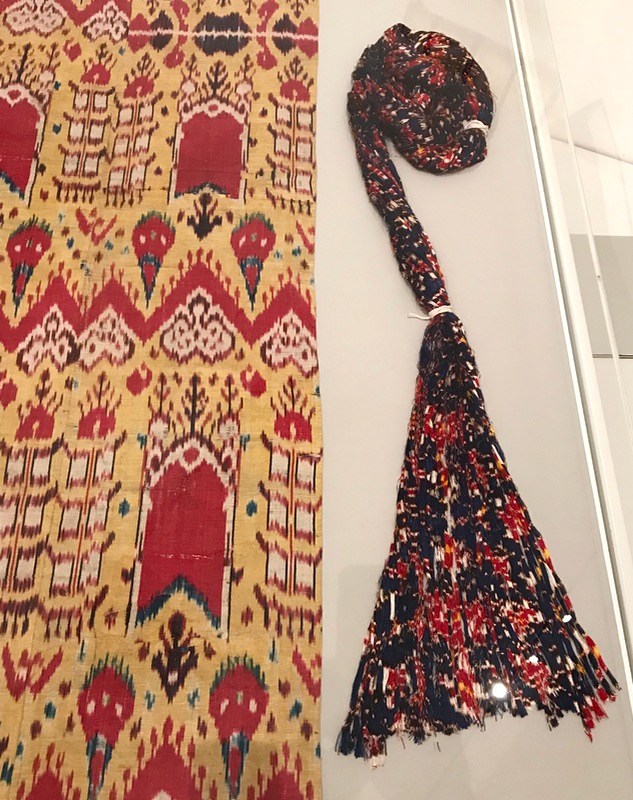
On the right is a series of threads which will form the warp threads in a loom, showing their various patterns from dying them using a resist process:
“Fabricating an ikat design demands vision as well as time. Before any actual weaving takes place, the lead craftsperson must picture a fully fleshed-out color pattern. Next, assistants soak the warp threads of the textile-to-be in a series of dye vats—up to eight in total—accumulating hues along the way. Prior to each dying phase, all stretches of warp are strategically bound with dye-resistant greasy thread, leaving exposed only those portions meant to be colored.
“By repositioning the dye-resistant thread before every immersion, textile makers gradually cover the entirety of the warp in an array of different tones. The most skilled designers will subject some sections of the material to multiple immersions, combining red and yellow dye to produce sunset orange, or red and blue dye to yield rich royal purple.
“Finally, when the Technicolor warp is ready, loom operators stretch it taut and gird it with a cotton or silk weft. The result is a long, narrow oblong textile bearing the designer’s repeating geometric pattern. This can be shaped into an eye-catching coat, or alternatively kept two-dimensional and made into a wall hanging” (from an article in the Smithsonian Institution Magazine, when they mounted their exhibit of ikat).



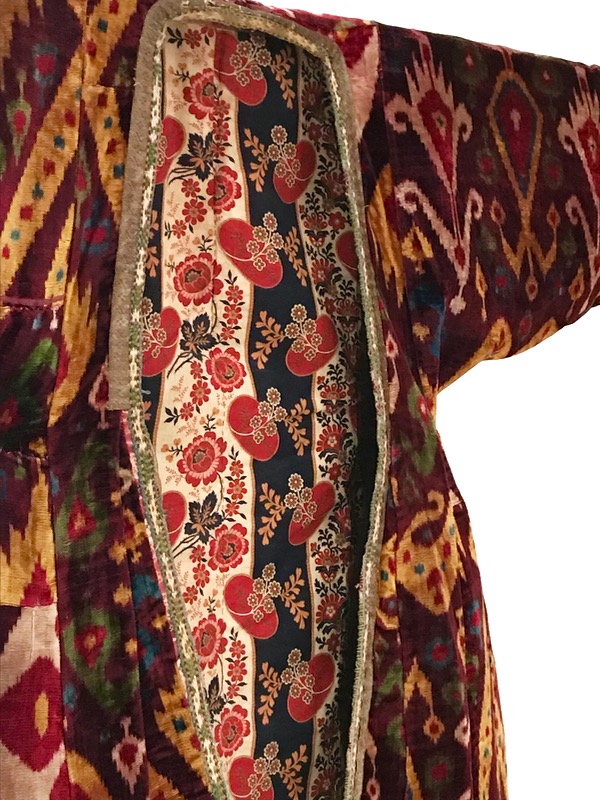
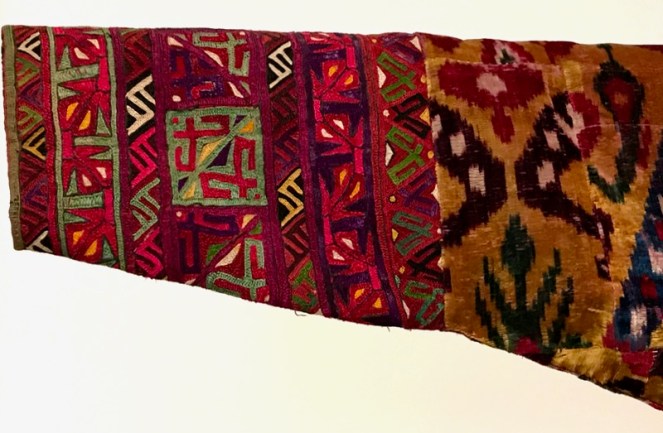
I think the guards thought I was crazy when I came to this robe. I kept crouching down, zooming in, trying to capture the details of what I would call a type of kantha stitching, embroidery, hand overcasting. It was a riot of color and texture and pattern:


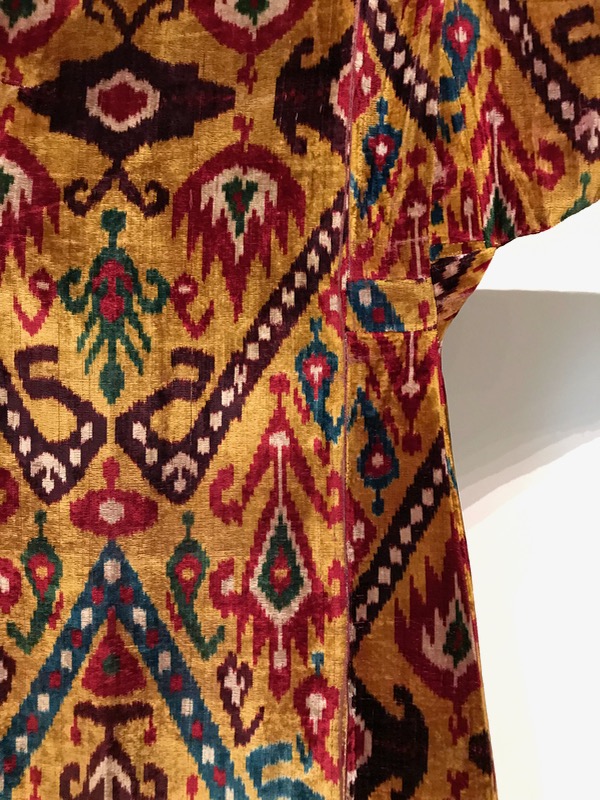
You can see the nature of the ikat weaving, which blurs the edges as the weft yarns are woven through those pre-dyed warp yarns. To make velvet, two rows of weft yarns are needed, instead of just one, so velvet robes were considered top of the line. In the outfit above, it is the outermost robe.
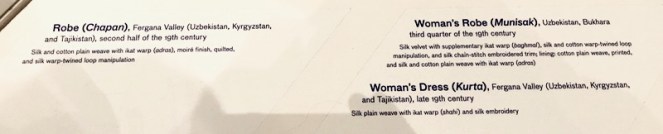
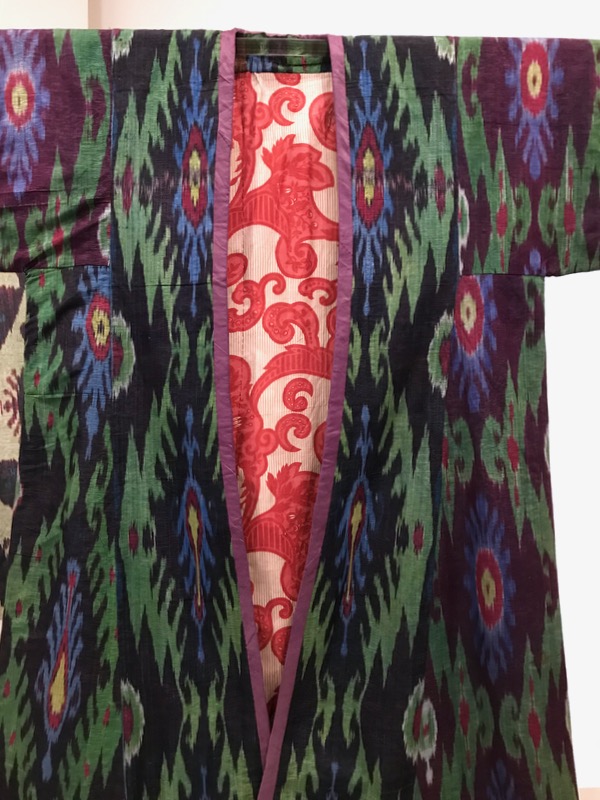
I took so many photos, that I’m not really sure which title goes with which picture, but I enjoyed reading the names of the clothing: a woman’s robe is a Munisak, a woman’s dress is a Kurta, and a man’s robe is a Chapan.
“Defined by an hourglass sihouette produced by the gathered fabric at each side of the waist, a munisak was used throughout a woman’s life for significant events, from her wedding to her funeral. As such, it was an important part of her dowry” (LACMA text).

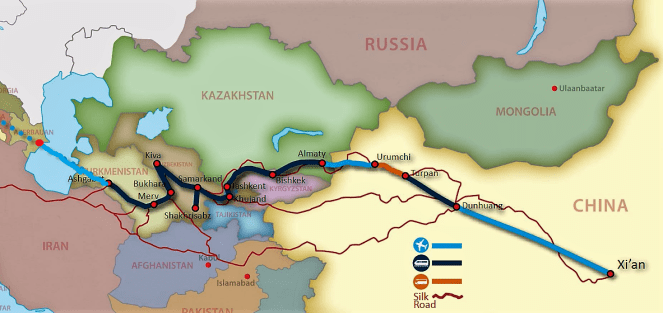
Recently, my friend Judy had traveled to this area with her husband, so I was familiar with the term “the Stans,” and what the area looked like. Although some consider that term a snub (“stan” means land, as in Afghanistan is the land where Afghanis live), I think it works well for those of us not familiar with where these countries are:
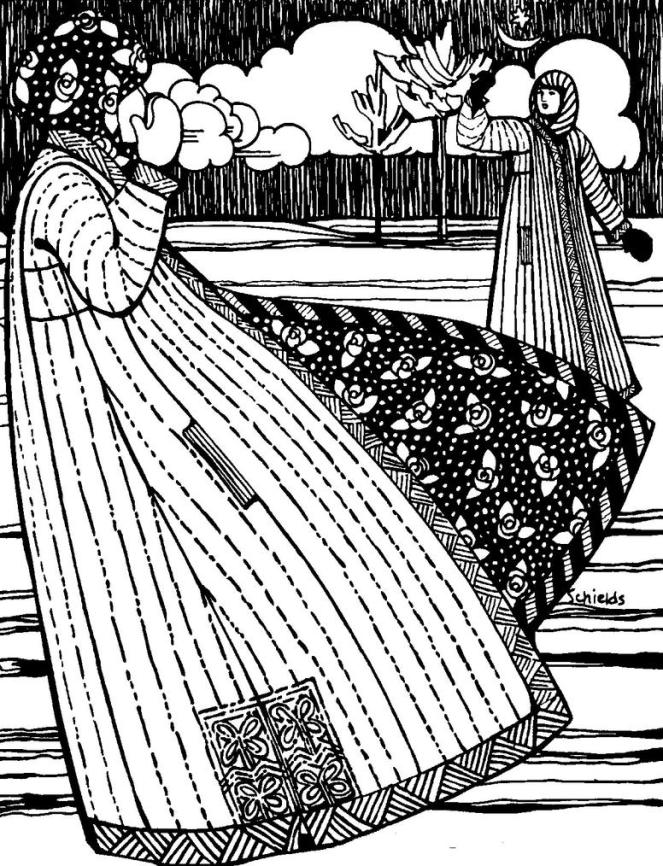
While we were in the LACMA exhibit, I told my husband that many quilters have used FolkWear patterns to make a similar robe, and added detailed surface decoration. I first learned about ikat when I took a class in Houston several years ago from Roberta Horton, a reknowned quilter, who showed us ikats from her line of fabrics, made in India:
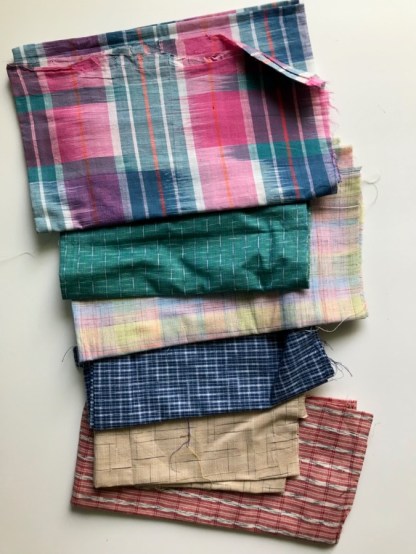
Although I was a Clothing and Textile Major in college, I’d didn’t remember hearing about this fabric before; perhaps that why I wanted to blog about it today. But in the quilting world, we also have variants of these colorfully patterned robes worn by these people from Central Asia.

I’ve seen the Tabula Rasa jacket and all its variations, from a pattern by FitForArt. Perhaps it’s the blurring of the lines between our patterned quilts and these beautiful ikat robes? The more surface decoration the better?
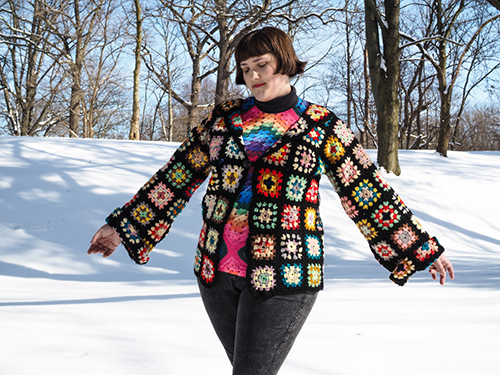
Not always. I’ve also seen some not-so-great versions of handmade clothing that were patterned to within an inch of their lives, certainly showing their makers’ skill but not always on the level of what was in that exhibit.
The brilliant thing about these ikat robes is the sense of balance that is present. Even in the layering of the different patterns, something pulls them together, links in either color or design. A worthy goal for our own creating, wouldn’t you say? whether it be in quilts or robes or clothing.

This was another experience that showed me that old truth: it’s always good to get out of my head, my studio, and the endless loop of social media, in order to gain inspiration from other places in the world.
Happy traveling, and Happy Father’s Day!













 OccasionalPiece--Quilt!