100 Quilts · Sewing · Tutorial

Lyon Carolings Top Finished!

Here it is in all its unquilted glory.  I’m really happy to be at this point.  Of course, I can see about five design changes I’d make right now, but I’m not unpicking another seam.  It will have to be what it is.

I cut the border print slightly away from the red band in order to have a little yellow piece separate and blend with the green initial border.  This has gone through so many iterations that I probably have enough for another quilt with Provence fabrics in my bin.  That will have to wait.  Now on to construct the back–I’m going to try to use some of the leftover border print there.

I’ve developed a few tricks for mitering a corner so it turns out half decent, or even better.

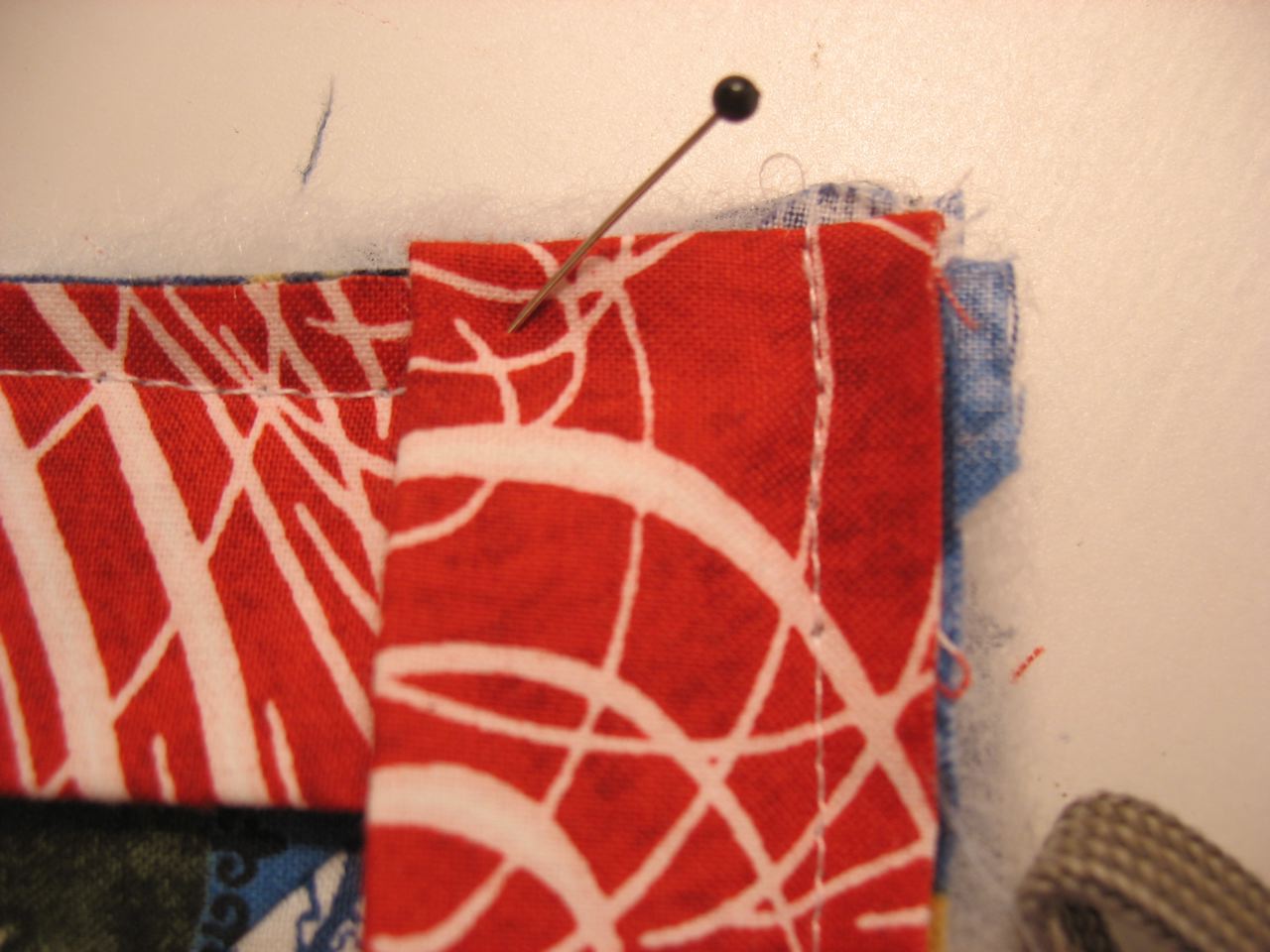
While sewing on the border, this really is be the first step (sorry it is already sewn).  What I want you to notice is where the blue thread on the green fabric begins and ends: at the seam.  Not over the seam. Don’t oversew in this step, or you’ll be picking it out.  You don’t need to sew past the seam because the fabric has to have the smallest bit of wiggle room in that area.

First lay your borders together, folding the quilt corner at a 45-degree angle, folding it out of the way below the borders. Match up the edges–both the sewn and the cut–very carefully.  Put pins if you have to.  Then using the 45-degree line of your favorite ruler, place that at the upper edge of the border and slide it so that the lower edge is at or just a thread’s width past the folded quilt edge.  Draw a line and pin it carefully before moving it at all.  DO NOT TRIM at this point. Stitch on that line (which you can see in the image above).

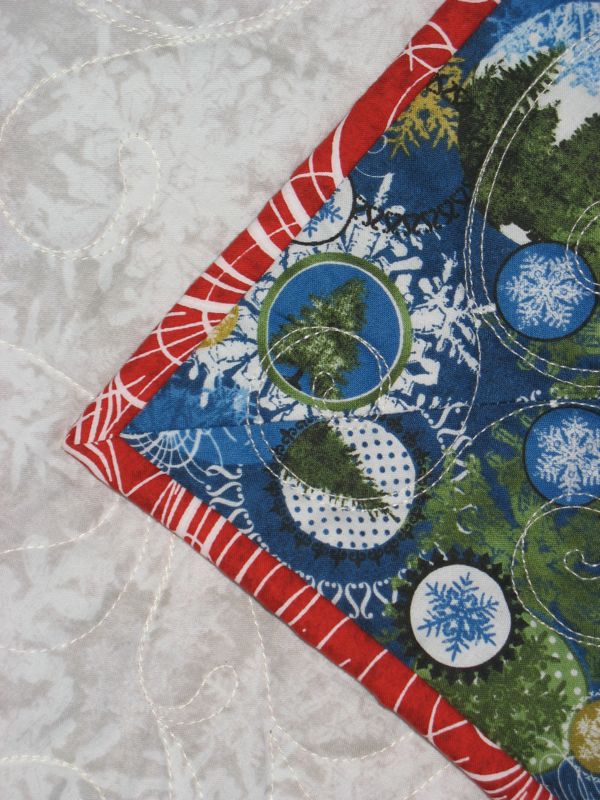
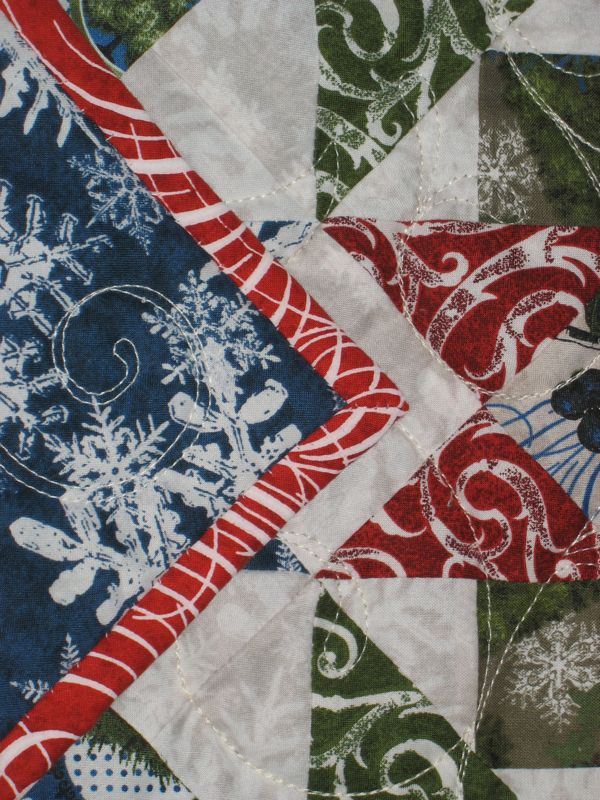
This is the glory shot: all the lines match up.  A good miter is a thing of beauty forever.  A bad miter hangs out in the back of the closet.

Trimming: Line up the quilt and borders as in the first step, replace the ruler so that you allow a 3/8″ seam allowance past the sewing line (I’m cautious here). 

Again, you are 3/8″ away from your stitched miter (at the green arrows). Slice it off, and try not to have heart failure that you’re cutting the wrong side.  If you fold it this way, you won’t (cut it wrongly, or have heart failure).

 Enjoy!

Quilt Shops · Textiles & Fabric

Shop-Hop, Miniature Style

Tracy and I headed out early this morning to have our own mini shop-hop, hitting a few stores that she knew about (she knows most all of the quilt shops around here). Click over to the interactive map to see where we went (I’ve also included the two shops I went to last week.)

Why a Google Map for my local fabric shops? When we went to England a couple of years ago, I was searching for information about York, and a local fellow had designed several “walks” that I printed out and we followed as we got to know the town. It was really helpful, and since then I’ve discovered many other helpful public maps on Google.

Is there a public fabric shop map for your town? A public “walks” map? We don’t have those kinds here in Southern California–our culture is car culture, whether it’s the best thing or not (it’s not).

100 Quilts · Journal Entry · Tools of the Trade

Provence, Blues and Sewing Machines

The French fabrics have arrived and they are beautiful.

But yesterday’s work was cutting 250-plus 6″ blue squares (5 1/2″ finished).  Of course, I was delayed in the forward progress by running off to a couple of quilt shops to see if they had something to add to this melange.  That’s something I used to do a lot before Professoring and before the Internet.  I used to make the rounds, collecting colors, shades, patterns and I have to say it was a thoroughly enjoyable process.  There’s something unique about being involved with the tactile when selecting fabrics–the feel of the cloth, the hand, whether they are a rough texturey linen or a smoothly woven cotton.  Heading to a fabric store is also about the hunt: what will I find?  In yesterday’s case, not much.  That makes me glad that the internet exists, as in the case of the ability to find–and purchase–the French fabrics.

We have our region’s Quilters Run next weekend and both stores were slicked up in their Sunday Best, ready for the hordes.  All the bolts were lined up, edges folded in, notions arranged, with a variety of quilts on the wall or artfully draped over the displays.  In one corner of one store was a display of Featherweight machines of all kinds, as well as some vintage toy Singer sewing machines.

It reminded me of the toy Singer Sewing Machine machine that my mother used to play with and which she gave it to me a long time ago.  This one’s not as shiny or gussied up as the ones in the store but it has nice quality that those don’t others don’t: a remembrance of my mother.

But I did catch a look at the price they wanted for theirs: $145.00.  A non-toy Featherweight Singer sewing machine like the one I have (which I purchased at a garage sale) now goes for $495.00.  I told Dave that it’s nice to know that some of my treasures accrue in value without me doing anything but hanging out, living, and getting older.  I’m going to resist any gags about how they’re gaining in value as opposed to what’s happening to me, as I hang out, live and get older.

100 Quilts · Textiles & Fabric

Blues for the Bedroom

So what am I working on while I let Provence stew a little while on the pin wall?  The above photo is our bedroom, really the only room in the house that I consider nearly fully “decorated.”  Nothing else in my house looks like this, I can assure you.  See where the small darker blue quilt is folded up on the bottom of the bed?  This place needs its own quilt.

Luckily, I’ve been planning for this for a while, as witnessed by the array above.  Many of these you’ll recognize as Amy Butler prints from two cycles ago–yep, I’m usually that far behind on things.  I loved the pale grayed-down bluey-green of that line, if that is indeed some kind of description.  I”ve added a piece from her Love line on the right, as well as that fabulous geranium print from Rowan Fabrics (Is that a Martha Negley? The selvage doesn’t reveal it.)

After breaking my brain on the last couple of quilts, I want this one to be all about the fabric–so I’m planning just a random assortment of 5″ or 6″ blocks.  Yep.  A one-patch.