Books · Something to Think About

Age of Subtraction

Many years ago, bricks used to be completely solid. Houses and buildings went up with solid bricks. But in 1927, Anna Wagner Keichline patented a brick known as the K-brick, which was hollow and could be filled with “soundproofing or insulating materials, making it versatile and efficient. The K Brick led to the development of today’s concrete block.” She subtracted something in order to make it better. I heard about her from the Hidden Brain podcast, in an episode titled “Do Less.” Shankar Vedantam, the host, featured Engineer Leidy Klotz and so much of what he said intrigued me: “We pile on ‘to-dos’ but don’t consider ‘stop-doings.’ We collect new-and-improved ideas, but don’t prune the outdated ones. Every day, across challenges big and small…we don’t subtract.”

I learned the phrase in the title of this post from my father, who says that a certain time in our lives we enter the Age of Subtraction. To him, this meant less energy, weaker eyesight, feeble knees, and a general inability to go and do like when he was a younger man. Coming from a different generation, one that had not yet been inundated with ads, consumer spending, The Great Garbage Patch, Climate Change or other such beauties of late 20th century life, the concept of addition was full steam ahead.

These two supposedly opposing ideas intrigued me. Why do we resist subtraction? Why are we all about addition?

For quilters and creatives, it manifests itself in adding to our Works in Progress lists. We grab at the next line of fabric, knowing the last line of fabric is at home. While this idea might certainly have at its root the dopamine ping of a new idea, or a few likes on our work on social media, or a brilliant new color (whether in a paint tube or in cloth). But maybe at its root is also a bit of anxiety. We used to be able to buy a fabric line for months, as it was in our shops. Now fabric lines come-and-go at a fast clip. If you don’t buy it now, it will sell out.

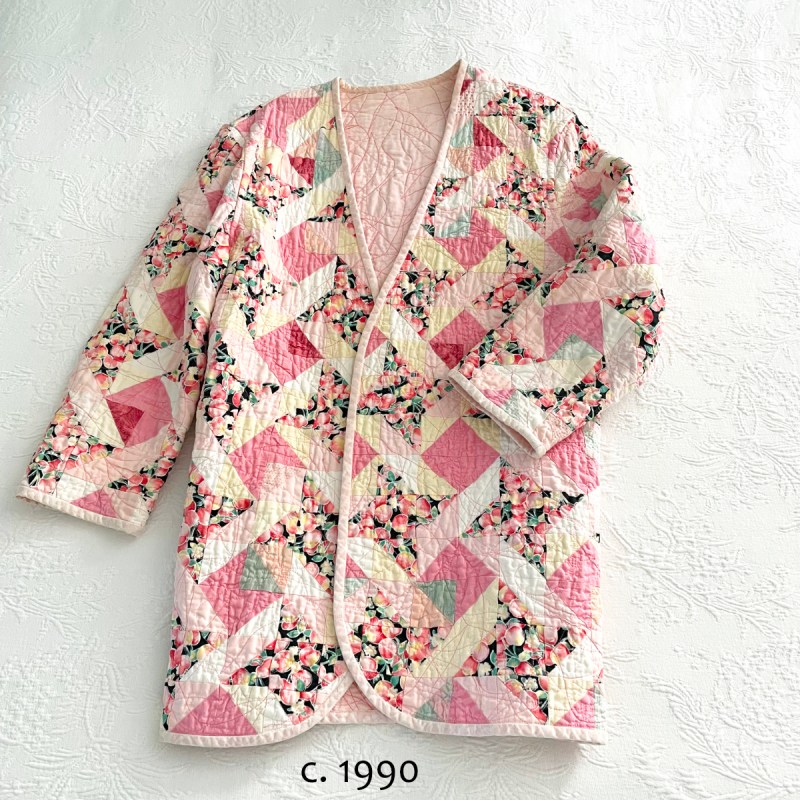
The same with ideas: everyone’s making a quilted jacket, so we’d better get going. There are supply chain line interruptions, so for a while, bakers couldn’t get vanilla except at exorbitant prices. Uncertainty is everywhere, so we buy faster, we make faster, our list of things to make never stops. And all the while, we feel the tick of time like my father, worrying about getting it all done.

In his book, Four Thousand Weeks, by Oliver Burkeman brings forward the idea that if you live to be 80 years old, that’s four-thousand weeks of life. He writes about this idea of trying to get it all done:

[T]he core challenge of managing our limited time isn’t about how to get everything done—that’s never going to happen—but how to decide most wisely what not to do, and how to feel at peace about not doing it.

Burkeman, Oliver. Four Thousand Weeks (p. 71). Farrar, Straus and Giroux. Kindle Edition.

And there’s that subtraction thing again: “decide most wisely what not to do.” Can subtraction be a new way to operate? I’ve been a time efficiency wonk for years, always trying to find a better way to add things in, organize them. Burkeman called himself a “productivity obsessive.” In this book he takes aim at that familiar time management trope of the rocks, pebbles, sand and water all piled into a jar in order, showing so-called good time management. But he notes, that object lesson is rigged, because the person demonstrating it isn’t going to bring bigger rocks, or more rocks and pebbles than can fit in the jar. (What a relief!) Yet, I still wondered about how to handle my Works-in-Progress projects that pile up. I still couldn’t get to subtraction:

[One] approach is to fix a hard upper limit on the number of things that you allow yourself to work on at any given time. In their book Personal Kanban, which explores this strategy in detail, the management experts Jim Benson and Tonianne DeMaria Barry suggest no more than three items. Once you’ve selected those tasks, all other incoming demands on your time must wait until one of the three items has been completed, thereby freeing up a slot. (It’s also permissible to free up a slot by abandoning a project altogether if it isn’t working out. The point isn’t to force yourself to finish absolutely everything you start, but rather to banish the bad habit of keeping an ever-proliferating number of half-finished projects on the back burner.)

Burkeman found that:

Making this rather modest change to my working practices produced a startlingly large effect. It was no longer possible for me to ignore the fact that my capacity for work was strictly finite—because each time I selected a new task from my to-do list, as one of my three work-in-progress items, I was obliged to contemplate all those I’d inevitably be neglecting in order to focus on it. And yet precisely because I was being forced to confront reality in this way—to see that I was always neglecting most tasks, in order to work on anything at all, and that working on everything at once simply wasn’t an option—the result was a powerful sense of undistracted calm, and a lot more productivity than in my days as a productivity obsessive (ibid.,75-76).

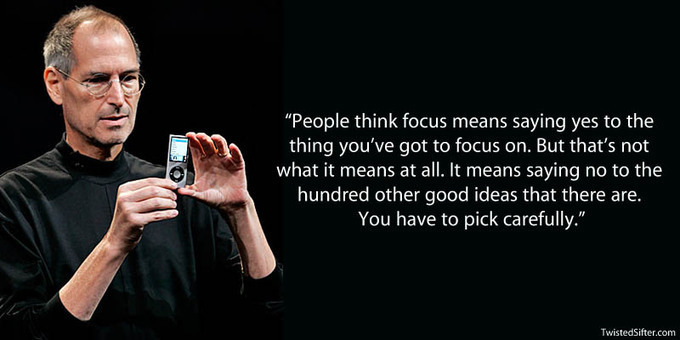
So maybe my idea of brain-dumping everything that I think I want to do isn’t so helpful after all. And maybe setting quarterly goals, while perhaps a good idea to guide me, isn’t really helpful on a weekly basis? Being introduced to this idea of subtraction, coupled with reading about my finite life in Burkeman’s book reminds me of that old line: Saying yes to one thing means saying no to other things.

Our lives are often quantified by how money we make, or how many followers we have, or by what we produce. But always when I step back from that race, I have to include satisfaction of the process. To this day, my 96-year-old Dad has a paintbrush in his hand, working on a new painting. I want to be found at 96 (if I’m still around), with a needle in my hand, or typing at the computer writing my history, corresponding with people I love. By subtracting out things I don’t think are important, I hope to do things that I enjoy and that sustain me.

Good luck with your own subtraction challenges–

Something to Think About

Ruangrupa: Parallels to Quiltland

First this:

And then this:

I have blocked out the quilter’s name

Ruangrupa is an Indonesian Collective that “turns social experiences into art,” as Samantha Subramanian noted in a recent article in the New York Times. The name comes from two Indonesian words: ruang, which means room, and rupa, which means form, “so the group’s mashed name prizes not product but process: the physical space in which people collaborate, things take shape and art is made” (italics are mine). As I was reading about these artists, I couldn’t help but finding all kinds of parallels to Quiltland, where we all live. Here’s some tidbits from the article, and then I’ll tie it all together (stay with me, now):

“Instead of collaborating to make art, ruangrupa propagates the art of collaboration. It’s a collective that teaches collectivity.” One school of thought says that “visual arts” can be “spectacles degraded by capitalism” but ruangrupa is devoted to the collaborative process and its “chief order of business is to offer a ruang: a place for artists to meet each other, try things and fail and ignore for a while the demands and dogmas of the world outside.”

The author described visiting the ruangrupa complex in Jakarta, and noted that there was a feeling of “slow ferment — the feeling that, as people floated through one another’s orbits, they were being creatively galvanized, working all the time toward new art and new ideas. Not grand projects necessarily…but small, rich narratives with great frequency.”

Although the paragraphs above probably need to be translated out of Artist-Speak, generally they describe ruangrupa as a place where people meet and share and create new art because of that sharing. It also reminds us that “before capitalism’s fierce individualism interfered, people worked in small, sustainable collectives not only to create art but also to grow crops or put up buildings. Large families, farms and guilds were all collectives: a village was a collective of collectives” (Subramanian). (Guilds!)

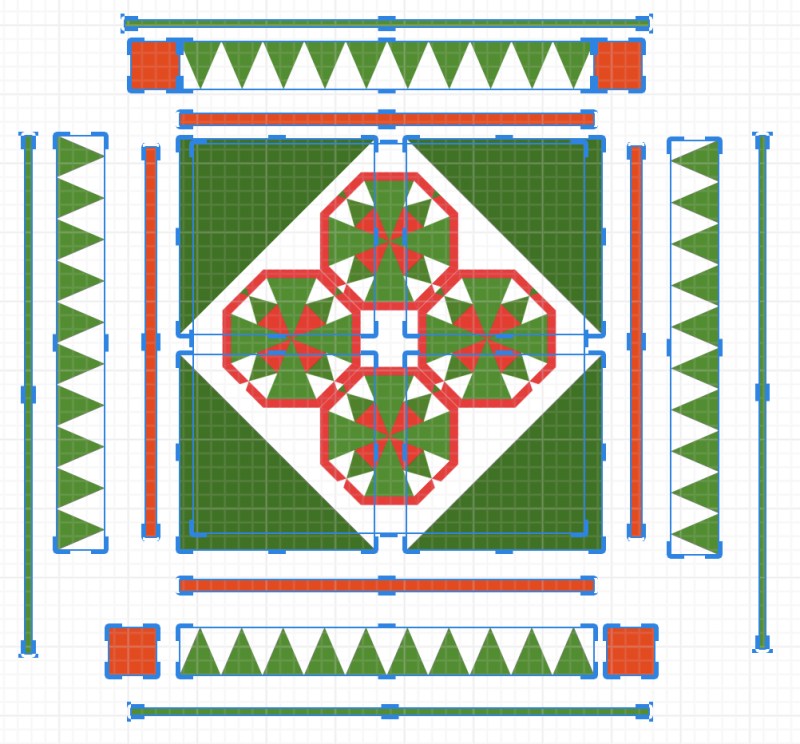
So the second image, that of a Star of Hope block, with the person who put the fabric choices together proclaiming “Designed by Me!”

Actually, no.

It started with an Ohio Star shape from Nancy Cabot, Brackman 1631b. The next derivation was 1631c and has ten different names.

Brackman 1631d, the one shown above (and from Barbara Brackman’s Encyclopedia of Pieced Quilt Patterns, as well as Blockbase Plus software) has this heritage:

from Blockbase Software

I chose the name Star of Hope, and you can see it’s from the 1920s to the 1940s. So what’s the connection between ruangrupa and Quiltland? A single thread: collaboration, creating by working through a collective of hundreds of women, some here now, some alive in the 1940s and some stitching in the 1800s. They are our ruangrupa, and we honor them and our quilting heritage when we call the blocks by their correct names, not claiming them for our own. Every artist borrows from one another, however, it’s probably good practice to acknowledge the inspiration.

And the series of photos at the top? Aren’t workshops, quilt meetings and retreats another form of ruangrupa? Don’t we, when in small groups or in our guilds, “[work] all the time toward new art and new ideas. Not grand projects necessarily…but small, rich narratives with great frequency”? Having taught guild workshops, I always brought a few extra bits of fabric to trade, and then I noticed quilters trading across the class, too. We’ve learned to work in a collective, to create small, rich stories and we do it often. It’s the best part of this quilting world, I believe.

pattern from here

I had another small, rich narrative happen this week.

I was making these happy blocks because of another task this week: listening to the January 6th Commission Hearings and not only because this storming of the capital was on my birthday (!). America is a collective, and we’ve worked hard in groups to collaborate, those early Founding Fathers setting up our Constitution and our way of life. We let a lot of that ideal slip away from us, claiming that we alone can do it (like claiming an Ohio Star Block as your own design). But lately, with Volodymyr Zelenskyy reminding us of what democracy and courage looks like, we seem to have woken out of a deep sleep. I decided that watching the J6 Hearings was something I could do to decide for myself, to learn and listen.

Those nine-patches of blue, with sunny yellow centers, kept me grounded through the hard parts, the tense videos, the growing realization that our American collective had been ruptured. I thrive in my quilt collective, and want to thrive in my nation, too. I hope we can come together and rebuild, put together “small, rich [stories]” while we “try things and fail and ignore for a while the demands and dogmas of the world outside.”

Take a breath…and quilt ~

Notes on this post:

I wrote another time about America being a collective, borrowing words from Walt Whitman, in my post about my quilt, I Hear America Singing.

Nine-patch has to be one of my all-time favorite blocks. I’m also quite fond of this one, another traditional block from our quilt heritage.

Something to Think About

Looking Out the Window

So often I spend days cramming it all in. I read Instagram, blogs, news, newspapers, and the sides of cereal boxes if there’s nothing else. I store up lists of patterns, of quilts to make. In the window of time I have in the day, I join sewing groups, plan trips to quilt conferences. Others head out on retreats, but all of us are filling up the spaces over and over and over.

The last two days I’ve been emptying out, which often happens when you leave home and live in a hotel space and walk in a strange city and ride busses (thankfully, given the time of Covid, they are somewhat empty). That first day is like detox, and you are anxious to pull out the stitchery in your bag, or read something or sew something, anything.

Then you find this notice on a crosswalk button and you smile. You have ten places to chose from for lunch, if you keep walking. You had great cookies yesterday, so you know where to find those today.

You notice where the tracery of pulled-off ivy creates a conversation with succulents and images inked in below.

You think: this would be a great wall for a quilt photo, and you see other nooks, crannies, painted spaces, architecture, houses. You notice.

At the end of looking out of windows in hotels, busses, beauty shops (when you decide to get a haircut), your busy life hovers at the edges. It’s now looking in at you, waiting for you to come and pick it up again and make colors and fabrics dance in lines and curves and triangles.

Coming.

Also coming in the next post: Block Three of the New York Beauties series, plus some insight into how I figure out some of the weirdness of FPP.

Something to Think About

Happy Mother’s Day 2022

Well, Happy Mother’s Day a bit early, actually, as tomorrow we are headed to Los Angeles to celebrate my sister’s newest grandchild. We’ll probably wear masks. Our luncheon is outside. Life goes on. Mother’s Day is a day to honor our mothers, and I’m lucky to have a great one. She turns 92 years old at the end of this month, and I am fully in Abraham Lincoln’s camp: “All that I am, or hope to be, I owe to my angel mother.”

I’ve had a great mother-in-law, and a mother-in-law that wasn’t so great — or at least that’s how I viewed things in my earlier life. Now that I’m a mother-in-law, I understand the not-so-great woman much better and hope she will forgive me for my failings. I’ve had great women who taught me how to quilt, mothering me into a craft that has sustained me for years. I owe them a great debt.

Where does the beginning start? We think this weekend of mothers and how they give birth to us and raise us. If we are fortunate we have a good mother. If life throws you a brutal curveball, you had a terrible mother. Reams of paper have been used in writing about those two polar opposites; I will not add my words to that pile today.

But somewhere we all had a beginning. Some beginnings are early, and we can locate the source and revere what gave us our start. Other beginnings come later, often after tragedy, pain, death, or divorce, and the reins of life are picked up again in a new beginning. I think it appropriate that whoever you decide is your mother — whether it be a birth mother, or an adoptive mother, someone who took you in, or someone who freed you to grow and fly — I hope that this day you are able to honor and remember them.

I also honor the mothers of all these grandchildren in our laps, a photo taken years ago, those young children giving us such delight (three are missing!). My daughter and daughters-in-law are all devoted to their families. I also love and respect my sisters, my in-laws, aunts, grandmothers. While there are always a few ringers, women who are best at a distance, I am fortunate to have such a great circle of love from women in my life, examples to follow and people from who I can pick up advice about teenagers, babies, husbands and daily living. And quilting.

I wish the same for you.
Happy Mother’s Day!