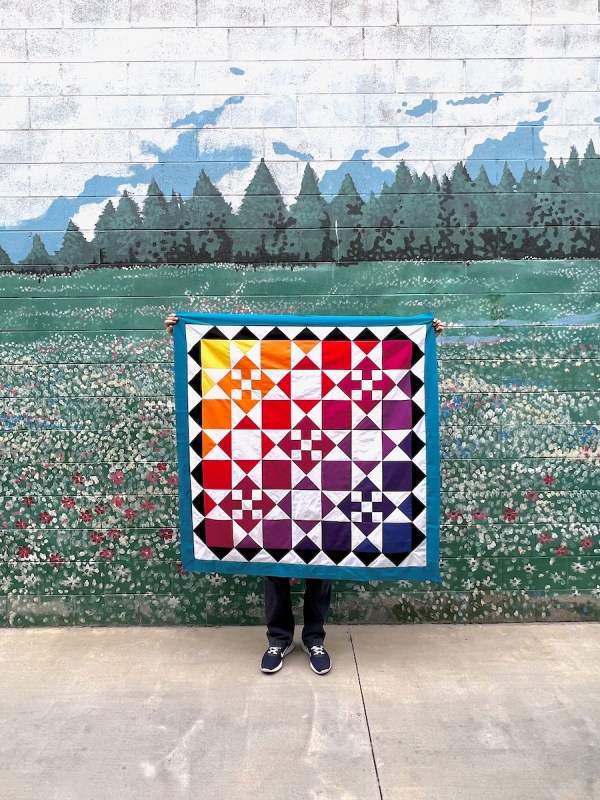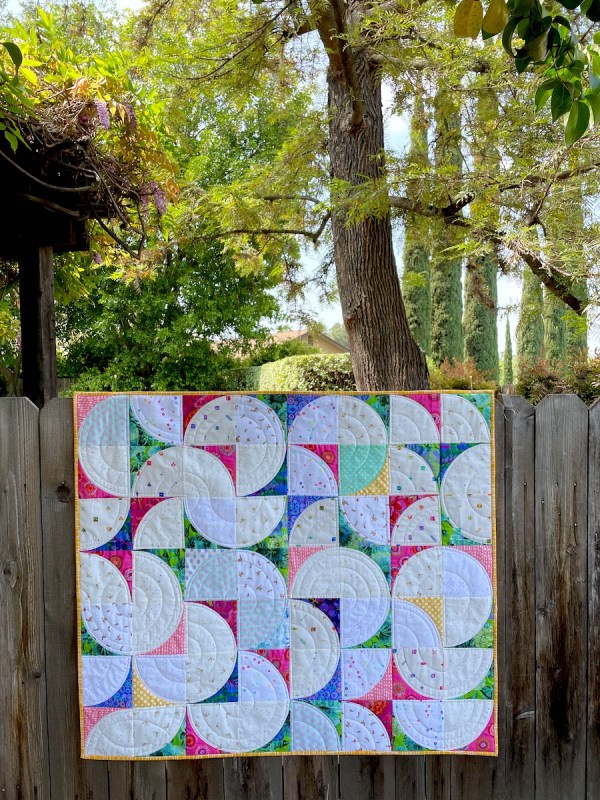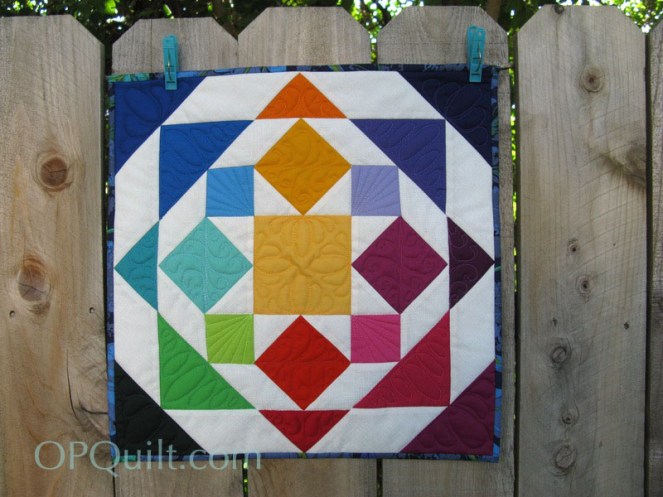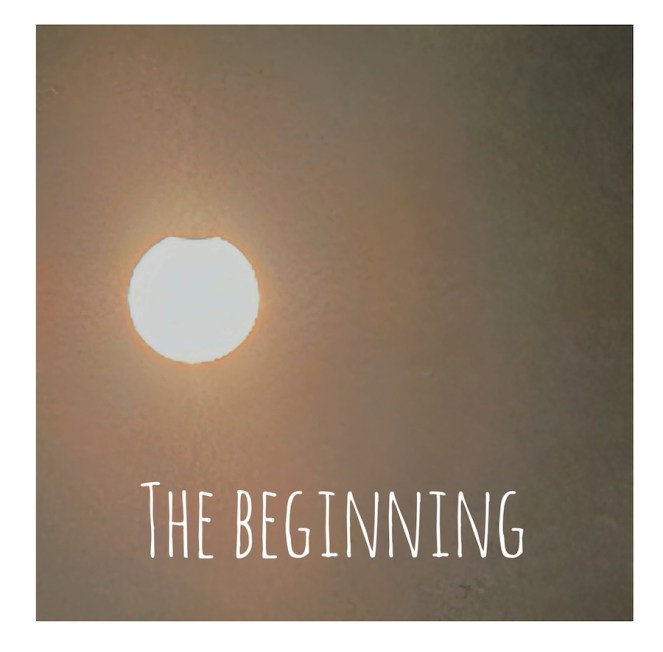
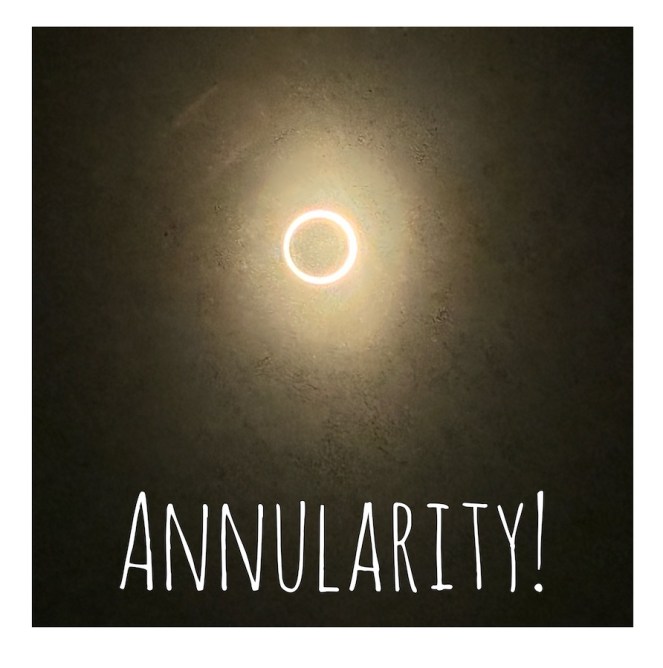
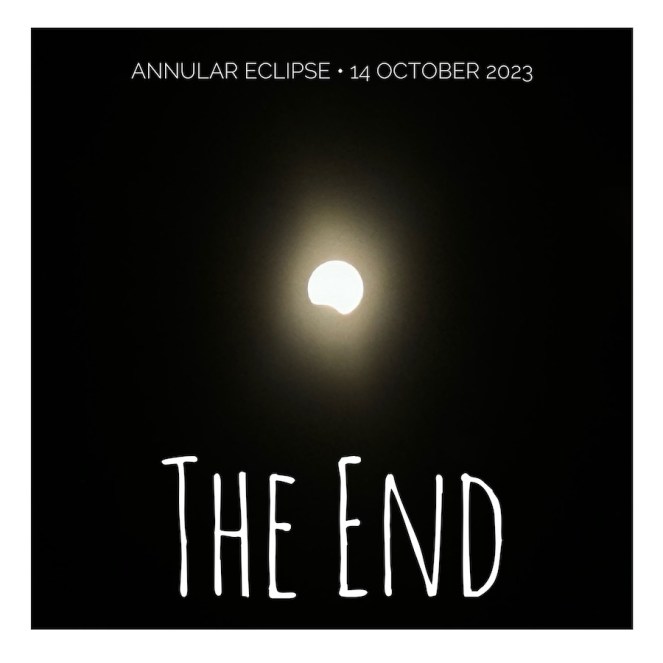
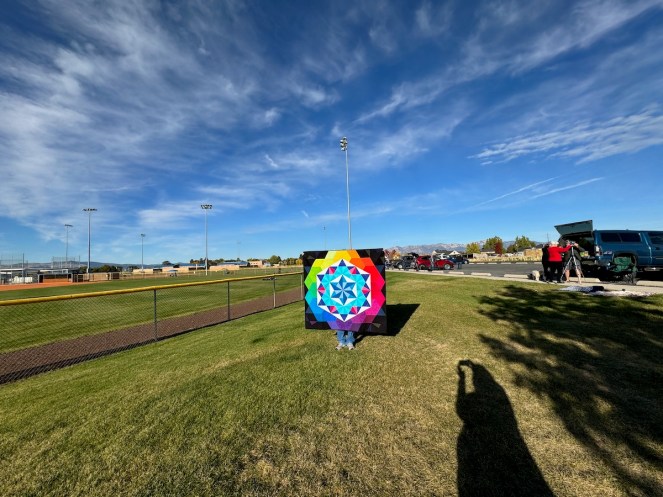
Of course I took my quilt titled Annularity up to the Annular Solar Eclipse, and took its photo while the eclipse was going on.
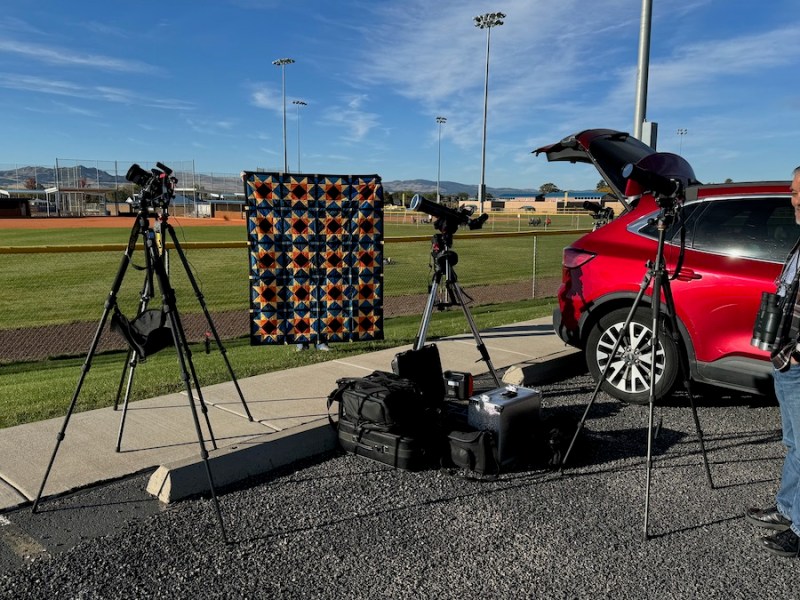
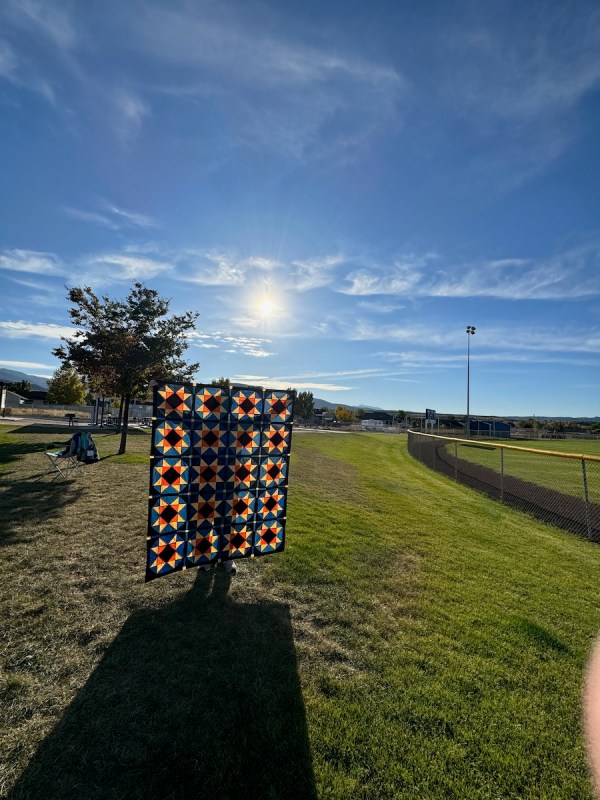
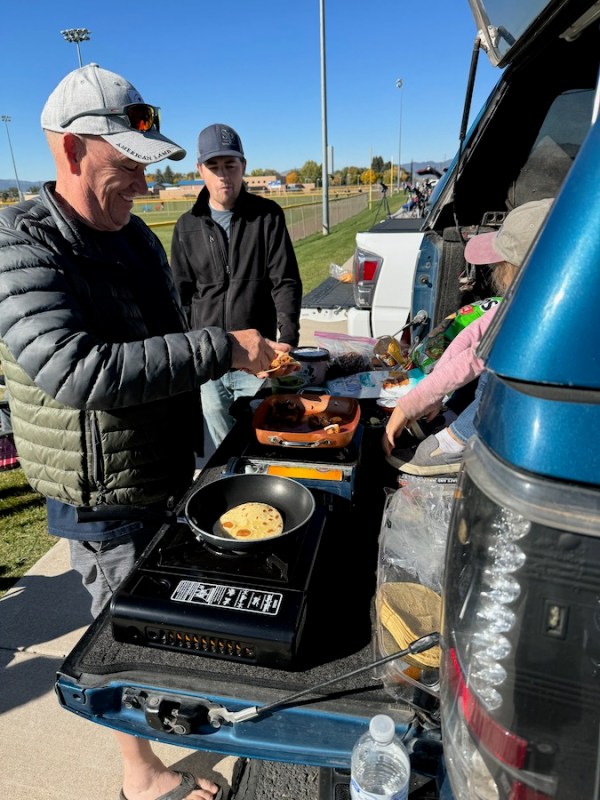
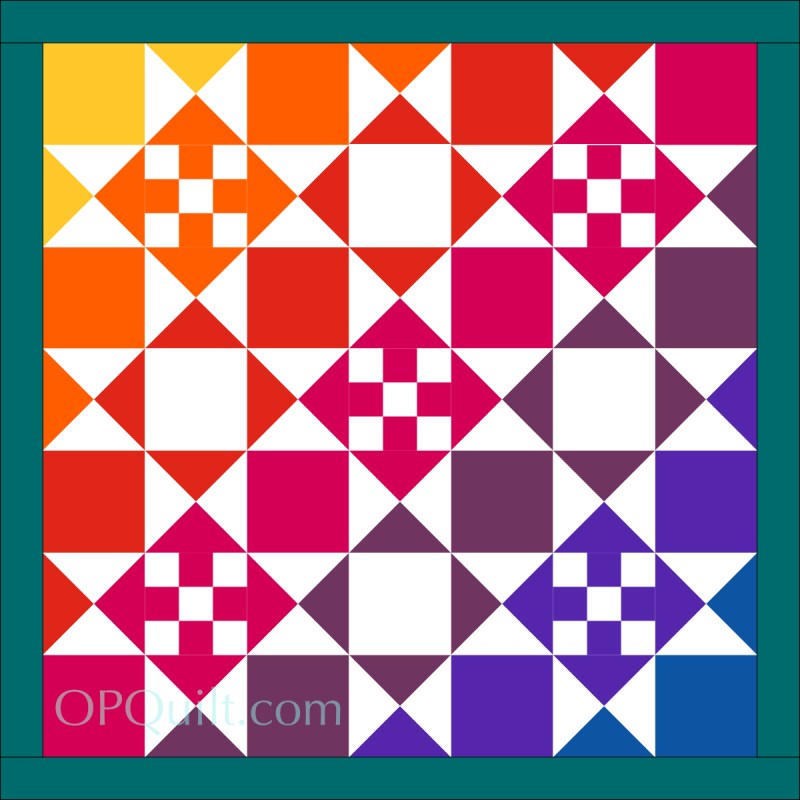
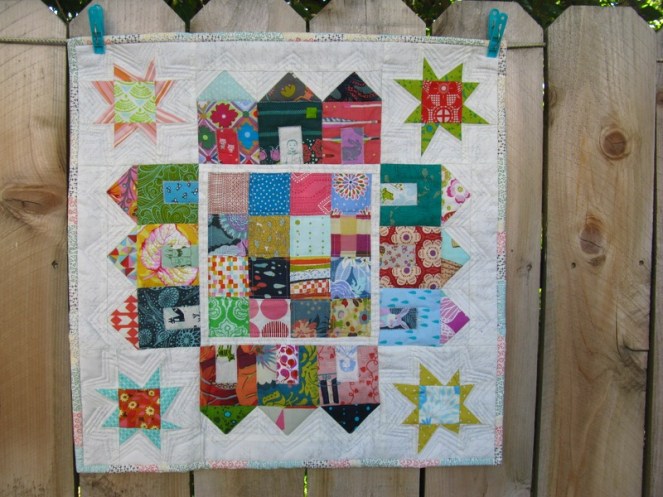
And my new Eclipse quilt also got a photo. The first photo is beside the car from Colorado, with two photographers, five cameras, boatloads of gear and who still called themselves “amateur.” To our left was Tim from Temecula (about 35 minutes from our home in California), and on the other side of him was an Astronomy teacher from Murrieta (about 45 minutes away from our home). I did a roll call video, as people were stationed all around the sports park in Beaver, Utah. Near the end of the eclipse, the car just beyond Colorado (they were from Hurricane, Utah), opened up two portable burners and invited us to have tacos with them, since two of their group were having birthdays. When the moon was exactly in the center of the sun, cheers erupted around the park. It was wonderful.
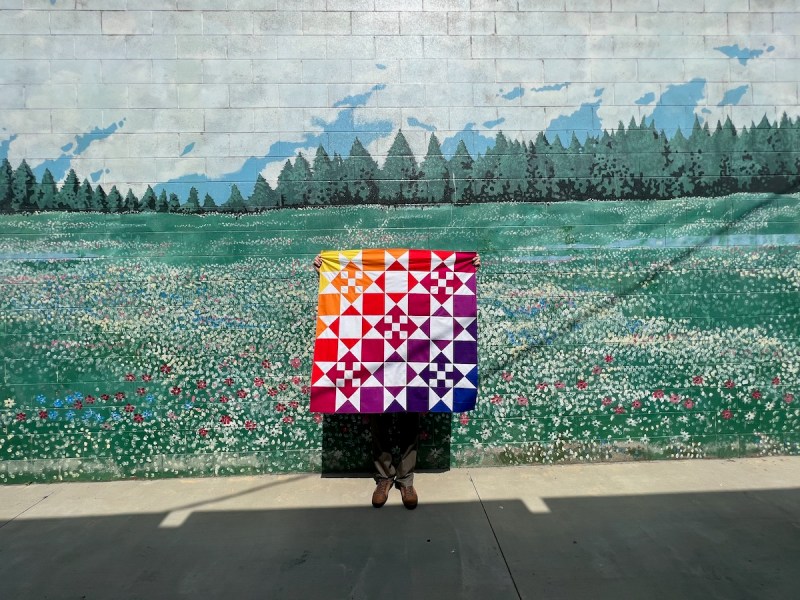
Oh, and here’s an earlier trip to an eclipse in Utah.
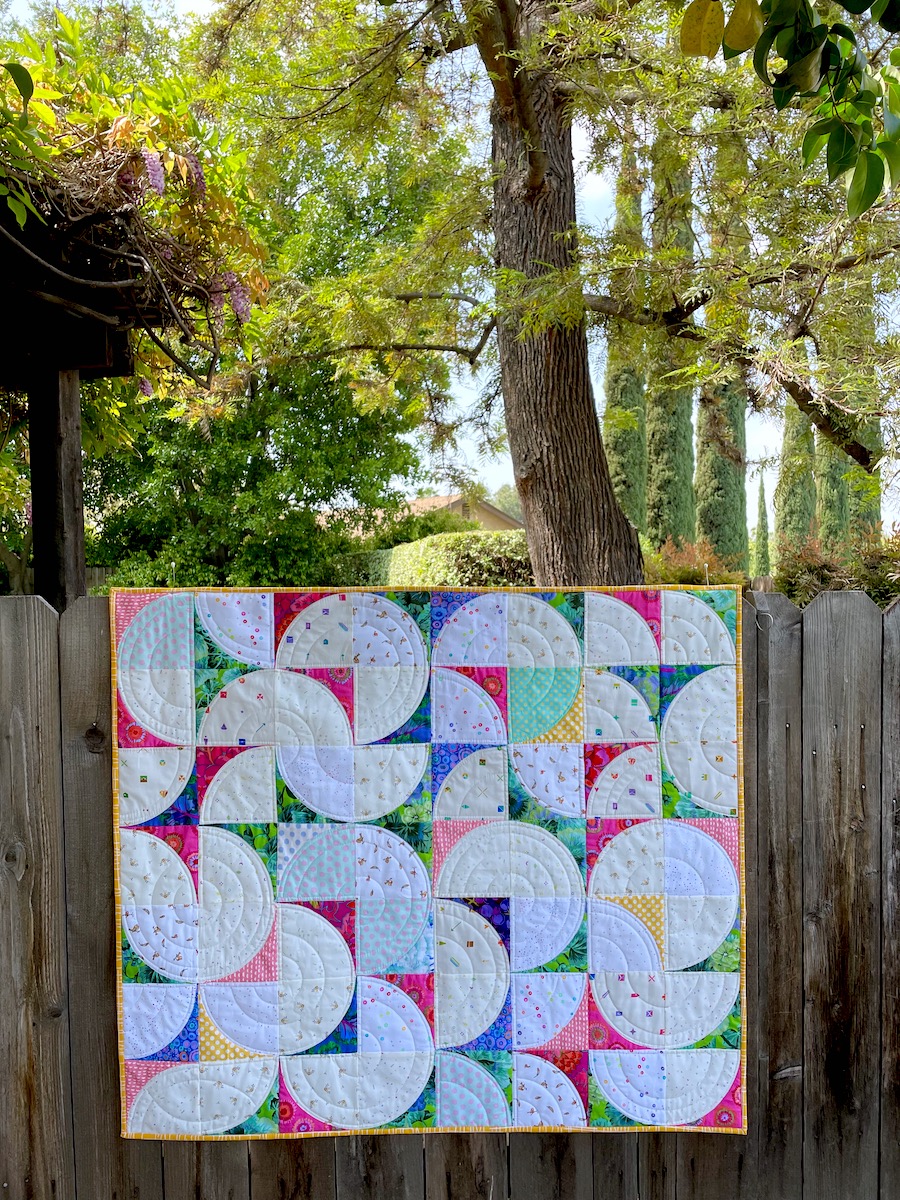
Other than that, what have I been doing? Quilt-prepping. Watching news. Struggling with social media. But first, some quilts.

I fell in love with a Quilt Kit for a quick Christmas Quilt, although as usual, I changed it up, leaving off the word Christmas from the front. I just wanted a nice TV quilt, and didn’t need the drapey-wordy-thingie across the front, although it would be cute if you were hanging this. And I am quite fond of this designer’s fabrics. I finish up a quilt top and I think, oh good! I’m done! but I’m not. These are steps I go through to prep it up for Jen, my Longarmer.
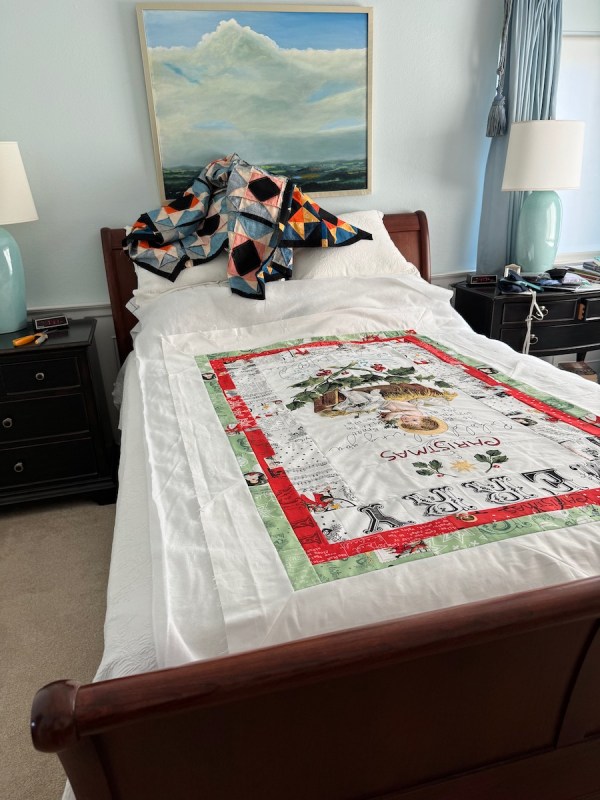
Lay out the batting on the top of my bed, and cut the batting 6″ larger all the way around. I have a roll of my favorite batting, and Jen is okay to use what I like. The Eclipse quilt is waiting in the wings on the pillows.
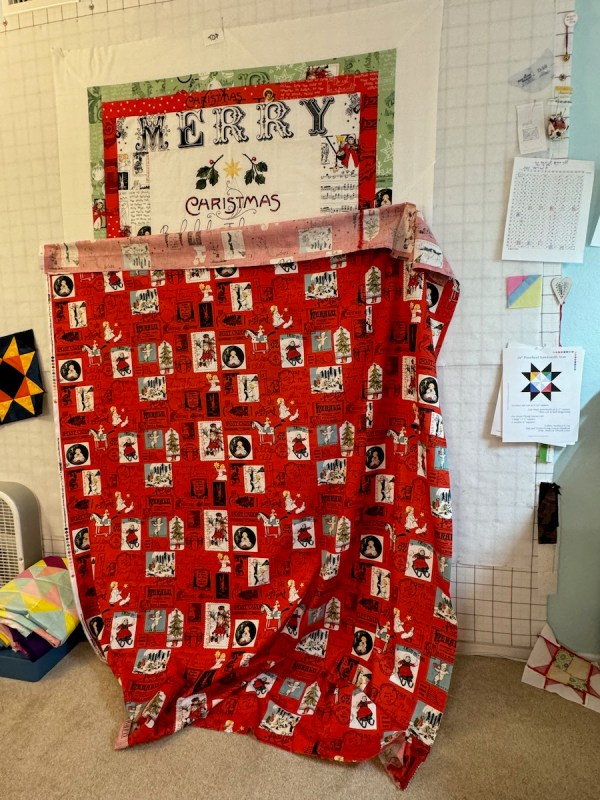
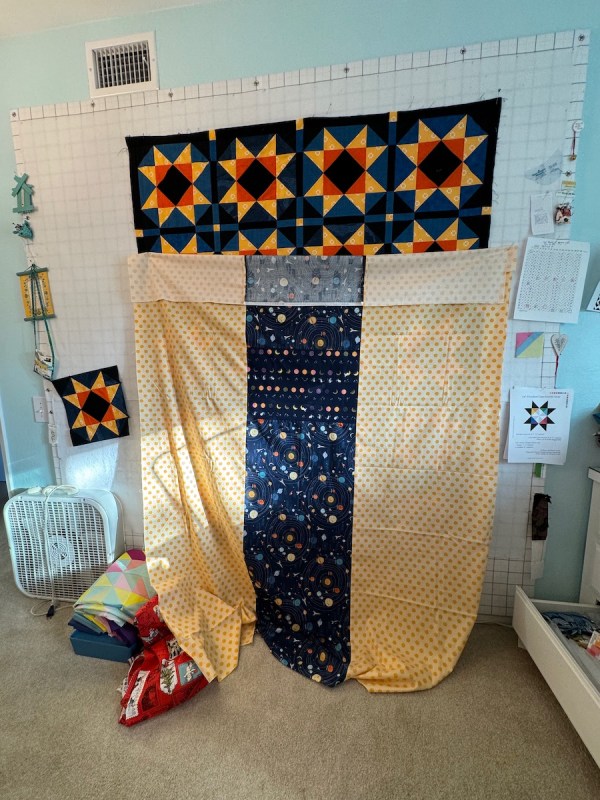
I smooth the quilt back up on the design wall and construct a backing that’s 6″ larger all the way around. On the right, I climbed through the stash and cut-and-sewed to create a back. The blue swath is fabrics concerned with planets, moons, outer space and rabbits. When you are shopping the stash, you get what you get, even if it means rabbits.
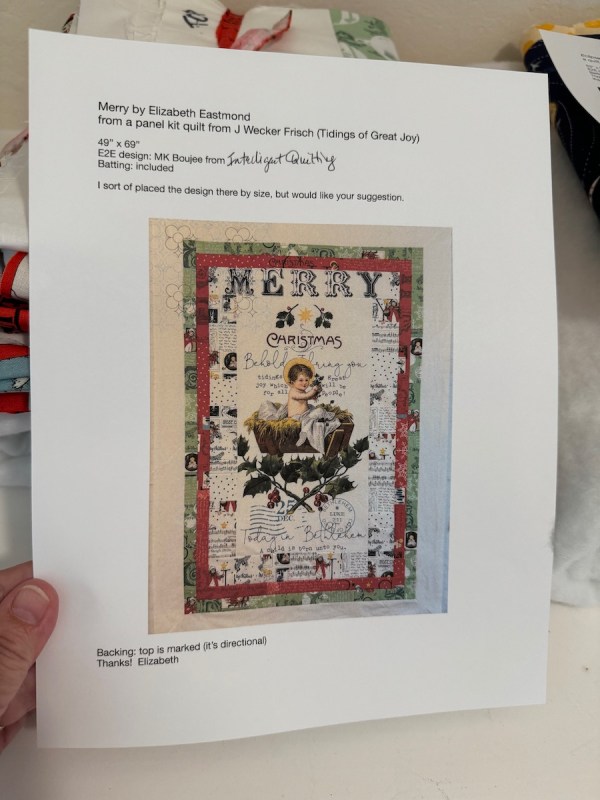
I do a sheet like this for every quilt. It travels with the quilt, but it is also a record for me. It took me ages to pick out the panto for Merry (my title). My long armer has some good sources on her website, but often it’s just me clicking through a site. For this one I chose “Boujee” from Intelligent Quilting, designed by Melissa Kelley.

So I make the background transparent in my Affinity Photo program, then copy and paste it onto the quilt image, enlarging it or smallerizing it until it’s how I like it. This panto reminded me of stained-glass windows from France, and I thought it might work. I like SoFine thread, and I have a thread card (and many spools) so I can tell her what color I like.
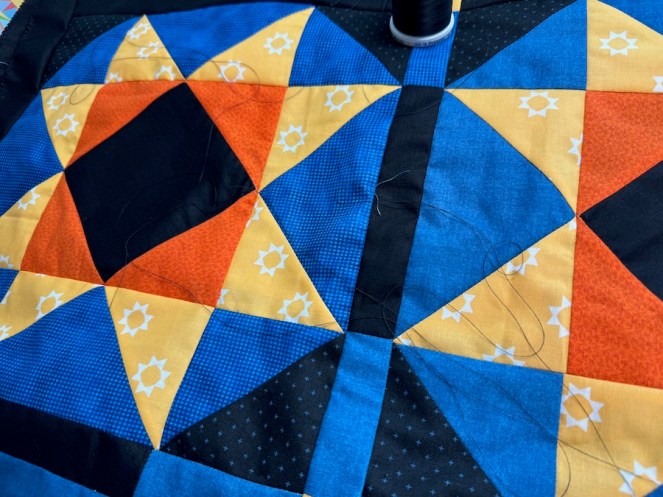
Eclipse was a bit harder, because I have that yellow and orange and then the dark blues and black. So I spooled off some thread over the top, letting it fall over the areas to see how it will look. I’ve also heard of others who sew a bunch of different scraps together and then stitch down the pieced strip with different thread to see how it will look.
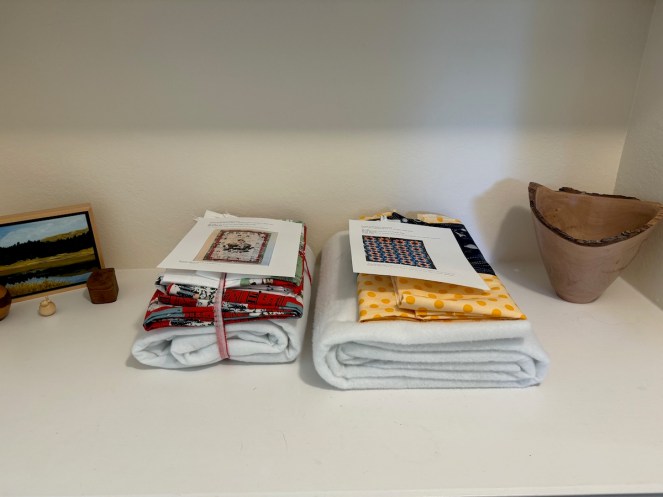
Finally the parts are ready. I sometimes will wrap up the parts for a quilt together, as the batting isn’t labeled. I do put little signs at the TOP of every piece, so that if I have a certain direction I want the top to go in, Jen will see that. (She always sends the little signs back to me.)
Then it’s find a sturdy box, put in a giant plastic bag, placing the quilts inside the bag. I include a paper with both of our addresses, and then tape the label on the outside of the box. I re-use bags, keeping them in my quilt closet so I know they haven’t held the lawn clippings from outside. Kidding. We recycle our lawn clippings. And our table scraps. And our cardboard, bottles, etc. And I reuse a lot of my quilting scraps and make Frankenbatting, so I’m good on that front, too. Geesh, I sound like I live in California, or something.
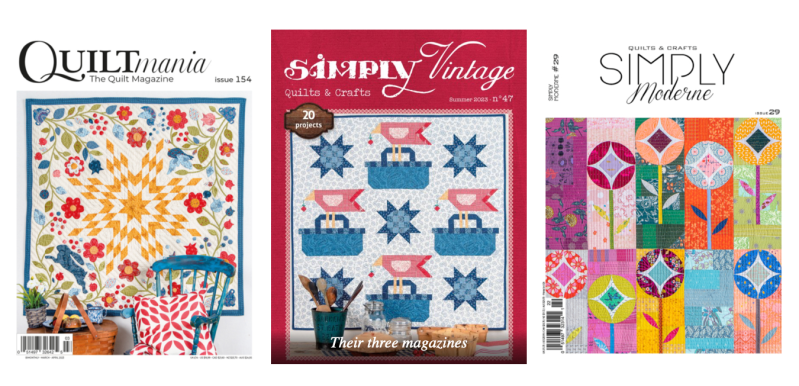
Recently the news came out that QuiltMania magazines (shown above) won’t be on newsstands for you to snatch up and enjoy. If you want to get their fine publication, you’ll need to subscribe. I’m writing this everywhere (on our local guild blog, too), with links to QuiltMania, Simply Vintage and Simply Moderne, so you can welcome this subscription into your home. We let our beloved Quilters Newsletter slip away from us; let’s keep these magazines around. I love that I get a glimpse of various quilt shows, how quilters around the world are doing, and different trends that can only come with a global viewpoint.
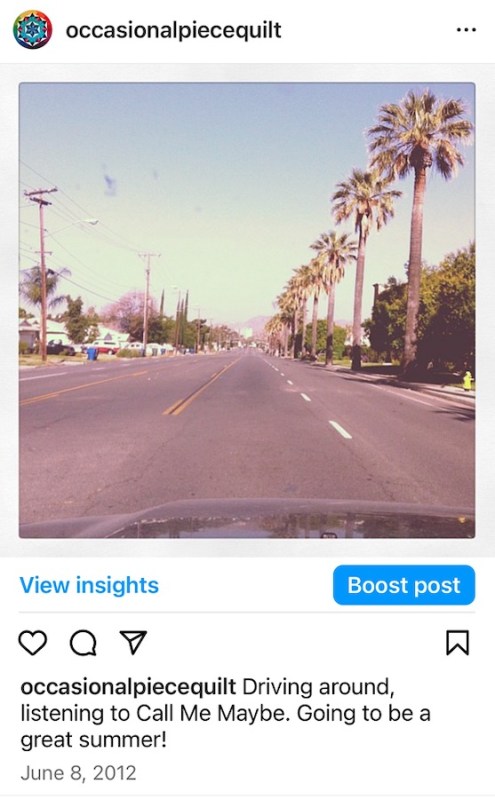
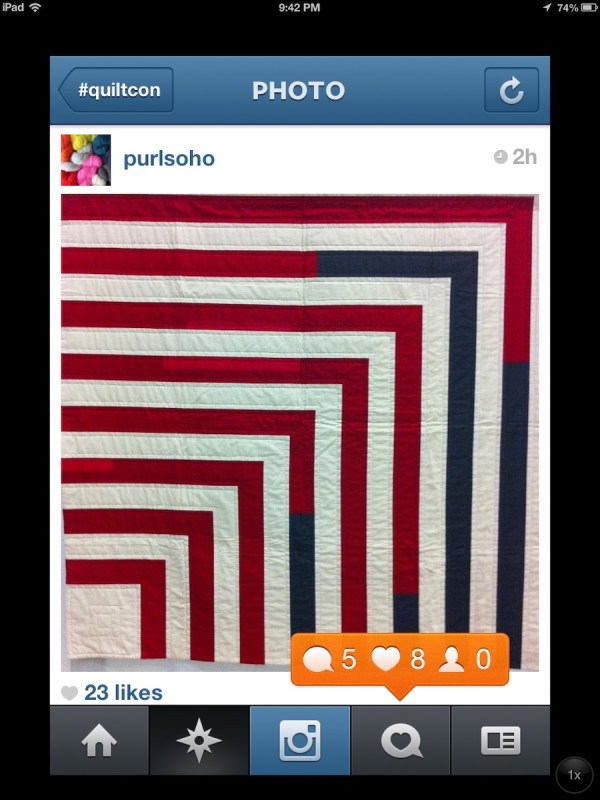
On the left is my very first Instagram post, on June 8, 2012. On the right is a screenshot of how Instagram 2012 really looked, with those blue banners. This is a screenshot of a quilt from QuiltCon, in 2013, and it’s when the power of this app sort of came alive to me–I could see all these quilts at a show where I wasn’t. I don’t remember much about comments early on, although clearly we could make comments. I remember that we mostly concentrated on how many heart-likes we received. Many months later, one quilter that I followed was diligent in replying to each and every comment, and I remember thinking: “We’re supposed to do that?”
Why am I strolling down memory lane? Because Instagram did this to my account:
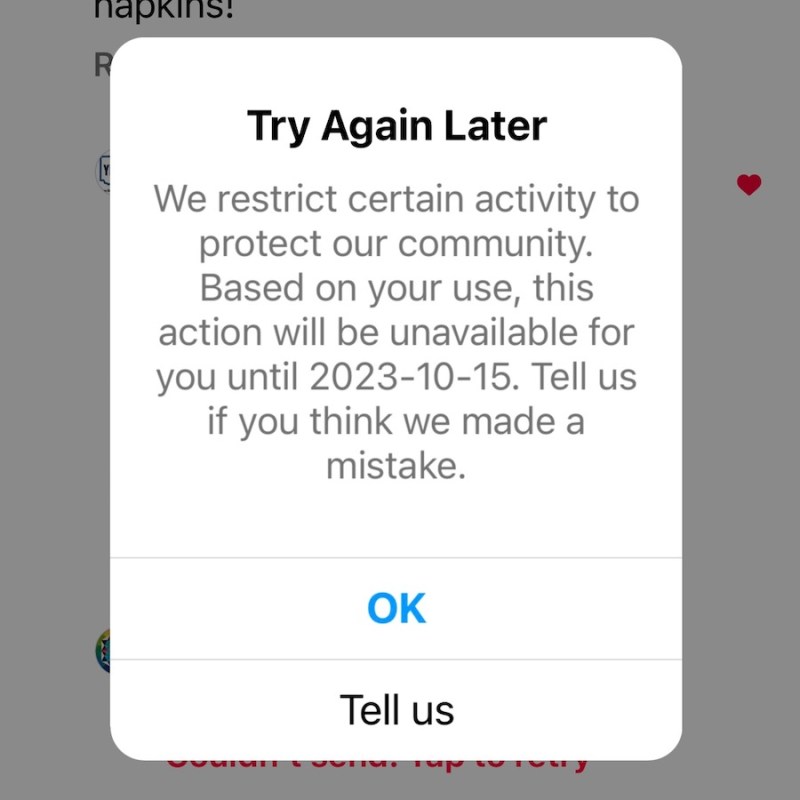
And they aren’t kidding. The “Tell us” button is bogus. It does nothing. So I’m back to a decade ago, liking things, posting things, but unable to have a conversation. If I really need to get through, I send a DM. It’s kind of weird, but also very freeing — meaning that while I miss our little conversations we had every day — I’m not included in the IG universe for a while. I don’t really know how to describe this, but it feels very much like how I felt at the beginning. And now this little meme is how it feels now (watch out, there’s one bad word), and it takes a minute to figure it out, but it’s so good.
Couple that with the warning I saw last week that if we have any Jewish or Palestine feeds, we should stay off Instagram for a while, as the Hamas terrorists are plan to air videos of those they took hostage, and it won’t be good. The whole incredibly horrendous attack on Israel has me aware, but admittedly, hiding. I know what’s going on and am not turning a blind eye to the suffering, but I am careful where I click, what I watch, all the while keeping the prayers going, and wondering which charity to donate to to help. Our church partners with many non-profit organizations around the world, and I know that soon we’ll find our avenue of action and a way to help. As Elizabeth Spiers wrote for the New York Times, “Sitting with uncertainty is hard.”
I imagine you are all in the same boat I am. So I write seemingly blythe posts like this one, but know that’s all I can do at this moment. I remember that even Christ was “troubled in spirit” as he contemplated what would befall him, when he considered the betrayal that would come. And the children in that area of the world, and their families, have certainly been betrayed. Wherever you find solace, I wish that for you, because for many of us, “peacemaking means that we resist the impulse to respond and instead…remain quiet” (from here). This does not mean quiet forever, but actively looking for the right moment, the right time, and in the right way. During this time of waiting, I will continue to post about quilting, and my life and the things that infuse joy, working to steadily to loosen the roots of evil where I can.
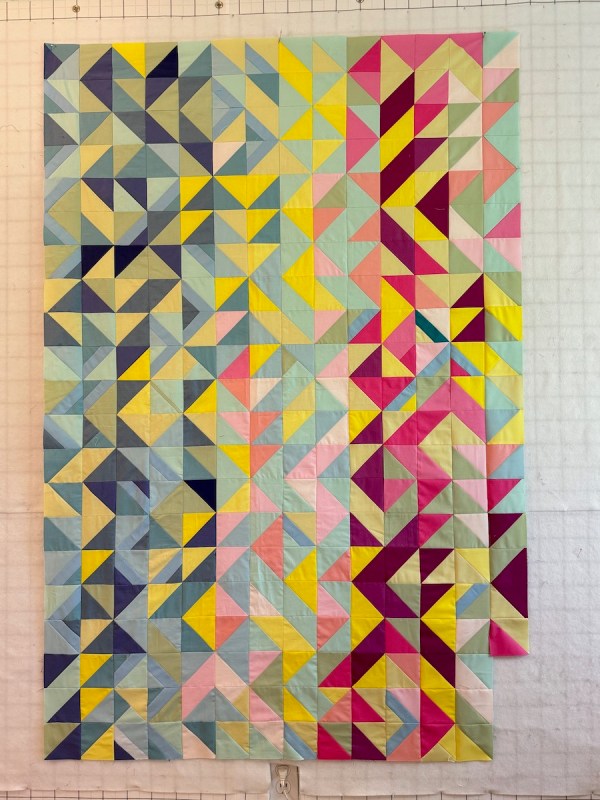
So, last quilt to report on. Progress on the temperature quilt for 2023, as I’m pretty much caught up. It’s a whole different color scheme than my first one, and the jury is still out on whether or not I like it. And yes, speaking of juries, I was summoned to Jury Duty for this next week, but since I’m going to be here…
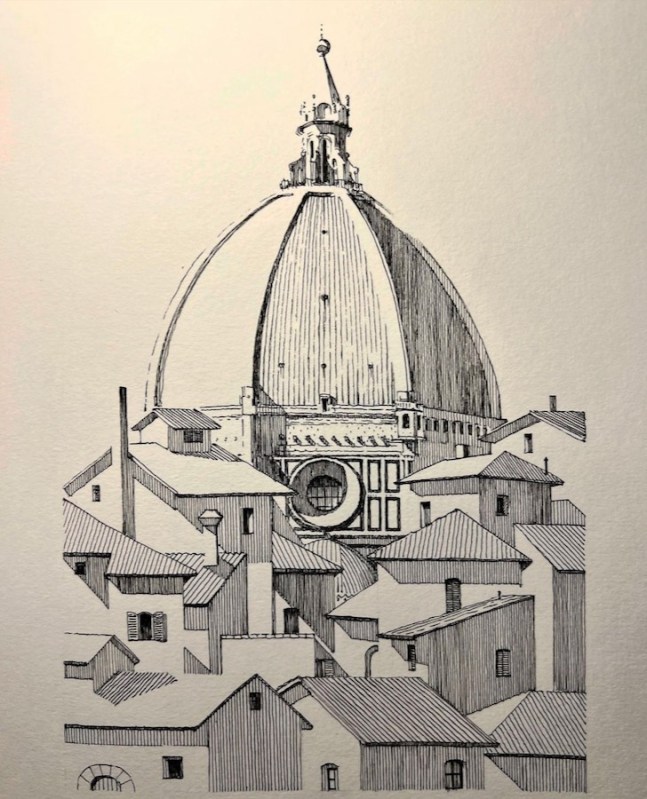
(from here)
…I moved my summons day until after Christmas.
See you when I return from our trip–