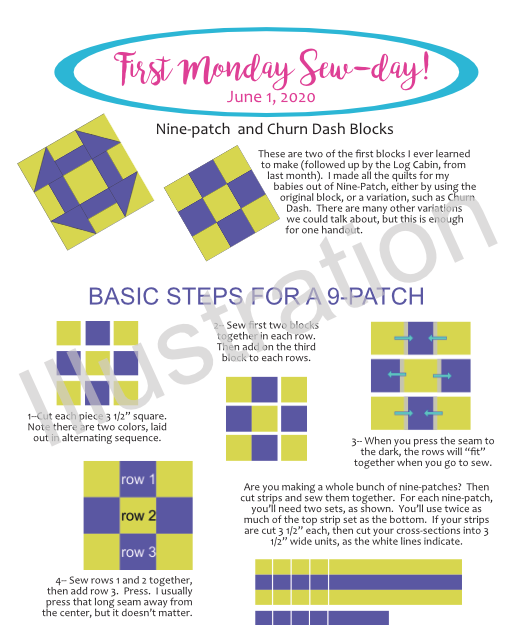
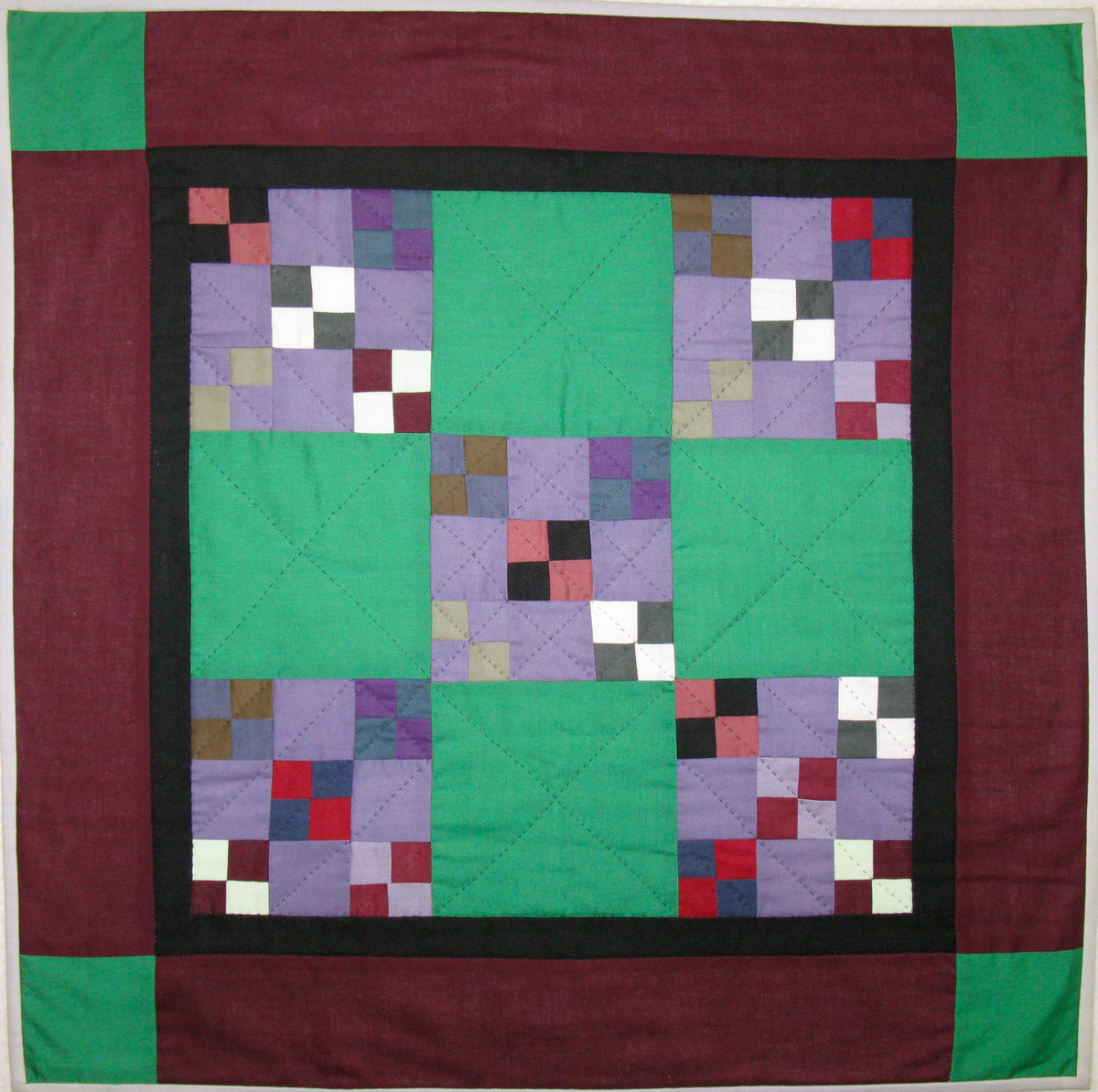
So what if you were trying to think of the basic blocks for beginning quilters? What would you choose? So far in our First Monday Sew-Day series, we’ve done four-patches and square-in-square and half-square triangles and flying geese and a few others (Log Cabin was last month), so I thought I’d take a look at another basic: nine-patch blocks. Above is a version of this block, colored a little differently than what we usually see.
For the handout for the nine-patch/churn dash blocks, click to download a PDF file:
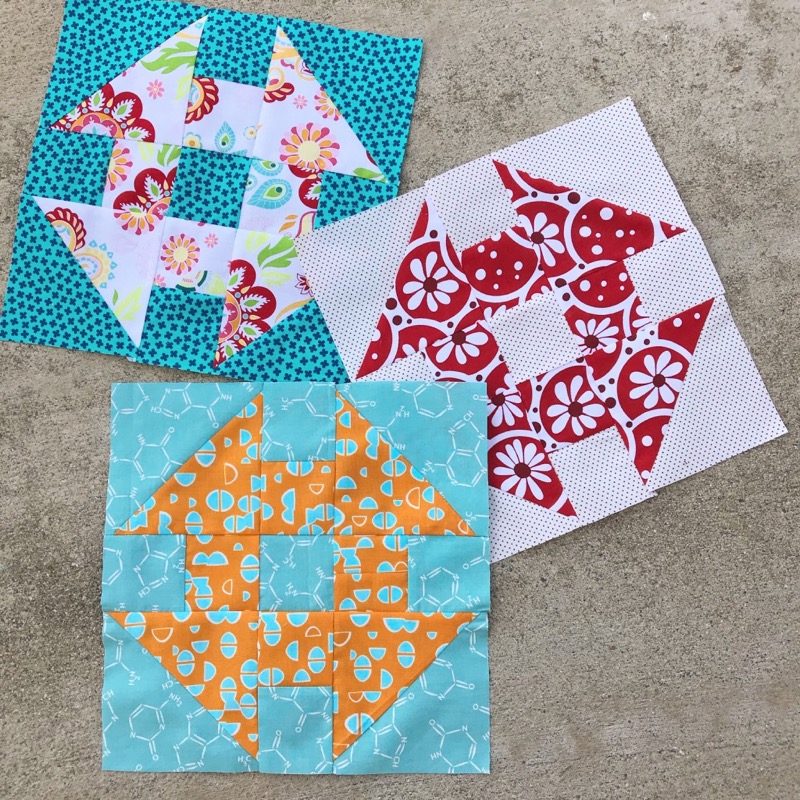
You think I might have caught that wonky churn dash.
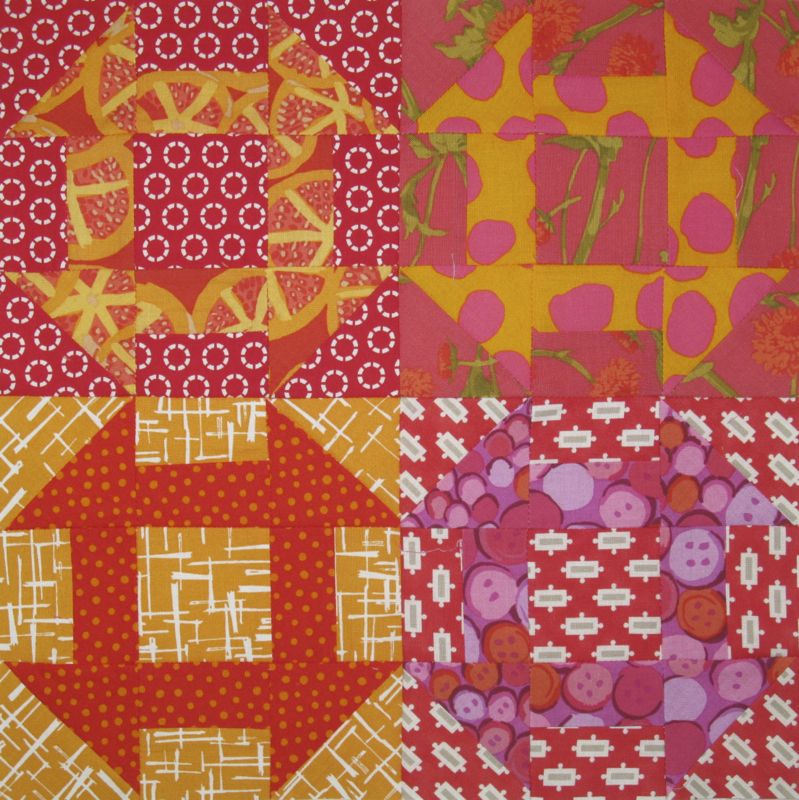
I recently made some churn dash blocks for the #dungeonofcute quilt I’m making, and yes, I did fix the problem in the upper left. For this beginning class handout, however, I chose to make the churn dash blocks more like nine-patches, rather than the adjusted proportions, seen above.
Here’s another variation of proportions: large corner squares, and smaller centers.
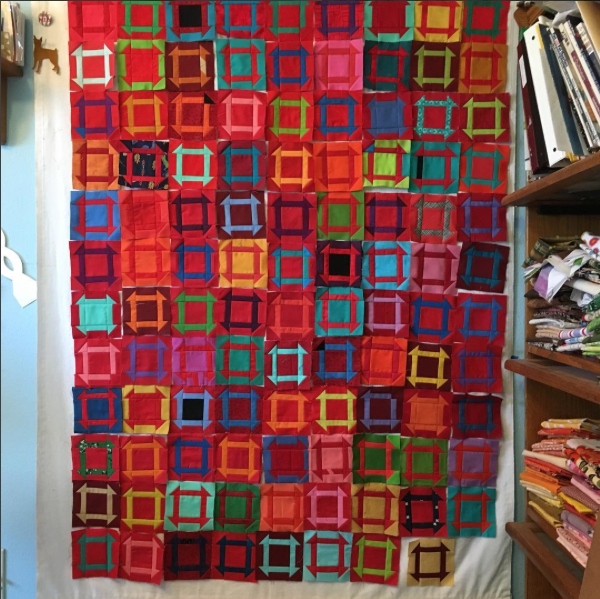
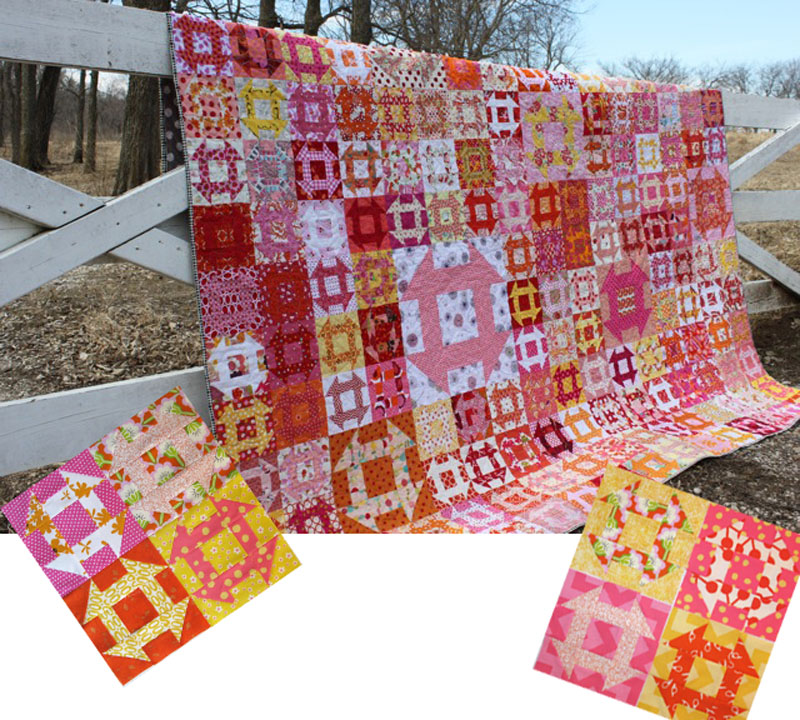
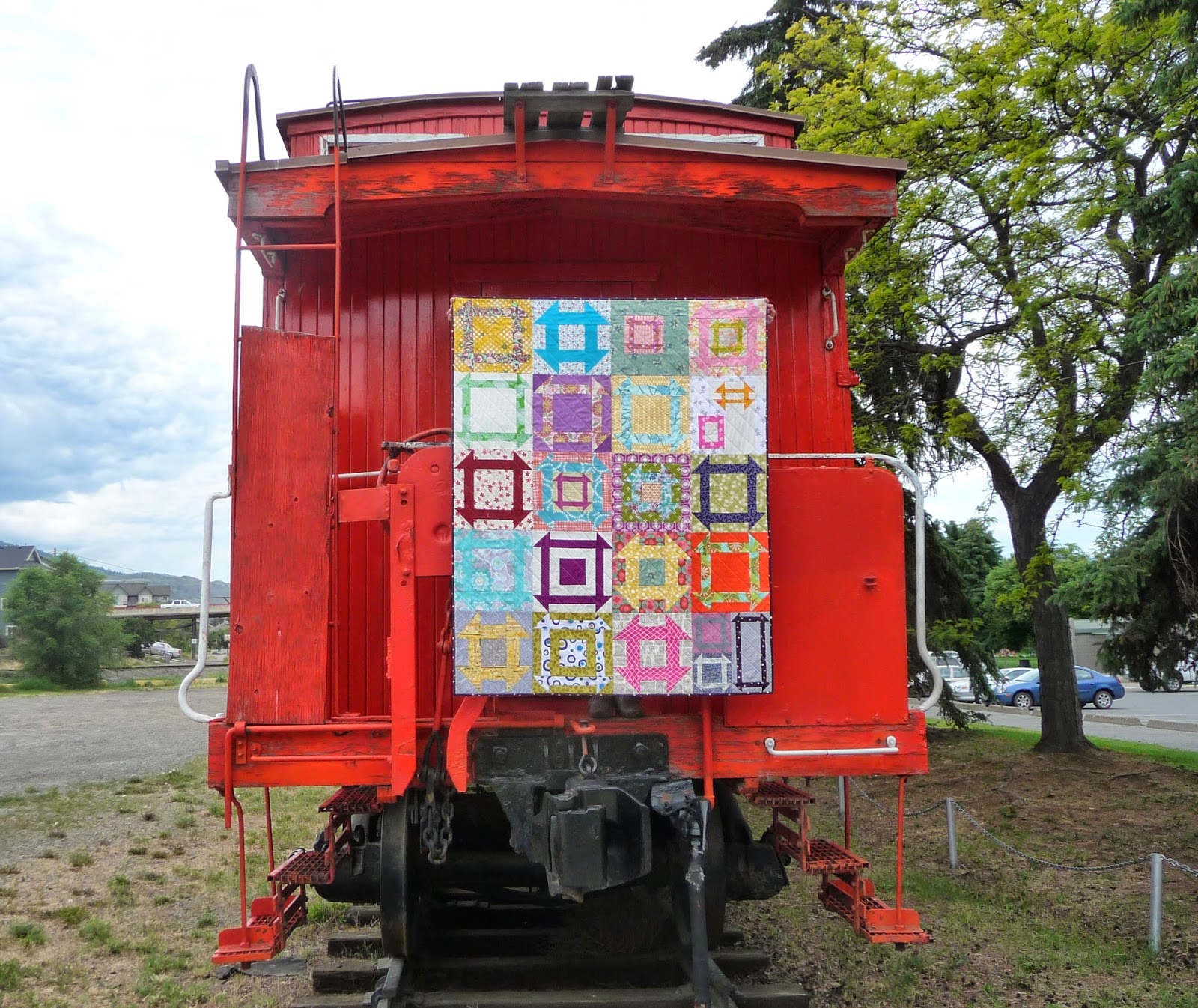
This is one of those Frivols quilts that I did in 2018, which frankly seems like it was about a century ago. All churn dashes, cozied up to each other.
This quilt is the result of a bee; Linda asked us for small churn dashes, with skinny sides and big, fat centers, in these colors. It’s a really fun way to work with churn dashes.
While I’ve never done a large quilt with churn dashes, more bee-mates at the time asked for them, in two more different styles. The blending of value and color in the bottom really makes it interesting.
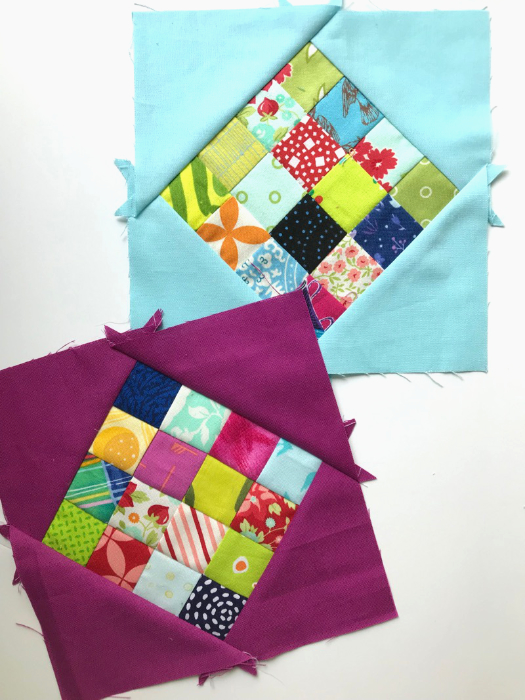
Here were my two blocks that I made for Carla T, and the finished quilt, with giant churn dashes interspersed in among the smaller ones.
Here’s a nine-patch “quilt” done by an artist I follow. He works in paint. He told me his mother was a quilter and I can see her influence.
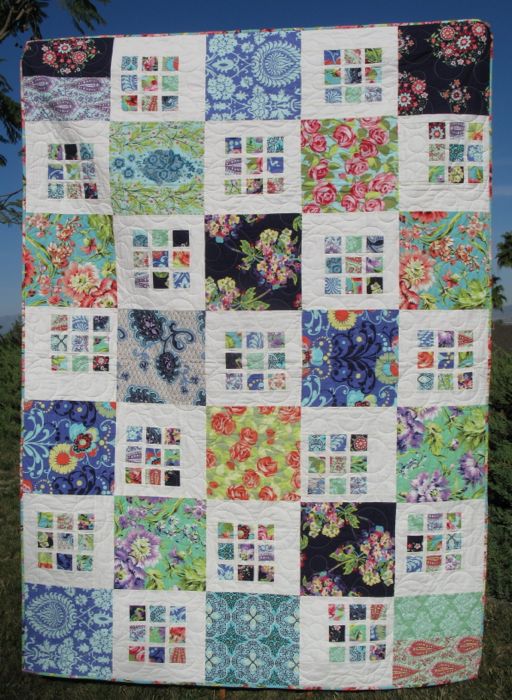
And here’s Quilt Frolic, a series of nine-patches, set in a an off-set white block, with tons of Amy Butler large-scale prints.
All our Handouts and topics can be found in the tab at the top of my blog: Projects for 2020/First Monday Sew-days. More quilts can be seen below, in a gallery.
Happy sewing!
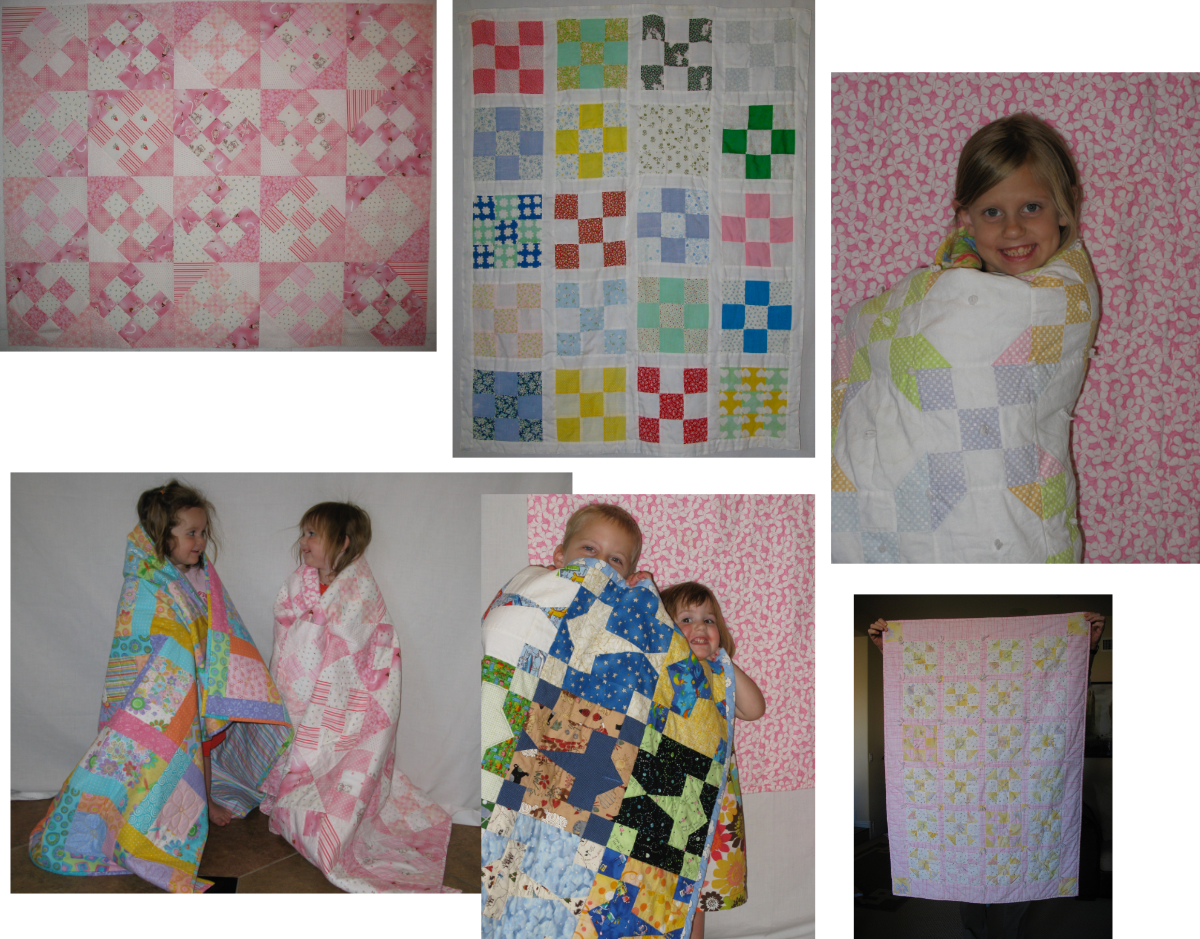
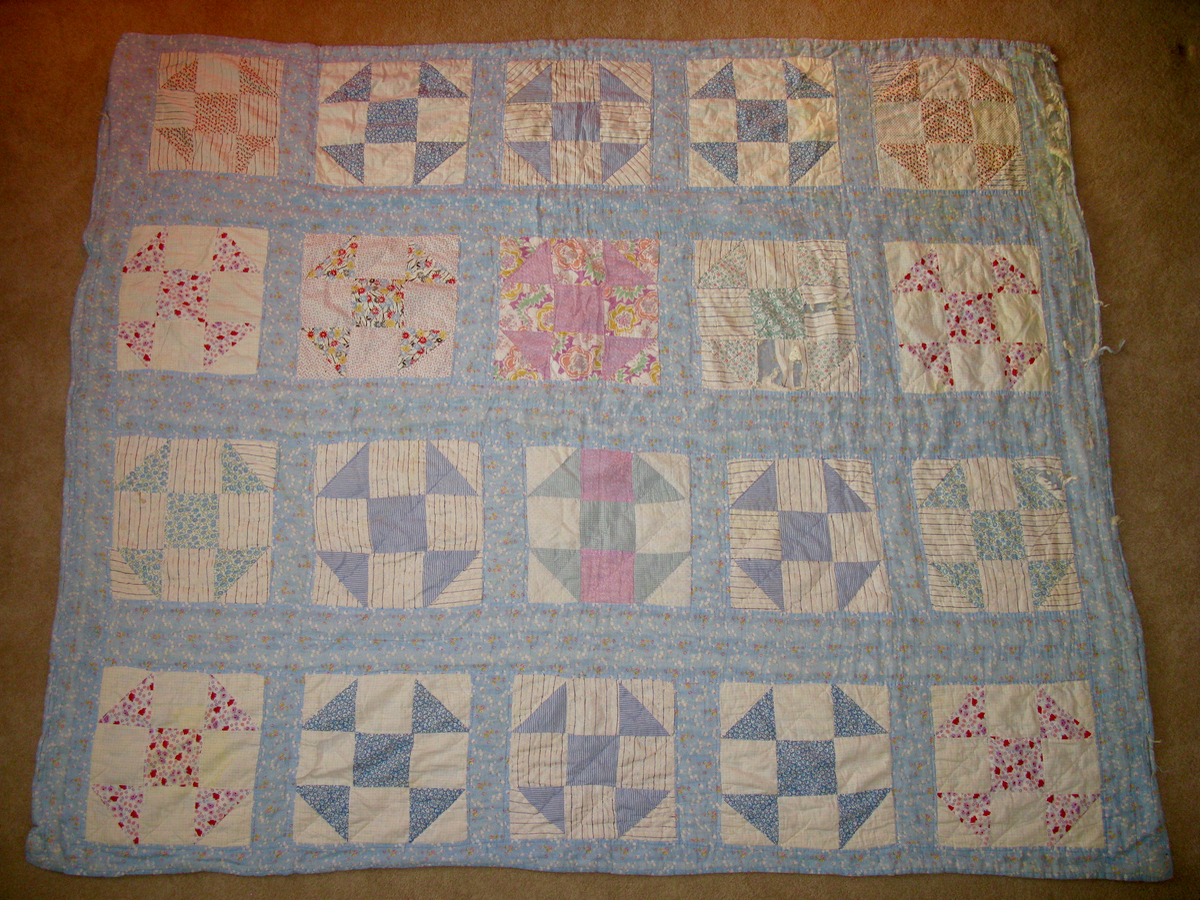
I’ve made a lot of baby quilts using nine-patch variations.My mother helped make these nine-patch variation (shoo-fly) blocks nearly 85 years ago.Mini Quilt: Amish double Nine-PatchCarla’s quilt, from here
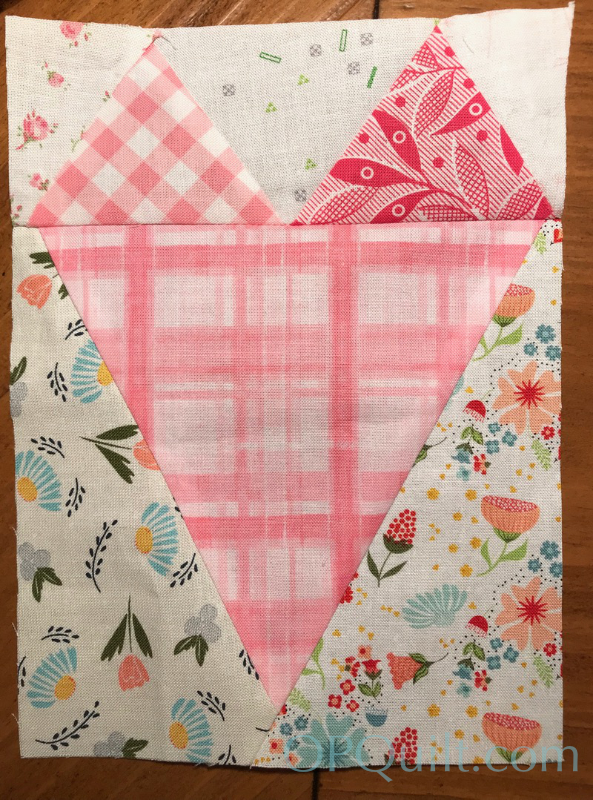
How do I make nearly 60 wonky, improv-y hearts and not go crazy? Now there’s a challenge.
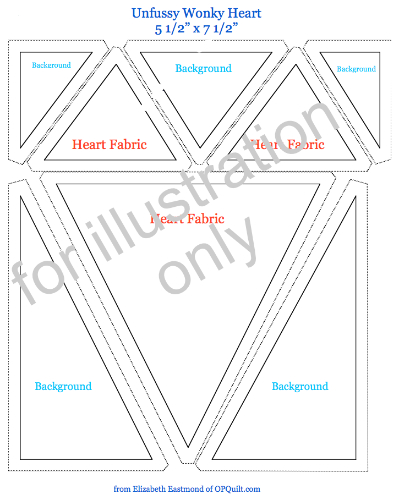
I started here, with a rough pattern of how big I wanted my “improv” wonky heart to be. The free PDF file is available for download. It finishes roughly at 5 1/2″ wide by 7 1/2″ tall.
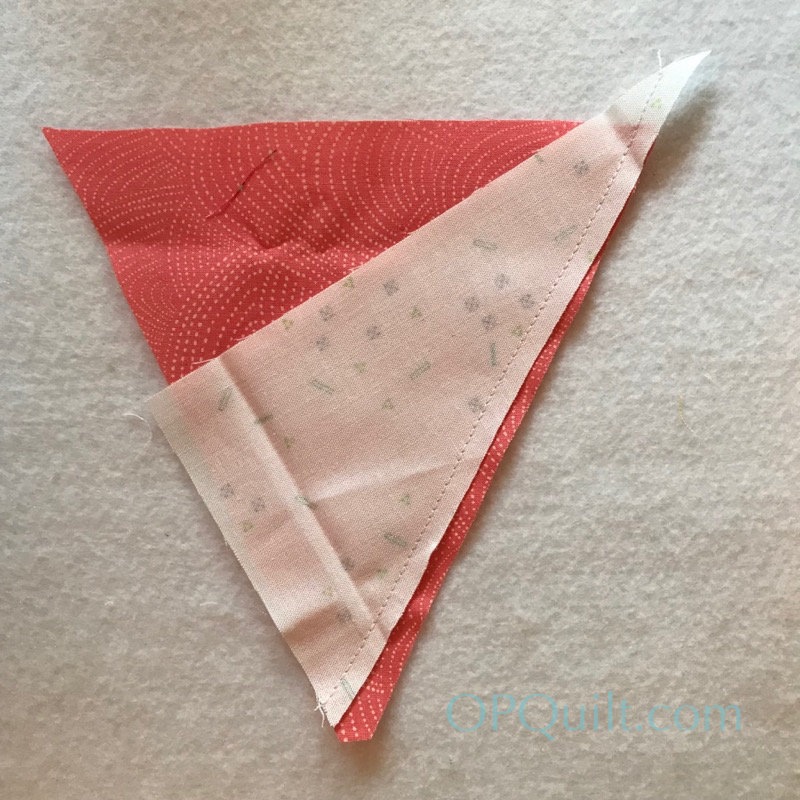
I started with the heart pieces. I layered up seven pieces of different pink and red fabrics, pinned on the heart pieces and placing my ruler along their outer edge, I cut around them with a rotary cutter: it wouldn’t really matter if I was hyper-accurate…close enough would do. I repeated this nine times.
Then I did the same thing with the background pieces, but was careful with my directional fabrics: I kept the pieces oriented as they would sew into the heart block.
Everything’s stacked up.
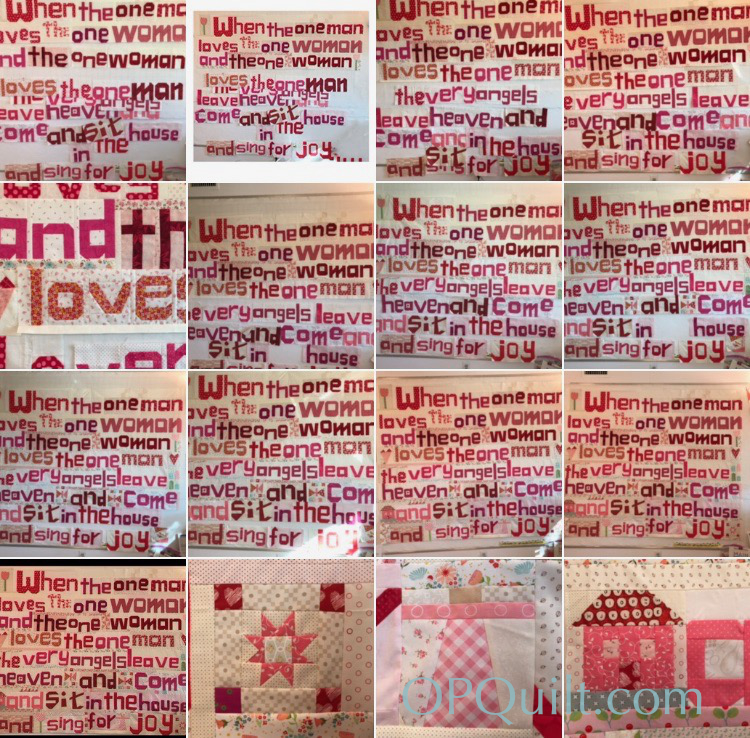
These photos were taken over two weeks’ time, as I tried to fit all the words together. Words were made in The Spelling Bee, from 2016.
I shuffled the fabrics so no two fabrics would be together, and made a sample heart (at the top of the post). I pinned it next to the quilt of words I’d been working on, closed up the machine, turned off the iron, and enjoyed the sunset:
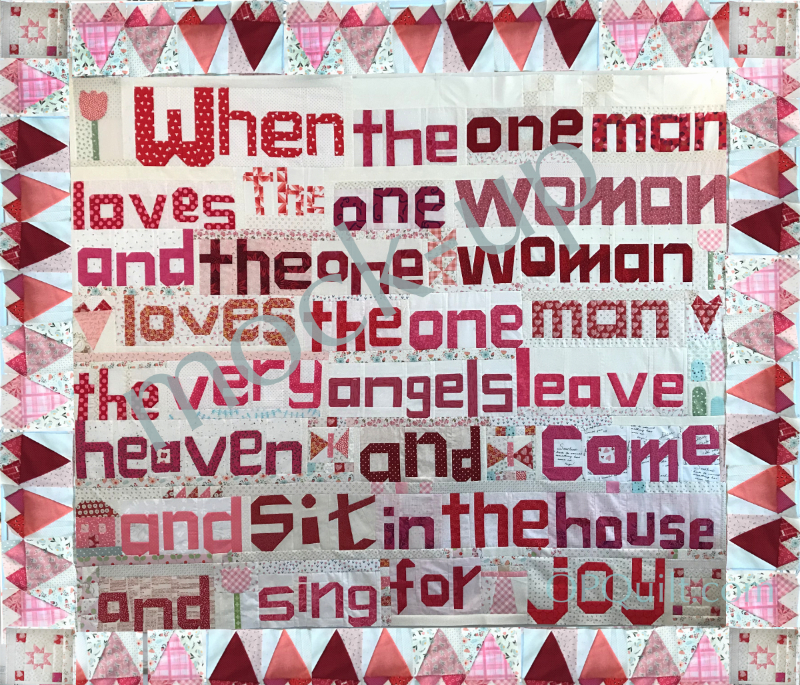
When I woke up in the morning, I decided to try a digital mock-up of the quilt with the hearts as a border, as I wondered if the hearts were too big. I sent the photo to my two of my quilting buddies and they gave me two thumbs’ up. I’ll probably try to sneak in a narrow red/pink border between the quilt center and the outer border of hearts.
I’ve become braver about being wonky and improv-like, skewing seams, overlapping, cutting off points, generally going at it easy, instead of pristine.
I have a few more hearts, now, and while the widths vary from 5 1/4″ to 5 1/2″ (I just trim them where it feels right), I’m forcing them to 7 1/2″ tall (that’s before seaming). Because I am tired of cutting off the points, I’ll now be cutting about 1/2″ off the bottom heart section before I seam it to the top part.
This is one of two long-term UFOs that haunt me in my dreams. The other one is Small World, which I keep in parts in a basket in my shelves. I do have hopes on finishing that one, too. I signed up for a Jen Kingwell class at Road to California in January; I suppose one goal would be to have it finished so she could sign it? Right.
In other sewing news, I finished July’s Gridster Bee blocks for my beemate Linda and sent them off.
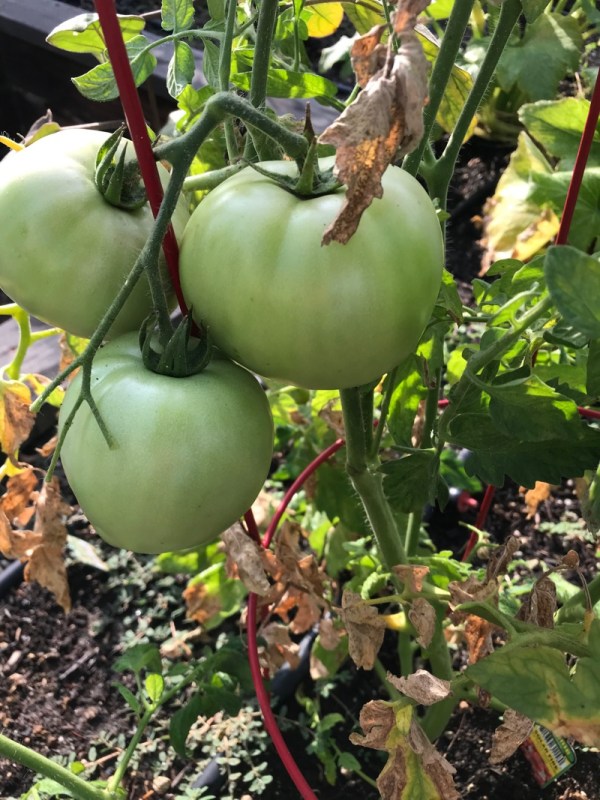
And I’m trying this new type of tomato, developed for scorching temperatures. This year we were almost chilly and foggy until June, then the temps shot up high. I haven’t had good luck with my garden in three years, after a stunning first year of beginner’s luck. But hope is a thing with feathers, said Emily Dickensen, or my case, tomatoes.
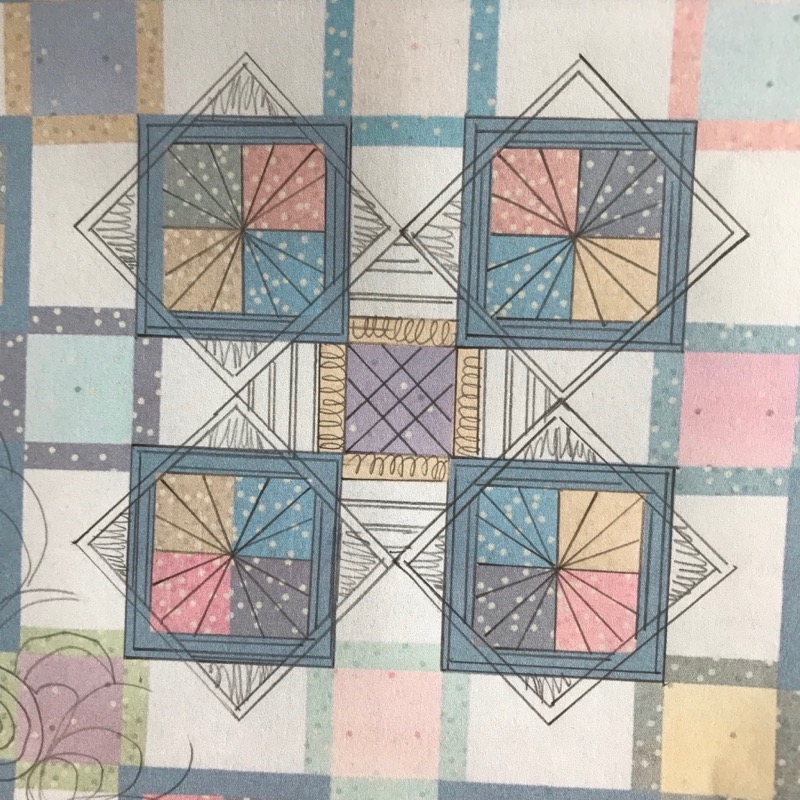
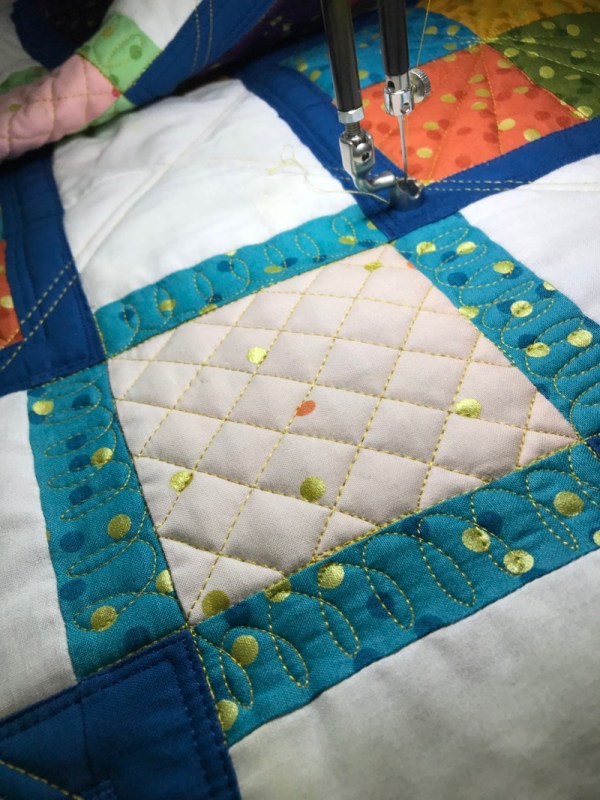
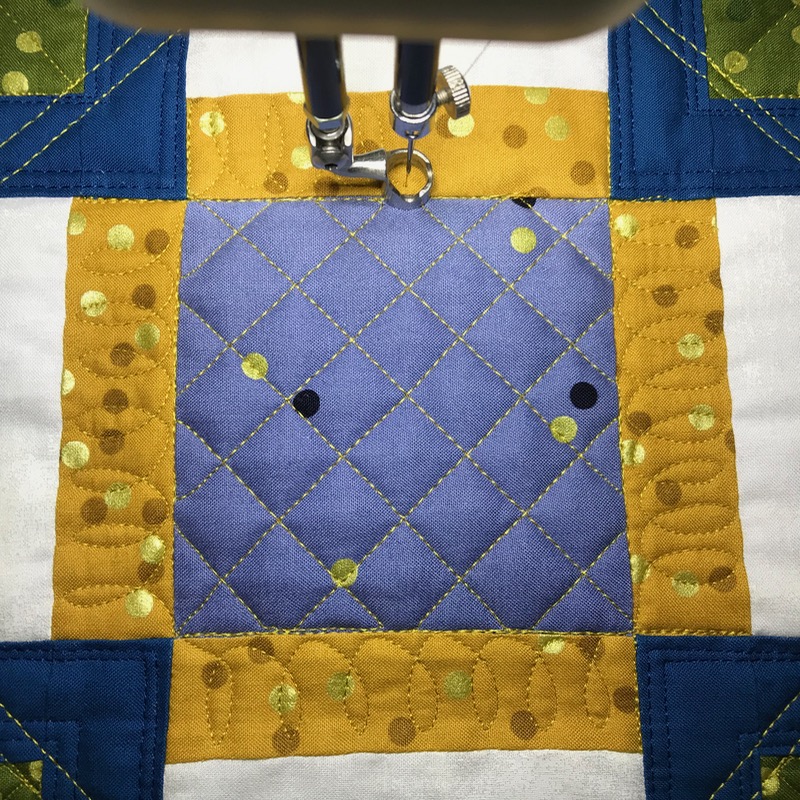
I’ve also started quilting City Streets, a quilt of my own design.
I’d picked up this Magnifico-cousin (same type of thread) when I visited Superior Threads last time. It’s color 101, and it looks like a gold thread, but isn’t a metallic thread:
I hope I don’t run out before I finish this quilt.
Finally, in my discussion about how the internet irritated me, I read a ton of blogs, some of which I can’t quite remember. But I did take a screen shot of this gem, a featured quilter on a truly dedicated quilter’s blog. (Given what he says about his favorite fabric color, I don’t think he would like my gold thread.) However, I leave you with the hope that you, too, have started quilting several times, as well as the ability to make the quilts in your head.
I am the Queen Bee this month for the Gridsters Bee, and thought and thought and thought of what I could do. I happened on this design while surfing the blogs, and something about it just made me smile. Since I am one month post-op on my interminable rotator cuff repair recovery, I realize that it’s probably because I just needed some happy-cheery-goofy-fun in my life.
Yes, I made the tutorial and wrote it all up before I went in to surgery, perhaps anticipating the need for something happy-cheery-goofy-fun. To start us off, here’s something to get you in the mood for making my block this month (stop it about 3:00):
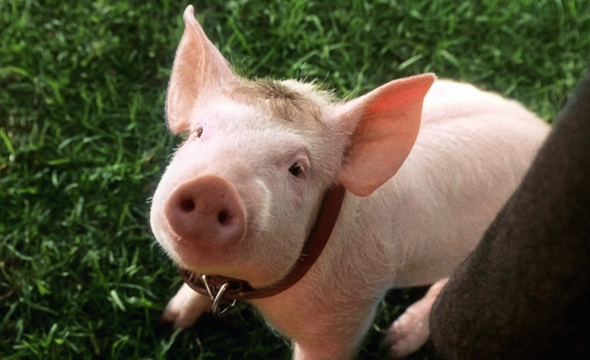
For those of you who can’t see the link, it’s from the movie Babe, The Gallant Pig, completing his “sheep” trials. (Go to the blog if you want to see it.)
Yep. Somehow little piggies have gotten in my heart and under my skin and I want a whole quilt of them, although I may add a barn or tree to break things up. I first found them on Gayle’s blog, Mangofeet, where it says she is a bonafide farmer. She found them on Sally’s blog, The Object of Design, which is where I found a tutorial for littler guys. And I found Gayle, by following a link from Bonnie Hunter’s Quiltville’s Linky Party for her En Provence mystery quilt. Connections everywhere!
Before I leave all the attributions, please visit Sally’s tutorial page, where she has other tutorials for bunnies and fish and all sorts of creatures.
But mine are slightly different, both in size and in style, so I wrote up atutorial for what I want. Since they are small, I’d like you to make me two, if you wouldn’t mind. I used Gayle’s post for inspiration (also look *here.*). To make it easier on yourself, make them both the same, but if you get adventurous, it’s okay to flip the orientation of the piglets, or make one going up and one coming down. But really, keep it simple so you aren’t calling me names in the middle of this process.
Again, while Sally has a tutorial (linked above) and she is the designer of this block, I changed up a few things (like the dimensions), so please follow along and make my piglet according to my tutorial. The piggies are all scrappy, but I do need:
sky–a consistent low-volume or “background–no need to make them the same fabric, but the do need to be the same lightness: pale blue, cream, white, tan, low-volume with grey/tan/etc. prints. Avoid prints with too dark of text or design so that it throws it to a muddy tonality. Some background prints are fun and will make the quilt more sparkly. It’s okay to mix up the borders, but I’d probably stick to the same fabric around the piglet.
body–a medium value fabric: small print or geometric, floral, Kaffe, but avoid fabrics that look “splotchy” when cut this small (such as cutting a giant polka dot in half)–generally anything in your stash. Have fun. Make me some colorful piglets.
ears, feet, snout–a darker-toned fabric that stands out from the body fabric
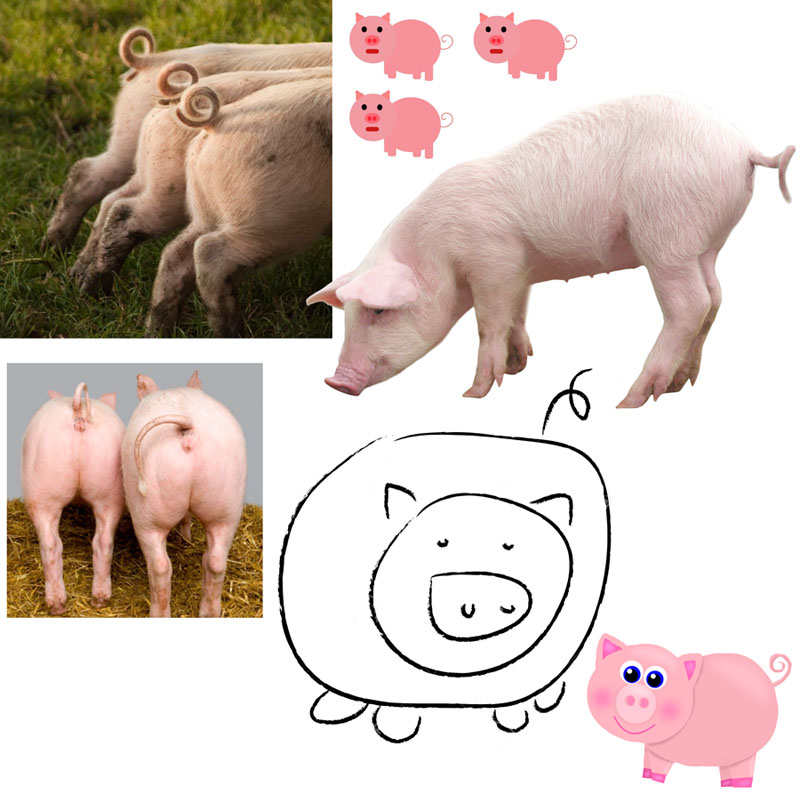
tail–embroidery floss/Perle cotton to match your piglet, to embroider the tail. Pattern is not given for this, but below are some piglet tail ideas. Please use a back stitch. More info in the tutorial.
Gayle showed hers on a tilting grassy hill, which I like quite well, so that’s what I’m asking you to make for me. Copious amounts of photography and images and text follow, but really it isn’t too hard. The following directions yield one piggie, so cut everything out double, out of two different piles of scrappiness.
Lastly, I follow standard print journalism standards: the caption in UNDERNEATH the image (MQG had theirs backwards on their award-winners page and I was so confused!)
Cut the background (sky).
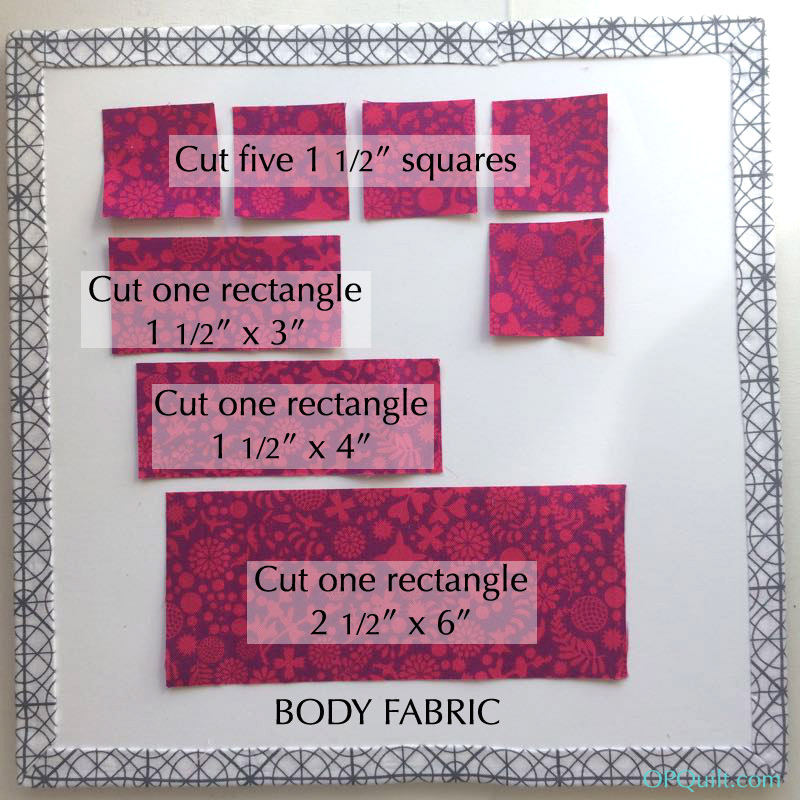
Cut the body fabric.
Cut the accent pieces of snout, ear and feet.
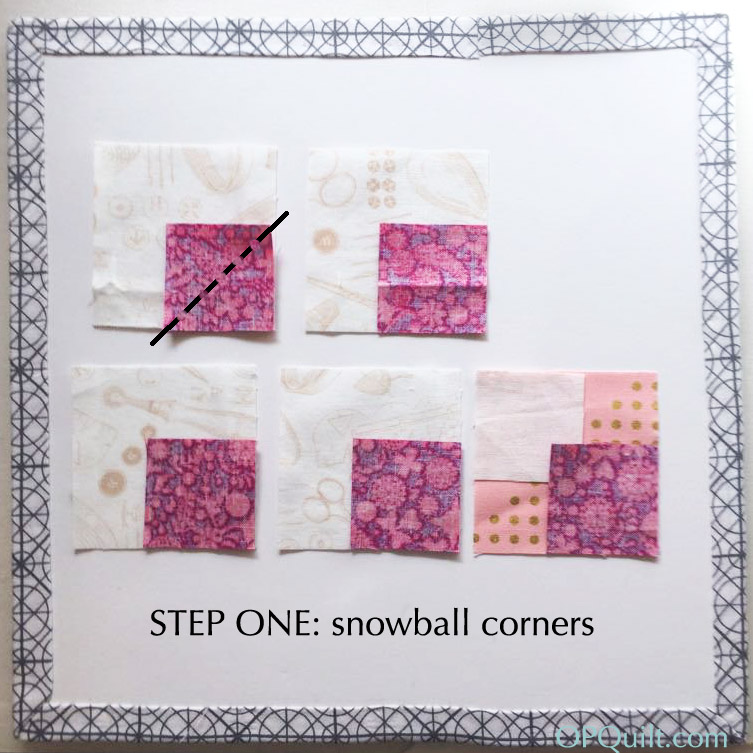
Step one is to snowball body fabric onto the background fabric, using the 2- 1/2″ square pieces of background and the 1 -1/2″ square pieces of body fabric. Then the last snowball is a double: use one 2- 1/2″ square of accent fabric and snowball on one 1 -1/2″ square of background and one 1- 1/2″ square of body fabric. Press the snowball corners to the dark side, and trim after pressing. With the double-snowball, you’ll press one square’s seam allowance toward the accent fabric and the other toward the body fabric.
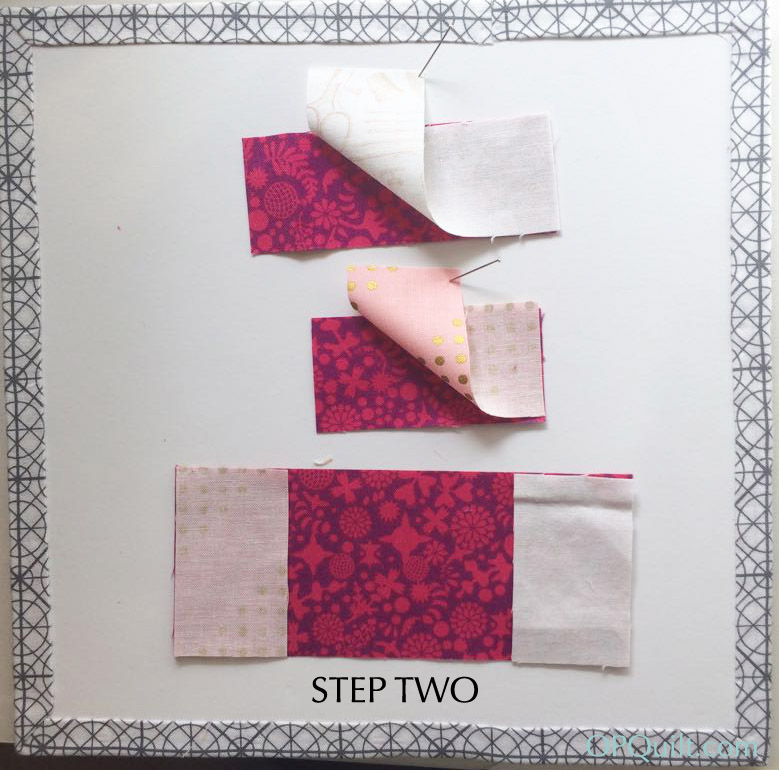
Step two is to gather the other pieces together: Line up the 1 -1/2″ x 4″ pieces in body and background, AND the 1- 1/2″ x 3″ pieces in body and accent. Place on the front accent piece (snout) and the back background piece on the large body piece (lowest piece).
Step three: sew the strips together and then press to the dark side on the top one. I don’t care which way you press the bottom one, but I went towards the dark as well.
Now cut those strips in half. Exactly. The top strip set (A) will yield two with body and background fabric that will measure 2″ across. The bottom set (B) will yield body and accent fabric that will measure 1 1/2″ across.
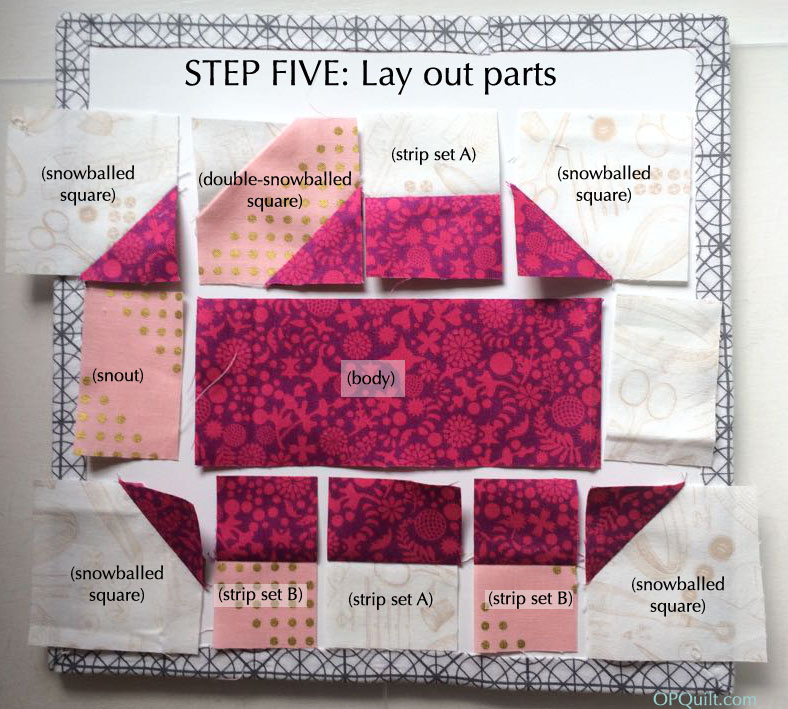
Step Five is to lay them all out. If you were going to make a reverse-direction pig, you’d need to fiddle with that ear (double-snowball) piece to sew that up differently, otherwise, everything else is the same/can be moved around. (See second pig at the end.)
Sew the top row together, then the middle and yes…sew the bottom row of pieces together. Pressing instructions are in a minute, but generally press towards the dark. PLEASE DO NOT PRESS THE SEAMS OPEN.
Babe!!! Babe!!
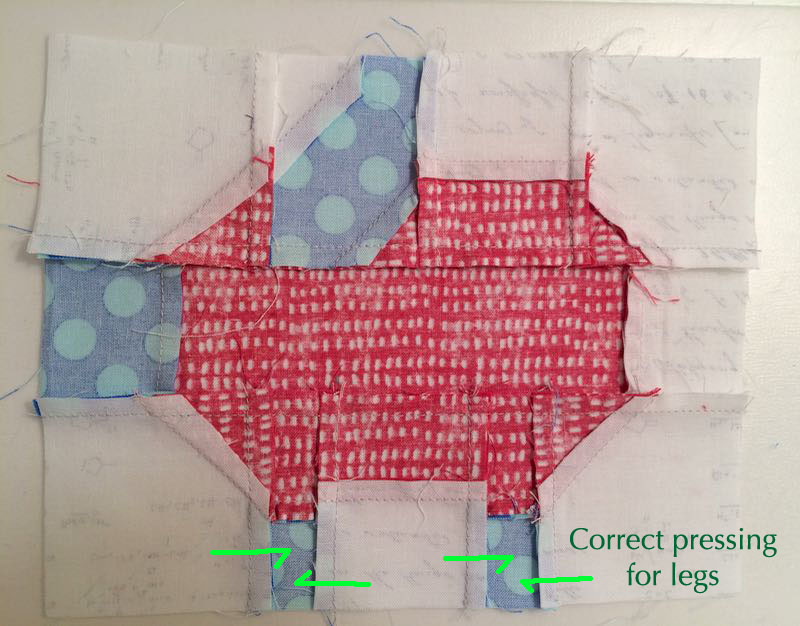
This is how I pressed the seams. I just realized I pressed the legs the wrong way. Oh well. Either way is fine, but just not open. [NOTE: I show it correctly in the second pig, at the end.]
Time to tilt this little guy. Start by sewing on a 2- 1/2″ strip of ground–can be green for grass, or flowery for a meadow, or brown for forest floor or purple for Outer Space. It just has to have contrast to the background and side strips.
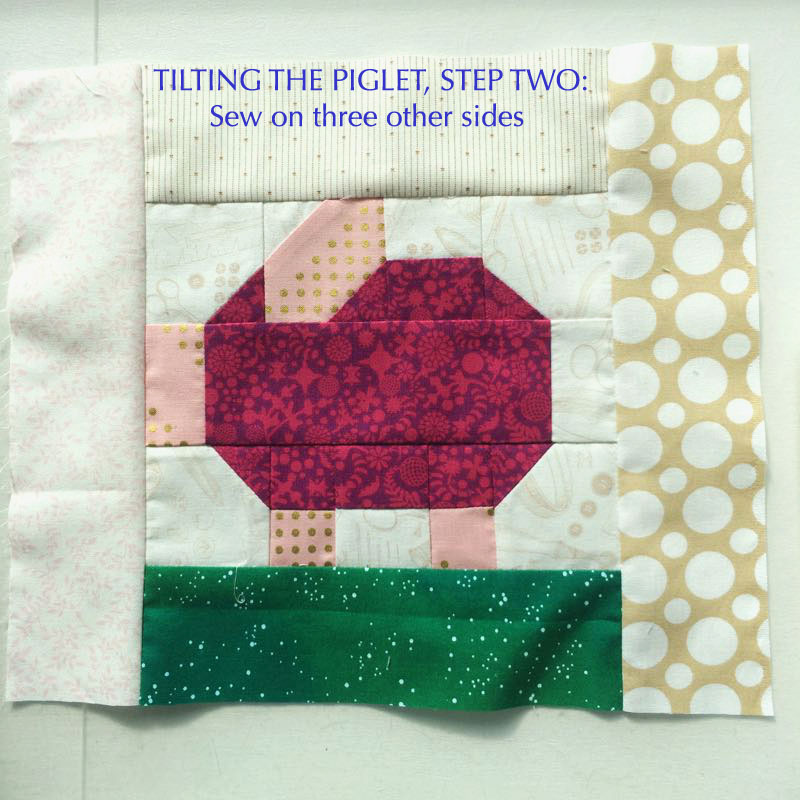
Sew on three side strips, by FIRST sewing on the top, then the two sides, all 2 -1/2″ wide strips.
UPDATE FOR MY BEE MEMBERS:
Please do not trim. After sewing on borders, just send untrimmed, untilted.
Now back to our regular programming.
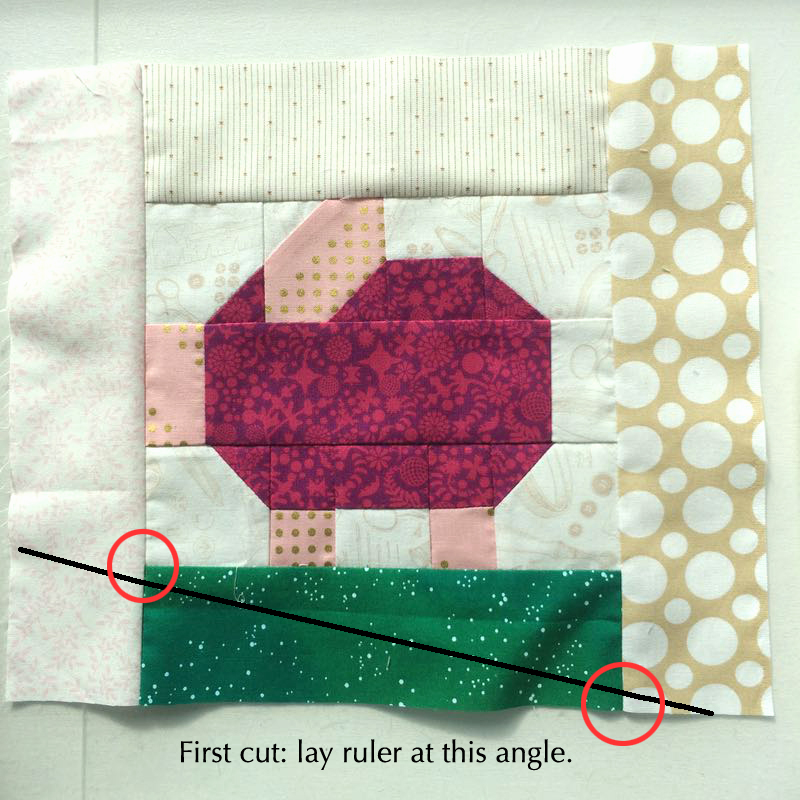
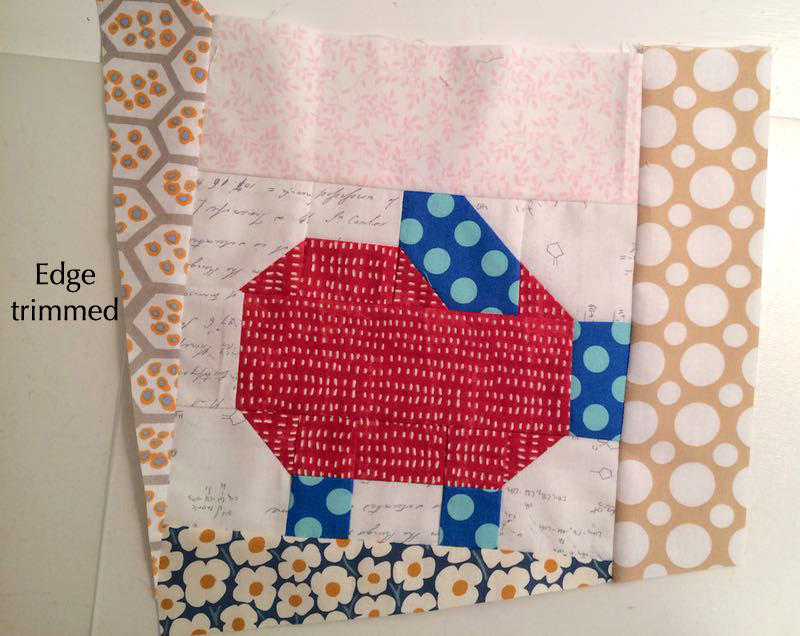
Now to cut. Please check the areas in those red circles to make sure you are leaving 1/4″ seam allowances (one above the line, one below the line). Lay your ruler with the edge along the black line, above. Cut.
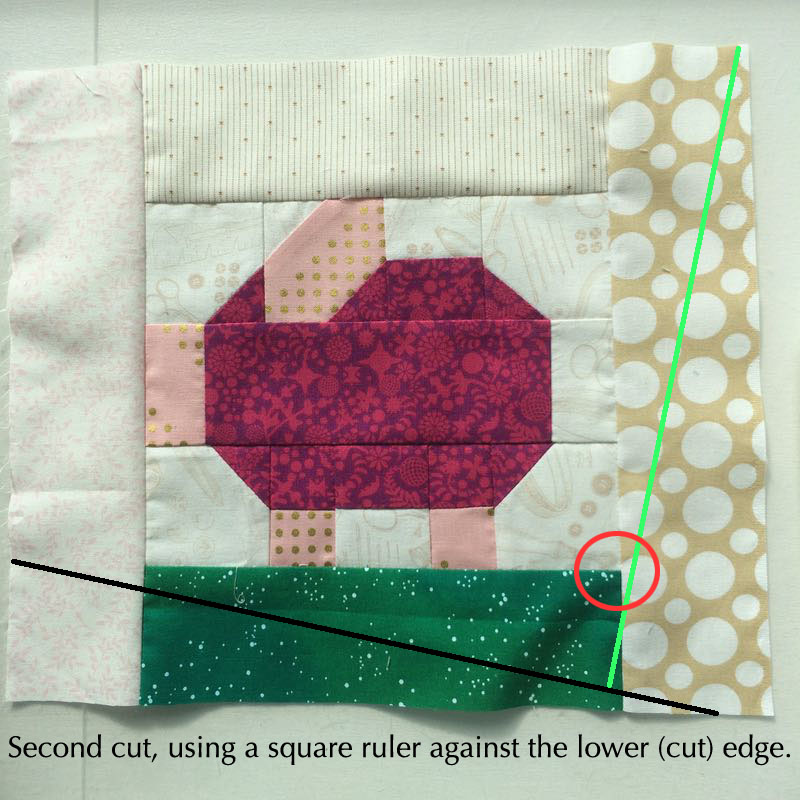
Now lay a square ruler at the bottom (newly cut) edge. Now play with the adjacent side it a bit, making sure to leave that 1/4″ in the circled area. Cut.
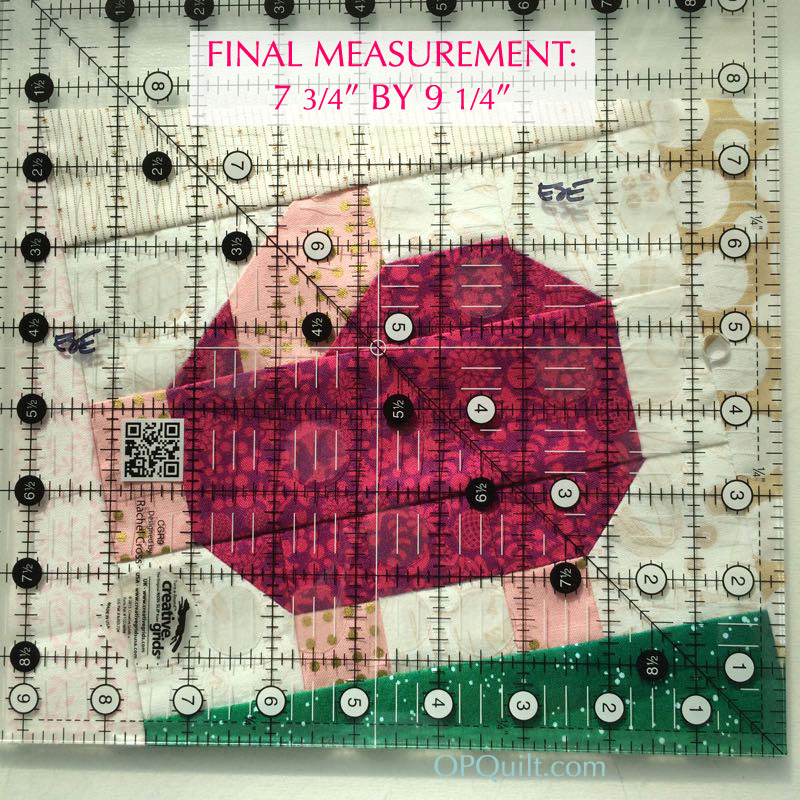
Now think about it as a beginning rectangle. Turn the piglet 1/4 turn clockwise so that the newly cut green line is at the bottom of the mat and the black line is to your left. Measure over 7 3/4″ from the black line; cut.
Measure 9 1/4″ up from the green line; cut.
Tilt the pig back to a proper vertical and it should look like this:
The piglet’s rectangle will measure as shown above: 7-3/4″ high by 9-1/4″ wide..
Again, this is the most important corner when you cut for the tilt. It’s so the ground will look merged together when seamed.
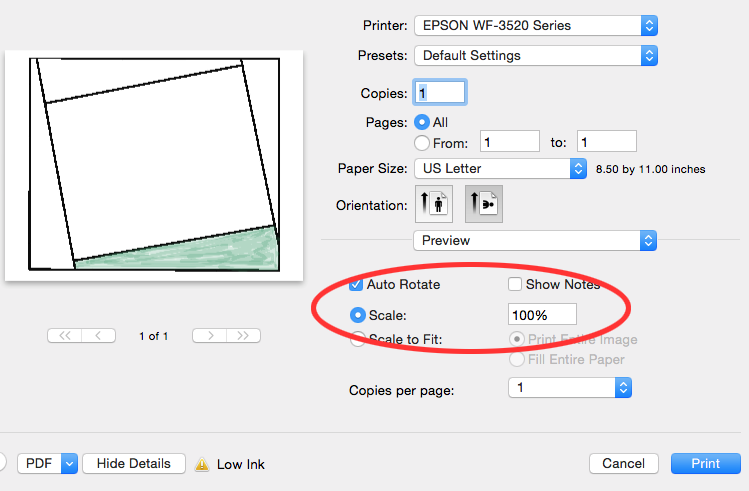
I made you an overlay, if you are nervous. Download the PDF file: piglet-tilt-overlay1 and print it out on vellum paper, or make a template out of this (too much trouble, I think). It will help you get the right angles.
Please print it at 100% or you will again find yourself cursing.
If you are really truly too nervous to cut this pig, send it back to me untrimmed and when I get better, I’ll be happy to trim it up.
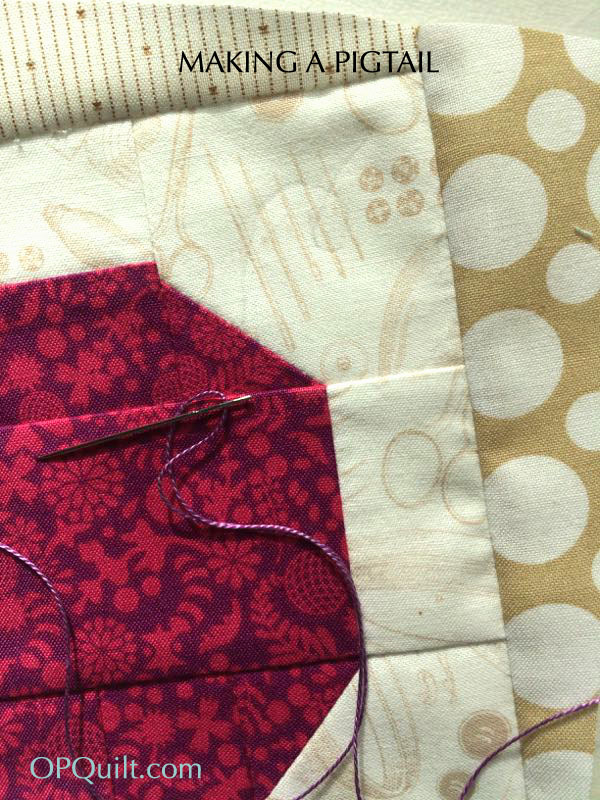
Now let’s add the pigtail. Draw on a squiggle, originating from the pig’s backside edge. My drawn line is really faint, above because I don’t want to have to figure out how to get the pencil off. Sometimes I’ve just eyeballed it. Sometimes I’ve just scratched it in. See the picture at the top of the post for pigtail ideas.
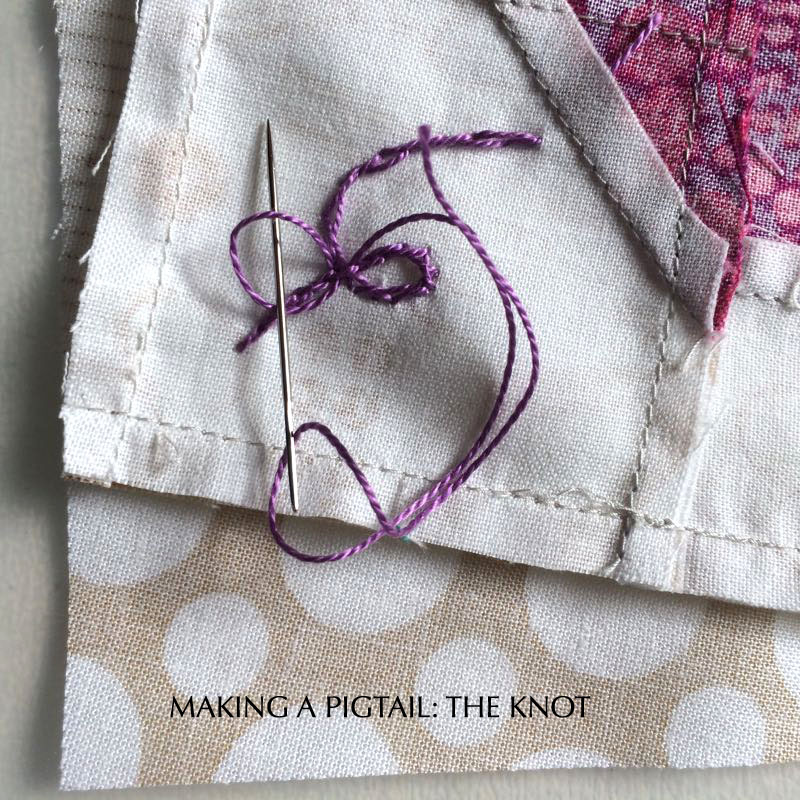
Tie a knot in your perle cotton (I used size 8, but 5 or 12 is fine, too) and bring it out at the fold, at the beginning of your drawn line, hiding the knot in the seam.
Take one stitch (#1) and then skip a stitch, coming out as shown in the photo on the left. Now put your needle in the same hole as where you came out on your starting stitch (#2) and backtrack and stitch that empty place, which will put you on the road to backstitching the piglet’s tail on.
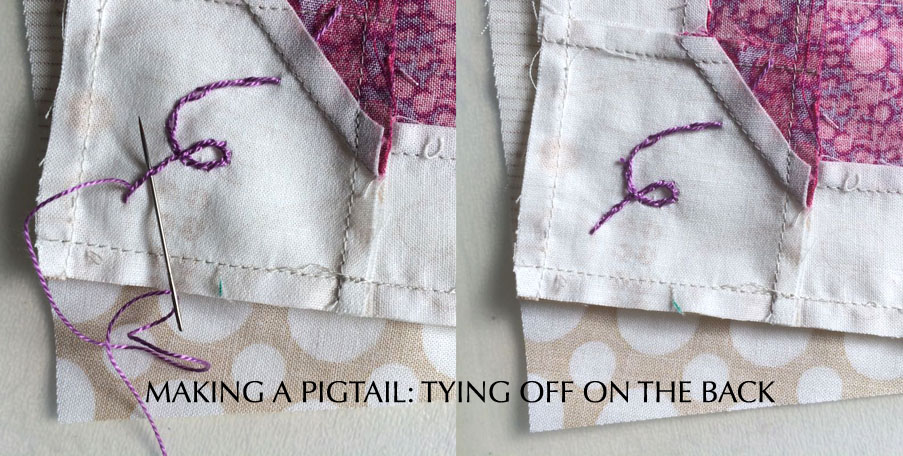
Insert the needle in the last stitch and pull it to the wrong side.
On the wrong side, weave your thread down from the top , then make a knot (below) by making a loop and drawing your needle through it. Continue weaving your thread for one or two more stitches, then cut it off.
Okay, let’s do it again, but with the pig flipped to the other side.
You can see how the ear needs the double-snowballed corners switched.
And the back, showing the pressing, this time with the correct pressing for the legs.
You have to think on this step: do you want your piggie going uphill? Or downhill?
I voted for downhill since I already have an uphill.
Here’s how I laid my ruler, keeping an eye on those 1/4-inch seam allowances.
Now you can see how I use my square ruler to find the next edge.
It’s really straight, even though the photo doesn’t look like it.
I put the ruler on as I described above, and worked it until I had the correct measurements of 7-3/4″ by 9-1/4.” I ended up trimming off a slice of a previous cut to get those dimensions. Then I do the tail.
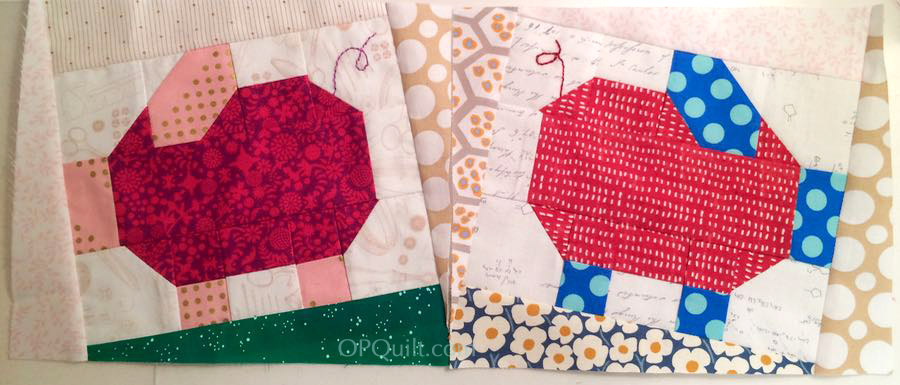
Here they are together, but not sewn together.
That’ll do, Pig.
Thank you everyone! I look forward to a whole farmyard of little piggies, running around my design wall. While I attribute all these ideas to two very fine quilters: Gayle, of Mangofeet (she is hilarious to read) and Sally of The Objects of Design (who has made a stunner of an En Provence Mystery Quilt), all the photographs and instructions above are my own. Please do visit their blogs to see all the fun piglets that are running around there.
This month, Sherri, of A Quilting Life, is our Queen Bee and she’s asked us to make her pineapple blocks.
First step: make a mess of the sewing room pulling out greens to get the best ones. (It also helps with re-organizing my messy shelves.)
I downloaded the free pattern, and also pulled up the post from Sherri where she makes her block, so I could glean any tips she had when she made it.
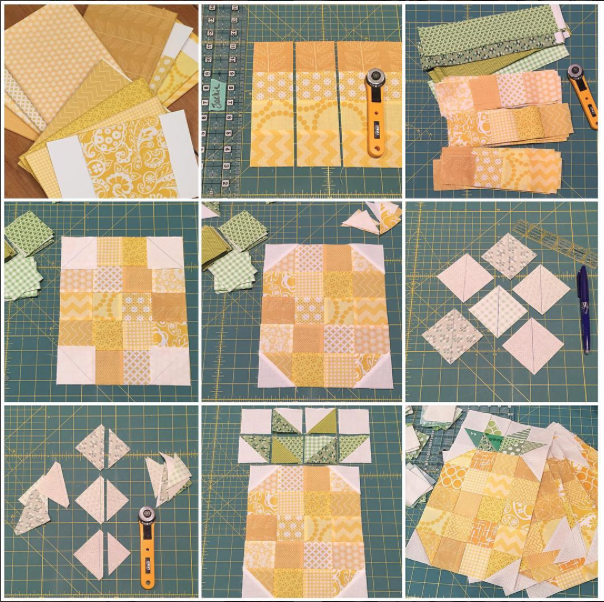
She suggested we scroll through Jackie’s IG feed until we found the tutorial, which really helped me understand how we put these together (that’s a screen shot of her image above), as the pattern is a bit sketchy on details. It can be a bit confusing, but basically she is making enough for 18 pineapple blocks.
As promised, here’s a brief tutorial on how I like to make my #pineapplequilt blocks! The great part about these blocks is there is no wrong way to do them, and lots of right ways! 1️⃣ I like to pull yellows in sets of four so that I can strip piece my units to form the yellow body. You need 24 2-1/2″strips sewn into 6 groups of 4 to produce 18 pineapples. 2️⃣ After sewing my 6 strips of 4, I like to press them all one direction and then I subcut them at 2-1/2″. This helps to nest my seams when I construct the body of the pineapple. 3️⃣ I choose a variety of greens, along with my white background fabric, and subcut the number of 2-1/2″ blocks needed to make the corners and stem units. 4️⃣ Then, I draw a line corner to corner and I sew on the line on the white squares to create the white background pieces. (Kind of like making a snowball block) 5️⃣ Next, I trim 1/4″ from my seam and press my corners out. 6️⃣ To make your stem units you’ll want to make HST’s in whichever method you prefer to equal 2-1/2″ unfinished HST’s. 7️⃣ This quilt is great for using up scraps, and I generally have a lot of 2-1/2″ strips, so I make my HST’s from that size and sew corner to corner and then trim 1/4″ from my seam down the middle. There is more waste this way, but if it’s just scraps anyway, I’m ok with it! 8️⃣ Arrange your background squares and HST’s to form the stem shape, and sew those units to your pineapple body. 9️⃣ Ta-da! You’ve made a pineapple block!!! 🙌🏻🍍
Better to click on the Tutorial (above) and use that.
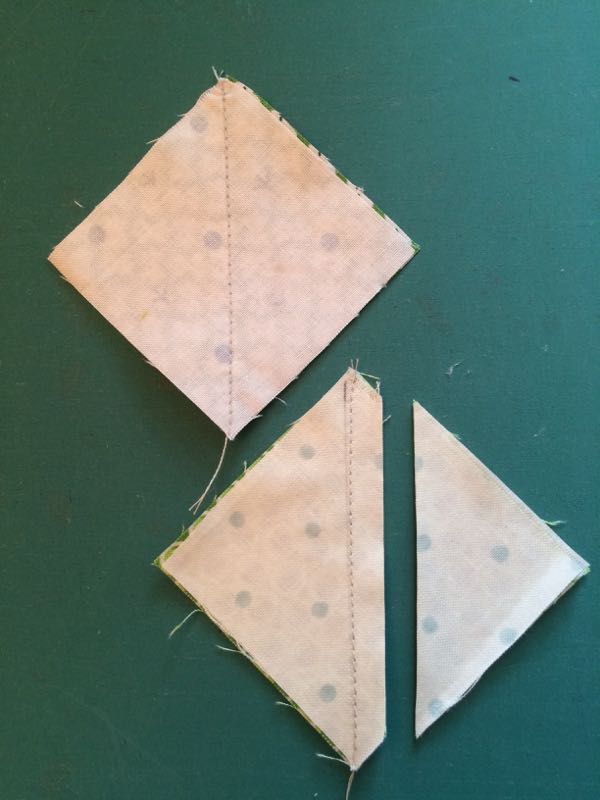
What confused me was that the pattern calls for cutting all the blocks the same size, different than what I would do if making half-square trianges (HST). After reading the IG tutorial, I see that Jackie sort of “snowballs” on the white corners, instead of making HSTs. She marks the line, and sews just to the side of it–to the seam allowance side. She then cuts off the excess. One advantage of this method: there are no dog ears to trim!
Yellows sewn: check. Green pineapple crown sewn: check.
One other difference in the construction of this block is that the low-volume white is added to the corners of the yellow block after it’s all sewn together, then sliced off and pressed.
Ta-Done!
And here it is with its signature block–with yellow on one corner and green on the other–albeit a bit blurry.
Elaine’s Quilt Block Quilt Shop in Salt Lake City had a swap of pineapple blocks–both in the yellow and in a range of colors. Unfortunately, they have now closed. I wish I’d grabbed more screen shots of all the pretty blocks!



































 OccasionalPiece--Quilt!