300 Quilts · Patterns by Elizabeth of OPQuilt · Quilt Finish

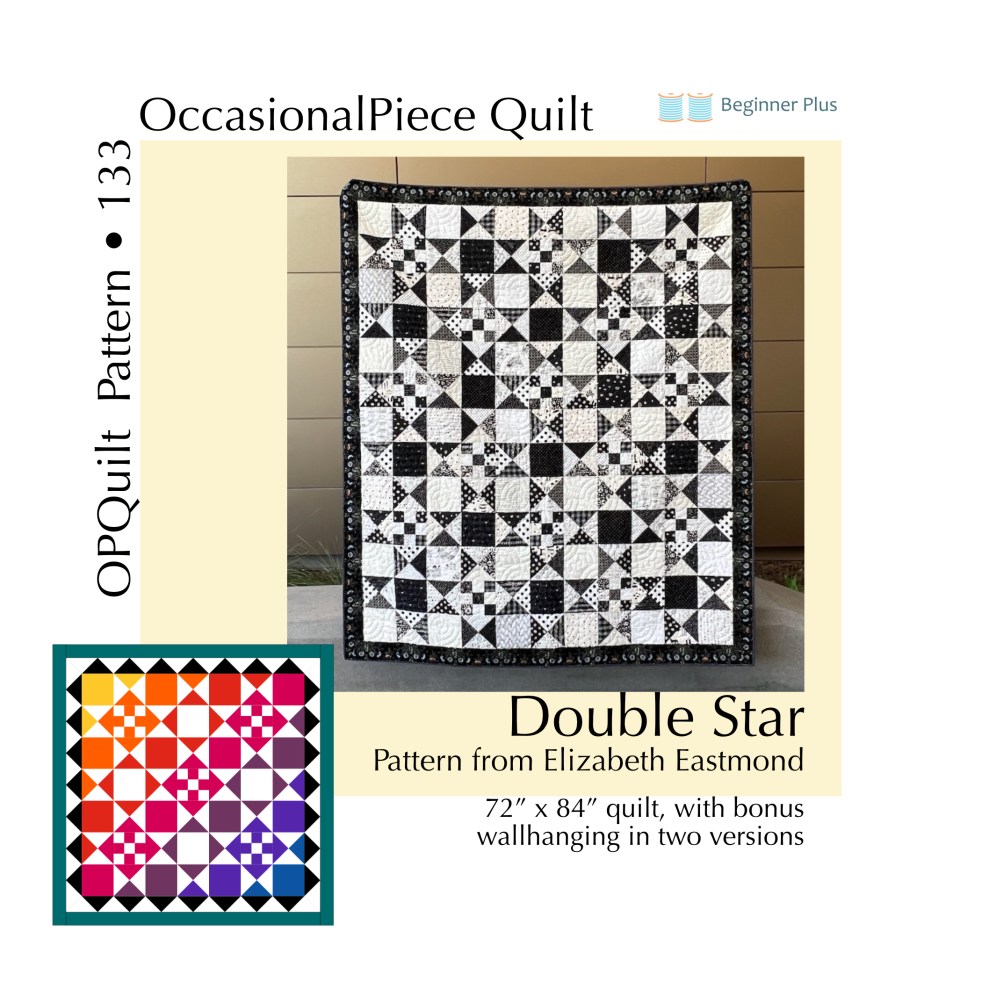
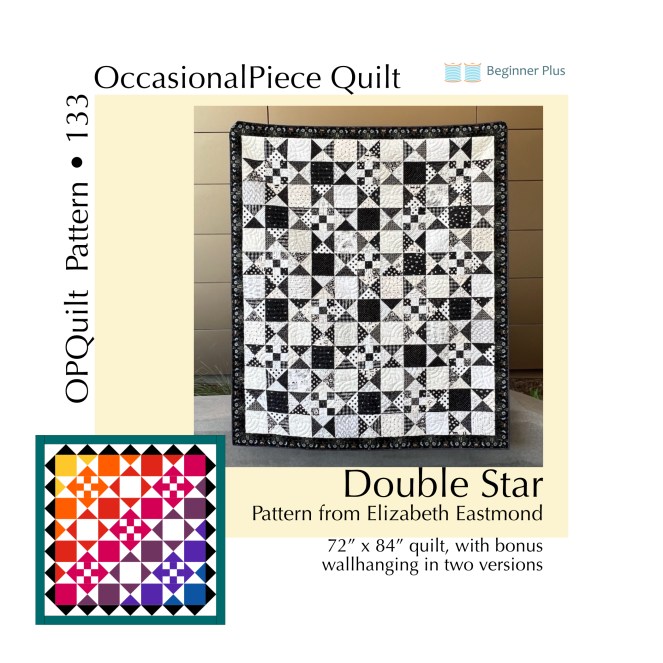
Double Star • new pattern

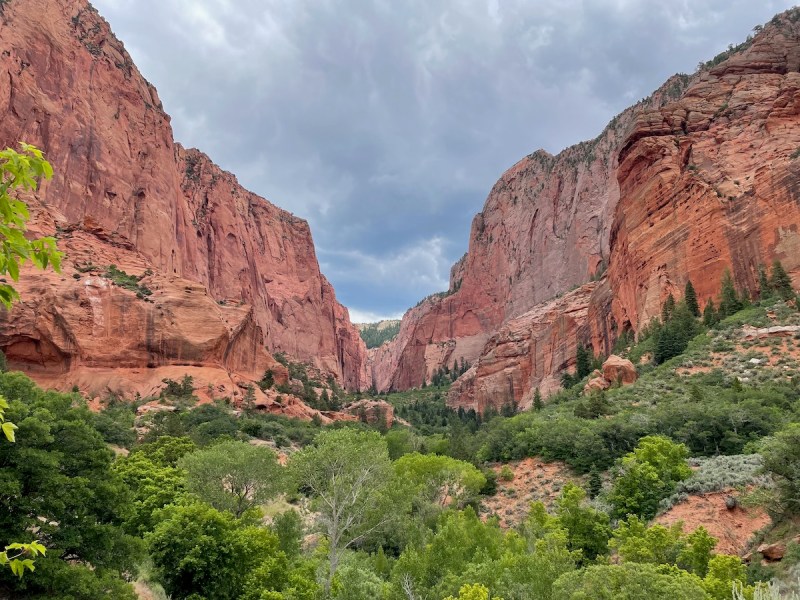
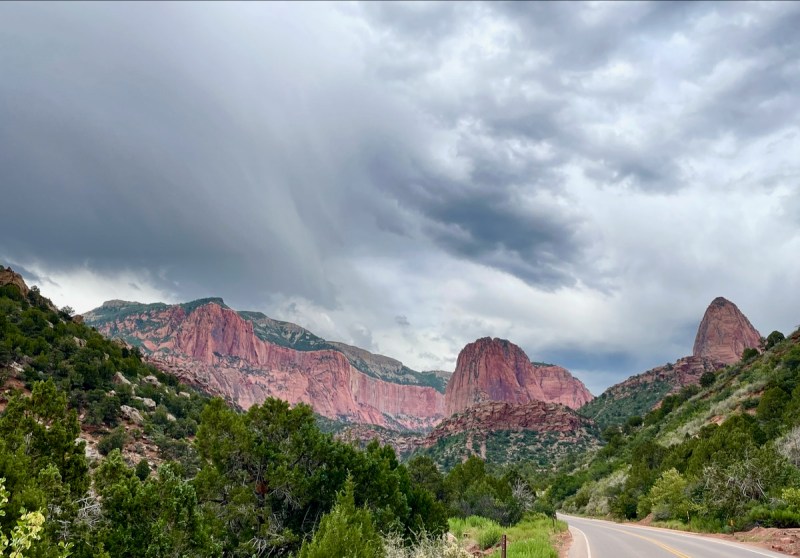
Kolob Canyon.

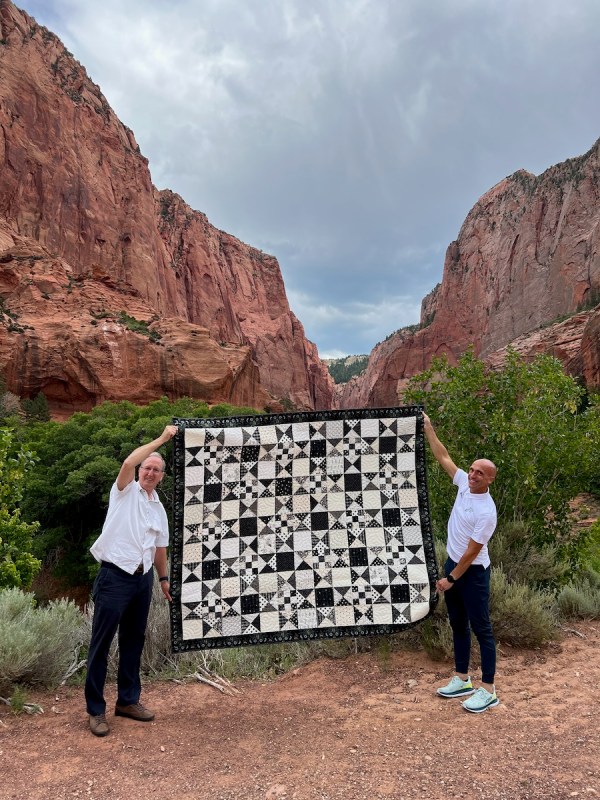
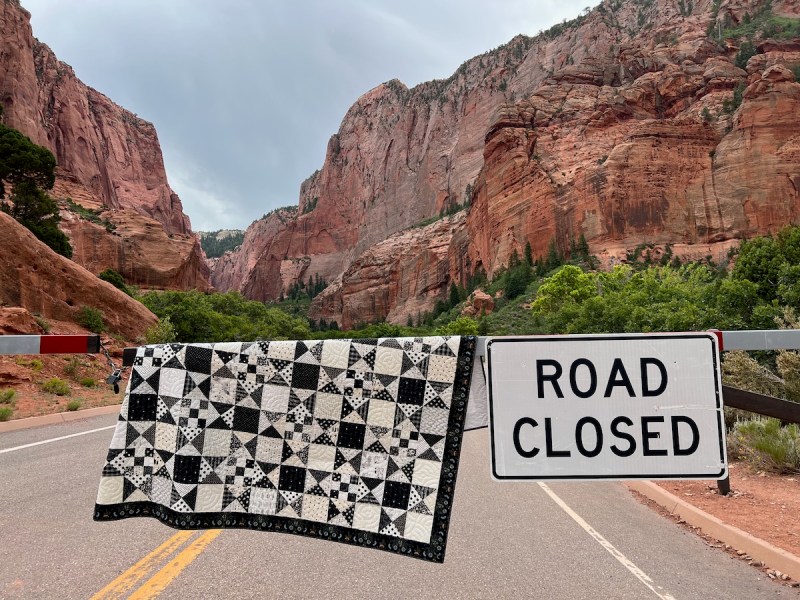
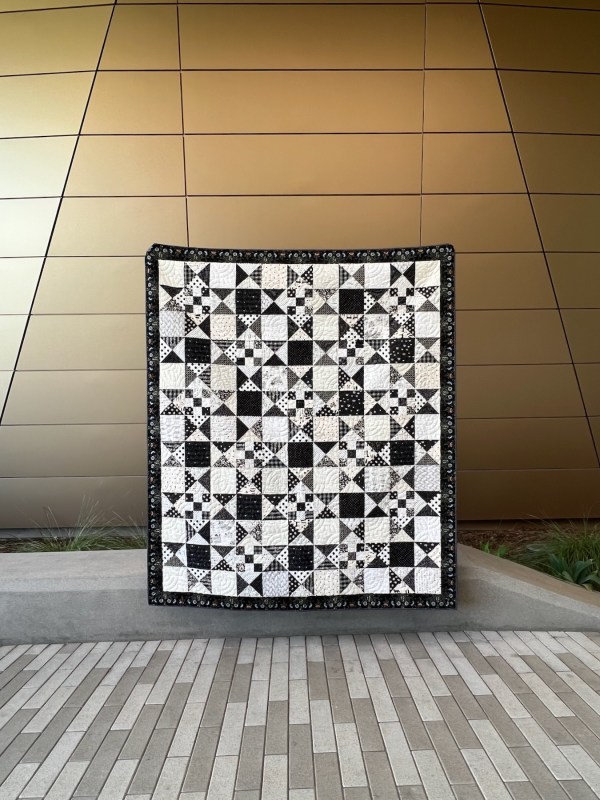
We were about mid-point in our drive from the Salt Lake City area to our home in Southern California, when we turned into the Kolob Canyon parking lot, in the upper section of Zion National Park. Ever since I sewed the binding on my newest quilt, Double Star, on the drive up to see a grandson get married, we’d been trying to find a place for a photograph. Kolob Canyon, with its red rock and green foliage, called to us.

We have a hymn in our church, If You Could Hie To Kolob, which is a fancy way to say “If you could get to Heaven.” The rest of the first verse sort of opens up the possibility of seeing where It All Began, and indeed, as we began the drive up the road to the Taylor’s Creek trailhead it does feel like you are in different space. There weren’t too many people, perhaps because of the threatening storm, or the advent of the Fourth of July weekend. But whatever the reason, it was bliss. We began to sing the hymn, then wondered how many other visitors were singing that same hymn, too, on their way up the canyon? And how many more of them were looking for a quilt photo?

A willing, helping visitor provided answers to both those questions: we were the only ones looking for a quilt photograph, but yes, he (on the right) and his wife did sing the first verse to that hymn as they drove up the canyon. The music is based on an old English tune, Kingfold, which figures because many of the early pioneers in this state hailed from England (including mine and my husband’s ancestors).

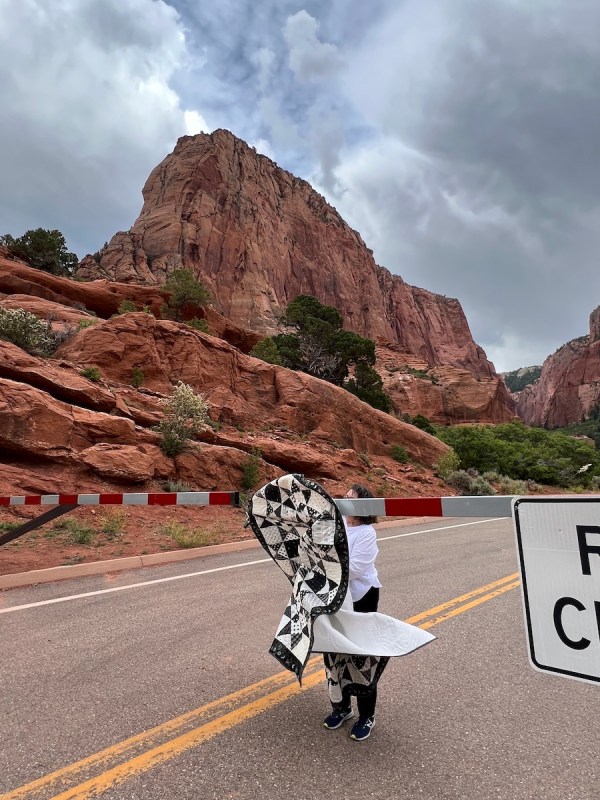
We struggled in the canyon’s wind, chatted with them, and wanted to go farther into the canyon, but the upper road had been closed because of winter damage.

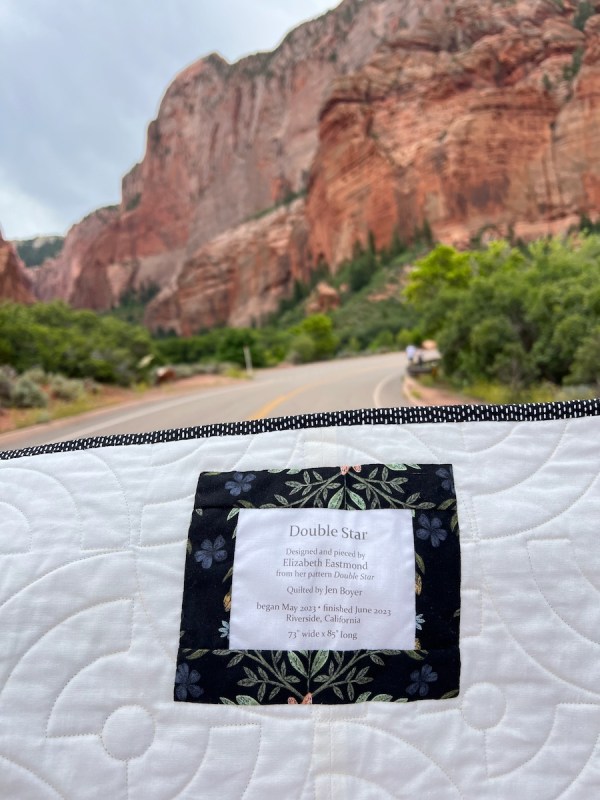
The label notes the quilter, Jen Boyer, and that it is from my newest pattern, Double Star. This was a quick one for me, given my languid pace of the last six months, but to be fair, that doesn’t include the two years the bag sat sitting under my ironing board full of black and cream fabrics, collected bit by bit.

I love the curvy quilting pattern, but hate the name of the e2e pattern (Target Practice).

It was quiet up in the canyon with the road closed, with only a handful of visitors to these beautiful finger canyons. I hummed the tune, and was reminded that the last verses talk about how “Improvement and progression / Have one eternal round.” That is a good thing, given that I am always striving to be better, not only in quilting, but also in kindness, grace, and all those other perfectly wonderful attributes that the author Phelps wrote about in the 1850s. Revisiting some of those ideals helps ground me, and encourages me to live well in today’s world, where Phelps might have scratched his head about all the challenges that we face.

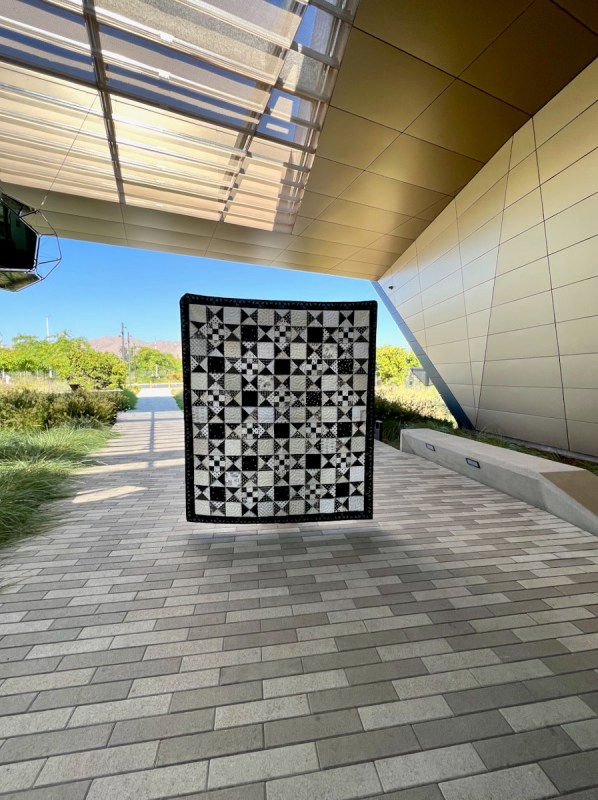
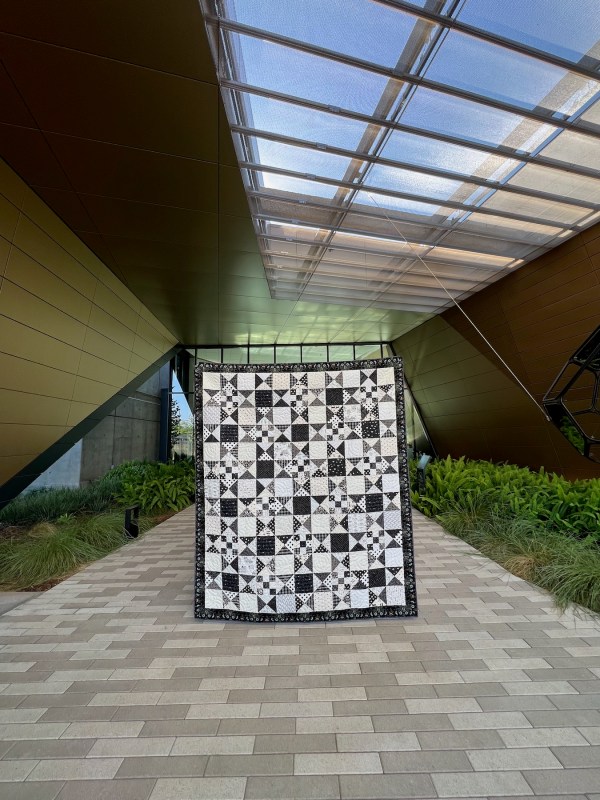
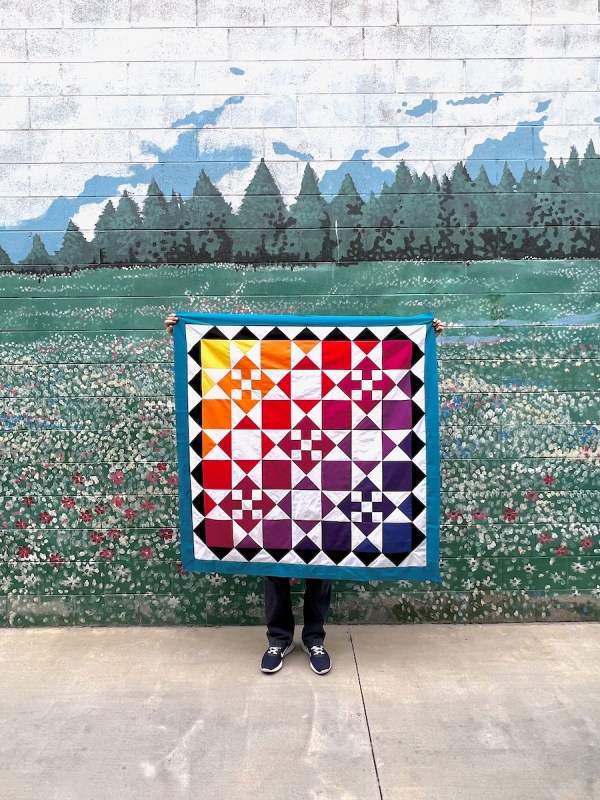
Back home, trying to finish up the writing of a pattern, I realized that while we’d had a grand time out in nature, none of those photos would work for the pattern front. So we headed to the California Air Resources Building, which was close by and that we knew had a dramatic entry, shielded from the windy day.

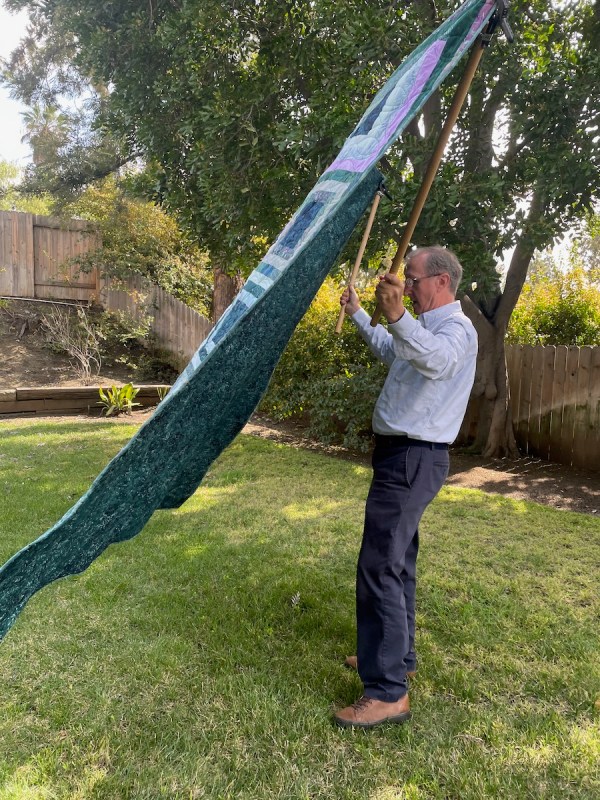
I promise my Quilt-Holding Husband is behind there, but it does look like the quilt is floating.

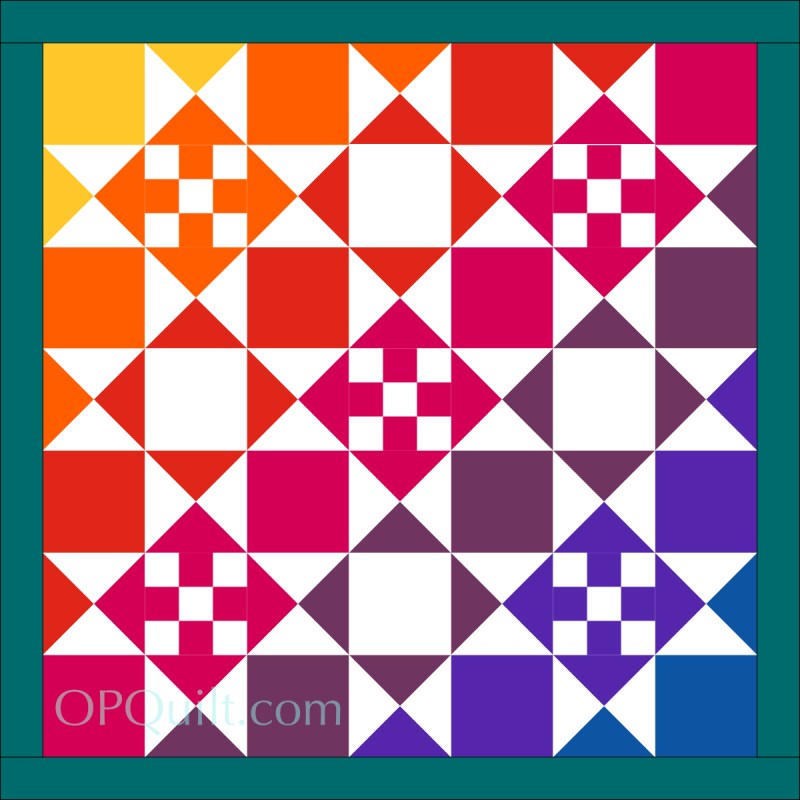
So now it is finished. You probably recognize that smaller bonus quilt from another post of mine. I included two versions of the smaller quilt in the pattern — one with the border, and one without the black/white triangle border (but it’s not hard to make). The whole pattern is pretty straightforward in the making so it earned at Beginner Plus label.

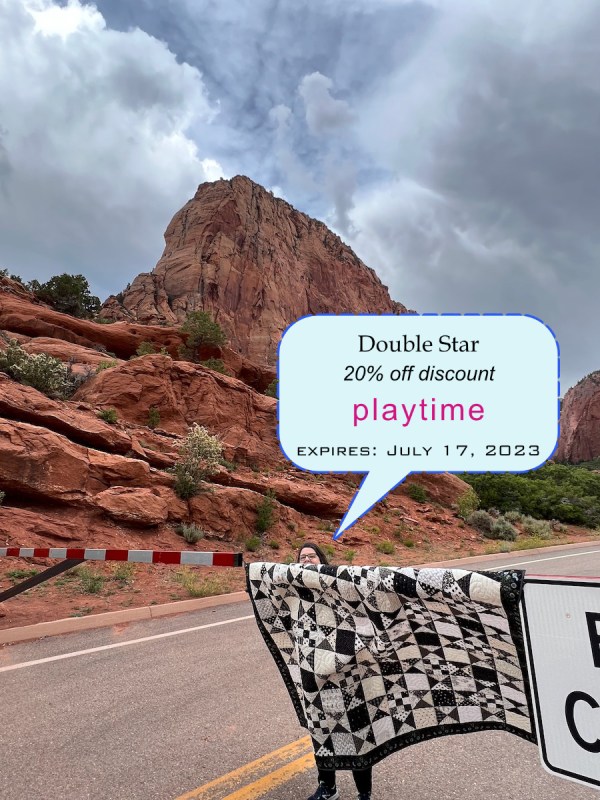
You can get the pattern in my PayHip shop, and if you act before July 17th, you can get 20% off with the code in the speech bubble, spoken by some rando with a black-and-cream quilt in red rock country. Glorious red rock country.

UPDATE: On JULY 20, 2023, the coupon will expire. I added a couple of extra days.

I guess I was just kind of taken with the place, and always have been since I married my husband when I was 34, bringing four kids to the marriage, and like the saint that he is, he brought us all on a trip when we’d been married about a couple of months, and that’s where I first saw Zion National Park, and Kolob’s finger canyons.

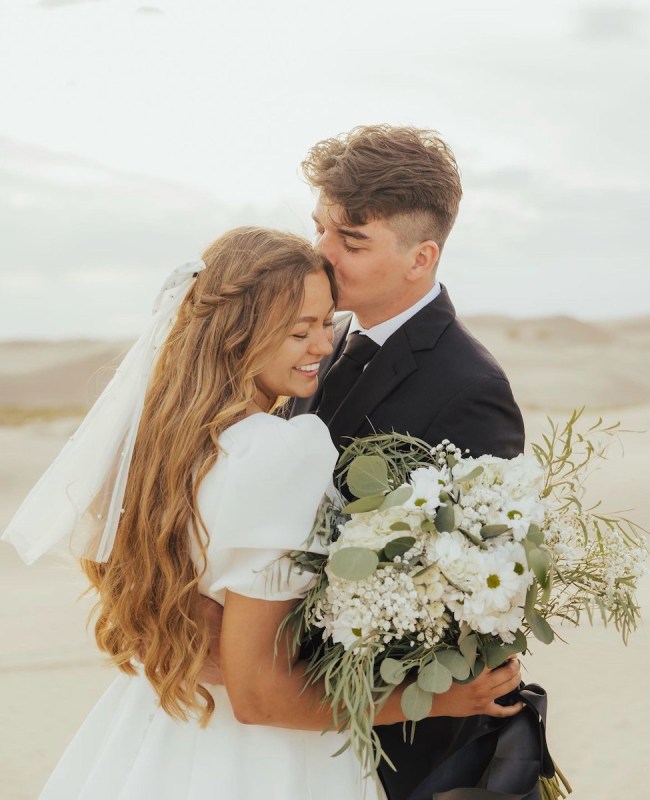
Maybe I was taken with the place because on this beautiful day in windy Kolob canyon, we’d just been to my grandson’s wedding the day before; he holding his bride’s hand, both their faces glowing as they said their vows. These two have an easiness about them, and it was lovely to be the grandmother and not have to worry about the arrangements, or the dress, or the tuxes, or the refreshments, but to just be able to sit and enjoy the radiant happiness of this young couple.

I take much hope in the hymn’s words written well over 150 years ago, their ideals firmly rooted in another time; however, they are still good for us.

No end to Love: Chris and Maya

Other Posts about this Quilt

Time Let Me Play
Flashback
Link to the pattern on PayHip

Write up about the canyon, and how it got its name.

The Tabernacle Choir at Temple Square sings the hymn.

If You Could Hie to Kolob
Text William W. Phelps
Tune: Kingfold, arranged by Ralph Vaughan Williams

Patterns by Elizabeth of OPQuilt · Something to Think About

Time Let Me Play

I was struck by the idea that: “…all thinking is an act of memory in some form. That includes imagination, creativity, innovation and other variations of ‘new’ thoughts. That means the components of the thought are not new. Only the combination is new.” I read this in an article in the New York Times by Peter Coy titled “If There Are No New Ideas, How Do We Keep Innovating?

This quote came from Sheena Iyengar who just wrote a new book called Think Bigger: How to Innovate. In the case of this newest quilt top, which I’m calling Time Let Me Play (more on that in a minute), I went smaller in size, but bigger in the idea of it, which is what I think she is referring to. The idea that there is nothing new under the sun is an old one, but I wonder if she’s trying to get at a new way of thinking about creativity, an “act of memory in some form.”

Coy also notes that Mark Twain believed that there was nothing that is truly original when he wrote to Helen Keller:

“It takes a thousand men to invent a telegraph or a steam engine, or a phonograph, or a telephone, or any other important thing–and the last man gets the credit and we forget the others. He added his little mite–that ninety-nine parts of all things that proceed from the intellect are plagiarisms, pure and simple; and the lesson ought to make us modest. But nothing can do that.”

In this case, the memory came from a photo my friend Lisa had given me, and I went on to make a large quilt in cream and black:

How many times have we quilters seen a new “original” quilt, and recognized a well-loved quilt block? How often has a traditional block been seen in a recent quilt, and the maker claiming it an original creation? I am always trying to spot new patterns, new shapes, new ways of thinking about things, but I do like Iyengar’s thinking that it’s memory driven. This motivates me to fill up that memory: to keep reading and adding new things to the mind’s hallways and closets. Museums, anyone? Books? A moderated dose of social media? Quilt shows? A visit to the mountains?

Iyengar writes that thinking bigger is about assembling old ideas in a new way… [S]he writes that all successful innovators are “strategic copiers,” who “learned from examples of success, extracted the parts that worked well, imagined new ways of using those pieces, and combined them to create something new and meaningful.”

Peter Coy, New York Times

So as I was working on the pattern (coming soon), I first called the cream/black quilt SunShadow. <Bleh.> Then, Starfriends, which is what I called it when I sent it up to my quilter. I’m still not there yet. But the colorful version? Here’s the deal: It’s been a long, long winter over here, with a significant death, the remodel of a kitchen, gobs of rainstorms (which I loved, but the grey skies are not a usual thing), too many small things which added up to bigger things. When we were able to get back into the kitchen, and everything was put away (and the glass lampshade I had accidentally clocked with a pan was fixed), I found a tiny bit of extra energy that no one had claimed. I started playing around with color and put the shape of this quilt into a drawing…

…it was like Time had opened the window a little bit and found time for me to play. Of course, that phrase could also be read as a plea: Time! Let me play! but I prefer the idea of all the tumblers falling into place to let a person find a memory, a space, an interval not yet filled up in order to play.

Last thought from her book: “Henri Poincaré, the great mathematician and physicist. ‘Invention consists in avoiding the constructing of useless combinations and in constructing the useful combinations which are in infinite minority,’ he wrote in 1913. “To invent is to discern, to choose.” So keep trying. That quilt you want to make is almost here.
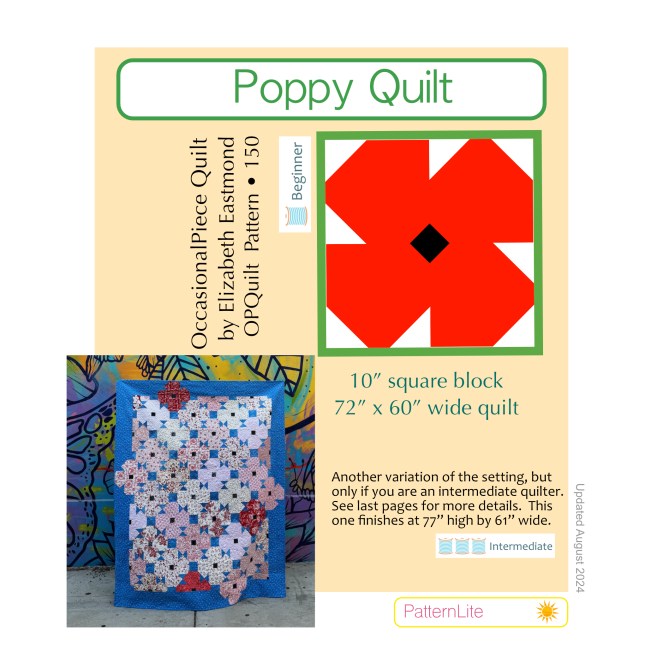
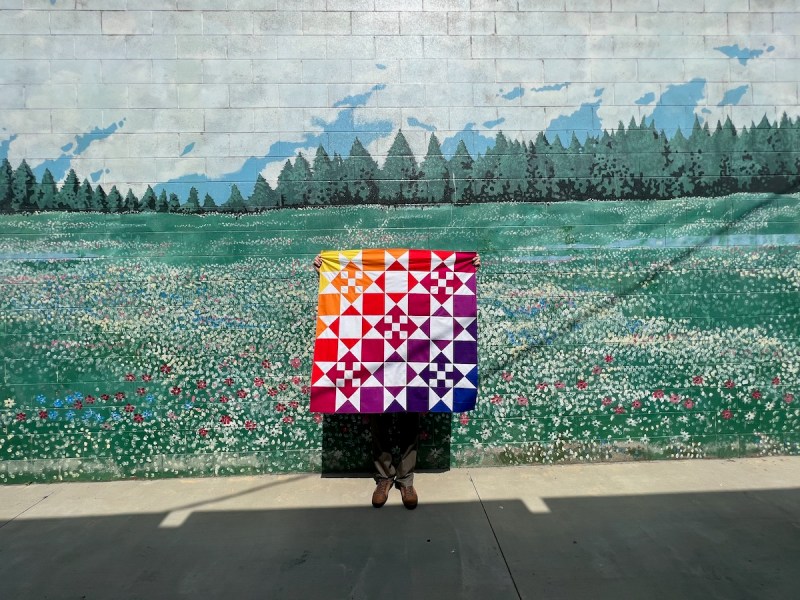
Our initial run at this photographing this quilt against the mural wall brought the lady out of the office next to us, with the scold “What is that? Some kind of flag?”
“No,” I replied. “I’m a quilter. This is my quilt.”
She went on to say we were on private property and generally wanted us gone. A flag. A flag? I puzzled about that long and hard until Dave made the connection that June had PRIDE connections, and rainbow flags were being washed over every advertiser’s website.
“Oh,” I said. “She thought my quilt was a flag???”

In her forming memory, seeing this quilt meant rainbows meant Pride Month. In my beginning memory, I was standing in a field of flowers, with pine trees ringing the valley with my quilt in the midst of it all.

But after seeing it, I did think it needed a different border, so added one. And we went back for another round, but asked her permission first. The woman is somewhere behind those mirrored windows. I’m sure she thought we were nuts.

More play time that night, pinning the quilt in my new blue kitchen.

In the deepest parts of this hard winter, I couldn’t write, I couldn’t answer emails, I.just.couldn’t. But Time is working its eternal magic on me, helping me heal and recover and find myself again. I think my Mom would like this quilt, with its bright colors, and I hope — if heaven has a window that can be opened — that she could peer down and catch a glimpse of me letting this quilt top wave to her. Thank you to all who have reached out and understood, thank you to all who have had patience with me.

Now, let’s go play!

Patterns by Elizabeth of OPQuilt

Poppies!

Anne of Springleaf Studios recently wrote to me, including a photo of her poppy quilt:

Anne is an amazing colorist; seeing her quilts is always a treat, as they are rich in color and perfect in value. She wrote that she enlarged my Poppies pattern a bit, and added circles for the centers. I love her version, and it made me think of the first version of this quilt (pattern is downloadable; see below).

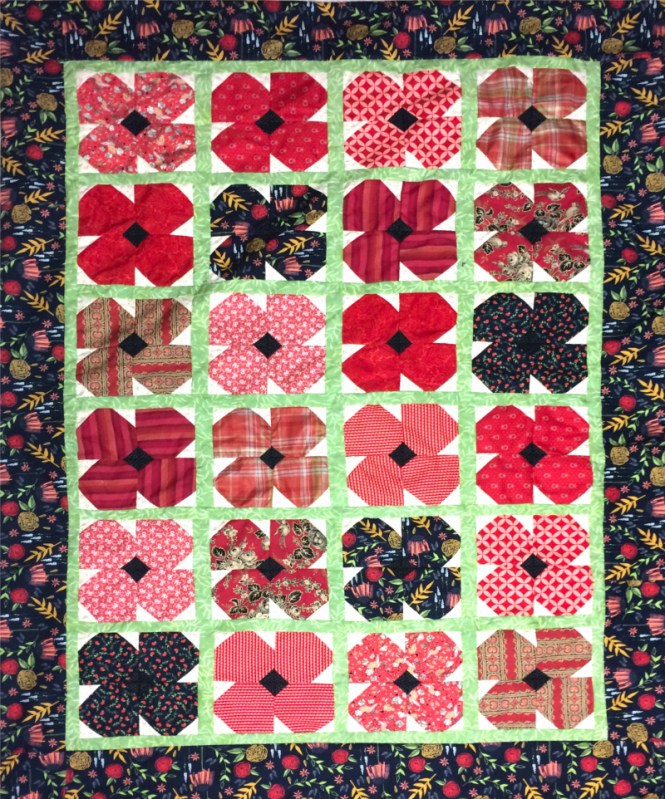
From ages ago, this was the first iteration. My distantly related niece knew I was a quilter and wanted to make a quilt for her mother who was undergoing treatment for breast cancer; they wanted poppies. I drew it up, heard that she finished it, but it wasn’t until much later that I was able to get a photo of it for my archive. (I wrote about the process earlier on this blog.)

This is a more traditional poppy block, with the red petals and the black center, but I’m in totally in love with Anne’s version. Hmmmm, I think I’ll have to add that to the list. I also have a lot of Kaffe prints and need to use them up.

The first Poppies pattern was written in 2017; I recently re-wrote the pattern, and included the more traditional setting which is over in my PayHip shop. I’m happy to share with you.

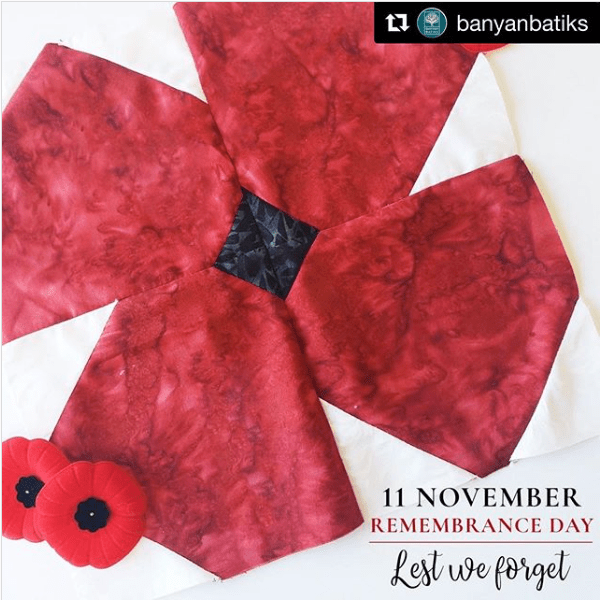
(Fabric companies picked up my pattern for Remembrance Day, 11 November)

Another way I share is by not having advertising on this blog. As some of your know, we’ve been re-doing our kitchen, We thought about it about a decade ago, then more earnestly in 2020 (haha!) and this year the time had finally arrived for us to update. The other night I was trying to figure out how to use our new Breville Smart Oven to cook some potatoes and I jumped online. It was like jumping into a pool of advertising, swimming upstream looking for the content/recipe/can I use the convection? So the only money that comes to me now is through the patterns; this is just a choice I made. Maybe I’m crazy (possibly–to do a kitchen remodel might be proof), but I very much like writing and visiting with those who find this blog.

Here are some more poppies — this time in California Poppy orange — a welcome visitor in March.

I mentioned that my friend Judy passed away mid-February and her memorial open house was March 17th. While cleaning out, her daughter found a completed batik quilt and backing and wondered if I could help her get it finished for her father? I contacted Jen of Sew-Mazing Quilting and she turned it around in no time flat. I got it bound (we took off the last border and used that for the binding — no one will ever miss it), and delivered it to them on March 16th.

I’m sure all the guys in the kitchen tearing out my kitchen cabinets wondered what in heavens name we were doing.

Hmmmm…the usual. Quilting!

The Poppies Pattern is found in my Pattern Shop.

300 Quilts · Patterns by Elizabeth of OPQuilt · Quilt Finish

Quilt Finish: Aerial Beacon

To get across great distances, way back in the day, early airplane pilots would focus on visual landmarks, or sometimes lit bonfires if they needed to find their way in the dark: “In February 1921, an airmail pilot named Jack Knight put this to the test with his all-night flight to Chicago from North Platte, Nebraska. Knight found his way across the black prairie with the help of bonfires lit by Post Office staff, farmers, and the public” (from here). When I found this Aerial Beacon block, it sent me gathering information about this idea: that there were physical beacons to guide those airmail pilots before we had modern navigation. Really? I’d never even thought about this.

An early map showing one of the routes across the United States.

Many aerial beacons were atop tall city buildings. This is from a vintage postcard of Chicago.

Some aerial beacon were little huts with a number painted on the roof. They were next to the tall beacon, with a concrete arrow pointing on to the next one. These are still found in the United States on hilltops, beside cities, although there are very few extant arrows.

This quilt began with these French Bee fabrics by Renee Nanneman. I kept trying to think of names for the bees, and thought up “sky pilots.” Nope. That’s an established term for clergymen/women, which I also didn’t know. So I kept looking, and then found this:

A traditional block, which would let the bees show off nicely, as well as the coordinating fabrics. I loved those four big triangles; sort of like propeller blades (another reference to flight). So I made my first block, wondering if could I even do this? I chose to make this a foundation paper-pieced block, so as to get those snappy points and to keep everything in place (pattern coming next year some time).

ultra-high radio frequency waves (RFID, or radio frequency identification)

Then, thinking about the idea of RFID waves, and the communications that replaced the aerial beacon huts, I referenced them with a waved border made with bias binding. It was a good exercise to figure it out, and I love how it looks.

Jen of Sew-Mazing Quilting went the extra mile in the quilting. I had many strong colors in the blocks and a very light border and backgrounds and I asked her to use Superior’s MicroQuilter thread in silver (7007). Bob Purcell (who founded Superior) told me it was their best blender, and he was right.

late-night sewing

I did begin making the blocks way back in October, first thinking about a design with nine blocks. But there was so much fabric left from each French bee color, that I made more. And took trips to Utah. And tried to sew. And took trips to Utah. And I kept trying to write the pattern, because it was such a fun block. And took a final trip to Utah. Then unlike those early pilots ferrying mail, in the next few weeks I felt more than once like I had lost my way. This quilt spent a lot of time wadded up in the corner, as I just didn’t have the moxie to work on it.

I even had the backing ready to go as I dithered and dithered about whether I should quilt it myself or not. I finally realized that given my current state, you-know-what would freeze over before I got around it it. When Jen returned the quilt, it sat some more time. Finally this past week, I found my way to binding it. (Binding is a lot less stressful since learning this trick.) And then I indexed it: Quilt #273.

the back of the quilt, held by the best Quilt-Holding Husband, at a local park

Since I often write about my own life on this blog, I will share that I have often wondered how I would react when my mother died. I thought about it off and on in my life, sometimes thinking I’d be perfectly fine and then other times thinking I’d be a total wreck. My mother lived to be 94, so she had been with me my entire life and really, truly, I liked her a lot. Yes, we had our differences, and no, she was not perfect, but in her later years (before it got really hard for her), we had an easy camaraderie. The truth is many days I am perfectly fine, and at other moments, in other days, I’m quite tender around the edges, breaking into tears. You probably know how it goes. When I was a teenager, Dad got all the credit, but I came to realize — and even more now that she is gone — that she did all the heavy lifting of relationships, of sending me little gifts, of checking in with me. I always knew she was my best cheerleader.

I had a chance a couple of years ago, after a presentation with the Utah Valley Quilt Guild, to go up to her condo and give her and Dad and one of her friends a mini Guild Presentation. Her eyesight was failing then, but we passed around the quilts so she could look at them up close and feel them; she enjoyed it all. She apologized that she didn’t have more of her friends there, but that wasn’t who the show was for.

It was for her, my mother, now my very own aerial beacon.

Other posts about this quilt:

Bias Binding Fun

the label, a simple one this time