Free Quilt Pattern · Gridsters · Tutorial

Basket Block Tutorial • February 2018 • (Gridster Bee Month for Me!)

gridsters-250-buttonx

I belong to an online bee called the Gridsters, and February is my month to choose a block that my beemates make for me.  You can find all our work on Instagram, using the hashtag #gridsterbee. 
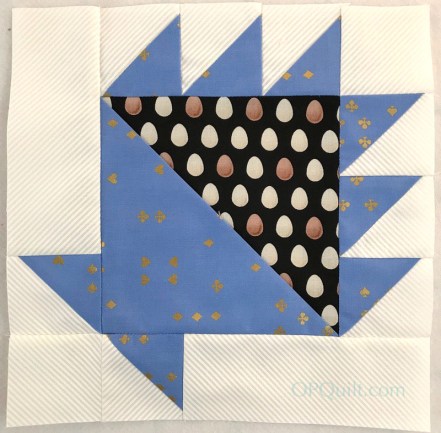
Basket_8

I chose a basket block.

Basket_food fabrics

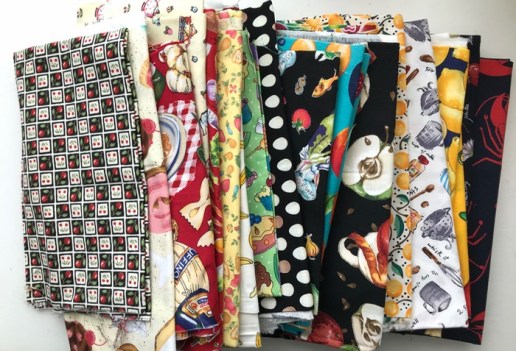
I also have been saving food-themed fabrics forever for a basket block quilt with the baskets full of food beginning at least a couple of decades ago, and continuing as I picked up a food fabric here and there.

I was also inspired to make basket blocks by Barb, of Fun With Barb and Kelly of Pinkadot who decided to do it together; their tutorials are on each of the links, above.  I upsized the basket block to 10 inches in size, so the making would go faster.  (You’d think with all the quilts in this house, I would have enough twin-sized, but I don’t, so I’ve already decided that’s the size it will be.)

If you want to join in with me, or Barb and Kelly, in making baskets, I’d suggest we follow their request to tag our Instagram photos with #basketswu [Baskets Sew With Us]. (Gridsters please tag them also with #gridsterbee.)

For the Gridster Bee

I’ve sent you some food fabrics; please use those for the A section of your blocks.  I don’t care what you use for the basket–it can match, it can contrast, it can coordinate, it can clash–choose what you think creates the look you want.  You can use small scale prints, large prints, florals, novelties, checks, whatever.

For the low-volume background, use these types of fabrics:

Basket_low volumes YES
They are a range of creamy-toned fabrics, without strong secondary designs.

Avoid these types:

Basket_low volumes NO

Solid in creams is okay, but avoid white, grey, tan, beige, white-on-white (I really don’t like beige for this quilt, but understand the limitations of our stashes–just do your best).  Many of the above fabrics have strong motifs and patterns, so reject those too.  Basically, I want the background to recede without being dull or same-same.

Basket Tutorial
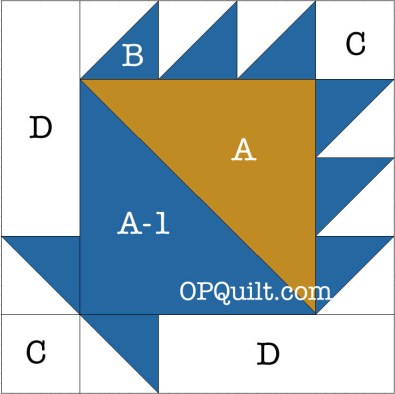
Basket Block_ESE
Not to size, for reference only–please use the PDF link below.

Here’s my cutting sheet for this tutorial, in PDF form, but the usual requests apply here–don’t print off a million copies for your mother and your friends, but please send them here to get their own: Basket Block 10 inch_OPQuilt

Basket_1
All my basket pieces laid out.

First, make the Half Square Triangles.

[Background:  One method is from Alyce, and she has a nice chart if you want to figure out your own eight-way Half-square Triangles.  However, I also have a different chart on this post which came from Jeni Baker, who encourages the use of a bigger initial square.  That means for us (and especially if you like to trim your HSTs) you would begin with a 6″ block, which is what I’ve specified on the cutting chart. BTW, her book on triangles is a good one to have in your library. ]Basket_2
Place one 6″ background square and one 6″ basket square right sides together. Mark two diagonal lines, and sew 1/4″ on either side of the marked lines.  On the left is the pieces with the sewn diagonals.  Press it flat to settle down the wrinkles, which you see on the right.
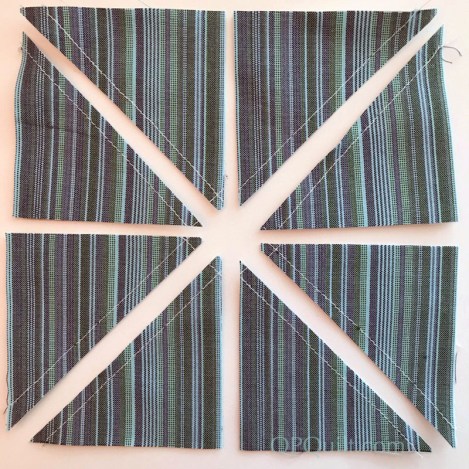
Basket_4b
I moved mine apart to demo this; leave yours close together.

Cut on marked lines.  Now without moving your squares, cut on mid-lines, crossing the centers, as shown below.  Press, with seam allowance to the dark side, trimming out dark fabric, if necessary, so it doesn’t show through.  Trim to 2-1/2″ inches square.

Basket_3
Make center half-square triangle (piece A-1):  Place a food fabric (measuring 6-7/8″ square) onto a basket square (same size), drawing a diagonal line, then stitching on either side of that line.  Press, then cut on marked line, then press towards the basket.  You’ll have an extra center to toss into your Random Patches Box.  (You do have one of those, don’t you?)

Press seam allowance ALWAYS towards basket, to give that dimensional look that something is IN the basket.  Now trim that center to 6-1/2″.
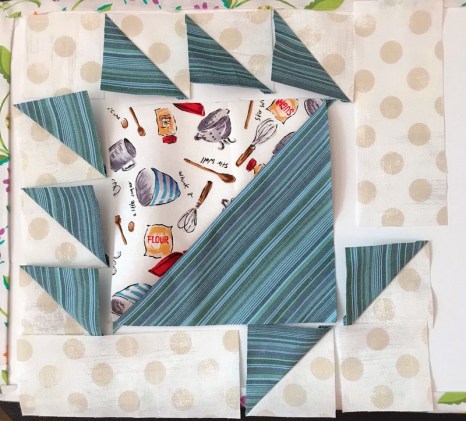
Basket_5
Here are all the pieces, laid out.  I chose a stripe to demo, so you can see the direction the stripes go.  If you use the eight-at-a-time half-square triangle method, you’ll have no problem getting the stripes in the small half-square triangles go the direction you want.  Yes, I did cut the 6-7/8″ square (basket) on the bias, so I could have the stripes go across the unit.
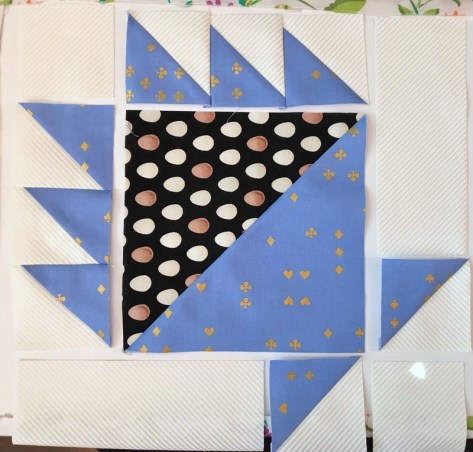
Basket_5a
I made two blocks at once; one had a light center, and one had a dark center.

Stitch together the three small half-square triangle pieces; press in the direction they want to go, which is usually toward the flat triangle piece.
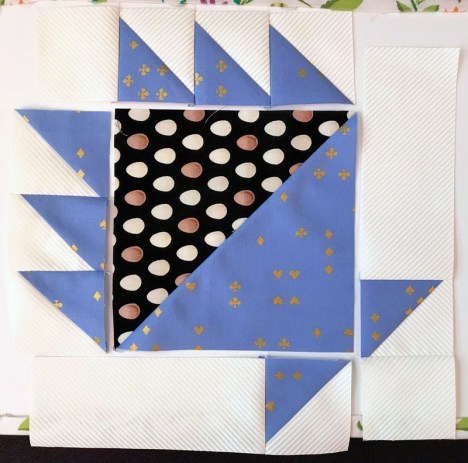
Basket_5b
Stitch one 2-1/2″ block onto one unit (shown in upper left corner).  It helps to arrange your square as you go, so you get everything all sorted out right.

Basket_5c
Sew the first three-unit “basket handle” to the center HST, as shown on the left.  Press seams away from basket, even though they don’t want to go there, again to preserve the illusion that something is in your basket.
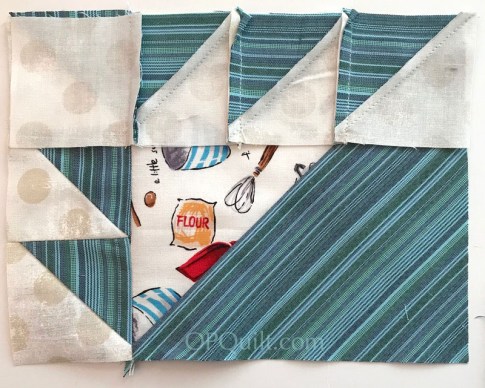
Basket_6
Sew the second three-unit “handle” with the C square to the center unit, as shown.  I pressed the square C-block toward the three-triangle unit so that the seams would nest neatly when I arrived at this step.
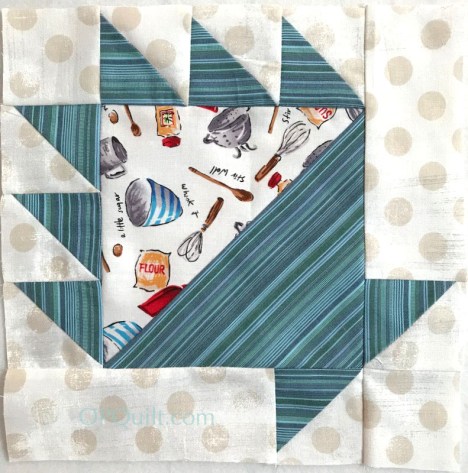
Basket_7
Create basket stand by sewing one of your small HST to the D-rectangle.  Pay attention to which direction the triangles are going.  Stitch this first unit onto the basket.

Repeat with second HST and D-rectangle.  Sew ONE of the C (2-1/2″ squares) to ONE of the basket stand units.  Stitch this onto the existing basket.

Basket_9
And you are done!

There are lots of fun ways I can finish this basket quilt:
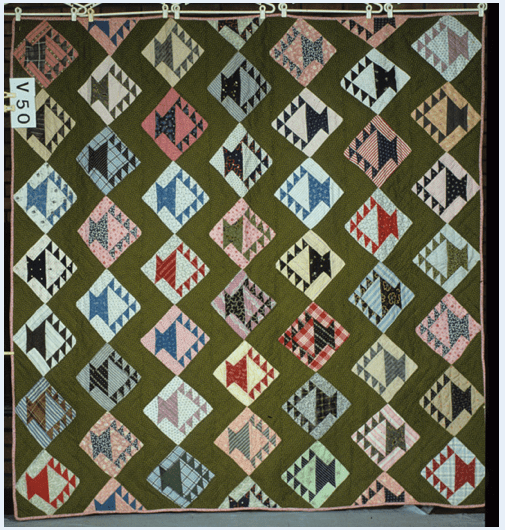
Basket Setting
from here

I like this setting, with all those energetic chevrons in between the baskets.

Looks like red is a pretty popular color for setting these blocks.  I have more basket ideas on my Pinterest site, if you want to see more block settings.  (I’ve been collecting these ideas for ages.)

Thanks to the Gridsters for making me baskets this month, and I hope you all have fun making a few for yourselves.
Free Quilt Pattern

Winter Pines

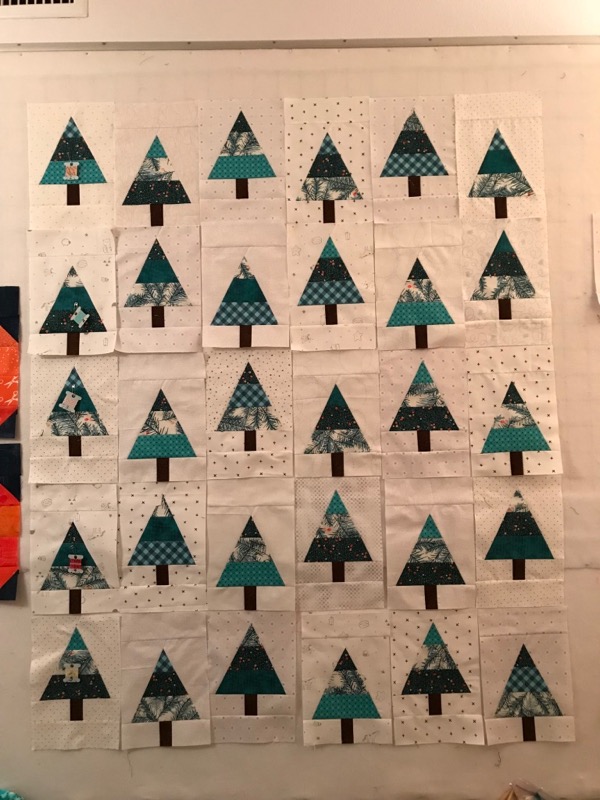
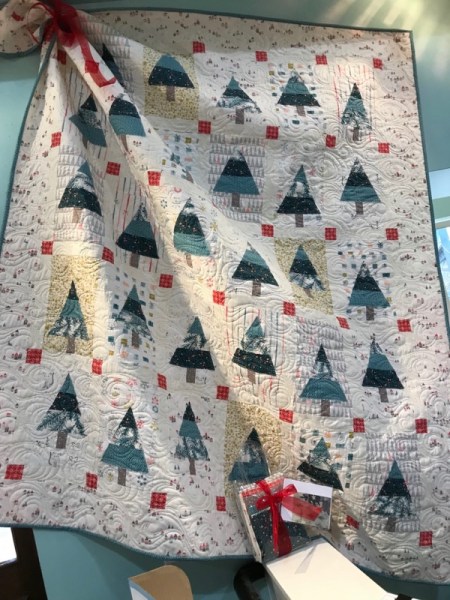
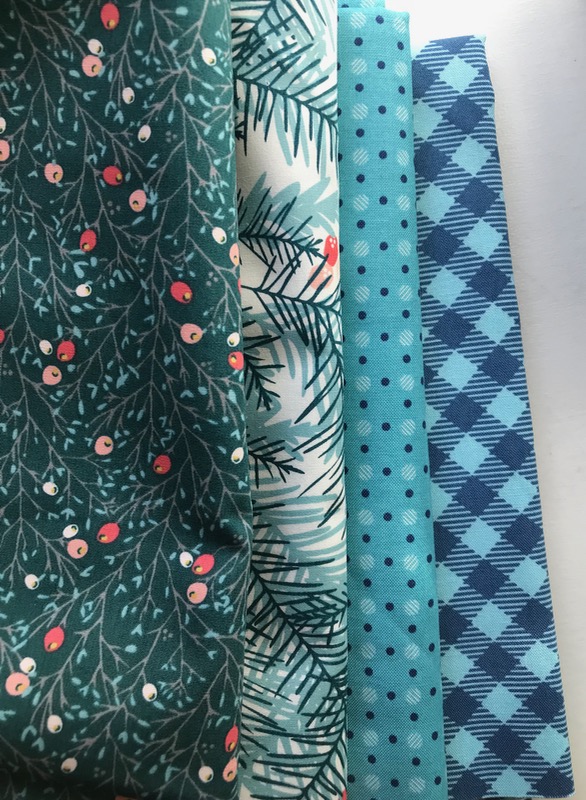
It all began here, with a visit to Gardner’s Quilt shop in Utah, where I saw this quilt.  I realized I had many fabrics that would work, so purchased only the pine boughs and a couple of other coordinates:The two fabrics on the left are from Amy Sinibaldi’s latest line, Little Town, and the two on the right are from Lori Holt’s collections.  I decided my brain hurt from some other projects, so went with the pattern they had at the shop.  It’s called Rustic Pines, from Amber and Amanda and you can get it free online.

But…I didn’t really like the way they made the pine tree.  Yes, they strip-pieced together some fabrics, cut out the trees, but they raw-edge appliquéd on the trees.  Yeah, okay.  I didn’t want my quilt to look old before its time, so I drew up a pattern in Quilt Pro software (RIP), that is really very much like the tutorial I already have for Christmas Trees.

The big difference is the size.  I drafted this second pattern to match the size the pattern makers had for their trees, and you can download a PDF version of this tree here:

The usual requests apply: don’t download billions for your friend and neighbors, but instead send them here to get their own.  The tutorial runs about the same as Christmas Trees, with a few different measurements.

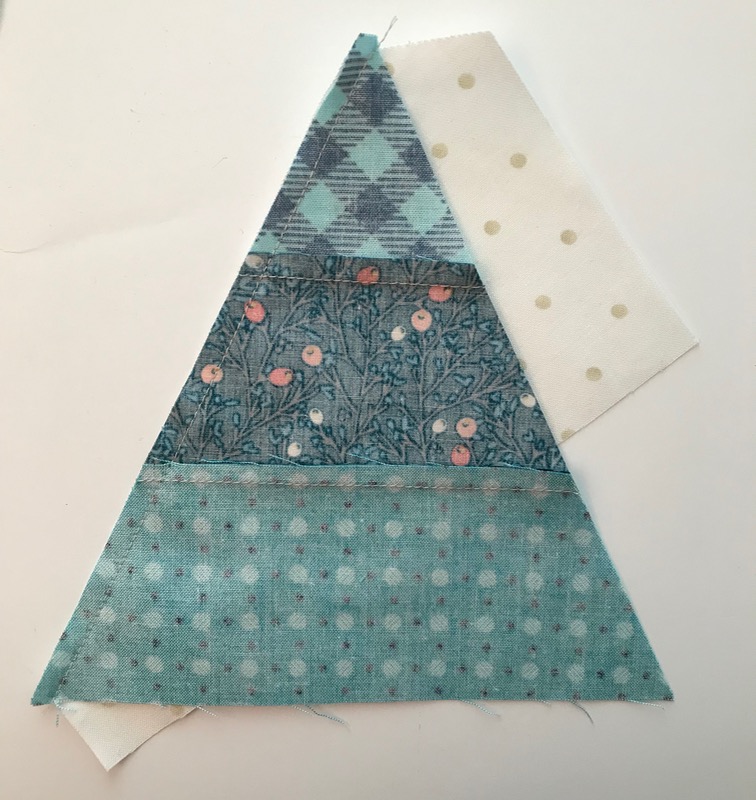
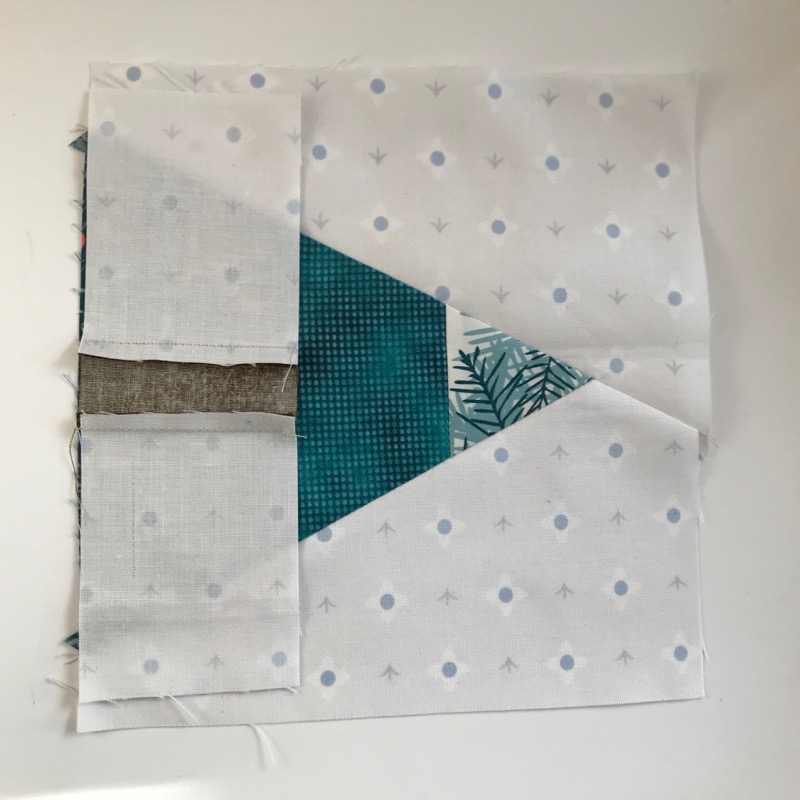
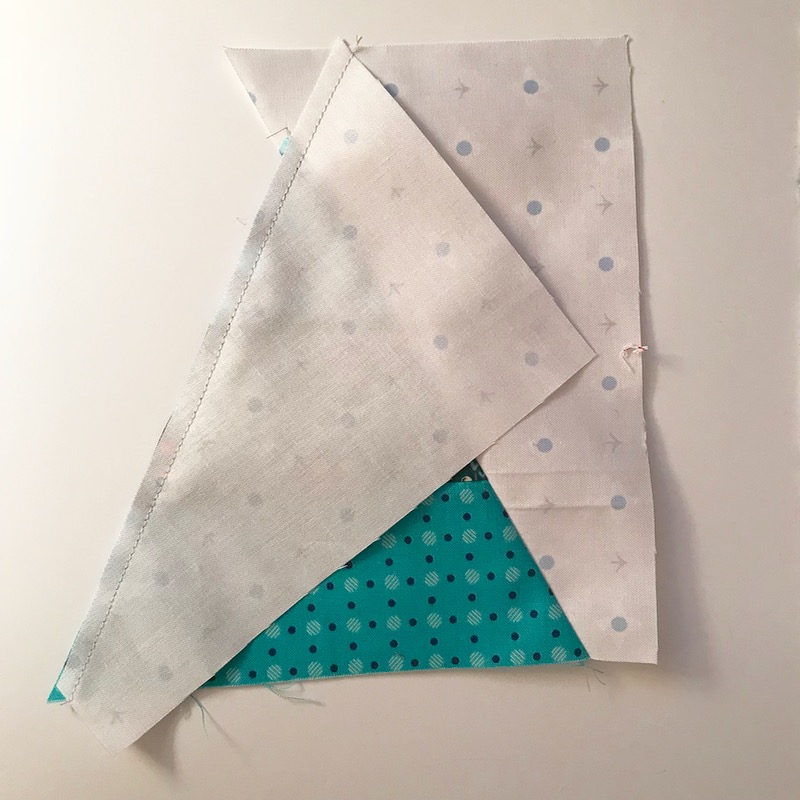
After making the tree add the right side by matching up the bottom edges of the piece.  A teeny triangle will overhang the edge, as shown on the left bottom corner in the photo above.  Stitch and press toward the tree (you’ll want your trees to look like they are in front of the background).

Match up the left side, again letting that teeny triangle overhang the background fabric (lower left corner in photo above).  Stitch, then press toward tree.

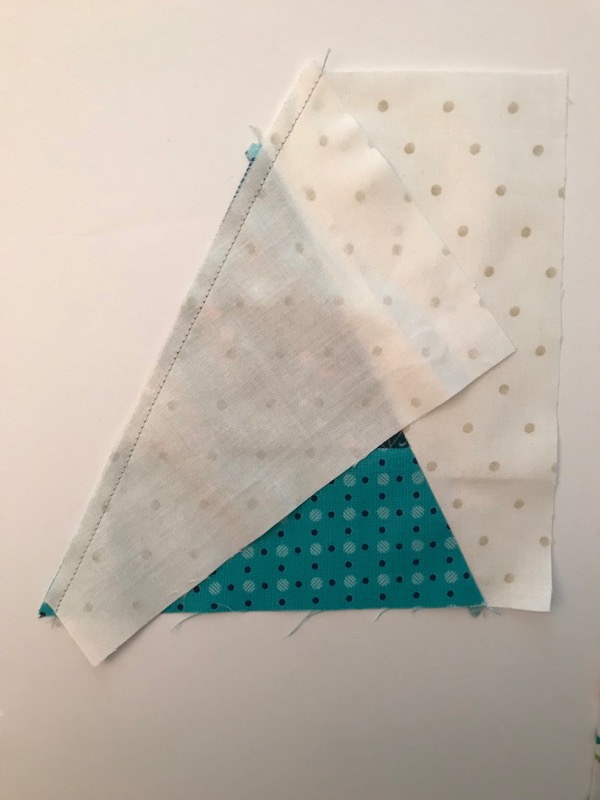
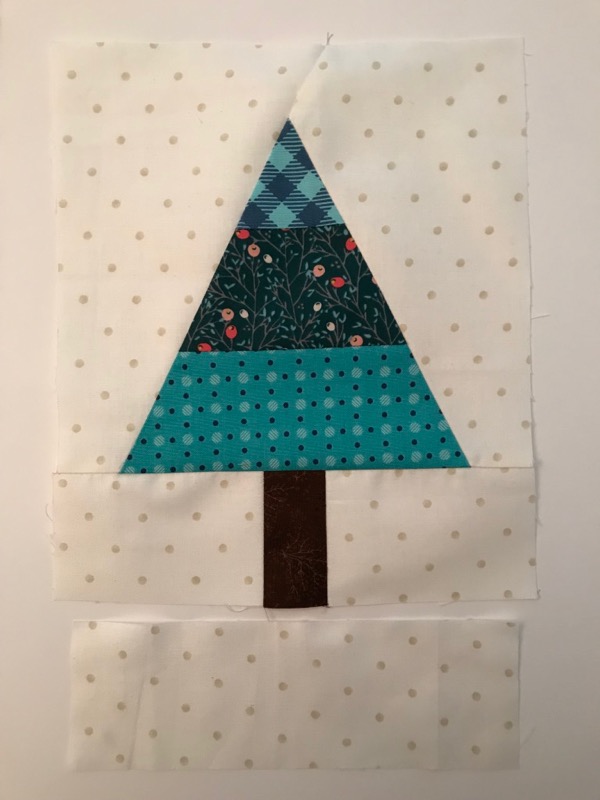
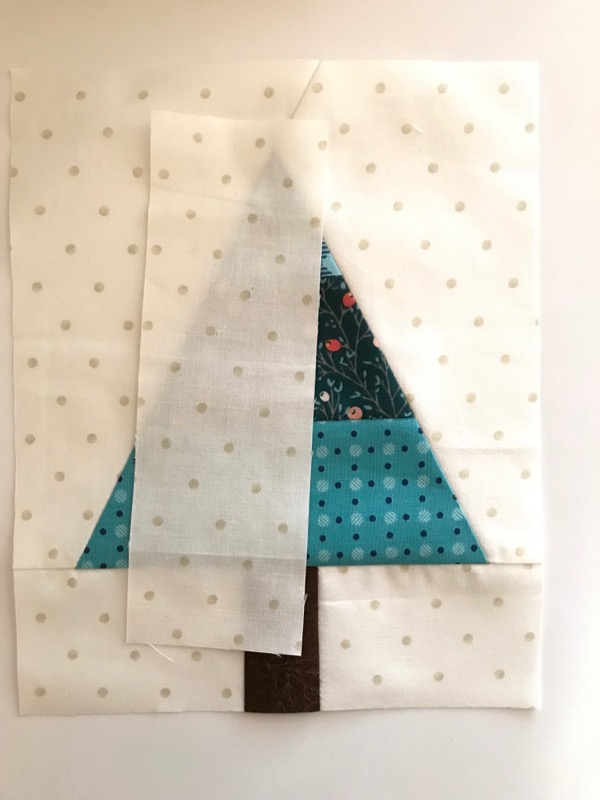
Stitch two background pieces on either side of the tree trunk; press toward trunk.  Line up the tree trunk with the tree’s top point, as shown.  Stitch seam.  I trim off the little triangles, too.

Because this pattern has you add an extra piece, I cut that too, and kept it to the side (but it’s shown, above).

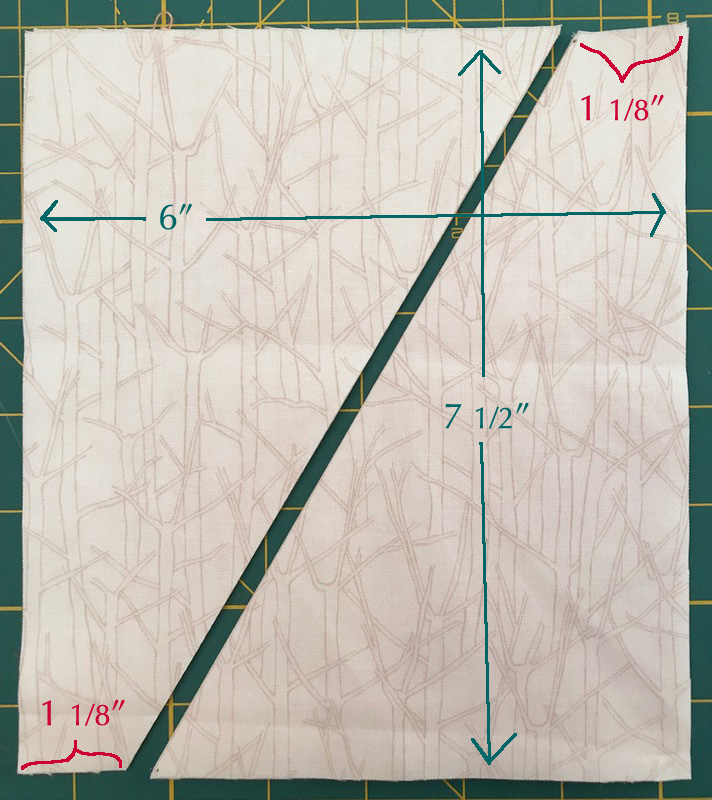
I like to streamline my cutting.  I cut two rectangles 6″ wide by 7-1/2″ tall, placing right sides of fabric together.

NOTE:  This only works if you have TWO of each fabric, and place them right sides together.  Layer up a couple of these rectangle sets — in units of two-right-side-together — then make marks roughly 1-1/8″ inches in from each side.

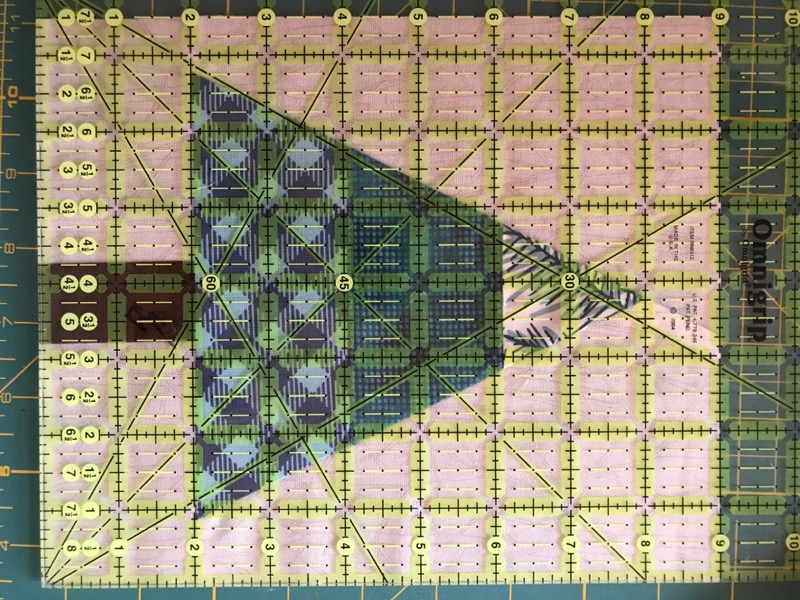
NOTE: It’s a FAT 1-1/8″ or a SKINNY 1-1/4″ measurement.  Aim for something in between.  Cut a diagonal line, as shown.  Now you’ll have backgrounds for your trees.

But the deal is, you’ll have to trim that sticky-outee triangle shown above, which really is no big deal.

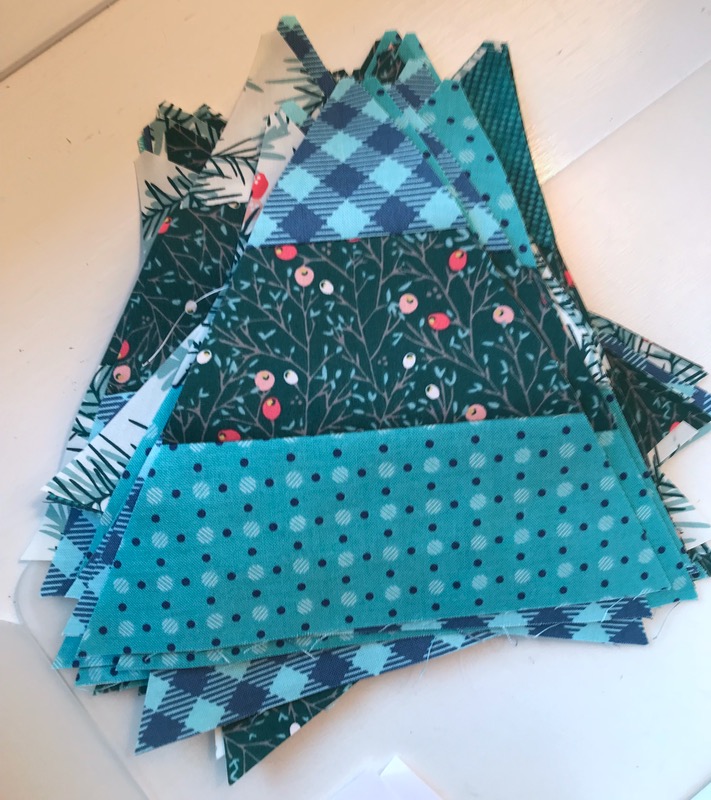
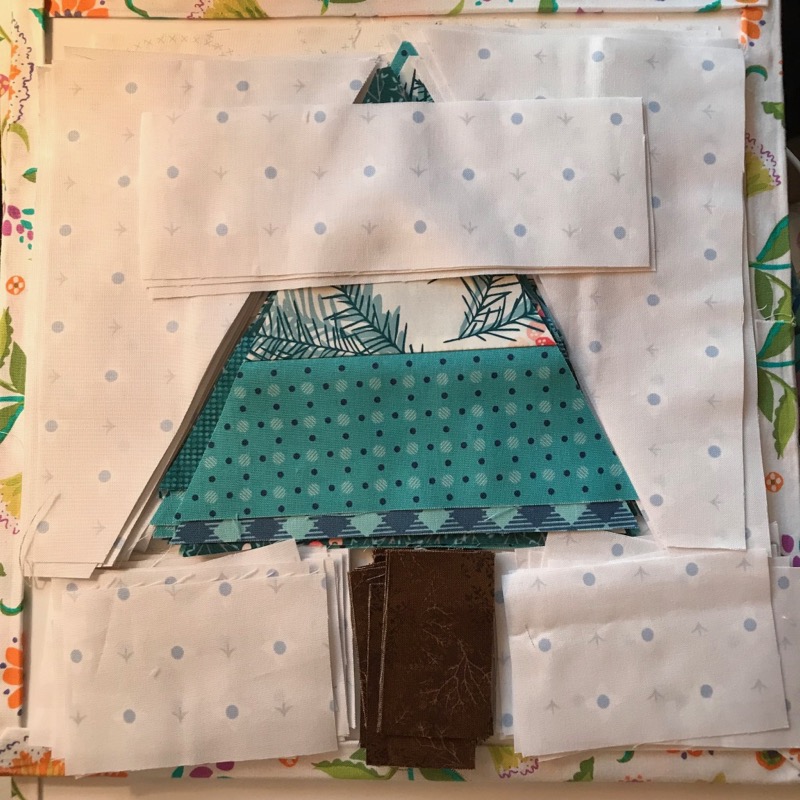
This is how I kept track of trees, backgrounds, trunks and bits-and-pieces.  I layered them up, stitching a bunch of right backgrounds onto the tree, then right backgrounds onto the trunk.  Head to the iron, then back to the machine to stitch on the right backgrounds onto the tree, then right backgrounds onto the trunk.

PAUSE, to slice off the bigger triangle, as I mentioned, then to the ironing board to press. Stitch the tree trunk unit onto the tree.

Time to true up the block.  My tree blocks were slightly smaller than the pattern’s, coming in at 7-1/2″ wide by 9″ tall.  Really, it just doesn’t matter — true yours up to your smallest tree and move on.

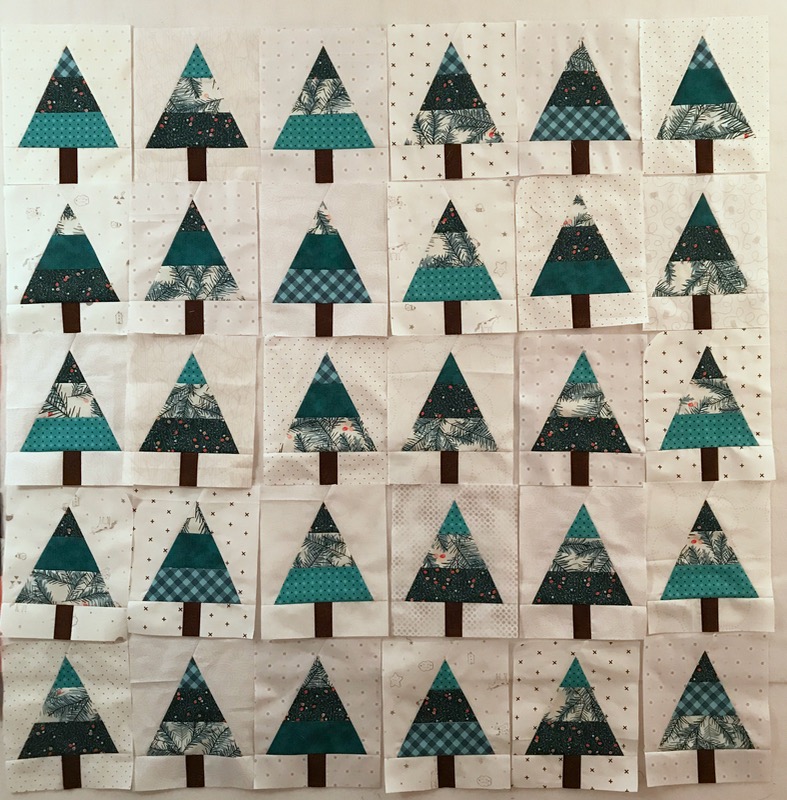
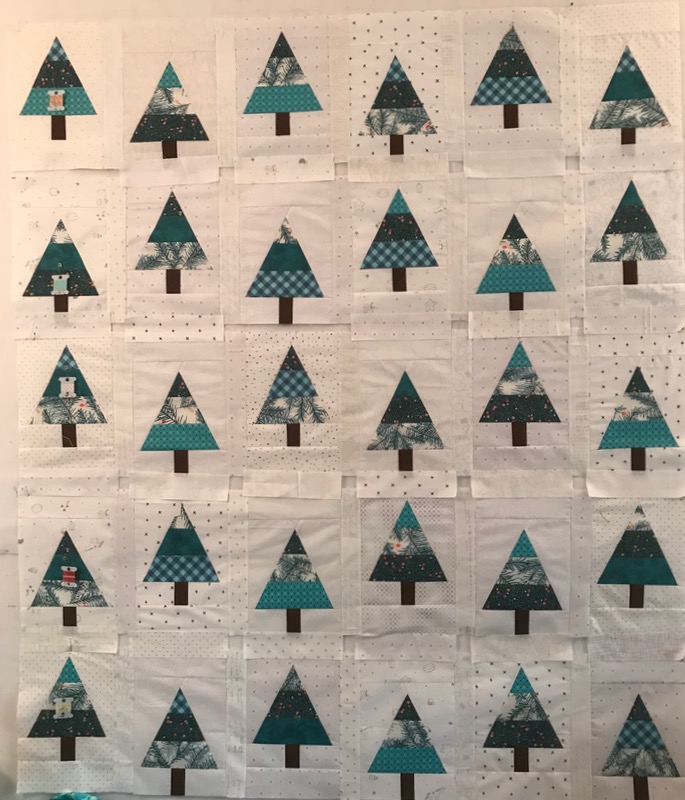
Arrange, and re-arrange until you like your trees, then sew on the extra strips, following the pattern’s instructions (shown below).

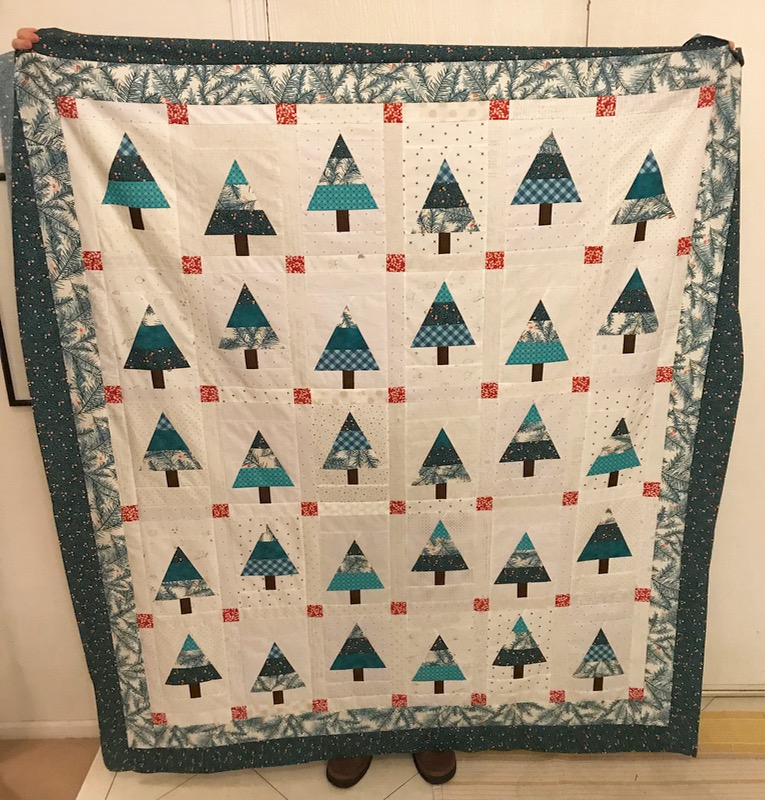
Stitch the sashing in between the trees, cutting that strip to the measurements of YOUR tree (mine was 11″), yielding strips of forest.  Then lay out the shorter sashing strips (mine measured 7-1/2″) for the horizontal sashing, making sure to distribute your background prints evenly, then add the sashing square (as per pattern) and sew.

I had a bit of the pine branches fabric and the darker one with the berries, so used them to add two 3″ borders around my quilt.  I just ran it up to the quilter’s and hopefully will have it back to enjoy before our Southern California winter disappears (it’s really only about 15 minutes long these days, given the effects of climate change).  Today is a deliciously rainy day, and I can hardly wait to use my Winter Pines quilt on days like this!

Get the other free Christmas Trees pattern *here* (shown above)

Free Quilt Pattern · Quilts

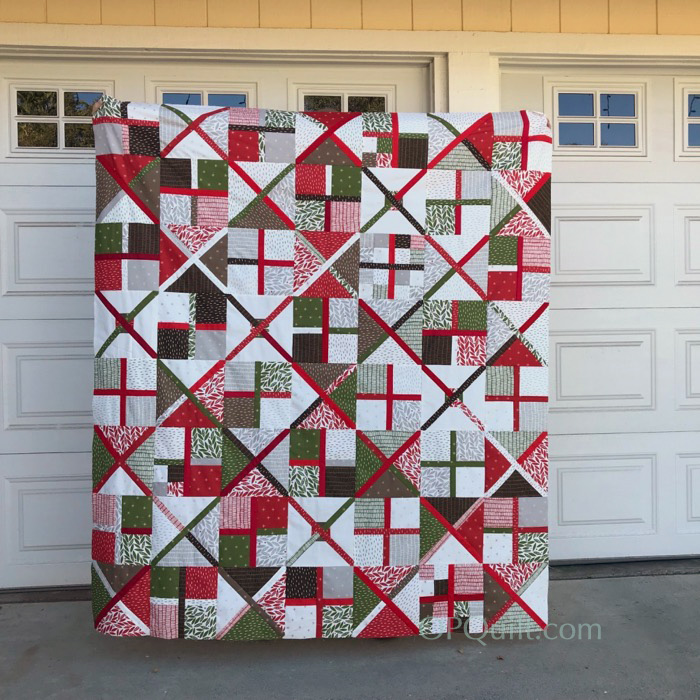
Criss-Cross Quilt Top

CrissCrossChristmas_front.jpg

Criss-Cross Christmas Quilt, top finished December 2017
59 ” by 68″

It all started when my friend Leisa gave me a mini-charm pack of Merrily fabrics by Gingiber.  Then the Fat Quarter Shop had the fat-eighth stack, and then when my making dictated more, I scooped up a layer cake of the line, and I was set (and I still have some left). I added Kona Snow, and got creative.

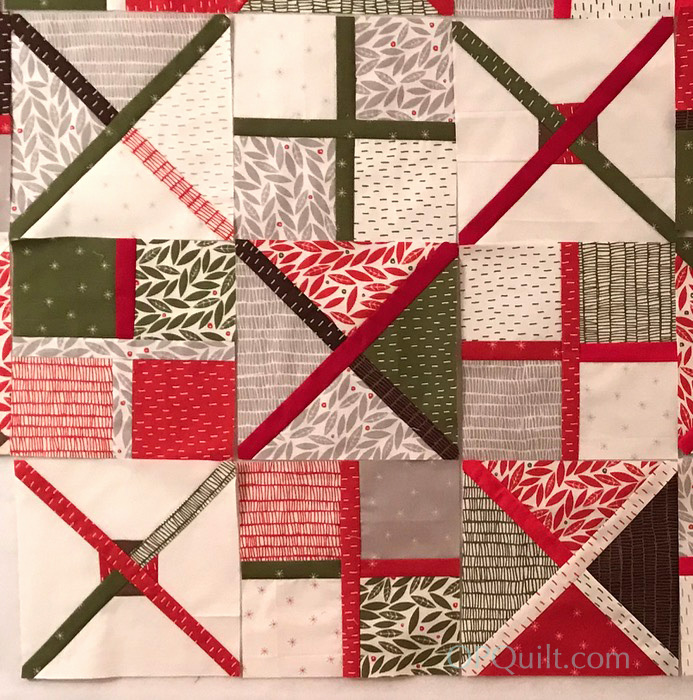
CrissCrossChristmas_3bCrissCrossChristmas_4CrissCrossChristmas_5

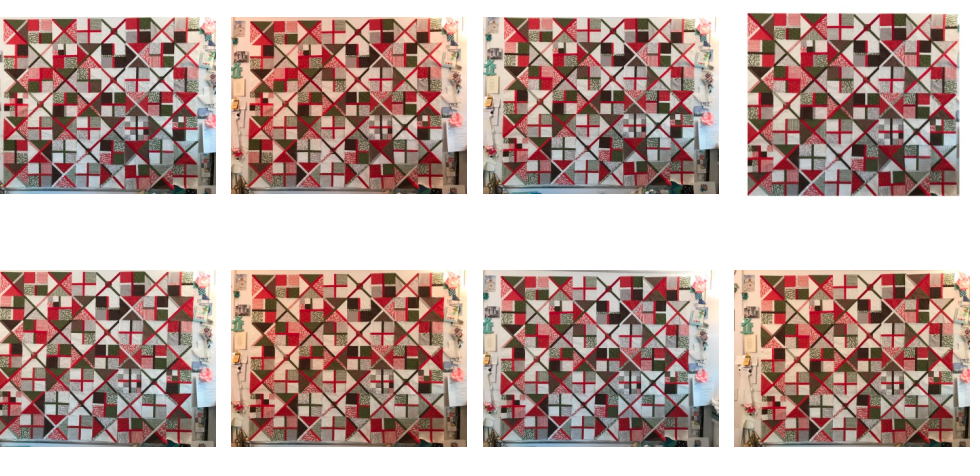
I just started making…and putting them up..and making…and deciding to enlarge it…

CrissCrossChristmas_6

Then I moved around the blocks, making sure the light of the mini-charm-square blocks were balanced against the heavier “filled-in” blocks.  At some point I decided I was done.

I sewed them together, stopping mid-way to celebrate Christmas and get the flu. Because the flu shot is only partially effective this year, more people will probably get the bug.  The good news, though, that by having had the flu shot, the duration and intensity will be lessened.  I hope so.

I’ve got some year-end sewing to do!

UPDATE:  The pattern for Criss-Cross is available on PayHip.

Free Quilt Pattern · Sewing · Totes and Purses · Tutorial

The Visual Story of a Sewing Kit

Rescue boats fill a flooded street at flood victims are evacuated as floodwaters from Tropical Storm Harvey rise Monday, Aug. 28, 2017, in Houston. (AP Photo/David J. Phillip)

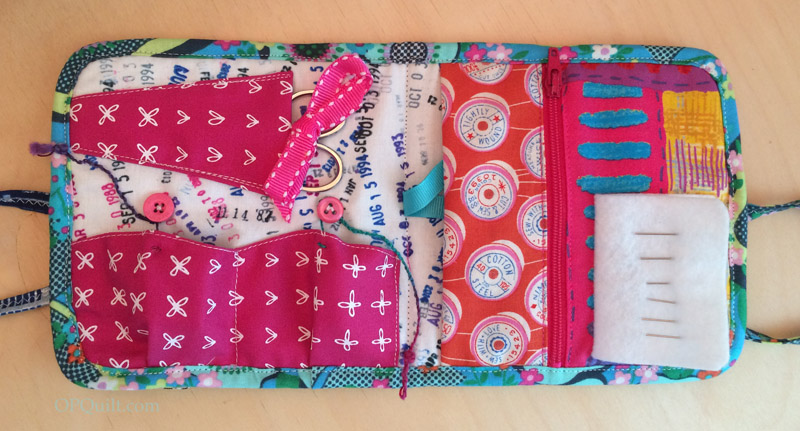
Okay–here’s what helps keep me busy while I’m watching hours of footage about the Hurricane Harvey disaster: hand-sewing.  So I came up with my own little sewing kit.  Start Here, with this rough sketch of a pattern: Sewing Kit_opquilt-pattern

SewingKitESE_1and these dimensions:
SewingKitESE_dimensions
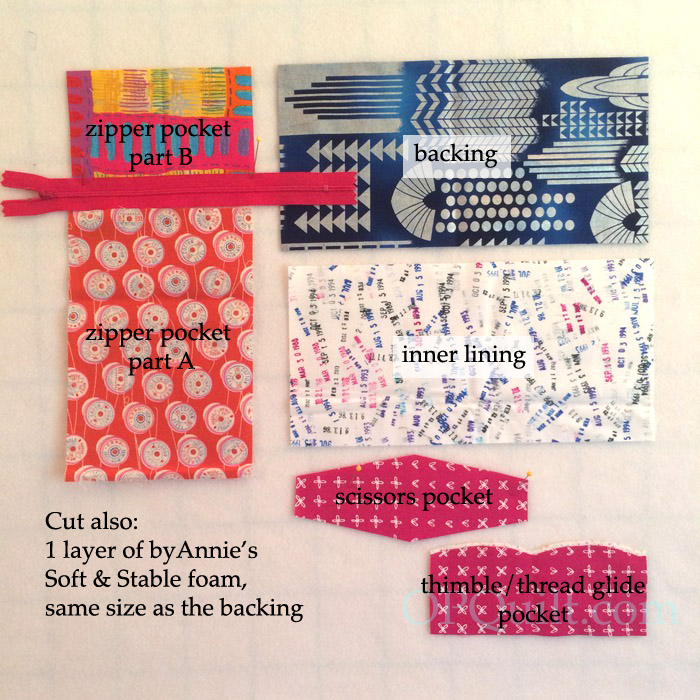
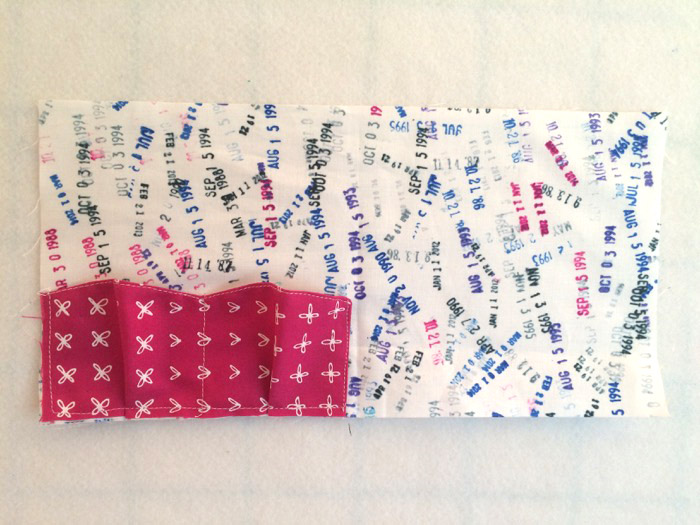
Cut out.  Quilt Soft & Stable lightly to backing, as you just want to hold it in place, you don’t want to distort it. NOTE: although it doesn’t show really well, I cut two of the notions pocket (thimble and thread glide); the dotted one (you can see it below) is the lining.  Remember to cut with wrong sides together, as the pattern piece is not symmetrical.

SewingKitESE_2

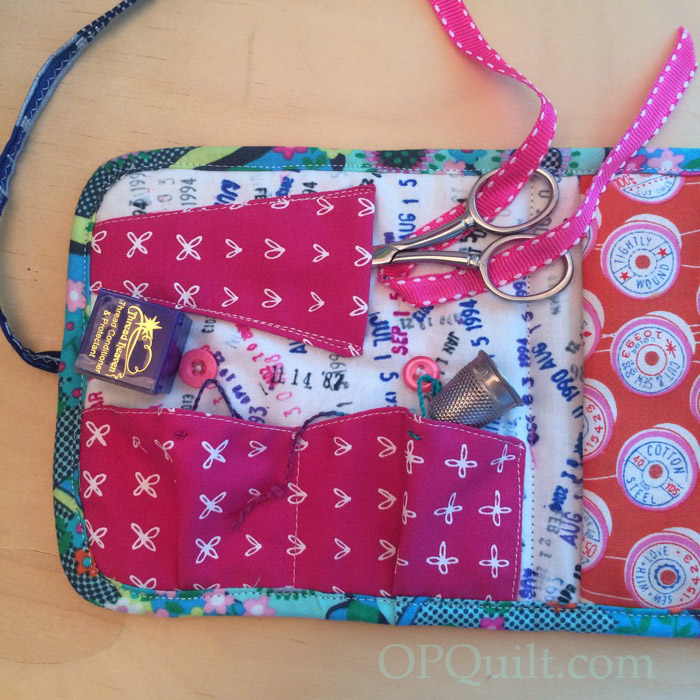
Stitch it together along the curvy top, and the right side.  Turn inside out, topstitch along the curvy edges. and make the pleats.  Top stitch along the two sides and the bottom, holding it in place to the inner lining. I like light linings, so I can see what’s going on.SewingKitESE_3

SewingKitESERefer to above photo for the rest of these sketchy detailed directions.
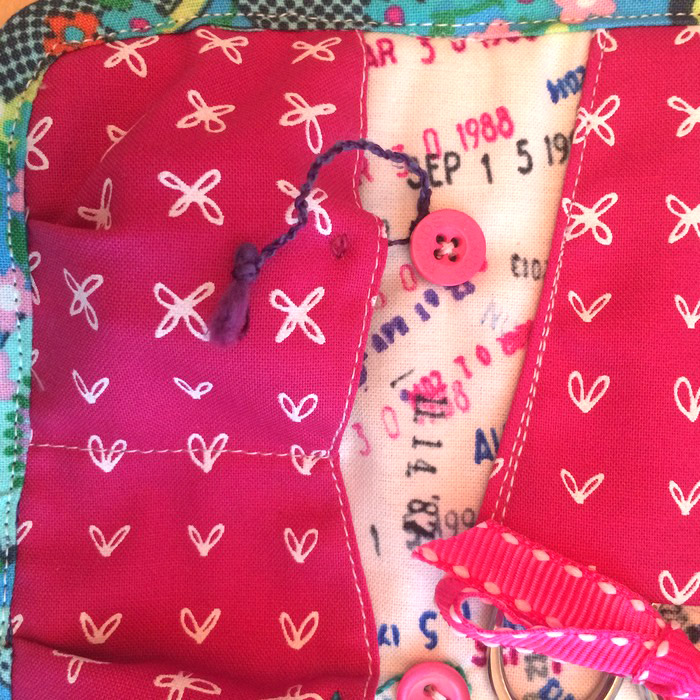
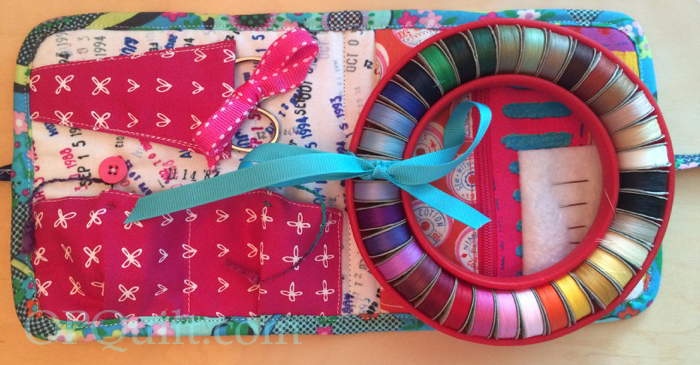
Sew down one long side of the scissors pocket; turn and press.  Turn in 1/4″ on the other long side; press.  Top-stitch the scissors pocket onto the lining.  Slide your scissors into place, and figure out where the ribbon needs to go: backstitch a ribbon into place.

Match up the backing with the lining and all its decor, putting wrong sides together and pin. All the edges will be raw edges.  Find the center line (where you will fold this closed) and stitch down the center to anchor the parts together.

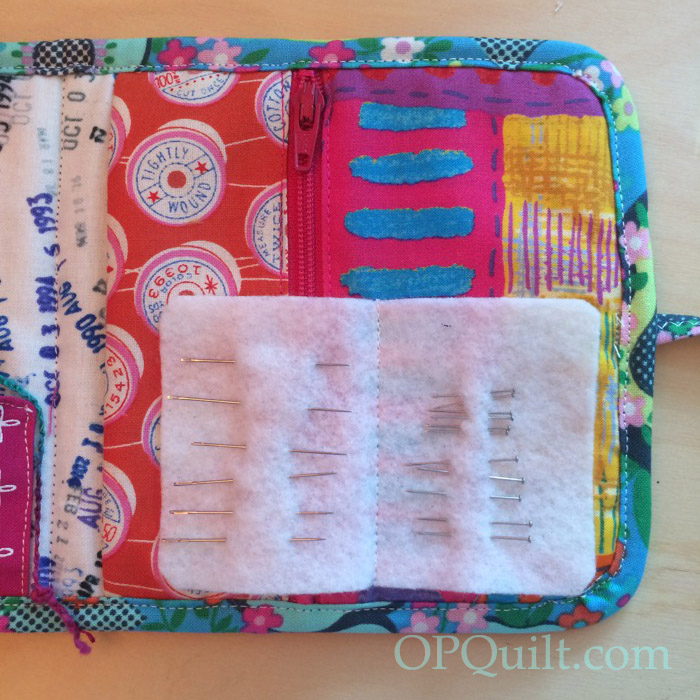
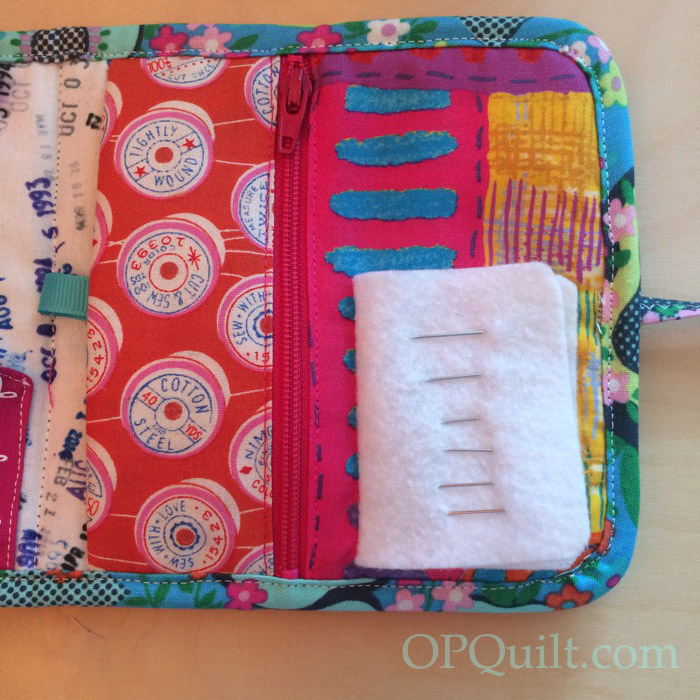
Insert the zipper between the two zipper pocket pieces, cutting zipper down to size after sewing thread tacks on each end to keep the zipper on its track.

If you want a needle holder, cut a piece 1-3/4″ by 4″ and stitch to the zipper pocket as shown in photo above.  Then fold the zipper-pocket-assembly in half, creating a pocket.  (You can see the aqua ribbon sneaking into the pocket in the above photo.)  Place zipper pocket on right side of lining and stitch around this narrowly–just to hold it in place.

Lay a spool of thread on all the corners and trace; cut the edges into a rounded edge.  You can omit this step, and just do the corners like a quilt binding.

Bind the edges with a double-fold binding: cut a piece approximately 20″ long and 1-1/4″ wide.  Fold raw edges into the center and press.  Open out binding; first stitch WST with binding to back.  Fold to the inside, pinning or glueing to keep in in place, then topstitch.  Make two other double-fold pieces, roughly 12″ by 1-1/4″ and zig-zag.  These are your ties.  Stitch them to either side of the outer edge (refer to photo way below).

SewingKitESE_3a

Add other trim: two buttons for the “String & Button” closure (yes, that is its official name).  I found some interesting thick string and sewed that through the little pocket at its tallest point and then knotted it behind the pocket.  I used Fray-Chek on all raw edges of string and ribbon and ties.  To close, you wrap it around the button (shown, above).

SewingKitESE_4

SewingKitESE_6SewingKitESE_6aSewingKitESE_7SewingKitESE_8SewingKitESE_9

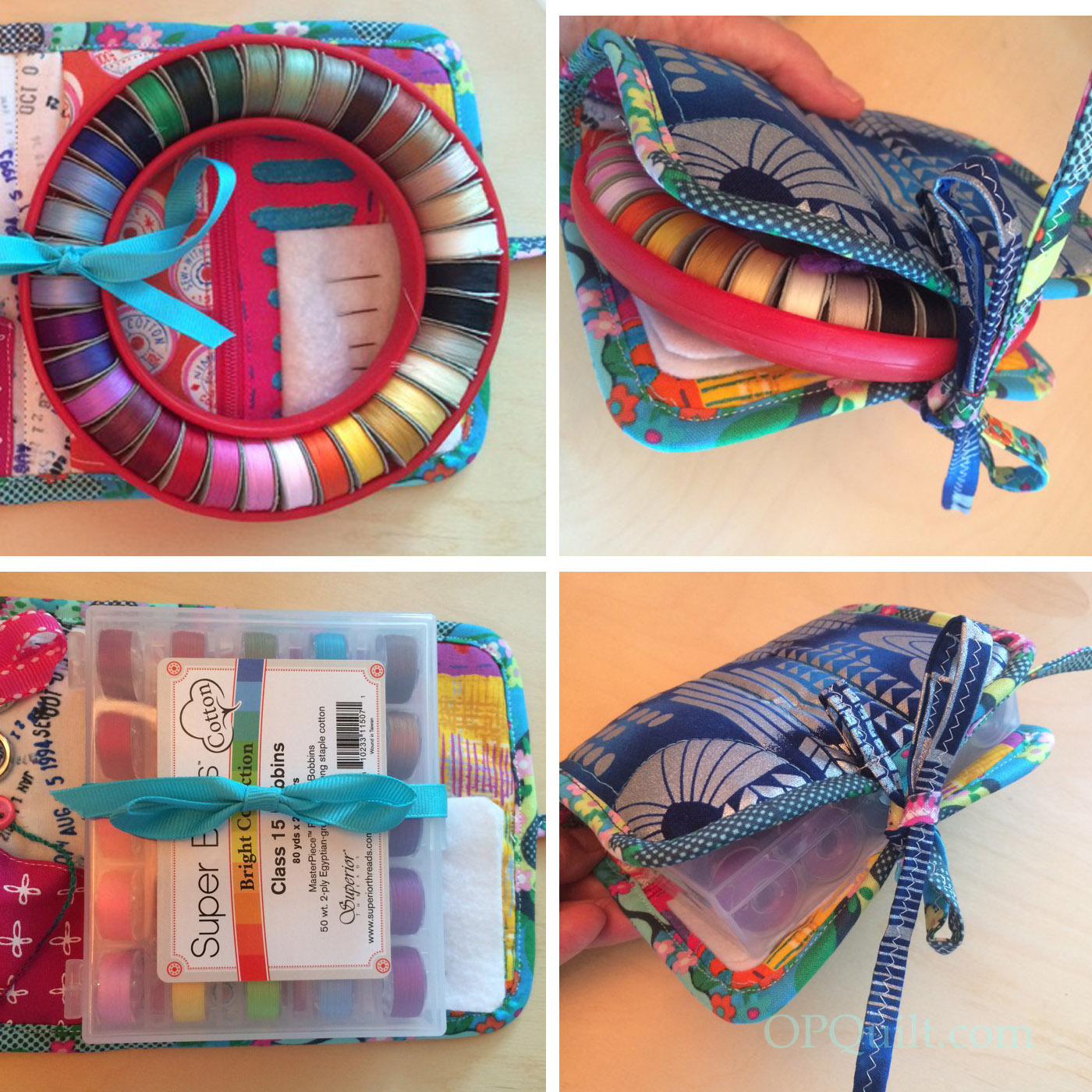
I use the Superior Threads Bobbin Donut in doing my hand stitching.  I tried and tried to think of a way to get it attached, and finally resorted to sewing a ribbon to the center. SewingKitESE_10

I also tried it out on their new Super Bobs box, which is what is replacing the Donut.  They still have a few donuts for sale on their website if you hate to see it go.  Truth: I probably won’t shove the donut or the box into the sewing kit…but I might.

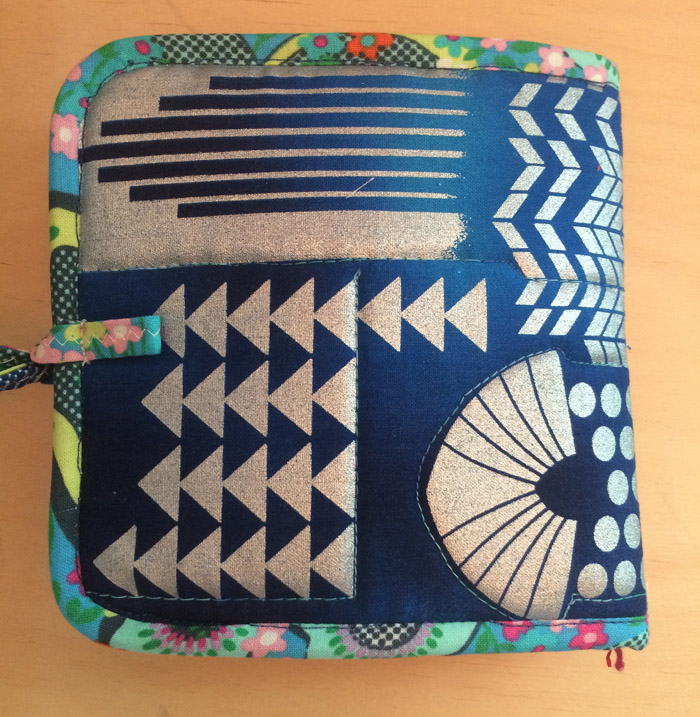
I realize that I assume you have some sewing knowledge when I posted this, but another Truth: it’s also for my reference if I ever want to make another one.  The very cool fabric on the outside is from Timeless Treasures Fabrics a few whiles back.  It’s called Lux, if you want to go looking.

Why did I make this?  I have lots of pouches and bags and I love them all, as most came from friends.  I also have a couple of sewing cases, too, but I found myself toting around my stuff in a zipper baggie, as nothing quite suited me.  So I know this is what works for me, but maybe you can find something in here that will work for you.

SewingKitESE_11

It matters little how much equipment we use; it matters much that we be masters of all we do use. ~Sam Abell

I have to say that my attention has been preoccupied with the victims of the Houston flooding.  My son and his family moved there a week ago (I know!), and I try to keep tabs on them as much as he is able to.  I’m not the only one focused that way, with loved ones being flooded.  We’ve contributed to the Google Hurricane Harvey Response (they’ll contribute matching funds), and there are many other charities where you can donate.  Please consider helping in this way, as this is catastrophic.

And One More Thing: Get your own Emergency Supply Kit.  Have water, basic necessities, food that’s portable.  None of us can expect that rescue will be a part of our community’s offerings, in case of disaster (and you know what your own disaster can be).  We have to expect that we’ll need to help ourselves first.

Samaritans help push a boat with evacuees to high ground during a rain storm caused by Tropical Storm Harvey along Tidwell Road in east Houston, Texas, U.S. August 28, 2017. REUTERS/Adrees Latif TPX IMAGES OF THE DAY – RTX3DRSF

SaveSave

SaveSave