

Blog-writing for other organizations can sometimes make me weary. I’ve been the blog-writer for a local guild here, and the other day — Blog Writing Day, as I like to call it, when everything stops and I won’t do one more thing before writing out the news and stuff for the organizaion — I sat at the computer, my mind blank. I wrote the usual paragraphs, then wondered if I should delete some of it, as I am turning everything over to a new person in a month, and would she want to have to write this in her tenure? It all became very complicated, trying to write what’s in someone else’s head, in someone else’s world.

When I write for this blog, on the other hand, I try to find some space and some quiet — a recent challenge during covid-time and we’re all shut in our houses together.
The conditions of these two aforementioned things may explain why you haven’t see a post from me in some time. But here goes.
Part of the title of this post, weary, might describe us all at this time. We’ve been covid-ing since March (wearying), made it mostly through an election (wearying), our energy levels are low, and now we are all putting up our Christmas lights early, trying to bring in some light into this weary world of ours. Ours went up last Saturday, and since we celebrated Thanksgiving early — a social distanced, outside on our patio, meal with local family this past Sunday — all our Christmas decor is creeping in to the house, well before the end of Thanksgiving Day.
It feels right. We need something to celebrate, to rejoice in, and I am looking to the familiar warm-hearted feelings that the Christmas season can bring, and if that means early tinsel and lights and nutcrackers, bring it on. If that means putting out the Christmas quilts, and pillows and table runners, I’m in. Christmas tunes? Now on the playlist.
I was trying to think of ways to help lift the weary and wondered if you were interested in a quilty make to up the holiday cheer. If so, here are two possible ways:

This is a teeny little quilt (4″ x 6″) that can be slipped over a frame. These make cute gifts for friends, for shut-ins, for people you visit but who are still fretting about their gain of the Covid-fifteen-so-no-more-chocolates-please. Directions are found *here.*

This is my field of Christmas trees, made so long ago from *this free tutorial* and which needs to be finished. What always stops me in a project is that I get plans which then complicates everything to that something perfect in my mind, which then shifts me to never-getting-it-finished. Keep in mind that just participating in the act of creation (like our quilts and blocks –and even wooden blocks on barns), can help us feel better about life.
Example of Complicated (work in progress):

Example of Uncomplicated:
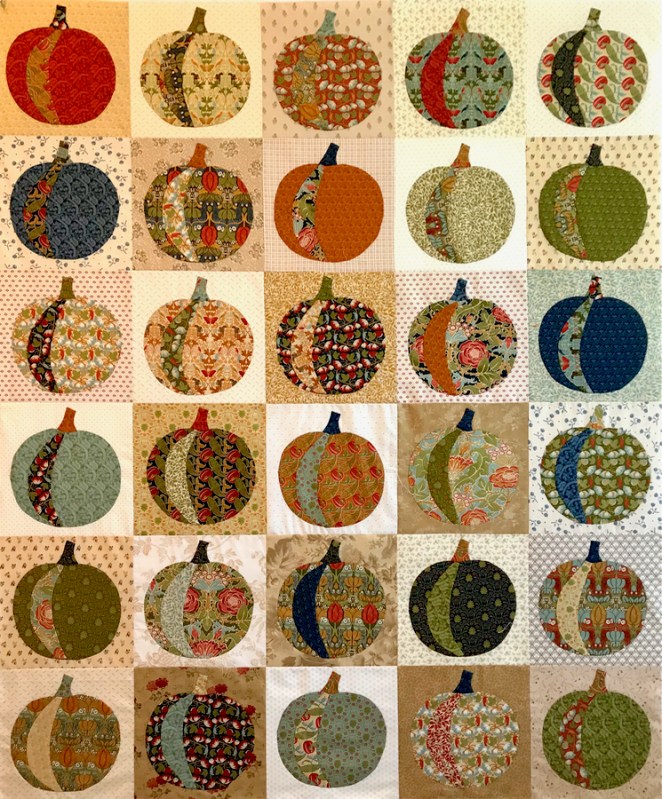
Maybe December 2020 is the season for simple, for easy, for uncomplicated. Maybe it’s the time for bringing light, for sharing our lives, for writing holiday cards, letting people know we are still here. And next year, when we’re all vaccinated (my Christmas 2021 wish) and we’re out and about and full of vim and vigor and excitement, and even in spite of all the recovery work that will be around us, we’ll not be weary.
We’ll be hopeful.

Happy Thanksgiving, everyone!


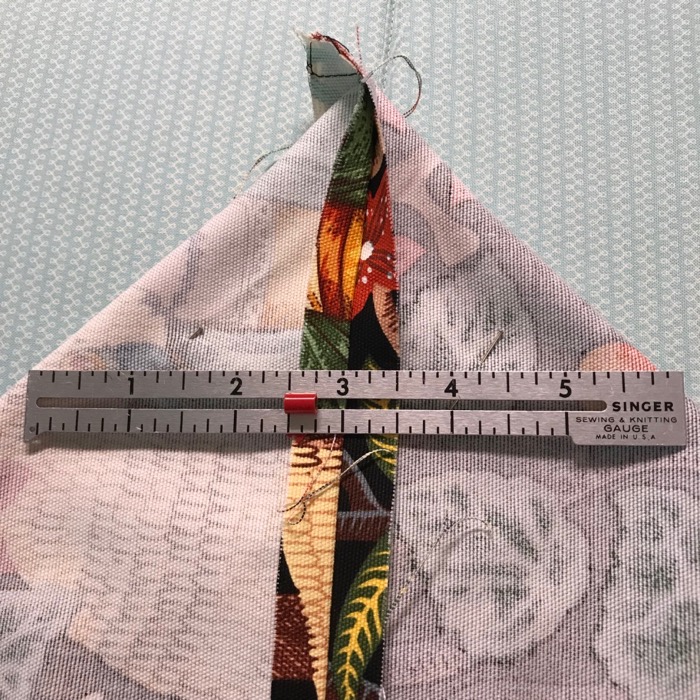


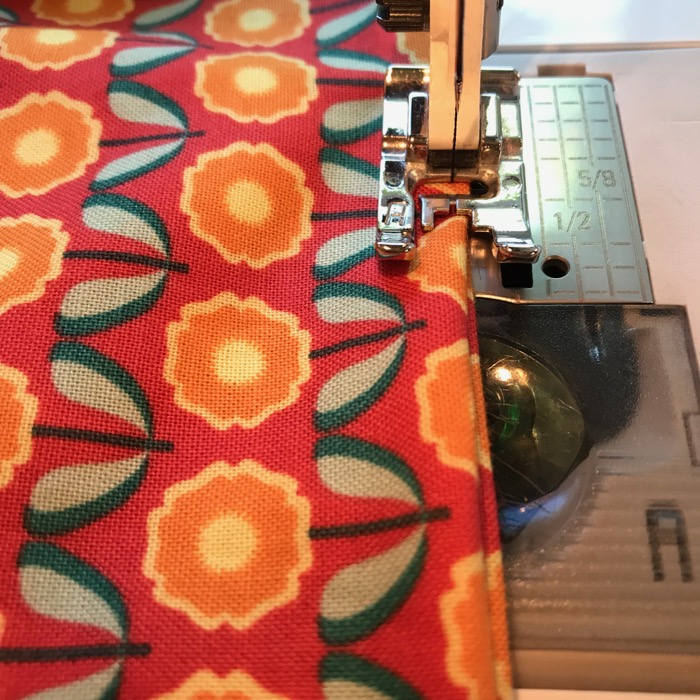

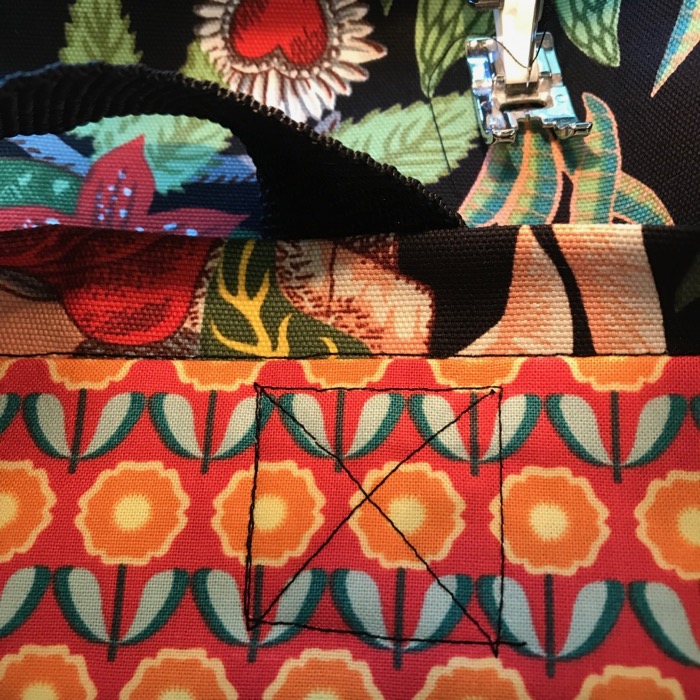




 I followed the instructions, as before (old picture, above), but if you need a more detailed refresher on how to make bias tape, head here, to the




 We all put double layers of fabric bindings on our larger quilts, but have you thought about using a single binding on a smaller quilt? It’s quicker, flatter, and really–are you going to wear out those edges any time soon? And if you do, won’t you just repair them? That idea came from Gwen Marston, in one of her last workshops. That idea — that a quilter would just repair them if they became worn — is why she uses single bindings on all her quilts.
 Start by squaring up your mini-quilt. Yes, that is a gigantor square ruler, and I use it a lot, actually.
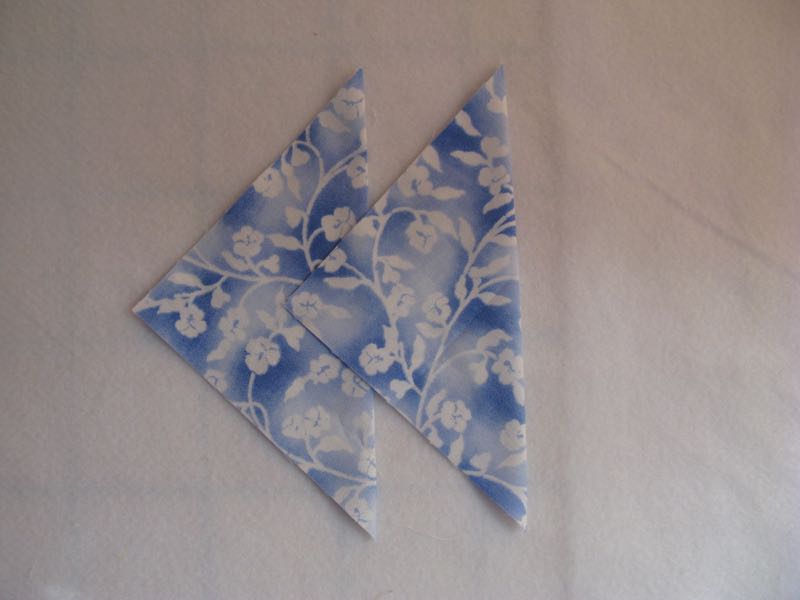 Prepare your hanging corners, by cutting a larger square (for a 24″ quilt, I use a 5 1/2″ square), folding in half, diagonally, and pinning it in the upper corners of your mini, against the back, matching raw edges to the edge of your quilt.
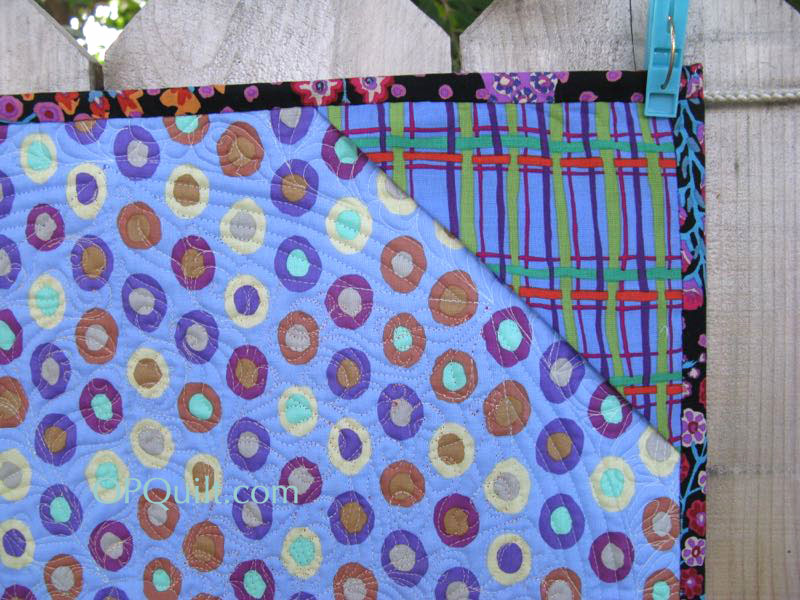 (Here’s what it looks like on another quilt, as my corners just disappeared on this one.)
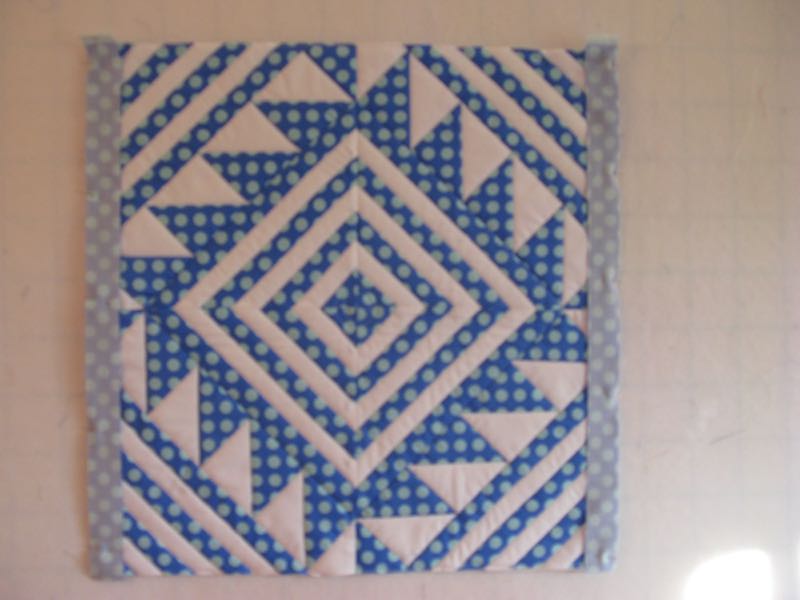 Cut strips of fabric (lengthwise, if you can) about 1 1/2″ wide and the size of two sides. Pin, then stitch on, using a 1/4-inch seam.
 Repeat for upper and lower edges. Pin and stitch, but watch out that you don’t veer off on those corners (I pin them).
 Square up the corner, and cut off the excess, both underneath (above) and on the outer edge (below).
 While this looks angular, it isn’t.
 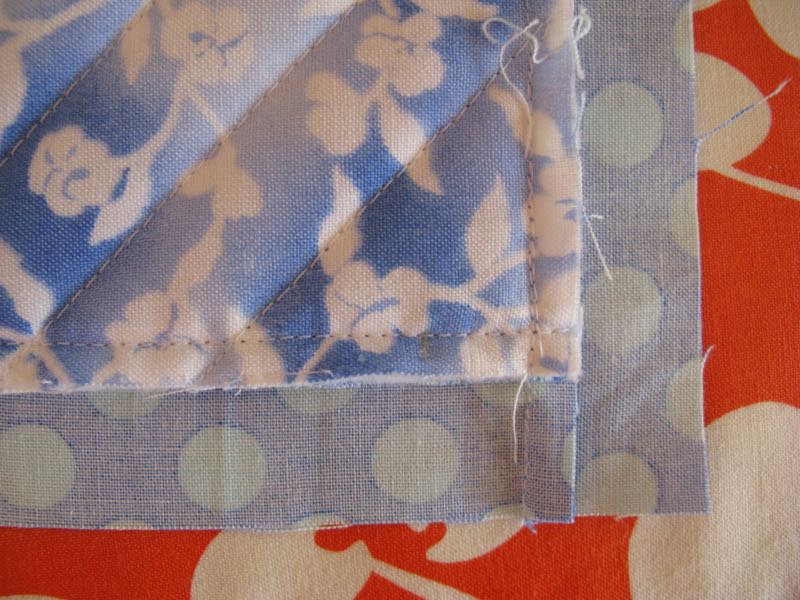 Press binding out away from quilt.
 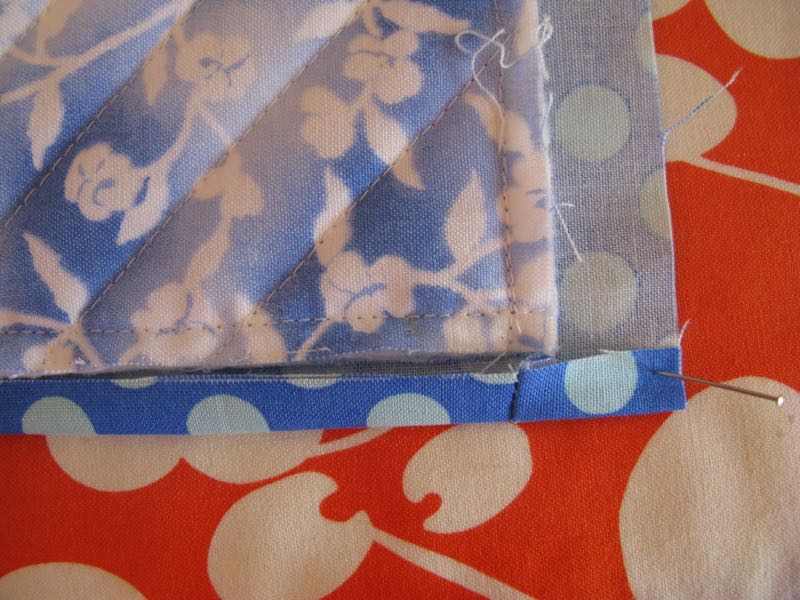 Fold up lower edge, so the raw edge of the binding meets the raw edges of the quilt.
 Fold it up again, covering the raw edges of the quilt. Pin in place, and then repeat with the sides:
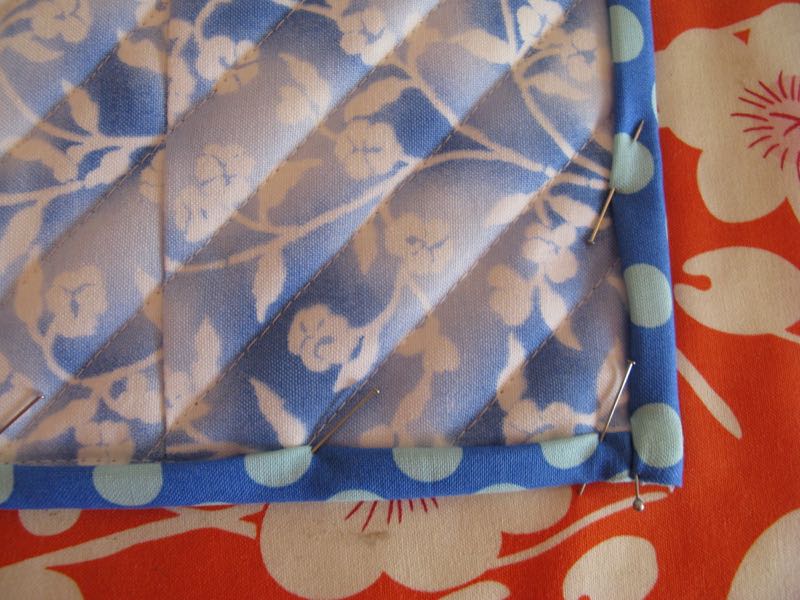 Hand stitch all the way around, or if you are a confident quilter, you can use a glue stick to affix the binding edges down, then machine stitch. I personally don’t like the machine stitching, as I think it makes the edges too rigid, but “To each his own,” said the Old Lady as she kissed the cow. (My Dad used to say that all the time.)
 Here’s the corner already on, but it’s hard to see. I cut a dowel the width of the quilt, minus 2″ and slip it into place. Then I hang my minis, balancing it on a push pin.
 Thanks to all who came to the Trunk Show and to all who sent their best wishes. It was a lovely evening! If your guild would like to see my Abecedary of Quilts Trunk Show, just drop me a note.
 OccasionalPiece--Quilt!
