Totes and Purses · Travels

Sewing in Translation

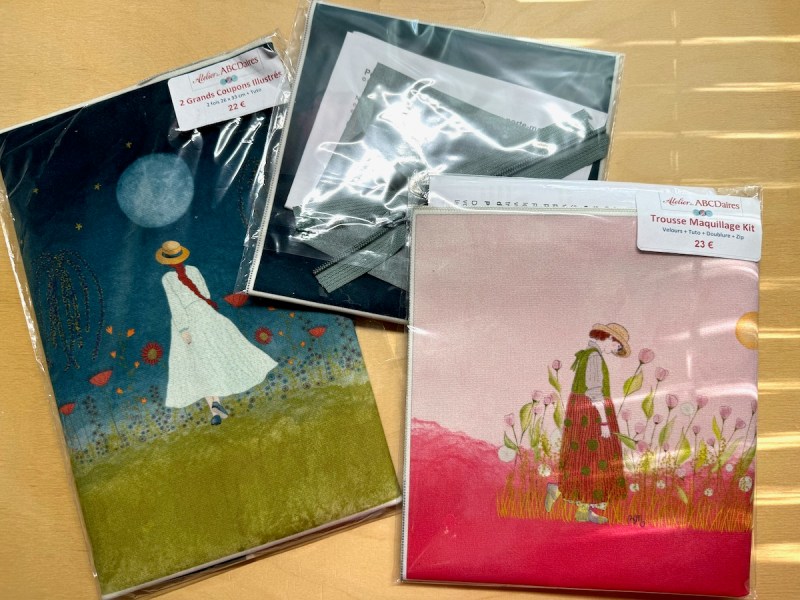
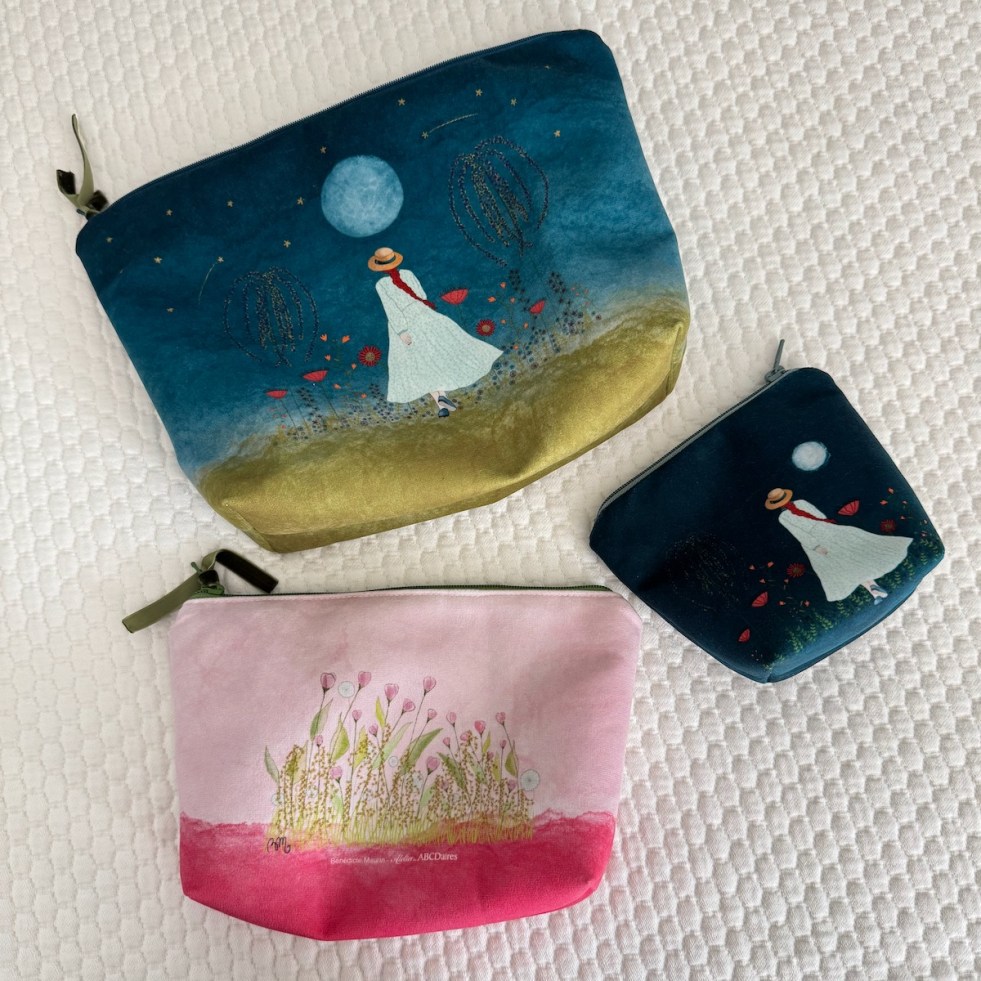
You know when I stood in the shopping area of Carrefour Quilt Show last September (2024), I wanted to buy up all the fabrics and patterns and everything, but alas my suitcase was small, so I had to limit myself. One of the choices was a series of small pouches from ABCDaires, with a soft velvety fabric with absolutely charming printed designs. I tend to buy something that I won’t see in the States, and this fit the ticket. I bought three: two kits and one that just had the printed fabric.
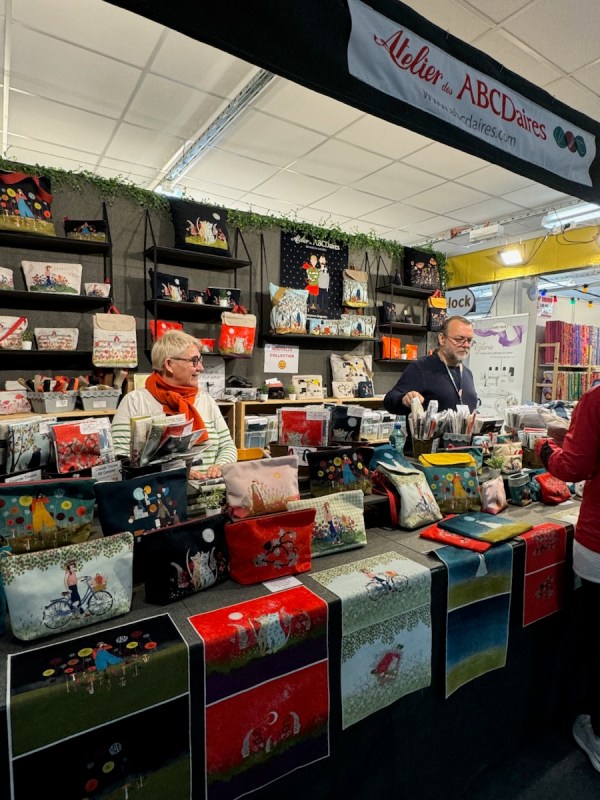
(taken with permission)
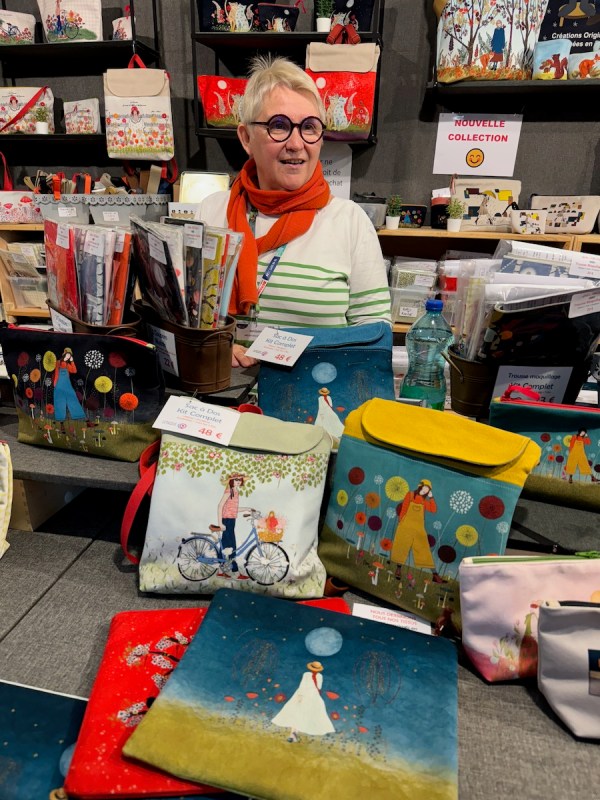
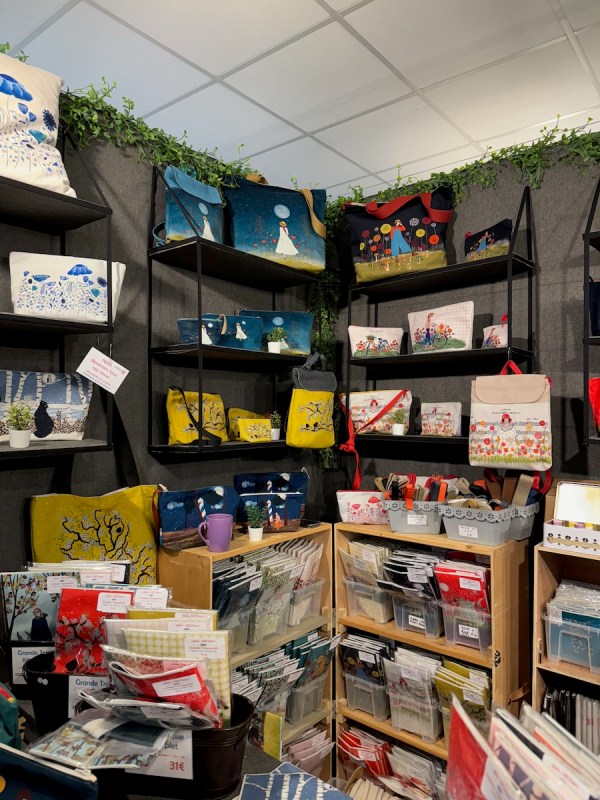
There is a front and a back to each pouch with different designs. One kit was pink with a girl in flowers on the front, and then just the flowers on the back. The colors were rich and saturated, so I was hooked.

However…Note to future self: Just.Buy.The.Kit. For the un-kit purchase, I luckily had a zipper that was a perfect match. However, the zippers in the kit were just a bit heavier duty, plus she included the lining, a waxed lightweight canvas.

But how can I sew it if it is in another language? you ask. Google Translate to the rescue. Let’s start with their website, ABCDaires:
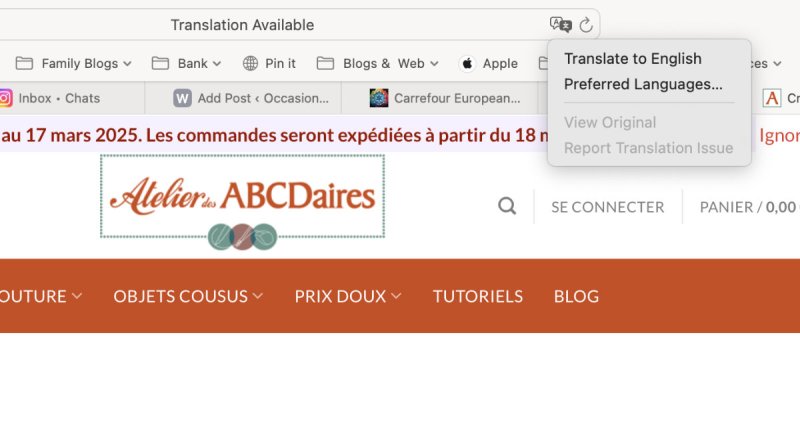
I have the Google Translate in my browser, so I just click on the little icon in the upper right of the search bar; in some reading I did it suggested that now you have to use Chrome as your browser to get that. (I don’t know–do some searching online.) Or you can head to Google Translate and paste in the URL of the page you want to see in English:
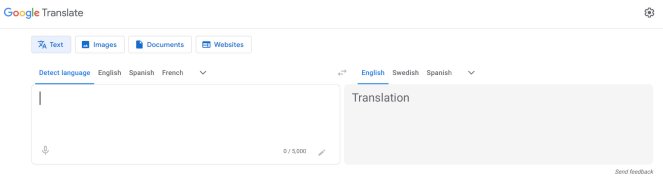
This is Google Translate (above). Click on the Websites box, paste in your URL and it should translate most of the language for you.
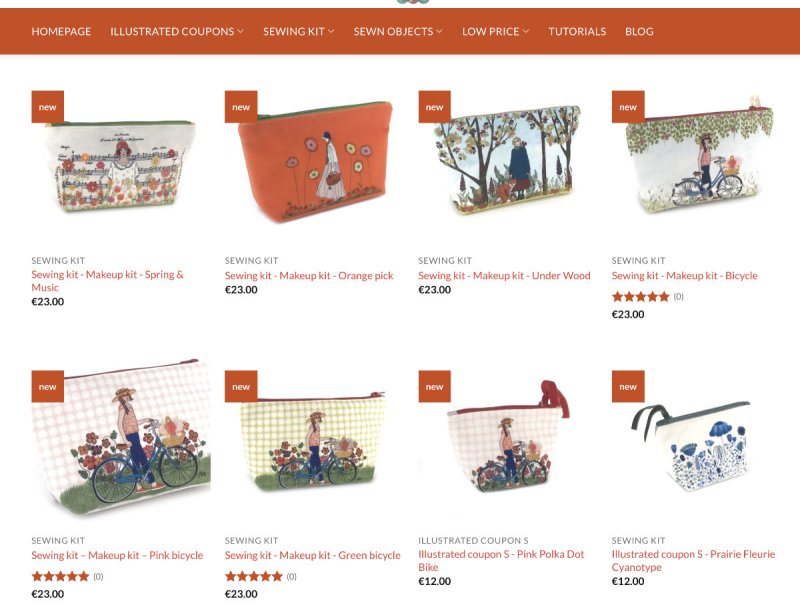
Now the website is all in English, and you can click around to purchase the little kit you want. Yes, you will still have to convert the metric measurements while sewing. I have a small ruler that I use for just this.
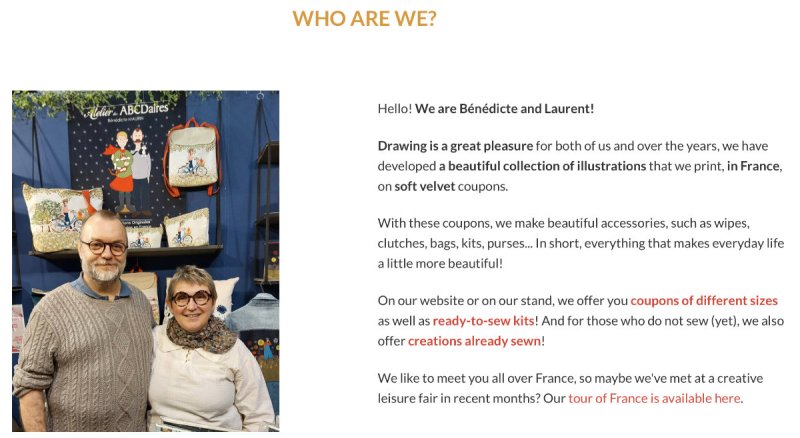
She was very helpful and just lovely and spoke English! They also have a downloadable PDF of instructions on their website. I’ll talk about that in a minute.
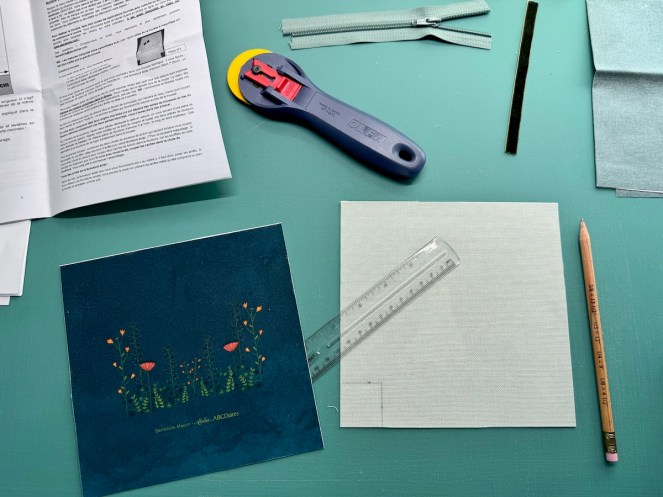
This is the smallest of the three I purchased. You can see the little ruler I use that has cm and mm marked on it. The first thing you do it mark off small squares in the corners, but she has two different measurement options. This was the first wrinkle in the translation business. Which one? I tried using my Google Translate on my iPhone. You open up the app, choose PHOTO and hold it over the paragraph:
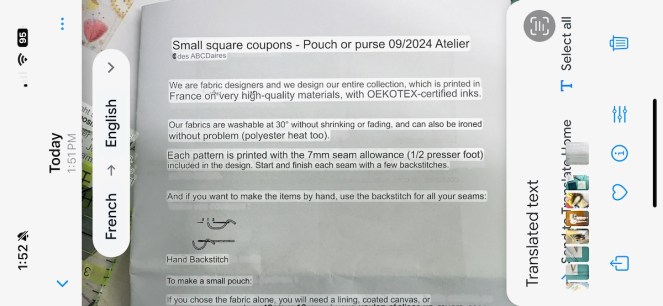
After a second or two, all the French is in English (I chose the language, but you could choose any). I learned a “coupon” is a “pouch” or maybe “fabric” or not (it’s not always perfect). So I went to the section about the corners, but alas, still couldn’t figure it out. I then went to math, something we quilters are good at. If the fabric measured X by X then I used the larger dimension, and if it was a different X by X, I would use the smaller. I measured the printed fabric, which gave me my answer. (I’m using “X” so I don’t give away her pattern.) I’m just saying, don’t be frustrated, but try another angle to solve your translation difficulty. Onward.
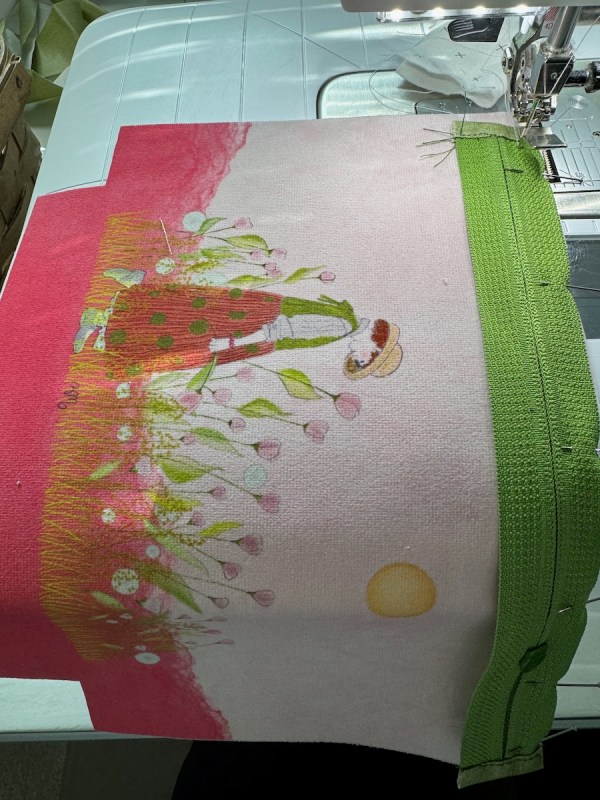
Ends go on the zipper, zipper gets sewn to the fabric…a usual sequence of steps for a pouch.

Since this is a velvet minky, I didn’t want to put a hot iron on it and scorch it, so I found my roller came in handy for flattening the seams. On the pink pouch, I opted to topstitch down the fabric with the zipper (she gives two options). I won’t do that again — in a minute I’ll show you why. [Of course it could be that I’m a dweeb at sewing pouches, and the results have everything to do with that.]
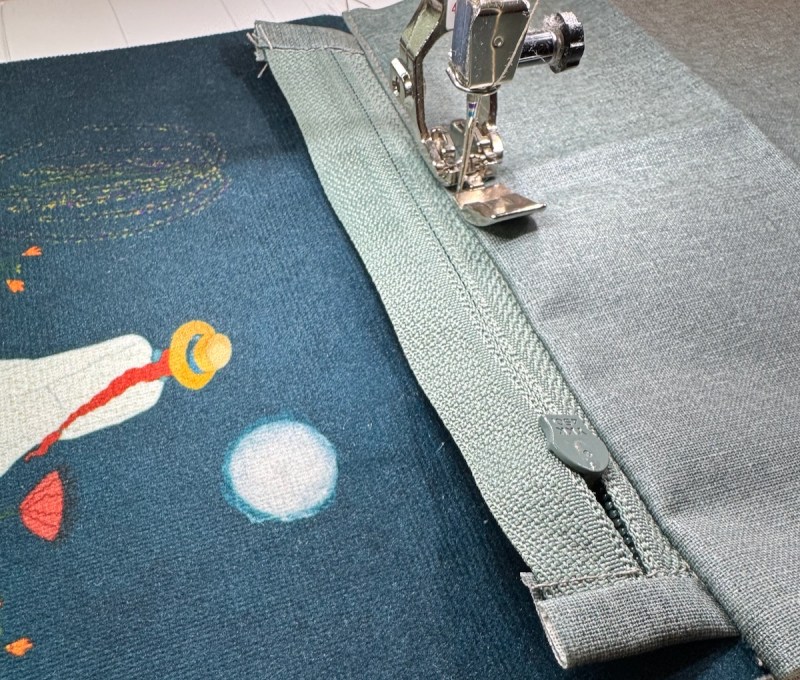
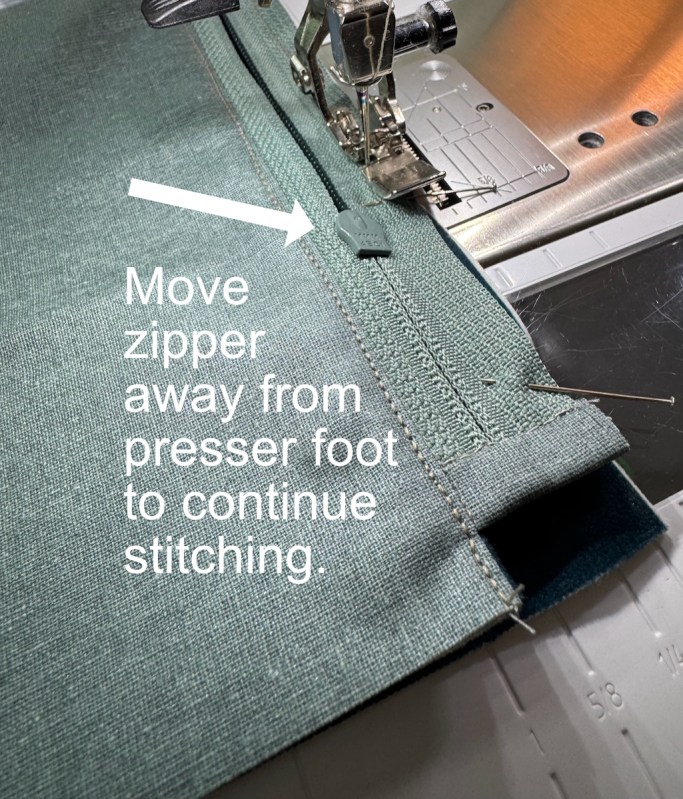
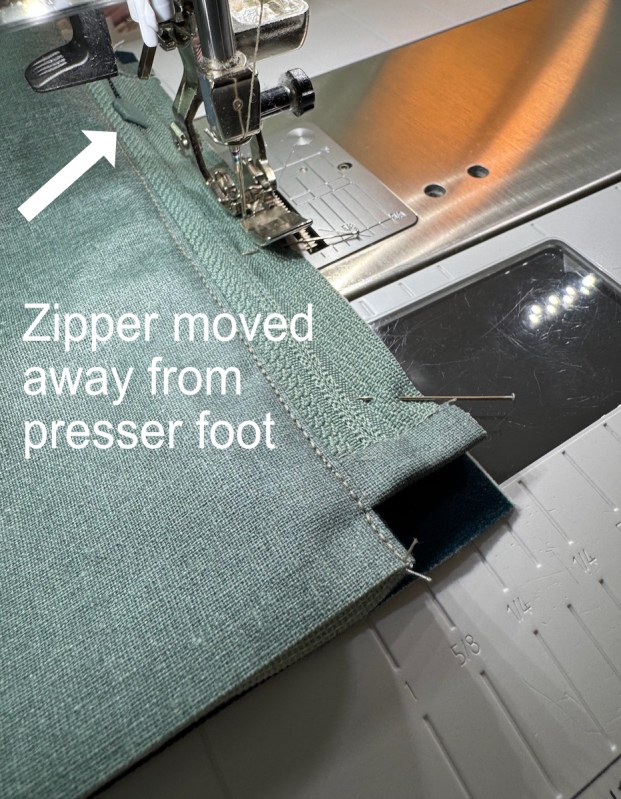
In the first photo, the designer fabric is shown smoothed away to the left, away from the stitching going on on the lining/zipper tape. As usual, when your presser foot approaches the zipper pull, leave the needle in the fabric, raise the presser foot slightly, and move it to the back where you’ve already stitched. This will eliminate bumps in the stitching line.

First one done! She has a clever way to put in the velvet ribbon so it becomes a nice zipper pull on a traditional zipper.

Here we go again. I used a bit of fabric from the stash for the zipper ends. I chose a spotty lining fabric (in upper right corner).
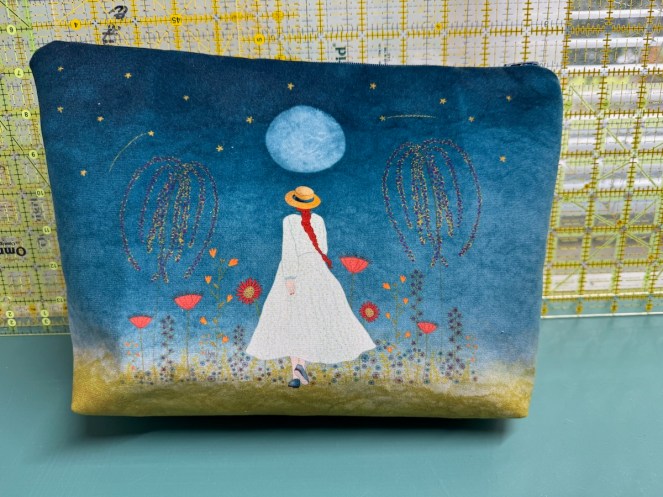
Done! The second one went so much faster, and I only top-stitched on the zipper, not the top designer fabric.
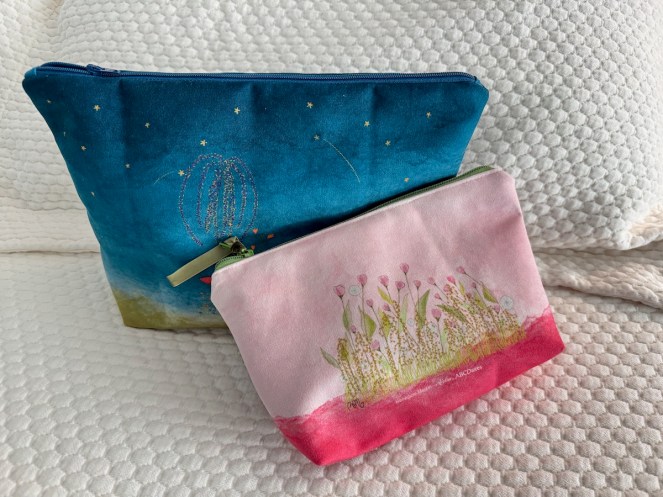
Back designs on both.
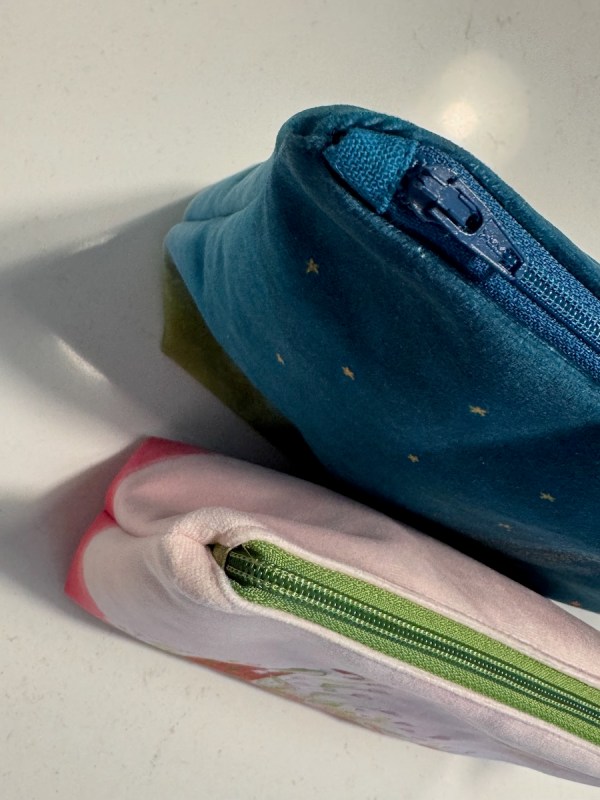
Notice how wonky the zipper ending is on the pink? I mean, it’s functional, but not as lovely as the blue zipper. I chalk it up to how the top-stitching impeded the inner seam. (I need to find a cute ribbon for the blue bag.)
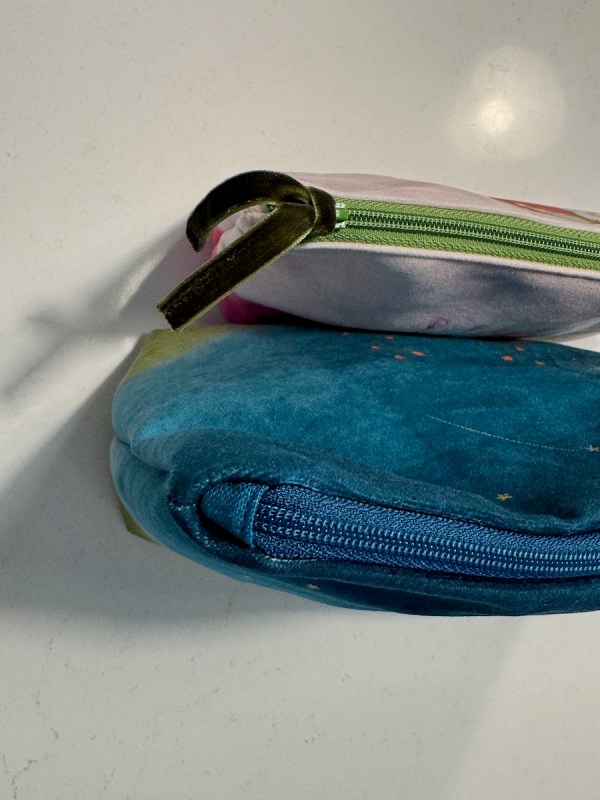
UPDATE: I’ve since sewn the last blue pouch, and now I think it was the coated lining fabric “zipper ends” that gave me so much trouble. The fabric “end,” shown above, was much easier to manipulate. So maybe, if you make these, find a coordinating fabric, rather than use the coated fabrics.
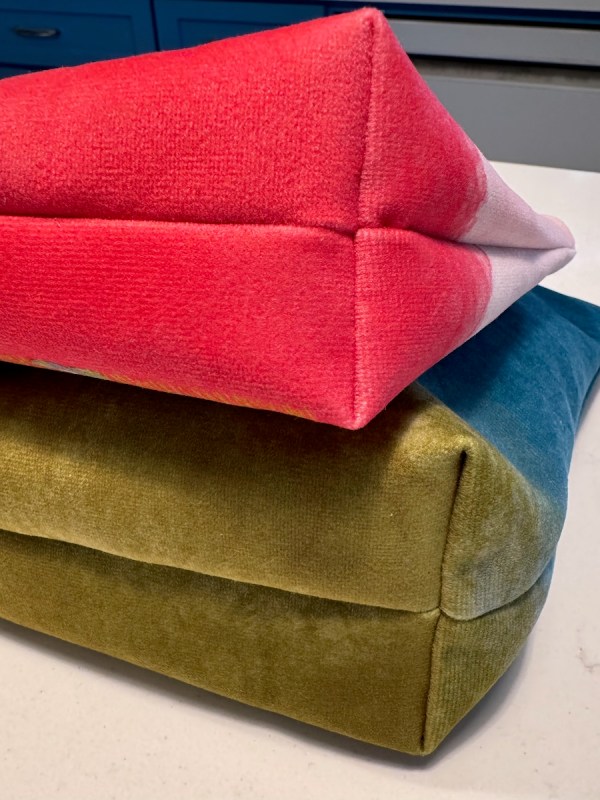
I love how the bag color blends into a second color for the base.
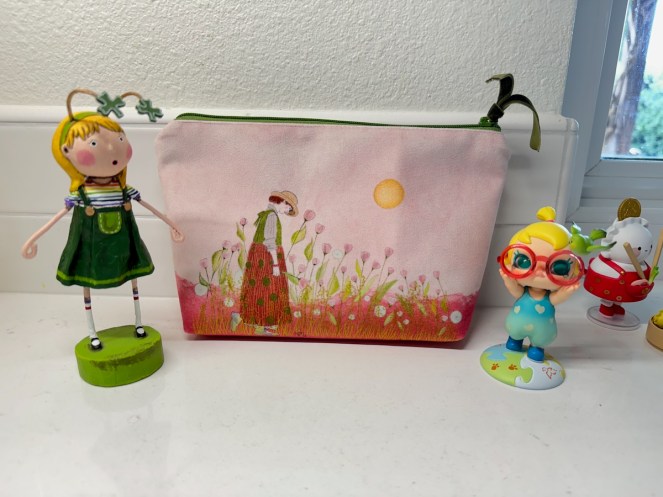
Baby Molly and St. Patrick Day Girl posing with the pink bag. (You know I have to put Molly in here somewhere.)

Now, a caveat. This was an easy translation task, relatively. The company had an English download for the instructions, and I already had the Google Translate installed in my browser. I was also familiar with how the iPhone’s Google Translate worked too, having tried it out on an earlier trip to Japan, where I found out that my breakfast roll was made with the “breath of heaven.” (Okay, so it doesn’t always work so well with idioms, but I took that to mean it had flour in it.) The app has improved greatly since then, I assume because of a a positive use of AI in our lives.
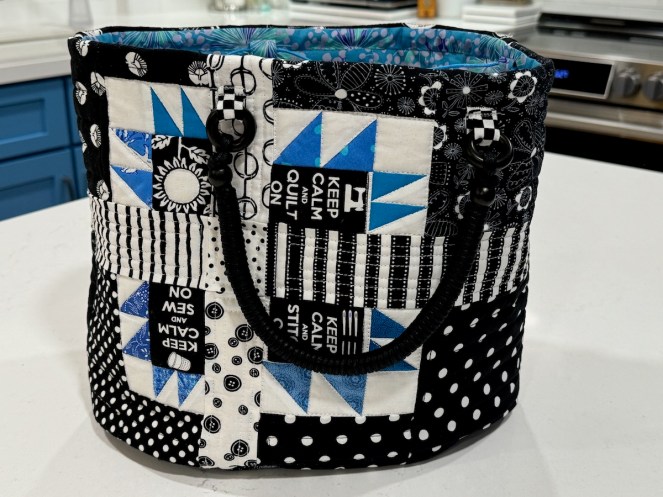
I struggled more on this project, made from a book I’d purchased at Carrefours and also published in French. The trip-up came because it was a JAPANESE bag, translated into French:
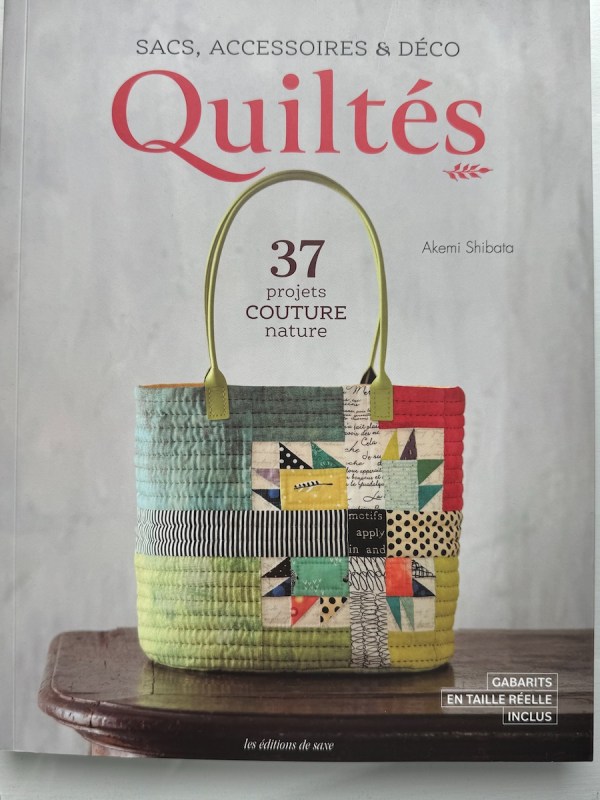
I did use a lot of “how to sew Japanese bags” searches on the internet, with questions like “Do I trace the pattern off the pattern sheet in the back of the book?” (yes) and “Are seam allowances included?” (no). This required a huge MIND shift, and aside from sewing the bottom to the top edge of the bag, I made it. (That’s why it looks upside down, ahem.) I did a lot of improvising, but I also love it, too.

I guess what I want to say is that it is a big world of quilting out there and we can always stand to have our horizons enlarged and widened, helping us to bridge all the acrimony and bitterness that can sometimes be found around us. I am in minor grief just about every day with the parts of what I once held dear being taken apart and sold for dross. So I’ve stepped up and purchased another subscription to a news organization, donated to three different local public broadcast stations, apologized to my Canadian friend Kaylie for who I’ve made two baby quilts, apologized to some scientists I know who won’t get funding for their research saving crops from pests (I do like to eat). I guess I’ll soon be apologizing soon to Greenland, too. And Mexico. And Europe, where I’ll be this year — I hope they let me in. I hope America lets me back in, and lets me have my phone after going through customs. I remember traveling in Italy when Hilary Clinton was running for President and the taxi driver went on and on about how her opponent was like Berlusconi, a real rat, he said. I assured him that she would win. Haha, spoke too soon.

I guess I just want to say that make friends with our international neighbors, sew their projects, buy American products (so they can survive the boycotts from other nations), but mostly just sew. I could go on and on, but I have many friends who are very happy right now, and I love them too. Mostly I just try to translate my complicated feelings and make the results come out with a bit of peace, a bit of kindness and a lot of forbearance.

Sort of like sewing with beautiful fabrics from a lovely French shopkeeper–
Update: I had some questions about what kind of fabric this was. After reading this post, I’d say it hews closer to a product similar to Celosia Velvet, as the back is very sturdy and is not stretchy, nor drapable.
300 Quilts · Happy Old Year Ending (Wrap-up) · Quilt Finish

Happy Old Year Ending: 2023

We can’t change the past.

Matthew Potts’ book Forgiveness: An Alternative Account holds this thought up to the light so the rays shine through in a multiple different ways, but the premise is always the same: “Even if we could completely undo the effect of what has been done, we cannot make it so that “the thing that was done never happened” (Jankélévitch, quoted in Potts, 77). That fact of the deed, and the impact of that fact if not of its effects, shall remain absolute and eternal.”

We can waste years of our lives angry at others out for all the wrong they have shown us. We can castigate ourselves for our personal failings (we all have our own list of them), vowing never to repeat them. We often struggle.

Potts’ answer? Bring in the principle of forgiveness: “Forgiveness seeks to live in the wake of loss. It accepts that what has been lost cannot be restored, and then it aims to live in and with the irrevocability of wrong” (23). He goes on to say that: “forgiveness also accepts that past as unalterable and so imagines what possibilities for the future its battered history might bear” (24). In other words, forgiveness is future-facing. “Whatever the past has been or the future may bring, we can begin, and begin again” (94).

I cannot quote enough of his book here to show you his extensive thinking around this idea. But I sometimes wonder — if we can not turn back time — why do we all turn our head to look behind us? Like how I started this post? These three quotes address this:

“As soon as you have a language that has a past tense and a future tense you’re going to say, ‘Where did we come from, what happens next?’ The ability to remember the past helps us plan the future” (Margaret Atwood).

“One faces the future with one’s past” (Pearl S. Buck).

And finally, to bring it full circle: “Nothing we can do can change the past, but everything we do changes the future” (Ashleigh Brilliant). I liked Buck’s idea, that the lenses with which we view the future are colored by our past. Atwood is more tactical, encouraging to use what we’ve learned to plan our future. Brilliant, whose cartoon is above, cautions us not to waste our energy dwelling on mistakes. 

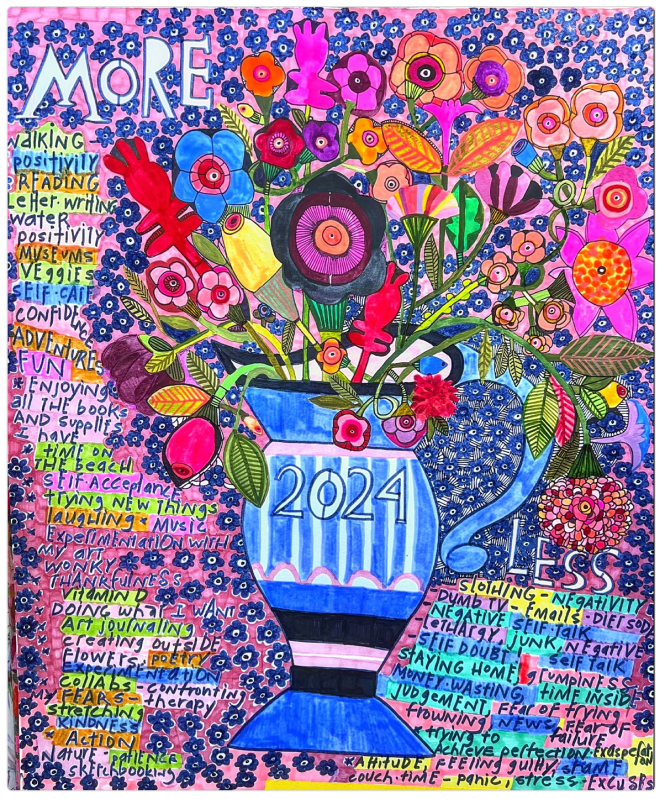
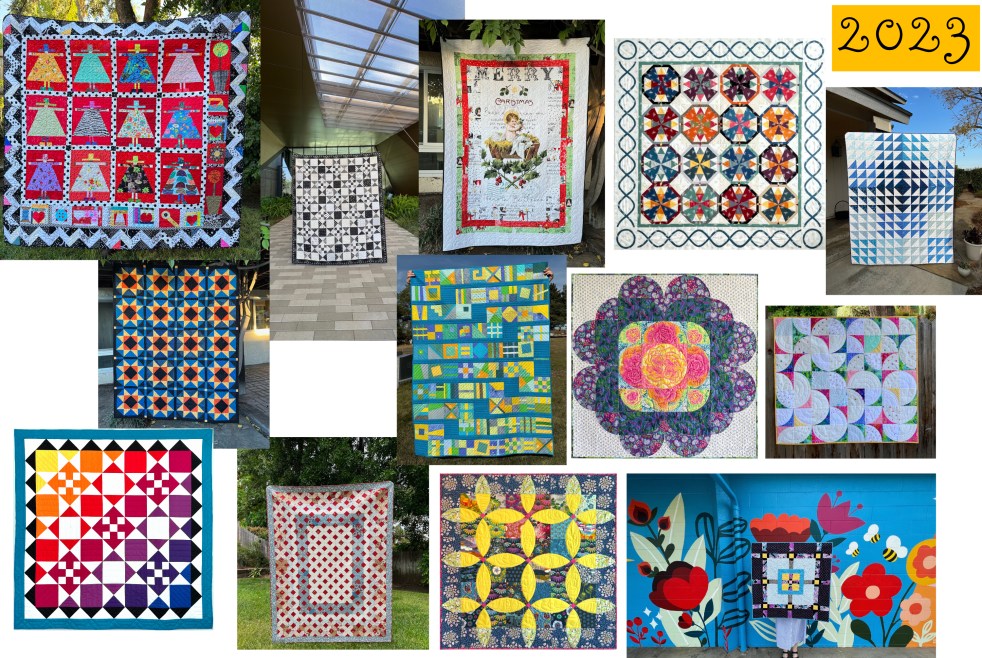
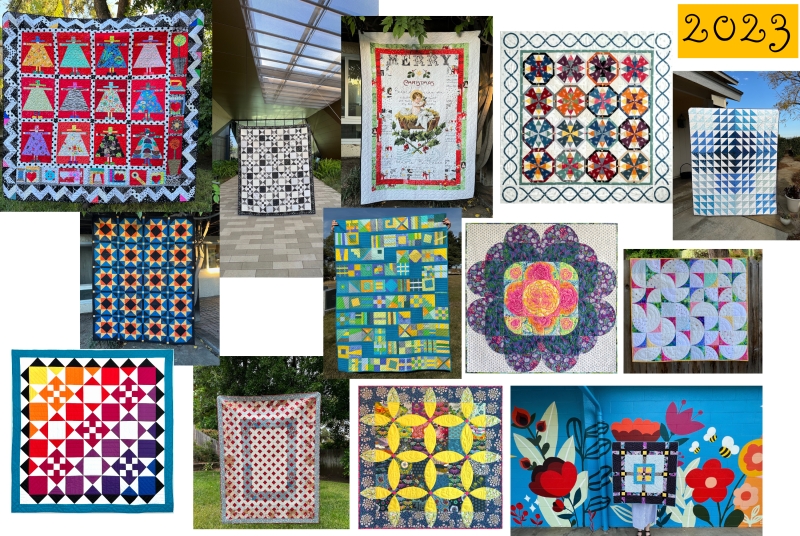
I hope that doesn’t mean that we shouldn’t tackle some of our UFOs, as I noticed that most of the quilt finishes (above) were pulled from my stack of UFOs. However, to think kindly about them, it’s like my past self left them for my current self to finish up (thank you, Pearl Buck). So, instead of rueing that new ideas in 2023 were sparse, I’m grateful that I had something to turn to to keep myself busy. I’m also trying to apply the ideas in Mr. Potts’ book to keep myself forward-facing. I’ve written up list of quilts I want to make in 2024, and I have already started on the first, sewing my way into this new year.

While I have a whole new year coming up in which to finish Potts’ book (and make quilts), what I’ve learned so far is this:
Evaluate where you are. Move on from failures. 
Forgive, and then forgive some more. 

Happy Old Year Ending–

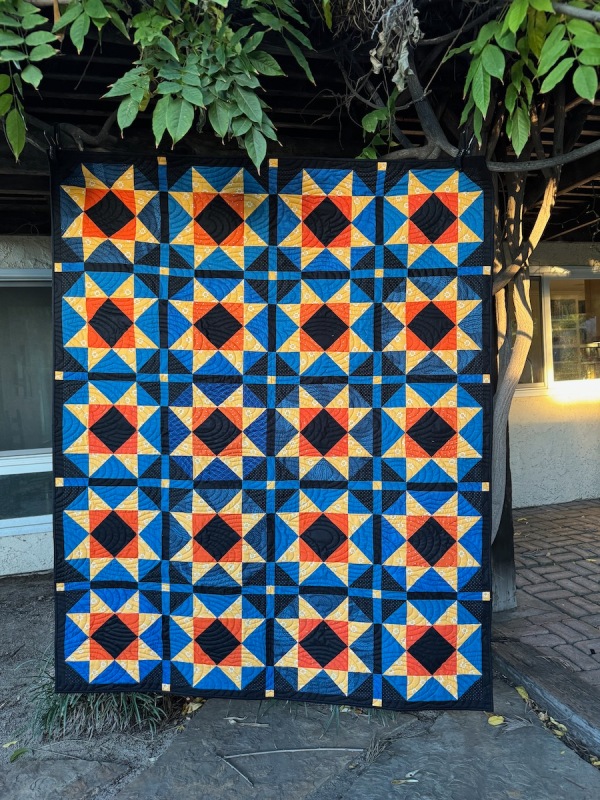
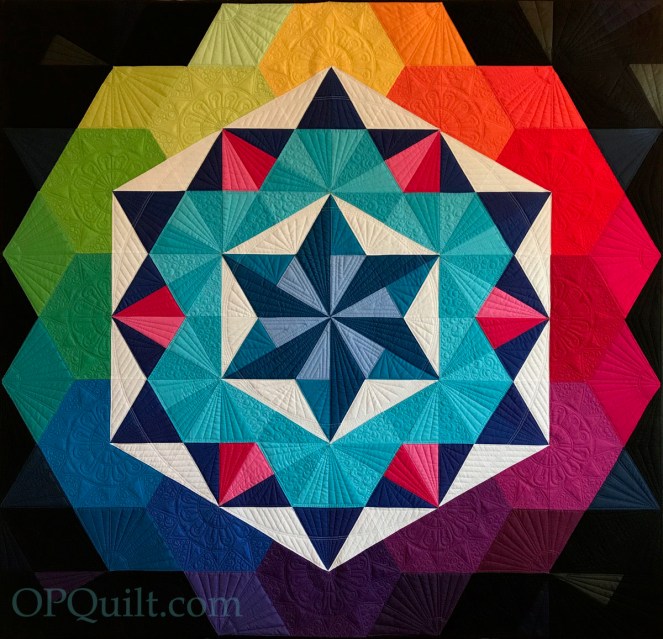
Eclipse • Quilt #285 • my final finish in 2023

P.S.In a combination of satisfying, yet somewhat unhappy goodbye to 2023, our local quilt shop (Bluebird Quilts) decided to close, and I picked up several lengths of fabric for backings for these planned 2024 quilts. It was sad to say good-bye to the place where I started teaching; her reasons for closing are varied, and I wish her well.

P.P.S. If you are new here, you can always revisit some of my Happy Old Year Ending posts, where I re-introduce myself to my readers. And maybe give an observation or two. The one from 2019 is a classic.

by Sharon Nullmeyer (@Nullsie on Instagram)
Temperature Quilt · This-and-That

Even Gritty People Get Discouraged

The title of this post comes from Angela Duckworth, the researcher famous for talking and writing about those who have what she calls “grit” — that innate quality that helps you to keep going. I used to show it to my freshmen English classes, in a teacher’s quest to motivate her students. But in a recent article on IdeasTed.com, she wrote about discouragement and surprisingly, even she gets discouraged. She tells the story of crossing the Rubicon, and how that metaphor came to mean a decision point. Duckworth has a list of “grit” items, available in her Ted Talk (video is at the bottom of that post), but now she adds one to it: “Setbacks don’t discourage me for long.”

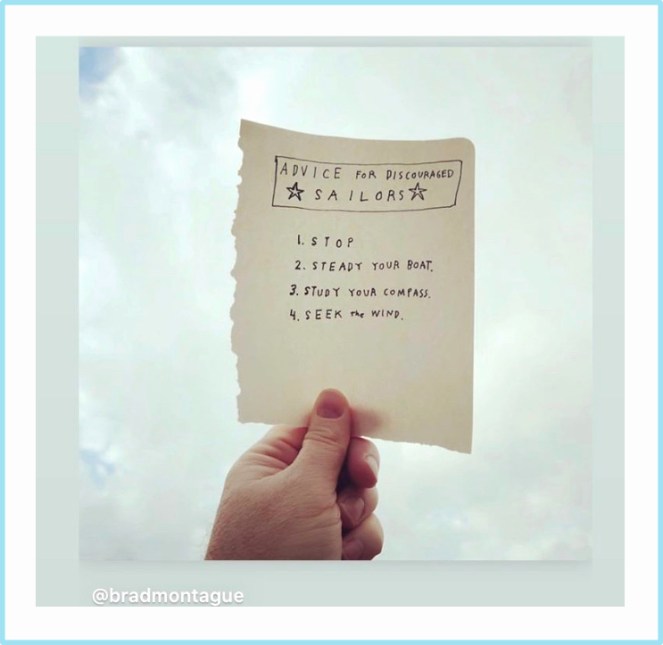
I’ve saved the Advice for Discouraged Sailors in one of my computer files, and just like cleaning out a drawer, this scrap of an idea keeps popping up. And like Duckworth, there is this moment of decision, of stopping and steadying your boat and figuring out where to go. I’ve never been a sailor, but I can only imagine how critical the advice is to “seek the wind,” if you are surrounded by a water everywhere, with no land in sight.

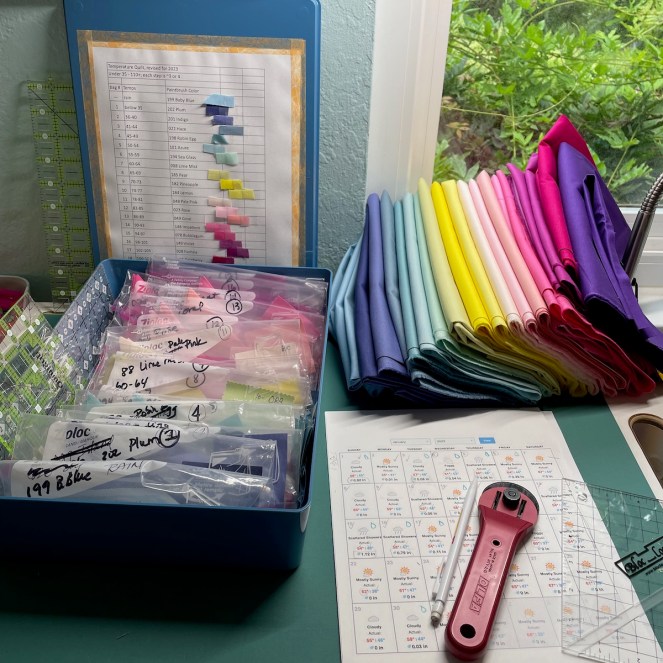
So, incorporating both of those ideas — setbacks don’t discourage me for long, and seek the wind — I started (again) on my 2023 Temperature Quilt. I tried listening to a book when I worked and that was a disaster. I needed to study my compass, not be distracted, even if it is a good book. And I had this in mind:

Yeah, that’s a Temperature Quilt, all right.

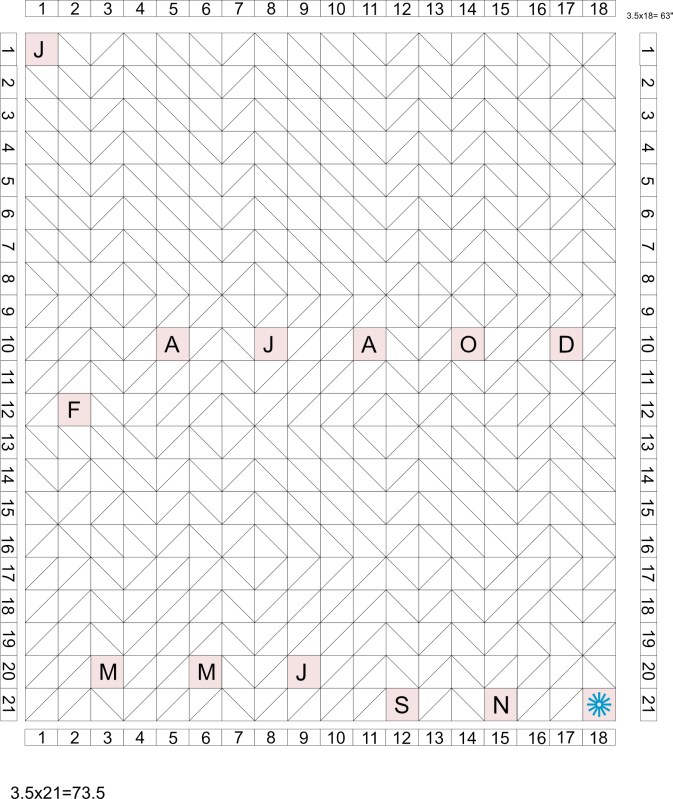
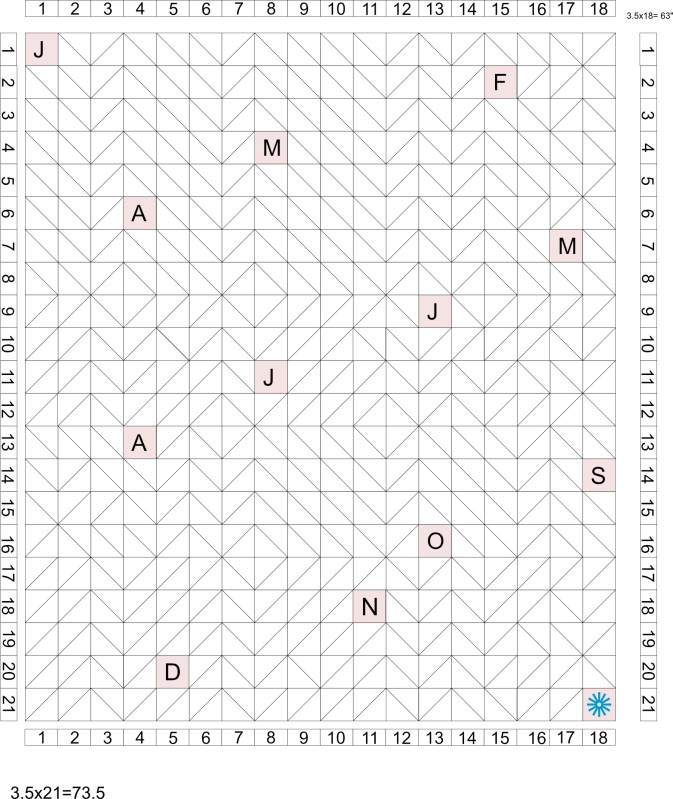
I made progress, by cutting triangles, cataloguing them in my box and making a fabric key on the lid. To the lower right is the calendar for January, and that’s when I discovered that the color for 60-64 degrees F was missing. I had to order some, and it will be here hopefully Monday. But I pressed on, keeping notes where the gaps were:

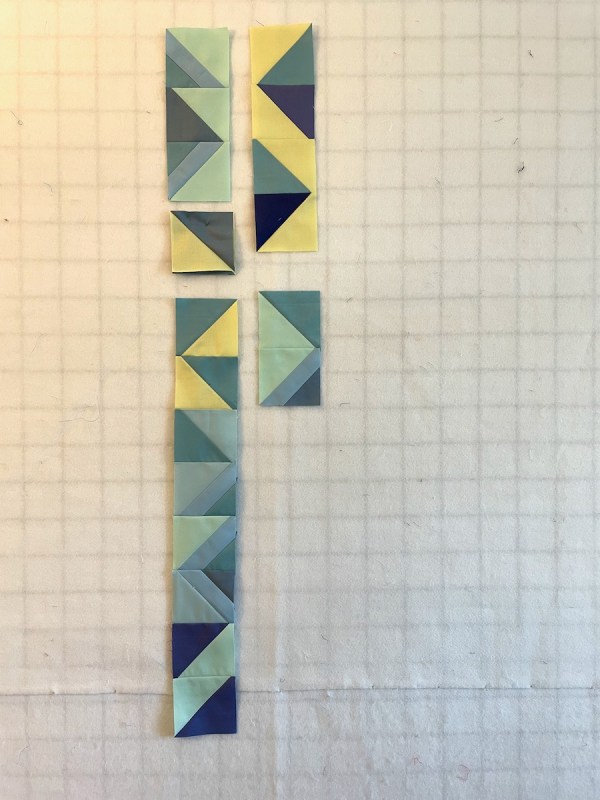
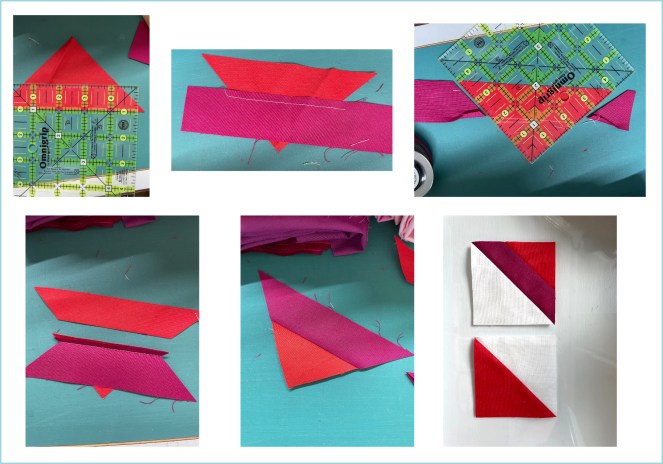
I figured out that I wanted a stripe for precipitation, and figured out how I wanted to make it:

Clunky, but it works. These are my samples, not my quilt blocks. I have a PatternLite I’m working up so that people can download my bits and pieces, but I need to do more trials and add more info before it’s ready. Patience. But here’s my graphic so you’ll know I’m serious.

Sketches of the layout. If you want your strong bands of color vertical, that’s the middle image. If you want them horizontal, that’s the last image. I went with vertical, just like my last quilt. I’m still puzzling over what to do for the month block. I didn’t need a month block in my 2019 Temp Quilt, but I want one here because unlike 2019, I’m wrapping the days from one column into the next. I need something that will blend, but be distinctive.

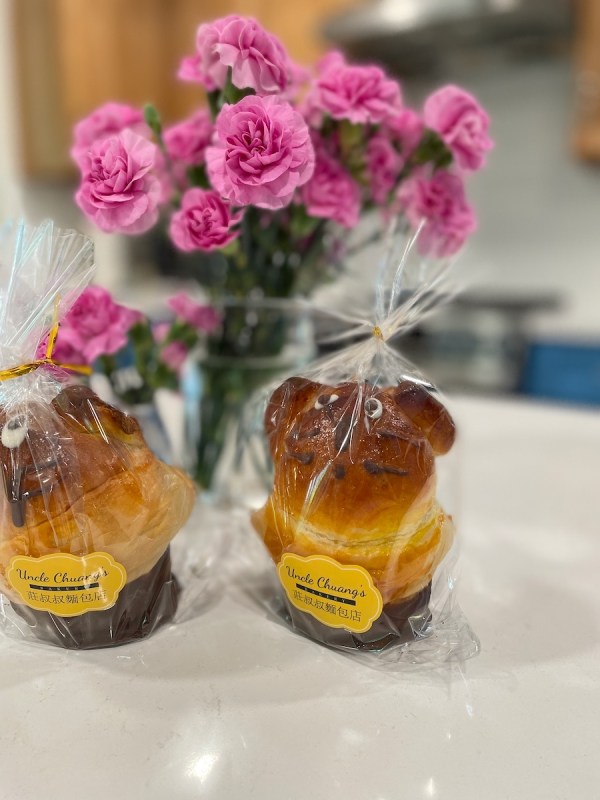
Anniversary treats: two Totoro buns from our local bakery, and pink carnations. The Totoro buns have blueberry jam in them, with chocolate-dipped bases. It was a quiet, but lovely day, and I finished it with the Creatives:

A group of women from my town, and we are quilting, stitching, crocheting. Glad they all could come.

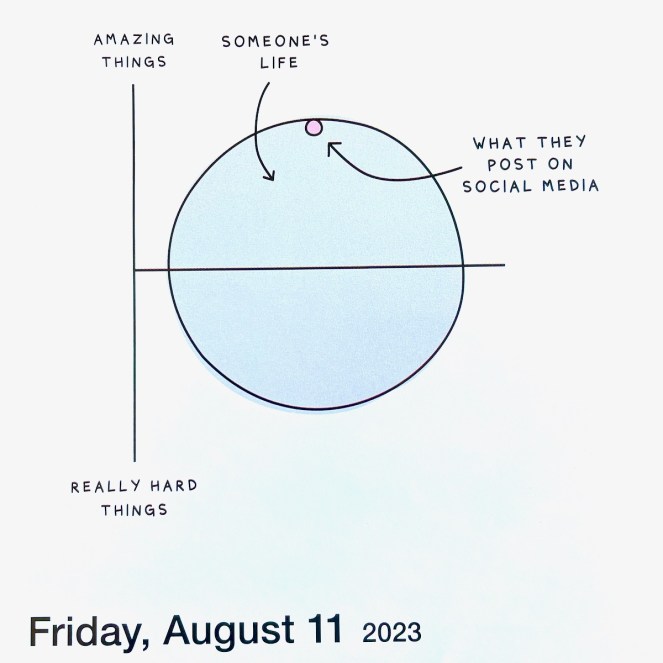
This popped up the next day, and it’s a reminder to myself to take social media posts with some caution. While I’m completely envious — and enjoy the scenery of all your trips and excursions — I’m well aware that there are bee stings, mosquito bites, schlepping the luggage, losing the luggage, fatigue, upset GI systems, missed connections and sore feet as well a glorious flower-filled grand square in Europe. Likewise, for this blog. I have my highs, my lows, my moments of satisfaction and other days when a good piece of chocolate is the only answer. Okay, maybe two.

So cross that Rubicon, seek the wind, and carry on with the journey–

Totoro and bee friend

Guild Visits · Something to Think About

Who Gets to Make Art?

I’ve been thinking a lot lately about our world of quilts, and by that I don’t mean the larger world–just our own little world. I’ve made some hideous quilts, some use-up-this-fabric quilts (above), some quilts I consider my best masterpieces. Our own little world is echoed out into our guilds, our social media, our quilt shows, publications and then it echoes back to us in terms of the materials we can use. It’s a cycle, a circle, but at the nub of it is that one quilter looking at her one stack of fabrics, or the sketch she made while waiting at the doctor’s office and seeing the print on the back of the chairs. It could be she was messing around with a traditional block, or created one of her own. And from that nub, that spark, hopefully art begins.

from here

I’ve been thinking about this because of an article by Guy Trebay (found while cleaning out) where he asks straight off, “Who gets to make art?” Written about the International Folk Art Market in Santa Fe, it is an interesting overview of this age-old question.

from here

Do you get to create art? Do I? Or is it only relegated to that famous quilter that is all over Instagram? The lady who has her face on the ads of the sewing machine you like? Does more fame equal more entitlement to call it art? And then there is the pressure from the outside world, debating forever and ever if making a quilt is a craft or an art?

from here

Trebay attributes this question to Luke Syson, and says that “In asking [this question], Mr. Syson was adding his voice to a growing chorus of museum professionals who are challenging traditional hierarchies of art production. He was talking, in this instance, about the obscure craft of scrimshaw, subject of a fine study show at the Fitzwilliam, but more broadly about the importance of recognizing and celebrating those gifted artists whose work is so often relegated to the stepchild status of crafts.”

from here

Luke Syson, now the director of the Fitzwilliam Museum at the University of Cambridge (Britain), shares his experience of having to address some of his biases about what iconic art is in his TEDTalk, which he titled “How I learned to stop worrying and love “useless” art.” It’s worth a listen, if you have a few minutes. In that afore-mentioned Instagram post about scrimshaw art, he asks “Who gets to be an artist?” In the text he writes ” I thought about the scrimshanders then – working class, almost entirely anonymous, using their time to making things that were beautiful and that documented their lives. Amateurs, yet completely excluded from the world of leisure that this word implies. But I’m guessing there was a collectors market for these objects early on – that these were a sideline rather than simply the making of personal souvenirs.”

Which leads me to think about the anonymity of women, making their art for years and years, hidden in plain sight. They were making that which was beautiful to them, and which represented their lives. And yes, amateurs, all. We’ll leave this discussion here, with a quote from Trevor Bell:

“Art condenses the experience we all have as human beings, and, by forming it, makes it significant. We all have an in-built need for harmony and the structures that create harmony. Basically, art is an affirmation of life.”

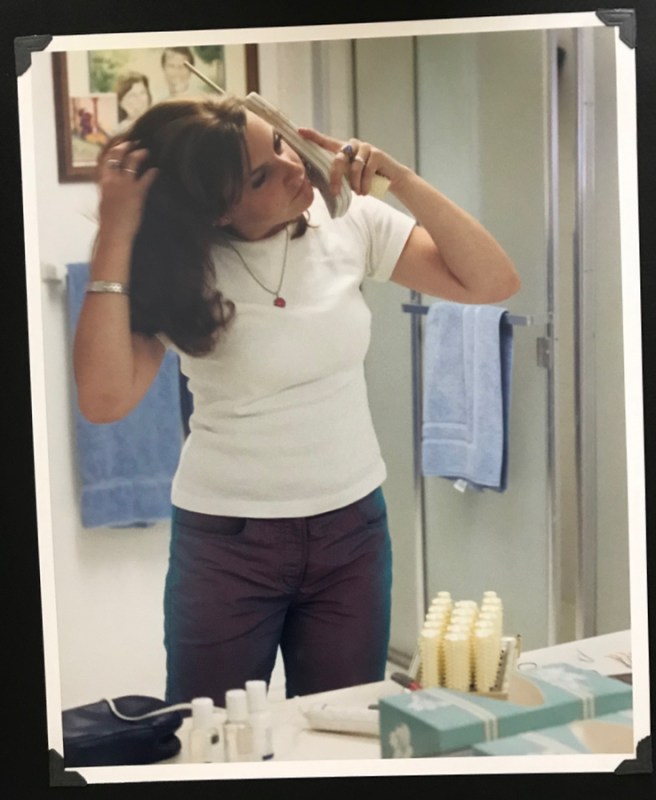
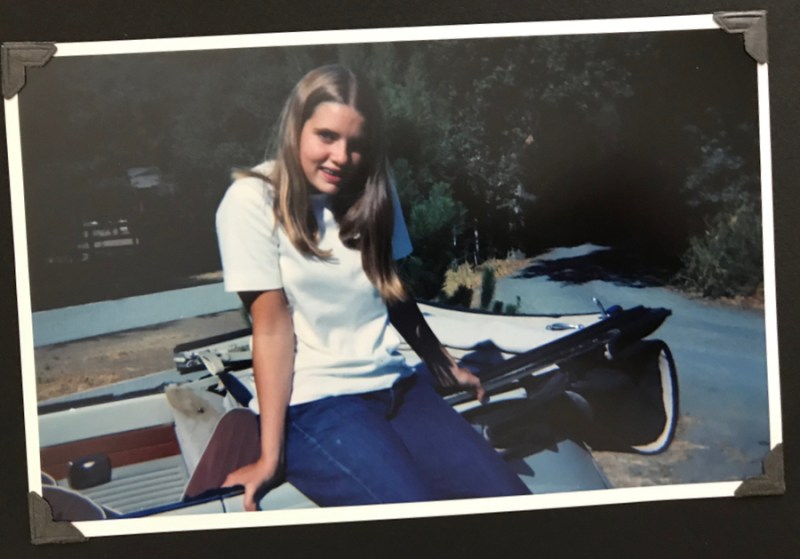
Today is Mother’s Day. My mother is on the left (c. 1948), my daughter (named after her) is shown in the center in a photo from high school (c. 1998). (I sent this photo to her when she complained about one of her children being always on her phone.) I’m on the right (c. 1972).

My mother made art: seven of us. She never quilted. She read. She never painted, as did my father. She did do dishes, laundry, dressed elegantly, organized us, kept us going. I owe her everything, and as she approaches her 93rd birthday, this Mother’s Day I celebrate her as a different kind of unsung, ungalleried, un-media-ed, unknown sort of artist, but she was significant and affirmed us all.

I’ll be in my happy place this week, hanging out with the Orange Grove Quilters. We’re making Merrion Square in our Workshop. If you want to hear my program of Abecedary of Quilts or participate in a live/online workshop, please contact Pat (the Workshop Chairman) at workshops@orangegrovequiltersguild.com or drop me a note (and I’ll check with Pat). I love teaching this little quilt, as there are as many different quilts and there are quilters. Each one makes this little village their own.

And as life moves on, it seems this will probably be the last time I teach this class. Let me know if you are interested.

Happy Quilting! (turn the sound on)