Quilts

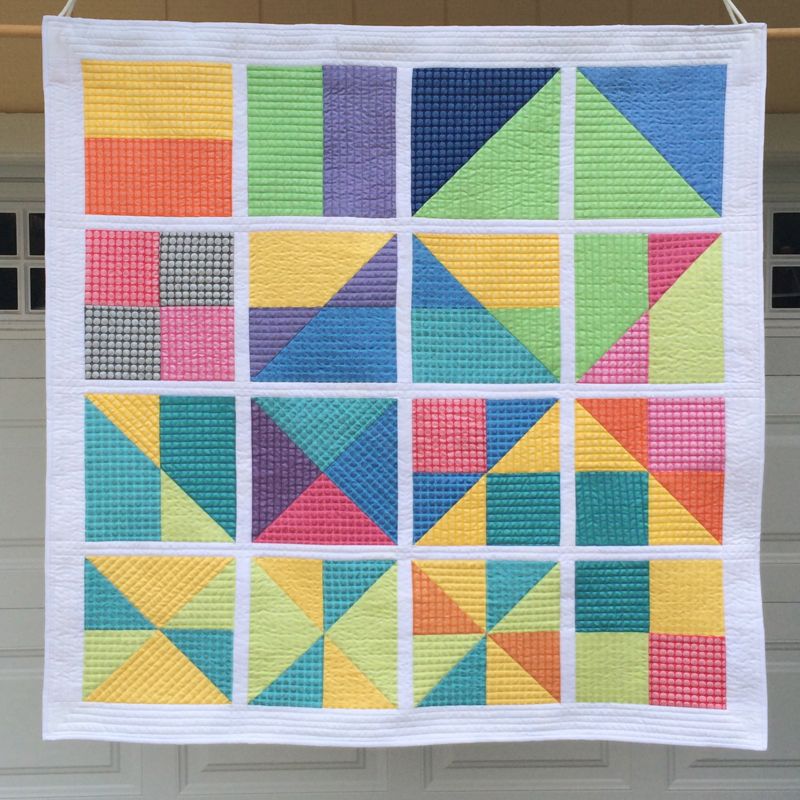
Sol LeWitt’s Patchwork Primer

Sol LeWitt's Patchwork Primer_final

Sol LeWitt’s Patchwork Primer
Quilt #135 of 200 Quilts
47″ square
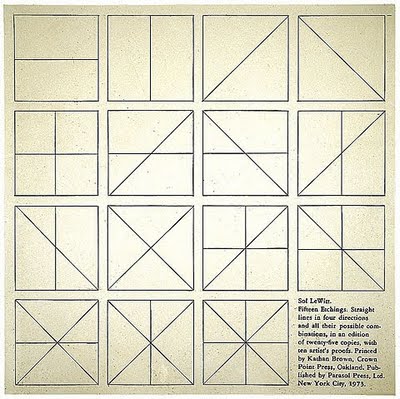
sol-lewitt

It started with a catalogue my father had of Sol LeWitt’s work, and I read it cover to cover, bookmarking different pages and ideas of his, impressed with his breadth and depth and interesting ideas.  I selected this image, “Fifteen Etchings,” thinking it looked sort of like a “how-to” or primer of sorts, for dividing squares into quilt patchwork.  You can read more about my process and sample some of LeWitt’s notes on getting to work in *this post,* including the 6900 variations of the arrangement of quilt fabrics into squares (maybe I’m exaggerating a bit).  The fabric I chose to use was Mirror Ball Dots.  After a long hiatus (I started this in March of this year), I finally got it out, pinned it and got the quilting going:
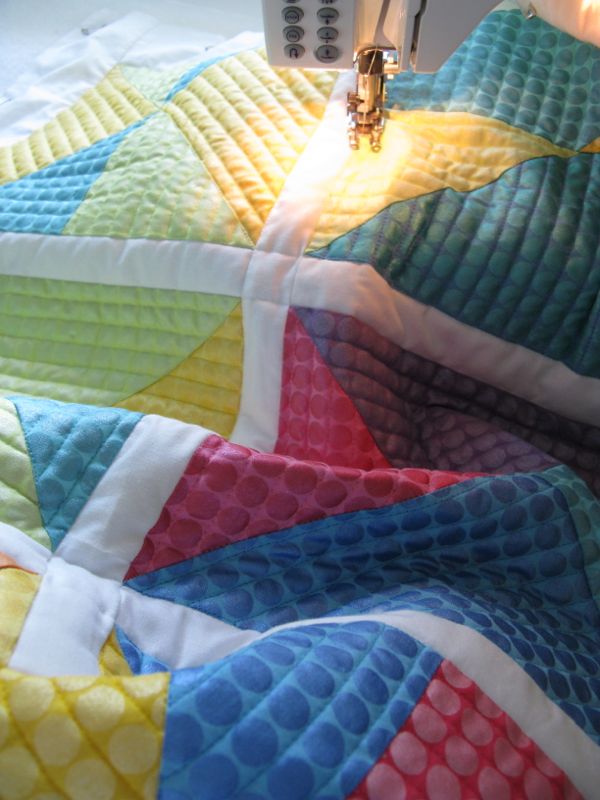
SolLewittPatchworkPrimer_quilting the quiltI started in the middle, quilting in between the lines of dots.  In the neighboring color, I sewed the other direction, and so on, around the quilt.  I changed out thread on each color, but used my go-to thread in the bobbin: Bottom Line, by Superior Threads.  I lowered my upper tension to keep the thread balanced in between the layers so no white popped up to the top and no colors popped through to the back.
SolLewittPatchworkPrimer_binding

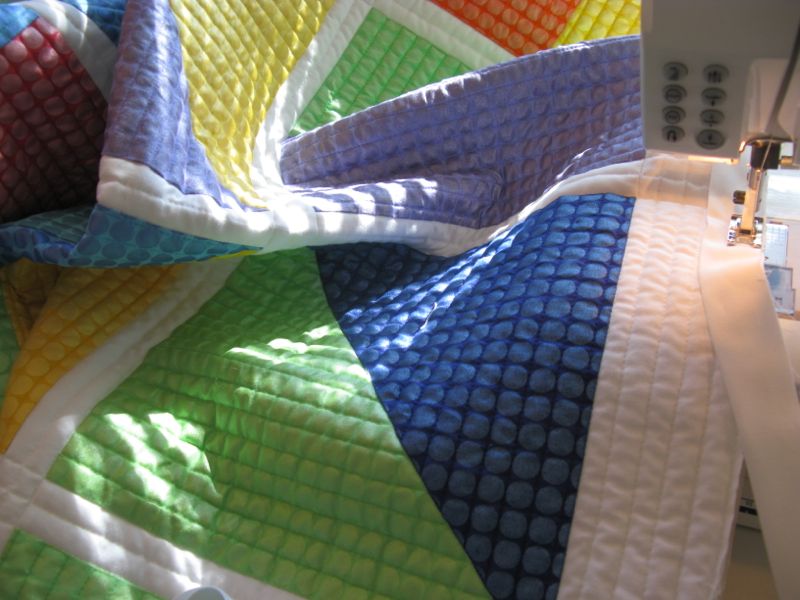
White binding (what else) goes on next.
SolLewittPatchworkPrimer_detail

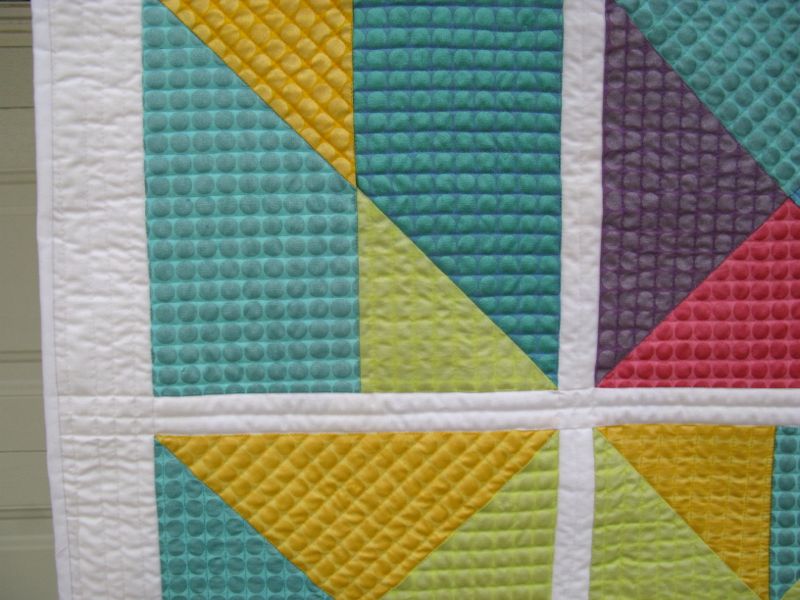
I think with the combination of the dots on the fabric and the quilting, it reminds me of what I envision a 1960s quilted jacket might have looked like.  I’m sure my sisters had them.
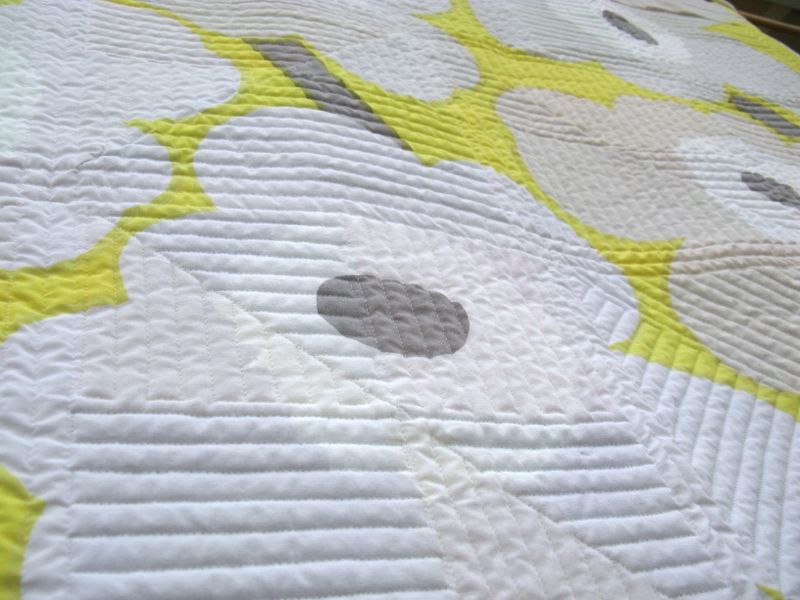
SolLewittPatchworkPrimer_quilting

The backing is a Marimekko fabric of large grey blossoms over an acidy-yellow background.
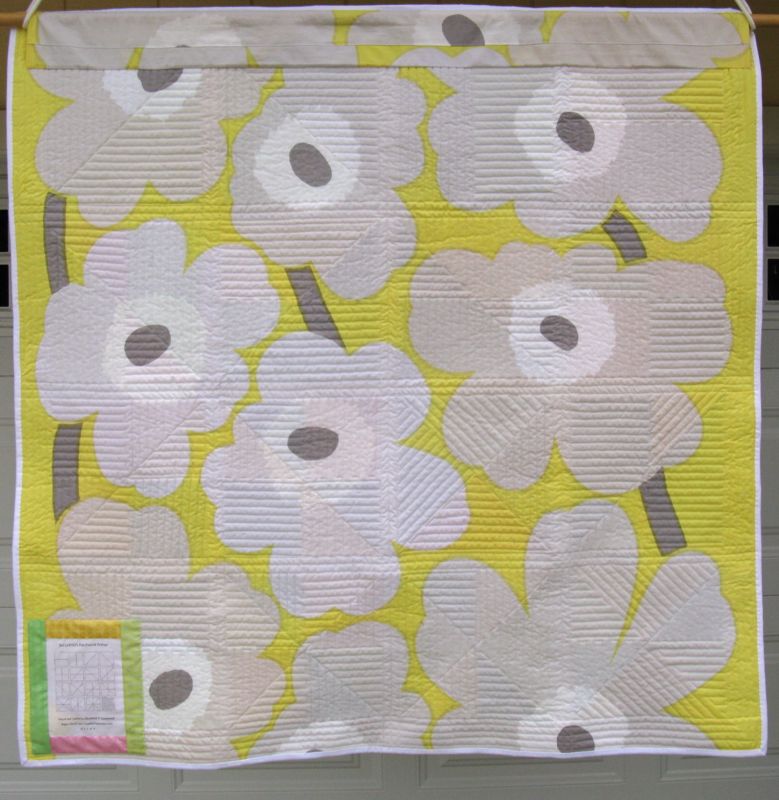
SolLewittPatchworkPrimer_back

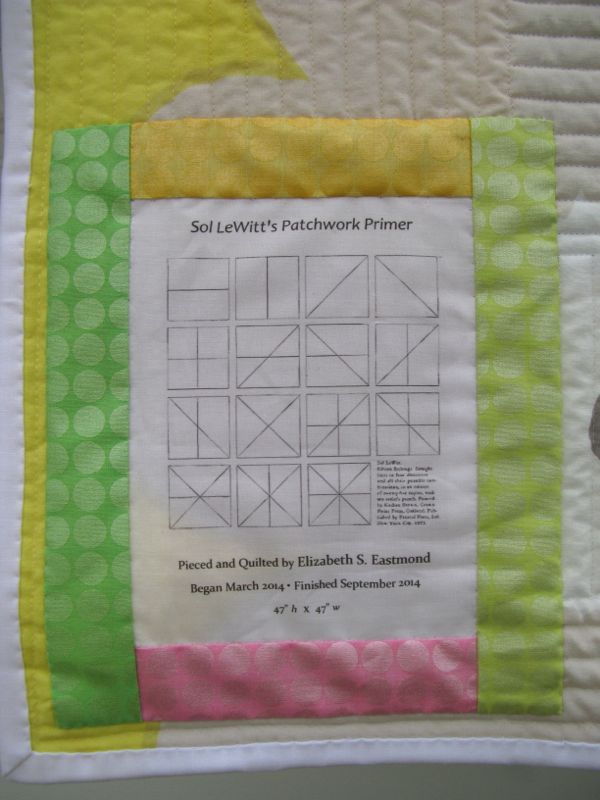
SolLewittPatchworkPrimer_label

I included the picture that inspired me on my label.
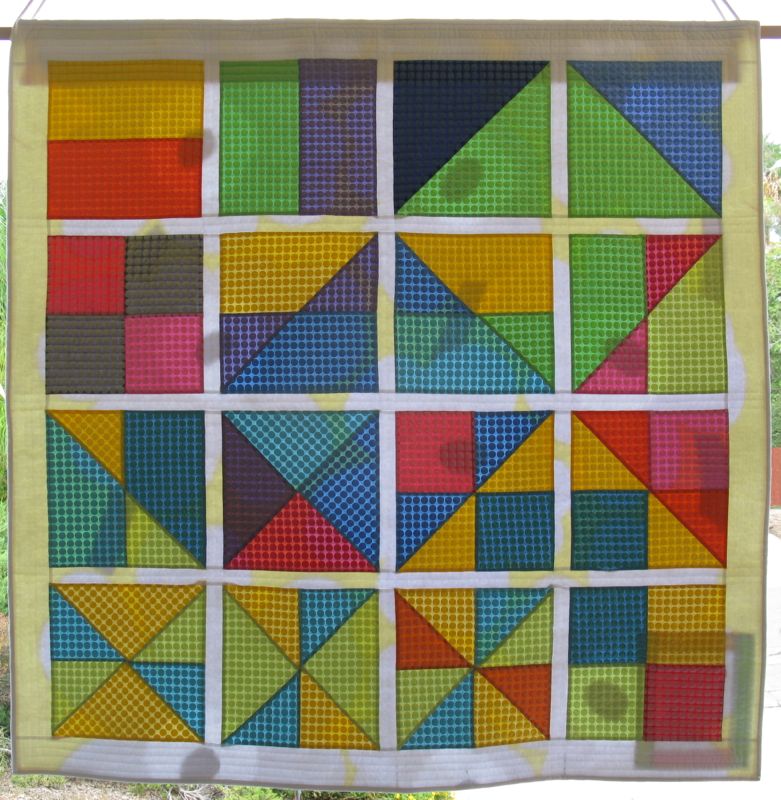
SolLewittPatchworkPrimer_stainedglasslook

I love the “stained glass” look of quilts, shot from the front when they are illuminated from the back.
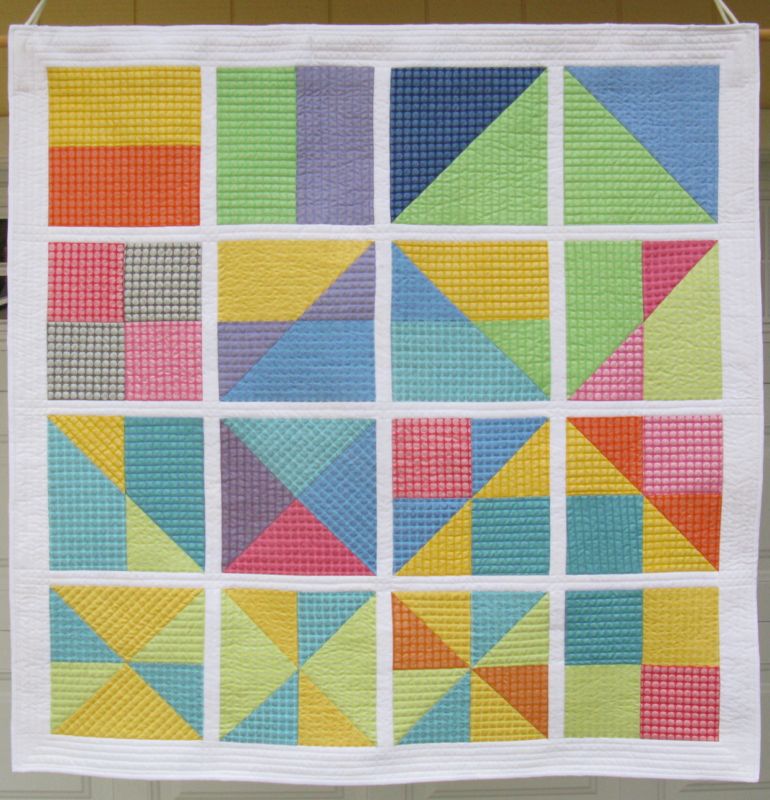
SolLewittPatchworkPrimer_front2It’s nice to have a finish!

Now here’s your quote on creativity for today:

“The creative act is not an act of creation in the sense of the Old Testament. It does not create something out nothing: it uncovers, selects, reshuffles, combines, synthesizes already existing facts, ideas, faculties, skills.  ~~Arthur Koestler, in the 1960s

Quilts

Ted and Maurice at Lorinc Pap Ter, a Four-in-Art Quilt, August 2014

4-in-art_3

Lorinc Pap Ter_front

Ted and Maurice at Lorinc Pap Ter

No. 4 in the Urban Series

small plaza

It all started here, in a small square in Budapest right outside our hotel, on a recent overseas trip.  We walked through it several times a day, enjoyed a lovely dinner at the Matryoshka Bistro in the background, sat and ate ice cream on a bench the night before we left.  “Why don’t we have small squares like this?” I wondered outloud to my husband.  “A place where you can get an ice cream and enjoy the evening, and see your neighbors?” for several people had greeted each other as they walked through.  Another group gathered at the pub (just out of sight) for an end-of-the-day gab session.

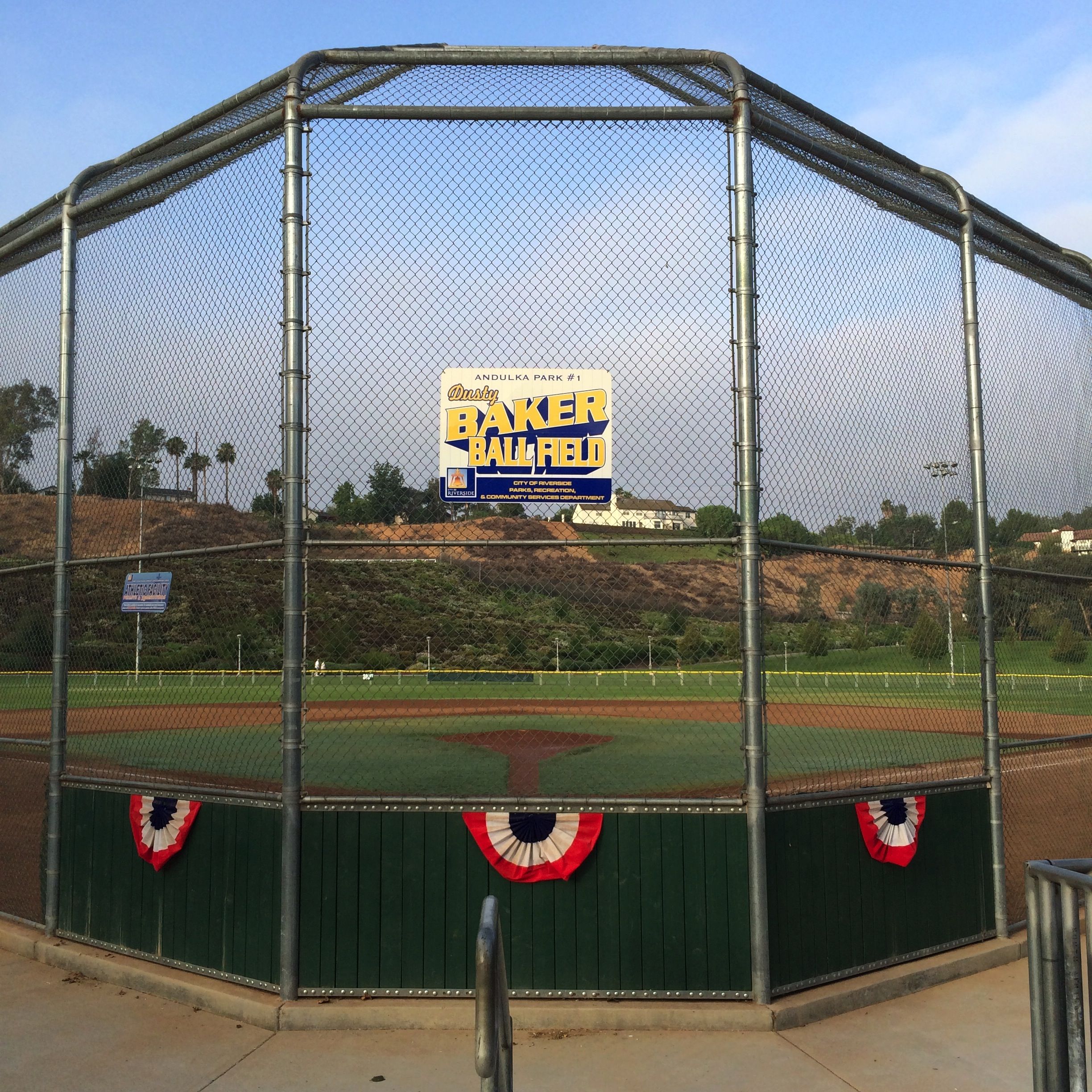
Baker Ballfield Backstop

Then the next week, trying to recover from an extended case of jet lag, I went walking at our local park — part walking path, part baseball fields, part tennis courts, with lots of benches.

Ted and Maurice

I chatted with Ted and Maurice, two regulars that we see walking in the morning.

Other Regulars at the Park

And these three men who walk together, who do have names, but who I refer to as The Retired Guys.

Ball players

And on Saturday mornings I see the Little Leaguers warming up to play their early morning games.  It was after talking to Ted and Maurice one morning (both retired) that I realized that while my “square” is a contrast to that sweet little Lorinc Pap Ter in Budapest (“ter” means “square” in Hungarian), it is also fundamentally the same.  Of course, I want to go back to Budapest yesterday, but I’m content to notice the contrasts and take what I have.

Some of the obvious contrasts are the commercial enterprises: we work really hard to separate them in the United States, but interestingly more and more shopping centers are trying to recreate that “square” feel, setting out benches, have shaded trees to sit by, and playgrounds for tired children and their shopping parents.  Another obvious contrast is the size, and the purpose.  I think that Lorinc Pap Ter was meant to pay homage to Count Zichy (who is atop the statue, being honored by The Common Man, and The Neighborhood Priest, for the church is right behind me in the photo) and while the park where I walk in the morning is named for a local land donor, there isn’t a bit of statuary in sight.

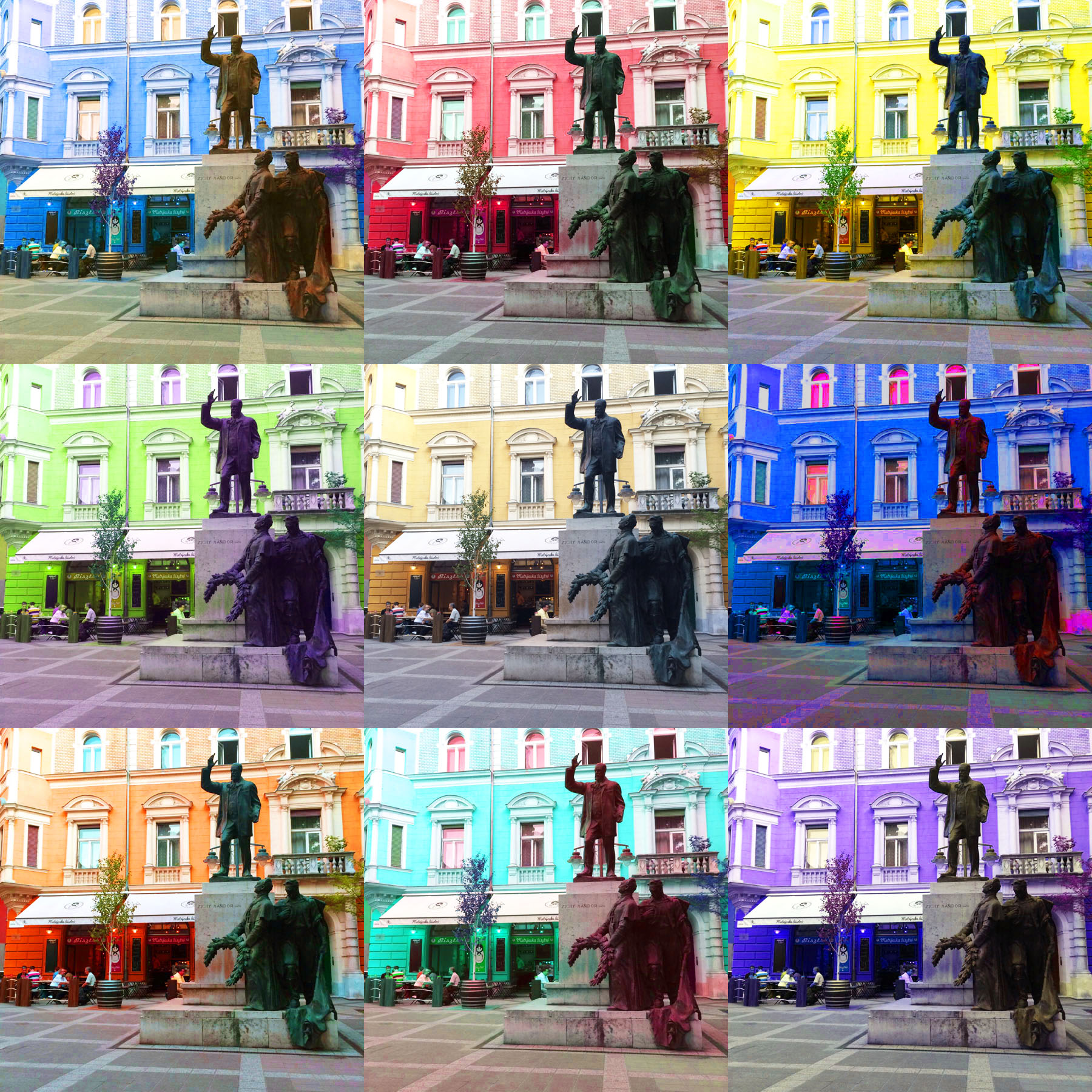
small plaza+multicolor

I first thought of contrasting the differences felt in times of day, how many people were there, and certainly the colors do provide some visual interest, but I felt it was really a cliche, and didn’t point up the contrast like I wanted to.  So I got the idea to merge the two parks and some of the people, overlaying the backstop and adding Ted and Maurice. It’s a jolt to see a Little League backstop in a Budapest city square, and certainly most ballparks don’t have statues holding laurel wreaths.  By mashing them together it pointed out the contrasts in a quick sort of shorthand.

Walkers at Park

I felt like I’d lucked out to get a photo with the tricolor bunting on the backstop (it’s gone now).  I now was much happier with the outcome, and didn’t let the colorful square of squares go to waste: I shrunk them down and used them for the border.

Ted and Maurice and Quilt

And to end it off, here’s Ted and Maurice, holding my quilt.  They were thrilled to be honored that way, and told me about more regulars (they get there earlier than I do).  Ted took photos of my creation having never seen something like this, and we all laughed and joked around, especially as The Retired Guys came loping around to join us.  All we needed was some ice cream.

Tiny Nine-Patch

Please take time to visit the other Four-in-Arters, who have also put up their Challenge Quilts today:

Amanda  at whatthebobbin.com
Betty at a Flickr site: http://www.flickr.com
Elizabeth at opquilt.com (you are here)
Leanne at shecanquilt.ca
Tiny Nine-Patch
And come back for the next post, with instructions on how you can make your own little art quilt, including the use of Bubble Jet Set!
˚˚˚˚˚˚˚˚˚˚˚˚˚˚˚˚˚˚˚˚˚˚˚˚˚˚˚˚˚˚˚˚˚˚˚˚˚˚˚˚˚˚˚˚˚˚˚˚˚˚
My blogging software places ads here so I can use this site for free.  I do not control the content of these ads.
Something to Think About

Cleaning the Design Wall

Since I am away from the computer for a while, I’m running a few favorite, previously published posts.  
This one originally ran on July 22, 2010, but is modified for today’s post.
˚˚˚˚˚˚˚˚˚˚˚˚˚˚˚˚˚˚˚˚˚˚˚˚˚˚˚˚˚˚˚˚˚˚˚˚˚˚˚˚˚˚˚˚˚˚˚˚˚˚˚˚˚˚˚˚˚˚˚˚˚˚˚

Here’s the before:

The during:

The after:

Okay, that’s not a very exciting thing to do, right?  We want all our sewing tools to keep on working, day after day, no complaints, no breakdowns, no upkeep or maintenance required.  But it’s such a little thing to take a few minutes and cheap-o lint roller remover and stroke down the board.  And really, is the Before picture really so objectionable? Yet, what surprised me is how many of the threads that came off on those sticky papers were seemingly invisible to me.

But since I did it yesterday, just walking into the room is different.  My pin wall is thread-free (for the time being) and it makes the room look cleaner.  It made me think of the premise behind Malcolm Gladwell’s book The Tipping Point: that an epidemic can start with one small thing and roll on out from that.   It’s like how picking up the towels in the bathroom and rehanging them triggers a cleaning of the sink.  Or washing the curtains makes you repaint the bedroom.  I’m talking about those kinds of mini-epidemics, that are just one person wide and one person deep. Those changes I make myself.

My sewing room (aka The Study) had been a mess since we arrived home from our trip to Canada and I just didn’t seem to have the mental energy to put the things away.  But I cleaned the threads off the wall and now I’m putting away those little naggy things that linger after travel is done.

So maybe, taking time off to take care of things has unintended consequences?  That this can, in some ways, apply to our own creativity level?  That taking time off to clean out a few cobwebs, have a walk on the beach, or take a minute to sing along to a popular song in between shuttling the family to various places is like cleaning the threads off the design wall?

boyinwaderpool

Perhaps a little mental maintenance on our own selves is why summertime is such a tonic, even if we don’t know what ails us.

Something to Think About

Process vs. Product

Since I am away from the computer for a while, I’m running a few favorite, previously published posts.  
This one originally ran on July 16, 2010, but is modified for today’s post.
˚˚˚˚˚˚˚˚˚˚˚˚˚˚˚˚˚˚˚˚˚˚˚˚˚˚˚˚˚˚˚˚˚˚˚˚˚˚˚˚˚˚˚˚˚˚˚˚˚˚˚˚˚˚˚˚˚˚˚˚˚˚˚

Is it possible to lust after another person’s finished quilt?  Yes, quite possibly.  Definitely. For sure.  The quilt shown above uses the Castle Peeps line, and was put together by  Elizabeth Hartman, of Oh! Fransson.  I purchased the blue colorway of this line this summer and before I close out my sewing blitz and focus on The Job, I’m dying to throw together one more quilt.  This design has inspired me.

There’s been a lot of talk on the blogosphere about the issue of production in quilting, and I’m here to add my .02.  Jennifer, of “That Girl. . . That Quilt,” has written a whole series of her thoughts about “quilting without obligations.” They seem to be a reaction to the feeling that quilting is all about production, rather than about the process.  This is an age-old discussion and is found in other corners of the creative universe.

When I was an undergrad, working in the black and white photo lab, this idea–process vs. product–was discussed constantly.  To give you a flavor of what our conversations sounded like, as we blew dust specks off of our negatives and worked at creating “art,” have a listen to the little clip below. Yes, it’s dense, but give it a go.

I think his point that when we focus on product, we may miss other connections that may arise from the creative process is valid, but there are times when product is not the Big Evil.  Sometimes I just want to get something done, speaking of quilts and quilting.  Sometimes I just want to quickly make up a quilt in a fabric line because I want to see that on my bed.  I’m not interested in being drawn into the process of the quilt–I just want to lay down under it.  Or hang it up on the wall.  Or because the process has already happened in my mind, in thinking about it at the back of my brain when I couldn’t get to the sewing machine for one reason or another.

I read a lot of blogs, like the rest of you, and many of them are designed as advertising.  The quilt artists/makers have been involved in the process of their art and designed fabric/patterns/quilts that they need to sell in order to make their living.  Many blogs are tied to online quilt shops.  These are valuable places for me to go and get my ideas, be exposed to new fabrics, enjoy the fruits, if you will, of other people’s labors all before I take up my rotary cutter to slice into some fabric.  I enjoy these blogs, love reading them, admire the work.  But I do not ever confuse what they are doing–earning a living–with what I am doing.  Some other blogs have “taken the process pledge,” and try to put out on their blogs how they arrived at the journey’s end.  This is a valuable resource for us as quilters when it truly involves process, and not just a “how-to” tutorial (although I like those too).

It seems to me that there is enough room in this quilting universe that we can quilt what we want to, blog when we want to, go off on vacation when we want to, work (when we have to) that we don’t need to compete.  Commercial blogs? Non-commercial blogs?  They are resources for us all to glean from.

ProductProcess_PreK+KImages, and interesting reading,  from *here*

Product?  Process?  We need them both.