Quilts

Faced Binding Tutorial

FacedBindingTitleA faced binding is applied to the front of your quilt and is wrapped to the back.  If done well, it can’t be seen at all from the front, allowing the last border of your quilt to act as the frame for your quilt, and eliminating one last design element from your quilt.  Often used on art quilts, when an additional line of a border would distract from the art, it can be also be used on our regular quilts.

kaleidoscope-top

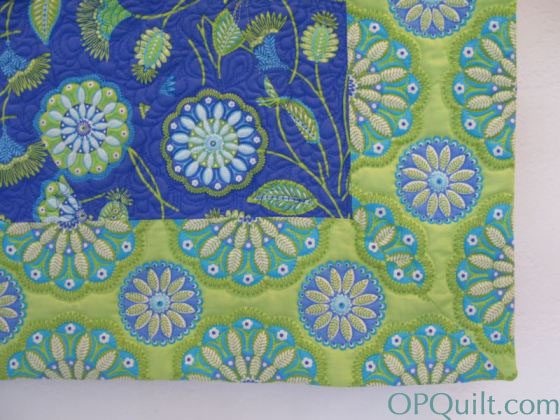
I used it on Kaleidoscope, as the printed border needed no other embellishment.

Step One: Prepare the quilt and strips
Trim the batting and edges of your quilt.  In the best world, your trimmed line falls at the edge of your fabric.  A little fudging here and there is okay.

For the binding, you’ll need four strips, one for each edge.  Measure the edges of your quilt and add 10 extra inches to that measurement.

Cutting

Cut 4″ wide strips for a medium- or large-sized quilt, and 3″ wide strips for smaller quilts.

Trim Ends

If you need to piece the strip to provide the right length, trim both ends at a right angle (make sure they are slanted the same way) and piece together on the bias.  Fold the strip in half lengthwise and iron.

Step Two: Applying Binding Strips
Leaving a tail on each side of about 5 inches, pin the binding strip to the FRONT of your quilt, raw edges even, with the folded edge of the binding falling toward the quilt center, just like you would for a regular binding. Only this binding is giant-sized, and you won’t stitch around the corners continuously.
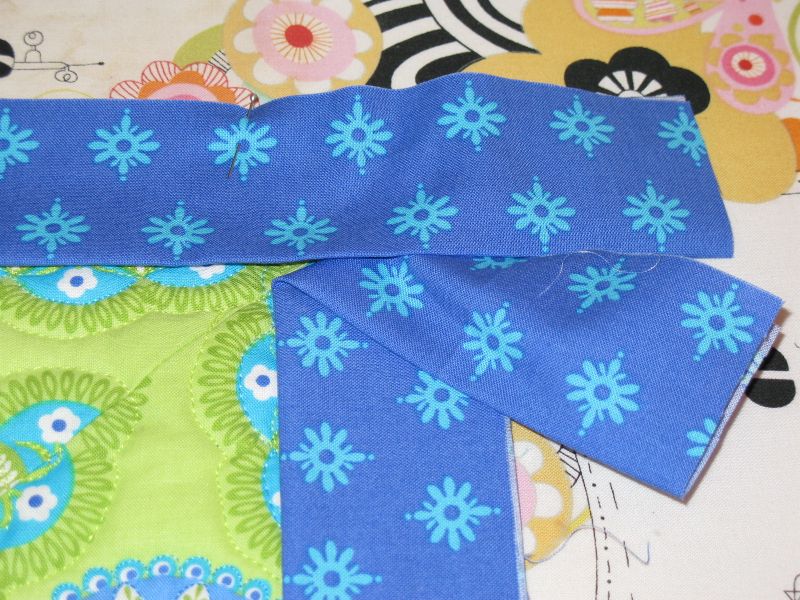
Pinned Binding

Continue pinning the strips onto each side.  Pin the strip nearly to the end, as you’ll be leaving the last one-quarter-inch of each seam unsewn.

QuarterInch from Corner

I measured one-quarter-inch from each corner edge, and placed a pin there to remind me to stop sewing.
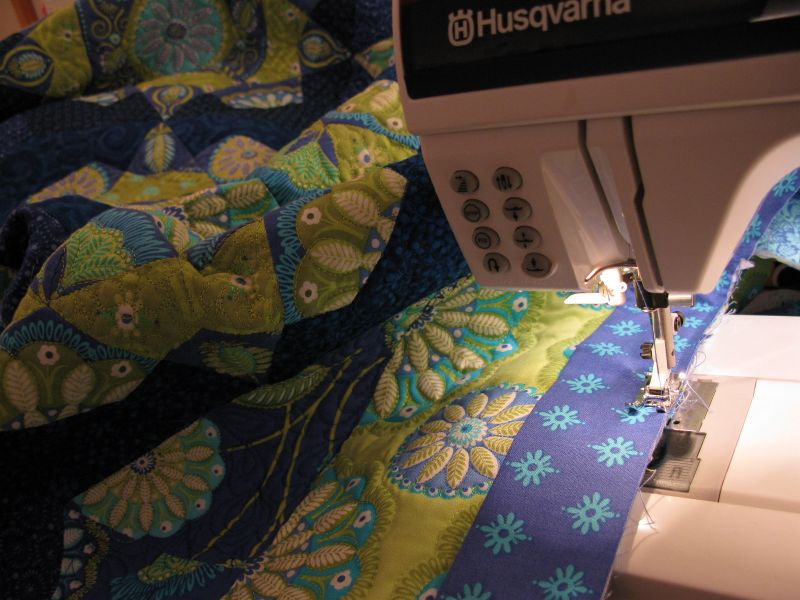
Stitching Binding

Stitch on the binding, using a quarter-inch seam allowance, and stopping at your placed pin, 1/4″ from the edge.

Step Three: Mitering the Corner

Pressing

Take the quilt to your ironing board and using a light touch, press the binding strips away from your quilt.

Mitered Corner2

Then lay the quilt so you can fold back the binding tails, as shown.  Work to have a perfectly straight 45-degree angle on those folds where they meet; use a ruler to help you align it, if necessary. Press.  The slight gap you see there between the folds is normal–the folds relax when you take the iron off.  It’s better to have a slight gap than to have an overlap.

Mitered corner1

Another view, but this is just fingerpressed.  While you can just fingerpress the folds, I think it’s better to get a hot iron on there so you can see the crease.  (See next image.)  Remember that you are pressing through double-folded fabric, so do a thorough job.

Unfold and align the binding strips for the first corner, making sure the pressed diagonal lines meet and folding the quilt down and out of the way.  You are also making sure the top folded edges meet.  I try not to pin this next seam to death, instead using only three pins:

Mitered corner3a

• #1–Place a pin at the outer, folded edges of each binding strip and line the creases up.

• #2–Then go to the bottom, near where it’s joined to the quilt, and poke a pin from the top crease down into the bottom crease, lining them up.

• #3–Lastly, line up the creases at the center and place a pin there.

Again, you are pinning along the crease you made when you ironed in that beautiful miter at the ironing board.

Stitch the seam.  You’ll begin stitching from the folded, outer edges and sew back towards the quilt-binding seam (at the bottom of the picture).  There’s really no need to “tack” by backstitching.  So don’t.  Just leave your thread tails long and you should be fine.

Mitered Corner 4

Trim the extra fabric to one-quarter-inch, as shown, then press the seam open.

TrimCorner

This is the backside of that mitered join up above.  Notice how the seam allowances become smaller at the point?  That’s because I trimmed them down to eliminate bulk.  Trim out as much of the batting as you can, while making sure you don’t cut the stitching. Don’t skip this step.  Just proceed carefully.  (You will be fine.)

Step Four: Understitching
Often used when attached a facing to a neckline in dress-making, understitching is a technique to join the weensy seam allowances to the faced binding, which will keep them from rolling to the front and showing on your quilt.

First, since you pressed the binding away from the quilt up above, you’ve already started on this step.  If you didn’t press at that time, do your best to press it now, going as far into the corner as your iron will allow.

Understitching

Line up your needle so you are just to the right of the binding seam.  Stitch a straight line, smoothing the binding and the quilt away from the seam as you go, keeping a light tension on the quilt/binding fabric.  Light.  The success of understitching depends on not letting the binding bunch up toward the quilt, nor wandering in your stitching onto the quilt.  Stay on the binding, smooth away the  binding and it will go as smooth as butter.

Of course you can’t sew deep into the corner, so go as far as you can and cut the thread tails long.  Now begin again on the next side.  You’re almost there.

Step Five: Sewing down the Binding

Carefully turn the binding to the back of your quilt, giving it a quick press, if needed.  Gently ease out the corners.  If you are brave and not foolhardy, you can use a chopstick to help ease out the tip.  But if you go too far, you’ll have a mess on your hands.  Proceed gingerly.

If after turning, you think your corners are distorted and look like the tips of a witch’s shoe, a little pulling at the side edges, just below the tip, will shorten that tip and bring it back into shape.  Set it with a little shot of steam from your iron, then press it with your fingers or a piece of wood until it cools.  Seamstresses use “clappers,” or smoothed wooden tools just for this purpose.  However, it’s better to lay a piece of cloth down and put your tender fingers on that, that to smash the heck out of it with a hot iron.  Never over-iron your quilts, or blocks, for that matter!  A horribly flattened block means that, to me, someone has decided to start wearing out their quilts early.

Stitching Down Binding

You’ll stitch the binding down by hand, just as you do a regular quilt binding.  Now you can clip those long thread tails on the top of the binding as you come to them.  Tuck the long tails that are on the backside of the binding up inside–no need to trim those.  If you find your miter is buckling just a little and has too much fabric, with your handsewing needle take a small tuck and secure it with tiny stitches.

All done!

Faced Binding--back

This is what the binding looks like from the back, when finished.
faced-binding-front

And this is the binding from the front–invisible!

Note: If you need to attach a quilt sleeve for hanging, you’ll create your tube of fabric and stitch it on now, aligning the top edge 1/2″ to 3/4″ down from the top, and leaving a slight bulge in the sleeve to leave room for the hanging rod.

˚˚˚˚˚˚˚˚˚˚˚˚˚˚˚˚˚˚˚˚˚˚

Return to OccasionalPiece-Quilt (or OPQuilt.com)

Colorwheel Blossom_front

200 Quilts · Four-in-Art · Quilts

Congruence, Deconstructed

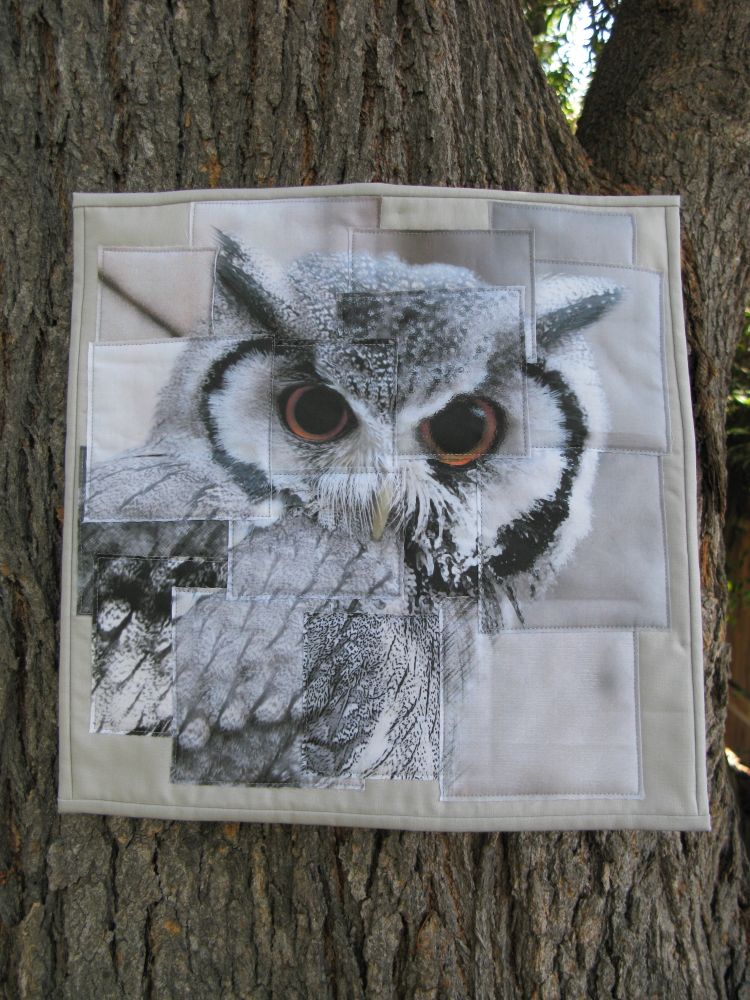
Congruence Owl quilt front 2

Our reveal for the fourth challenge quilt in our art group, Four-in-Art Quilters, was yesterday and today I’ll tell you how it came together.

I first started by looking a what seemed like billions of photos of owls.  I did a lot of this through Flickr, where I found this photo:

OWL ese

I wrote to Matt Smith, the person who posted it, and asked permission to use this photo and he gave it to me.  And then I sat on it for a couple of months, not knowing how to approach this.  Did I want to paper-piece it?  Not really.  Embroider it?  Pixelate it into little squares?  None seemed satisfying.  And then it was in the background reading that it came to me that I would fracture it, play with it a little and see where that went.

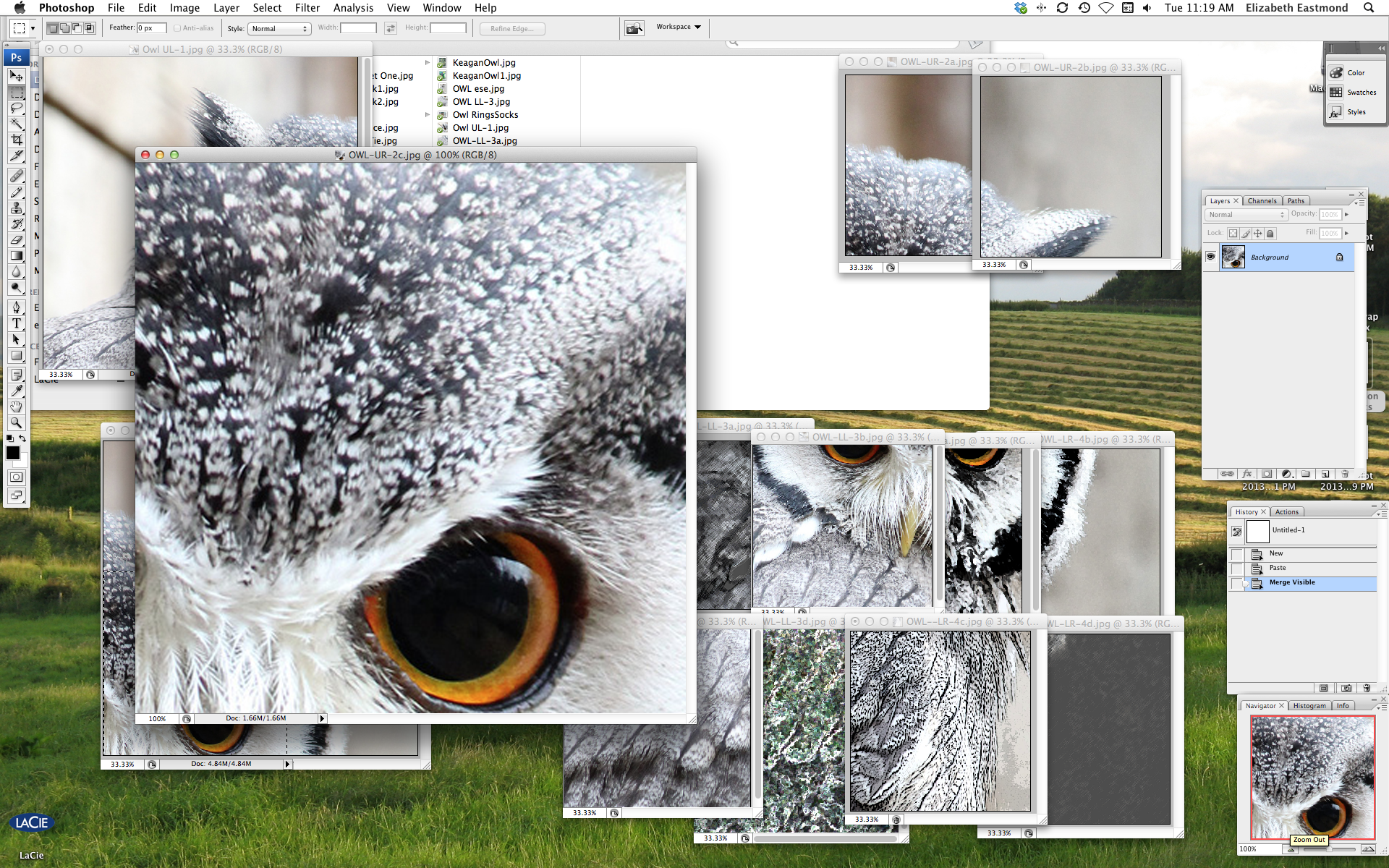
OWL ps desktop

I digitally chopped the owl picture into fourths and then chopped into fourths again, making sixteen parts.  And then I began to play with filters, one of the least used, but really fun parts of Photoshop.  I applied at least one, and sometimes multiple filters to each segment, approximating the sizes so I could get this bird back together again in the end.  You can see the mock-up on the lower right.  That was me, trying to reassure myself.

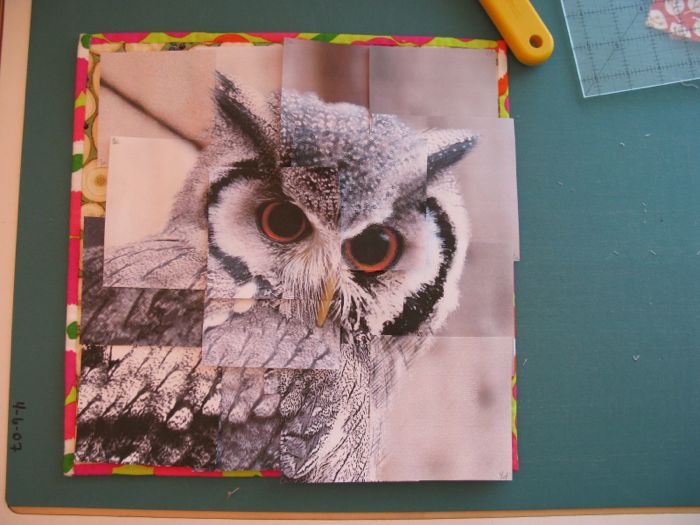
Congruence Owl quilt construction 1

Then I printed it off on paper, cut it apart, and still tried to reassure myself. I grabbed a previous art quilt off the wall (I knew it was 12″ square) to use as a template.  It seemed okay. But how to get it to fabric?  I usually iron freezer paper to the back of a piece of fabric, tape that to a piece of paper like I did in English Elizabeth, then run it through my Epson color printer. But I’d read in a blog about someone who simply ironed the fabric and freezer paper together, making sure it was a standard paper size, and then ran it through the printer.

Congruence Owl quilt construction 2

Don’t you love the ink smudges?  The next time, I made sure the freezer paper was really well-adhered to the fabric, then set the printings for thick matte paper on high quality and ran it through again, using a long thin tool to assist it through the last phases and so the fabric wouldn’t touch anything.  The closest thing I could grab was a nail file — but it worked.

Congruence Owl quilt construction 4

I peeled off the freezer paper carefully and cut apart my sixteen squares of Mr. Owl.

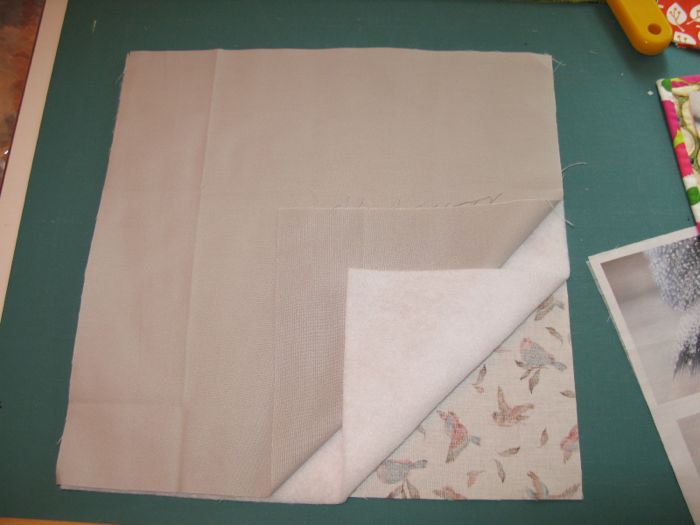
Congruence Owl quilt Layering up the backing

Layering the background — Kona Ash — with the backing and batting.  Kona Ash?  Light taupey gray?  Cindy of Live a Colorful Life is probably laughing her head off now because she knows how much I hate gray.  Really, I do.  In so many modern quilts it acts as a big hole in the composition, especially if it’s a medium gray.  I think if a quilter has to go gray in a quilt (and I’m not talking about those low-volume quilt compositions where it is intentional and where it works) they ought to go charcoal.  Or slate.  Ash is what I had on hand, as I don’t generally keep gray around (I bought it for a bee block I had to do).  But it worked for this as the picture, except for the owl’s eyes, is all in taupes and grays.  Yeah, low-volume.

Congruence Owl quilt construction 3

Using the paper mock-up as a guide, I start layering the cloth images onto the backing.

Congruence Owl quilt 2 layout

Congruence Owl quilt 1 layout

Moving things around, trimming down the pieces so some aren’t square, trying for balance.  Trying for that little artist’s lightbulb to go off in my head.  I got about a night-light’s worth of illumination, but from my writing in grad school, I knew that showing up wouldn’t get you anywhere–you have to keep trying.  To fully put this concept into action,  I went to dinner, then let it sit for a week while I went to our quilt retreat.

Congruence Owl 1

Then one morning it was simply time to tackle it again.  I couldn’t decide between satin-stitching a thicker line (close zig-zagging) or straight-stitching a narrow line of thread around each piece.  Narrow won.  I trimmed it up to 12 inches and then thought I’d like to try a faced binding (tutorial on how to do a faced binding coming in a couple of days).

Congruence Owl 2

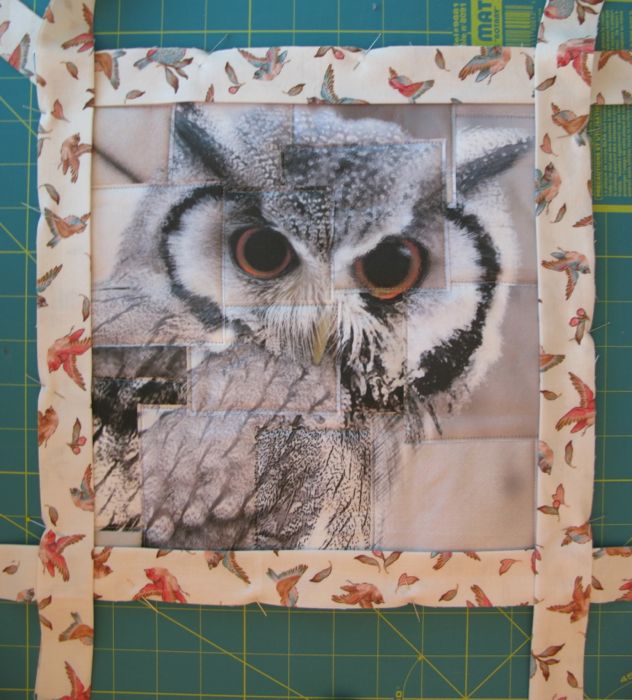
I cut strips to match the backing, sewed them on.

Congruence Owl 3

When I ironed them to the back on a couple of sides, it became apparent that I needed that “frame” of the binding for this particular quilt.  Rip off the binding.

Congruence Owl quilt tiling

I kind of liked the way the binding corralled those tiled pieces.

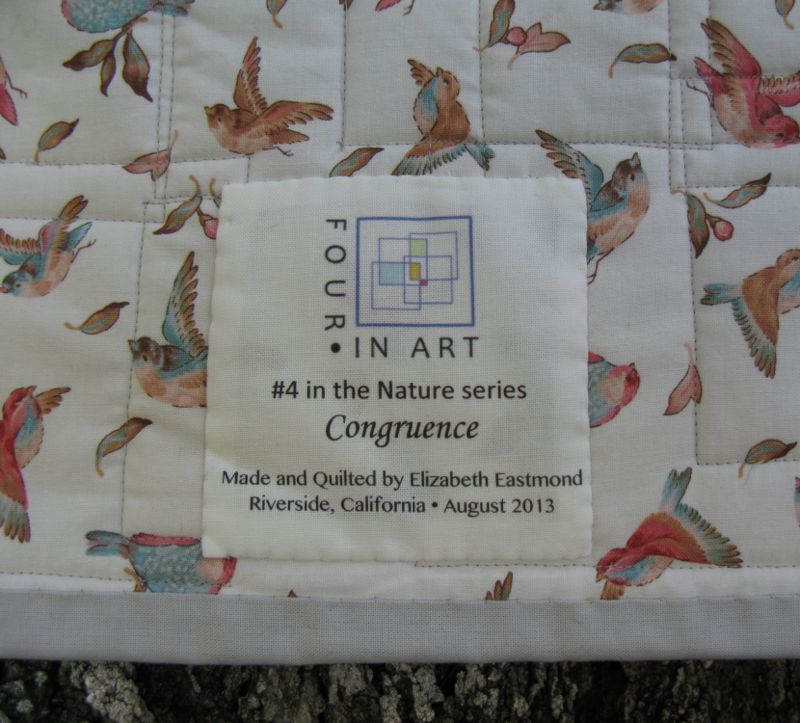
Congruence Owl quilt label

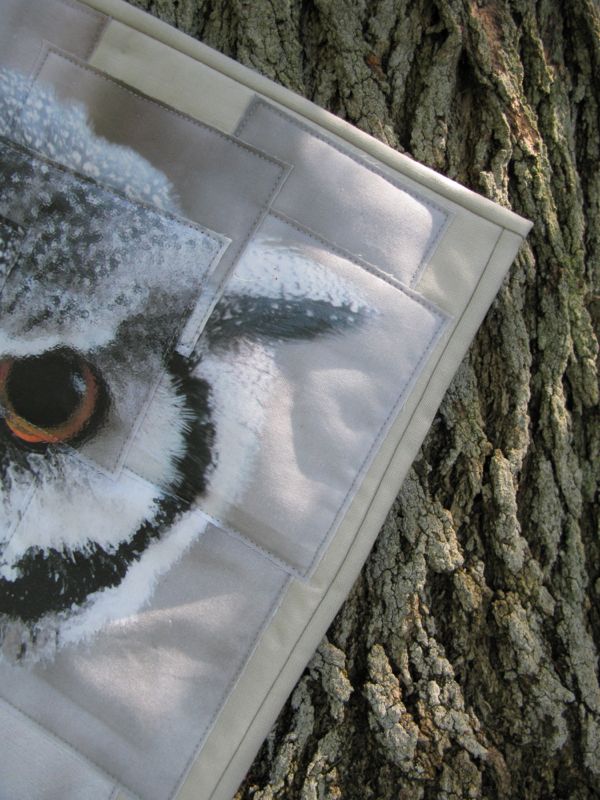
I made the label, sewed it on, then went outside to photograph it.  I made an interesting discovery.

Congruence Owl quilt 5 textures

This lower section of the feathered wing imitated the gnarly bark of my silk oak tree in my backyard.  Maybe because I’d dampened the literal image of feathers with Photoshop filters?  I don’t know, but I liked the effect.

Congruence Owl quilt front tilted

So, all the incongruent small pieces — the images, the tiling, the layering, the stitching — all merged into a lovely congruence of an owl, just like the metaphoric meanings discussed yesterday.  All combine into that creature that captures our imagination while mystifying us as well.

And now I leave you with a poem by Mary Oliver, that I think captures this idea:

“Praise,” by Mary Oliver

Knee-deep
in the ferns
springing up
at the edge of the whistling swamp,

I watch the owl
with its satisfied,
heart-shaped face
as it flies over the water–

back and forth–
as it flutters down
like a hellish moth
wherever the reeds twitch–

whenever, in the muddy cover,
some little life sighs
before it slides into moonlight
and becomes a shadow.

In the distance,
awful and infallible,
the old swamp belches.
Of course

It stabs my heart
whenever something cries out
like a teardrop.
But isn’t it wonderful,

What is happening
in the branches of the pines:
the owl’s young,
dressed in snowflakes,

are starting to fatten–
they beat their muscular wings,
they dream of flying
for another million years

over the water,
over the ferns,
over the world’s roughage
as it bleeds and deepens.

from House of Light, 1990

200 Quilts · Good Heart Quilters · Quilts · Schnibbles · Something to Think About

Citrus

Citrus Front_ quilt

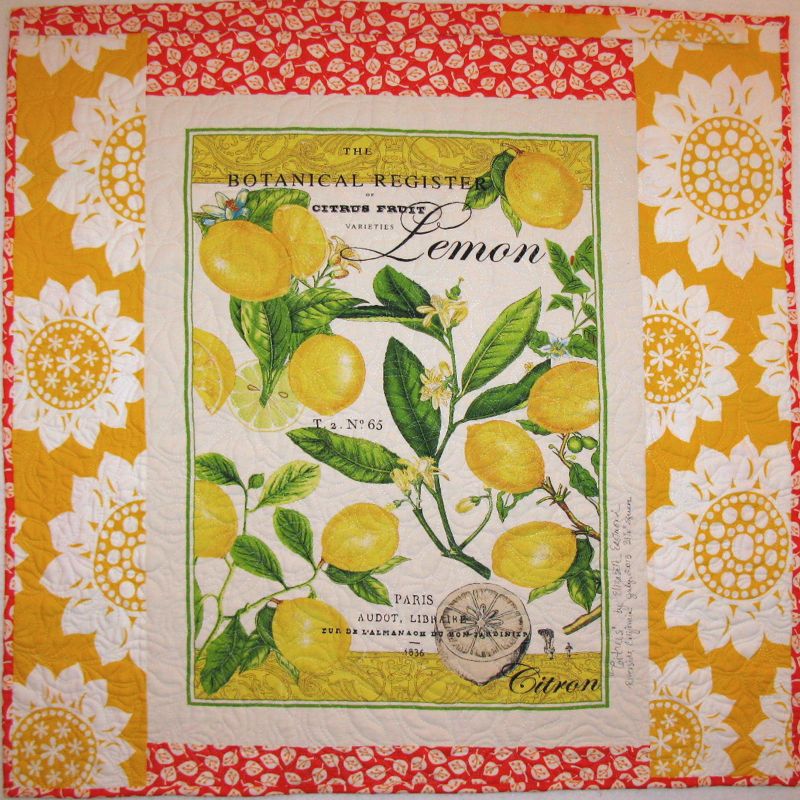
Citrus, 31-1/2″ square, finished July 2013

This is a simple Schnibbles quilt, with rail fence and sawtooth star blocks, in bright citrusy colors.

Citrus back_quilt

The back, with my sister’s gift of a tea towel as part of the backing.

Citrus quilting

As I was at our annual summer retreat, I chose a simple leafy pattern–one I could quilt while we talked about children, grandchildren, hymn-singing at church, marathons, and could-you-please-bring-me-a-piece-of-chocolate sort of conversations.

Citrus quilt Label

I was tired today, after nearly two days at our retreat, so no big fancy quilt labels for this one.  Just handwritten in Micron pen, the title, my name, the place, date and dimensions. Truthfully, this is 31 and three-quarters-inch wide, but just couldn’t face all that, so I’m calling it 31-1/2″ inches square.

Citrus and Village Faire quilts

Here are the last two Schnibbles I’ve made.  I’m thinking that whatever the next pattern is, it needs to be pink.  Or aqua.  Anything but yellow, orange and green.

Sewing on Binding_Citrus quilt

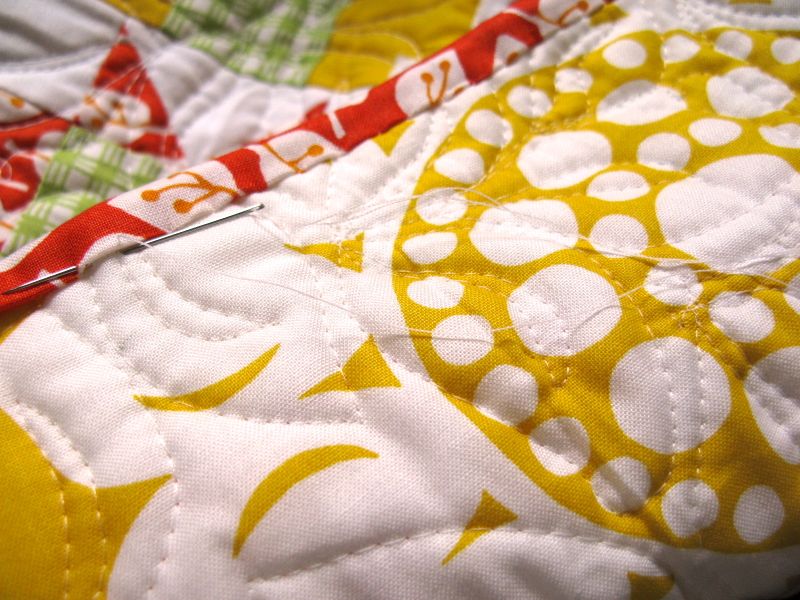
The house was quiet this morning as I sewed on the binding. My husband had not yet returned from his scientific meeting. The weather was cool so I had the windows open, listening to the faraway sounds of traffic, the nearby sounds of insects, birds, a dog barking his good morning.  I could have machine-stitched this binding down, the chunk-chunk of the needle going through so many layers of fabric, but instead, I picked up a needle and thread.

I thought about all the conversations I’d had in the past forty-eight hours at our annual summer retreat.  The topics of conversation varied from books to quilt tops to sewing pillowcases to “how do you make bias binding?” to no conversation at all as we concentrated on our tasks, letting others carry the call and response around us.  There is something so rich and rewarding about being in the thick of this, of feeling surrounded and accepted by all these creative, productive and interesting people.  We have all brought our fabric, thread, and know how to borrow each other’s books for patterns, search Pinterest or the web, or locate what we want in a magazine or on a blog.  We all seem to find the time to begin the quilt or table runner or creamy white blouse or Polaroid blocks and bring them to the communal sewing circle, so we can keep our hands busy while we solve what really is on our mind.  The machines hum a nice alto line while our chorus of soprano voices slip in those concerns and cares that worry us at night, all of us telling a story of being unable to sleep because a friend moving away, or how to find the money to go to another state to meet an adult child’s sweetheart, or how to recover from a foot injury, or recover from a broken heart of a life called away too soon.

The stories are as varied as we are, from new mothers (am I doing this right?) to mothers of teenagers (can I send them to the moon?) to mothers of grown children (everything will work out).  We are young, running marathons.  We are older, with a litany of physical complaints.  We are professionals, earning retirement and benefits, and we are under-employed, wondering how to find medical insurance.  We are so different.

We are the same, with thread and scissors and stars and triangles and squares of cloth.  After days of sewing together, we are tired and head back to our houses with our half-finished projects, our conversations, our new friends, our memories, all packed away until the next time.

All of this is on my mind, as I think about how this is being repeated at every retreat, every sewing circle, all of us being bound together like this quilt I am working on, a stitch at a time.

***************************

This quilt is my first finish on my list of things to do in the Third Quarter of 2013’s Finish-A-Long (FAL).

FinishALong Button

It is #118 on my 200 Quilts List.

Good Heart Quilters

Latest Schnibbles is Taking Shape

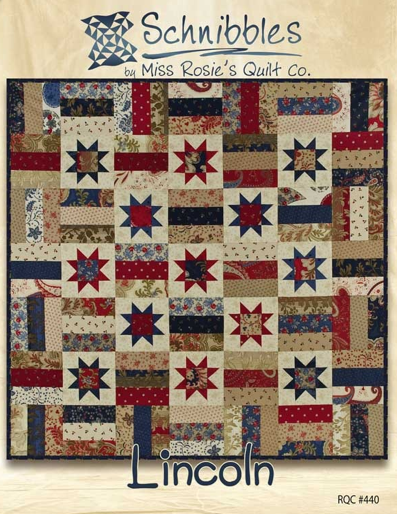
Schnibbles Lincoln

This is the Schnibbles pattern chosen for this month’s Parade of Schnibbles, hosted by Sherri and Sinta, a design called Lincoln. While I love the red, cream and blue and it is appropriate for July, I had a cute packet of fabrics brought to me by a friend while I was convalescing and it just pushed its way to the front and demanded to be used.  So I did, sewing and ironing with my foot up (it’s quite a feet feat).

Crowded Pin Wall Quilt

Think this real estate is getting crowded?  I didn’t want to take down the quilt on the left, so just folded it over while I put my quilt up on the wall.  In looking at it, I knew the name: Citrus.  What else to call a quilt with lime, lemon and bold orange in it?

Citrus Top

Sewn top.  I cropped it so you wouldn’t have to see my messy pin wall.  But I’ve put a tea towel on the back of every Schnibbles so far, and what to put on this one?  I thought about going by the Citrus Historical Park, where I thought they may have something. Then I looked on the towel rack in my kitchen (the oven door) and there it was–a citrus-themed tea towel!

Back of Citrus quilt with dishtowel

My sister brought it to me because my kitchen is yellow, and maybe because we carried a sack of oranges up to her in the snowy mountain west last February, a ray of sunshine from our home town’s harvest.  But I hope she won’t mind that I put it into service here. I whipped it off the rack, washed up up and bordered it with fabrics from the front.

Batting Seaming

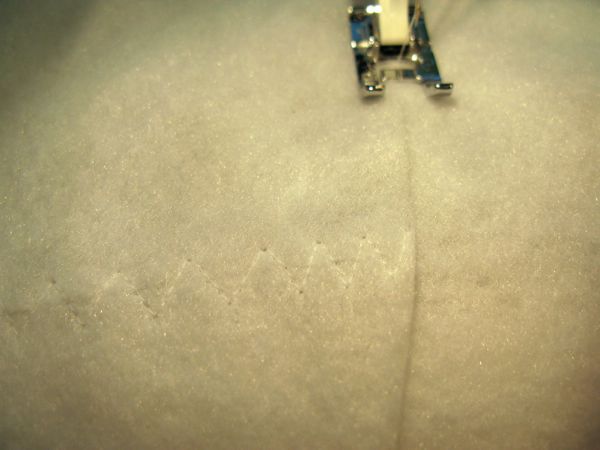
One beauty of making small quilts is that I get to piece my scraps of batting hanging out in my closet and use them in the quilt.  I lay the scraps side-by-side on my  cutting mat, overlapping the sides I want to seam.  Then I take my rotary cutter and make a wavy cut in them–a long, slow wavy cut.  I butt those seams side by side, and using a stitched-zig-zag in a 9.0 width, I zig-zag the seams closed.  It makes a nearly invisible join with no ridges.

Citrus Pinned UP

Citrus is all pinned up.  I’m actually getting some projects ready for our little quilt group (The Good Heart Quilters) is getting together for a retreat this weekend.  I have learned that it’s too busy to do intensive thinking, so it’s better to go prepared with projects I can sew while chatting away.

This coming January, our quilt group will have been going strong for about 15 years.  We generally meet about 7 or 8 times a year, always on the first Friday of every month just after 7 p.m.  When we were all younger, we stayed until 2 and 3 in the morning, but now we’re all packed up and gone by 10:30 p.m.  Here’s some photos from June’s get together:

IMG_4929

We met at Leisa’s house this time; we rotate where’s we’ll meet.

IMG_4930

What I tried to work on–this is when I remembered it’s best not to have too brain-draining of a project to stitch/cut!

IMG_8678

Bridget is a new quilter, but look what she turned out!

IMG_8680

Laurel finished the quilt she started last fall–a combination of piecing and appliqué.

IMG_8681

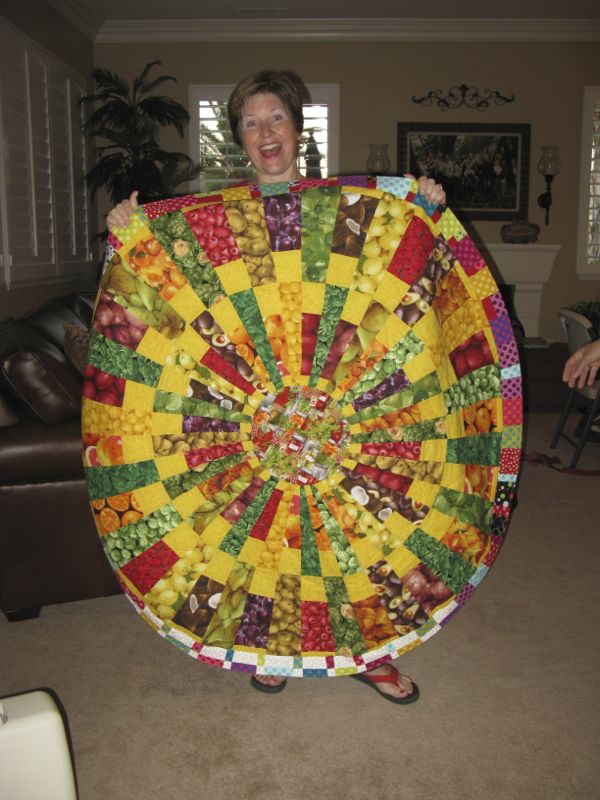
JoDy showed us her cool round tablecloth, made with a wedge ruler. . .

IMG_8682

. . .then flipped it over and showed us the back!

IMG_8683

She also finished a reversible table runner.

IMG_8684

IMG_8685

Caitlyn (L) recently ran a half-marathon with Lisa (R) who is a marathoner.  Lisa showed off their medal. ( That’s a pair of scissors on a magnetized disk on Lisa’s shoulder, not a fancy broach or something!)  Our retreat will be at Lisa’s house–she did one last year and we had such fun, we’re doing it again.

IMG_8686

Of course, we have to have food!

IMG_8687

Deneese is coming along on her Chevron quilt.

IMG_8688

Lisa showed off a newly completed UFO–it was one of the early quilt block exchanges we did, in patriotic colors.

IMG_8689

Lisa G. finished her quilt top–I love that spoon/fork fabric.

Looking forward to this weekend’s retreat!

*****************

Linking up with WIP Wednesday at Freshly Pieced.

WIP new button