Quilts

Straighten Up and Sew Right

Sad Seamtress(from *here*)

It had been nearly a month since I’d threaded the needle of my sewing machine and sent it to humming, and I felt like the sad seamstress in the photo, above, pining away.  I wanted to get to the machine and have a good sewing session and have something to show for it.  As one Instagrammer said, “My sewjo is missing.”  But I wasn’t idle.  First, I had a root canal, which ought to occupy anyone for a few days.  And I also cleaned out the stash a bit, filling two large mall shopping bags with swatches of fabric to let my quilting group, the Good Heart Quilters, rummage through before donating the rest to our quilt guild.  And here’s some photos to prove I have tidy cupboards, before I start messing it up again:

Straightened Up 1

 I like to organize mine by color and value (light-to-dark).

Straightened Up 2

The lower half of the cabinet.  Inside the pull-out box are browns and blacks–easier on the back this way.  I keep the Kaffe Fassets in another place, and I also have a stack of cream/tans and a stack of “low volumes” (neutrals or pastels), and stack of predominantly white/light background fabrics.

Molly Qee xfour

Here’s a close-up of my Molly Qee collection (the characters with the crowns).  They are hard to find in the States.  I started my collection when my sister Christine and I happened into a collectibles shop in Lyon, France.

More Shelf Stuff

And on the other shelf are other doodads.  My husband gives me the little Japanese dolls (ningyō).  And those fabric-covered binders are all my journals, began when I was a young woman of twenty-one years old.  Since the advent of email and cheap phone calls, I’ve stopped writing them, but I love having them around (they hold all my secrets!).

Pink Selvage BlockSo after a busy month, I pulled out the machine and got started.  I decided to ease my way in slowly, making a selvage block.

Basic Selvage Block Foundation

When I begin, I use my standby translucent paper, cutting, then pasting a strip on one side so it measures 10 1/2″ square. Then I draw lines on it to keep the selvages on straight.  Do I cut all my selvages off when I buy fabric?  No.  I like having them on to keep track of the newer stuff in case I need more.  Most of these selvages happen when I’m going through older fabrics that are in my stash (like those to be donated), of which I know I’ll never need the information again.  Then I slice it off, leaving about one-inch to 1-1/2″ of the fabric on top of the selvage so I have Lots of Options.

Pieced Selvage Strip

I get started by cutting two 4 1/2″ blocks, then slice them on the diagonal to make up the four triangles you see in the center above.  I pin them down, then start sewing on the selvages, placing the selvage edge 1/4″ in from the raw edge of the triangle, as shown.  Sew closely along the edge.  I like it best when the first selvage next to the color is the same, or nearly all the same, so I look for a longish piece. I think it just helps set the stage.  Sometimes I piece selvages to get the printed symbols and the words closer together (above) and other times I just let it be.   Then it’s random, random, random after that, some thinner strips, some thicker strips.  Some people like to trim the fringey pieces, but I just leave it that way.  Sometimes after I sew on a strip of selvage, I’ll go in and trim down the underneath piece just to keep it tidy.

Selvage Block Colors

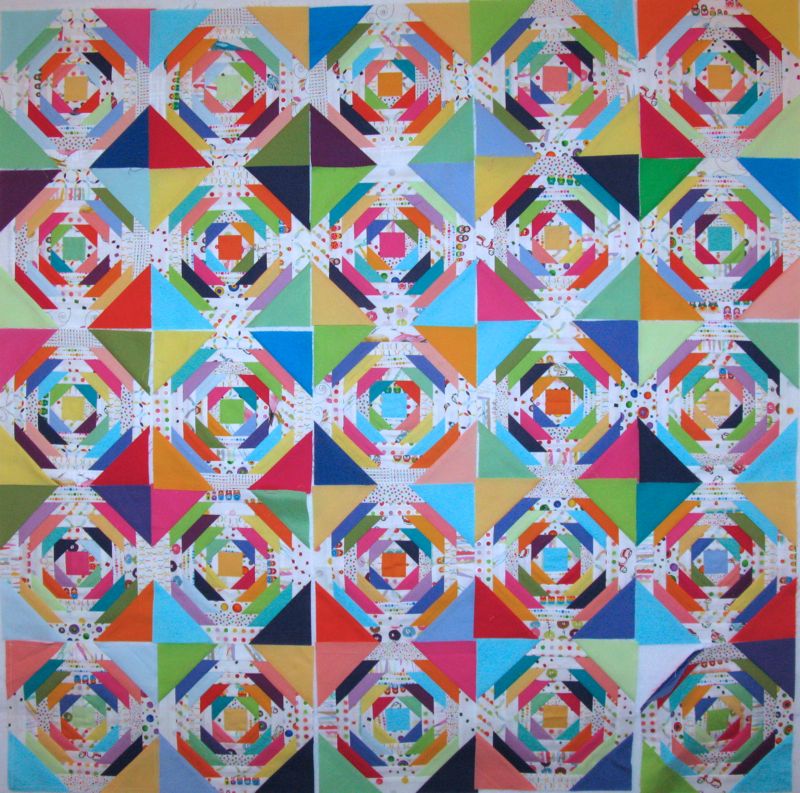
Sometimes I get things off balance, like in the pink block way above (too much deep maroony-pink in the lower left) but then I figure I’m teaching myself how to let go a bit and just enjoy the process.  And I do.  I now have five colors of four 10″ (finished) blocks, so the block will be twenty inches square after all four parts are sewn together.  This is going to be one big quilt, but I’m in no hurry.

To close with, here’s a quote from The Rise, by Sarah Lewis (the book I wrote about in the Creativity post):

“Perhaps we have grown impatient with the incomplete. We are part of a generation that, as the African proverb goes, wants to eat dinner in the morning, that longs for the immediate, fully prepared for consumption. Yet the strength to linger over the long-left unfinished reminds us that something inexhaustible in us is empowered by striving, that we sense unnaturalness in blunt ends of journeys, of lineage. And that power comes from where we least expect to find it.”

Go tackle something incomplete, and enjoy the power of taking another look at something that in our hands, has had a long journey.

Quilts

Deconstruction of Ted and Maurice at Lorinc Pap Ter, an Art Quilt

On the Bench at the Park

This post is a deconstruction of the techniques I used to create Ted and Maurice at Lorinc Pap Ter, a small (12″ square) art quilt for the Four-in-Art Quilt group.  Our challenge this quarter was Contrast, under the overall yearly theme of Urban.  Often an idea will come to me, but sometimes I start with the technique.  I knew I wanted to drag out those bottles of Bubble Jet Set and Bubble Jet Rinse that I’d ordered some time ago, and find out if this whole process was difficult or easy.  It was easy.

Bubble Jet Set is a type of mordant that binds to your fabric and allows the ink from your inkjet printer to adhere more easily.  I’ve printed on fabric for years, but haven’t ever prepared the fabrics.  I first started by reading a lot of blog posts, and I’ll post the links at the end.  The one website that described the process best was Caryl Bryer Fallert-Gentry’s (Bryerpatch.com), and I followed her instructions.

Bubble Jet Set

I bought a shallow plastic container at Target, about 4 inches deep with a latch-type lid, as I wanted to store the prepared fabric in there afterwards.  I cut my fabric about 9 inches by 12 inches, grabbed the container and the Bubble Jet Set (I only needed that one at this time) and went down to the kitchen sink.  I put on dishwashing gloves, as suggested, then laid the first piece of fabric in the bottom of the container.  I sparingly glopped some BubbleJet Set (BJS) onto the fabric, smoothing it out until it was thoroughly moistened.  I placed a dry piece of fabric on top of that, again, smoothing until it looked like it had picked up most of the excess BJS, then glopped a little more.  I’m being quite stingy with the BJS, actually, but do want to make sure that the fabric is sufficiently soaked.  I repeated this until all four sheets were saturated.

Prepared Fabric DryingI lay down some towels underneath my improvised clothesline in the garage (some say you can put containers to catch the extra drips, but I didn’t have that much excess) and hung up my sheets of fabric until dry.  In our summer heat, it only took about an hour.  Meanwhile, I washed and thoroughly dried my container, and when the fabric was dry, put them in the container until I could get to them.  I read one blog where the crafter cautioned about letting too much time pass between treatment and printing. I had a space of about 4 days, and that was fine.

In yesterday’s post, I talked about how I created my art conceptually, but what I did technically was begin with a good photo of the square in Budapest.  I overlaid the baseball backstop photo, sized it, then took it down to 20% transparency, and used the Eraser tool to start erasing a space to let the statuary shine through.  I could have created a Path and selected it, but sometimes I think the Erase Tool does just fine.  I did change out the size of brush I was using, from 1 pixel in some places to 75 pixels in other places.  I did the same with Ted and Maurice, first flipping them around so they faced the other way, as that’s where I had some space to put them.  I merged the layers, as I know from experience that when printing on fabric, it’s wise to pump up the Saturation of colors (enhancing the image without making it garish), and to Lighten/Brighten the entire image.

Four Squares of 9Patch

For the border pieces, I sized each combination of colors to four inches, then pasted them into one document so I could print all the colors at once, first flattening, then then increasing the Contrast/Saturation and then adjusting the darkness through the Lighten/Brighten menu.

Trimming Fabric

When I was ready to print, I backed the prepared fabric in freezer paper, ironing it thoroughly but using NO steam at all — I wanted the freezer paper to really bond with the fabric.  I trimmed it to exactly 8 1/2″ by 11″ inches, and used a High Quality photo setting to print.

Image Printed on Cloth 4-in-art_1

It worked like a charm!  I let it set for the recommended 30 minutes then peeled off the freezer paper.  I let it set some more to let it thoroughly dry–a caution I read on many blogs.

Bubble Jet Set Rinsing

I put four capfuls of Bubble Jet Set Rinse in my container, then added about a gallon of water (about 3 inches) and set the first printed sheet in the water.  I kept it agitating the whole time of two minutes, as you see above.  I held up the sheet to let it drain and in the other sink, I rinsed the sheet well and laid it out on towels that I had set on the counter.  I did the same process with all the other prints, agitating them (apparently to keep the dye from the printing to re-settle back onto the fabric — they cautioned several times to keep it flat, and to not let it crease!).

Leftover Rinse Water

This was the color of the rinse water after I did all four sheets.  The Bubble Jet Set Rinse is a mild detergent formulated to remove excess dye.  In my reading, many said that Synthrapol would work also, but I had this so I used it.

Blotting Printed Sheets

I blotted the sheets gently, pressing out the excess moisture.  I did not wring or crumple the printed fabrics at all, working to keep them flat.

Sheet to Dry in Garage

I hung them in the garage again to let them dry, again taking only a short time.  I was pretty happy with the results.  The colors were vibrant and the fabric was soft and I knew it was washable, although there are cautions about what type of detergent you use.  I never wash my art quilts so it wasn’t a concern, but if you plan on doing so, here are some good websites with information on their experience with using BJS:

http://vickiwelsh.typepad.com/field_trips_in_fiber/2009/04/bubble-jet-rinse-whats-the-point.html

http://quiltbug.com/articles/bubble-jet-set.htm

http://www.bryerpatch.com/faq/bjs_q&a_page.htm

http://www.cjenkinscompany.com/Frequently_Asked_Questions_s/25.htm

The C J Jenkins Company manufactures the Bubble Jet Set, and I thought their page on printers was helpful, although I swear by my EPSON with their Archival Inks.

First Layout of Printed Sheets

After this, the construction was pretty straight forward, although I had to do some cutting and stitching to get the dimensions correct around the central image.

Sashing Printed Sheeets

I sashed the central image because I felt it might get lost in the tiny square borders.

Quilted 4-in-art_Aug2014

I quilted it, using matching threads (mostly lots and lots of gray).  Detail below.  I didn’t want to “over-quilt” this, but did want to emphasize the various elements.

Lorinc Pap Ter_detail front

Lorinc Pap Ter_front

And that’s it!  I’m pretty happy with how the BJS and BJR turned out, and glad that I had this little art quilt to nudge me into trying that preparing-fabric technique.

Circles EPP Button

Next up? The third block in my Circles English Paper Piecing Sew-Along.  I’ve remade this thing twice, so I’m ready to put it up and move on to the next block.  See the above tab if you haven’t started yet.

˚˚˚˚˚˚˚˚˚˚˚˚˚˚˚˚˚˚˚˚˚˚˚˚˚˚˚˚˚˚˚˚˚˚˚˚˚˚

My blogging software places ads here so I can use this site for free.  I do not control the content of these ads.

Quilts

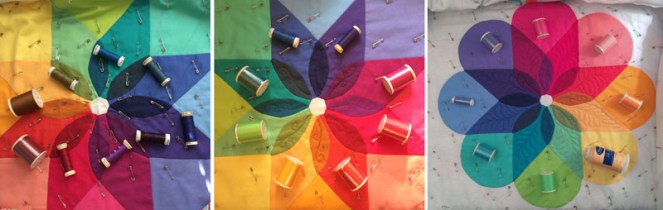
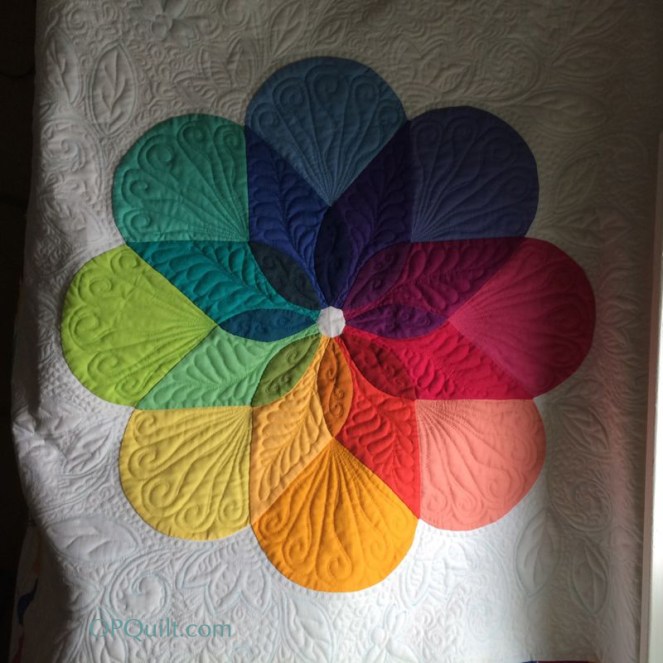
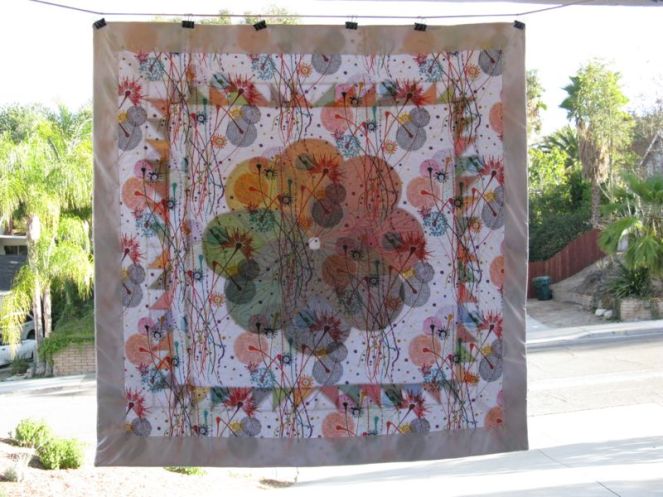
Some Interesting Circle Quilts

IMG_0862

While looking through this blog, I found some examples of interesting circle quilts.  This one, made by Kathleen H. McCrady and titled  Sawtooth X, is patterned after an old one from 1875, using reproduction fabrics in brighter colorways.

IMG_0863

IMG_0821

This is kind of “circle-y,” but has added oak leaf appliqués in the corners.

American Folk Art Museum Circle Quilt(from *here*)

Known as the Georgetown Circle Quilt, its maker is unknown, but it was made in the era between 1900-1920.

Georgetown circles variation(from *here*)

Here’s a modern variation of that Georgetown Circles quilt.

airship_propeller_std

I found this one on my computer, with a date of 2005.  It’s from Freddy Moran and I believe she calls it Airship Propeller. But I could be wrong about that title.  Jenn Kingwell did a similar design, but turned her blocks on point:

Steampunk1(from *here*)

Circle Block from Smithsonian

Lastly, when I lived in Washington DC, the Smithsonian Institution’s American History Museum had this sort of secret quilt tour, but if you knew about it, you’d call them up and a docent would take you in the back and open lots of archival drawers, showing you positively ancient quilts (some 250+ years old).  It was amazing.  In one drawer was this quilt with circles.  This one looks challenging to piece, but I think easier if is English Paper Pieced.  I’ll save this one for later in the series, once we’ve gotten our skill set up and going.

All this proves that our slow sewing, of making English paper  pieced circle blocks is an idea that has come around again.

Quilts

Iron Woman Improv: My Version of a Weekender Bag

Weekender Side A

Ever heard of Iron Woman Improv?  Well, anyone can throw together a bunch of scraps and make it end up sort of squarish-like, but this past week I’ve improv-ed a travel bag for some upcoming travels.  Above is the backside.

Weekender Side B

This is the side with the long big pocket across the front.  The problem with improv-ing is that you don’t know quite where you’re going, which some find liberating and free, which reminds me of the story of The Dot and The Line: A Romance in Lower Mathematics, which you should read, if you haven’t.  Basically it involves a romantic triangle with the Dot originally falling for a Squiggle, who could sprawl into random sort of positions and places, pulling her heart into anarchy, but no worries!

The Dot and The Line

The initially uptight straight line figures out how to make a bend. . . and then another and another until he has made complex (and even erudite) shapes, wooing that Dot back into his shapely arms.  But I digress.  (But do get the book for this next Valentine’s Day for someone you love. It’s a classic.)  Basically my challenge was how to get from these photos:

Various Weekenders Women Holding Weekenders Screen Shot of Weekenders Sewn

. . .  and this sketch. . .

Sketch for Weekender

. . . to this. . .

Weekender Side C

Weekender Side D

. . . and using a limited supply of my typewriter fabric.  Weekender Bags are all over the web, ranging from about 60 bucks way up to 500 bucks and more.  And certainly I read enough posts of people making Amy Butler’s version of a quilty weekender to know that you really haven’t earned your Quilter Stars until you’ve conquered her pattern.  And that’s where things get interesting. . . because I had NO pattern.  Nothing.  Not from Amy Butler or McCalls or Vogue.  Like I said, I had a sketch.  And this:

Baggage. . . which is the NEW! IMPROVED! (smaller) dimensions of what is considered a carryon.  I have wanted to make this bag for ages, needing a place for my iPad, my camera, my water bottle (carried empty through security, then filled afterwards), my junk and my stuff.  I’ve sketched something like this fifteen ways to Sunday and only now, got around to making it.

Zipper Top Weekender

I also needed it to have those little blue webbing handles that you see there, because I’ve learned that if I can hook it to my rolling bag (yes, we had to buy a  NEW! IMPROVED! (smaller) one for our trips) and get the weight of this second bag –er, personal item– over the wheels, it’s easier on my shoulders and on my arms and wrist.

Zipper Side Weekender

I’d purchased a couple of long zippers in different colors when I was in New York City last time, so I figured what would go with the fabric and pressed it into service.  And even though one of the cities we’re heading to looks like this:

Checking Weather

I didn’t use my Amy Butler laminated fabric, opting instead for my typewriter fabric.

Weekender Pattern Pieces

I first drew up the pattern.  I started with a rectangle of the dimensions from the airline, which is basically a backpack turned on its side.  I noticed that many of the Weekender bags, both Amy’s and all the eight billion other ones I looked at became narrower at the top.  I didn’t take off too much as I wanted the ROOM to carry my stuff.  I was going to go full out for the width dimension, but then thought I would look like I was carrying a fabric-covered brick of cheese or something and it wouldn’t look that good.  And I noticed that many had a wider base moving to a narrower piece across the top, where the zipper lives.  I did that too.  I laid over more pattern drafting paper (which is doctor’s tissue that you can buy in Medical Supply Houses) and traced some side pockets.

First Inside Pocket for Weekender Bag

I LOVE pockets.  So the first step was to cut the fabric way bigger than I needed and then sandwich the Annie’s Soft and Stable in between two fabrics and quilt it.  I had seen all the quilters talk about the expense and the headache of broken needles and the hassle of cutting out eighty-five thousand pieces, and decided I would go this direction.  So, above, you see the quilted purse piece with the handles stitched on, a pocket bound in another fabric for cuteness and stitched on and the first sewing of the cording around the outside edge (you can only see the stitching).

Unschool Plus had a pretty good write-up about her making the Butler Weekender Bag, with lots of helpful links from other bloggers.  I used one of those to make my corded piping by using a narrow strip of fusible web, instead of sewing it together, thereby eliminating another stitching line you have to disguise at the end, because let’s face it, NOBODY is fabulous at inserting cording.

I sewed in this in segments:
Segment One: Quilt and cut out the bag pieces.
Segment Two: Make the pockets and attach (I’ll talk about the other one in a minute.)
Segment Three: Sew handles.  Again, a guess.  I got out my last two travel bags and measured and took the average.  I wanted enough so that I could carry it over my shoulder and then so it wouldn’t drag the ground if I grabbed it and carried it by the handles.
Segment Four: Figure out zipper.  In fact most of the steps start with “Figure out. . .”  I spent a good amount of time sewing this, and an equally good amount of time walking away from it when I wanted to stomp on it and throw it off the roof of the house.

Zipper Trim on Travel Bag

I liked how I’d assembled the zipper in my Bostonian Bag, so found some of scraps of that fabric and did it here.  It’s basically a strip of fabric cut wide, folded in half, then the raw edges folded in.  Above is the first step, sewing the strip down.

Completed Zipper Trim on Weekender

And then topstitched down the other edge.  At this point I was freaking out because the thread in the bobbin kept pulling out from the bobbin tension spring.  ACK! ACK!  I painstakingly would thread it back in, again and again and again, thinking that my bobbin case was damaged somehow.  So there are little bobbles here and there unfortunately, but I don’t think the flight attendants will be grading my construction so I think I’m okay.  I finally just decided to tighten up the bobbin screw and that worked until I finished.  (And then I took my machine in for a tune-up at the sewing machine spa.)

I made the other pocket, the one with gathers, and sewed that on (you can see it better in a later photo and I’ll talk about it then), then made the cording, as mentioned above and stitched that, being careful to clip the piping so it would go smoothly around the corner.

Cording on Weekender Bag

Look ma!  No pins!  You don’t need any–just proceed slowly. Move your needle as far as it will go to snuggle up against that ridge of the cording.  My needle never broke because basically  you are sewing with a giant spear of a needle, if you’ve switched (as so many recommended) over to a size 16.

Clipped Corners on Weekender Bag

Color Plastic Clips

I bought my quilty clips in the children’s stationary section of our local Asian-foods grocery store, so that’s why they are all different colors (about $2.50 for a package). So many sewers/sewists/pick your word testified that the quilty clips were the only way to go.  I agree.

Clamped Seam Weekender Bag

The band around the middle that contains the zipper is now fully clipped to the first bag piece.  It’s at this point that I think I might actually make it.  Thanks to all the Instagrammers who cheered me on.  And on.  I sewed that seam using a size 16 needle (advice from the Experienced Weekenders), and I was so aware that I didn’t have an industrial machine which would have made the job so much easier.  The only thing to do, then, is to forgive yourself your mistakes and keep going.

Inside Pocket and Clamped Weekender Bag

Side Two, clipped and ready to be sewn.  This pocket is a long rectangle, about 5 inches longer that the desired space.  I backed it in that fabulous Backyard Baby fabric, sewing around all four edges, but leaving a space about 1″ unsewn on two of the shorter edges, near the same long edge.  I turned it, pressed the corners out, then stitched a double line of stitching on either side of those little gaps, making a ruffle at the top, and a placket for elastic.  I threaded some elastic through, stitched it on one end to hold it, then pinned the pocket in place, pinning in random pleats on the bottom to take up the fullness.  I started sewing on the right side of the pocket, backstitching to hold the top in place, down the side, halfway across the bottom (going over the pleats), then up the middle to create two pockets.

Just before hitting the placket with the elastic, I gently pulled it take up the fullness, but not letting the purse side buckle.  I stitched over that, turned the piece, and re-stitched over that center dividing line, then across the bottom, then back up the last side.  Just before reaching the elastic in the placket, I repeated the pulling gently to adjust the elastic to fit.  I pinned it about an inch inside the sewing line, clipped off the extra elastic, then let it retract slightly back inside to hide it.  I finished stitching over that.

(I think I’m writing all this down so I won’t forget what I did just in case I lose my marbles and decide to do another one.  Just in case.)

Inside Pocket A Weekender

I finished stitching that second round of stitching-the-purse-side-to-the-zipper-band-piece, then turned it to find those places that needed a bit more stitching or a bit closer stitching, and did that.

Inside Weekender Bag

Binding Seams Weekender Bag

I cut a companion fabric into bias strips 2″ wide, folded them like bias tape, and topstitched them over the slightly trimmed inner seams.  I won’t let you see that, because again, my home sewing machine is no match for the industrial binding machines used in factories.  But it looks fine, and is sturdy.

Oops on Weekender Bag

I had an oops, and covered it with the selvage from Backyard Baby.  I would try to explain it, but then you’d really develop a migraine and swear off bag-making forever.  Let’s just say that even though I have a degree in Clothing and Textiles and have sewn sewn sewn for nearly forty-five years, I can still make big enough mistakes that need a fix like this.  The trick is to forgive yourself for the imperfections and move on.

Bottom of Weekender

And that’s it.  I’ve gone through security and traveled enough that I know what I need in a travel bag.  I need it to be sized appropriately, have a zipper pocket that I can access quickly on the outside to throw my phone in while I go get X-rayed and the bag gets X-rayed, long enough handles to slip over my shoulder and a way to attach it to my bag so when I make long connections it can be carried on my roller bag.  And can it please look good and not cost a bunch?  While I don’t plane-travel all that much, I think that this bag will also work for short hops in the car when I drive to see the grandchildren, too.

So, now I do I qualify for Iron Woman Quilting Improv?  My travel weekender-type bag was made from start to finish in one week, with lots of help from all you wonderful blogging quilters, who laid down a trail for me to follow.

May the typewriter be with you.

˚˚˚˚˚˚˚˚˚˚˚˚˚˚˚˚˚˚˚˚˚˚˚˚˚˚˚˚˚

Occasionally my blogging software will run ads here so that I can blog for free.  I make no money from them.