Patterns by Elizabeth of OPQuilt · Something to Think About · Travels

Quilting and the Churches of Kraków

Traveling is a blitz on the senses, a clearing of the mind, and making connections that are new or novel. I’m always making quilting connections when I travel, I suppose you are too: new patterns, repetitive designs that could be a quilt are not uncommon on our Instagram feeds or in quilt shows.

If you are new here — and welcome — I often take a small diversion from the *making* to the ideas that propel our quilts. This is one of those posts, and it centers around the creativity shown by a group of Polish parishes during the Communist years in this country. And actually, they are all over the country of Poland, not just in Kraków.

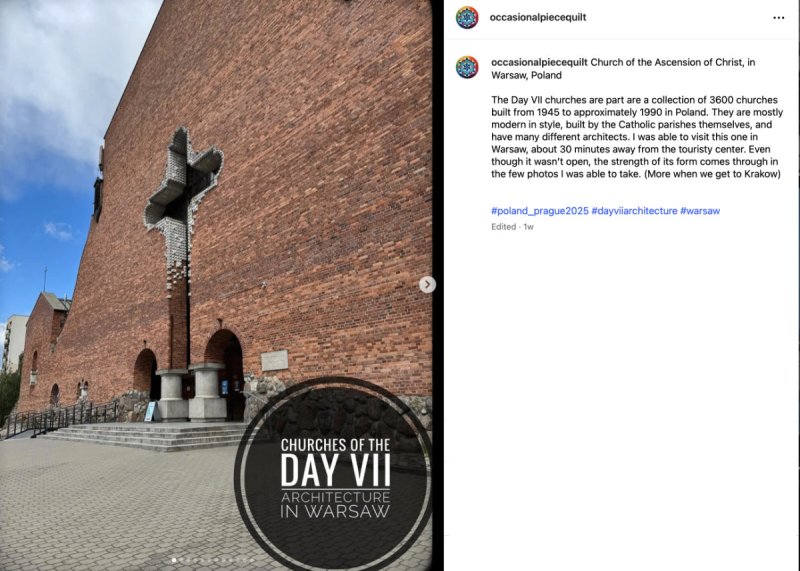
Screenshot of Instagram post

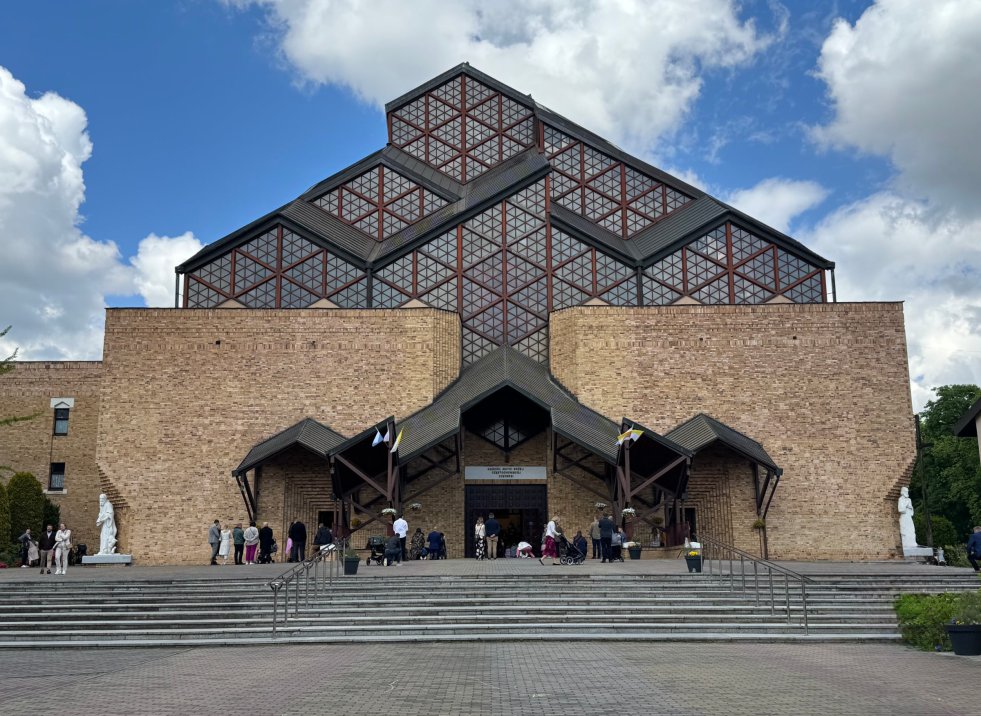
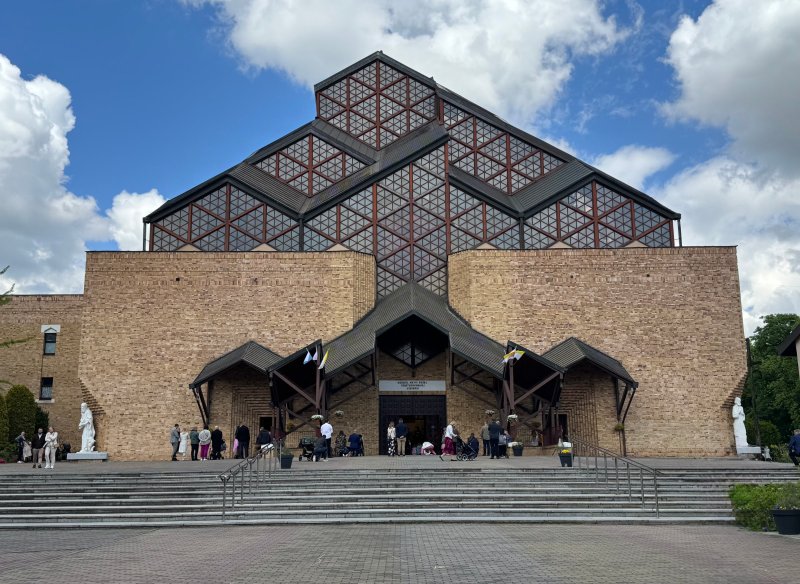
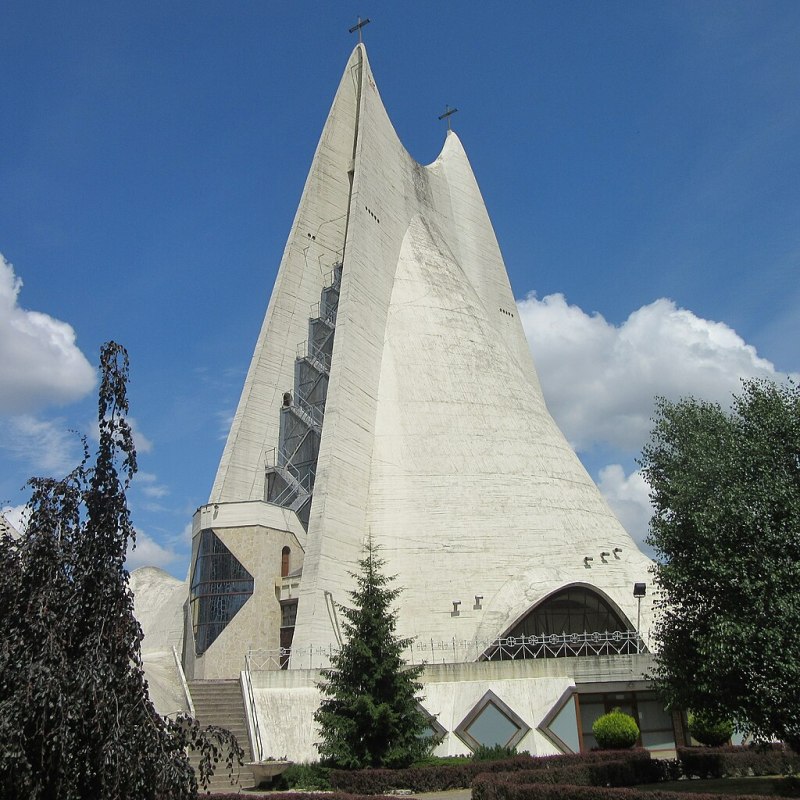
I wrote about the church in Warsaw, our first one to see, and believe me — now that I am home — I vow that if I ever go back to that lovely country my husband and I will rent a car and go see more. They are so different that the usual gothic and decorative churches that we tourists usually go to. (I do like some of these and will show a couple more in this post.) I first found out about what’s known as the Day-VII Churches during the usual pre-trip fatigue: searching for what to see in a given city, I typed in “churches in Kraków” and saw a photo of this church:

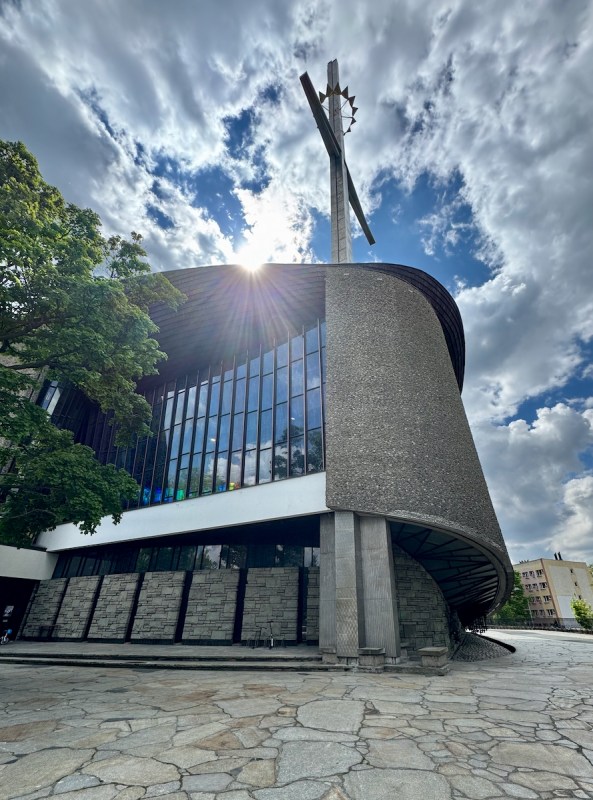
Our Lady of Częstochowa Parish, Kraków – Poland

Whoa. All those triangles, the different angles, the airiness — some architect had been incredibly creative in making this. I found out that there were about 3600 churches with similar heritage. The man who hunted down and gathered all these — Kuba Snopek — also worked with Izabela Cichońska and Karolina Popera; together they compiled a catalogue, which I ordered and read. I watched his Powerpoint presentation. I hunted and searched and read and soon realized that I was limited by my time in Poland and had to choose what we would go see. Sometimes there was information and in English, and other times there was not.

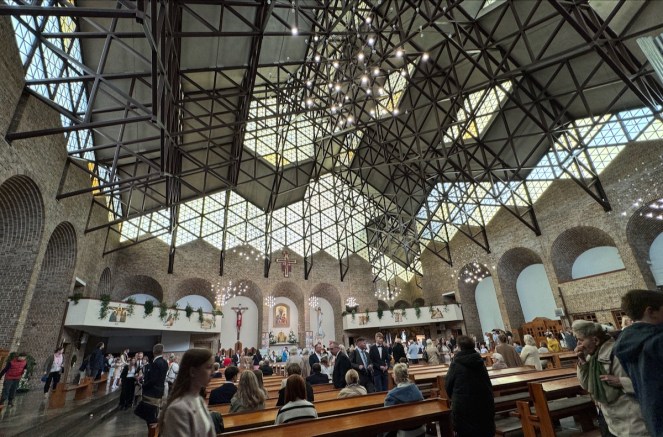
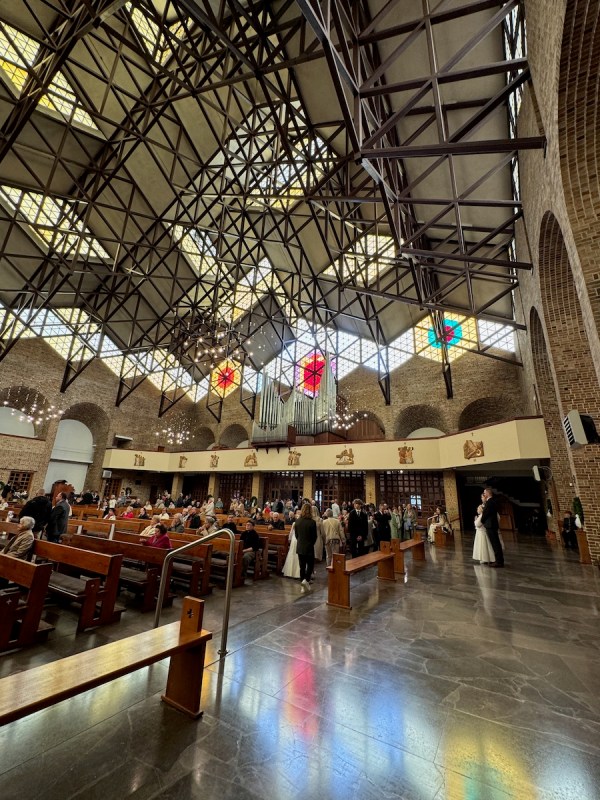
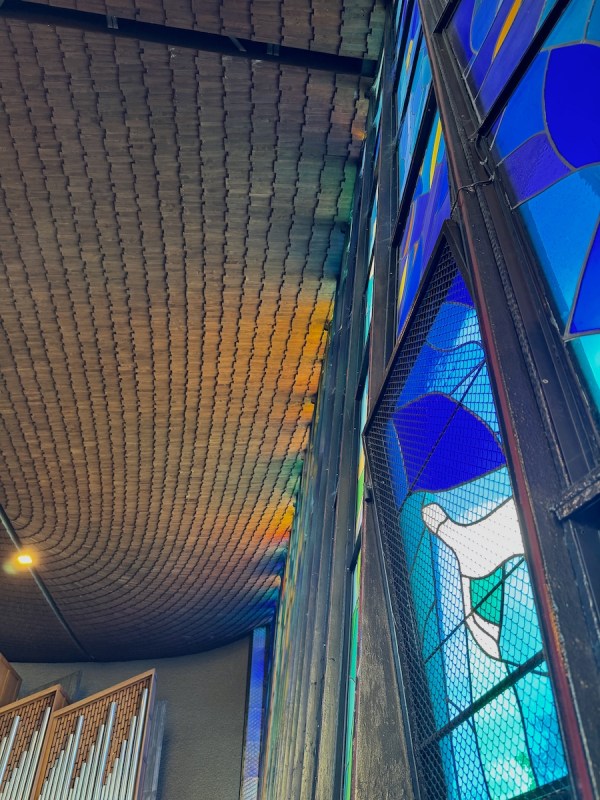
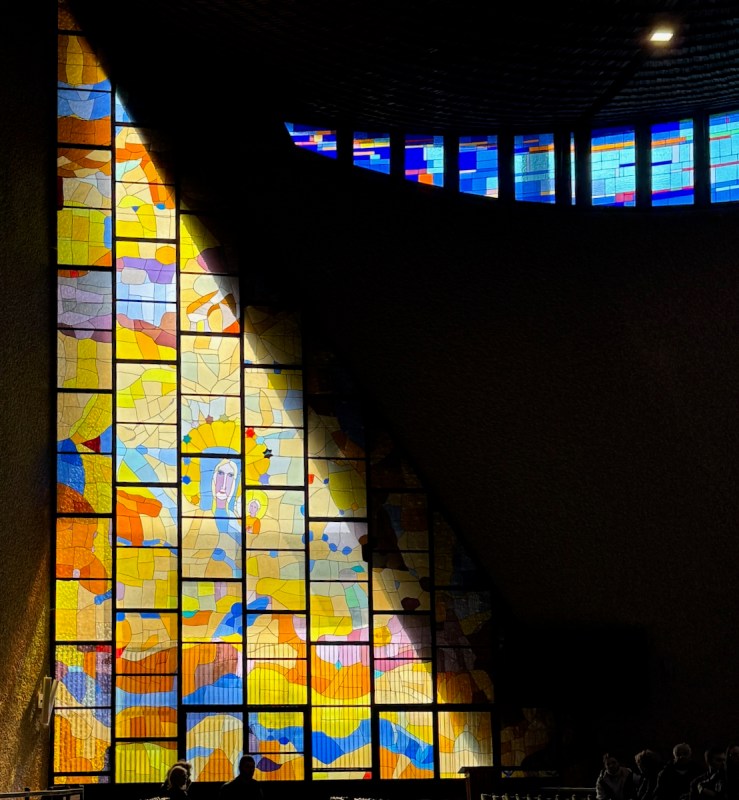
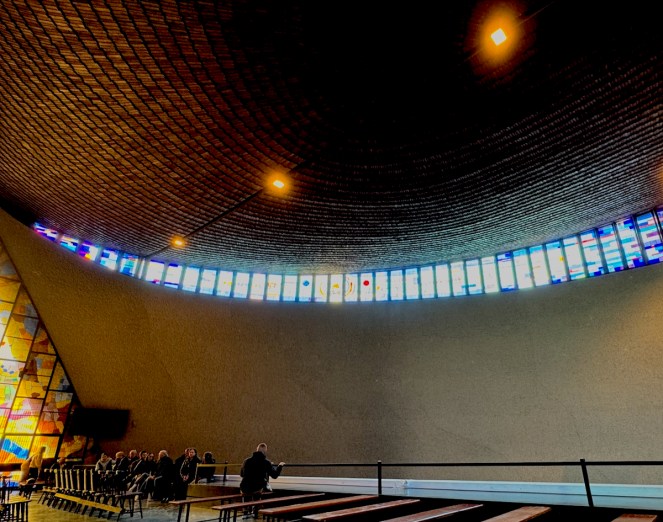
Interior, Our Lady of Częstochowa (Some video of the interior)

A lot of these churches were impacted by the changes of Vatican II. In reading about this preciously unknown subject, I learned a lot about how the desire to have the priests more in front of the congregation and to include the participants in the worship experience, changed how the architects designed the churches. Communication with the Vatican was spotty, at best, during the early years after the war, so some parishes/architects turned to the ideas found in theater construction; broad expanses became more common instead of the more traditional narrow nave and side aisles.

(looking toward the rear of church, with hexagon windows)

While we did go to these on a Sunday, we worked to not take photos during their services, with only a couple of exceptions. However, there were many photographers around that day, as it was a celebration of First Communion for a whole group of young people, and the joy and celebration was palpable and only added to the experience we had.

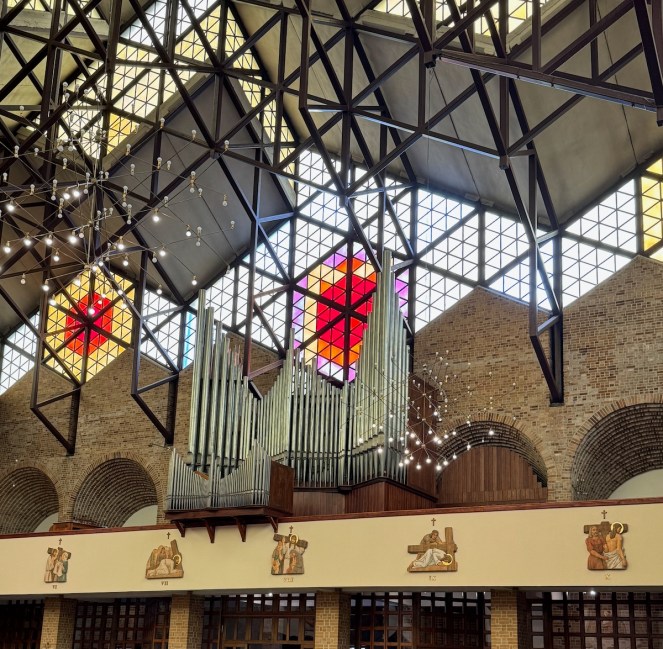
(zoom-in of hexies and organ)

Often when I see a new quilt design, I’m asking How did they do that? Why are the colors distributed that way? Why were those colors used? and finally, Can I replicate this?

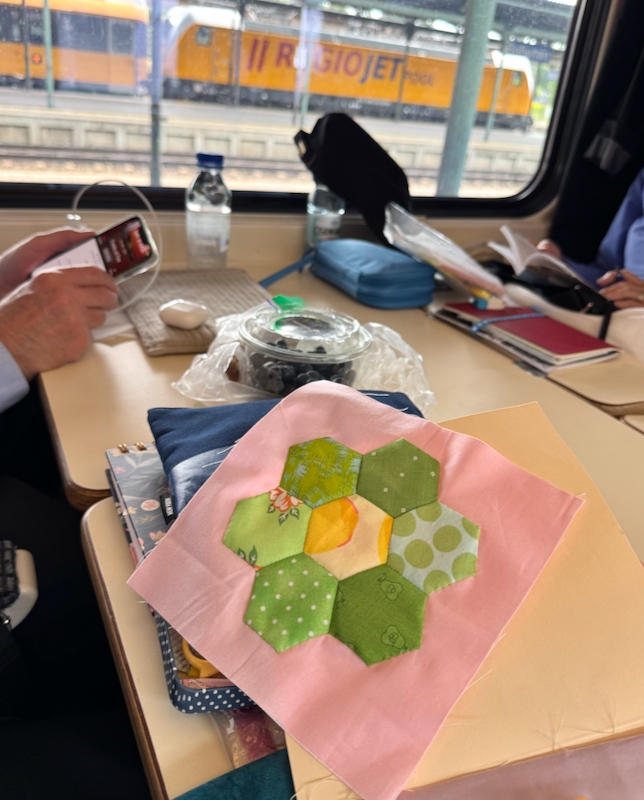
I was already working on hexies on our train and airplane rides, so I was familiar with this element, certainly.

But what prompted the architect to insert them where they were? Was the lack of materials the reason for subdividing all those larger triangle windows? I knew that many of these churches were made from whatever was available, and sometimes the parishioners themselves were working at night by the lights of car headlights, using their own small concrete mixers to help pour the larger structural elements.

from here. This church has a nickname of the White Batman, which we did not get to see. Be sure to link over to see the construction photos, all very rudimentary, with lots of scaffolding since there were no cranes (which couldn’t be obtained at that time).

Do we arrange designs by the amount of fabric we have? All.The.Time. I found myself thinking about the nature of making, of design. Do our construction techniques vary according to the design we have in mind? Yes.

However, mostly I was in awe.

Another church, close by, was built in a giant housing project, nestled beside buildings, as were many churches. Imposing in stature, they nonetheless adapted to the area they were in.

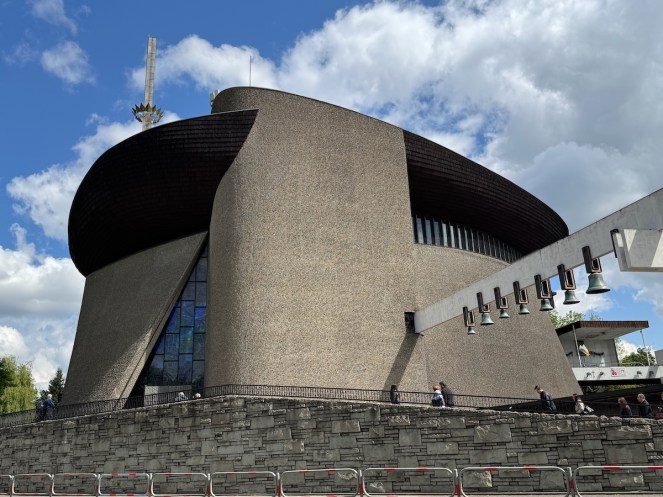
The entry is behind that square stone wall. We arrived about 10 minutes before their services started. I had done my research, but somehow open hours were hard to find, but I knew from my own experience that Sunday was probably a good day to visit a church.

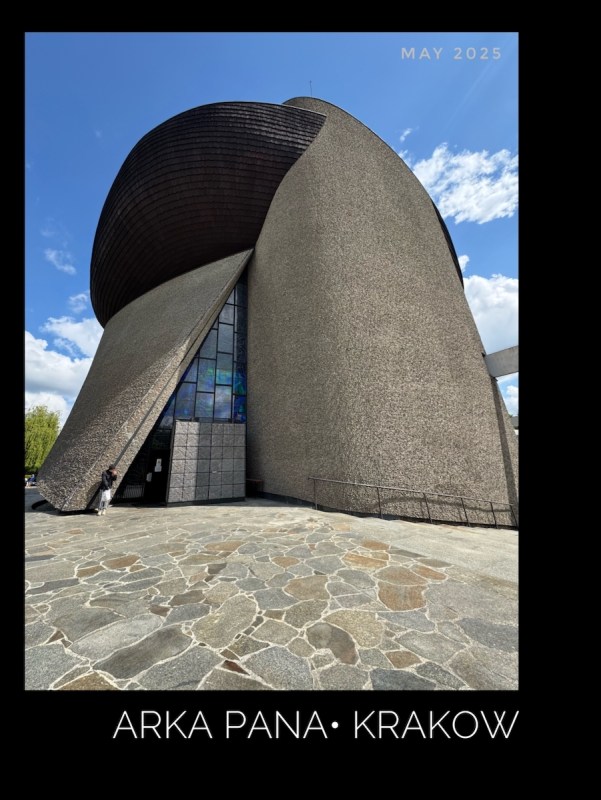
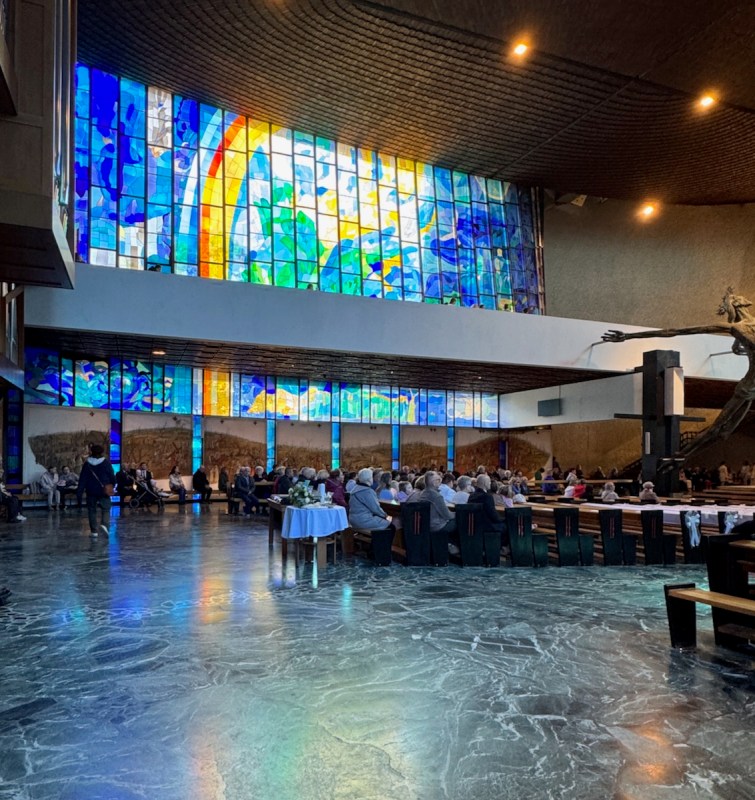
The full name of this church is Church of Our Lady Queen of Poland, Kraków, but they call it Arka Pana, and it is in the Nowa Huta section of the city. The outside is clad in small rocks, and St. John Paul II, who had been given a moon rock, donated it to the church (although I think it is not embedded in this concrete).

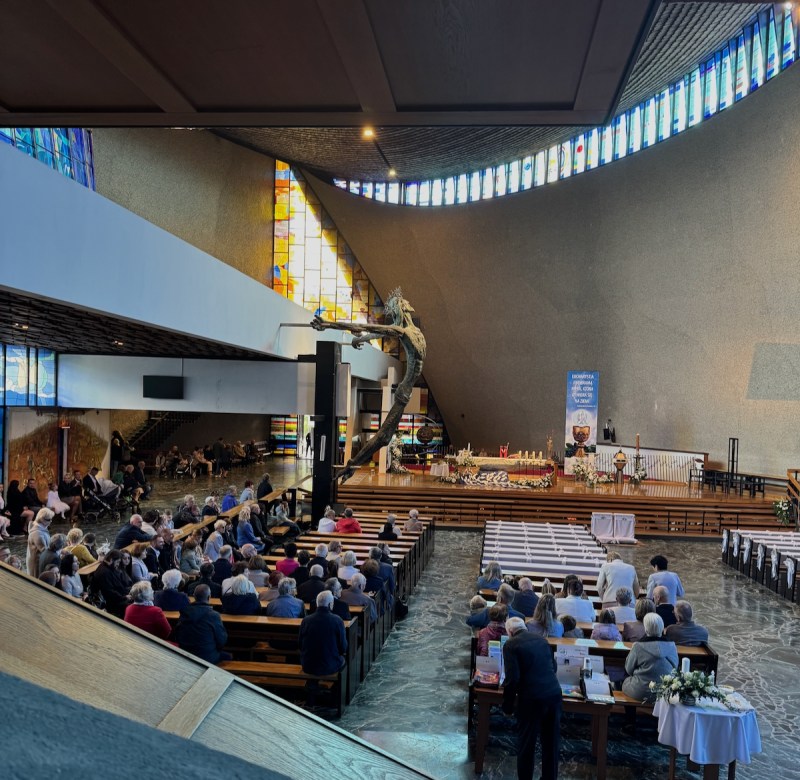
(upper balcony) We left just as the service started, and went outside:

I wrote this on Instagram:
Our Lady Queen of Poland Church, also known as Arka Pana, is in Kraków, Poland and is one of the Day-VII churches. They are a group of churches built from 1945 to approximately 1990 in Poland, and they are mostly modern in style, built by the Catholic parishes themselves, with different architects. This church was about 30 minutes away from the touristy center, and we walked through a huge Communist housing block to reach the church. It was well worth the effort. We snapped a few shots before Mass began, and only after seeing all the rest of the congregation snapping photos (it was First Communion Day) did we sneak a few more. We then slipped outside to admire this church, reminiscent of Le Corbusier’s Notre Dame du Haut in France.

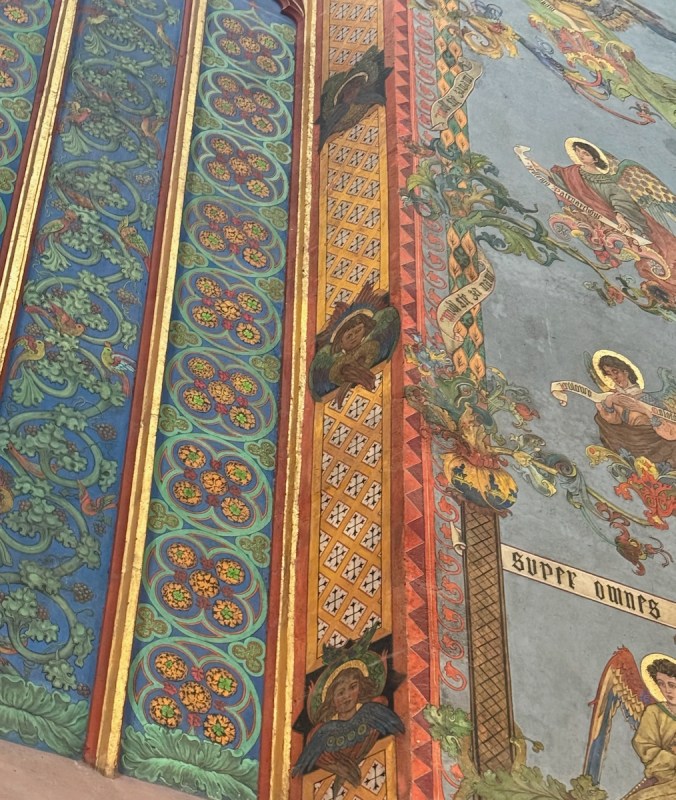
Now for the more traditional inspiration, the Basilica of St. Francis of Assisi. It’s more modern –haha– as compared to some of the other churches in the area. I learned that:

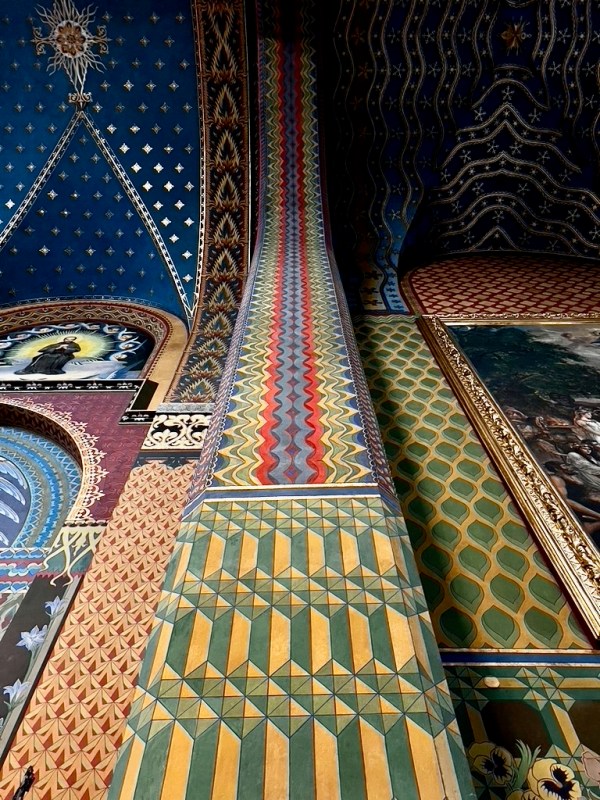
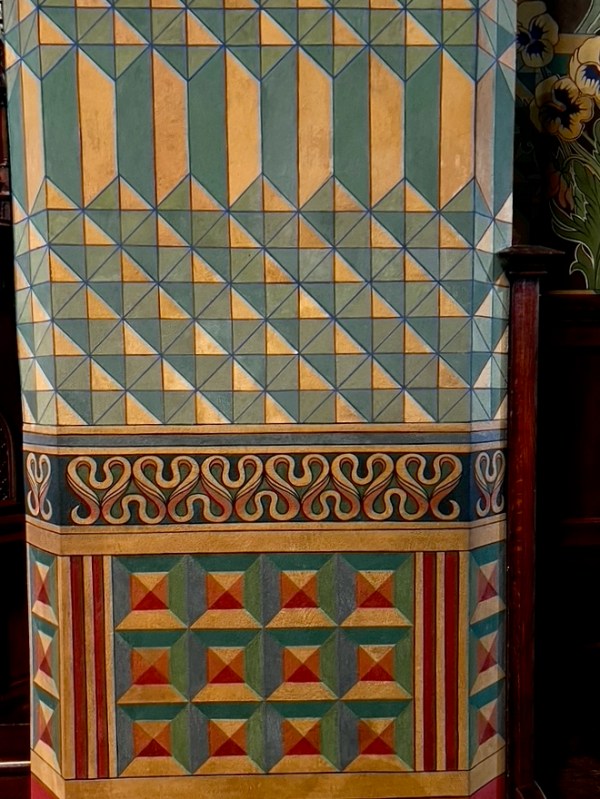
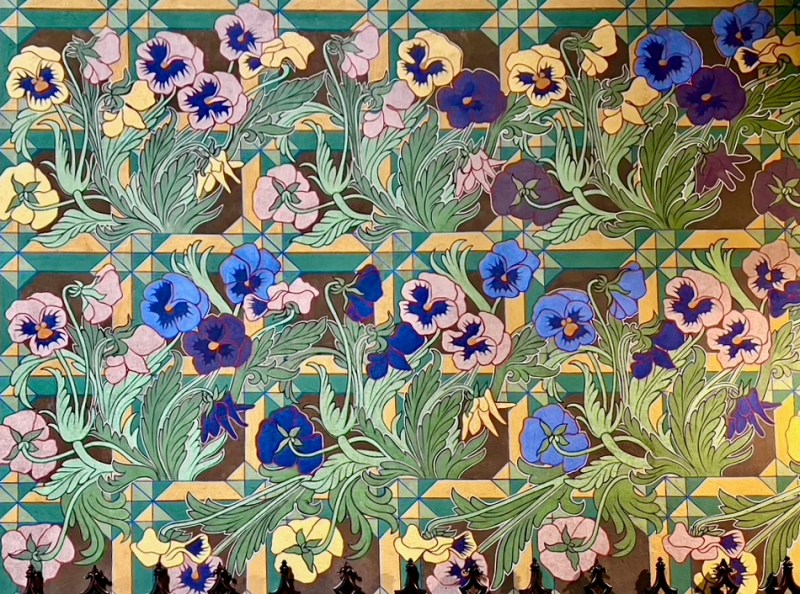
It’s that design by Wyspiański which engaged me:

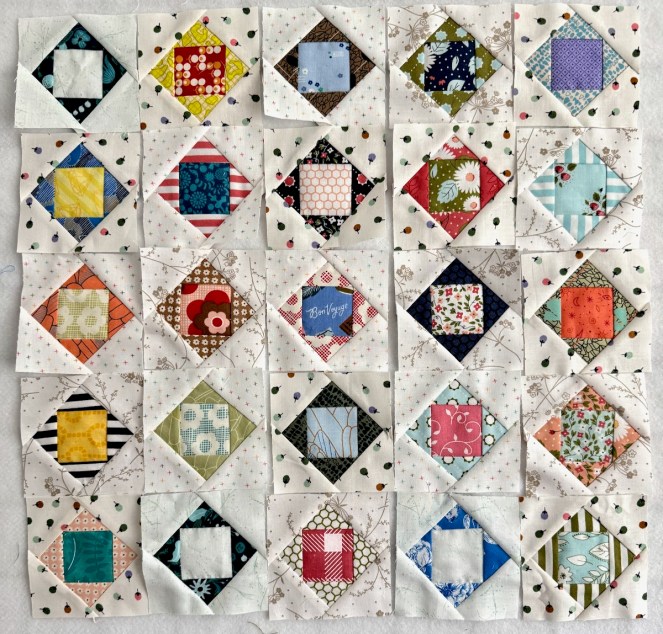
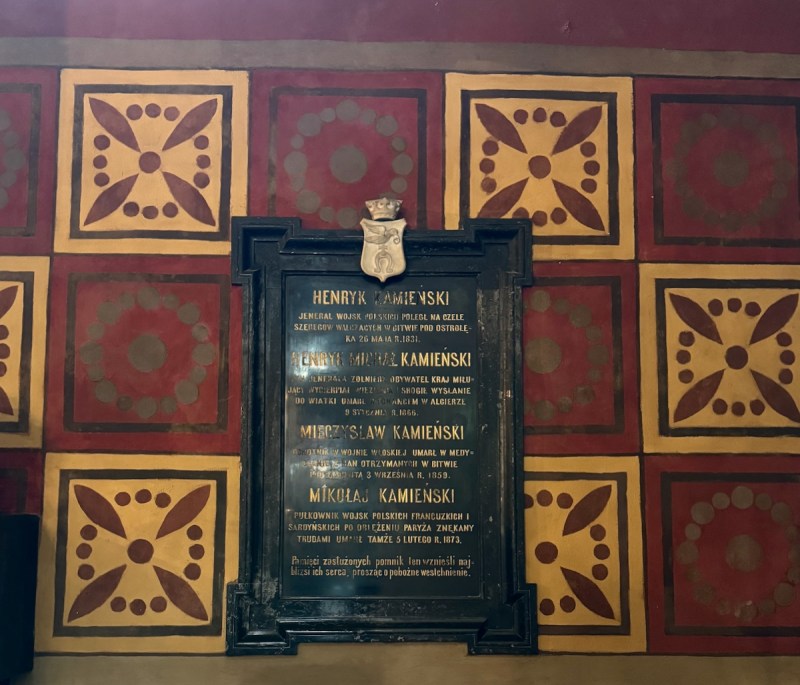
Parts of these images remind me of the economy blocks I’m currently working on.

It’s not exactly the same, but a suggestion.

Yep. I collected pattern and image and ideas and great ideas to fold into quilts in the next little while.

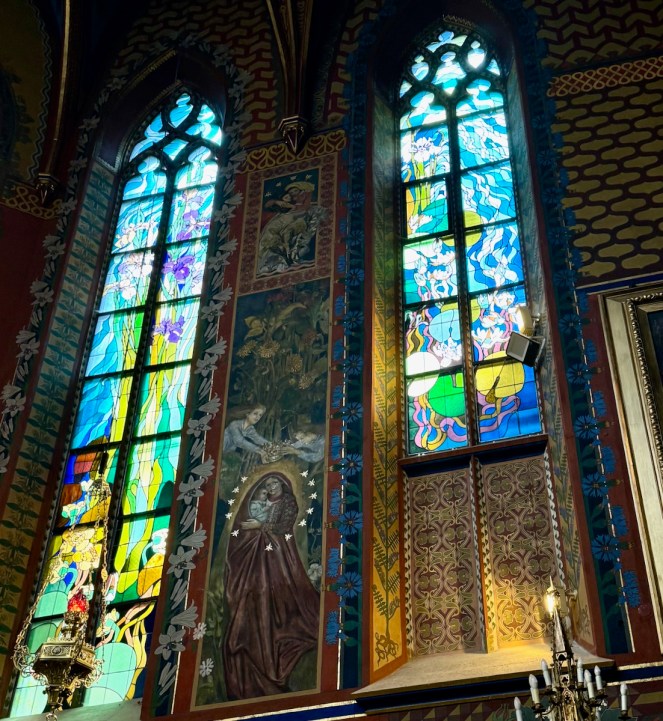
a Wyspiański window; I loved all his wall paintings of flowers!

Our trip tag on Instagram is #poland_prague2025 if you want to see more of our trip.

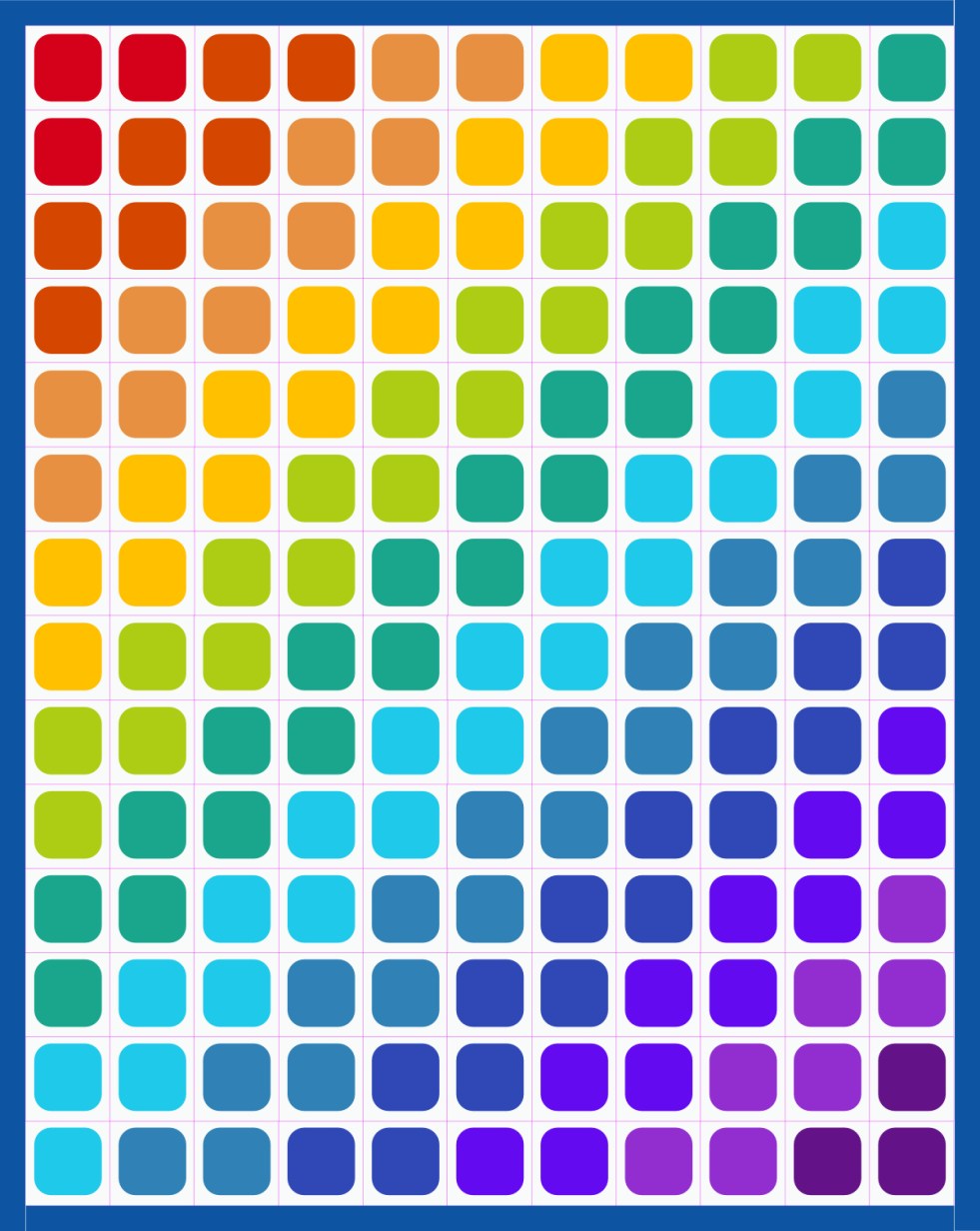
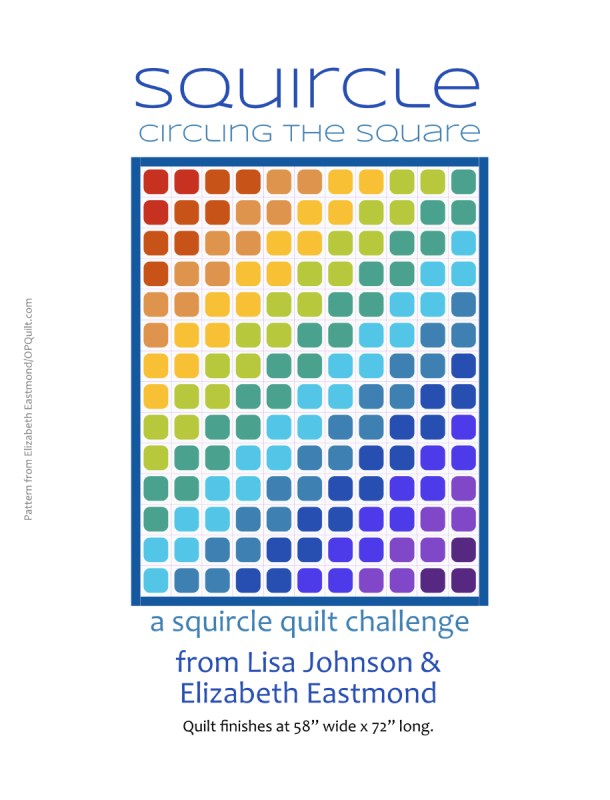
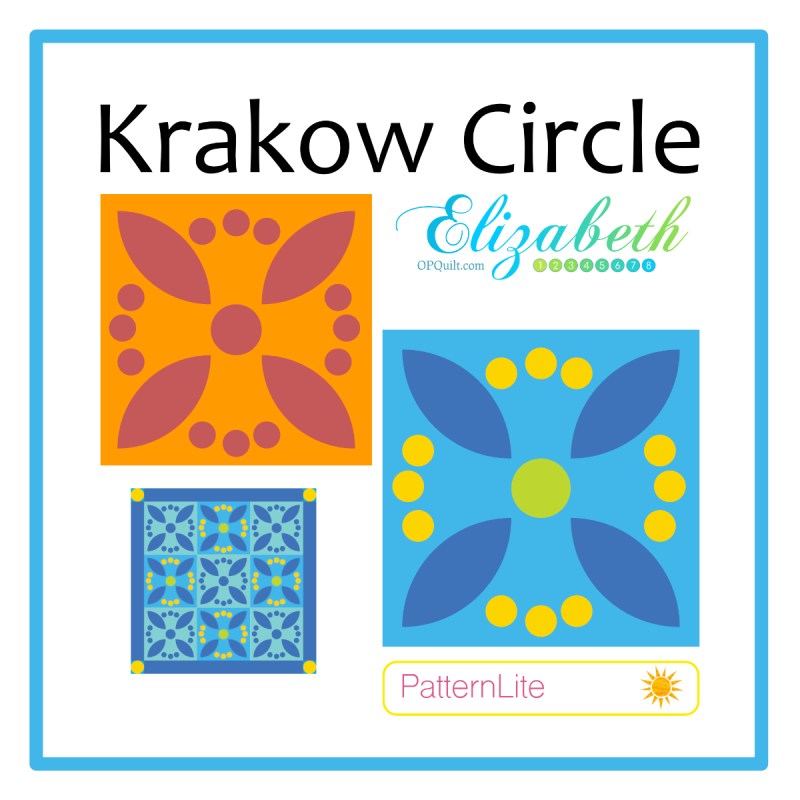
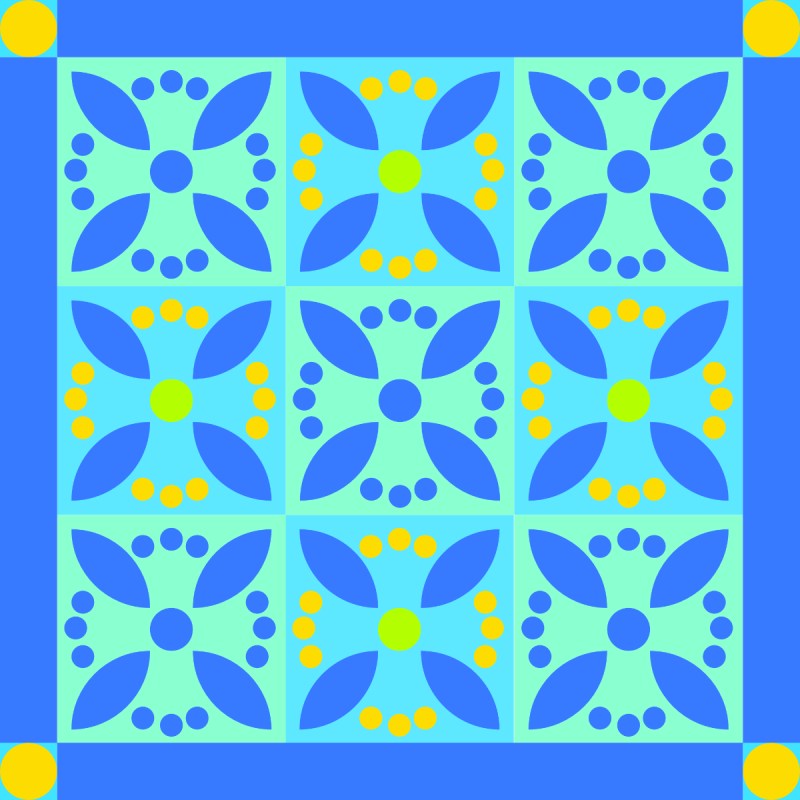
And because you’ve been so patient in exploring these ideas, I worked up a small idea from the blocks in St. Mary’s Basilica. Below is an illustration of the pattern and a mock-up of colors. Link to quilt pattern is here.

Obviously, I drew color inspiration from the windows of Arka Pana and Stanisław Wyspiański!

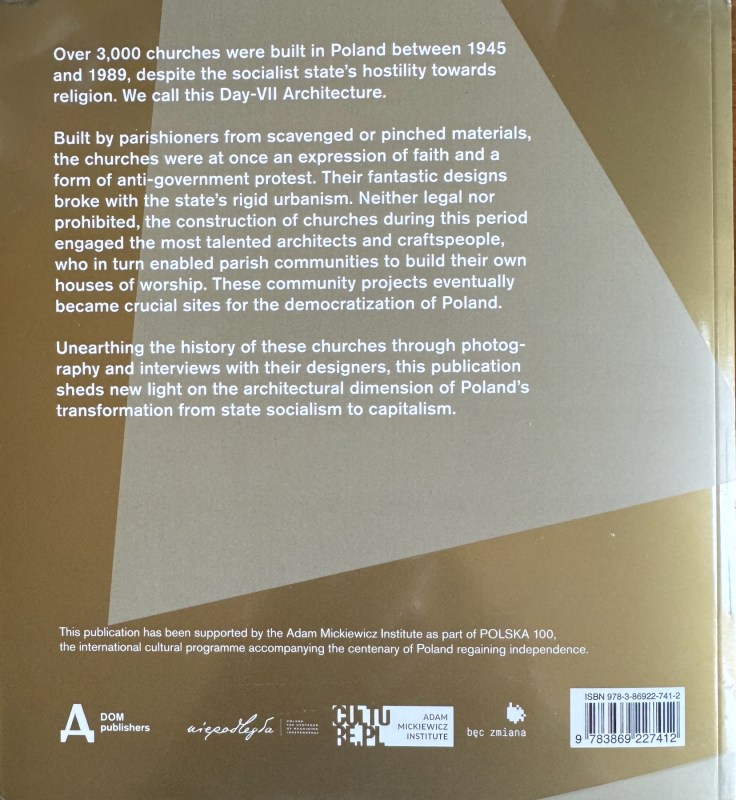
(back of catalogue)

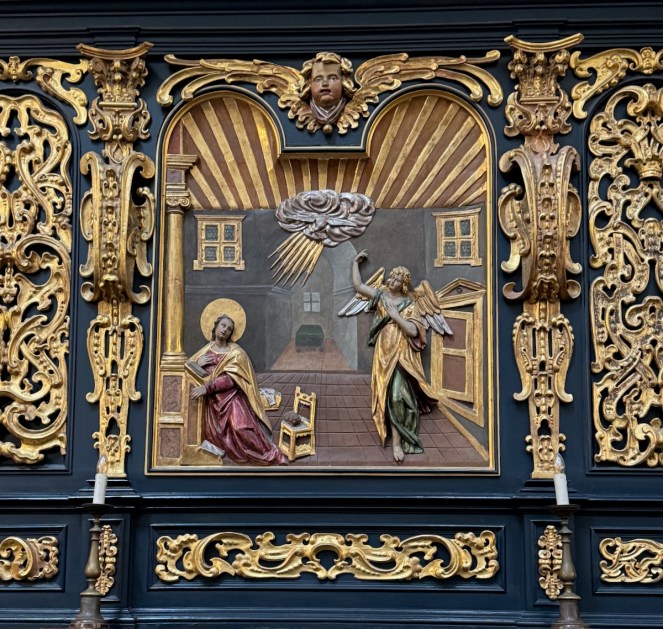
Also from the Basilica of St. Mary in Kraków’s main square. I love seeing depictions of the Annunciation.

300 and Beyond · Quilt-A-Long · Quilts

Flying Through Rainbows

In a series of interviews with new poets, they each expressed their confusion, discussed their work ethic, and acknowledged the daily drudgery — and joy — of being able to create and work. (See some quotes, below.) Do I wish I’d saved the source information for my series of quotes from these young poets at the beginning of their career? Yes, but knowing the internet, it is probably gone. I copied and pasted them into my digital calendar, and they pop up like clockwork every January. Fitting. We all begin creating at the beginning.

We seem to go full-steam in January, the new year giving us a fresh start. But lately, on Bluesky and Instagram, I am hearing often how the well some quilters usually dip into has run dry, that their “sewjo” or “mojo” is just not there. Is it because we are tired of winter? Or that we have early spring fever? Or just that creativity runs in spurts, and we have to step away every once in a while and get back to “real life” with its rainbows, as well as its tornadoes and sudden squalls?

In a slightly related idea, my husband’s father hung crystals in his window so they could flash rainbows around in random ways when the sun came shining through. Today, as my hands fly over the keyboard, typing this post, rainbows are dancing on my fingers, courtesy of two crystals hanging in our window right now from my husband.

Carol and I made a pact to apply our rotary cutters to fabric and our noses to the grindstone and Make This Quilt: Posh Penelope by Sew Kind of Wonderful. While I usually like to be sewing my own designs, this year, this level of drama, this level of chaos has sent me to “let go of the pressure to be innovative,” as Jane Freilicher puts it (qtd. in Emily Skillings, below). We committed to making four blocks per month.

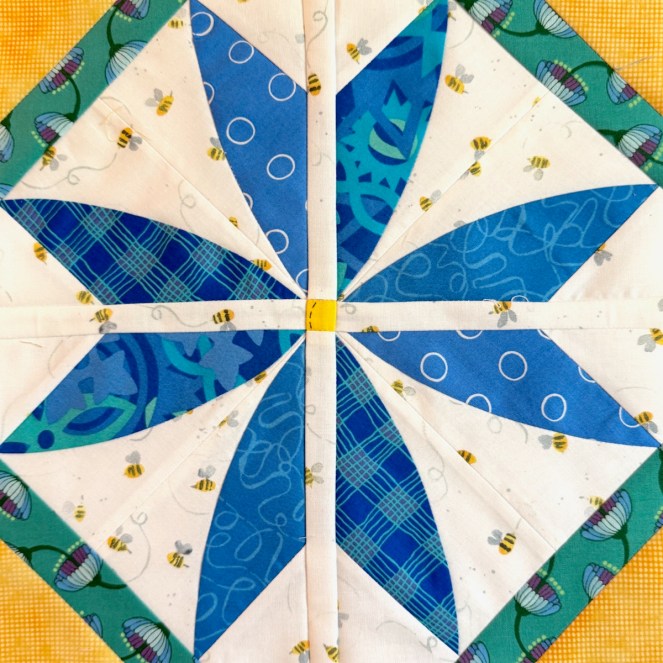
But even in creating between someone else’s lines, there is room for fabric choice, pawing through the stash or scraps — for as Carol noted this week, all our fabrics are soon going to cost a bazillion dollars — and this month, I went for blues. I thought the blues might calm down the riot of colors I had going on, with their steady approach. After all blue is the color overhead in our sky and of the water that surrounds us and we’ve been crazy for blue way before Yves Klein first mixed up a batch of his trademark Klein Blue. Klein noted that:

“Blue has no dimensions. It is beyond the dimensions of which other colors partake.” Fascinated by … it, [he made] …roughly 300 monochrome paintings in his signature International Klein Blue” (qtd. in article linked above).

(These blues read a bit more red-blue, or purple.)

All of these notes are to say, take a look at these young poets’ advice on if you get “quilter’s block,” or “writer’s block” and just give it time. Take a break to breathe in some of the blue overhead, or swim in the watery blue. Or catch a rainbow on your keyboard, courtesy of a defracting hung crystal.

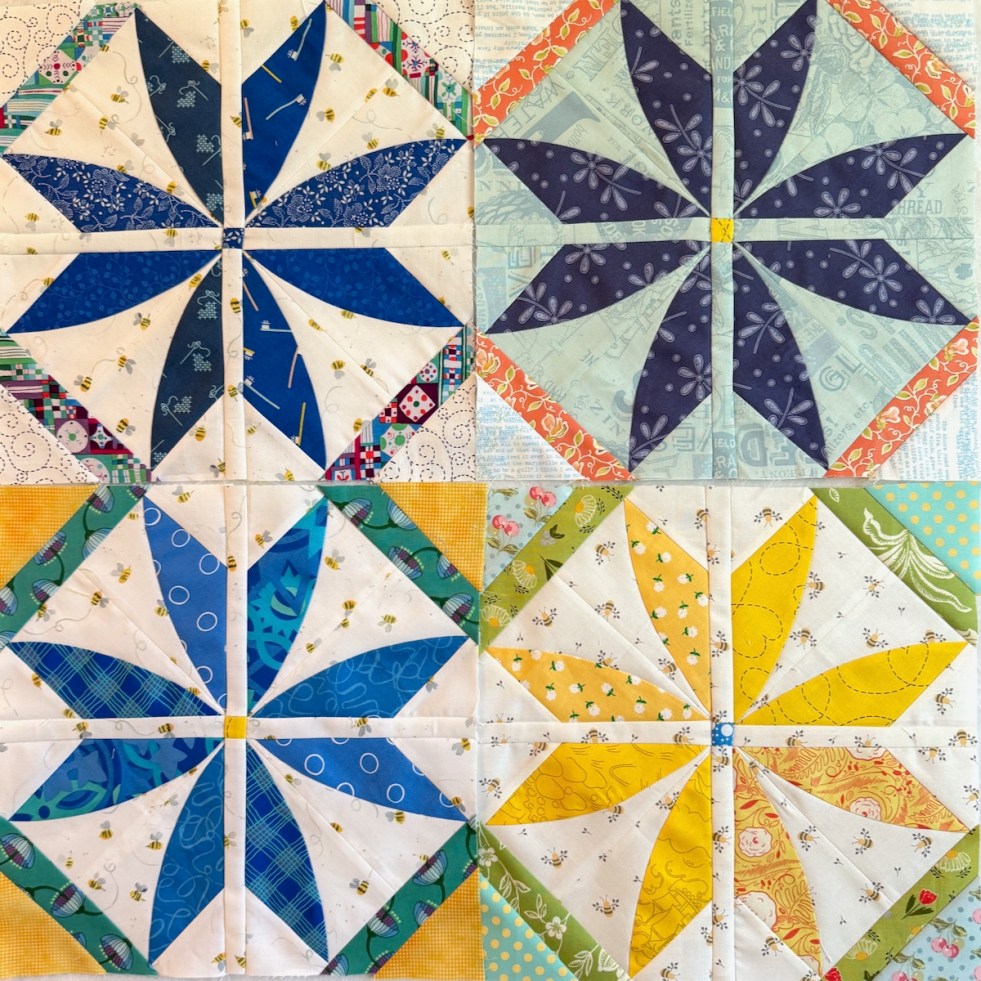
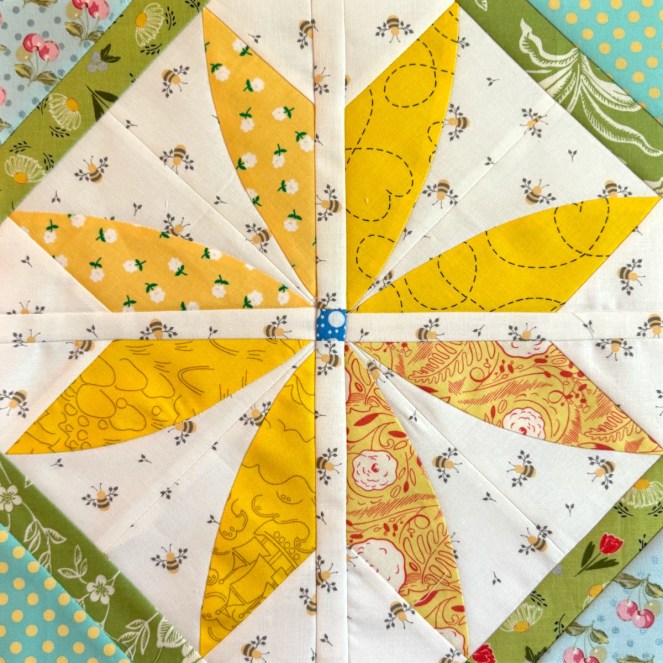
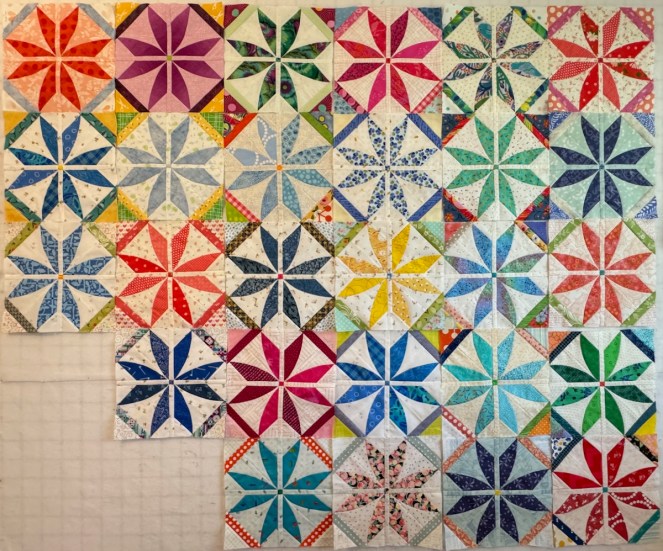
Block by block, I’m making a quilt. I’m up to 23, and the goal is 42.

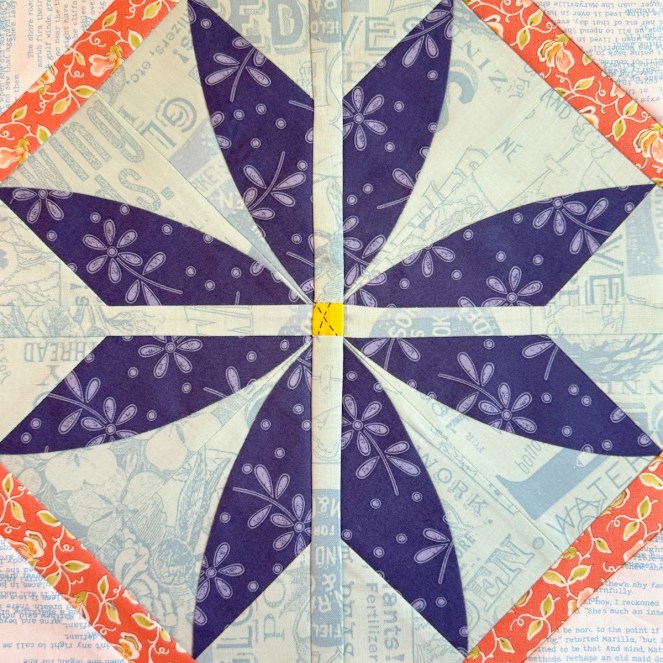
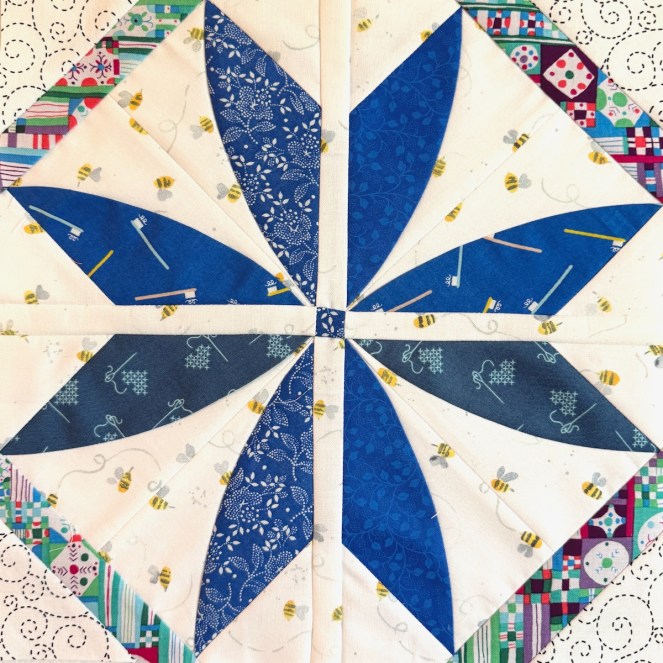
Advice if you are going to make this pattern: Do more than one block at a time. Do…like four. It’s easy, but complicated, and better if you don’t have to remember all the bits every time. And I say, make the “petal blocks” but before you sew it all up with the sashing, choose your itty-bitty center then, when you can see if it needs a pop, or if it’s okay to just have a fabric from one of the petals. Or do as Carol is, using a single fabric in all the centers. Hers is a black and white linear pattern, and it looks great.

Now I’ll put these all away in their box until next month, along with a a few scraps and bits and bobs, and it will wait for me until next time. After all, as Fatimah Asgha notes, “you’re on no one else’s timeline.”

One Last Thing

A friend had a new baby boy and I made them a quilt.

Pattern is Azulejos, from my pattern shop on PayHip. I just used fewer blocks to make it baby-sized. (And she gave permission for the photo.)

Emily Skillings–
One question I am still grappling with is how to negotiate a balance between “innovation,” constraint, and intuition. The painter Jane Freilicher put it best, I think, when she said, “To strain after innovation, to worry about being on ‘the cutting edge’ (a phrase I hate), reflects a concern for a place in history or one’s career rather than the authenticity of one’s painting.” There’s also, I think, a quieter quote somewhere about her letting go of the pressure to be innovative, and that she felt she could really paint after that, but I can’t seem to find it anywhere.
This sounds a little strange, but I like to think of my life so far as a writer as a kind of oscillation between states of openness and movement and states of stillness and solitude. There are islands of production, productivity, and then pockets of…nothing. I think I am grateful to my depression in this way, in that it often forces me to be still.

Phillip B. Williams–
Writer’s Block Remedy: I go for months without writing and then write nonstop for about a month or so. An impasse for me is a sign that I simply have nothing to say, and that is fine. I had to learn that it was fine not to write. As far as what keeps me going, I’m still not sure. Something just clicks on and stays on until it runs its course.

Mario Chard–
Writer’s block remedy: The impasse is never with the writing itself; it is with the reasons to keep going.

Fatimah Asghar–
Writer’s block remedy: I take a break. I think that if you bang your head against the wall trying to create, you’re going to resent the process of creation. Usually when you reach an impasse it’s a signal to move on to another thing. Maybe you haven’t slept in a while. Maybe you need some time to ponder, to just stare at the wall. Maybe you need to live, truly be alive for a little and not near a computer [or sewing machine]. Maybe you need to read, see, watch—to refill your well.

Advice: I’d say you’re on no one else’s timeline.

Solmaz Sharif–
Writer’s Block Remedy: If the causes are perfectionistic, I pull out the collected poems of a poet I greatly admire and flip through to remind myself how many mediocre poems their oeuvre contains. It is my duty, I remind myself, to write even those mediocre, messy poems. These failures are the ones that create openings in the conversation for subsequent writers and poets to enter—I’m not trying to kill the conversation, after all. I pull out journals—André Gide’s, Franz Kafka’s, Susan Sontag’s—to remind myself how long the process is and how often the sense of failure or impasse hits. I watch a movie. Advice: Write a book you want to fight for. Fight for it.
I don’t have answers about “how to be an artist”; I’m not trying to make it sound like I do. But I do want to have that conversation. What do you want to do as a writer in the world? What do you see the arc of your writing life to be?

My corollary: Make the quilt you want to fight for. Fight for it. Acknowledge the arc of your quilting life.

300 Quilts · Patterns by Elizabeth of OPQuilt · Quilts

Turning of the Year

Thus times do shift, each thing his turn does hold;
New succeed, as former things grow old.
Robert Herrick, from Ceremonies for Candlemas Eve

I don’t know how many more turns this life does hold, but I’m getting better at recognizing them. That’s what living for a while will do for you: give you practice at the painful, help you recognize delight, and deliver the ability to watch calmly as another year turns.

We get our fall this time of year, here in Southern California. We pretend to have colorful autumn arrive with the Northern and Eastern States, putting out our russet and pumpkin and burgundy decorations all through October and November, but really our trees don’t have their turn until December. I gather up a few to rest on my dashboard as I drive around (for we also do that in Southern California), and celebrate the colors.

I made the top to this quilt in December 2020, so it’s appropriate that I finish it when we have turned away from the pandemic, its memory triggered only when we find our cloth masks in the sock drawer, or the junk drawer, or realize that a box of N95s has taken up permanent residence in our hallway closet, a talisman to ward off the unthinkable.

It’s nice to be able to crunch around my “walking” park, the leaves crisp underfoot, finding places that echo the muted tones of this quilt, Pomegranates.

Many of our leaves go from green to brown, a dimming of our usual colorful landscape. It’s as if they say, we gave it all for the year and now are tired, just needing rest. I can understand this. I have times of dimming, as well as times of bright.

Herrick reminded us that “each thing his turn does hold” and I don’t have to have only one season of quiet and rest. I have had many years to watch the days grow shorter, the nights grow longer and then again, and decades to watch the reversal of it all.

I’m lucky that way. Hopefully, so are you–
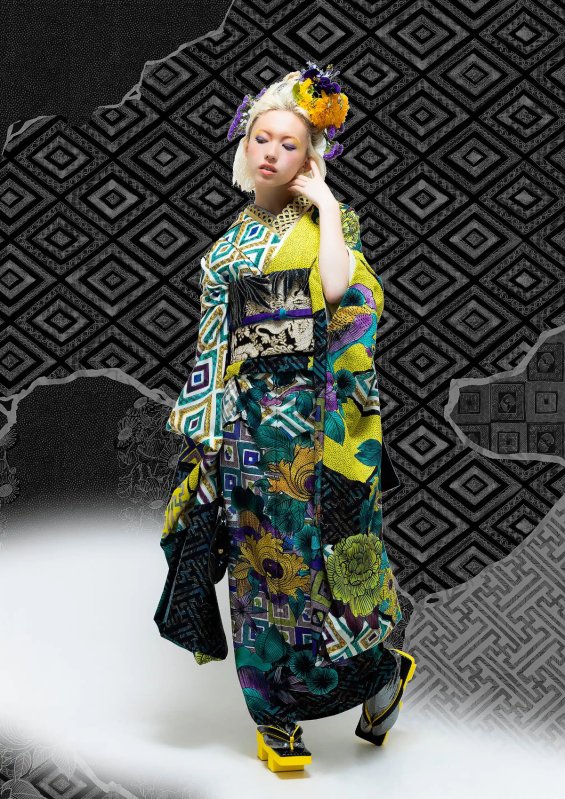
Quilt # 298 • 42″ square, with a simple single-binding
No label, as I’m sending this off and think they may like the backing of this quilt (a treasured piece from Alexander Henry) as well as the front.

Another post about this quilt

Yes, it is up in my pattern shop and for December, you can choose your own discount if you want to stash it away for New Year’s sewing (another turning for all of us).

300 Quilts · Christmas Quilts · Patterns by Elizabeth of OPQuilt · Quilt Finish · Quilts

Christmas Trees • Quilt Finish

Biography of this quilt:

Factoid #1: It could be Christmas Trees. It could be Easter Trees. It could be Halloween Trees, even though I posed it in a Christmasy setting in a small town in Arizona.

Factoid #2: Started in a small sewing group swap in 2016, it lingered in a bag somewhere in my closet. I found it again this year, and when my friend Lisa finished hers up and prompted me to Get Going.

Factoid #3: The block pattern has been spruced up into a charming new version of itself. Get it yourself by clicking on the Download button:

This free download will also be at my pattern shop on PayHip.

Factoid #4: This is a great quilt for using the shirt from your husband/boyfriend/son that has worn out. Or your Dad (see different trees from different shirts, below–somehow blue checks are popular).

Factoid #5: These make up fast. What takes the most time is picking out the fabrics. I decided a slim border with a fun binding would finish it off nicely.
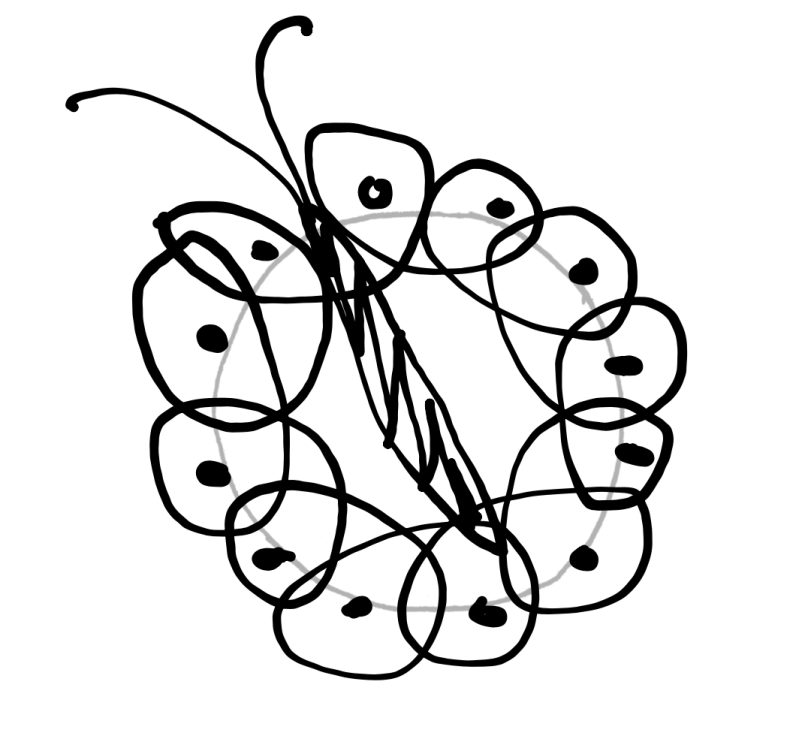
Factoid #6: This is the second “holiday-ish” quilt I finished this year. I never seem to get into the mood until Thanksgiving rolls around. Next on the list: order the Christmas Cards. (eye roll)
Factoid #7: Label

Factoid #8: (last one) This is quilt number 296. Four more to go to reach my goal of 300. Then what? (I don’t know. Probably not much will change.)

Have fun choosing fabrics and breezing through a fast quilt–

Other posts about this quilt:

Christmas Tree Block Swap Original Block freebie pattern is here, but it’s gone now. Do yourself a favor and use the new one (download above). However–> Step-by-step directions are found here, if you need them.

Christmas Tree Block Swap, part 2 More frivolity. This is like…EIGHT YEARS AGO! That is just bonkers.

Tiny Tree and Teeny Trees — if you want to make little ones, this post gives you instructions for how to make wee quilts that slide over dime-store plastic frames. Again, free pattern.