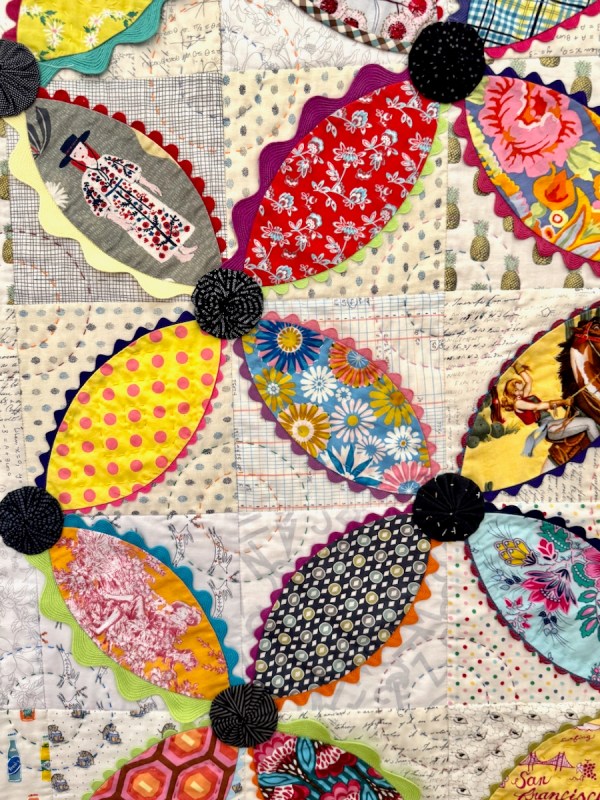
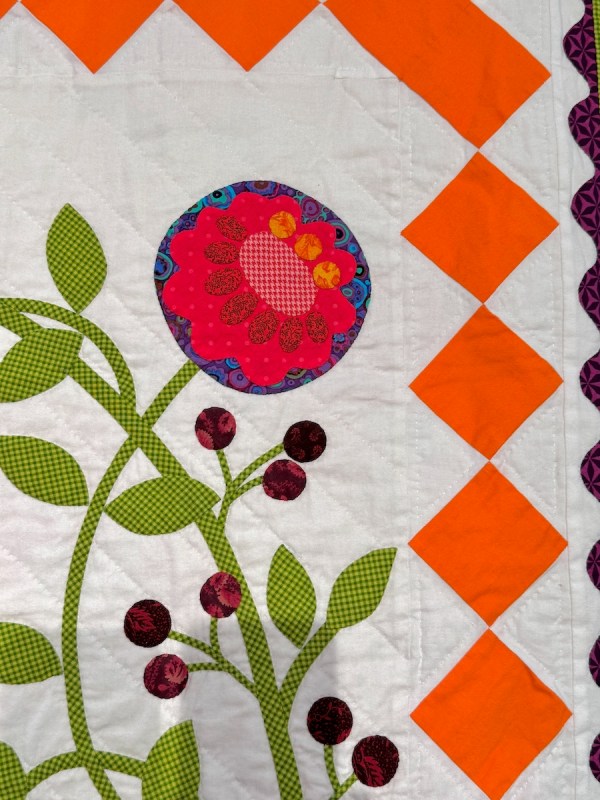
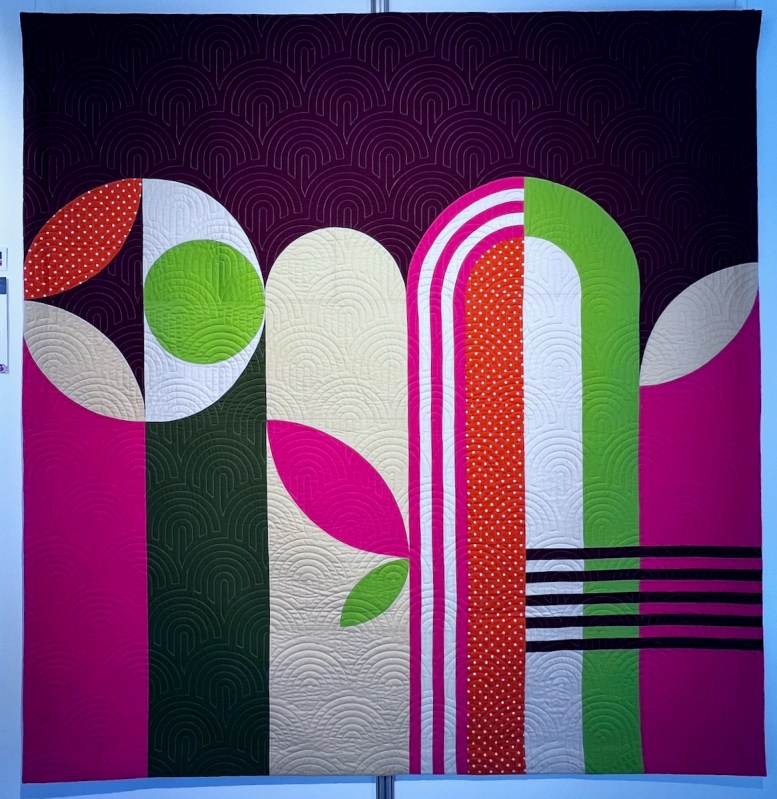
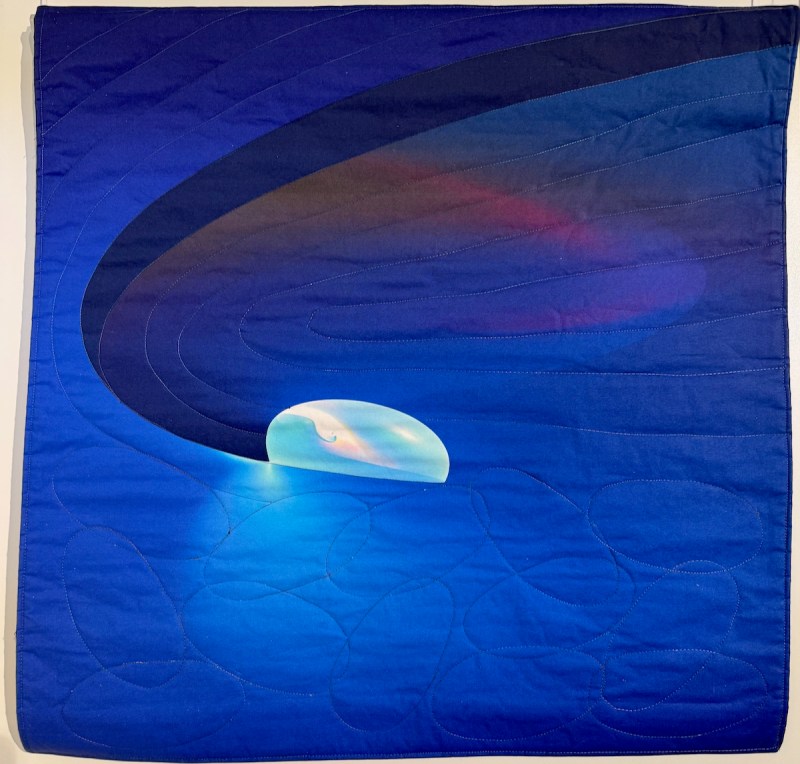
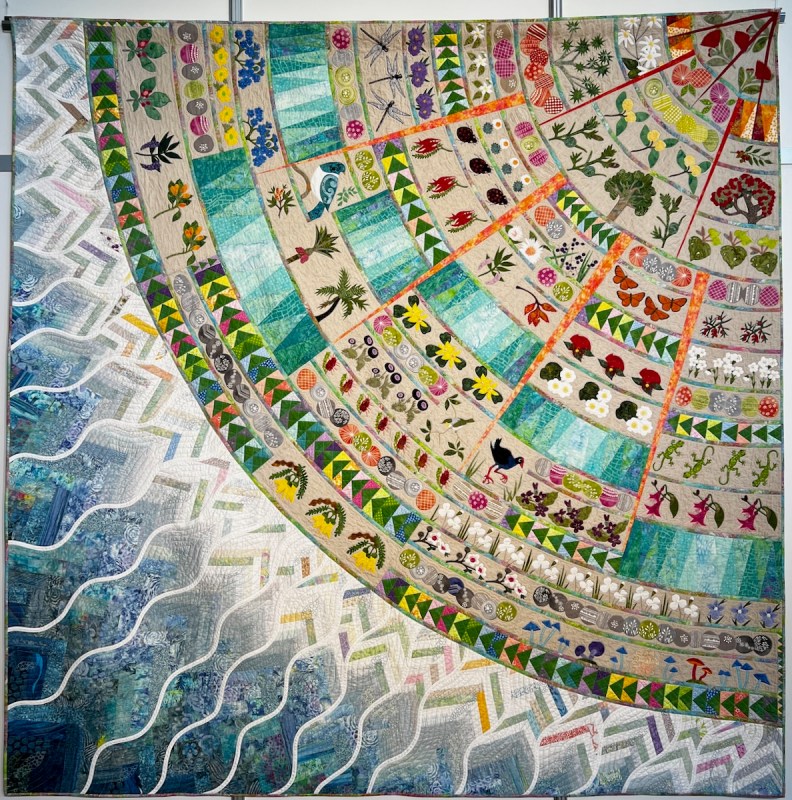
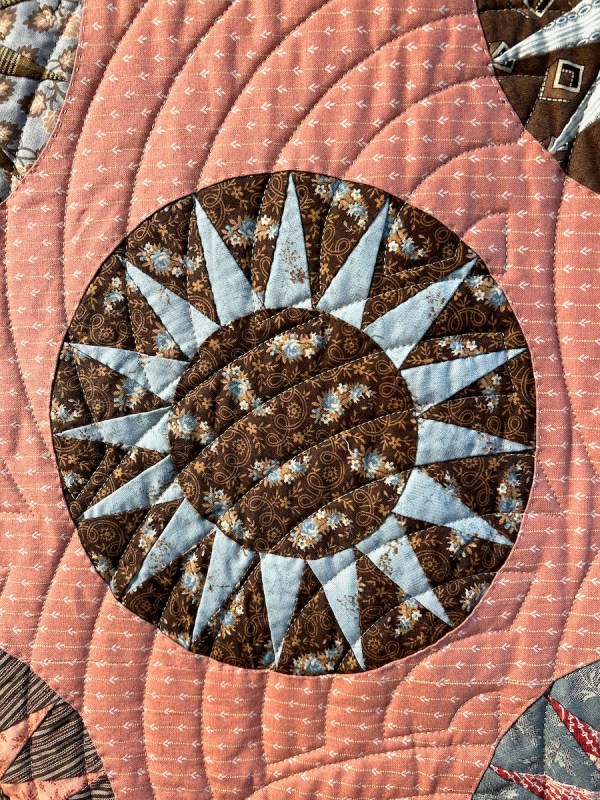
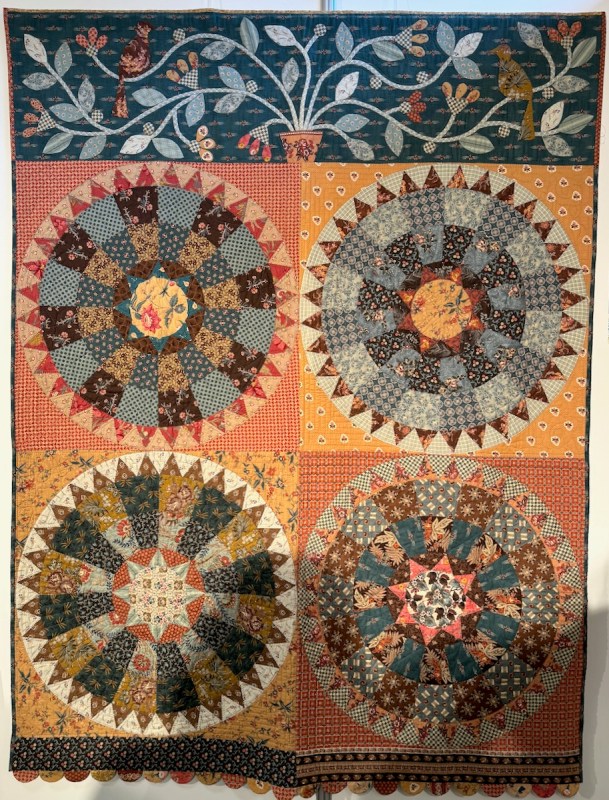
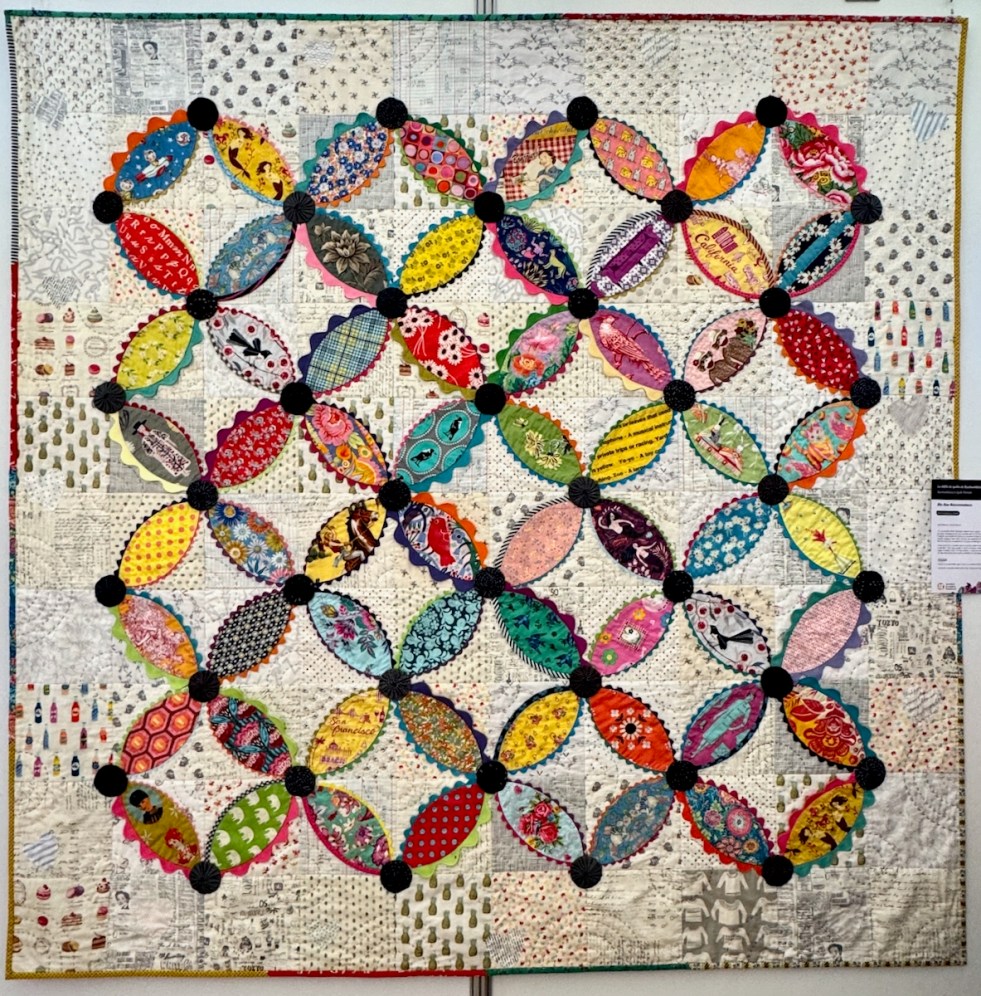
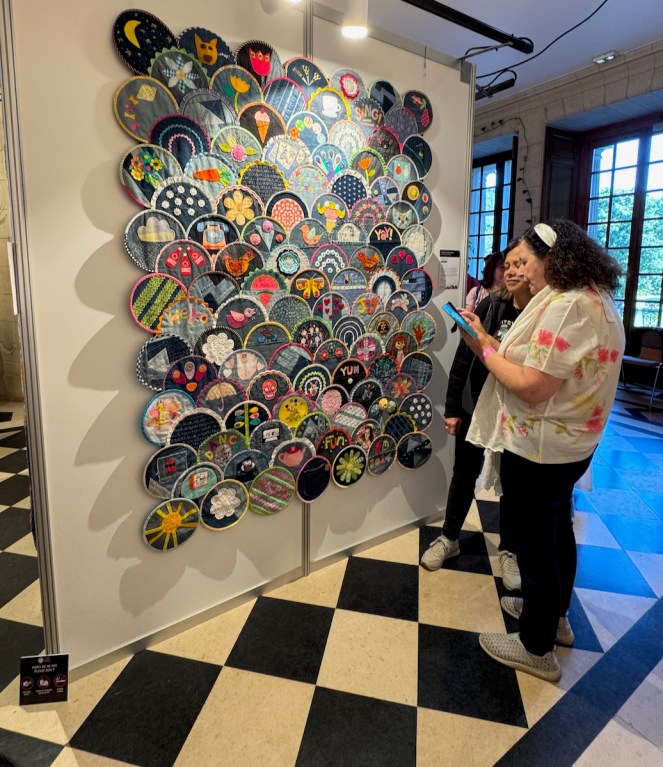
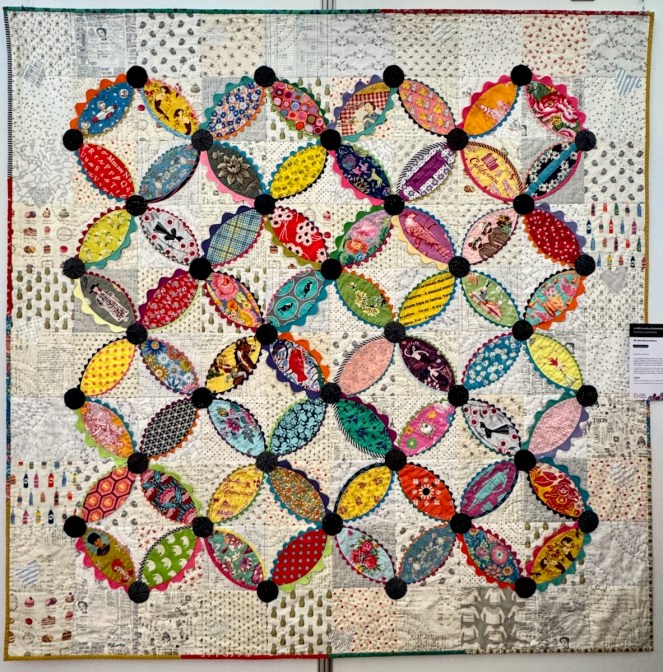
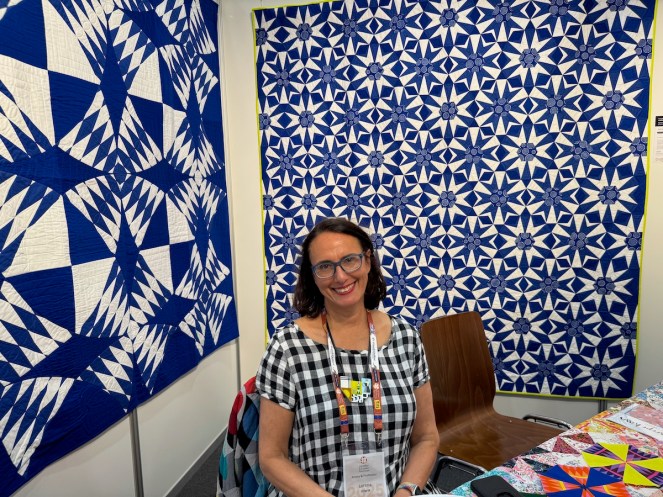
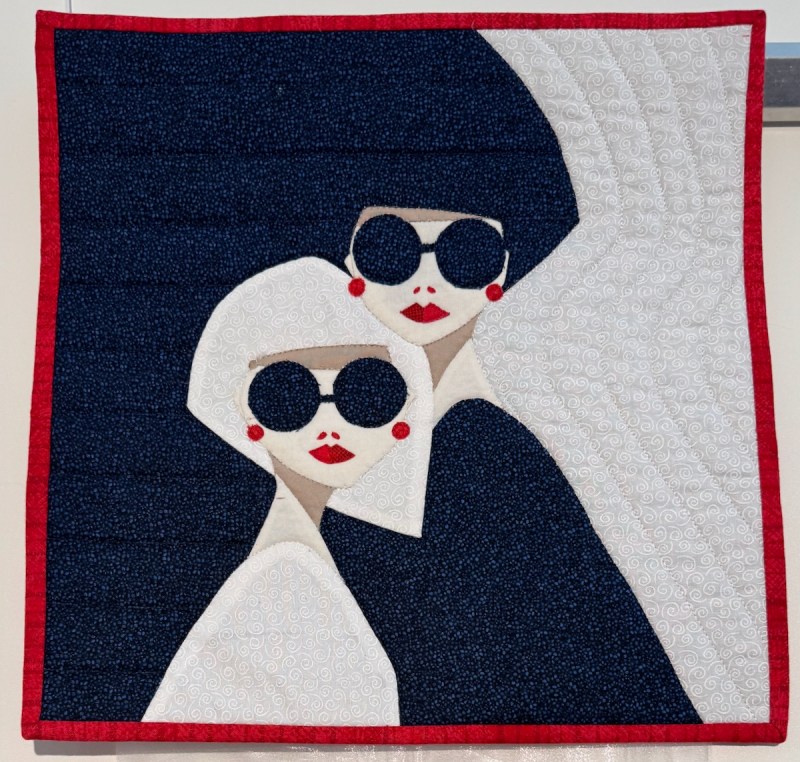
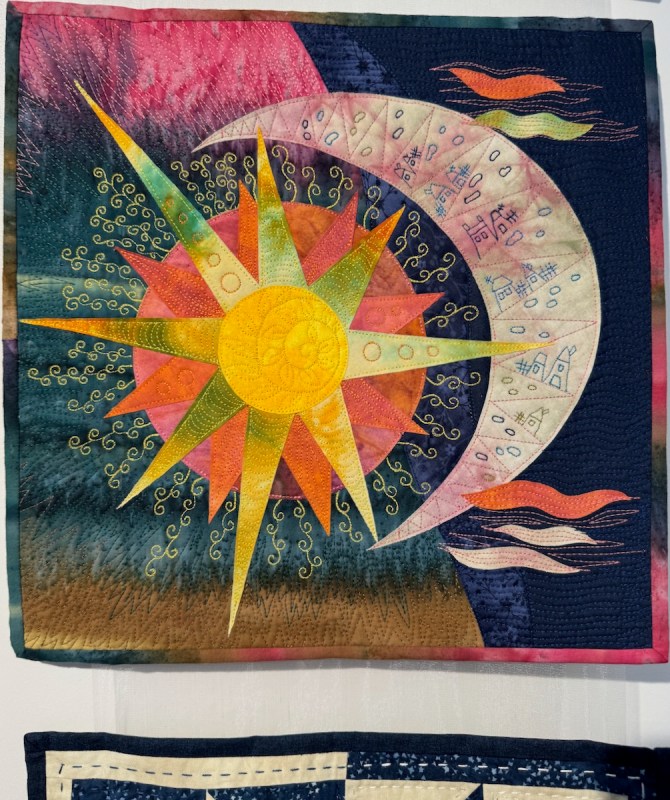
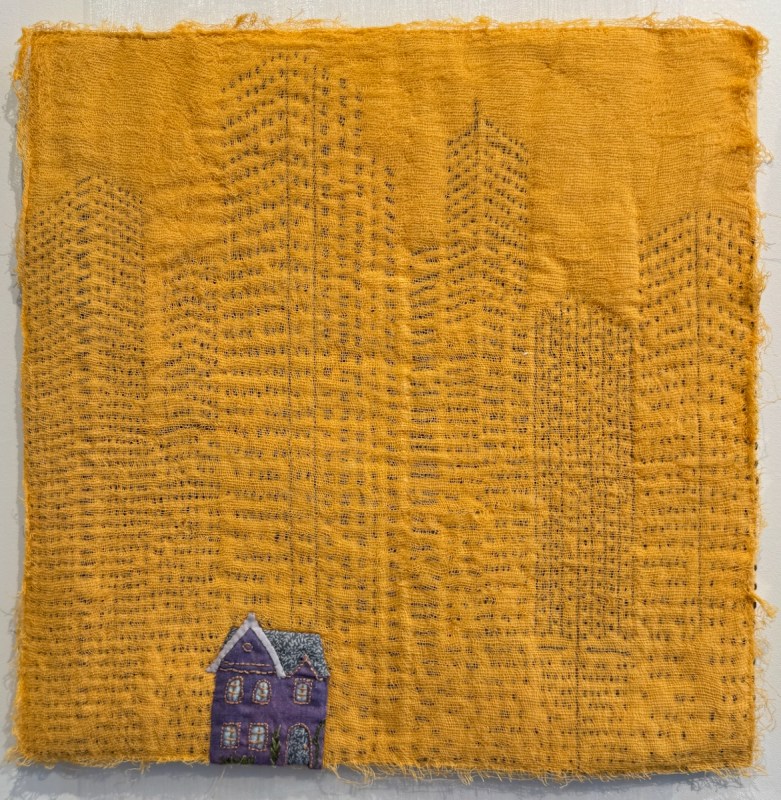
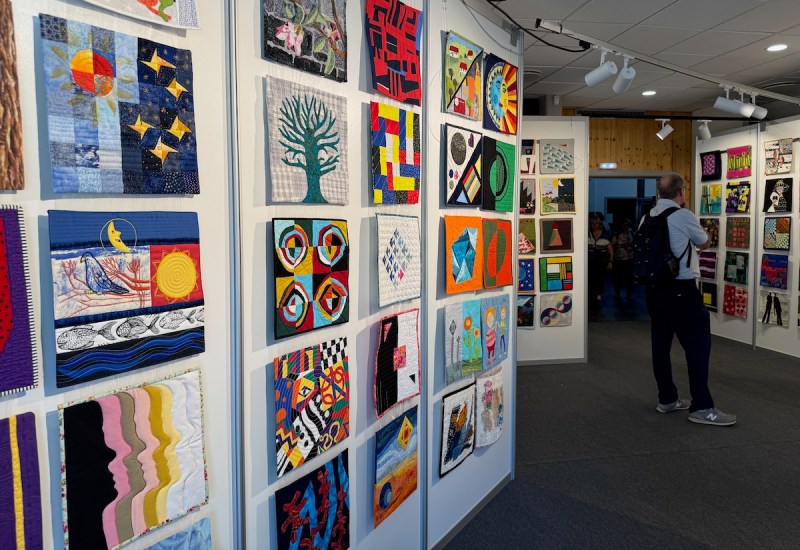
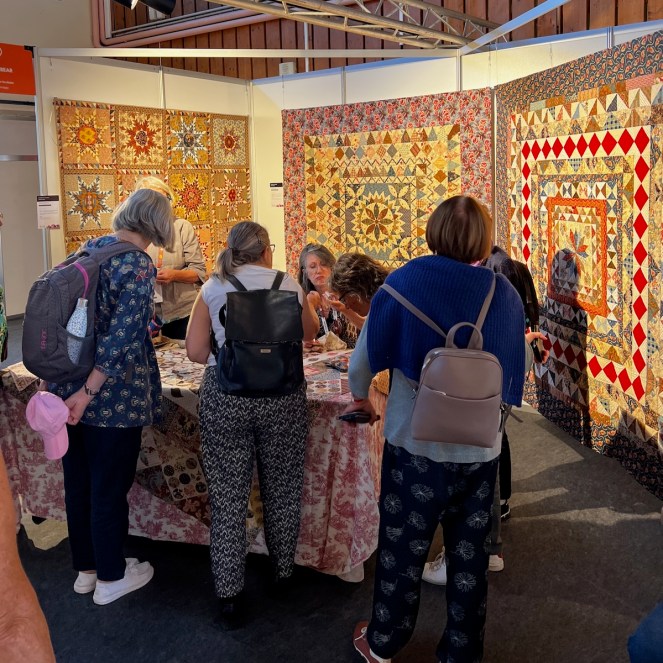
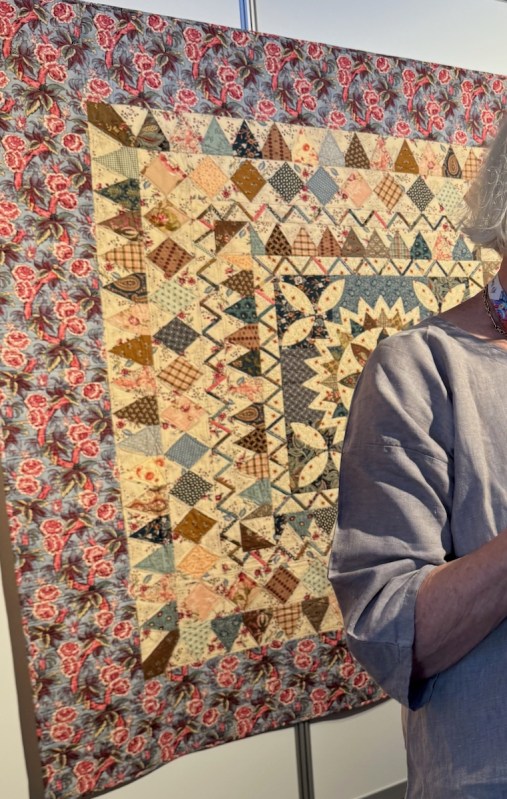
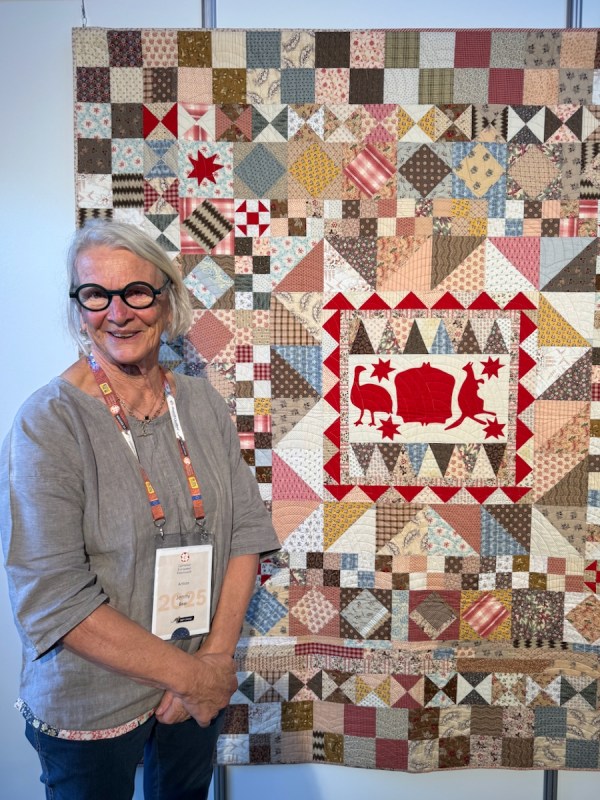
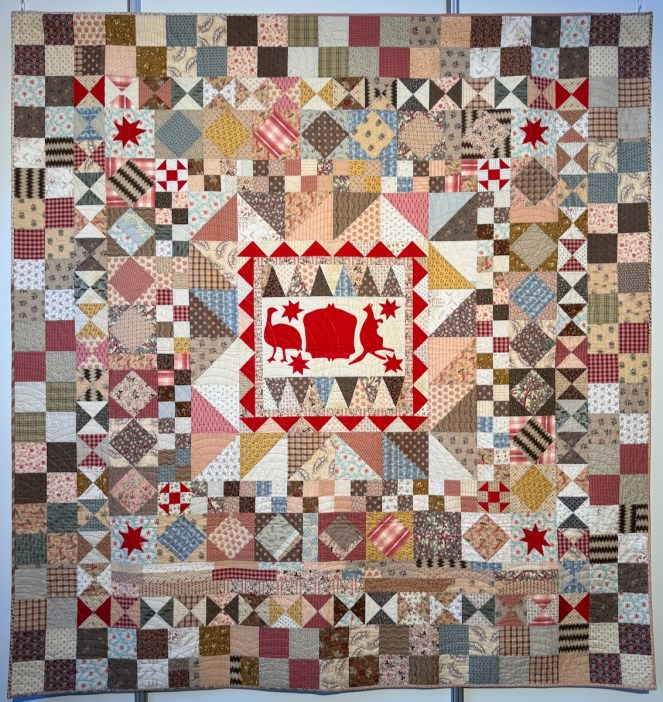
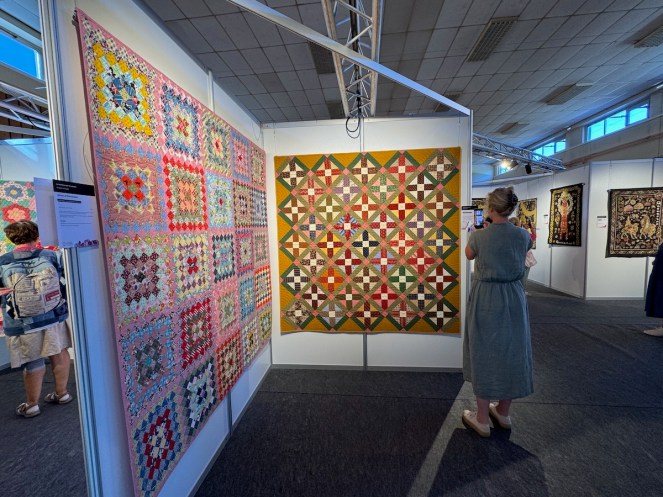
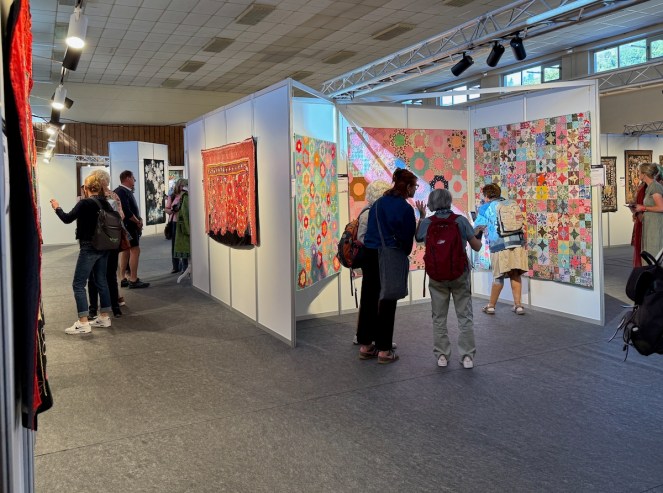
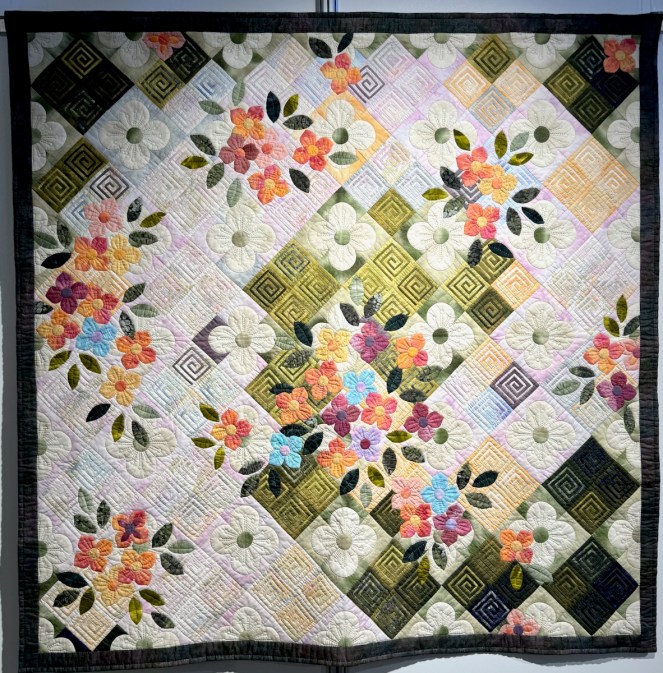
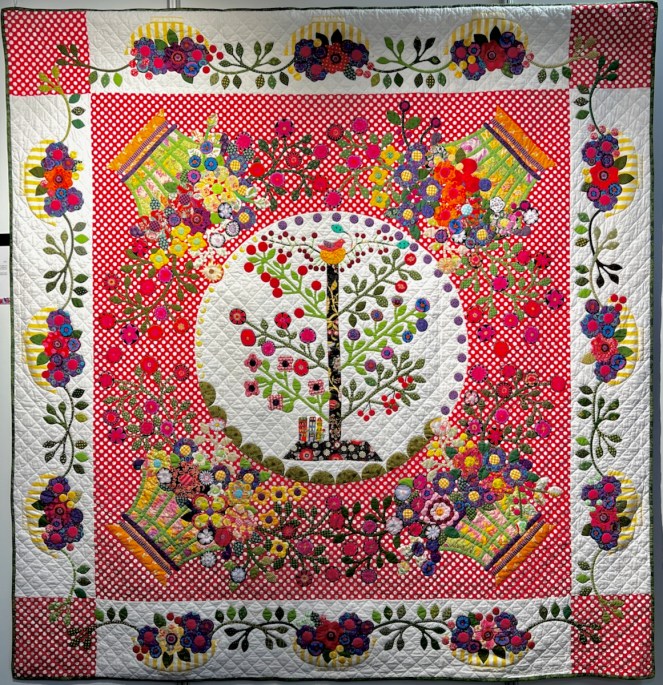
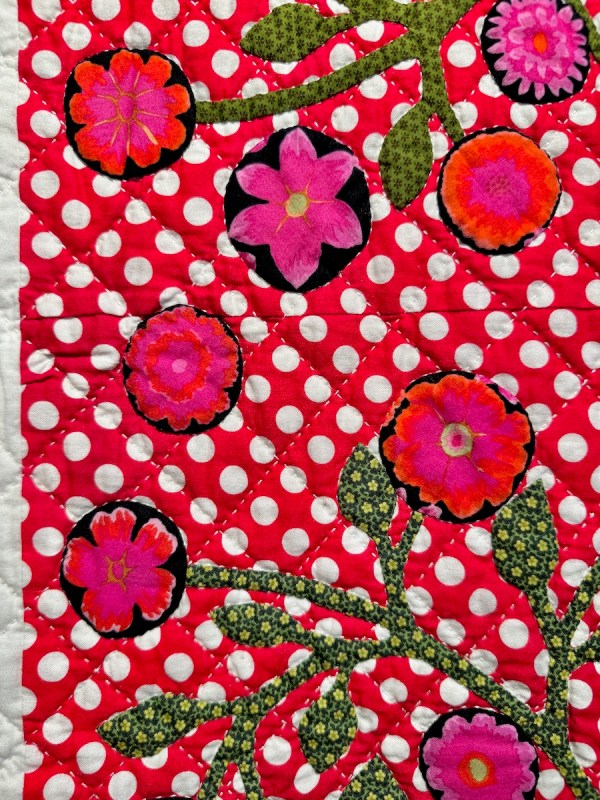
This is where I left Round Three of the Stay at Home Round Robin (SAHRR 2026), our last round. The new prompt for Round Four was “curves.” I’d been writing up my posts from the quilt show I attended in France last year, the Carrefour European Patchwork Show, and kept seeing some curvy eye candy from 2025 and 2024:
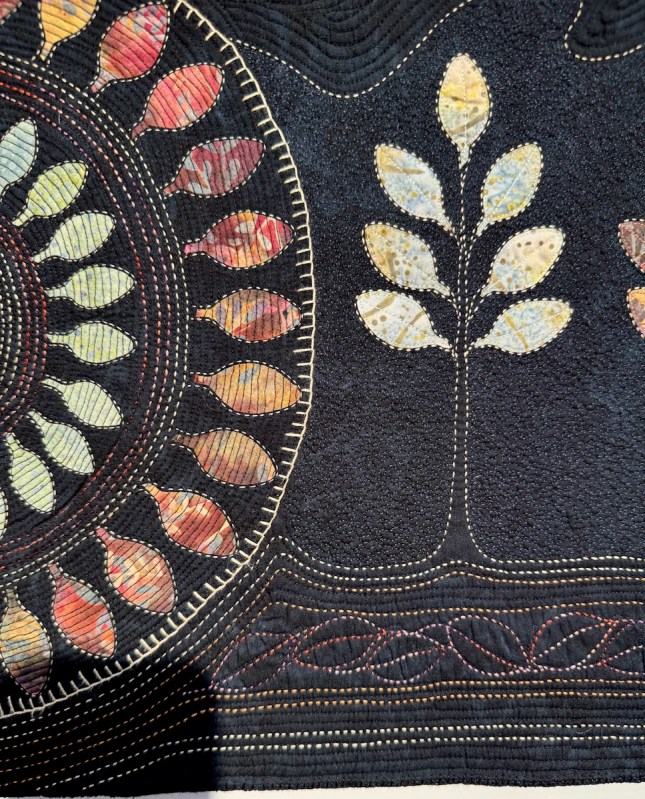
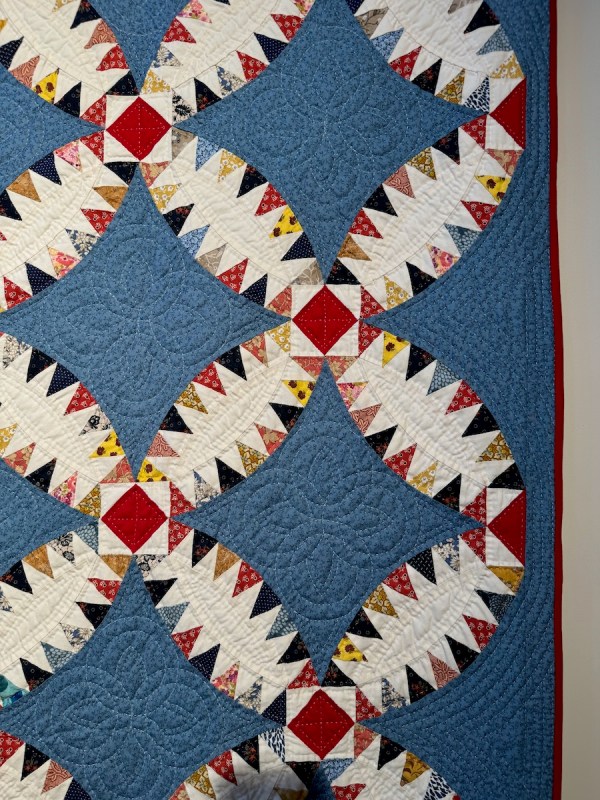
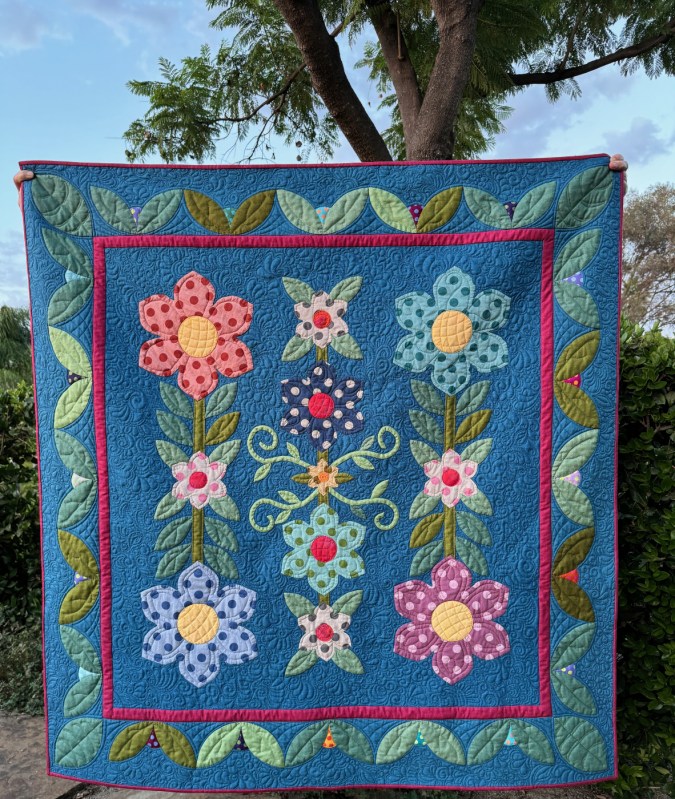
And these two borders (from earlier quilts) were running around in the back of my mind, too.
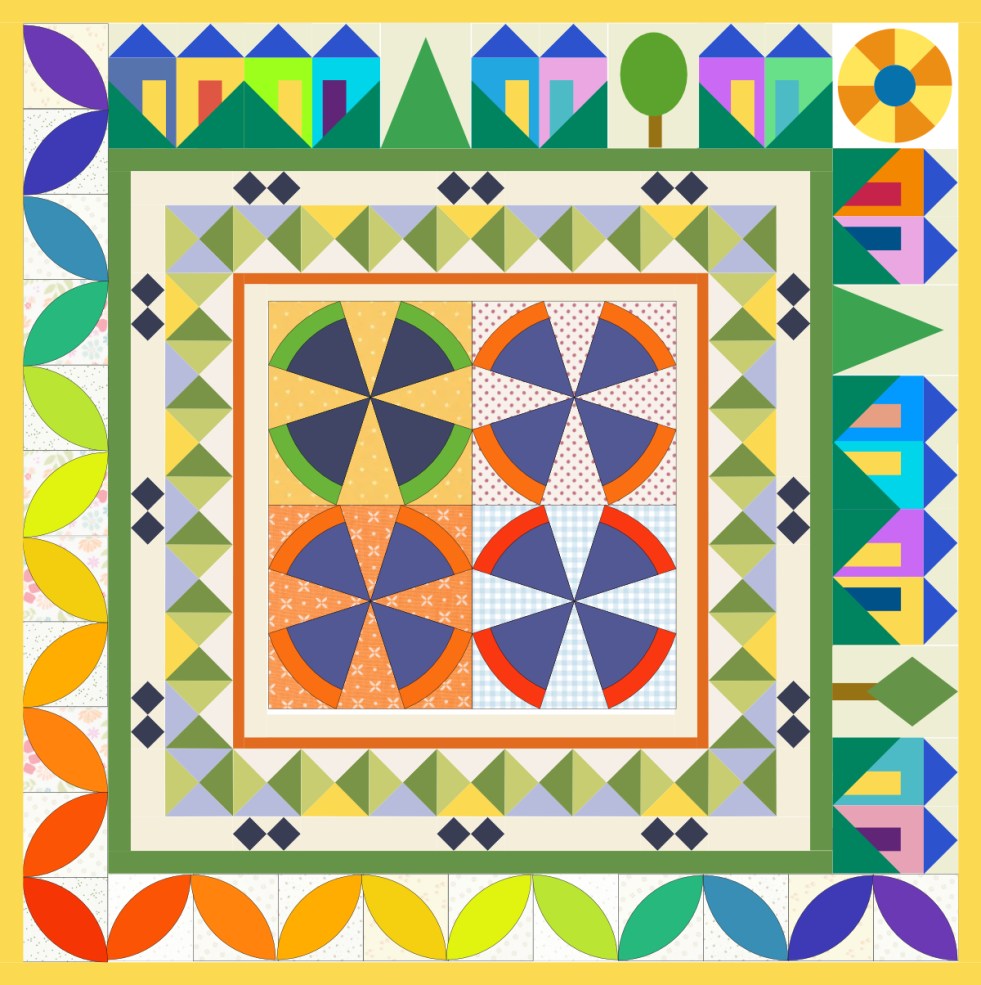
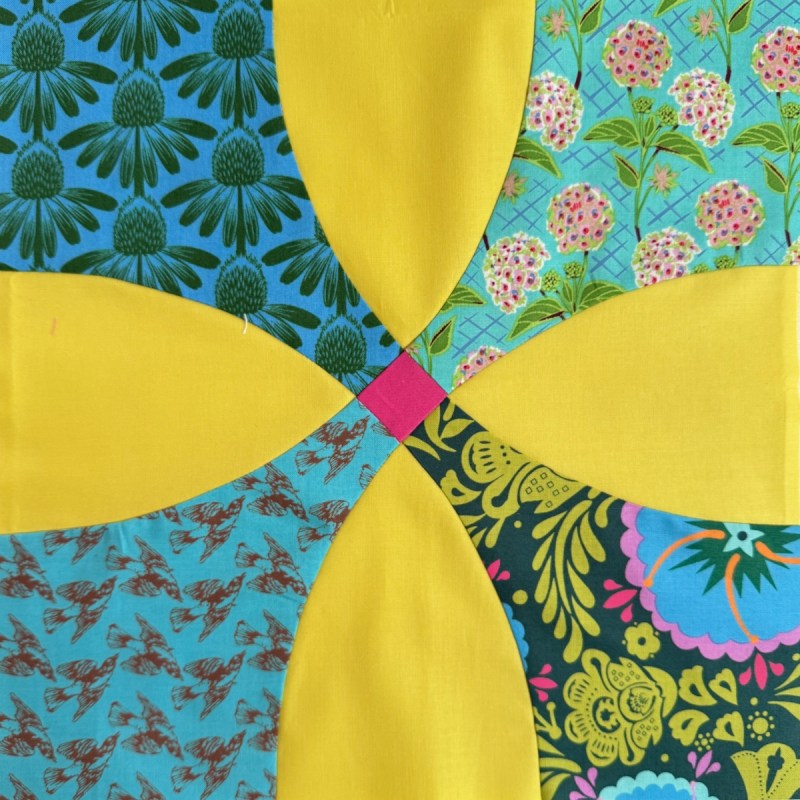
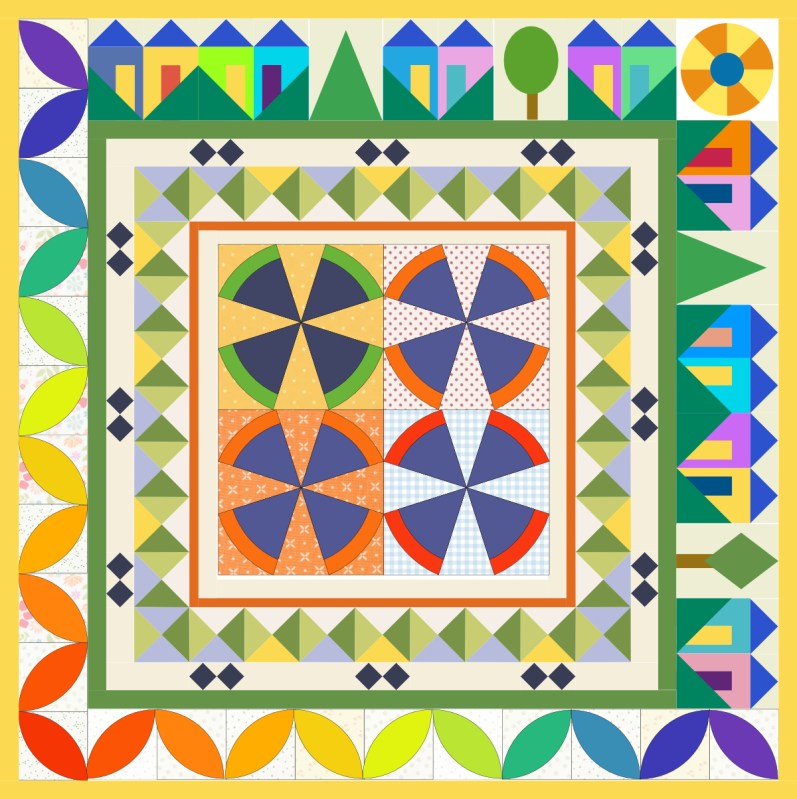
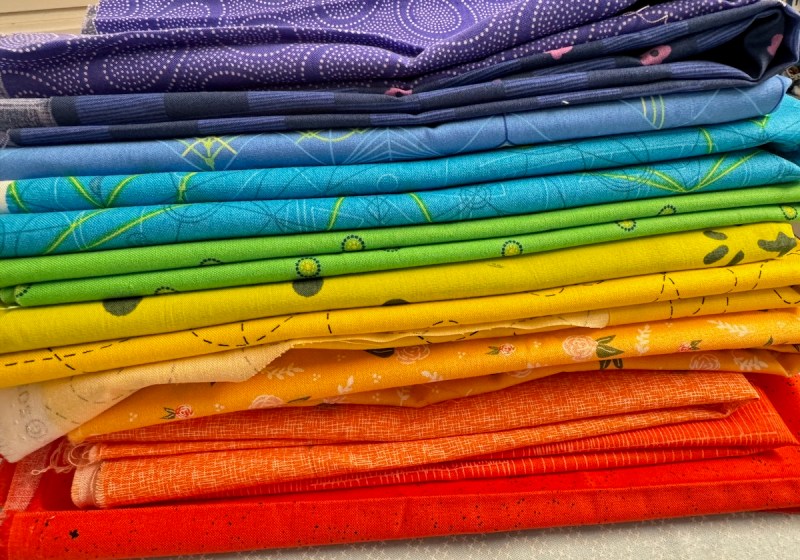
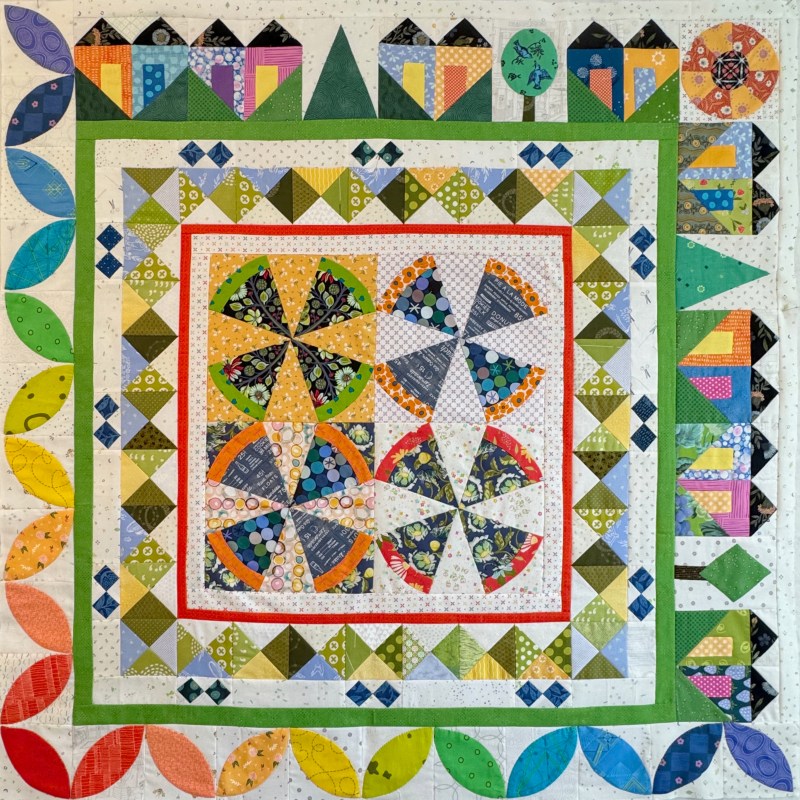
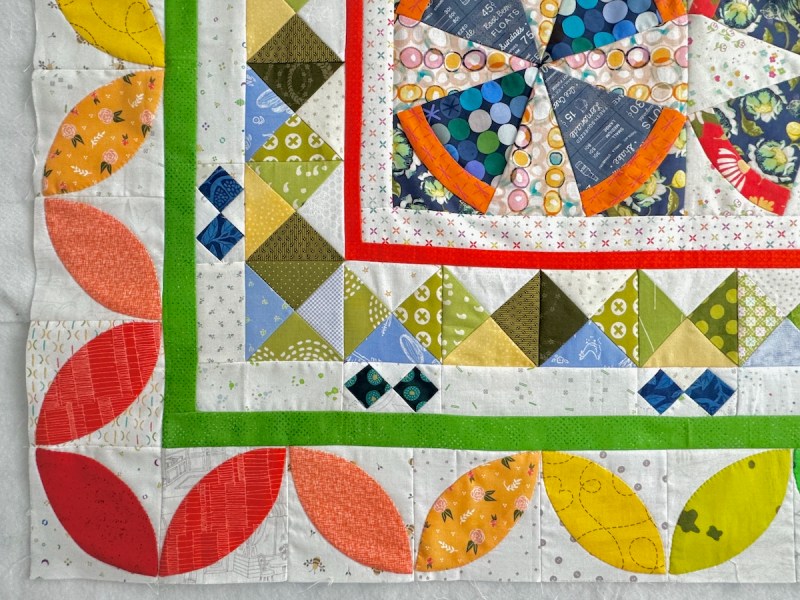
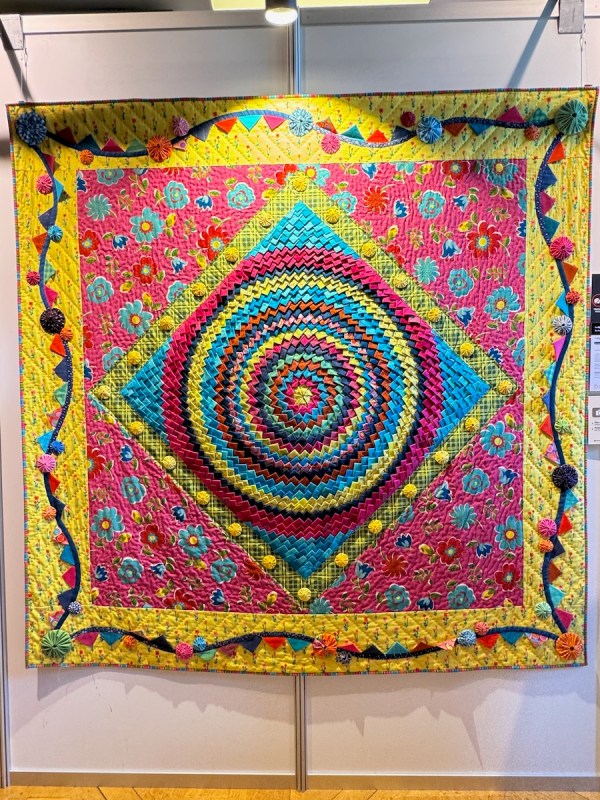
And if you can throw a rainbow in somewhere, why not? This was the sketch I drew up.
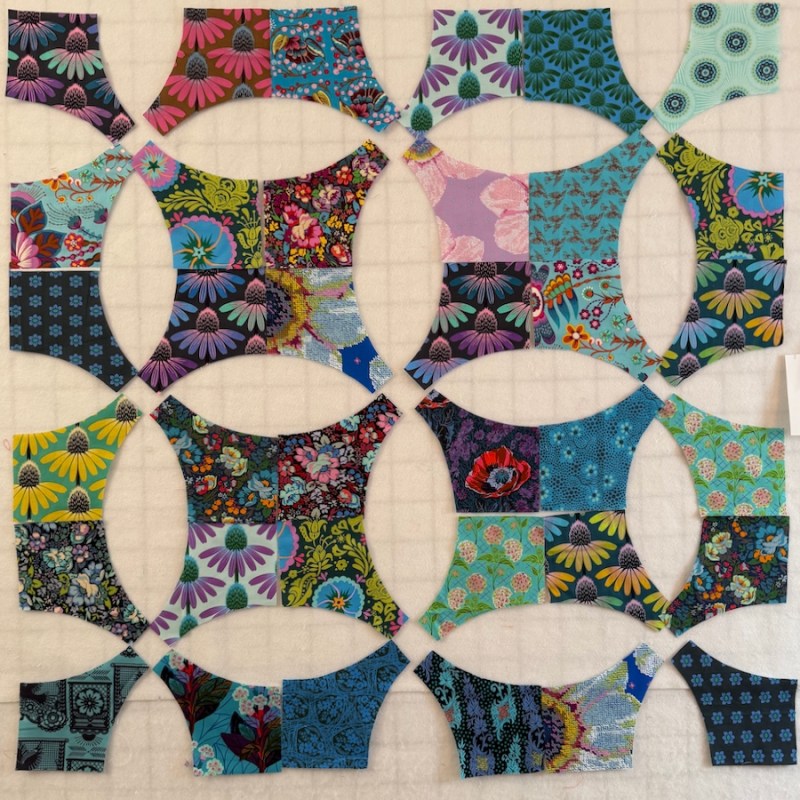
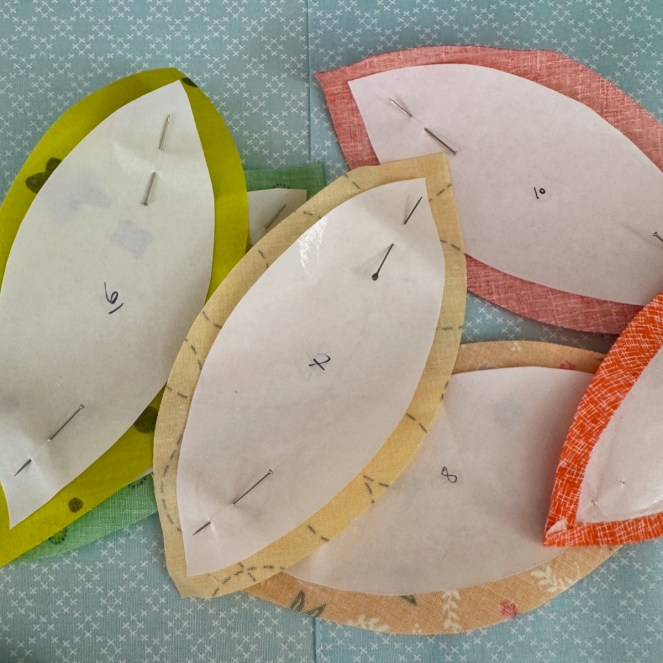
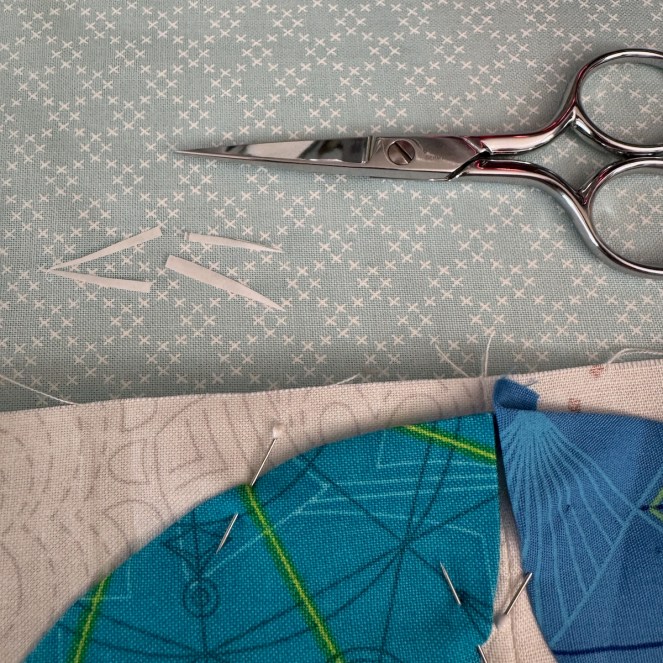
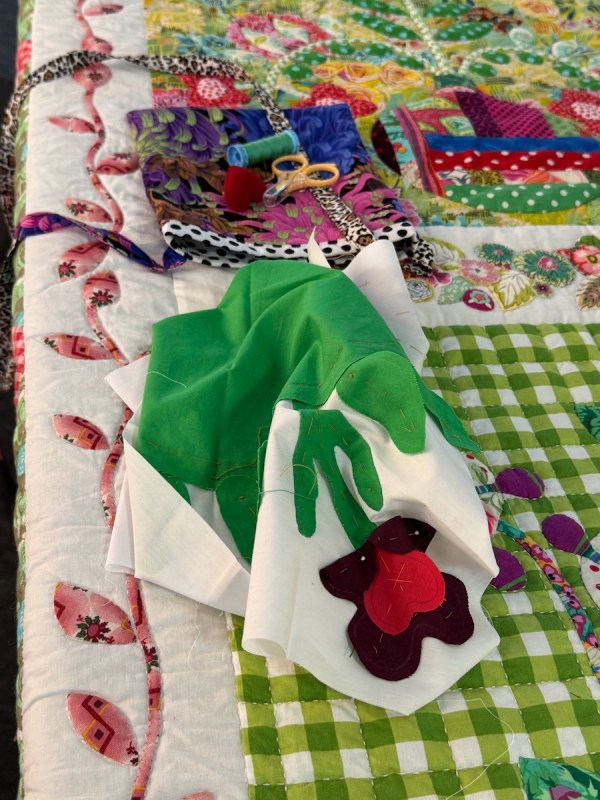
I am a fan of cutting my leaf/petal shapes out of freezer paper, putting the shiny side up, then ironing the seam allowance up over the edge.
Sometimes, if I cut the paper too liberally, I have to shave off the points to get them to fit. You can see the cuttings from this pair. I learned that it’s easier to sew all the background squares together, then appliqué the shapes.
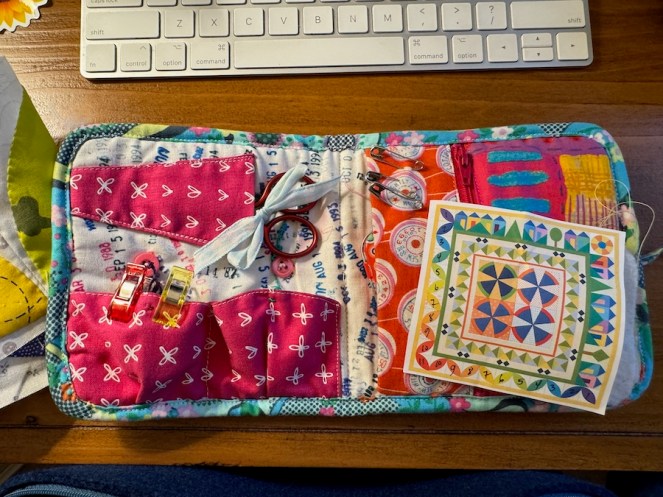
Finished, and putting away my recent birthday present from my husband: red scissors. I often carry around a small image of what I’m working on, as I sew in many places. This round it was my son’s home, a long car ride, and a doctor’s office where invariably someone asks what I’m doing.
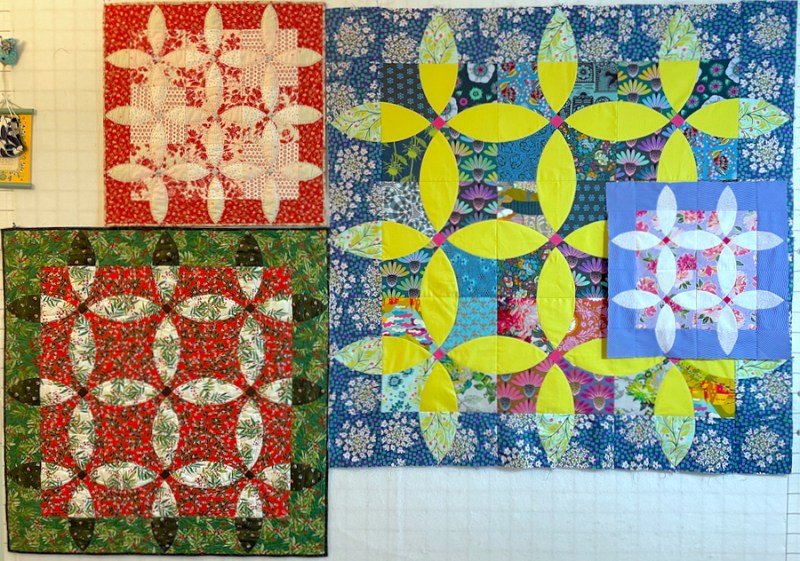
Here’s the handout from this week, with the size I worked up (3 3/4″ petals) and a 3 1/2″ size (more common). Click on title to see the handout, and click on download to get one for yourself, free.
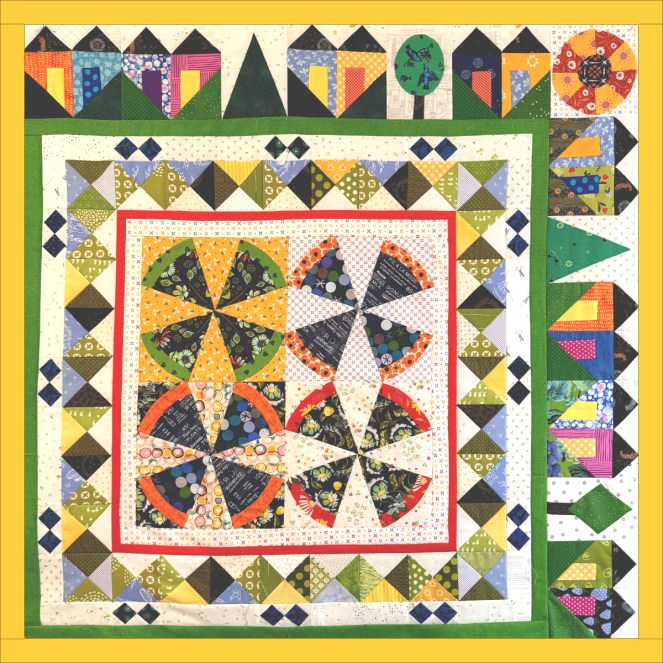
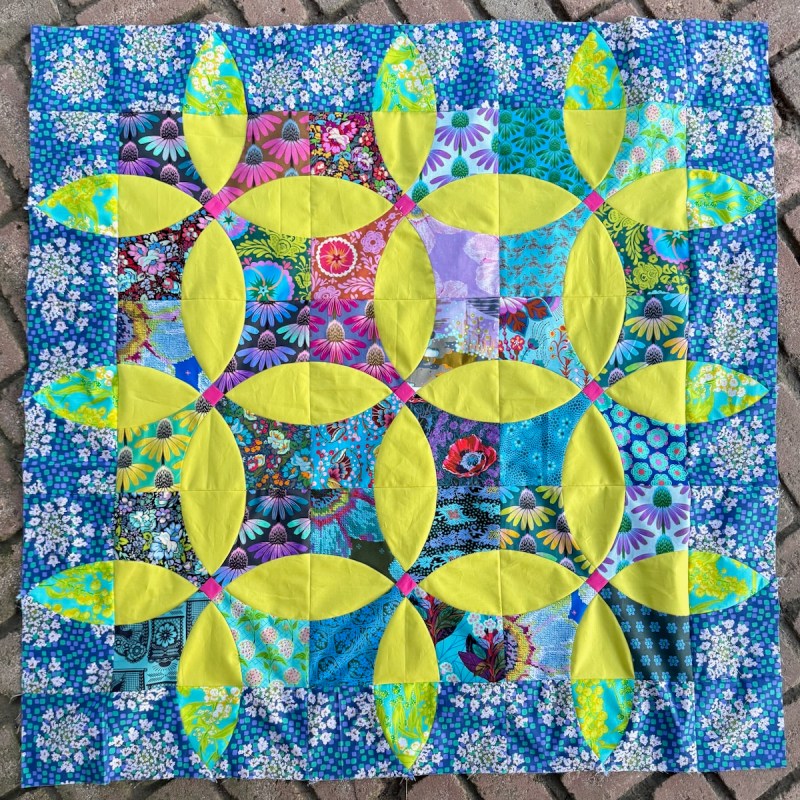
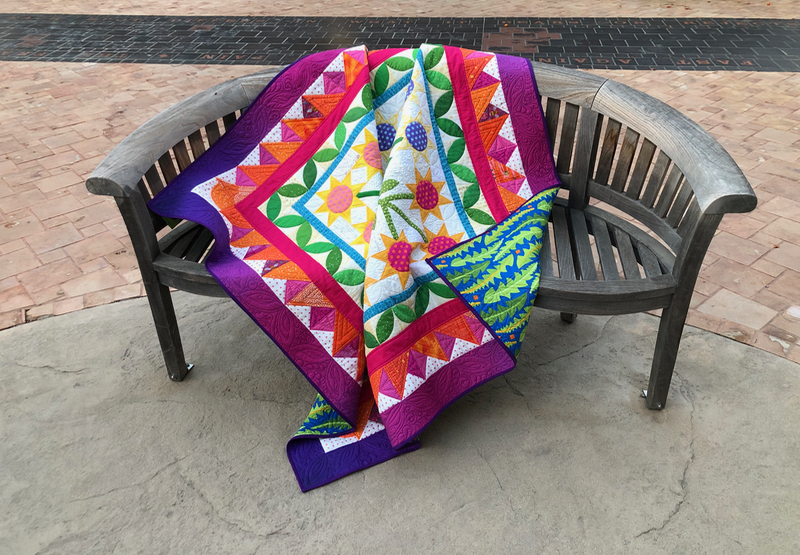
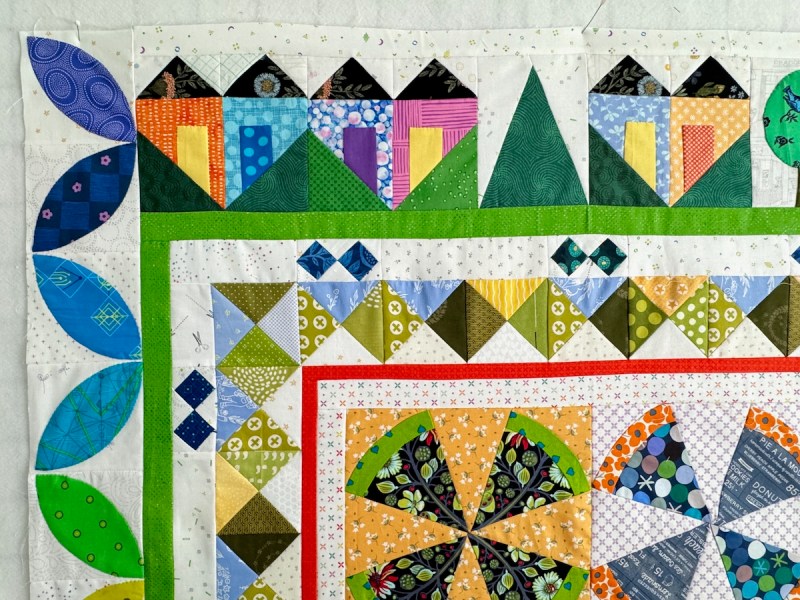
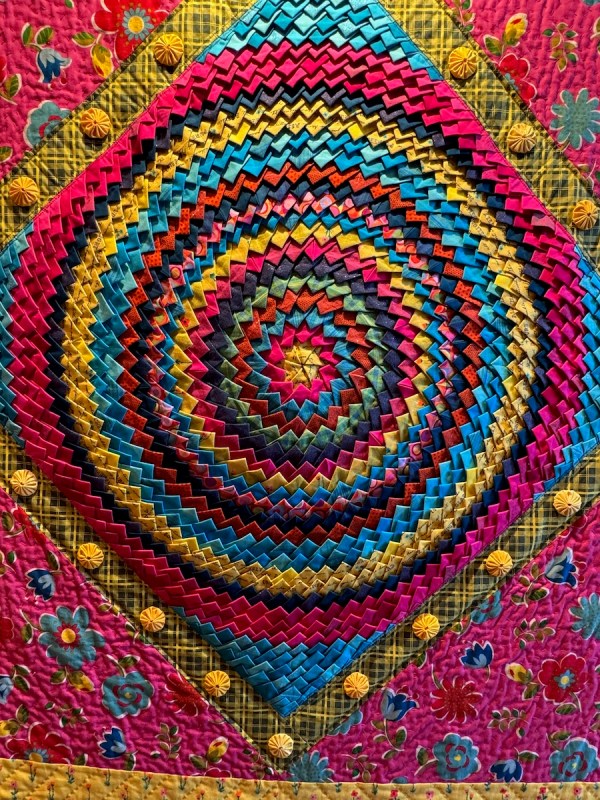
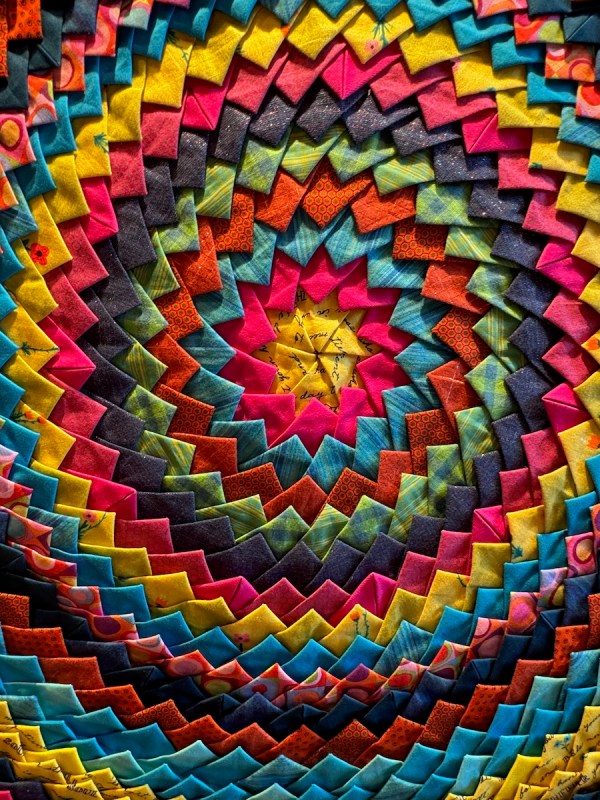
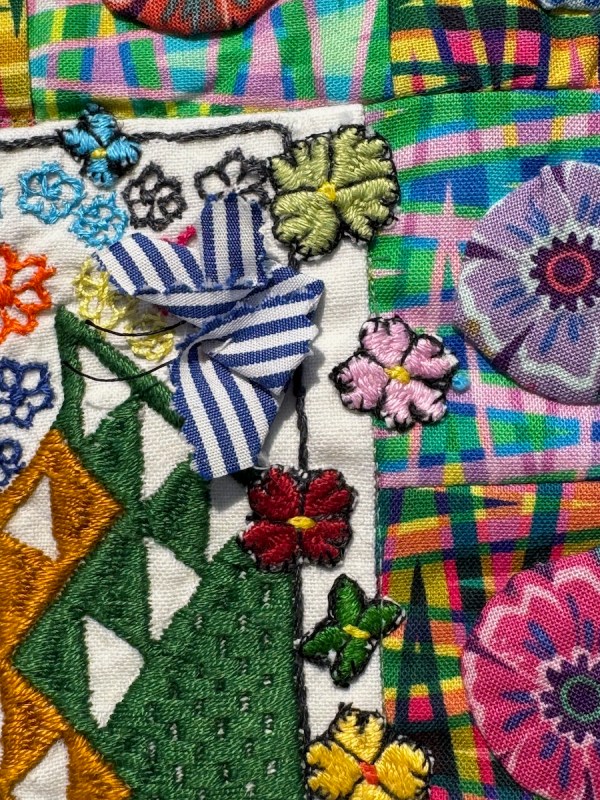
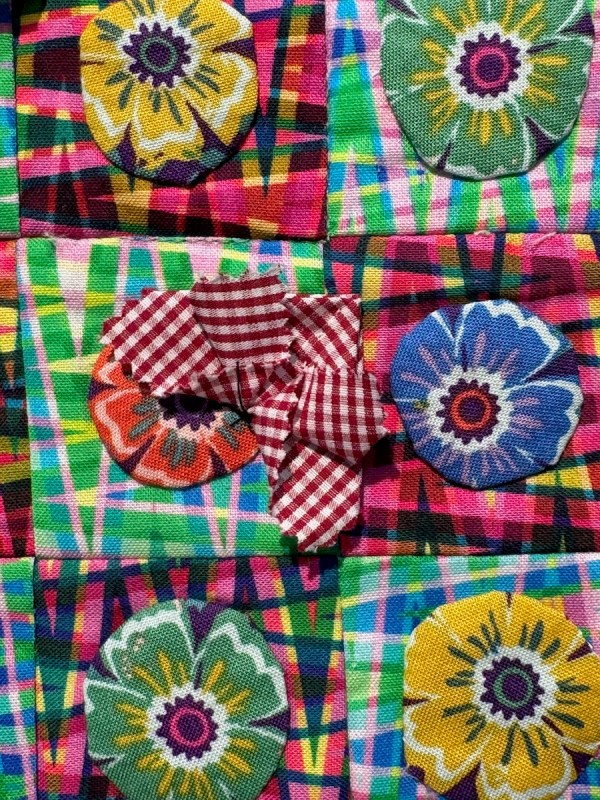
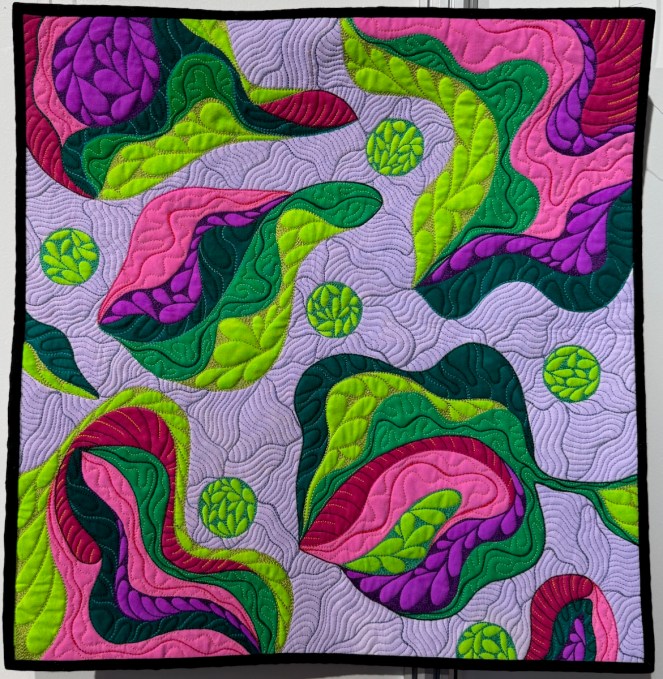
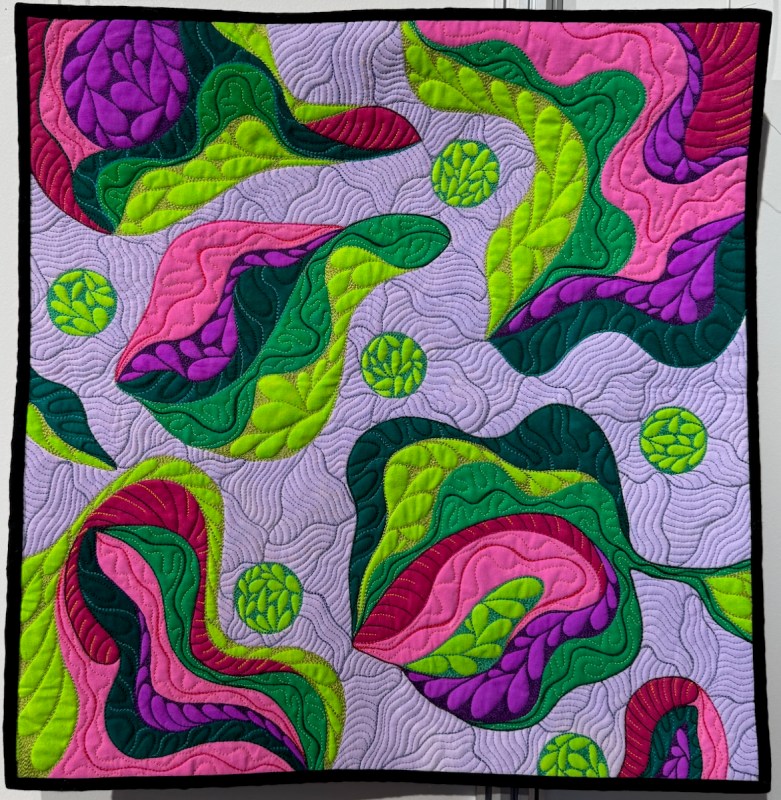
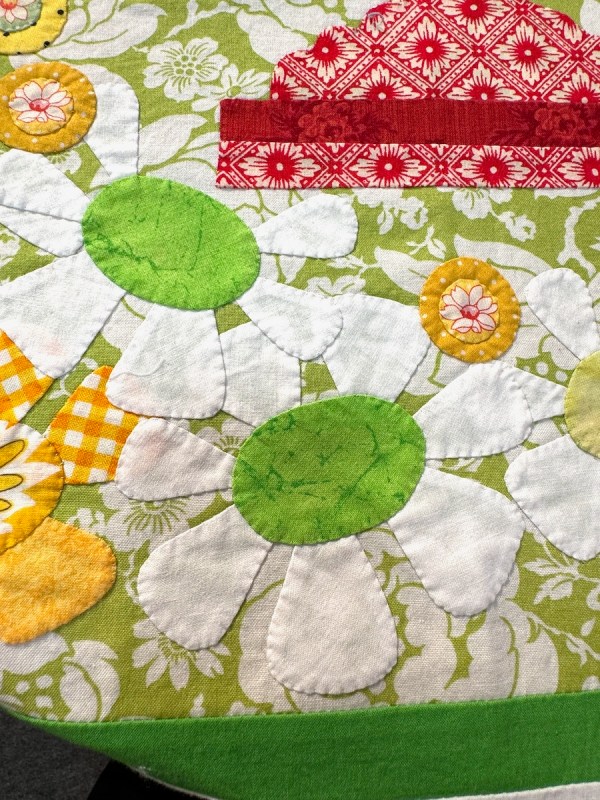
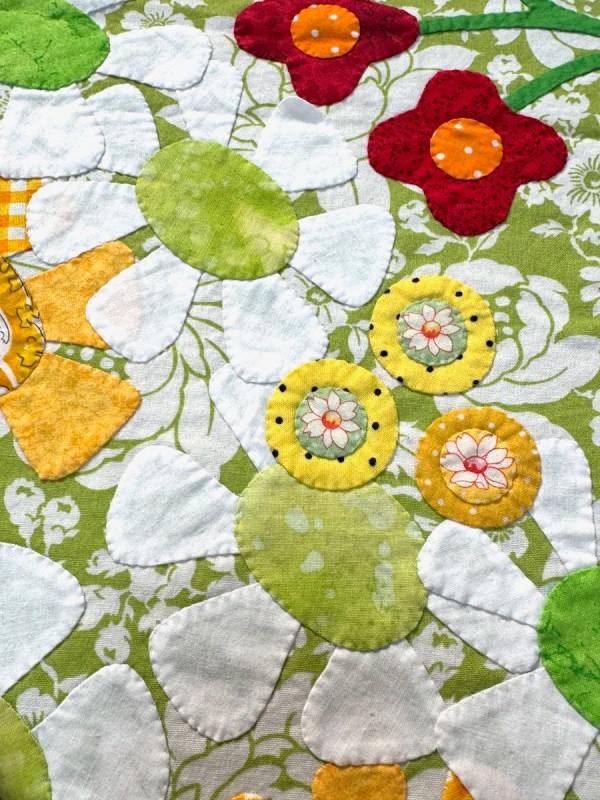
Even though I measured and measured, I still had to add on a coping strip on two edges. I think it looks okay, though. (Update 2/17/26: a daytime photo, plus two detail shots.) Dimensions: about 43″ square.
Making Curves is the theme for Round Four of the Stay at Home Round Robin. I’ve seen some pretty terrific curves this round,
Many thanks to the hosts and organizers of this fun experience. Only two more prompts to go!
This is the sixth, and final post about the Carrefour European Patchwork show 2025. The post covers:
• Venue 13: Villa Burrus, with RachaelDaisy Dodd • Venue 14: Église de l’Assomption, with Ruth De Vos • Venue 15: Salle Polyvalente, with Lorena Uriarte, Dianne Firth, ASL Liépvre, EQA, France Patchwork • Venue 16: Ulla Hoppe
I have a main Carrefour Quilt Show page that lists all the posts of all the meetings I’ve gone to, and includes the posts from this year too. If I haven’t mentioned it before, you might enjoy these posts more if seen on a desktop computer or even a tablet. Cell phones re-format the layout and can sometimes do strange things to how it looks on the screen.
If you are interested in going to Carrefour, I wrote two posts for them about our travel, and how we put the trip together. You can find them here and here. Their main website is HERE, where you can subscribe to their newsletter (scroll to the bottom).
Thank you so much for reading and traveling along with me by way of these posts. Enjoy!
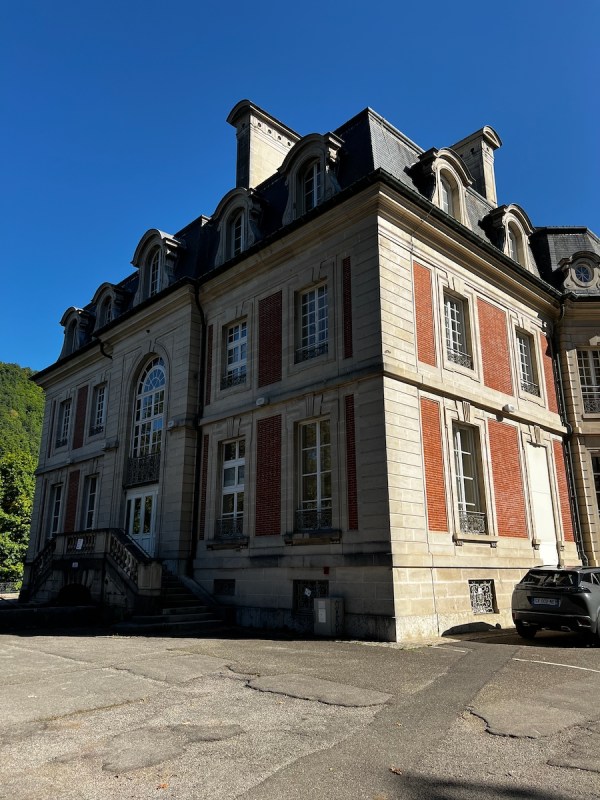
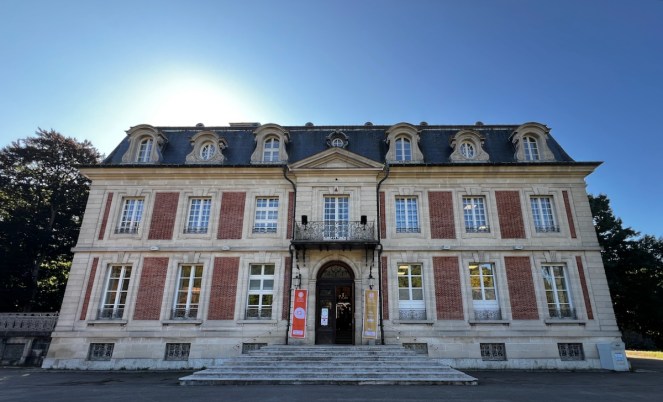
This venue, Villa Burrus, was just a few short steps from the Party Room (Salle Des Fêtes, from the previous post) and although we’ve been to Carrefour twice before, it was new to us.
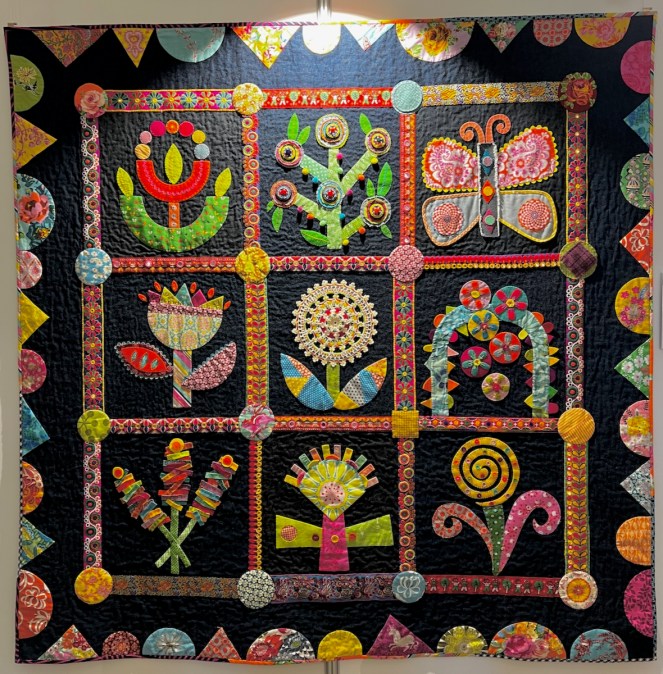
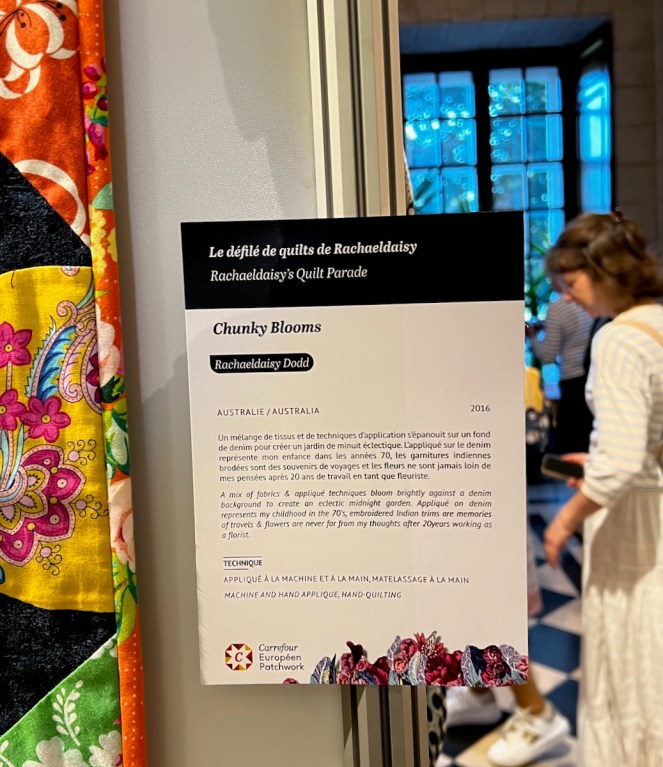
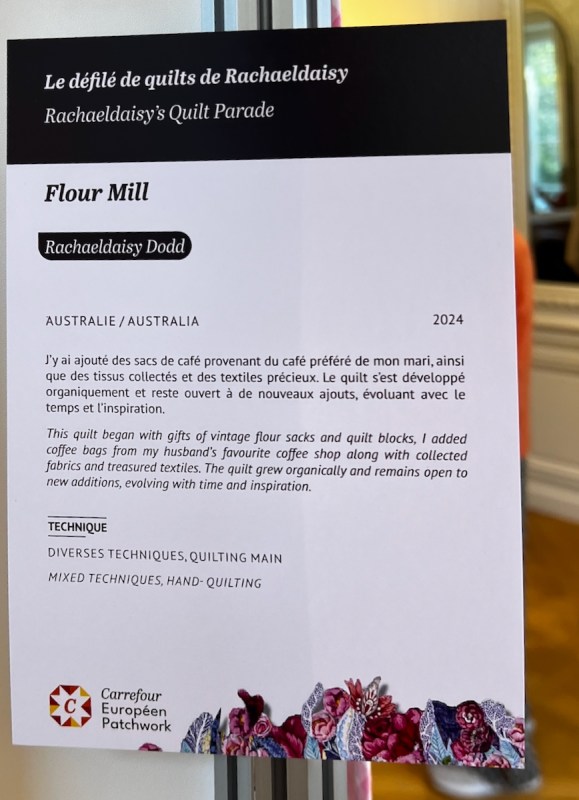
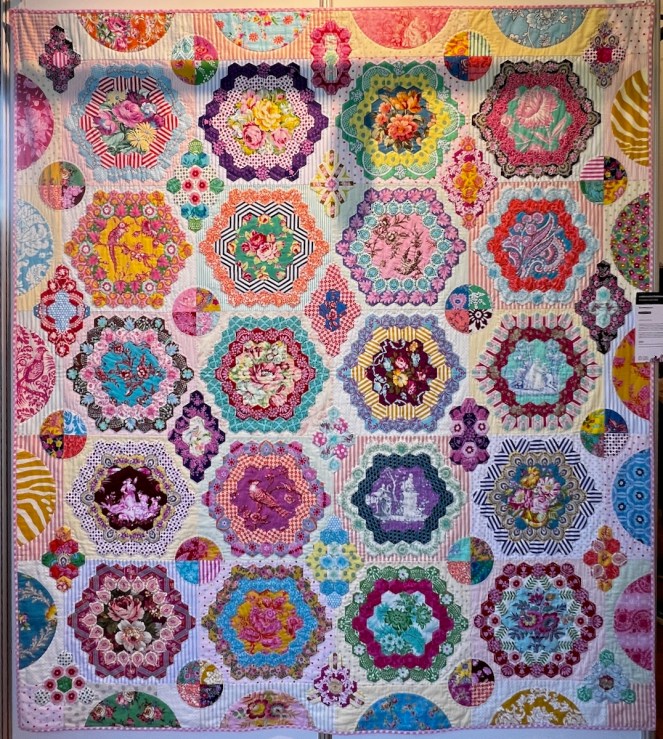
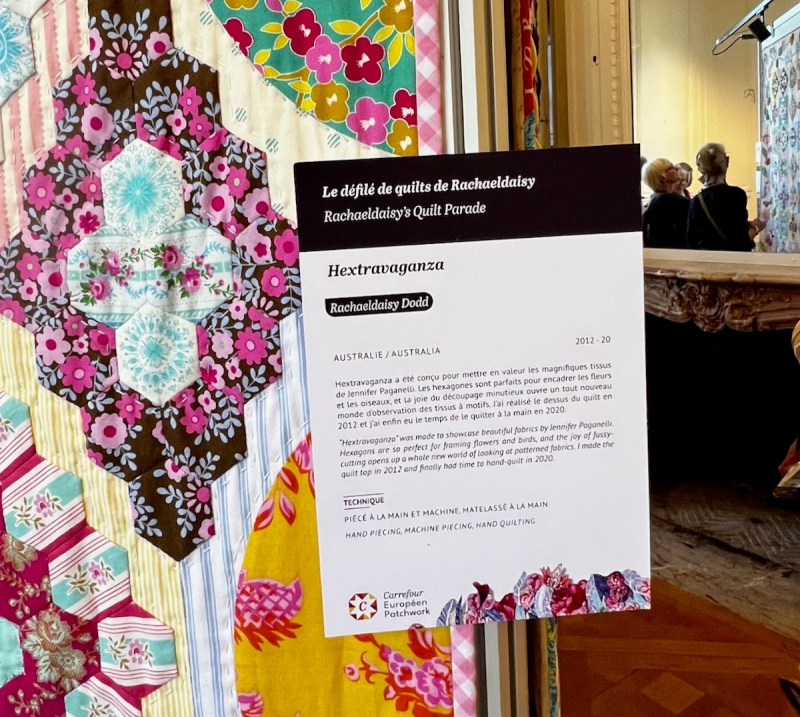
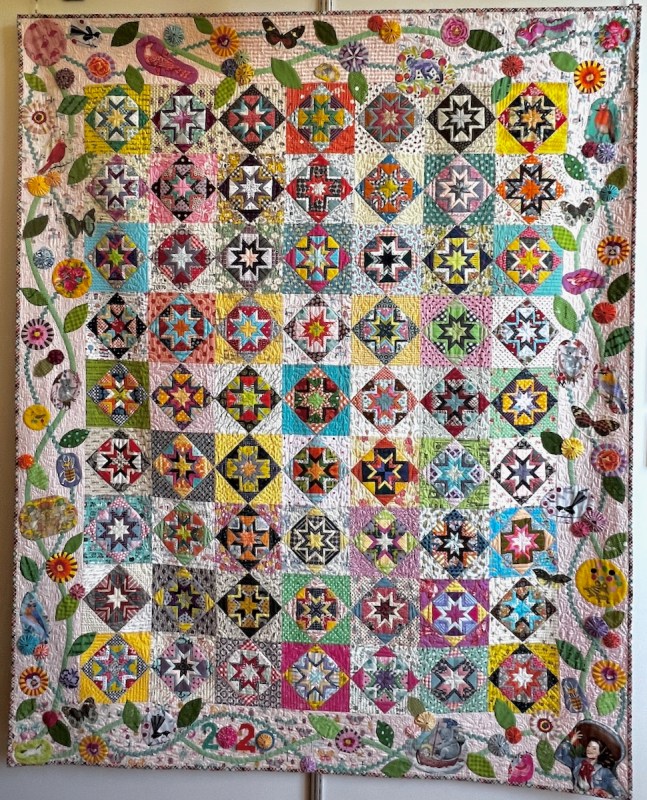
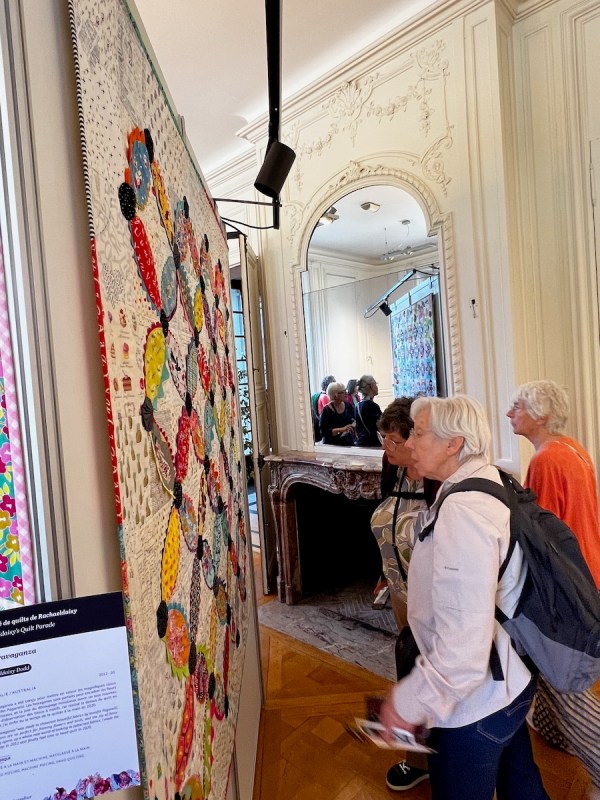
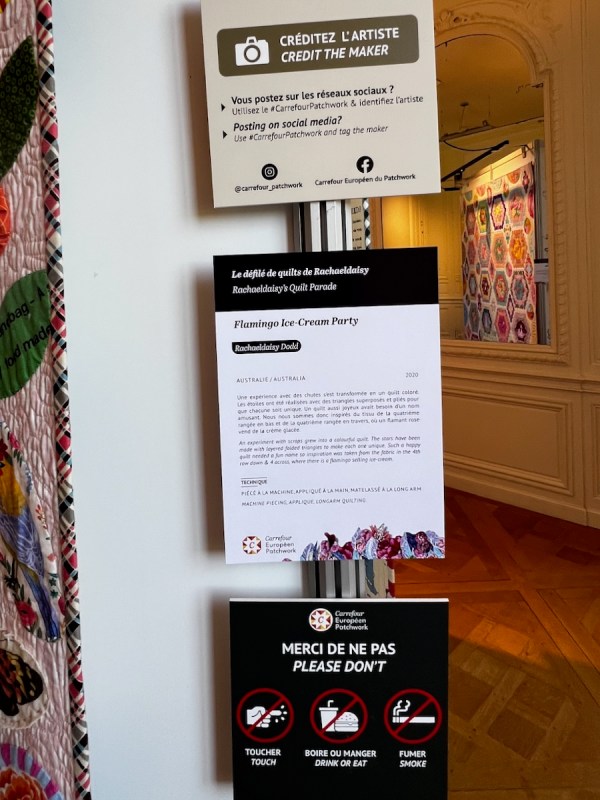
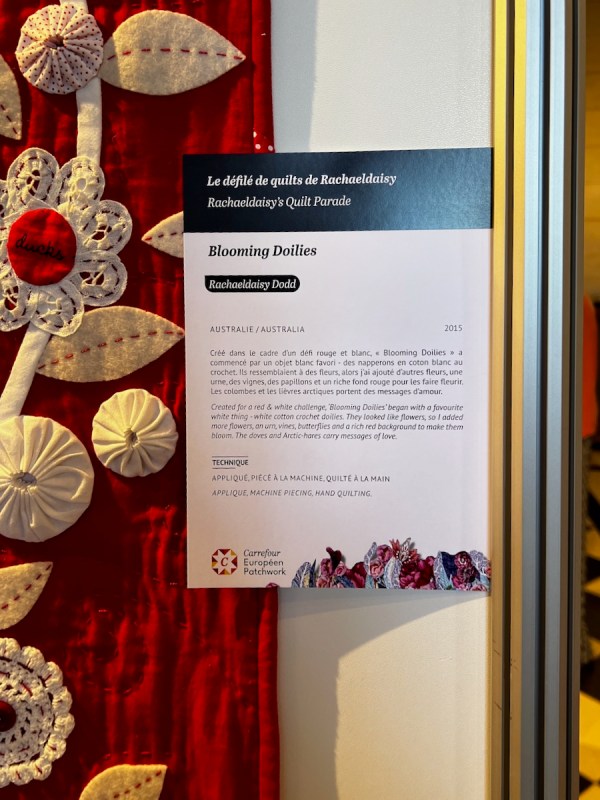
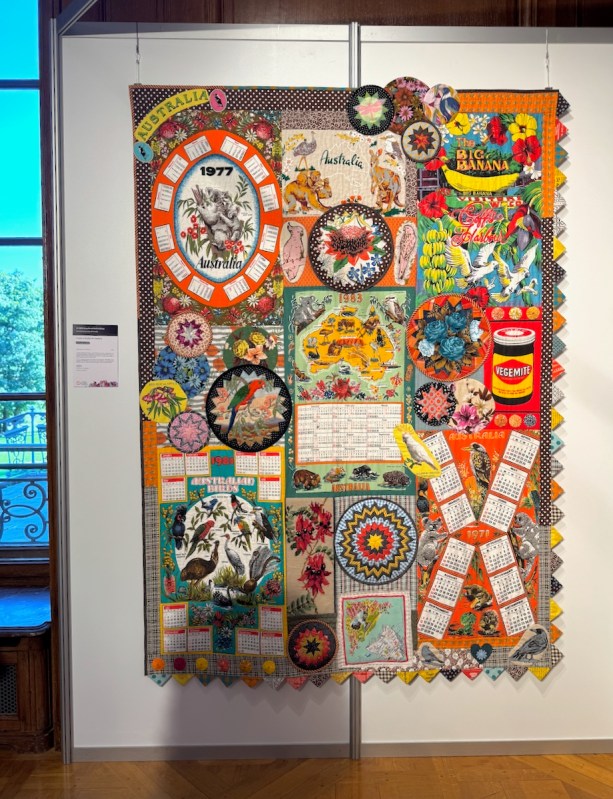
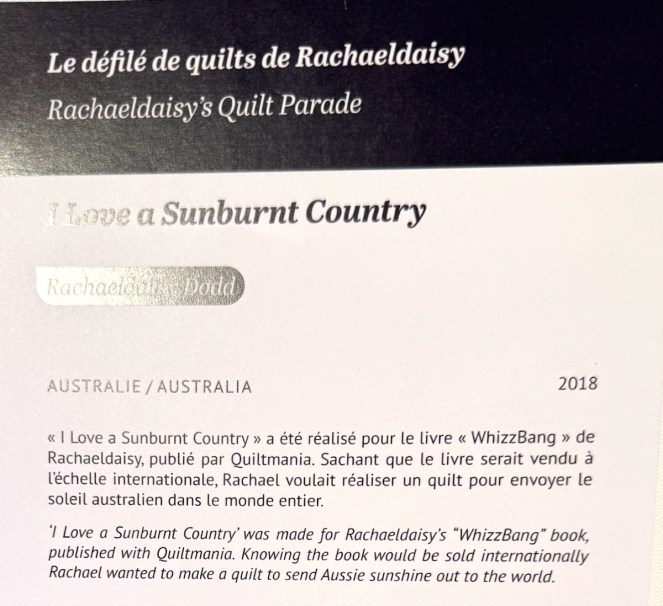
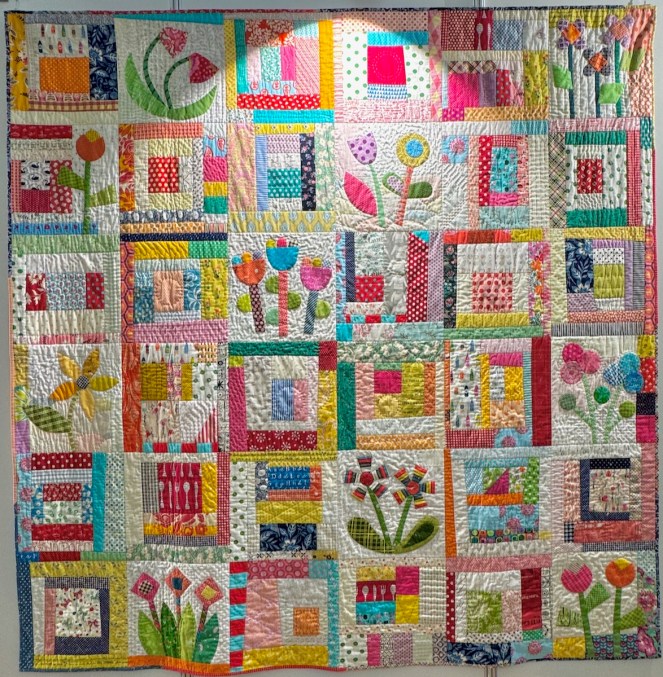
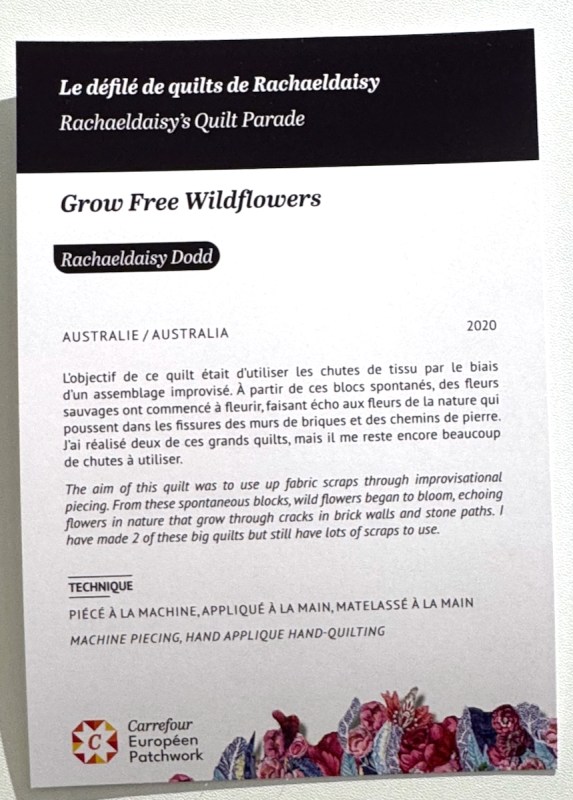
Sited on Le Parc de las Villa Burrus, this mansion was built in 1900, at least as I can figure out for the literature we picked up was all in French, printed for their Patrimonie — or Heritage — Days, when many buildings are open to the public. Whatever its origins, it was a great place to see quilts, and RachaelDaisy Dodd had her solo exhibit here.
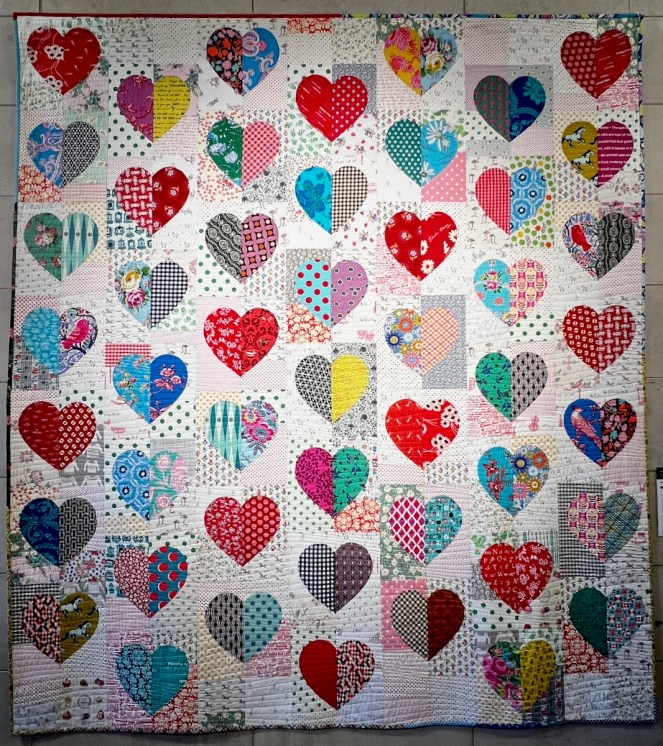
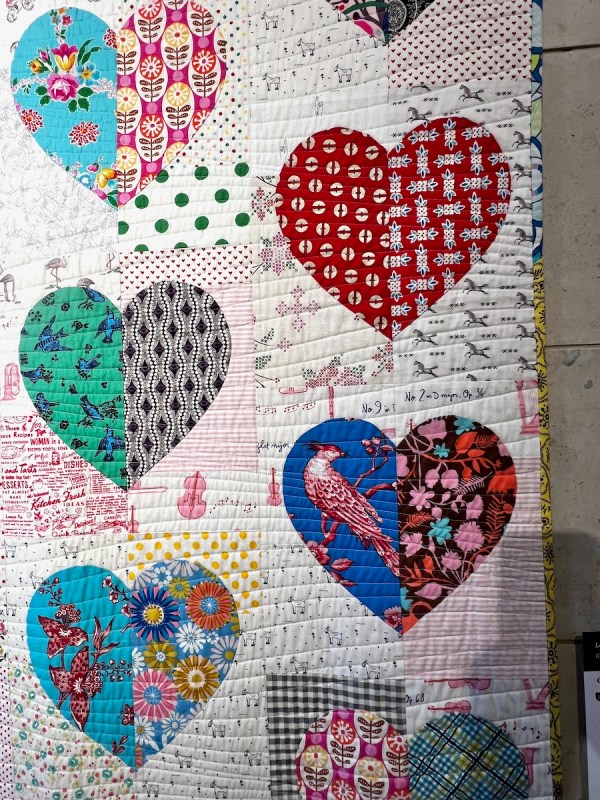
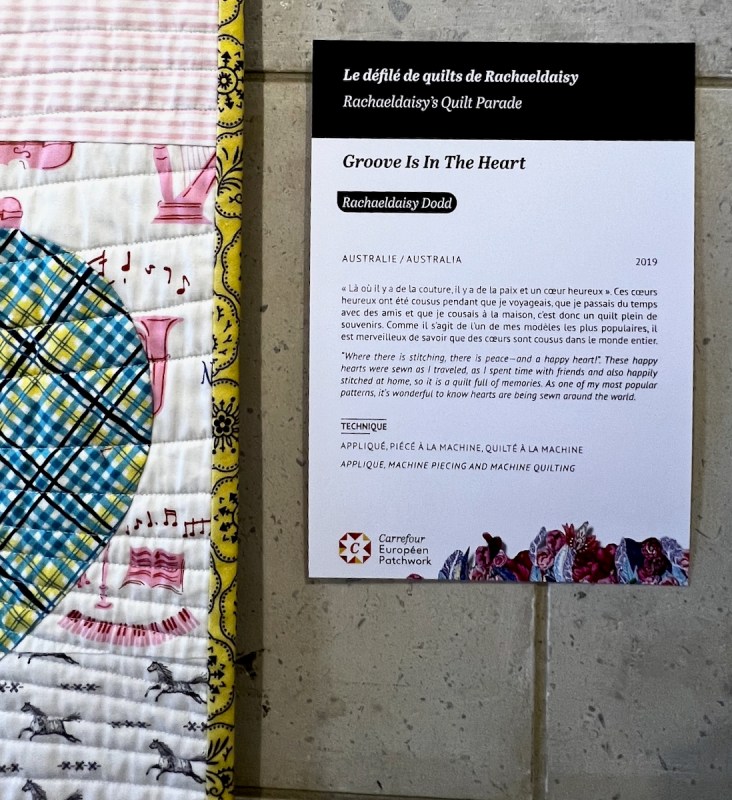
She was always thronged by, and visiting with, quilters, so I’m afraid I didn’t get the best photos of her. But her we go with some of her quilts.
In the front hallway, just across from where her table was, and I apologize, but I have no title card for this.
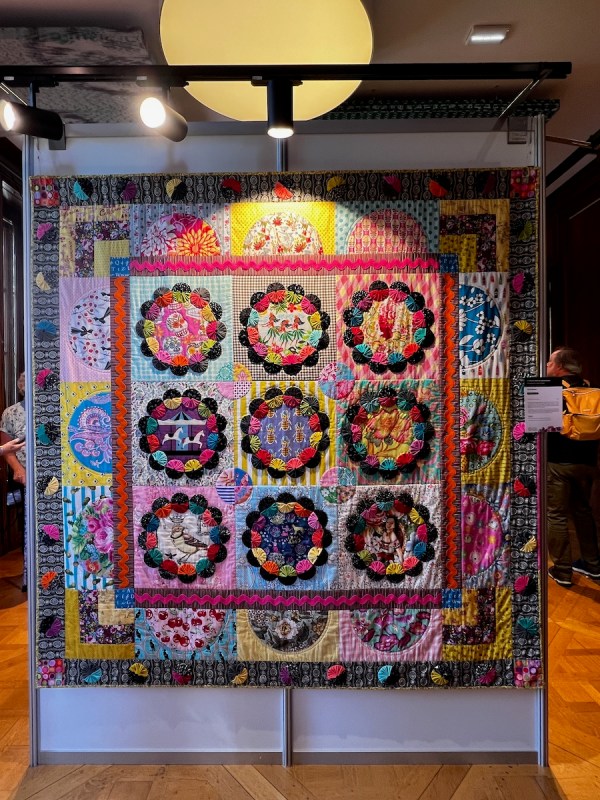
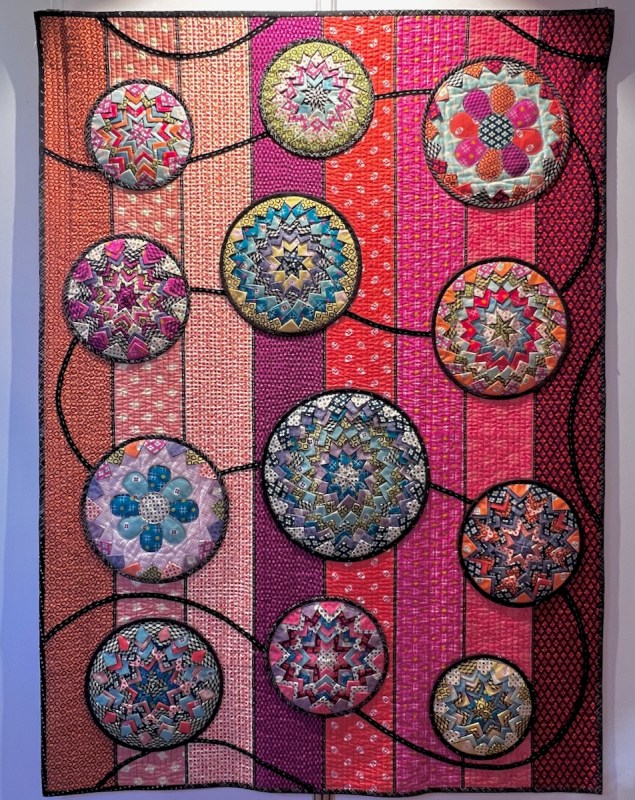
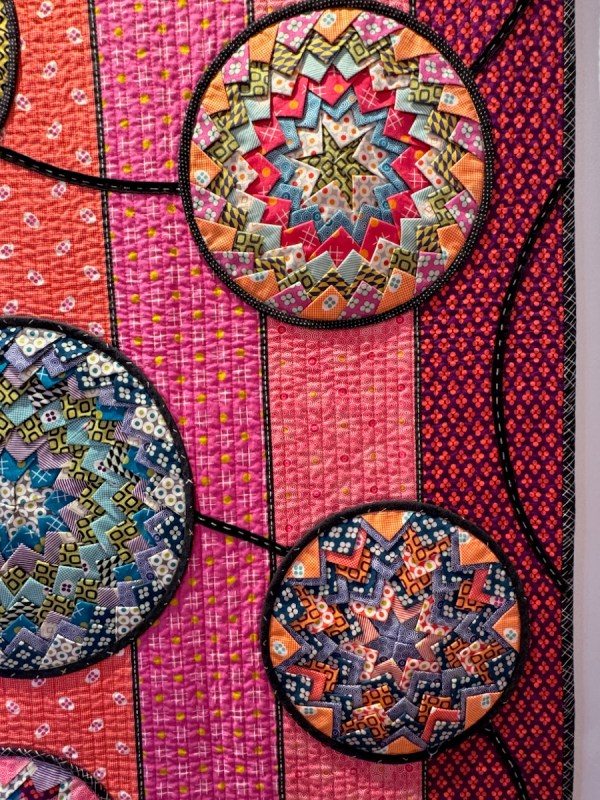
Her signature is a variation of the pine cone (or pine burr) block.
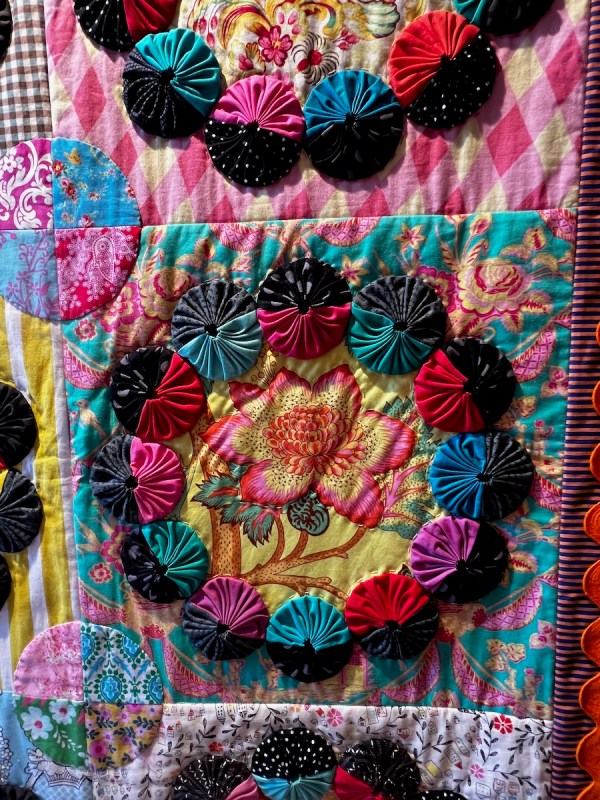
Followed by another motif she commonly uses: the yo-yo, a gathered circle with the gathers on the top.
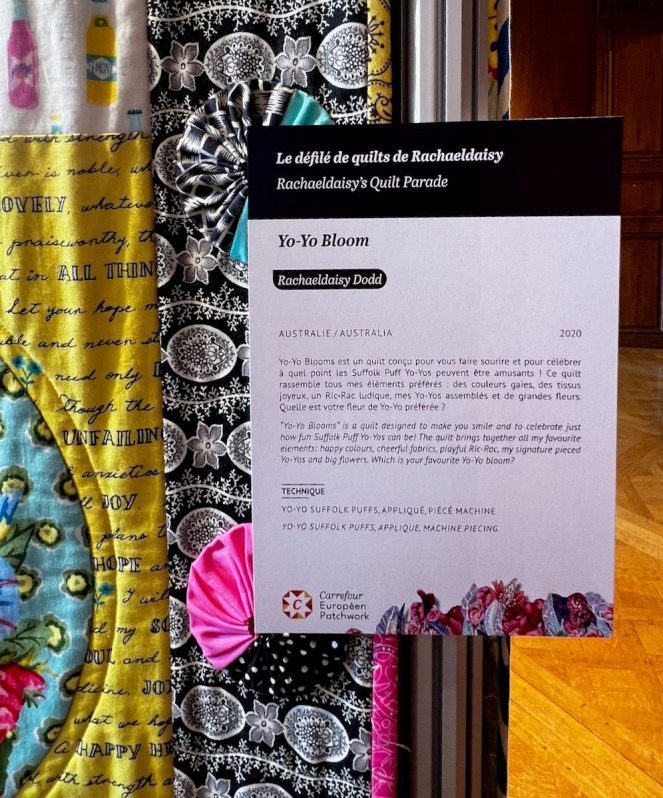
Title: Yo-Yo Bloom Title Card: “Yo-Yo Blooms is a quilt designed to make you smile and to celebrate just how fun Suffolkd Puff Yo-Yos can be! The quilt brings together all my favorite elements: happy colors, cheerful fabrics, playful Ric-Rac, my signature pieced Yo-Yos and big flowers. Which is your favorite Yo-Yo bloom?” Technique: Yo-Yo Suffolk Puffs, Appliqué, Machine Piecing.
Fun and funky shapes that delight.
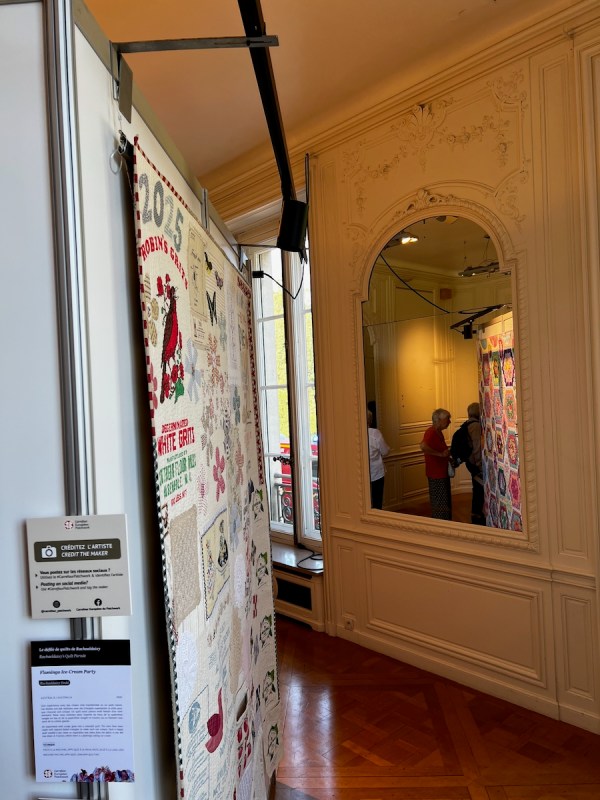
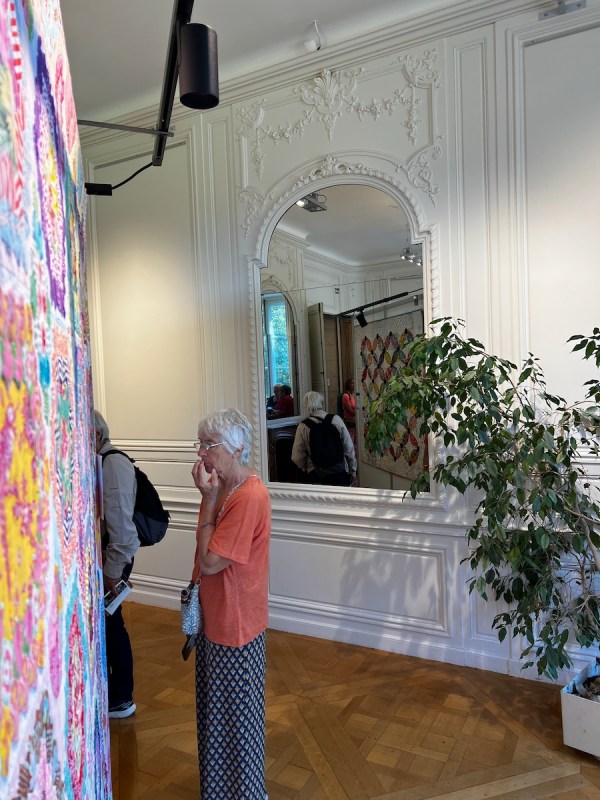
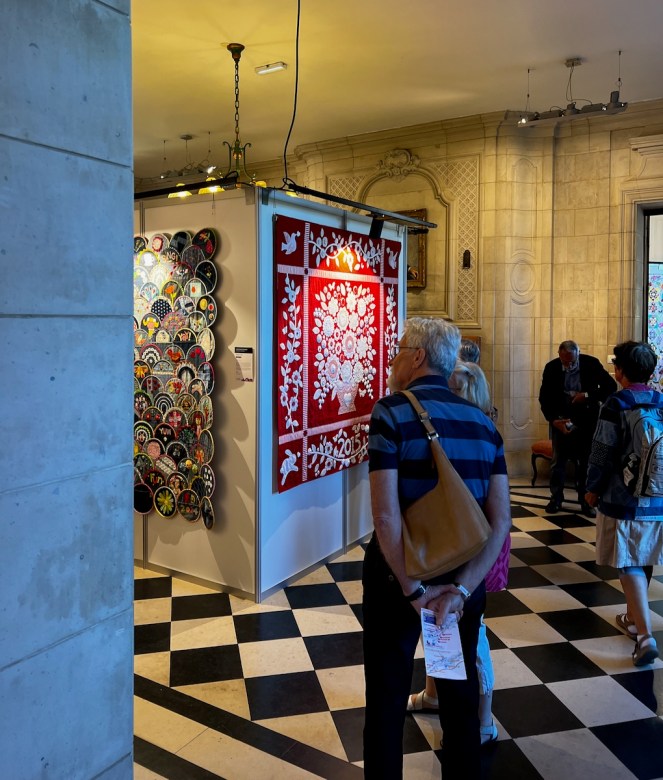
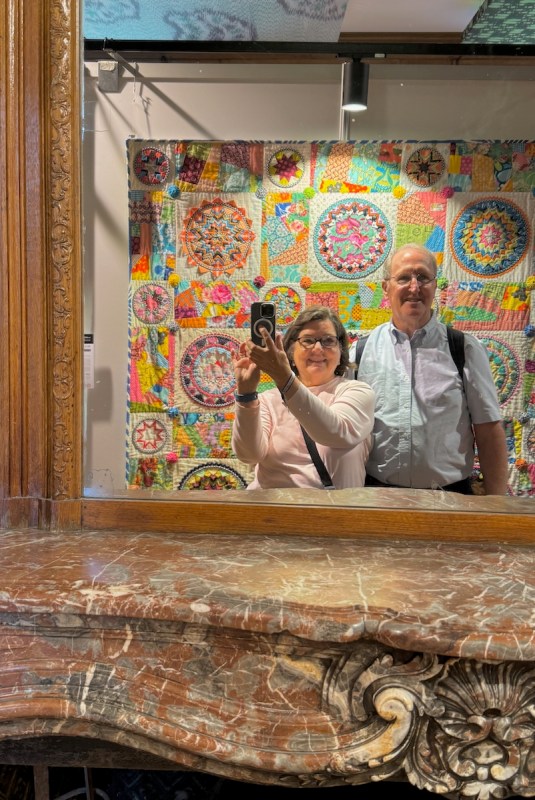
Several rooms held her quilts, with large moveable frameworks. In the next room, the frame was set up in the center, and the large mirrors and windows and her quilts all echoed with pattern and color.
Click to enlarge.
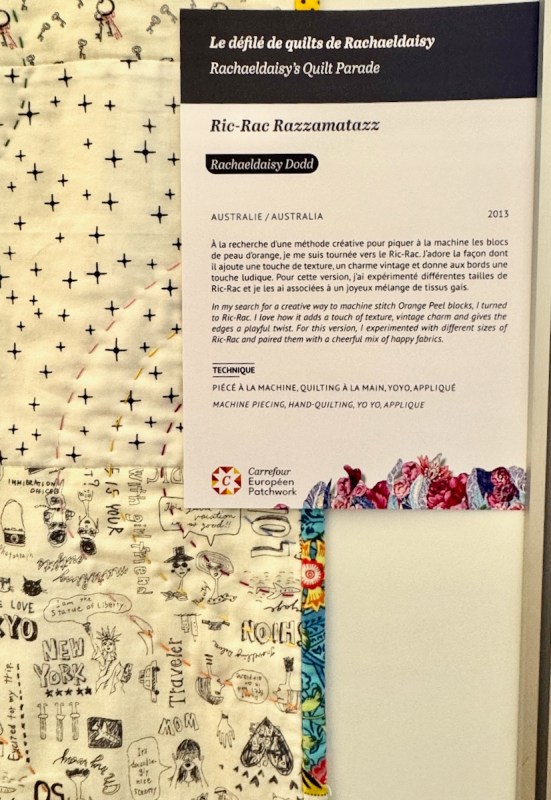
Where does she get all her ric-rac? I think a lot of it is vintage, as she alludes to in her title card.
This one was always hard to get a photograph of. I also kind of liked that the man is carrying his wife’s (his??) purse.
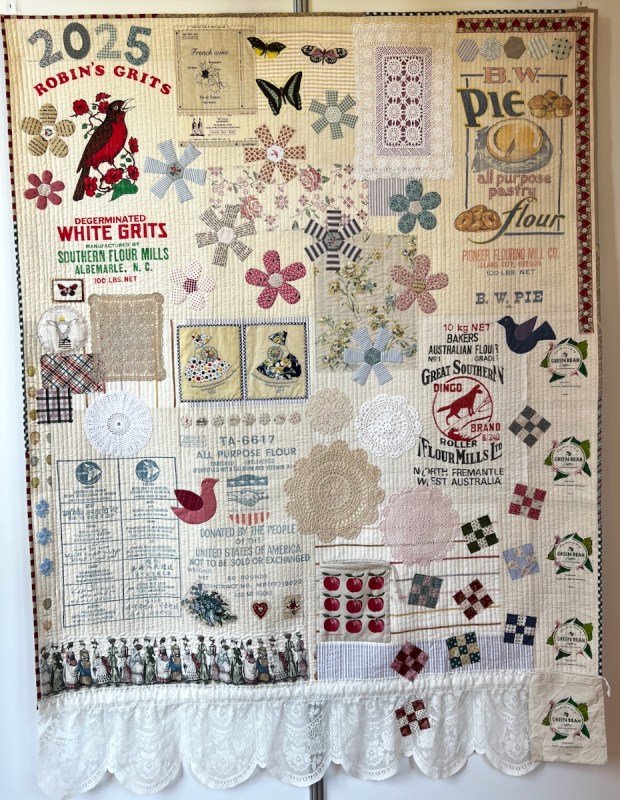
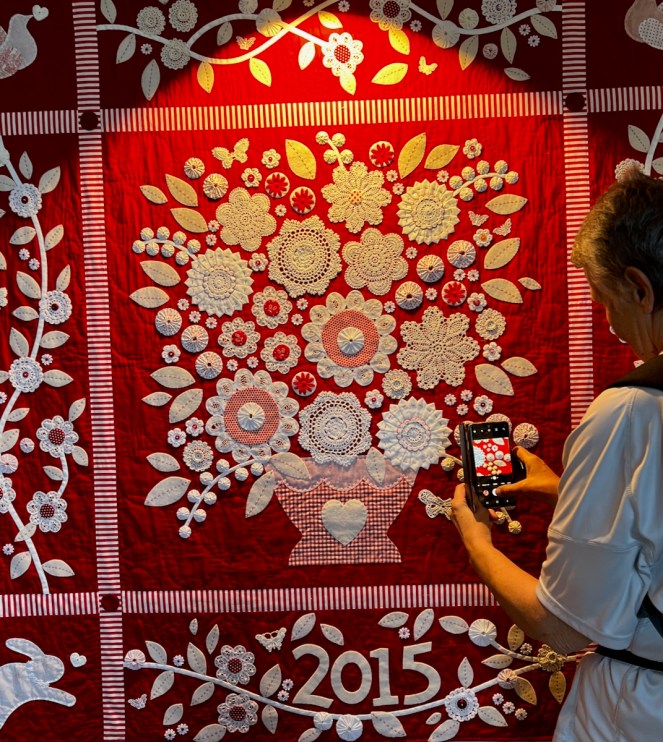
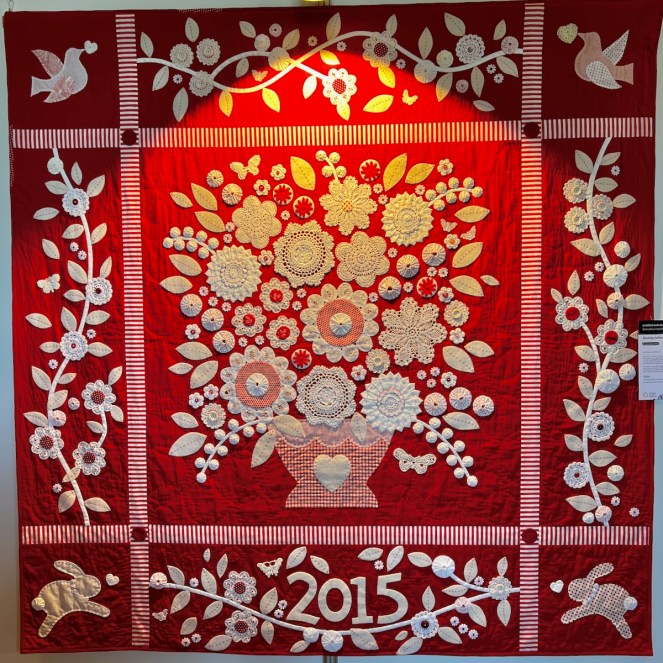
Yo-yos galore, along with doilies and appliqué; she is not a minimalist, and I love it all.
Apologies: no title card. But what do you think? Did she quilt the background, and then add the giant circular pine burr blocks afterwards? My brain is always whirling with questions at these shows.
Another scrap quilt, another inspiration.
A couple of random tourists, haha.
I just saw a smaller version of this on my friend’s IG feed. Link. Makes me want to put it in the queue for a handwork project while traveling to Pour l’Amour du Fills in Nantes in 2016.
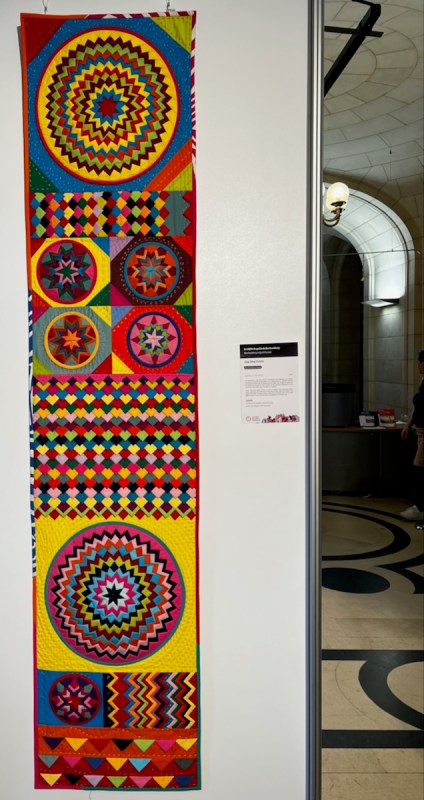
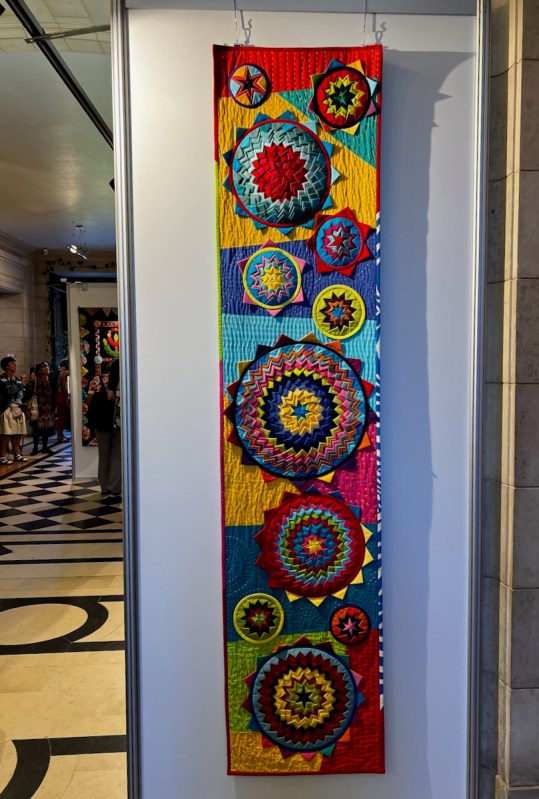
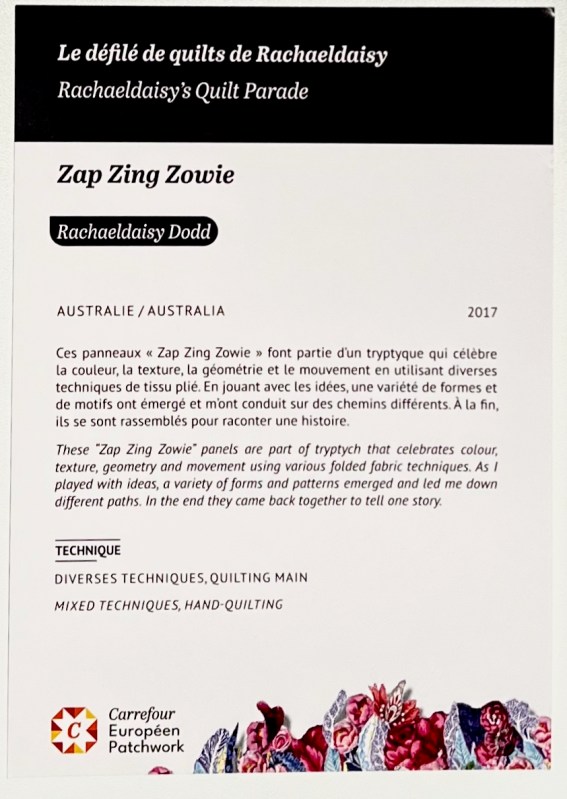
We only noticed two of the triptych of quilts. Click to enlarge the title cards and banner quilts. These were hanging by the entry/exit hall, and we were on our way out.
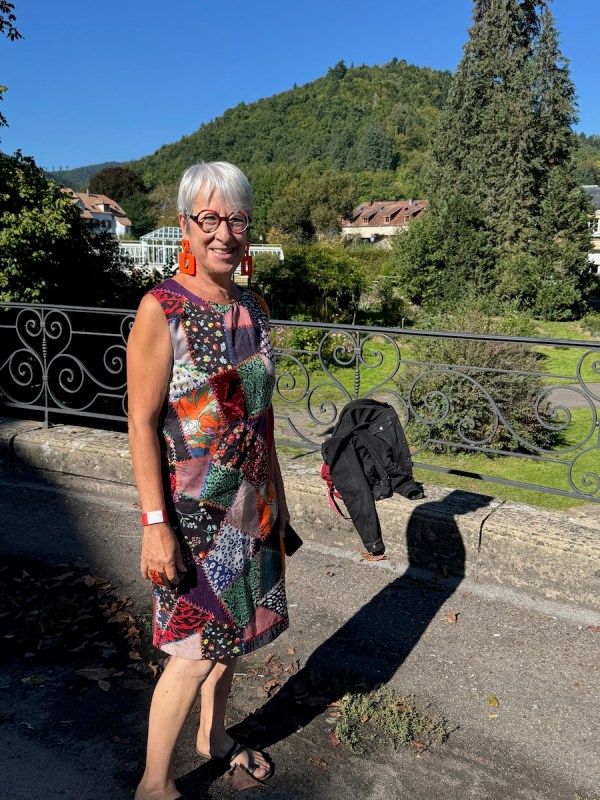
Loved her dress. I need to get a patchwork-appropriate dress for quilt shows.
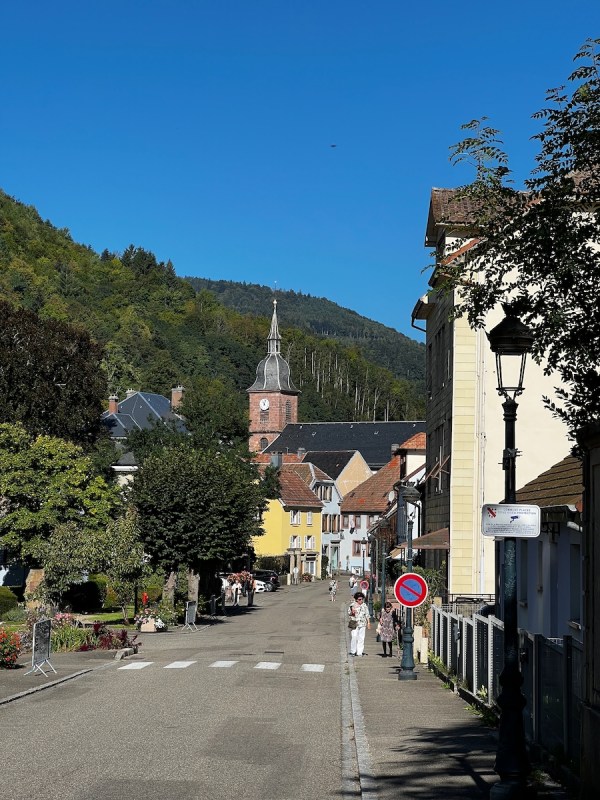
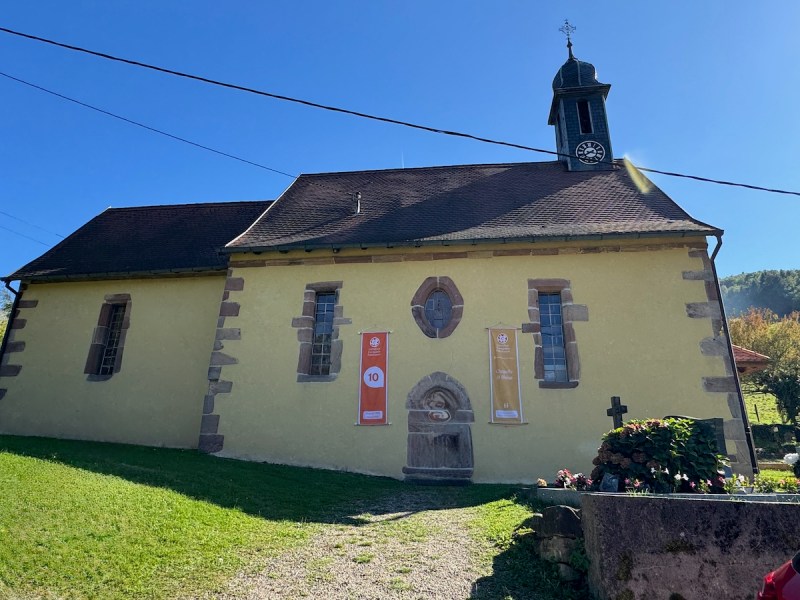
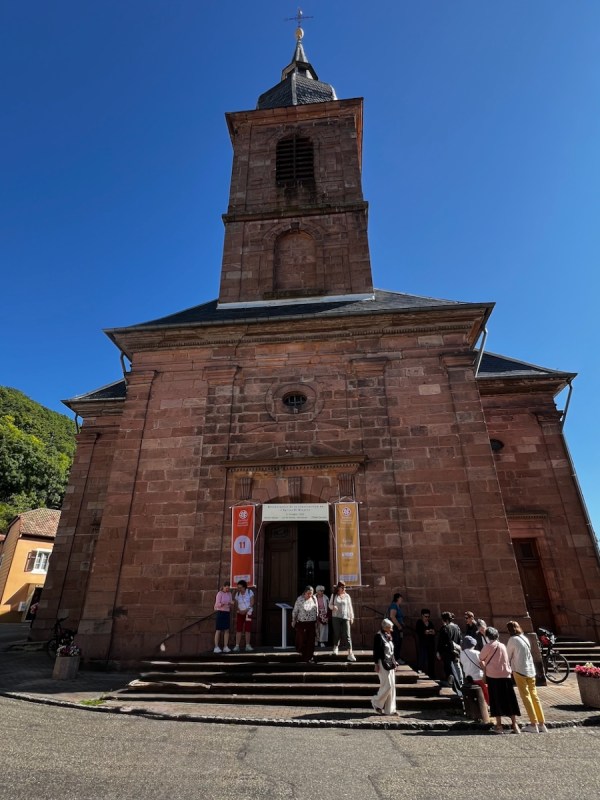
The small towns of Val d’Argent; we are currently in Sainte Croix-aux-Mines, heading to Lièpvre. The church above is Église St. Nicolas, venue 11, written about in the previous Carrefour post.
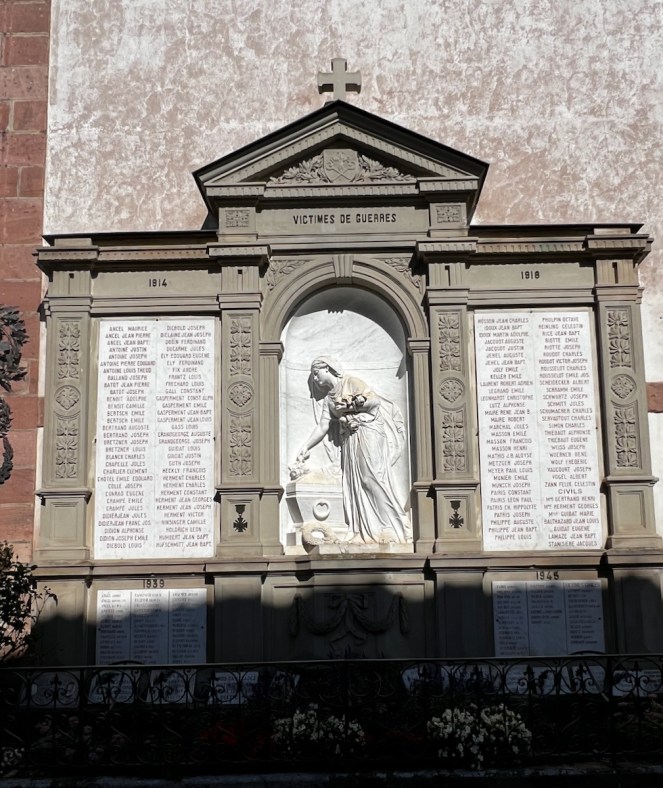
This reminds us that this portion of France went back and forth between Germany and France several times. If you’ve traveled in this area, it gives you an appreciation for the diverse, yet subtle differences between these neighboring countries (and add in Switzerland, too).
Venue 14: Église de l’Assomption, with Ruth De Vos
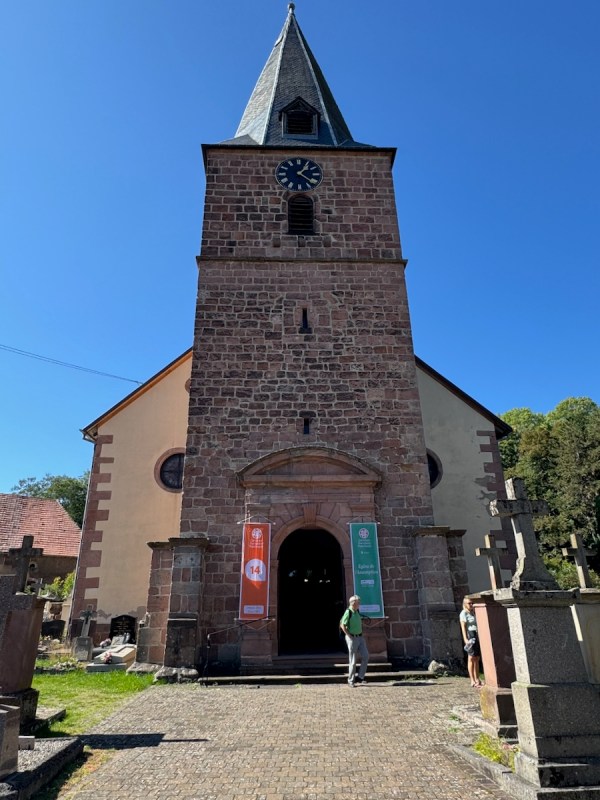
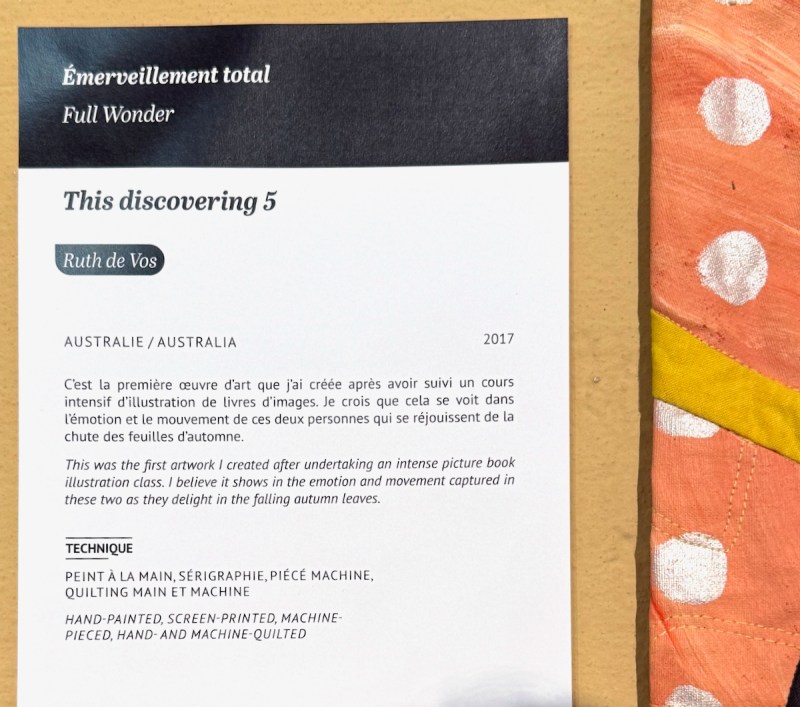
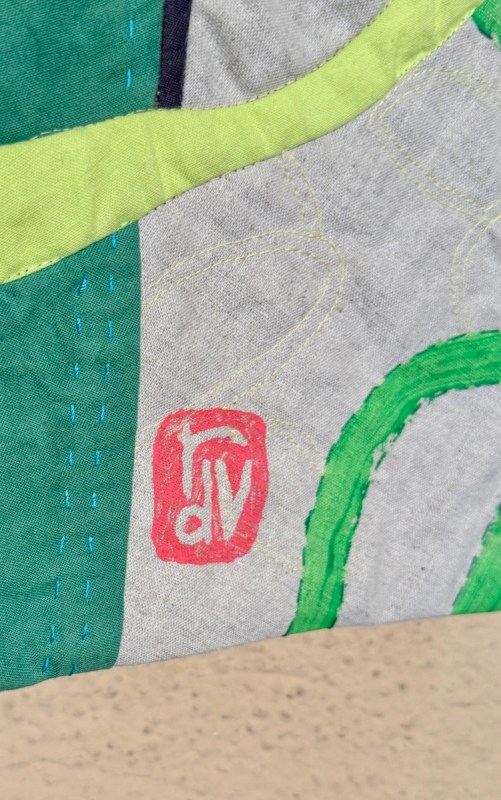
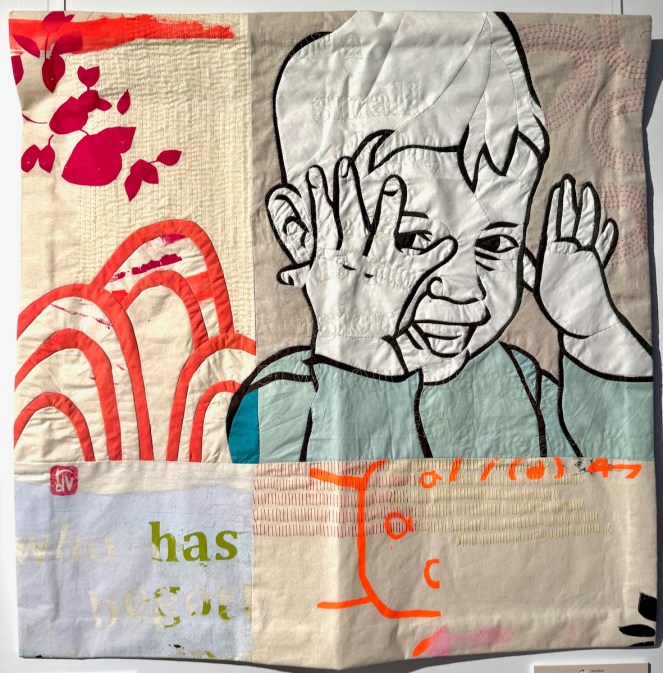
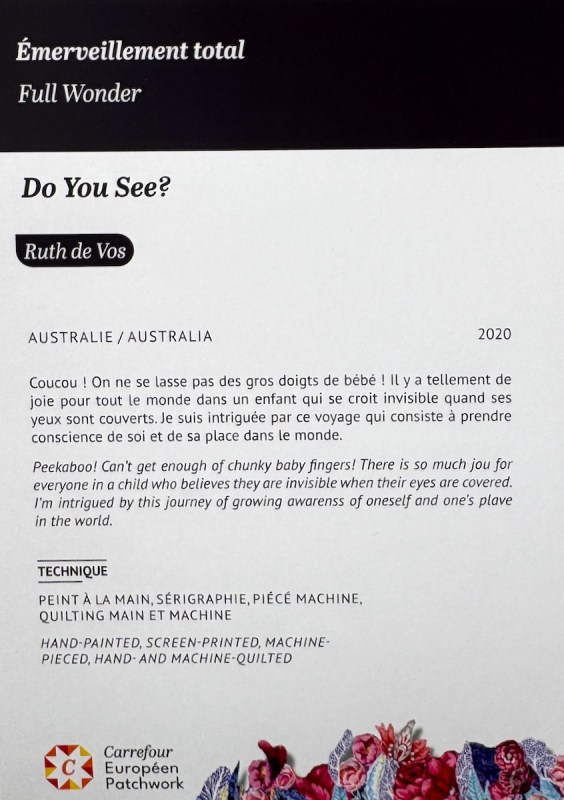
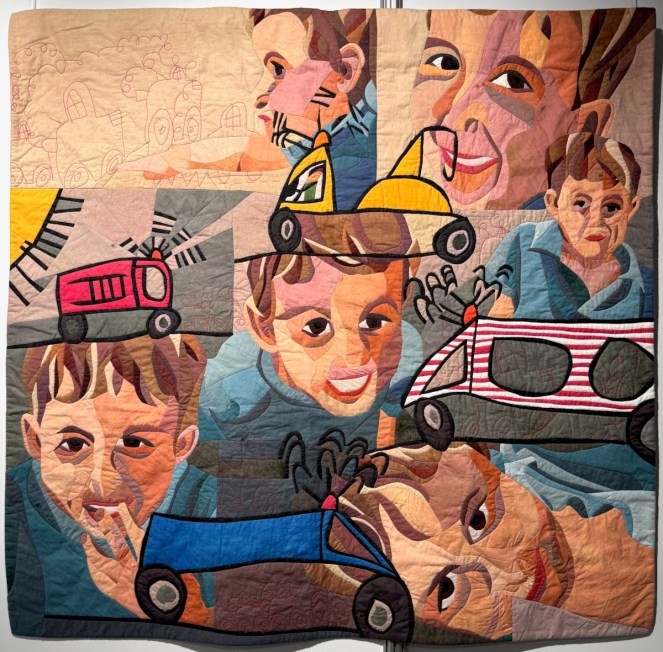
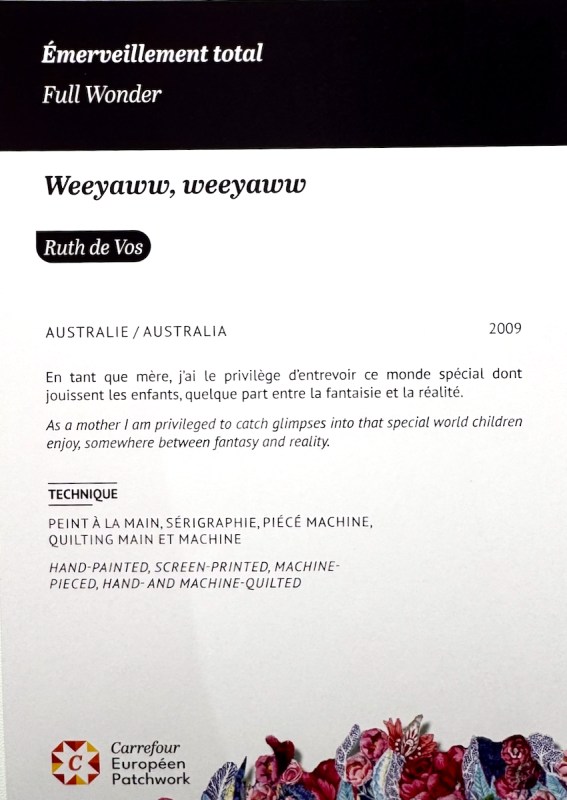
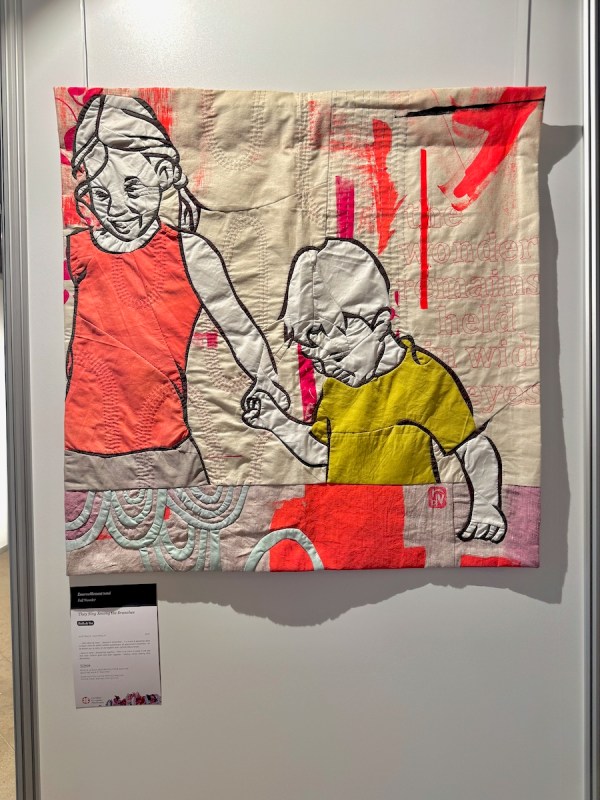
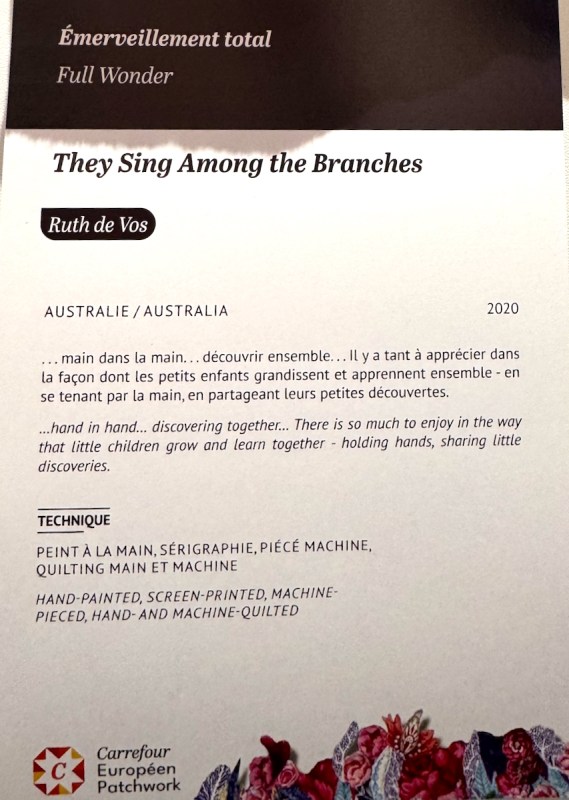
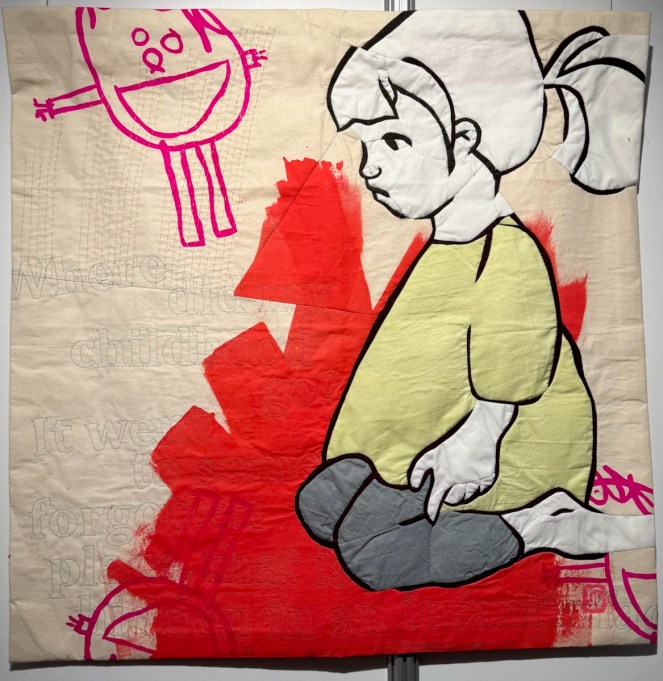
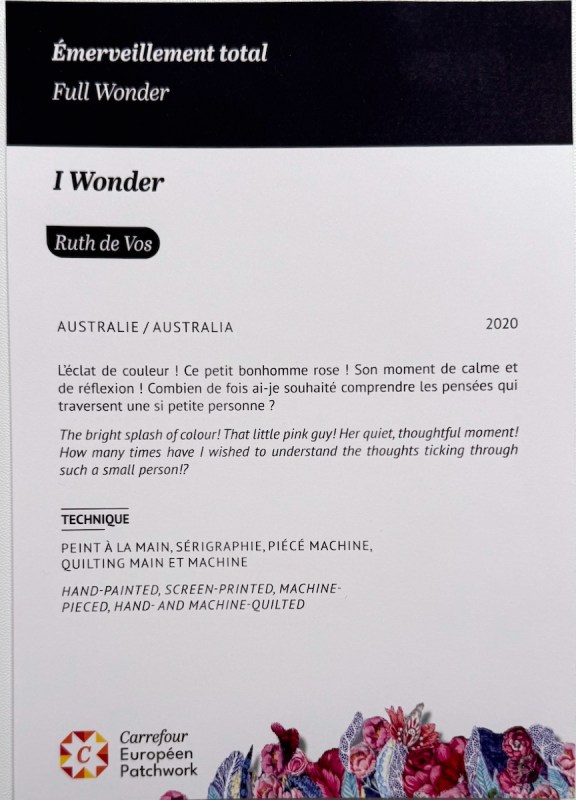
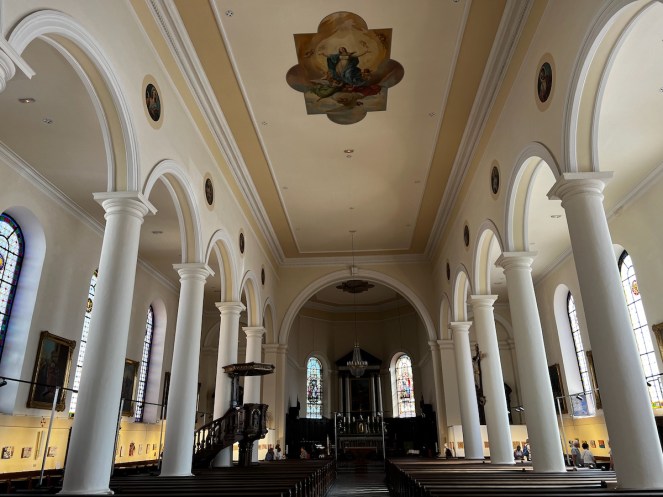
A small church in the town of Lièpvre, one of two sites in this village. Inside were new works from Ruth De Voss, she of flower fame. You can find her on Instagram @ruthdevosart.
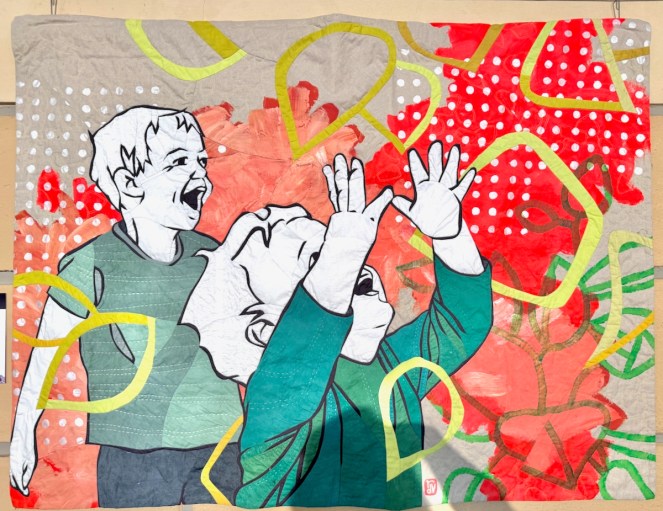
Now she has turned her piecing and printing and surface decoration skills from flowers to children. Her children, which I loved. Many women seem to avoid this side of their lives, and often in the art world they are expected to, but De Voss celebrates it.
(click to enlarge) The church had many of her art pieces; I’m only showing a selection. They were colorful, drawn with strong lines.
Click on small arrows to advance this slideshow to see more of her pieces.
Venue 15: Salle Polyvalente, with Lorena Uriarte, Dianne Firth, ASL Liépvre, EQA, France Patchwork
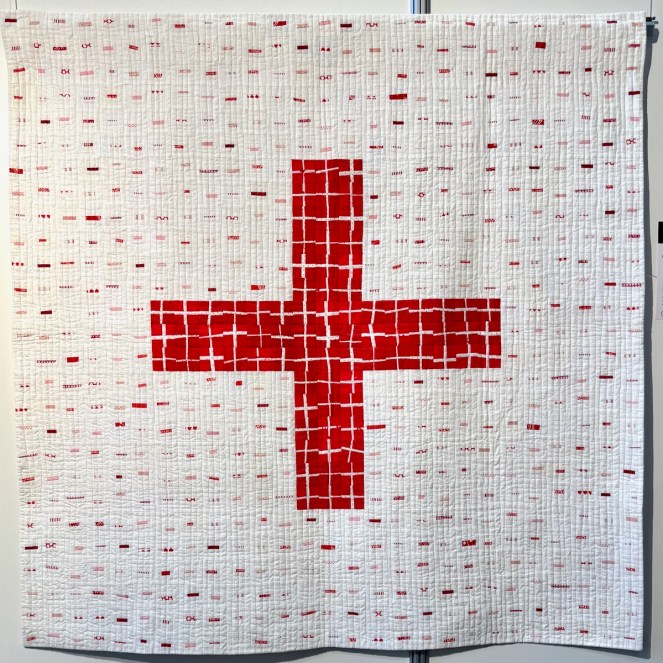
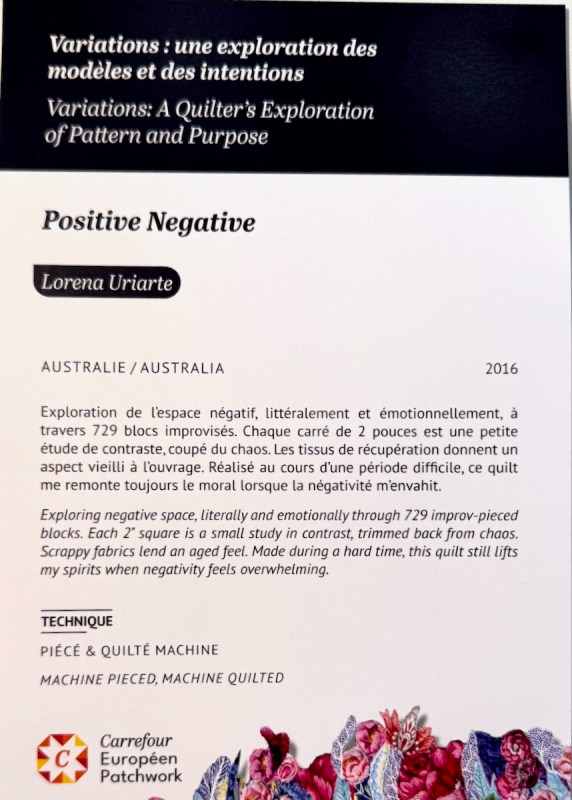
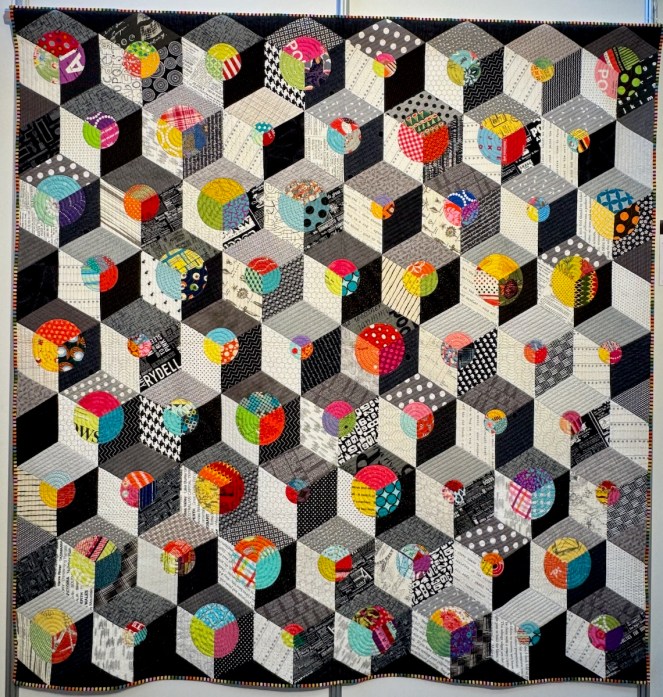
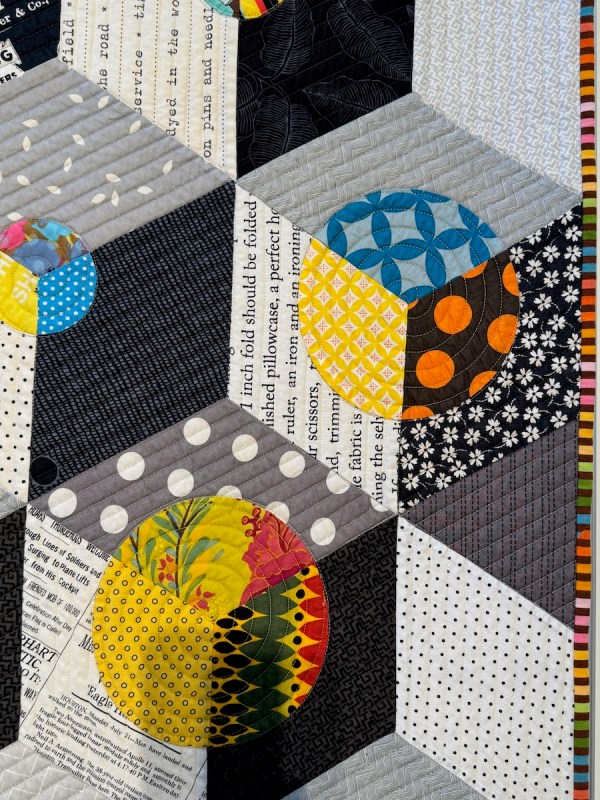
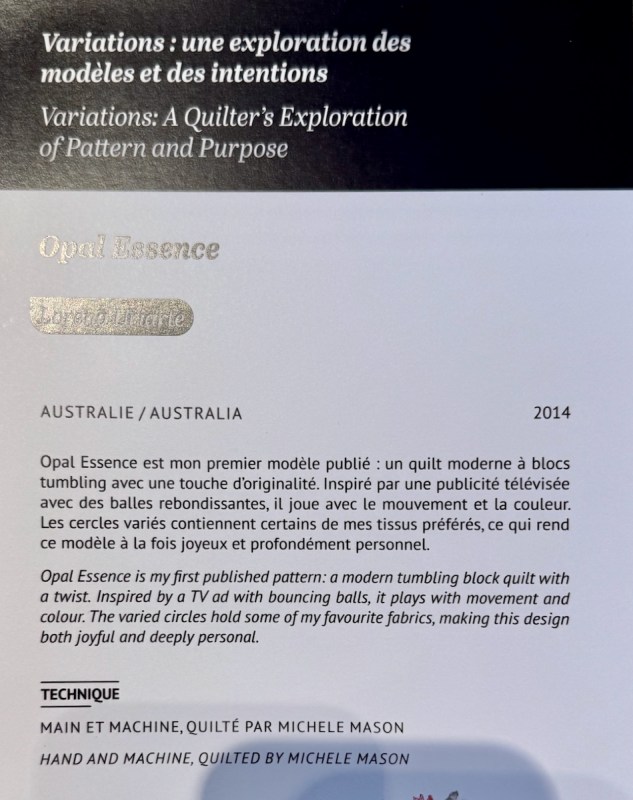
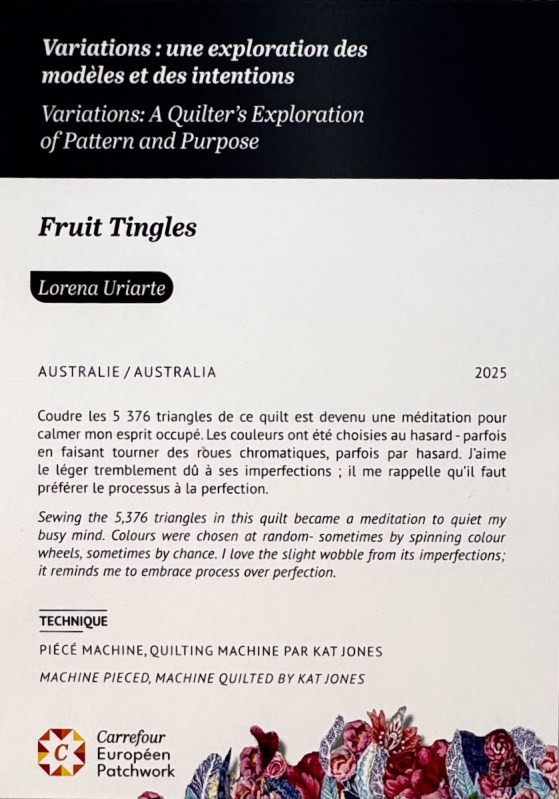
Lorena Uriarte is a well-known Australian quilter, who has been active in teaching, making patterns, and championing good design in quilts for years. You can follow her on Instagram @lorena_in_syd, as well as enjoy her quilts, below.
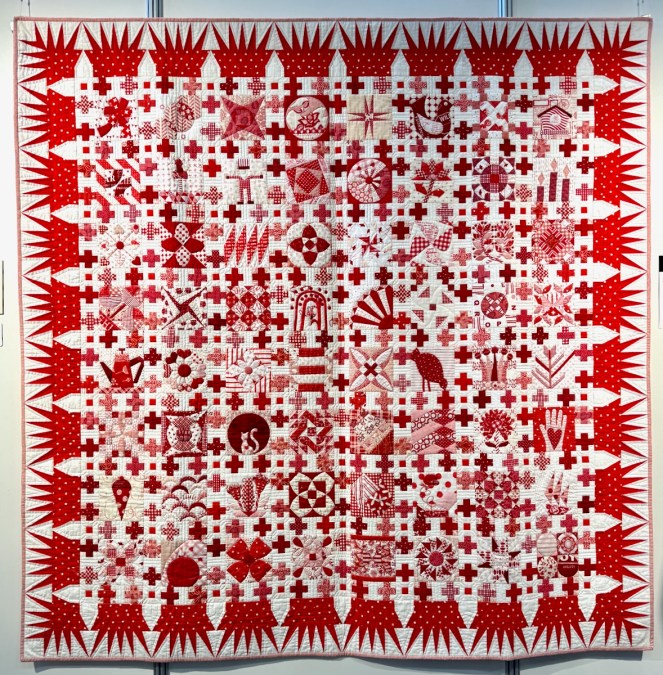
Title: Wingdings: A Variety of Symbols Title Card: This quilt “is my red and white interpretation of Chuck Nohara’s Symbol Quilt Using self-drafter blocks from her book 2001 New Patchwork patterns, I explored every piecing technique to create a playful and personal visual language.” Techniques: Hand and Machine; Quilted by Michele Mason
She had a range of her quilts hanging in this venue; they had a bold and colorful impact.
France Patchwork, and others
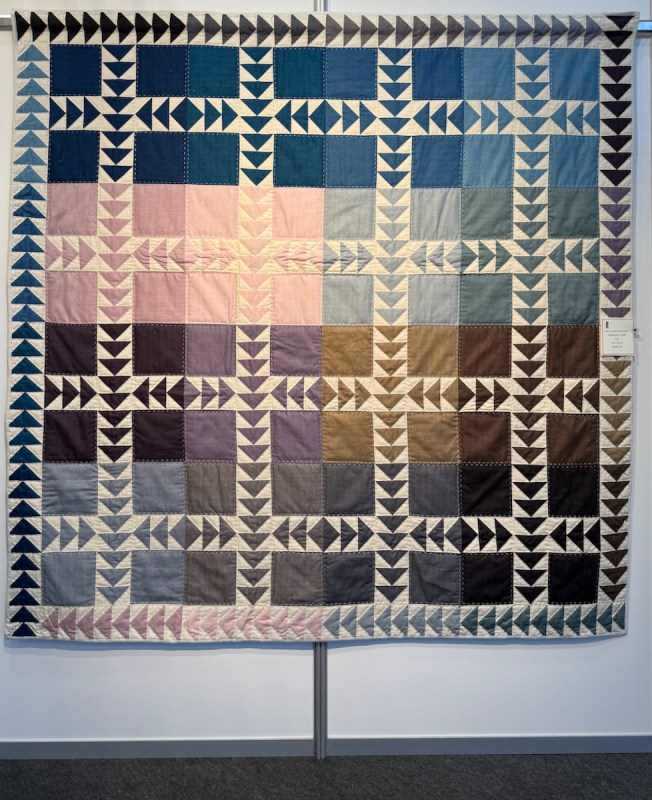
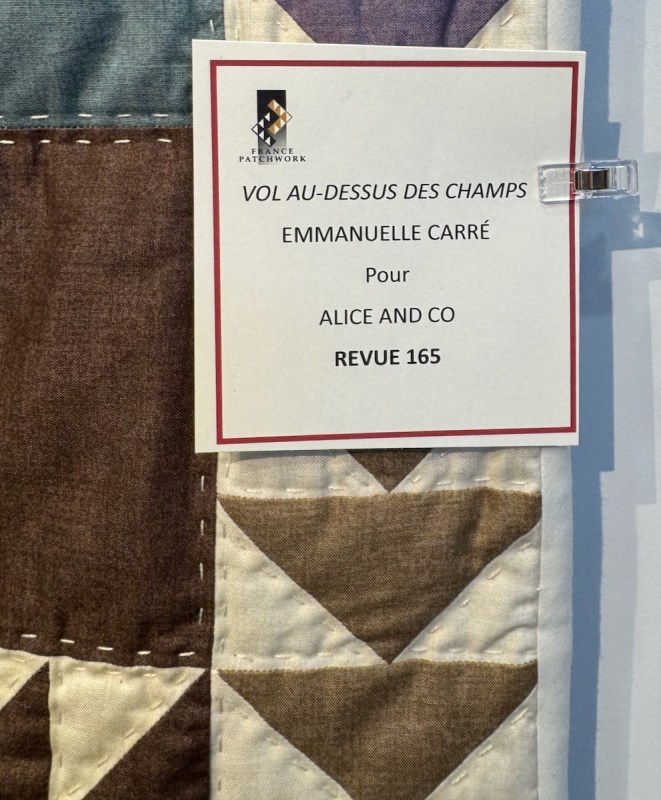
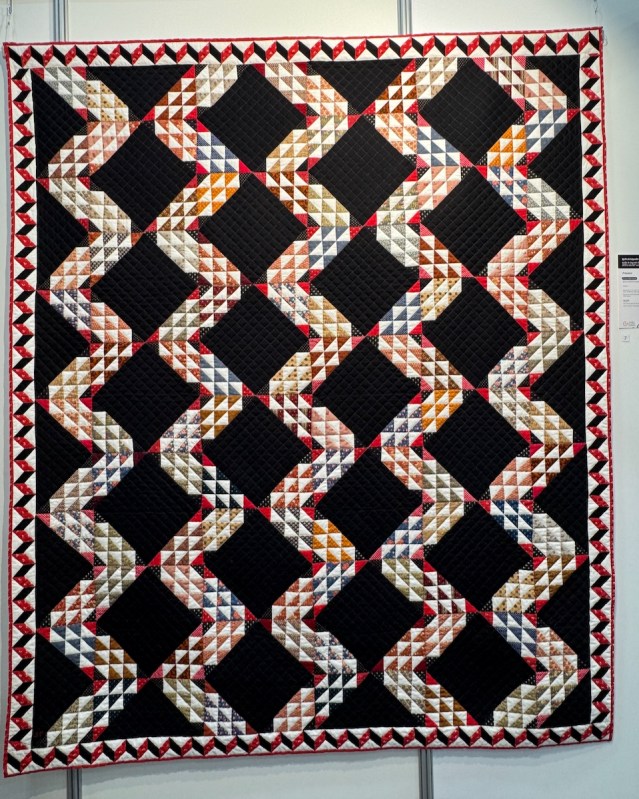
As always, France Patchwork, the national quilting guild, had a few quilts on display.
“France Patchwork is the French quilting guild, with over 6,000 members. Founded in 1984 and still thriving thanks to its volunteers, its mission is to promote quilting and its various forms through competitions, Friendship Days, and a quarterly magazine: Les Nouvelles de France Patchwork (from website).
They can be found on Instagram @france_patchwork_news. Happily this year I was there early enough to snag one of their tote bags. (One can never have too many tote bags!)
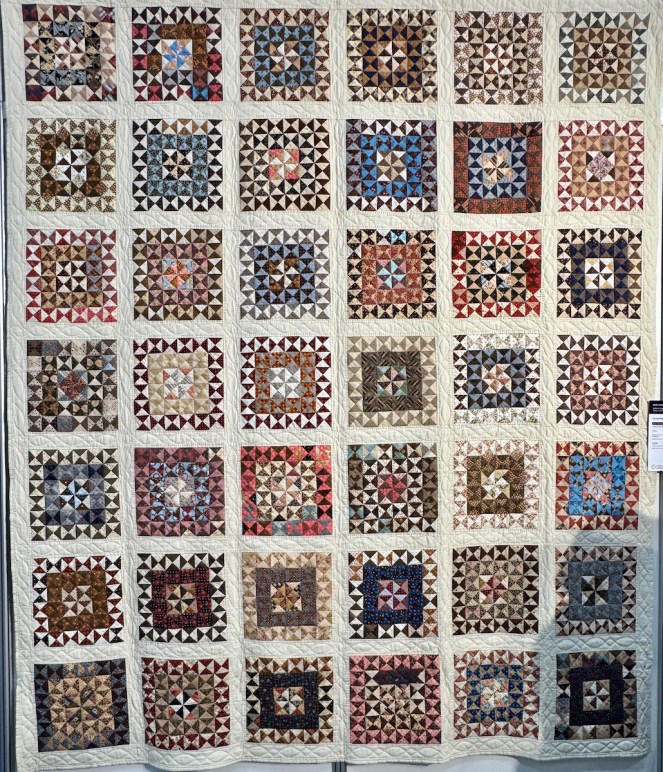
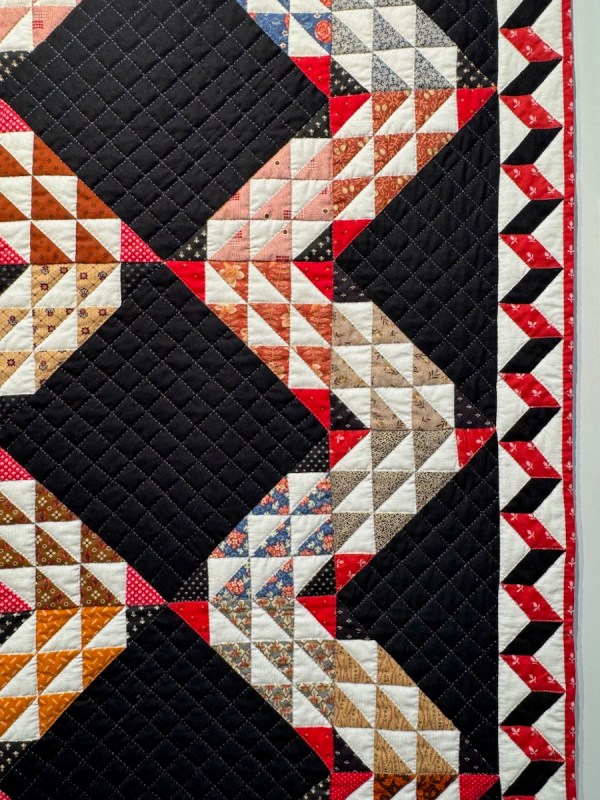
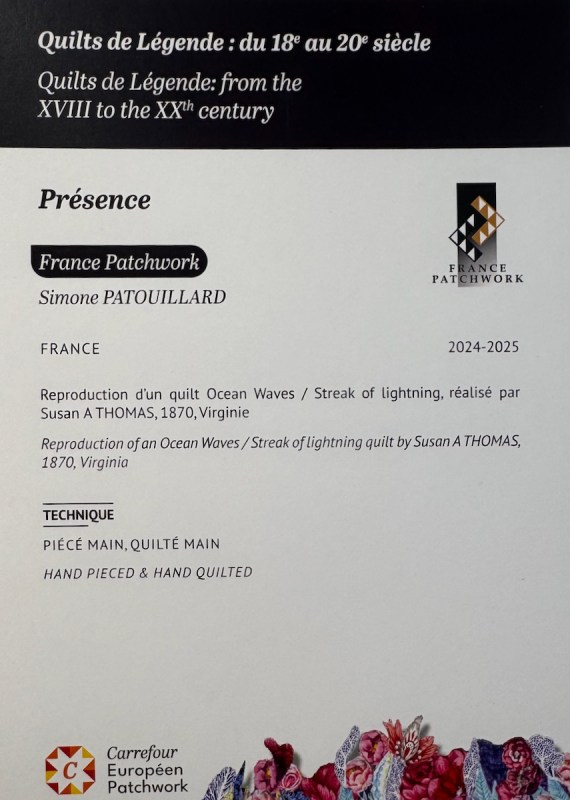
The quilting is done by hand, with heavier thread, and is more spare. I believe these quilts are the cover quilts for their magazine, Les Nouvelles, but I can’t find any working links to their magazine or their organization, beyond the Instagram account.
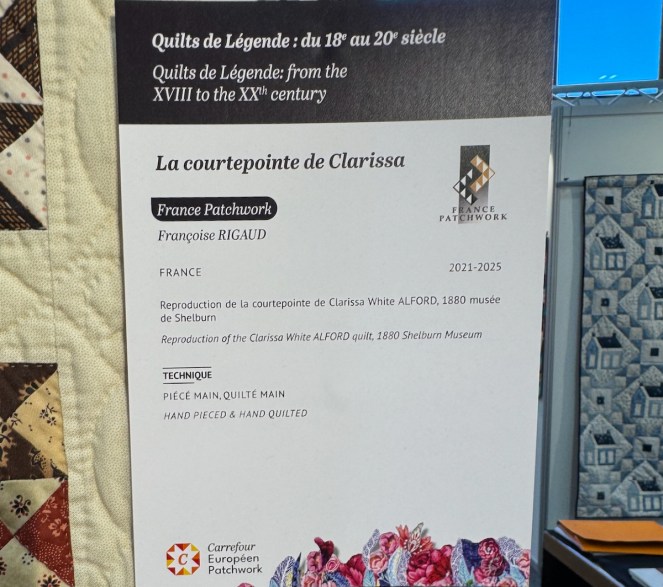
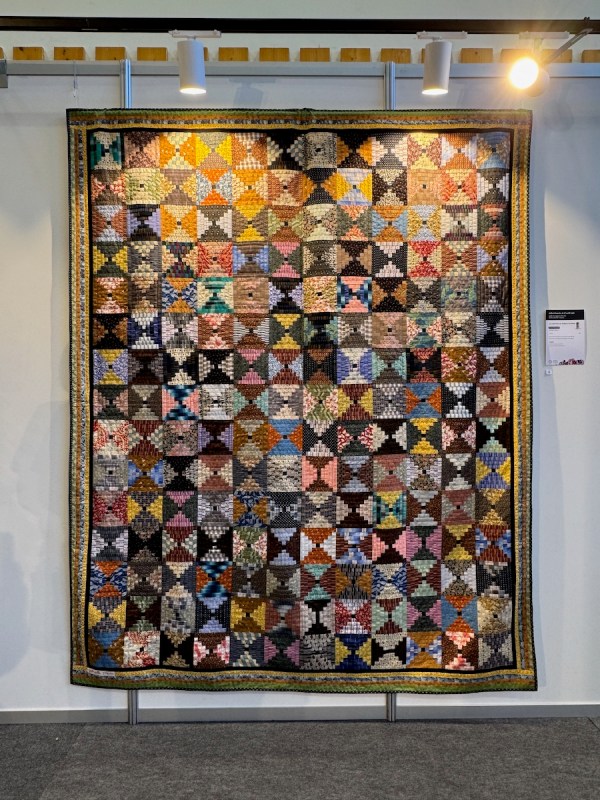
I wonder if Françoise Rigaud is with the group quilt_en_reve on Instagram? If so, they always do such beautiful work in making reproductions of antique quilts. They had a display in 2024 at Carrefours, and I wrote about them here.
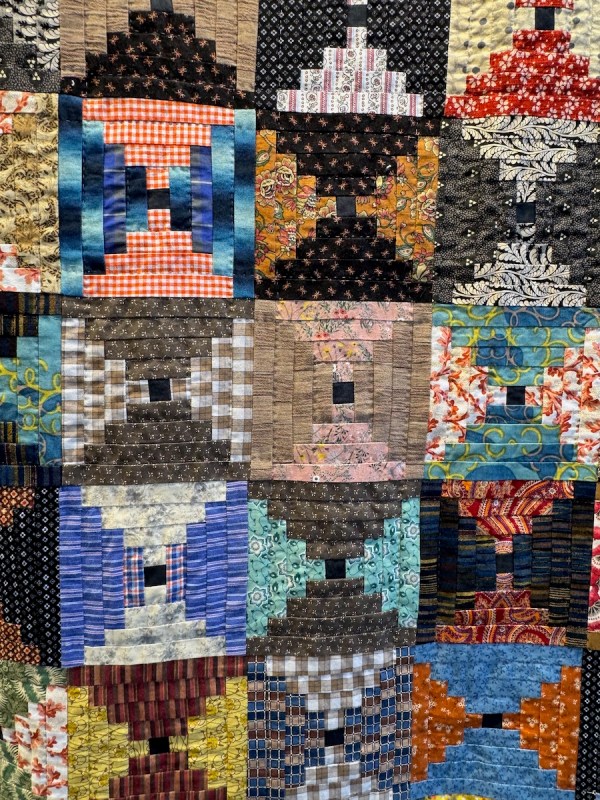
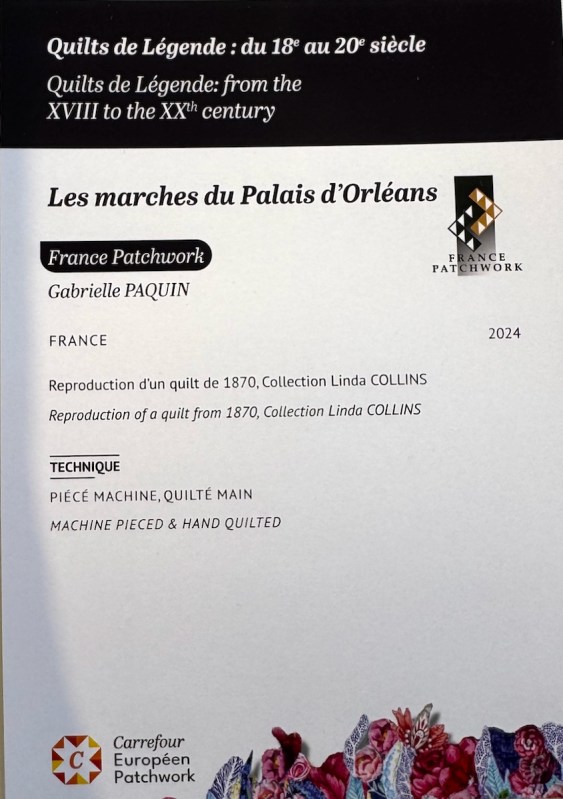
I loved the use of that ombre fabric in the one block. Gabrielle Paquin is a favorite of mine; I saw her the first time I went to Carrefour (link) and began to see I had a lot to discover and learn about our beloved patchwork.
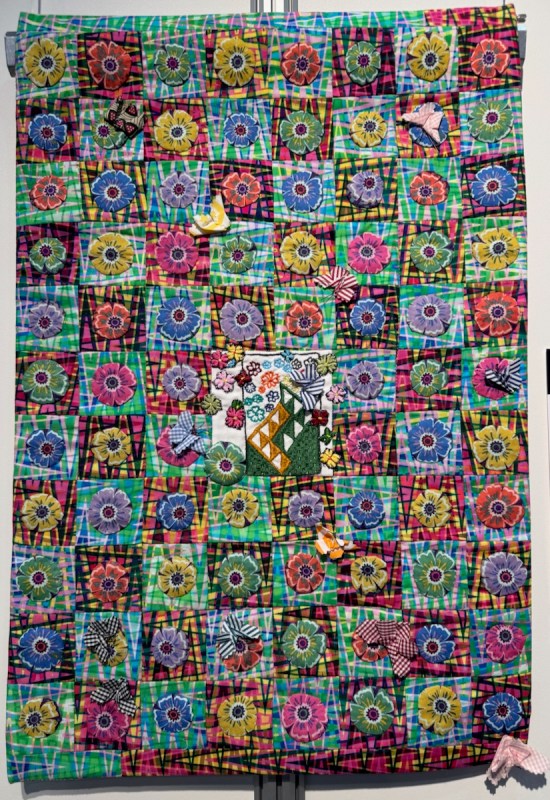
I recognized the France Patchwork logo in the center of the quilt.
And I loved the combination of appliqué and these interesting little butterflies.
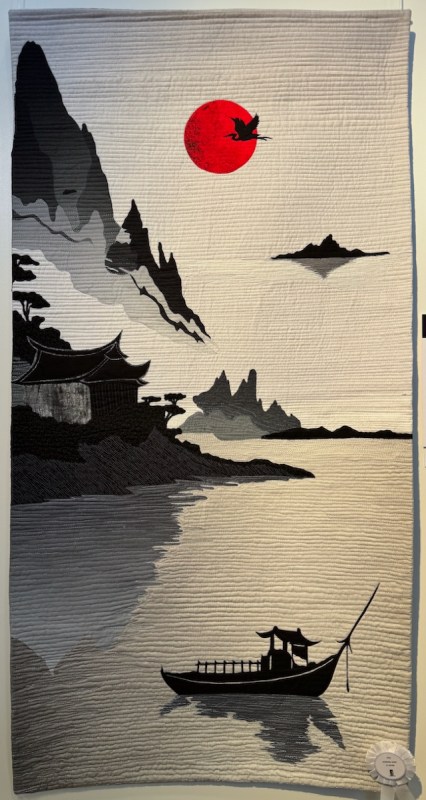
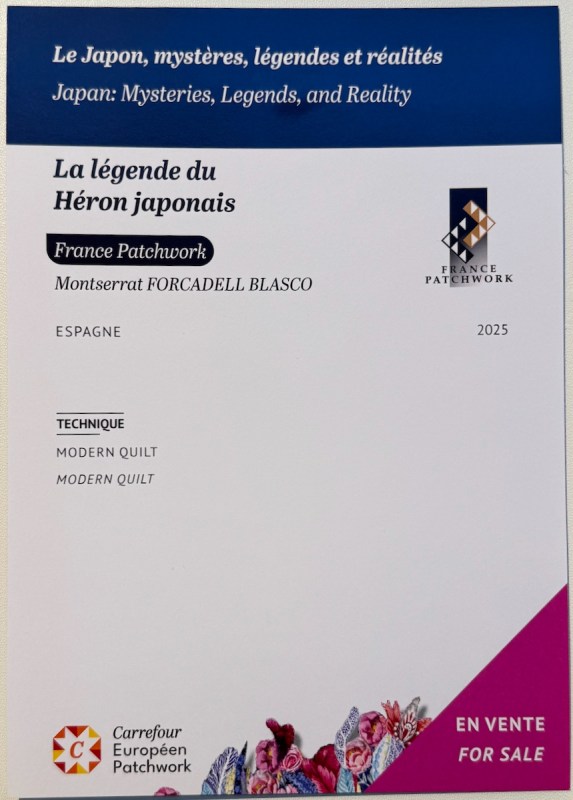
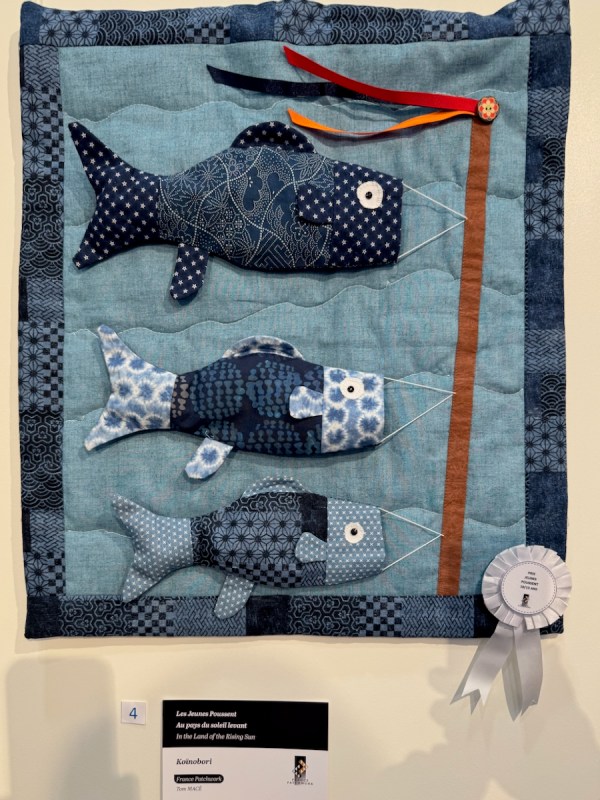
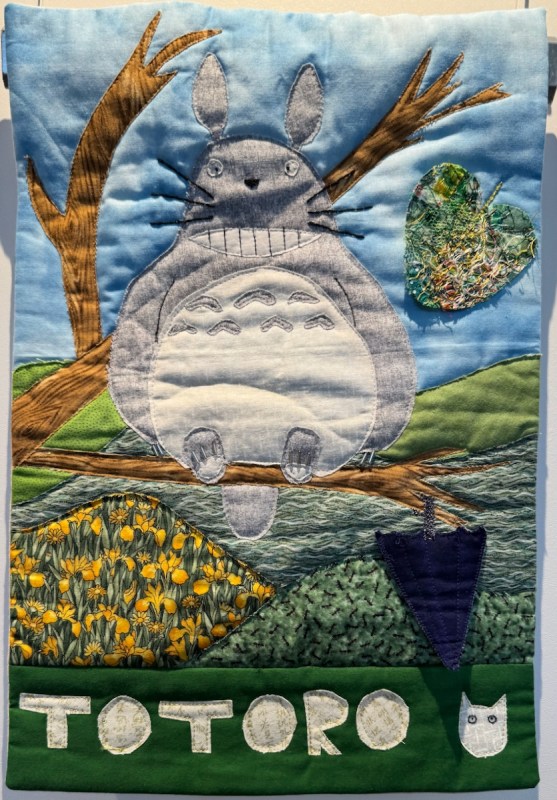
A tribute to Japan, from France Patchwork.
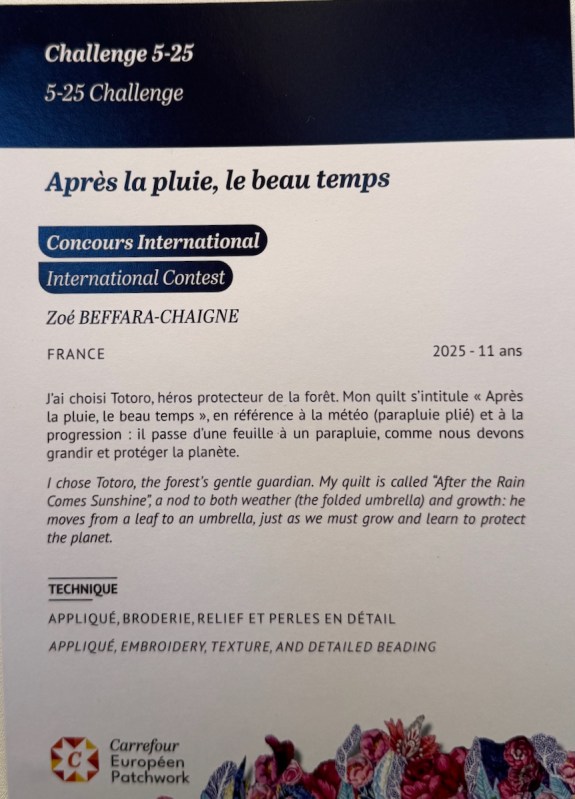
Title: Koïnobori Artist: Tom Mace, France This is from the category of “Les Jeunes Poussent” in the grouping In the Land of the Rising Sun, and was in the age group of 10-13 years old. (Literally it translates to “The Youth Are Growing.”)
The Challenge 5-25 was to encourage the interest of the youth. The website says:
“For the 30th anniversary of the European Patchwork Meeting event, we’re inviting budding artists and young prodigies to take part in the “HEROES” competition, inspired by those people and characters they admire, on screen or in real life.
The challenge is to create a patchwork quilt: a work made up of different pieces of fabric, illustrating the theme of heroes. Think of everyday heroes and heroines, cartoon characters, bright colors and comic books for inspiration!”
Diane Firth
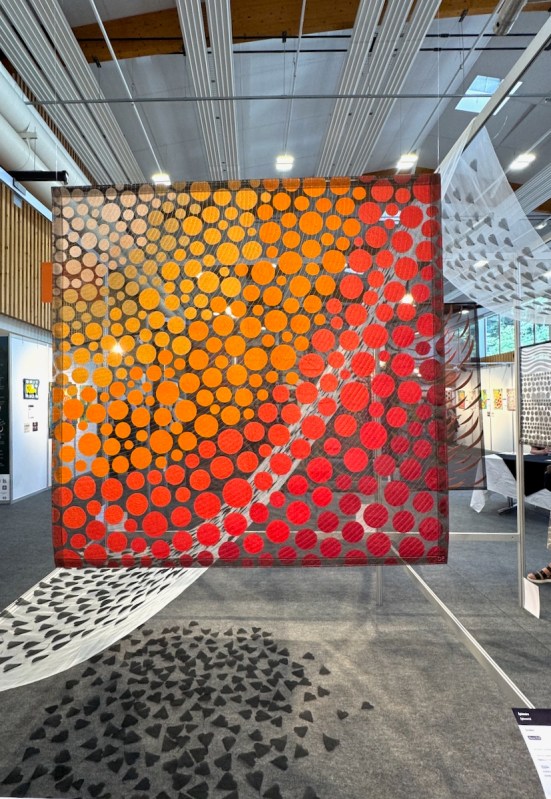
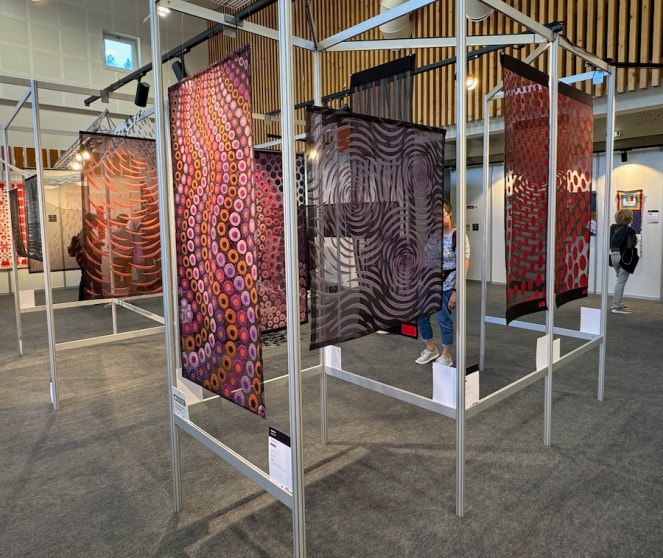
And now, for a complete change of pace in quilting, here are some transparent quilts made by Diane Firth, of Australia. This is titled Scatter, which was inspired by the dispersal of seeds.” The title card also notes, under techique, “Assembled and Machine stitched on Bernina 770.”
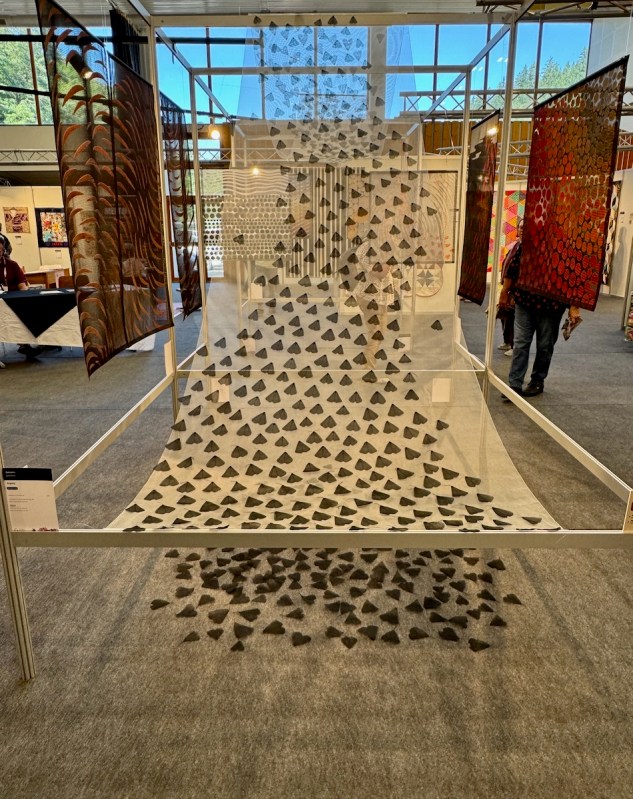
Title: Bogong Description: The moths emerge from the black soils Technique: Machine and hand-stitched
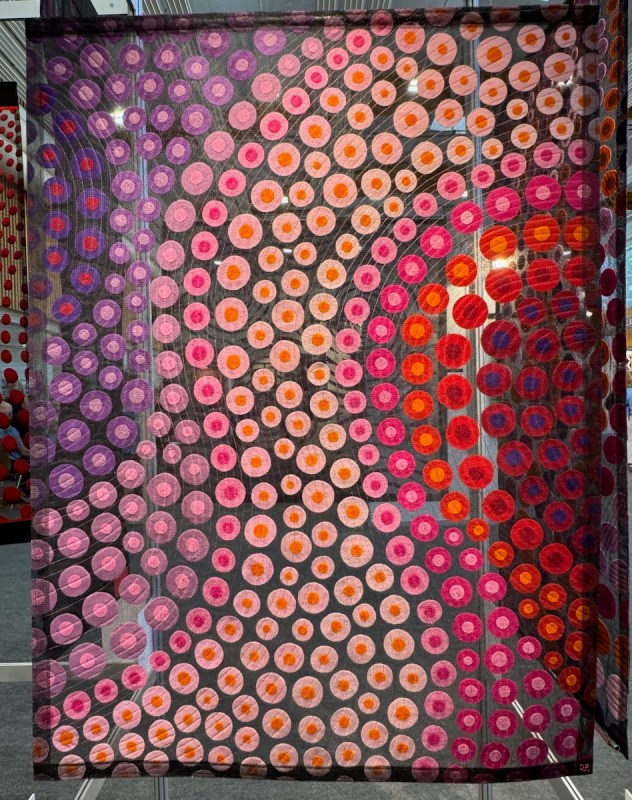
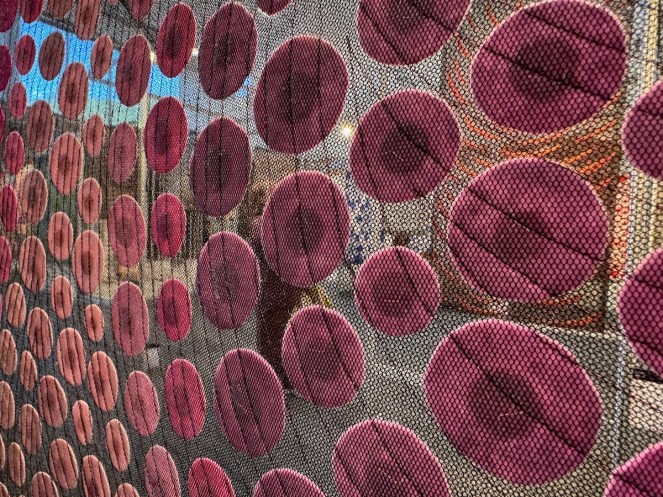
Title: Floriade #4 Description: Floral Abundance This black mesh netting was in several of her pieces, holding the circles (which looked like felt) in place. The Carrefour website says this about Diane: “Dianne Firth, a quilter for almost 50 years, is a landscape architect and academic. She exhibits regularly in juried exhibitions and her works are held in public and private collections around the world.” The OZquilt Network has a page about her where you can read more.
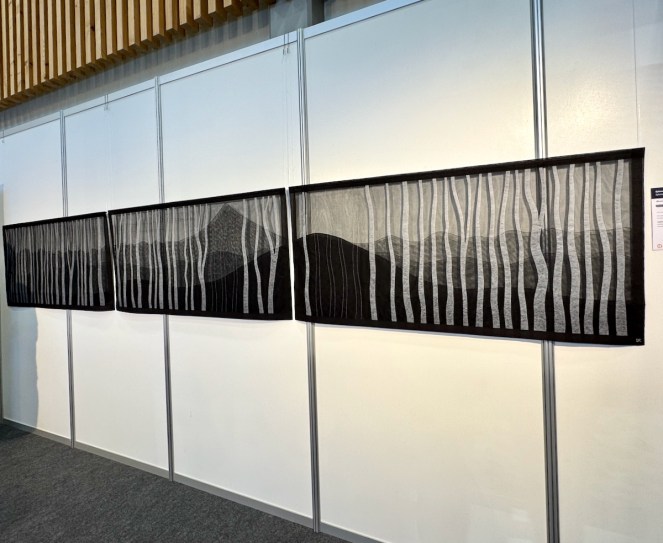
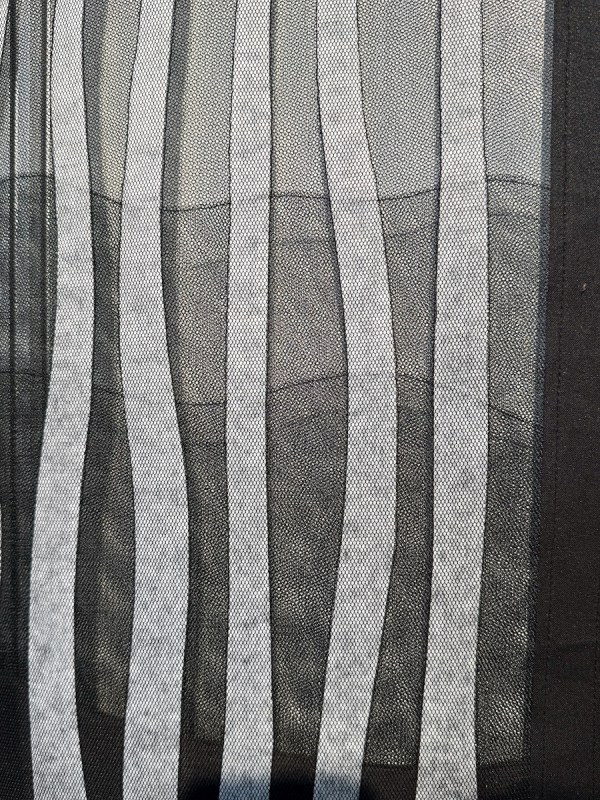
Title: Black Mountain Description: An exploration of changing landform This is one of the larger pieces, but the entire display was intriguing and again made me ask the question about what is a quilt? Clearly, hers has three layers, but it is so inventive and structural.
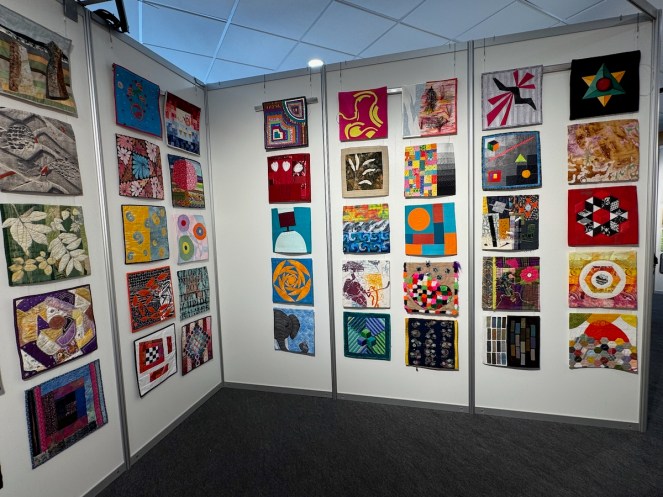
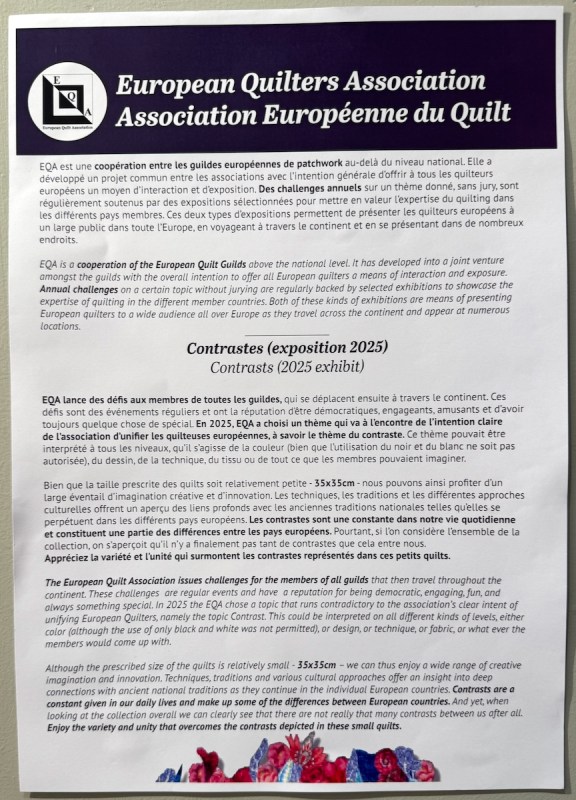
EQA: European Quilters Association: Contrasts (2025 Exhibit)
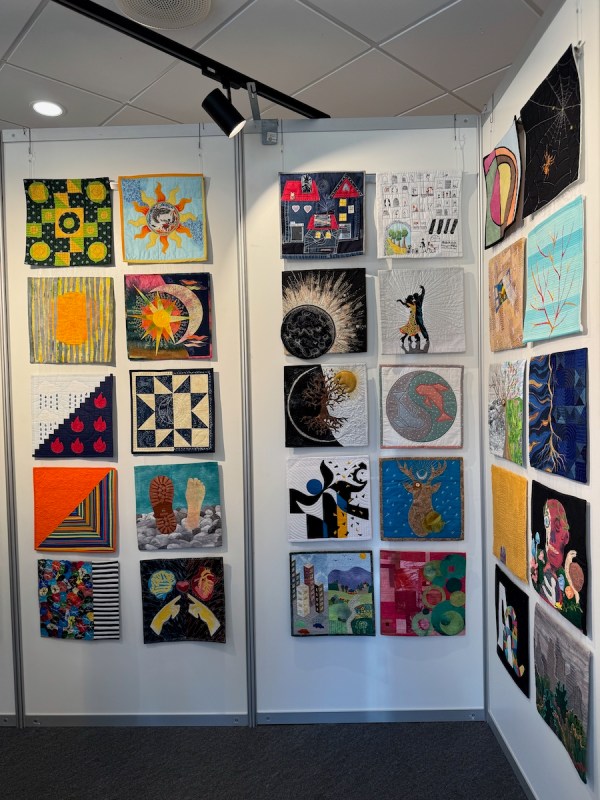
The EQA is a cooperation between the European quilt guilds, and has a yearly challenge of small quilts (35 cm square, which is about 14 inches). As always, I spent a lot of time looking at the artworks. Here’s the Challenge:
(If you right-click to open this in another tab, it may enlarge for you.) What intrigued me was the line in the last paragraph: “Contrasts are a constant given in our daily lives and make up some of the differences between European countries. And yet, when looking at the collection overall we can clearly see that there are not really that many contrast between us after all.”
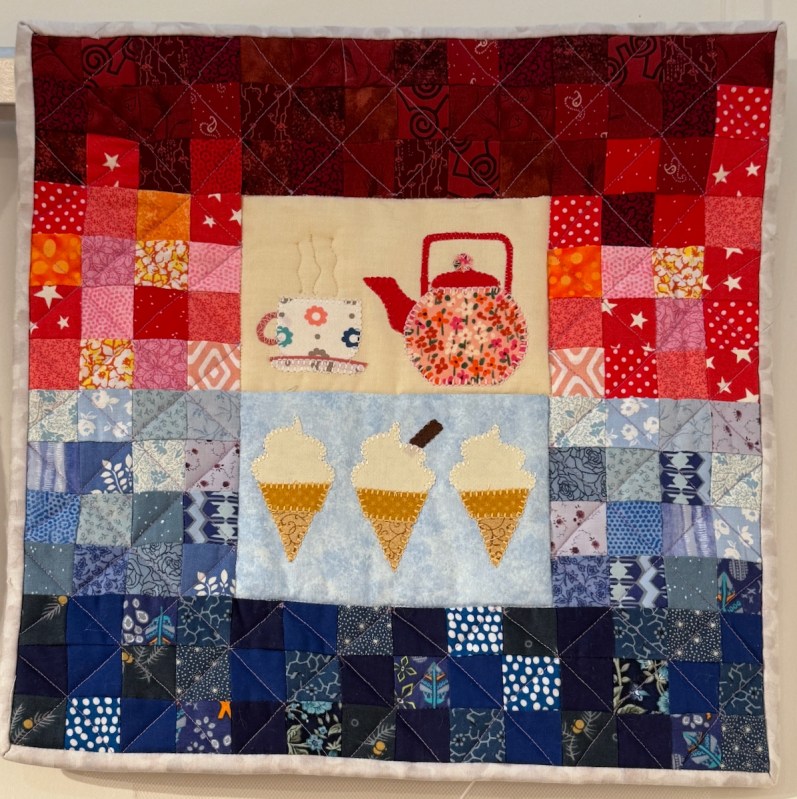
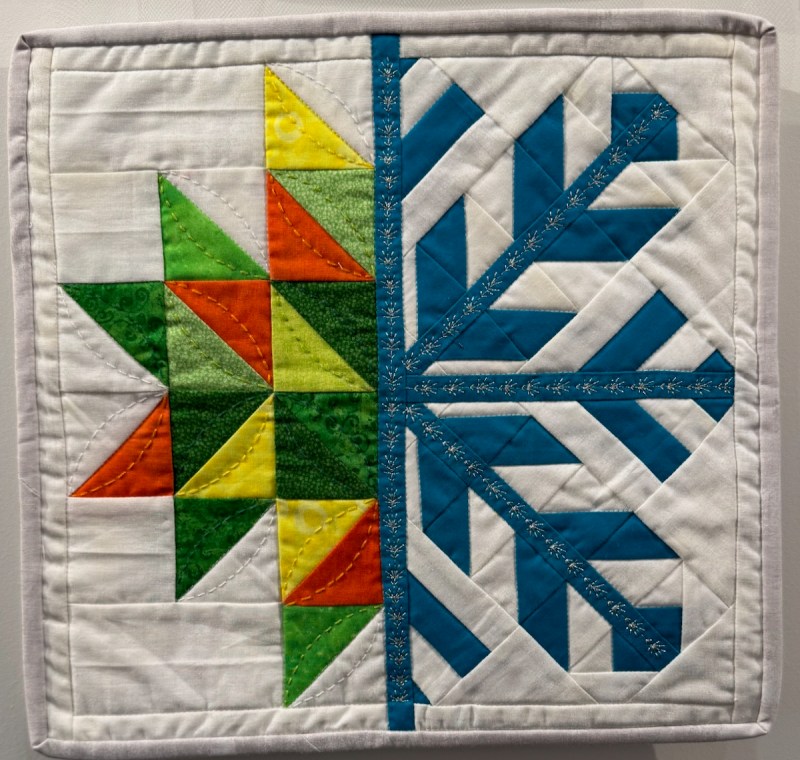
Here are a few of the many, many wonderful quilts.
After this, we leave the venue and try to decide if we hungry, as this year…they have a full lunch service just outside. Tempting, but we went to the market at the edge of town, grabbed something and drove to Rombach-Le-Franc, the last town. We parked outside the Espace Raymond Hestin, and ate our shared lunch in the car, in the shade as the day had grown hotter.
We were on the last two venues of the show. We’d started the day before, and went through the vendors and other spaces in Sainte Marie-aux-Mines, then headed to Saint Croix-aux-Mines and got to Venue 12, before calling it day and driving back to Colmar.
We got up early the second day, picked up again with the Australian quilters in Venue 12, and progressing through the show. Now, eating lunch there in the parking lot, we talked about if we’d be back next year (no), and what we liked and didn’t like. My husband is a great partner in this adventure and I regularly talk quilting with him. Many of the photos you’ve seen have been taken by him.
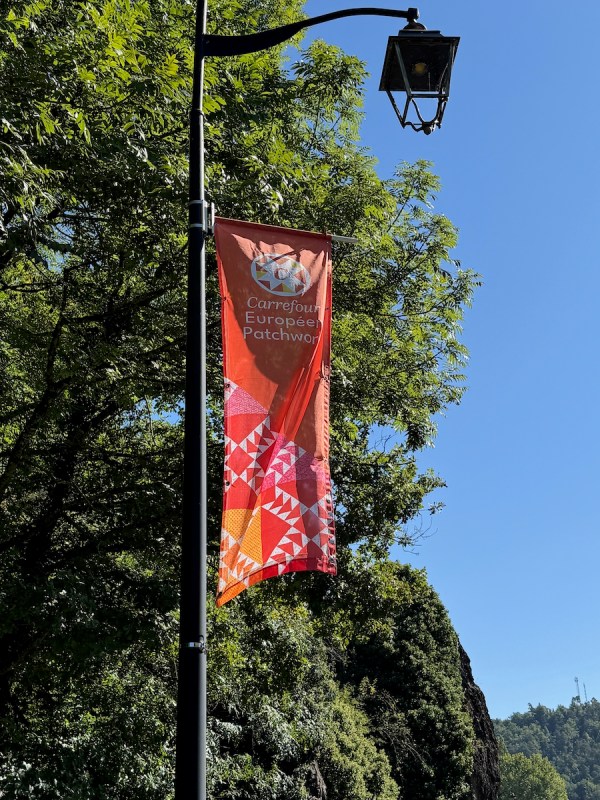
Along the road to Romach-le-Franc. We tried for this three times, pulling U-turns to double back to get the wind just right in the banner.
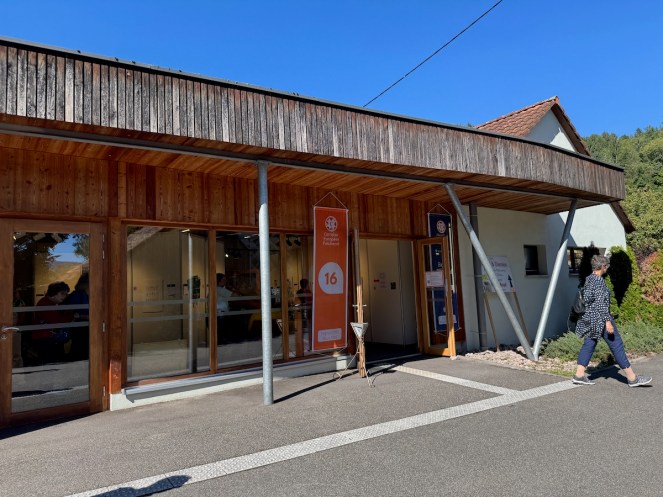
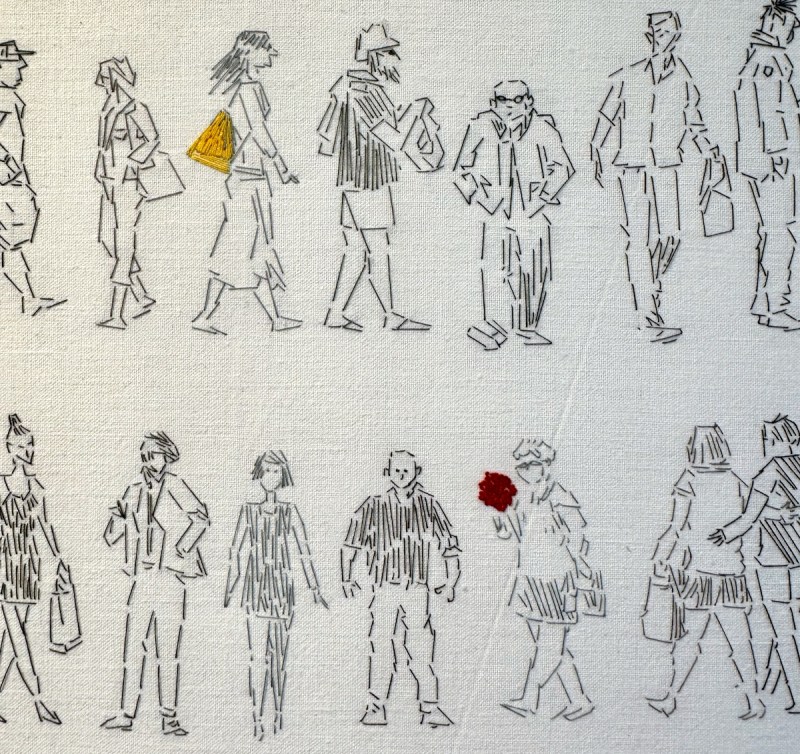
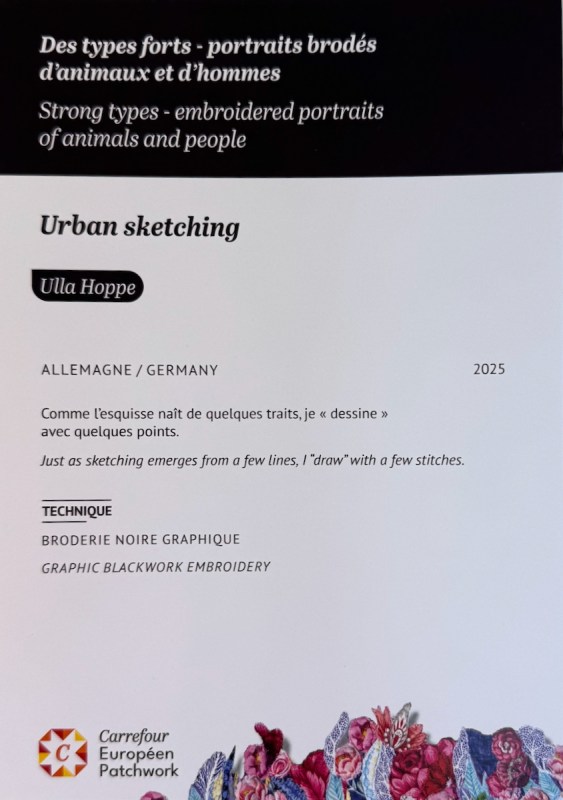
Venue 16: Ulla Hoppe
Here we go! This venue is quite small, and while there were a couple of exhibits there, I’ll mention only one.
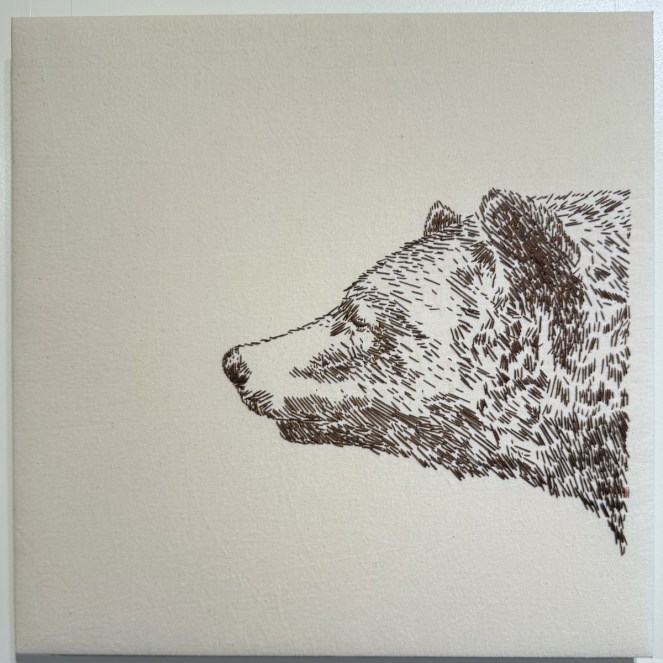
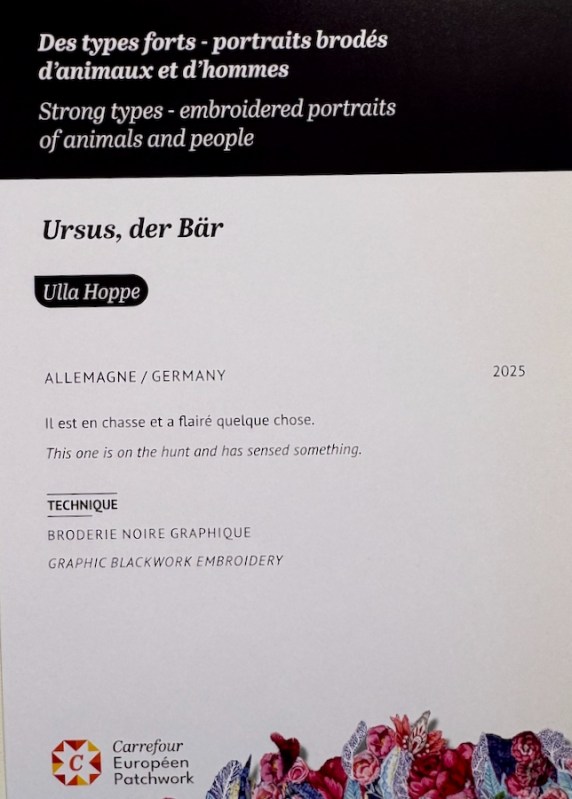
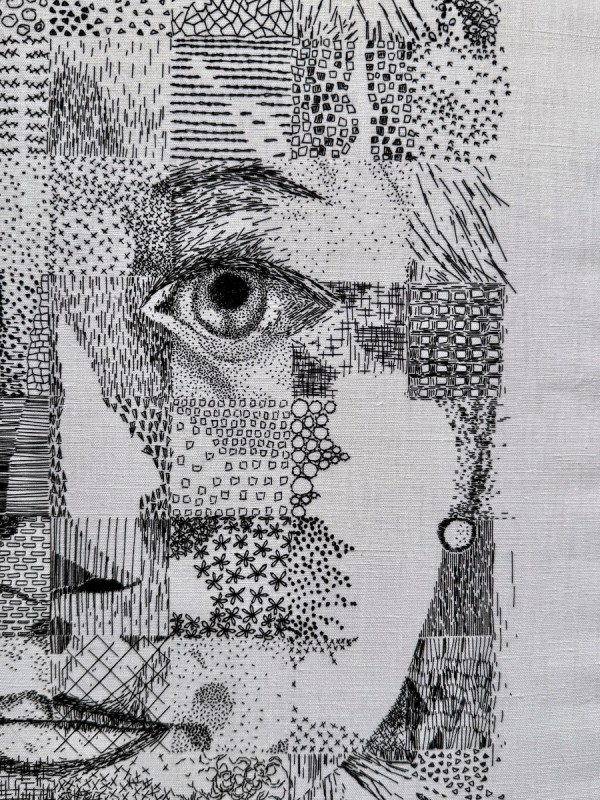
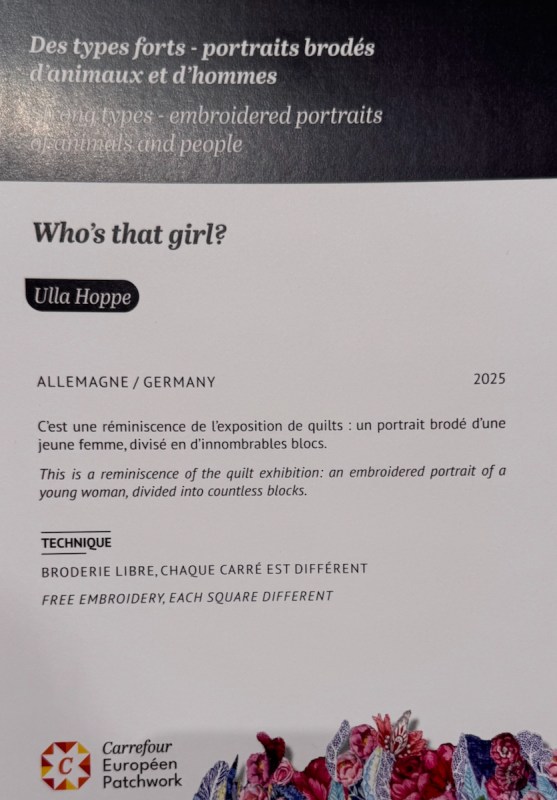
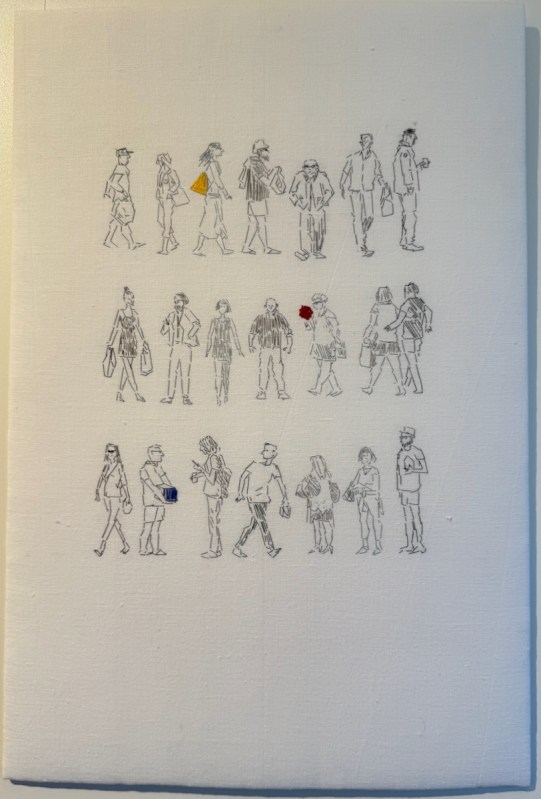
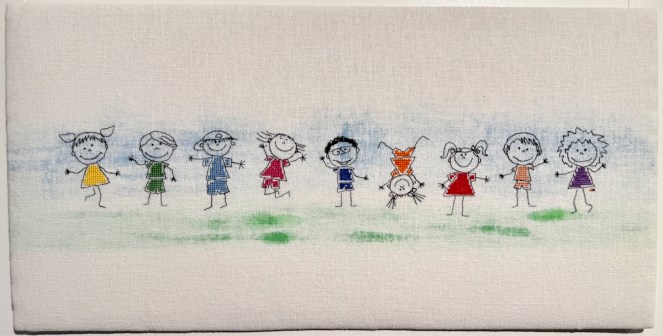
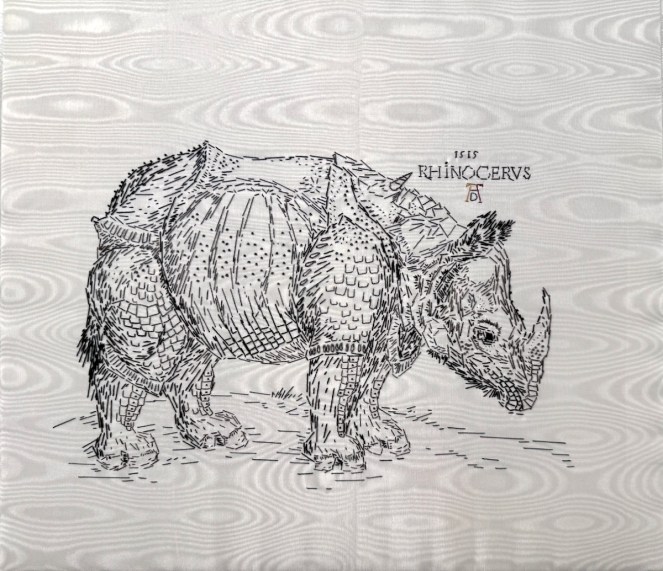
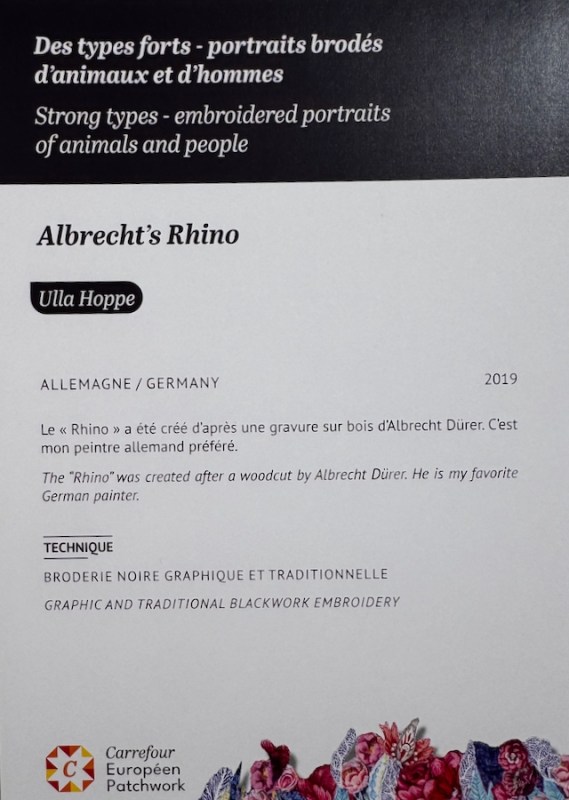
Ulla Hoppe, from Germany, was exhibiting her stitching, embroidery. Not quilting, but I thought it was amazing.
The range of blackwork stitches really brings the complexity of the young woman into focus: aren’t we all full of discreet “countless blocks?”
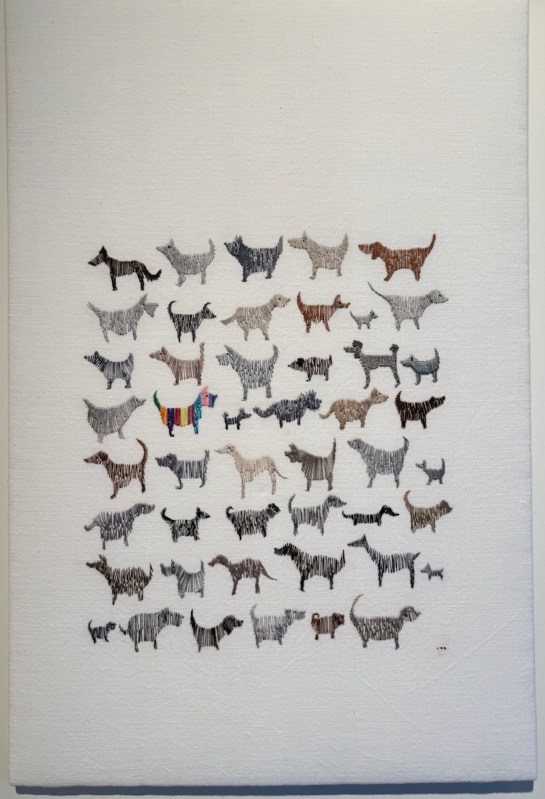
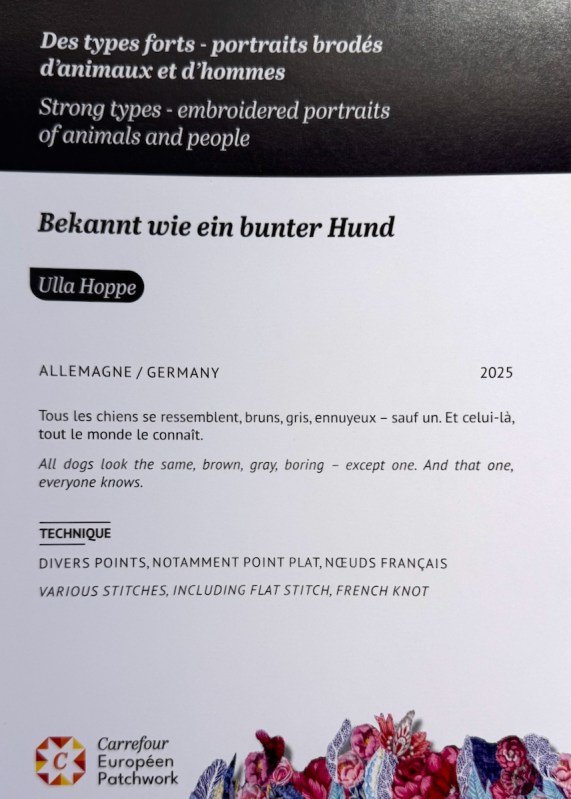
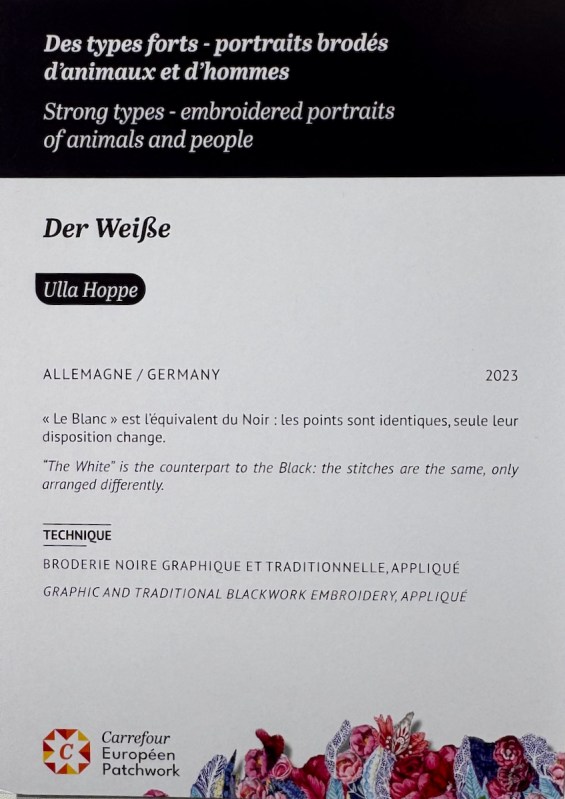
I loved the title of this piece.
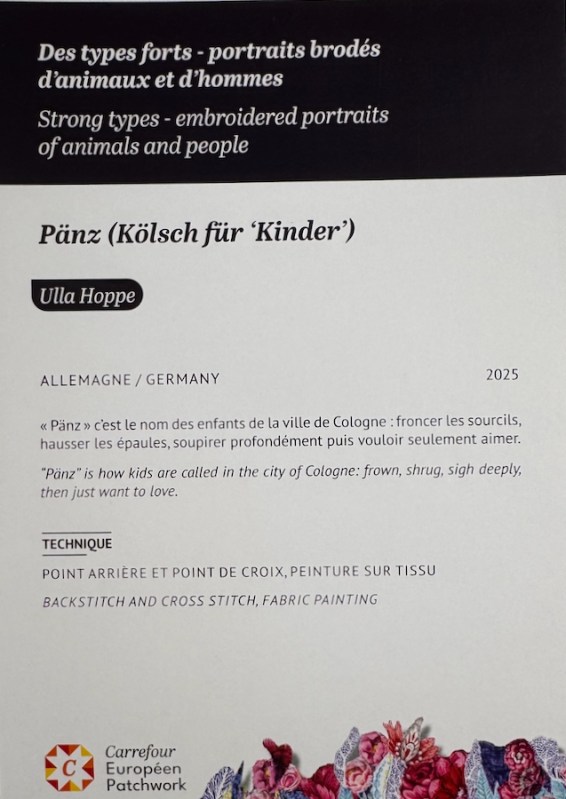
“That one” lives across the street from me!
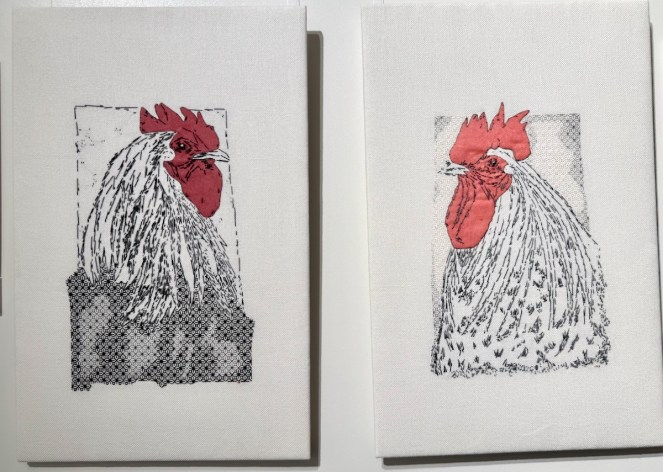
What is notable in this one is the inversion of the stitches, although done in different colors: what is foreground in the black rooster’s image is background in the white rooster’s image. (If you open it in a “new tab” it will be enlarged.)
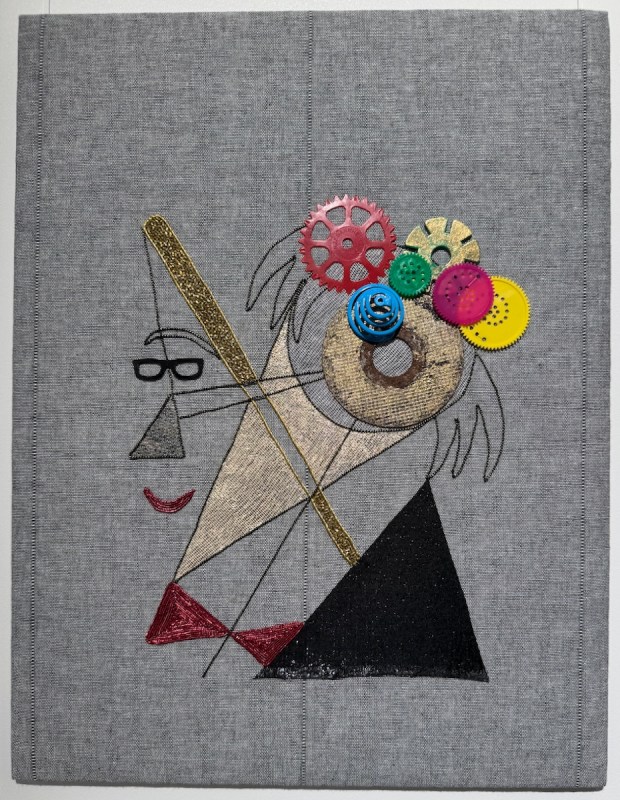
Title: Der Nobelpreisträger Artist: Ulla Hoppe, Germany Description: Nobel Prize winners: often “grey eminences,” yet crowned with gold. Technique: Gold embroidery, collage, partially gilded
Alas! We could come back in two hours, but alas! alas! we wanted to see another small town on the way home, so we missed seeing Fabia Diniz. We missed a LOT! I went onto the Carrefour website and downloaded this:
I hesitate to put a link because I know they change their website a lot. But head to her Instagram, and click on her Story, Carrefour, and you’ll see her story about coming to France, along with some of her creations.
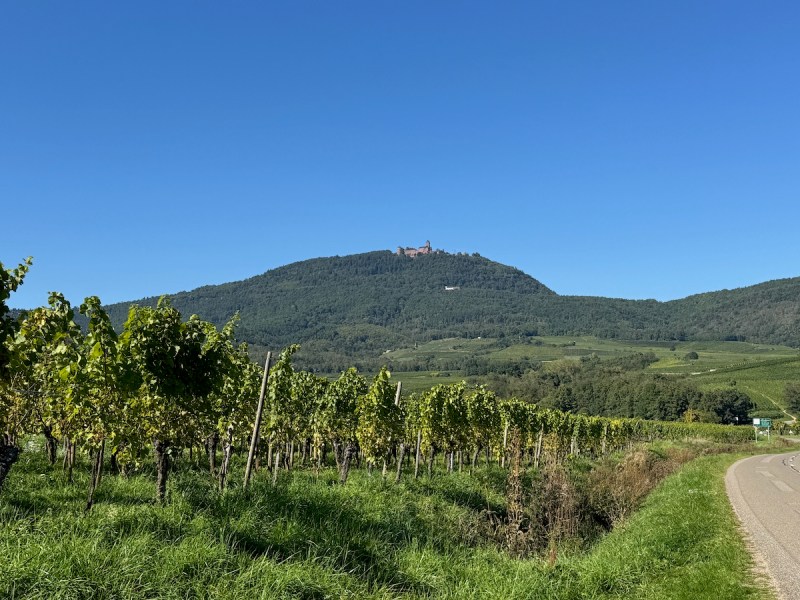
We drove over the hill, and back down into the next valley on our way to Equisheim.
And this is where we’ll leave our adventure, where the light was just right at the end of the day.
This post about the Carrefour European Patchwork show 2025 covers:
• Venue 10: Chapell St. Blaise, with Tania Tanti • Venue 11: Église St. Nicolas, with a quick look at embroideries sponsored by Guldusi • Venue 12: Salle Des Fêtes, with Fiona Lindsay, Jenny Bear, Hae Ok Chang, Patchwork Association of Kazakhstan
I have a main Carrefour Quilt Show page that lists all the posts of all the meetings I’ve gone to, and includes the posts from this year too. If I haven’t mentioned it before, you might enjoy these posts more if seen on a desktop computer or even a tablet. Cell phones re-format the layout and can sometimes do strange things to how it looks on the screen.
If you are interested in going to Carrefour, I wrote two posts for them about our travel, and how we put the trip together. You can find them here and here. Their main website is HERE, where you can subscribe to their newsletter (scroll to the bottom).
–––––––––––––––––––––––
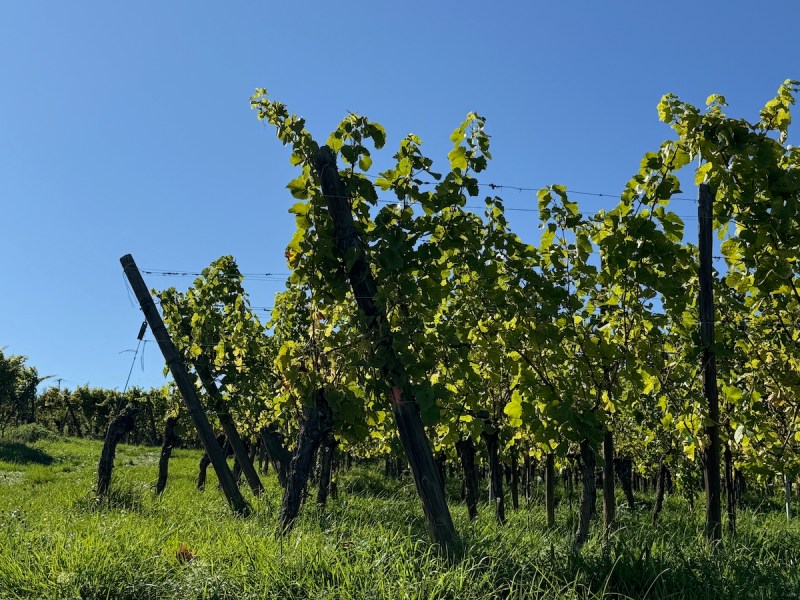
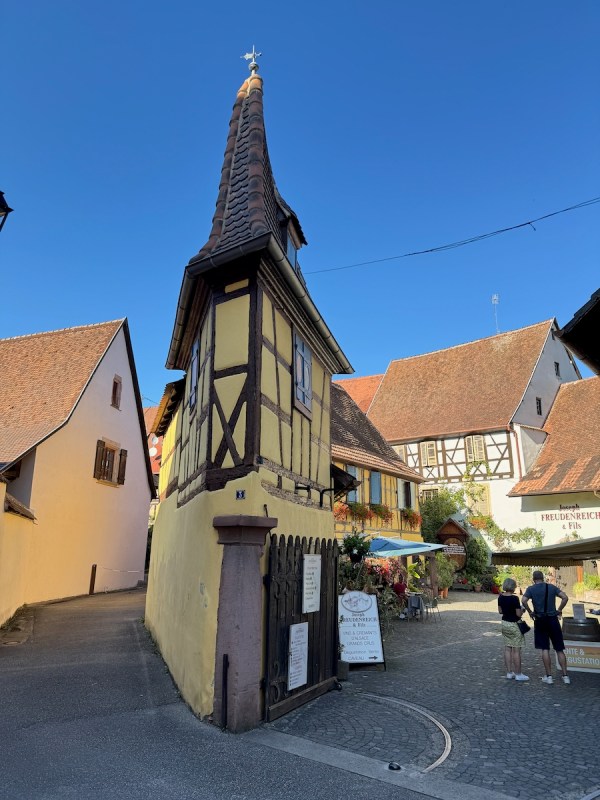
Now that the orientation is complete, the story is that last year my husband and I had a chance to go to the Carrefour European Patchwork Show in the Silver Valley, near Colmar France. That’s called the Val d’Argent, in France in the Alsace region, and yes, there is great food and beautiful countryside. One of the things we like about this show is that is spread out over four small towns in the valley, and they use churches and community centers and municipal buildings, so you really get a feel for being in that area.
Venue 10: Chapell St. Blaise
Venue 10 is a small little chapel, the Chapelle St. Blaise, basically a one-room church. I stood there for a long time but that man wouldn’t move from the doorway…so I erased him. (!) Let’s see if this video will embed:
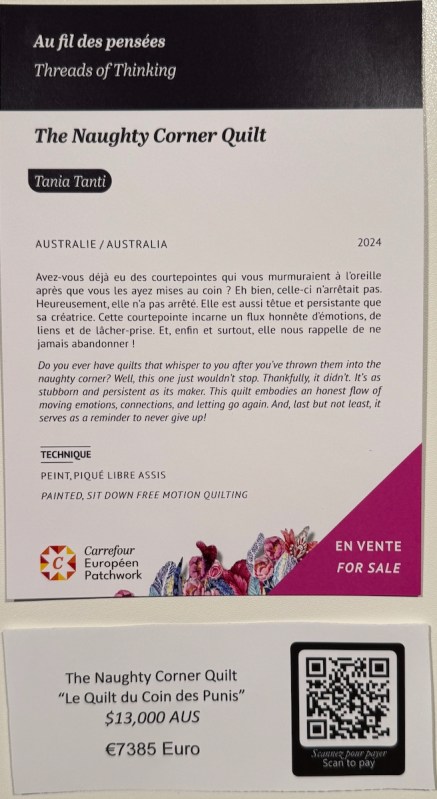
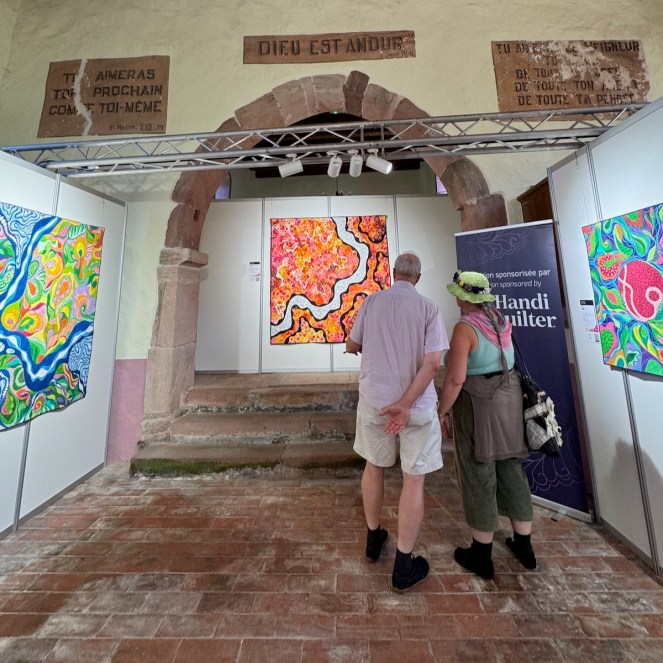
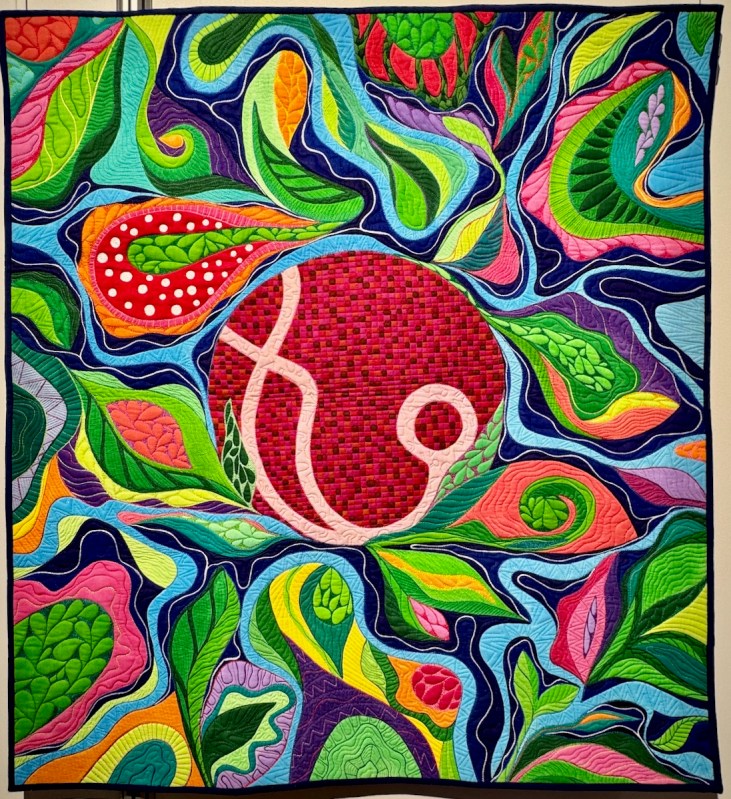
Click on image to start the movie. The voice you hear is the artist, Tania Tanti, talking to some quilters about her technique. Now to see some of her quilts. Many are not pieced, but instead are painted with textile paints then quilted and embellished.
The is quilt that starts the movie, above.
Click on any photo to enlarge. I took detail shots so you could see the amazing amount of work in each of her pieces.
Please click if you want it larger.
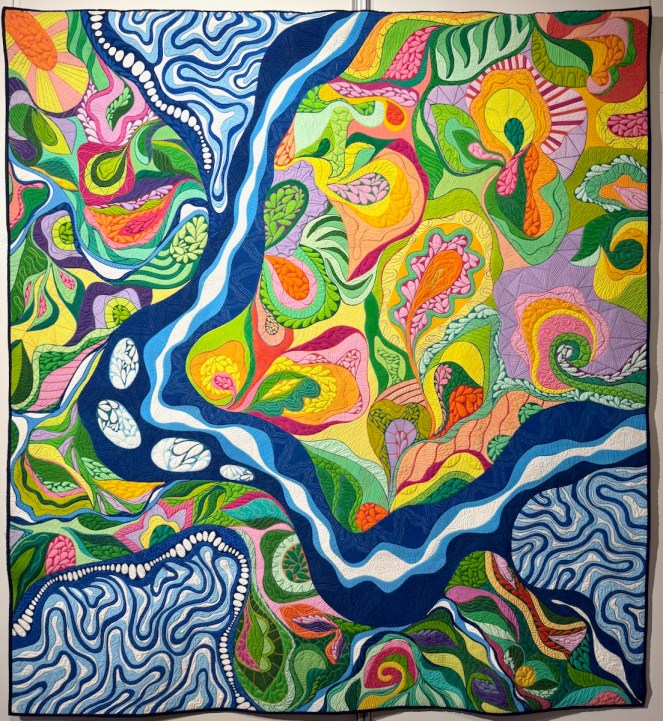
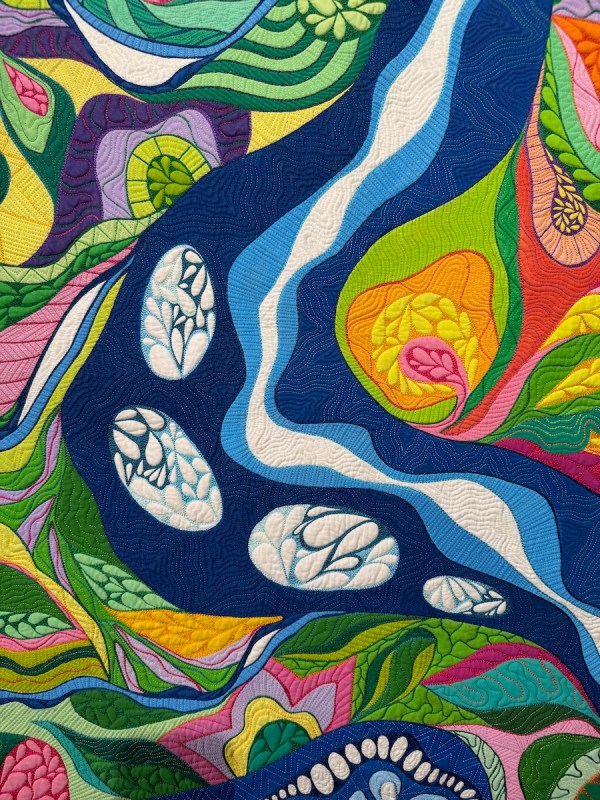
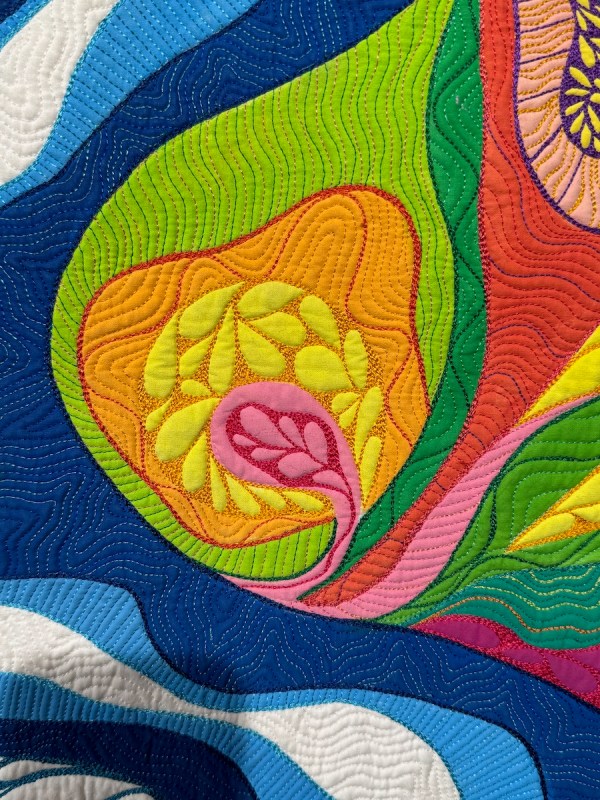
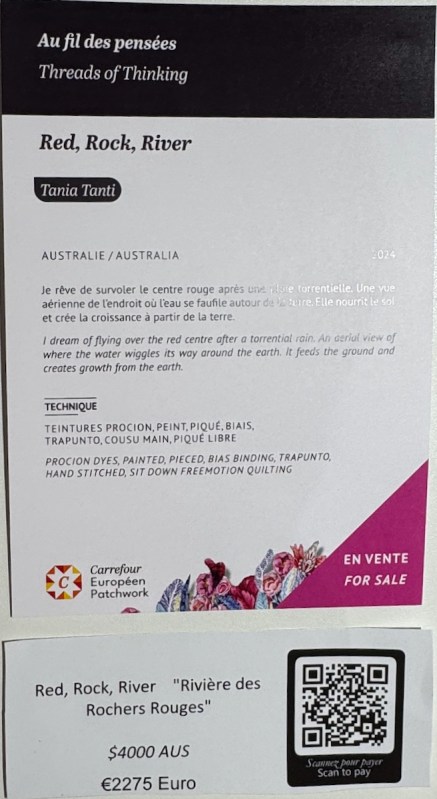
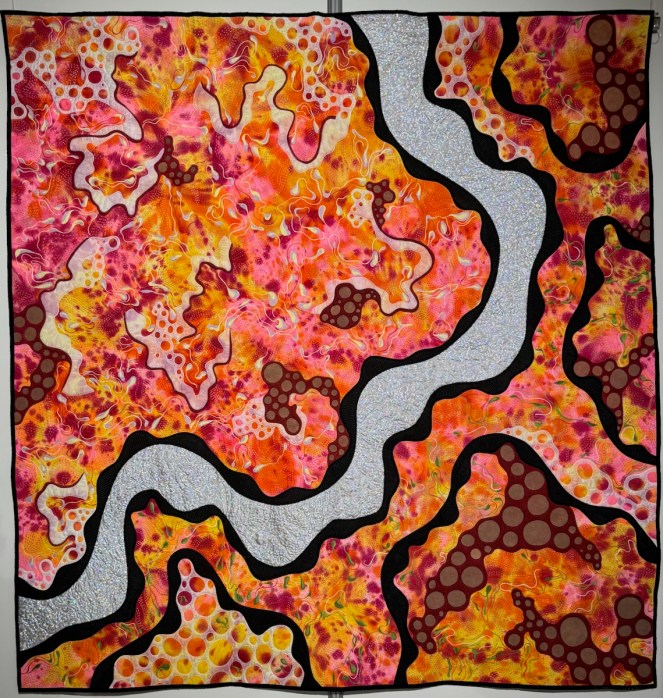
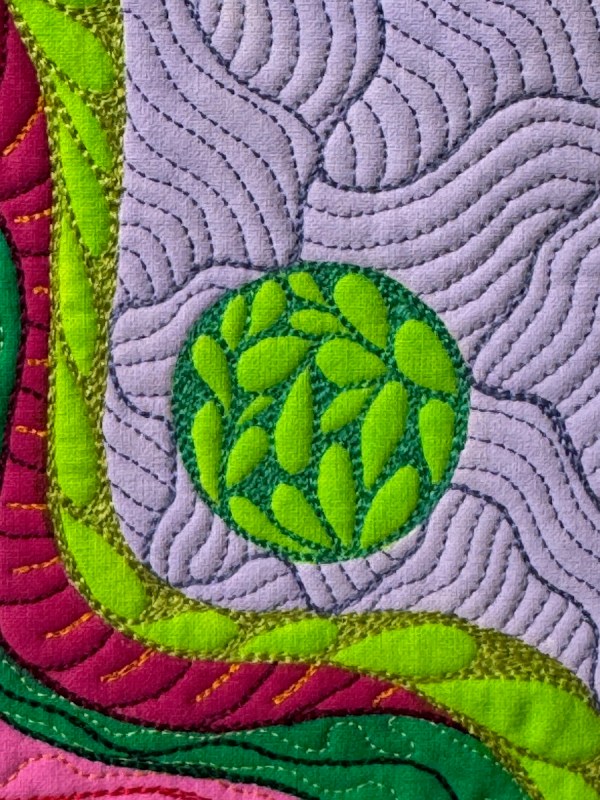
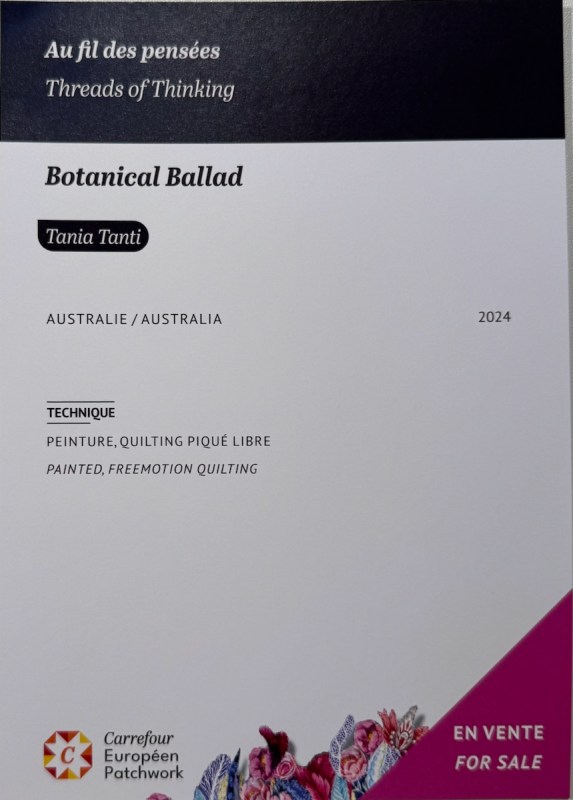
Red, Rock, River by Tania Tanti. She writes: “I dream of flying over the red centre after a torrential rain. An aerial view of where the water wiggles its way around the earth. It feeds the ground and creates growth from the earth.” In her technique section she writes: “Procion dyes, painted, pieced, binding, trapunto, hand-stitched, sit-down free motion quilting.”
She writes: “At then beginning of this year I faced my second battle with breast cancer. As soon as I could I got back into my studio and focused on small achievements each day. This is my Recovery.” And that is the title: Recovery. Technique: Painted, free-motion quilting, hand-quilting.
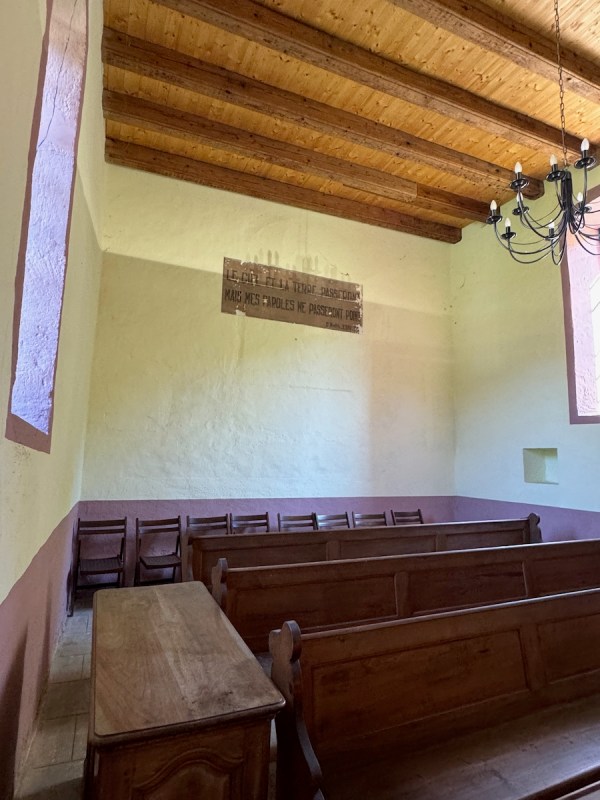
I looked behind the wall to see this spare room in this church.
Look carefully: a spider! (not our car)
Onward, through the valley.
Venue 11: Église St. Nicolas
Hopefully you can hear the bells. Right after this, we went for a take-out lunch from the local market. The choices were rather cleaned out, but we found something. There were a lot of quilters there — so happy to see this!
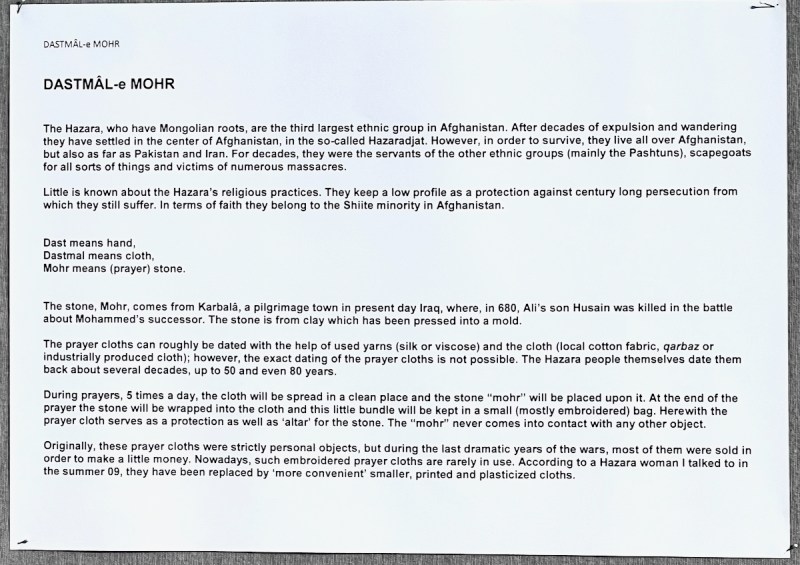
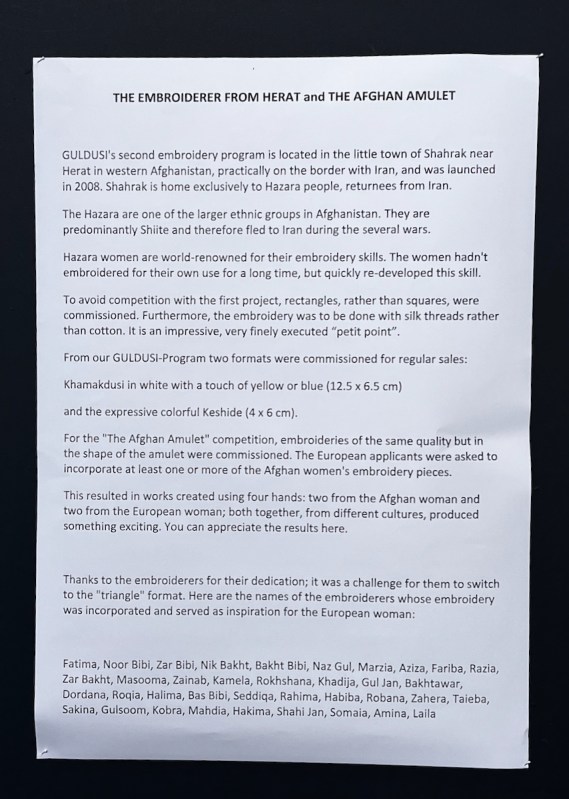
I admire and enjoy the art of these churches. The exhibit here was titled Guldisi, which is a hand embroidery program launched in 2004 (quoting from the catalogue), which “now enables 200 women in Afghanistan to support their families….Each piece will include at least one silk embroidery in the shape of a triangle, created by the Afghan Woman.
Ingrid Meier, from Germany. Title: Aller guten dinge sind drei, or All Good Things Come in Threes.
There were also many embroideries, which I found fascinating, and which included some blackwork/redwork.
These two signs were somewhere on the wall; click to read.
Venue 12: Salle Des Fêtes
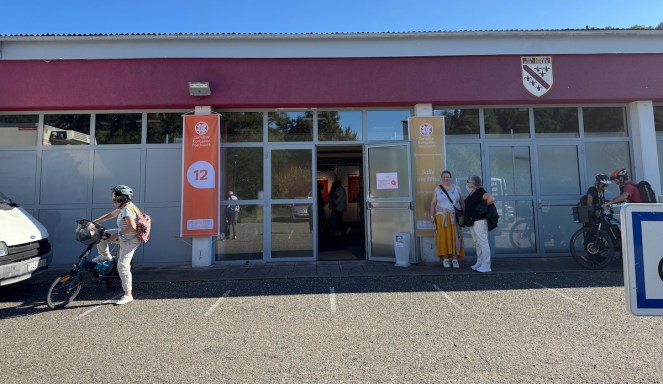
We drive to the Salle des Fétes, or the Party Room…and they are having quite the party!
A gathering.
A glimpse of a quilt.
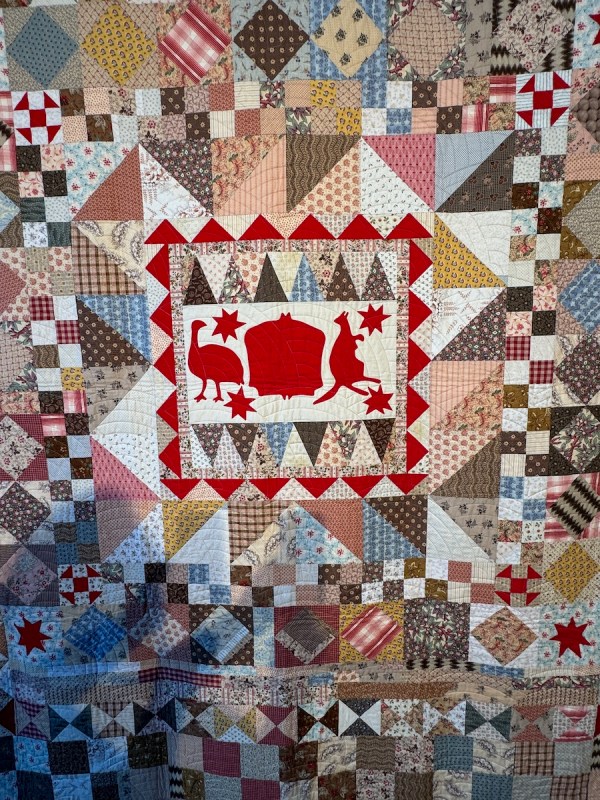
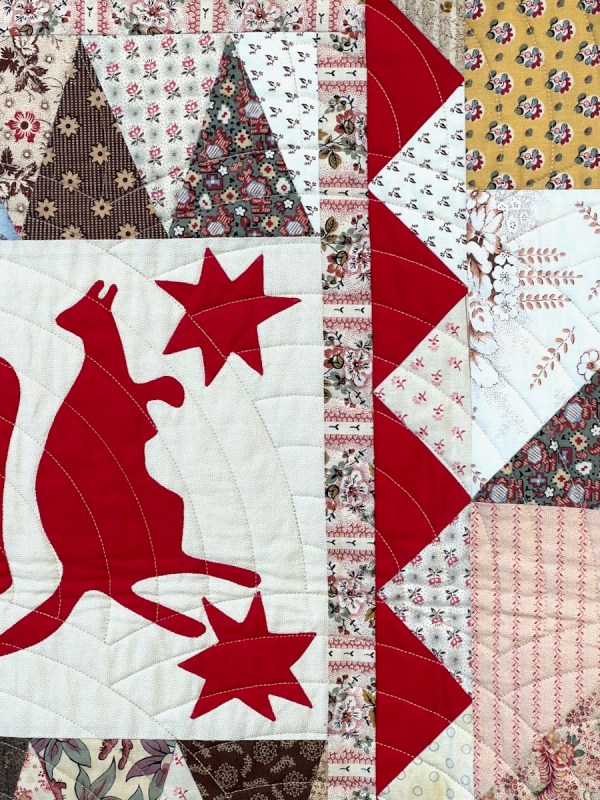
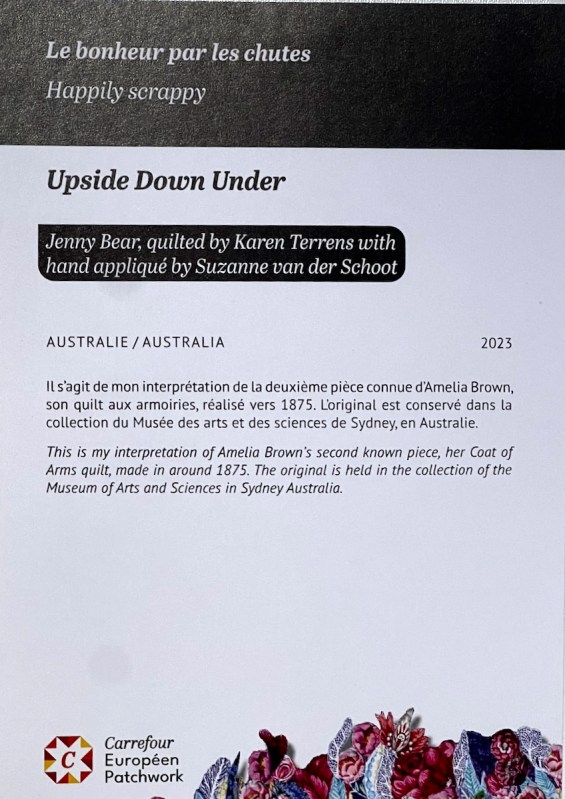
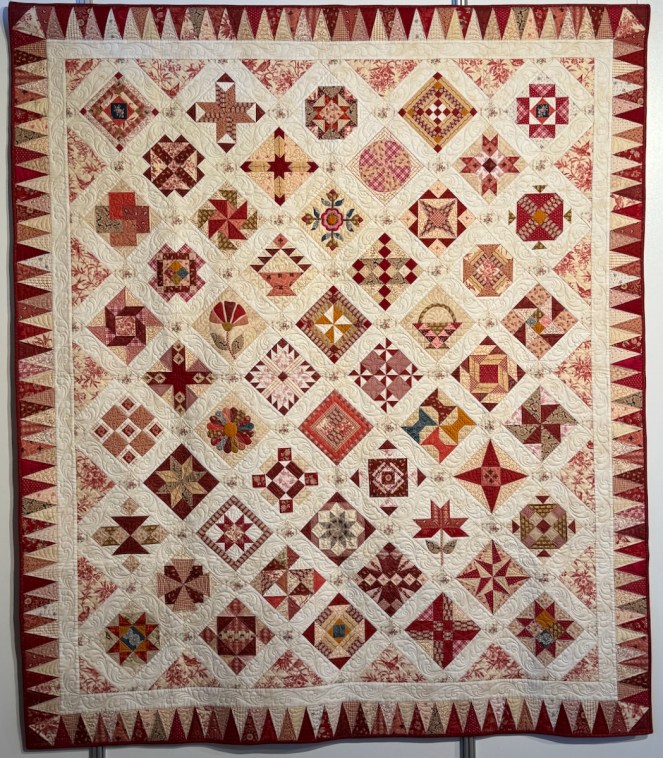
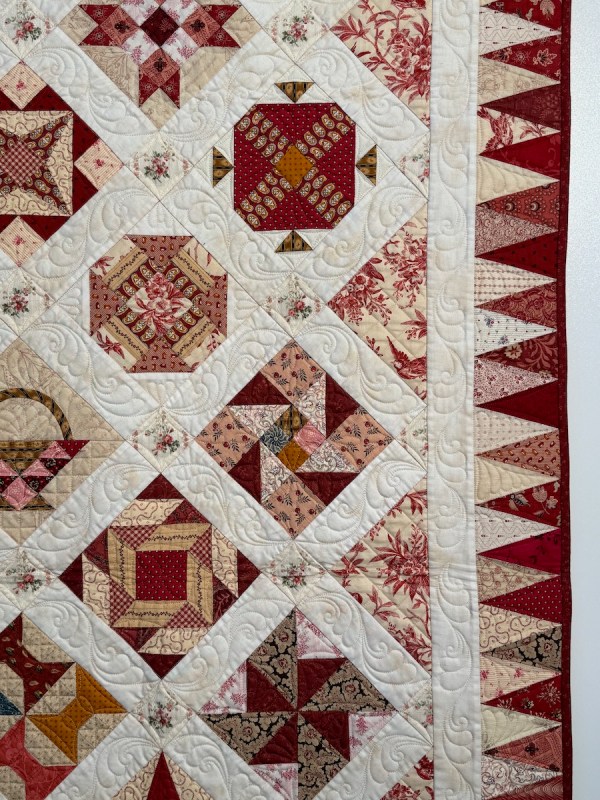
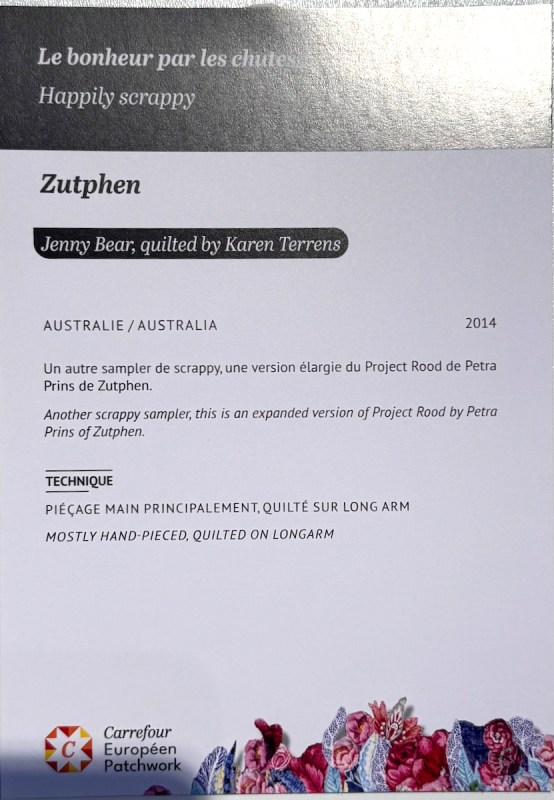
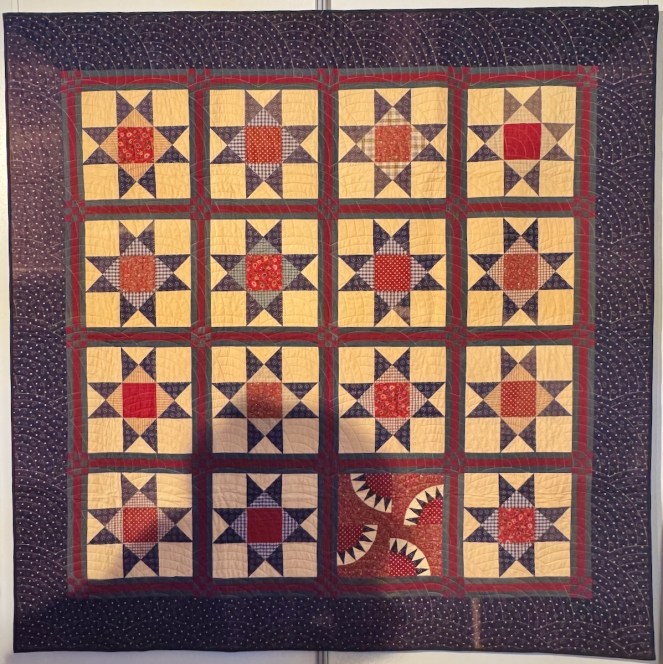
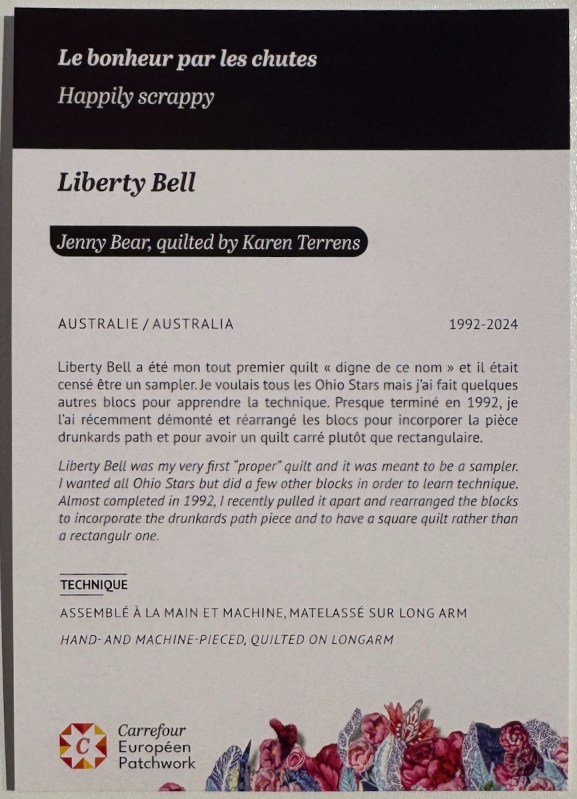
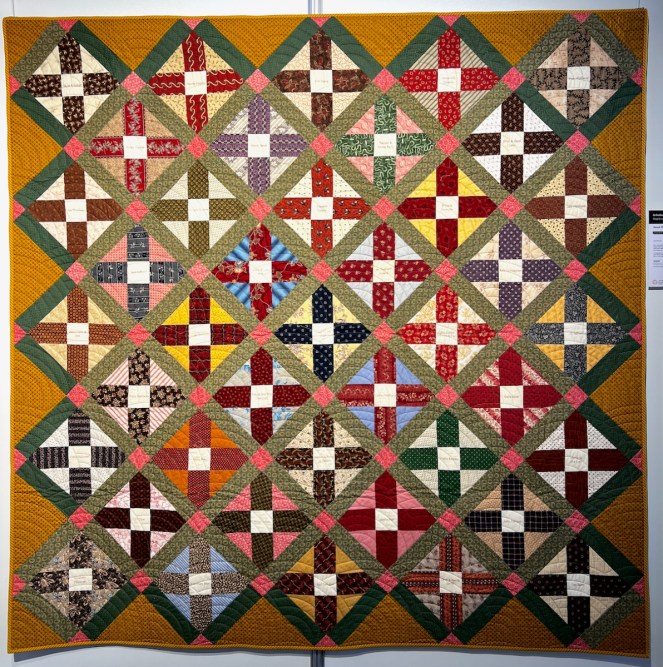
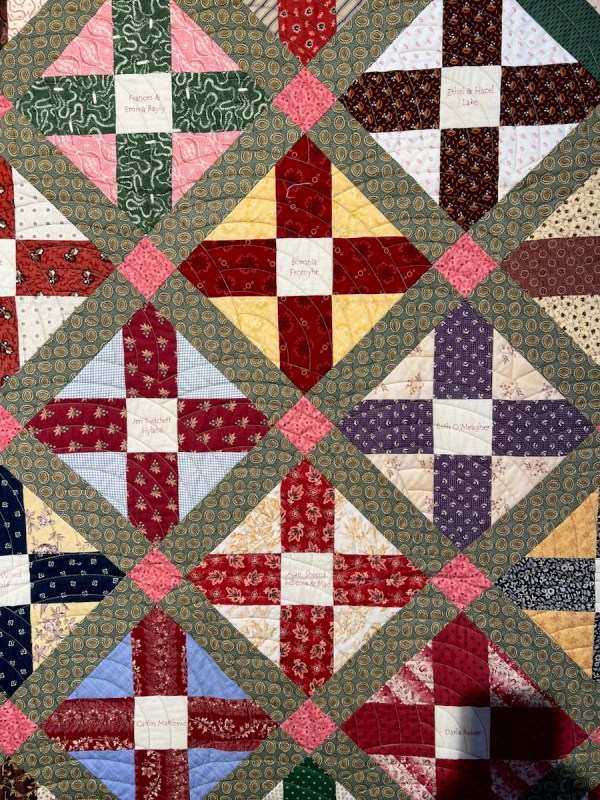
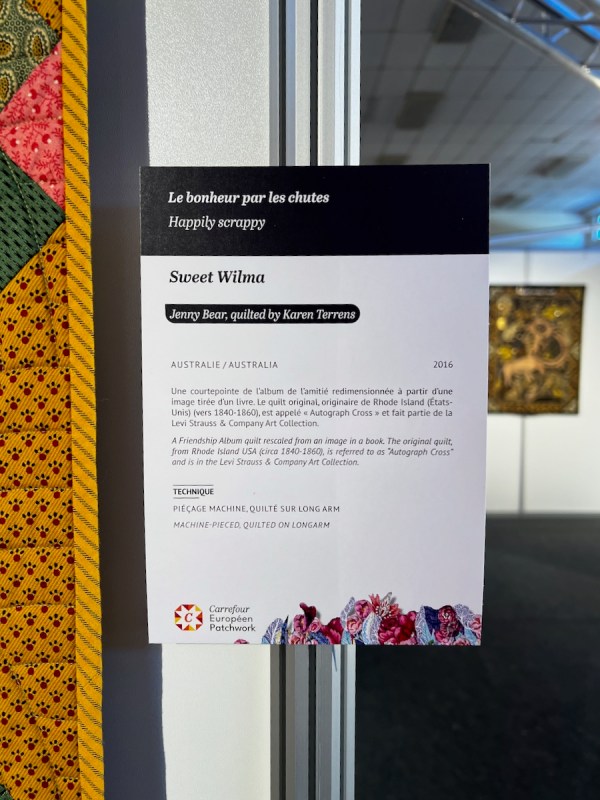
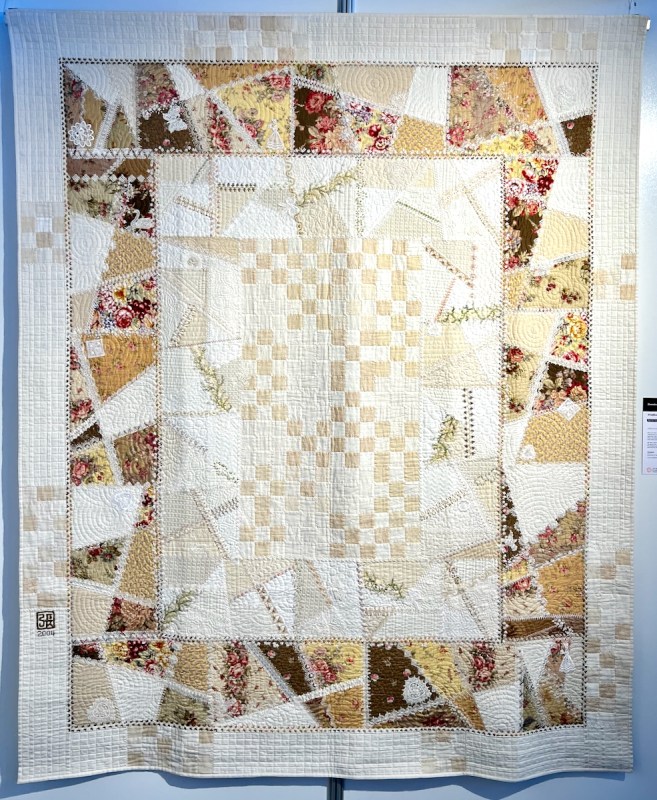
And we meet Jenny Bear! She is a renowned quilter from Australia, known for her scrappy quilts, but exquisitely put together. The catalogue called her “Happily Scrappy” and said that “Jenny’s quilts are a celebration of social history, fabric, color, frugality, and the art of making do. She loves using her stash of antique, vintage and reproduction fabrics as well as rescuing old, unquiltable or broken tops, fragments, orphan blocks and tiny scraps to make something beautiful from them. Her favorite quilts are simple, utilitarian and achievable by anyone who loves to sew.”
She “has been making quilts for more than 40 years….and after her exhibition here, she hopes that her quilt making will return to hobby level and that there may again be time for housework and gardening” (from catalogue).
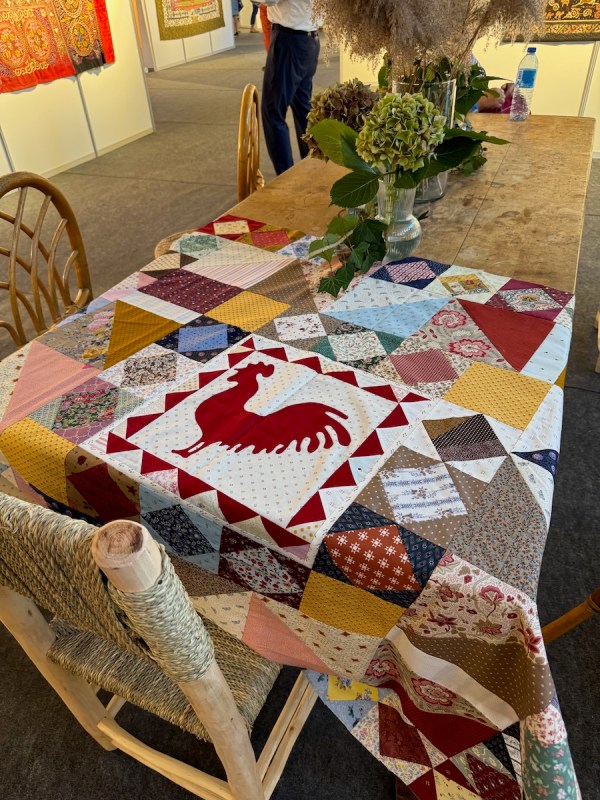
Everyone was busy, but I loved that quilt on the table.
And on another table, it looked like she was creating something new:
Such a rich tapestry of fabrics and piecing…it just glows.
This was a favorite, but I do love stars.
Simple, yet so powerful in its design.
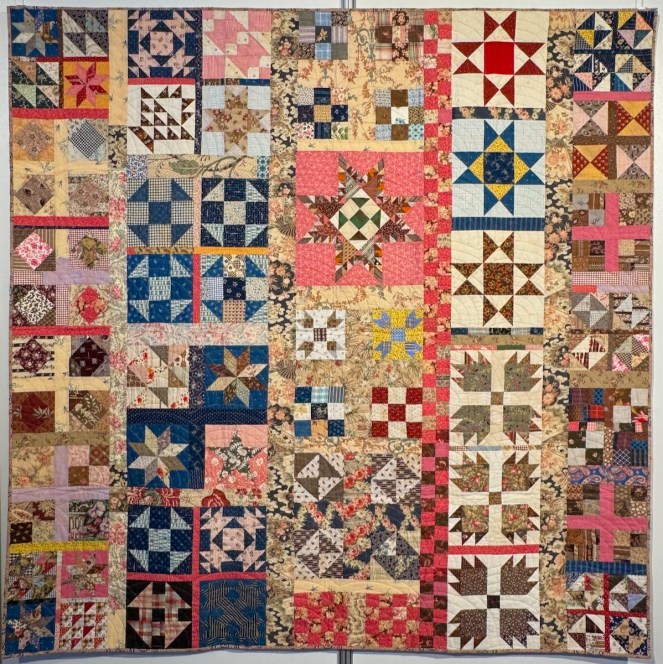
My orphan quilts never look like this. This is Sweet Georgia Brown, from 2023. She writes: “Using antique fabrics dating from around 1840 to 1910, this hotchpotch of oddment blocks was inspired by an early twentieth century piece featured in “Unconventional and Unexpected” by Roderick Kiracofe, a book that has inspired many a quilt of mine. Many of the blocks were gifts from friends or purchased from Jane Lury and David Hubert. It is indeed happily scrappy.”
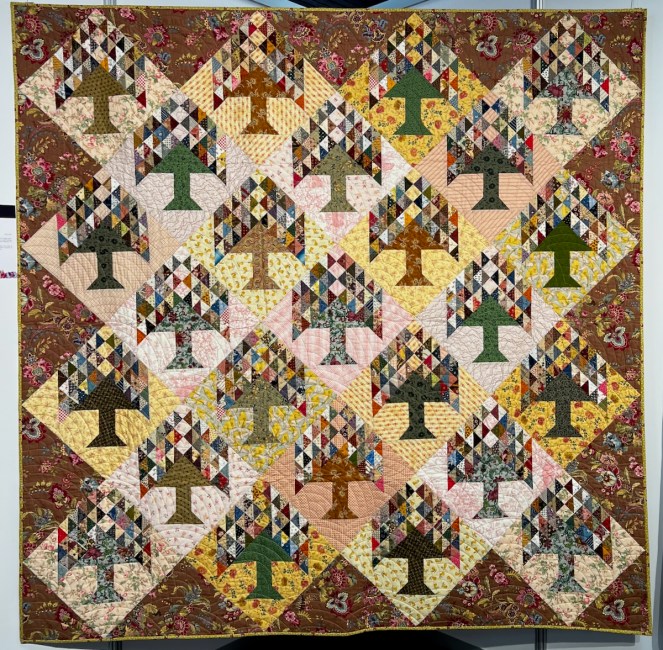
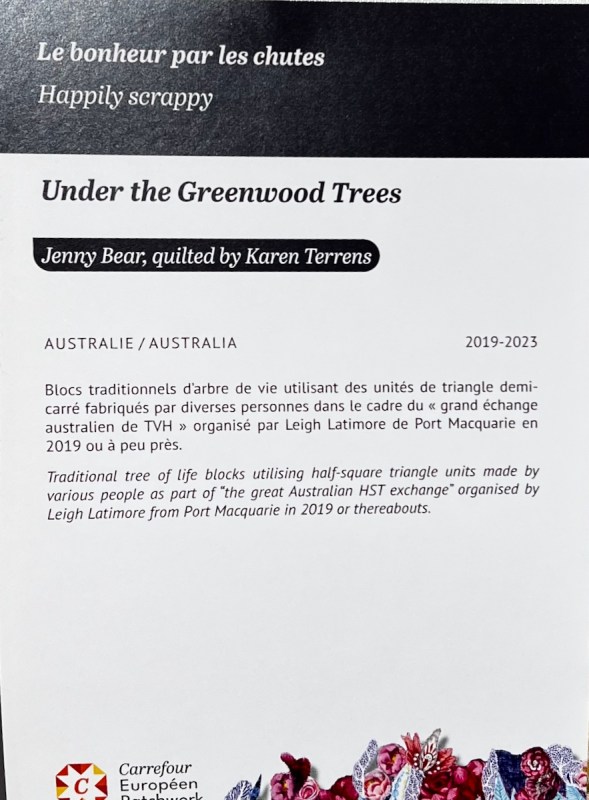
A giant block-swap brought Under the Greenwood Trees to life.
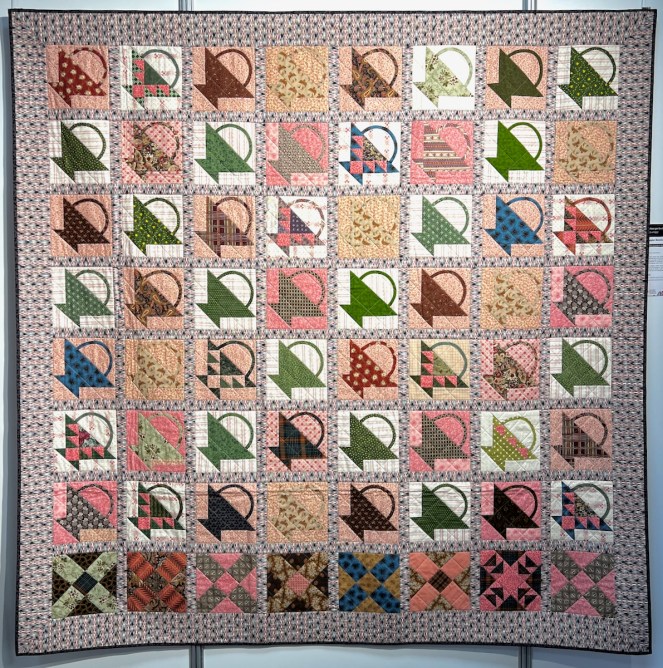
Last one of Jenny’s is Scrappier Bennington Baskets. It is made by Jenny Bear, and quilted by Karen Terrens. The title card says: “This is a scrappier version of Linda Collins’ “Bennington Baskets” featured in her book with Quiltmania “Treasures from the Barn.” The basket block is traditional but the setting is quite quirky, especially with the row of oddment blocks at the top in the original, but at the bottom in my version.” Mixing blocks is a great idea, one to try for sure.
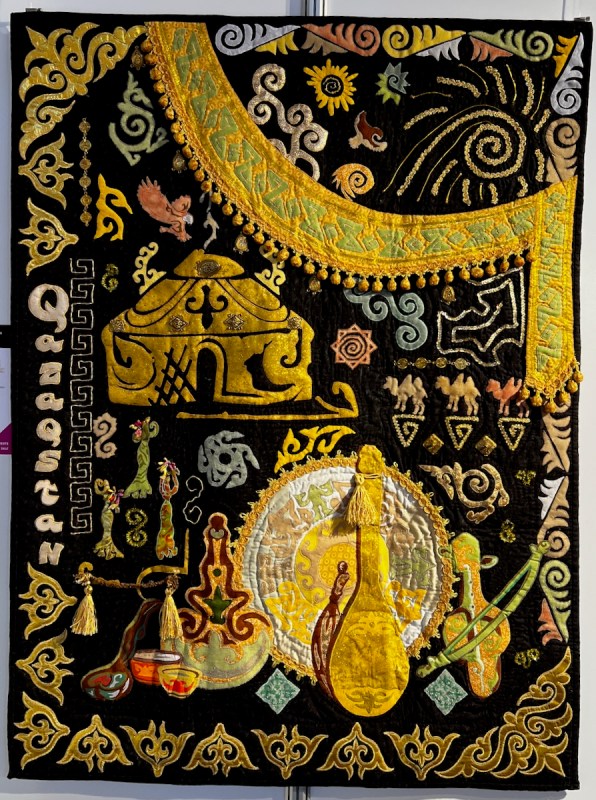
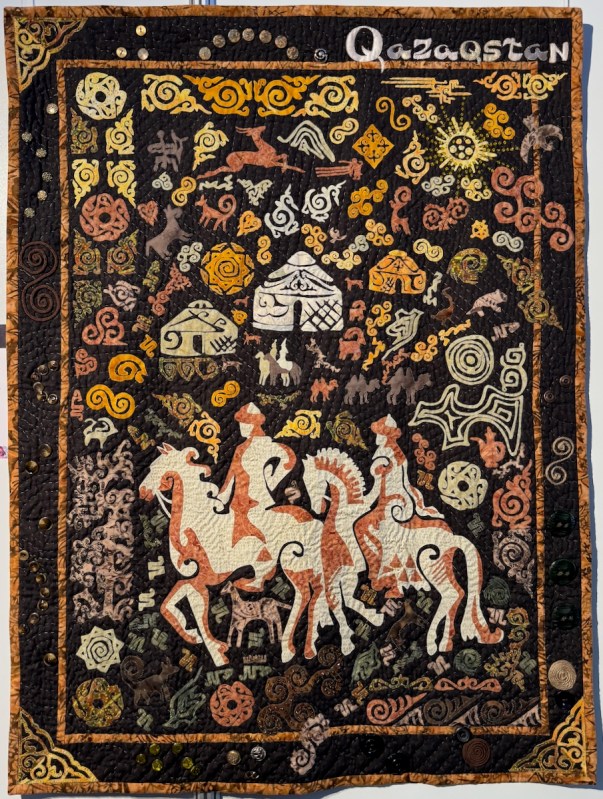
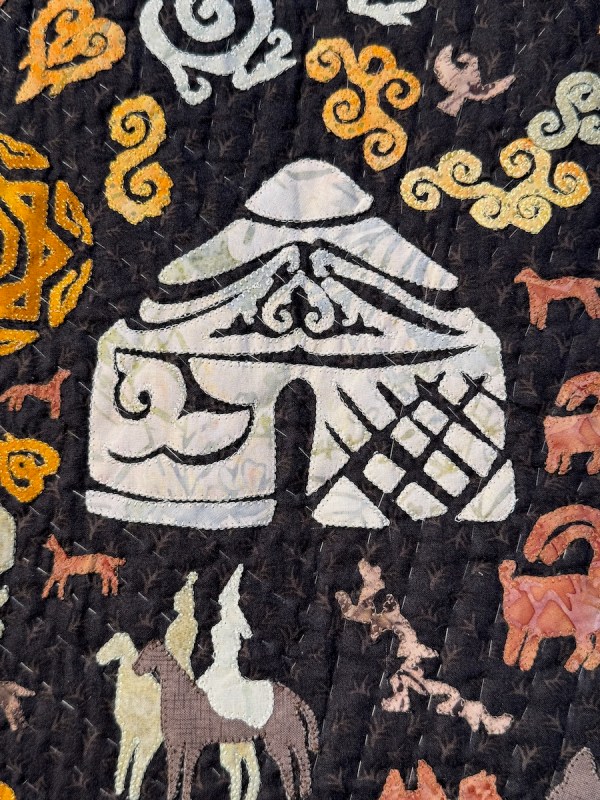
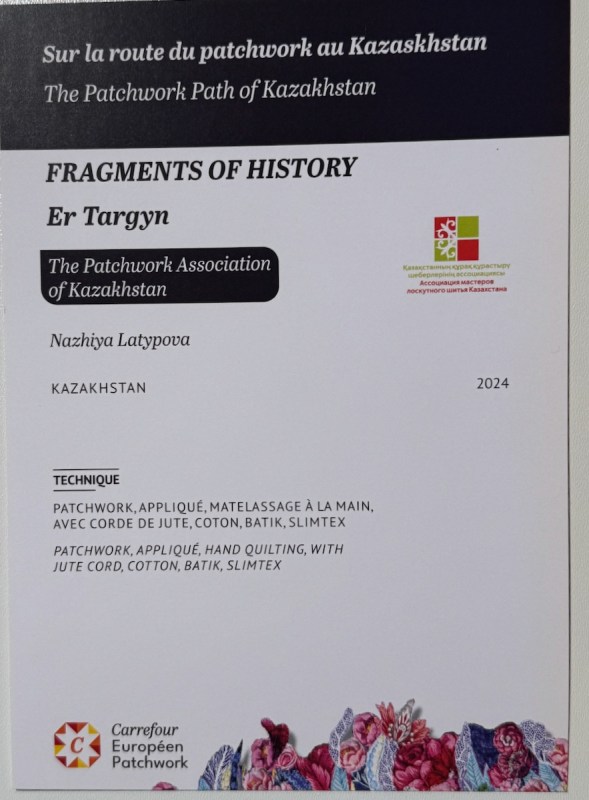
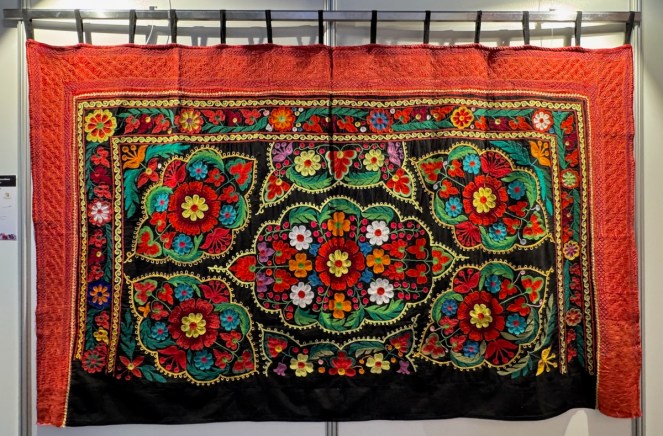
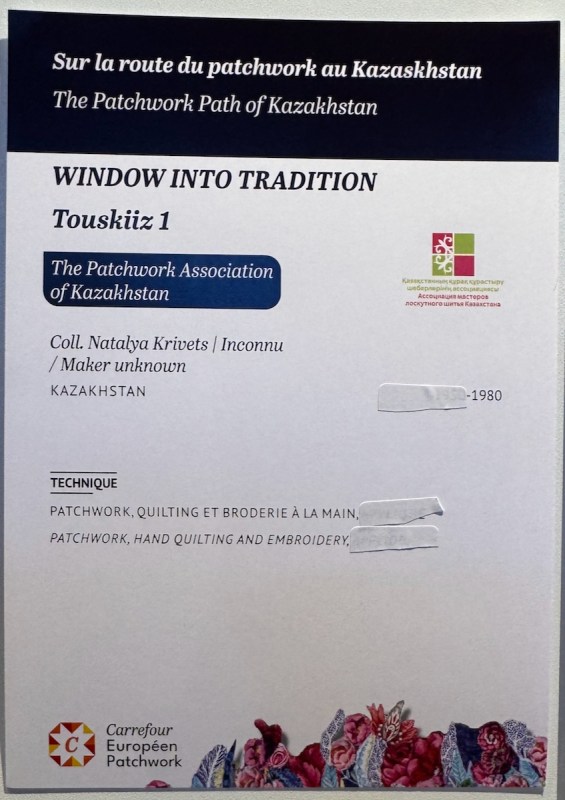
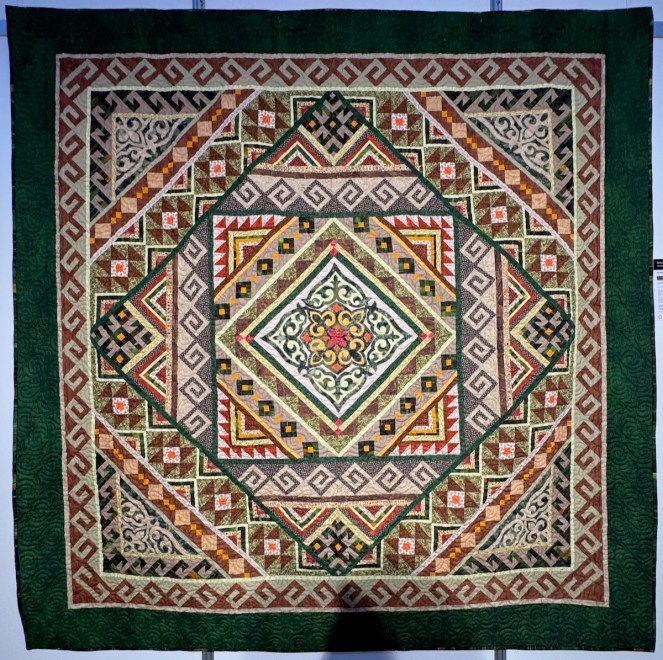
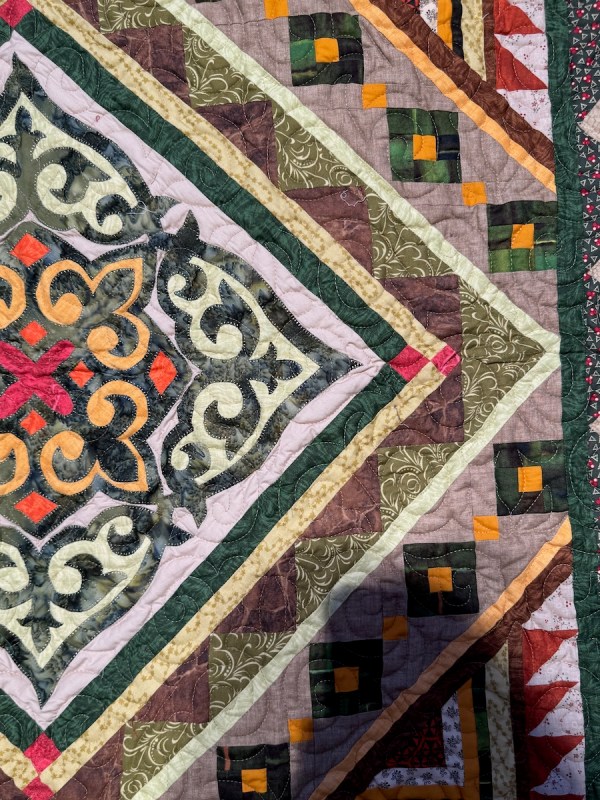
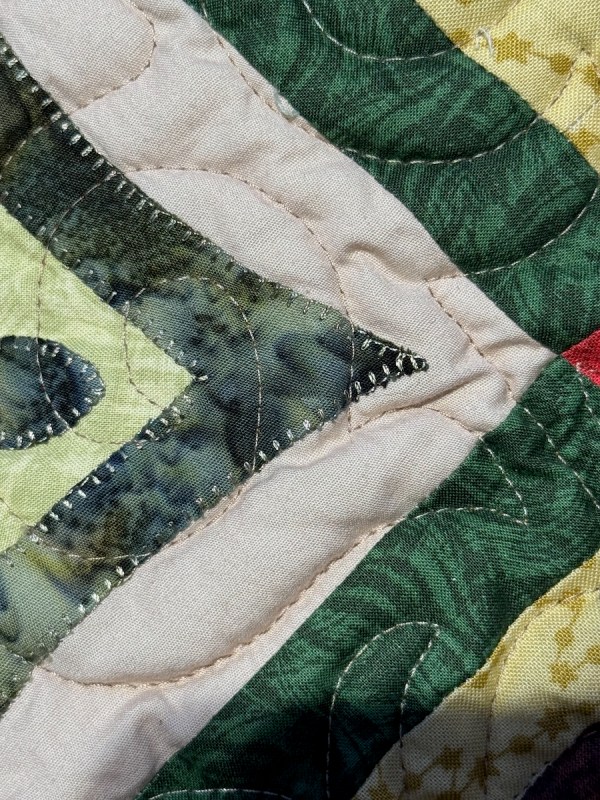
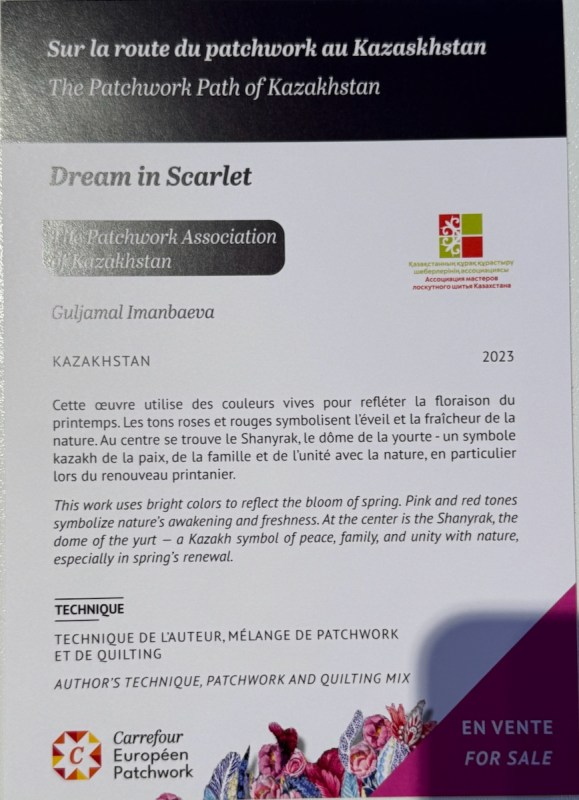
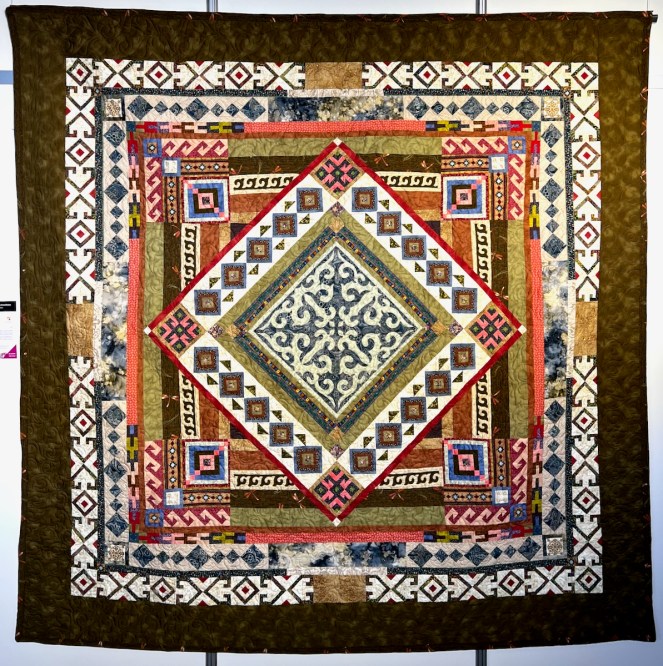
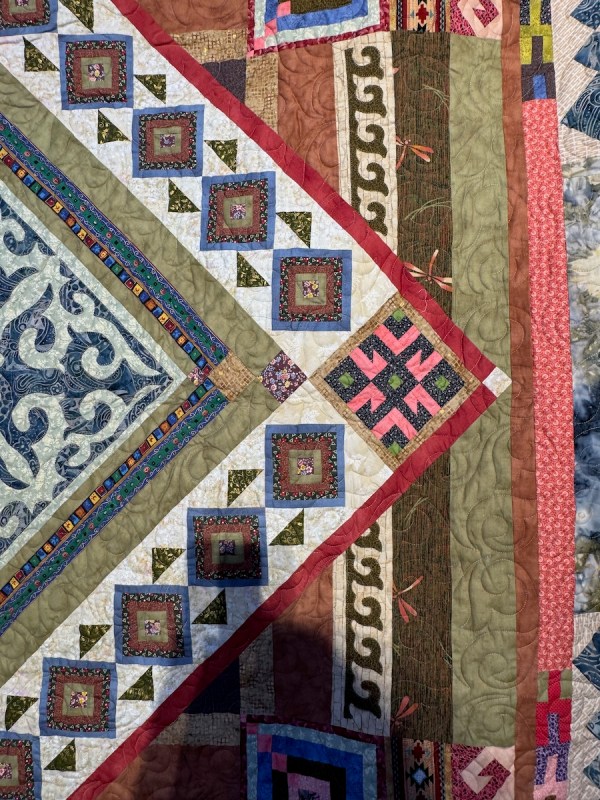
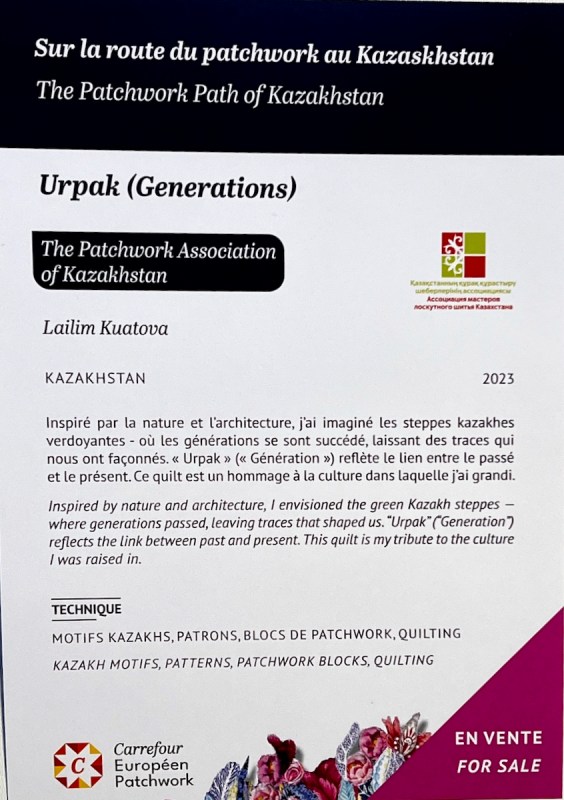
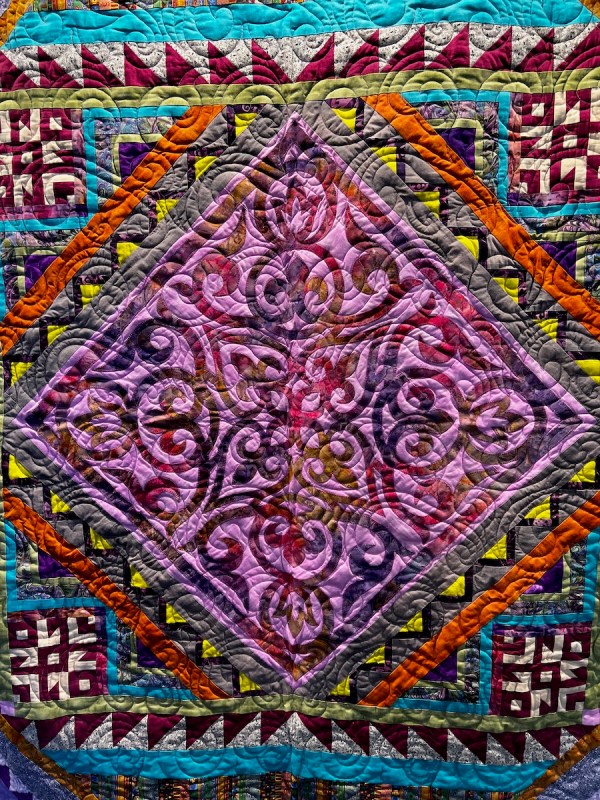
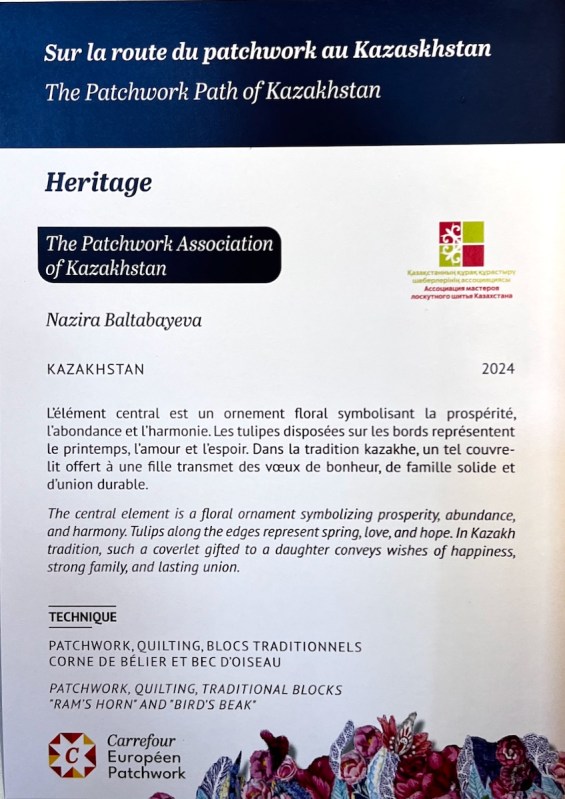
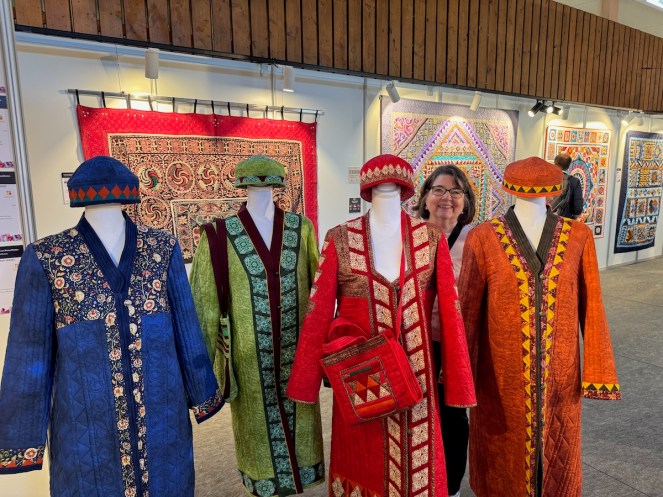
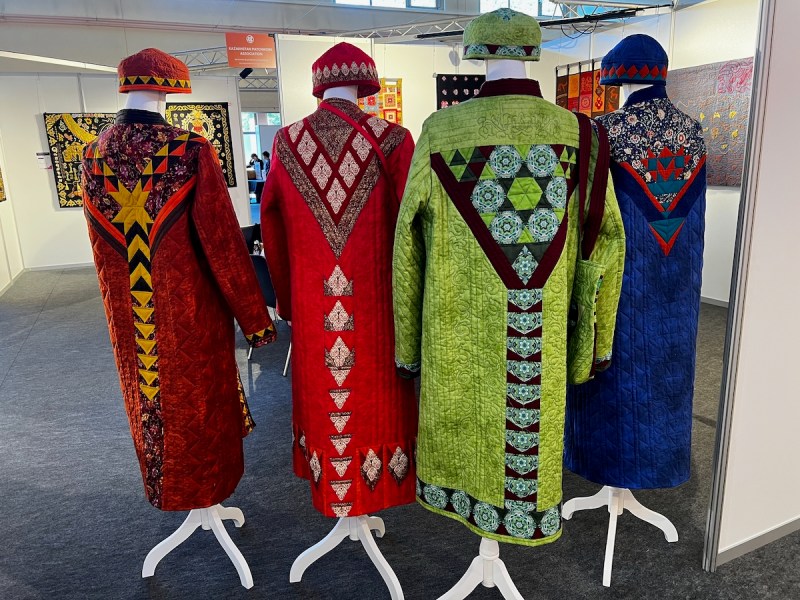
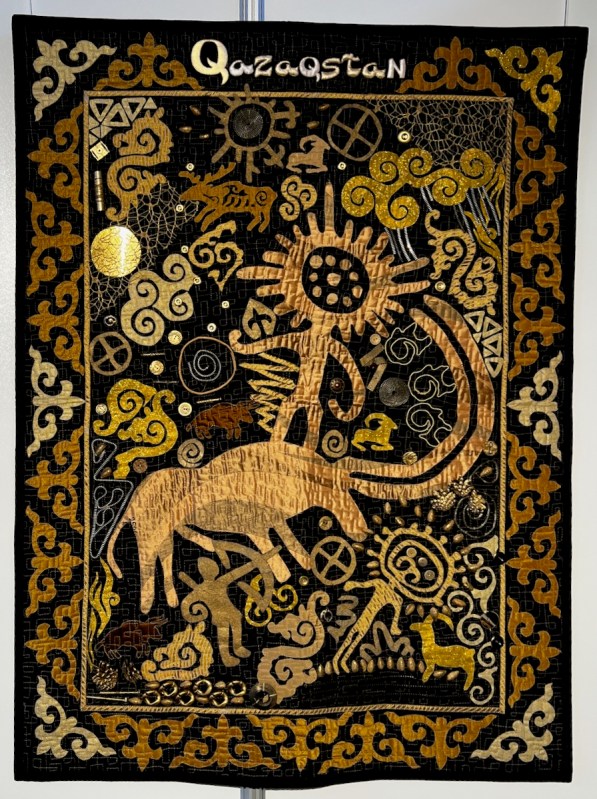
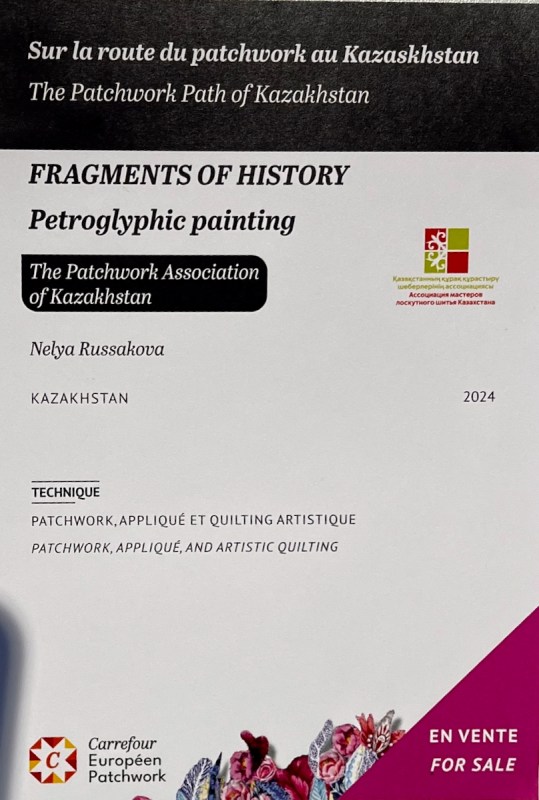
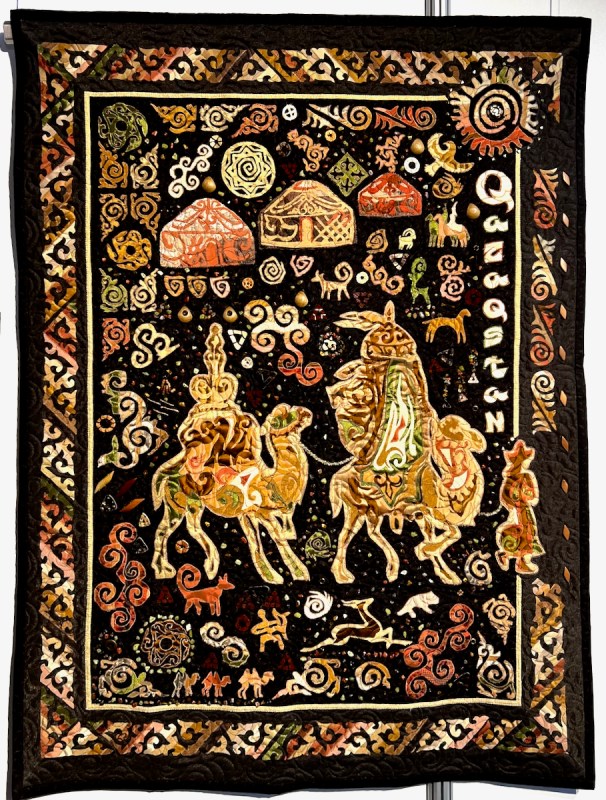
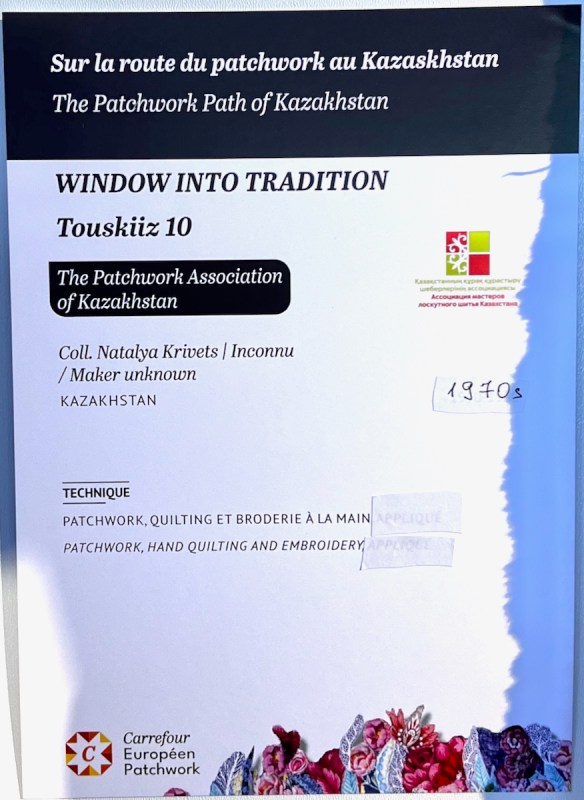
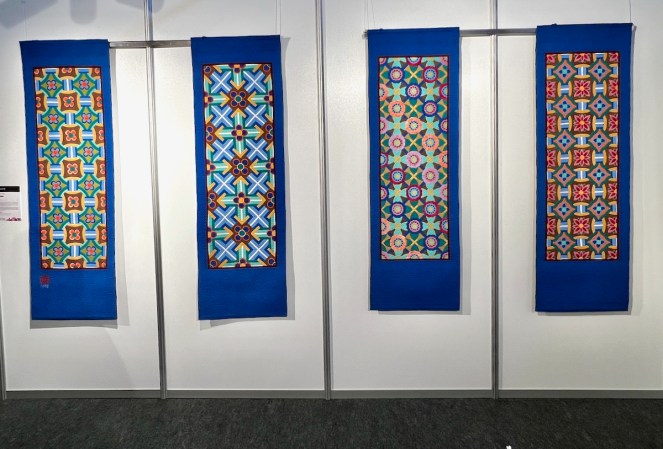
Right next to Jenny’s was the Kazakhstan quilts, a collection brought to Carrefour by the Kazakhstan Patchwork Association. This was founded in 2013, and has over 180 members “dedicated to promoting and developing ethnic-style patchwork (Kurak) and art quilts. The organize workshops, competitions, and the annual Orient Bazaar Festival.” The catalogue goes on to say that “this exhibition merges historical tradition with modern outlook in Kazakh quilting. At its heart is Tuskiiz-traditional wall coverings reflecting Kazakh nomadic culture.”
How many of us have made house-block quilts? Here’s one, using their traditional home, a yurt. A house quilt, but from a different land.
A quilt we are familiar with, but the motifs are all germane to their culture and country.
Click to enlarge.
Natalya Mametniquazova Tamara Stroscherer (at least I think that’s her name, or their names?) made a series of four garments, titled “Four Seasons Chapan Series” with Spring, Summer, Fall and Winter.
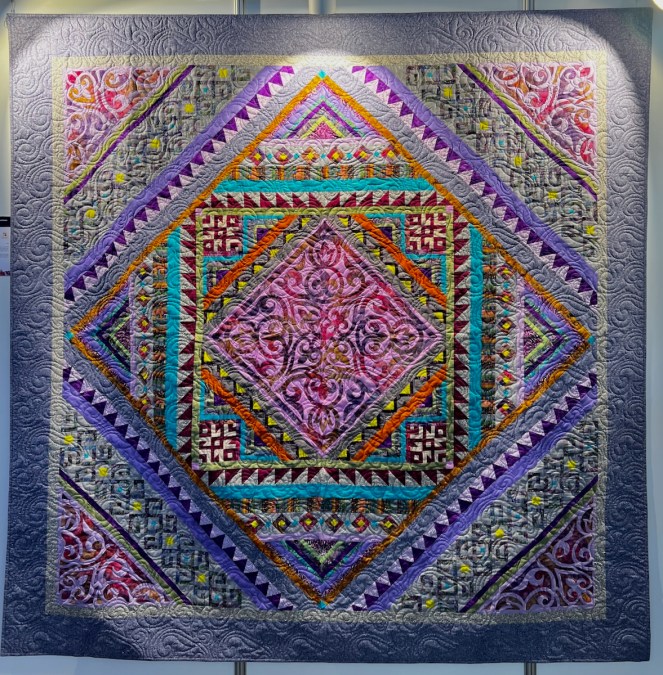
A couple more from this country:
There were several artists in this Party Room. We have two more to go, if you are still with me!
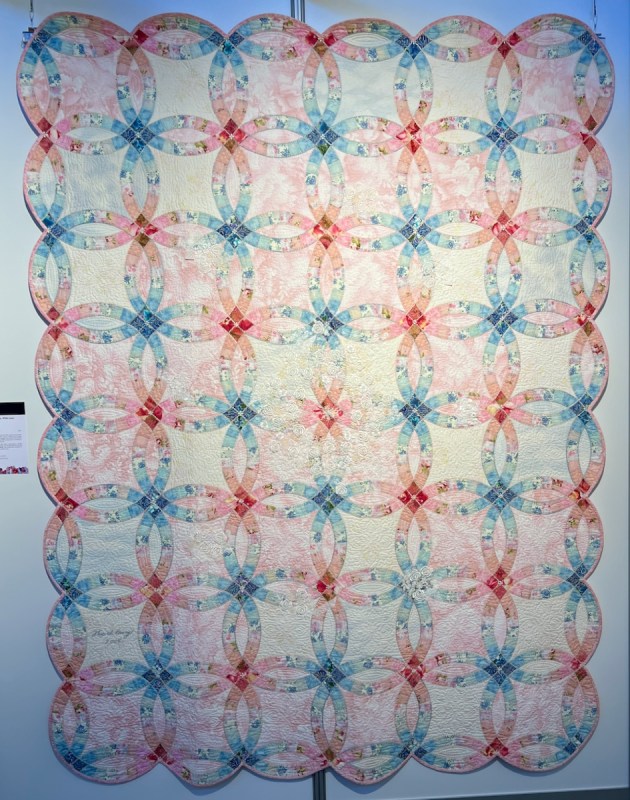
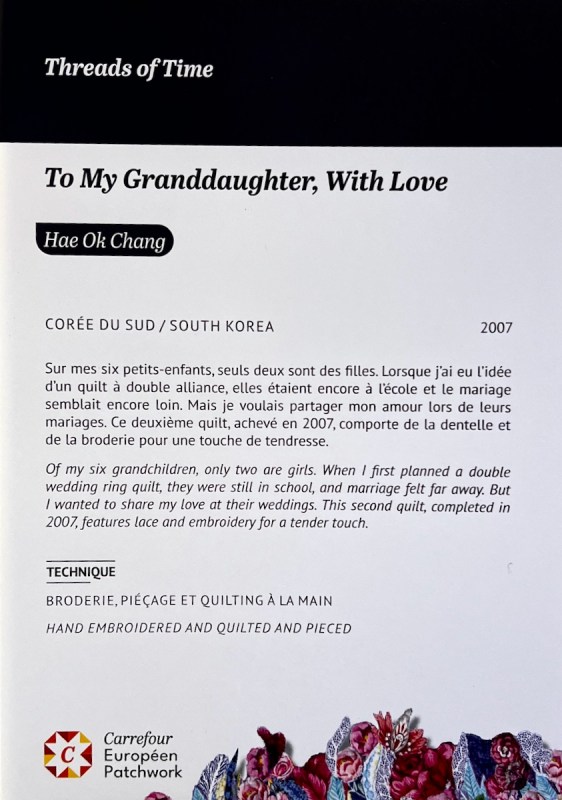
Hae Ok Chang, South Korea
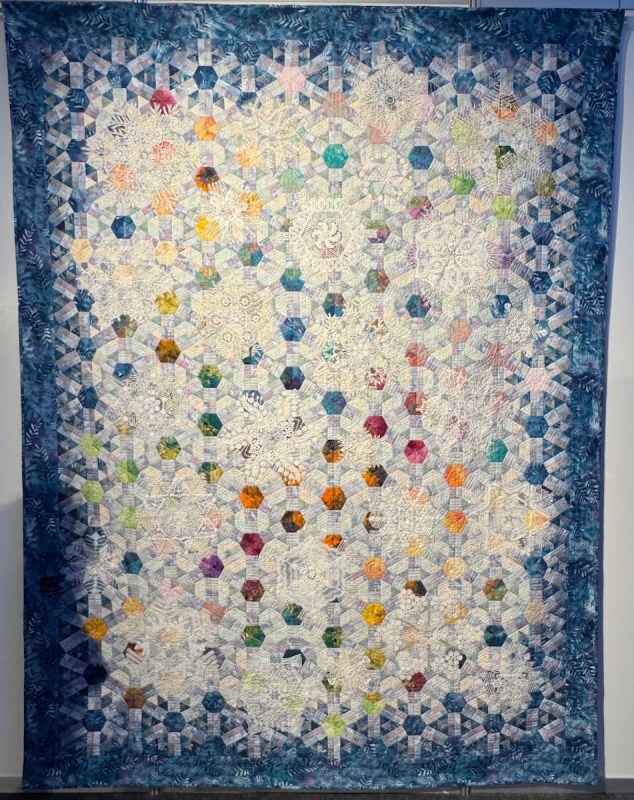
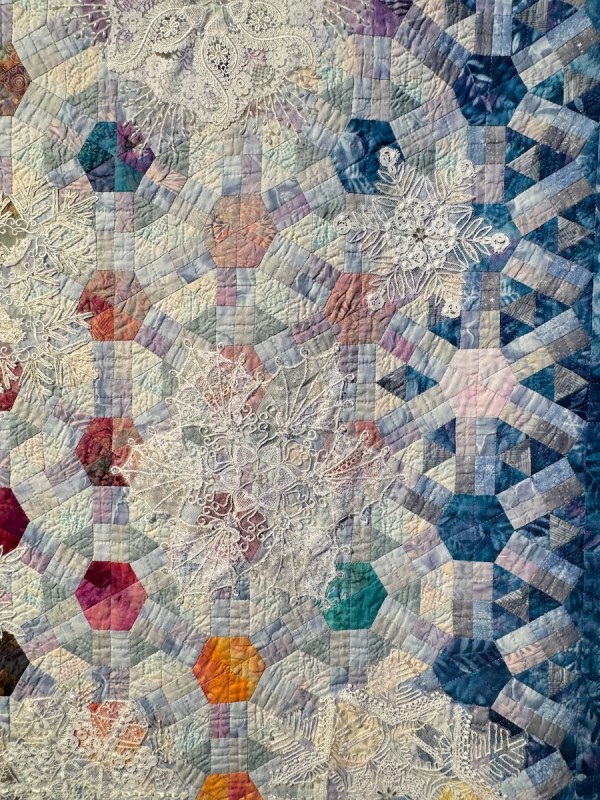
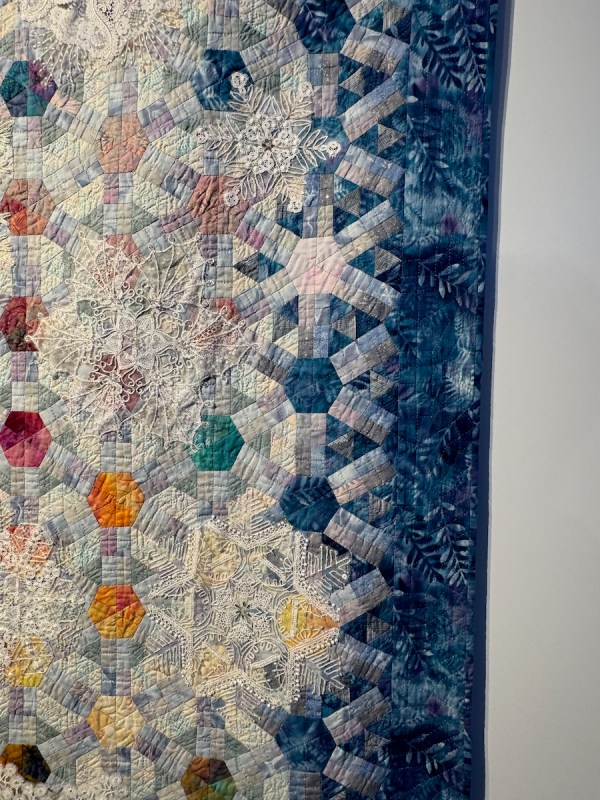
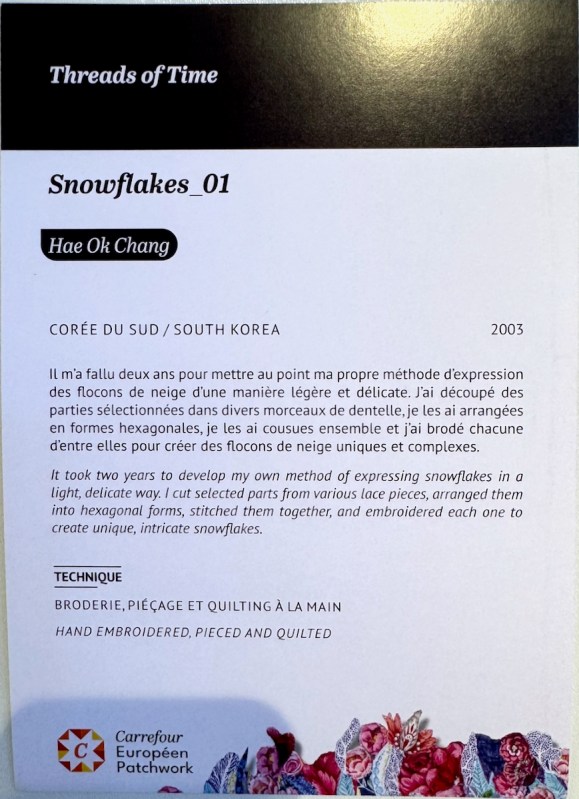
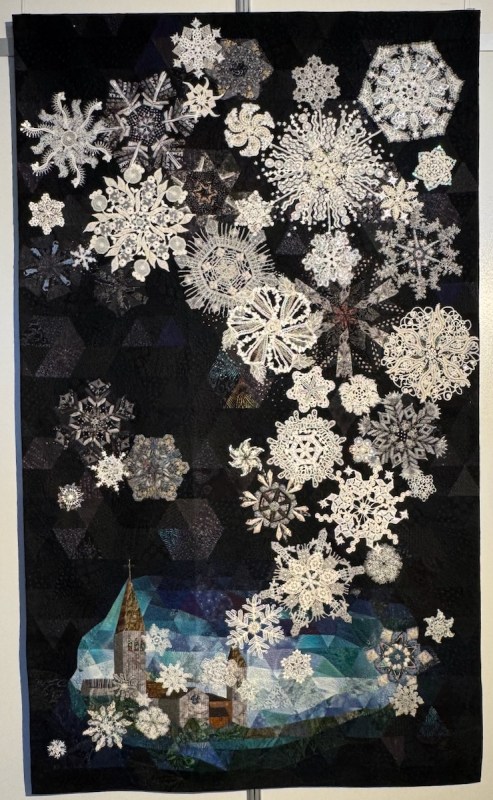
Hae Ok Chang, from South Korea, blends Korean and Western influences in a style that ranges from contemporary to traditional. One of her more well-known quilts has snowflakes on a traditional pieced quilt:
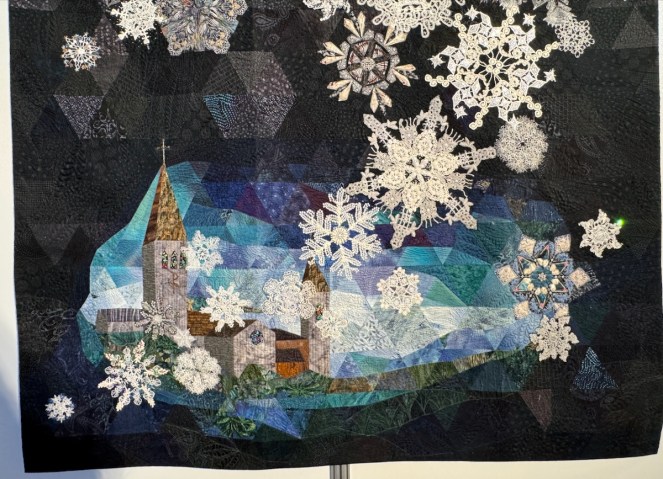
Here is another Snowflakes quilt, Snowflakes_04.
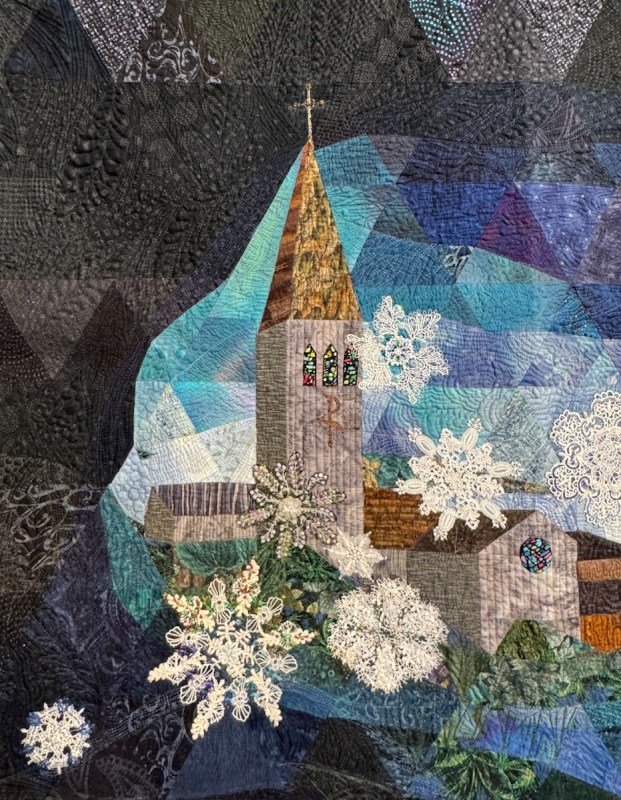
She writes: “Hesitating to start a large piece as my strength waned with age, I began a joint work with my daughter. She created the background, I made the snowflakes. Inspired by the night sky over St. John’s Catholic Church, it evokes angel wings and a chorus of family and friends” (from title card).
It is heavily quilted by machine, with hand-embroidered snowflakes.
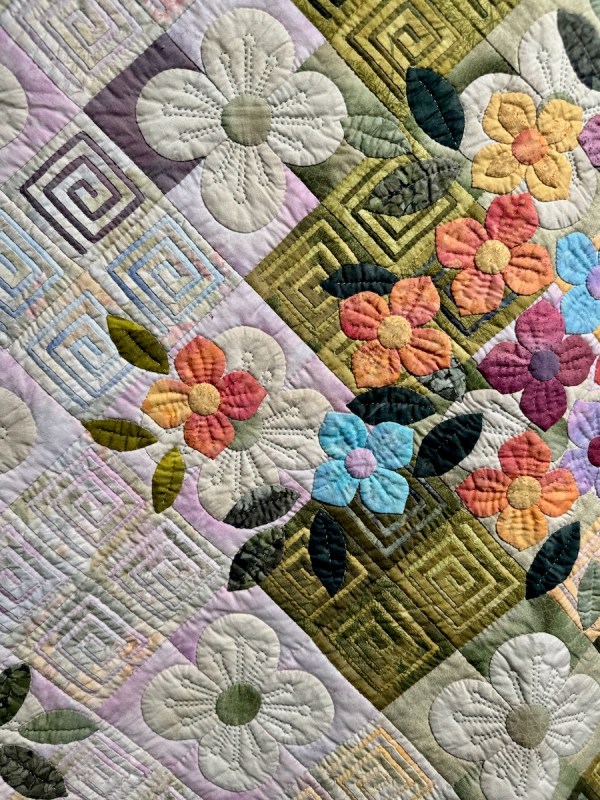
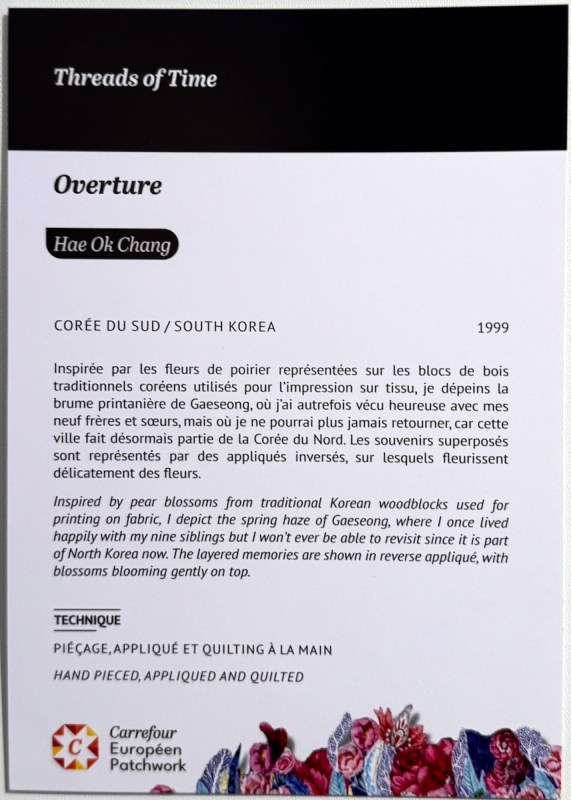
She also makes more traditional quilts, such as this one, inspired by pear blossoms.
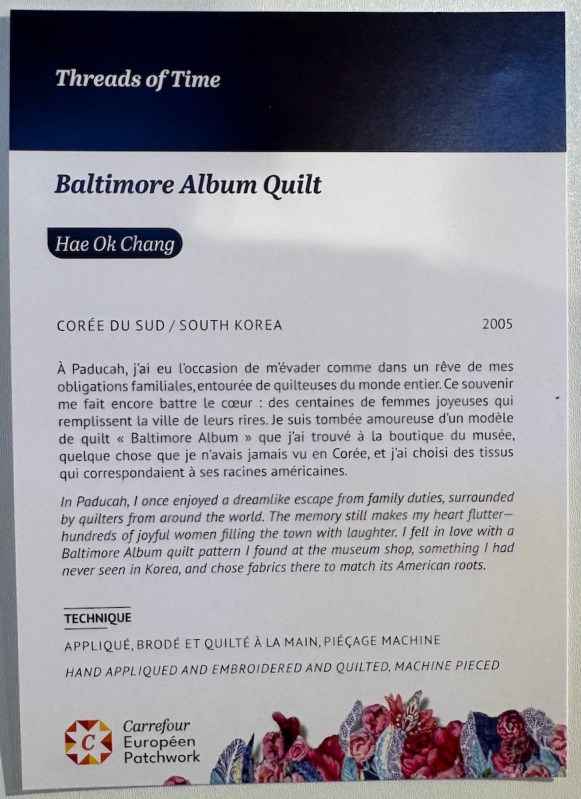
This was inspired by a trip to the Paducah Quilt Show.
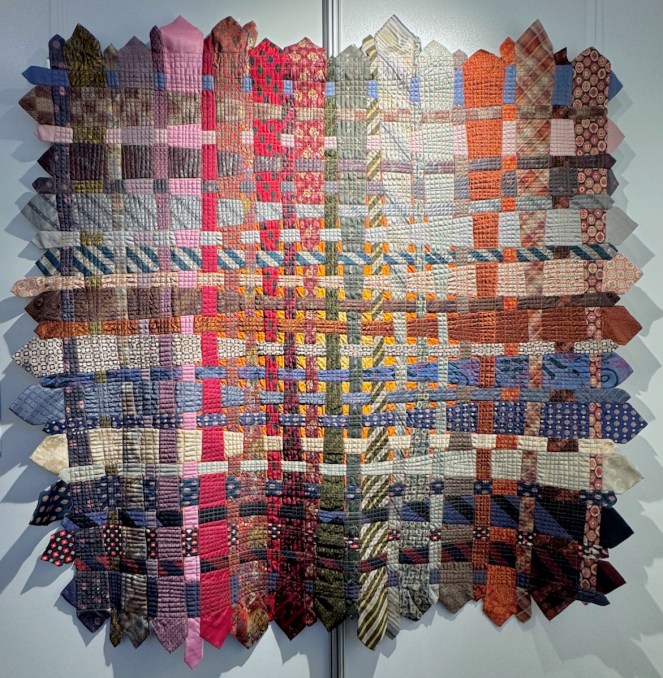
Titled Husband, Chang says she “wanted to weave my retired husband’s neckties into a story. Moments of joy and pride as he walked our daughter down the aisle, welcomed a daughter-in-law, celebrated with friends, and shared hardships. Days of work, success, and failure. I keep his devotion, love, hope, and sorrow close to me. Made in 2007.
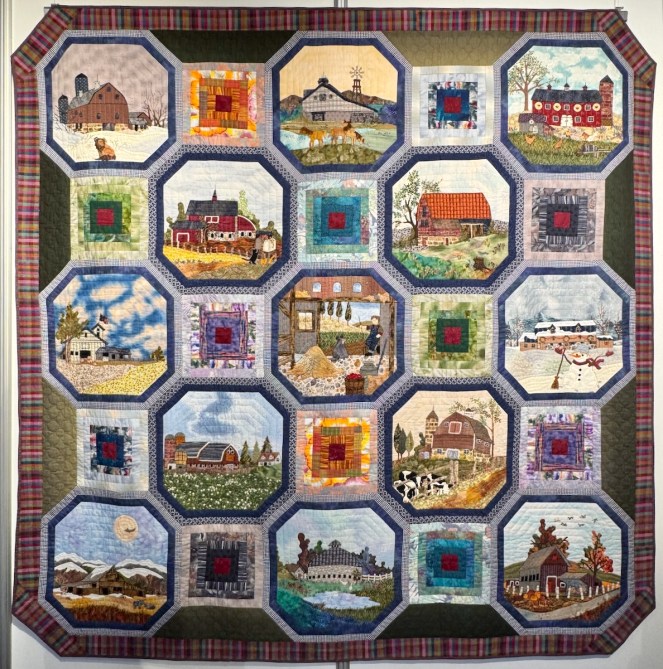
This quilt was made in 2012, after her husband passed away. Title: Time and Seasons.
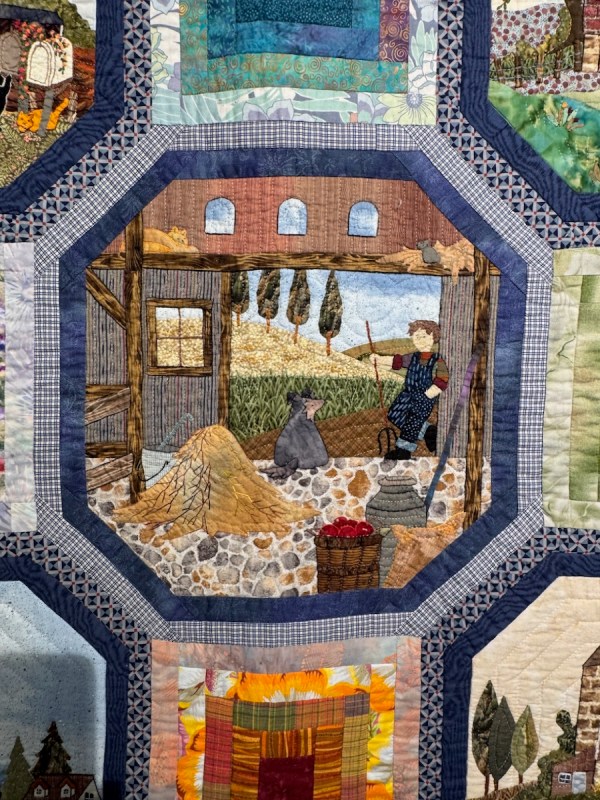
She writes: “After my husband passed away in 2012, I couldn’t bring myself to do anything for a while. I had started this quilt earlier, but left it unfinished. Eventually, I returned to it, intensely embroidering each octagonal block with meadows, flowers, birds, animals, wind, and trees. As I followed the seasons, life slowly returned, and I felt grateful to still have work to do.” Technique: Machine pieced, hand appliquéd, embroidered and quilted.
Title: Wildflowers 01, by Hae Ok Chang Title Card: “We three sisters spent hours together knitting, sewing, and making clothes. My eldest sister did everything well, the second was precise and skilled, and I, the youngest, just tried my best. As I embroidered this work, I often thought of them and our time together.”
I have three older sisters, so this one was especially meaningful to me, although we don’t sew together.
Title: Serene Glory
Unfortunately, I didn’t get a good photo of the title card. You can find her on Instagram, too.
Fiona Lindsay, from Australia
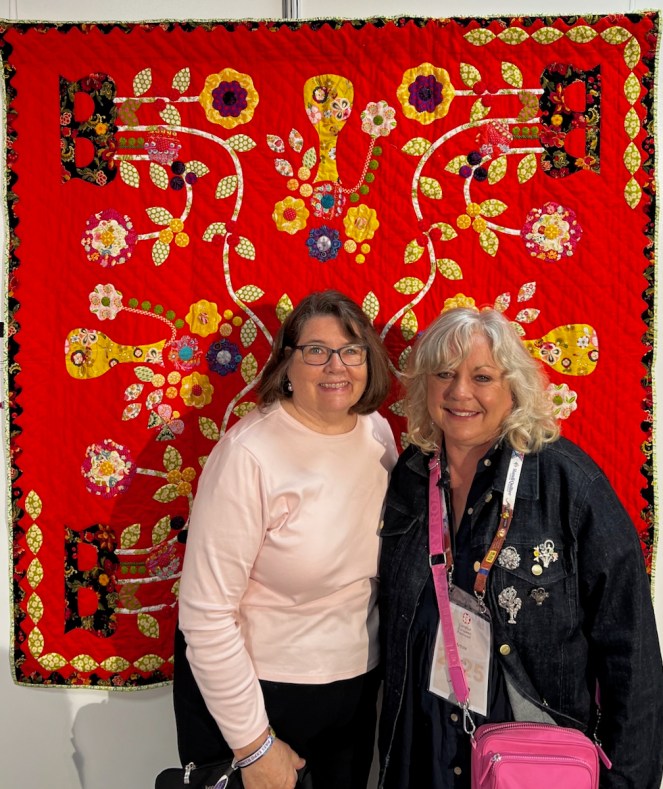
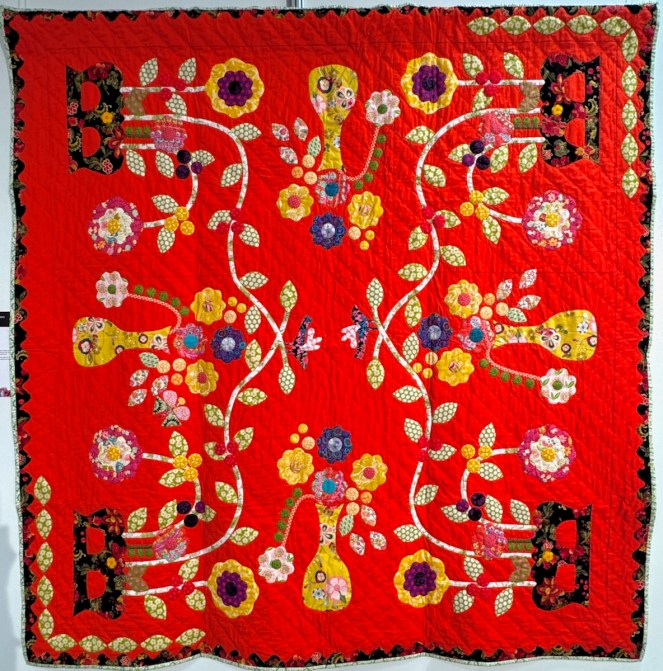
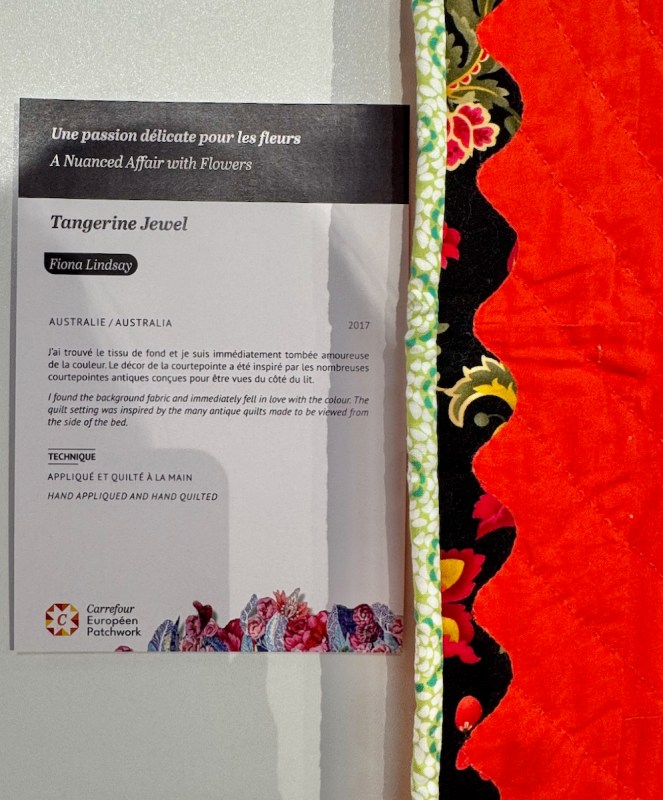
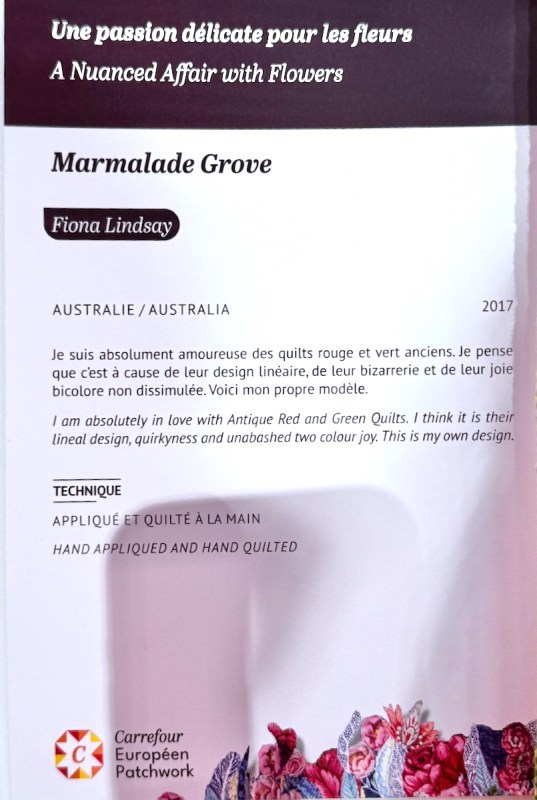
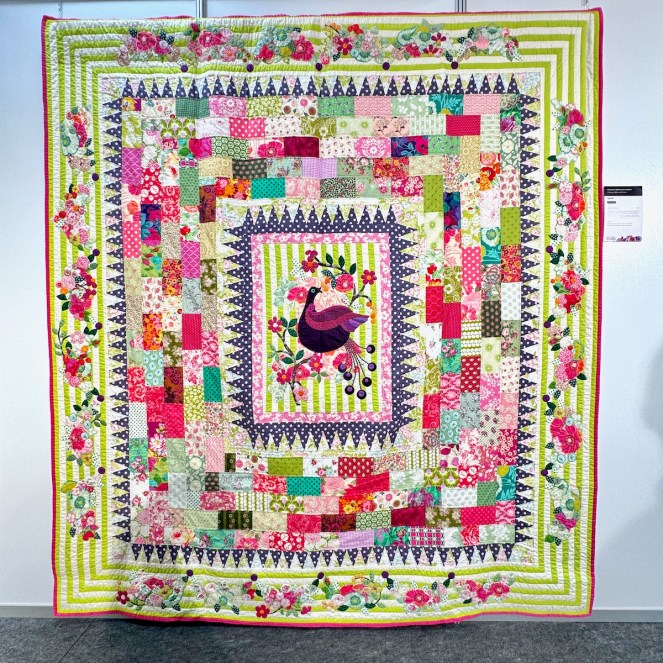
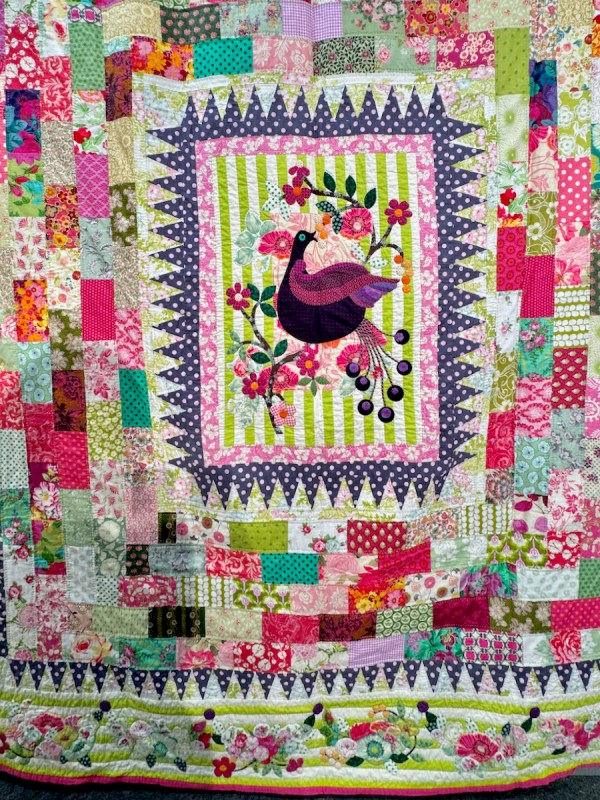
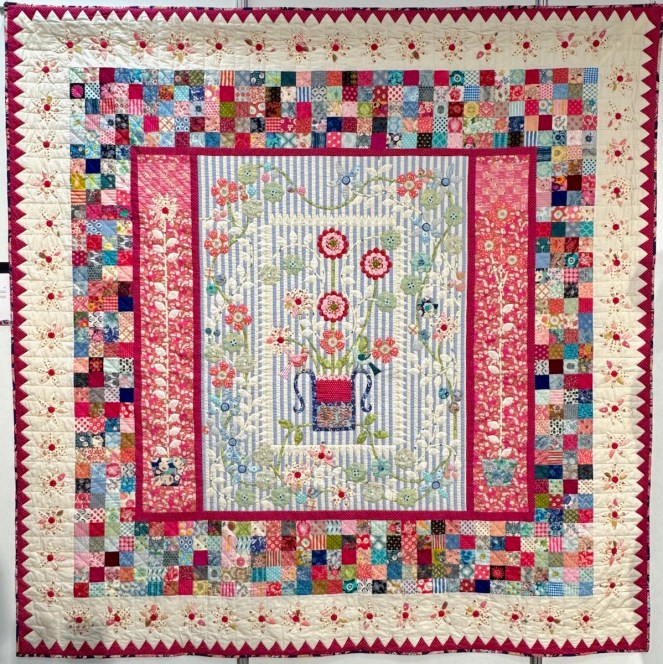
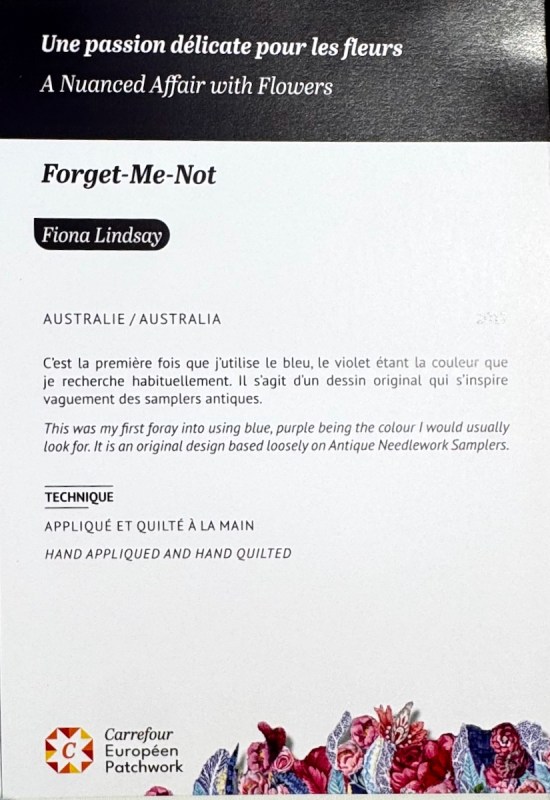
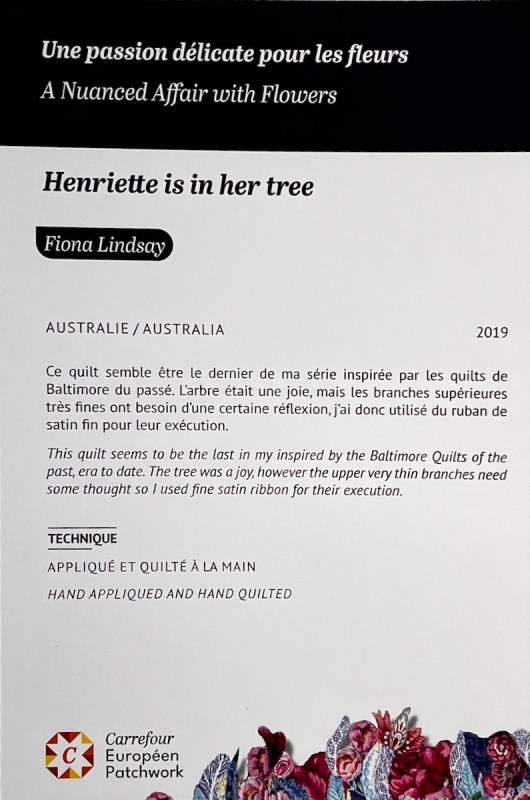
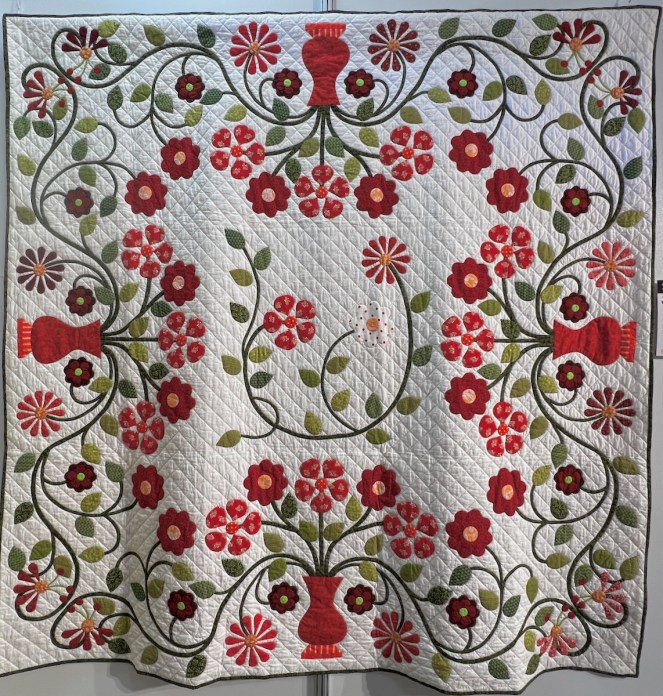
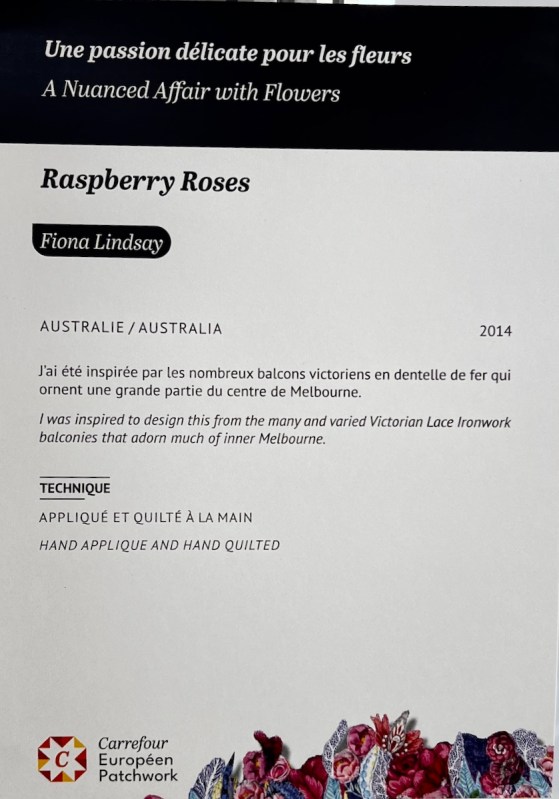
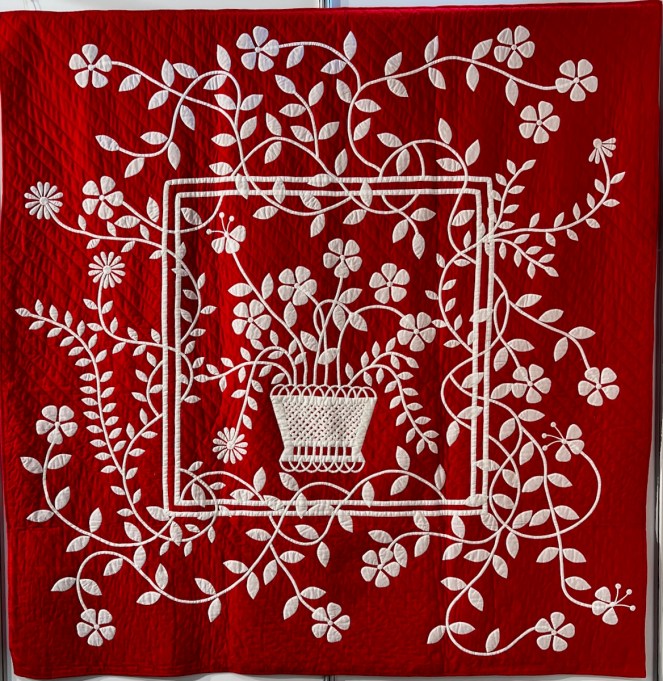
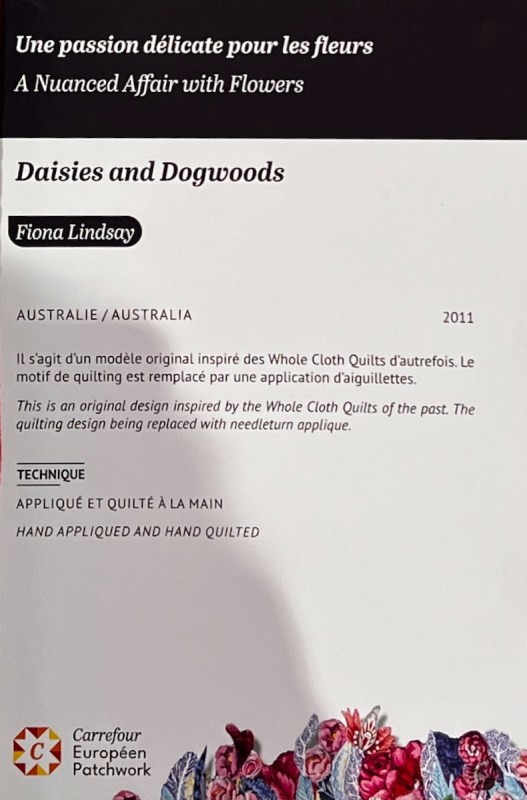
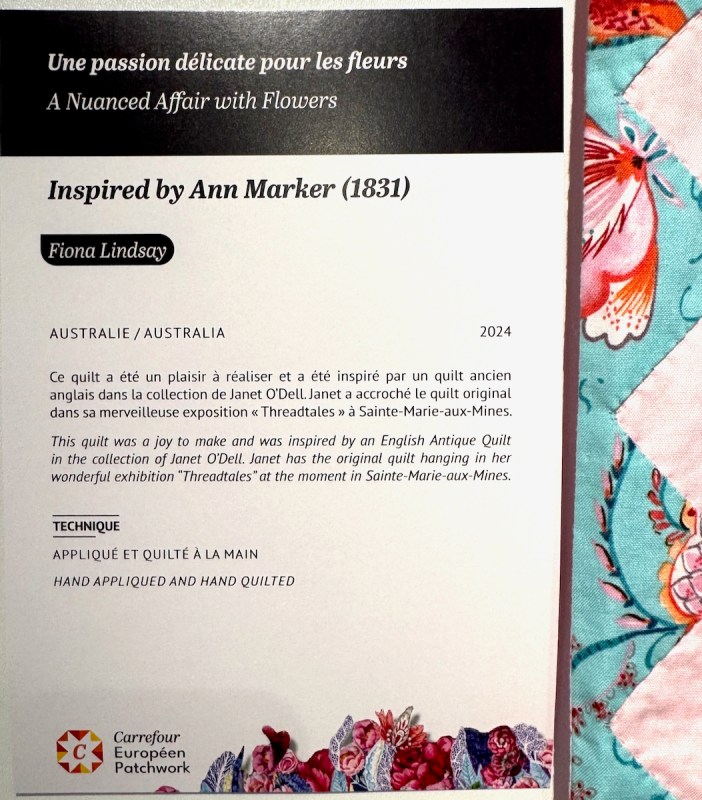
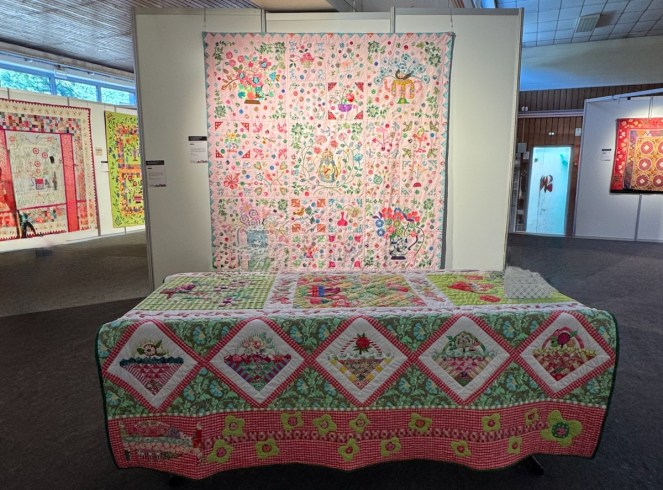
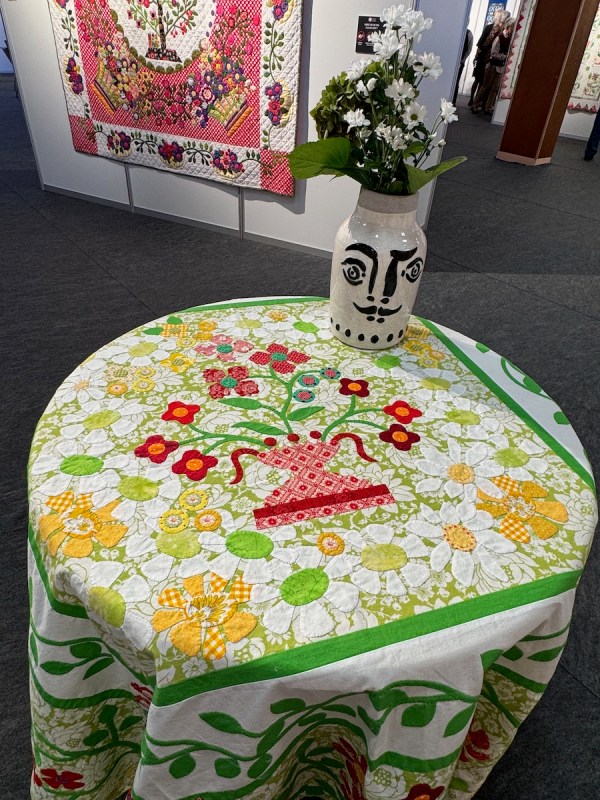
Fiona Lindsay is our last quilt artist for this post, but not the least! as they say. Also showing in Venue 12, her quilts were a veritable flower garden, a theme of hers, chosen carefully, as she loves sewing and she loves gardening.
She was so fun to talk to, and agreed to let me record her talking about her ideas about color and stitching and practice and quilting. It runs about a minute.
Now, for her garden of flowers!
As a reminder, all the quilts are very well lit up, but the shadows can be very strong. I tried to crop them out/edit them out as best as I could.
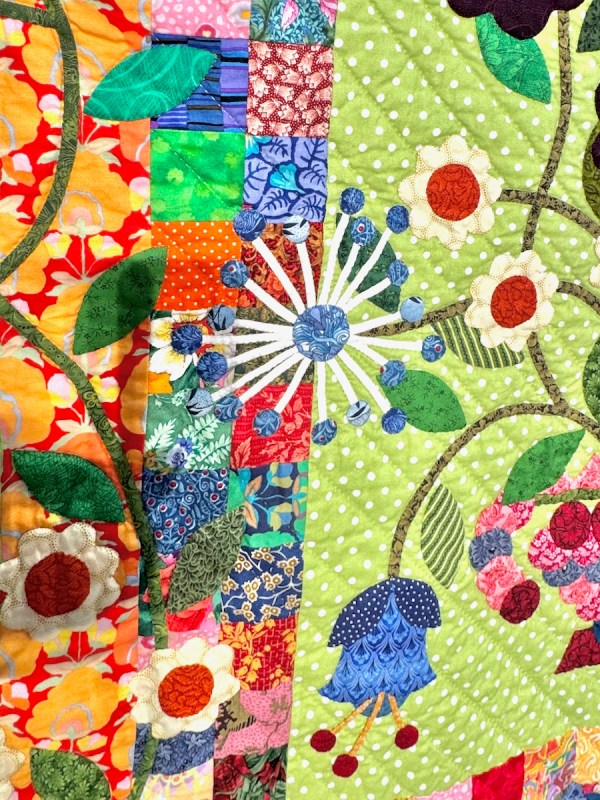
Those teensy seeds on the blossom, and the wonderful shape and proportions of this quilt: loved it!
(Click to enlarge.)
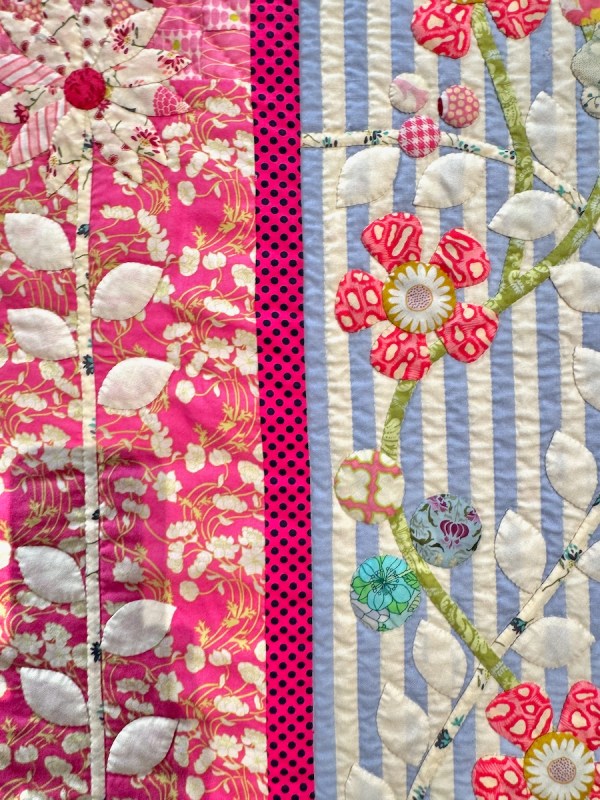
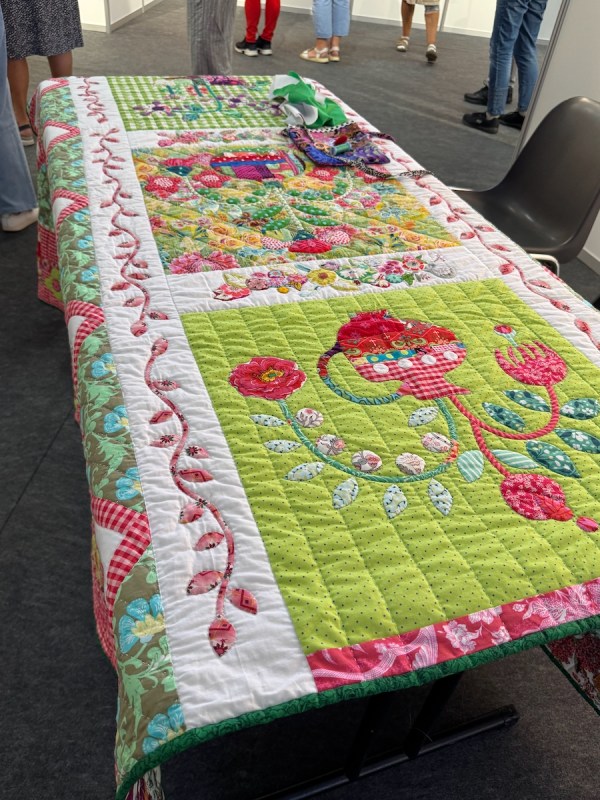
Those border vines have an energy all their own.
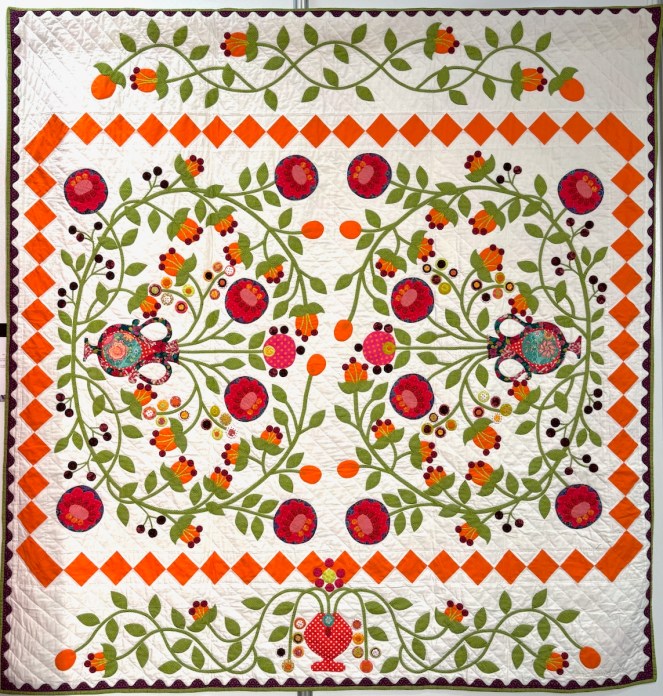
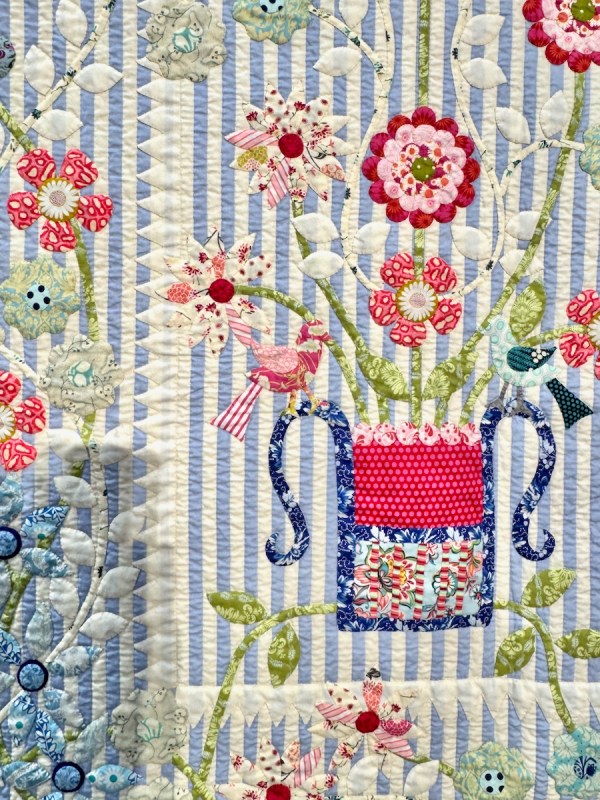
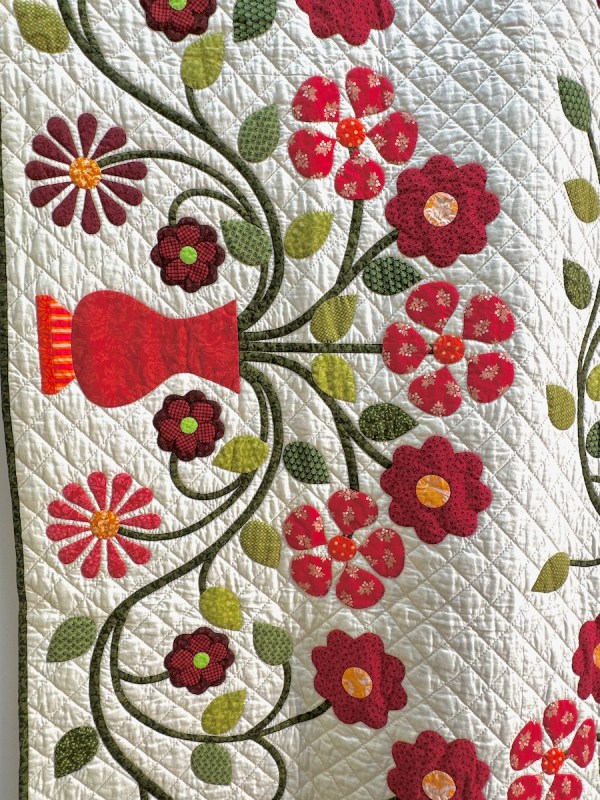
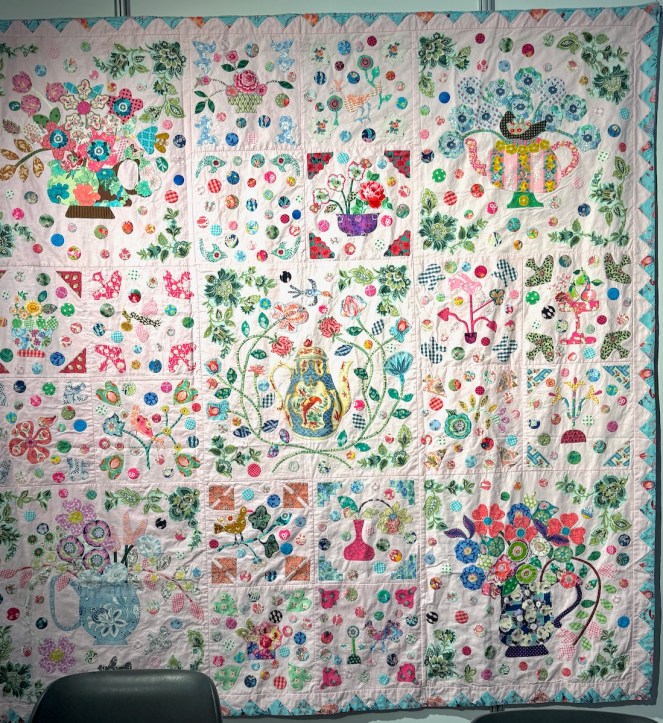
By now you can see that she can put together fabric combinations and colors with such skill, that she makes it look easy. I love the balance of the stems and the shapes of the flowers, too.
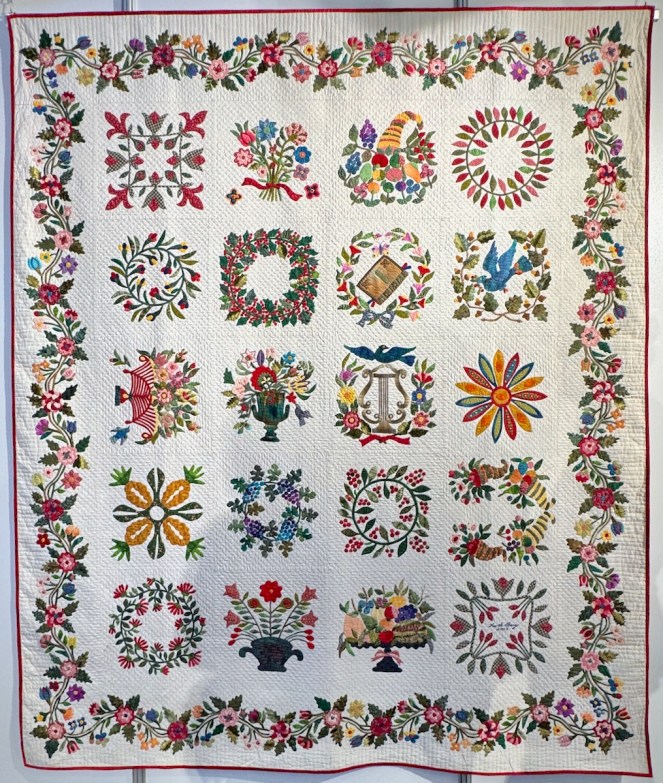
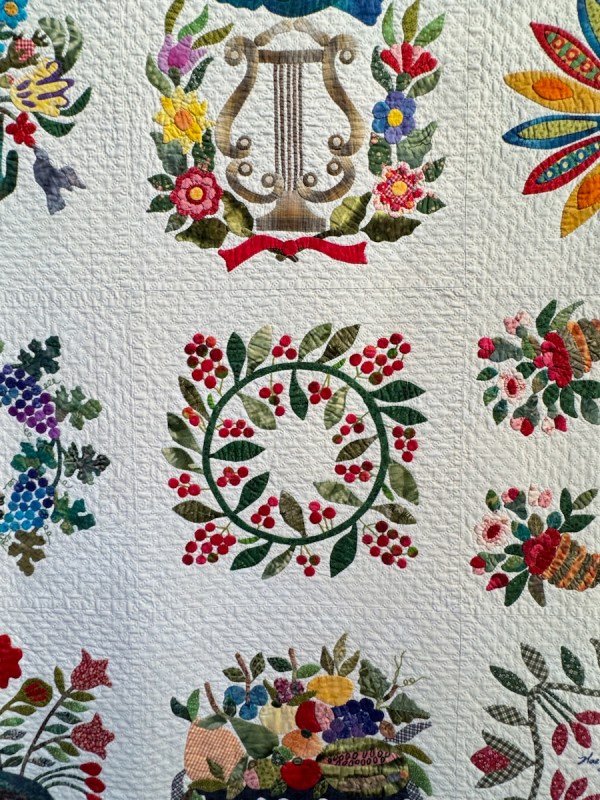
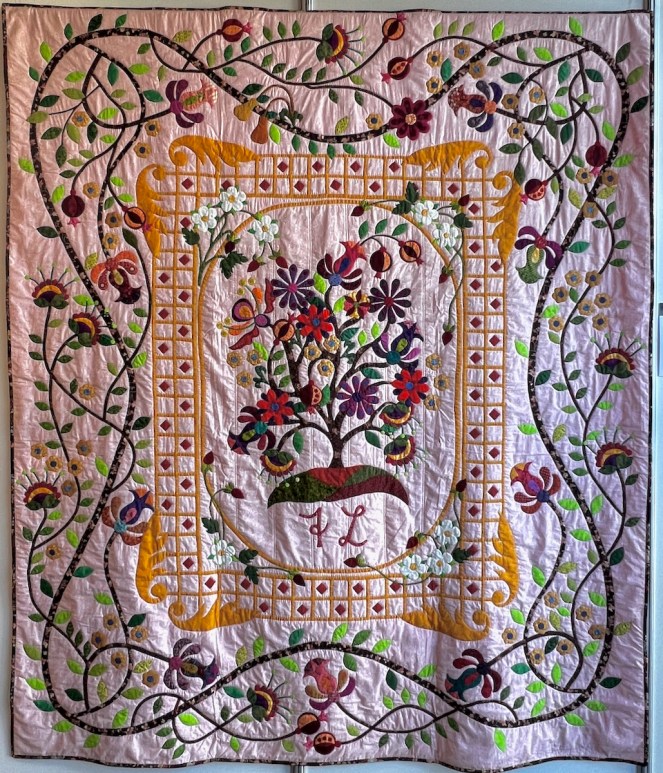
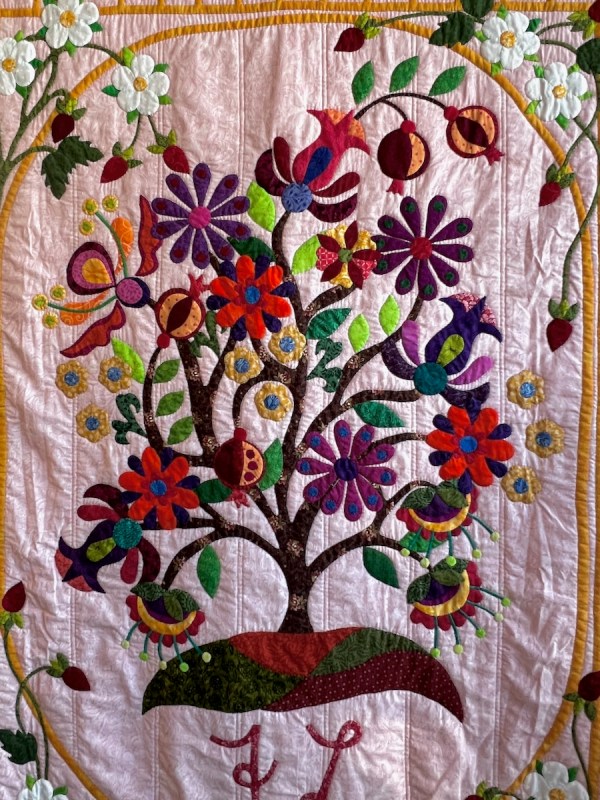
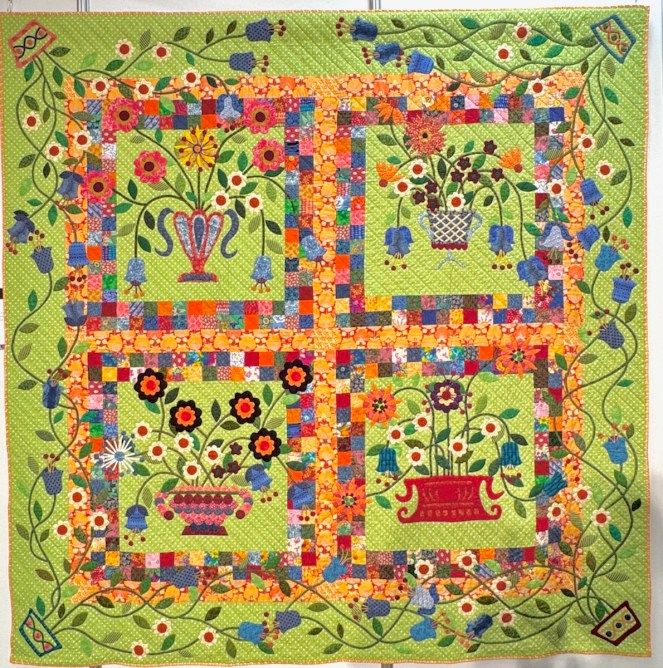
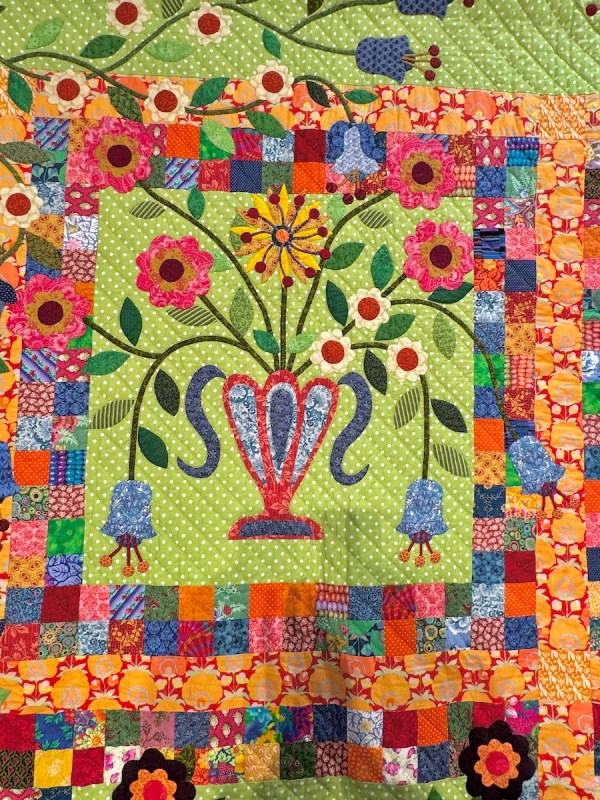
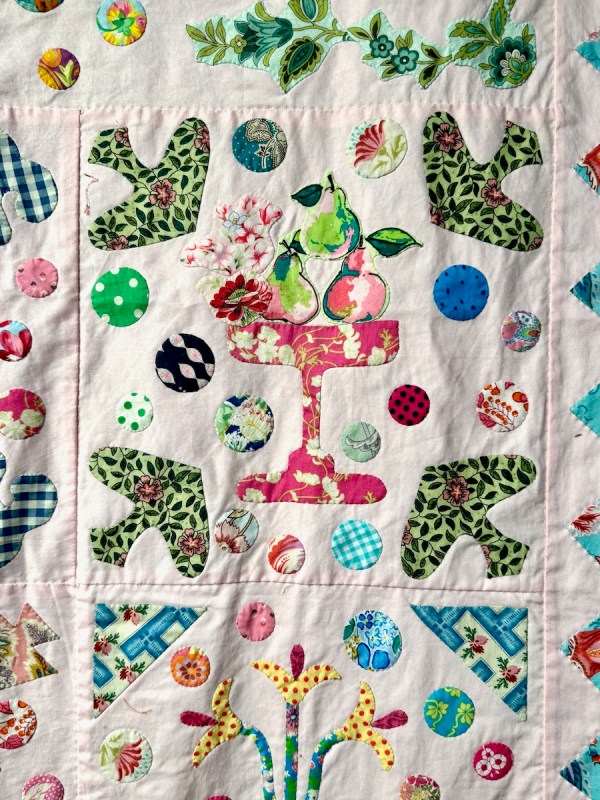
One reason why I do these posts from Carrefour is not only to introduce you to new quilting artists, and to let you glimpse the passions from around the world (which Carrefour is so good at bringing together), but also as sort of a reference book for our own designs. Who would have thought to put a Baltimore-style urn of flowers together (above) with a wild vine running free from tiny pots in the corners? Yet it all works with that pieced border and the wild orange Kaffe fabric sashing. Here’s a closer look:
And now I know the maker of that antique quilt: Ann Marker, from nearly 200 years ago. This truly is free and fabulous appliqué — the joy in these shapes just radiates.
Thank you, Fiona, for all your beautiful flower quilts. You can find her on Instagram. And thank you to all the other quilters and artists.
I know this was a really really long post, but again I hope you’ll treat it like a reference, as well as a delight. I think I have at least one or two more post in me before finishing; it will come soon. Very soon. (Teaser: next up is Racheldaisy, from Australia.)
• Venue 7: Église Ste. Madeleine, with Shin-Hee Chin • Venue 8: 86 Wilson, with Tara Glastonbury • Venue 9: Chapelle St. Joseph, with Janet O’Dell
I have a main Carrefour Quilt Show page that lists all the posts of all the meetings I’ve gone to, and includes the posts from this year too. If I haven’t mentioned it before, you might enjoy these posts more if seen on a desktop computer or even a tablet. Cell phones re-format the layout and can sometimes do strange things to how it looks on the screen.
If you are interested in going to Carrefour, I wrote two posts for them about our travel, and how we put the trip together. You can find them here and here. Their main website is HERE, where you can subscribe to their newsletter (scroll to the bottom).
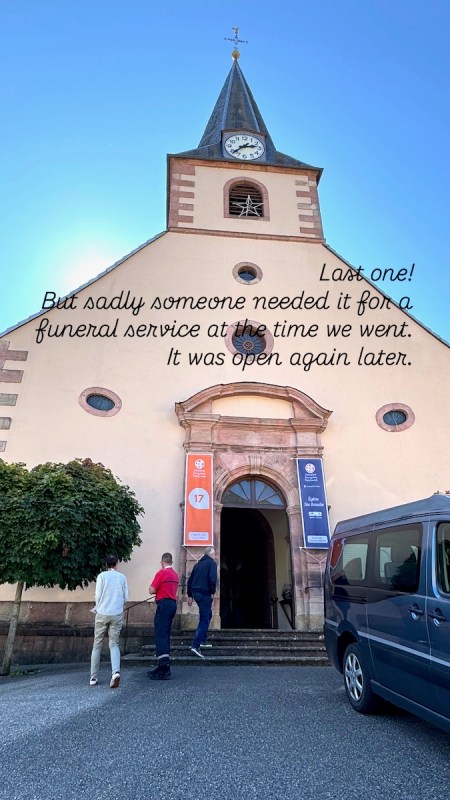
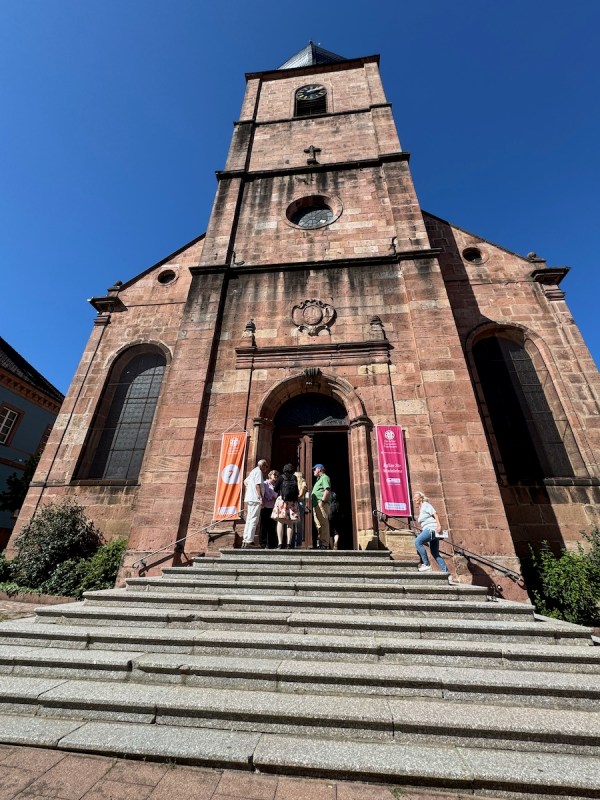
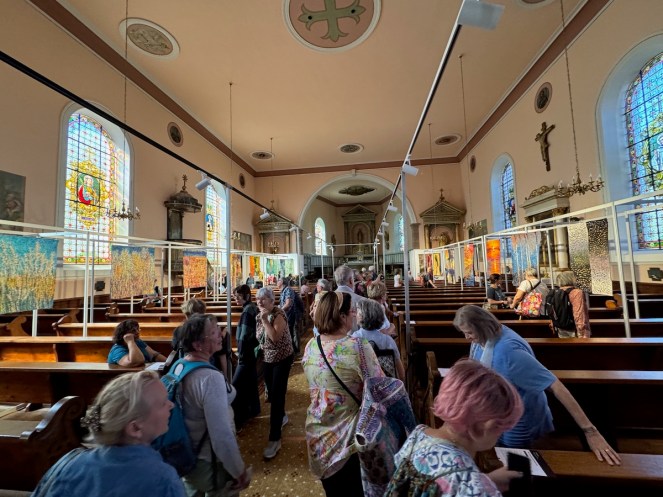
Venue 7 is the St. Madeleine Church.
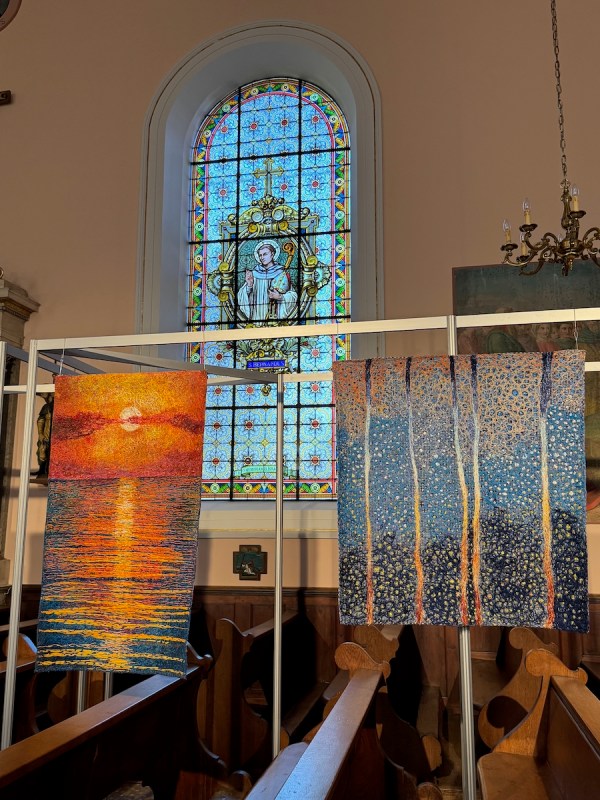
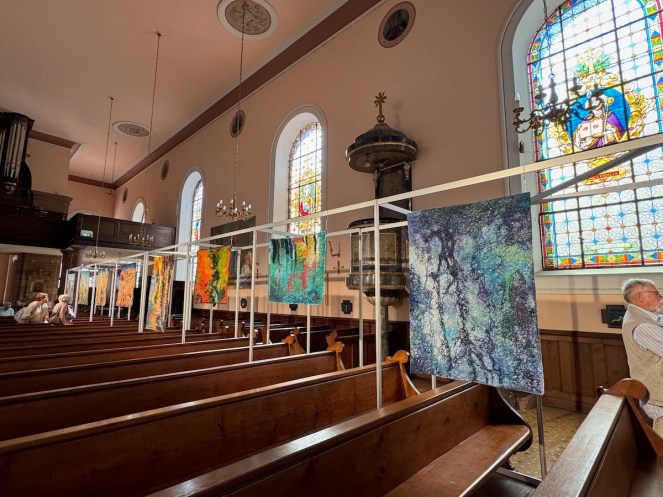
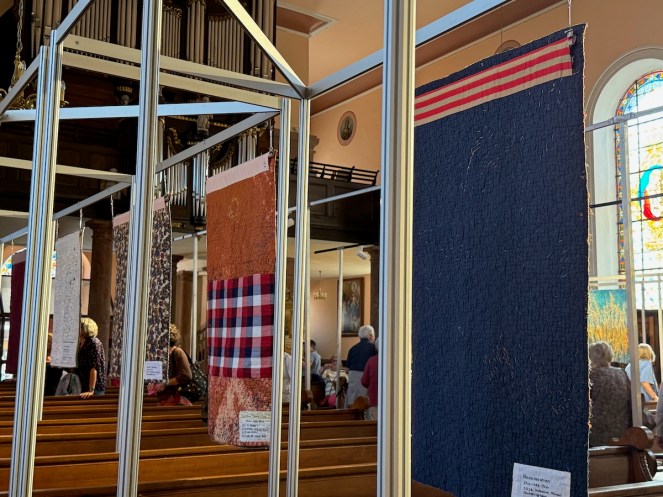
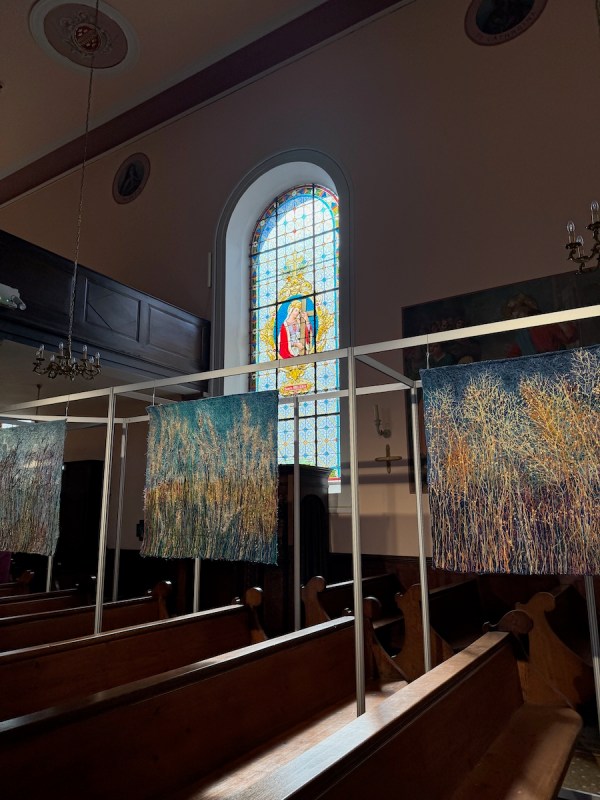
Inside, the organizers set up a metal scaffolding framework to see the quilts. The lights are strong and the quilts are well-lit (sometimes with shadows, but we tried to work around them). I appreciated the effort they made for us to see the quilts. Sometimes, we’d have to walk down the bench to see details, which is what you see going on here with people moving in, then back out to the main aisle.
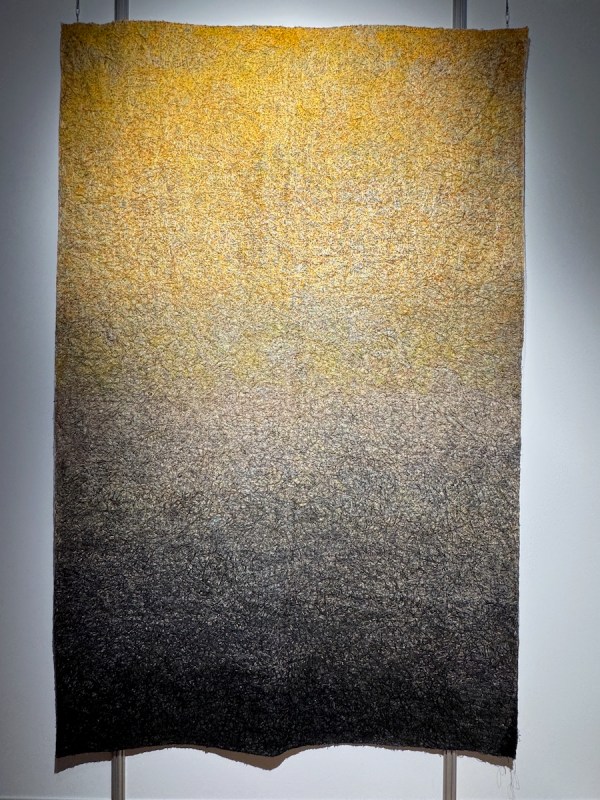
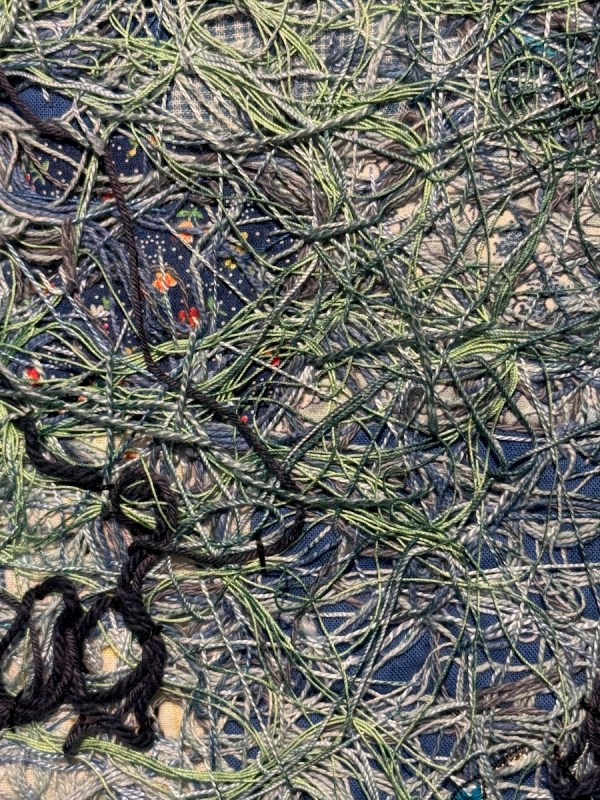
She was born in Seoul, and earned her BFA/MFA from Hongik University and an MA in Fiber Arts from Cal State Long Beach, in California. She is now a professor at Tabor College (Kansas), where “her work explores identity, hybridity, and belonging through feminist traditions and spirituality” (from catalogue). The catalogue goes on to say that her work also “honors the deep bond between humanity and nature. Through meditative hand stitching, she reflects on our share facility and interconnectedness. Each stitch connects with nature’s rhythms, creating texture and depth to celebrate the patterns that sustain life.”
Now here’s the surprise. Perhaps you glimpsed through the threads a different quilt.
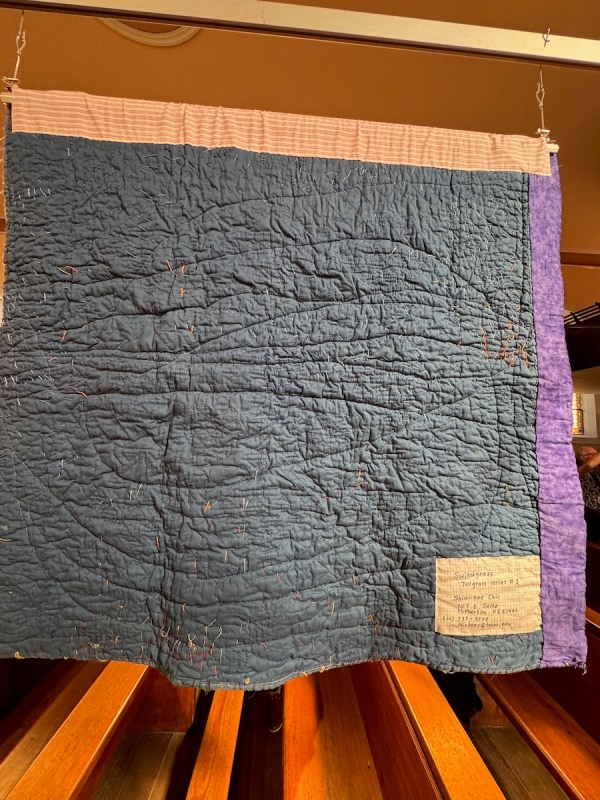
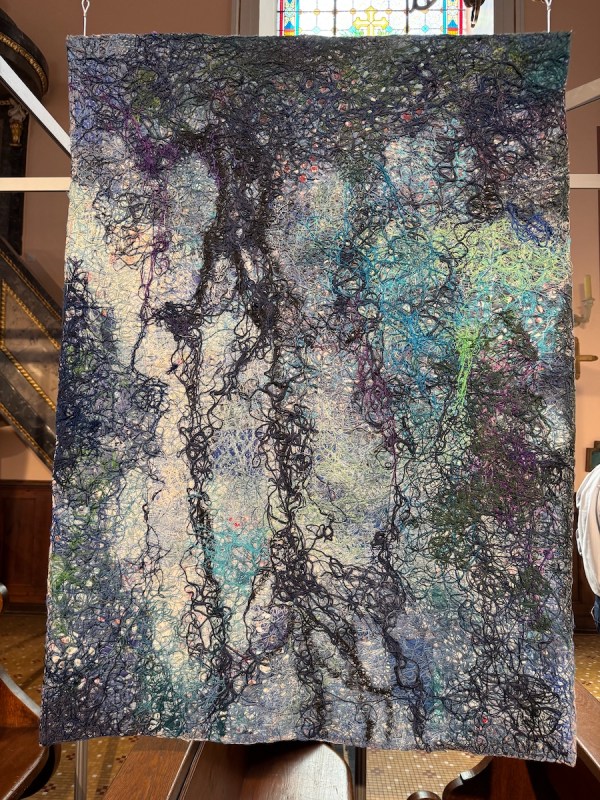
She uses quilts and blankets as the basis for her thread work. This caught me by surprise, and at first I didn’t know how to think about it. We quilters get our knickers in a twist if people make coats, etc out of old quilts. How do we feel about someone obliterating the quilt with their own work? Well, generally that is one reason that I come here: to have my eyes opened to what else is going on in the quilting world. I just needed to accept this artist on her terms, and look at her work. We all have seen quilts at guilds and local shows that surely might be well-suited to a second life (I’m looking at you, pre-printed panels!), and what an impressive life they would have with this quilt and fiber artist.
(Click to enlarge the photos.)
Confession: somewhere along here, I lost track of which quilt belonged this title card (sorry).
Fronts of quilts…
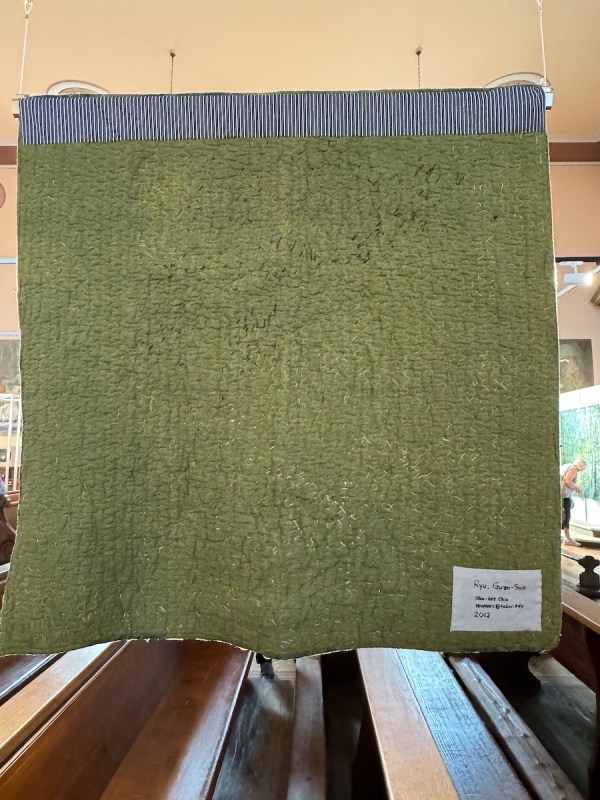
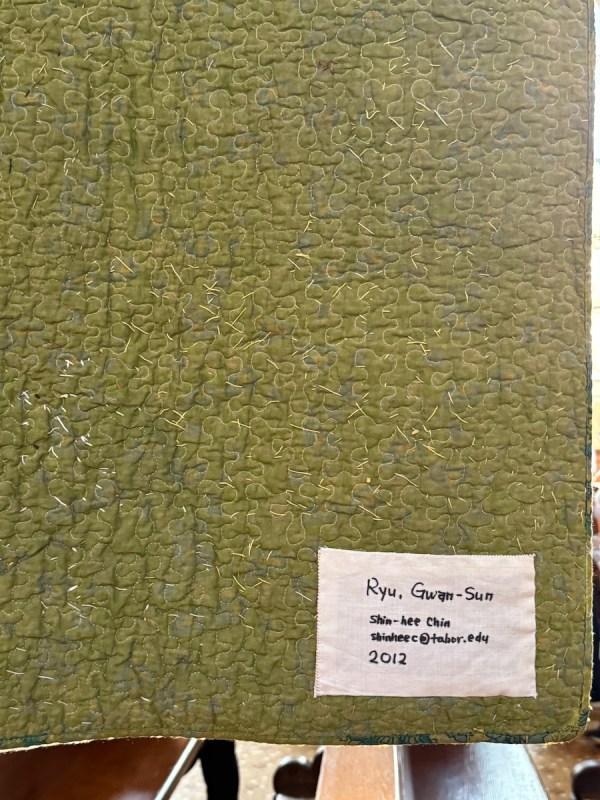
…and the backs of the quilts.
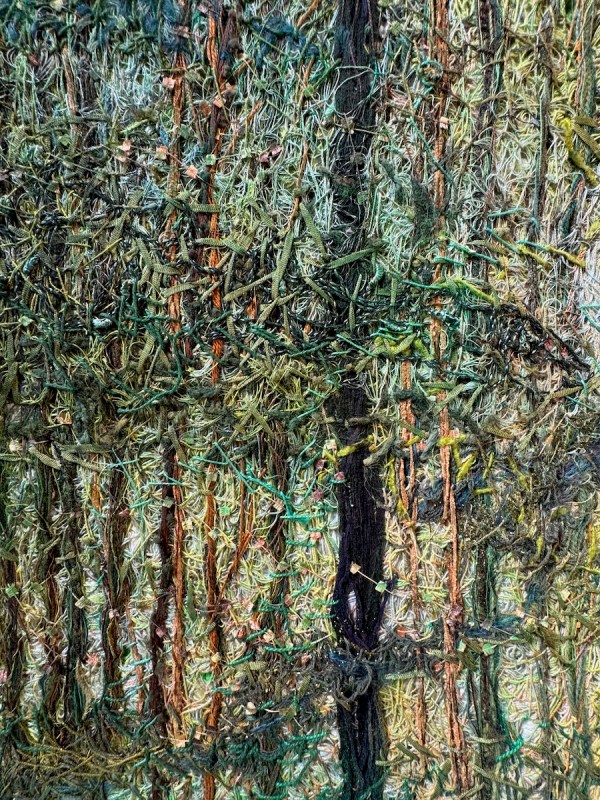
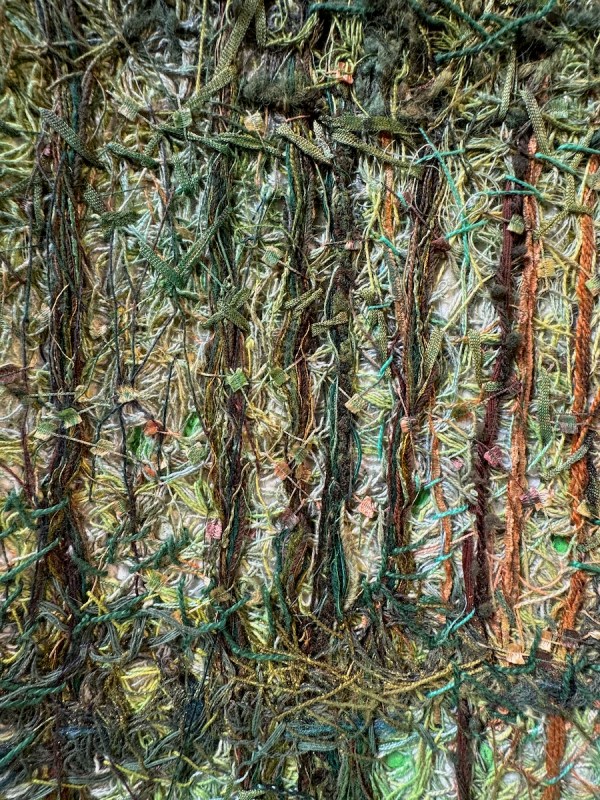
A quilt from her nature series, a collection up on her website. One of the reasons I was interested in this was because her materials: a thick thread with little squares attached, which I’ve seen knitters use to make decorative scarves.
Her work appears literal, like — yes, this is a reflection of tree branches — but then you get closer, and the thread stitches and tangles add another dimension.
The tiled floor, of course.
Last look: the interplay of the church’s stained glass with Chin’s threaded images.
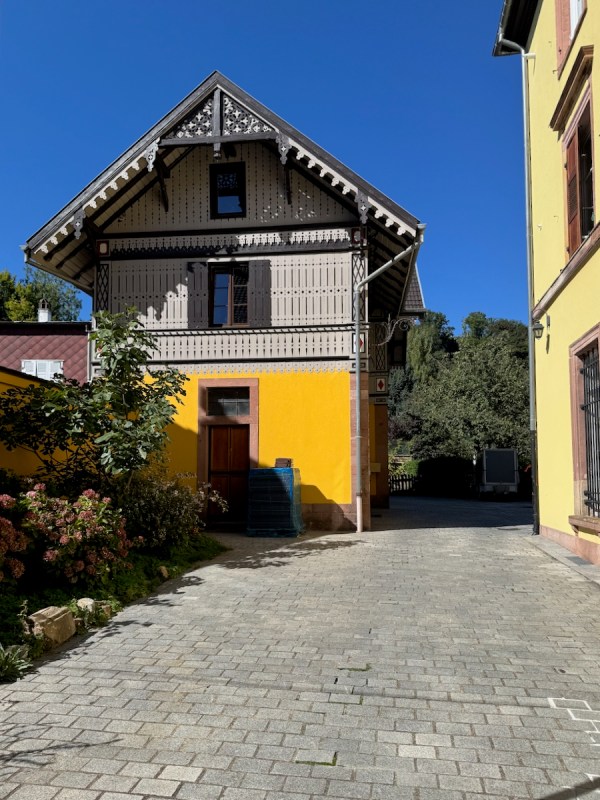
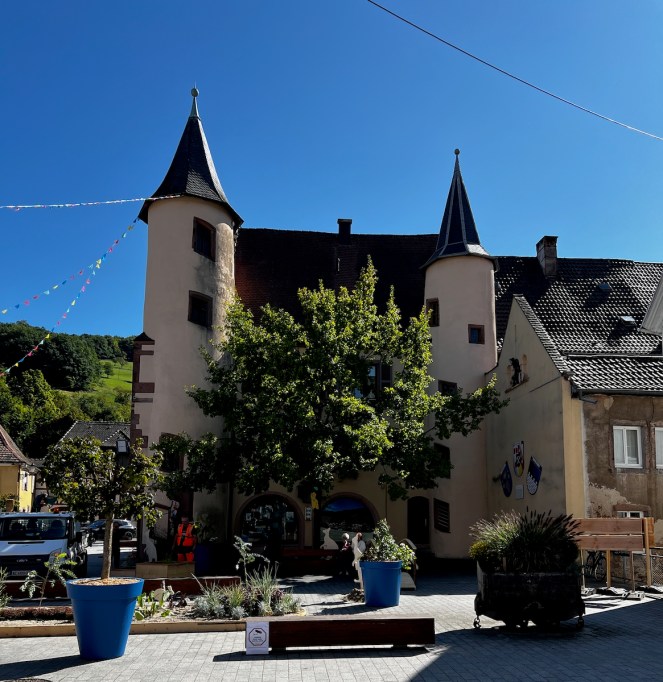
As we walked to the next site, we loved the brilliant yellow against the wood-carving on this small house.
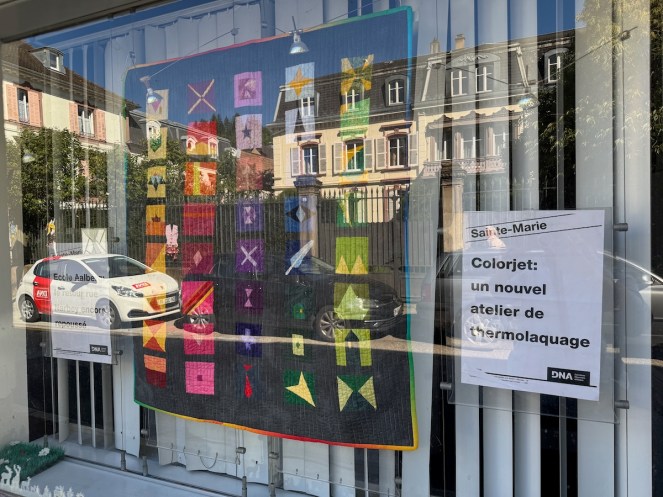
We notice the quilts in all the windows around town. We’re headed to Venue called 86 Wilson, which is really just a street address. It’s where Tara Glastonbury is exhibiting, another quilter from Australia.
The view across the street.
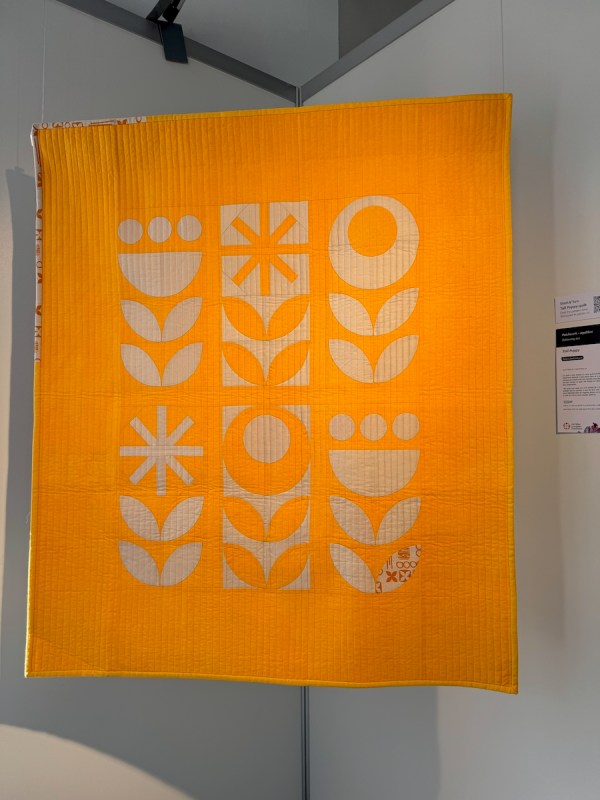
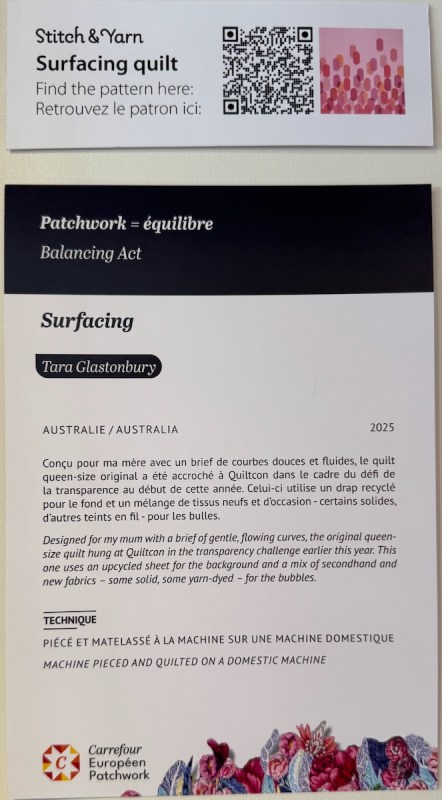
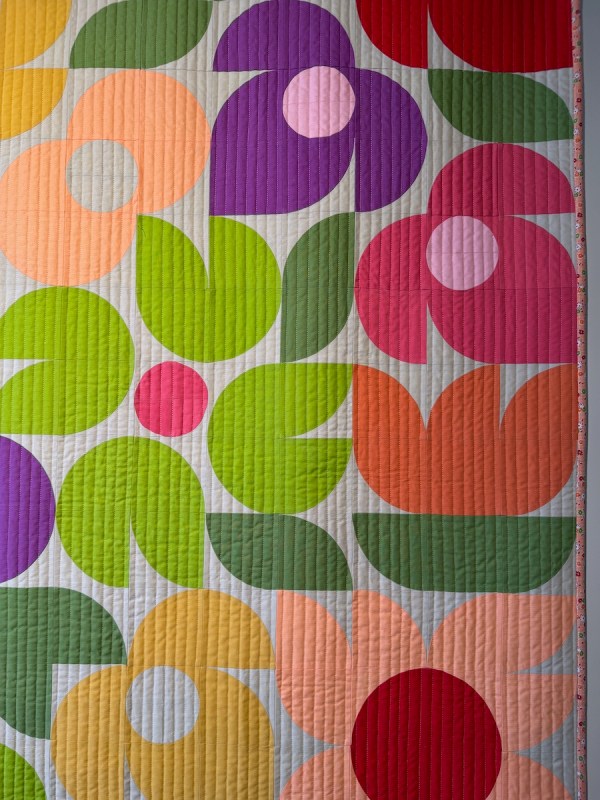
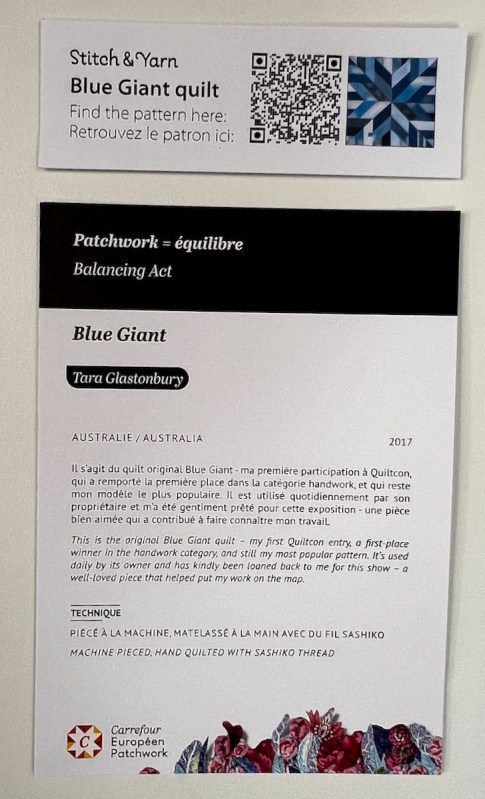
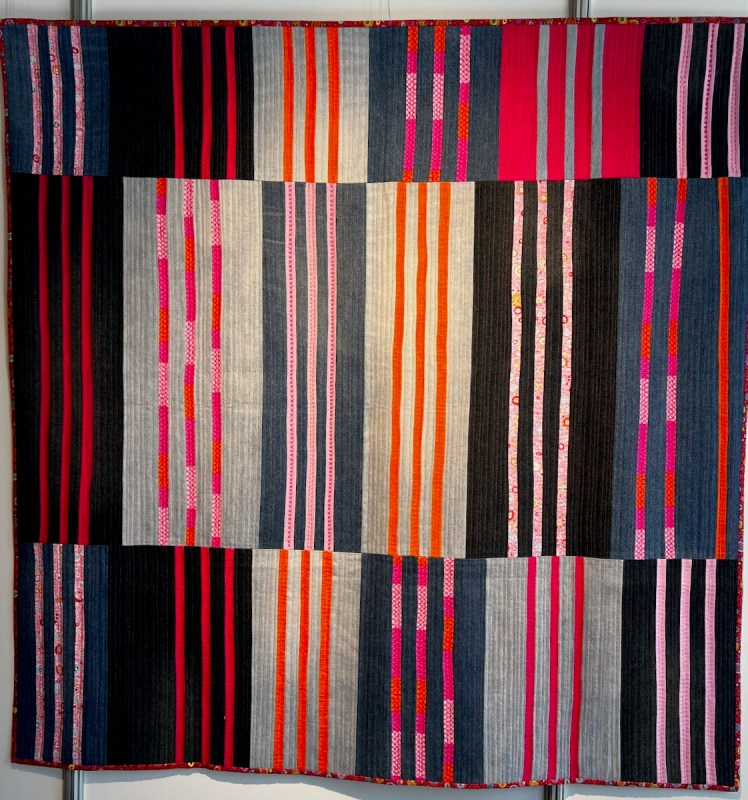
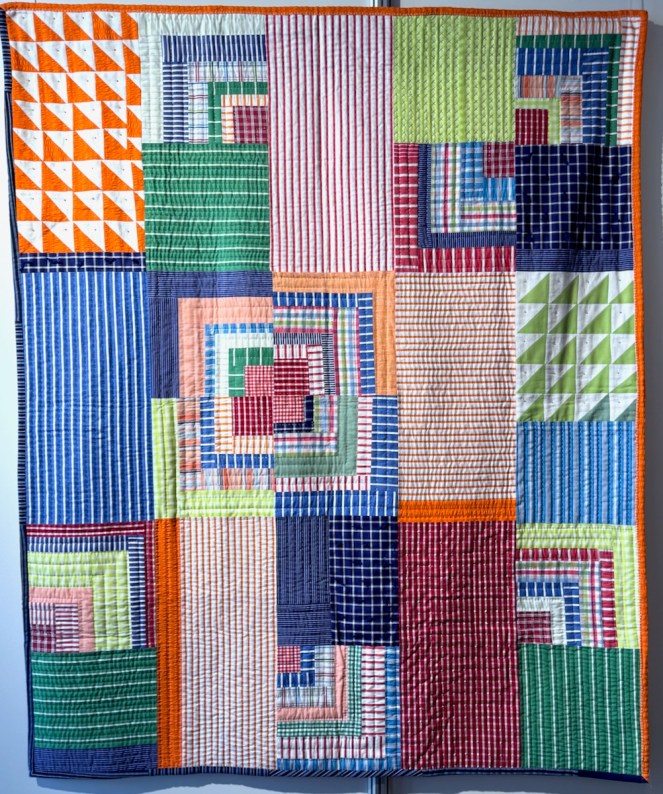
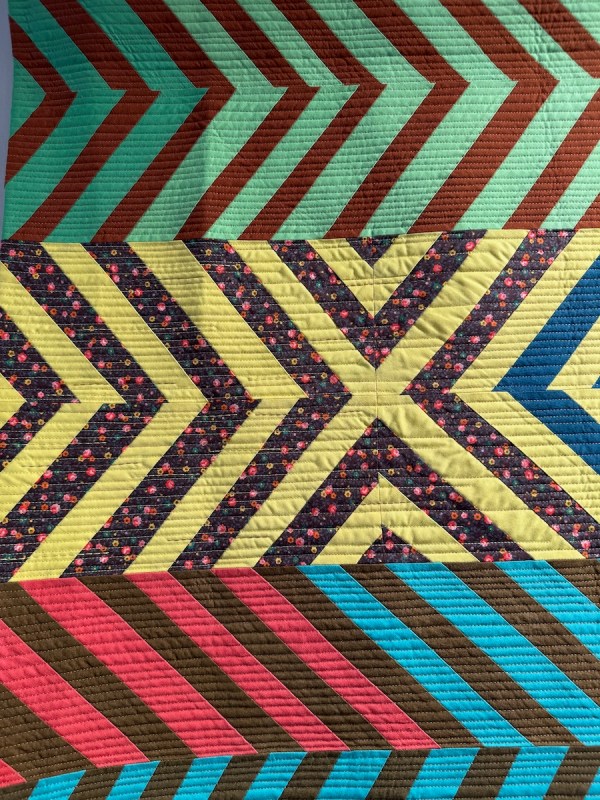
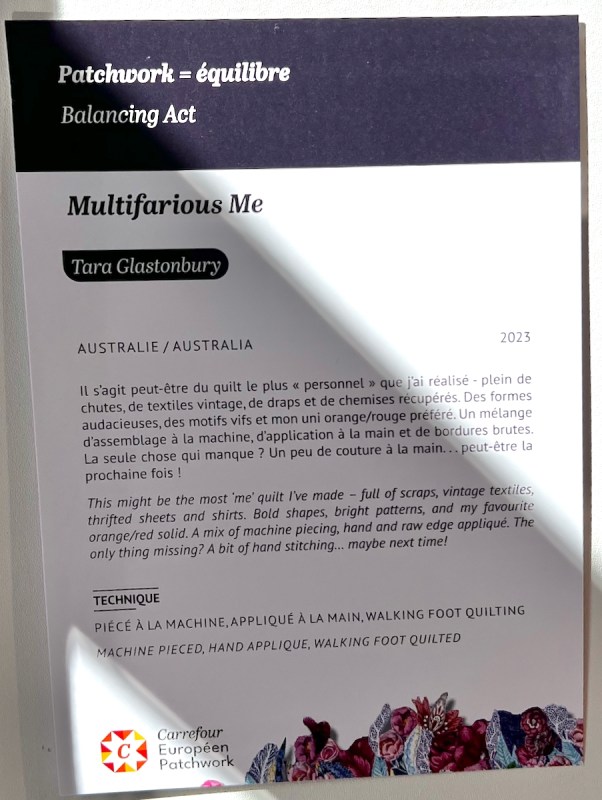
Now do you recognize her work? She has a pattern line, as she has “a background in graphic design, and a long history in textile crafts” (from catalog). She titled her exhibit “Balancing Act,” as it “explores her evolution as a design-led modern quilter through her use of bold color and striking geometry.”
Tara and her mother sat inside, just a bit away from the front door, in front of a sunny window lighting the space. She had copies of her newsletter and patterns (yes, I bought one). The atmosphere was genial and happy.
I struggled to get the right color balance, because the lights cast a really warm light.
I love that she had tote bags that echoed her quilts.
Two quilts that I don’t have title cards for are below, but you can find them in her pattern shop.
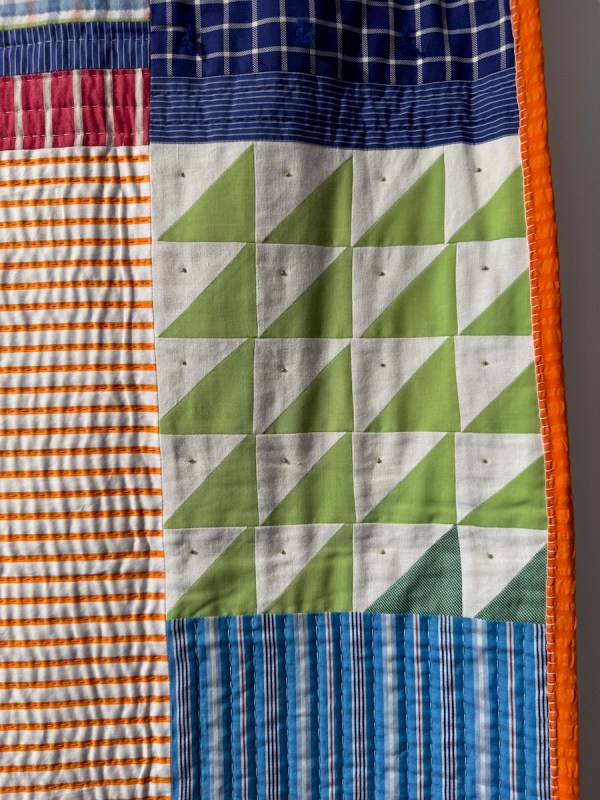
I love that she “jazzed up” her Log Cabin with some triangles.
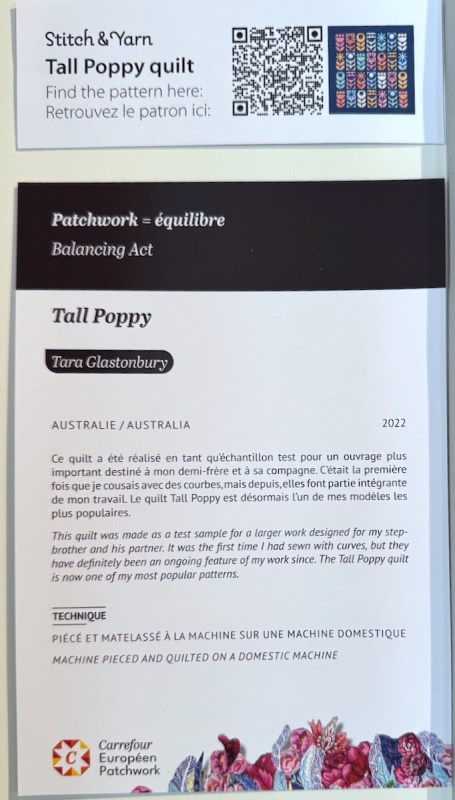
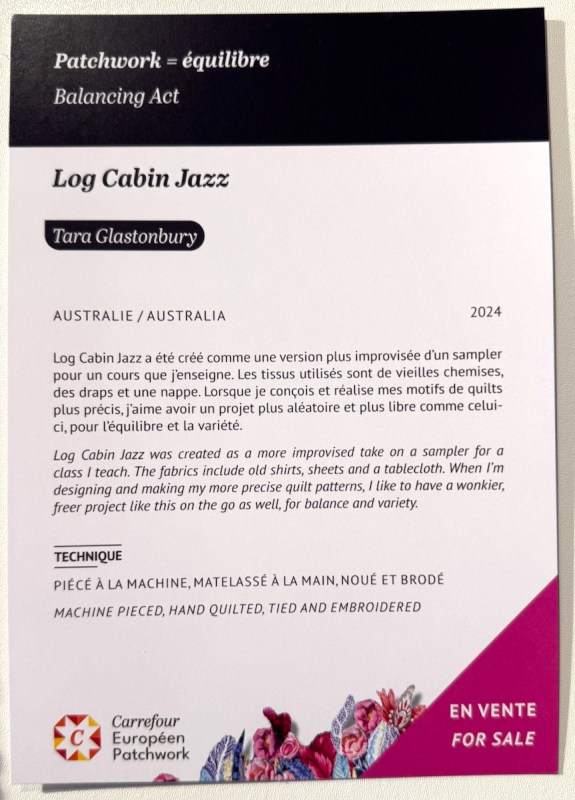
See her card (below) for a truer representation of the colors. It’s such a terrific design.
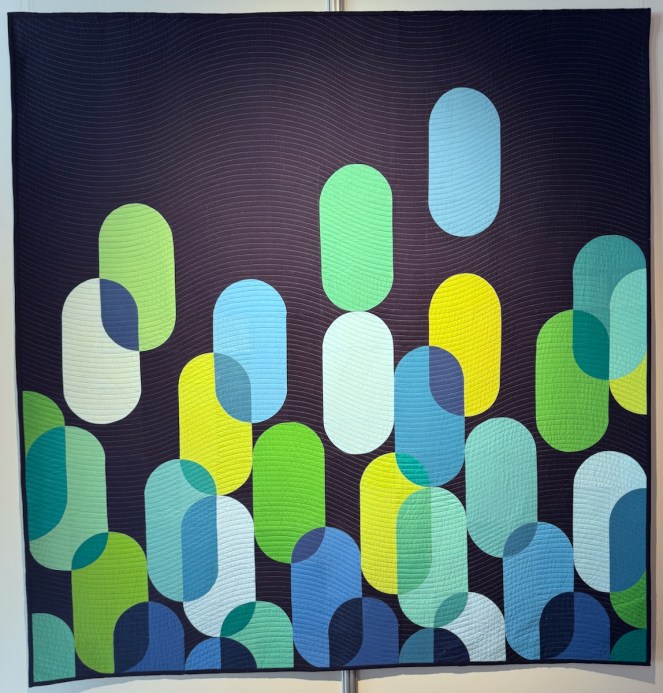
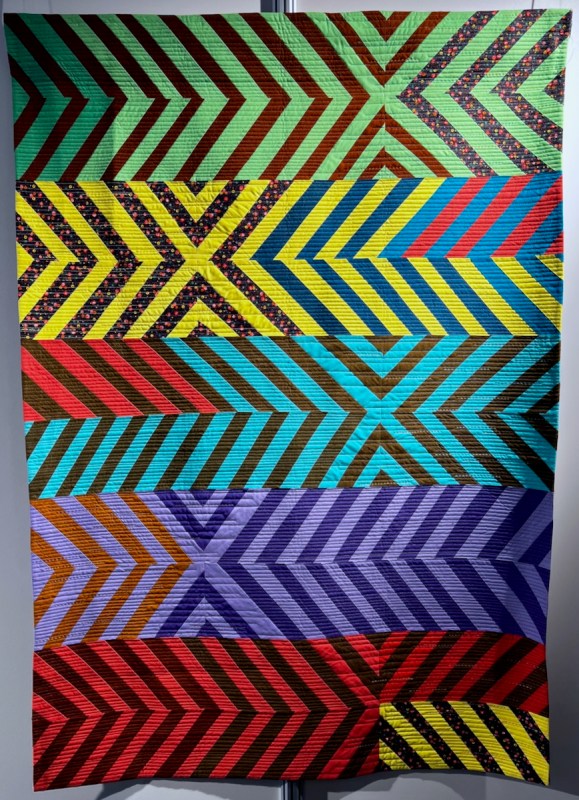
Tara’s penultimate quilt:
She uses small pieces of fabric in an interesting way. Scrappy-not-scrappy, but more ordered.
Last one from Tara:
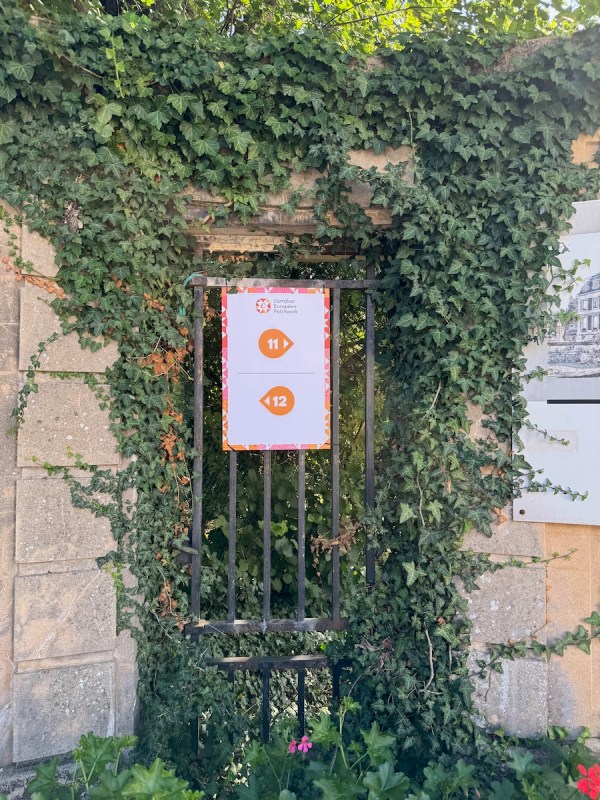
We jumped in the car and drove to Venue 12, passing another house with a carved wood exterior. We’re skipping Venue 11 for now, as it’s not on the way. After finding a parking place around the corner, we arrived.
Venue 9 is a tiny little church where we saw the European Bobbin Spool Invitational Quilts last year. What will it be this year? Again (you’ve heard me say it before), I am always just blown away by the diversity of quilts and quilters at this quilt show — it really pulls me out of the US manufacturers/quilters/design loop and makes me think and appreciate the diversity we have. I hope these posts help you see your quilting and creativity with new eyes, or maybe spark a new idea.
Photo of stained-glass taken by my husband. As always, we both took lots of photos, so many of the images in these Carrefour posts are his.
This time, we will meet our great-grandmothers of quilting.
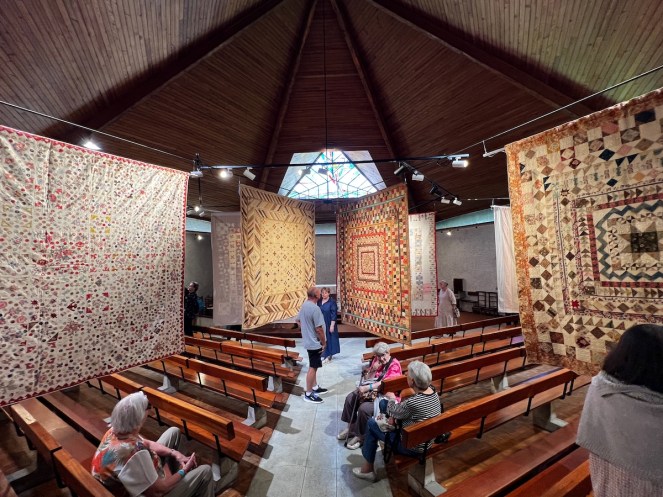
Not in the flesh, but in the work they left behind, courtesy of quilt collector Janet O’Dell, from Australia. She (as the catalogue says) “is a keen collector of antique quilts. Her collection of hexagon and medallion quilts has been built up over the past 25 years from a variety of sources. All have been chosen because they appeal to her personal taste.”
And the one quilt that I will flood here with photos and which I loved-loved-loved, I did not get a photo of the title card. Interestingly enough, it was inspiration for another quilt in Venue 12, from Fiona Lindsay (a future post). Okay, back to Janet O’Dell’s quilts.
Here’s the one I loved and I’ll intersperse my comments with the photos. Just keep remembering. These are OLD.
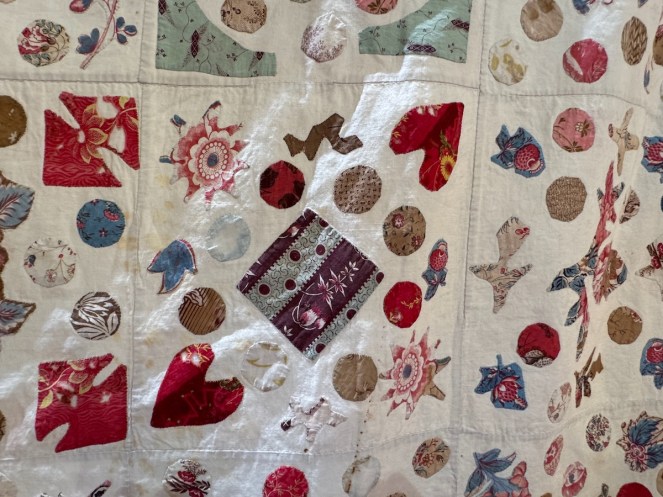
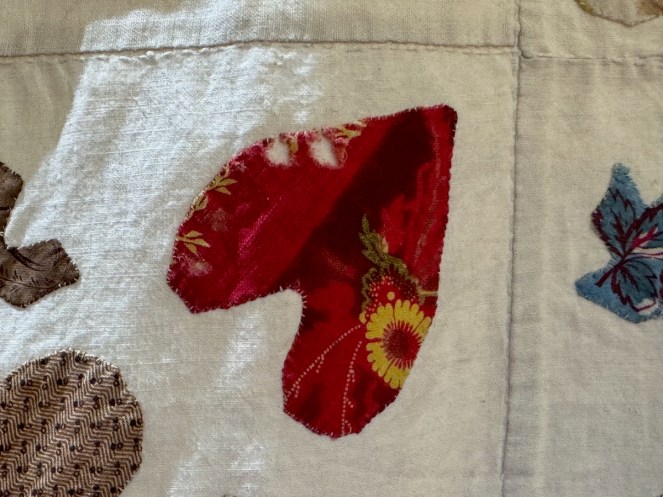
So, the Big Picture, to closer-up, and then to these hearts with their worn spots.
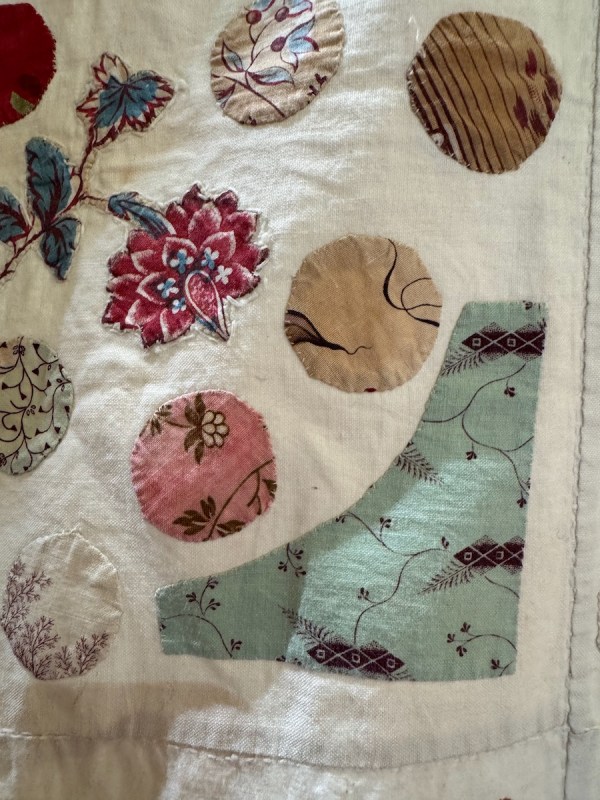
This block, with its free-form cut “corners” of minty blue-green, the broderie perse flower in the center, and those random circles was another favorite. It was interesting being in that space, with these very old quilts. People were quietly moving around them, and then taking a minute to sit and gaze. In so many other venues, we are dashing to take it all in, but here, sitting with the quilts was the point.
Okay, maybe I was just tired.
Or maybe I was fascinated with their technique on their appliqué stitch, each bit of thread taking a bite over the top of the shape, so different than how I do it now: trying to come out on the fold so you don’t see my bits of thread.
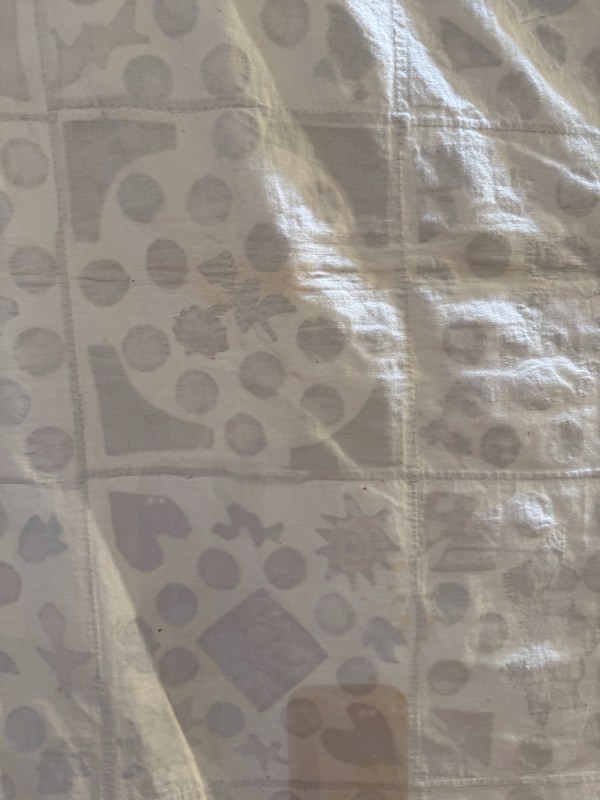
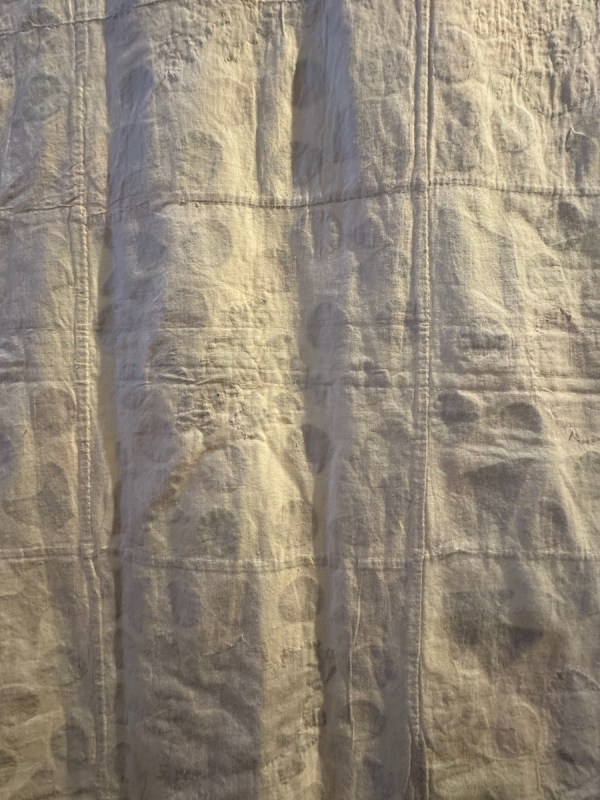
And the back — it didn’t appear to have any batting at all in the quilt, so they must have just done the stitching over two layers of fabric, then did a “quilt-as-you-go” to get those flat-fold seams on the back? I’m not usually that over-the-moon about antique quilts, but for some reason I really liked these.
I read a piece this past week about how difficult it is for us to go back in time and really know how people 100 years ago thought or felt or processed image or feelings — or, since most of these quilts were from around 1830, nearly 200 years ago. And we are so “feeling-centric” these days that we even use the term in all our phrases, such as I felt you might like this — or–I felt badly for you, and so on. Did fatigue register the same way for them, or were they always tired (thinking of their housework)? Did that feeling we all have of a lovely quilt finish, register on this quilter the same way? I’d like to think that this woman, as she put the last stitch on that now-worn red zig-zag binding and unfurled it onto the bed, had a sense of satisfaction over the many years it took to stitch.
(If any reader sees this post, and has any information about this quilt, please leave me a comment. Thanks.)
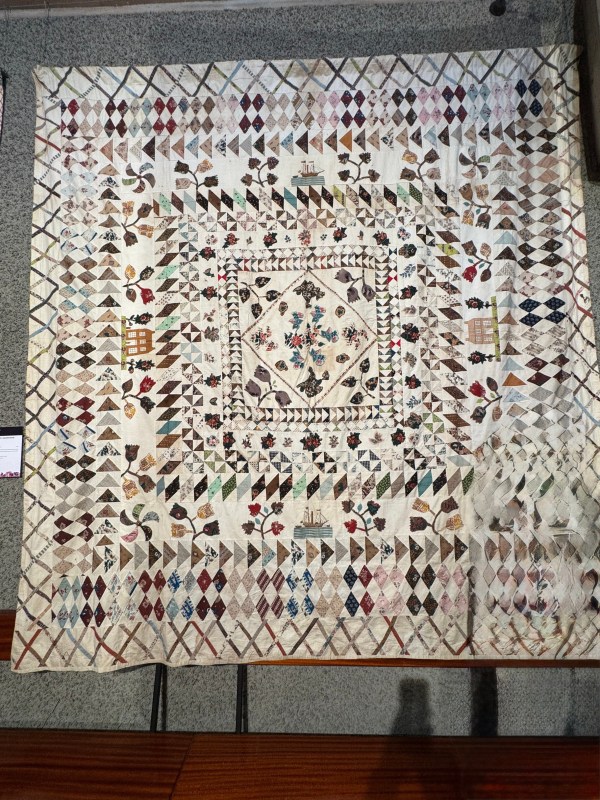
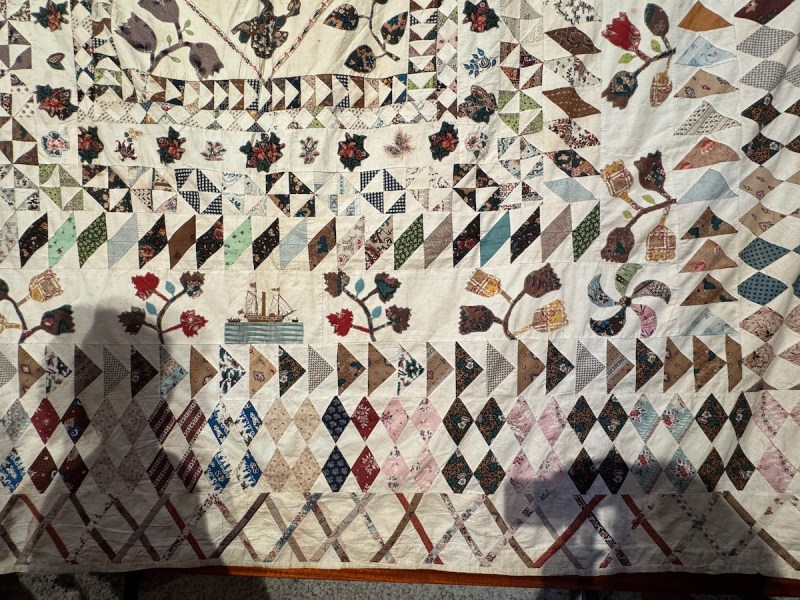
Love that border print! Click to enlarge the title, which is Wood Hey, from the country of Wales. It was made in 1833 and displayed at the National Eistedfodd of Wales in 1933. It’s hand-pieced, with appliqué and is unquilted.
In case you can’t read the title: Sailing Ship & Manor House, from Pays de Galles in Wales, c. 1833. Check out the sailing ship, below.
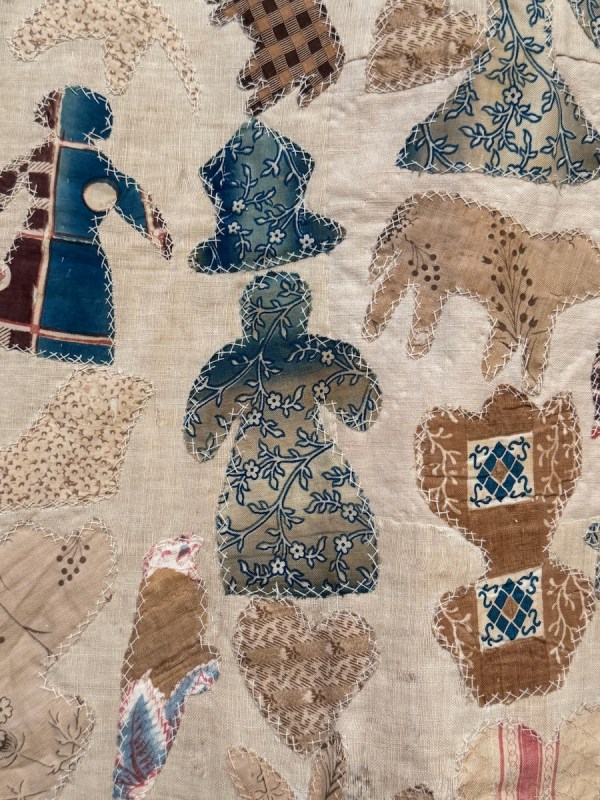
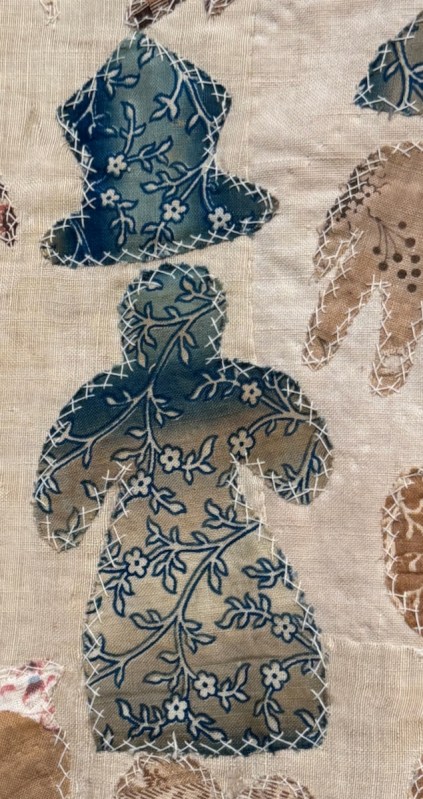
This quilt was another stunning example of applique, and I love the title: Animal, Vegetable, & Mineral. It’s appliqué and unquilted and was made c. 1842 in England.
Check out this type of appliqué! Criss-cross, a type of tailor’s stitch; I learned this in my clothing and textile classes when I was a freshman, and have rarely used it since. There is a smaller bite of fabric on one side, and then the needle travels before taking the next stitch, and you are stitching backwards, from left to right. I don’t know what the “official” name is, I just know we used it to tack down our wool jacket facings.
It appears they went over a raw edge. I’ve seen variations of this animal-vegetable-mineral quilt pop up every once in a while. Lovely to see it here. Note the pieced backing, even though it “reads” as a whole piece of fabric. Would we add “digital” to the categories? And how would we depict that…with images of our hardware?
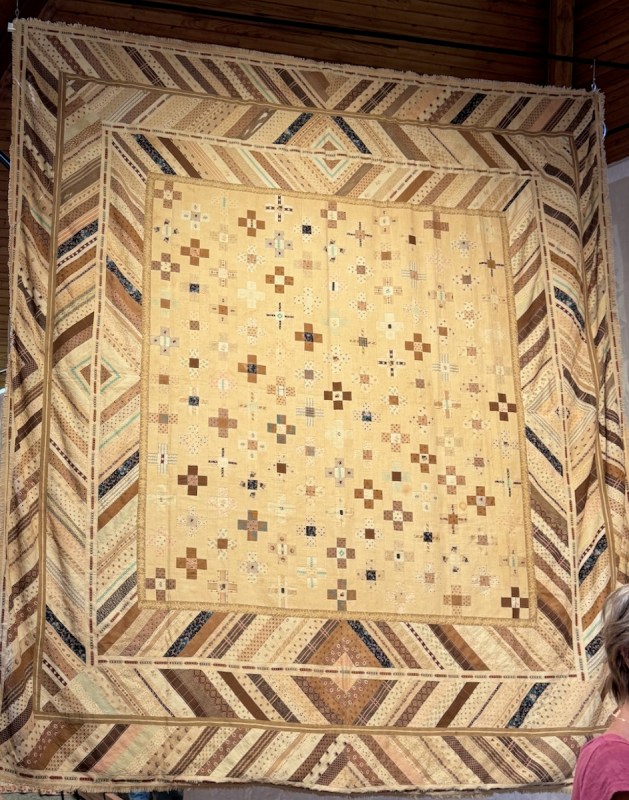
So, a form of offset nine-patches? With a spacer?
Normal quilt show pose.
That is a lot of quilting!
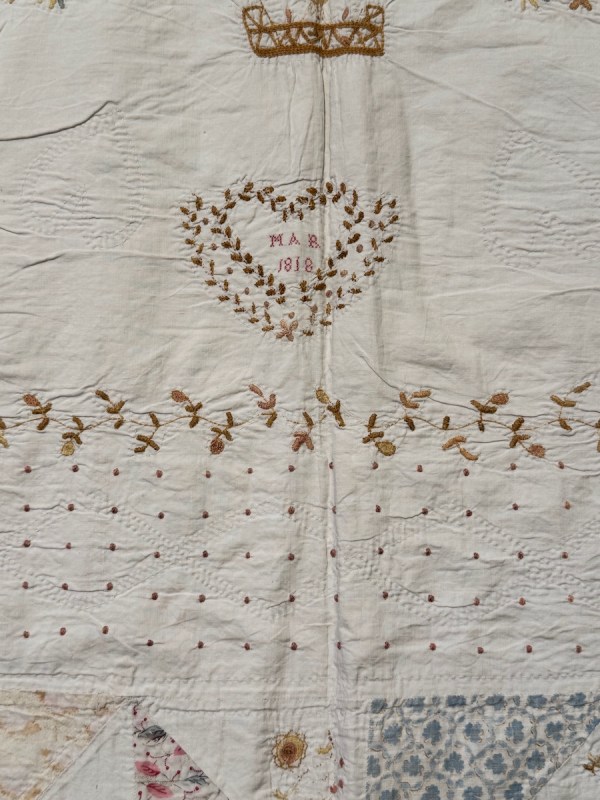
Who was M.A.R? and what was the world like in 1818? (You do realize this quilt is over 200 years old, right?) Some notable events (just to get you in her head, and which maybe she never knew about?) are listed below.
Historical Events when this quilt was made:
Official reopening of the White House
Netherlands and England sign treaty against illegal slave handling
First steam-vessel to sail Great Lakes launched
49th parallel forms as border between U.S. and Canada
1st known Christmas carol (“Silent Night, Holy Night”) sung (Austria)
Handel’s Messiah, U.S. premieres in Boston
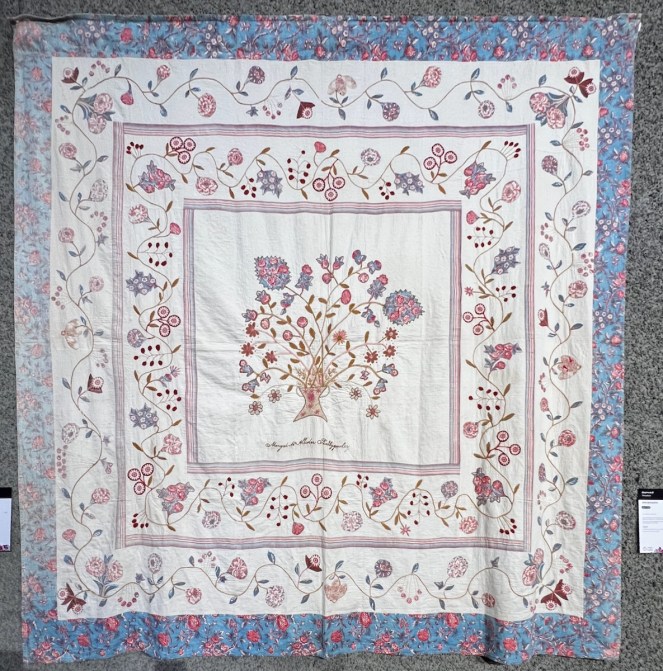
I love the name of this. Apparently BallyGawley is a town in Ireland, north of Dublin, so perhaps the quilt came from there?
Last one for this post.
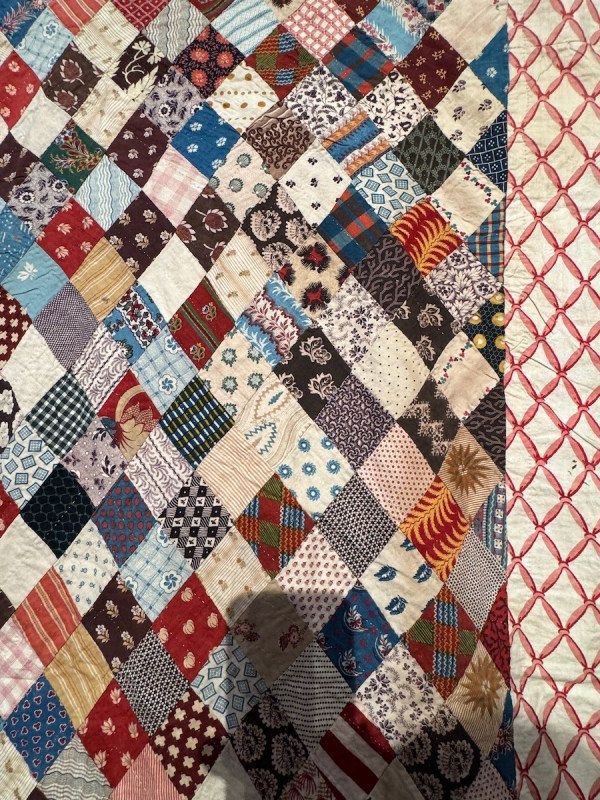
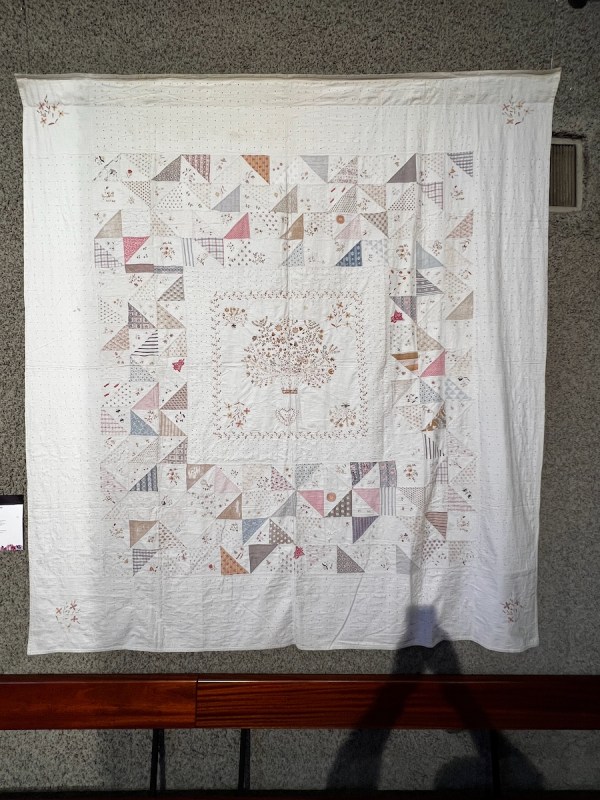
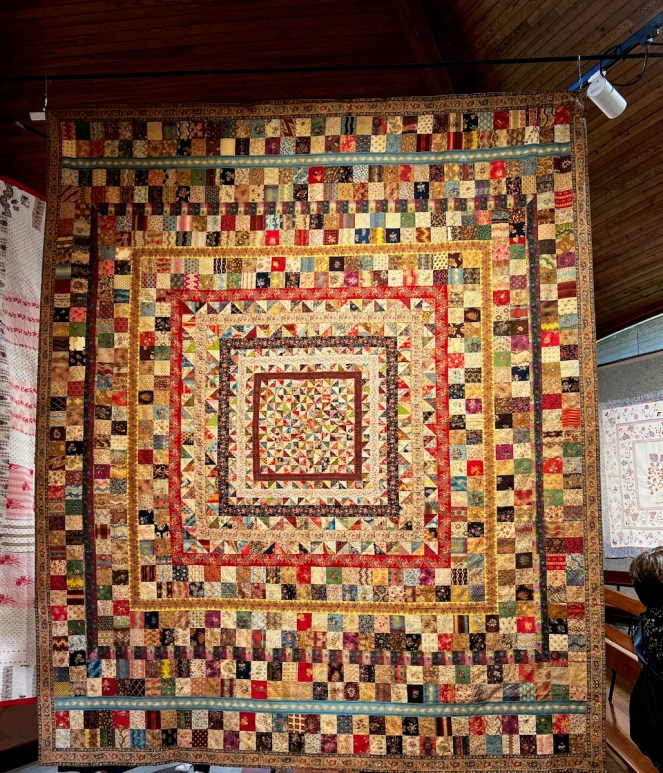
This is Broken Dishes Square, and from the United States, c. 1830. It is hand-pieced and unquilted, in the medallion style. These fabrics are so interesting, so busy and I love the bands of color in between each section of the triangles. Some woman spent hours and hours piecing this quilt.
I’m really grateful that the organizers of Carrefour Patchwork Show arranged with Janet O’Dell to have these brought to the show. As always, this show has something interesting around every corner!
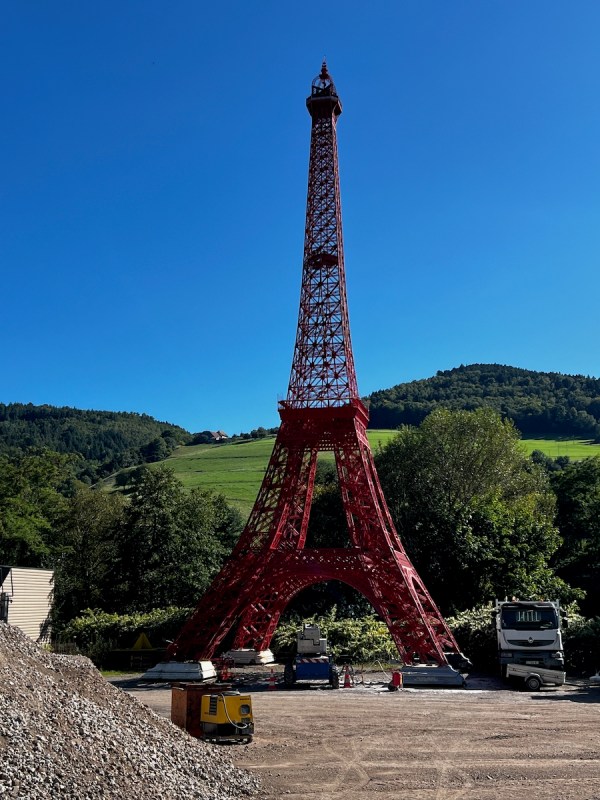
Like this replica of the Eiffel Tower, stuck in some sort of a construction yard. We saw it last year in two pieces, so we’re happy it was put together this year.


















































 OccasionalPiece--Quilt!