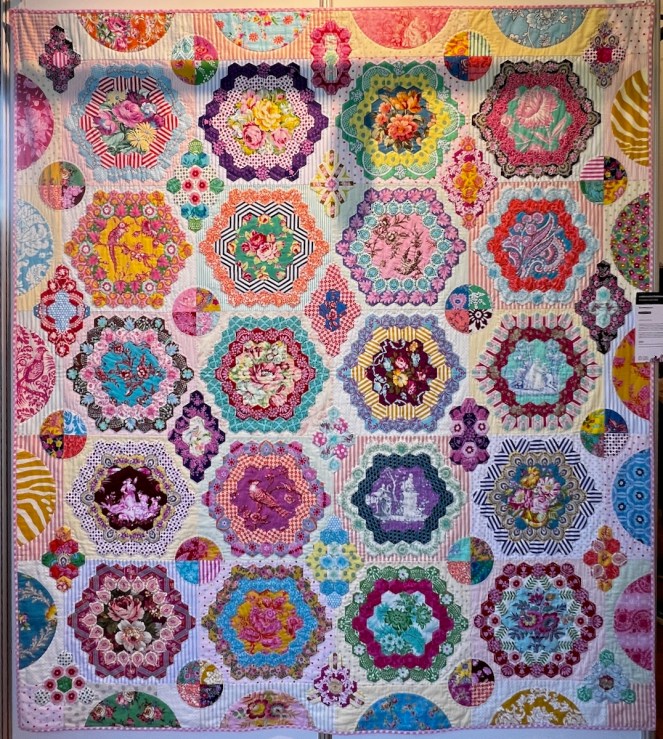
Carrefour Quilt Show · European Patchwork Meeting · Quilt Shows · Quilts · Travels

Carrefour VI: RachelDaisy Dodd, Ruth De Voss, Lorena Uriarte, Diane First, France Patchwork & Ulla Hoppe

This is the sixth, and final post about the Carrefour European Patchwork show 2025. The post covers:

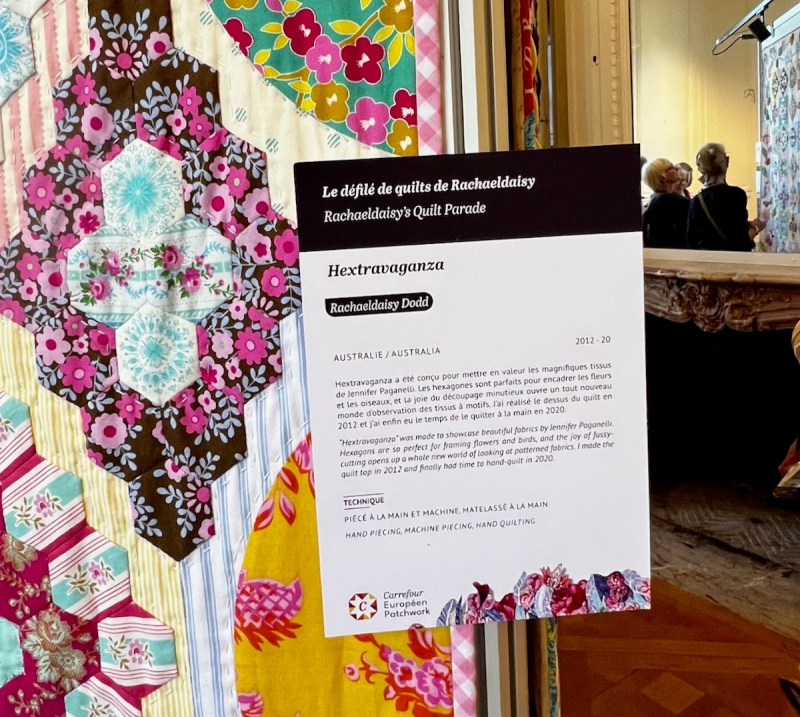
• Venue 13: Villa Burrus, with RachaelDaisy Dodd
• Venue 14: Église de l’Assomption, with Ruth De Vos
• Venue 15: Salle Polyvalente, with Lorena Uriarte, Dianne Firth, ASL Liépvre, EQA, France Patchwork
• Venue 16: Ulla Hoppe

I have a main Carrefour Quilt Show page that lists all the posts of all the meetings I’ve gone to, and includes the posts from this year too. If I haven’t mentioned it before, you might enjoy these posts more if seen on a desktop computer or even a tablet. Cell phones re-format the layout and can sometimes do strange things to how it looks on the screen.

If you are interested in going to Carrefour, I wrote two posts for them about our travel, and how we put the trip together. You can find them here and here. Their main website is HERE, where you can subscribe to their newsletter (scroll to the bottom).

Thank you so much for reading and traveling along with me by way of these posts. Enjoy!
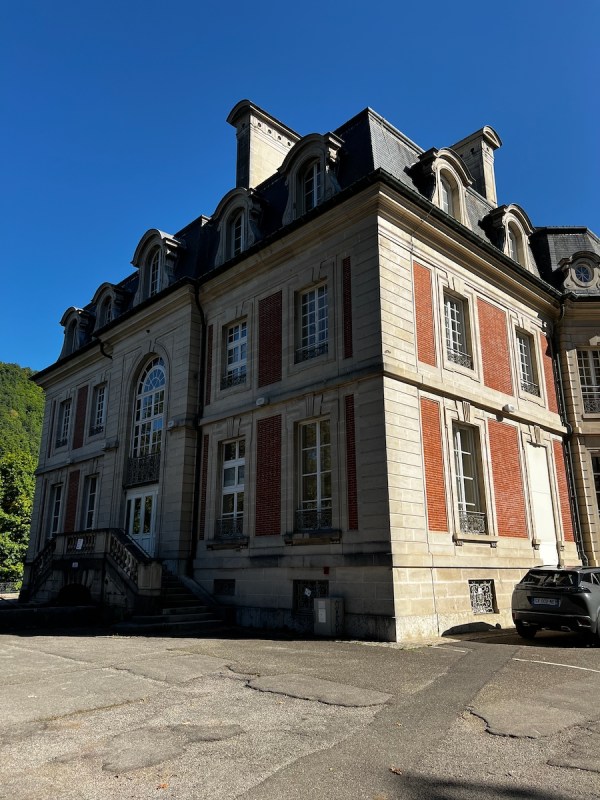
This venue, Villa Burrus, was just a few short steps from the Party Room (Salle Des Fêtes, from the previous post) and although we’ve been to Carrefour twice before, it was new to us.
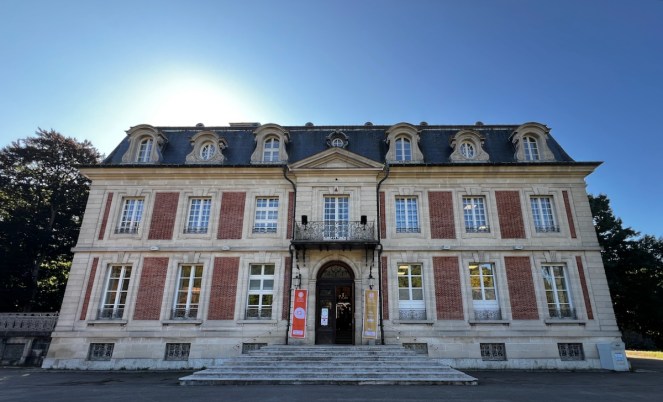
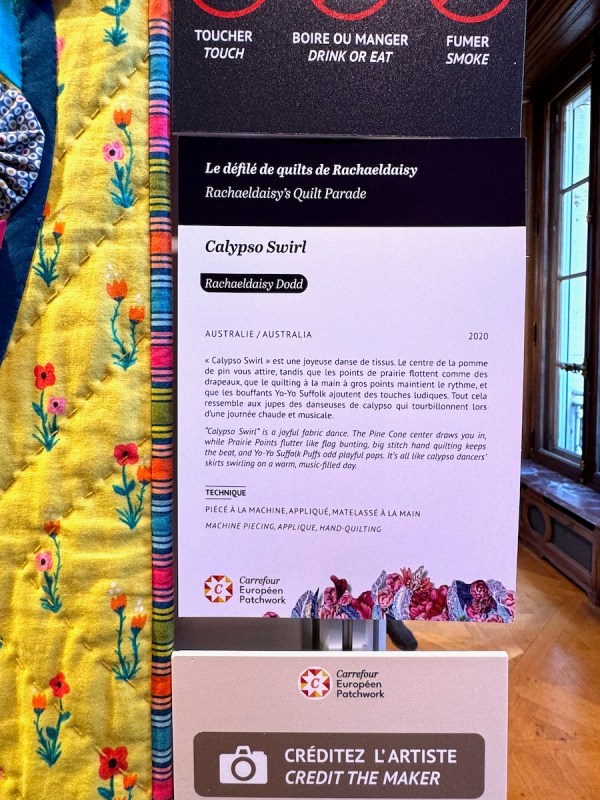
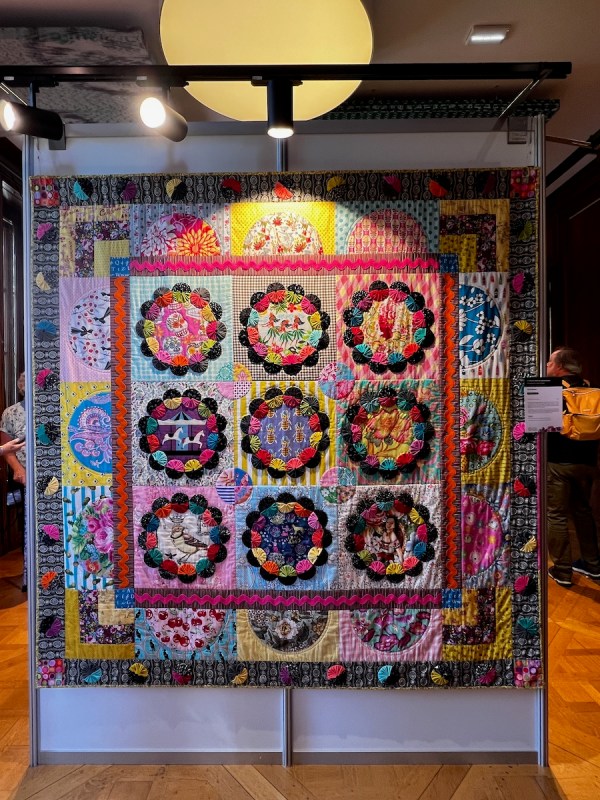
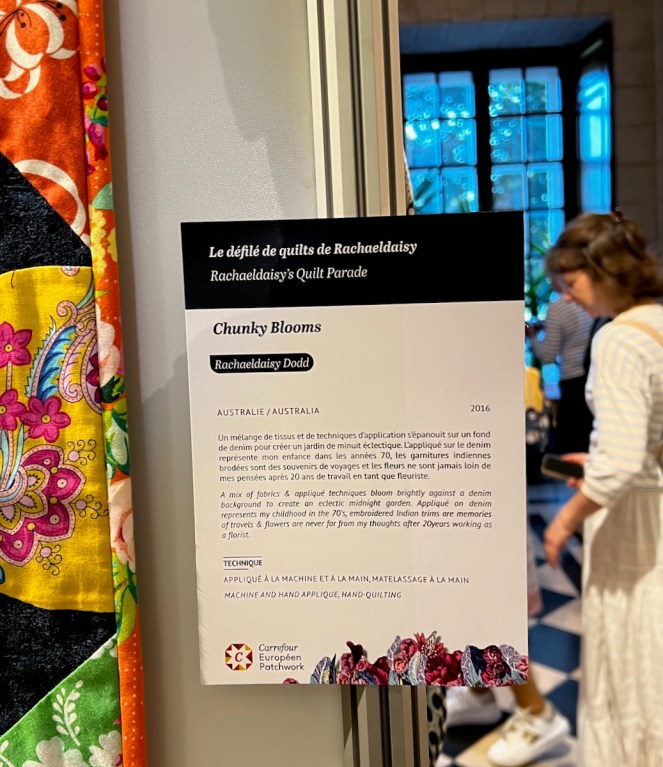
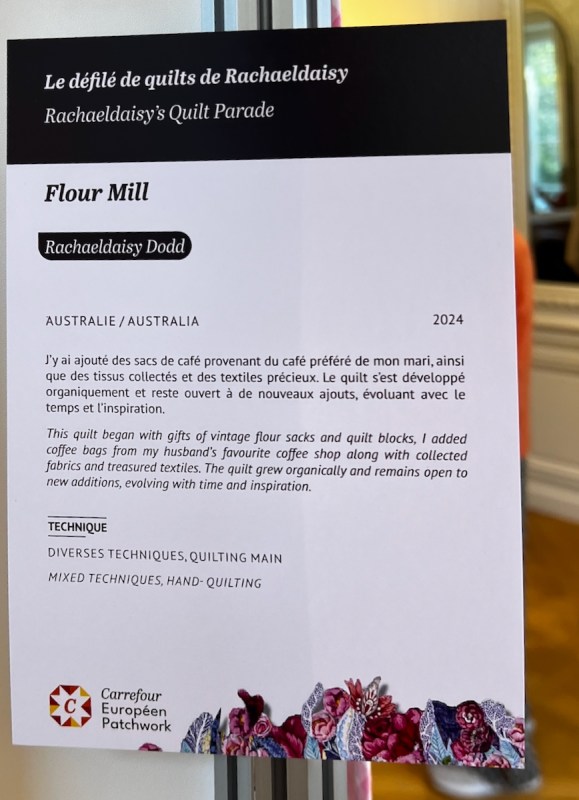
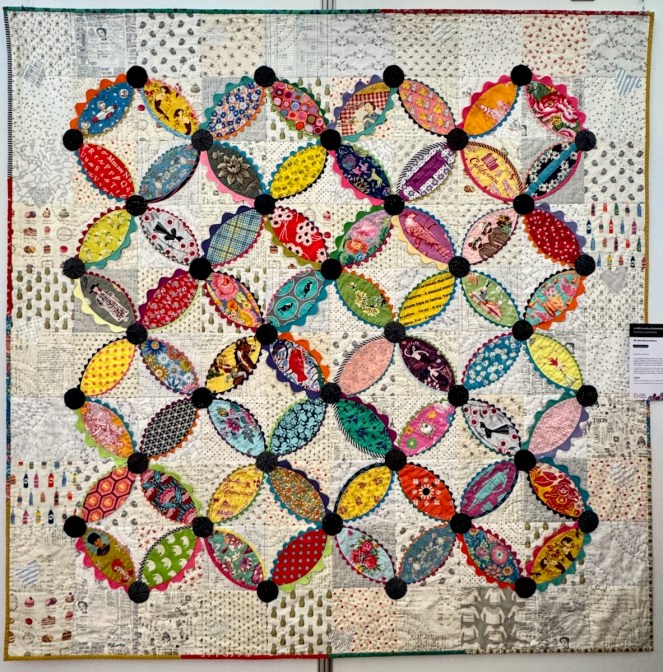
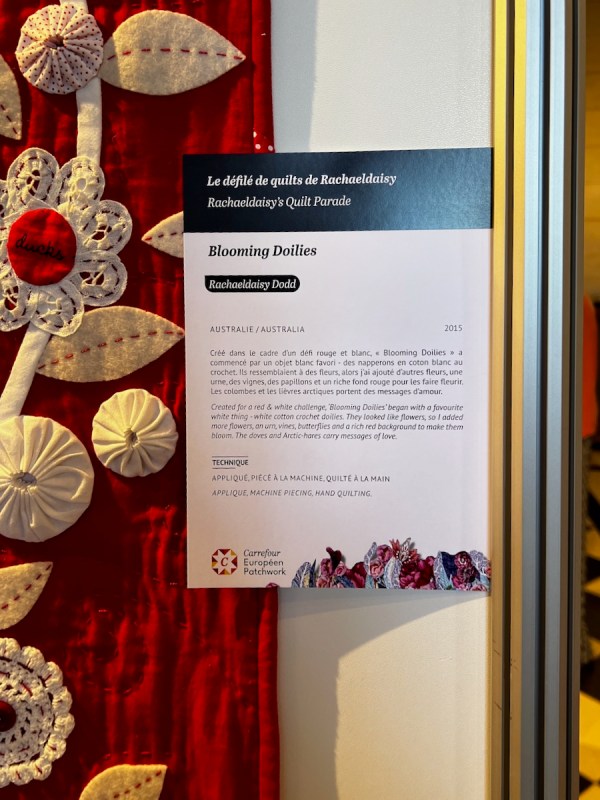
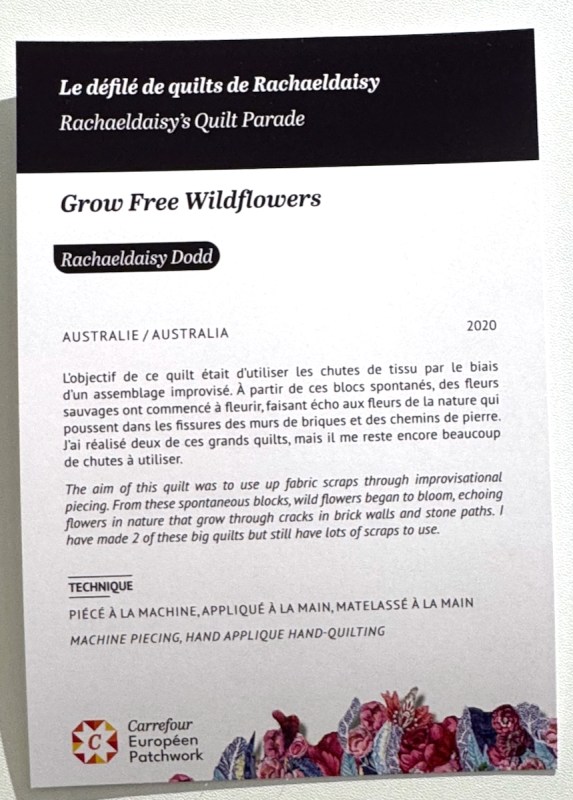
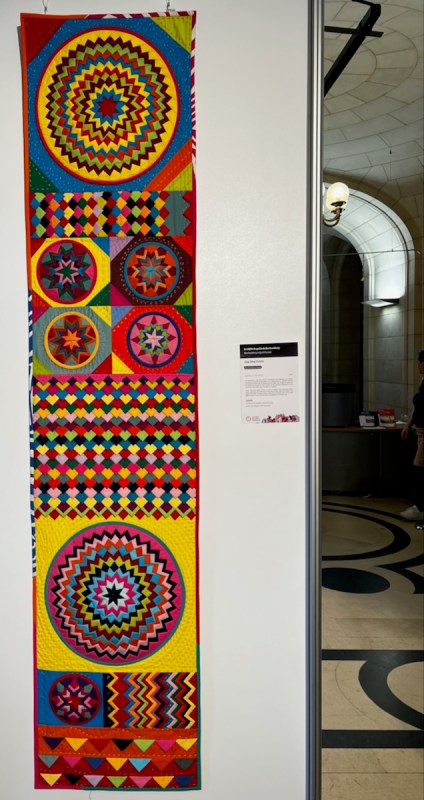
Sited on Le Parc de las Villa Burrus, this mansion was built in 1900, at least as I can figure out for the literature we picked up was all in French, printed for their Patrimonie — or Heritage — Days, when many buildings are open to the public. Whatever its origins, it was a great place to see quilts, and RachaelDaisy Dodd had her solo exhibit here.
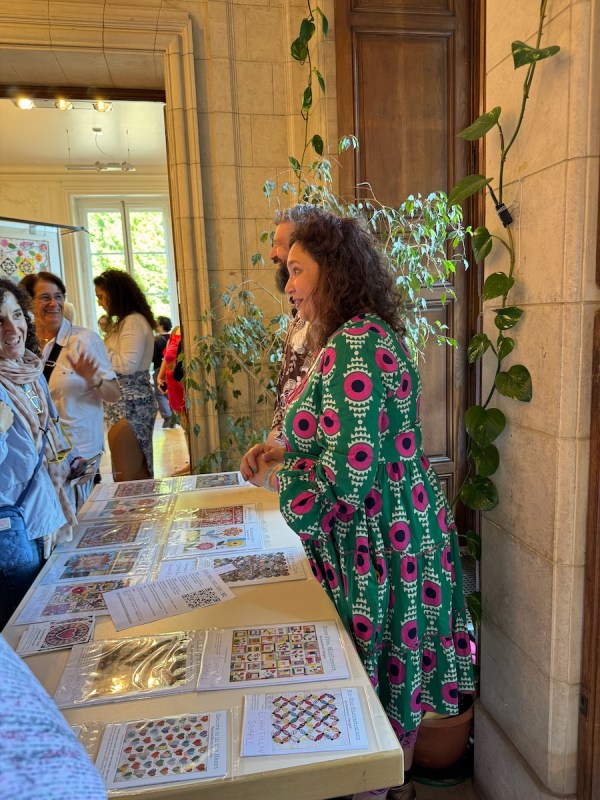
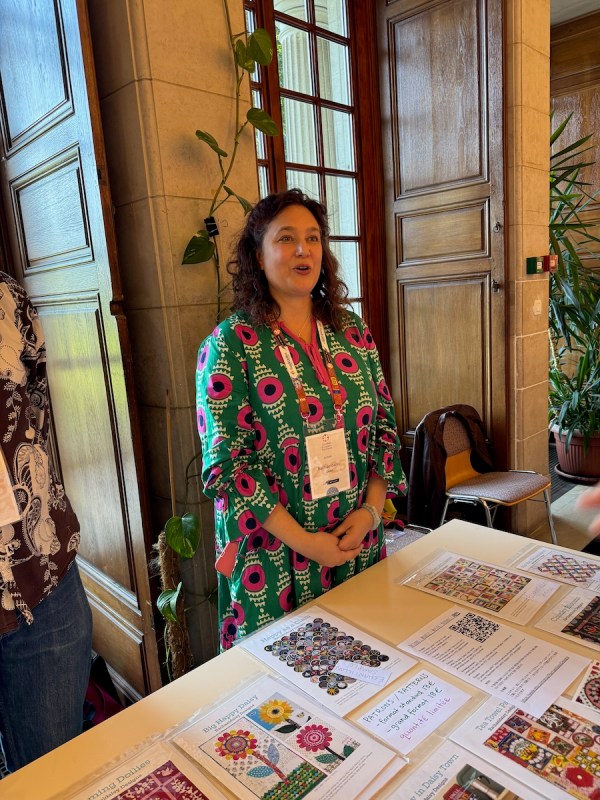
She was always thronged by, and visiting with, quilters, so I’m afraid I didn’t get the best photos of her. But her we go with some of her quilts.
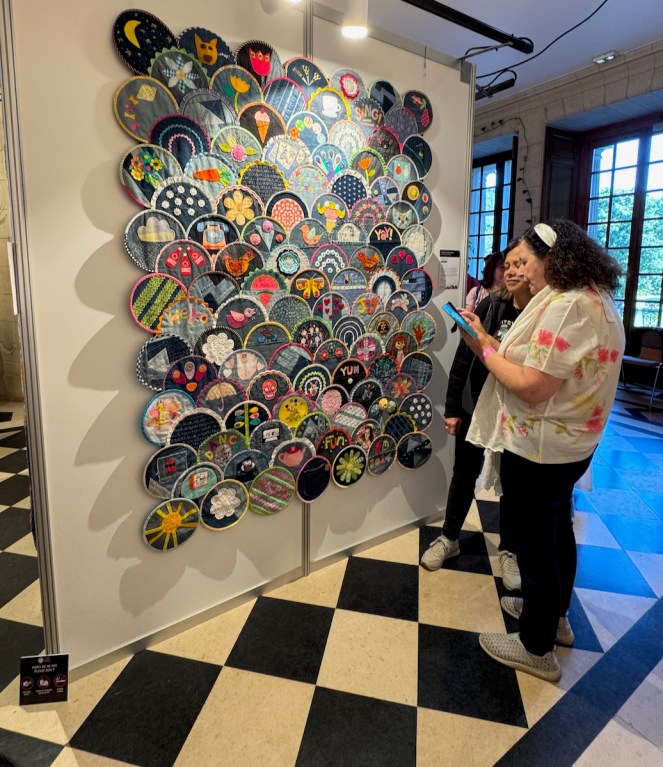
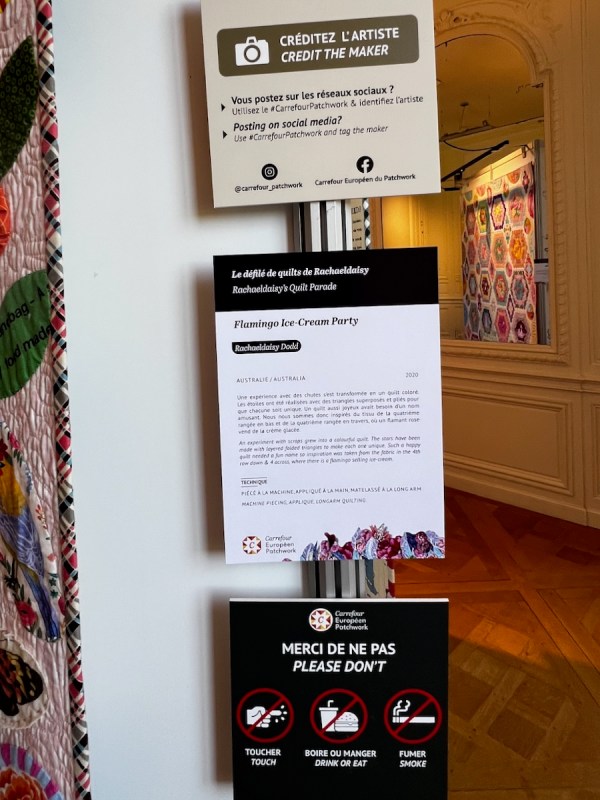
In the front hallway, just across from where her table was, and I apologize, but I have no title card for this.
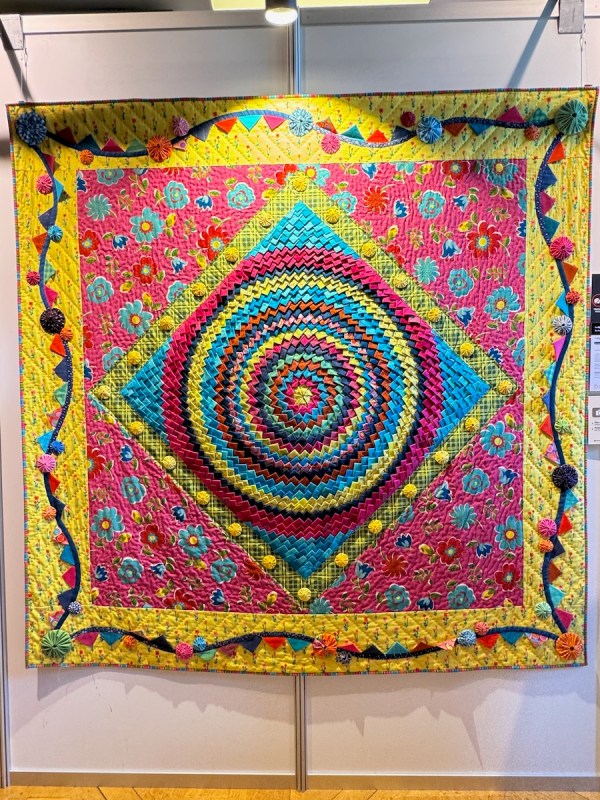
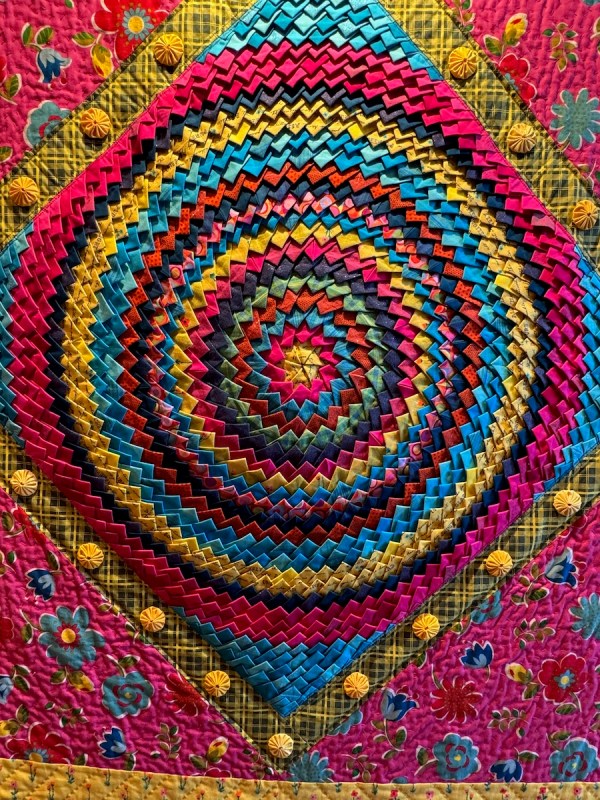
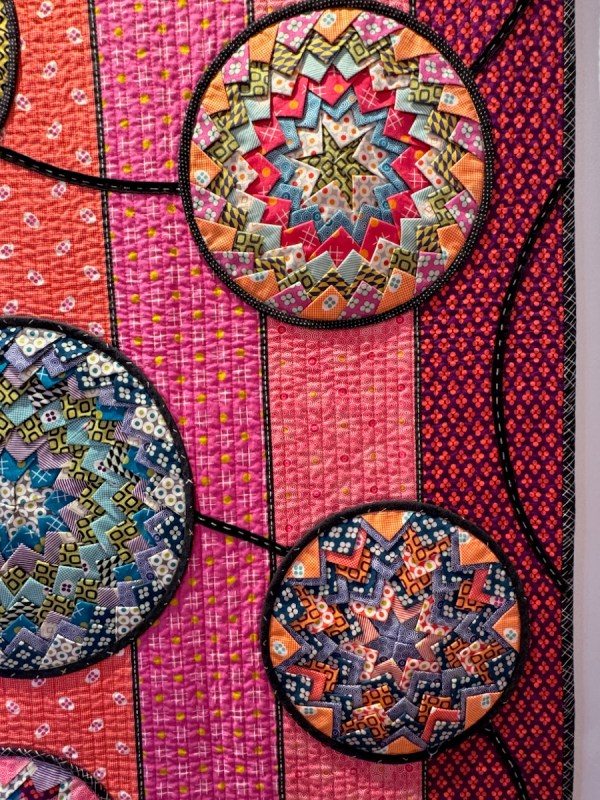
Her signature is a variation of the pine cone (or pine burr) block.
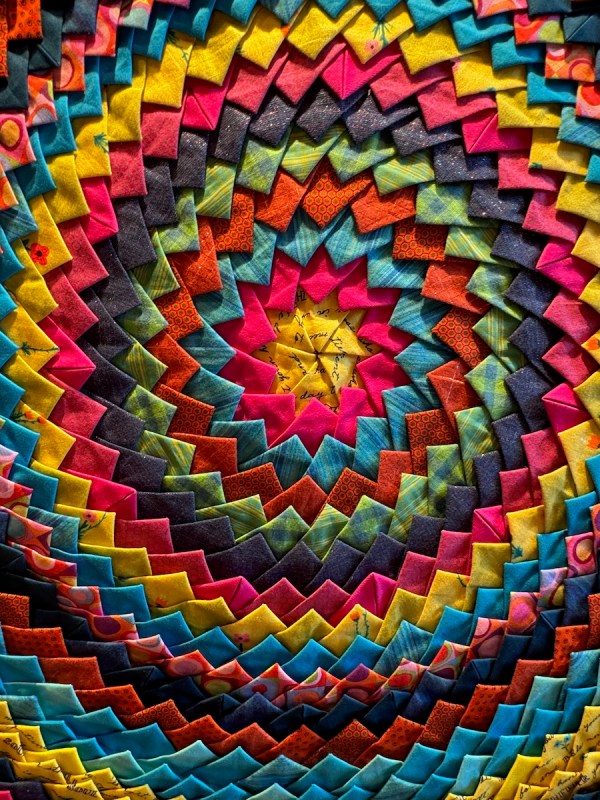
Followed by another motif she commonly uses: the yo-yo, a gathered circle with the gathers on the top.
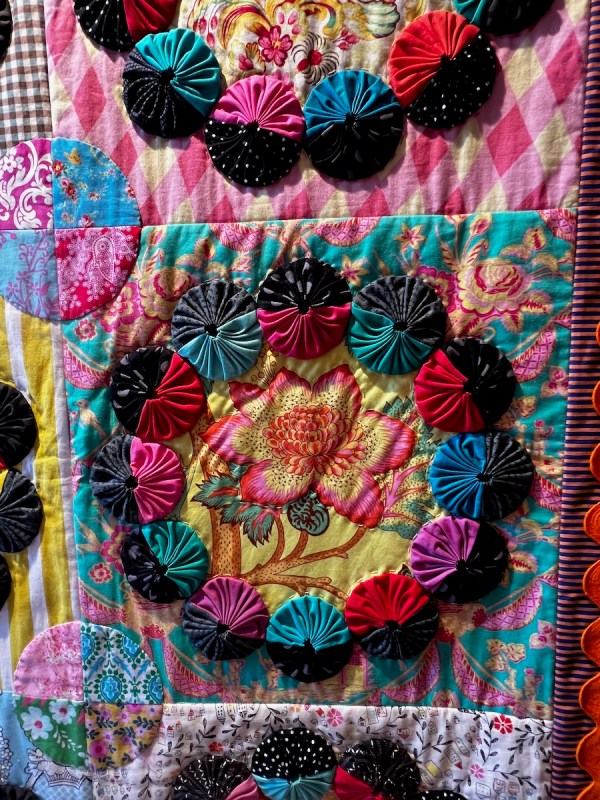
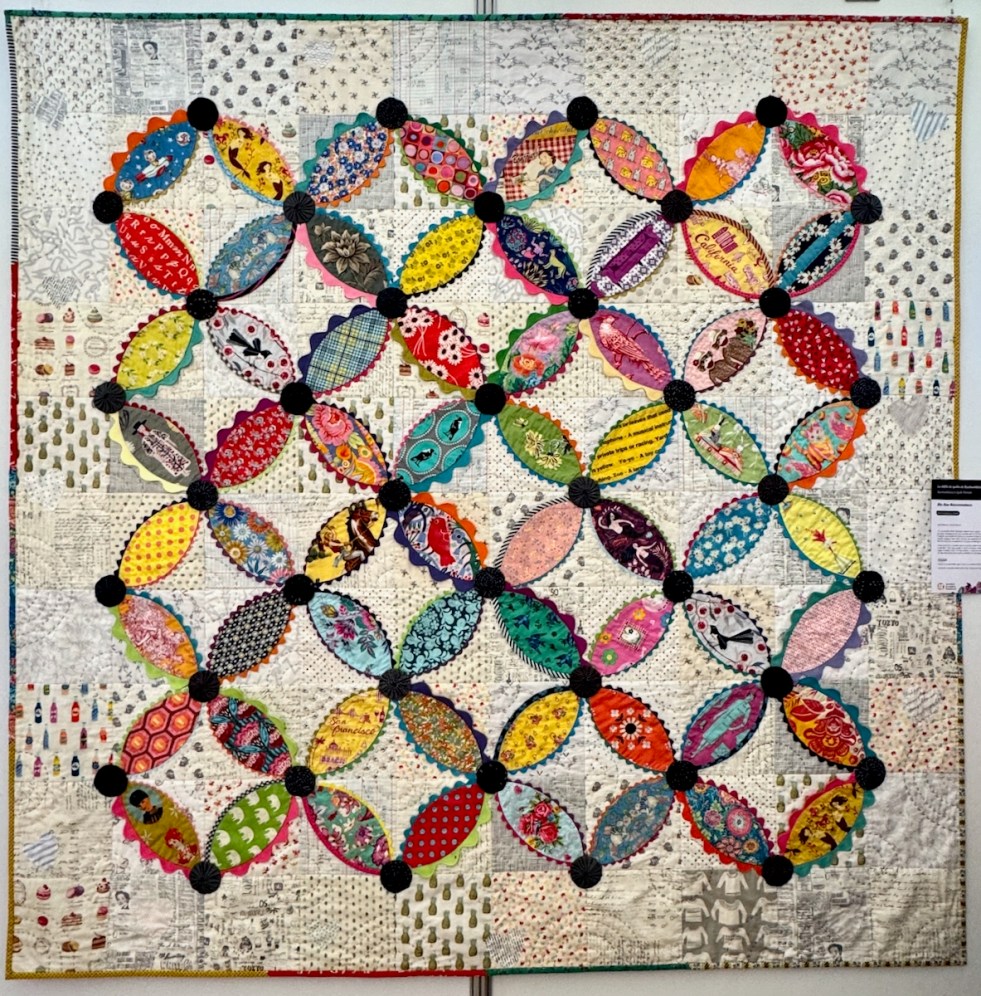
Title: Yo-Yo Bloom
Title Card: “Yo-Yo Blooms is a quilt designed to make you smile and to celebrate just how fun Suffolkd Puff Yo-Yos can be! The quilt brings together all my favorite elements: happy colors, cheerful fabrics, playful Ric-Rac, my signature pieced Yo-Yos and big flowers. Which is your favorite Yo-Yo bloom?”
Technique: Yo-Yo Suffolk Puffs, Appliqué, Machine Piecing.
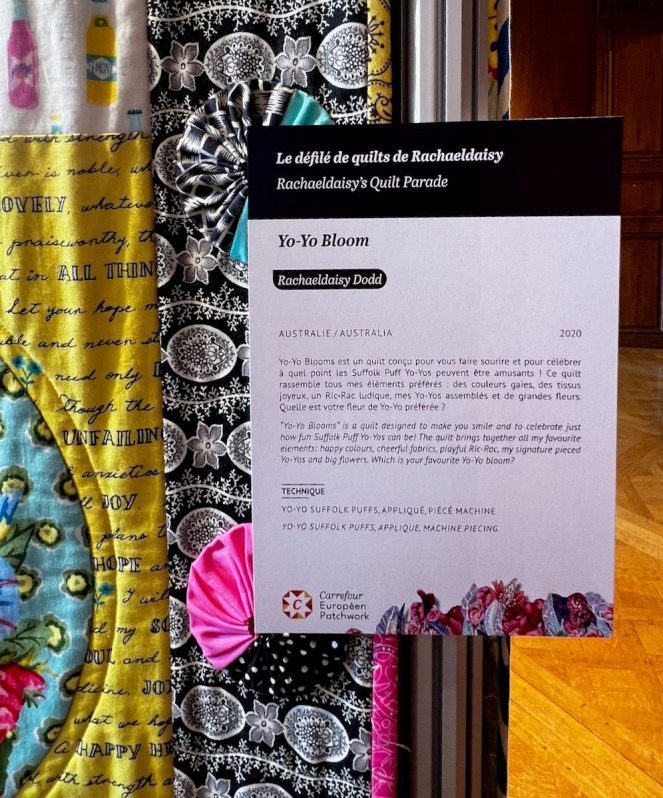
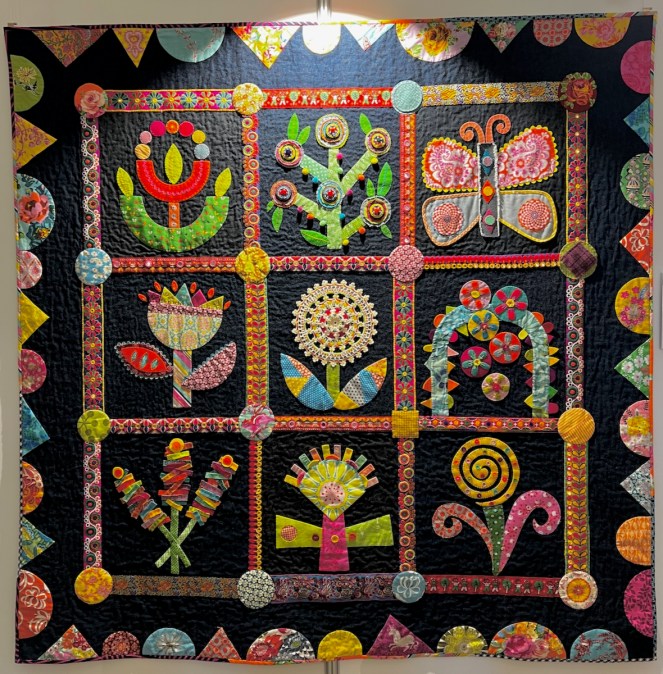
Fun and funky shapes that delight.

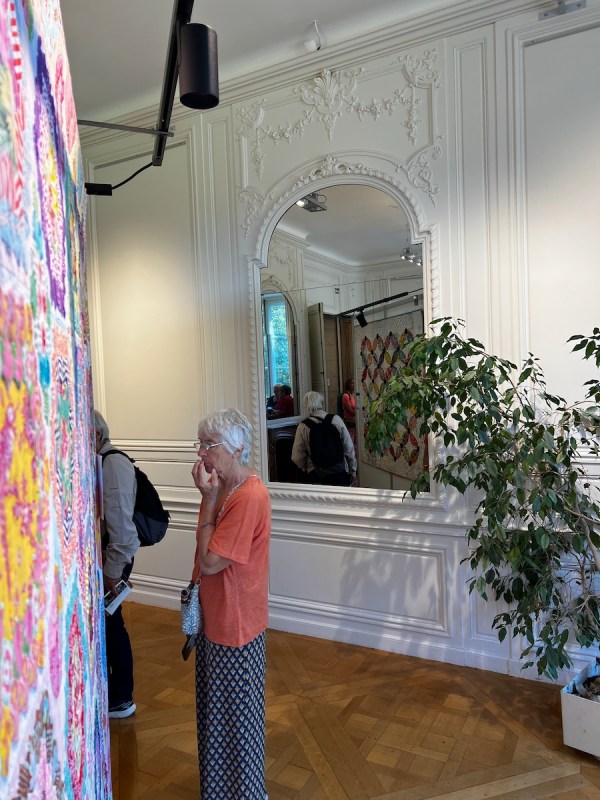
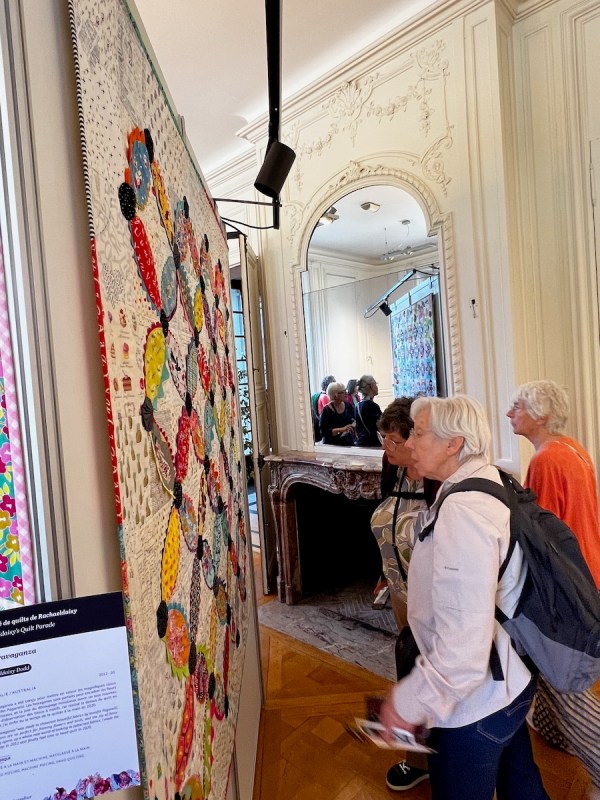
Several rooms held her quilts, with large moveable frameworks. In the next room, the frame was set up in the center, and the large mirrors and windows and her quilts all echoed with pattern and color.
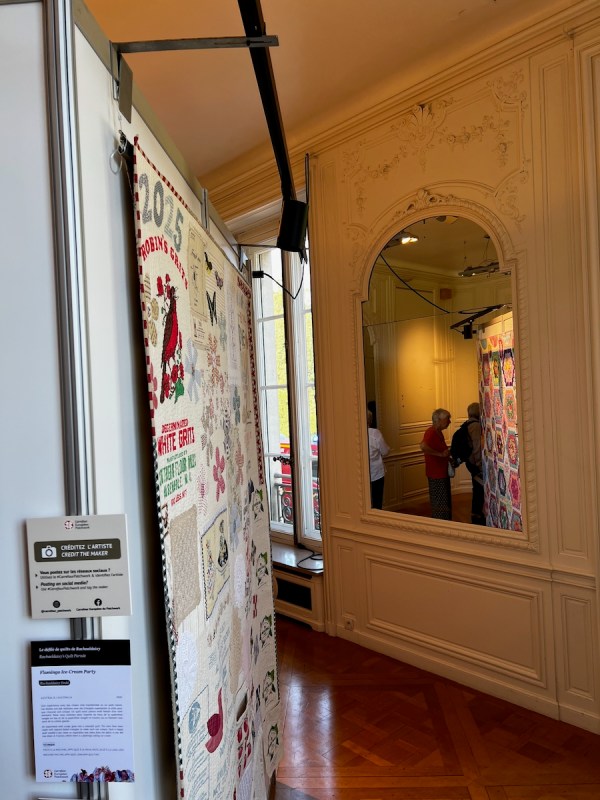
Click to enlarge.
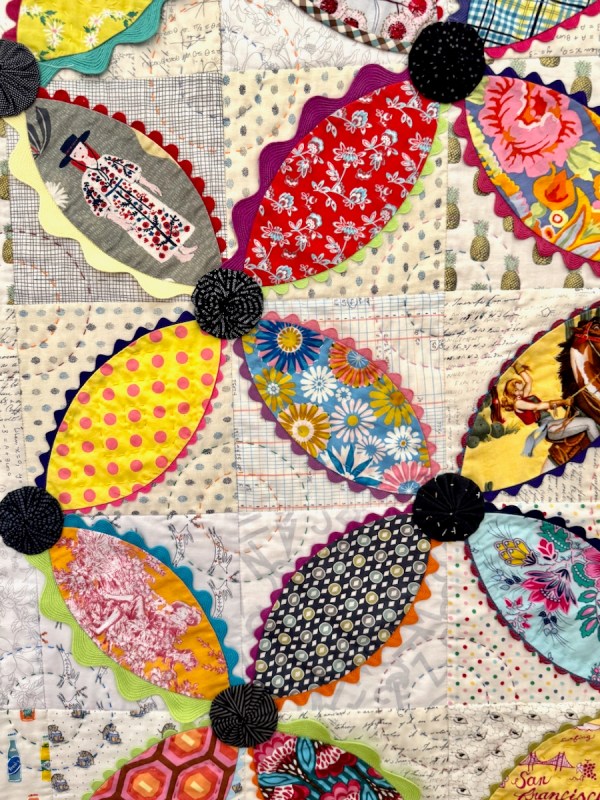
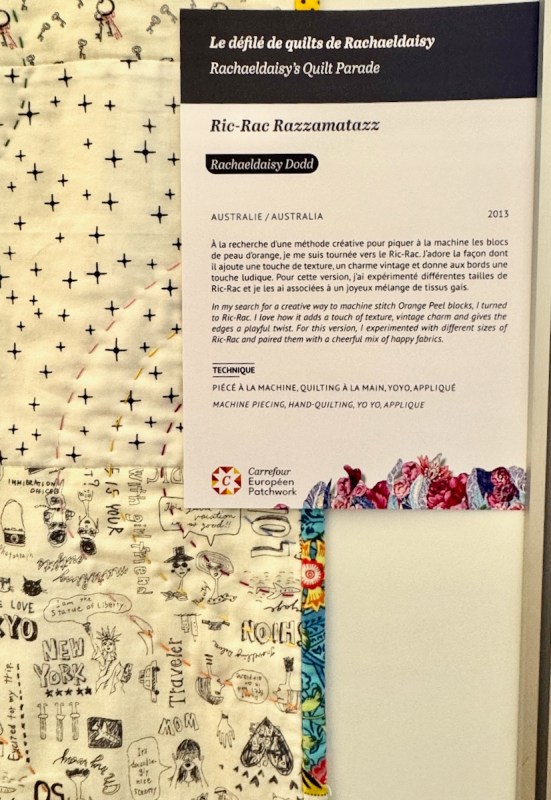
Where does she get all her ric-rac? I think a lot of it is vintage, as she alludes to in her title card.
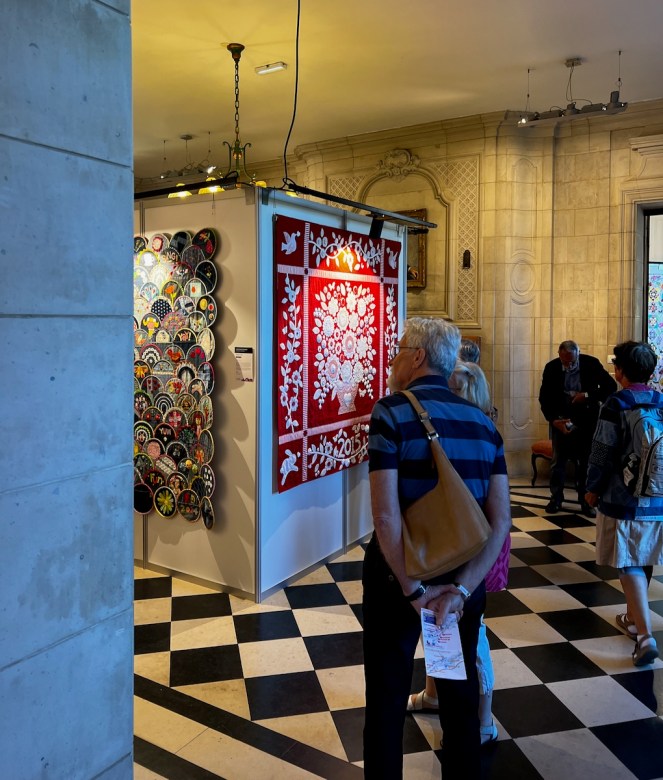
This one was always hard to get a photograph of. I also kind of liked that the man is carrying his wife’s (his??) purse.
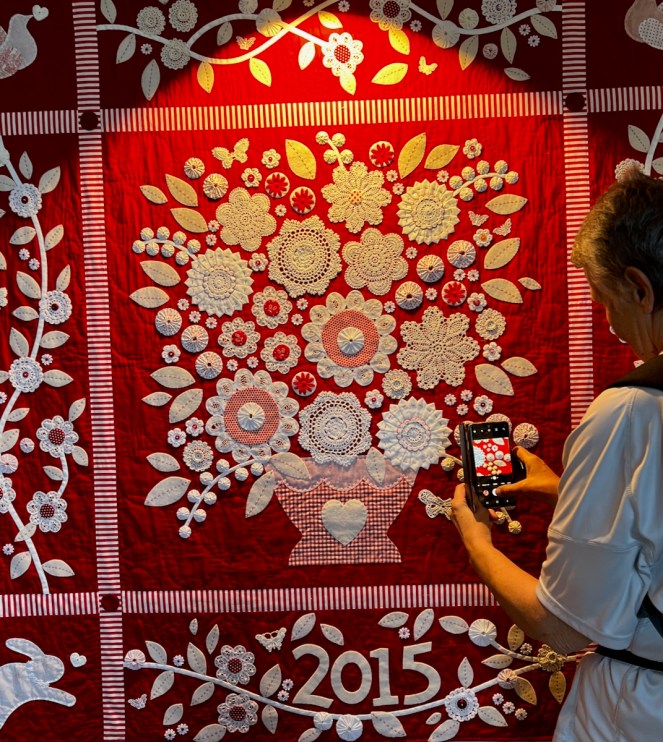
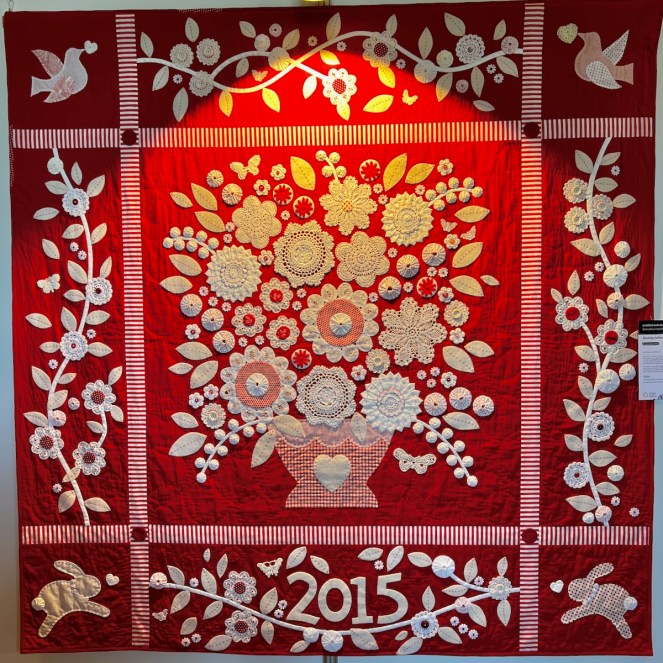
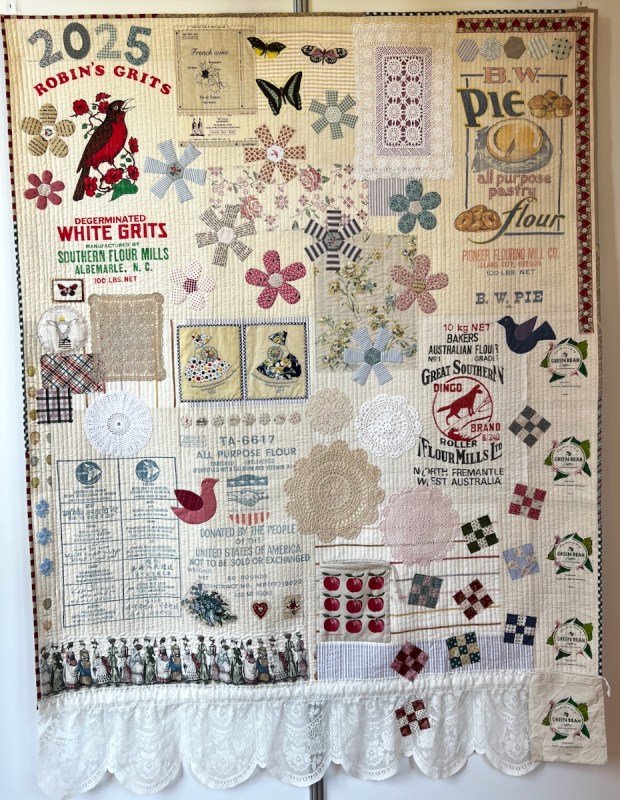
Yo-yos galore, along with doilies and appliqué; she is not a minimalist, and I love it all.
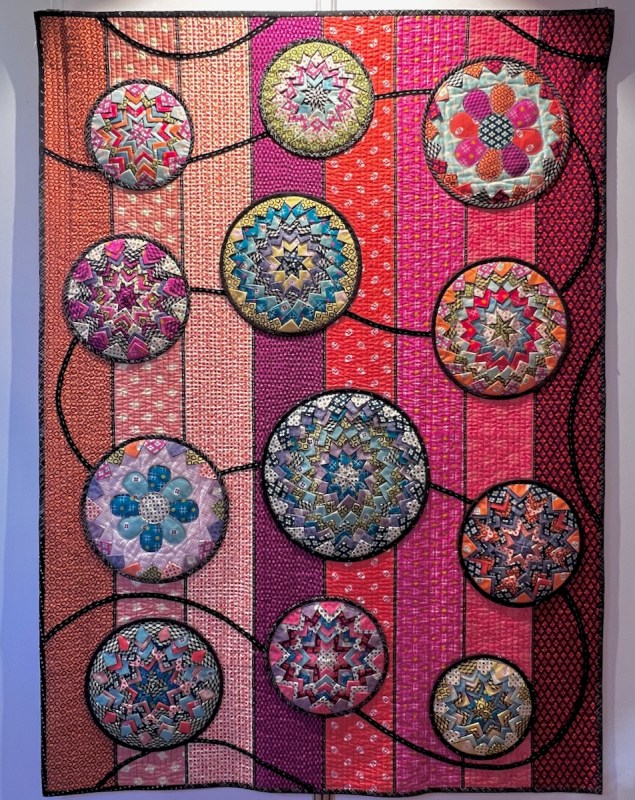
Apologies: no title card. But what do you think? Did she quilt the background, and then add the giant circular pine burr blocks afterwards? My brain is always whirling with questions at these shows.
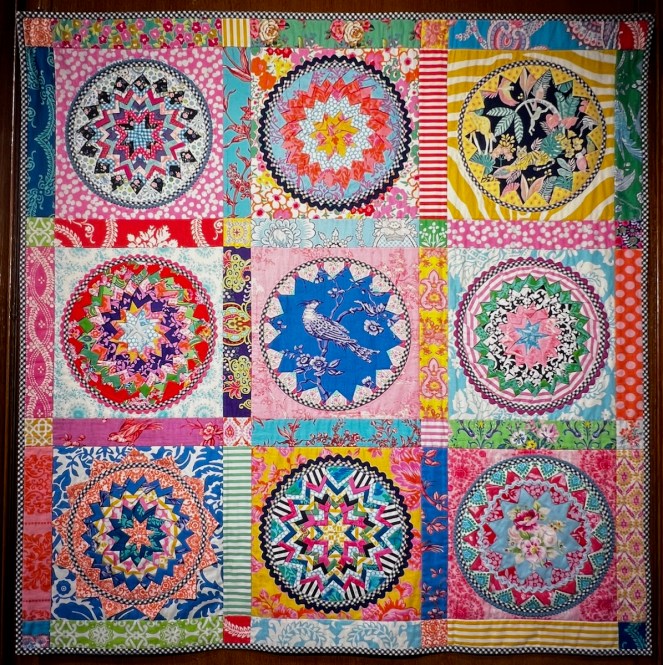
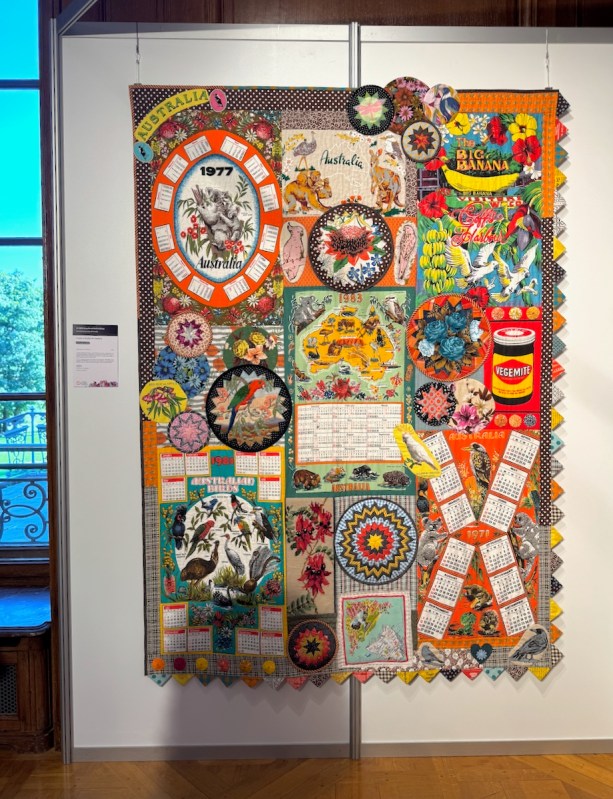
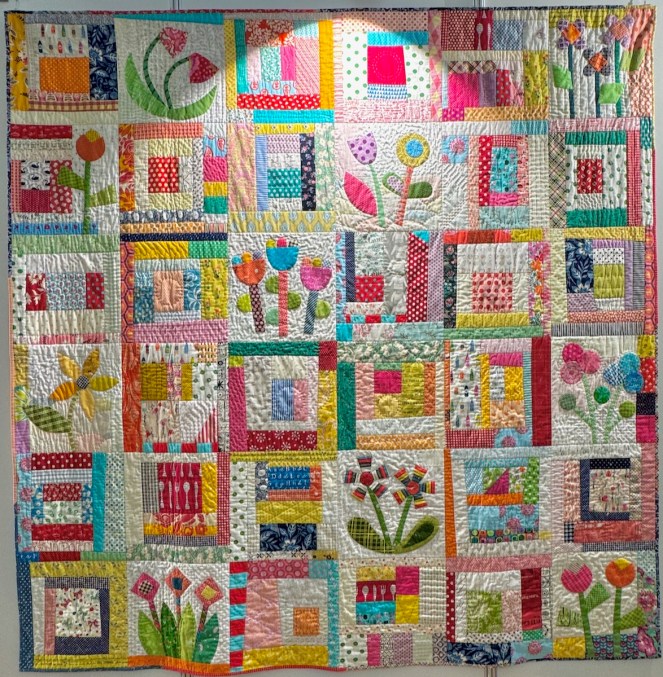
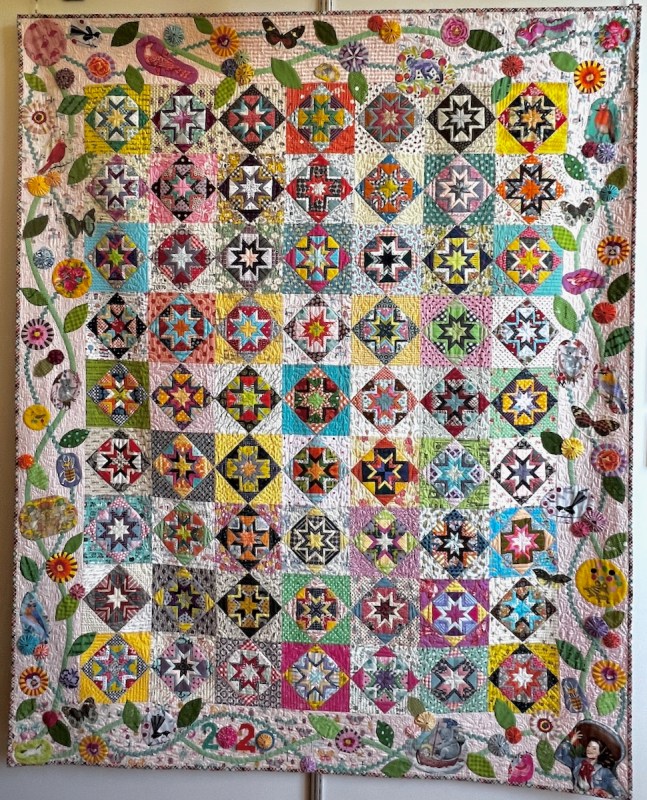
Another scrap quilt, another inspiration.
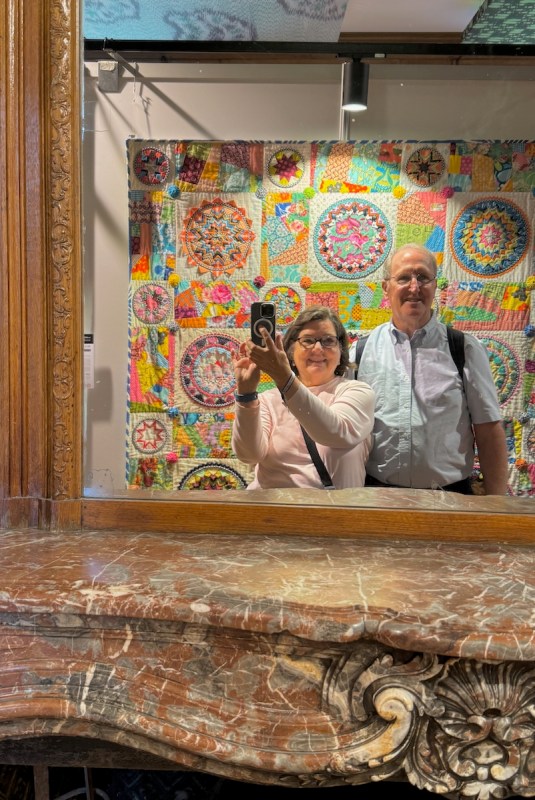
A couple of random tourists, haha.
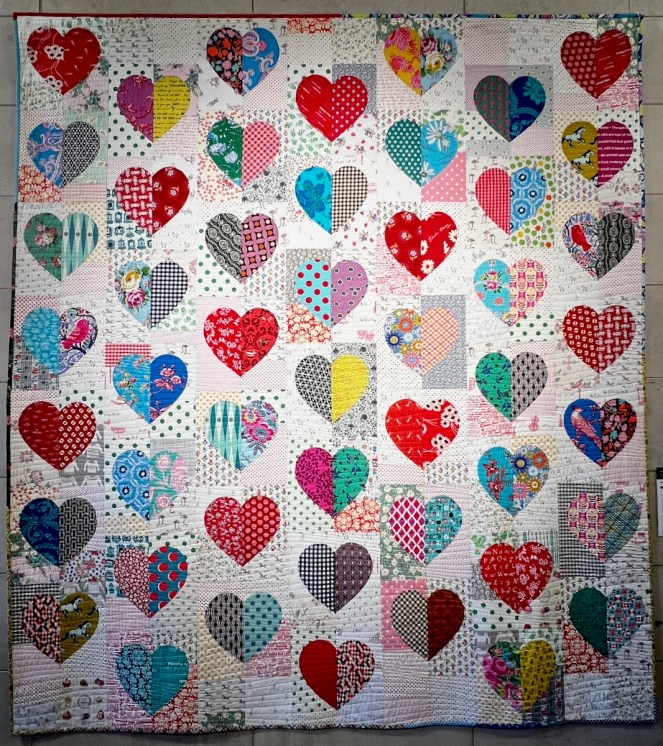
I just saw a smaller version of this on my friend’s IG feed. Link. Makes me want to put it in the queue for a handwork project while traveling to Pour l’Amour du Fills in Nantes in 2016.
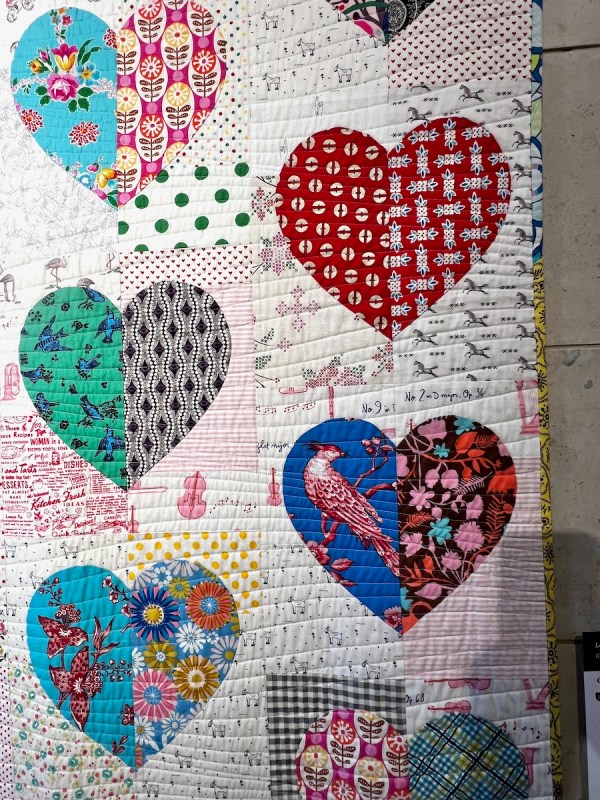
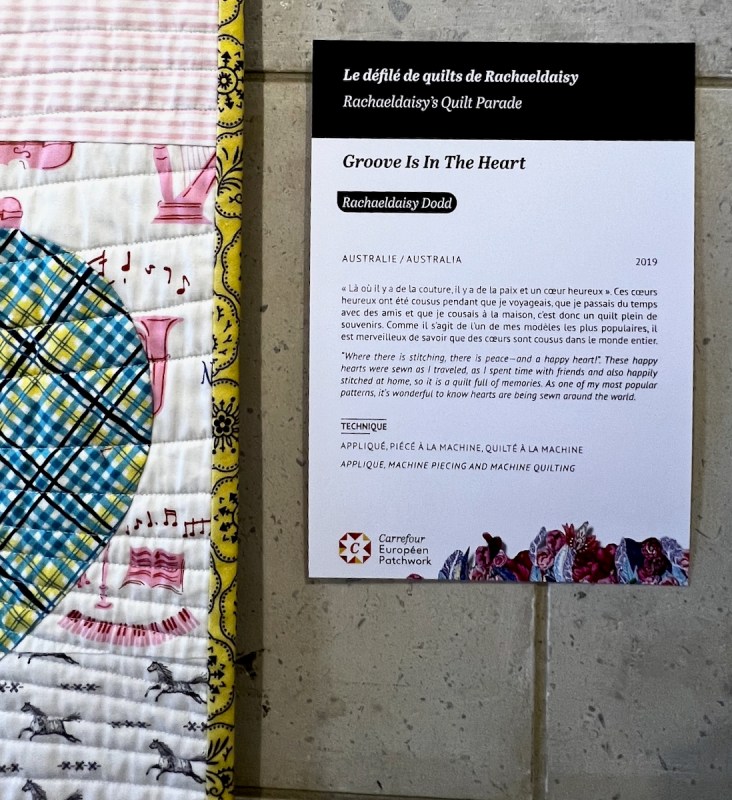
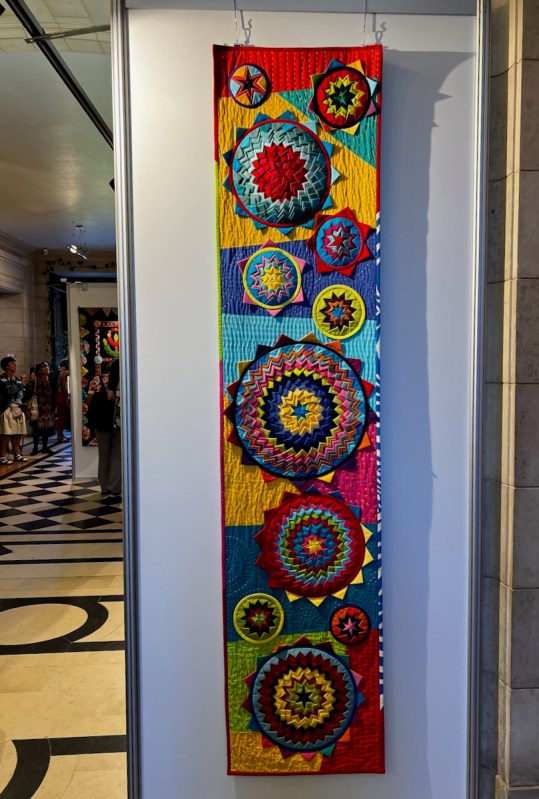
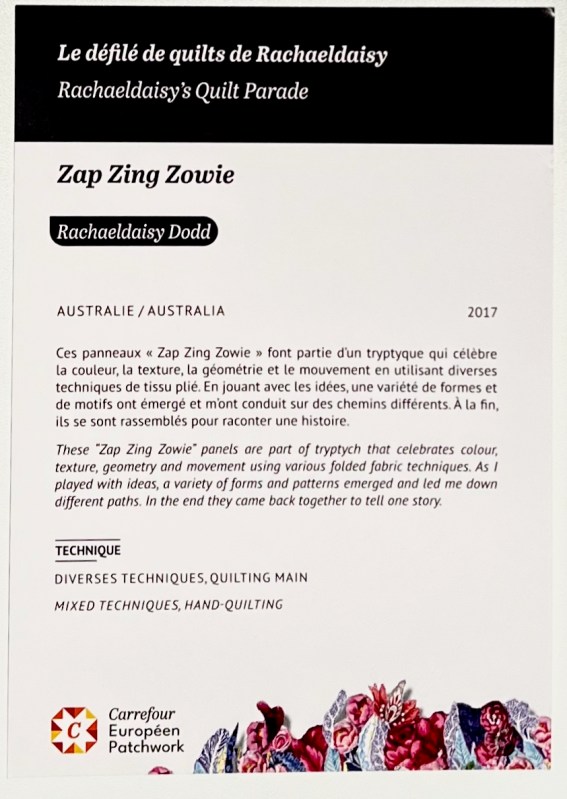
We only noticed two of the triptych of quilts. Click to enlarge the title cards and banner quilts. These were hanging by the entry/exit hall, and we were on our way out.
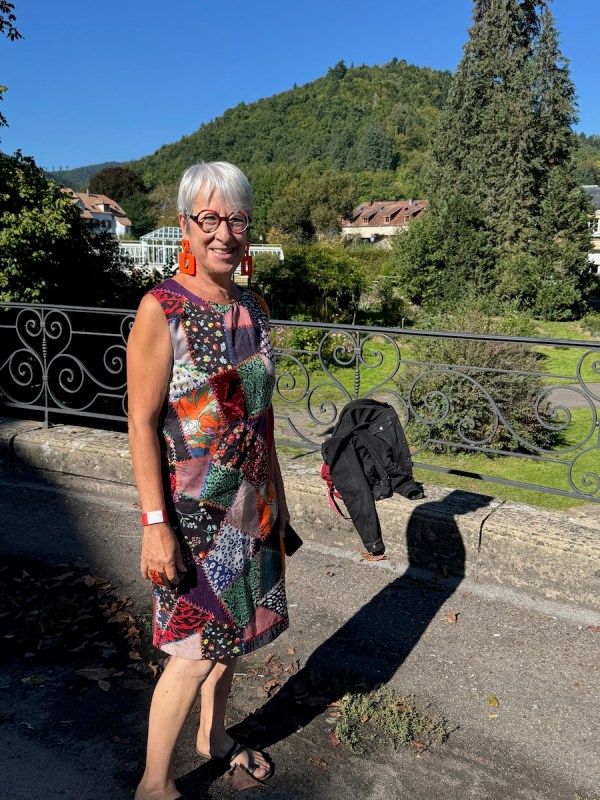
Loved her dress. I need to get a patchwork-appropriate dress for quilt shows.
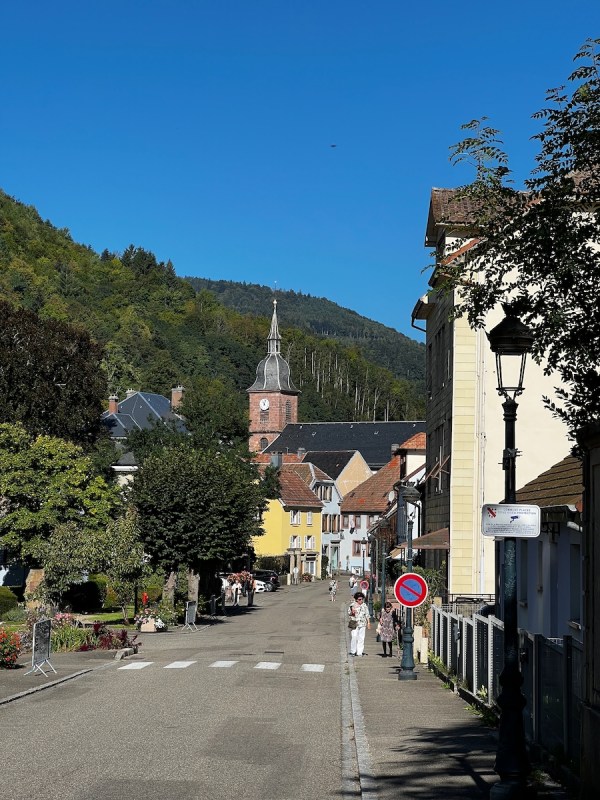
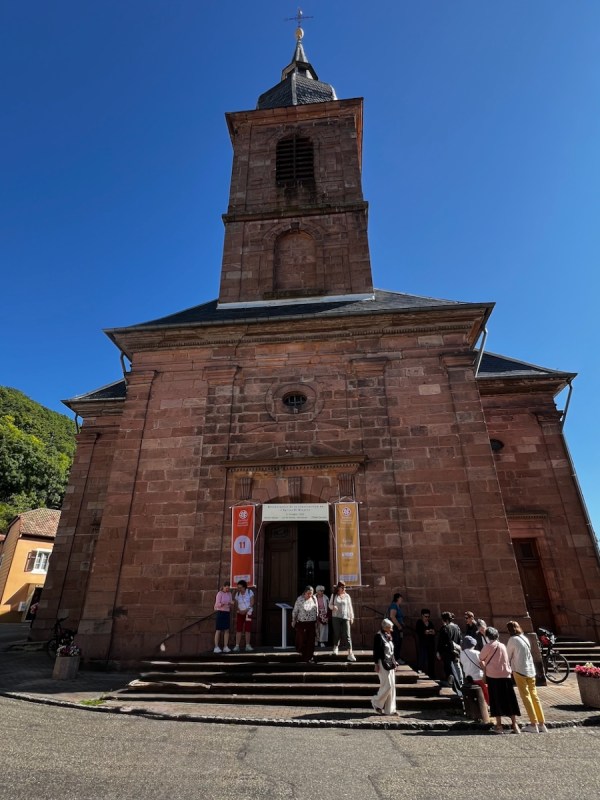
The small towns of Val d’Argent; we are currently in Sainte Croix-aux-Mines, heading to Lièpvre. The church above is Église St. Nicolas, venue 11, written about in the previous Carrefour post.
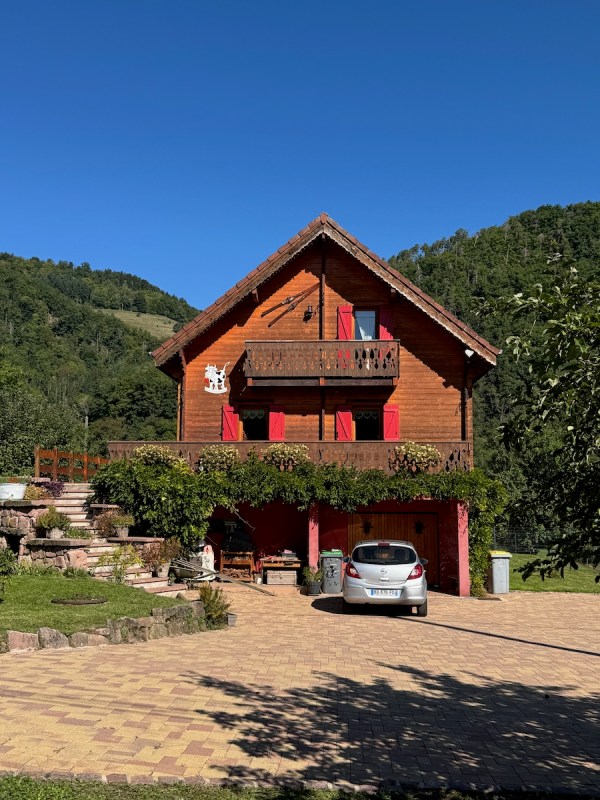
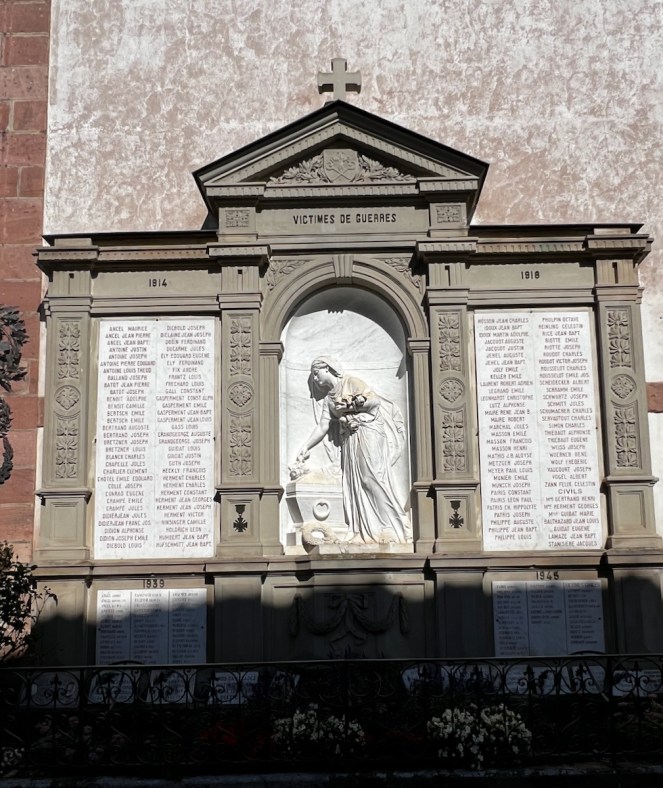
This reminds us that this portion of France went back and forth between Germany and France several times. If you’ve traveled in this area, it gives you an appreciation for the diverse, yet subtle differences between these neighboring countries (and add in Switzerland, too).

Venue 14: Église de l’Assomption, with Ruth De Vos
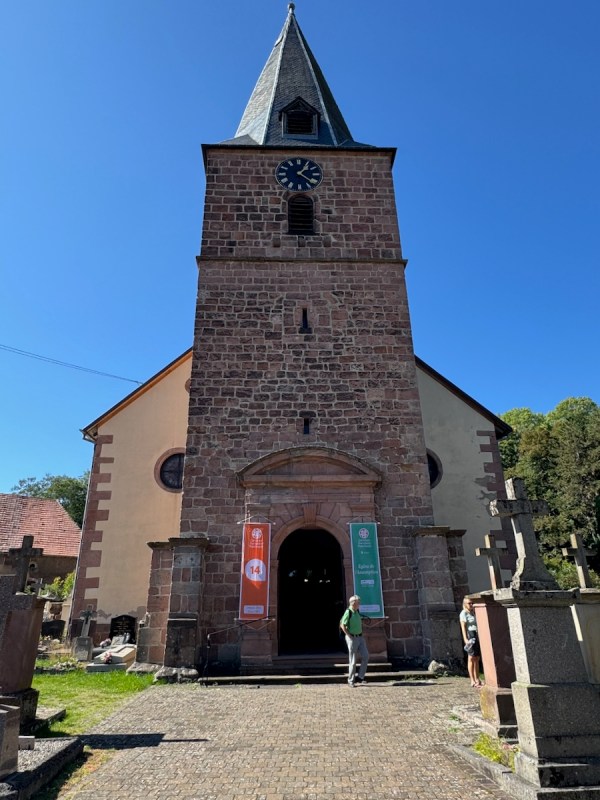
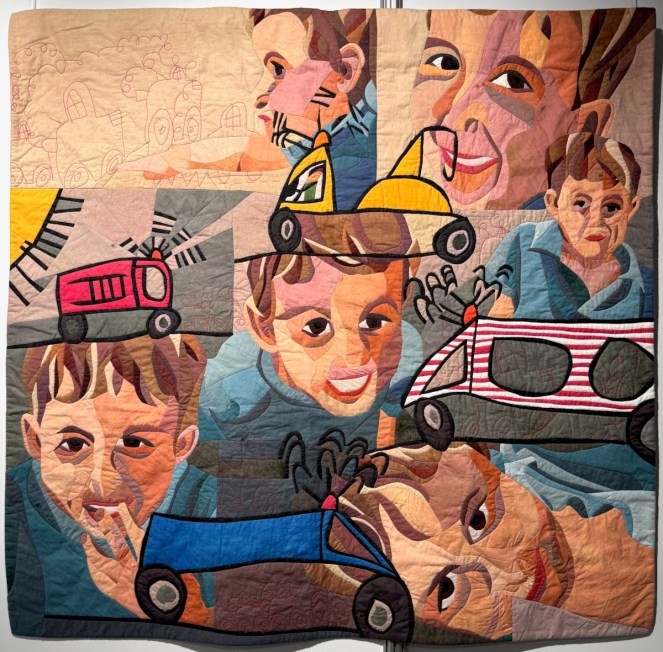
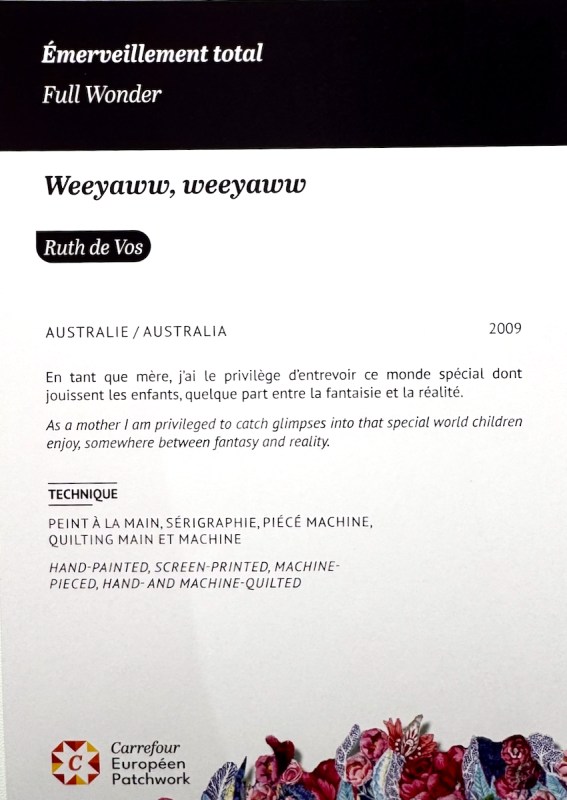
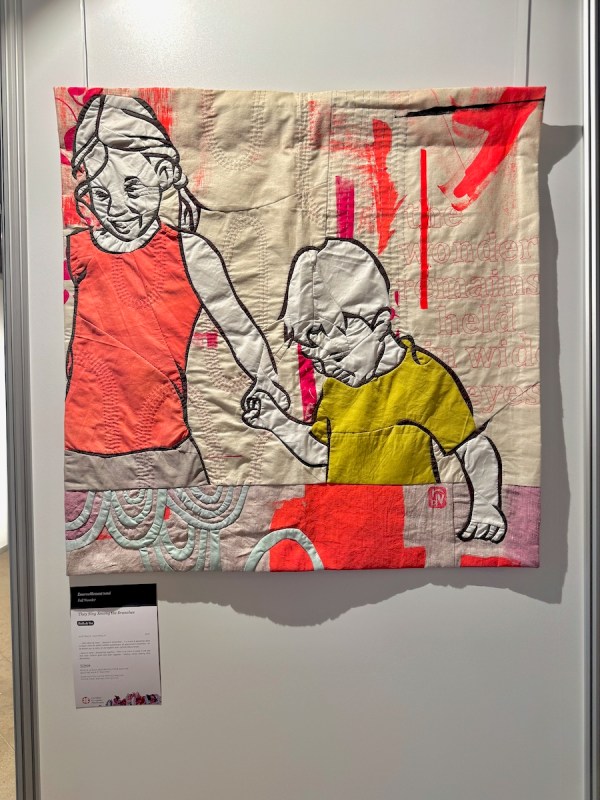
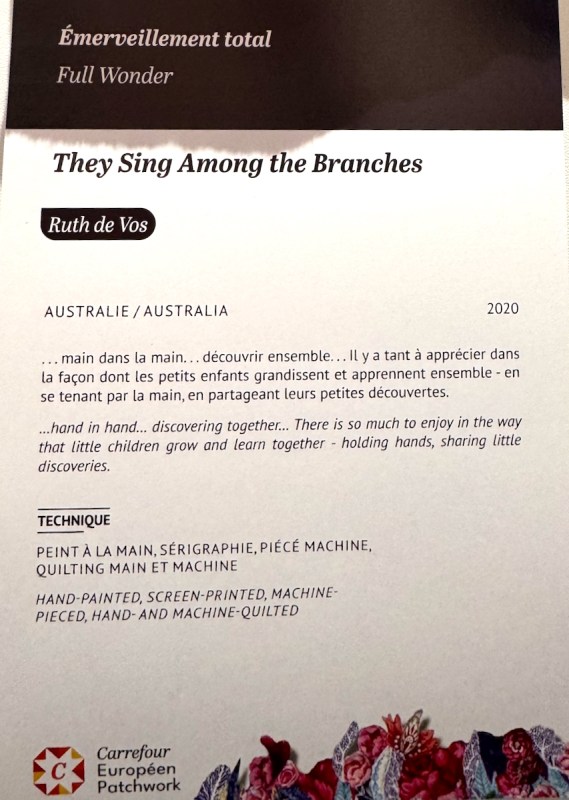
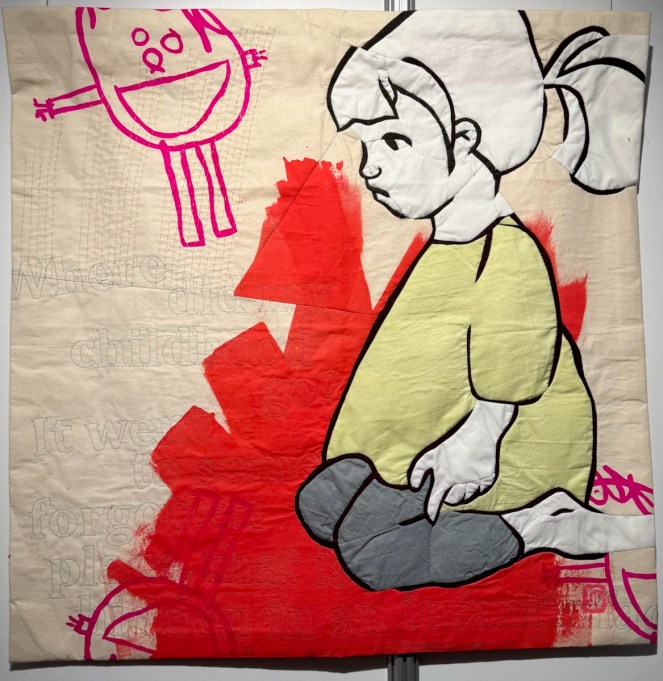
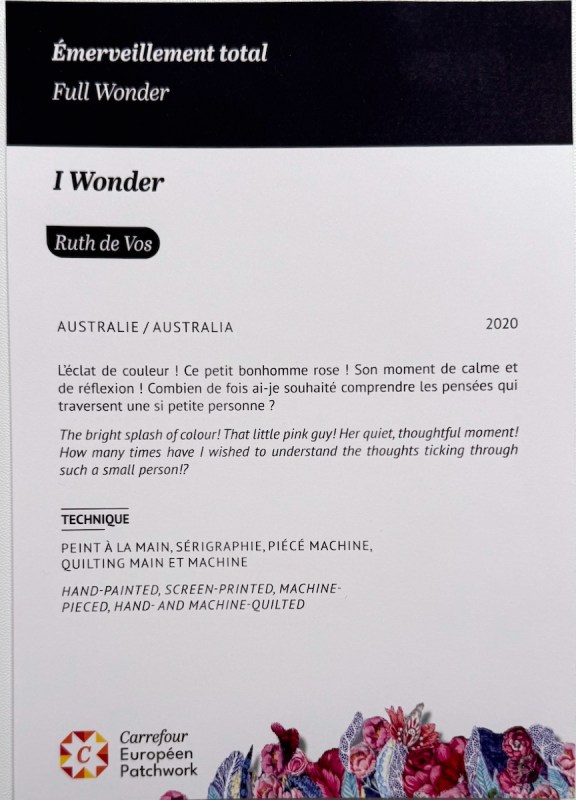
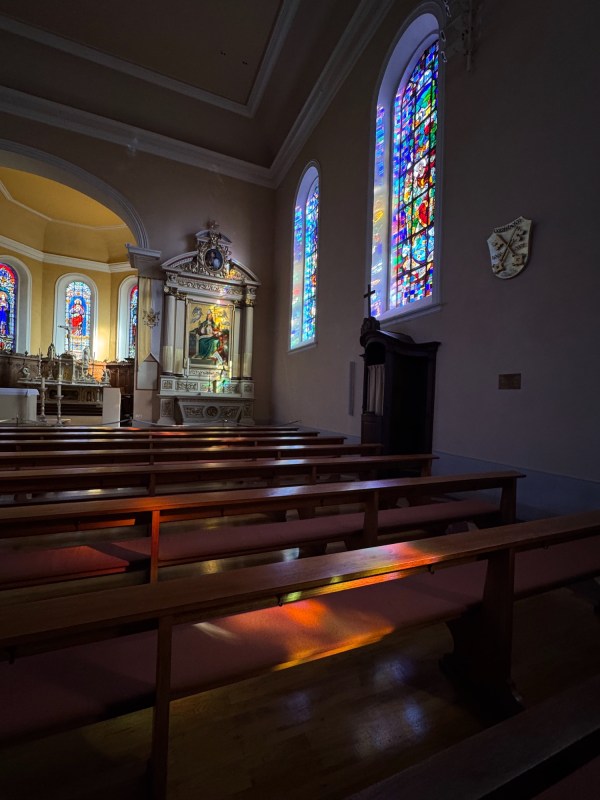
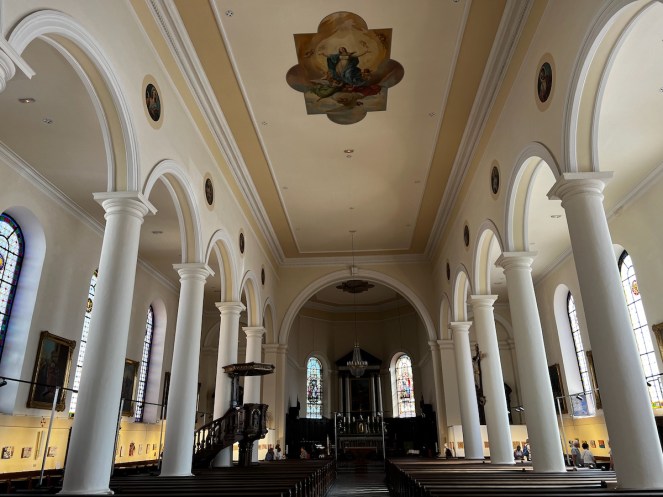
A small church in the town of Lièpvre, one of two sites in this village. Inside were new works from Ruth De Voss, she of flower fame. You can find her on Instagram @ruthdevosart.
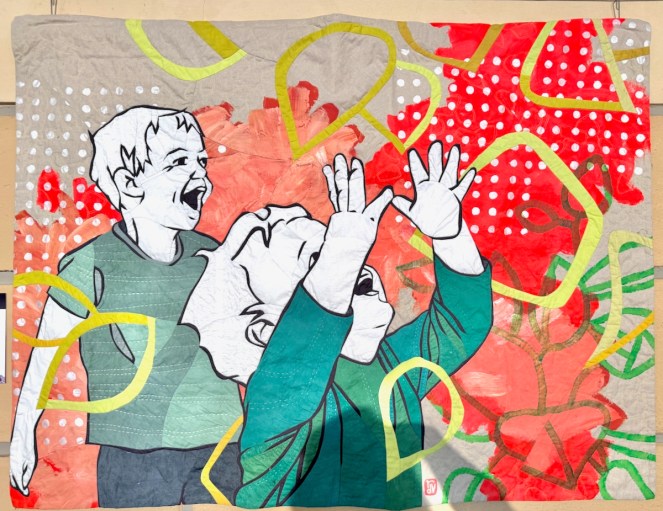
Now she has turned her piecing and printing and surface decoration skills from flowers to children. Her children, which I loved. Many women seem to avoid this side of their lives, and often in the art world they are expected to, but De Voss celebrates it.
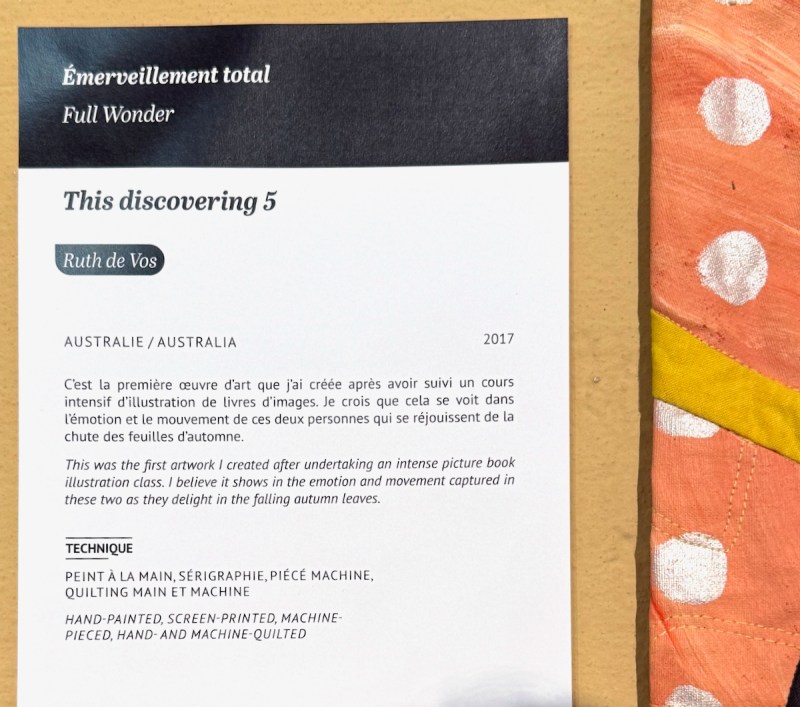
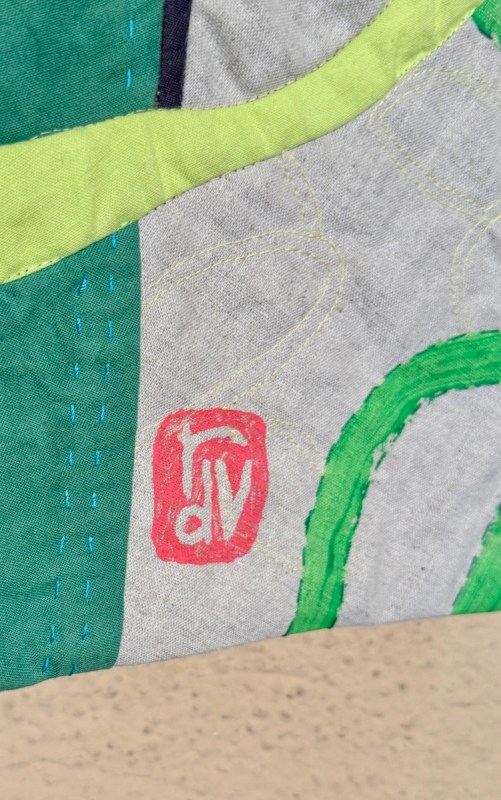
(click to enlarge) The church had many of her art pieces; I’m only showing a selection. They were colorful, drawn with strong lines.
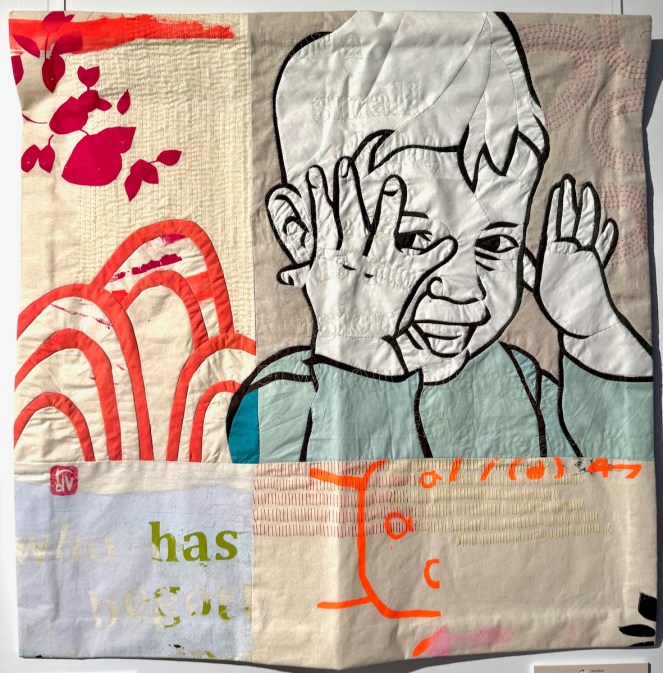
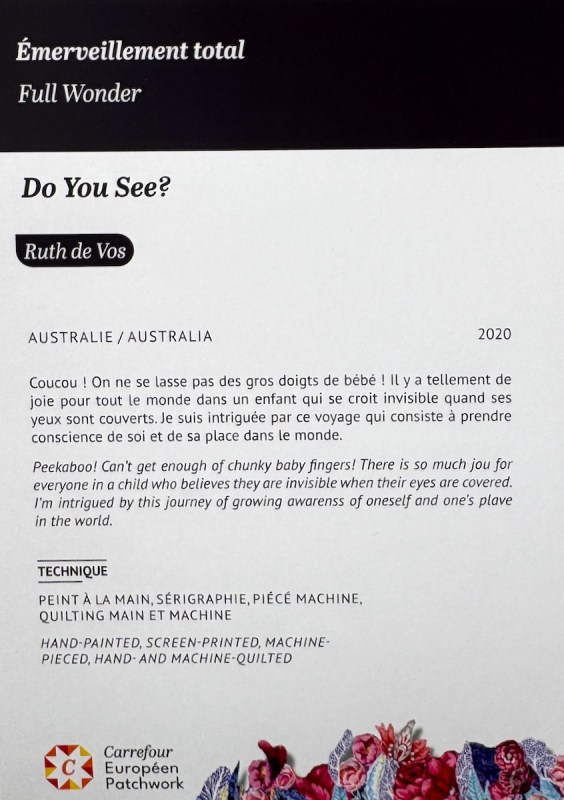
Click on small arrows to advance this slideshow to see more of her pieces.

Venue 15: Salle Polyvalente, with Lorena Uriarte, Dianne Firth, ASL Liépvre, EQA, France Patchwork
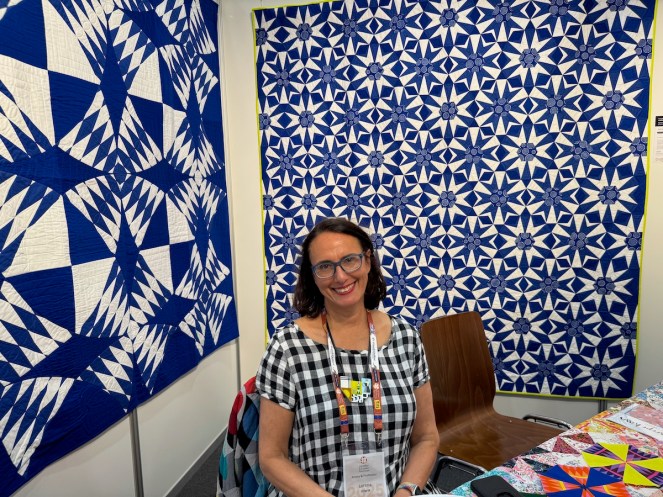
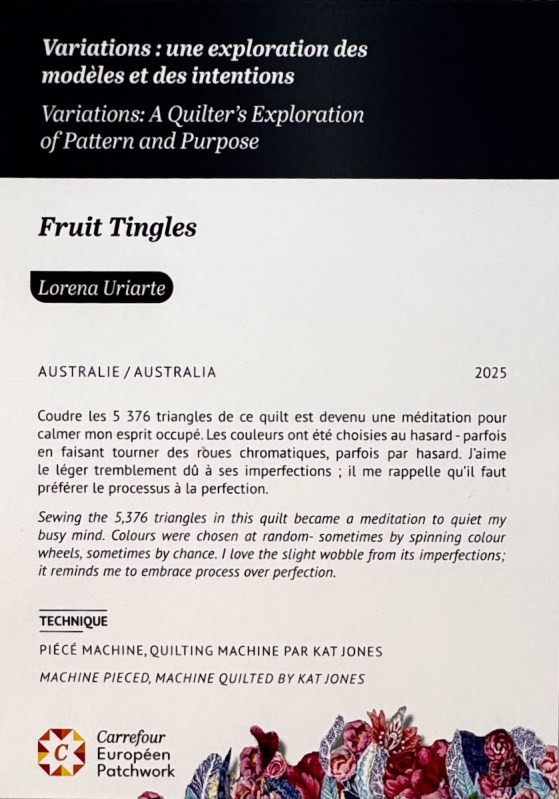
Lorena Uriarte is a well-known Australian quilter, who has been active in teaching, making patterns, and championing good design in quilts for years. You can follow her on Instagram @lorena_in_syd, as well as enjoy her quilts, below.
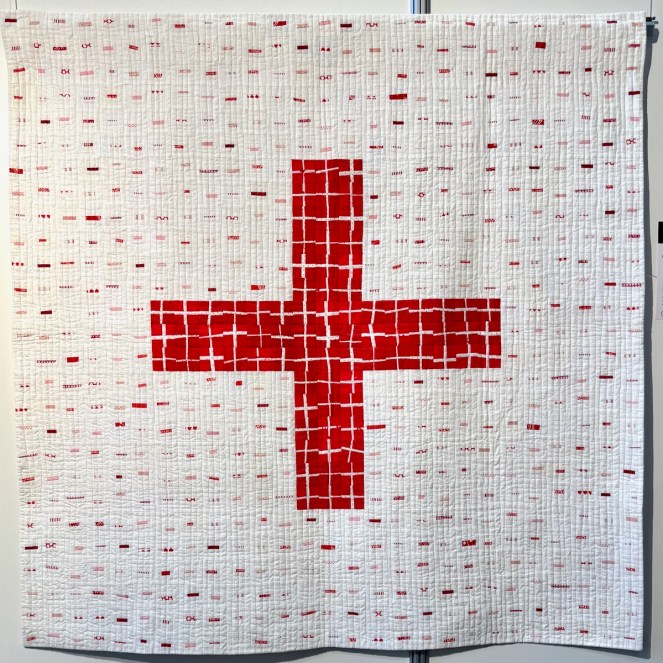
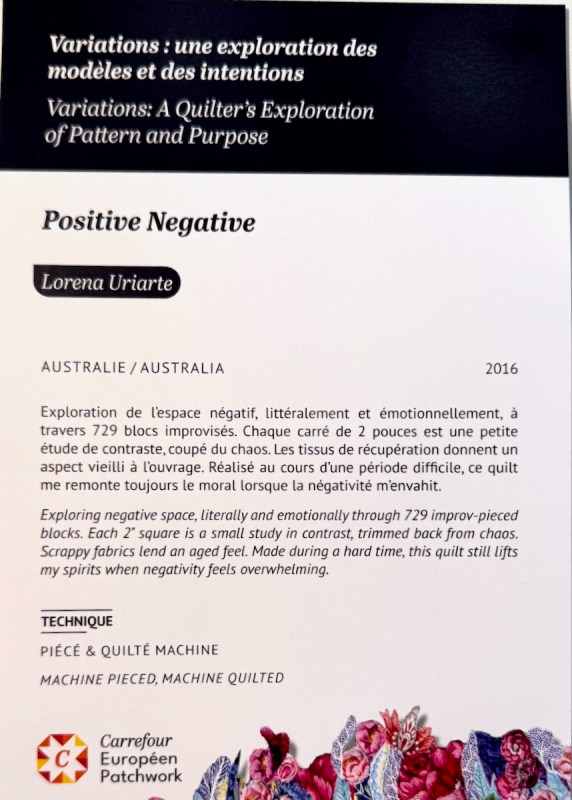
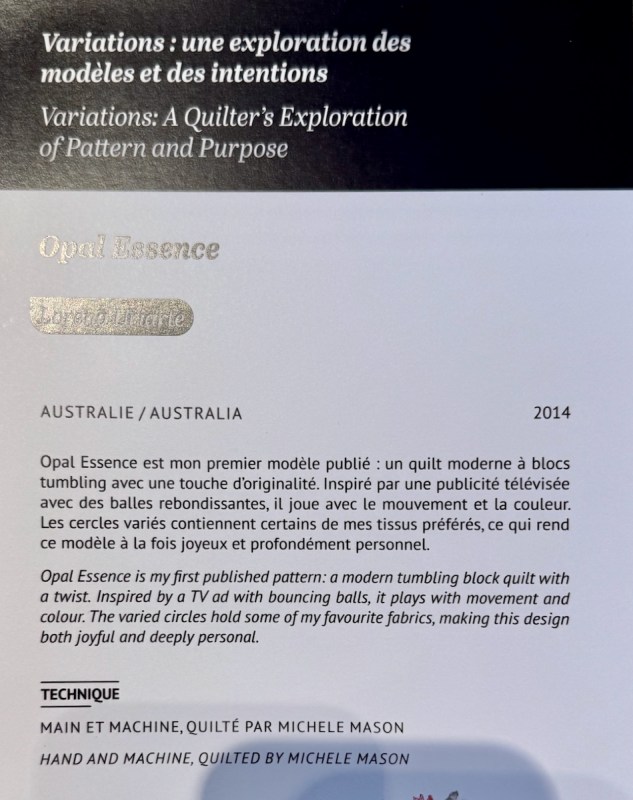
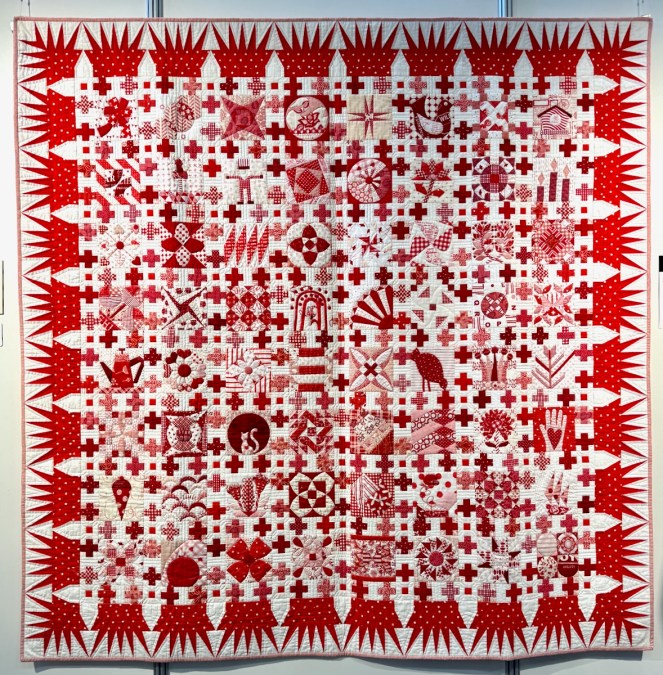
Title: Wingdings: A Variety of Symbols
Title Card: This quilt “is my red and white interpretation of Chuck Nohara’s Symbol Quilt Using self-drafter blocks from her book 2001 New Patchwork patterns, I explored every piecing technique to create a playful and personal visual language.”
Techniques: Hand and Machine; Quilted by Michele Mason
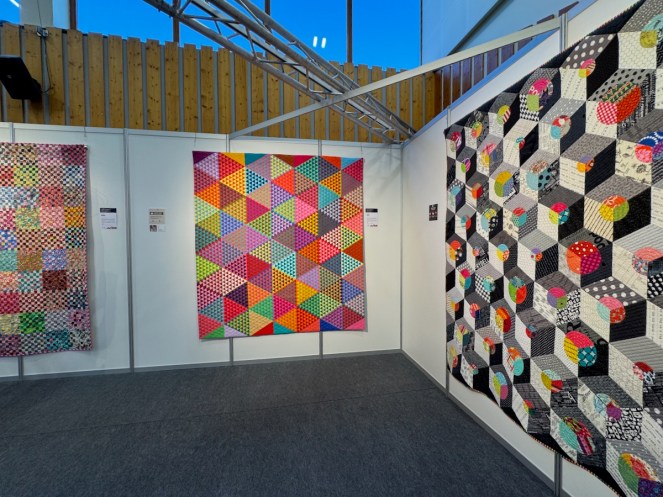
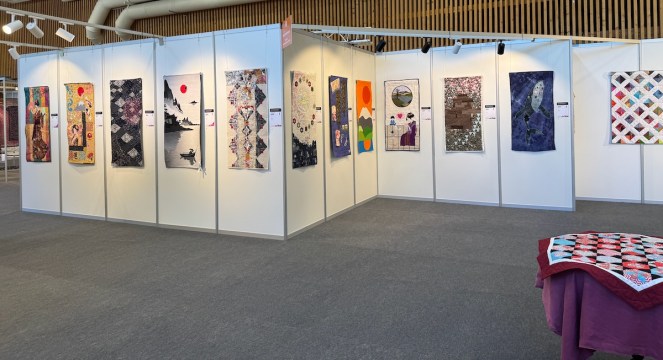
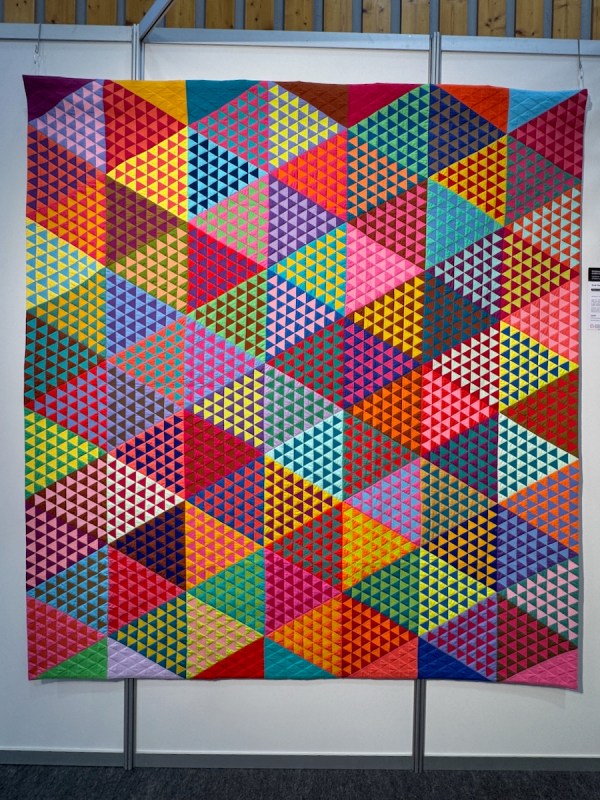
She had a range of her quilts hanging in this venue; they had a bold and colorful impact.
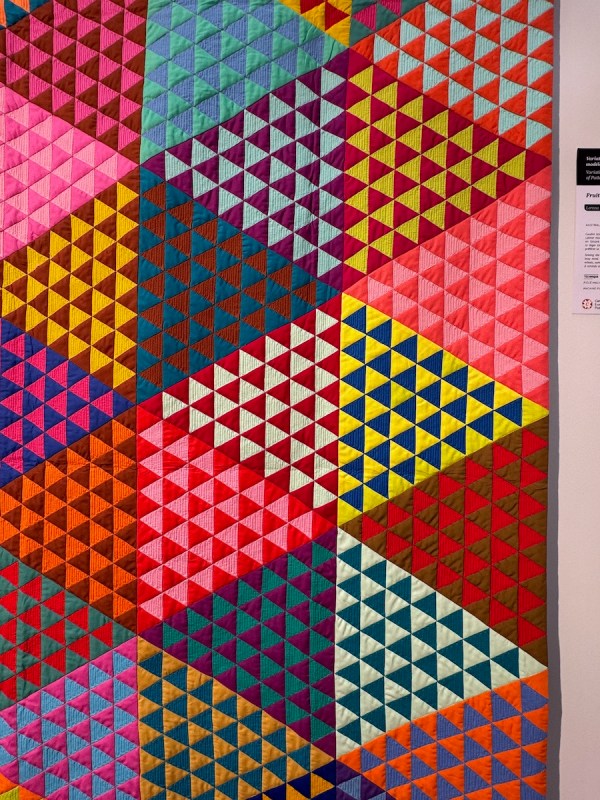
France Patchwork, and others

As always, France Patchwork, the national quilting guild, had a few quilts on display.

“France Patchwork is the French quilting guild, with over 6,000 members. Founded in 1984 and still thriving thanks to its volunteers, its mission is to promote quilting and its various forms through competitions, Friendship Days, and a quarterly magazine: Les Nouvelles de France Patchwork (from website).

They can be found on Instagram @france_patchwork_news. Happily this year I was there early enough to snag one of their tote bags. (One can never have too many tote bags!)
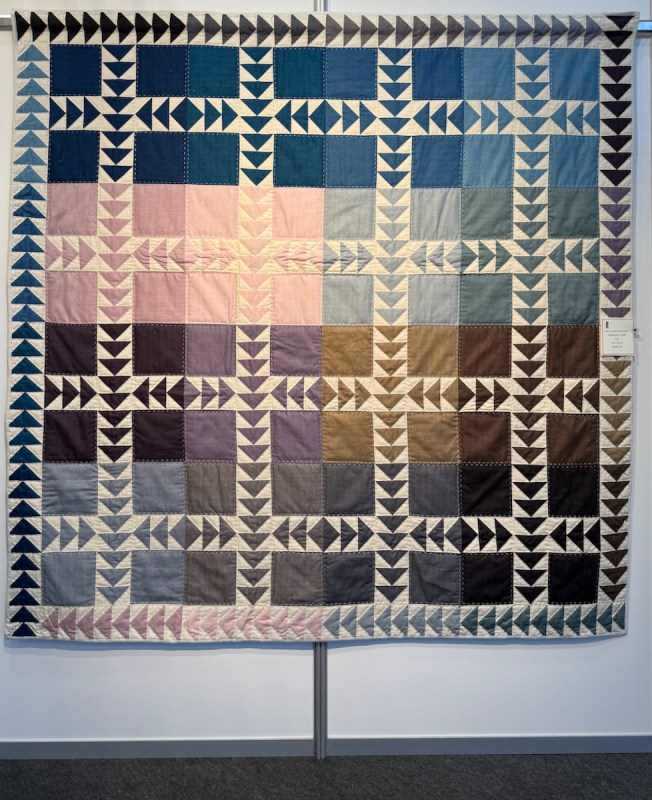
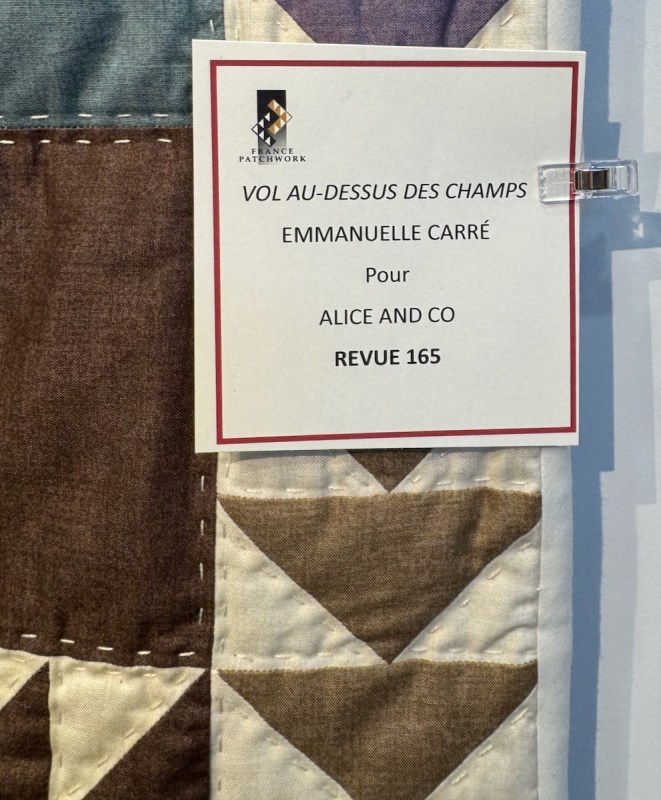
The quilting is done by hand, with heavier thread, and is more spare. I believe these quilts are the cover quilts for their magazine, Les Nouvelles, but I can’t find any working links to their magazine or their organization, beyond the Instagram account.
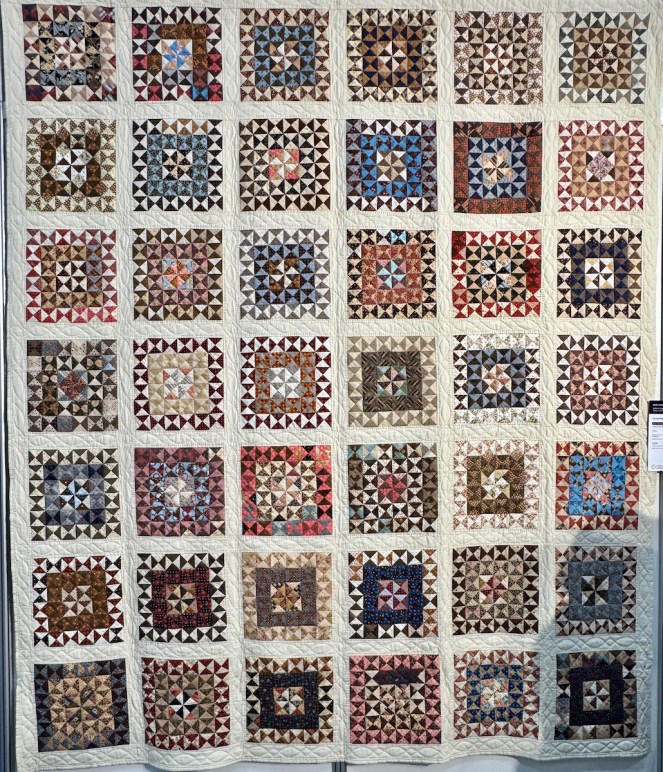
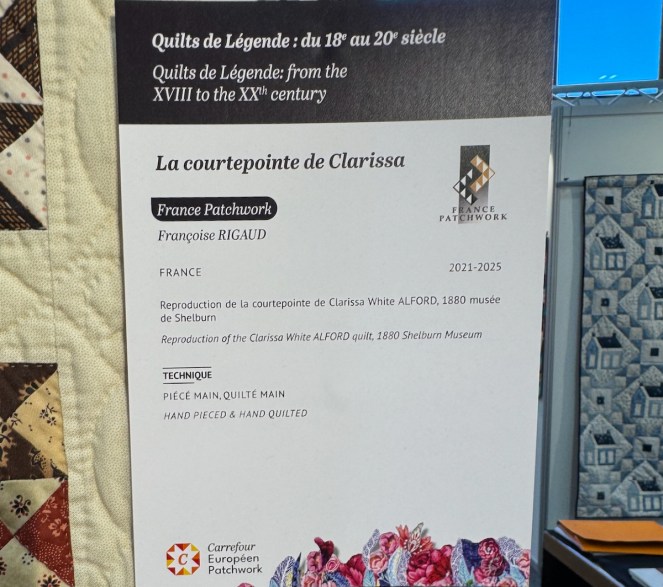
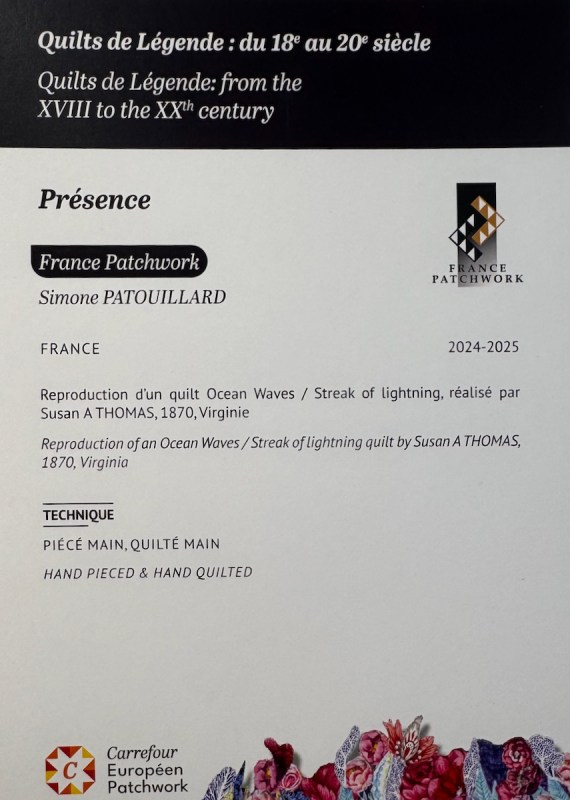
I wonder if Françoise Rigaud is with the group quilt_en_reve on Instagram? If so, they always do such beautiful work in making reproductions of antique quilts. They had a display in 2024 at Carrefours, and I wrote about them here.
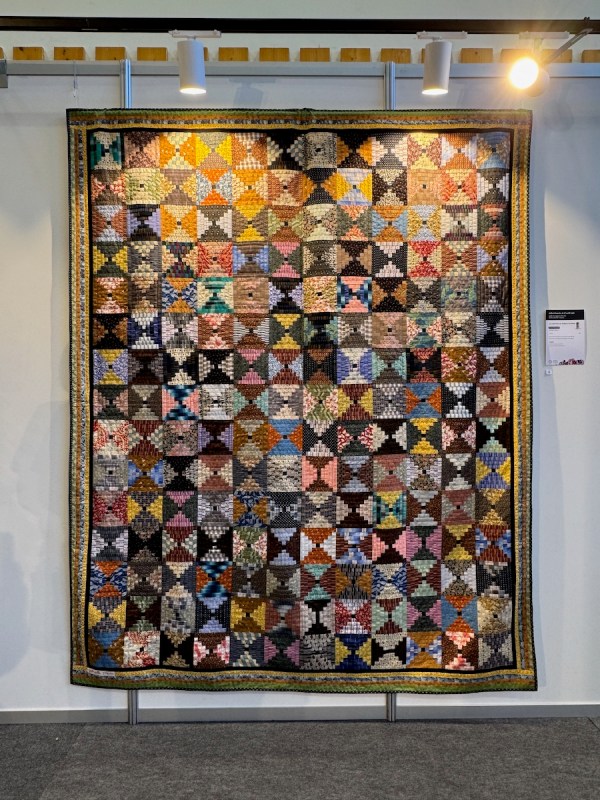
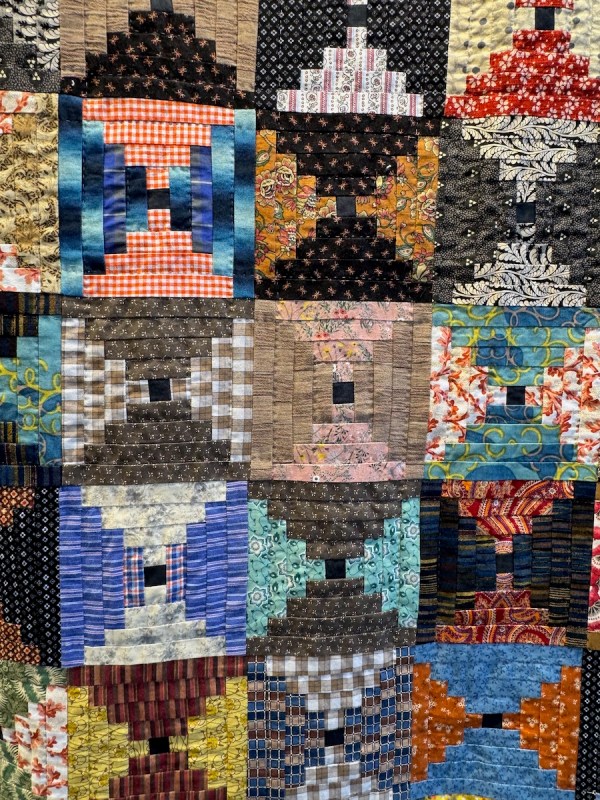
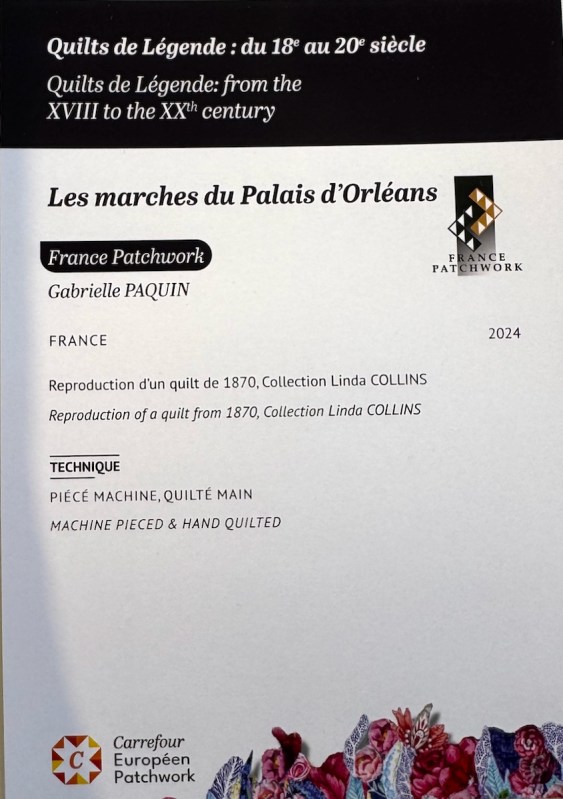
I loved the use of that ombre fabric in the one block. Gabrielle Paquin is a favorite of mine; I saw her the first time I went to Carrefour (link) and began to see I had a lot to discover and learn about our beloved patchwork.
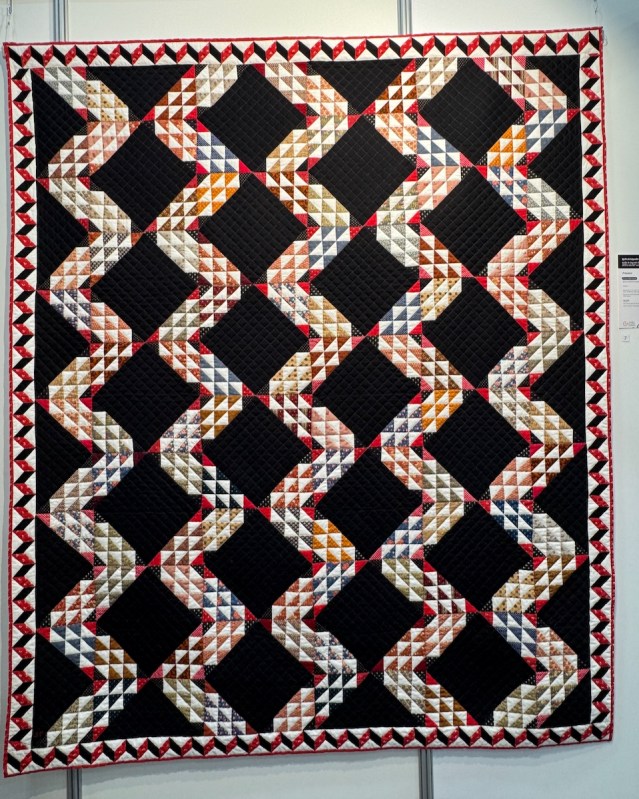
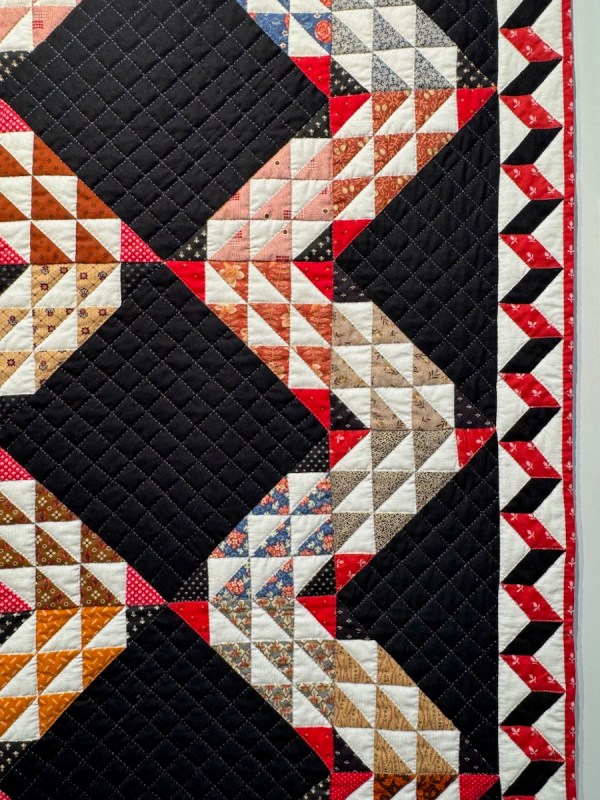
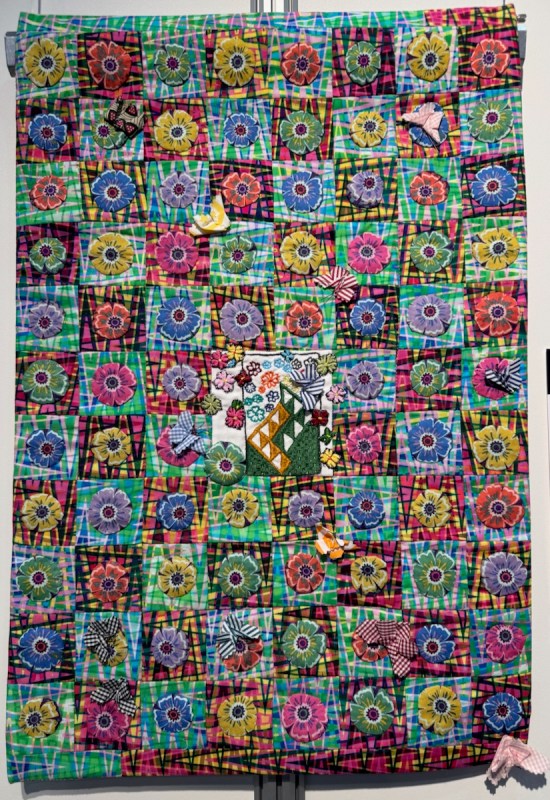
I recognized the France Patchwork logo in the center of the quilt.
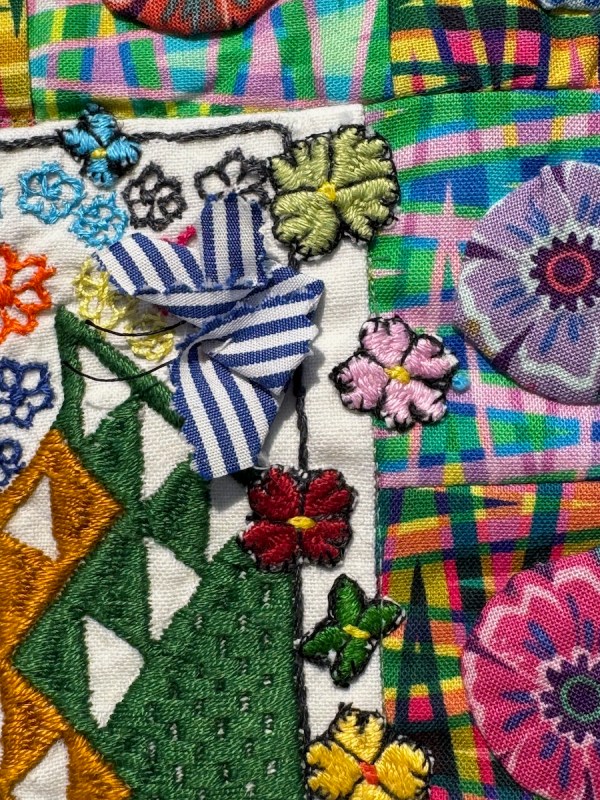
And I loved the combination of appliqué and these interesting little butterflies.
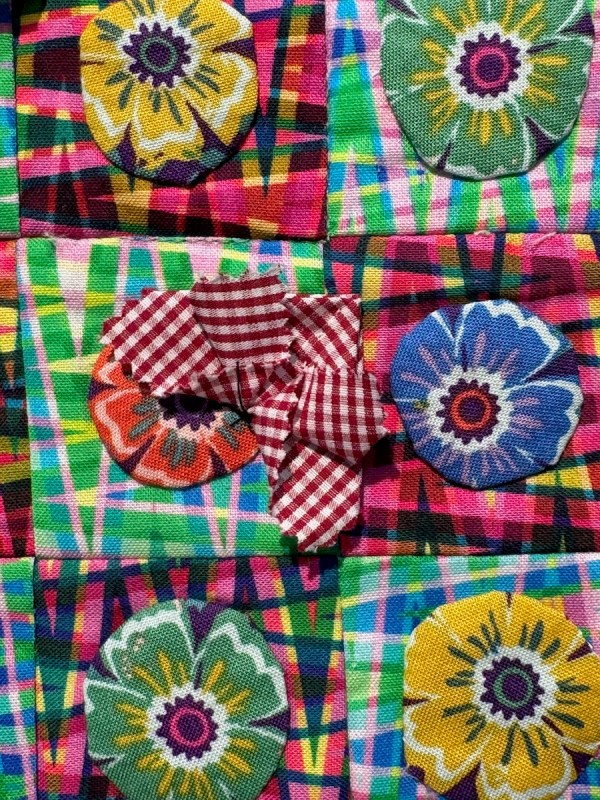
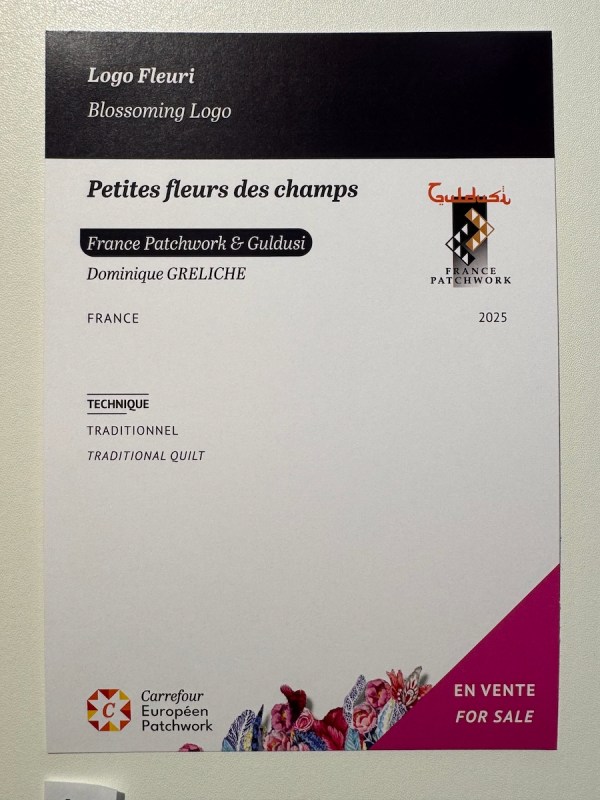
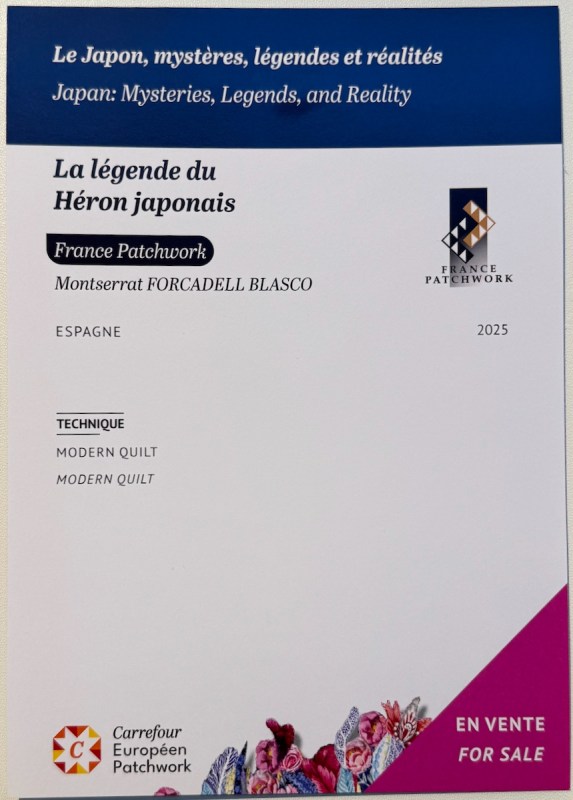
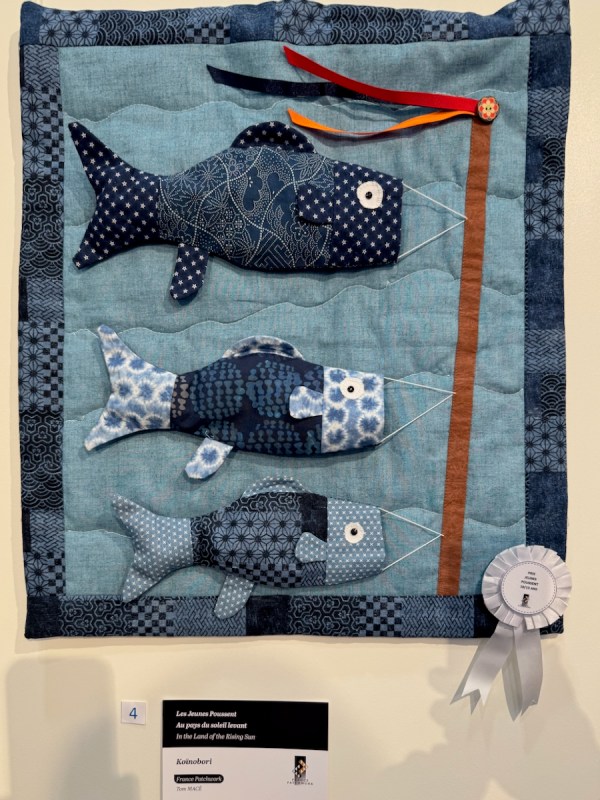
A tribute to Japan, from France Patchwork.
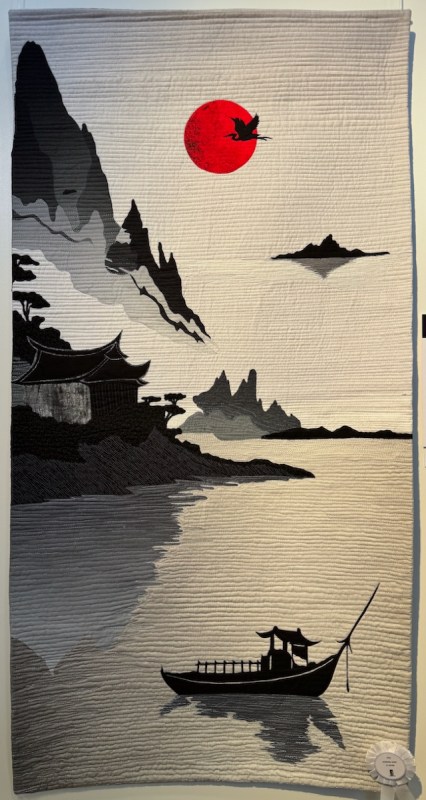
Title: Koïnobori
Artist: Tom Mace, France
This is from the category of “Les Jeunes Poussent” in the grouping In the Land of the Rising Sun, and was in the age group of 10-13 years old. (Literally it translates to “The Youth Are Growing.”)
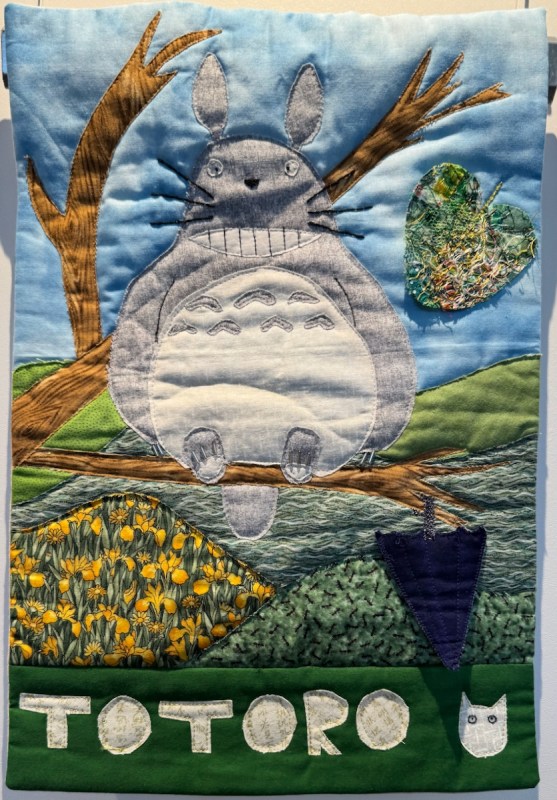
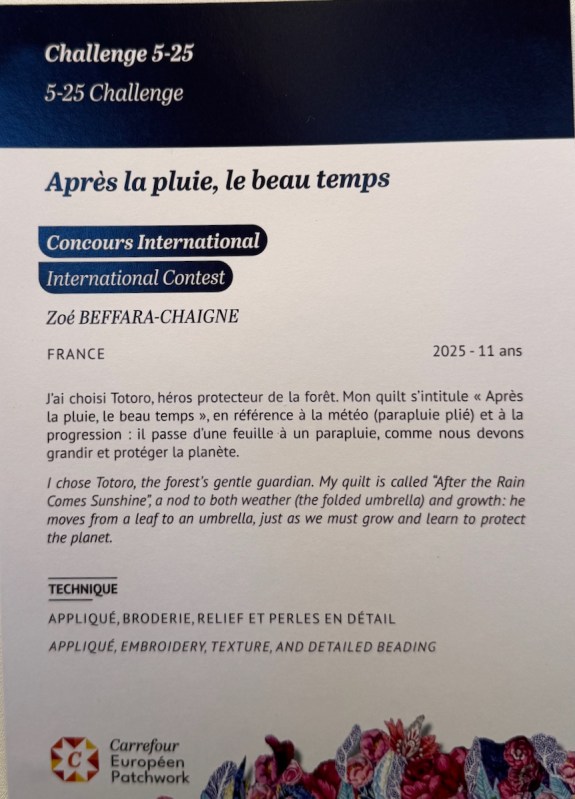
The Challenge 5-25 was to encourage the interest of the youth. The website says:

“For the 30th anniversary of the European Patchwork Meeting event, we’re inviting budding artists and young prodigies to take part in the “HEROES” competition, inspired by those people and characters they admire, on screen or in real life.

The challenge is to create a patchwork quilt: a work made up of different pieces of fabric, illustrating the theme of heroes. Think of everyday heroes and heroines, cartoon characters, bright colors and comic books for inspiration!”

Diane Firth
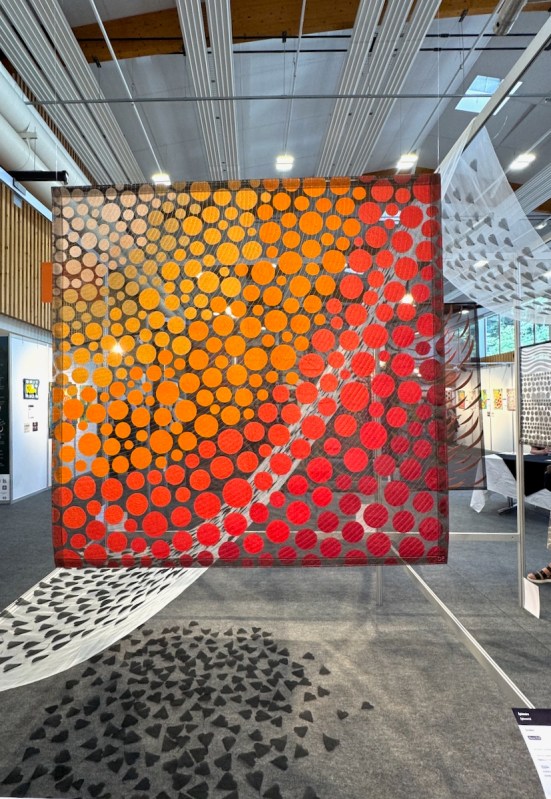
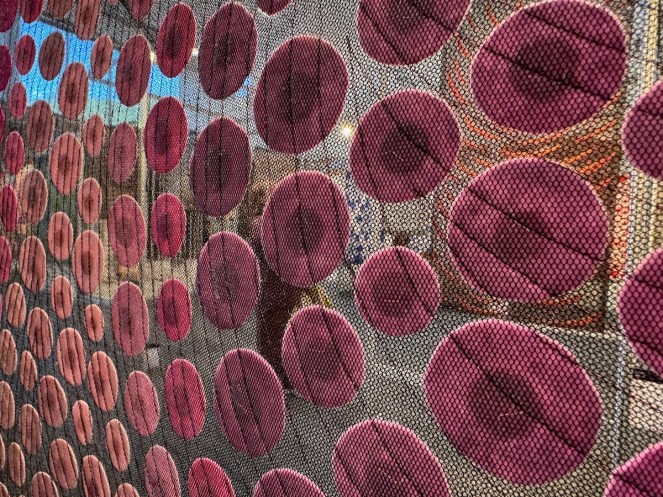
And now, for a complete change of pace in quilting, here are some transparent quilts made by Diane Firth, of Australia. This is titled Scatter, which was inspired by the dispersal of seeds.” The title card also notes, under techique, “Assembled and Machine stitched on Bernina 770.”
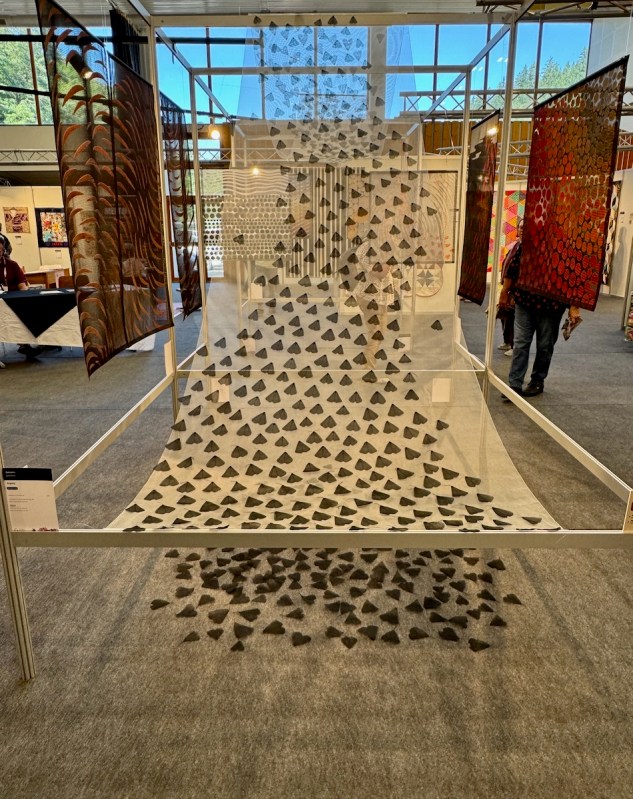
Title: Bogong
Description: The moths emerge from the black soils
Technique: Machine and hand-stitched

Bogong is a type of moth.
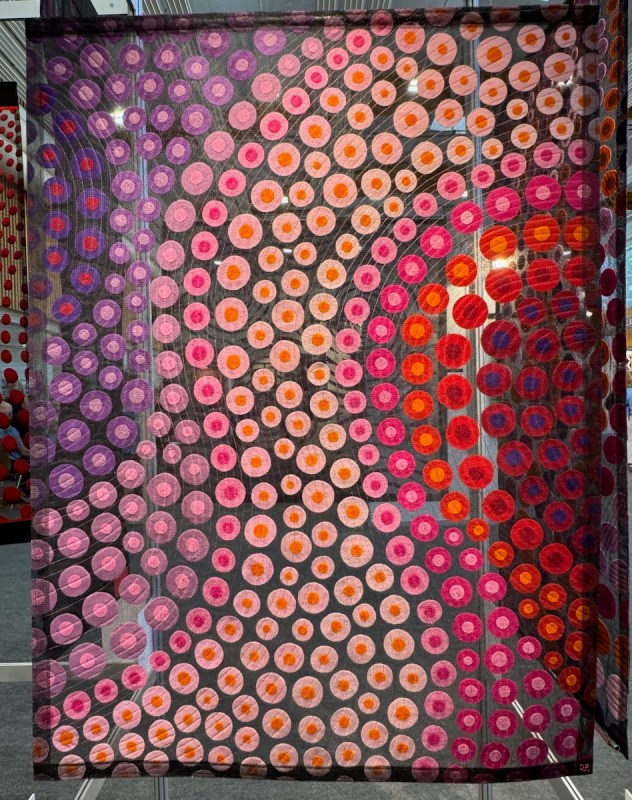
Title: Floriade #4
Description: Floral Abundance
This black mesh netting was in several of her pieces, holding the circles (which looked like felt) in place. The Carrefour website says this about Diane: “Dianne Firth, a quilter for almost 50 years, is a landscape architect and academic. She exhibits regularly in juried exhibitions and her works are held in public and private collections around the world.” The OZquilt Network has a page about her where you can read more.
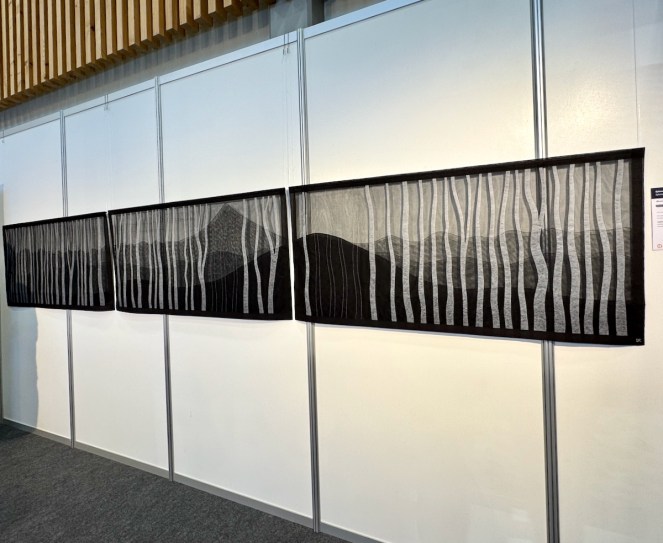
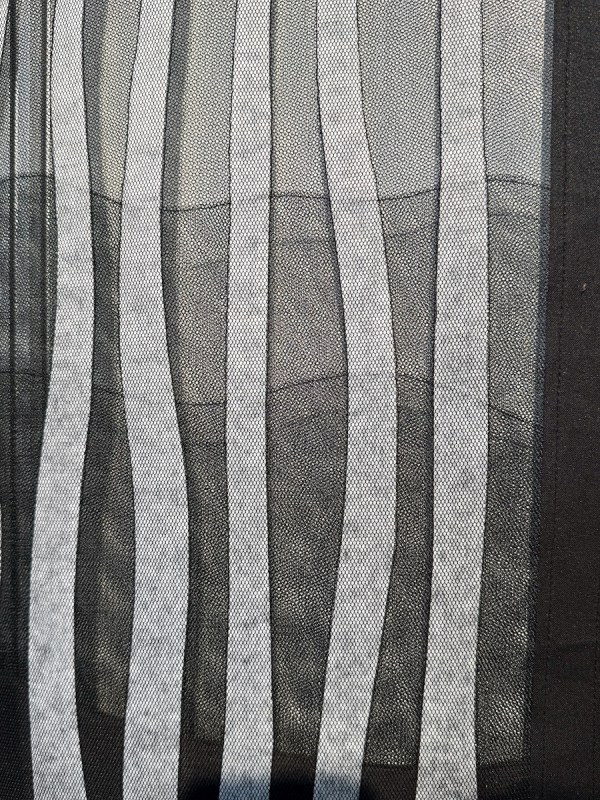
Title: Black Mountain
Description: An exploration of changing landform
This is one of the larger pieces, but the entire display was intriguing and again made me ask the question about what is a quilt? Clearly, hers has three layers, but it is so inventive and structural.
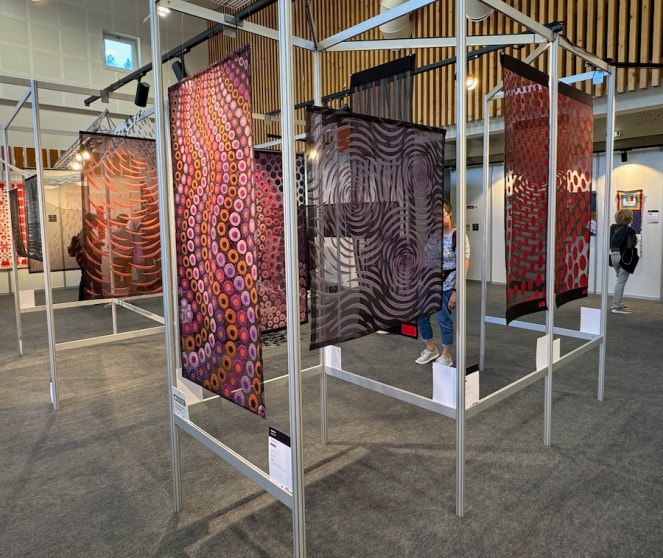
EQA: European Quilters Association: Contrasts (2025 Exhibit)
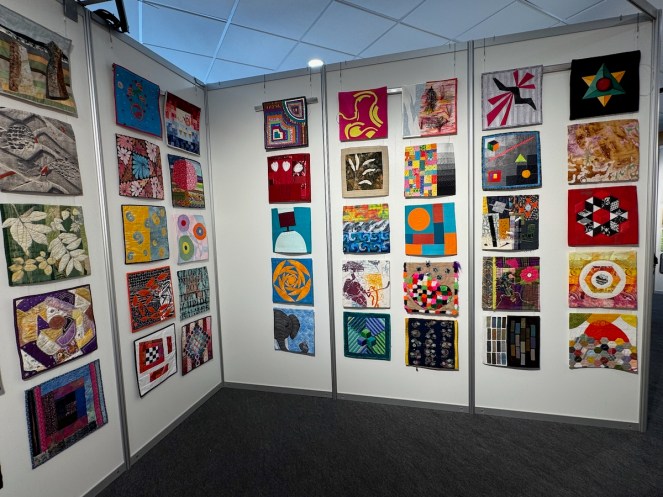
The EQA is a cooperation between the European quilt guilds, and has a yearly challenge of small quilts (35 cm square, which is about 14 inches). As always, I spent a lot of time looking at the artworks. Here’s the Challenge:
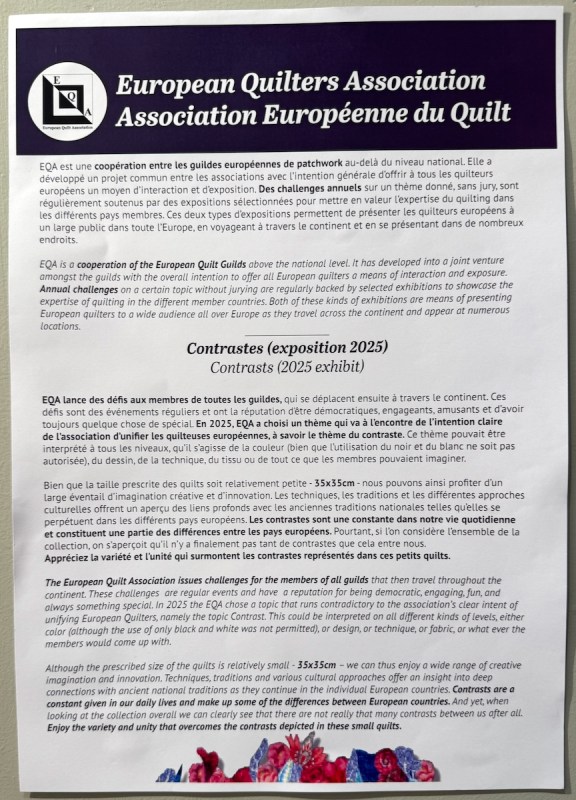
(If you right-click to open this in another tab, it may enlarge for you.) What intrigued me was the line in the last paragraph: “Contrasts are a constant given in our daily lives and make up some of the differences between European countries. And yet, when looking at the collection overall we can clearly see that there are not really that many contrast between us after all.”

Here are a few of the many, many wonderful quilts.
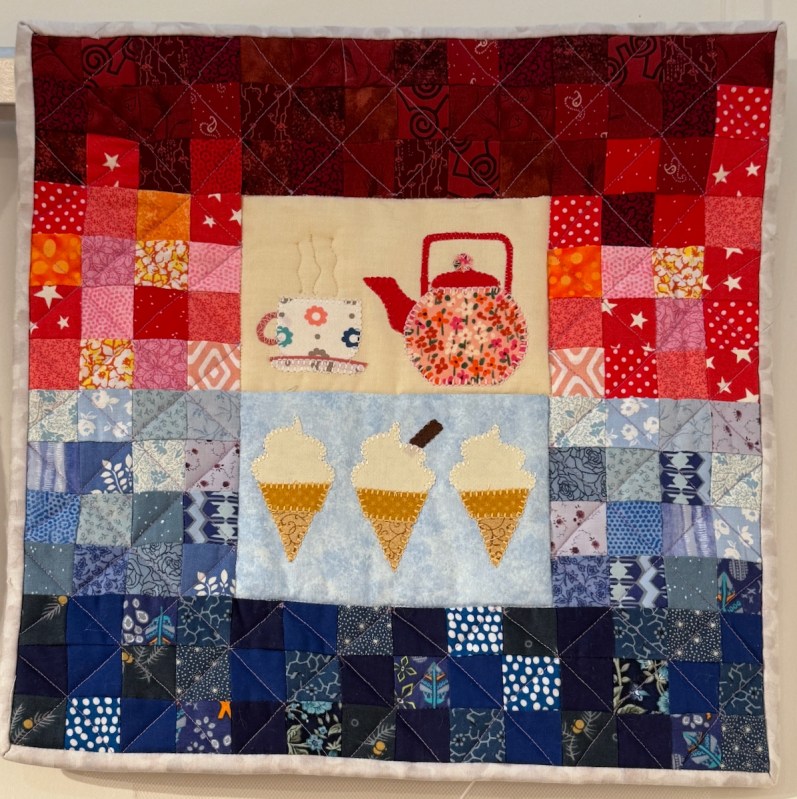
After this, we leave the venue and try to decide if we hungry, as this year…they have a full lunch service just outside. Tempting, but we went to the market at the edge of town, grabbed something and drove to Rombach-Le-Franc, the last town. We parked outside the Espace Raymond Hestin, and ate our shared lunch in the car, in the shade as the day had grown hotter.

We were on the last two venues of the show. We’d started the day before, and went through the vendors and other spaces in Sainte Marie-aux-Mines, then headed to Saint Croix-aux-Mines and got to Venue 12, before calling it day and driving back to Colmar.

We got up early the second day, picked up again with the Australian quilters in Venue 12, and progressing through the show. Now, eating lunch there in the parking lot, we talked about if we’d be back next year (no), and what we liked and didn’t like. My husband is a great partner in this adventure and I regularly talk quilting with him. Many of the photos you’ve seen have been taken by him.
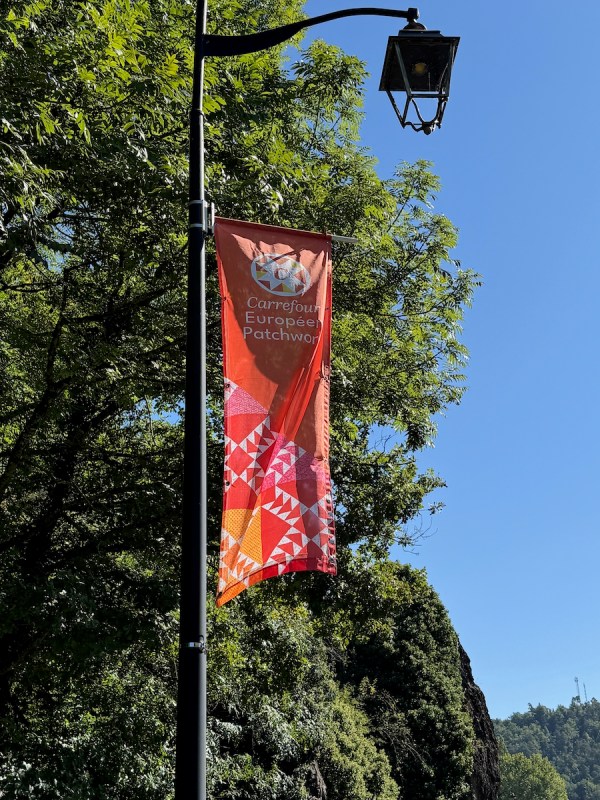
Along the road to Romach-le-Franc. We tried for this three times, pulling U-turns to double back to get the wind just right in the banner.

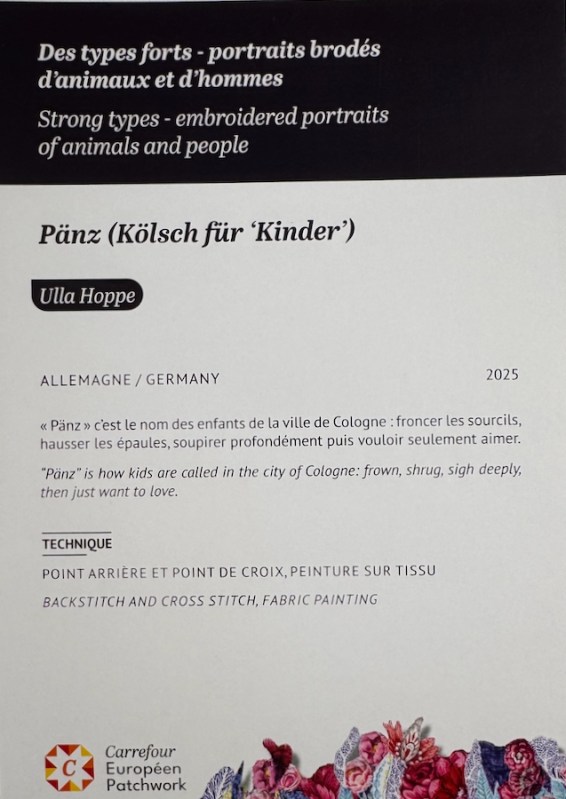
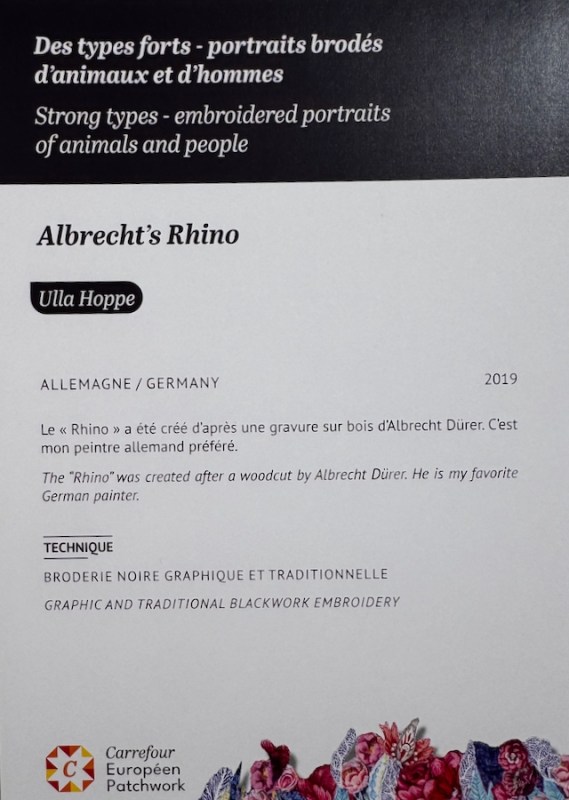
Venue 16: Ulla Hoppe
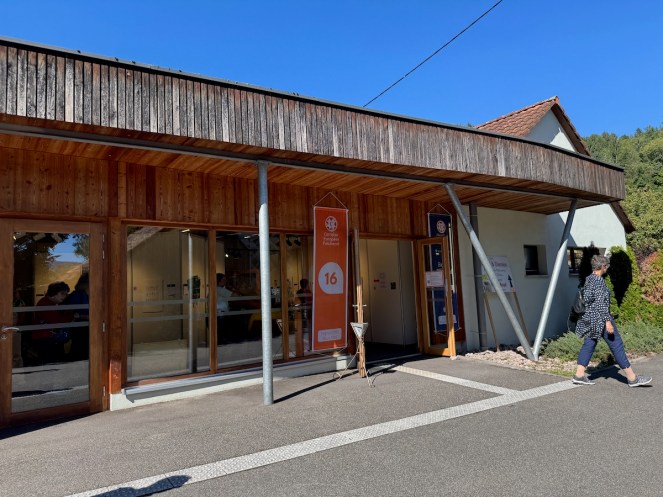
Here we go! This venue is quite small, and while there were a couple of exhibits there, I’ll mention only one.
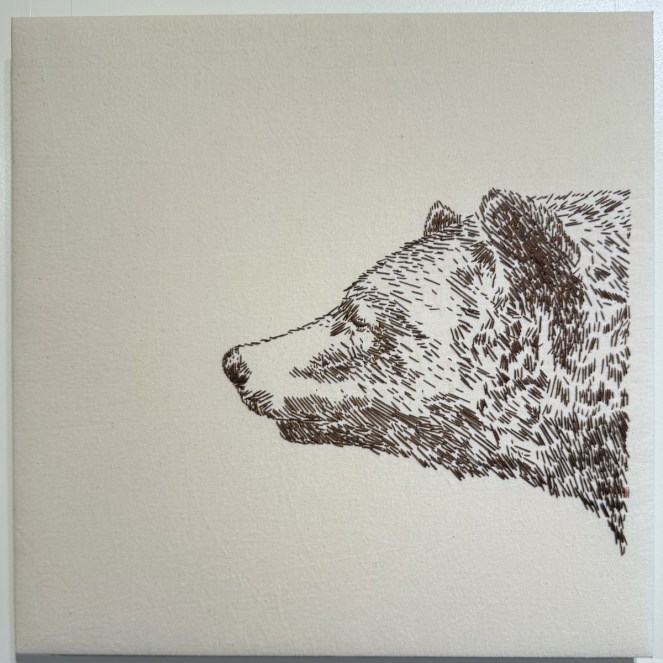
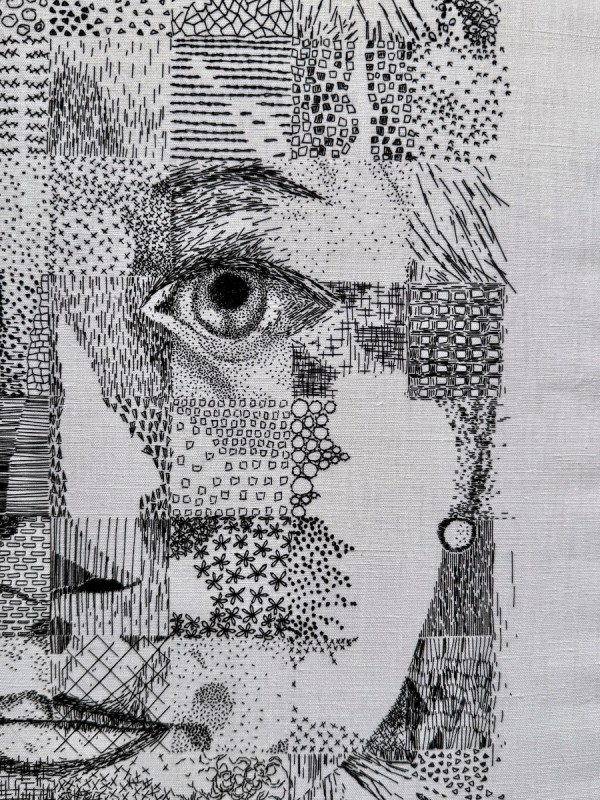
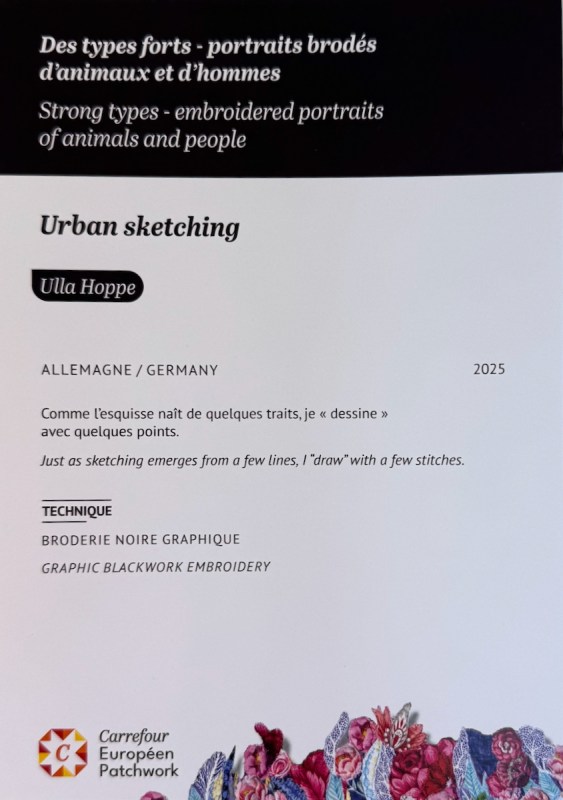
Ulla Hoppe, from Germany, was exhibiting her stitching, embroidery. Not quilting, but I thought it was amazing.
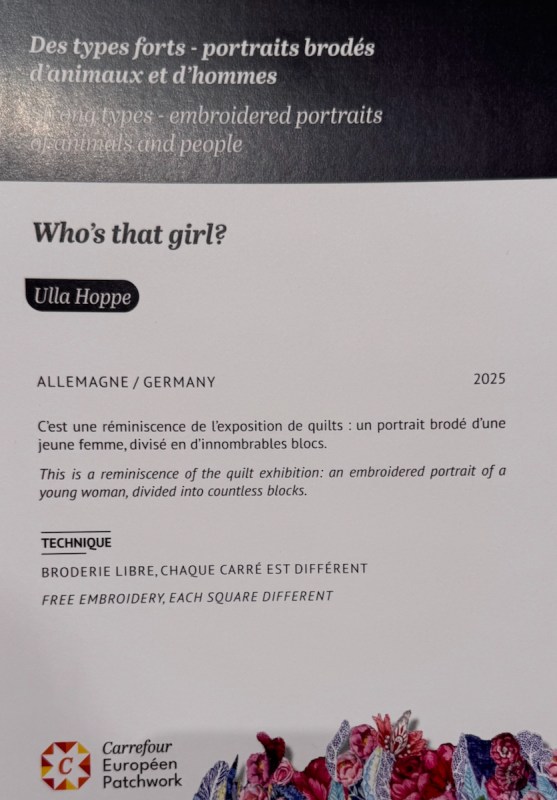
The range of blackwork stitches really brings the complexity of the young woman into focus: aren’t we all full of discreet “countless blocks?”
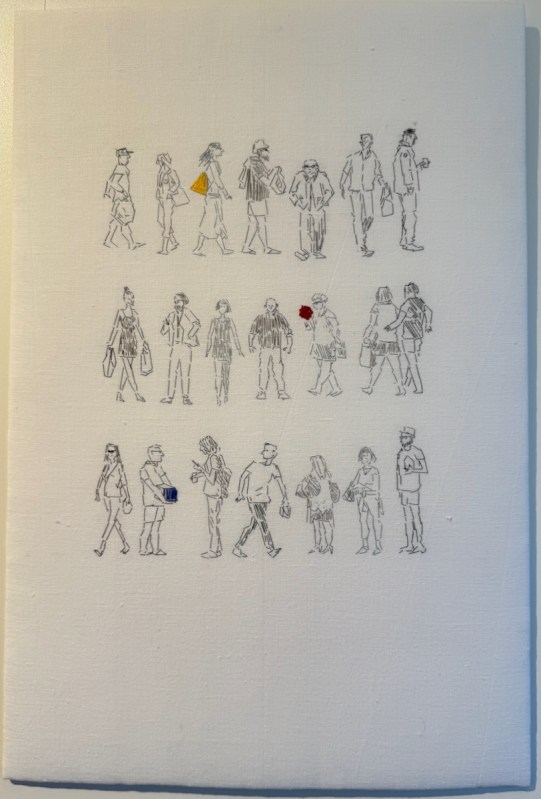
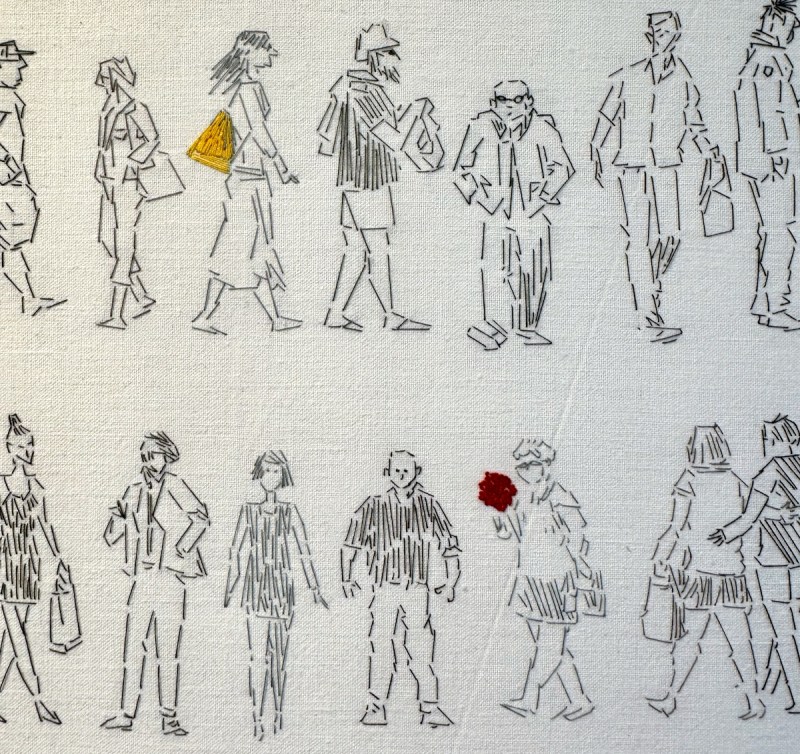
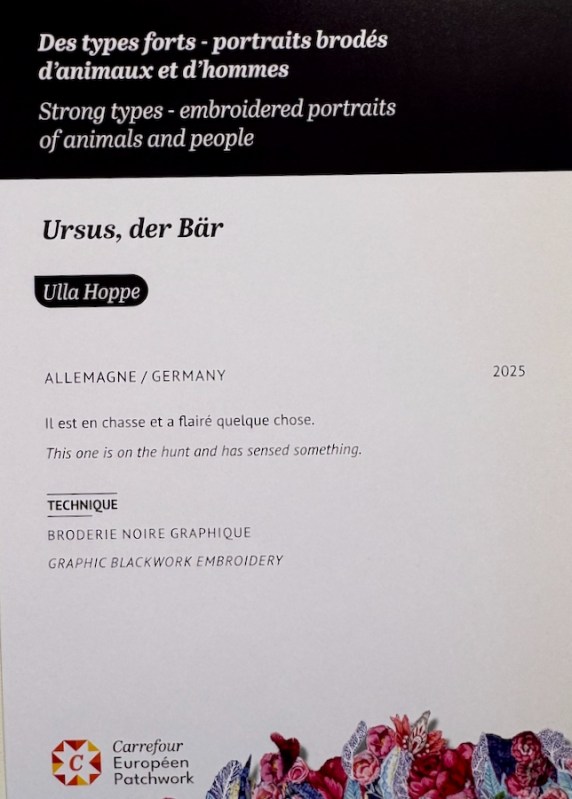
I loved the title of this piece.
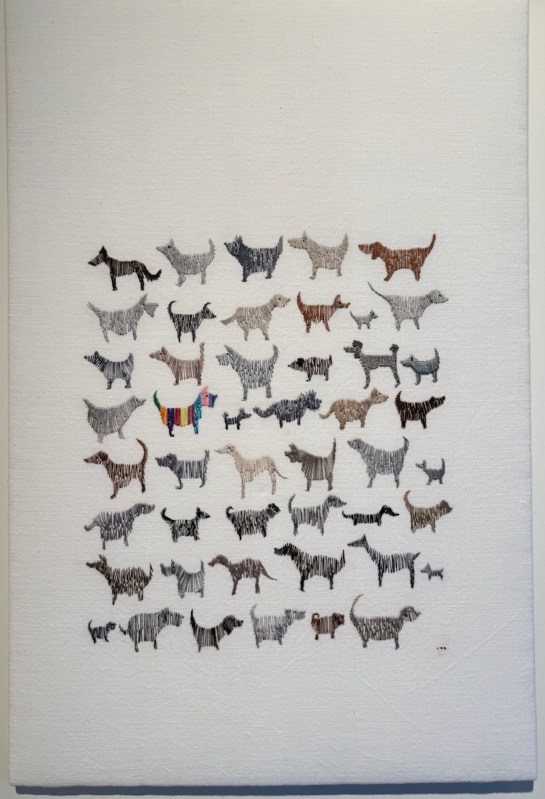
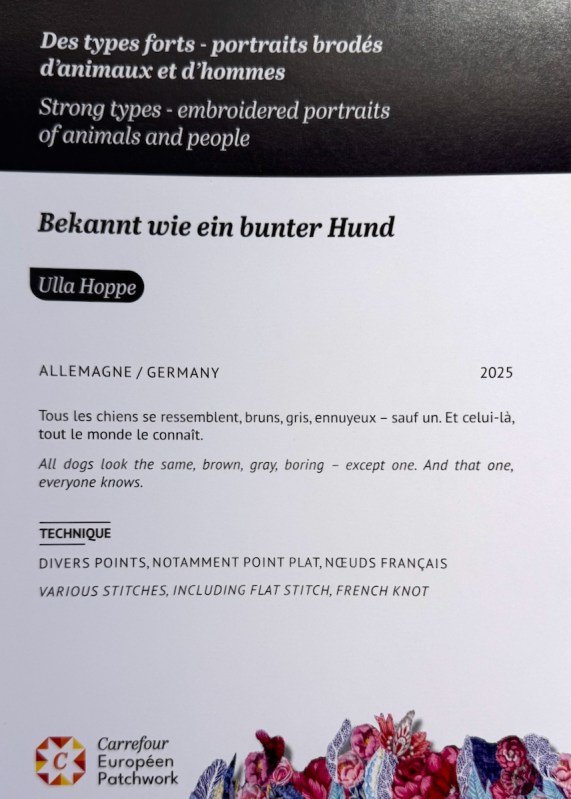
“That one” lives across the street from me!
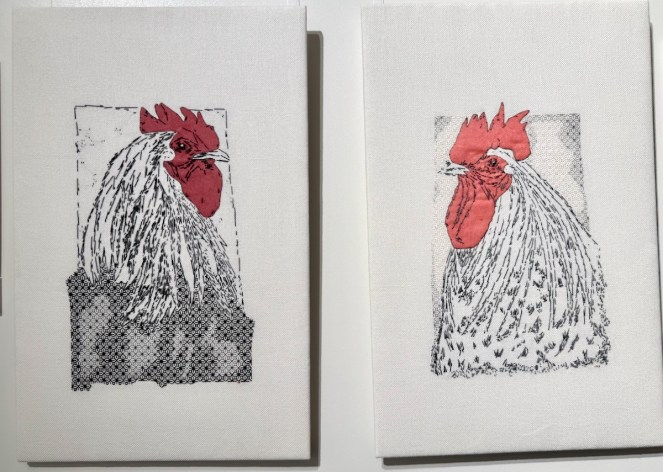
What is notable in this one is the inversion of the stitches, although done in different colors: what is foreground in the black rooster’s image is background in the white rooster’s image. (If you open it in a “new tab” it will be enlarged.)
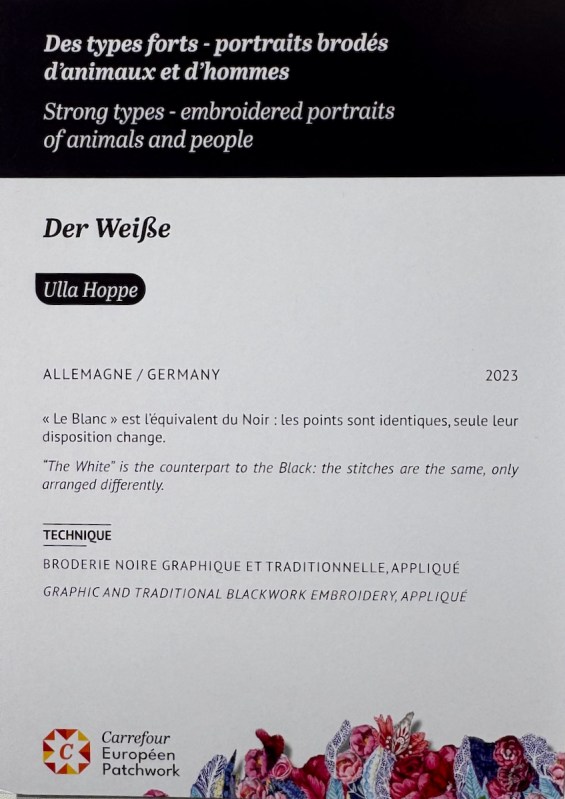
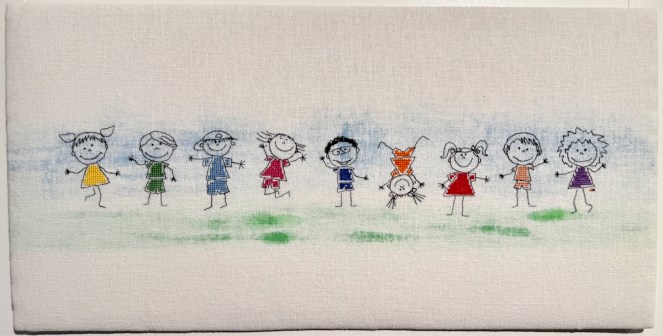
You can find her on Instagram @ulla_stickt
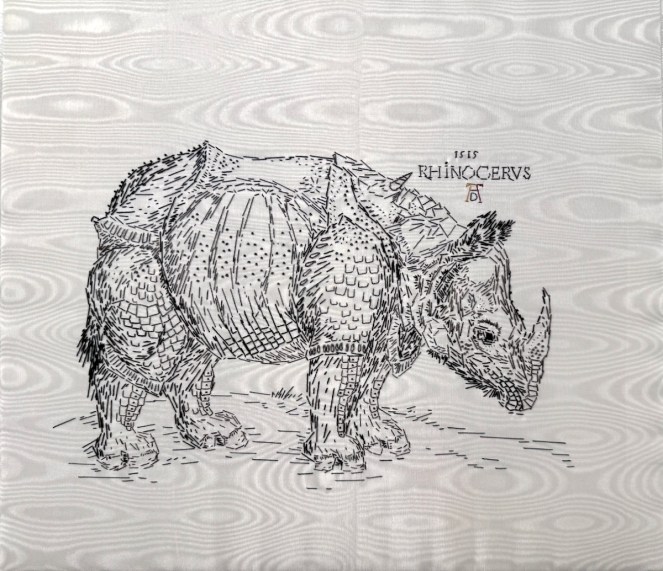
She even stitched in Dürer’s insignia. Last one:
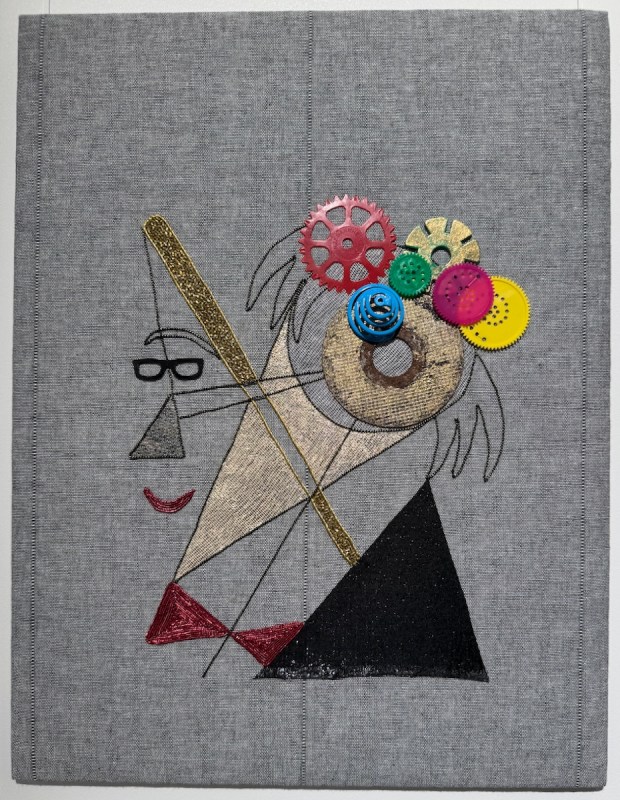
Title: Der Nobelpreisträger
Artist: Ulla Hoppe, Germany
Description: Nobel Prize winners: often “grey eminences,” yet crowned with gold.
Technique: Gold embroidery, collage, partially gilded
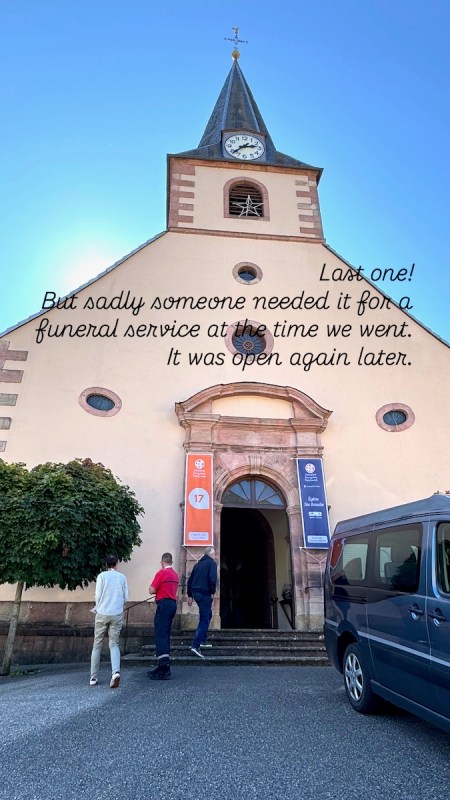
Alas! We could come back in two hours, but alas! alas! we wanted to see another small town on the way home, so we missed seeing Fabia Diniz. We missed a LOT! I went onto the Carrefour website and downloaded this:
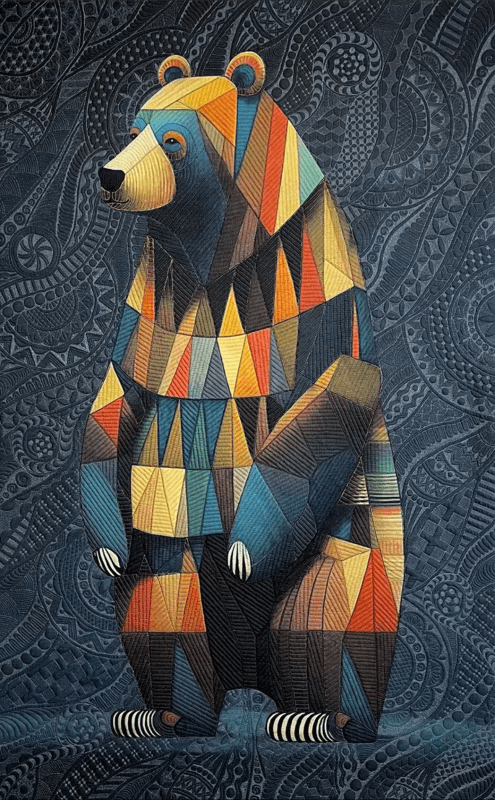
I hesitate to put a link because I know they change their website a lot. But head to her Instagram, and click on her Story, Carrefour, and you’ll see her story about coming to France, along with some of her creations.
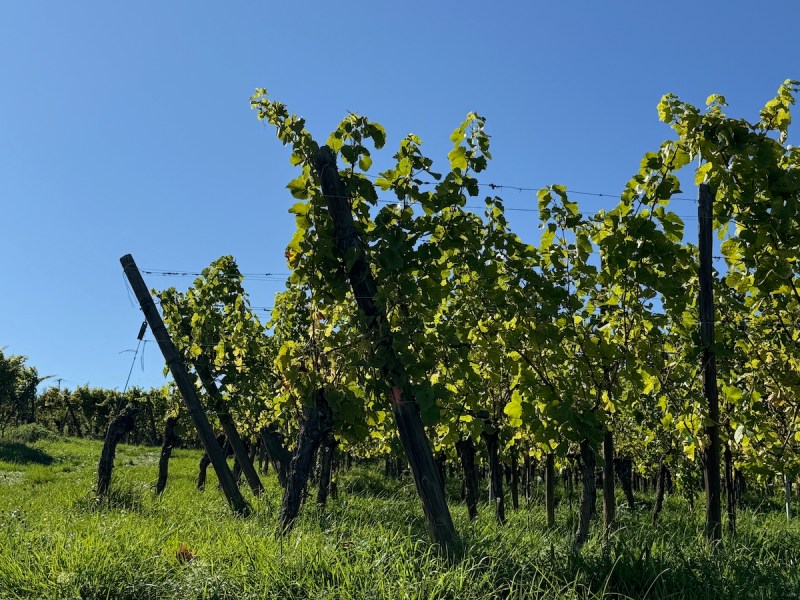
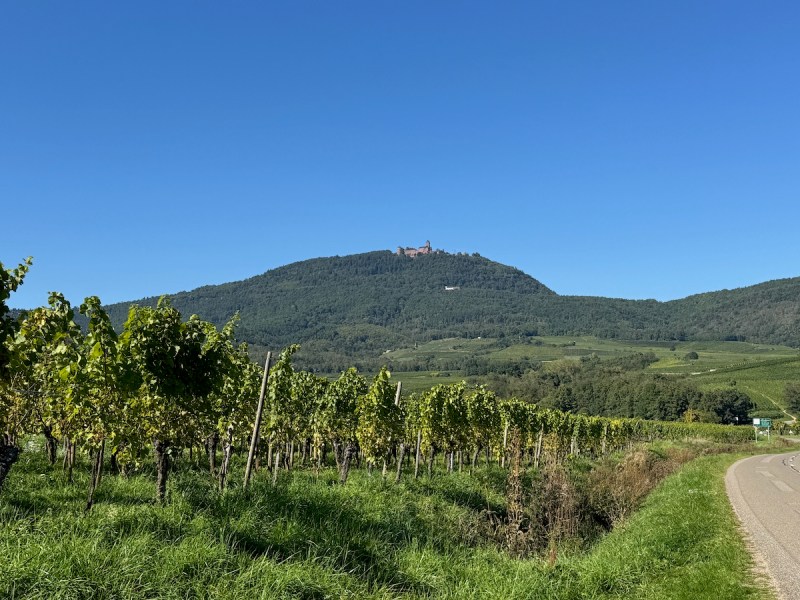
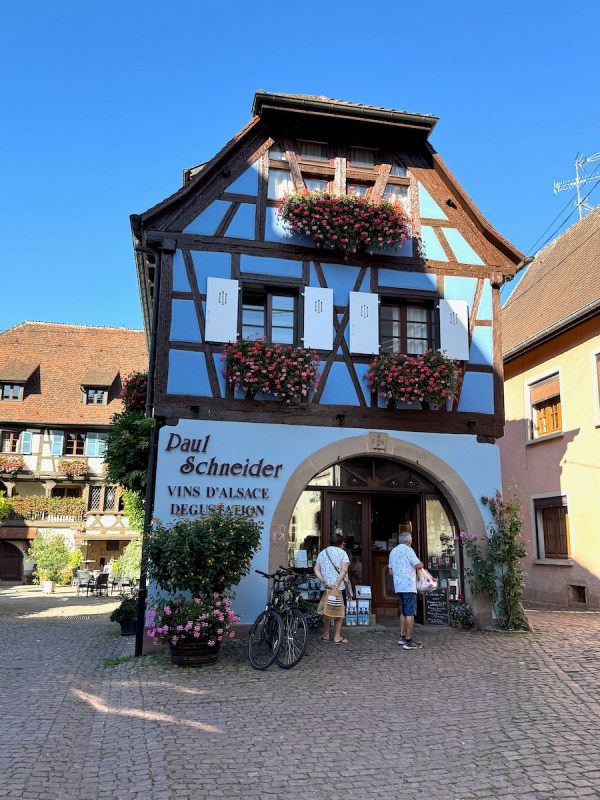
We drove over the hill, and back down into the next valley on our way to Equisheim.
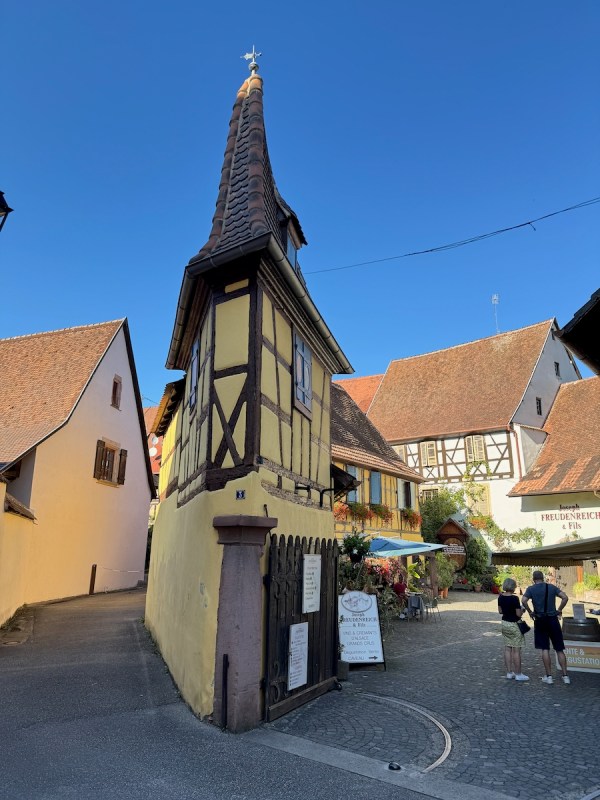
And this is where we’ll leave our adventure, where the light was just right at the end of the day.

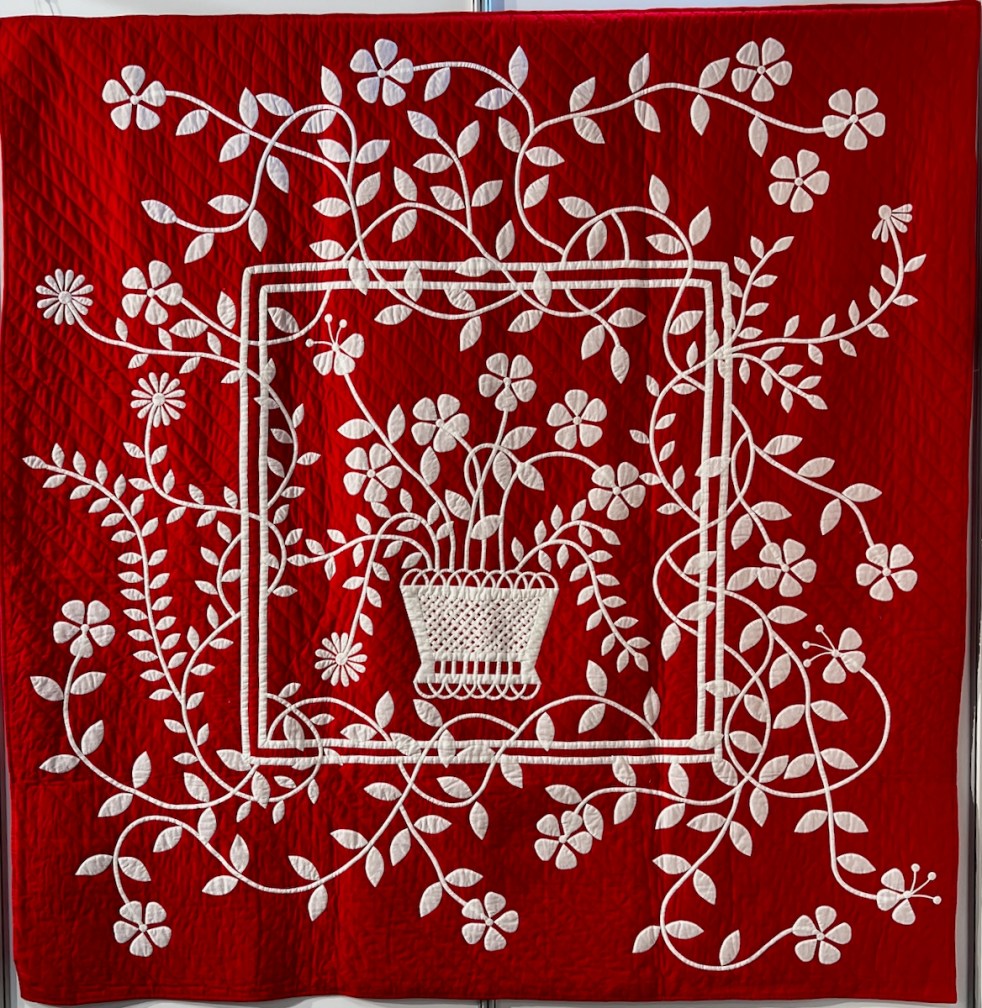
Carrefour Quilt Show · eQuilt Universe · European Patchwork Meeting · Quilt Shows · Quilts

Carrefour V: Tania Tanti, Fiona Lindsay, Janet Bear, He Ok Chang, & Quilts from Kazakhstan

This post about the Carrefour European Patchwork show 2025 covers:

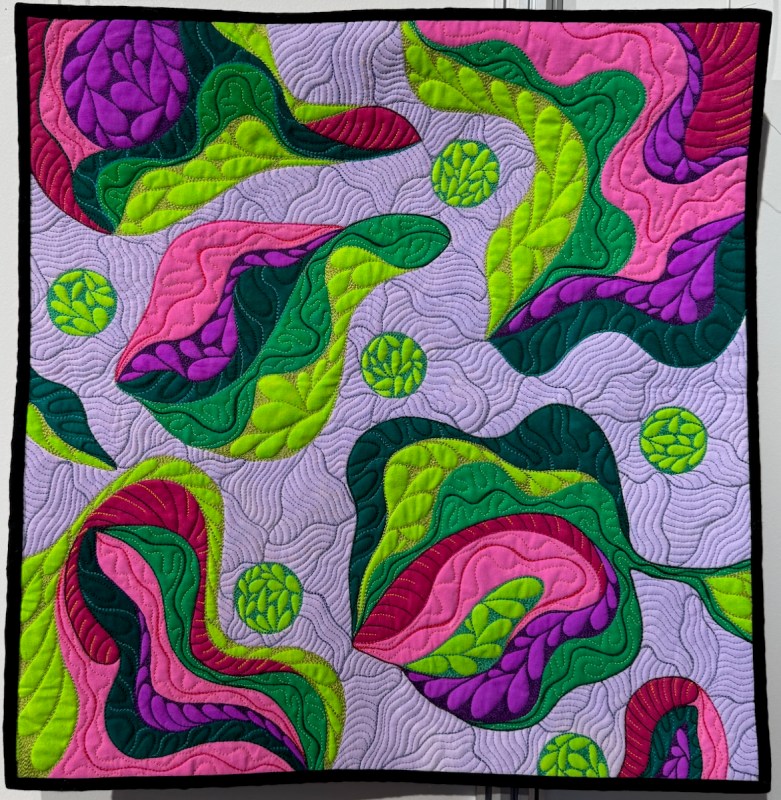
• Venue 10: Chapell St. Blaise, with Tania Tanti
• Venue 11: Église St. Nicolas, with a quick look at embroideries sponsored by Guldusi
• Venue 12: Salle Des Fêtes, with Fiona Lindsay, Jenny Bear, Hae Ok Chang, Patchwork Association of Kazakhstan

I have a main Carrefour Quilt Show page that lists all the posts of all the meetings I’ve gone to, and includes the posts from this year too. If I haven’t mentioned it before, you might enjoy these posts more if seen on a desktop computer or even a tablet. Cell phones re-format the layout and can sometimes do strange things to how it looks on the screen.

If you are interested in going to Carrefour, I wrote two posts for them about our travel, and how we put the trip together. You can find them here and here. Their main website is HERE, where you can subscribe to their newsletter (scroll to the bottom).

–––––––––––––––––––––––

Now that the orientation is complete, the story is that last year my husband and I had a chance to go to the Carrefour European Patchwork Show in the Silver Valley, near Colmar France. That’s called the Val d’Argent, in France in the Alsace region, and yes, there is great food and beautiful countryside. One of the things we like about this show is that is spread out over four small towns in the valley, and they use churches and community centers and municipal buildings, so you really get a feel for being in that area.

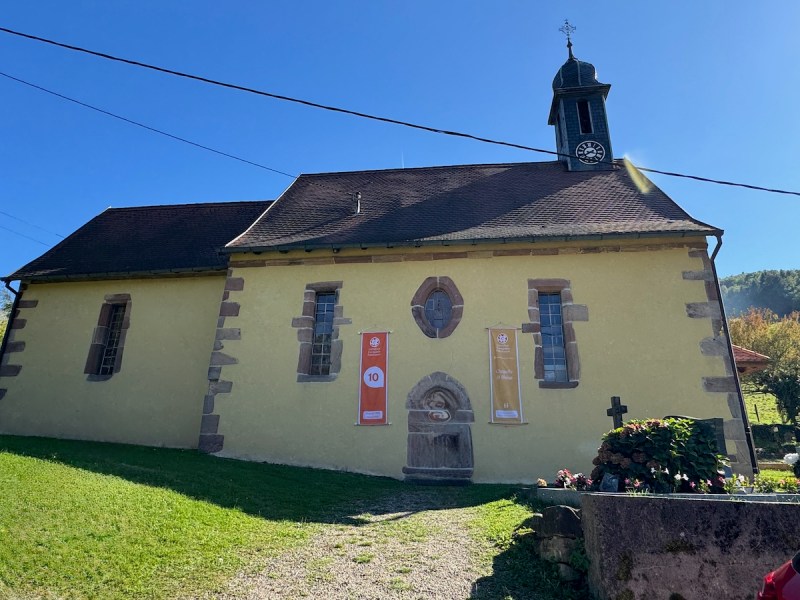
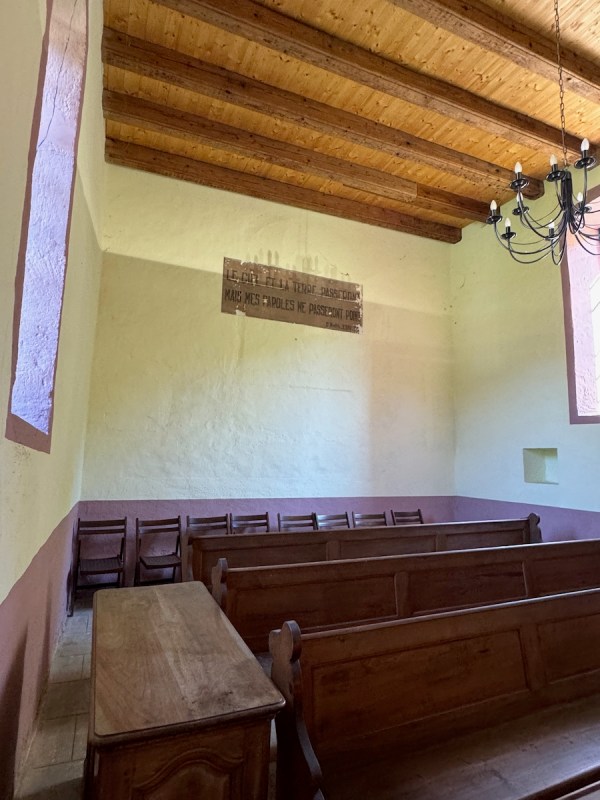
Venue 10: Chapell St. Blaise

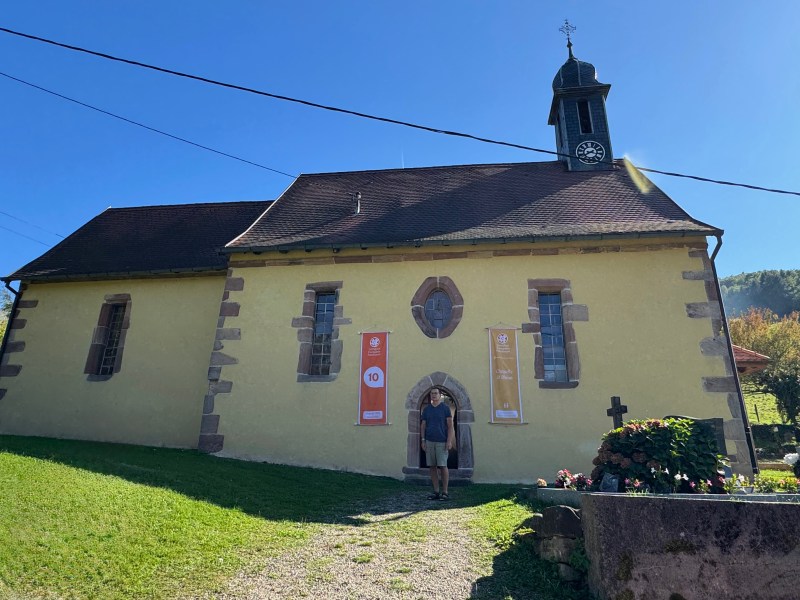
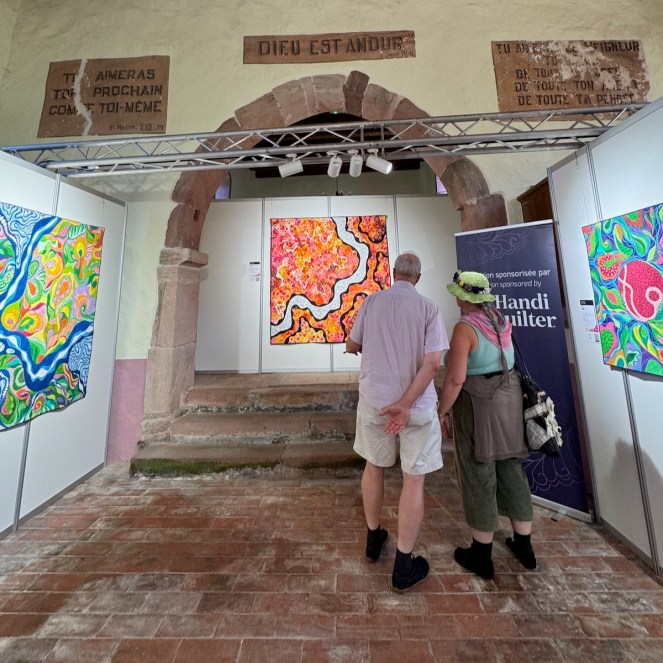
Venue 10 is a small little chapel, the Chapelle St. Blaise, basically a one-room church. I stood there for a long time but that man wouldn’t move from the doorway…so I erased him. (!) Let’s see if this video will embed:

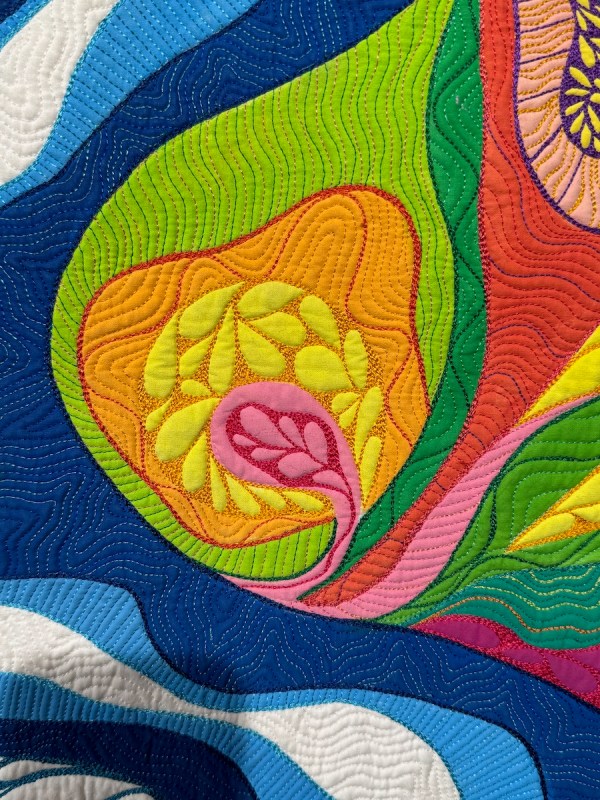
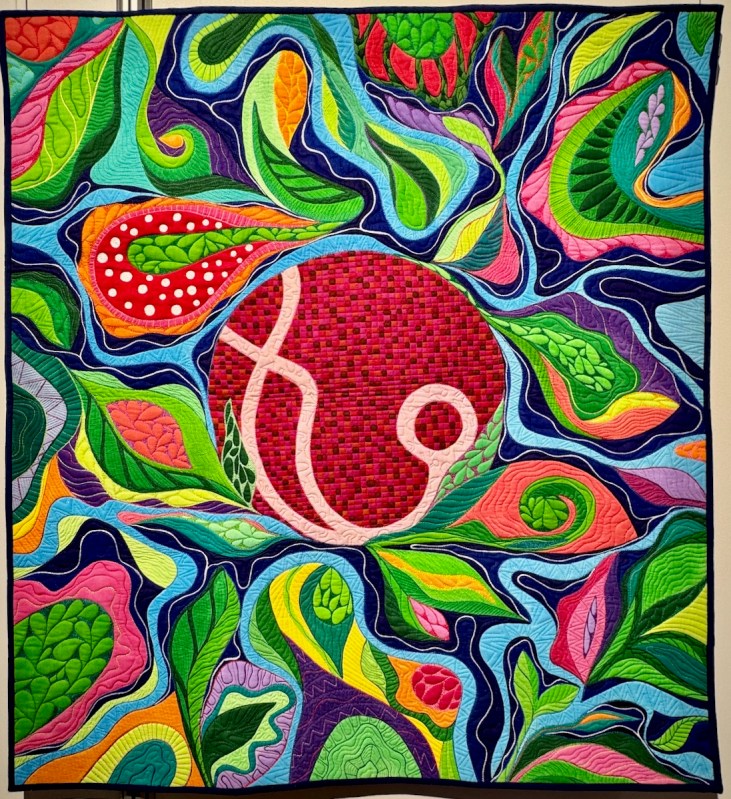
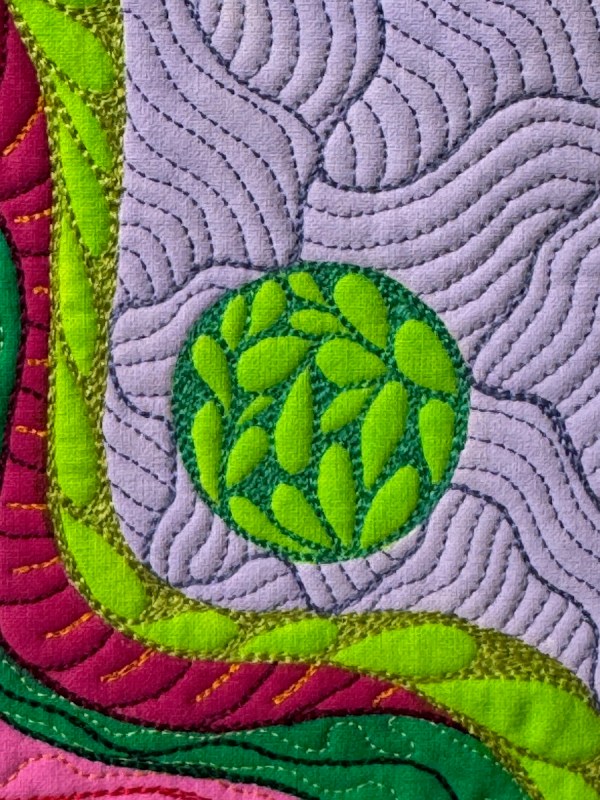
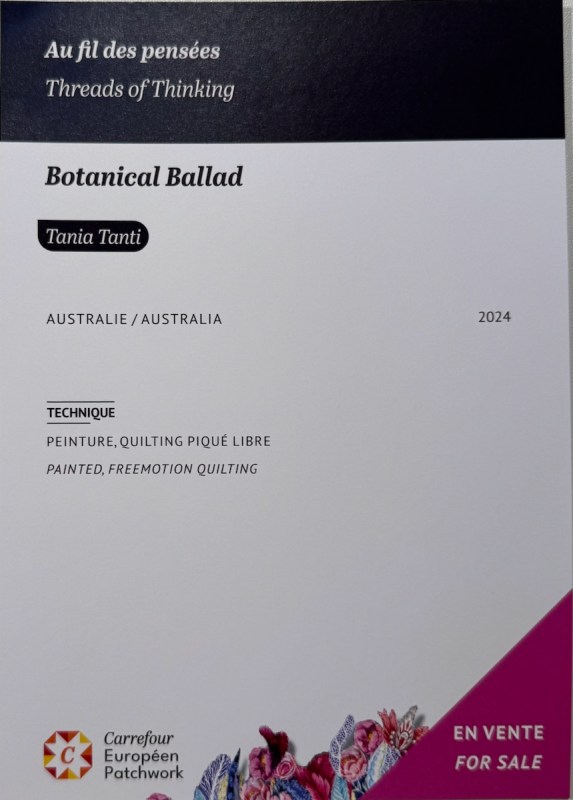
Click on image to start the movie. The voice you hear is the artist, Tania Tanti, talking to some quilters about her technique. Now to see some of her quilts. Many are not pieced, but instead are painted with textile paints then quilted and embellished.

The is quilt that starts the movie, above.

Click on any photo to enlarge. I took detail shots so you could see the amazing amount of work in each of her pieces.

Please click if you want it larger.

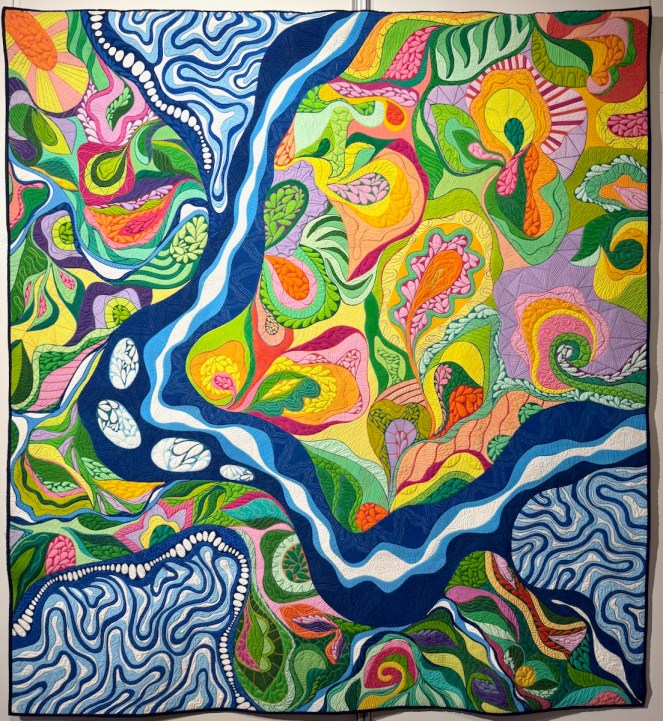
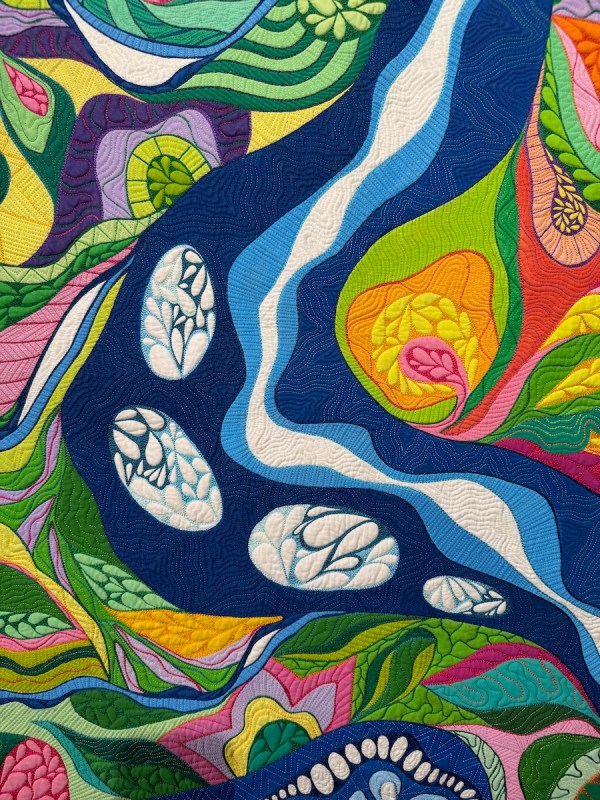
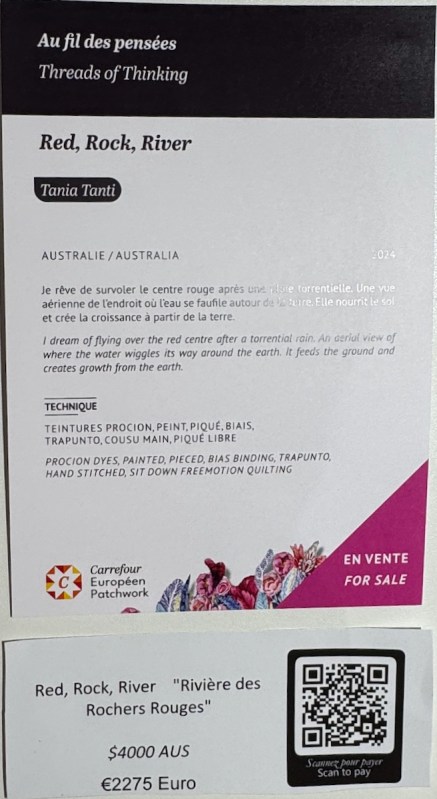
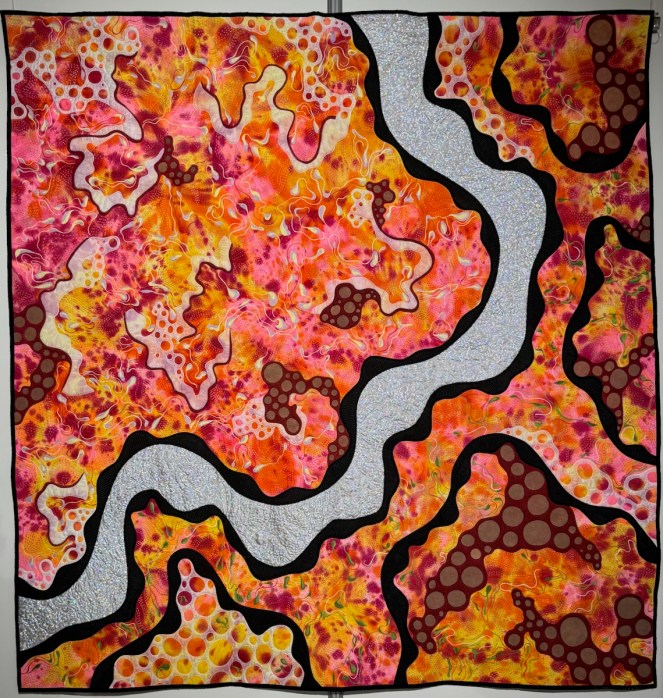
Red, Rock, River by Tania Tanti. She writes: “I dream of flying over the red centre after a torrential rain. An aerial view of where the water wiggles its way around the earth. It feeds the ground and creates growth from the earth.” In her technique section she writes: “Procion dyes, painted, pieced, binding, trapunto, hand-stitched, sit-down free motion quilting.”

She writes: “At then beginning of this year I faced my second battle with breast cancer. As soon as I could I got back into my studio and focused on small achievements each day. This is my Recovery.” And that is the title: Recovery. Technique: Painted, free-motion quilting, hand-quilting.
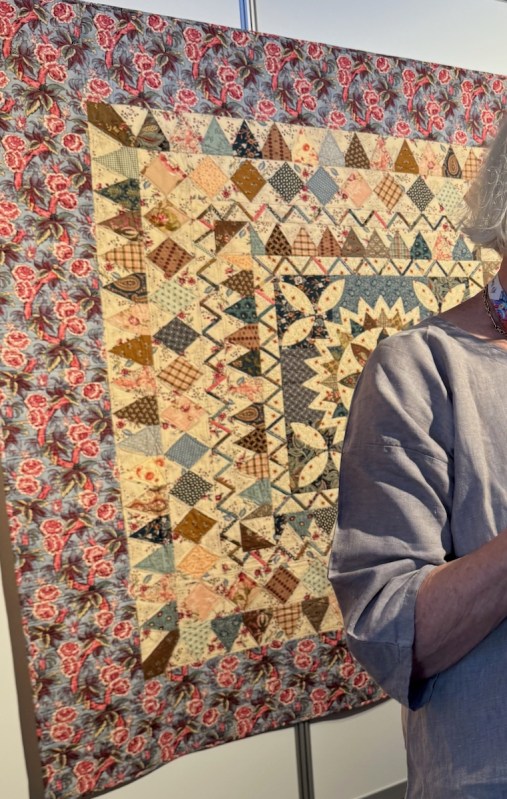
Tania Tanti is on Instagram, if you’d like to keep up with her.

I looked behind the wall to see this spare room in this church.

Look carefully: a spider! (not our car)

Onward, through the valley.

Venue 11: Église St. Nicolas

Hopefully you can hear the bells. Right after this, we went for a take-out lunch from the local market. The choices were rather cleaned out, but we found something. There were a lot of quilters there — so happy to see this!

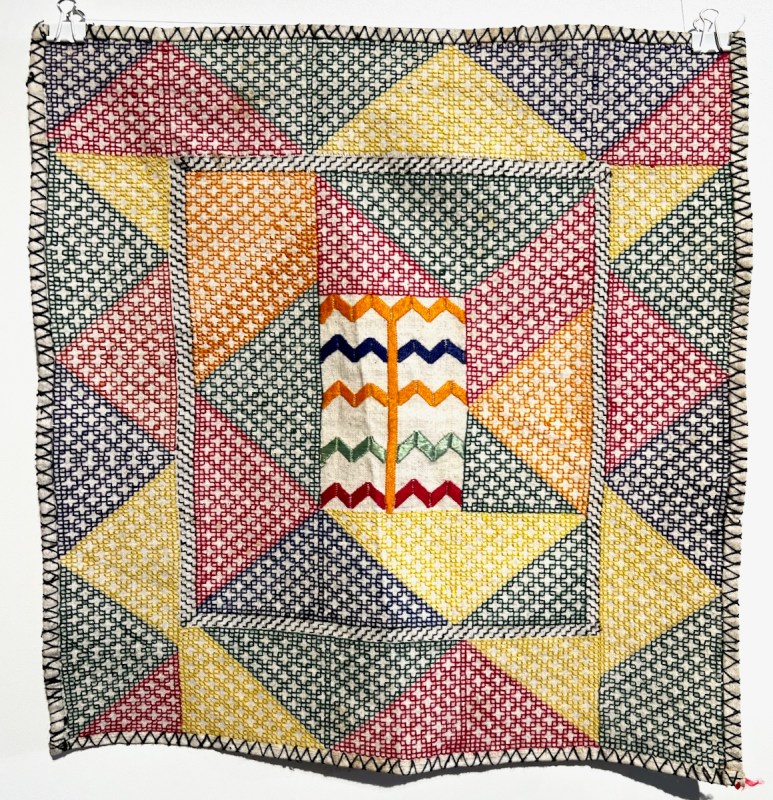
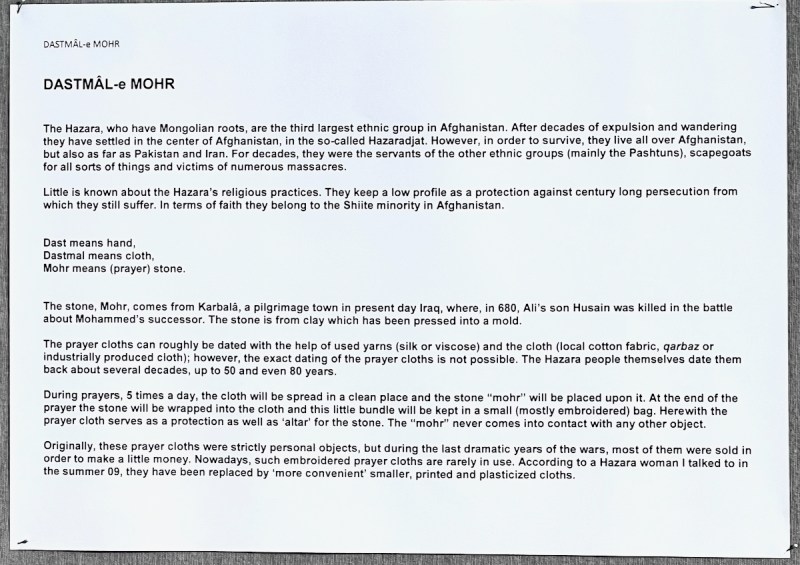
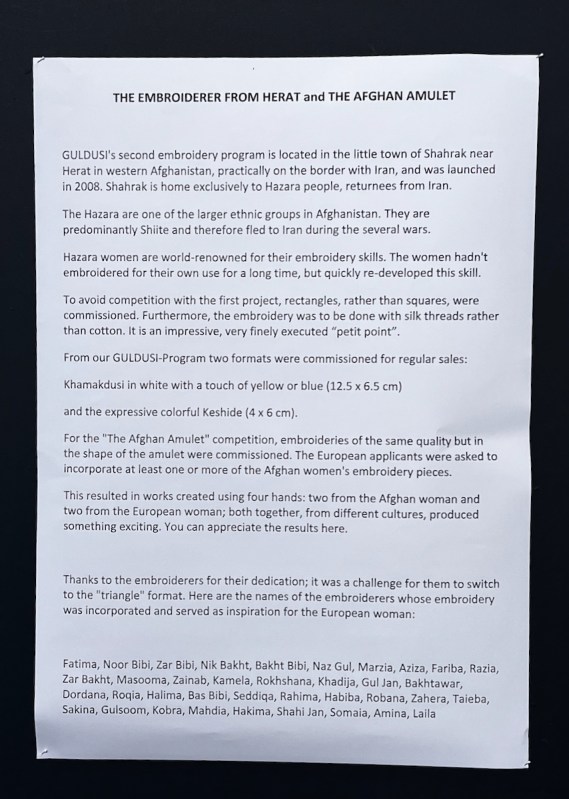
I admire and enjoy the art of these churches. The exhibit here was titled Guldisi, which is a hand embroidery program launched in 2004 (quoting from the catalogue), which “now enables 200 women in Afghanistan to support their families….Each piece will include at least one silk embroidery in the shape of a triangle, created by the Afghan Woman.

Ingrid Meier, from Germany. Title: Aller guten dinge sind drei, or All Good Things Come in Threes.

There were also many embroideries, which I found fascinating, and which included some blackwork/redwork.

These two signs were somewhere on the wall; click to read.

Venue 12: Salle Des Fêtes

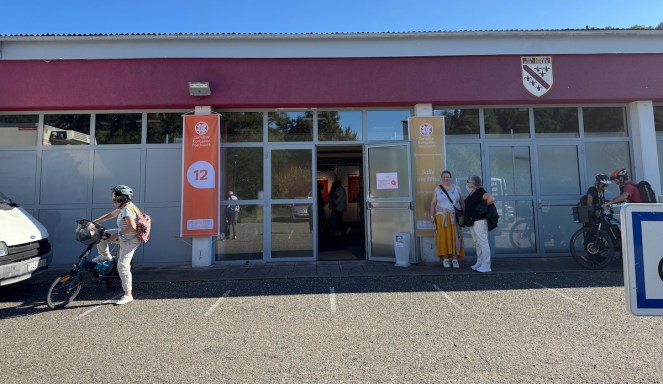
We drive to the Salle des Fétes, or the Party Room…and they are having quite the party!

A gathering.

A glimpse of a quilt.

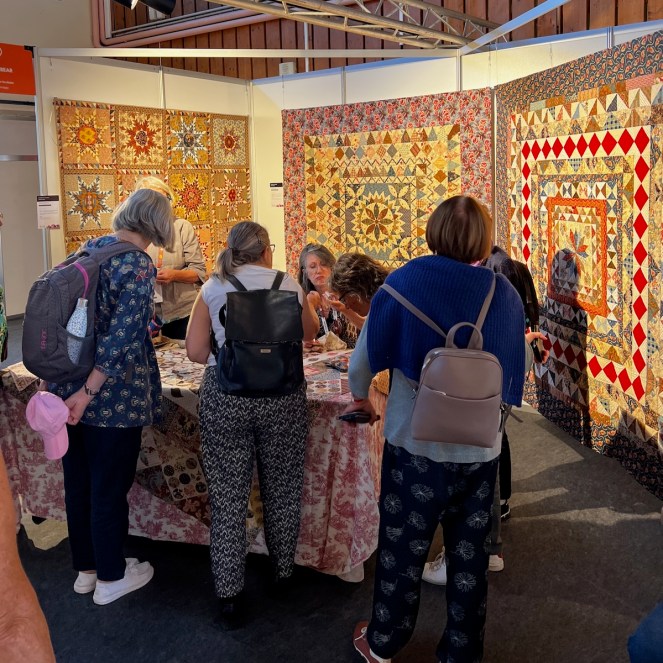
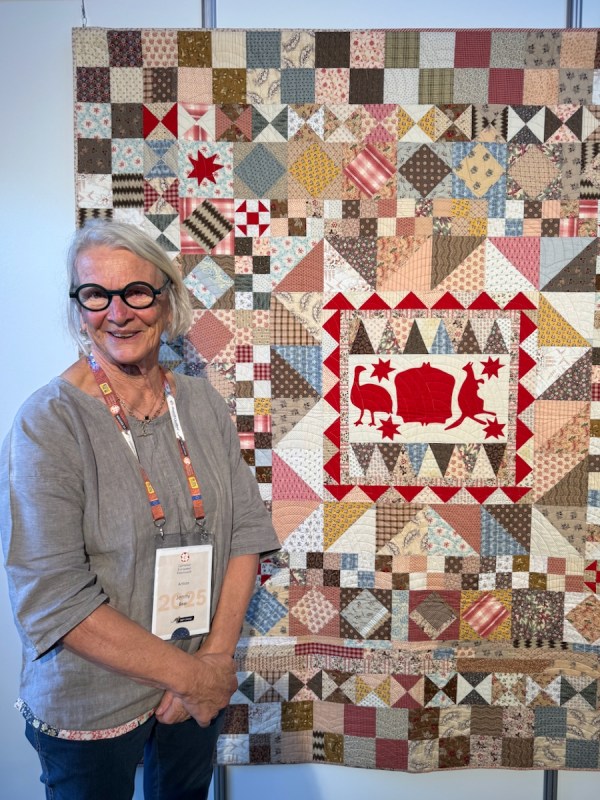
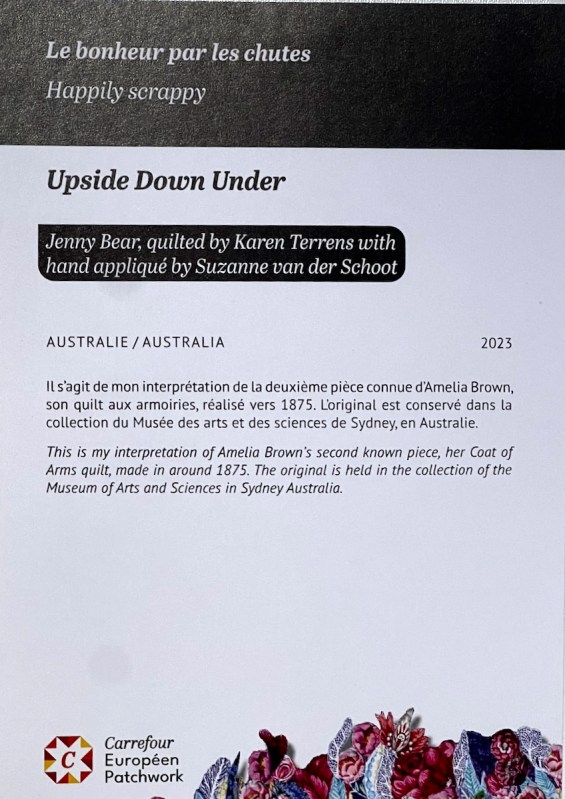
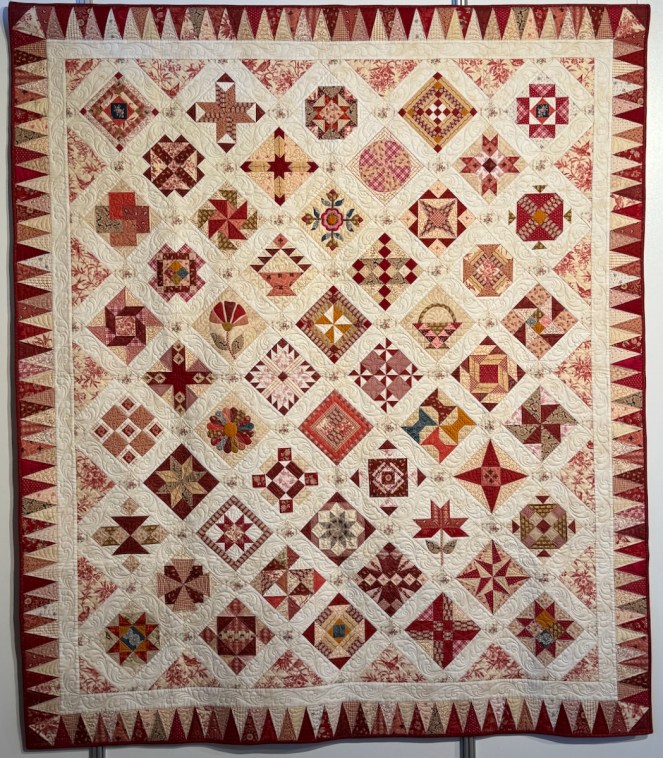
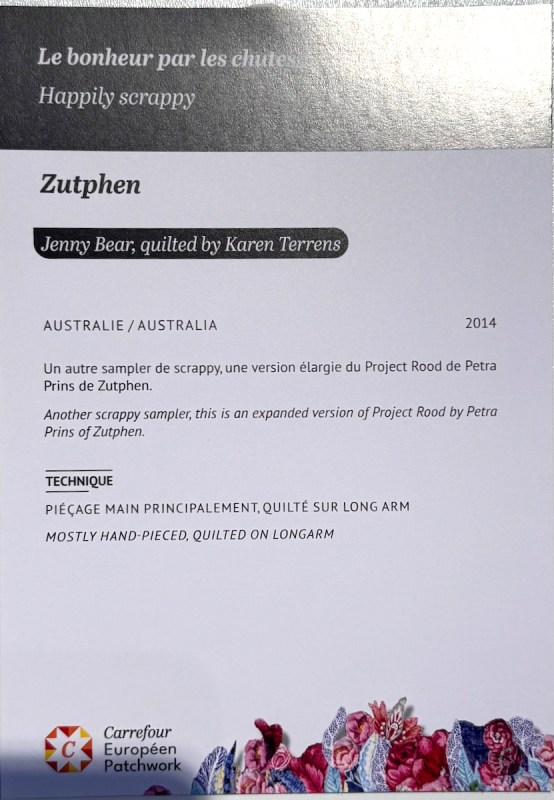
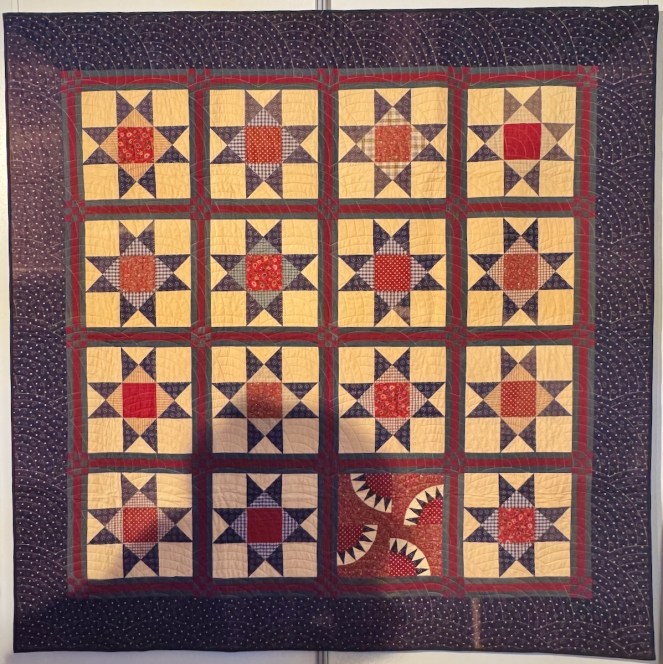
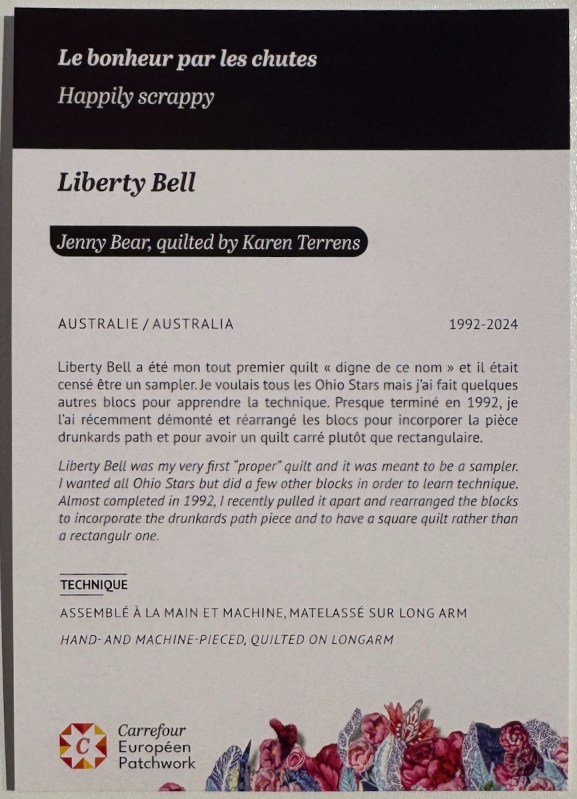
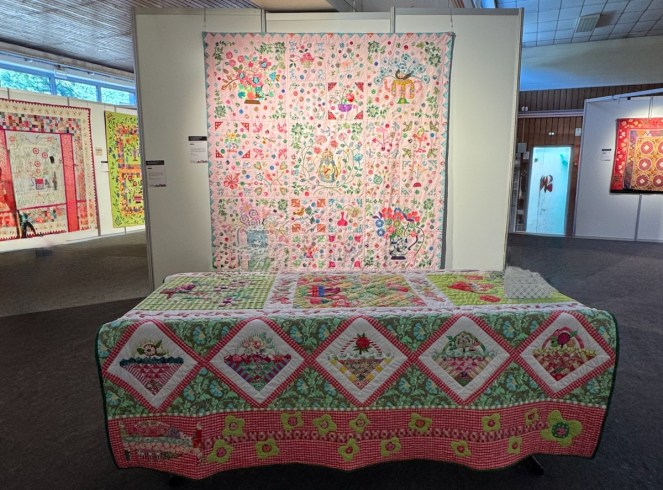
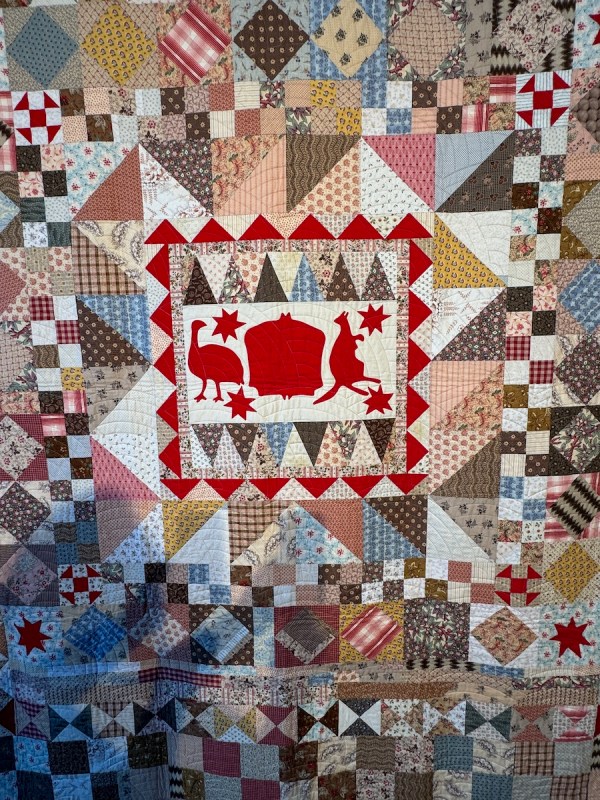
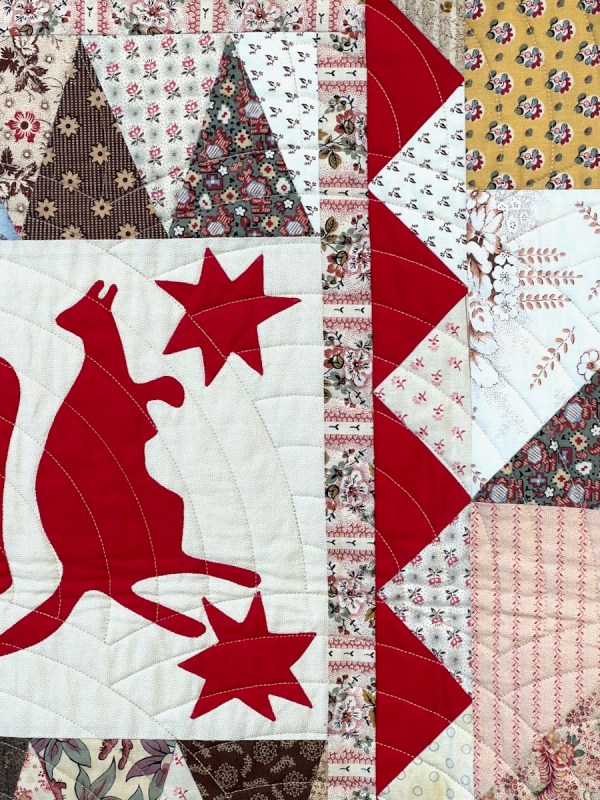
And we meet Jenny Bear! She is a renowned quilter from Australia, known for her scrappy quilts, but exquisitely put together. The catalogue called her “Happily Scrappy” and said that “Jenny’s quilts are a celebration of social history, fabric, color, frugality, and the art of making do. She loves using her stash of antique, vintage and reproduction fabrics as well as rescuing old, unquiltable or broken tops, fragments, orphan blocks and tiny scraps to make something beautiful from them. Her favorite quilts are simple, utilitarian and achievable by anyone who loves to sew.”

She “has been making quilts for more than 40 years….and after her exhibition here, she hopes that her quilt making will return to hobby level and that there may again be time for housework and gardening” (from catalogue).

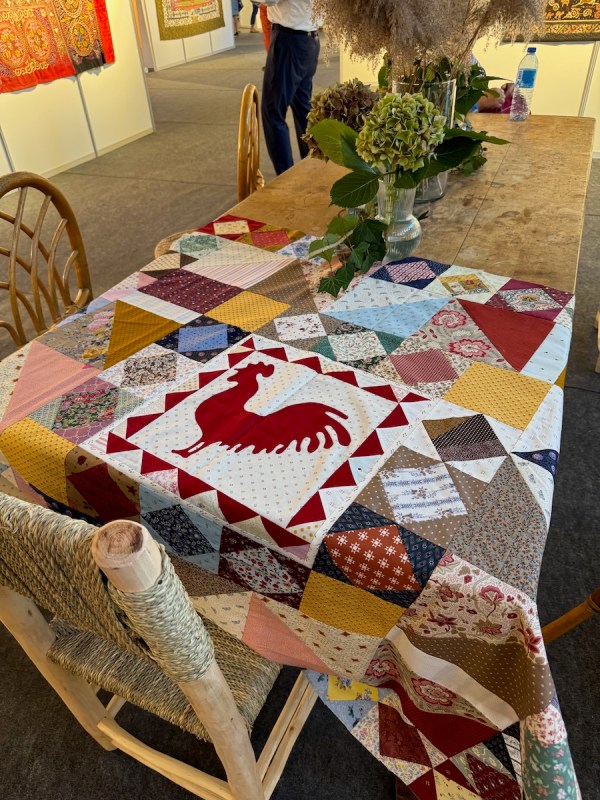
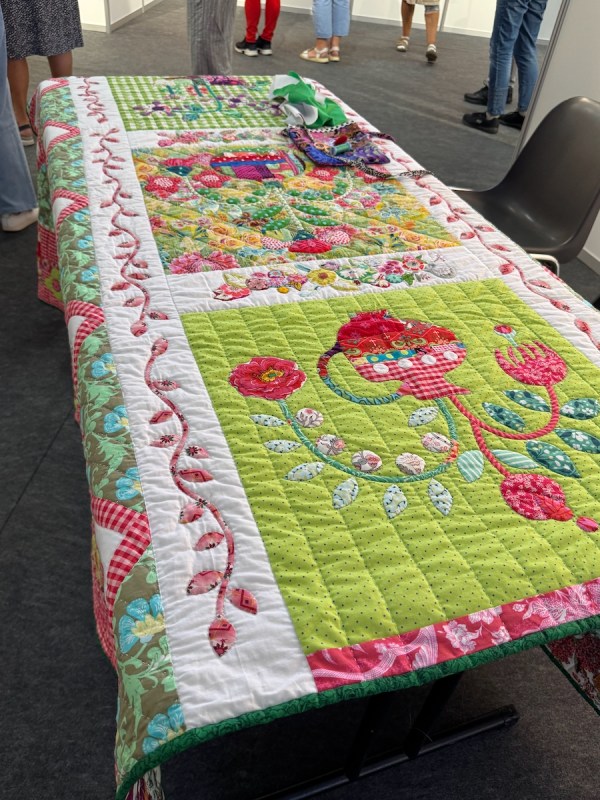
Everyone was busy, but I loved that quilt on the table.

And on another table, it looked like she was creating something new:

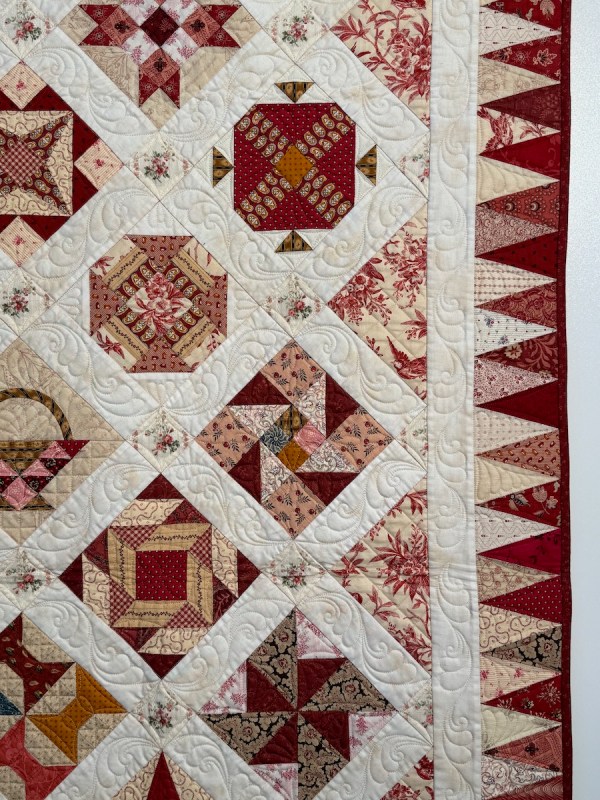
Such a rich tapestry of fabrics and piecing…it just glows.

This was a favorite, but I do love stars.

Simple, yet so powerful in its design.

My orphan quilts never look like this.
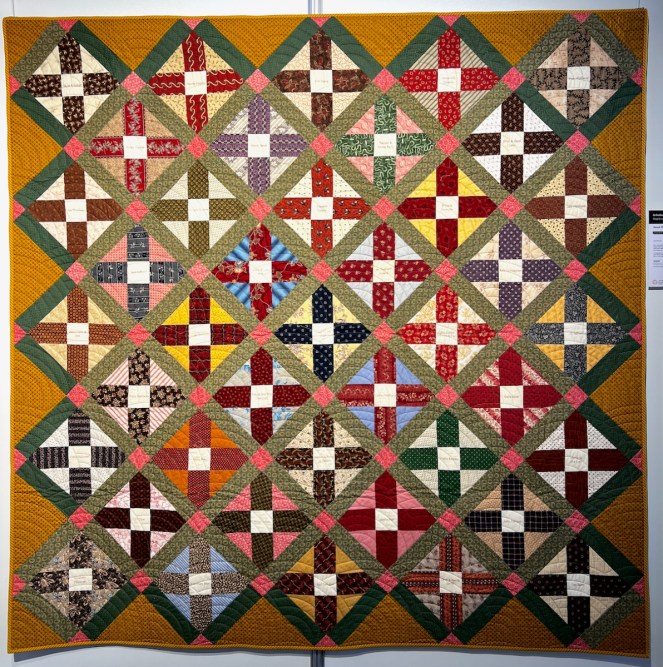
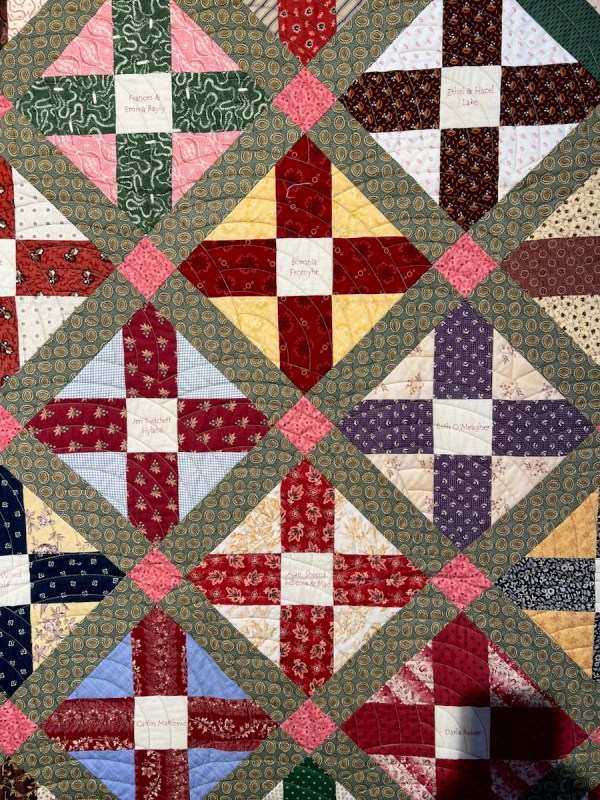
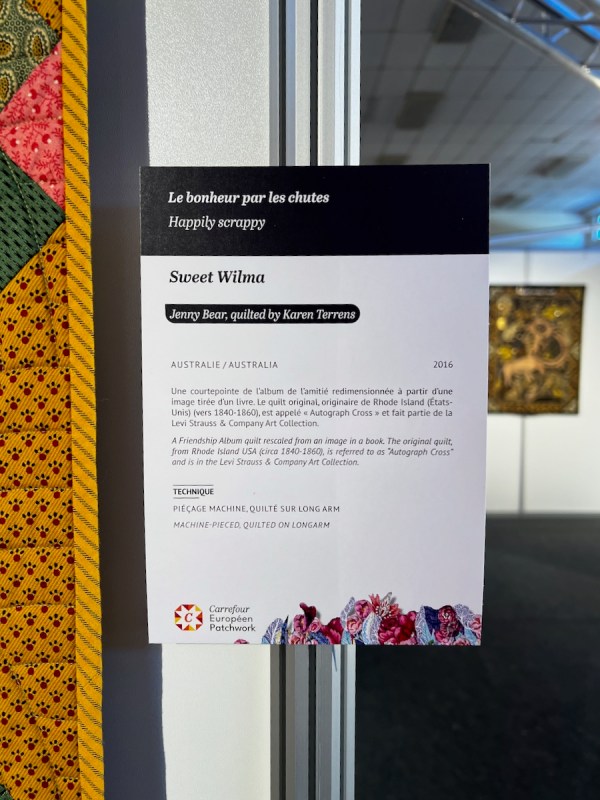
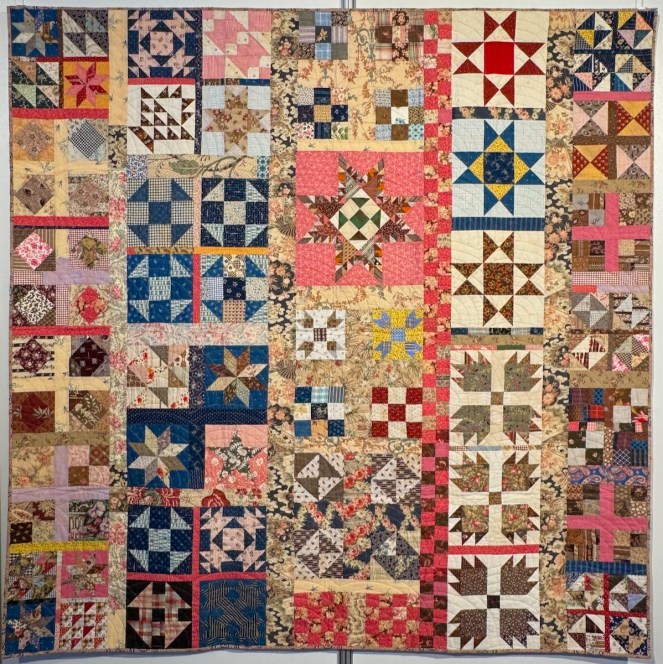
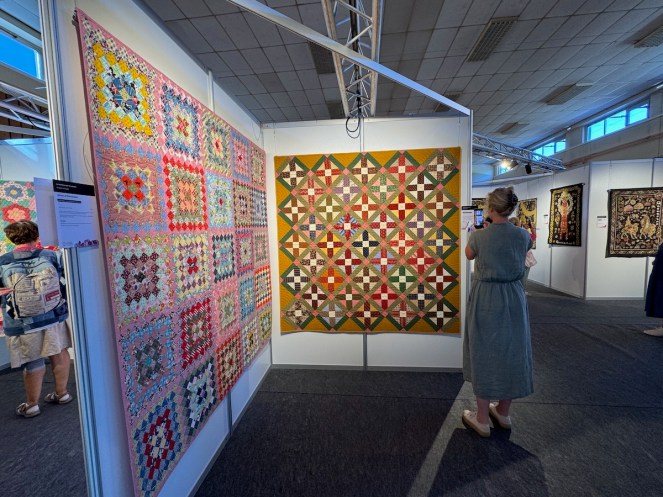
This is Sweet Georgia Brown, from 2023. She writes: “Using antique fabrics dating from around 1840 to 1910, this hotchpotch of oddment blocks was inspired by an early twentieth century piece featured in “Unconventional and Unexpected” by Roderick Kiracofe, a book that has inspired many a quilt of mine. Many of the blocks were gifts from friends or purchased from Jane Lury and David Hubert. It is indeed happily scrappy.”

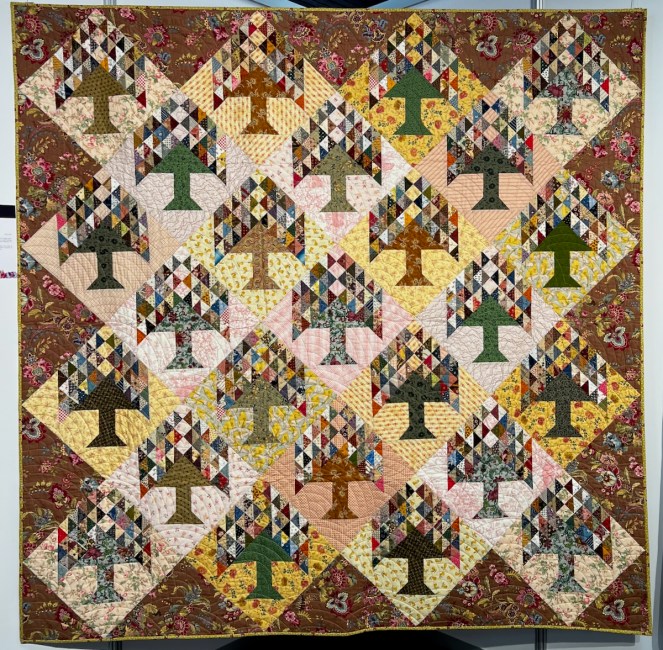
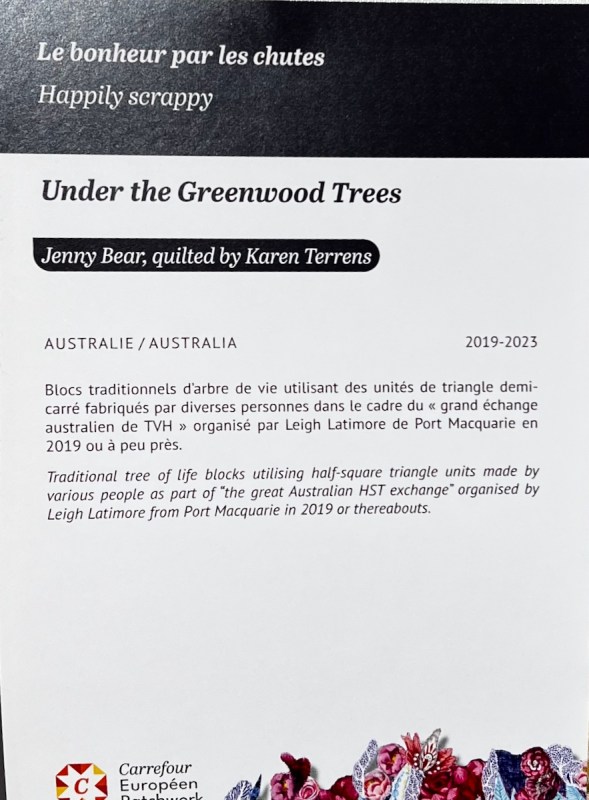
A giant block-swap brought Under the Greenwood Trees to life.

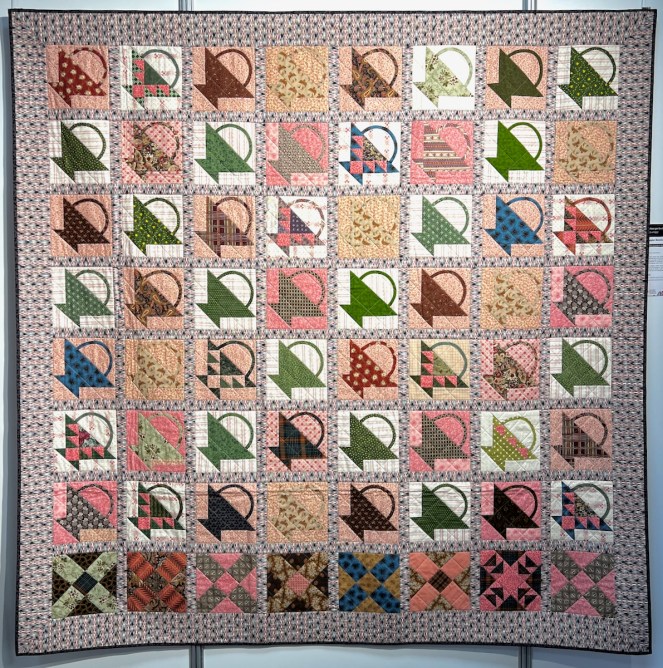
Last one of Jenny’s is Scrappier Bennington Baskets. It is made by Jenny Bear, and quilted by Karen Terrens. The title card says: “This is a scrappier version of Linda Collins’ “Bennington Baskets” featured in her book with Quiltmania “Treasures from the Barn.” The basket block is traditional but the setting is quite quirky, especially with the row of oddment blocks at the top in the original, but at the bottom in my version.” Mixing blocks is a great idea, one to try for sure.

She’s on Instagram if you want to see more.

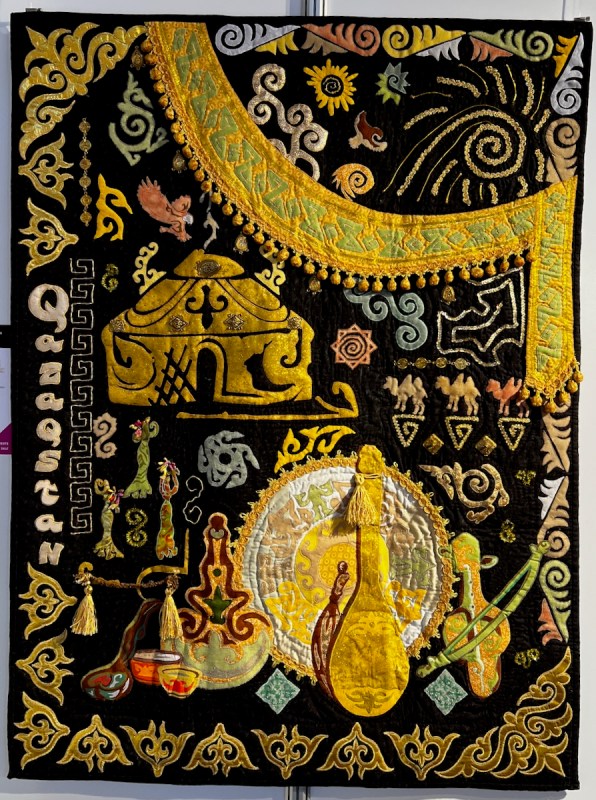
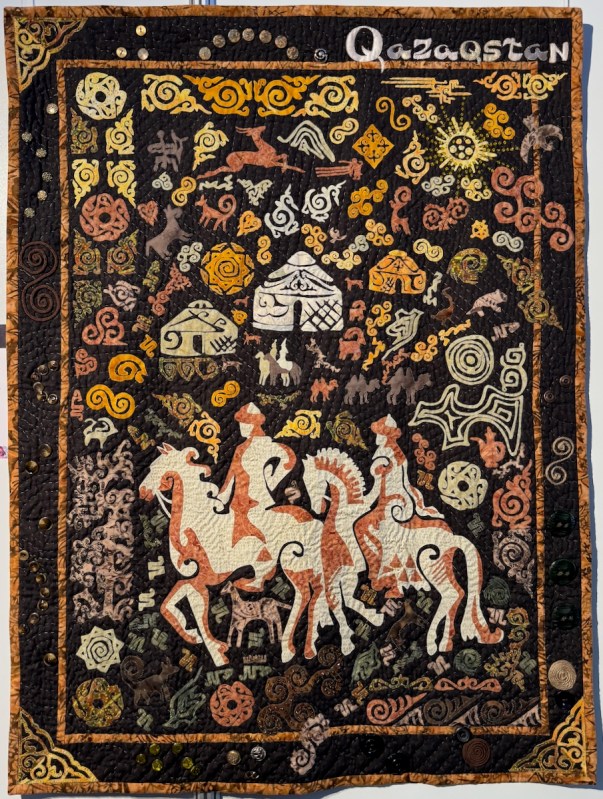
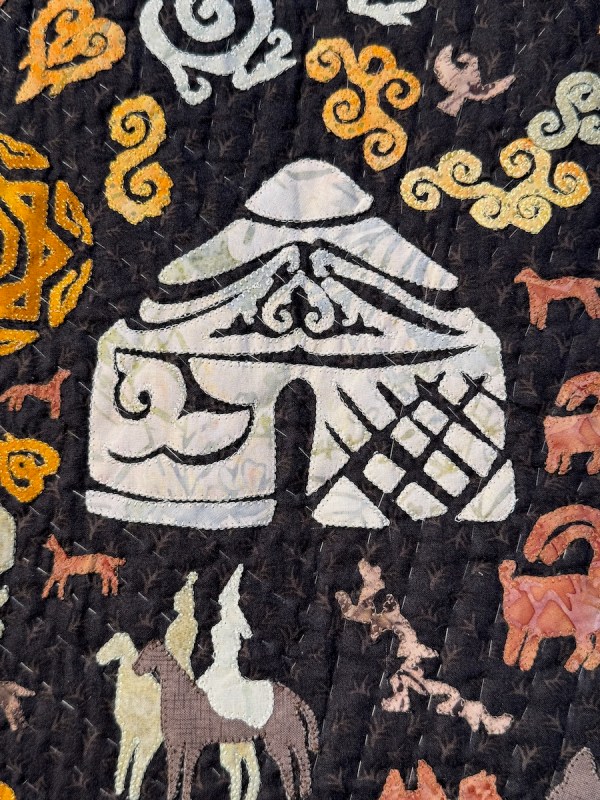
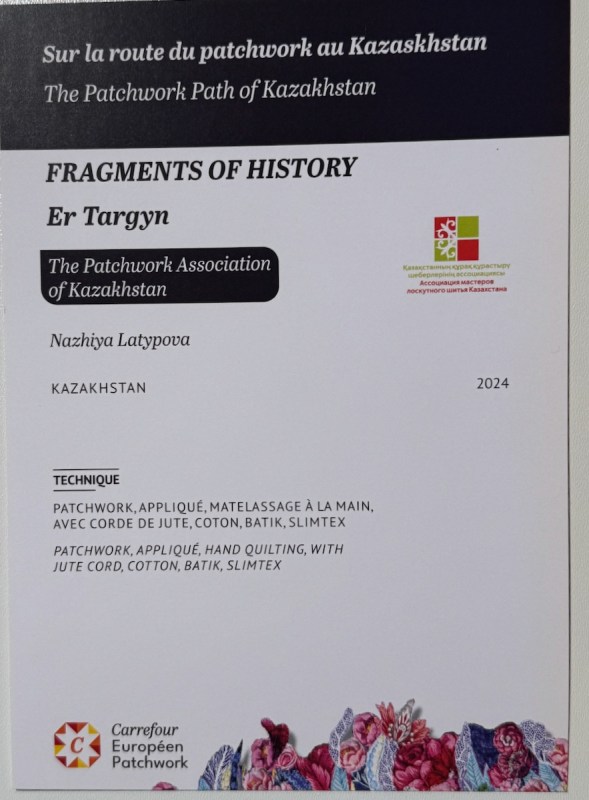
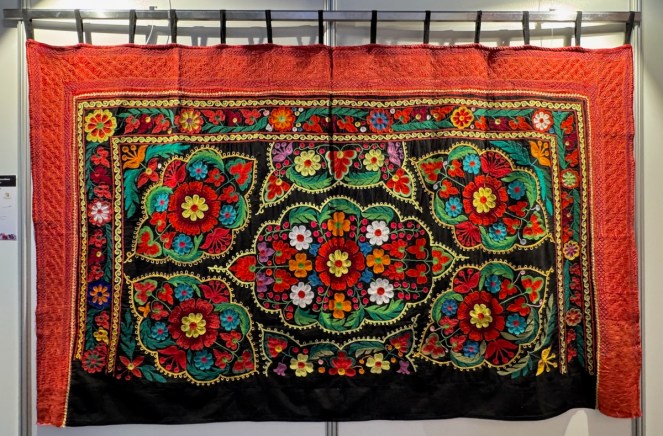
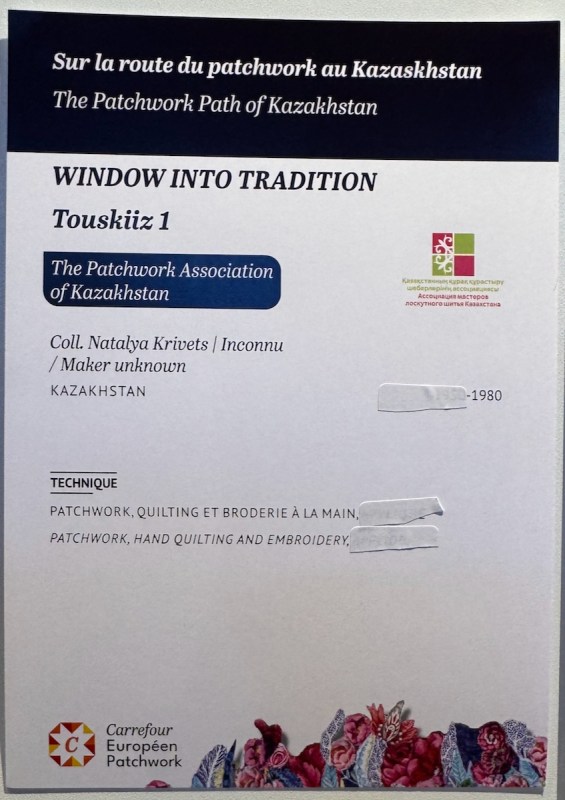
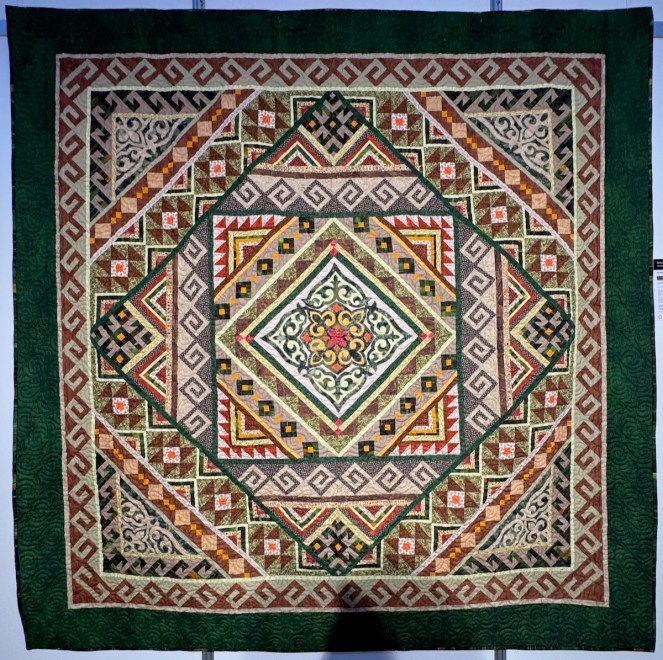
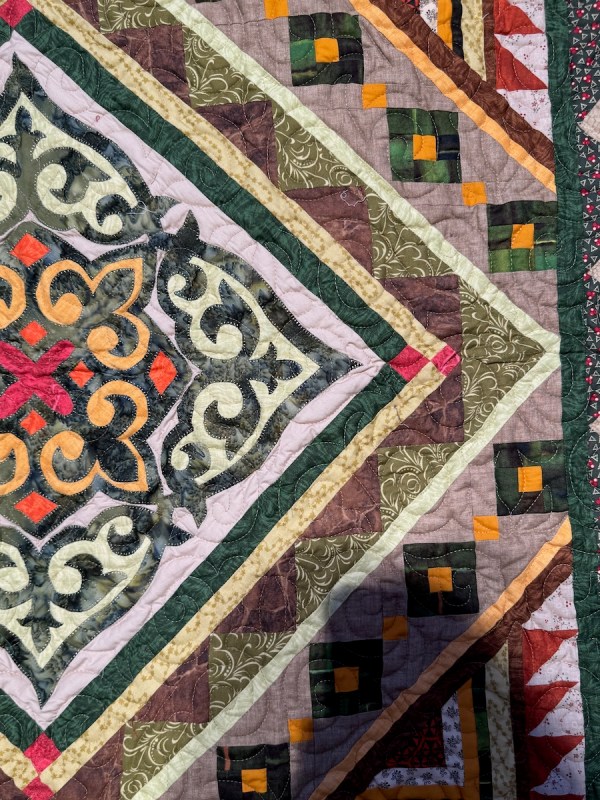
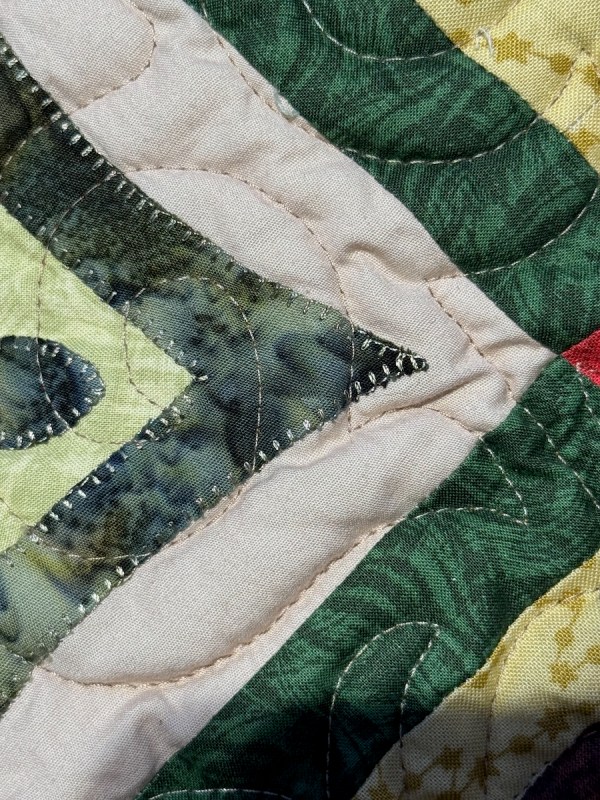
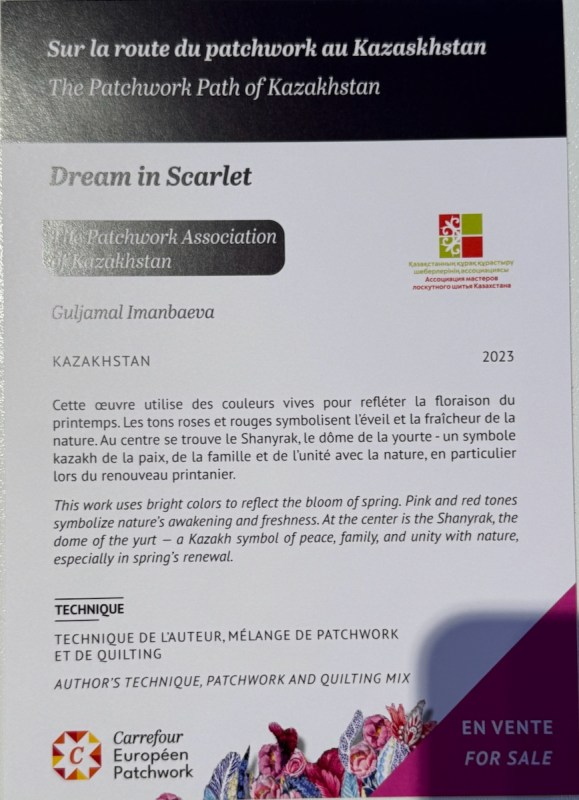
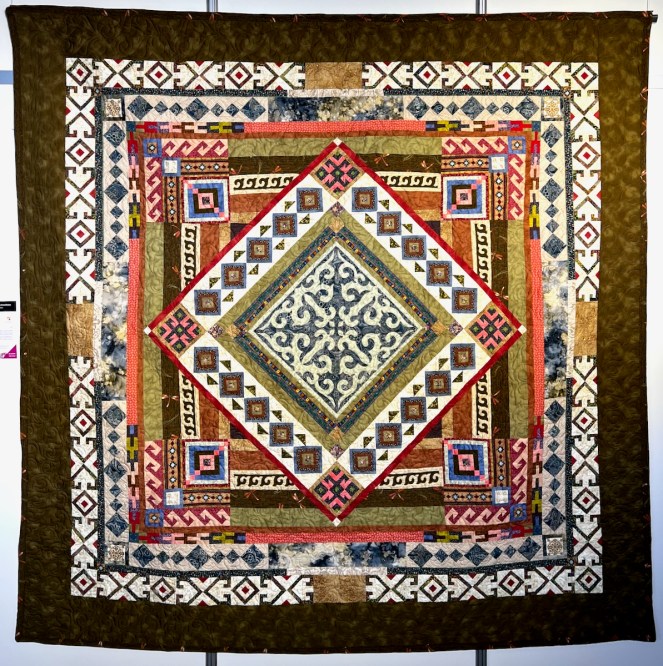
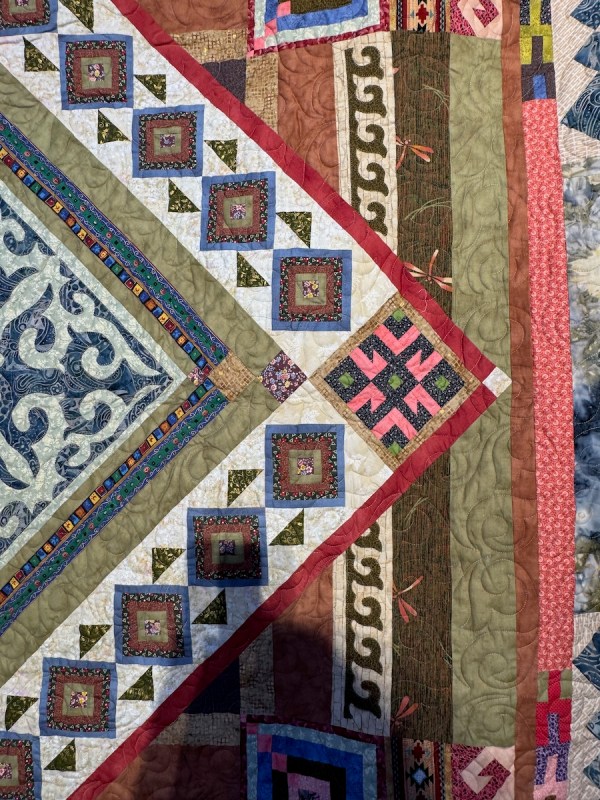
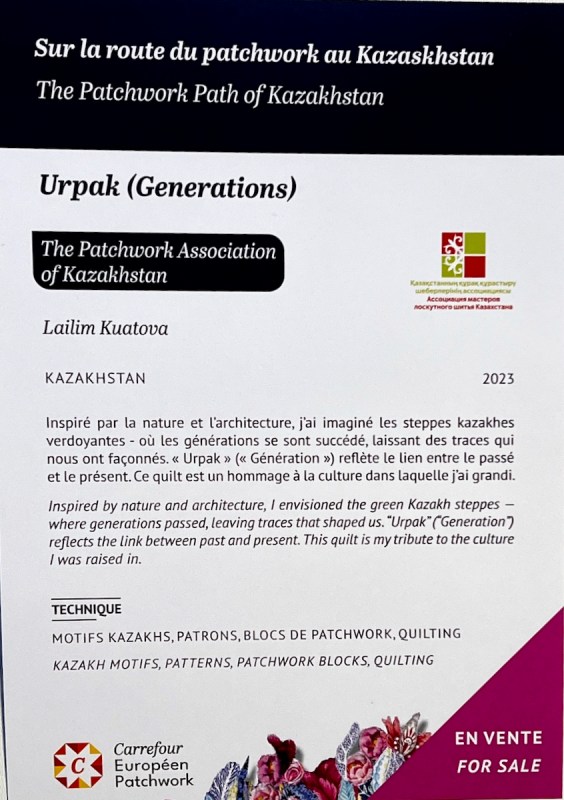
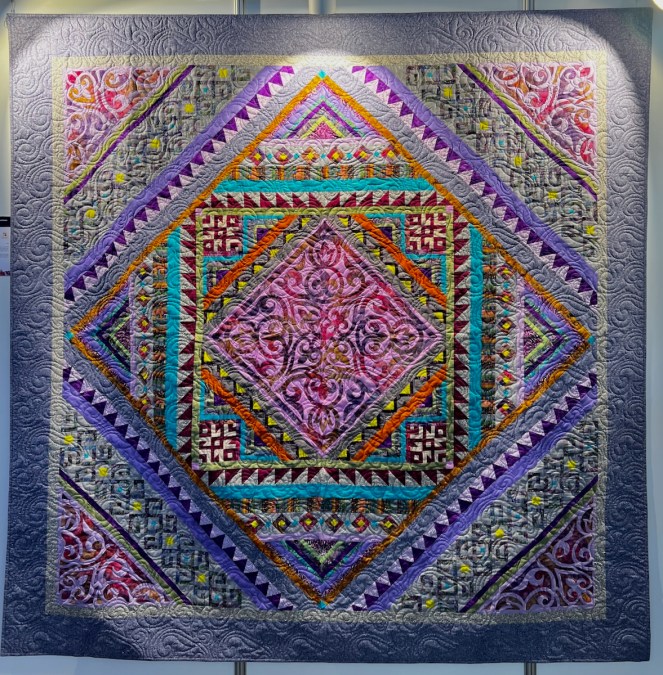
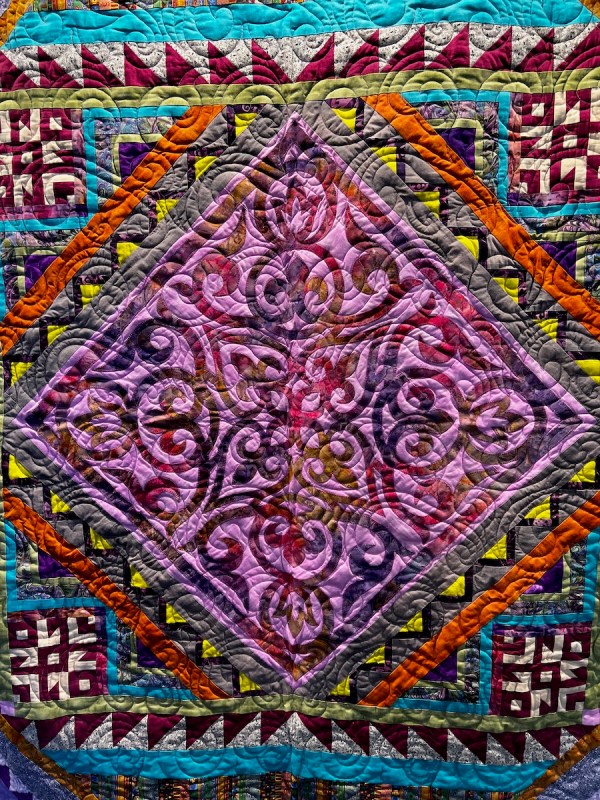
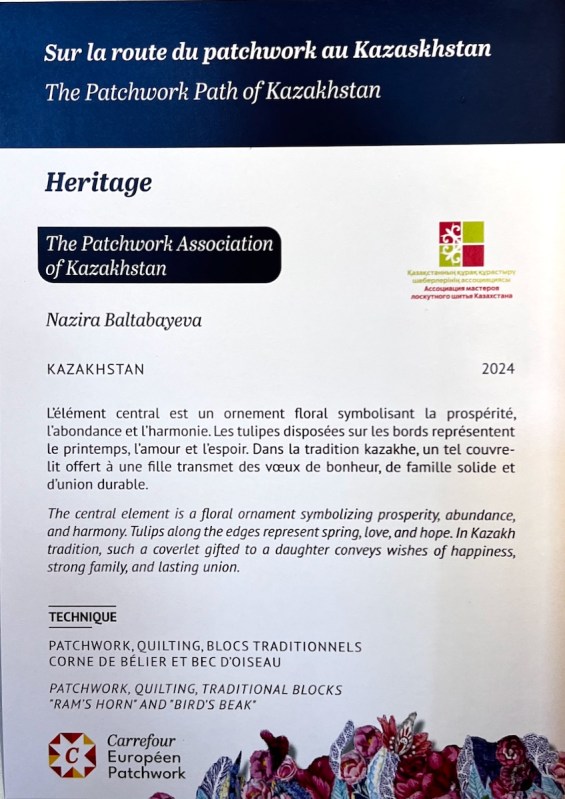
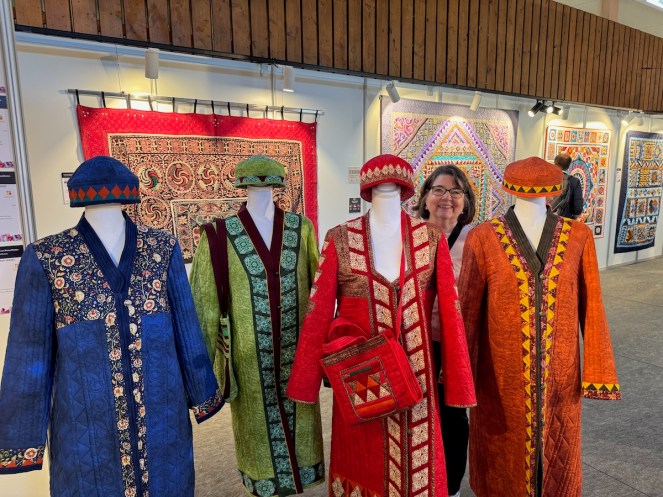
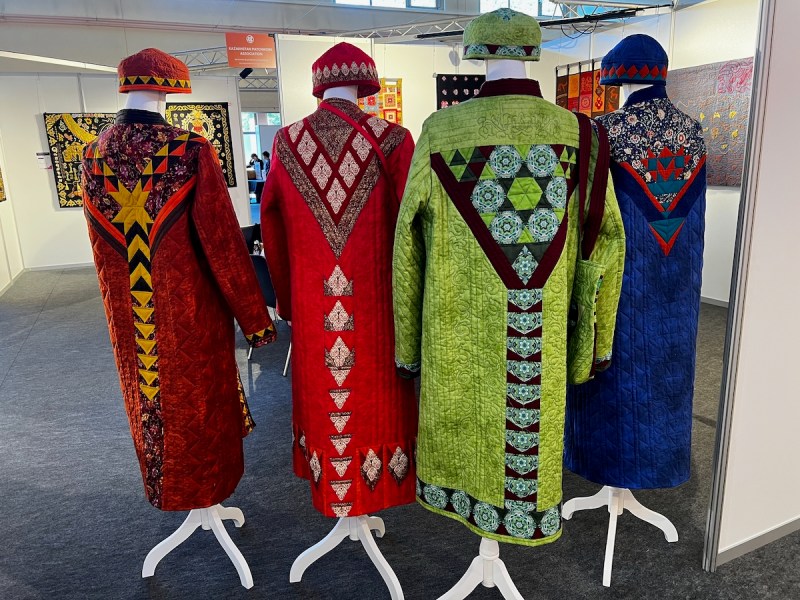
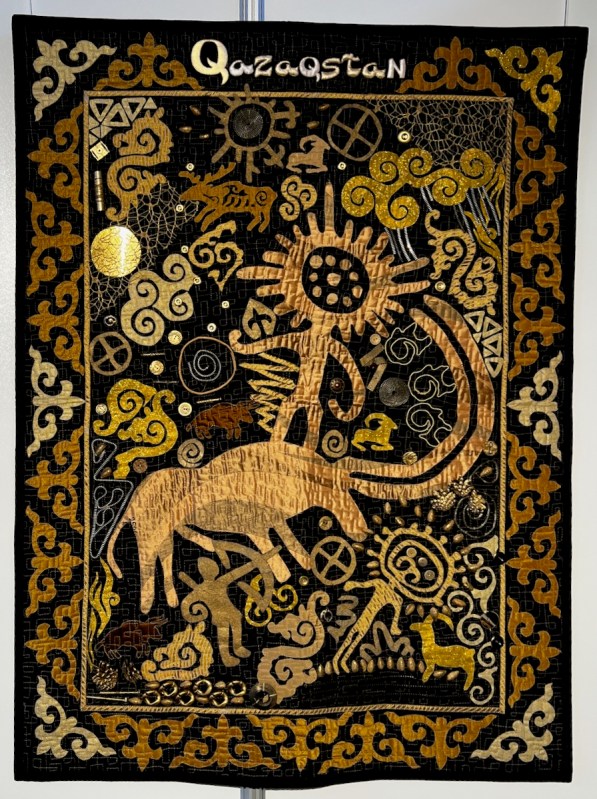
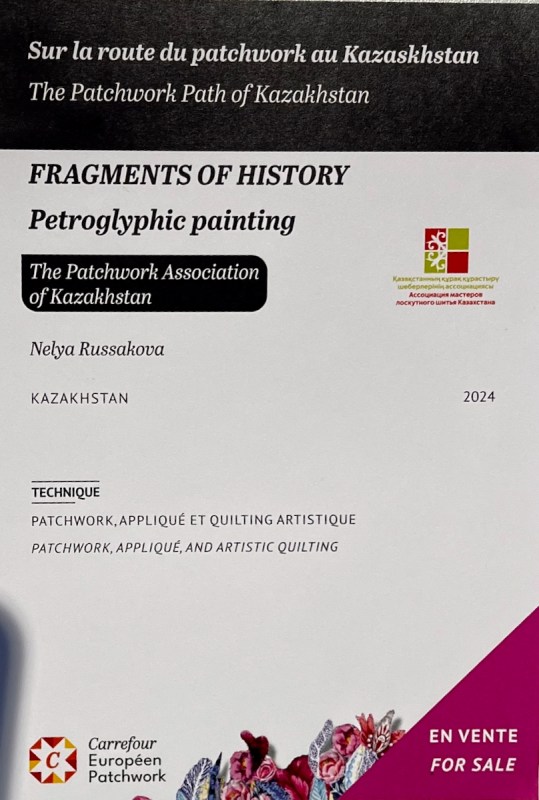
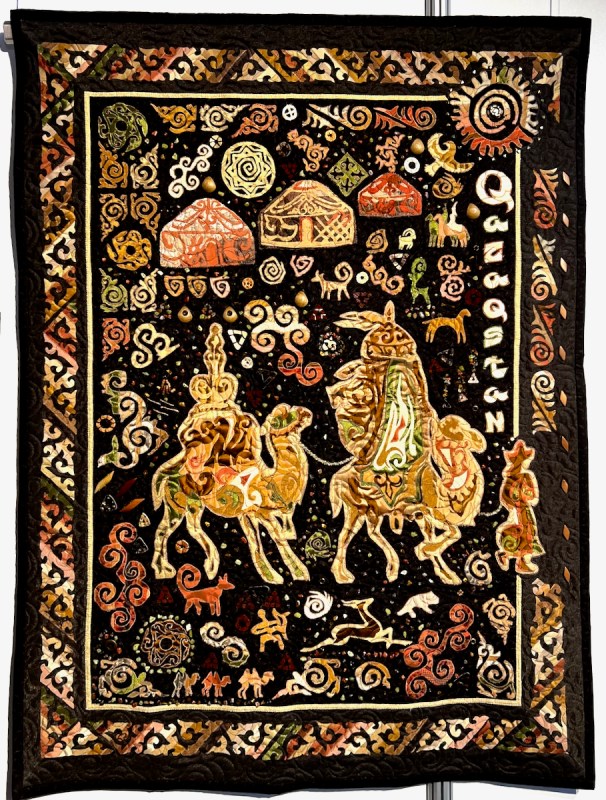
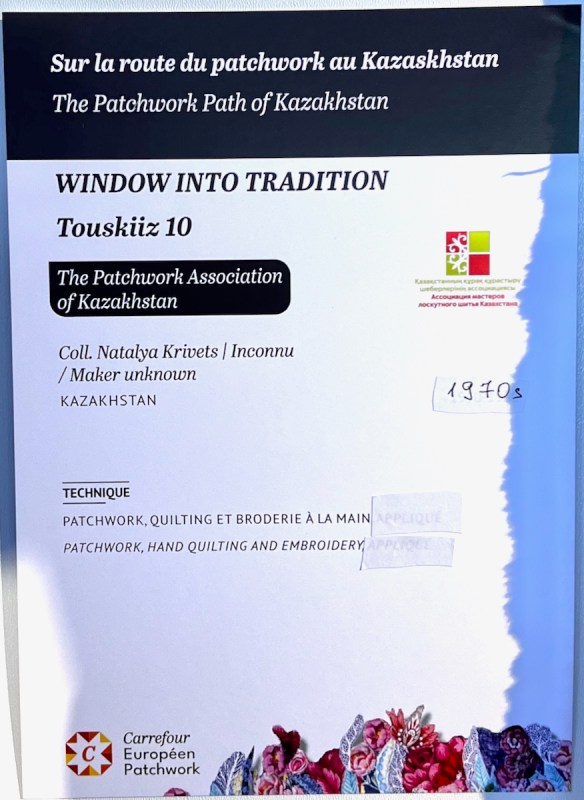
Right next to Jenny’s was the Kazakhstan quilts, a collection brought to Carrefour by the Kazakhstan Patchwork Association. This was founded in 2013, and has over 180 members “dedicated to promoting and developing ethnic-style patchwork (Kurak) and art quilts. The organize workshops, competitions, and the annual Orient Bazaar Festival.” The catalogue goes on to say that “this exhibition merges historical tradition with modern outlook in Kazakh quilting. At its heart is Tuskiiz-traditional wall coverings reflecting Kazakh nomadic culture.”

How many of us have made house-block quilts? Here’s one, using their traditional home, a yurt. A house quilt, but from a different land.

A quilt we are familiar with, but the motifs are all germane to their culture and country.

Click to enlarge.

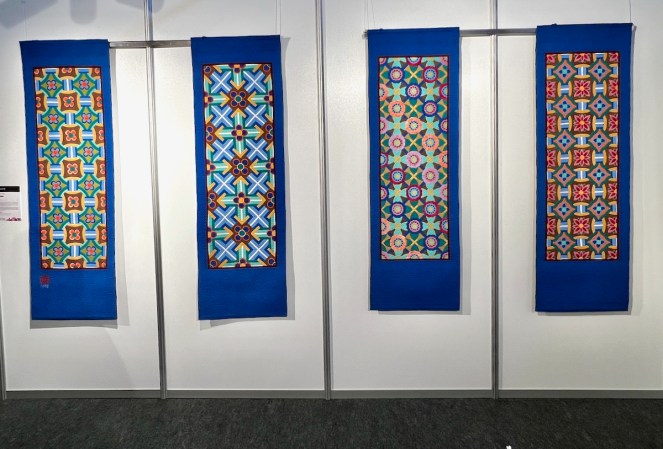
Natalya Mametniquazova Tamara Stroscherer (at least I think that’s her name, or their names?) made a series of four garments, titled “Four Seasons Chapan Series” with Spring, Summer, Fall and Winter.

A couple more from this country:

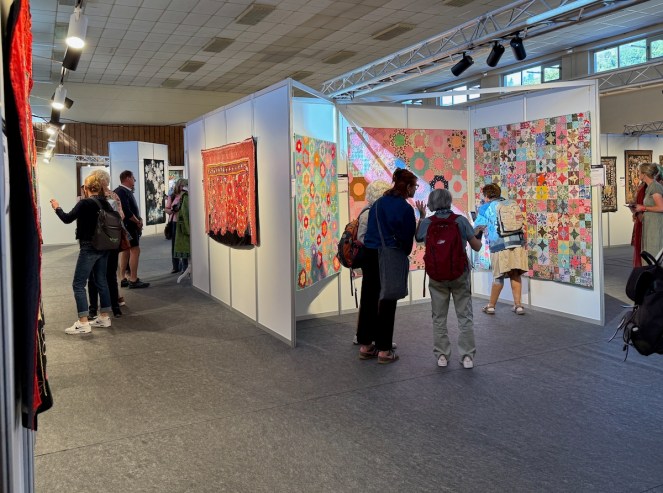
There were several artists in this Party Room. We have two more to go, if you are still with me!

Hae Ok Chang, South Korea

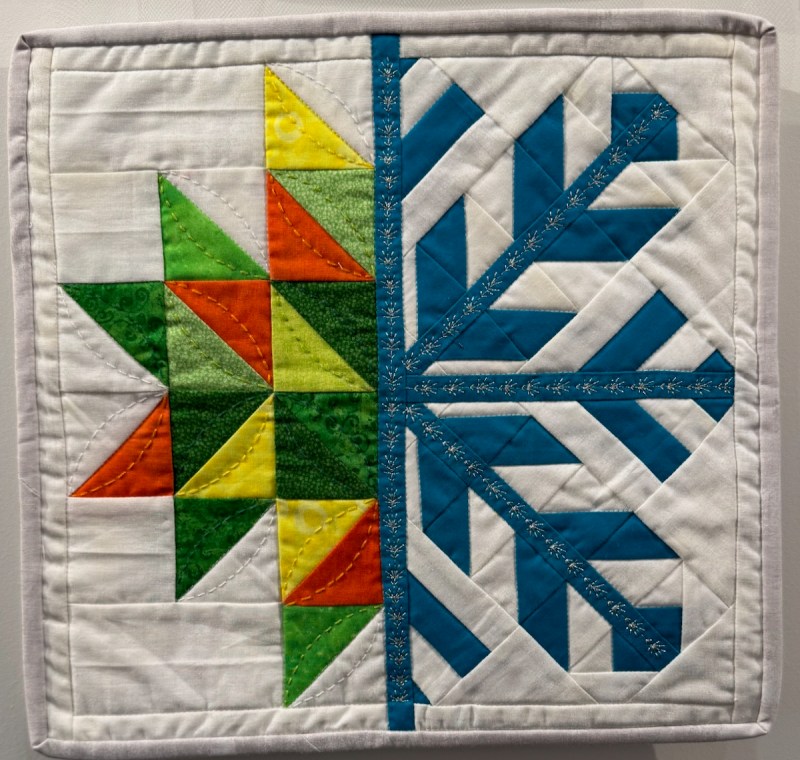
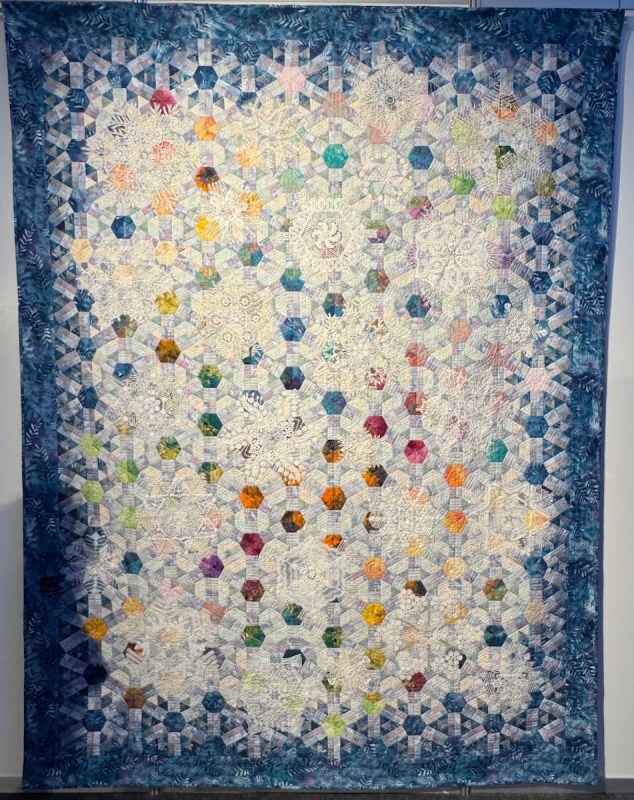
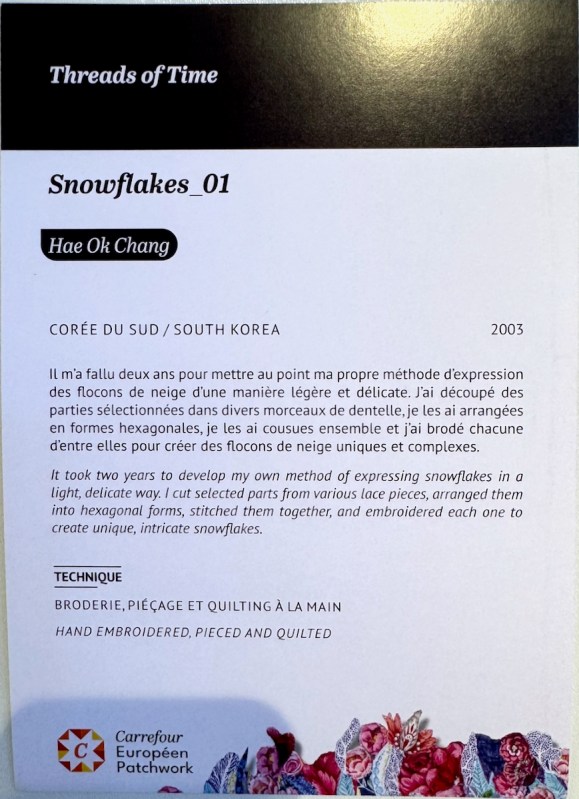
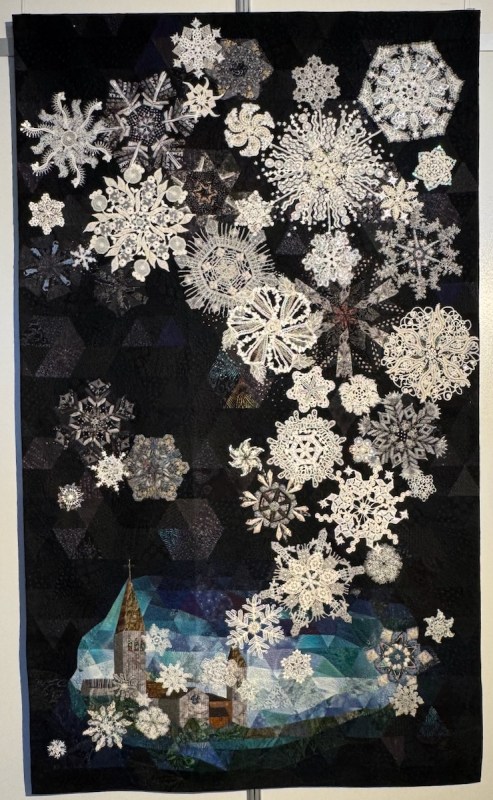
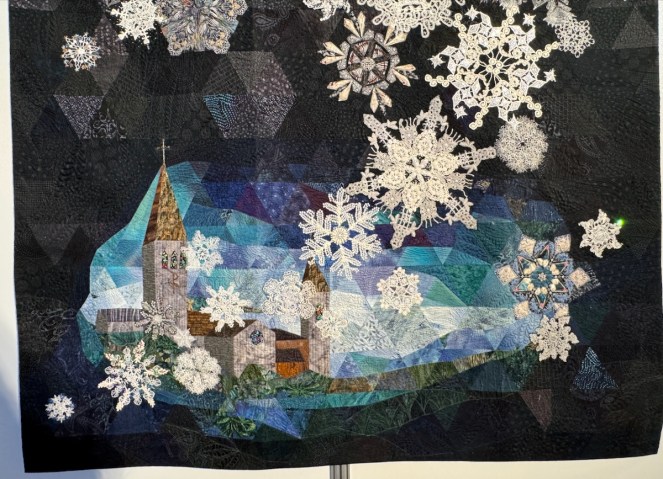
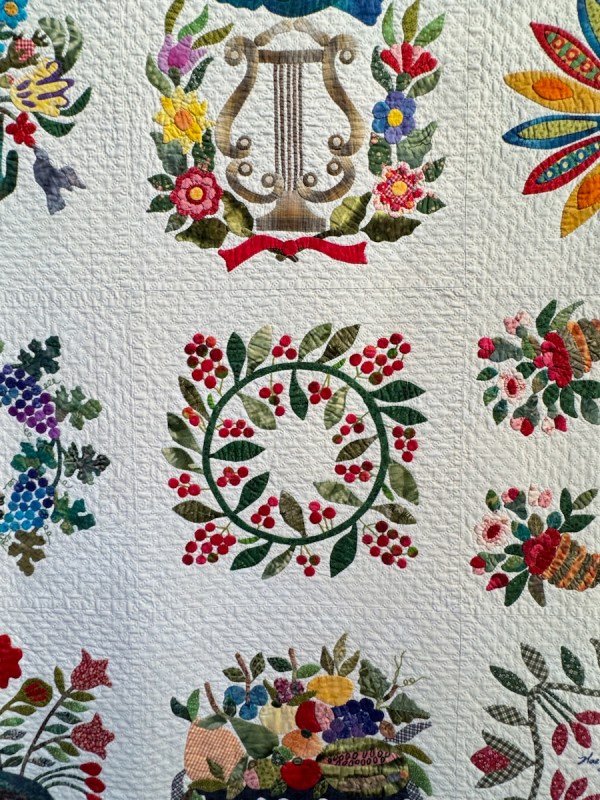
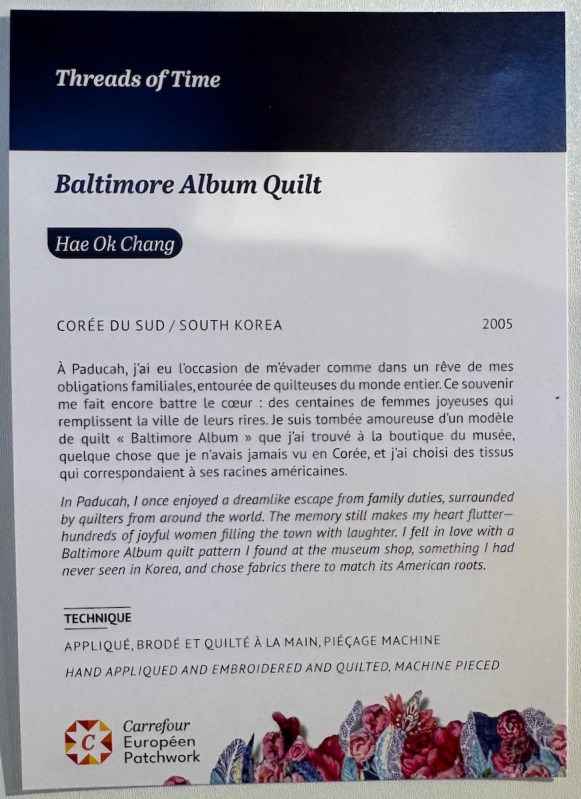
Hae Ok Chang, from South Korea, blends Korean and Western influences in a style that ranges from contemporary to traditional. One of her more well-known quilts has snowflakes on a traditional pieced quilt:

Here is another Snowflakes quilt, Snowflakes_04.

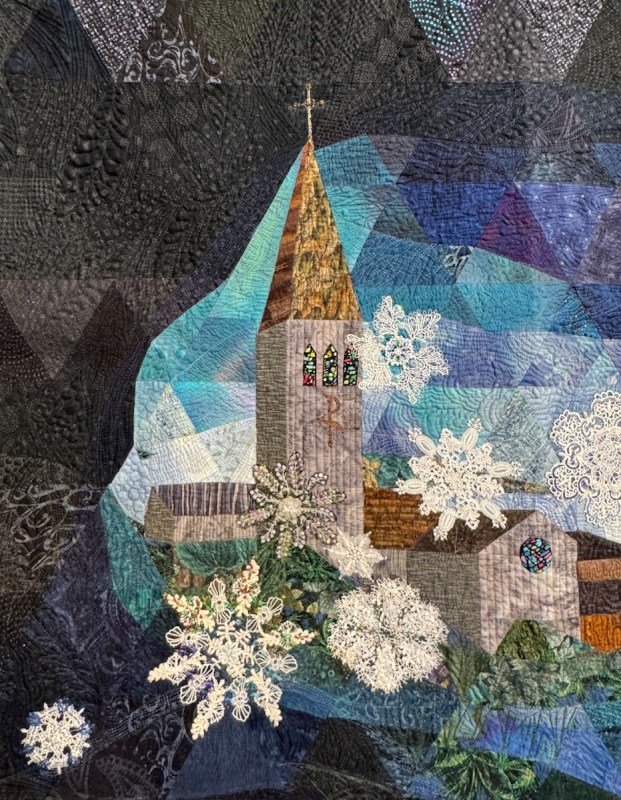
She writes: “Hesitating to start a large piece as my strength waned with age, I began a joint work with my daughter. She created the background, I made the snowflakes. Inspired by the night sky over St. John’s Catholic Church, it evokes angel wings and a chorus of family and friends” (from title card).

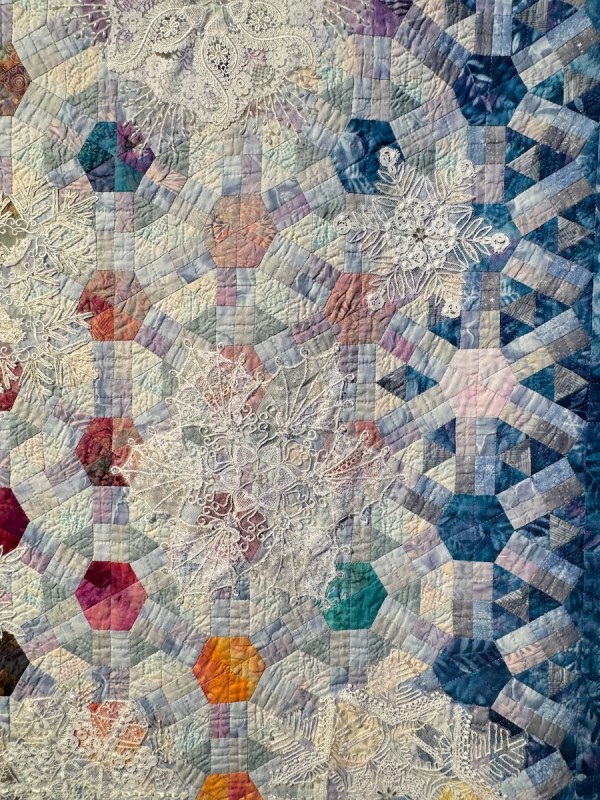
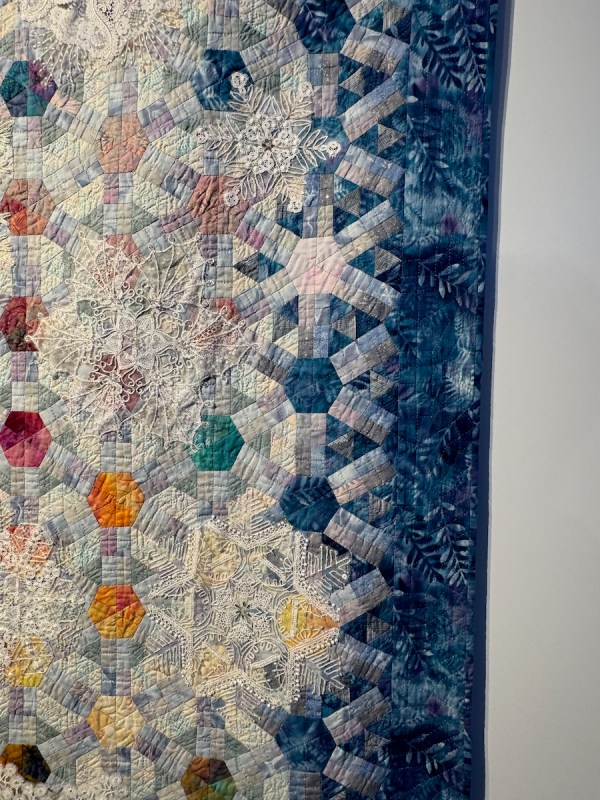
It is heavily quilted by machine, with hand-embroidered snowflakes.

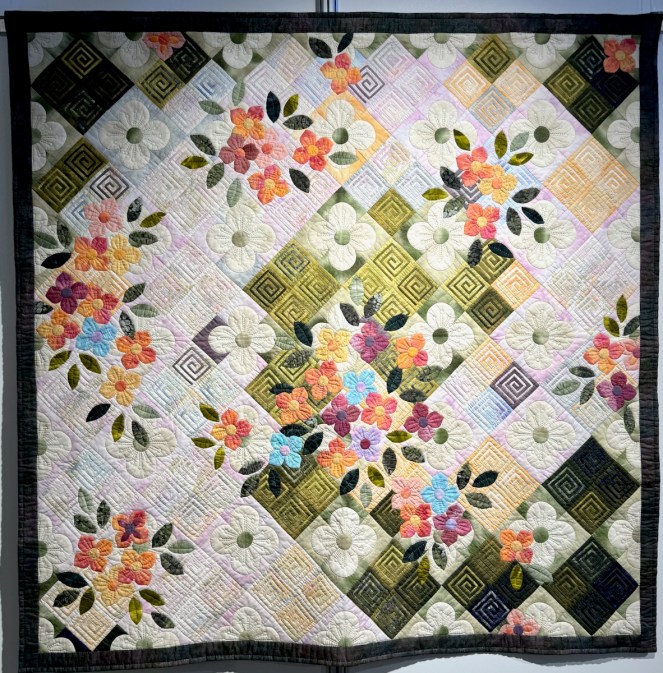
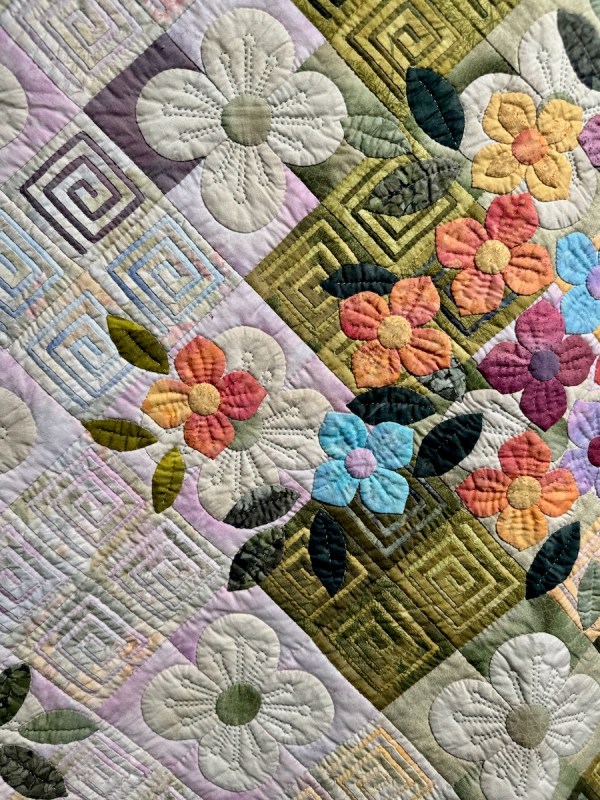
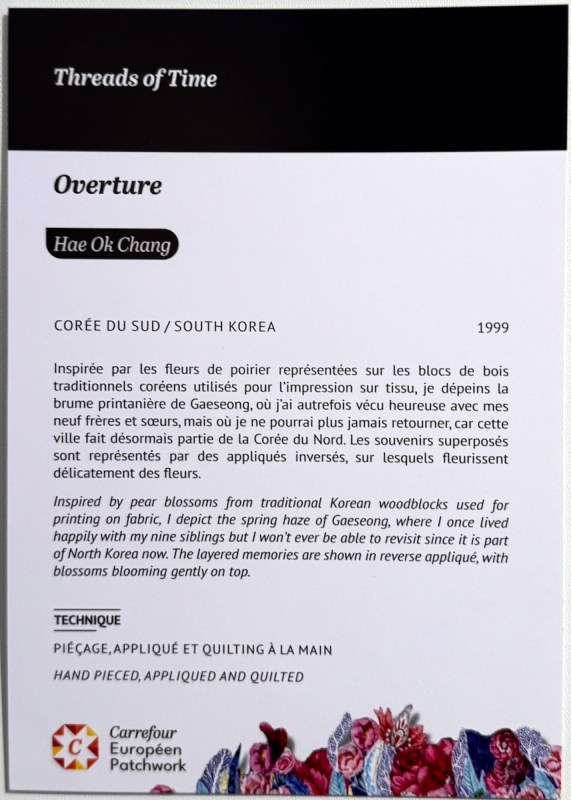
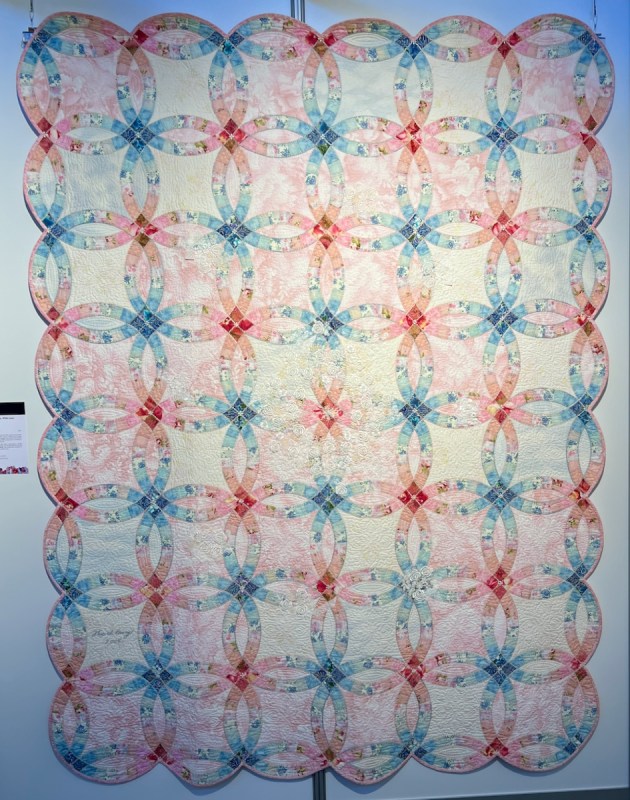
She also makes more traditional quilts, such as this one, inspired by pear blossoms.

This was inspired by a trip to the Paducah Quilt Show.

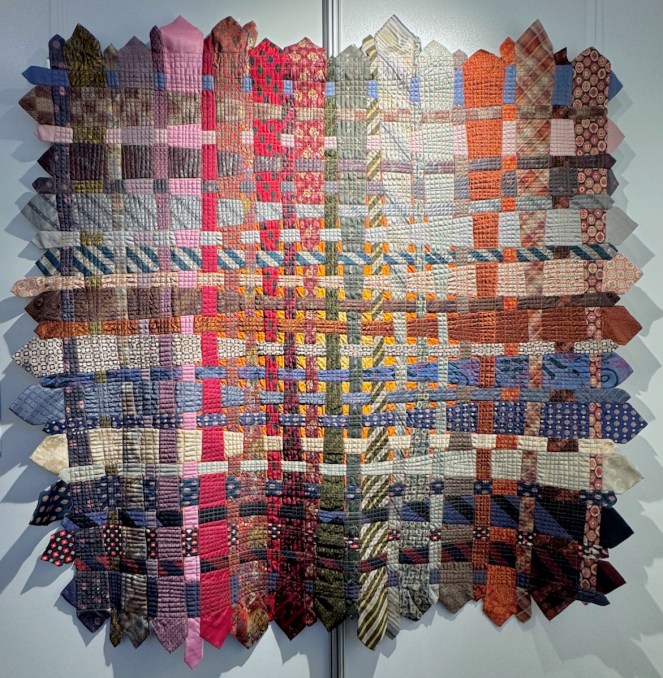
Titled Husband, Chang says she “wanted to weave my retired husband’s neckties into a story. Moments of joy and pride as he walked our daughter down the aisle, welcomed a daughter-in-law, celebrated with friends, and shared hardships. Days of work, success, and failure. I keep his devotion, love, hope, and sorrow close to me. Made in 2007.

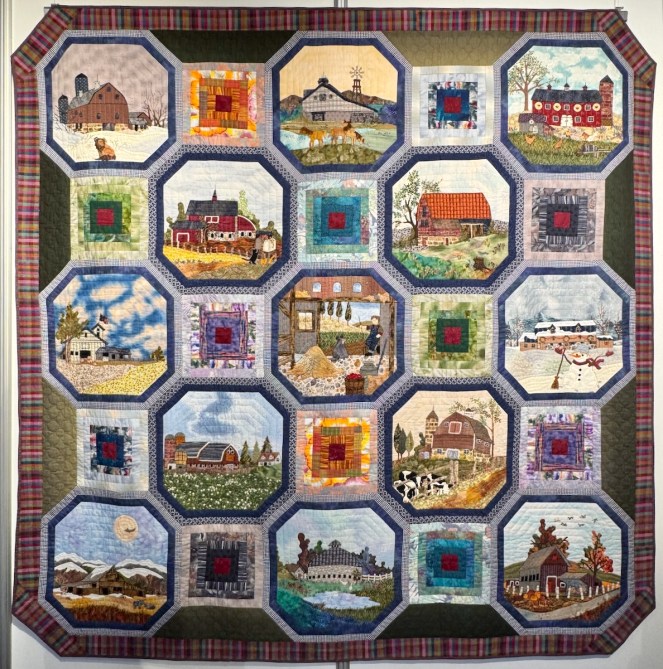
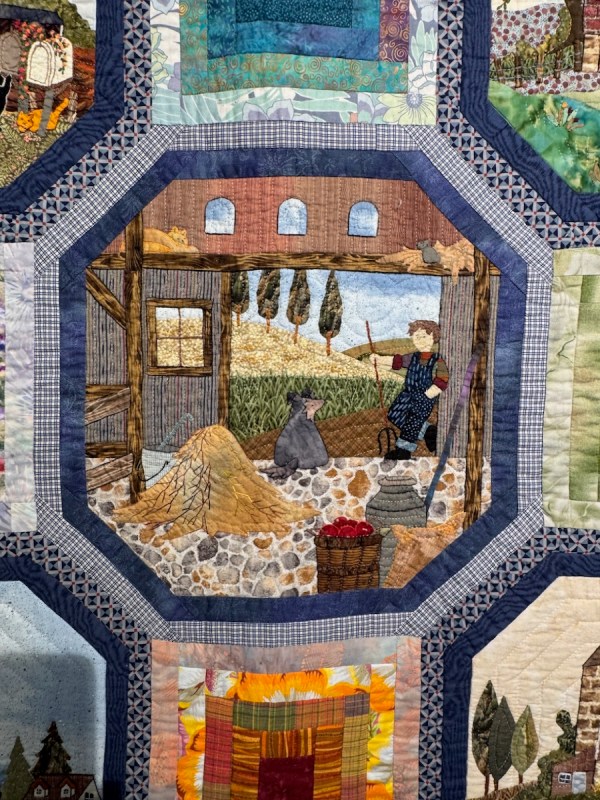
This quilt was made in 2012, after her husband passed away. Title: Time and Seasons.
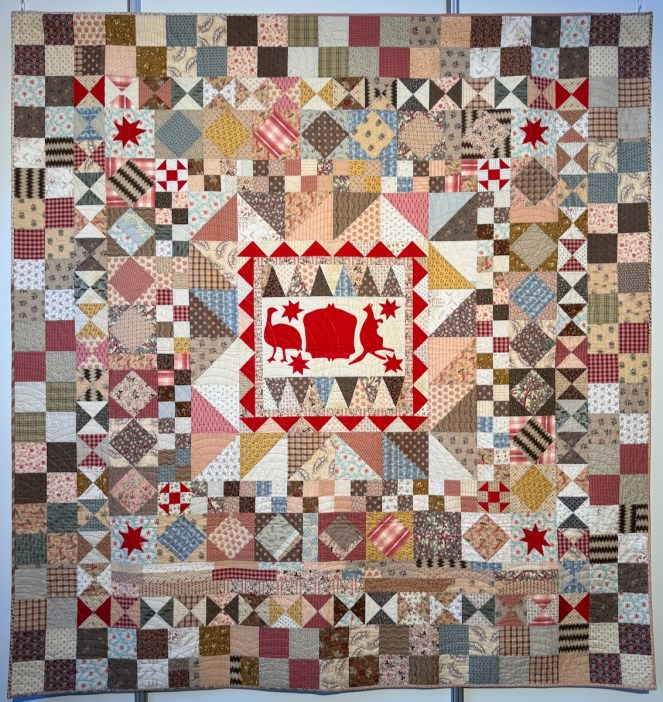
She writes: “After my husband passed away in 2012, I couldn’t bring myself to do anything for a while. I had started this quilt earlier, but left it unfinished. Eventually, I returned to it, intensely embroidering each octagonal block with meadows, flowers, birds, animals, wind, and trees. As I followed the seasons, life slowly returned, and I felt grateful to still have work to do.”
Technique: Machine pieced, hand appliquéd, embroidered and quilted.

Title: Wildflowers 01, by Hae Ok Chang
Title Card: “We three sisters spent hours together knitting, sewing, and making clothes. My eldest sister did everything well, the second was precise and skilled, and I, the youngest, just tried my best. As I embroidered this work, I often thought of them and our time together.”

I have three older sisters, so this one was especially meaningful to me, although we don’t sew together.

Title: Serene Glory

Unfortunately, I didn’t get a good photo of the title card. You can find her on Instagram, too.

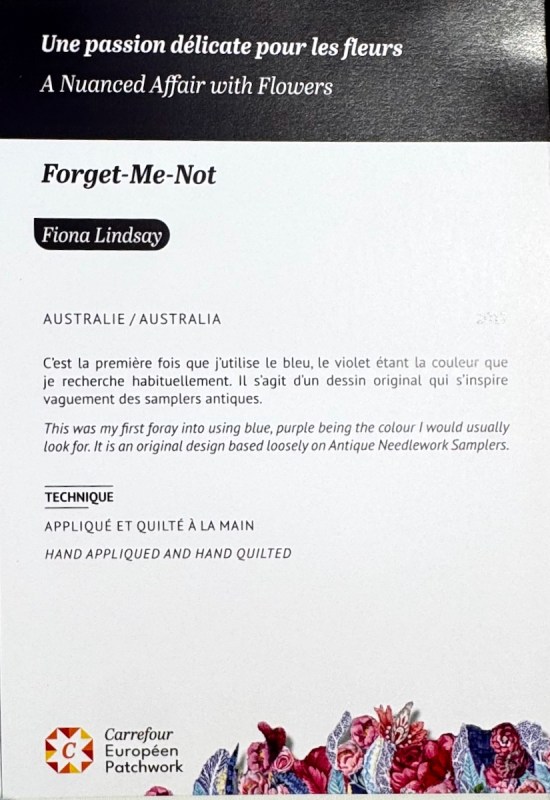
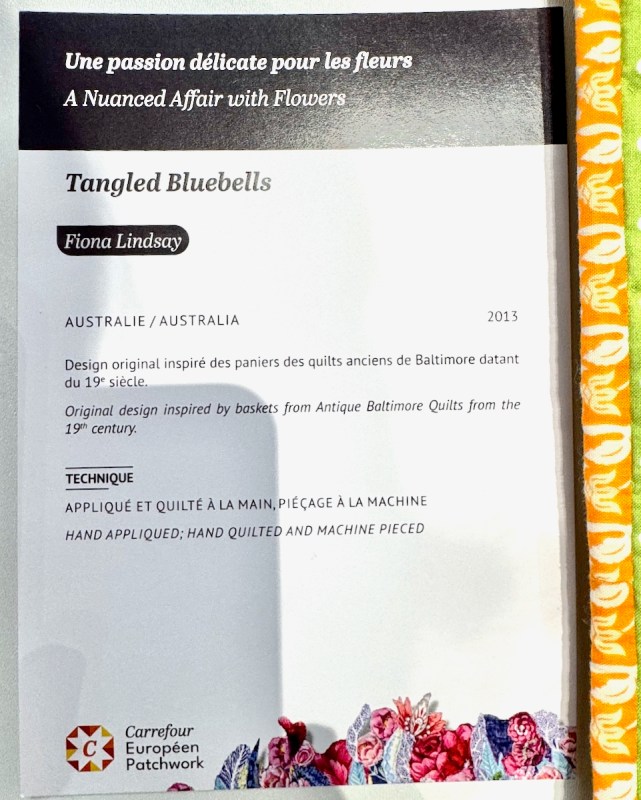
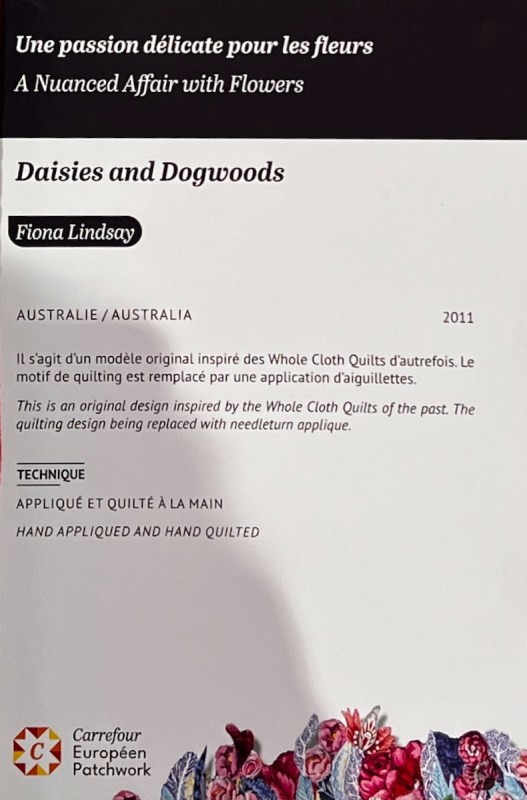
Fiona Lindsay, from Australia

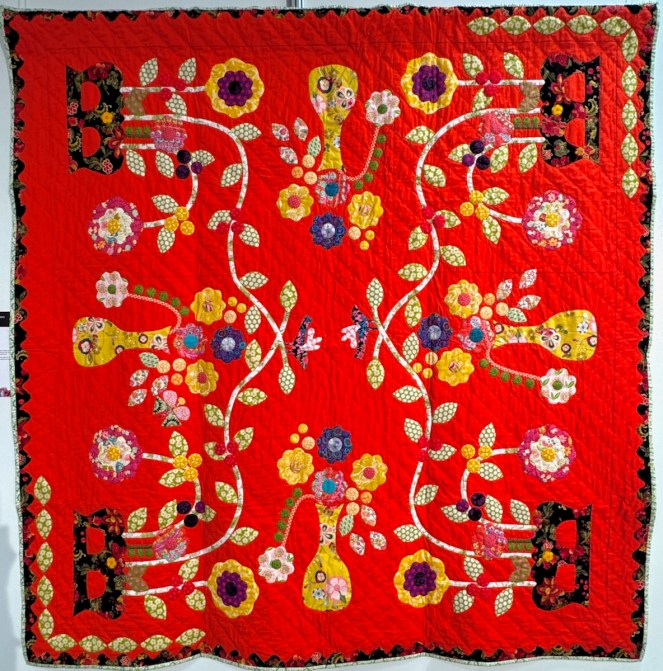
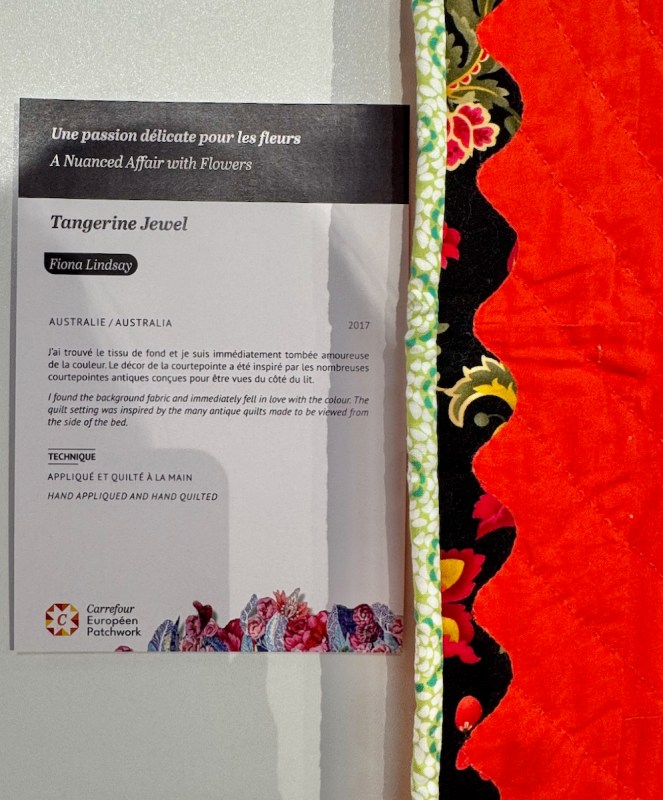
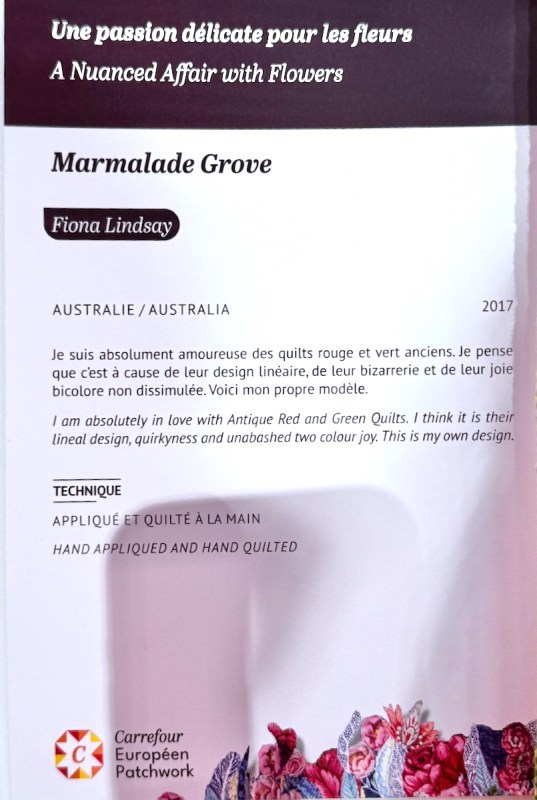
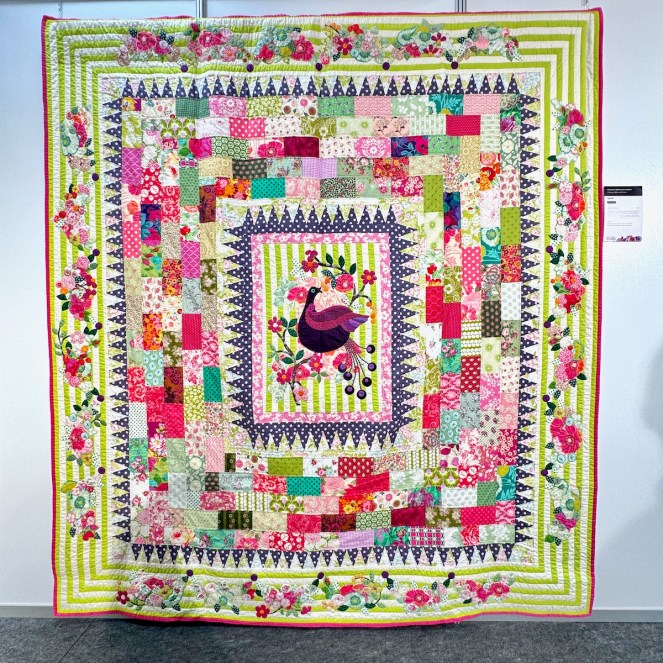
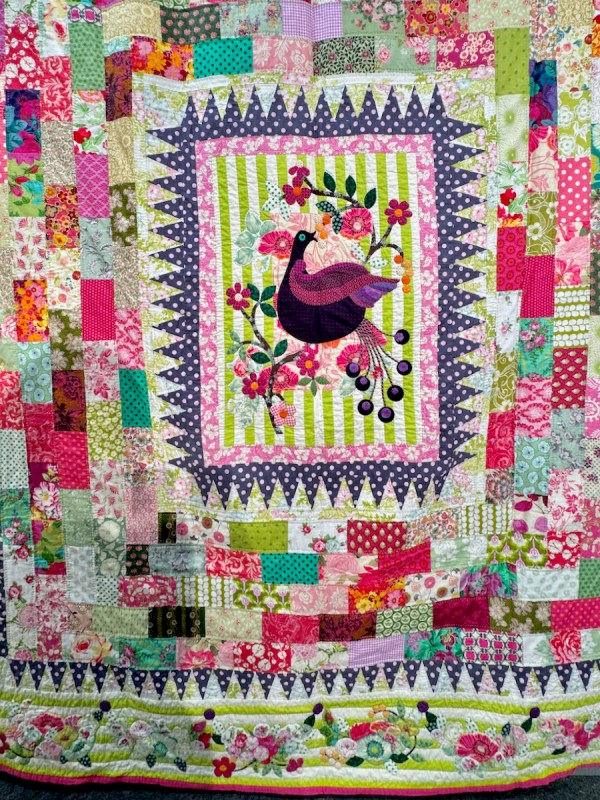
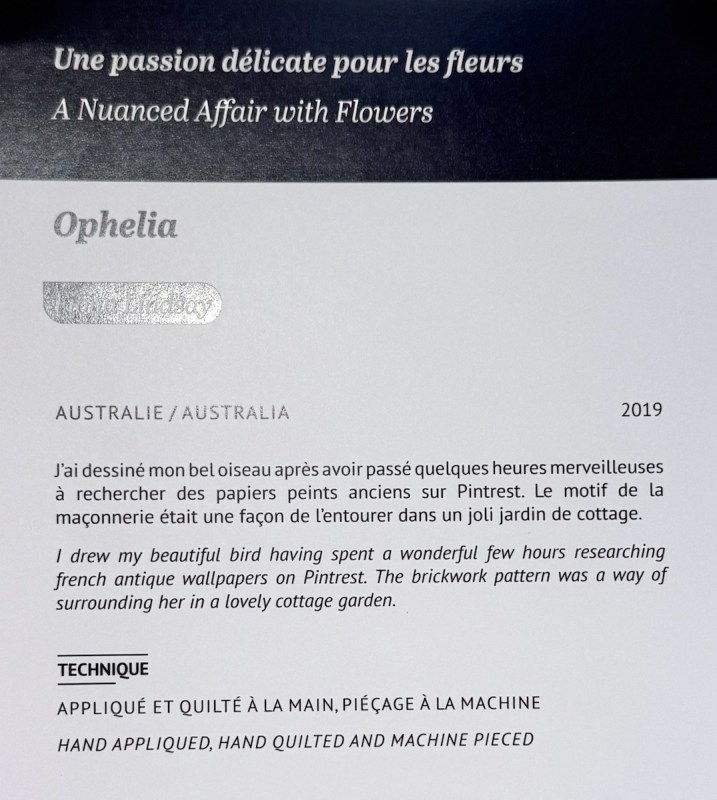
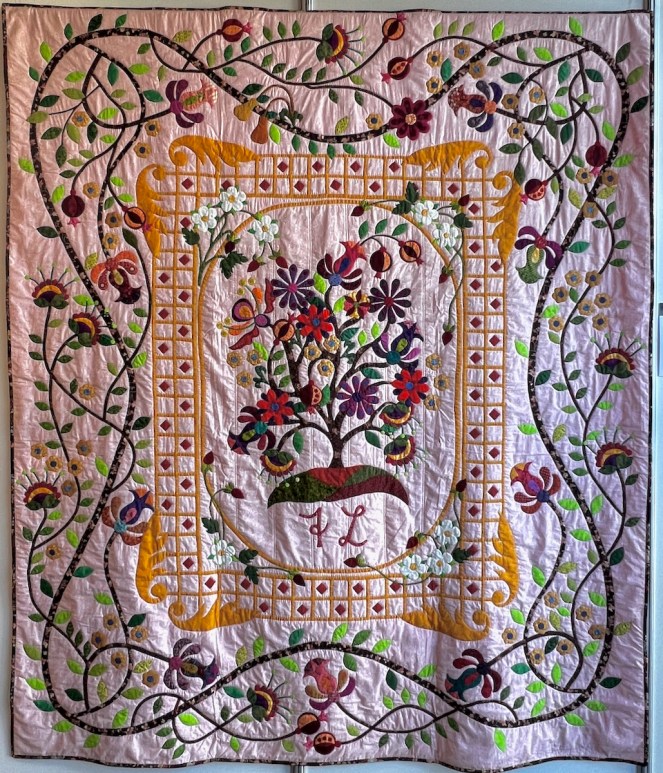
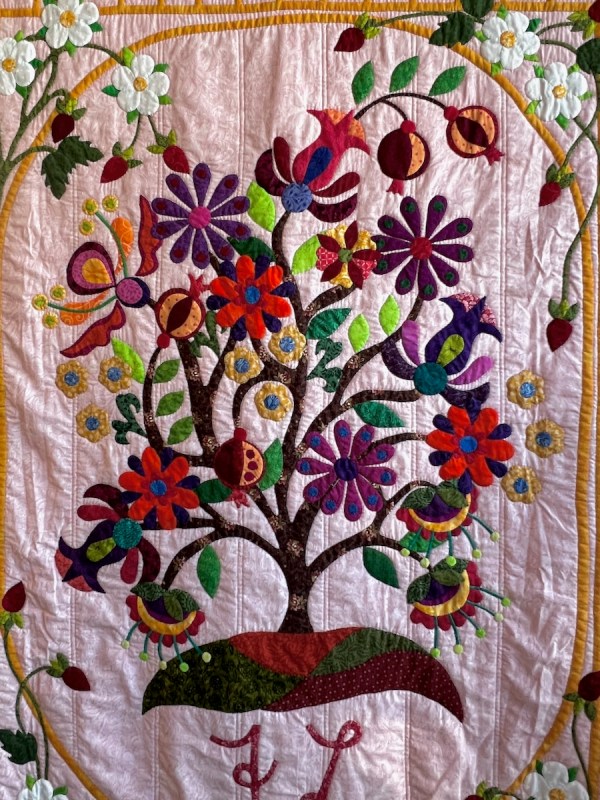
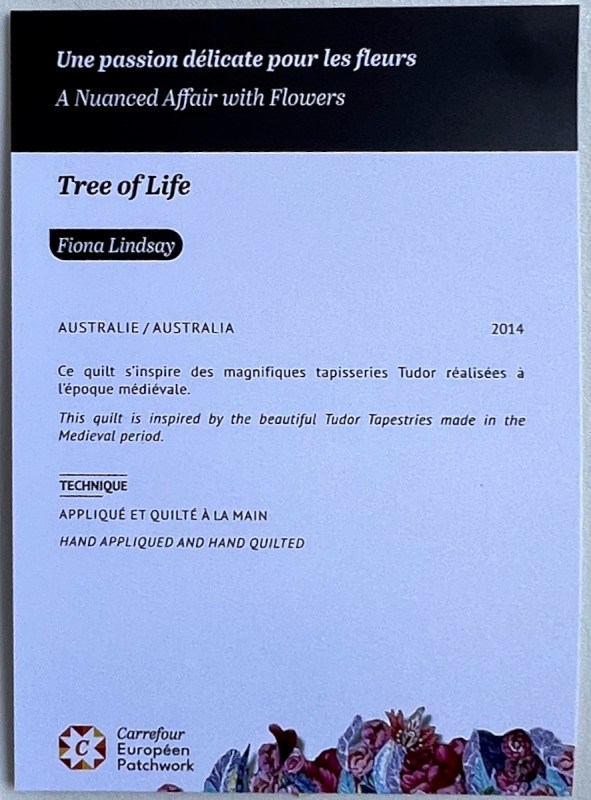
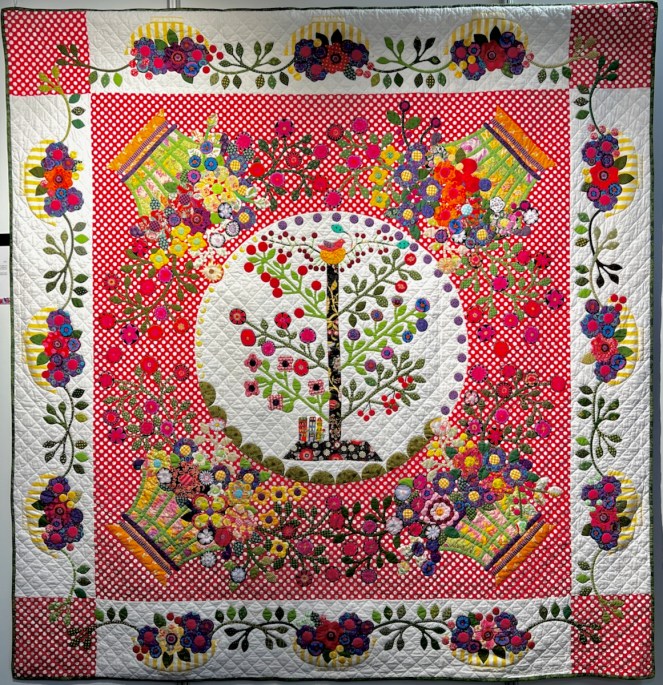
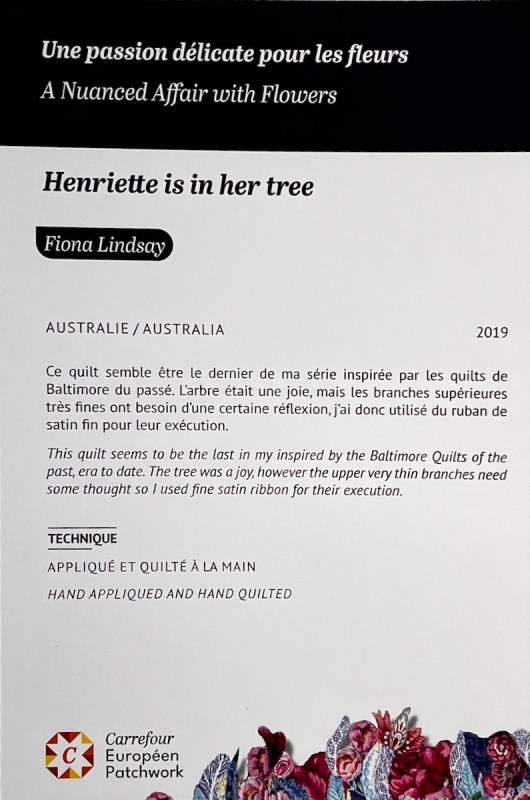
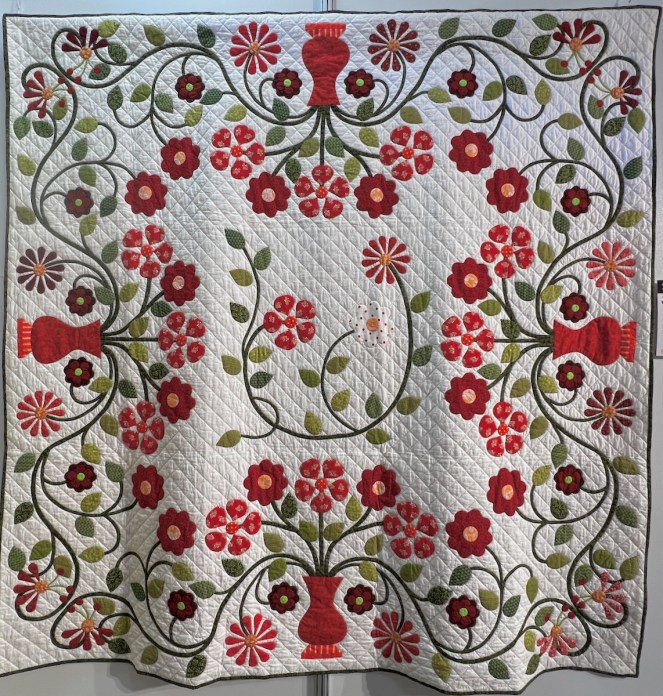
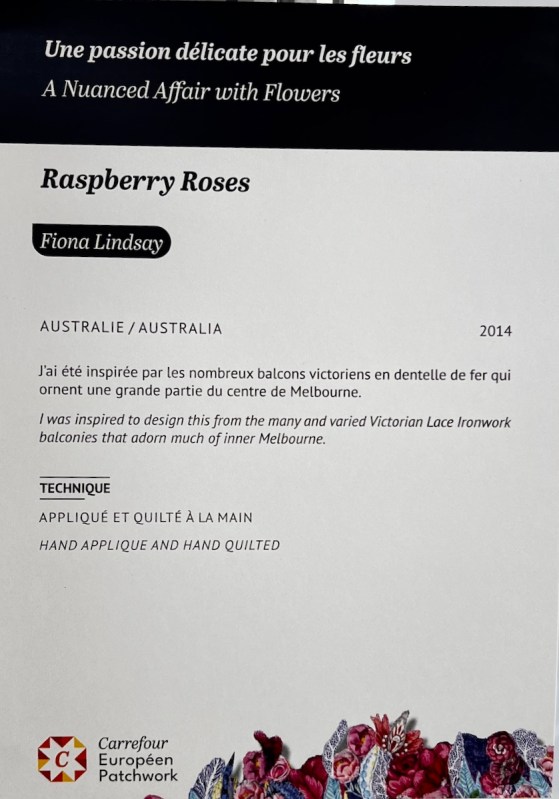
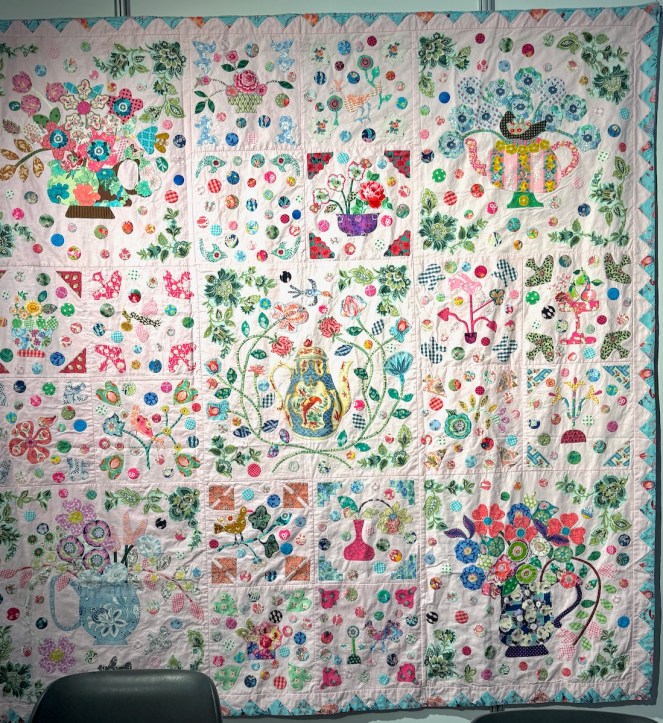
Fiona Lindsay is our last quilt artist for this post, but not the least! as they say. Also showing in Venue 12, her quilts were a veritable flower garden, a theme of hers, chosen carefully, as she loves sewing and she loves gardening.
She was so fun to talk to, and agreed to let me record her talking about her ideas about color and stitching and practice and quilting. It runs about a minute.

Now, for her garden of flowers!

As a reminder, all the quilts are very well lit up, but the shadows can be very strong. I tried to crop them out/edit them out as best as I could.

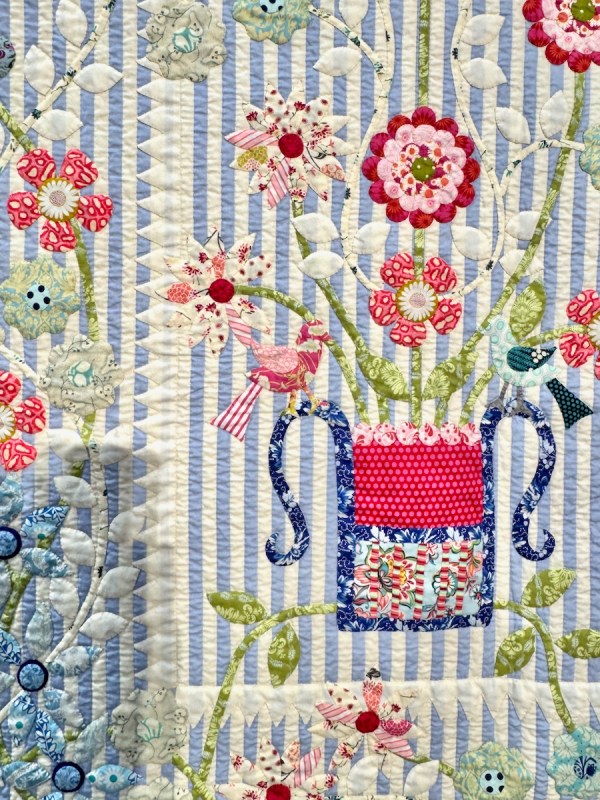
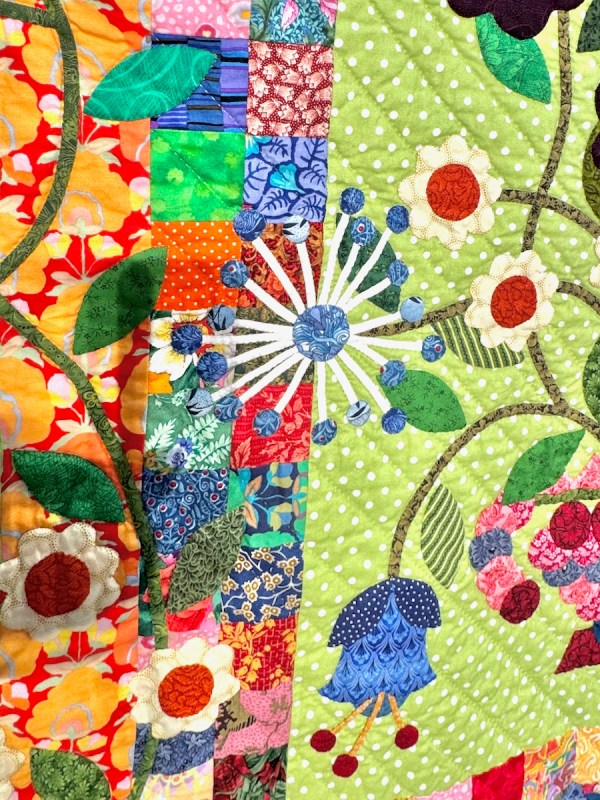
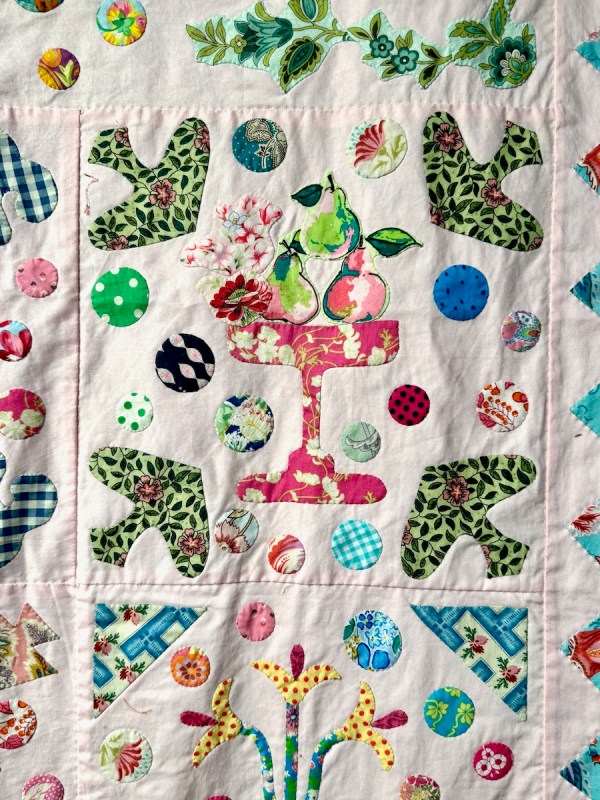
Those teensy seeds on the blossom, and the wonderful shape and proportions of this quilt: loved it!

(Click to enlarge.)

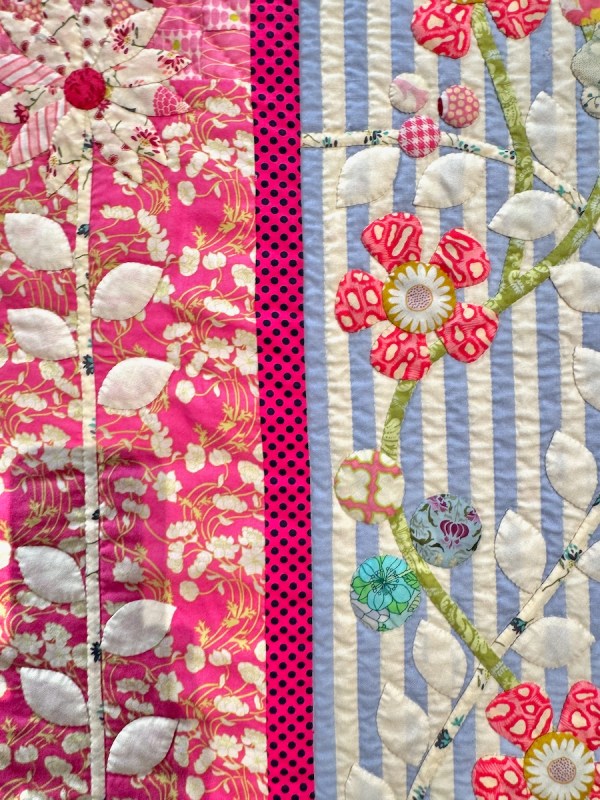
Those border vines have an energy all their own.

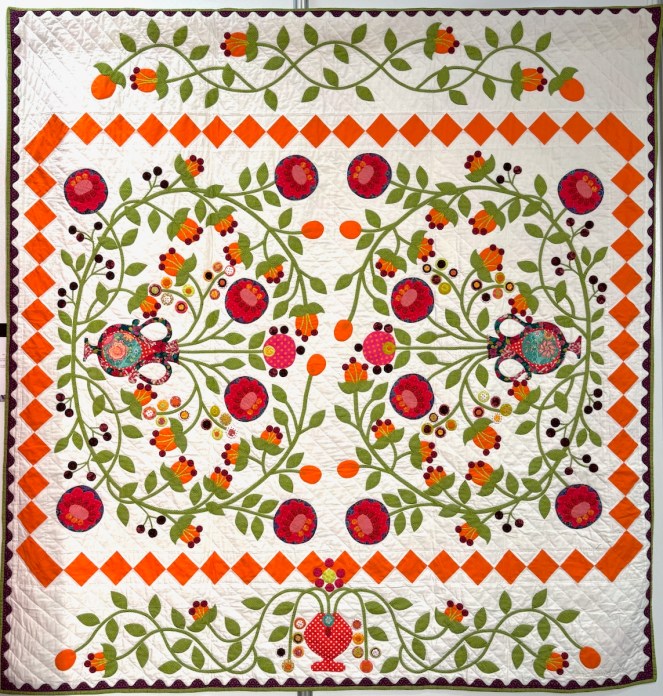
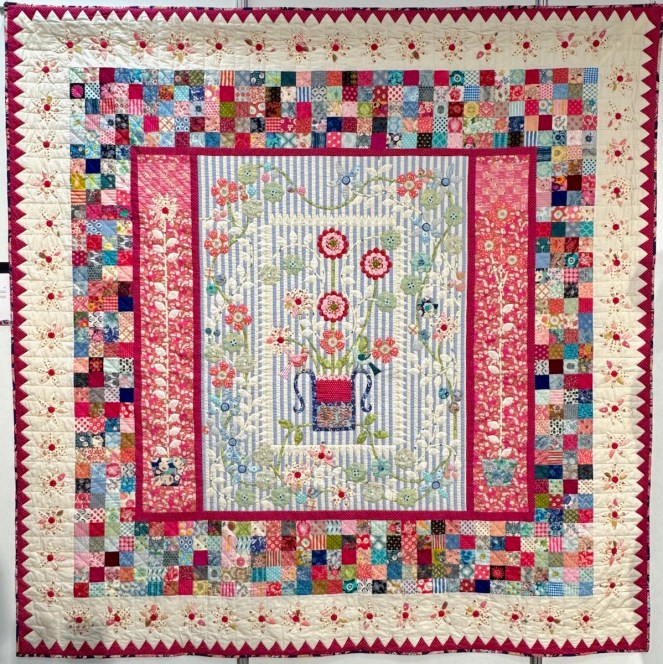
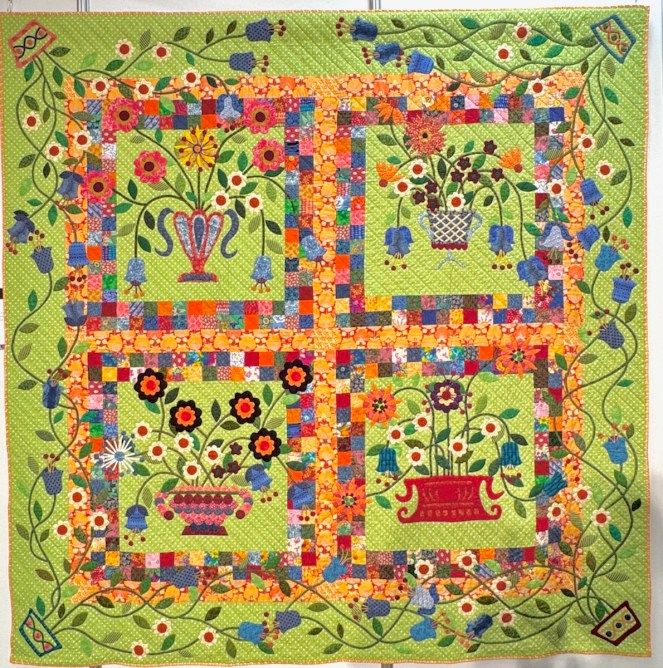
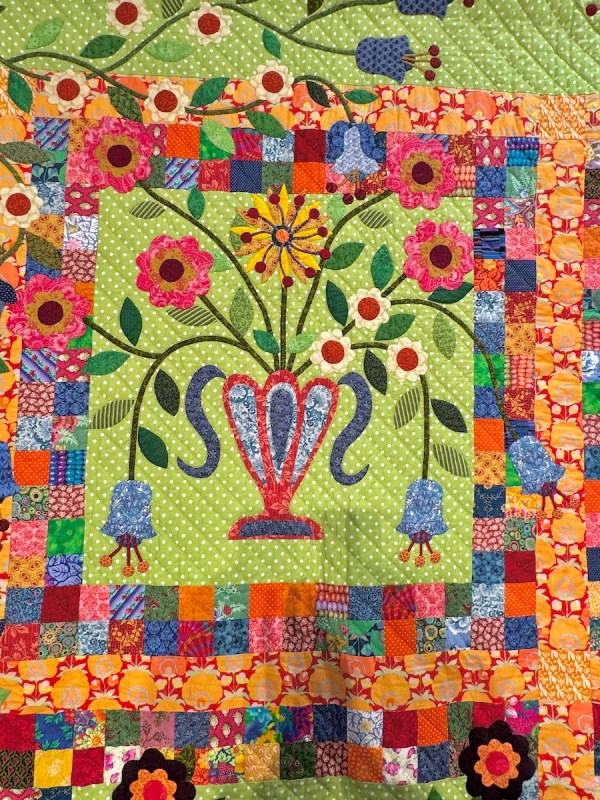
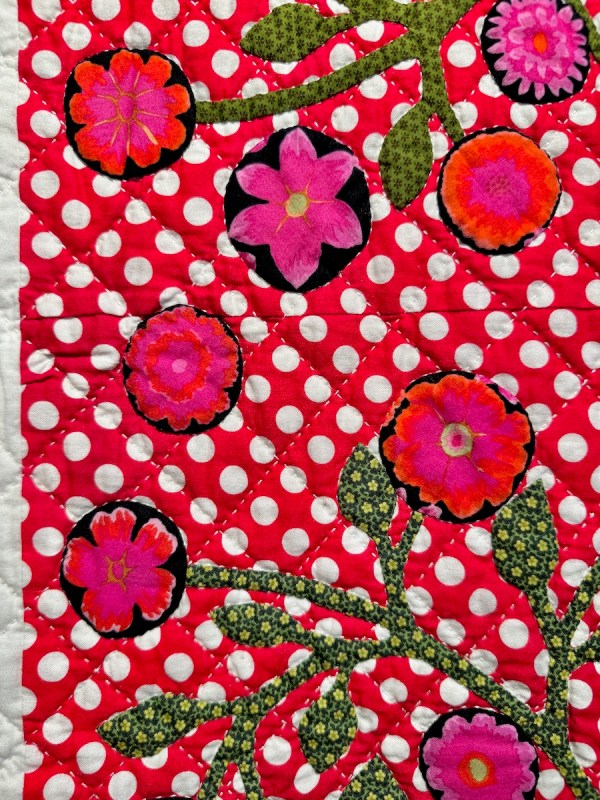
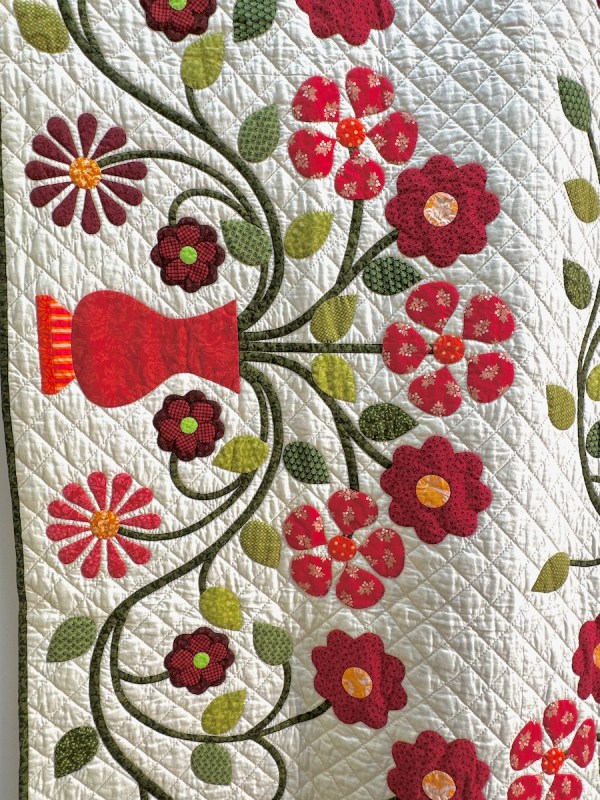
By now you can see that she can put together fabric combinations and colors with such skill, that she makes it look easy. I love the balance of the stems and the shapes of the flowers, too.

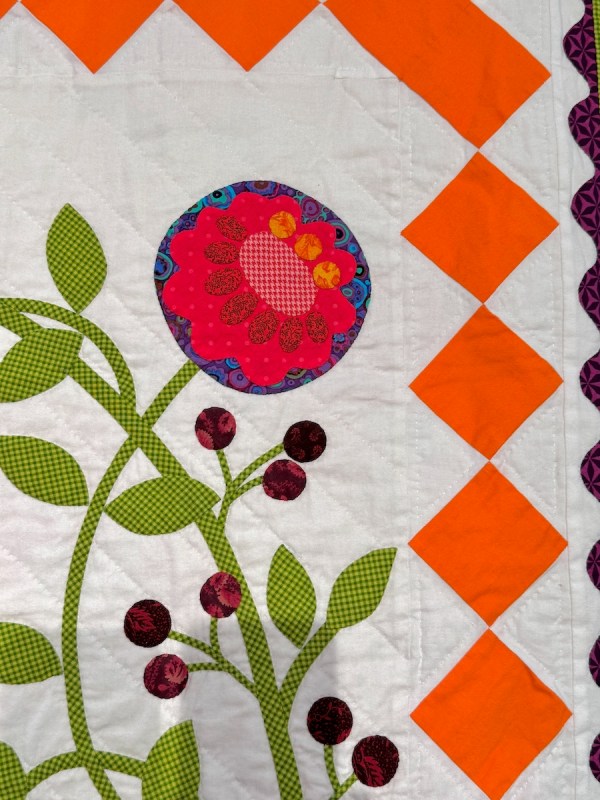
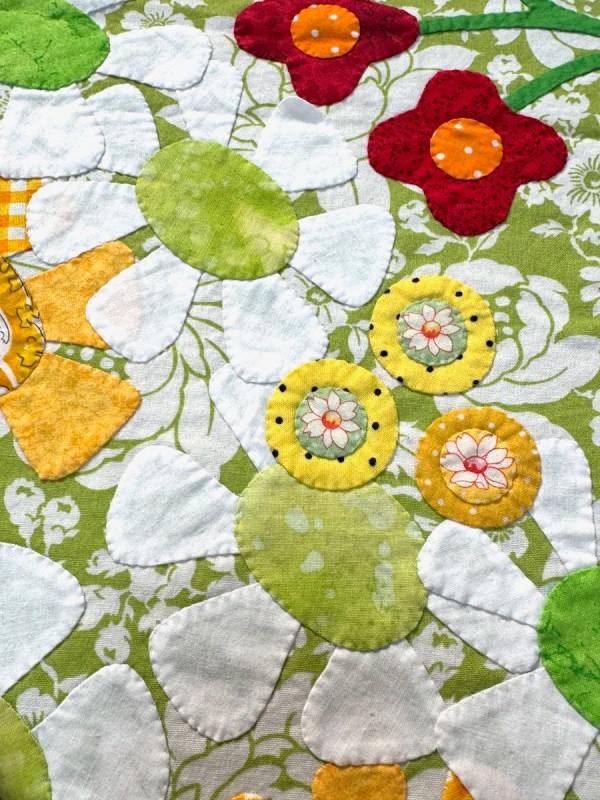
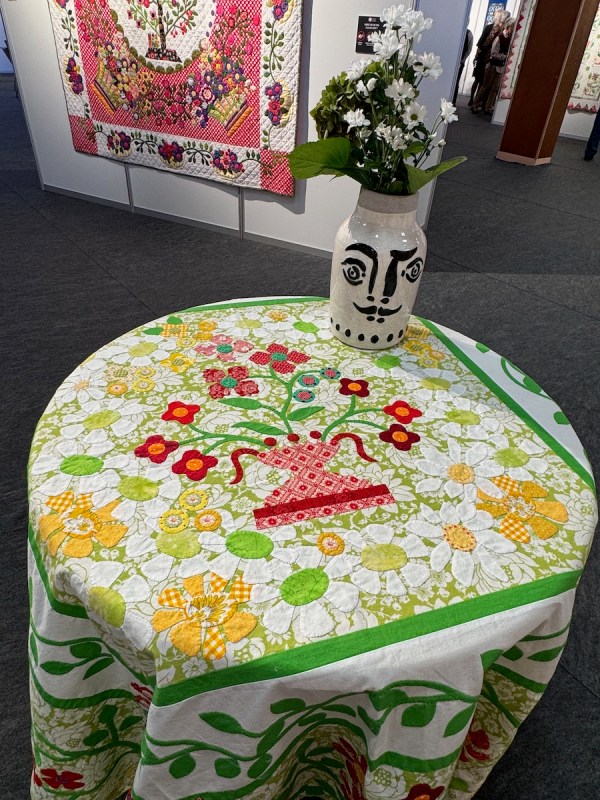
One reason why I do these posts from Carrefour is not only to introduce you to new quilting artists, and to let you glimpse the passions from around the world (which Carrefour is so good at bringing together), but also as sort of a reference book for our own designs. Who would have thought to put a Baltimore-style urn of flowers together (above) with a wild vine running free from tiny pots in the corners? Yet it all works with that pieced border and the wild orange Kaffe fabric sashing. Here’s a closer look:

It was great to see a close-up of her work:

Okay back to the quilts.

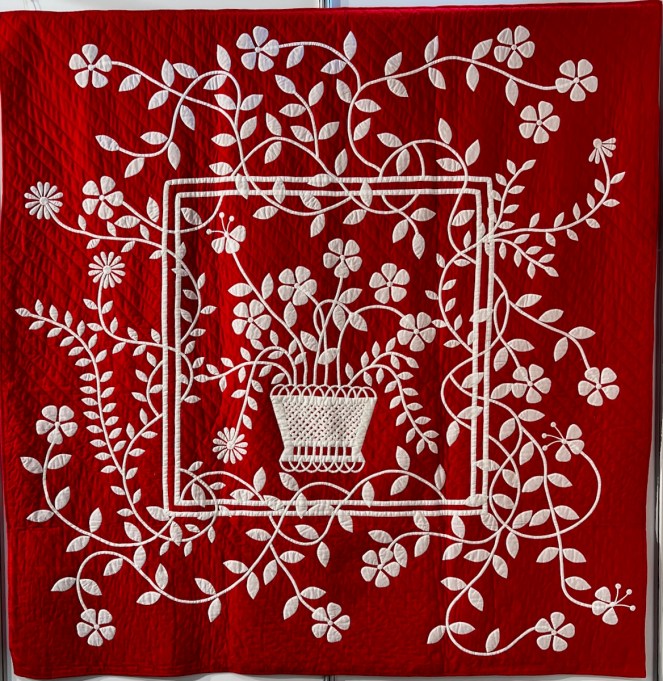
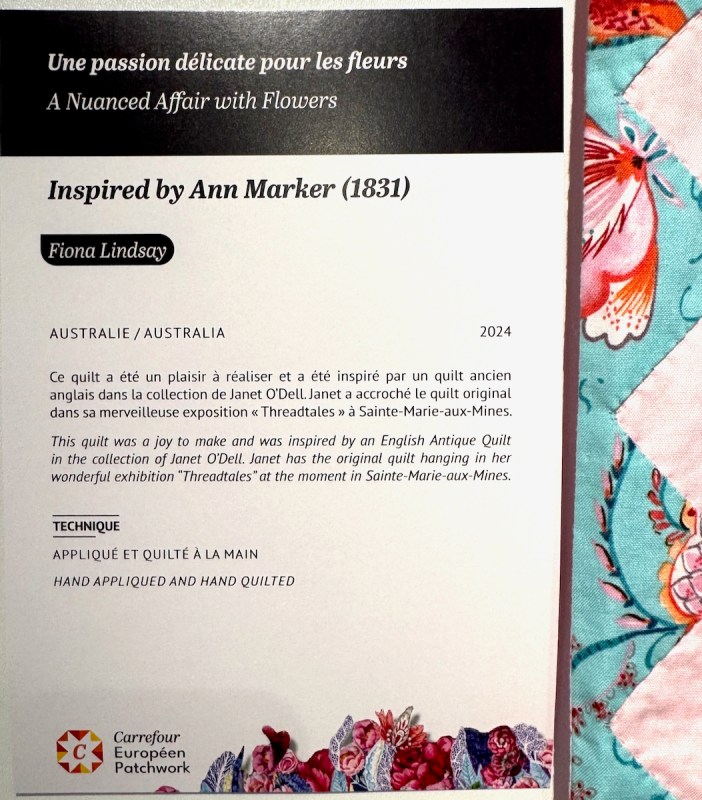
And now for the favorite from the last post withf Janet O’Dell’s quilts: the antique quilt, but given a Fiona twist:

In pink! With color!

And now I know the maker of that antique quilt: Ann Marker, from nearly 200 years ago. This truly is free and fabulous appliqué — the joy in these shapes just radiates.

Thank you, Fiona, for all your beautiful flower quilts. You can find her on Instagram.
And thank you to all the other quilters and artists.

I know this was a really really long post, but again I hope you’ll treat it like a reference, as well as a delight. I think I have at least one or two more post in me before finishing; it will come soon. Very soon. (Teaser: next up is Racheldaisy, from Australia.)

Carrefour Quilt Show · European Patchwork Meeting · Quilts

Carrefour III: SAQA, Aotearoa Quilters, Libs Elliot, Esther Delgado, Caroline Simm, and the OZQuilt Network

This post covers:

• Venue 6: Espace des Tisserands, with OZQuilt Network, Libs Elliot, Caroline Simm, Esther Delgado, and the Aotearoa Quilters

I have a main Carrefour Quilt Show page that lists all the posts of all the meetings I’ve gone to, and includes the posts from this year too.

This exhibit place, call the Espace des Tisserands, is sort of like your town’s gym and event center, all in one. In the following photos, you’ll see some of the basketball hoops (drawn up) as well as all the partitions that Carrefour brought in to subdivide the large space. At the front door, they sold us booklets, stickers, and it was where we could pick up our tickets. Because I had done some writing for the Carrefour European Patchwork Blog, they had two wristband passes waiting for my husband and I, and I am grateful for Carrefour for providing these for me.

If you haven’t figure out yet what this is all about, every year in a small town in the Val D’Argent (Silver Valley), the Carrefour Patchwork Show is spread out over several small towns, and exhibit in event centers, churches, and other places. Plan now for September 17-20, 2026!

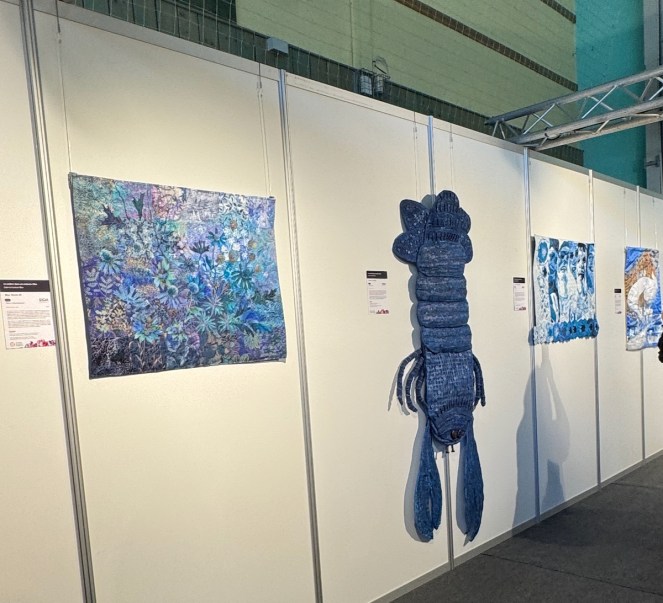
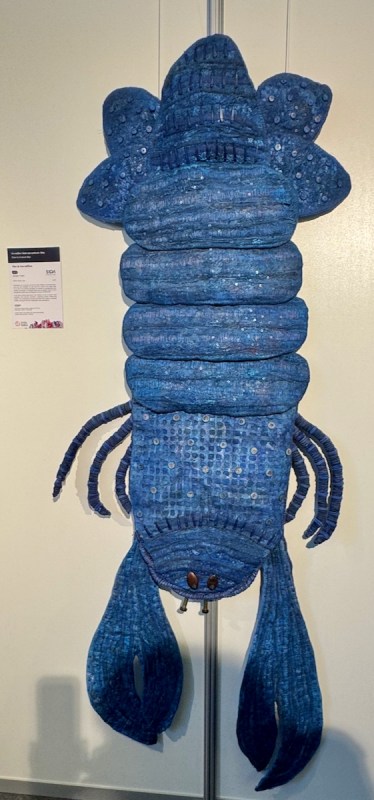
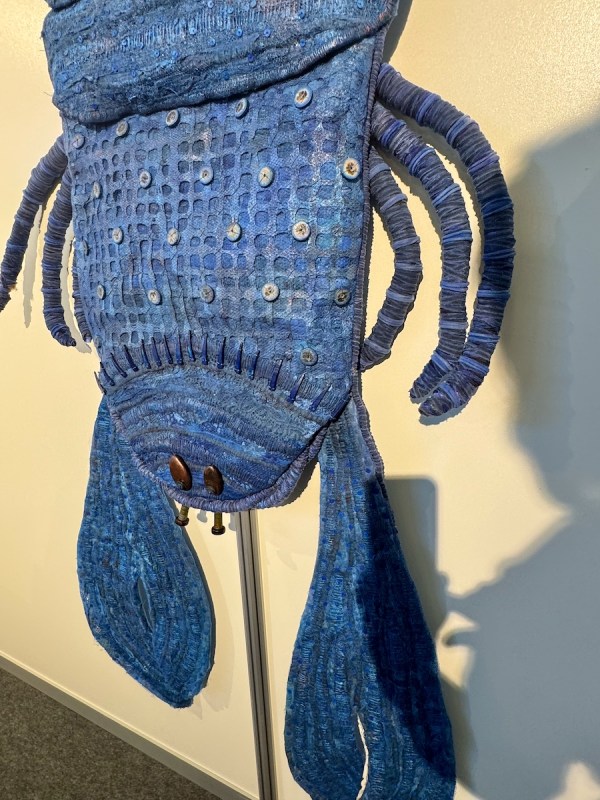
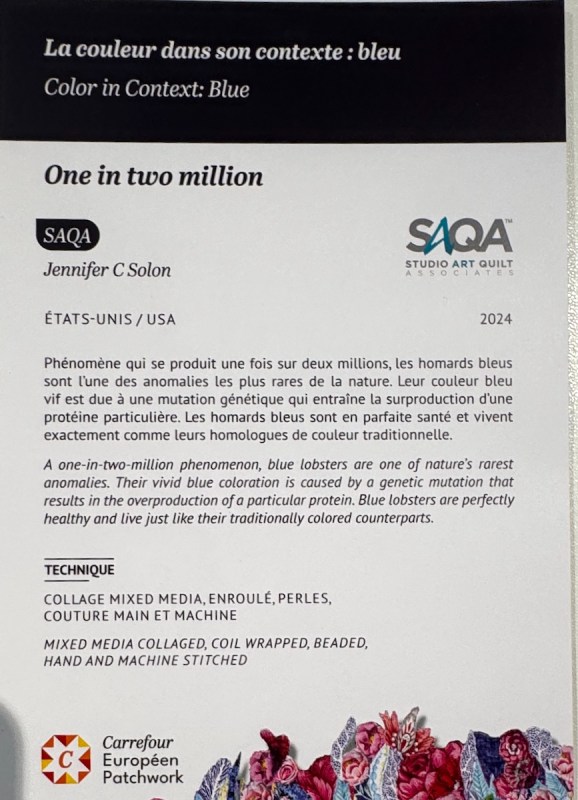
SAQA (Studio Art Quilt Associates) had a large area in Espace Tissurands. They also had companion interviews on Textile Talks with three of the artists who exhibited in France, and it’s worth a look to get the background on their work, and especially the giant blue lobster.

So much texture and that beautiful blue color, and I loved this piece for how interesting and surprising it was.

I’m showing these in random order; not all of the exhibit will be shown.

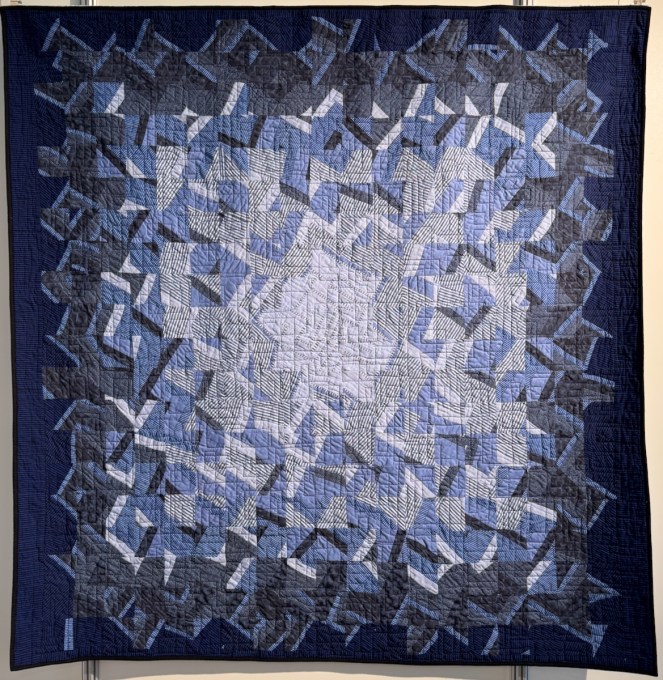
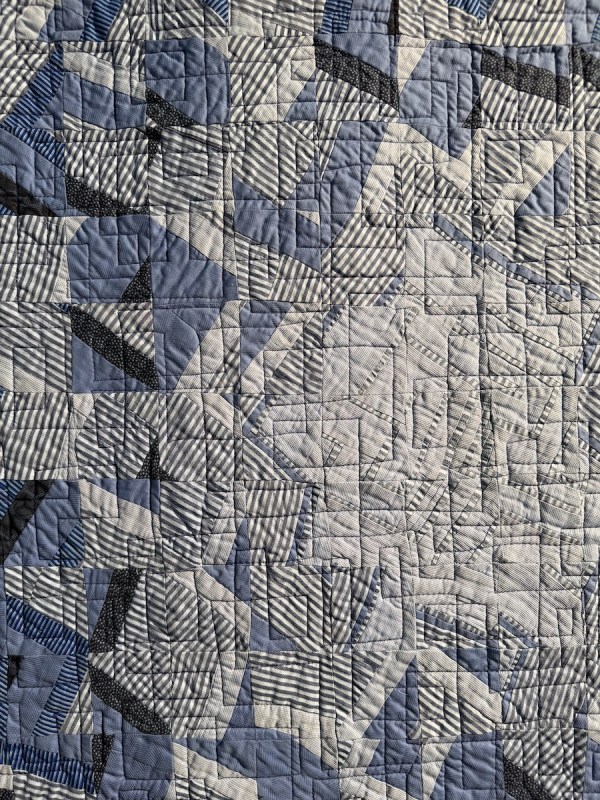
Once in a Blue Moon, by Lorraine Woodruff-Long, was “made entirely from repurposed men’s blue shirting.” First she made a giant Log Cabin block, then she cut it up and re-arranged it, while taking the Biscotti Quilt workshop with Brandon Wulff.

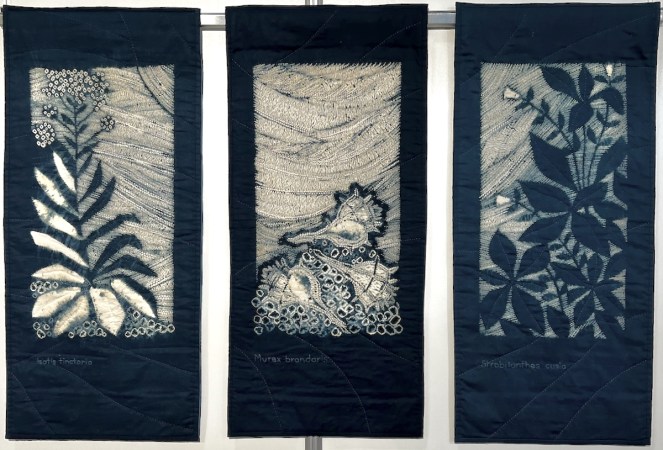
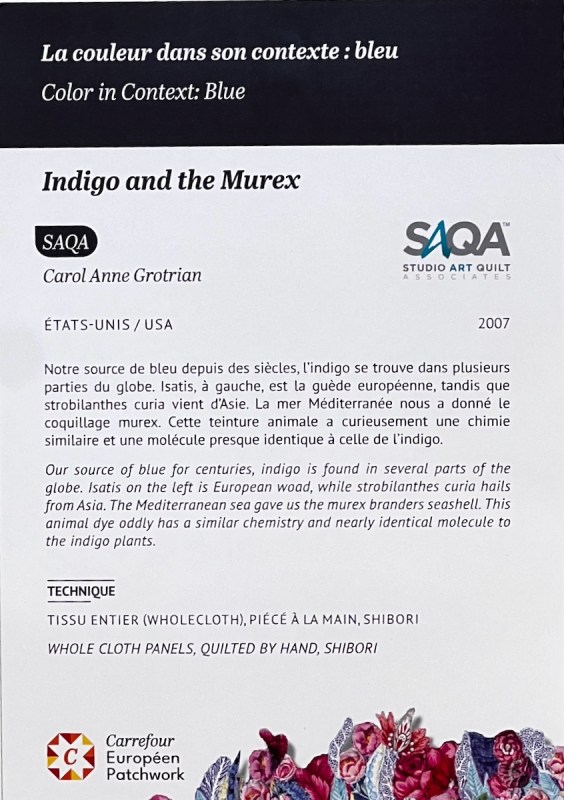
Indigo and the Murex: I lightened this as much as I could, but not so much you might miss the intense saturation of three kinds of indigo blue dye: (on the left) Isatis is European woad, and on the right, the stroblianthes curia hails from Asia. In the center, the Murex branders seashell is from the Mediterranean sea, and the artist, Carol Anne Grotrian, writes on her title card that the dye from this animal has a similar chemistry and is nearly identical molecule to the indigo plants.

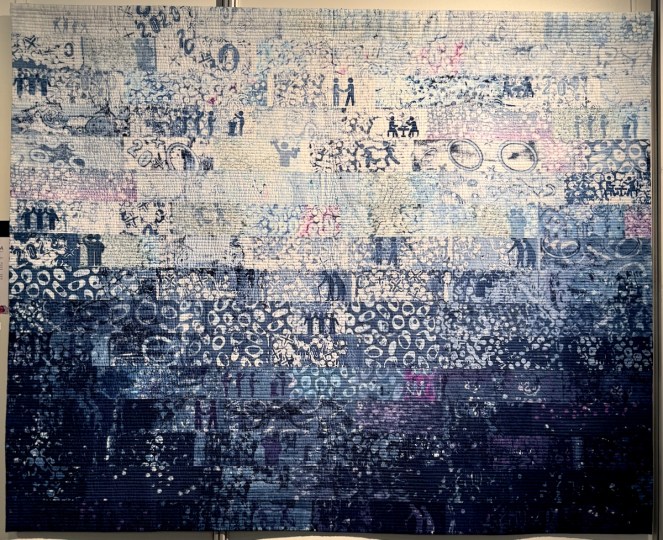
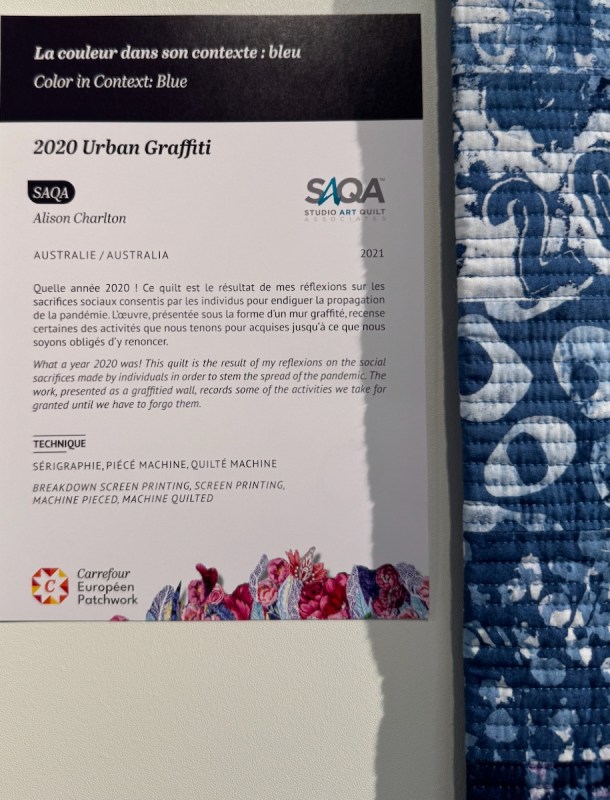
Urban Grafiti, by Alison Charlton

(Note: photographs were taken by both my husband and I.)

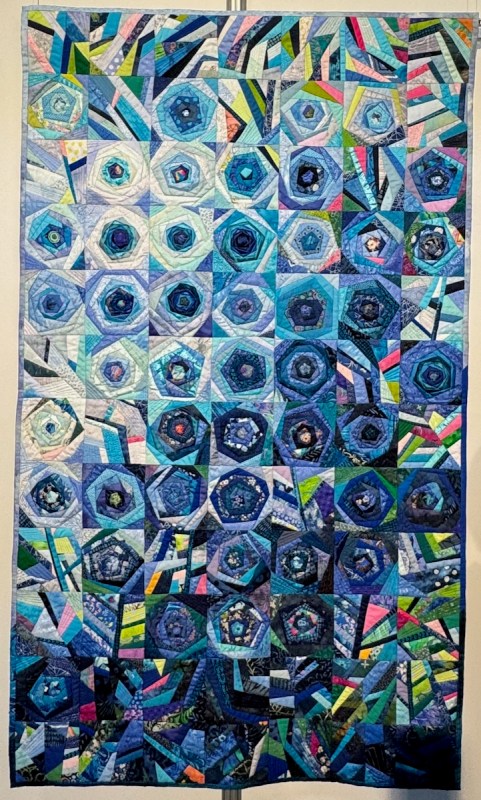
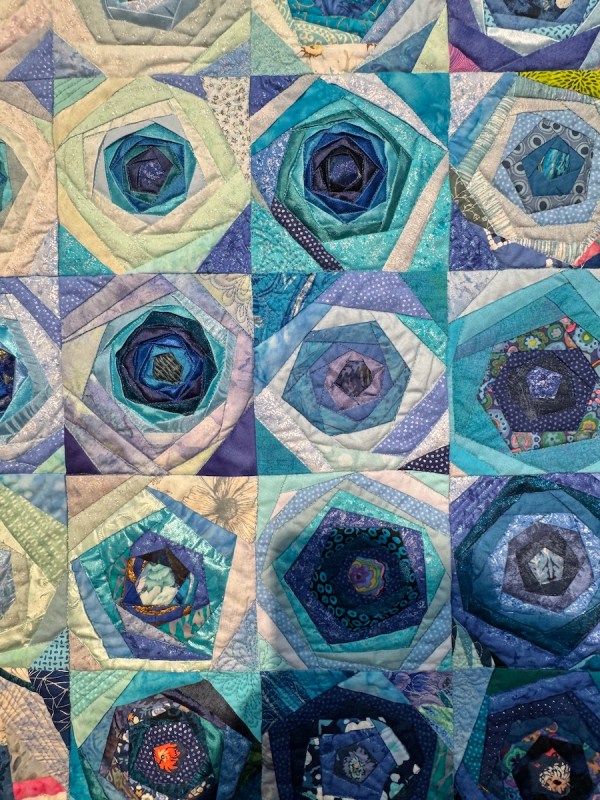
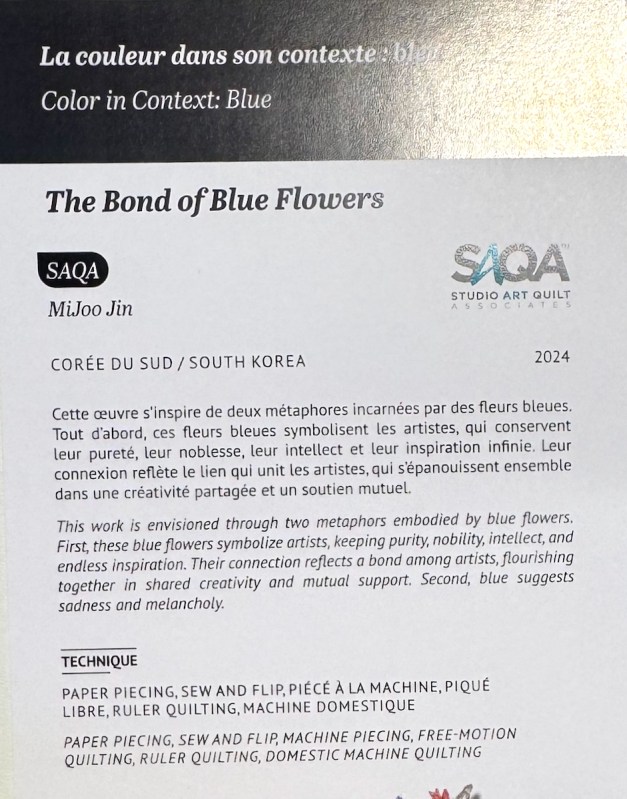
MiJoo Jin, from South Korea; The Bond of Blue Flowers.

(Click to enlarge photos.)

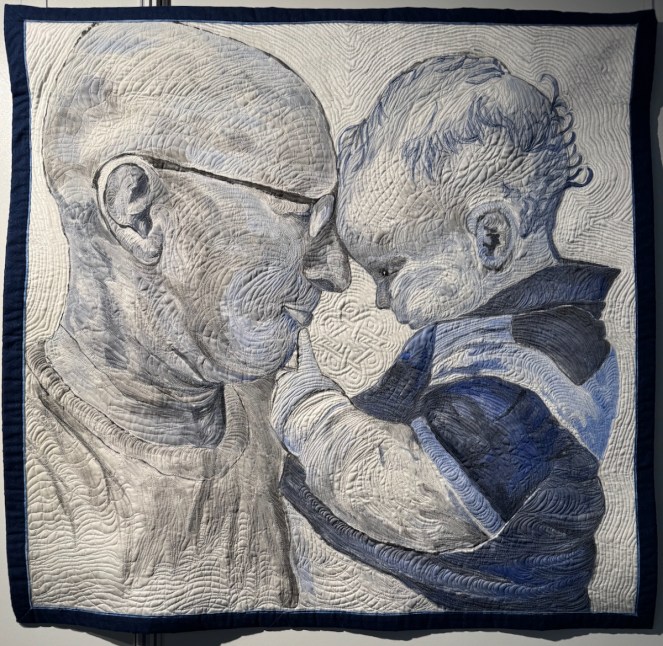
Love You x2, by Joanna Ellis. Unfortunately, the title card photo was so blurry it’s difficult to read (the hazard of a quilt show!), but the artist does mention the Celtic knot, quilted into the center, which symbolizes a love that never ends–in this case, between a grandson and his grandfather.

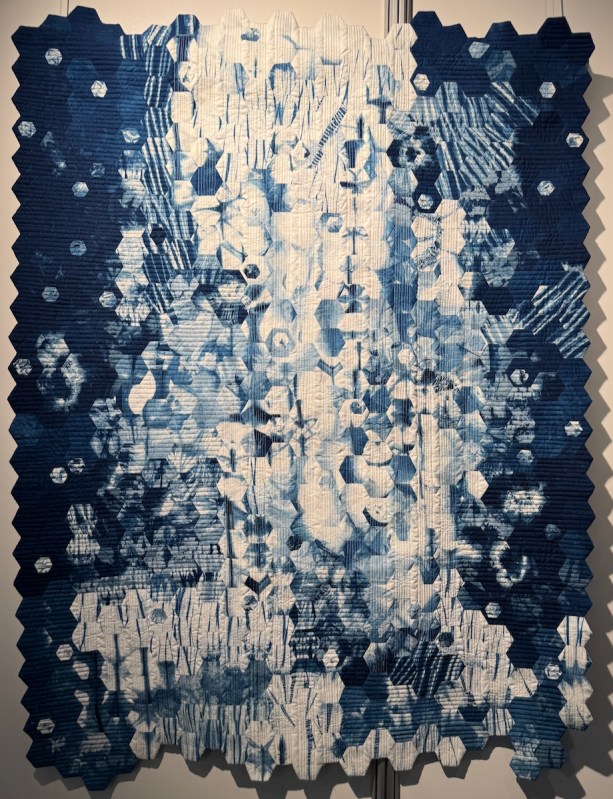
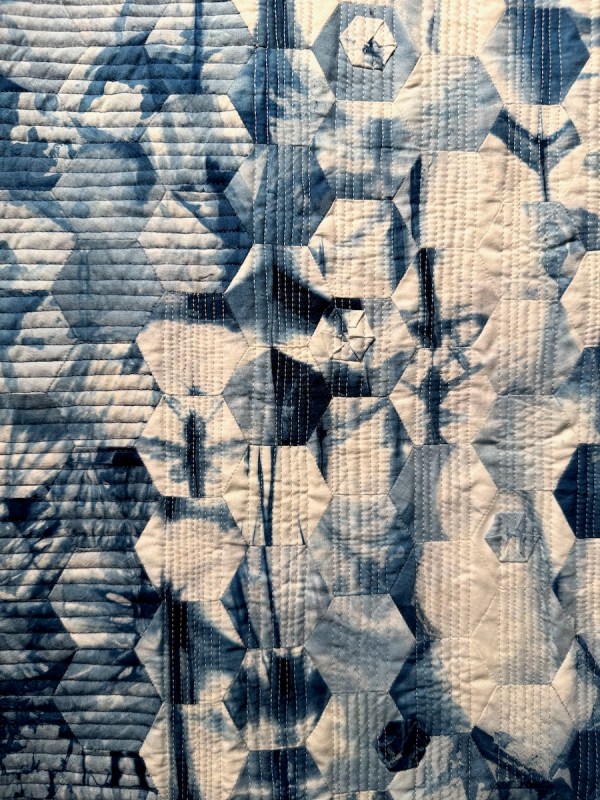
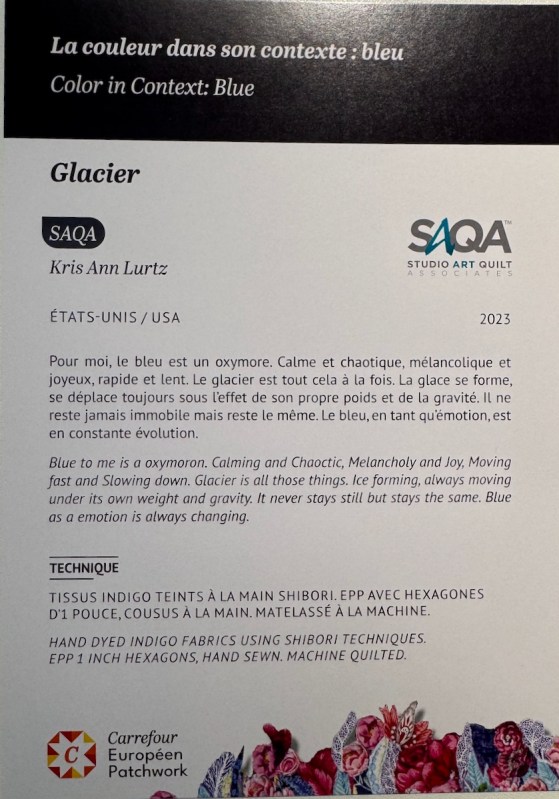
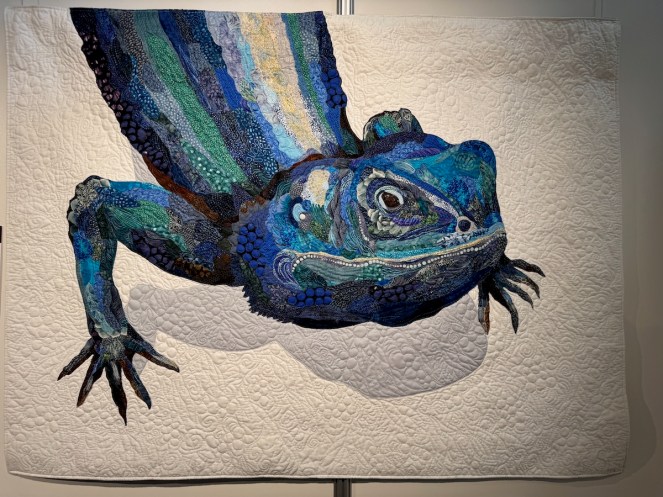
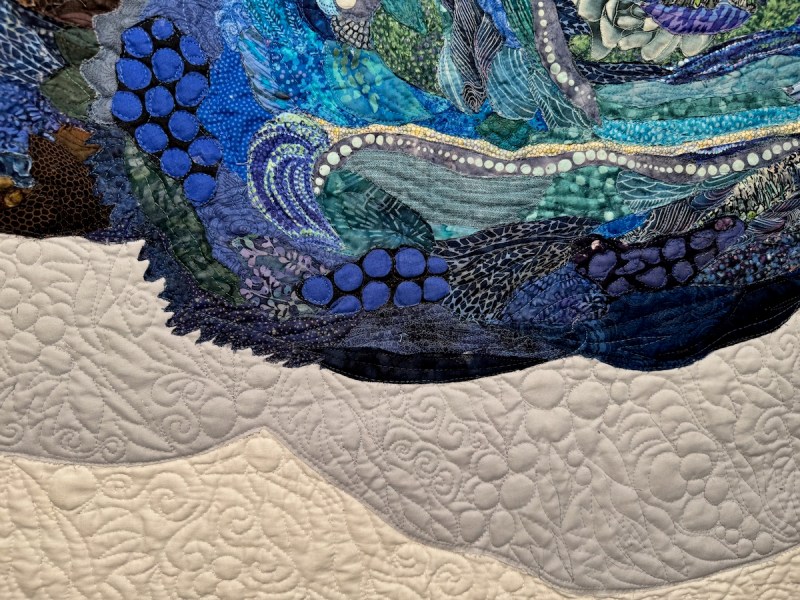
I loved the shibori technique, coupled with the small one-inch hexagons. The smaller folded hexagons attached here and there bring to life the idea she writes about: “Blue as an emotion is always changing.”

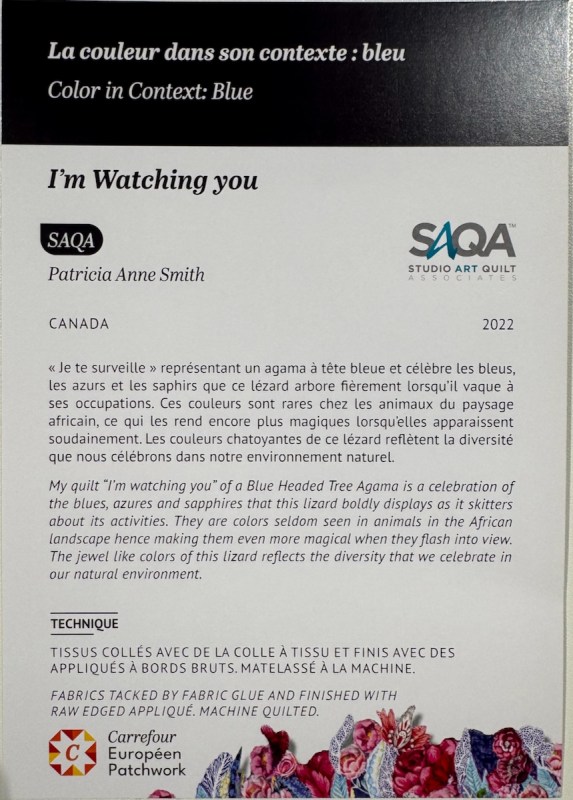
Another creature! And so many blues and so many textures, not only in the Blue-Headed Tree Agama, but also in the quilting in the background..

Last one in the blue series for this post.

The SAQA blue quilts were sort of over in the far upper left of this building.

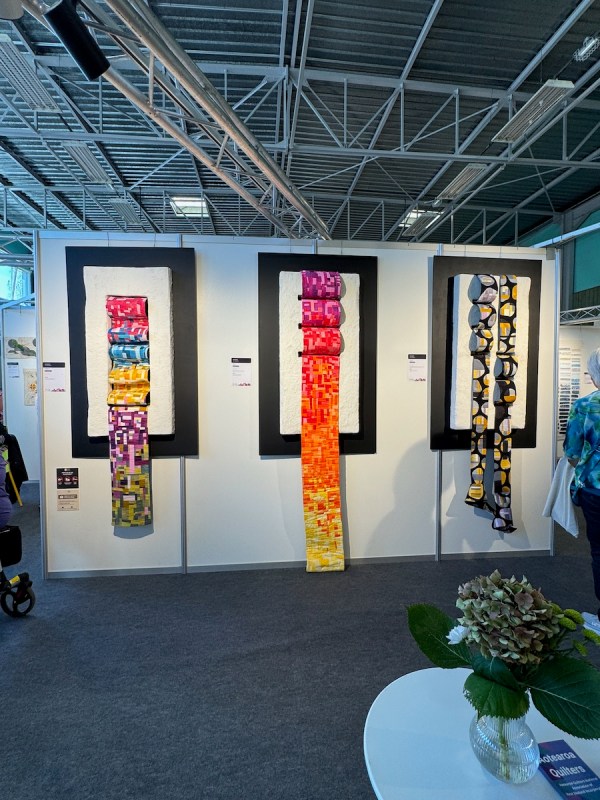
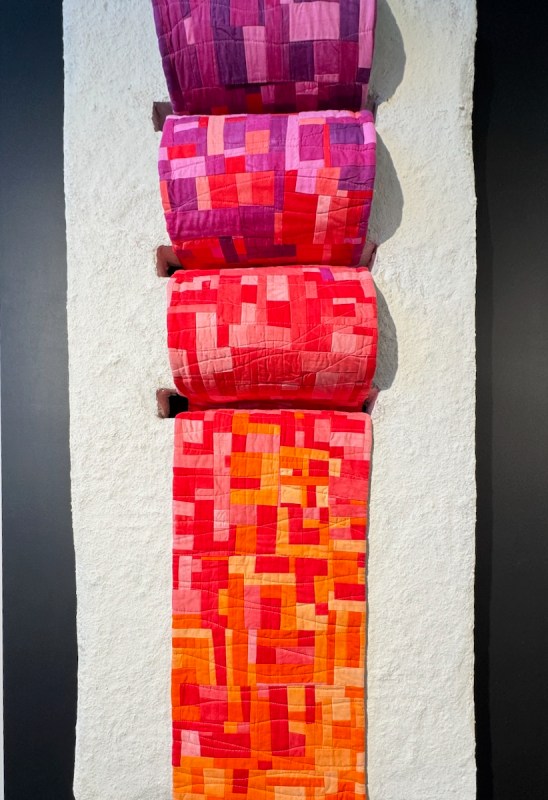
This is what greeted us when we came in: this triptych of folded and hanging quilts.

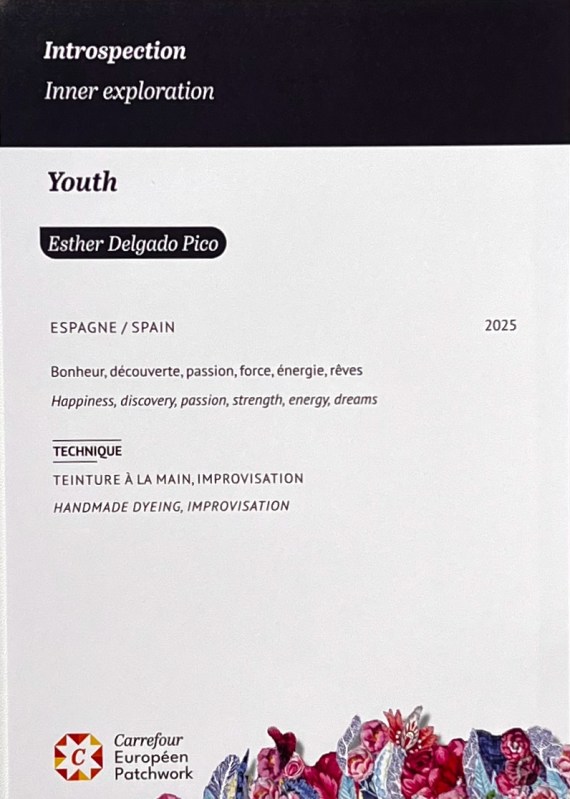
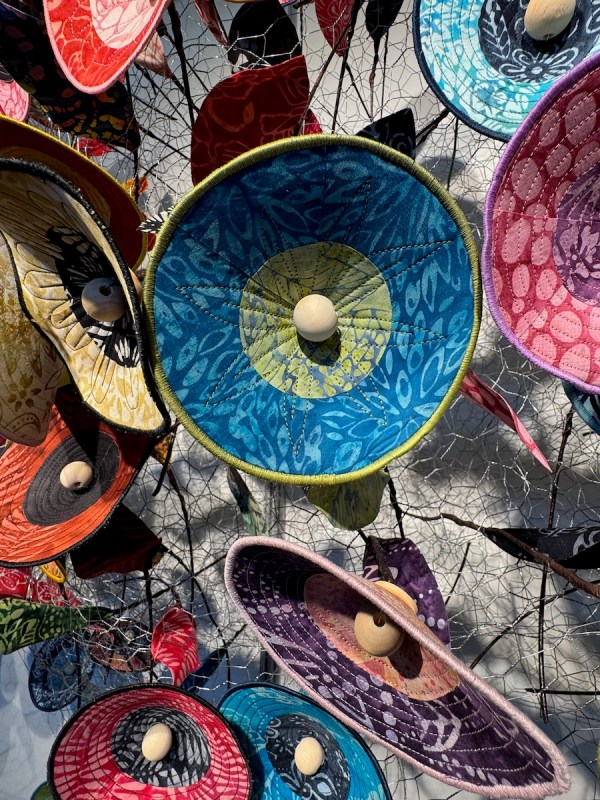
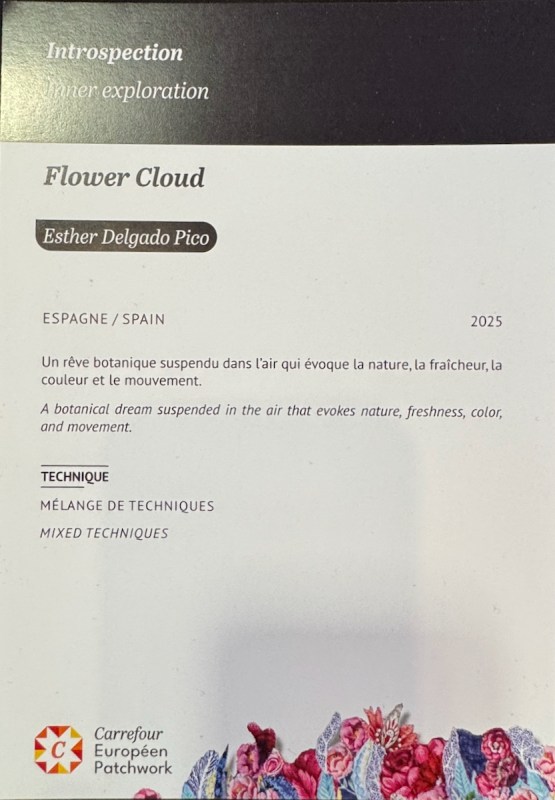
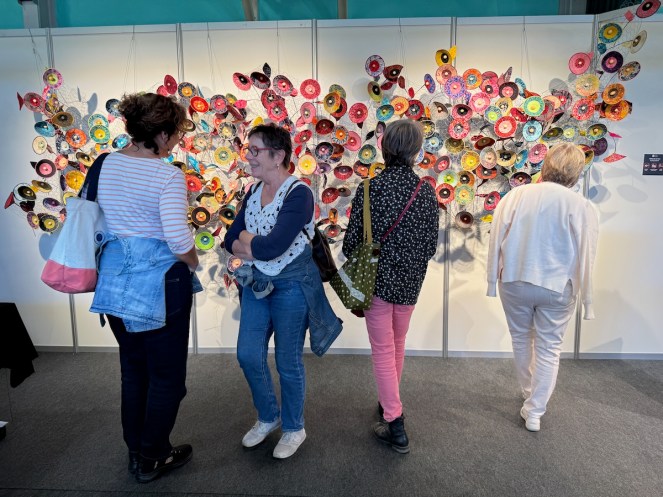
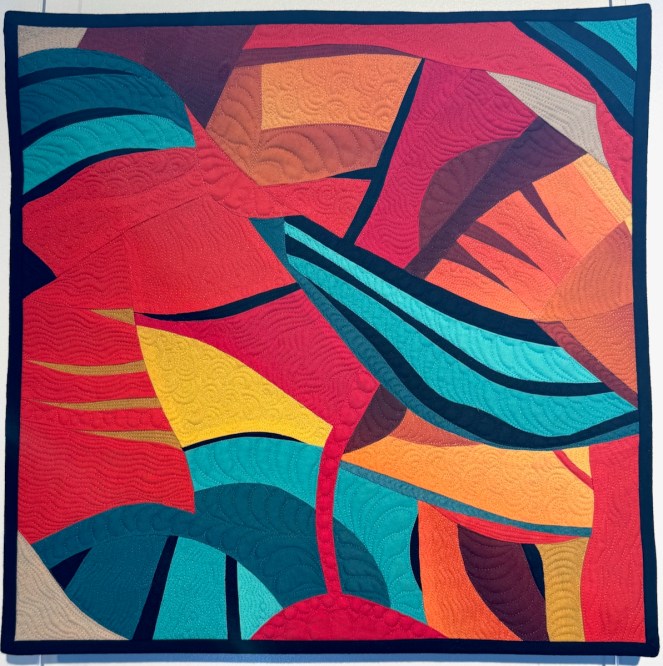
Esther Pico had quite a few quilts, and this is the title card from the one in the center of this group (unfortunately, no photos of the other title cards).

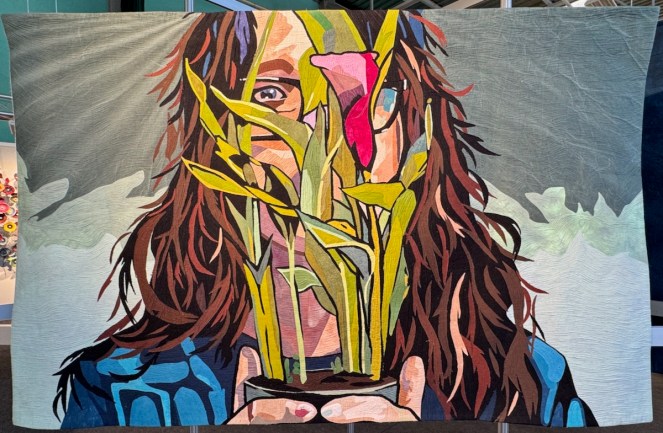
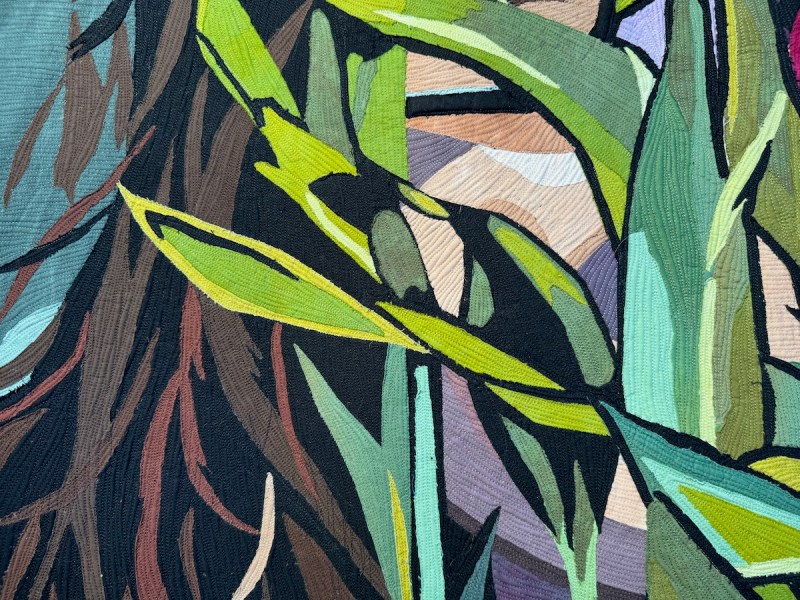
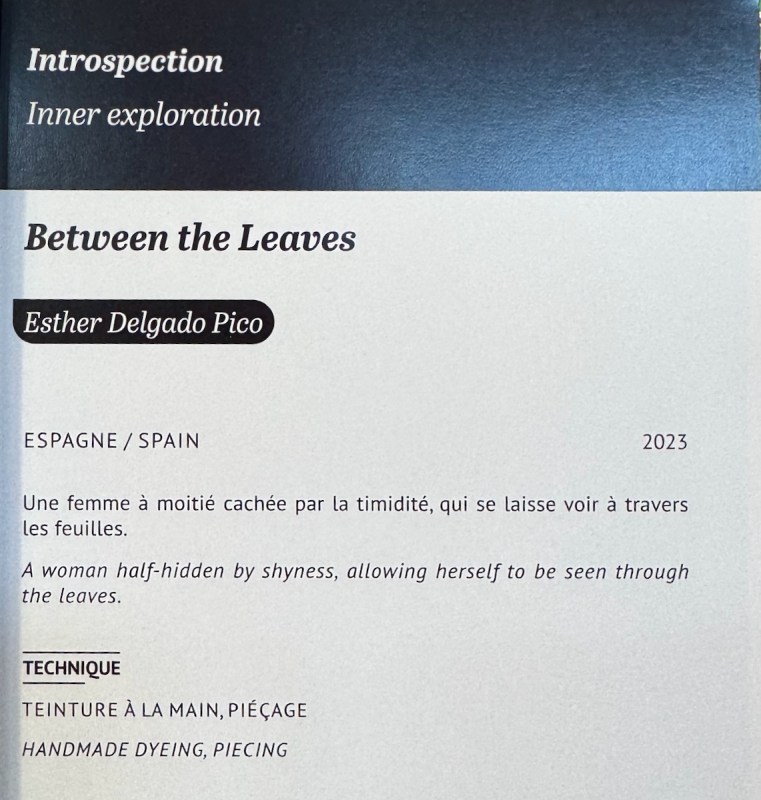
Turning to my right, I see this quilt, of the artist (maybe?) peeking out between the leaves of her plant.

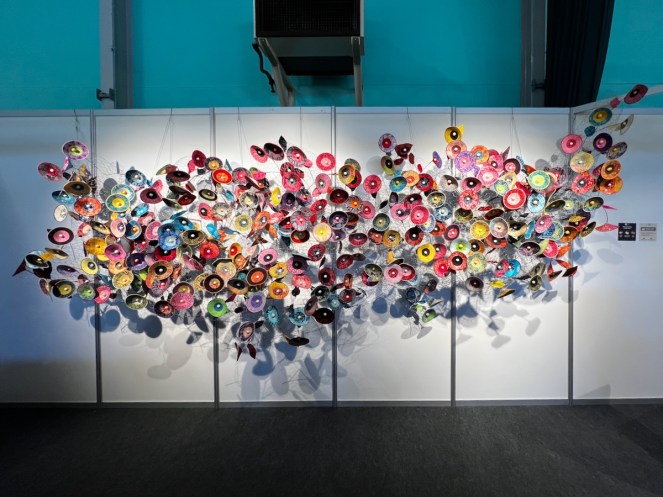
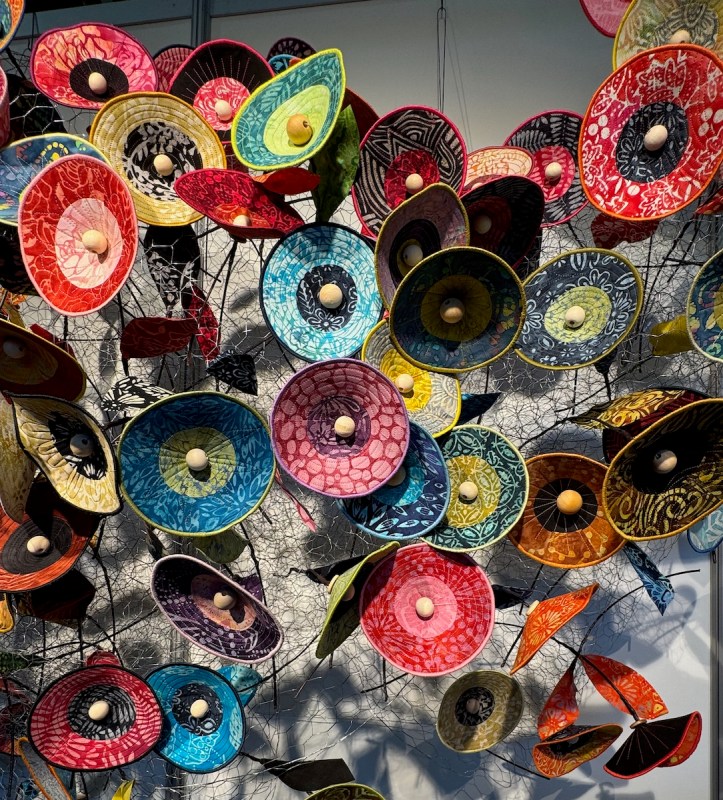
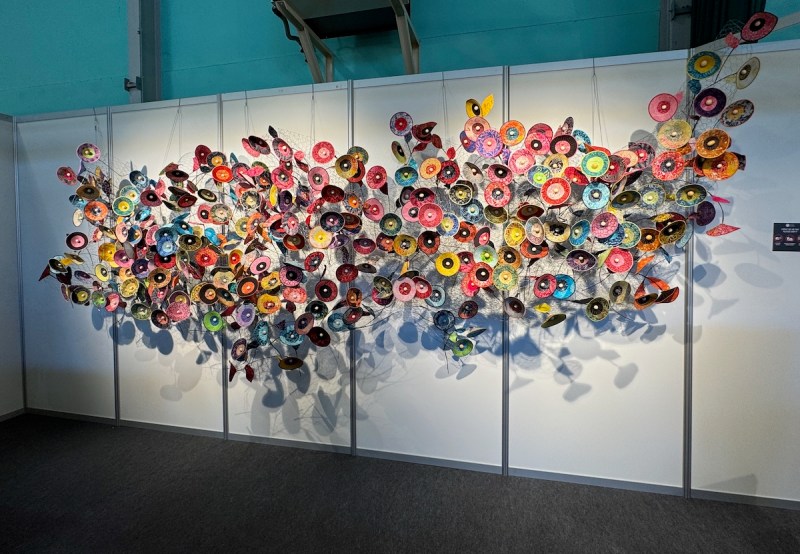
And then just beyond the shy woman with the plant, was this burst of floral energy! We took more than a few photos:

This is how it looked most of the time: a place to gather with friends and to study and look at all those blossoms!

This is a piece from Linda Steele who belongs to the Ozquilt Network (OZQN), an Australian organization for art quilters and those interested in art quilts (from the catalogue). Tropicana is the title, and she writes: “I happened to be at a bird sanctuary at feeding time, and I was delighted to have birds flying all around me.” It’s not a huge piece, and I realize that this time many of the quilts did not have their dimensions listed, so it makes it hard to visualize the relative sizes (sorry).

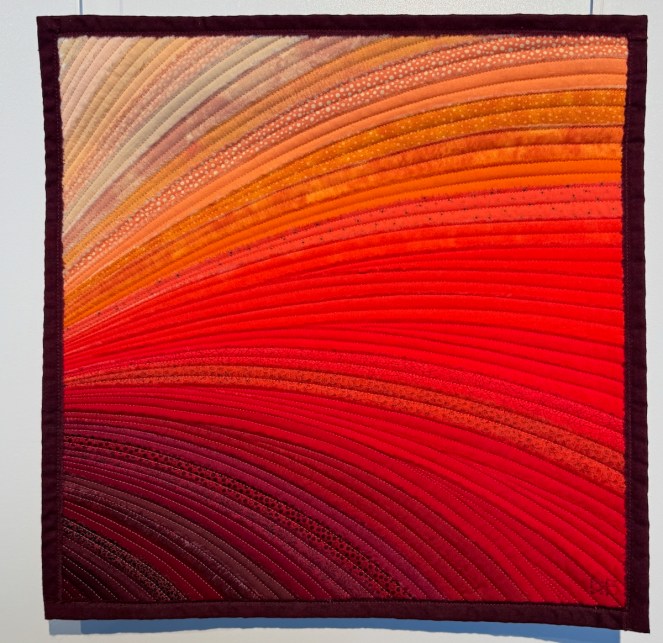
This is also a smaller piece. It’s by Dianne Firth (also with OZQN) and is titled Evening. It was done with torn-strip appliqué, machine stitching and quilting. She writes: “Each evening the sky takes on a different characters. Sometimes it is clear and serene while at other times it takes on a brilliant display of red and orange.”

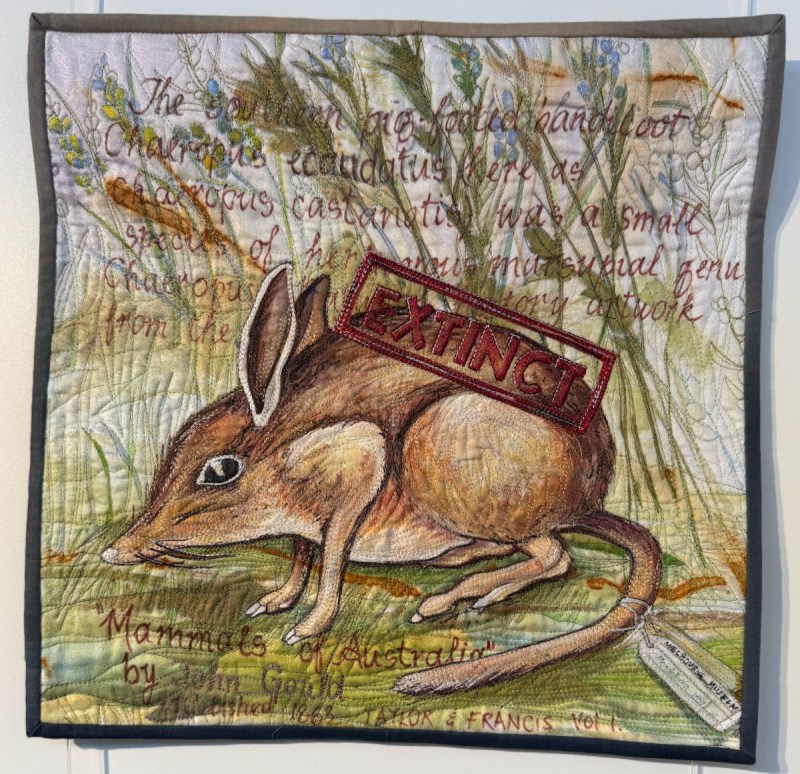
Julie Haddrick makes a keen (and startling) observation about the different mammals that are now gone.

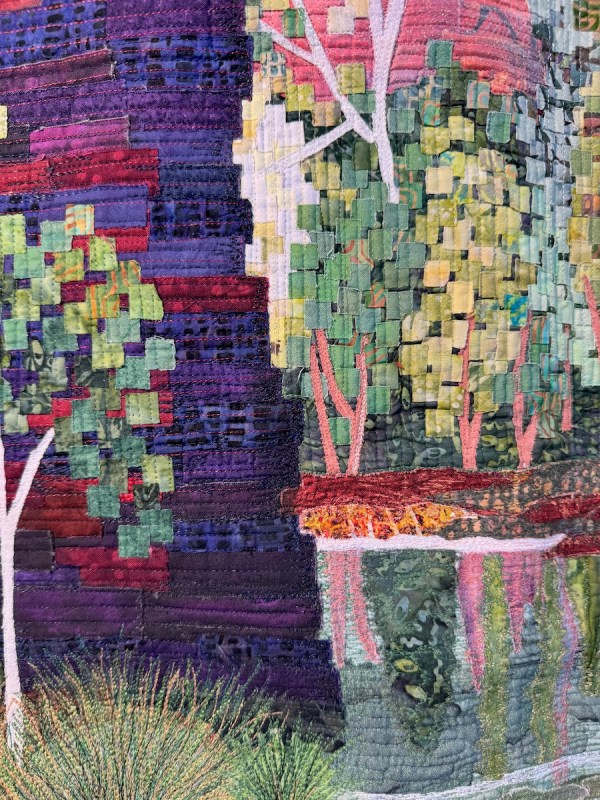
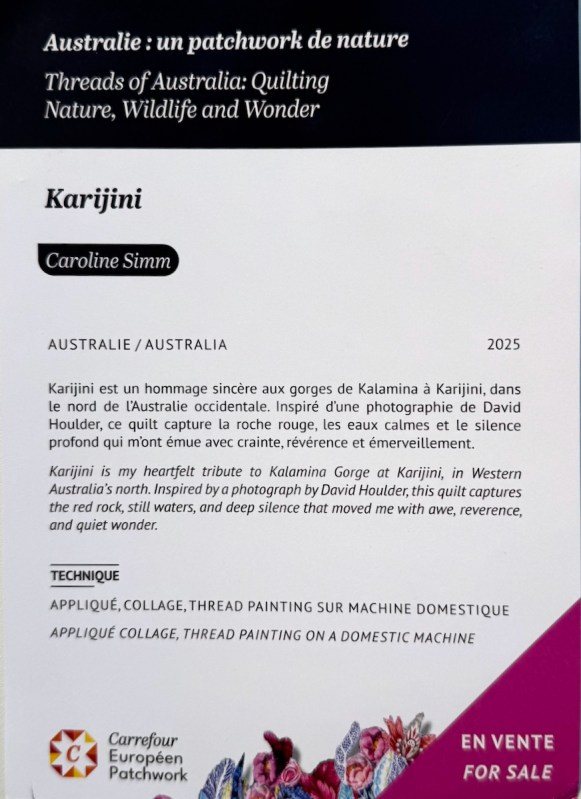
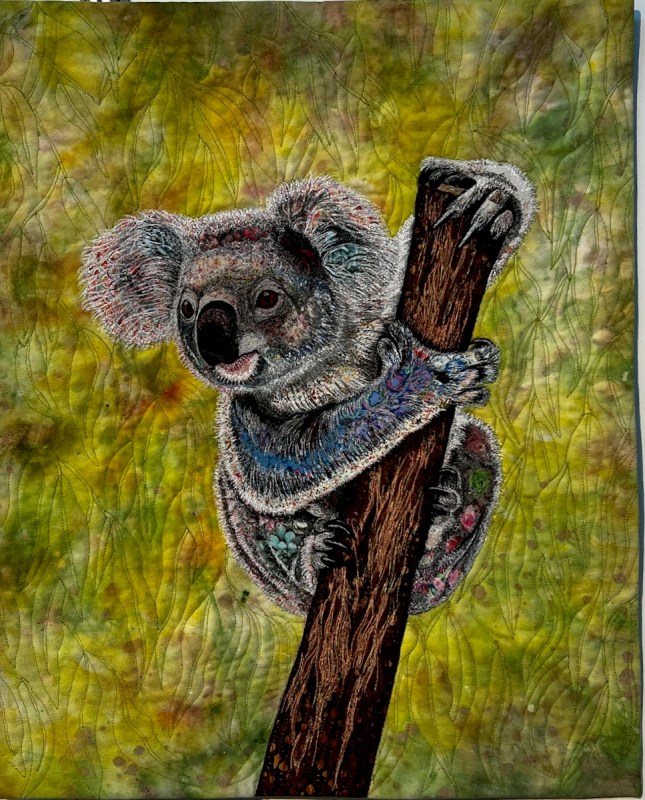
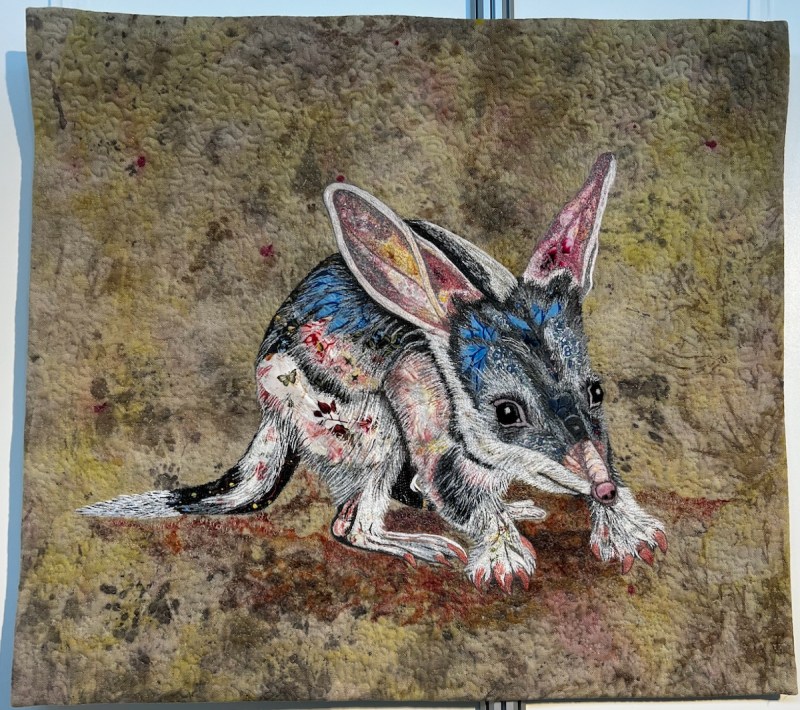
Below is a collection of quilts by Caroline Simm, who lives in Western Australia, and who has been quilting for over two decades. She likes to use mixed media, art quilting, and collage.

This was a larger quilt, with complex construction and collage.

(Click in order to enlarge to read details.)

A design by Ruth deVos, who also has her own exhibit here!

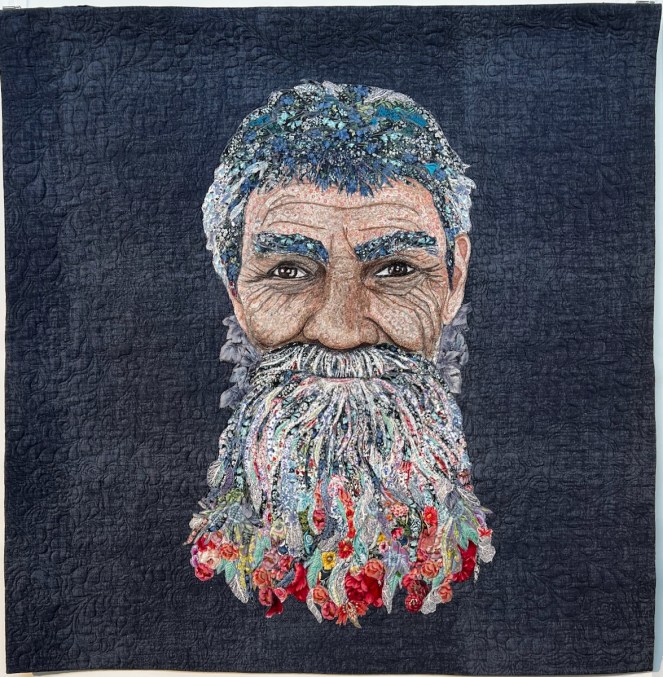
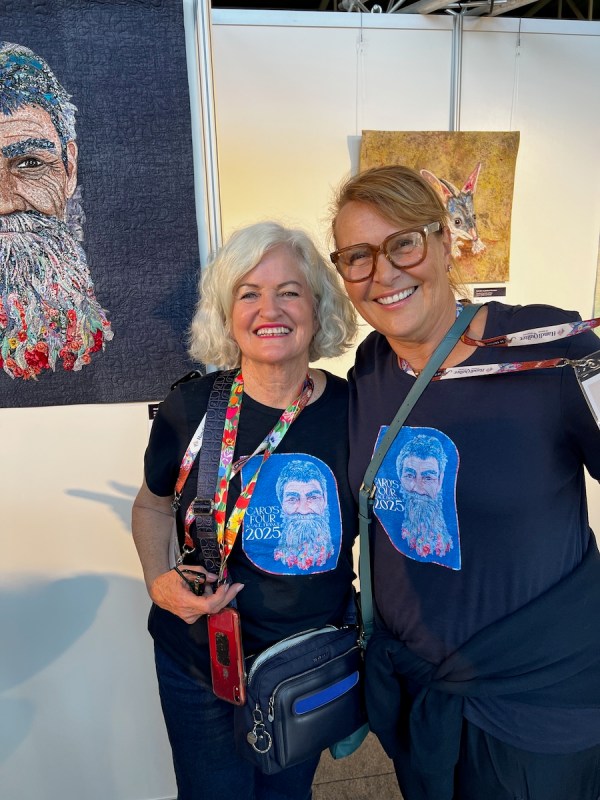
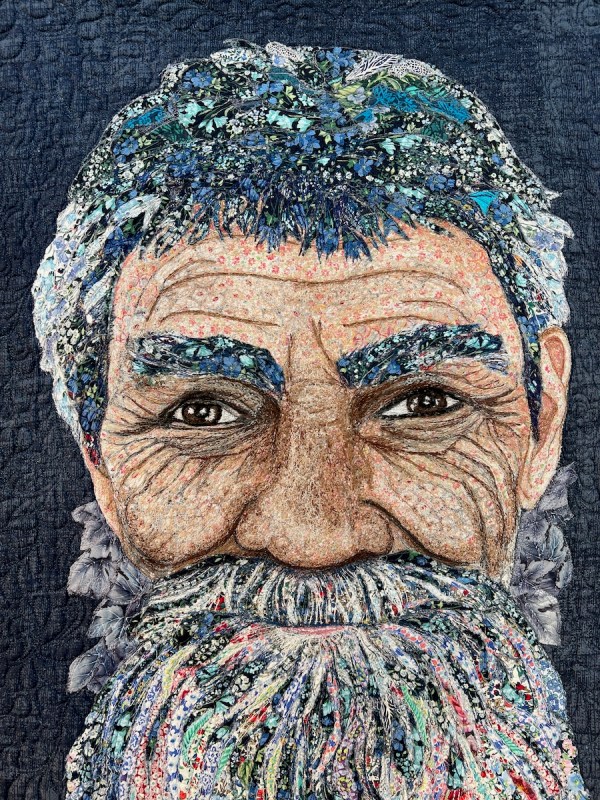
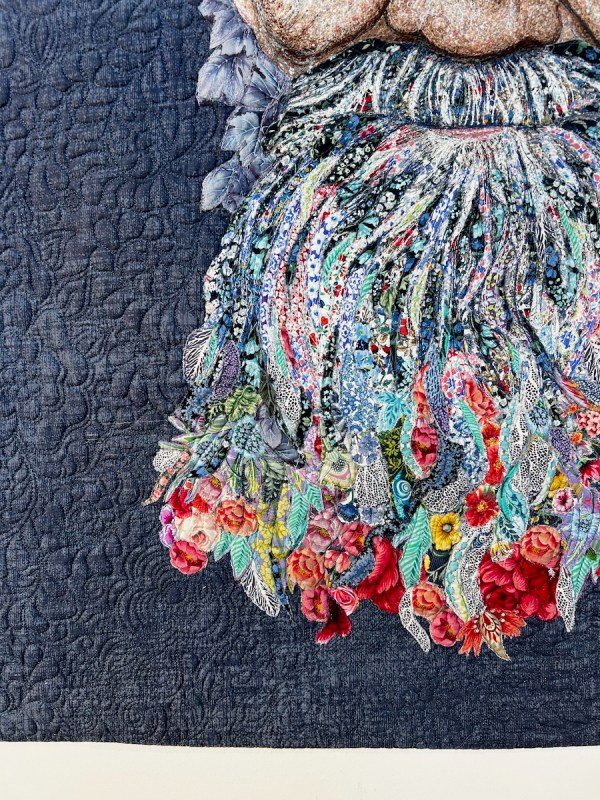
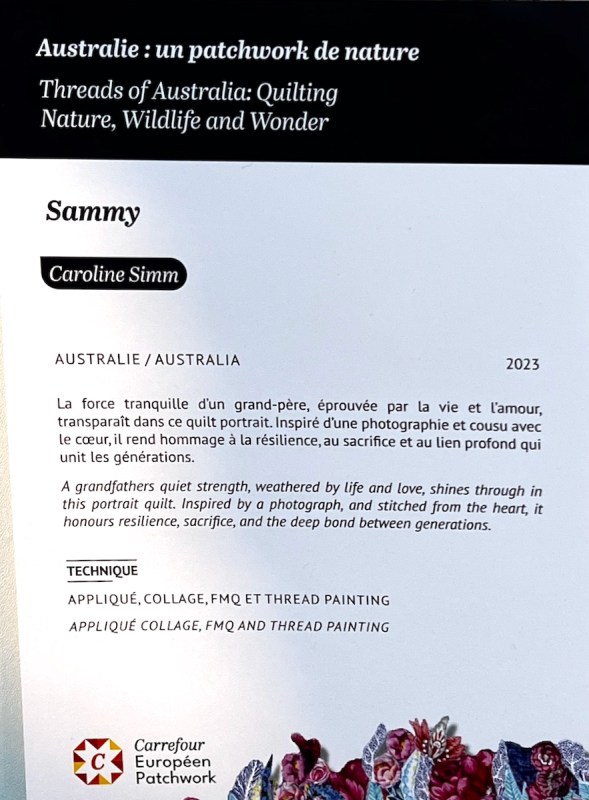
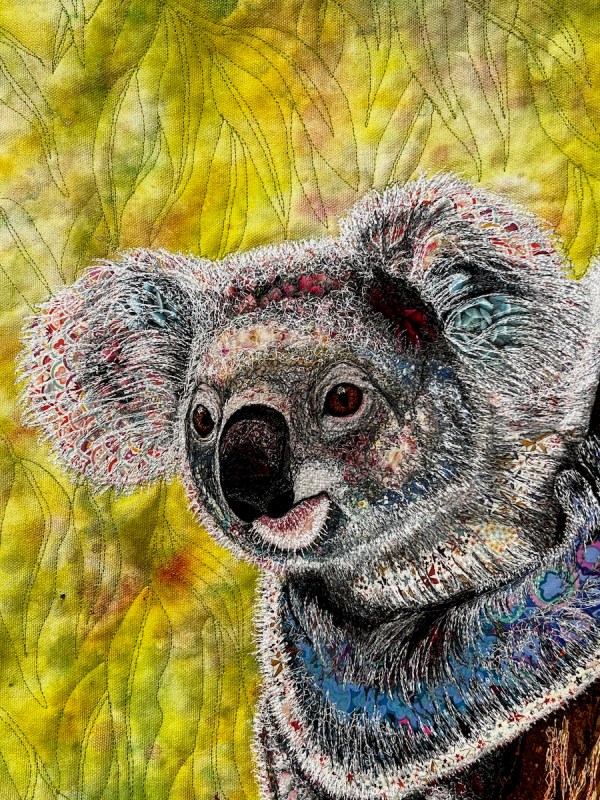
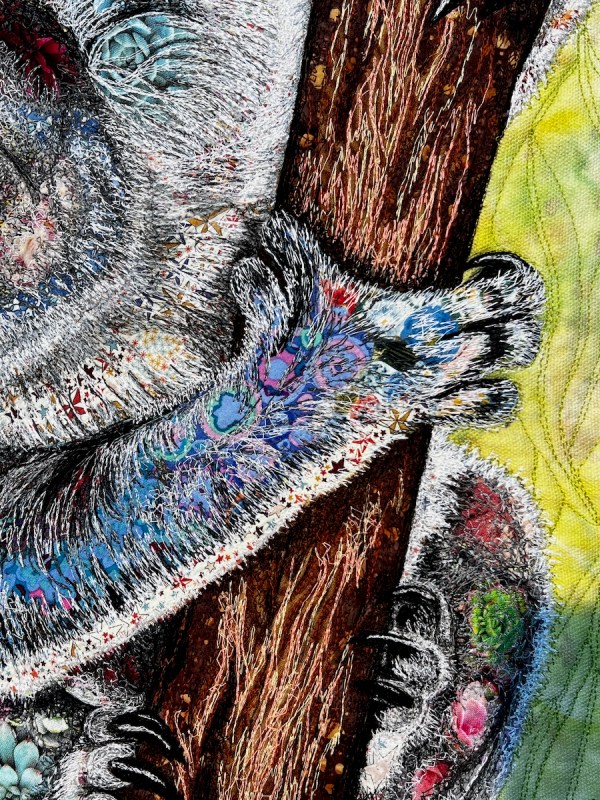
Sammy. He was the mascot of the show, as shown by the T-shirts below. Details are in Simm’s IG post.

Click to see how Simm layers in different fabrics to bring out the texture in Sammy’s beard.

A trio of smaller quilts, now, of the wildlife in Australia and also by Caroline Simm.

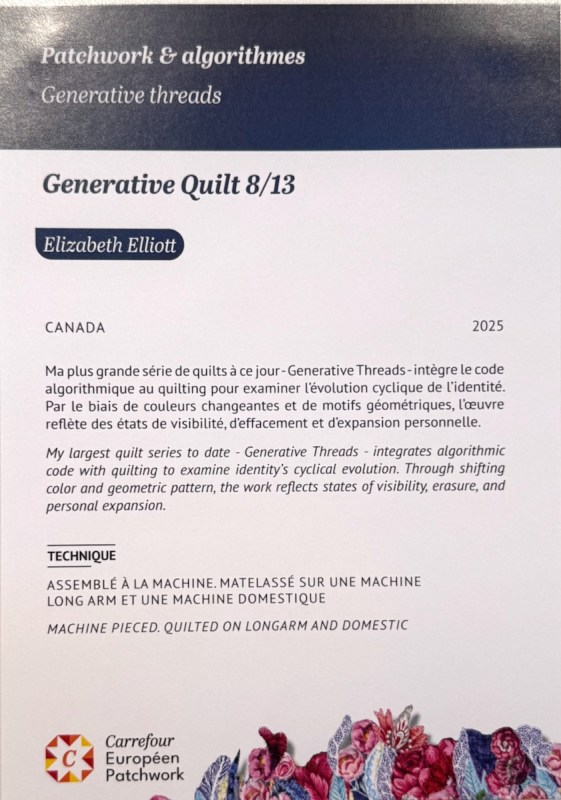
In the far right, in the corner of the Espace des Tissurands, was a small exhibit with quilts by Libs Elliott. She was not there when we visited (probably teaching or speaking).

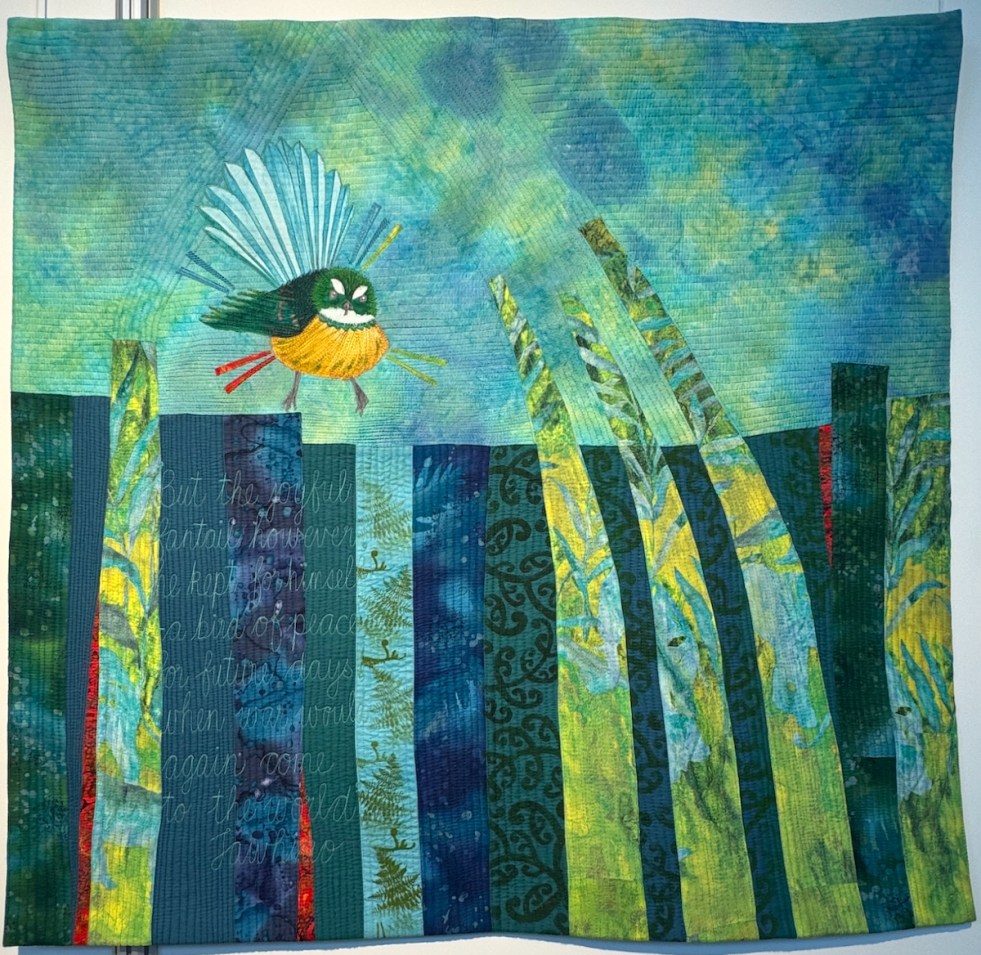
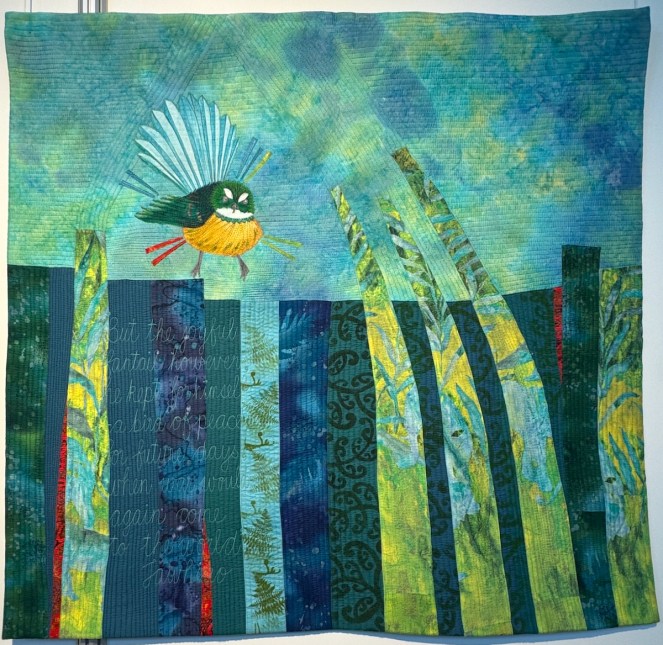
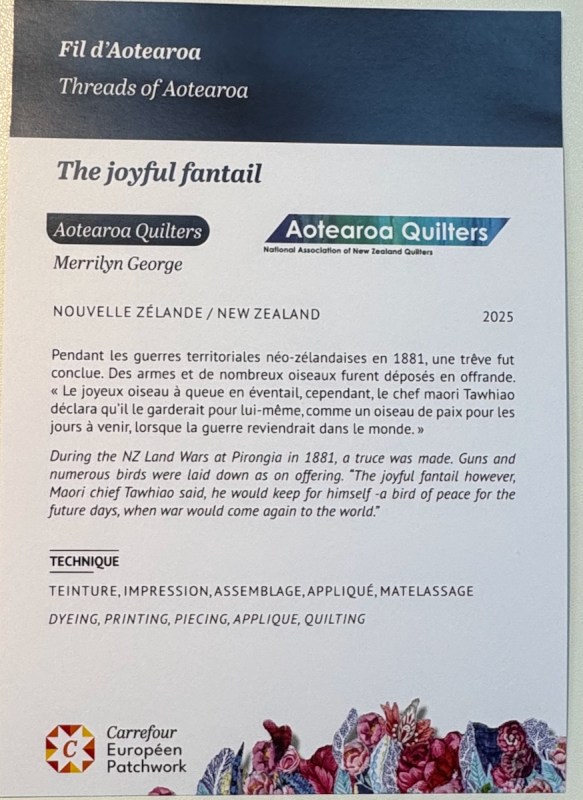
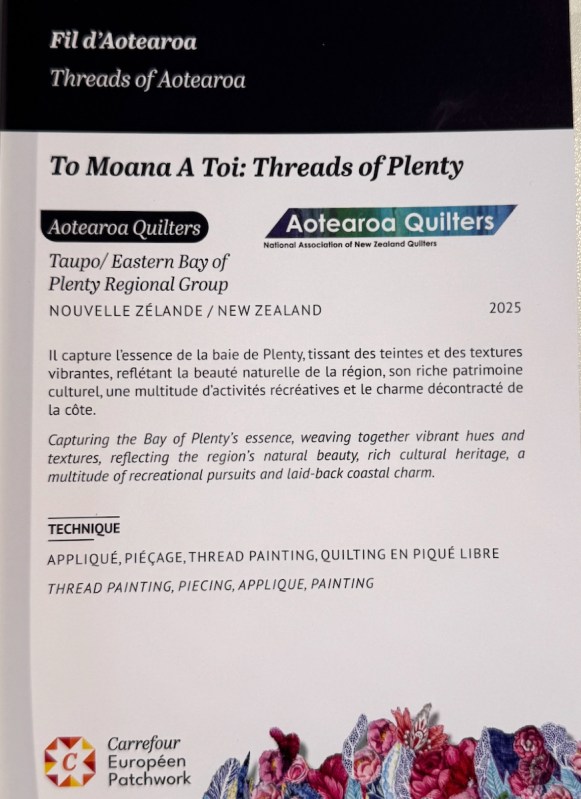
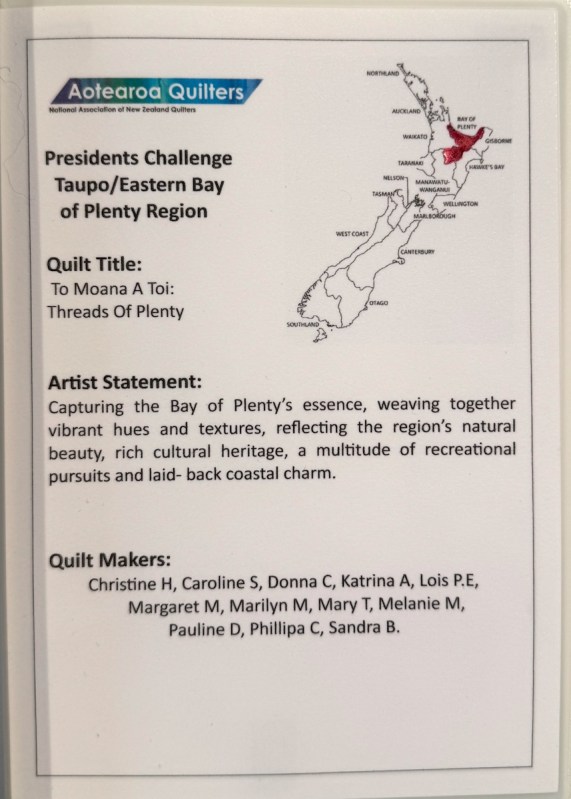
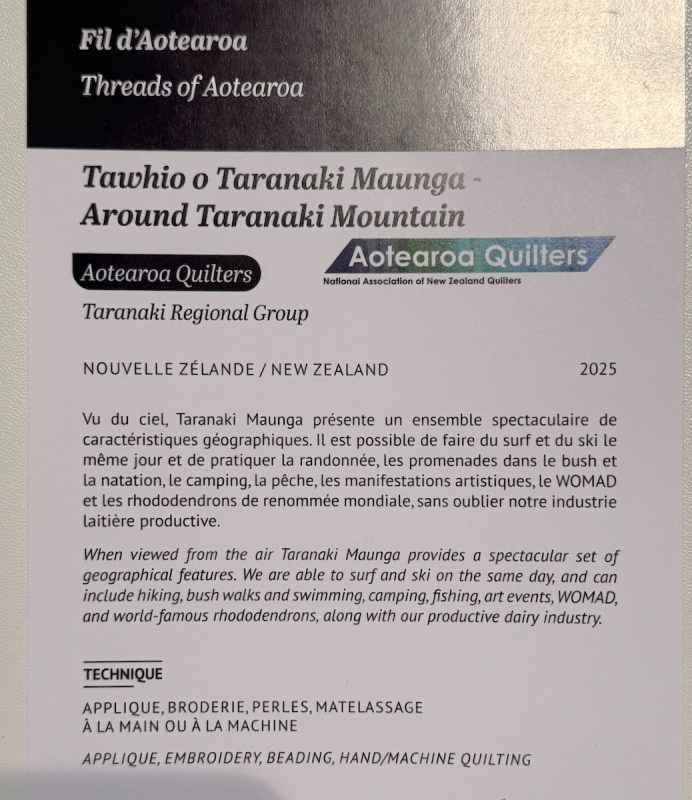
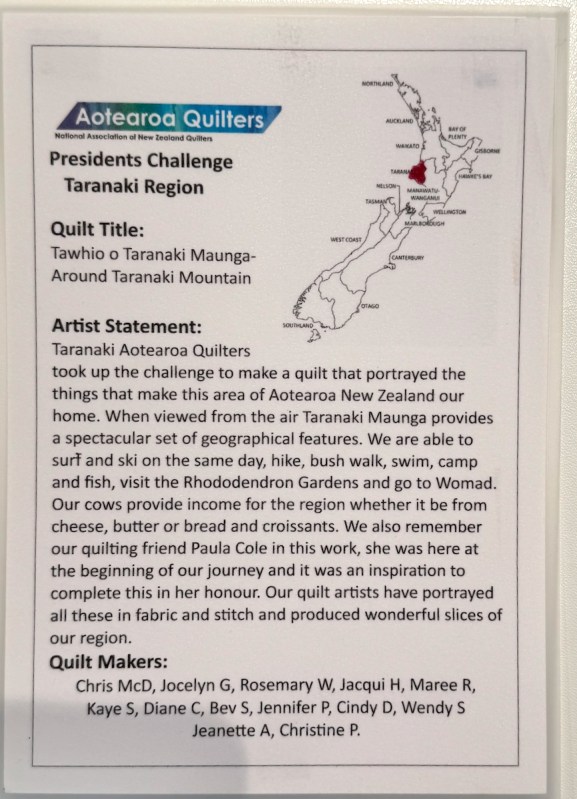
Are you still with me? Now some quilts from the Aotearoa Quilters, and as a treat, they gave me one of their giveaway pens (I’m big on souvenir pens). This organization is the only quilting group in New Zealand, “that operates at a national level. The principal objective of Aotearoa Quilters is to promote the art and craft of patchwork and quilting within New Zealand” (from the catalogue).

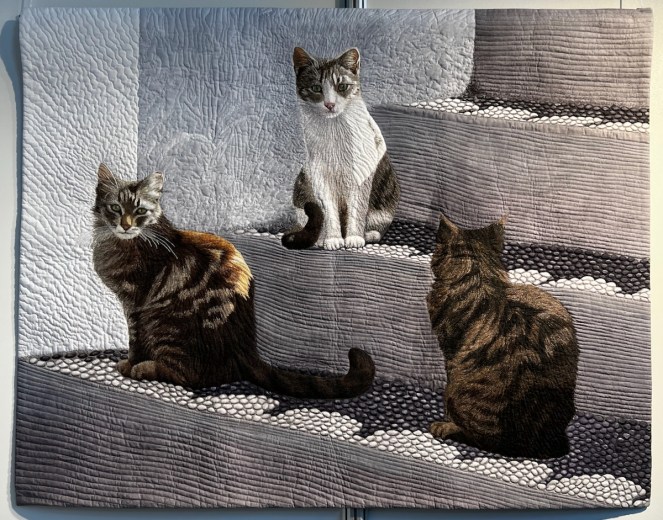
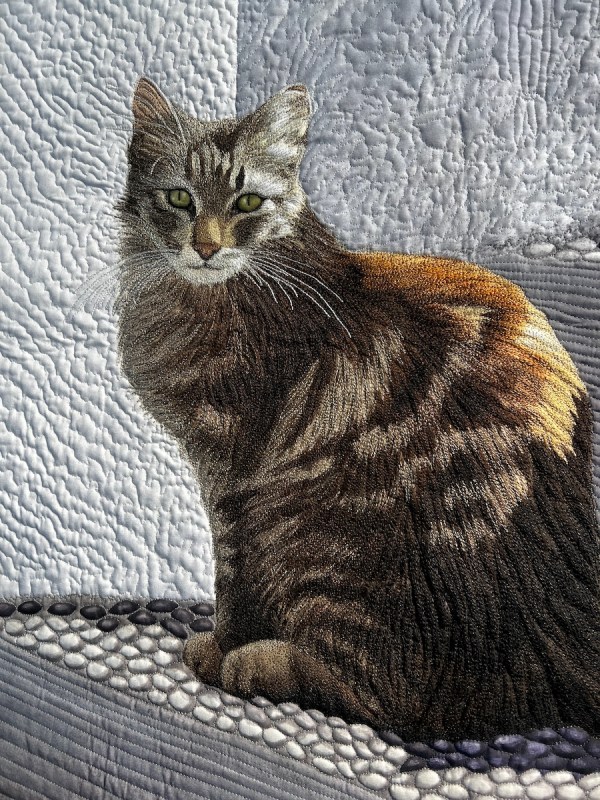
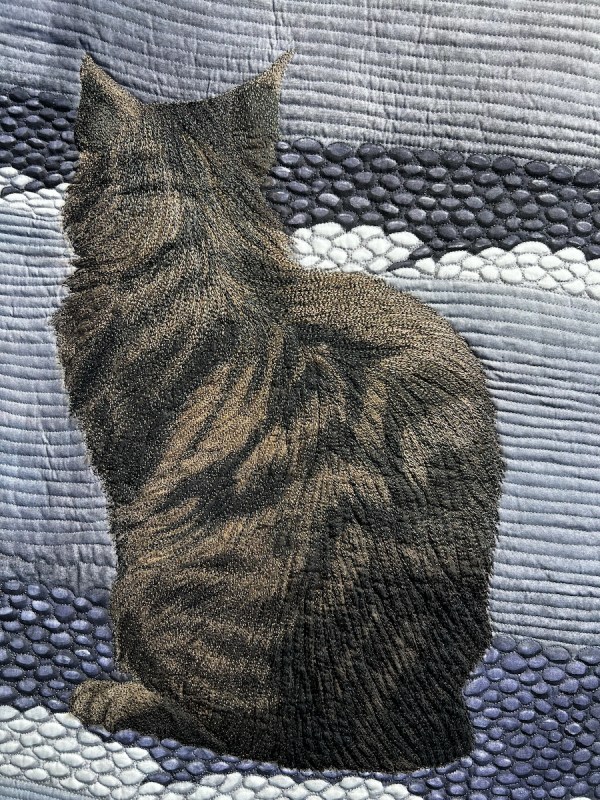
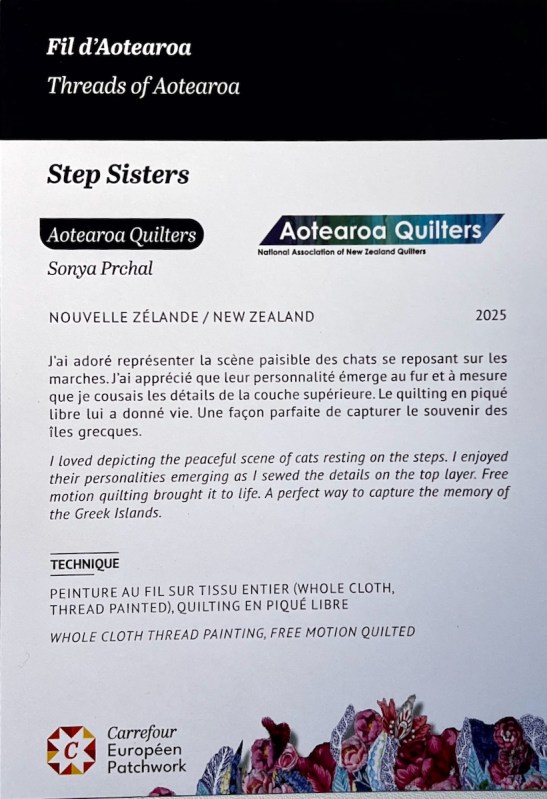
You could almost reach out and pet this cat.

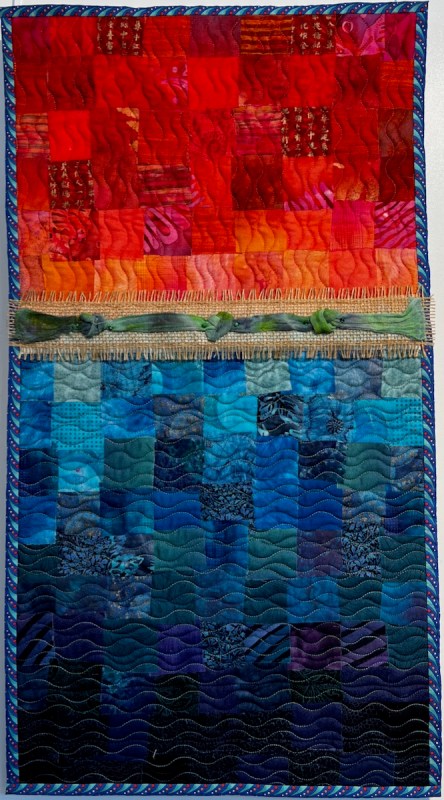
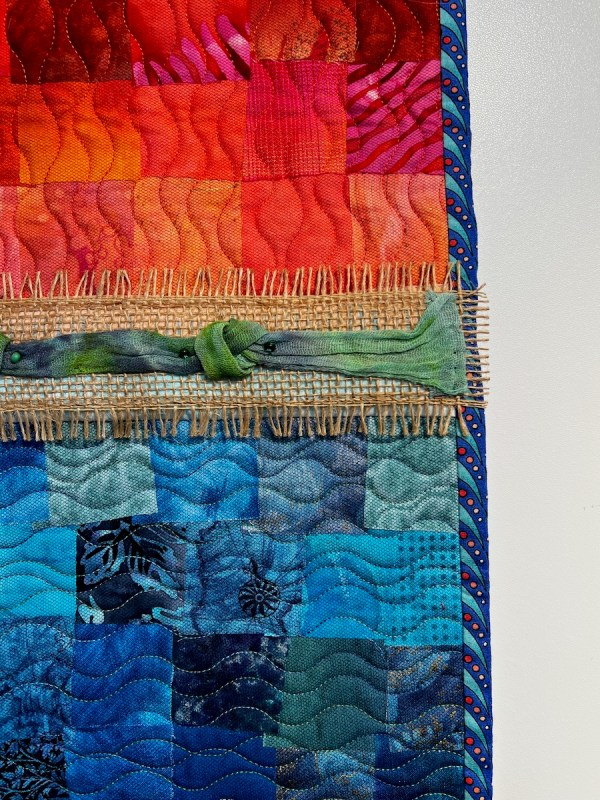
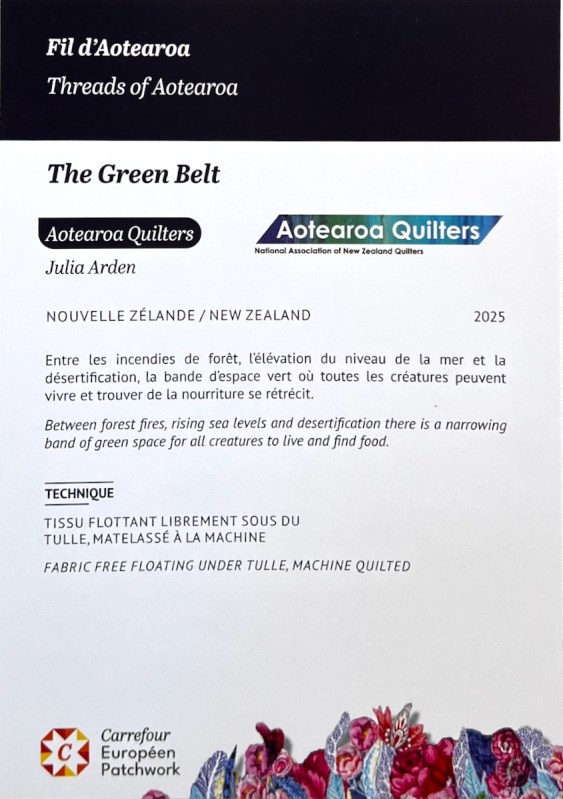
Arden’s piece was a favorite of mine, with the different materials and that fabulous binding.

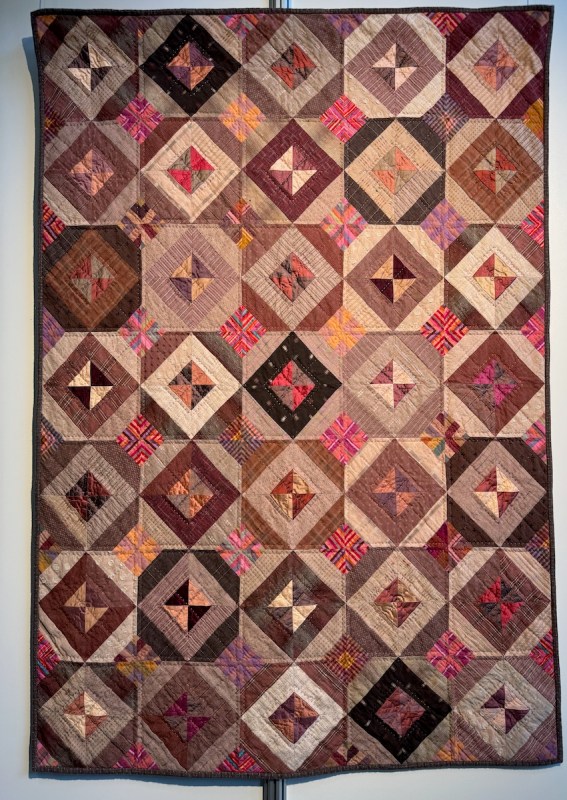
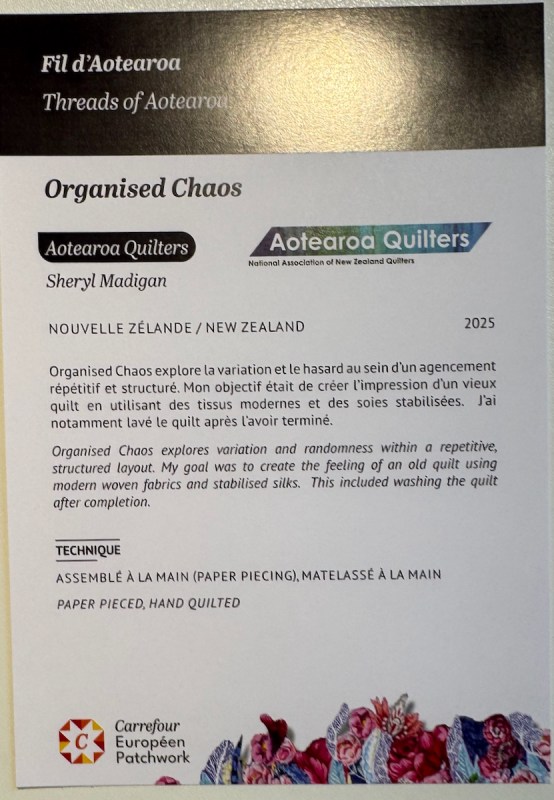
Organized Chaos, by Sheryl Madigan.

I love all the “hidden” piecing in here, in the background, in the figures, in the halo. So many interesting parts to study.

Oh, I want to meet this bird!

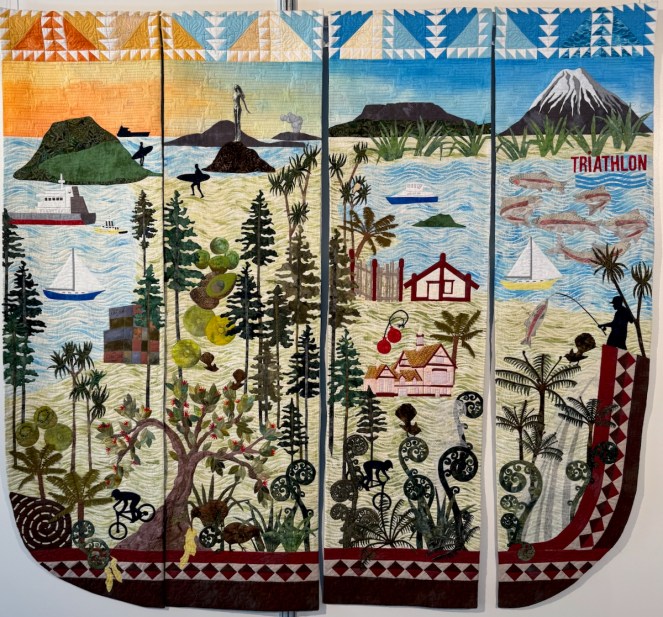
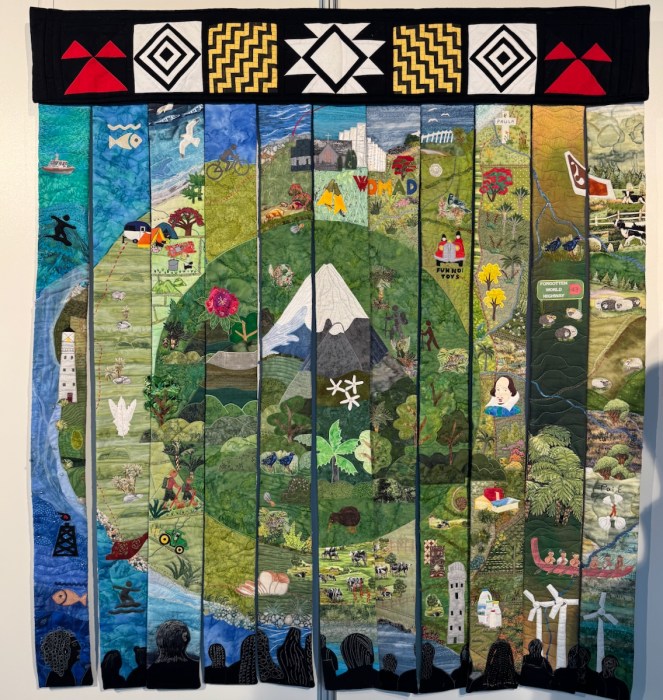
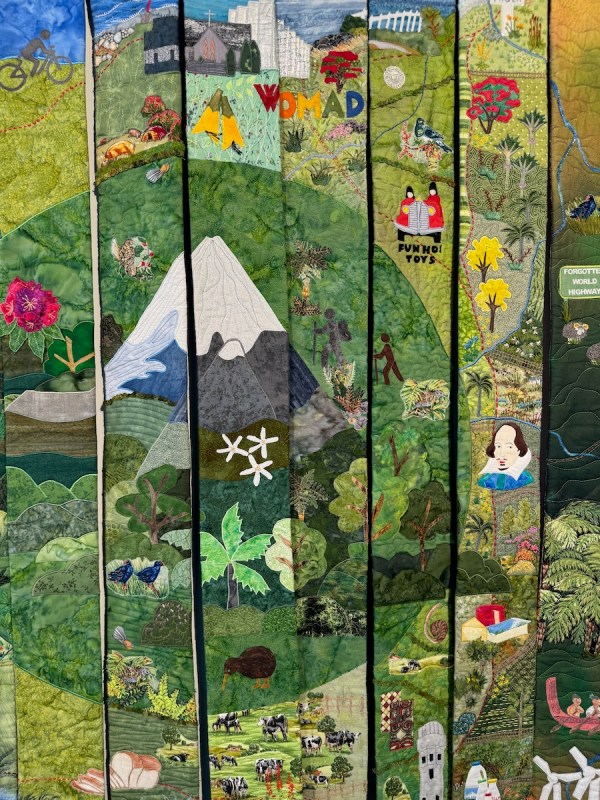
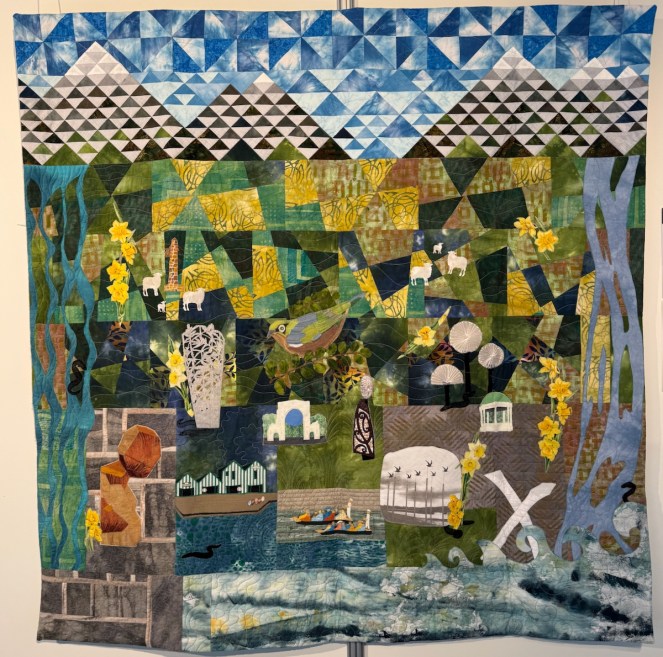
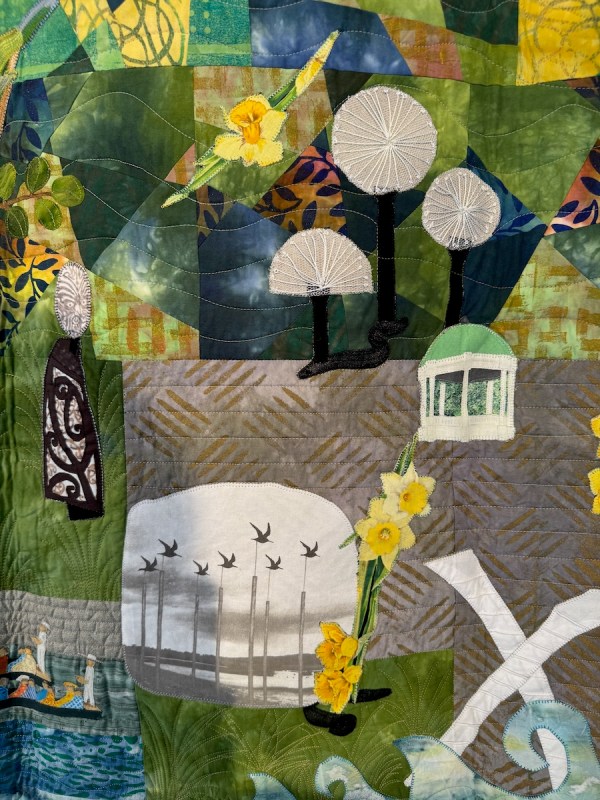
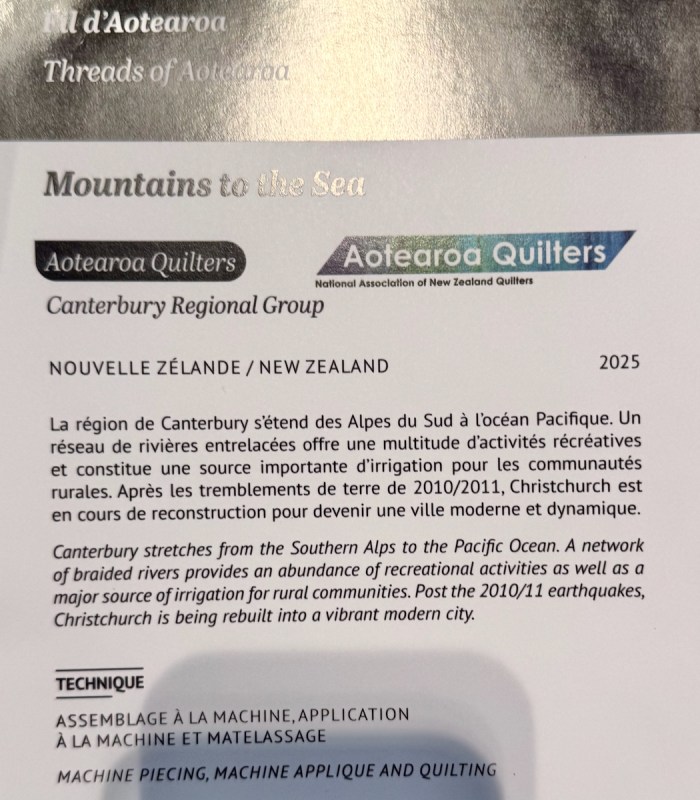
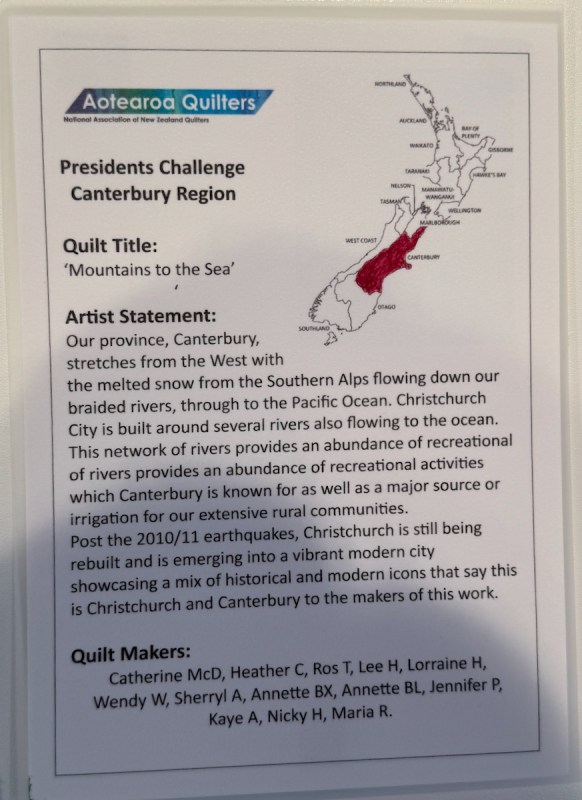
Here are two quilts constructed in the same way: with parts made by several quilters, and a band of pieced fabric at the top.

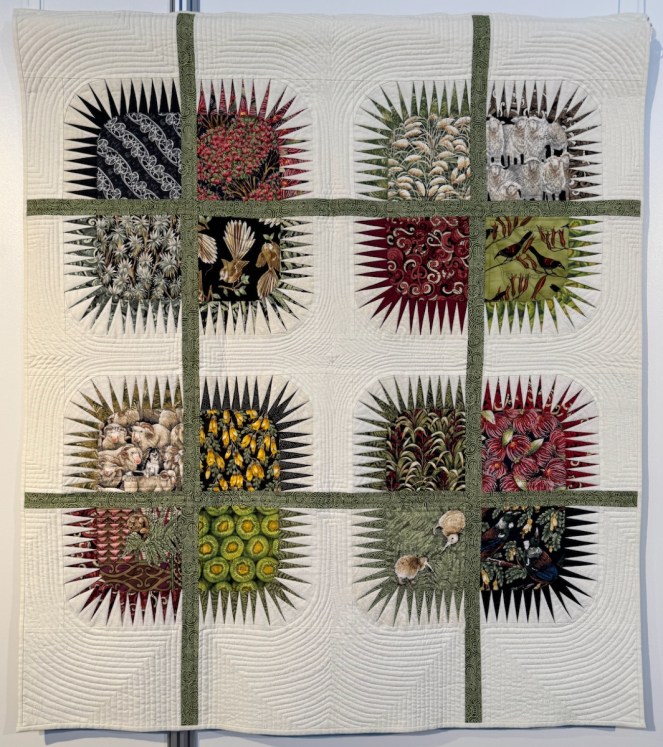
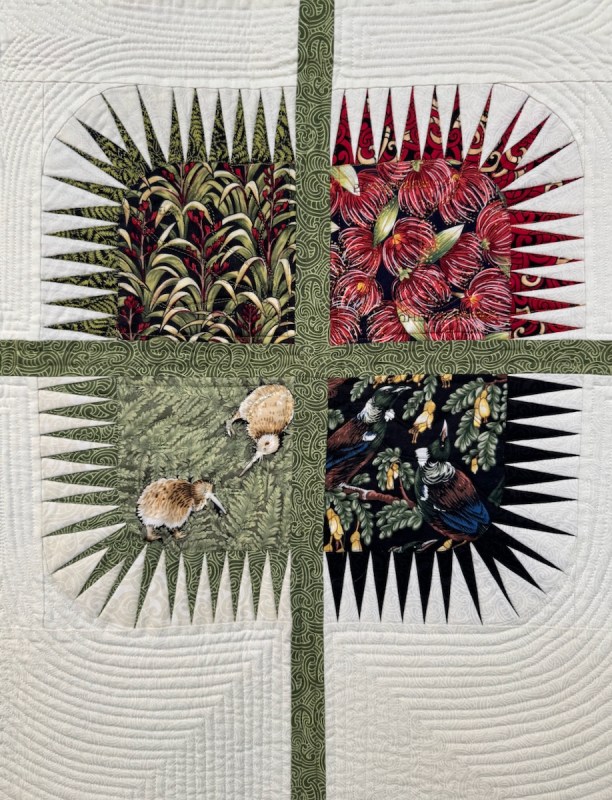
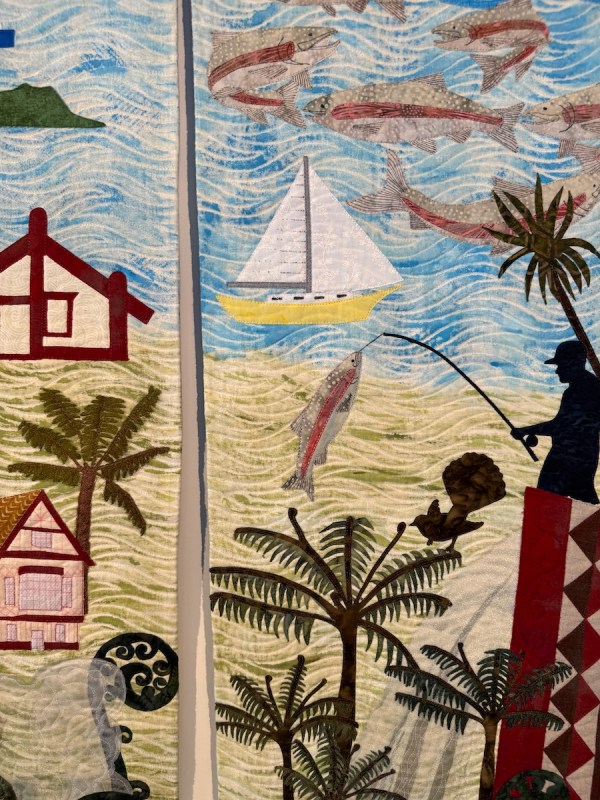
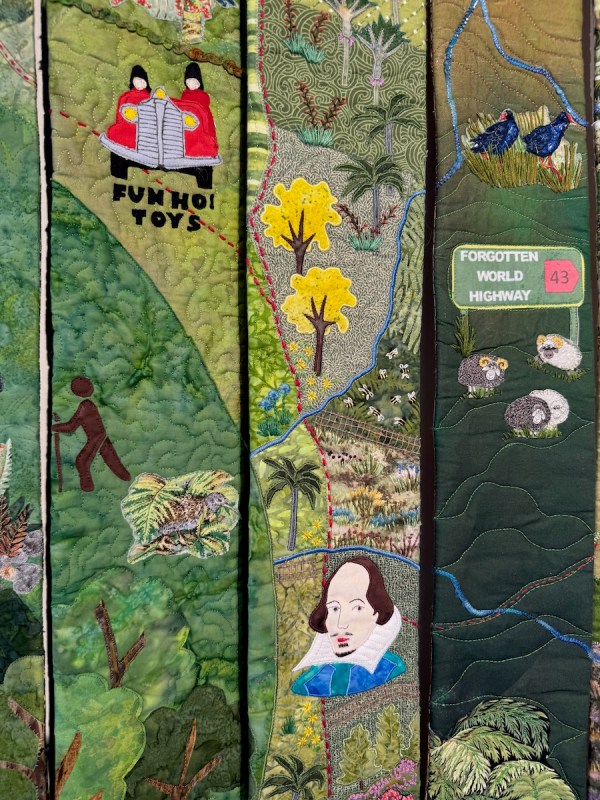
I love how I could learn about this area of New Zealand, just from studying the images.

While this quilt had the pieced bands at the top, it was not made in strips. It was, however, made by a group of quilters.

And now one that really caught my eye, to close out this post. I know this post was long, but there was a lot in this exhibit building, and I liked that it was all grouped together. So I kept it that way in writing it up.

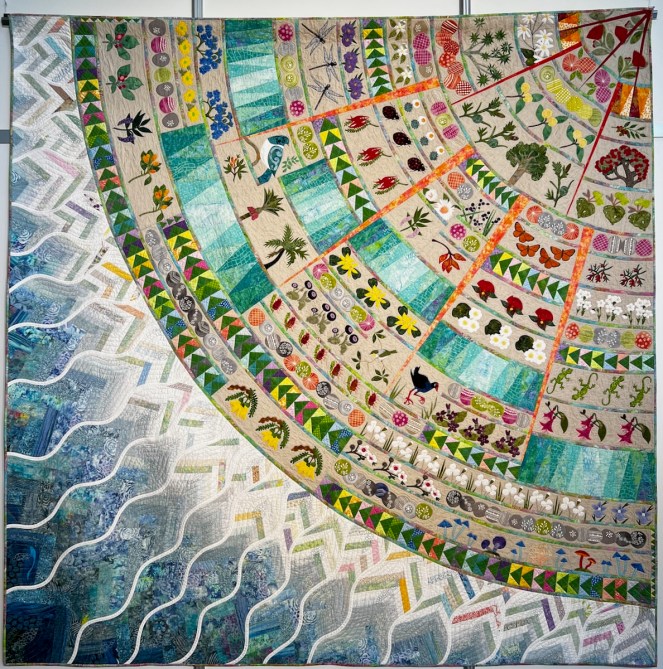
Chris McDonald: My Little Corner of the World

She writes: “My Little Corner of the World refers to New Zealand’s location in the South Pacific Region. My quilt represents both land and sea. The flora and fauna which are featured are all native to NZ and are but a tiny number of the interesting species found here. Inspired by the Japanese quilter Harumi Asada.”

It was pieced, appliquéd, embroidered, and used the quilt-as-you-go method. Here are some more photos:

Thank you for reading about these quilts. It was a lot to take in, but so much beautiful work. I’m turning the comments off on this post, as it came on the heels of the other one. You can always reach me by leaving a comment on any post; I’ll see it.

Quilts · This-and-That

If I Do This, Can I Do That? April 2025

If I go to see all my kids, will I be able to recover from the trip? If I buy this, can I buy that? If I choose to sew this project, will I have energy to tackle that other thing? Or, this is all another way to title a This-and-That post for April 2025. First, the mundane and then the sublime. (Hint: an introduction to one of my favorite artists.)

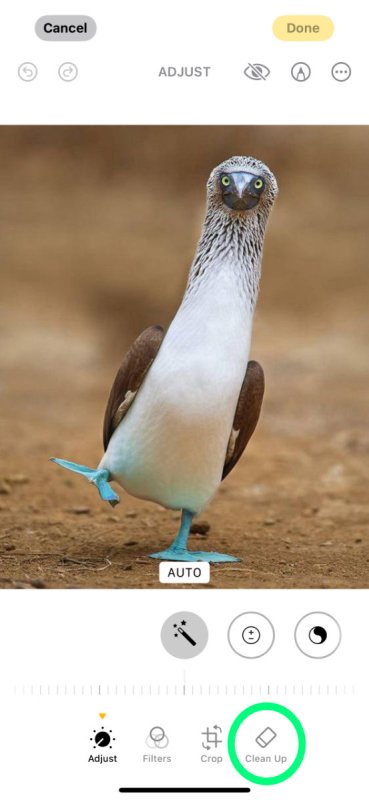
Feeling a lot of the time like a blue-footed booby; this photo was harvested from Bluesky, from the #naturesky tag. Bluesky is also where I have a new account. We need more quilters over there (tag: #quiltsky) so come on over. If you set up an account, I’d love a follow: OPQuilt on Bluesky. (If you need to know more about this platform, search, and research, buy this book, or ask me a question.)

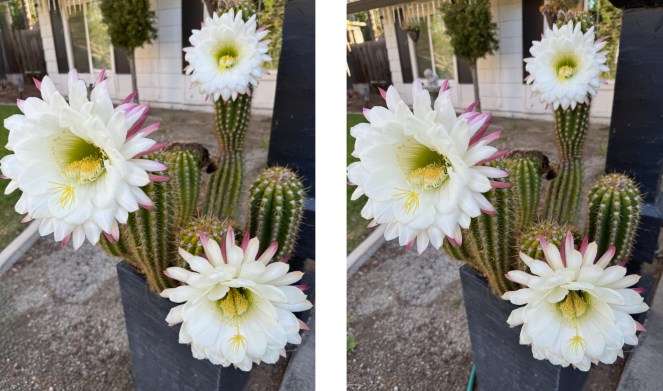
Apple’s Photo app has a new fun toy: Clean-up, behind the three sliders at the bottom of a photo (apparently not on all phones, my husband tells me). I click on that, then follow the instructions. Can you see what I did in this next pair of photos?

I probably wouldn’t use it to clean up everything, as that can give your photos (this one, of my neighbor’s cactus flower) a sterile and weird look. Life is messy, life has hoses in the foreground and angels in the background.

Early warning notice. I did none of those when the earthquake came, but did decide to hold off on getting in the shower. Just in case.

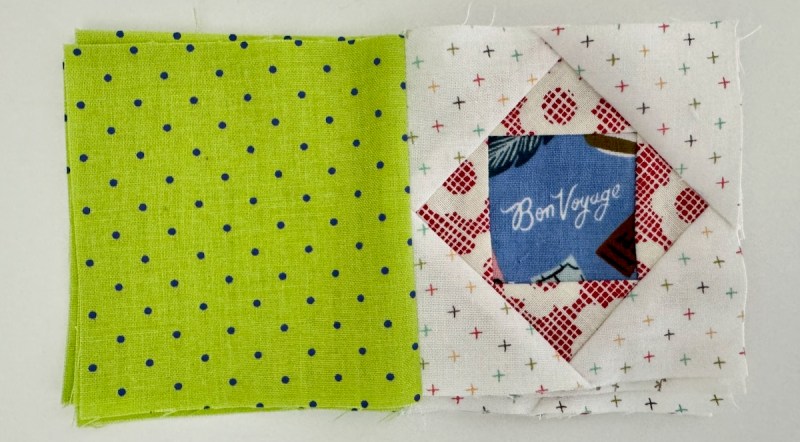
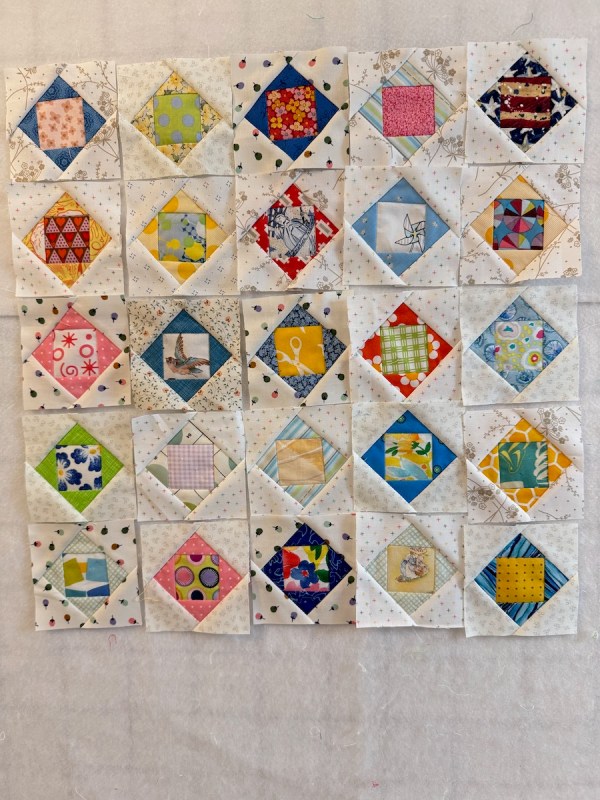
I sewed up my next batch of 25 Economy/Thrift/Square-in-a-Square blocks. In my first post about these, I noticed that one of the quilters I mentioned had sewn each of hers to a background block, so I decided to do the same. Eventually I will sew them into blocks of 10-patch units, as suggested by Taryn, who is running this (9-patch units? 12-patch units?).

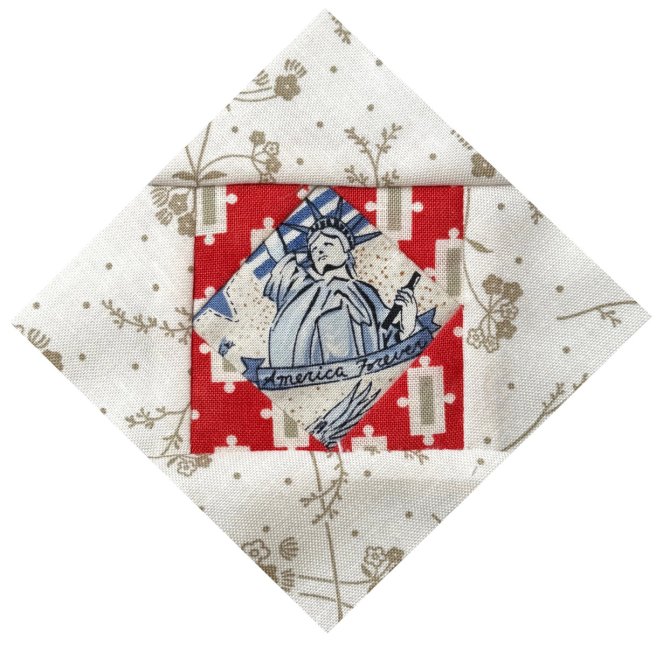
To make all my economy blocks, I opened my drawers and just used up old scraps, cut nearly a decade or more ago. It’s a lovely time-travel experience. Most centers are not fussy-cut, but this one spoke to me, as my heart aches a lot for what is going on. Other centers of other blocks also hold meaning, but I won’t detail them here.

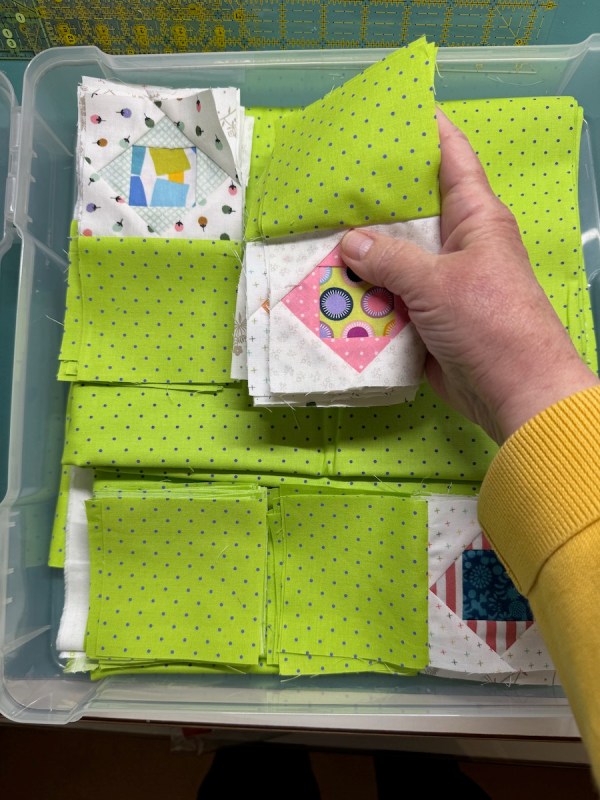
I can’t work if all my projects are stacked up around me, calling me to come pay attention. So after completing this batch, I carefully put them away until some time in May, giving me some mental space. (Fun video, here, with a perky little tune.)

So, March’s 25 blocks are done.
April’s 25 blocks are finished, too.

This came out next. It’s Sherri’s BOM for 2025. April’s block is finished, and now I’ve tucked that away, too, until May.
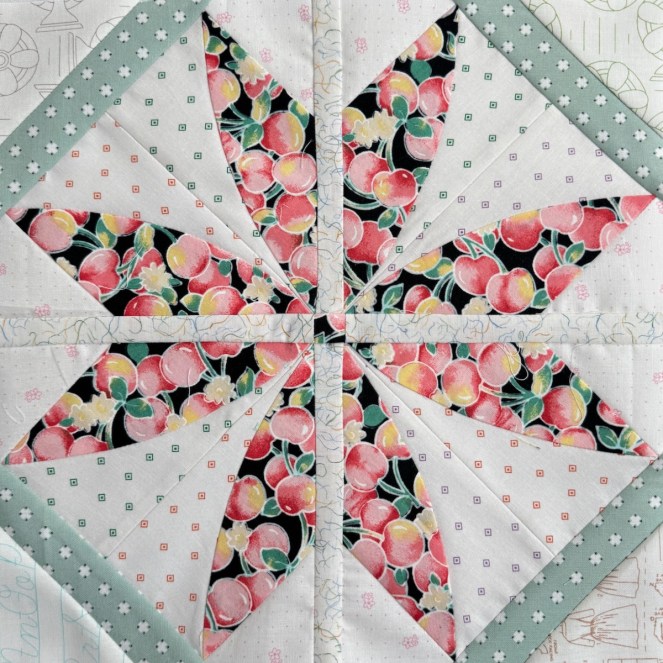
Posh Penelope blocks are up next, but I’ll wait to work on them until after Easter. (It makes a big happy mess in my sewing room.)

Every April and October, our church holds their Semi-Annual General Conference, which we listen to via streaming broadcast. Through all the talks, I sink deeply into thinking about ways to better my tiny life, but this year I also enjoyed the sights of this young choir, dressed much as I did back when I was their age: hair streaming down from a middle part at the top of their head, their dresses all smocked and ruffled and gathered and puffed sleeves, too! I didn’t have a camera when I was 17, nor were many photos taken of me, so you’ll just have to trust me that I looked like them.

I also like to sew while I listen (hence making good progress on the economy blocks!). I tried sewing them without paper, but it was harder to keep them square. So, here I’m using the freezer paper method. Here’s a free handout, in case you missed it on the last post:

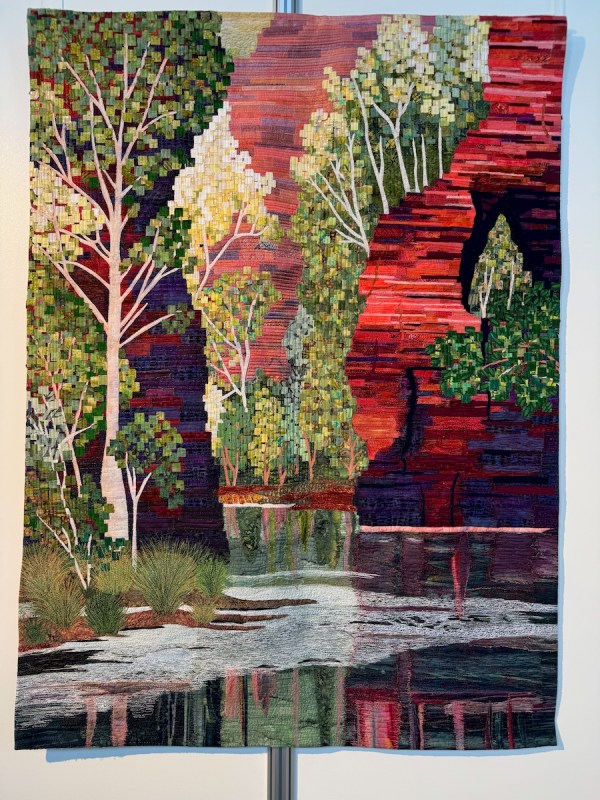
Utah’s Virgin River Gorge

My husband Dave and I took a trip up to see grandchildren and family, as I mentioned.

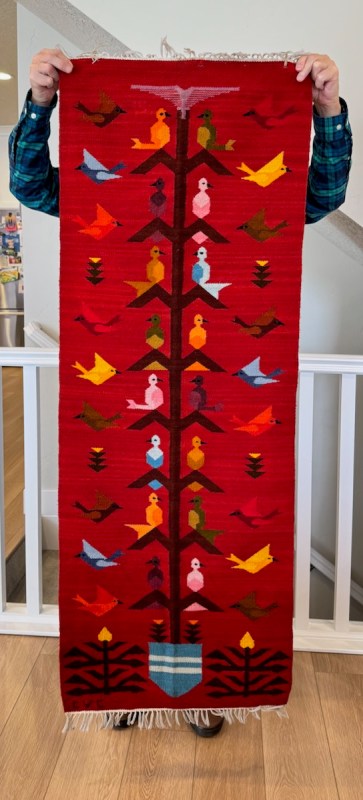
We also had a chance to visit some of our siblings. My sister showed me the wonderful tree of life weaving she purchased on her last trip. I love all these birds perched on the branches, with companions flying all around.

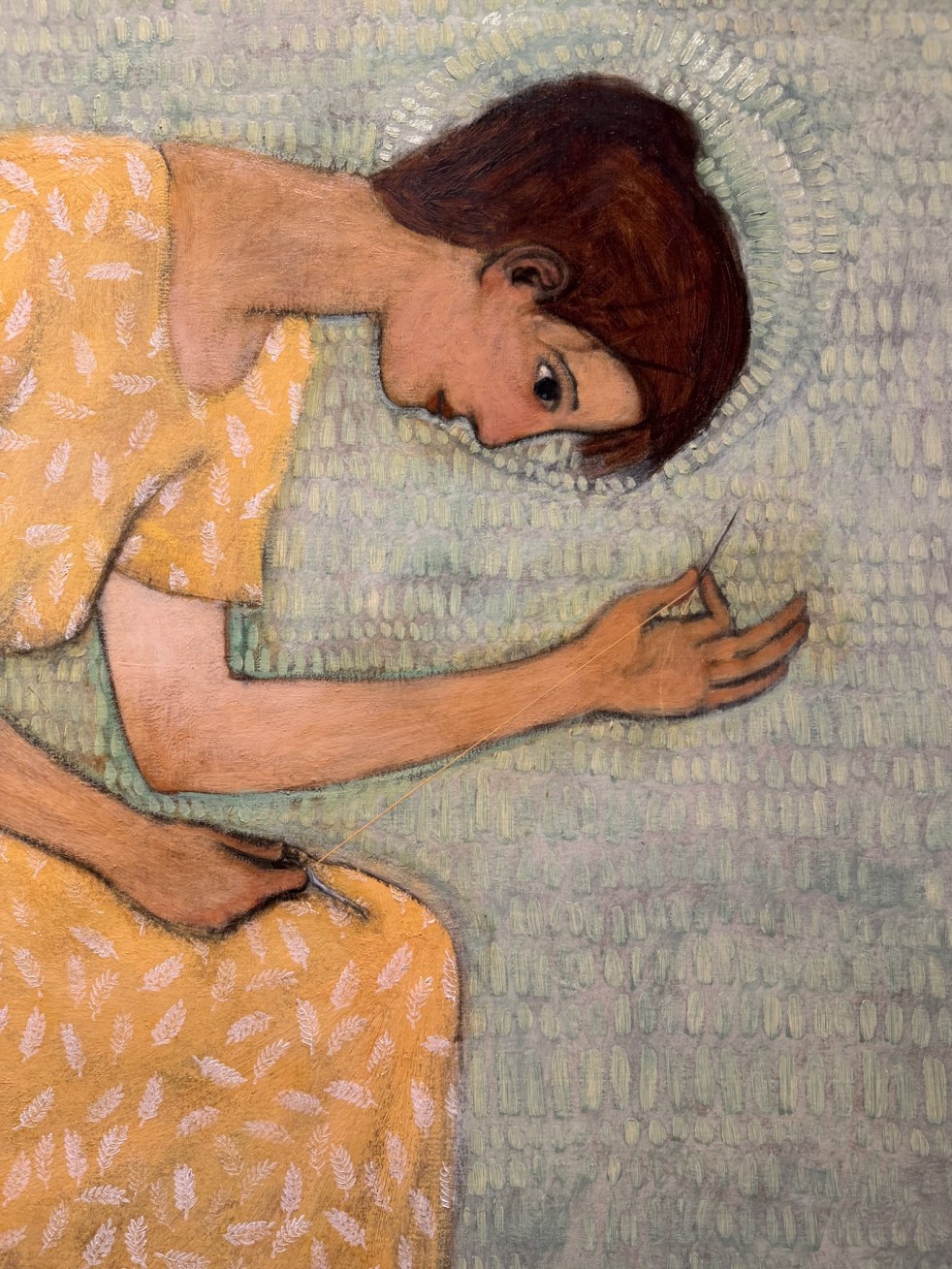
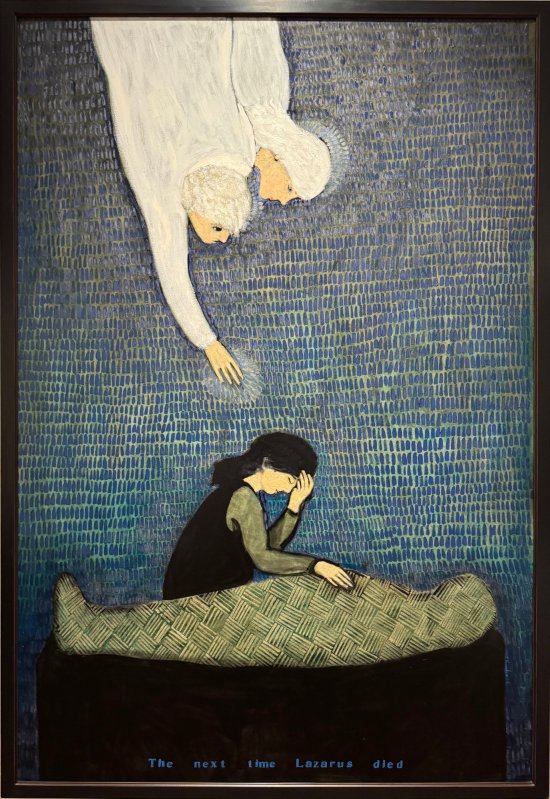
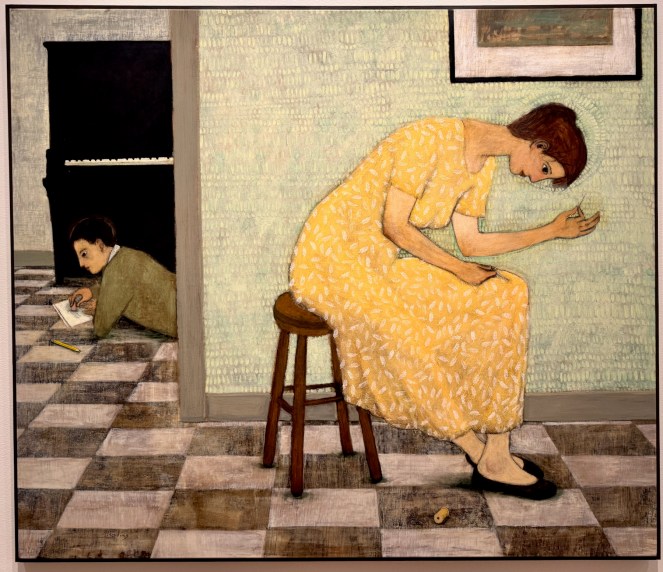
Another highlight of the trip was to see a mid-career retrospective of the artist Brian Kershisnik at BYU’s Museum of Art. Kershisnik’s exhibit began with a video of him working and talking and interspersed in between were snippets of his TEDx talk, which is worth watching, ending with something to think about. Kershisnik has long been a favorite of mine; he paints the quirks and slivers of human life that we are all familiar with, but don’t seem to see in traditional paintings. He also has a sense of humor about things, so valuable these days.

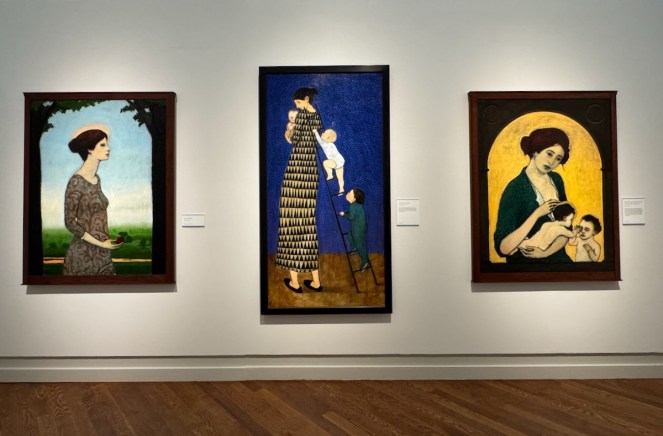
In this trio of paintings of women, the titles read (left to right):
Holy Woman, 2001
Climbing Mother, 2013
Madonna and Child with the Infant John the Baptist, 2003. Yes, the infant Jesus is poking young John in the eye.

from title card: “While not undermining his holy nature, the baby Christ (still with a visible halo) acts more like an actual child than most traditional versions. Kershisnik humanizes saints and holy figures, suggesting that perhaps they are not as different from us as we might have previously supposed.”

I found so many paintings that echoed into my life. As my father would have said, it was a peak experience. Since this is the week before Easter, here’s a few more.

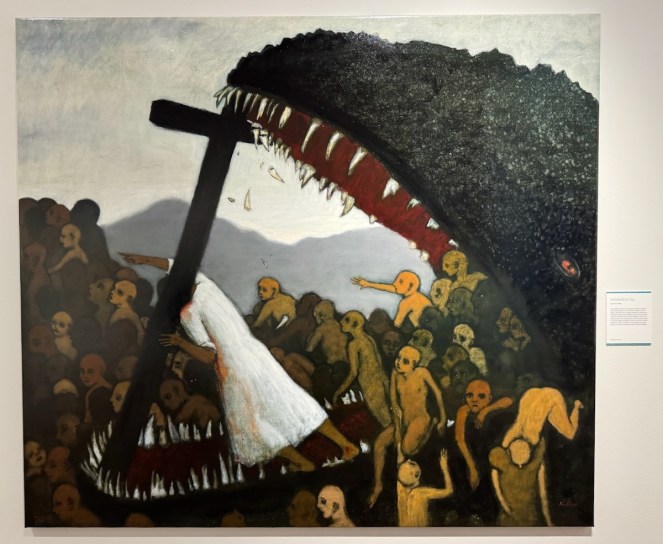
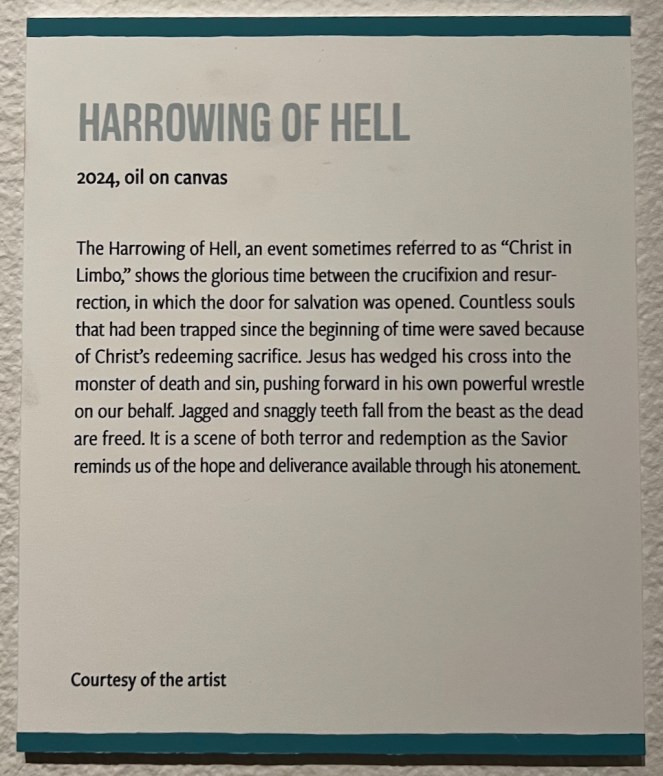
Even if you aren’t religious, Christ’s palpable straining to let the souls of hell escape their awful fate helped me understand the whole idea of sacrificing for others in a most visceral way. And Christ gesturing, says, “Go.” Get going, get doing, make something of yourselves. Below is a link to a video clip of Kershisnik below where he says he is reticent about “explaining” the meanings of paintings for others, not wanting to limit them. I also don’t want to limit you. This is just my take, after standing there gazing at this enormous painting, a couple of weeks before Easter.
Death has hung around my life in a significant way in the last couple of years, so yeah, I lingered at this painting.

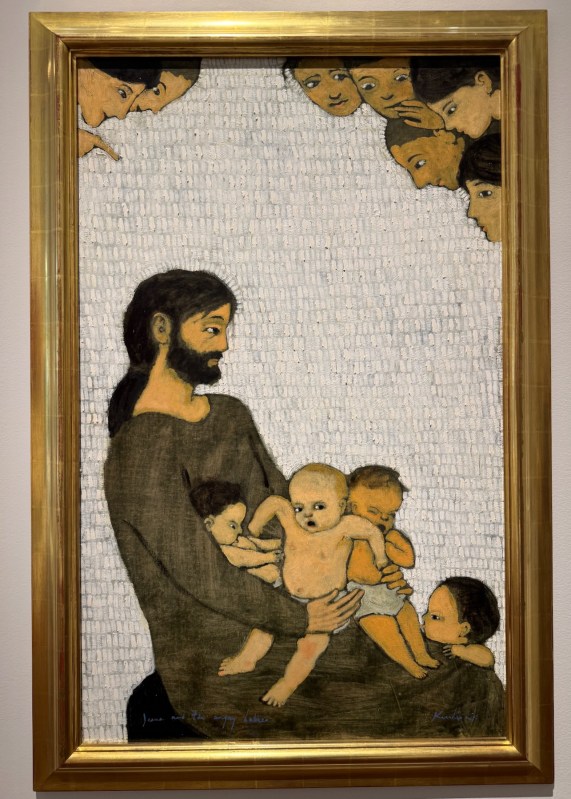
Are we like these little ones in Kershisnik’s painting, Jesus and the Angry Babies (2014)? Maybe. The angels in the background are there to help. (video clip of the artist discussing this painting) Last one, with a theme pertinent to our sewing experience:

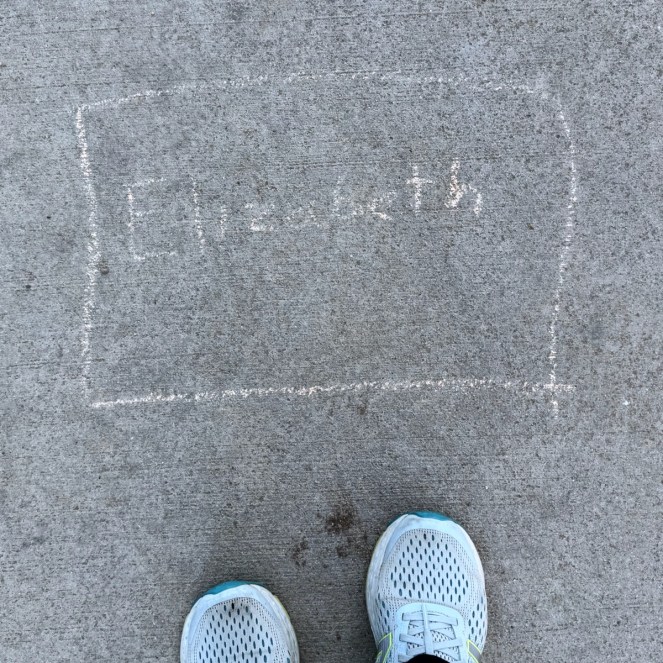
The morning after we arrived home, I took a walk in our local park. Right after that photo I saw that some children (not angry babies, not angry adults) had decorated up the sidewalk with all colors of chalk, including a hopscotch diagram, which I most definitely took time to jump through, before continuing. I conclude one of the artist’s names, below.

I had a field day listening to Brian talk on numerous videos. I’m putting these here so I can come back and listen.

Spring Open House Video (long)

On his painting, Bearing News

Brian Kershisnik’s Instagram

On Interpretations [On What Paintings “Mean”]

Working with [Your] Media I love when he says “you have the let it [the media] do what it does.” Boy, do we know this about our fabrics and threads!

Smile!