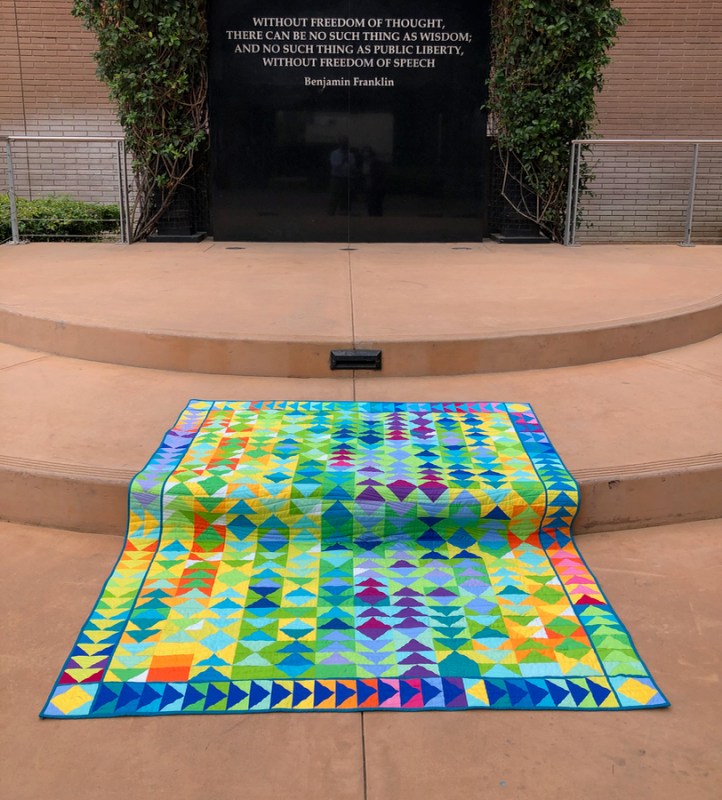
Wealth of Days underneath a poster of one of our town’s vintage packing labels
When I first starting making this quilt, I cut each flying geese block by hand because I was not able to rotary cut. I drew out the lines, cut a triangle, and piled up the cut pieces in bags for their corresponding temperatures. After constucting them, I found out how unstable the edges were, how inaccurate a method this was. Of course, it didn’t help that one arm was in a sling, but hey, a quilter’s gotta’ do what a quilter’s gotta do.
I’ve also done the snowball-on-the-square method, which is good for single Flying Geese.
But I’m a fan of the four-at-a-time, provided you use the Mostly-Magical-OPQuilt method of trimming them. I showed this trick to my friend Cindy of LiveAColorfulLife the other day and she said it changed her life. I took that with a grain of salt, considering the covid-lives we’ve been living, but I was happy it worked so well for her. Here we go.
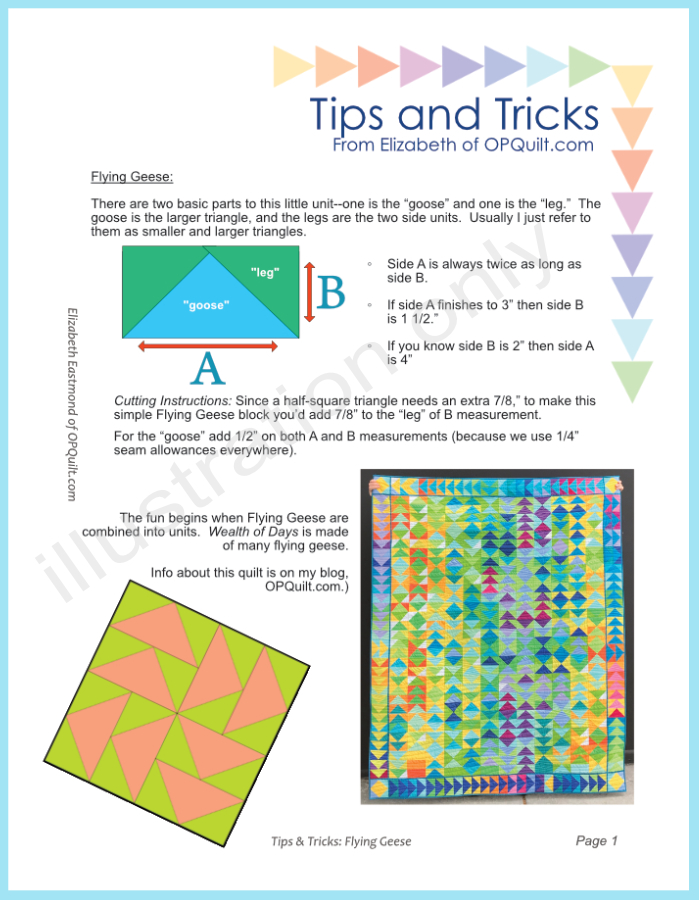
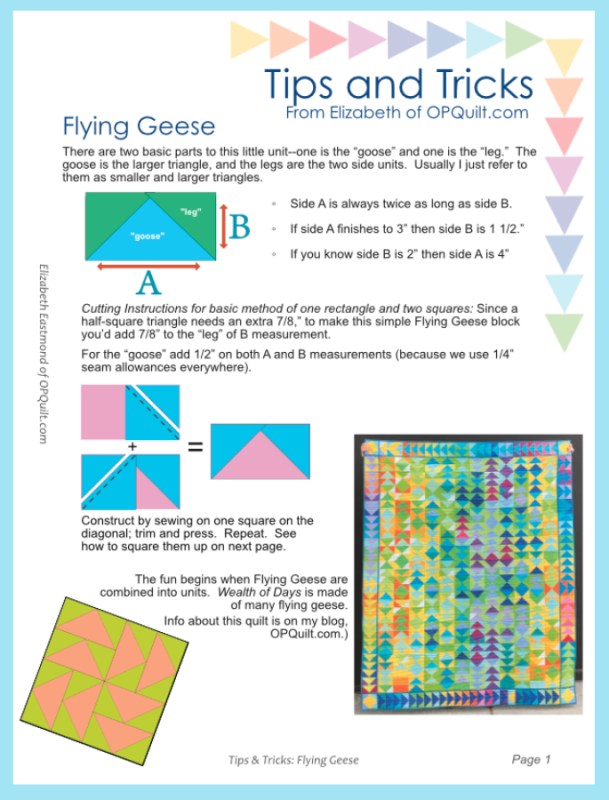
NOTE: In the free Tips and Tricks Handout, downloadable below, I give you a formula for figuring out what sizes the large squares and the small squares should be. No more charts!
I use a 4-inch ruler for smaller Flying Geese, and a 6-ish-inch ruler for larger. (Can we talk about Rulers?) It’s all in where you take your first cut, and the angle of that first cut.
Step One. Make your Flying Geese, and grab a ruler, preferably one that has a diagonal line.
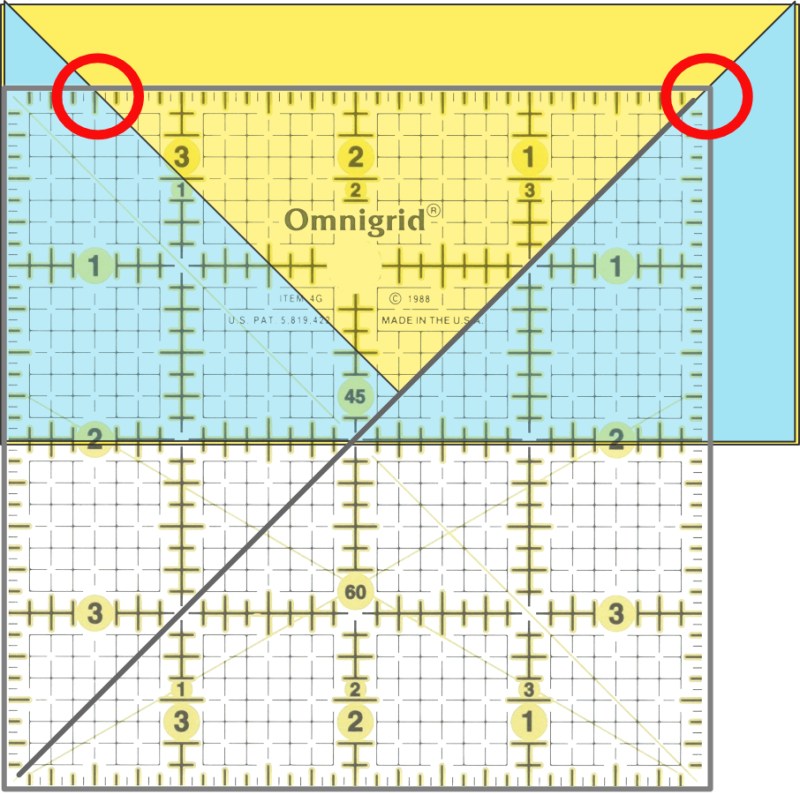
Step Two: With the flying geese point FACING TOWARDS YOU, line up the ruler’s diagonal line with that right-hand folded edge.
Step Three: Concentrate on where the r.h. tip of the ruler is, and where the measurement for your Flying Geese is. I’m trying to make a Flying Geese that will finish at 3″ by 1 1/2″ tall, so I’m concentrating on the 3 1/2″. If you have done your measuring and cutting correctly, don’t worry about the lower edge right now. Line up the r.h tip ON THE FOLD. Line up the target measurement on the LEFT-HAND FOLD, as shown. Note: I am now free to make Flying Geese any size I want, not just what’s out there in the manufactured acrylic cutting rulers.
Step Four: Trim the RIGHT excess and the TOP excess.
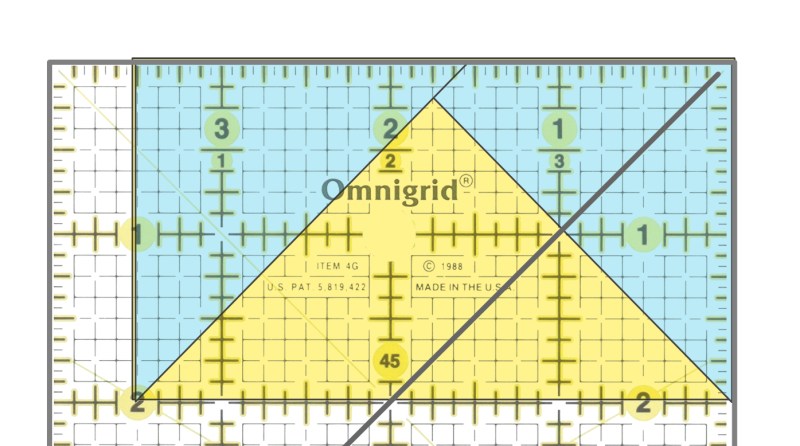
Step Five (and final): Rotate the Flying Geese block so the tip is pointing away from you. Line up the LEFT (3 1/2″) and LOWER (2″) side or the measurement at which you want the block to finish. Trim away the remaining excess (as shown).
I can crank through a ton of flying geese using the four-at-a-time and the Mostly-Magical-OPQuilt-method of trimming. So can you.
Okay, because everyone likes a free handout, here it is: Tips and Tricks from OPQuilt.com — Flying Geese.
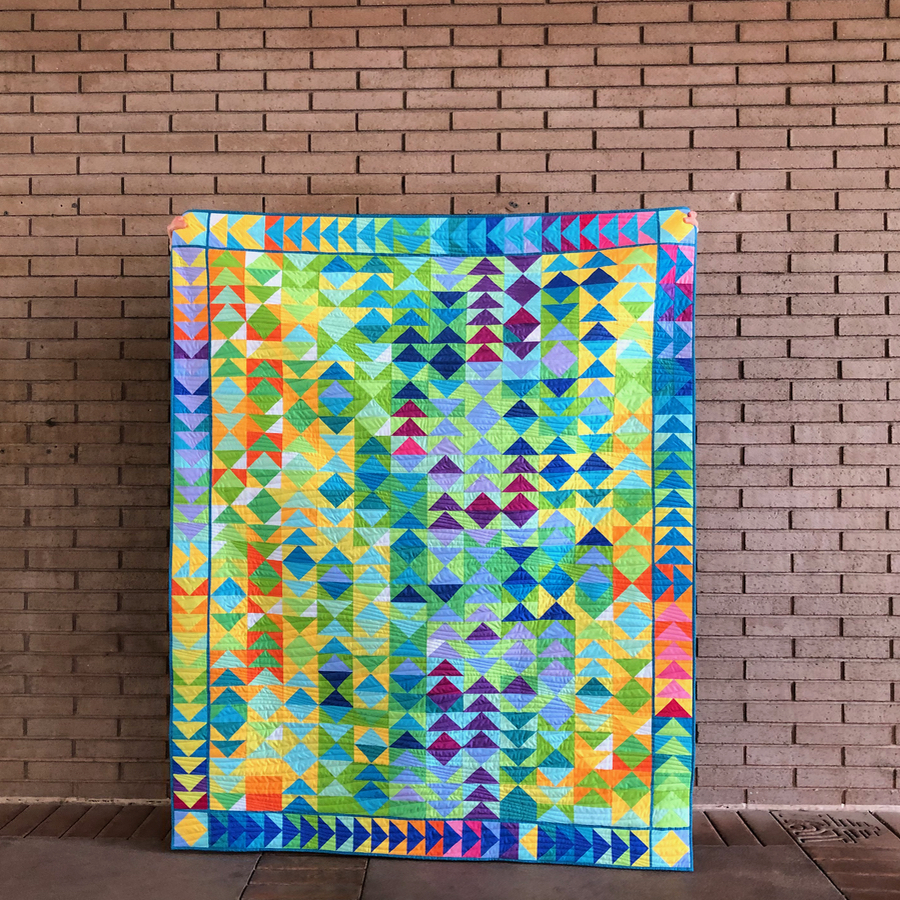
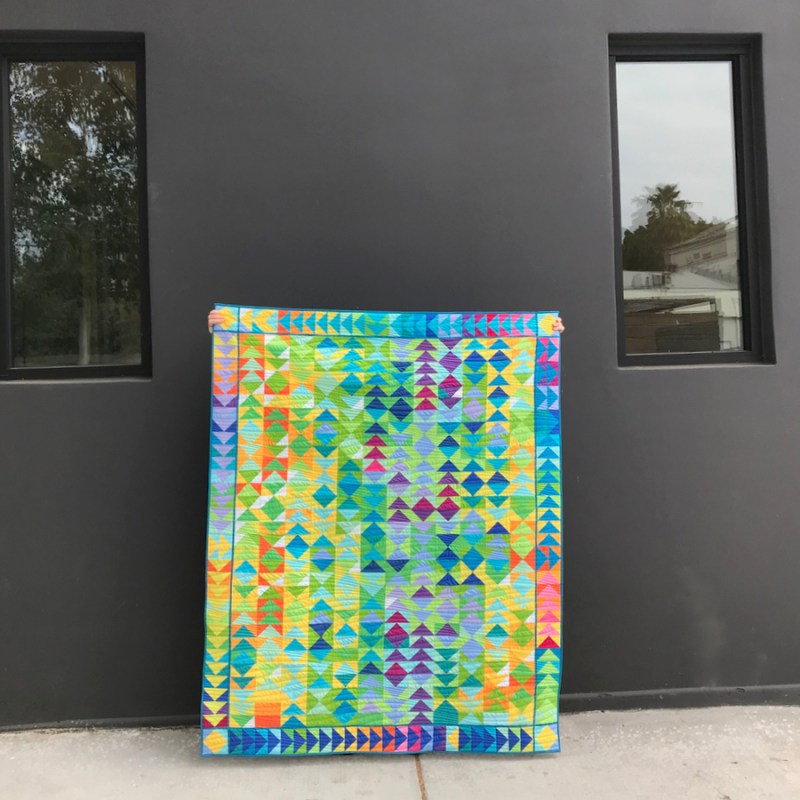
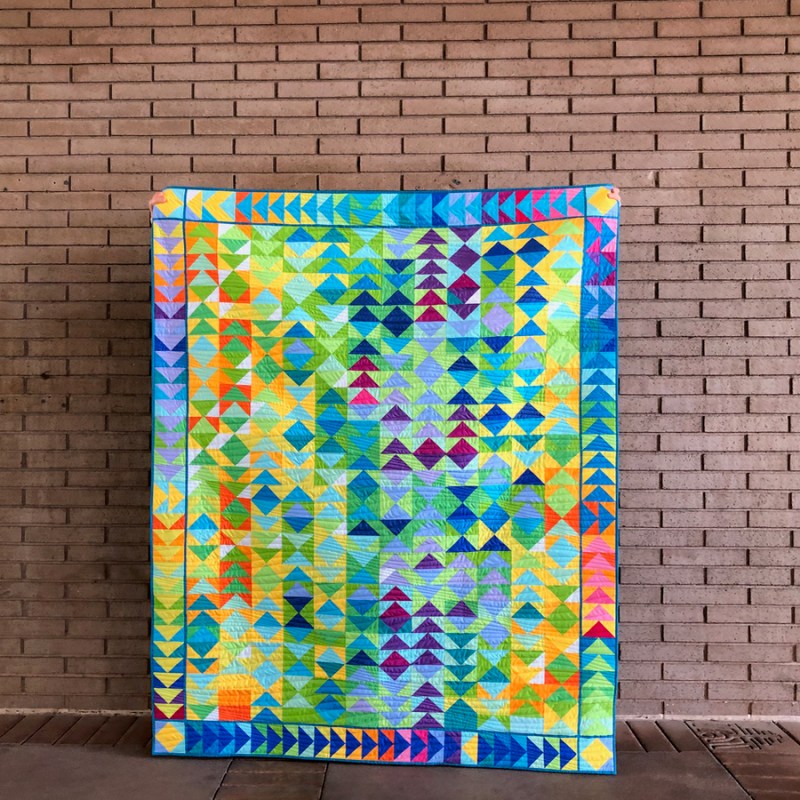
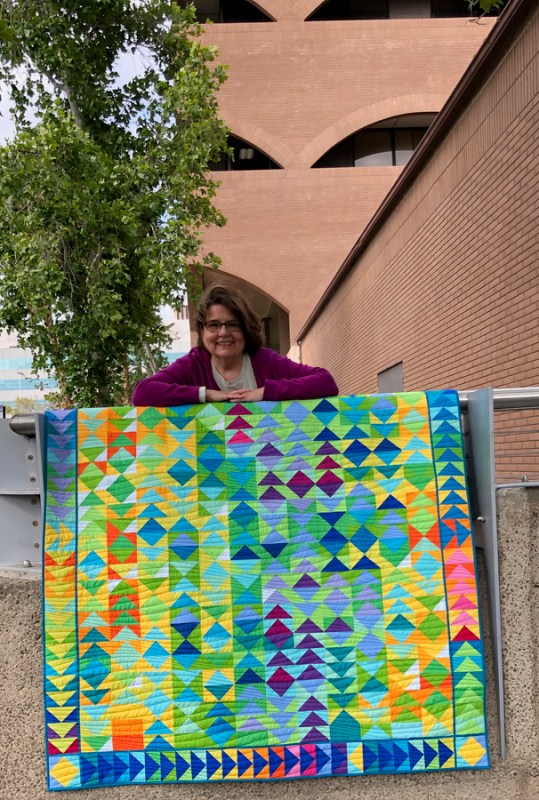
Wealth of Days Quilt no. 247 57″ wide by 70 1/2″ high
From my journal 9 January 2019: “Here we go again. Today I had rotator cuff repair surgery on the right arm. My little joke is that I only have two arms, so after this one is over with, I have no more shoulders to operate on.”
18 January 2019: “A dark day. But I was able to shower and dress myself, all the way, by myself. I also made the bed.”
24 January 2019: “Dave took me to Road to California today, where I saw Cindy and Janice and all three of my quilts. After about 90 minutes, I said I was ready to go home. But it was so good to get out of the house.”
1 February 2019: “I started the day in tears, but by the night things were better. I finished the January’s temp quilt flying geese strip, and started on the temperature quilt key block, a circle of flying geese.”
19 February 2019: “The sling wearing is finished! (Cue: Cheering) Another milestone: I did some rotary cutting. I made dinner and we watched another episode of Madam Secretary. So happy to be at this place!”
26 February 2019: “Mailed our taxes, then went to Quilter’s Cocoon for some retail therapy. New Kaffes were in and I picked up some browns for the new Lori Holt Bee Happy quilt.”
29 March 2019: “Photographed the Plitvicequilt in the fields of the Poppy Superbloom.”
24 April 2019: ” I just returned from Utah where I was the Utah Valley Quilt Guild’s “National Teacher.” Such a lovely experience, plus we saw about every relative possible that lives in Utah. Many years ago, I was pregnant with my first child on this day, wondering if he would ever come [he was 4 days late and was born the next day.]”
1 May 2019: Today L. [a girlfriend] and I had a good lunch out together. Tonight I started work on a quilt block that reminds me of ladybugs.”
15 June 2019: “Today was a lovely basic day. Dave went on a bike ride and I picked him up in the neighboring town because he had a flat tire. We then went out for a burger at In-N-Out. Back home, I finished up the days for May, and sewed the strip onto the rest of the temperature quilt.”
25 June 2019: “Saturday, Dave was trying to stomp down the Clean Green yard waste and the giant can tipped over, throwing him against the garage. We headed to Urgent Care, and they took him down to X-ray by himself. While he was there, in walks L., feeling awful. It was good to be there to talk with her. Found out that he’s broken three ribs.”
5 August 2019: “Updates: • L. never left Urgent Care, and was instead taken to the regional medical center. The diagnosis came back: Chronic Myeloid Leukemia. We are all devastated. • Turns out Dave only has two broken ribs, but is still sleeping in the recliner.” • Went to Parliament Artisan Chocolate and stocked up on chocolate bars. • I am having the time of my life talking to Quilt Guilds and teaching workshops. • I went to lunch with L., Carole, and Pat.”
1 October 2019: ” Biggest national news this week is that an impeachment inquiry has been opened up. Just wanted to note it in this journal, as so much in these pages is focused on my world, my people, and my feelings about all of that. Meanwhile, I’ll keep quilting, keep trying to be better. I’ll keep trying to forgive more. In September, I only slept in our house 12 days out of the month — gone the rest of the time. That’s too much.”
21 October 2019: “I went to my second quilt show this year: PIQF in Northern California with L, where I met up with Tracy, a quilter I’d corresponded with. More happy fun: Crossroads was published in QuiltMania.“
23 October 2019: “I finally made it to the grocery story today for some basics: tomatoes, canned goods, meat and some zucchini, as I’ve had a craving for zucchini bread ever since returning home from PIQF.”
3 November 2019: “I hate Daylight Savings Time. It is soooo nice to go back to regular sun time.”
13 November 2019: “Still dragging around after getting home yesterday from Guatemala to see my sister and her husband, who are on a church mission there. I had no idea that there were so many wonderful fabrics in that country. We didn’t travel very much this year. Next year, we are already planning a couple of international trips, but first, Thanksgiving at Barbara’s [our daughter].”
2 December 2019: “Our very first First Monday Sew-day was today. I taught them about the basics of rotary cutting and quilting, and Simone handled the color portion. We had it at Beth’s house, and it was a tangle of little children, laughing women, fabric and chatter. A good morning.”
25 December 2019: “Just went through a most wrenching, emotional day. We had a big fancy Christmas dinner at Mom and Dad’s, trying to ignore the fact that it was probably their last in their home of so many years. We helped them get papers signed for their new independent living place, and it was a dance of push and pull and trying not to cry, all while keeping up the Christmas Cheer. We said goodnight to them around 7 p.m., then drove down to our hotel in Salt Lake City. I could not just sit in the hotel room, so we parked and walked around Temple Square, taking in all the crowds, the lights, the nativity scene, the carols playing in the background, and an occasional quartet of missionaries serenading us with Christmas carols. It was good to be alone, but with people. It was good to walk. It was good to be with Dave.”
As these journal excerpts from 2019 show that the year came and went, a day at a time. I made this quilt a day at a time, each flying geese in the center showing the high and low temperatures of each day, along with the precipitation. I started calling it Wealth of Days when all of us had a year of days, not recognizing then as little gifts of time and experiences. We made plans, went on trips, had lunches and fun at quilt shows. We started quilts and finished them, and left some undone.
We had regular, precious life: a Wealth of Days.
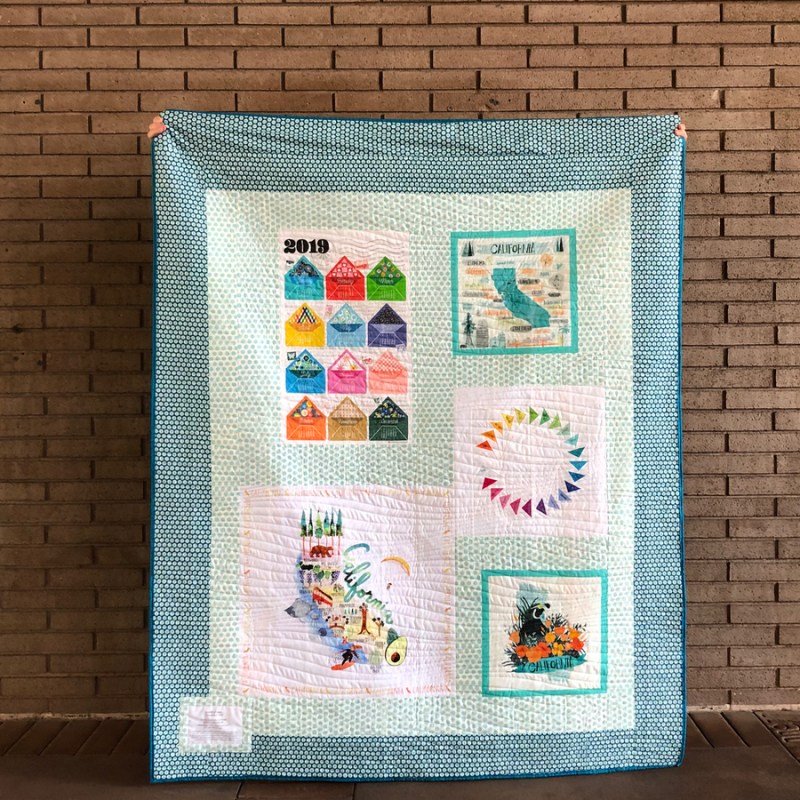
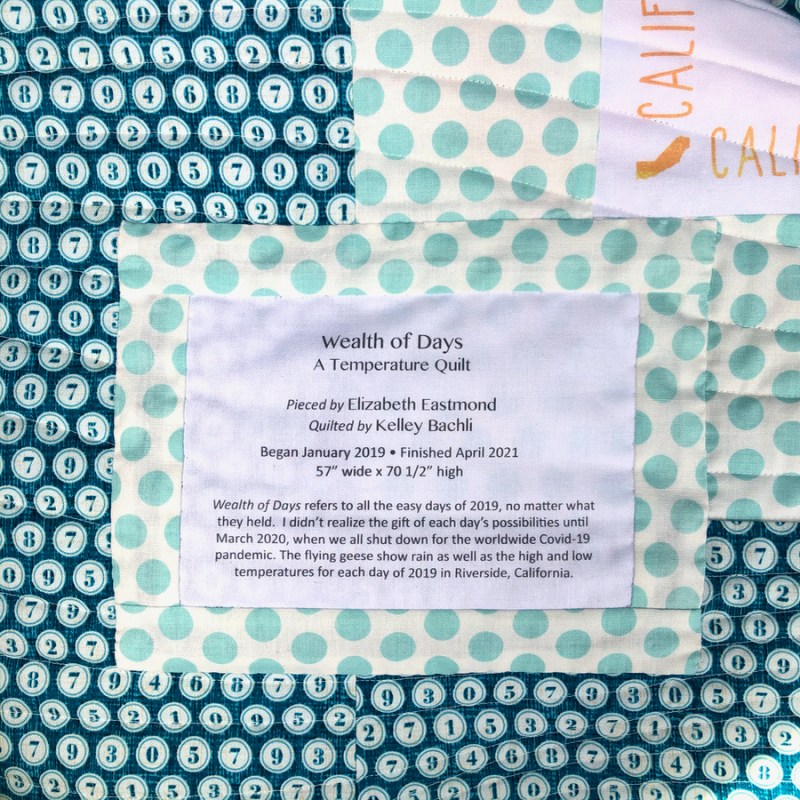
The label says it all.
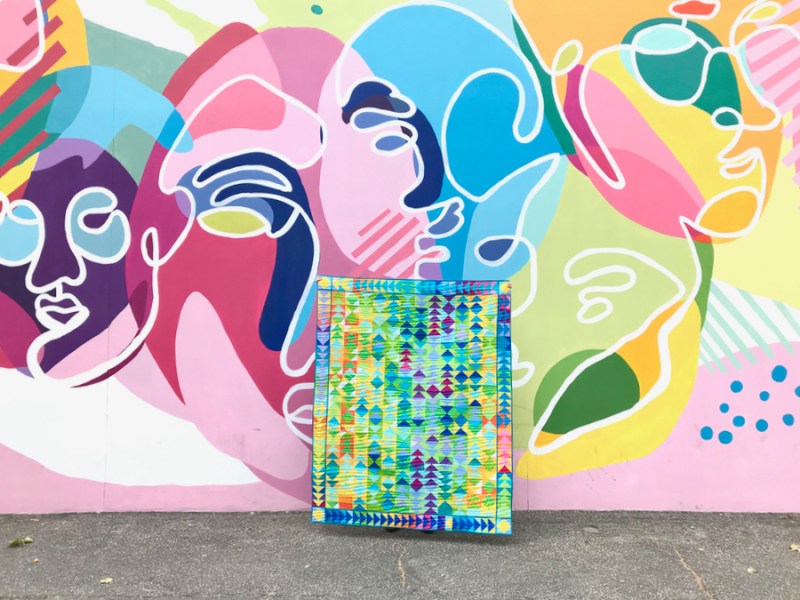
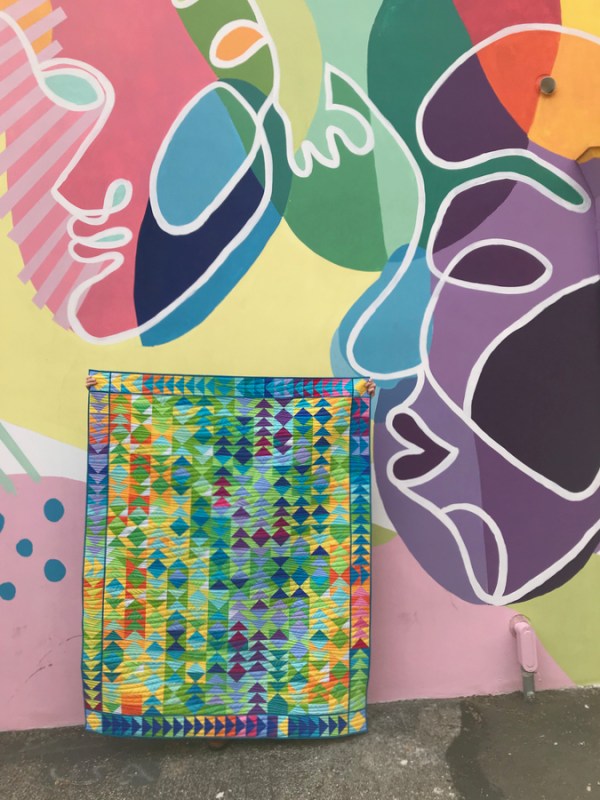
The quilt and I on a windy day at City Hall, Riverside, California. Thanks to Dave for all the quilt holding, the photos and our life together this past year of covid. Update on L: she is home from her stem cell transplant treatment, and is taking one day at a time. Just like all of us.
I dream of houses. I dream of houses with quilt blocks on their sides, or quilty houses I can make any size. This started when I was asked to help beta test for BlockBase+ and began to see some possibilities of putting a block within a block. So I thought I would share how I did this. (News about the giveaway is at the end.)
Brackman ID 864
One way to export their images is by SVG, which means Scalable Vector Graphic. That means I can take this image and scale it (change the size) and everything will stay in proportion. I about fell over in happiness when I found out this was available in BlockBase+. That means I can take out lines, add lines, take out and add shapes, all using the basic image from BB+. So I did some of that.
Double X Brackman ID 1629a
So take one house, add a Double X (using the Brackman ID number to help you find it), and combine them:
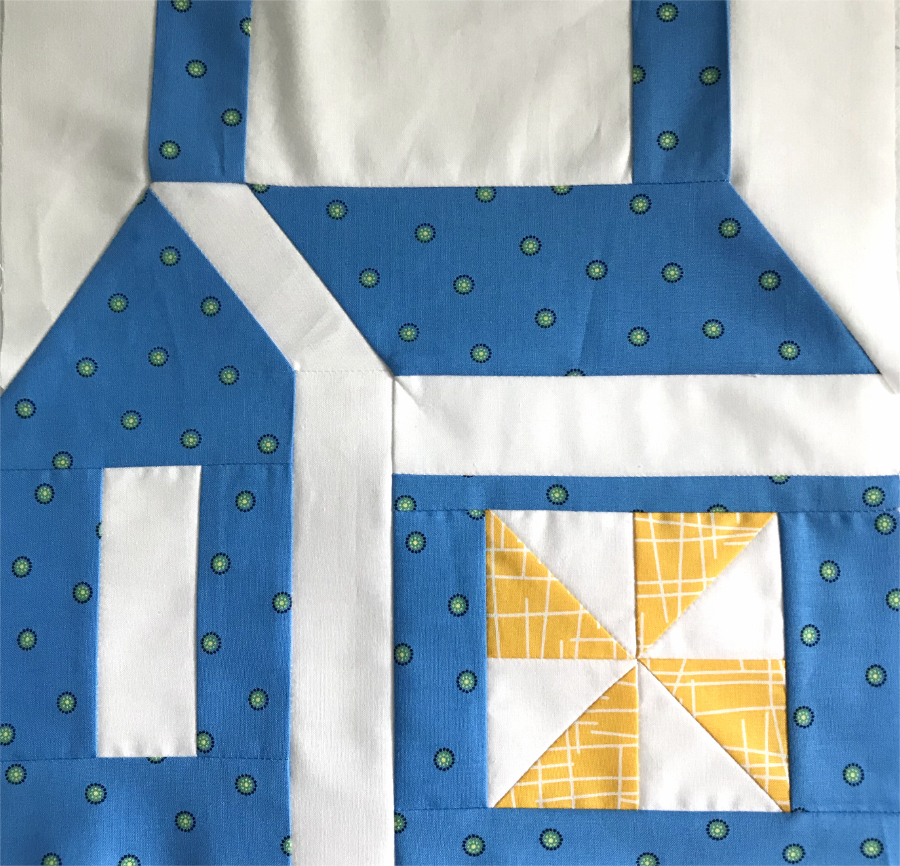
Now I have a Shoo-Fly House.
Here’s my Ohio Star House.
Last is the Eight-Pointed Star House.
Combine them all and you have a house-warming gift for a friend or a small wallhanging for yourself (depending on what size you make your basic house and their blocks). If you don’t have a digital design program, change that section of the house by making your block, sashing it on top and fitting it into the space where the two front windows are.
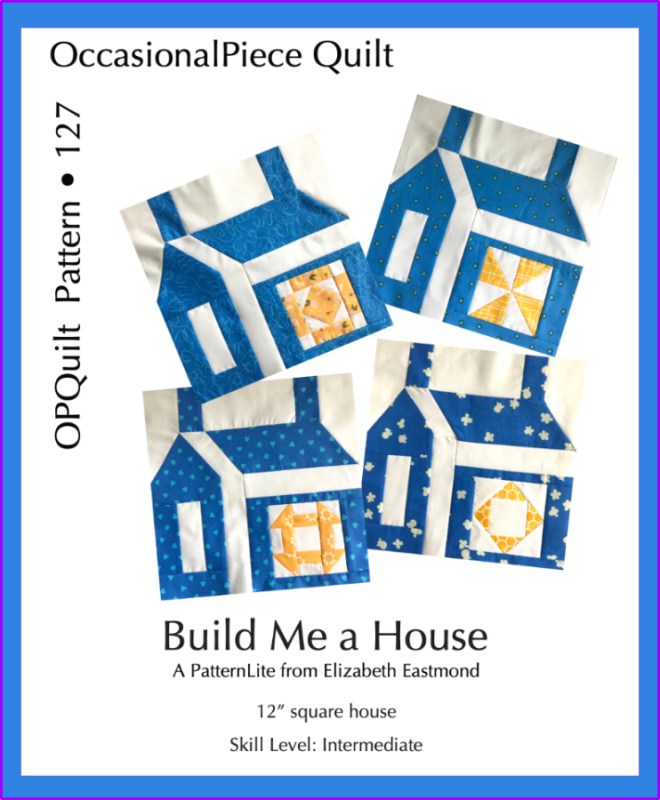
I worked up what I call PatternLite that has all the info about this particular block merging: four snappy yellow-and-white blocks into blue houses.
It normally costs five bucks, but you can use the coupon below to get it for half-price. And inside is another discount coupon for any of the patterns in my shop. This PatternLite is nine pages of instruction and includes templates for the odd parts of the house, above, plus info on the four different smaller blocks.
Take this coupon and head over to PayHip, if you’d like to nab my Build Me a House PatternLite.
The last thing I want to show is how you can swap elements of one block for another.
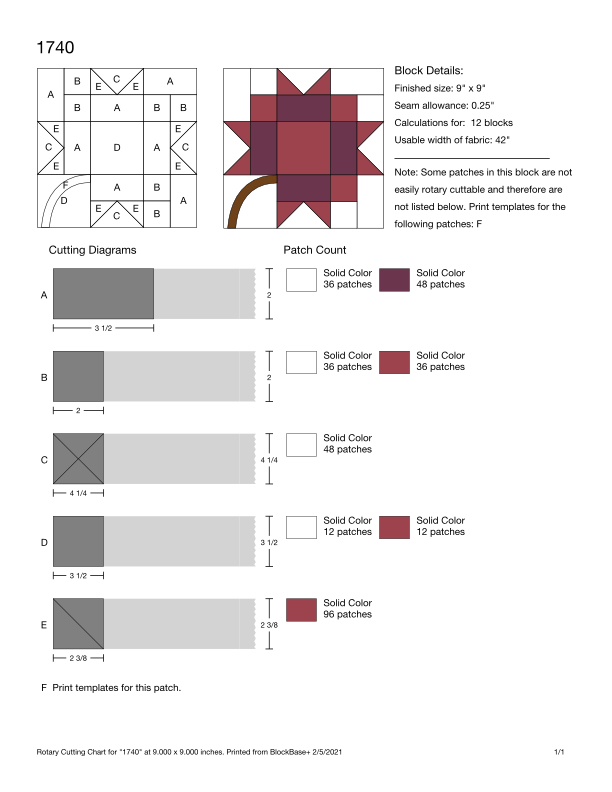
Brackman ID 1740
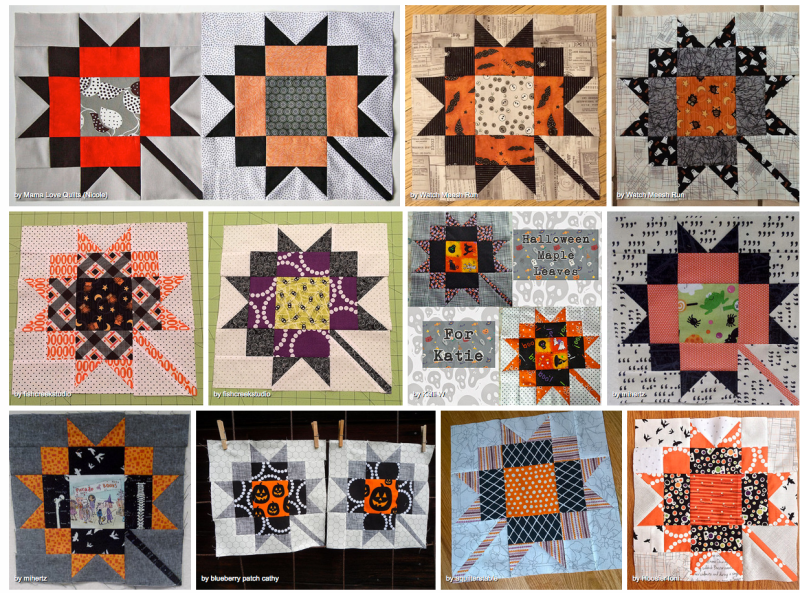
I have been in love with this block forever, ever since way back in the day, a Flickr group did it for a Halloween online bee block.
But they have a straight stem and I see a curved stem in the BB+ version. This is no problemo, my quilty friend. Swap the stems!
Since both of these are based on a nine-patch block, I can just print the templates for 1740, then print just the stem patch for 1735 (by using the Preview, I can delete patches I don’t want to print), and then swap that part of the block.
If I wanted to just rotary cut them all, I could use this chart (which is the Rotary Cutting Chart of the Export Menu). It will tell you how many to cut of one size, if you change the “Calculations for:” above. However, it will not tell me how much fabric to buy or to pull. I hope that is coming in a future version!
Jennifer (jeifner on IG) was the winner of the giveaway. I typed/copied everyone’s names from Instagram as well as names from comments on the blog posts on this website. I used Google’s Random Number Generator to select the winner, so congratulations, Jenn!
Thank you very much to every one, for all your kind and interesting comments. I enjoyed reading them very much. I also want to say a thank you to The Electric Quilt Company for generously offering up a package of software for me to giveaway. I did ask them if they were having any discounts for people who might want to buy this software. Apparently they always have a site-wide sale over Memorial Day, if you are interested in purchasing this for yourself.
Welcome back to BlockBase+ Week! In this post, Post #2 of BB+ week, we’ll build a medallion quilt.
UPDATE: Giveaway Contest is closed. Thanks for entering!
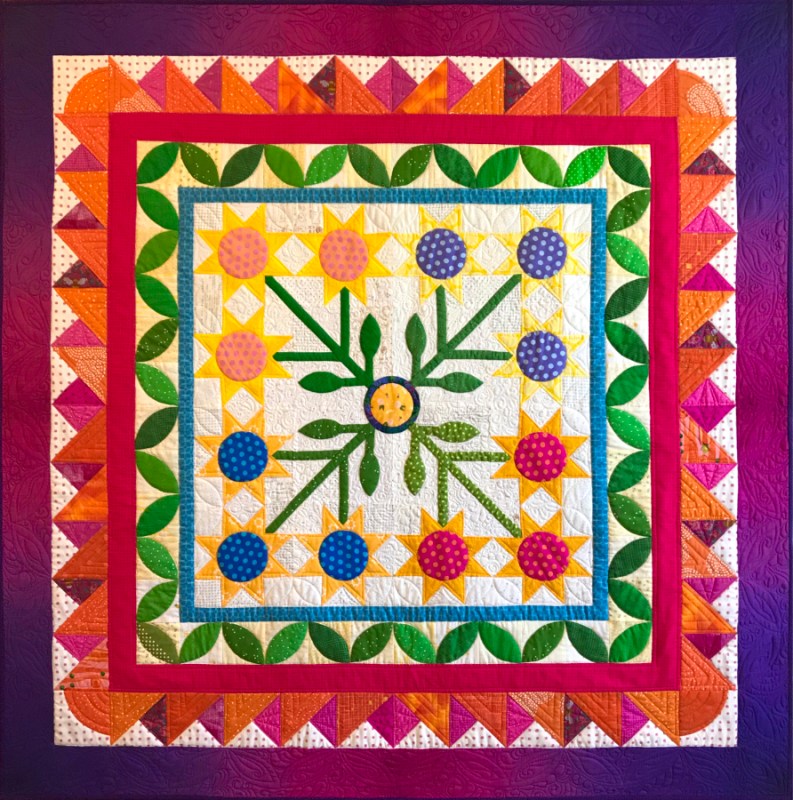
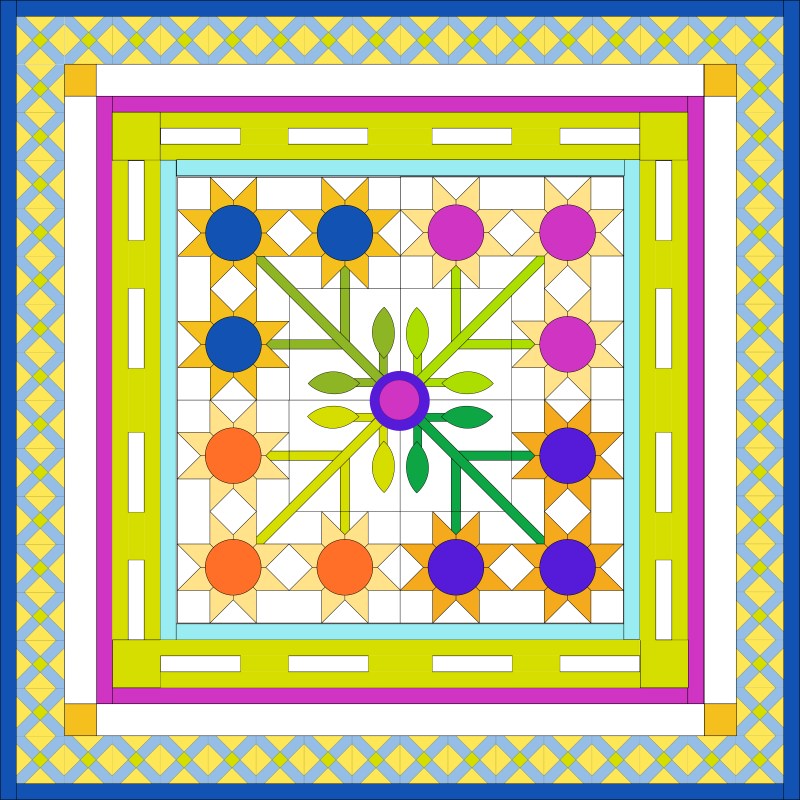
Sunny Flowers was a fun quilt to make, but I think using BlockBase+ (BB+) enabled me to move a little faster on some of the borders, and I’ll tell you why: I could just decide what size I wanted a certain border, head into BB+ and choose a type of block, then re-size it easily.
Center
In many medallions, the center is where you start. A lot of moderns have been trying centers off to the side, but however its placed, usually there is a larger catch-your-eye-and-set-your-theme block to anchor the quilt.
I have a few more center ideas in my free TipSheet for Sunny Flowers Quilt (details in a minute).
Here are the two centers I mentioned in the kick-off post for BlockBase+ week: a spring/summer block and an fall leaves Autumn block. There are tons of possible centers, and since you can size them, your options are wide open. I begin my designing more easily in an illustrative digital program (Affinity Designer, if you want to know), so that’s where I start. But if you are a quilter who works in EQ8, all of these blocks are available to you in that program.
This was my first version, but it just didn’t work well. Cute, but in my world I like stronger colors and stronger contrasts. I give you my final measurements in the Tip Sheet, but I did keep track of how wide the plain strips were, so I could choose blocks that fit.
I refer constantly to the wide body of work that Melanie McNeil has posted on her blog Catbird Quilt Studio. The first page you should visit is a page listing all her topics, called Medallion Lessons. She has links to everything else on that page–a wonderul resource! She and I have corresponded for years, so when I hit this impasse, she had all sort of tips and tricks for me to try. Some of my angst is written about here.
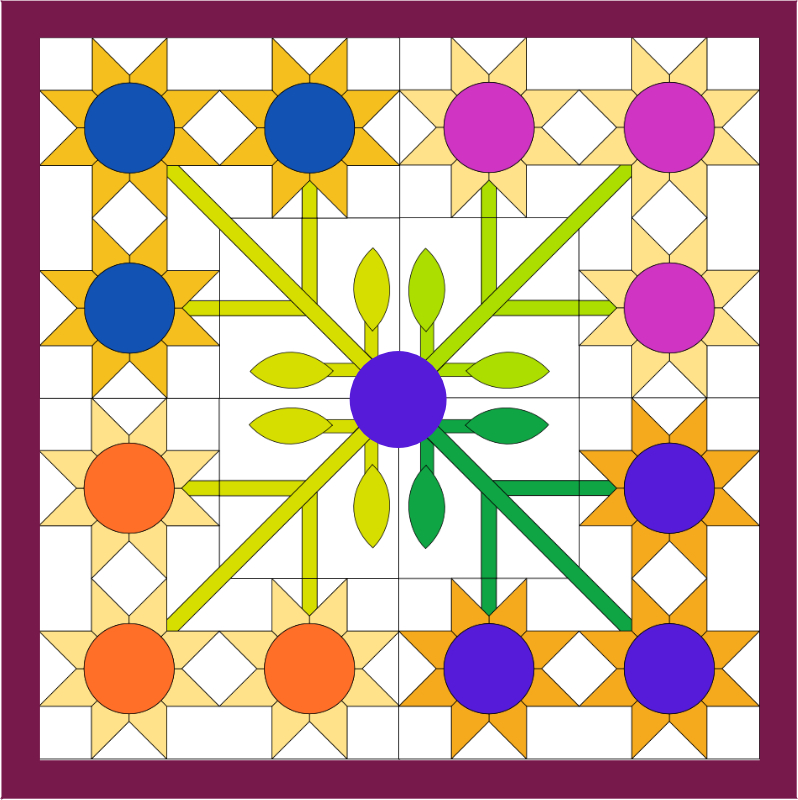
Version Two. Remember, that I had determined what size all those borders were, and then went into BlockBase+ to find blocks I liked. I would then resize them, and make a sample or two or five.
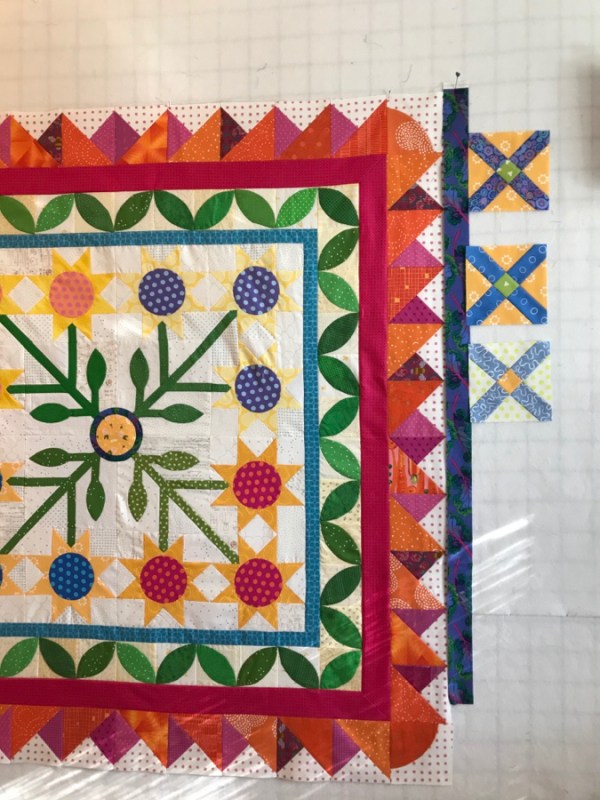
I had been cleaning out photos and saw a quilt that had shapes I liked (we’re talking about the orangey-pink border). I found a similar block in BlockBase+ and since I wanted a four-inch block, I re-sized this Brackman ID 1194 block to print out at 8″ so that part in the aqua circle would be the correct size. I changed the corners from the photo, using a Drunkard’s Path block (again, from BlockBase+), written about in this post. Moral of this story: take photos at Quilt Shows, get ready for your future.
This was The Plan.
Yeah, okay, and this total wreck was The Plan, too, as I tried out different borders.
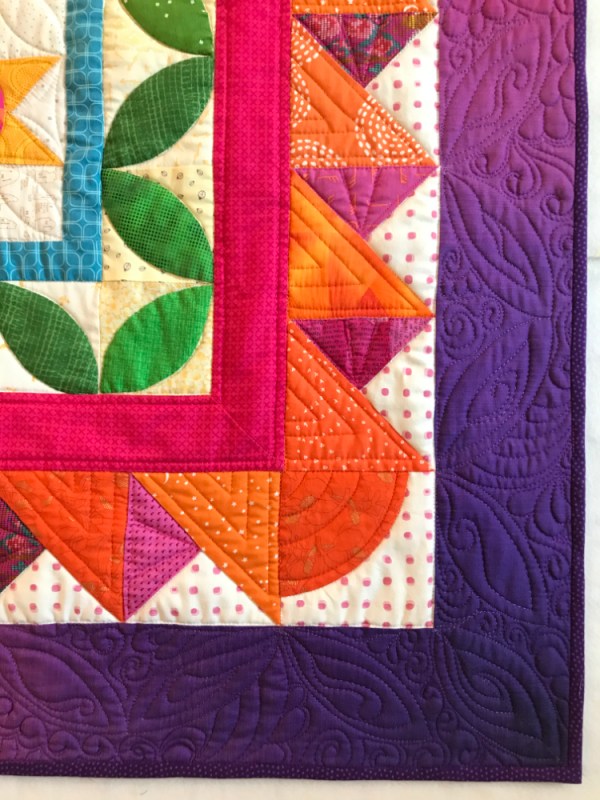
I kept trying to go farther with those crosses. I really really like them. But the bold orange-pink border was too strong, so it became the last pieced border. I had the brain flash to use violet in that outer border, so I stayed up one night searching online shops for violet; however, this is not the color this year.
I was madly going through my stash one early morning, and had a stack of fabrics neatly lined up on the ironing board when my husband walked in. After explaining that I’d gone through everything, he reached over and pulled out a piece of fabric from the ombré bin. “You mean, like this?” he asked. I pieced it in the middle to get the darker outer corners, and it was done.
Get Your Tip Sheet for Free
I’ve compiled a little TipSheet for you for this quilt, which is free, if you use this coupon code:
Just enter it in at the checkout spot at PayHip, where I sell my patterns, and it will download for free to your email. I do have plans to make this a full-fledged pattern, but just like The Plan above, it may go awry. But for now, get your free tipsheet for Sunny Flowers.
UPDATE: Giveaway is now closed. Thank you to all who entered. Winner will be announced on Sunday, April 25, 2021.
Yes, the giveaway is still going strong. Please leave a comment below about how you will use BlockBase+: would its be a baby quilt for a new niece or nephew? Would it be a medallion quilt? Or do you need a fun picnic quilt for summer?
If so, maybe this Brackman ID 912 Mayflower is the one for you?
Leave me a comment below. I will be combining all the comments from everywhere before I pick the winner, so, I don’t mind if you leave one here, too!




















 OccasionalPiece--Quilt!