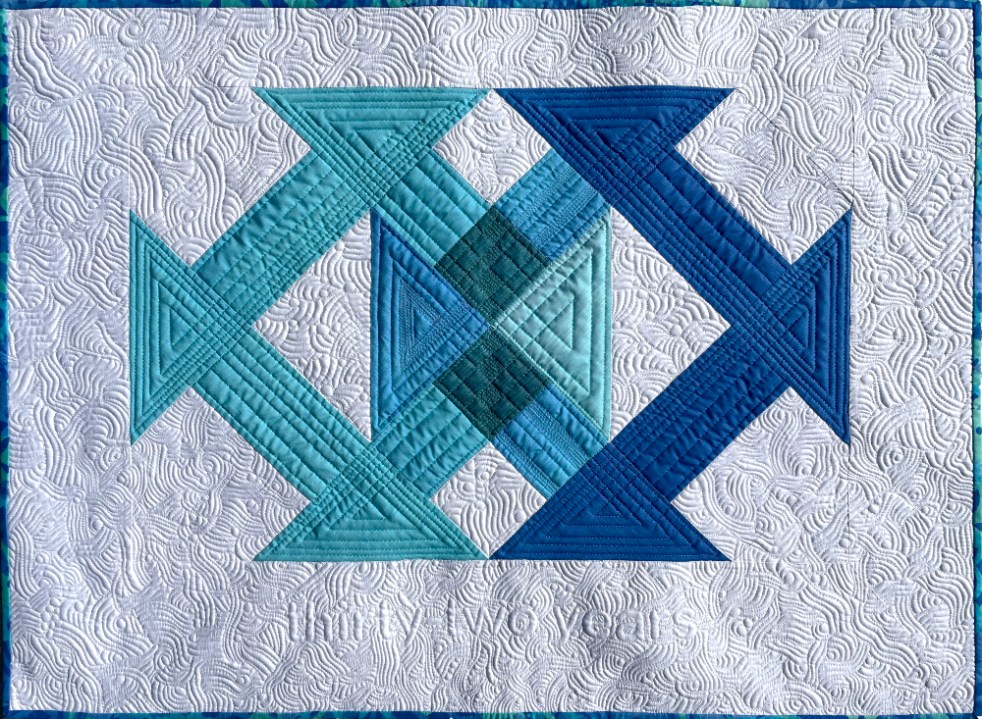
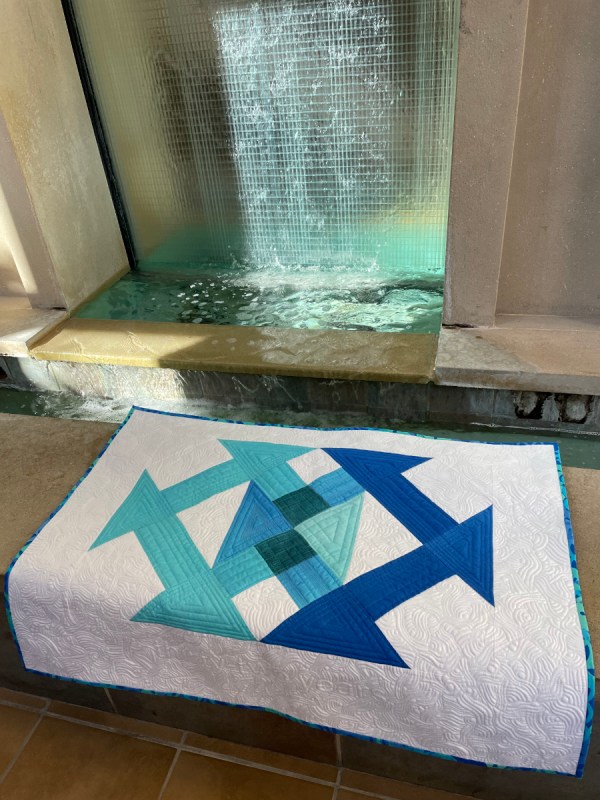
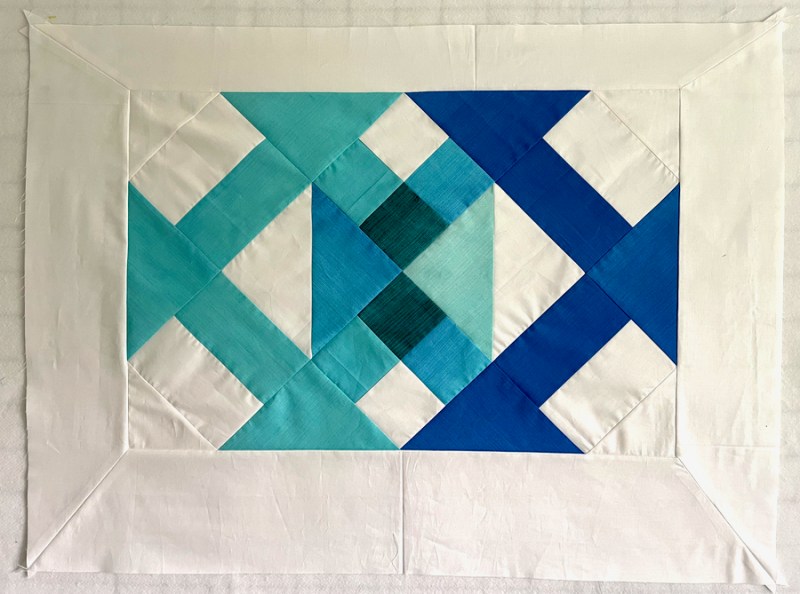
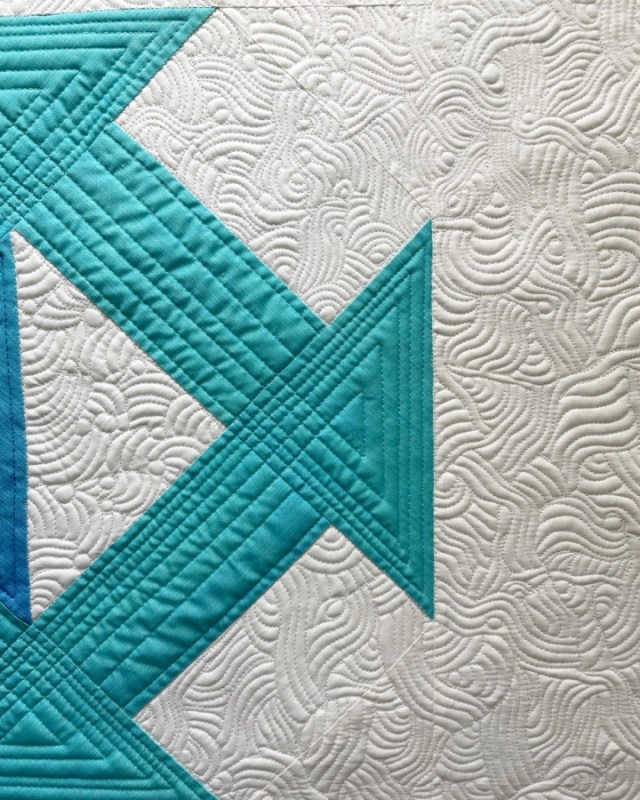
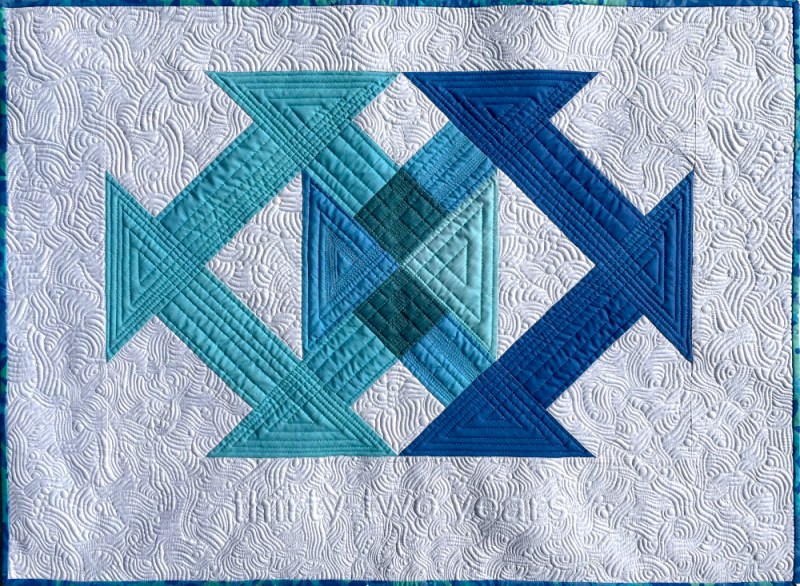
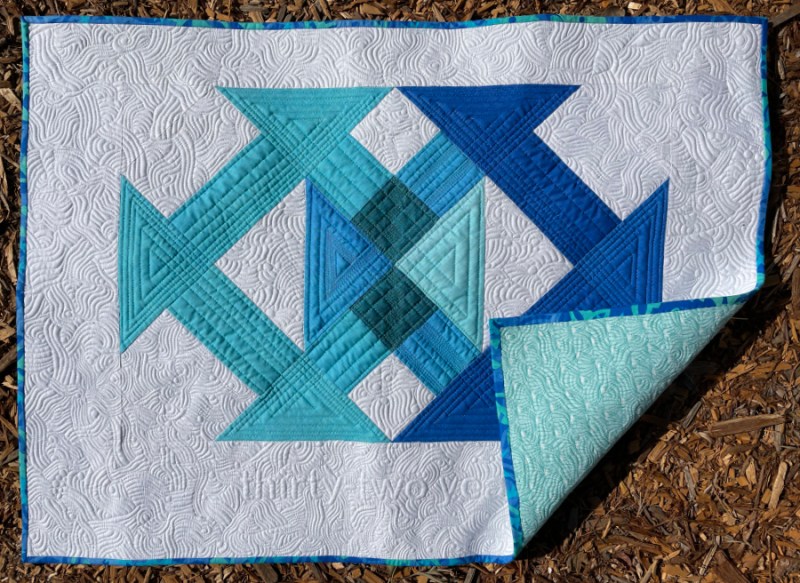
thirty-two years quilt #257 • 34″ wide by 25″ high
Guild Challenge: Use the Churn Dash block, but make it “modernish.” Reams have been written, umpteem digital slides have been presented over what “modern-ish” means. I decided to just do what I want and roll from there.
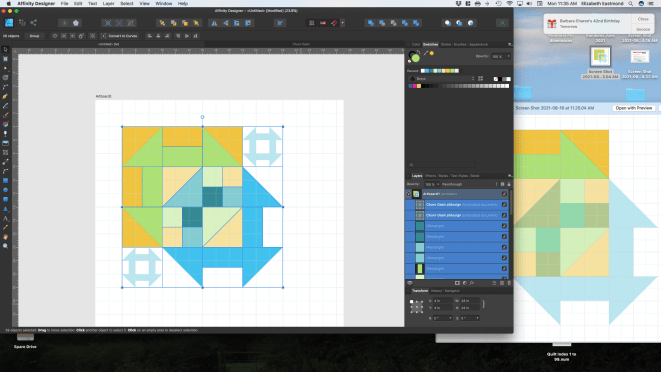
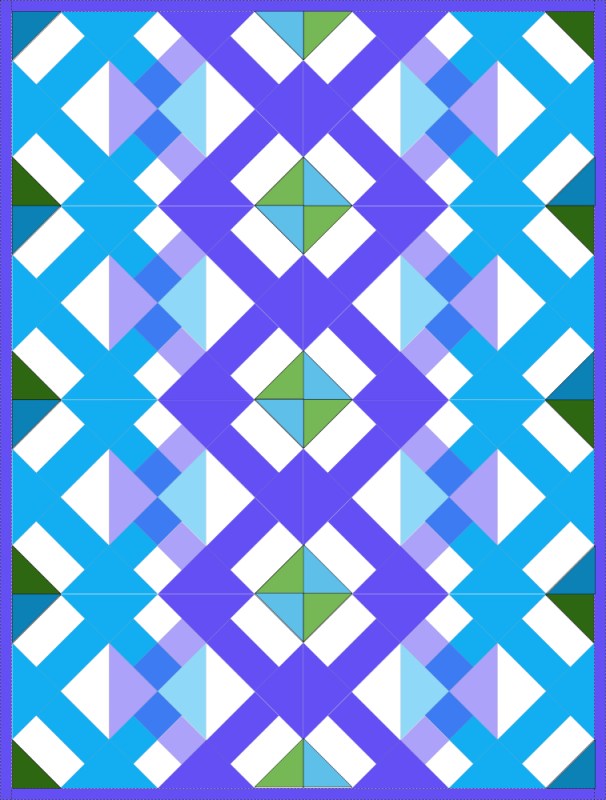
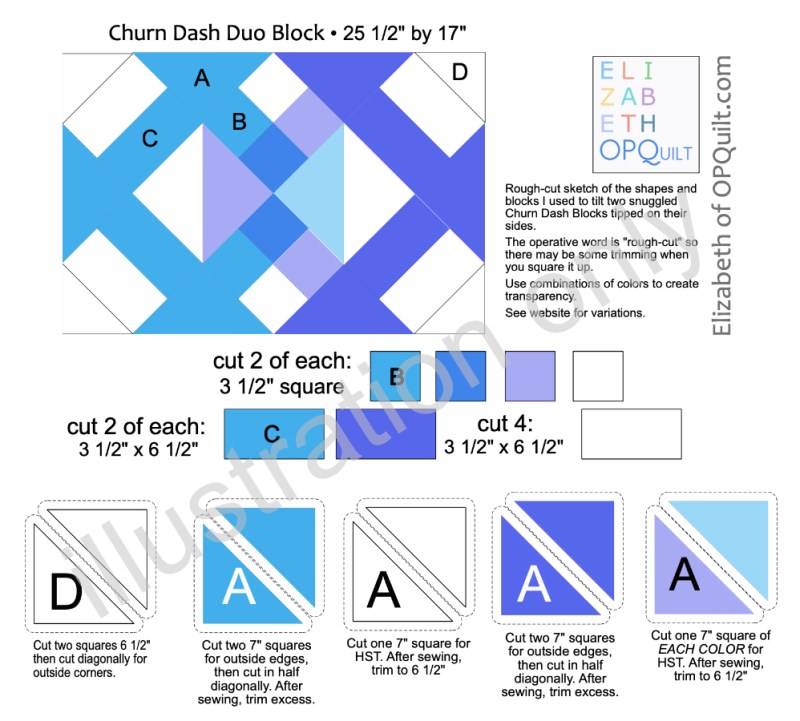
This was first base: overlapping churn dash blocks with blocks in the corners. I’d already left home plate long ago (which would have been a single Churn Dash).
After I’d merged the two blocks, late one night (tired) I sat and studied it. The deep blue color was strong and I liked the aqua color and I really liked where they merged in the middle, retaining something of themselves, but blending by giving a little of their color to the other, making a new hue. Yep, I thought, reflecting on our recent thirty-second wedding anniversary, this little bit of a quilt is just like marriage.
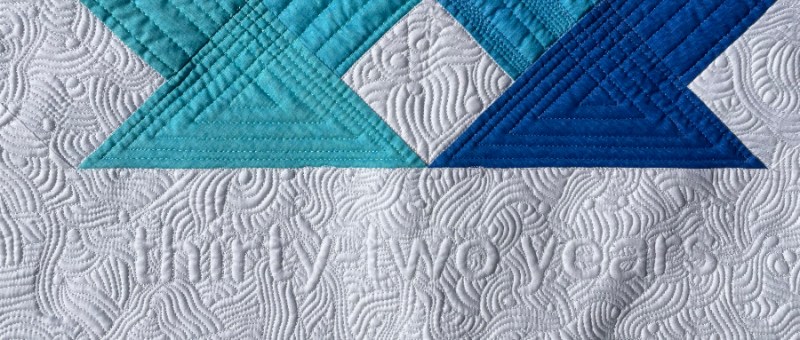
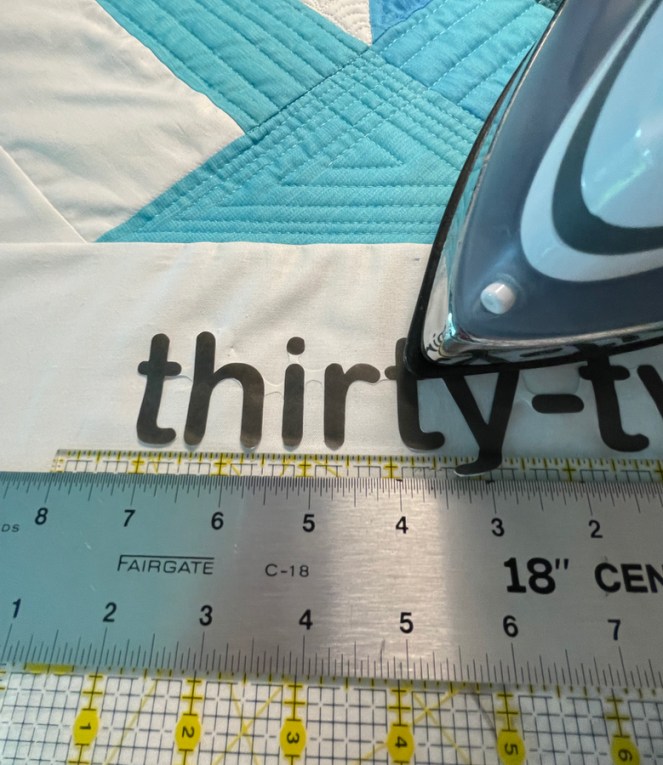
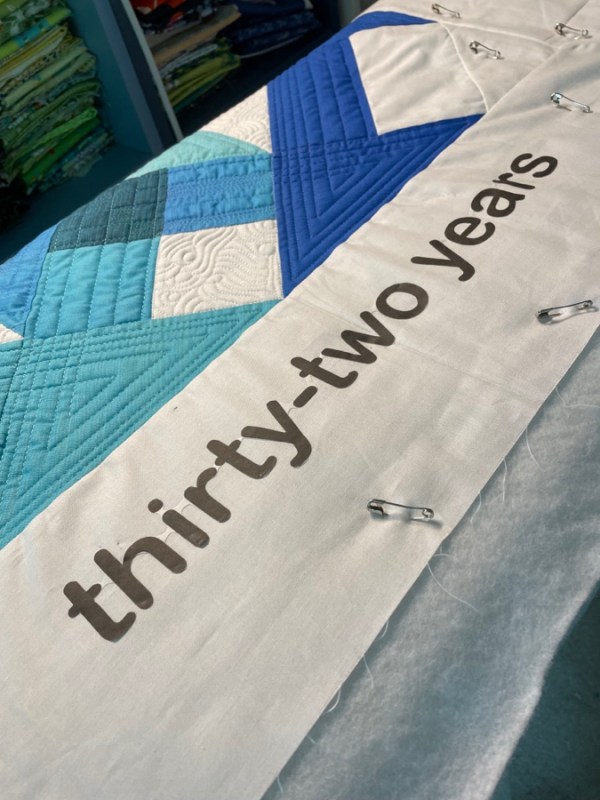
So now how to get the numbers in script onto it? I’d done this once before, so I went at it again. That’s the beauty of all those art quilts I made; I was schooled in many techniques. I wrote it in my Pages (word processing) program, then scaled it up, and printed it out on freezer paper (I had to tape the paper to some card stock to get it through the printer). The most tedious part is cutting them all out; I left them joined by a small bridge of paper, knowing I could just quilt through it.
I pressed it well. Yes, I pinned the quilt together first, quilted the center, then added the letters.
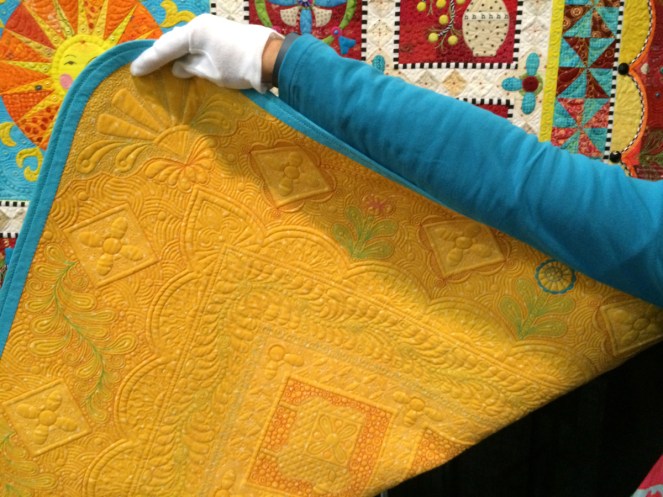
I wondered what to do for the fill. This is why I take lots of photos of quilts at quilt shows (remember those?).
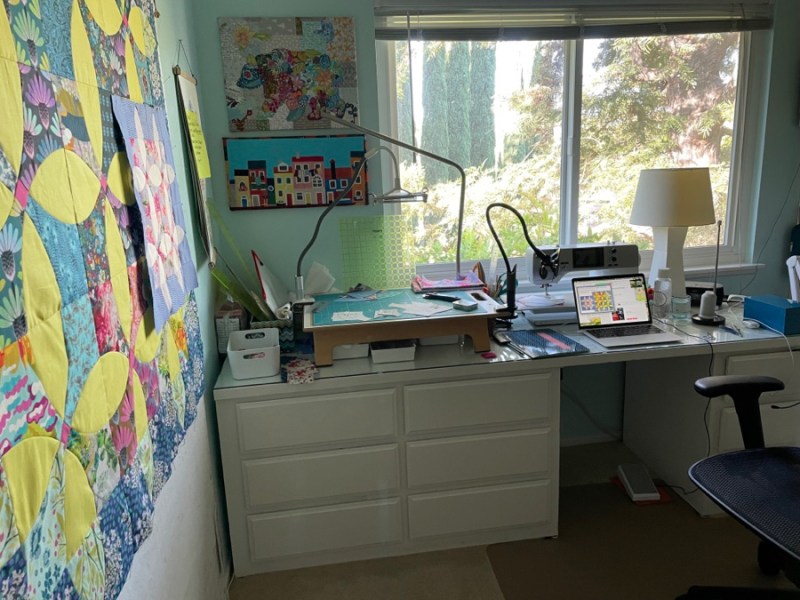
I work upstairs in a bedroom at the end of the house in what used to be my daughter’s room, before this penultimate child burst out into the world, leaving home at twenty, coming back only for visits — an ending I didn’t see coming, for sure. In that room, my sewing machine sits on a desk that runs underneath a double-wide window, and my view is visually sheltered there by the boughs of a silk oak tree, like a frame.
Just below the window, and sometimes climbing up the screen, is an enormous wisteria vine — no it’s really two vines — stuck in the earth some thirty years ago when we moved to this house. In the spring it’s an uncontrolled explosion of heavy blossoms, followed quickly by incessant leaves and sinewy vines and tendrils, climbing, growing, spreading, taking over the old arbor full of termites and carpenter bee holes, and reaching over the pathway to the silk oak.
Two days ago I was startled by a squirrel that leapt from the roof of our house onto the silk oak limb, and as the wisteria has its tendrils wrapped around that one, too, the whole green carpet above and just below my window was set into motion with the squirrel’s landing, a rustling that kept me watching until everything stilled and the squirrel descended down the trunk and onto to other things.
I took a leap of sorts last year when I figured out how to do everything Guild-related from this desk in front of this window: videos, Zoom lectures, demos with two cameras on camera stands that I always have to wrestle into submission for at the time, I was unaware of the fancy ones that moved at the touch of a finger. I loved the Zoom teaching, especially.
I loved all the students in their places and their spaces, their fabrics right at hand, the mess underfoot, the walking back and forth from cutting station to ironing board to sewing machine. It was a rich, varied tapestry of individuals all honing their craft, this pattern they’d chosen, and we worked together as a very long-distance team. Most of the time.
I had a few failures, when I couldn’t reach through this digital space to show them how I trimmed, or to look at the blocks arranged on a wall that was in the hallway just around the corner, with no way to show me. I’ve had classes where it was deathly silent, everyone on Mute, watching my class videos or just being extra-respectful to not bother everyone with their usual noises: phone calls to friends, TV on for company, or the singing along to the radio. I could see them having a life, but there I was at the desk, sipping my water: the girl in the digital box.
Concentrating on getting the talk set up
I loved the Guild Presentations, too: the rows and rows of shining-faced quilters, and before I start, we are all expectant, all of them present in their easy chairs, propped up against their pillow towers on their beds, or the living rooms where husbands/friends/children/dogs wander through, and at the kitchen tables, all of us beaming at each other.
As you know, I recently taught a second class for the Santa Clarita Quilt Guild and my husband asked me if I had any repeats from the first time. I hadn’t looked up the previous class, but when I saw one student’s beautiful wall, I knew she had taken from me before. The space was familiar, for, in a way, I’d spent several hours there last year.
I now have two lectures, four online classes, but almost no gigs lined up. Is this an ending? I love teaching, but maybe it’s time to take longer to watch that squirrel with her descent or “To follow the notes of a disappearing bird out into the trees, up and out along the farthest / branch…”
I don’t know. Maybe it’s not?
I pinned all the Blossom quilts on the design wall before class.
I recognized an ending last time I came to this familiar junction. And I recognized when I had written everything I needed to say at another place in time. But this is all sort of unfamiliar to me now, for I don’t think I’m done, but yet somehow it feels like it might be that way. Or, it might not.
I gave the final scheduled lecture for 2021 last week. It was a hybrid: with a small cohort in their Guild’s usual meeting place at the Fellowship Hall, and the rest of us on Zoom. It was an interesting push-pull, a tension between the recent months of Covid and our isolation and this guild meeting was kind of at the reverse place — wanting to get out, but also wanting to stay in.
I recognized the impulse. Here in California we are all feeling sort of safe with masking in place, numbers down, vaccines in arms, and so we are venturing out to normalcy. However, I figured out some time ago that I would never visit a Guild in person again to teach or give a talk, much preferring the Zoom format. So perhaps this hybrid meeting was the opening of that proverbial door, the notes of that disappearing song beckoning me to the edge of a different wood, in a different territory.
Perhaps.
I’ll still be quilting, I’ll still be writing here on this website. I have a thousand-and-one projects lined up, and I may yet figure out how to schedule my own classes, turning students loose in my videos and handouts and structure. And I know Santa Clarita wants me to come back, too.
Stay tuned.
“Some Ants for Henry,” by Ralph Black [….] To begin each day among the weeds, crouched and hungry for a sign of complete desire, this is my small prayer. To pull a blade of grass and watch a single globe of dew fade and blink out. To follow the notes of a disappearing bird out into the trees, up and out along the farthest branch, laying my fingers against the pulse of that blue-fletched, warbling throat. Such moments can kill a man, or startle him back to his senses. [….] (from here)
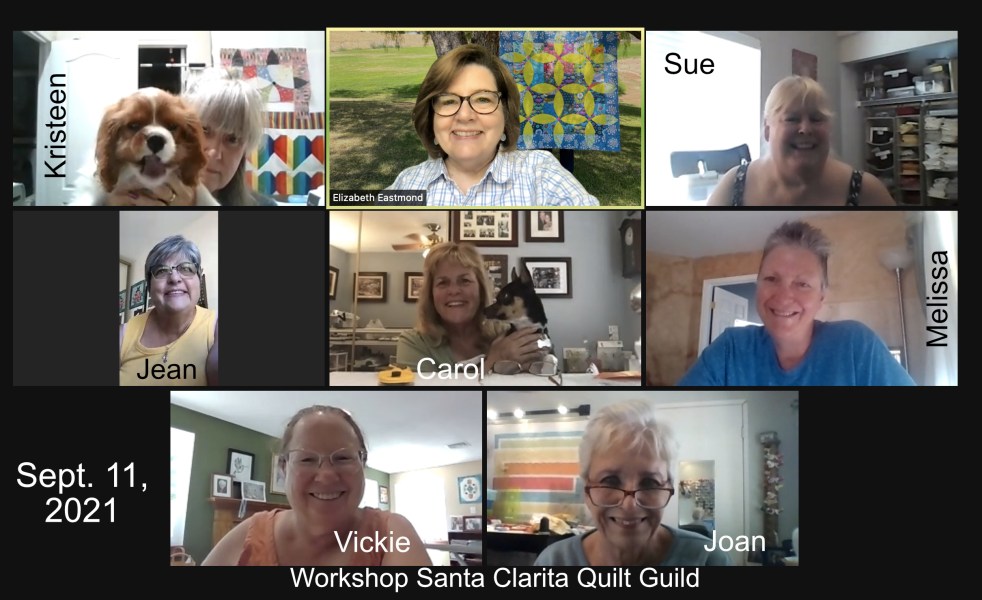
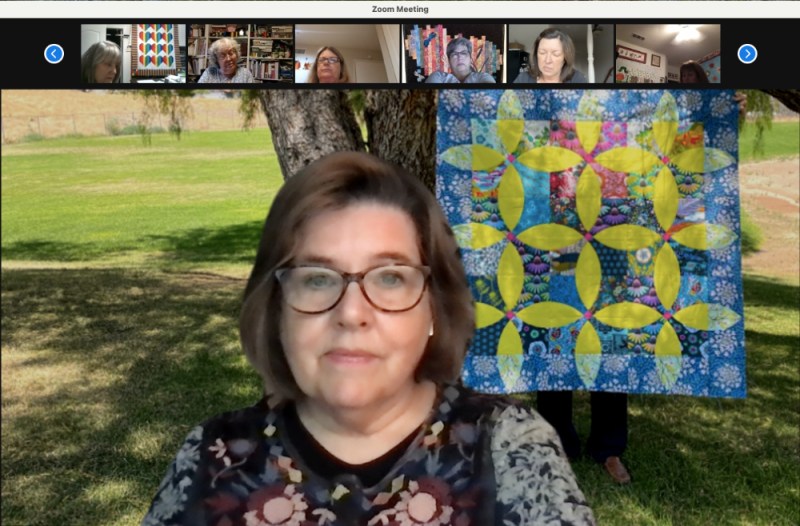
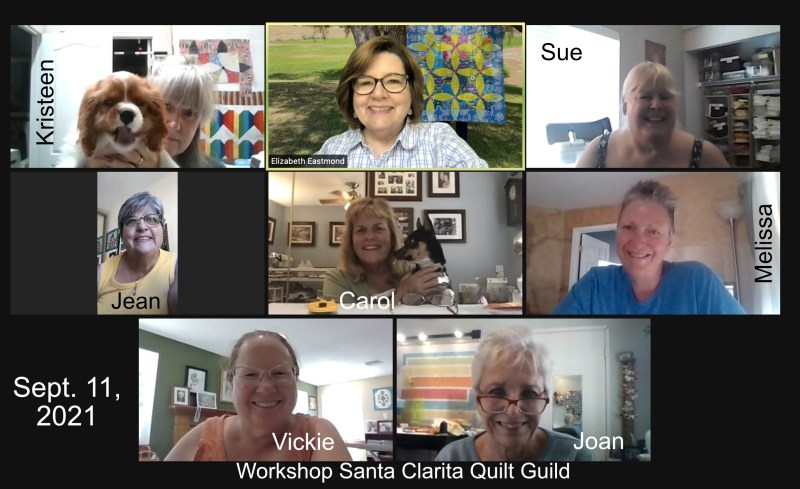
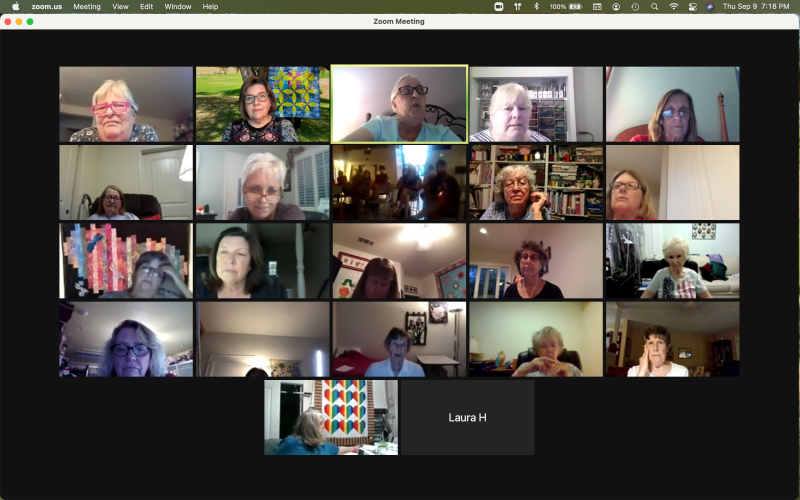
I had a great visit to Santa Clarita Quilt Guild this past week, presenting a new lecture: Exploration Through Modern, Art and Traditional Quilts. I then taught a Workshop on 9-11 (!) using my Blossom pattern. I’ve worked with this Guild before and they are delightful. I thought I would share (with their permission) some of the quilts they made for our Follow-Up meeting about a week later.
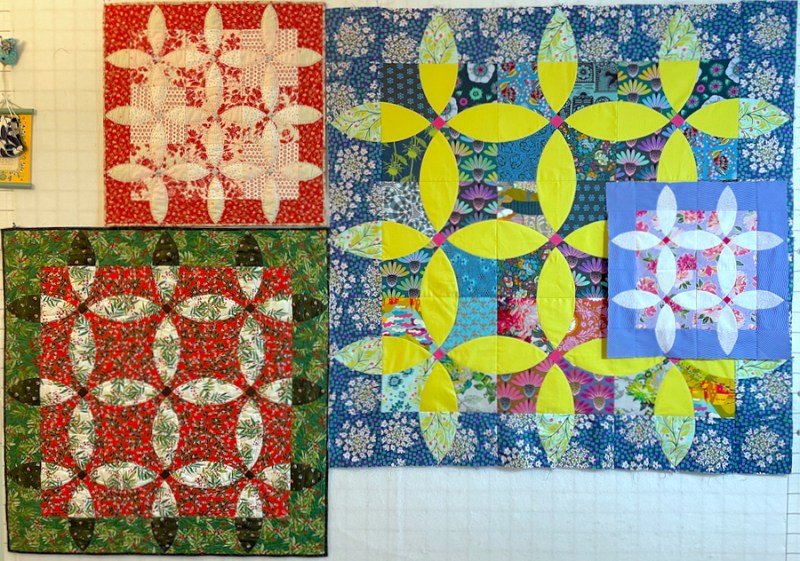
The pattern has three sizes of blocks, and some quilters chose the smallest size, and some chose the largest, but the impact is great with whichever size was used, as the basis — the Flowering Snowball block — is really adaptable to many different fabrics.
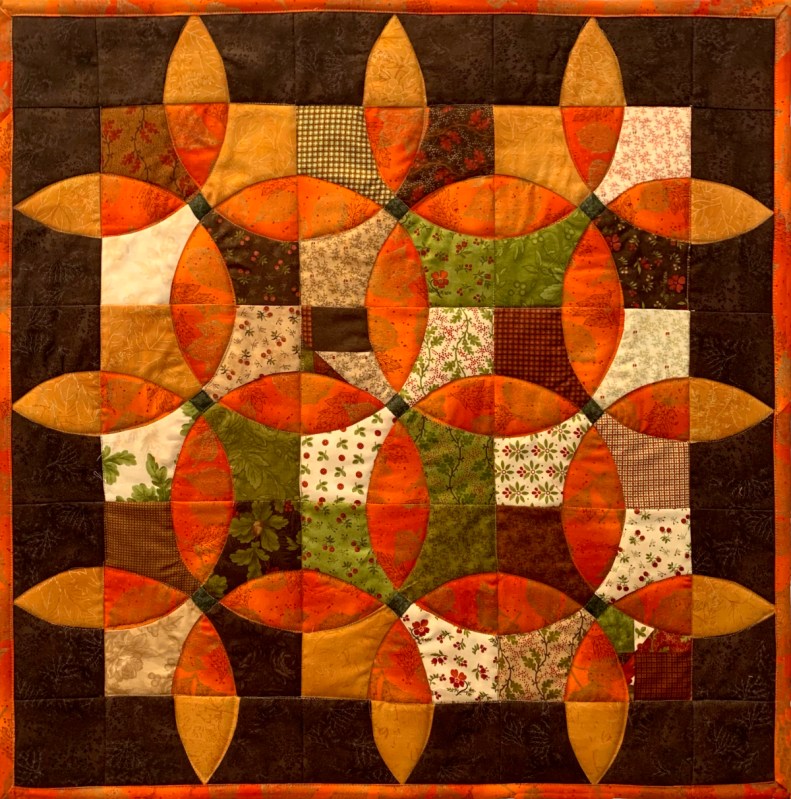
Carol C. used the smallest size, wanting to make a quilt in autumn colors. I think those oranges fairly glow against her dark border.
Jean C. chose dark tone-on-tone batiks for her petals, and backed them with brights. I love that grayed aqua border. While you can’t really see it here, she used a flanged binding, so outside the burnt orange is the dark color again.
I think Joan used the small block again, and I love how the bright cranberry background is balanced by the soft floral petals and the muted green border.
Kristeen D. started out with a white polka dot fabric at our workshop, but by the time we met again, she’d swapped all of that out for the black/white polka-dots. That was a really great choice, along with that border.
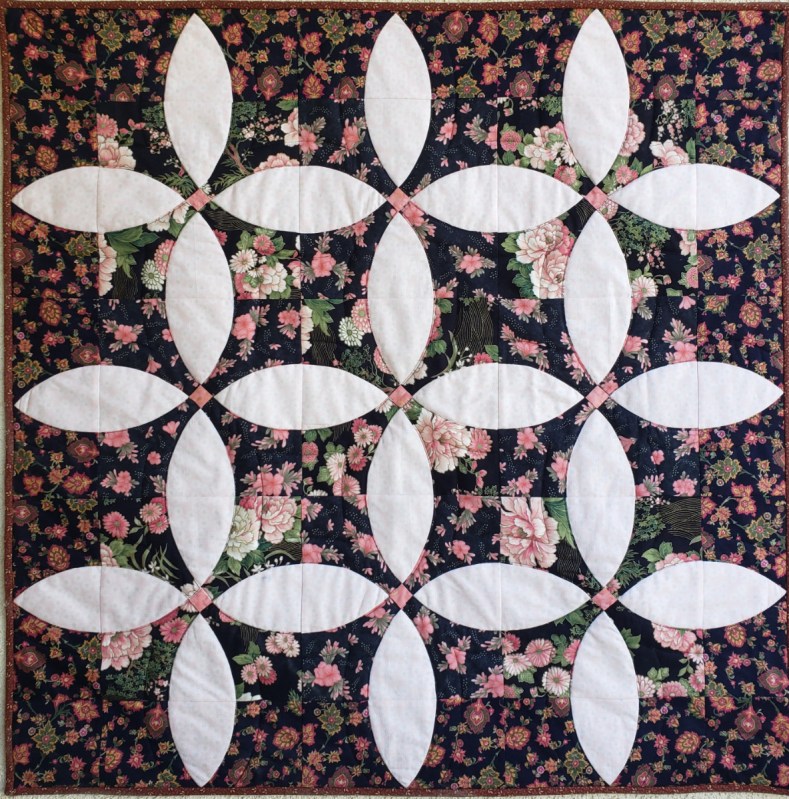
Melissa N had pieces of three different black florals, which she combined to great effect for the backgrounds and border. Several quilters finished their quilts completely and she was one of them.
Vickie R used the smallest block in a limited palette of yellows and blues. But she finished hers into a pillow–a great use for this mini-mini quilt.
Usually we have a full week in between, but we shortened the interval to five days. Sue B. was able to get her quilt pieces cut out and arranged on the wall — I am happy to see quilts in progress in our Slide Shows, as that reflects Real Life. I love that border she chose, and it’s a perfect foil to the bright colors in the center.
Robin T. was at the Guild Meeting and once she heard that I have several videos in the class materials, she realized she could sign up even though she couldn’t attend the Workshop. She used autumn tones again, and then brought the center petals forward with her bright pop of yellow. We all liked how she stepped down from that to the polka-dotted half-petals, then out again to another muted floral fabric.
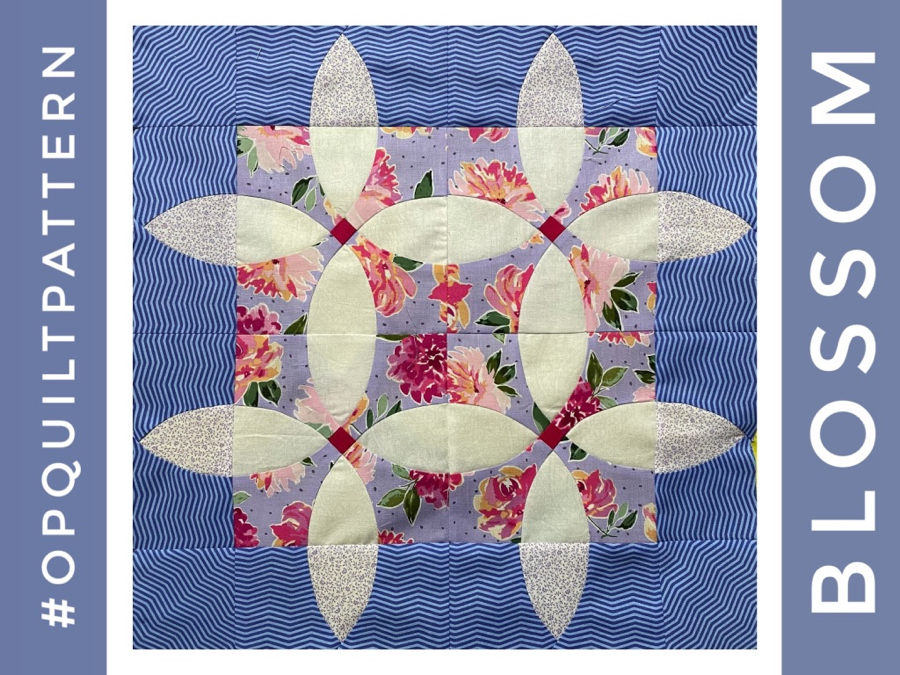
And this is my mini-mini, made in the smallest size. I had decided I’d better try the quilt myself, in preparation for teaching. I loved using the subtle stripe in the border, and rotated the corners 45-degrees so the pattern would continue around the outside. I also demo-ed on this fabric, so this is the front and a large version of the block is the back. Note: the tiny lavender flowered fabric in the outer border is one of the oldest in my stash, as I think it’s about 25+ years old, and was used in a quilt for my then young daughter.
Thank you to the women in the Santa Clarita Quilt Guild for their creativity and imagination and quick work. Hope you enjoyed the Blossom Quilt Show!
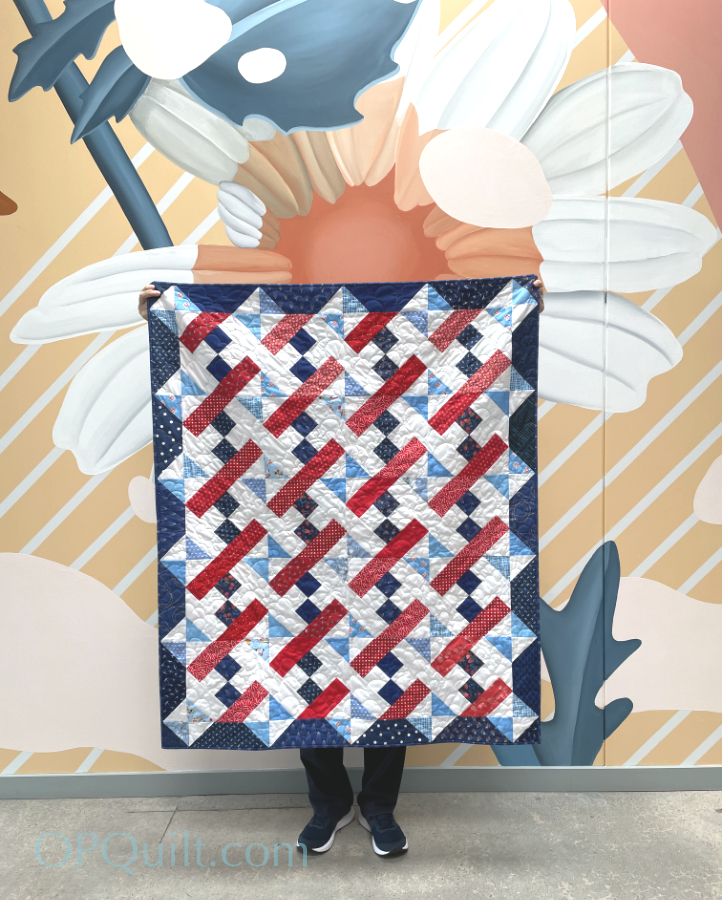
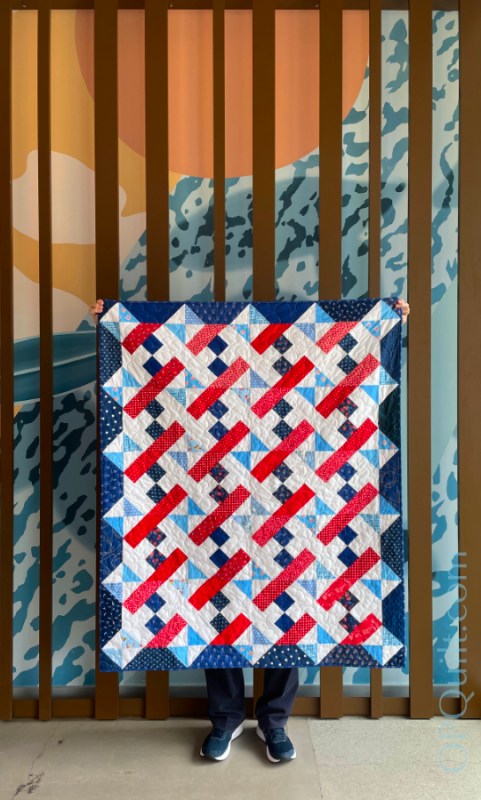
Summer Snowcone, variation of Sun and Sea Pattern Quilt #251 48″ wide x 56″ high
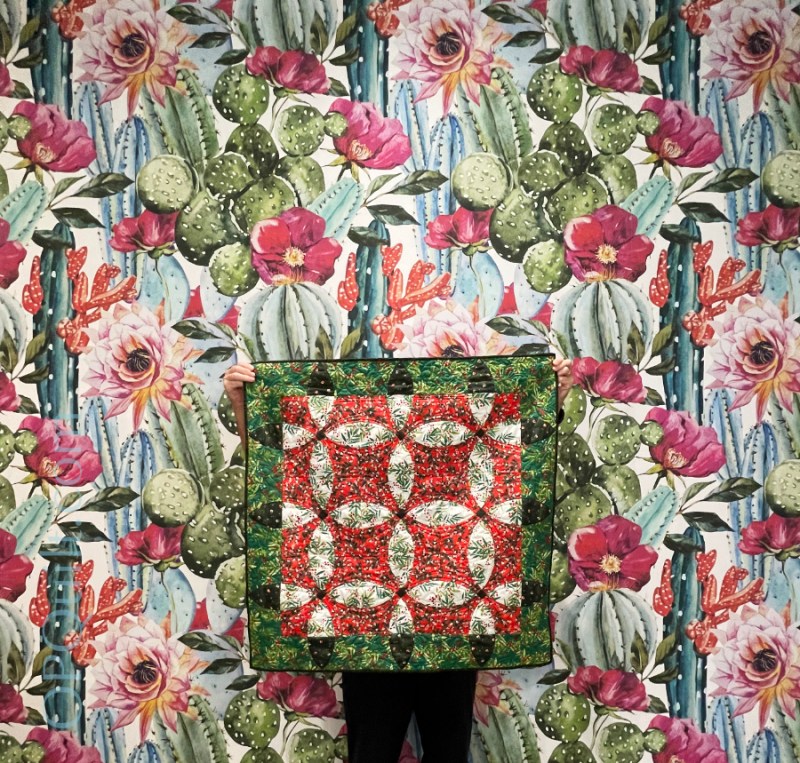
Advent, previously shown but what a cool backdrop of flowers. It was in the women’s bathroom, but I couldn’t resist. (I propped open the door and we were in and out in under 60 seconds, and no one was there.) And yes, I have the best quilt-holding husband on the planet.
The drive to meet our son for lunch was about 90 minutes, and I wanted to finish sewing down the hanging sleeve on Advent and the binding on Summer Snowcone, so we had them along. When I saw that painted hallway, I grabbed the quilts out of the car for photographs.
Photographed in the hallway at City Tacos, Sorrento Valley near San Diego. Since my son’s a working man, we drive to see him and his girlfriend. A good day out.
Website of Interest: A project to make a kimono representing every nation was recently completed. The website groups the kimono by continent, and then you can navigate to the country you want to see. Of course I went to see America, then copied and pasted the text into Google Translate.
Their caption, translated:
The image of a country consisting of 50 states called "United States" is expressed by "state flowers". Designed with the national symbol "President" as "American Eagle". Baseball, American football, Hollywood movies, and the goddess of freedom, which Americans love, are studded in the state flowers, and the great presidents Lincoln and Kennedy are represented by statues and Apollo programs.
I love that Abraham Lincoln is right up there with the “goddess of freedom (which Americans love) as well as baseball and Hollywood. When they say “goddess of freedom” I think they mean the Statue of Liberty. But so cool that they included all the state flowers.
I’m now going to go waste a lot of time thinking about how I should get more stuff done. But hey! it’s Labor Day Weekend and we honor the concept of Labor by relaxing, barbecuing and not doing anything.