Creating · Free Quilt Pattern · Patterns by Elizabeth of OPQuilt · Quilts

This and That: No June Gloom, please.

First off: Happy Father’s Day to the men in your life, and especially the men in mine: my husband, Supreme Quilt Holder, three sons, and one son-in-law, then a gang of grandsons. Here’s a early photo:

(Missing: three more grandsons, three more granddaughters. I just love all those little girls in their beautiful dresses.)

There’s this phenomena about June of every year, when the deserts heat up, drawing cool, moist air further inland from the coast. The locals have a name for it, which I hate. I just call it Reprieve from the Heat for Another Month, or something. because I do love the cool mornings. Yes, I do.

My friend Mary gets too much of this cooling layer and we are always mentioning it in our correspondence, me complaining about the coming heat, and her bemoaning the too-cool summer. Welcome to Sunny California.

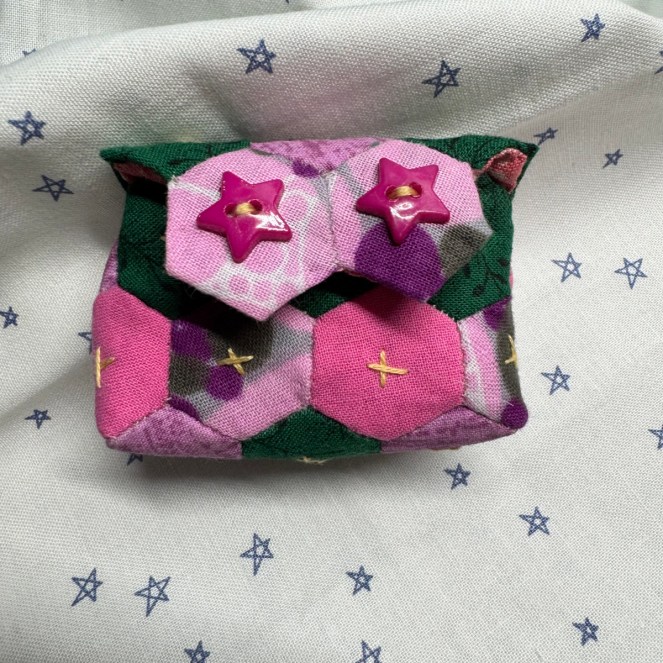
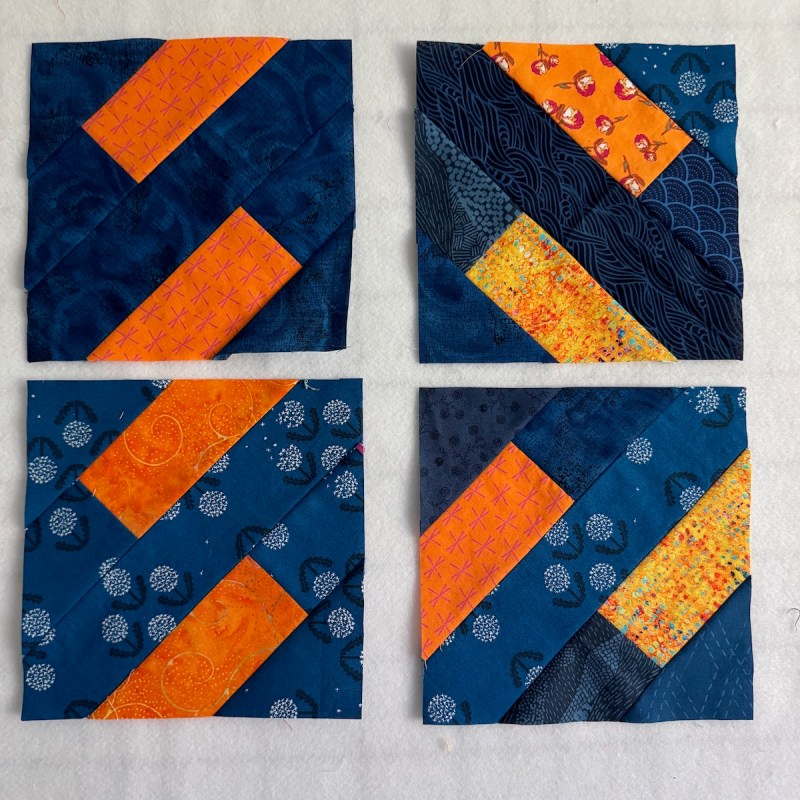
So here is my first Posh Penelope for June: all sunny and bright, in a good kind of way.

A little less sunny, but still bright.

Full out fog in these, with all those blues. I’m going to have to ramp up with brighter colors next go-round, but I do like those toothbrushes on the blue fabric.

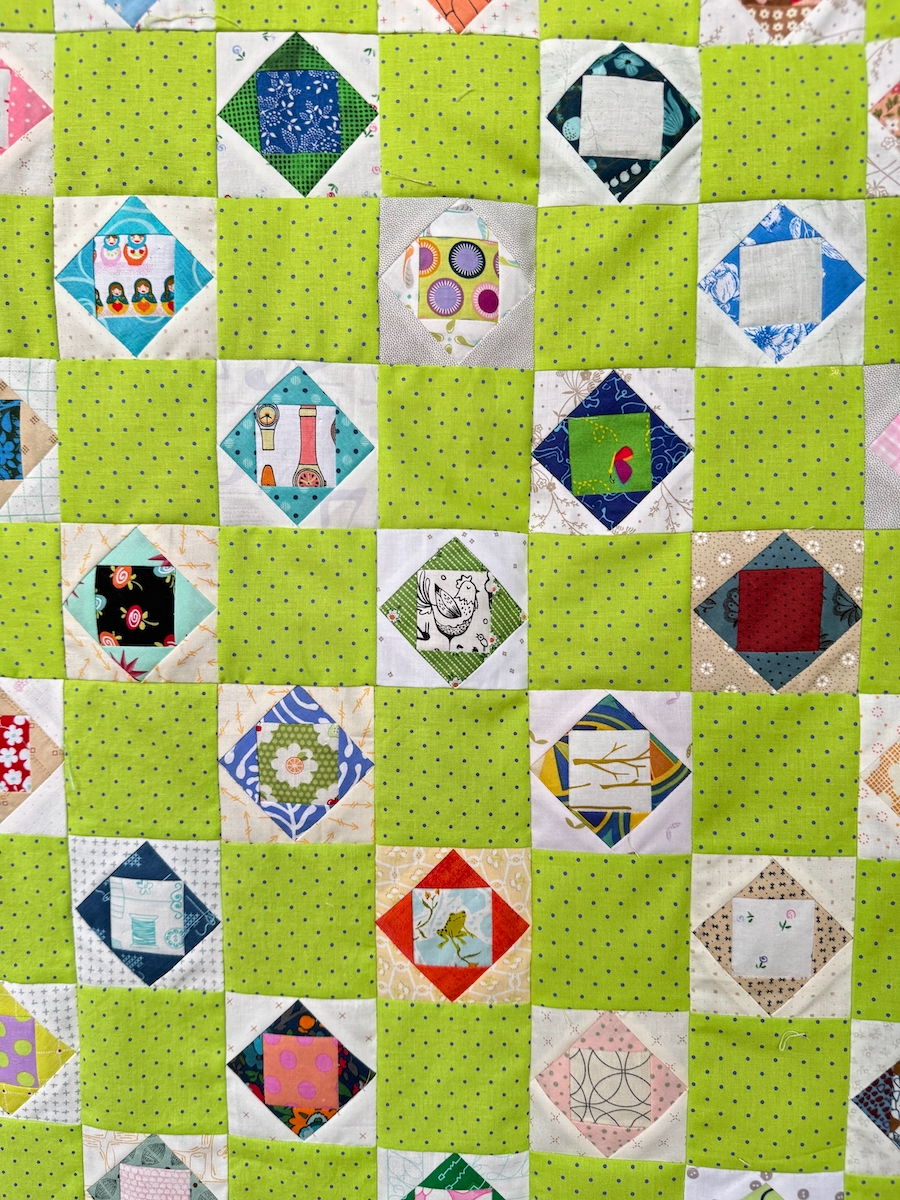
Here’s the group so far. 41 blocks are planned, and I’ve made 27, more than halfway. But I probably said that last time. You should see Carol’s stack — they are wonderful!!

Here’s Sherri’s Block of the Month for June. It’s a fun series and I’m using all her fabrics (picked up one more new last week). But alas, the Friendship Star and I are NOT friends. Nor do I like these stars:

I also don’t like sour gummies or the smell of coconut shampoo, but I don’t think that has anything to do with quilting.

So I substituted this: I have no idea what Sherri has planned next, so I may be moving other centers of hers around, but since I’m allergic to the star she chose, here’s my spool of thread.

And here’s the back of it. It’s fast: sew the sides on, sewing only between the dots. Then sew from the dots to the corners.

And yes, here’s your free PatternLite. And you’re welcome. Click below the spool to download.

Here are the six I’ve made so far:

This is me, making a mess. It’s good to document messes once in a while. I was learning a new way of making circles. (Last post) I know these photos drives one of my friends crazy; she is a very tidy sewer, but her sewing room is also about 4x as big as mine; a lot of stuff gets piled up in mine. I have learned to focus and ignore the periphery, a skill I learned when I had four small children and had to get the quilt done:

Like this one, from the Early Years. My son Chad now has this Sunshine and Shadow quiltsomewhere, he says — but even if it’s lost in his attic, I still have photos. Machine-pieced, hand quilted with a layer of flannel inside…not batting.

For a fun click, head to this write-up of the kimono exhibit at the National Gallery of Victoria in Australia. The article shows both traditional and more modern kimono.

I think I kind of jumped the shark a couple of posts ago, writing about sewing nightgowns and stuff, but things are going better this week. The New York Times must have known I needed a creative tune-up, and published a five-day “Creativity Challenge.” (If you don’t subscribe, here’s a link to the first article.) In it they note that “Research links creativity to happiness and well-being, and a 2021 study found that older people who participated in creative activities showed less cognitive decline than those who did not” (Passarella, NYTimes).

In an earlier missive, Elizabeth Passarella, the writer, said “You are all creative in some way. There’s a definition of creativity that researchers use: generating something novel that is also useful.”

Generating something novel that is also useful. I need to print that out and tape it to my sewing machine. The first exercise was doodling:

We had to begin with a circle and go from there. I’m do not consider myself a hand-drawing-artist, so I did the best I could with a screen and a mouse. Don’t know where that second drawing came from–maybe from the state of politics in our nation today (doesn’t it make you crazy, too?).

So take a listen to Amie McNee if you need a shot of “why should I create.” Her TEDx talk was something I happened on this week, and I found inspiration in many things she said [words in brackets are mine]:

We need to be at the piano [or the sewing machine] making our art more than ever as we navigate these incredibly difficult things. Art is not just for kids; art is not just for adults…we need it now.  [One reason is that] creativity is the missing pillar of self-development.  [Another reason is that] when we create, we have agency.
Another beautiful reason to create is because it reclaims your most valuable resource…our attention in a society that profits from you being stuck on your phone.  We are a culture of consumption and we’ve forgotten how to make.  We need less consumption, more creation.

The act of making art is inherently generous.

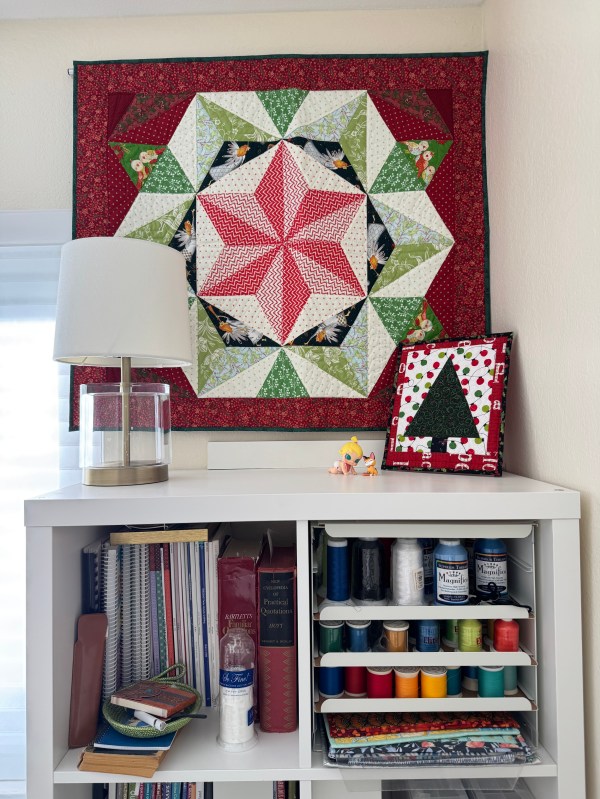
I’ve been slowly working on this. There are a lot of thread changes, and some unpicking, as it’s been a while since I was at the quilting machine. I don’t quilt every day, so I like to keep track with the labels.

That plastic bag in the Messy Room photo? I pulled it off this pile of gorgeous goodness from Stash Fabrics. I wish I could say I was influenced by all the pansies I saw in Krakòw, but the truth is I ordered these before I went. But maybe I could see into the future?

In the NYTimes creative series mentioned above, I especially liked how they talked about a form of daydreaming:
“You’ll be more likely to capture original ideas if you’re in “atypical salience processing mode,” which is a fancy term for a state in which you’re focusing on the unconventional. Look at a piece of abstract art, or stare out your window in a way you usually don’t, paying attention to the space between buildings or the shadows formed by trees.”
(You can read the article with this gift link: here)

Happy Day Dreaming!

Layer your summer salad into a bowl:

  • Cook a cob of corn in the microwave, wrapped in wax paper, for 4 minutes. Run under cool water to cool it down then slice off the cob.
  • Tomatoes (smaller and flavorful like Campari tomatoes)
  • Romaine lettuce, sliced
  • Bit of arugula
  • Radish chunks
  • Cucumbers, cut in half lengthwise, then sliced 1/3″ thick
  • Chunks of rotisserie chicken
  • Focaccia (my favorite recipe is here — I make it every other Saturday night (10 minutes to whip it up in the evening and in the morning, 10 minutes to prep for the baking, plus rising time).
  • Drizzle Lemon Vinaigrette over everything.

Anywhere you travel in Europe, they call arugula “rocket” for some reason. Here’s a little joke for you from the internet.

300 and Beyond · Appliqué · Patterns by Elizabeth of OPQuilt

Kraków Circles

I have this line of patterns I call PatternLite. Usually they start out as just a block I’m kind of doodling around with and want to share. Then I decide I want to make it, and take a lot of photos, and work out some helps and aids and tips and tricks, and before I know it, it has blossomed into a full-fledged — or at least partly-fledged — pattern.

Kraków Circle started out as a free block on the post about my visit to that city, and touring all the churches. Then I thought it might be interested to try out Sharon Keightley’s circle method, since there are bunch of little circles in this design. And then I added a different view, different color way, and so on. Here’s my first stab at the little circles:

She has you use a long pin as your handle, and then using the shiny side of freezer paper, you ease up the fabric, ironing to make it stick (Iink is below) I usually do the gather-stitch around the outside, and then slip in a plastic circle and press, with some spray starch. That just did not work on these little orbs:

You can see how over-full they are. The first try with this, it took me about five minutes and the circle was a bit of a mess. But after about 7 or 8 tries, they were nice and round, so I re-did the gather-circles.

Here’s my one-minute video and I hope inserting the video works! (I’m trying something new.) I know there is a little bump on the circle’s outside, but when I appliqué that, I can ease it in with my needle.

Here’s Sharon’s version of making circles. And she also has a version for the petal shapes, too, found on her page of Appliqué Video Tutorials.

I use Painter’s Palette Solids, purchased from here. This has been my go-to color scheme for years, ever since this quilt, but I was happy to see that it also drew on the stained-glass windows from Krakòw.

I bagged the pieces for the blocks, so I wouldn’t get lost.

I made a placement guide for the block, which is included in the pattern. I also added a print-a-ton-of-circles-at-once page, at the end.

I printed that page onto freezer paper, the how-to shown on this post. Sometimes, I chunked the 12 circle sections together, layered them up carefully, stapled the pages together, and then cut them out.

I also folded the freezer paper into smaller pieces, layering it up, then traced on a petal. Staple the layers so they won’t shift, as shown.

In the pattern, I give the tips for tracing the placement guide, and here, I’ve slipped the block underneath, taping it into place. (The placement guide is pinned to a board, but you could also tape it to a workspace.)

One all pinned into place, and another ready to come off the pinboard.

I was listening to a book, so I can’t tell you how long it took me to appliquè these all in place (maybe 90 minutes?) but it didn’t feel tedious, as the circles had been prepared.

I flipped over the block when I was finished, and cut out a small circle from the back — and slipped the paper out. Sharon Keightley suggests that cutting it out in a circle (instead of just cutting a slash) will keep the quilt back more intact.

I slipped out the freezer paper from the larger pieces as I appliquéd them.

Here’s the thumbnail of the pattern: it grew from 3 pages to nine. However, I’ve still priced it as a PatternLite — less than a slice of pizza, a pot of basil from Trader Joe’s (ask me how I know), or a Kouign Amann pastry from a bakery in Kraków.

If you like to make circles, here you go–

Pattern can be purchased in my PayHip Pattern Shop. If you have the introductory version, this one may be more helpful.

Other related posts:

Quilting and the Churches of Kraków

When You Can’t Create You Can Work

Something to Think About · Textiles & Fabric · Travels

When You Can’t Create You Can Work

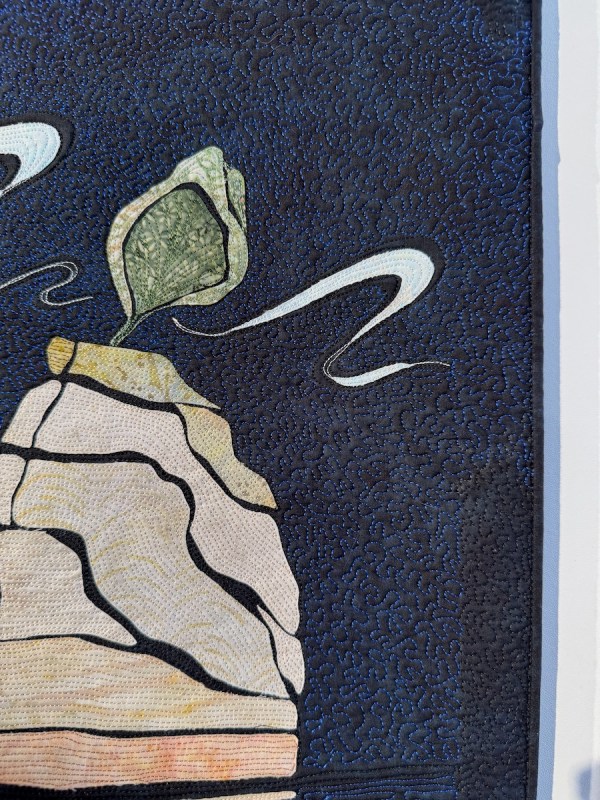
Henry Miller, a writer in the early part of the 20th century, devised a list of rules for himself when writing his first book (Black Spring). I found this whole idea while zipping through an exhibit in Kraków, where a designer tried to incorporate pieces of his so-called Eleven Commandments. One of them, “When you can’t create you can work,” was printed on ribbons and strips of whatever. Of course this phrase caught my eye, and I paused a nano-second to snap a photo then moved on. Tourists! (Look at the end of the post for Miller’s complete list.)

So it’s been that kind of a week, still snowed under by jet lag, I didn’t feel up to creating not one quilty idea. But I could work.

Our weather has started to turn to the hot, dry summer kind of weather, which means that the seersucker that I stashed back in October was going to have to get cut up into my summer nightgowns, using the same pattern that I’ve been using for half my life.

I usually only make two at a time, but this time went for three. I scavenged ribbons, which necessitated digging deep into the garage (more on that, later). The laces bordering the woven ribbon (pink/blue) were picked up on a trip to Austria, a millennia ago. The woven ribbons were purchased when I working at a local fabric store before I had my first child, and when they had wonderful local fabric stores.

I’d given the Jemima Puddleduck buttons to my mother, which she gave back to me at some point. (Three for only one dollar??!!)

I found them in my button box, still wrapped in the tissue paper the shop lady in Britain had wrapped up for me. Before JoAnn’s closed, I would have felt guilty for stashing away all these treasures. Now I feel sort of proud of myself. We quilters are funny people.

Last time she was here, my daughter said, “Mom, you need to clean out.” Implied was the rest of the sentence: “Clean out before you die so I don’t have to.” Message received; rafters cleared. Working on the rest…later.

This standing quilt hoop was a heart breaker to leave at the thrift store. The boy taking this treasure from my husband turned it upside, and one side of the stand fell out onto the floor. He kicked it to the side and dumped the rest into the bin. (Perhaps it’s best if we don’t watch what happens to our treasures.)

Sick and tired of podcasts and newscasts, and realizing my stubborn jetlag was still with me — which answers the question about why it took me soooo long to make the nightgowns — I started listening to a new book, recommended by my sister. So far, so good. I will say that I have gotten things put away from the trip, but so much else needs to be dealt with, primarily the emails. Thank you for your lovely notes on the Kraków churches!

I could have used this Pasmanteria (the word for this kind of a store in Czechia) when I was hunting buttons and trim for the nightgowns. Yes, I found a fabric/notions store while traveling! I purchased the usual: two thimbles.

Alphonse Mucha window, St. Vitus Cathedral

I’ll leave you with this two glorious stained glass windows from the St. Vitus Cathedral in Prague, along with (below) this tiny wrought iron work of a woman spinning thread into cloth, from one of the chapel gates:

Happy Working, if not Creating–

Here are the ELEVEN COMMANDMENTS, if you are interested:

  1. Work on one thing at a time until finished.
  2. Start no more new books, add no more new material to ‘Black Spring.’
  3. Don’t be nervous. Work calmly, joyously, recklessly on whatever is in hand.
  4. Work according to Program and not according to mood. Stop at the appointed time!
  5. When you can’t create you can work.
  6. Cement a little every day, rather than add new fertilizers.
  7. Keep human! See people, go places, drink if you feel like it.
  8. Don’t be a draught-horse! Work with pleasure only.
  9. Discard the Program when you feel like it—but go back to it next day. Concentrate. Narrow down. Exclude.
  10. Forget the books you want to write. Think only of the book you are writing.
  11. Write first and always. Painting, music, friends, cinema, all these come afterwards.

This little PatternLite pattern is a reminder of what we see when we get out of our own town.

You can find it in my Quilt Shop, on PayHip. Enjoy!

Patterns by Elizabeth of OPQuilt · Something to Think About · Travels

Quilting and the Churches of Kraków

Traveling is a blitz on the senses, a clearing of the mind, and making connections that are new or novel. I’m always making quilting connections when I travel, I suppose you are too: new patterns, repetitive designs that could be a quilt are not uncommon on our Instagram feeds or in quilt shows.

If you are new here — and welcome — I often take a small diversion from the *making* to the ideas that propel our quilts. This is one of those posts, and it centers around the creativity shown by a group of Polish parishes during the Communist years in this country. And actually, they are all over the country of Poland, not just in Kraków.

Screenshot of Instagram post

I wrote about the church in Warsaw, our first one to see, and believe me — now that I am home — I vow that if I ever go back to that lovely country my husband and I will rent a car and go see more. They are so different that the usual gothic and decorative churches that we tourists usually go to. (I do like some of these and will show a couple more in this post.) I first found out about what’s known as the Day-VII Churches during the usual pre-trip fatigue: searching for what to see in a given city, I typed in “churches in Kraków” and saw a photo of this church:

Our Lady of Częstochowa Parish, Kraków – Poland

Whoa. All those triangles, the different angles, the airiness — some architect had been incredibly creative in making this. I found out that there were about 3600 churches with similar heritage. The man who hunted down and gathered all these — Kuba Snopek — also worked with Izabela Cichońska and Karolina Popera; together they compiled a catalogue, which I ordered and read. I watched his Powerpoint presentation. I hunted and searched and read and soon realized that I was limited by my time in Poland and had to choose what we would go see. Sometimes there was information and in English, and other times there was not.
Interior, Our Lady of Częstochowa (Some video of the interior)

A lot of these churches were impacted by the changes of Vatican II. In reading about this preciously unknown subject, I learned a lot about how the desire to have the priests more in front of the congregation and to include the participants in the worship experience, changed how the architects designed the churches. Communication with the Vatican was spotty, at best, during the early years after the war, so some parishes/architects turned to the ideas found in theater construction; broad expanses became more common instead of the more traditional narrow nave and side aisles.
(looking toward the rear of church, with hexagon windows)

While we did go to these on a Sunday, we worked to not take photos during their services, with only a couple of exceptions. However, there were many photographers around that day, as it was a celebration of First Communion for a whole group of young people, and the joy and celebration was palpable and only added to the experience we had.

(zoom-in of hexies and organ)

Often when I see a new quilt design, I’m asking How did they do that? Why are the colors distributed that way? Why were those colors used? and finally, Can I replicate this?

I was already working on hexies on our train and airplane rides, so I was familiar with this element, certainly.

But what prompted the architect to insert them where they were? Was the lack of materials the reason for subdividing all those larger triangle windows? I knew that many of these churches were made from whatever was available, and sometimes the parishioners themselves were working at night by the lights of car headlights, using their own small concrete mixers to help pour the larger structural elements.

from here. This church has a nickname of the White Batman, which we did not get to see. Be sure to link over to see the construction photos, all very rudimentary, with lots of scaffolding since there were no cranes (which couldn’t be obtained at that time).

Do we arrange designs by the amount of fabric we have? All.The.Time. I found myself thinking about the nature of making, of design. Do our construction techniques vary according to the design we have in mind? Yes.

However, mostly I was in awe.

Another church, close by, was built in a giant housing project, nestled beside buildings, as were many churches. Imposing in stature, they nonetheless adapted to the area they were in.

The entry is behind that square stone wall. We arrived about 10 minutes before their services started. I had done my research, but somehow open hours were hard to find, but I knew from my own experience that Sunday was probably a good day to visit a church.

The full name of this church is Church of Our Lady Queen of Poland, Kraków, but they call it Arka Pana, and it is in the Nowa Huta section of the city. The outside is clad in small rocks, and St. John Paul II, who had been given a moon rock, donated it to the church (although I think it is not embedded in this concrete).
(upper balcony) We left just as the service started, and went outside:

I wrote this on Instagram:
Our Lady Queen of Poland Church, also known as Arka Pana, is in Kraków, Poland and is one of the Day-VII churches. They are a group of churches built from 1945 to approximately 1990 in Poland, and they are mostly modern in style, built by the Catholic parishes themselves, with different architects. This church was about 30 minutes away from the touristy center, and we walked through a huge Communist housing block to reach the church. It was well worth the effort. We snapped a few shots before Mass began, and only after seeing all the rest of the congregation snapping photos (it was First Communion Day) did we sneak a few more. We then slipped outside to admire this church, reminiscent of Le Corbusier’s Notre Dame du Haut in France.

Now for the more traditional inspiration, the Basilica of St. Francis of Assisi. It’s more modern –haha– as compared to some of the other churches in the area. I learned that:

It’s that design by Wyspiański which engaged me:

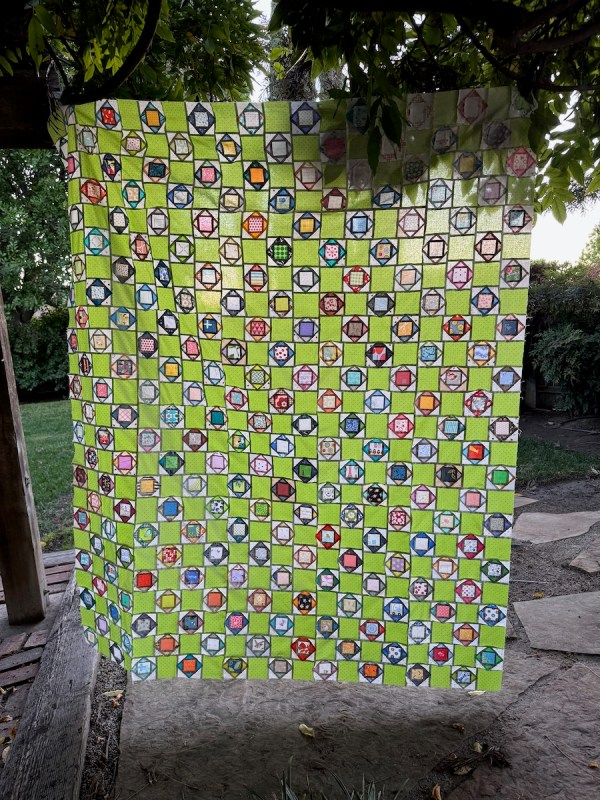
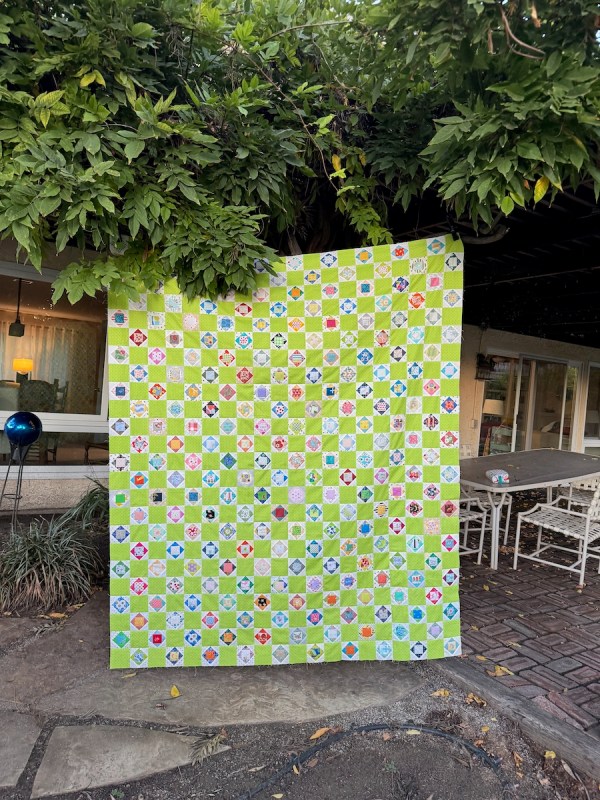
Parts of these images remind me of the economy blocks I’m currently working on.

It’s not exactly the same, but a suggestion.

Yep. I collected pattern and image and ideas and great ideas to fold into quilts in the next little while.

a Wyspiański window; I loved all his wall paintings of flowers!

Our trip tag on Instagram is #poland_prague2025 if you want to see more of our trip.

And because you’ve been so patient in exploring these ideas, I worked up a small idea from the blocks in St. Mary’s Basilica. Below is an illustration of the pattern and a mock-up of colors. Link to quilt pattern is here.

Obviously, I drew color inspiration from the windows of Arka Pana and Stanisław Wyspiański!

(back of catalogue)

Also from the Basilica of St. Mary in Kraków’s main square. I love seeing depictions of the Annunciation.