Giveaway · Heart's Garden · Something to Think About

Writing Poetry

The famous and prolific writer Joyce Carol Oates was once asked,
“What do you do when you finish a novel?”
“I’m spent,” she said. “Can’t write another word of fiction. So I turn to writing poetry.”

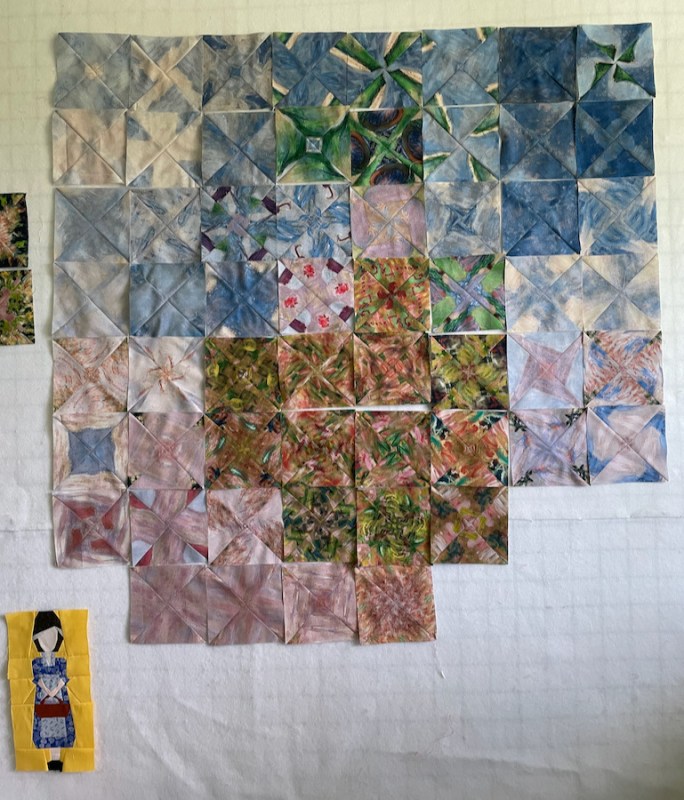
Late Friday night, I finished stitching on the final border of the Heart’s Garden Mystery QAL (the slice of pink in the picture below). I sunk down into my sewing room chair, took a couple of photos and went to bed.

The next morning, her quip — about poetry — began boinking around in my head. I started my day by cleaning up my sewing space: emptying bins, throwing away junk-that-accumluates, vacuuming crevices and window frames. Then my husband came in and asked me to go out to lunch with him.

We happened on our town’s Saturday morning market and bought vegetables, a perfect tray of strawberries, and lunch at the local deli.

We ate outside on the plaza, escaping before the BoJangles Man set up with his amplifier, microphone and guitar.

We walked down the pedestrian mall and shared a Crème Brûlée donut complete with a crackling sugar top.

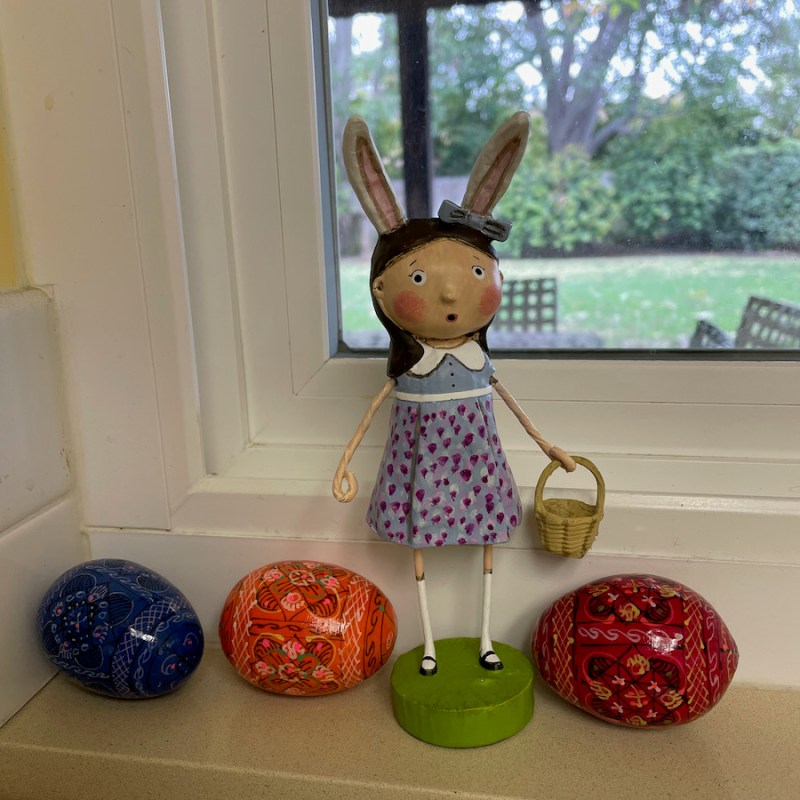
We wandered into Mrs. Tiggywinkle’s shop, and came out with this small Elenor Easterly figurine by Lori Mitchell. I sometimes find that aimless wandering and buying tchotchkes can often help a Mood.

Back home, I finished cleaning up. But I kept thinking about poetry. I used to write poetry, and was once Poet Laureate for University of California-Riverside as an undergraduate. I do have times when I hop onto Poetry Daily and just read for a while, sometimes typing in a search keyword but other times, just reading at random. It’s also great for quilt titles, if you need them.

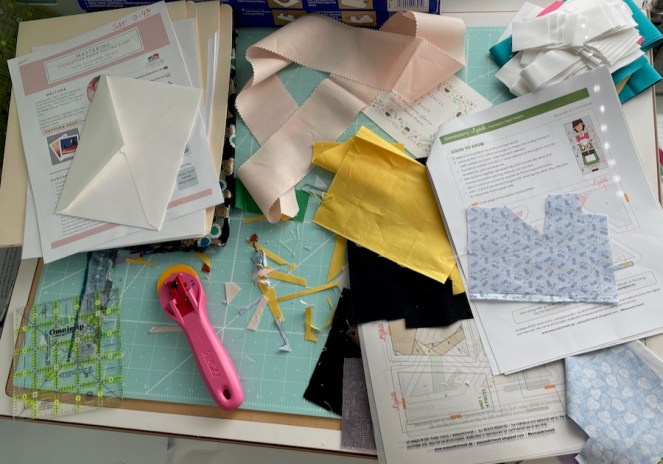
I think, with poetry, there is an assumed connection between the external life and the interior life–one is linked to the other in a reciprocal relationship. But I feel that as well with creative or quilting projects. How I’m feeling internally will affect what I do externally, and if I’m exhausted or unsettled or wrung out, I have to deal with this. However, sometimes that creative connection is automatic — and I have to try to shut it down to relax (like wanting to take a photo of the table because it looked like it could be a quilt design or something.)

Oates’ poetry allowed her to keep creating, yet still leave the scene of her most arduous work. One example of this that we know all too well is our past two years which has kept us immersed in a strange world; many of us turned to our creative connection to help keep ourselves sane. We have all spent our two years chipping away at the gloom while trying to stay mentally and physically healthy. More than once I’ve wondered how my grandmother got through the 1918 flu, but she didn’t write about it. We’ve obviously found tiny slivers of poems (in the abstract sense) to help us — a child’s drawing, a phone call, or just taking a walk — things that can bring us back to ourself.

So after thinking about it, here were my poems for today:

I created a clean space.
I admired the completed quilt top Heart’s Garden on the design wall.
I created a space for me to listen the jet that roared through the skies, shaking our home, its contrails like two steaming taillights.
I opened the window to feel the breeze.

I let myself rest.
I let myself empty out.

Saturday afternoon, I sat at my neatened desk and read poetry, then copied and pasted two poems in below; hope you have time to glance at them.

And…I have already found two quilts that intrigue me, here and here.

(QCR’s Posh Penelope quilt, not mine)

I took a look at the quilt I started at Road, and thought I’d like to make some more blocks. I do have one extra pattern from that day, and will send it to someone, if you are interested. To enter to win the pattern, please tell me what your “poetry” is when you are wrung out–how do you restore yourself…to yourself? How do you replenish that creative urge? How do you find your way back to creating again after a long project?

Leave me a comment below!

Happy Quilting!

Links, etc.

That’s a statue of Eliza Tibbets up there in the collage, with her skirts flowing. Tradition has it that when the first batch of navel orange seedlings arrived in the United States from Brazil, she persuaded the Plant Importation Program to give her some. They sent two, and they flourished — so the story goes — because she watered them with her dishwater. (She really didn’t look like that, but I still love that statue.)

Poetry Foundation, where you can read poems daily, and from where I pulled the following two poems.
I also like Poetry.com for reading poems.

from here

My mother has gone blind over the last decade, but she sewed intricate needlepoint canvases. All three of my sisters and I worry about losing our sight. After reading this poem, I should probably take up crocheting.

poem is from the September 1918 issue of Poetry, from here

This poem is haunting, reflecting our world today, but instead of pink roses, we stitch blue and yellow patchwork. Armistice Day for World War I was a month later: November 11, 1918.

Leave a comment about what your “poetry” is, to enter the giveaway. Thanks!

Quick Quilt · Quilts · Tiny Quilts

Teeny Quilt for St. Patrick’s Day

May your pockets be heavy, and your heart be light;
May good luck pursue you each morning and night.

And may you have a few a minutes to stitch yourself up a little Teeny Quilt on a Frame for St. Patrick’s Day. Pattern is a free PDF download:

I’m adding this to the Main Page of Tiny and Teeny Quilts on a Frame, so you can always find it there.

This teeny quilt on a frame was inspired by two things: this March pillow from Stash Fabrics (from Riley Blake’s Year of Pillows).

And because a dear friend of mine, who is by all rights and purposes is Irish (even though she was born and raised in the United States), has had a bad dose of it this year, and I didn’t want her to be forgotten on her favorite day. She’s the one who would hand out pots of shamrocks to her friends on St. Patrick’s Day. She and her husband have also gone to Ireland about a dozen times, and I never tire of her bopping out with phrases in the way they say them in Ireland. She gardens like no one else, loves saints and sinners and babies and her family with a fierce love, including her friends in that welcoming aura.

While I machine appliquéd the hearts on the pillow, I decided that for such a small project, I would fuse the hearts on.

I put a light crease at the halfway mark — both ways — to get those hearts perfectly centered.

A simple topstitch with green thread, then a white echo, then stipple everywhere else. I’ve learned not to get too “over-the-top” on the quilting with these tiny quilts: the design is the most important, not the quilting.

I cut my binding strips 1 1/2″ wide and use the single-fold binding technique (post is also found in the Tutorials, Techniques, and Freebies, above). I use a glue stick to get it into place, then topstitch down the binding 1/4″ away from the edge and no farther. This ensures that you can slide your picture frame into the pocket on the back.

Happy Making to you all–

Happy St. Patrick’s Day!

Heart's Garden · Patterns by Elizabeth of OPQuilt

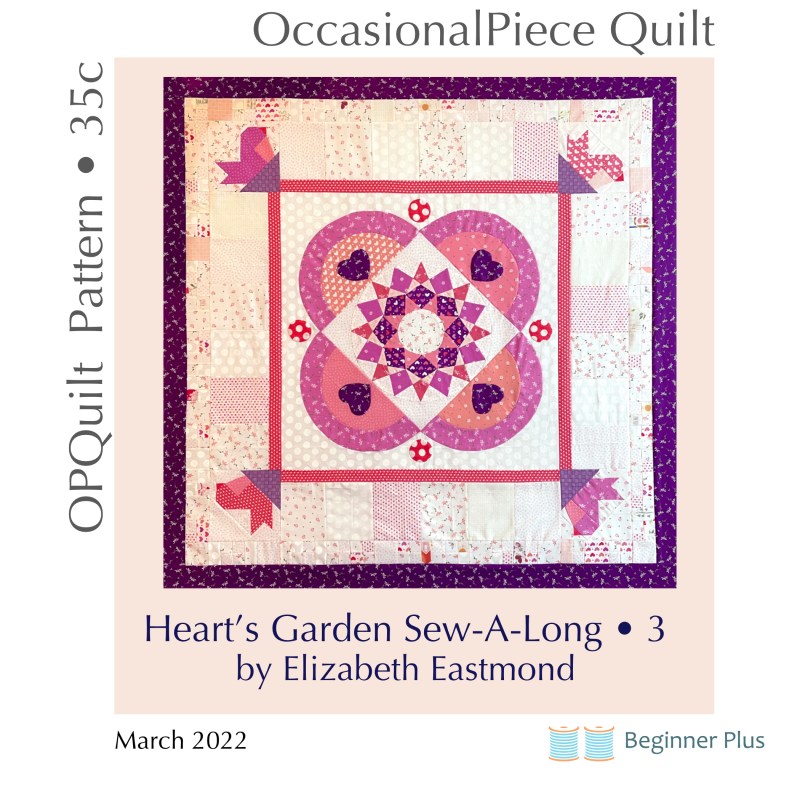
Heart’s Garden • Mystery QAL Part 3

This month is what I call a supporting month in the Heart’s Garden Mystery QAL. Of course you can figure out that flowers will be planted here next go-round, and so you’ll keep that in mind as you create your garden beds for them to grow in. There are three borders: the first inner one with large blocks and corner birds; a second one of interesting bits; and finally, a third one for stability and delineation for what’s coming next. All things rest on your creation this month, but first! some eye candy from Part 2 from Joan, Lisa and Susan:

Joan has put a butterfly in the center. Lisa (middle) also fussy cut her center and the striped border is really perfect. Susan decided to create a four-patch in the background of her Part 2 as she didn’t have any one piece of fabric that she liked. I’m really enjoying the creativity of these quilters!

This month includes making four sparrows in the garden.

I made more samples out of scraps to refine the pattern, but most of the fabrics I’m working with are Sherri and Chelsi’s line of Sincerely Yours, with a lot of warm pinks, reds and fun neutrals. After seeing the quilters above, I now want to remake it in something different.

Then the rest is cutting small bits, creating a background for what comes in Part 4–easy, peasy, right? I know it’s hard to create without knowing the future of a design, and my hat is off to Joan, Lisa and Susan for giving this mystery a go. As I mentioned in the last post, it was a bit of a mystery to me, too, after I scrapped the design of what I’d been headed toward and reworked it into a medallion quilt, but now I’m full steam ahead.

Here’s the front of this month’s installment. Parts 1 and 2 have come down, but all parts will be available in a stand-alone pattern, for sale in mid-summer. Our Instagram hashtag:

[UPDATE: The pattern is for sale in my online pattern shop.] Hope you enjoy making this third part. If you can post them on Instagram they will be fun to see! P.S. If you can’t manage another project, feel free to download for another time.

Happy Quilting!

P.S. This is how I feel about Daylight Savings Time.

Appliqué

Appliqué

I just made a little video about machine appliqué that you can find on YouTube (click above image to watch). It’s not glamorous, I’m not an expert, but most of the important technique about how I do machine appliqué is there in my few minutes of total glory. (haha) While I was making it, I was thinking about gathering all my thoughts about appliqué..so I did.

TIPS & TRICKS

I use MonoPoly as the top thread. I use both their Clear and their Smoke, depending on what colors of fabrics I’m working with. The smoke (as their website says) is a reduced sheen invisible thread.

I use SoFine polyester thread (also from Superior) in the bobbin, and a very fine needle — size 12 is preferred.

Slow down your sewing machine speed if you can.

This clay tool, Mudshark from Mudtools, is one of my favorite stiletto tools for working with machine appliqué. It’s easier for me to hold and the tip is quite long. I also just like the colors. I bought it in the Smithsonian Museum after seeing an exhibit about Michael Sherrill. I figured if he used it and got such beautiful work, then I was going to lean in on his skills and start using it myself.

Stitch settings:
Length 1.4, width 1.3
The zig-zag should just catch one side of the folded appliqué piece (green) and then the (white) background:

This quilt was done with all machine appliqué, and was mentioned in my video.

PREPPING THE APPLIQUÉ

I cut all my shapes to the finished size, then cut the fabric 3/16″ (a fat one-quarter inch) bigger all the way around. I use the freezer paper shiny-side up, and with a hot iron, “adhere” the seam allowances to the waxy side of the paper while moving my iron in an arc-like motion.

Folding edges in freezer-type paper with shiny side down, from @jillilystudio on Instagram. She uses spray starch.

(NOTE: I don’t always wash my wallhangings, so don’t like a lot of glue and starch on them, but for Useable Quilts, she has some great ideas.)

HAND APPLIQUÉ

The only thing I have to offer up about hand appliqué is to think of the folded edge of the appliqué as the frosting inside a macaron, the background being the lower cookie layer and the appliqué itself being the top. Try to bring your needle out of the frosting, then poke it back down in the background just below. Run the needle for about 3/16″ (fat one-quarter-inch) underneath the background, then bring it back out through the frosting (the fold of the appliqué piece). There are many more talented people out there who can explain it better than I, but that’s how I think about it. (I know Jill Finley has a one-hour class on appliqué on her website if you are interested.)

LINKS

How I make my circles (about halfway down the post)

Sewing down the small pointed corners, from @jillilystudio on Instagram

Sewing down small pointed corners, from Becky Goldsmith (and another)

Four Yorkshiremen skit from Monty Python (just to see if you are still reading)