There was a young lady named Bright, Whose speed was far faster than light; She set out one day In a relative way, And returned home the previous night. (limerick by Arthur Henry Reginal Buller)
Our high respect for a well-read [wo]man is praise enough of literature. (Emerson)
Perhaps the most valuable result of all education is the ability to make ourself do the thing you have to do, when it ought to be done, whether you like it or not. (Thomas Henry Huxley)
But now my task is smoothly done, I can fly, or I can run. (Milton)
Have faith and pursue the unknown end. (Oliver Wendell Homes)
***************************
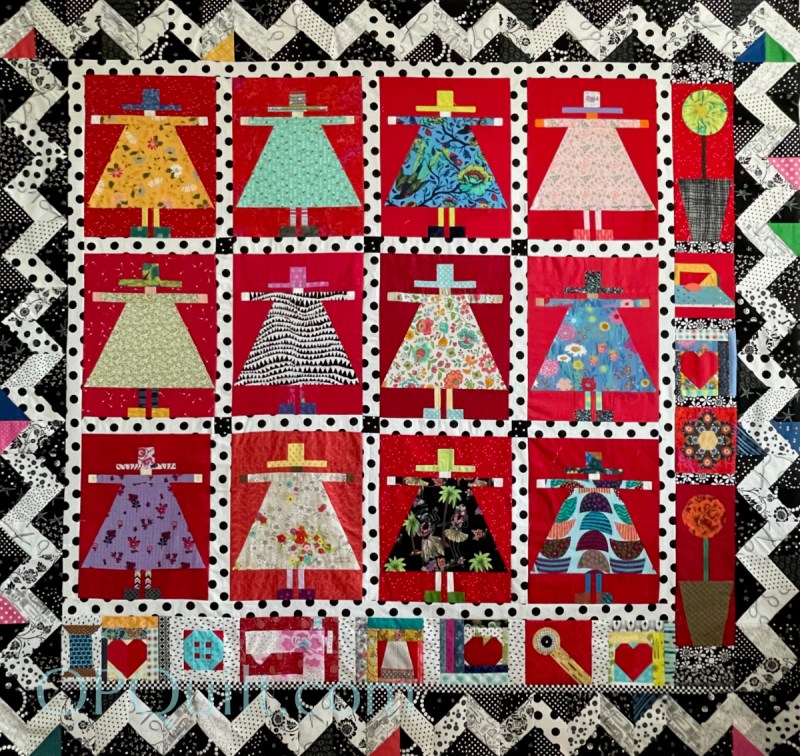
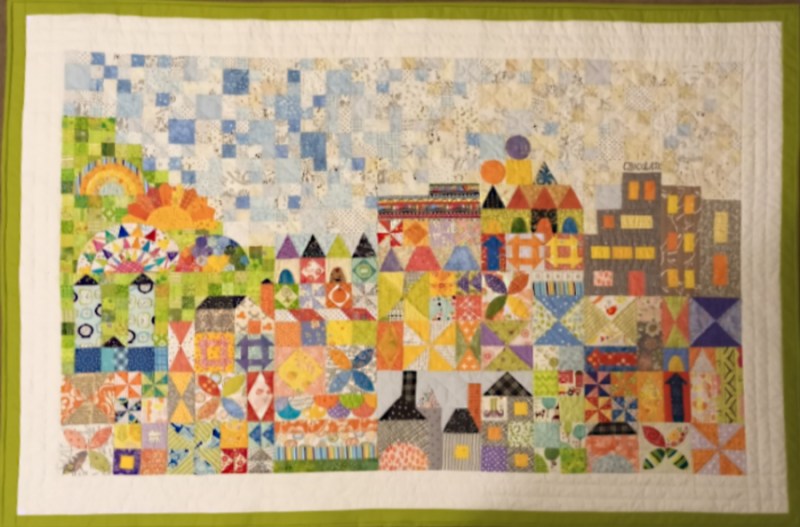
I’m just having fun here, typing in some quotes that fit my happy mood at having finished the Ladies. For a while this unfinished quilt top fell into the worst place for a while, as it became a metaphor for my sadness, my sorrows, my frustrations, my pain, my inability to finish a task, the mess downstairs in my under-construction kitchen, and it mocked me at night when I would come in to try and finish it. I had to hack off a border to get it to this place. I did like that border — but it was either make more to even things out • or • take it off and be done — so the rotary cutter came out. We are all friends again, the ladies and I.
****************************
I don’t really have a title for this quilt yet. Ladies has to be somewhere in that title, though.
*****************************
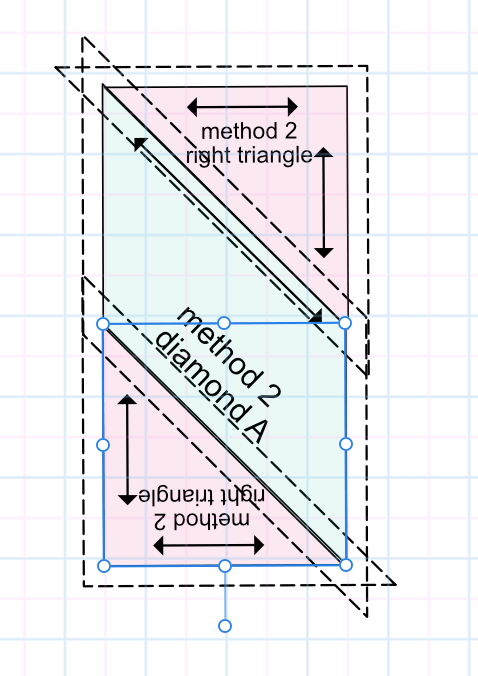
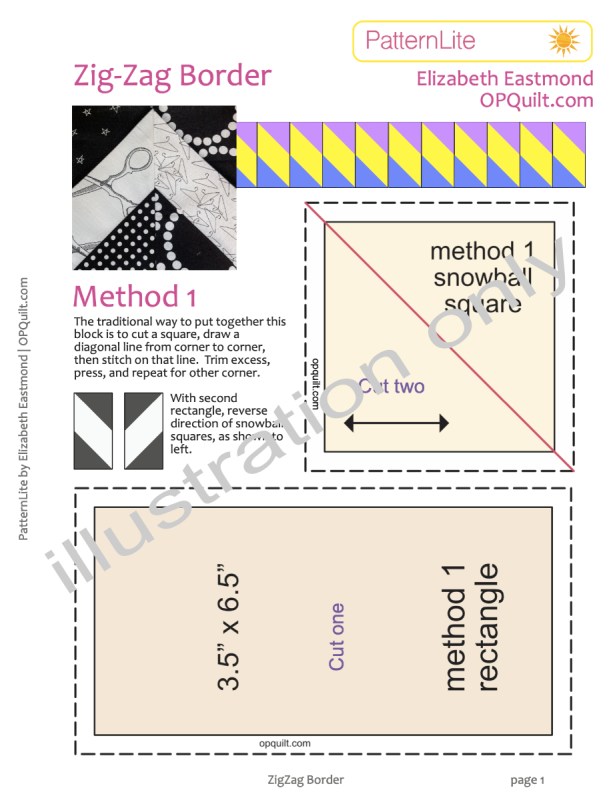
I decided I did not want to snowball a million rectangles to get that border. So I figured out a pattern for two triangles and a diamond that would fit together. It’s not that I hate making snowball corners. I just hate having to figure out what to do with all those leftover triangles. Yes, I know: make more half-square triangles, but then it begins to feel like real work, instead of fun.
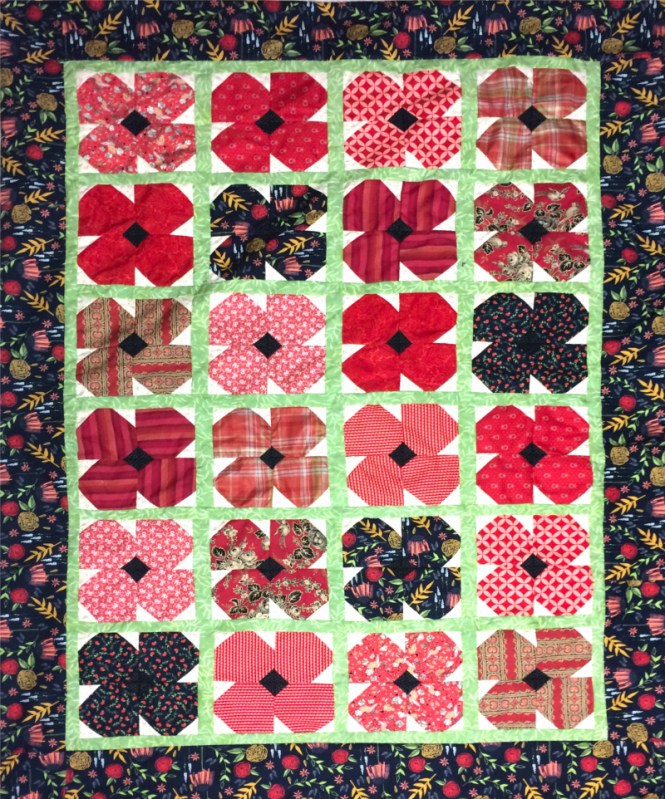
Anne of Springleaf Studios recently wrote to me, including a photo of her poppy quilt:
Anne is an amazing colorist; seeing her quilts is always a treat, as they are rich in color and perfect in value. She wrote that she enlarged my Poppies pattern a bit, and added circles for the centers. I love her version, and it made me think of the first version of this quilt (pattern is downloadable; see below).
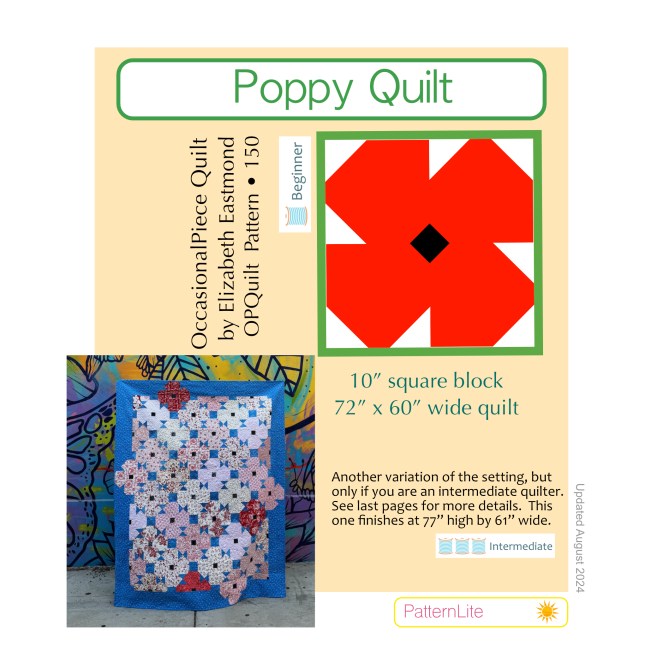
From ages ago, this was the first iteration. My distantly related niece knew I was a quilter and wanted to make a quilt for her mother who was undergoing treatment for breast cancer; they wanted poppies. I drew it up, heard that she finished it, but it wasn’t until much later that I was able to get a photo of it for my archive. (I wrote about the process earlier on this blog.)
This is a more traditional poppy block, with the red petals and the black center, but I’m in totally in love with Anne’s version. Hmmmm, I think I’ll have to add that to the list. I also have a lot of Kaffe prints and need to use them up.
The first Poppies pattern was written in 2017; I recently re-wrote the pattern, and included the more traditional setting which is over in my PayHip shop. I’m happy to share with you.
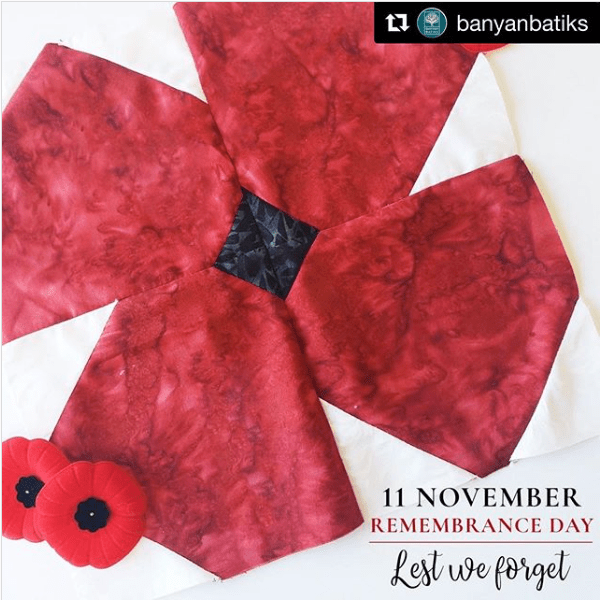
(Fabric companies picked up my pattern for Remembrance Day, 11 November)
Another way I share is by not having advertising on this blog. As some of your know, we’ve been re-doing our kitchen, We thought about it about a decade ago, then more earnestly in 2020 (haha!) and this year the time had finally arrived for us to update. The other night I was trying to figure out how to use our new Breville Smart Oven to cook some potatoes and I jumped online. It was like jumping into a pool of advertising, swimming upstream looking for the content/recipe/can I use the convection? So the only money that comes to me now is through the patterns; this is just a choice I made. Maybe I’m crazy (possibly–to do a kitchen remodel might be proof), but I very much like writing and visiting with those who find this blog.
Here are some more poppies — this time in California Poppy orange — a welcome visitor in March.
I mentioned that my friend Judy passed away mid-February and her memorial open house was March 17th. While cleaning out, her daughter found a completed batik quilt and backing and wondered if I could help her get it finished for her father? I contacted Jen of Sew-Mazing Quilting and she turned it around in no time flat. I got it bound (we took off the last border and used that for the binding — no one will ever miss it), and delivered it to them on March 16th.
I’m sure all the guys in the kitchen tearing out my kitchen cabinets wondered what in heavens name we were doing.
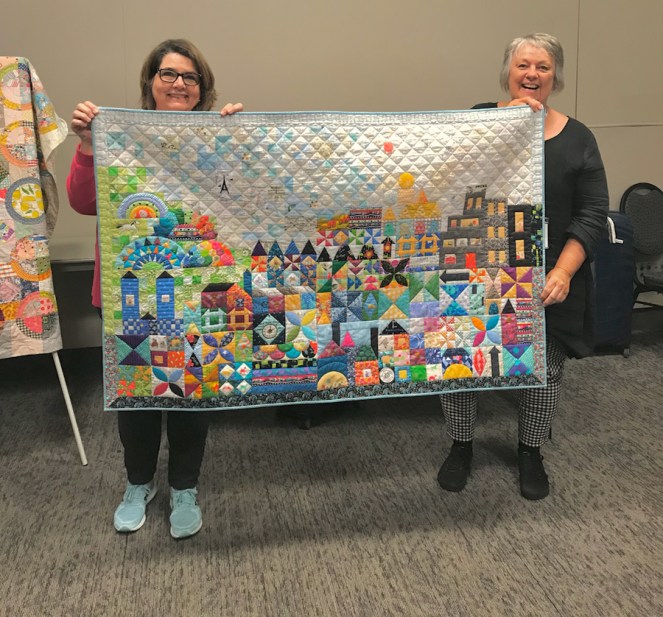
January 2020 • Road to California, where I showed Jen Kingwell my completed Small World Quilt
February 2020, QuiltCon: Shown here finishing my first block in Yvonne’s class (QuiltingJetGirl)
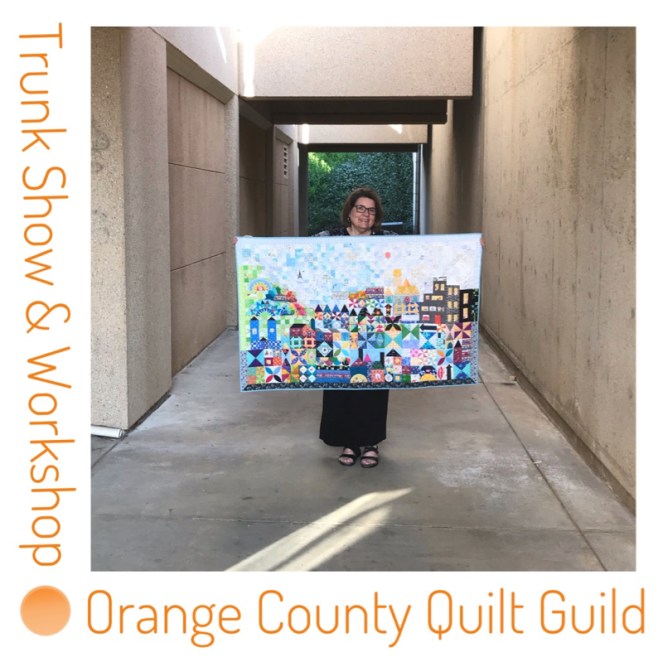
March 2020 • Quilt Guild Lecturing and Teaching
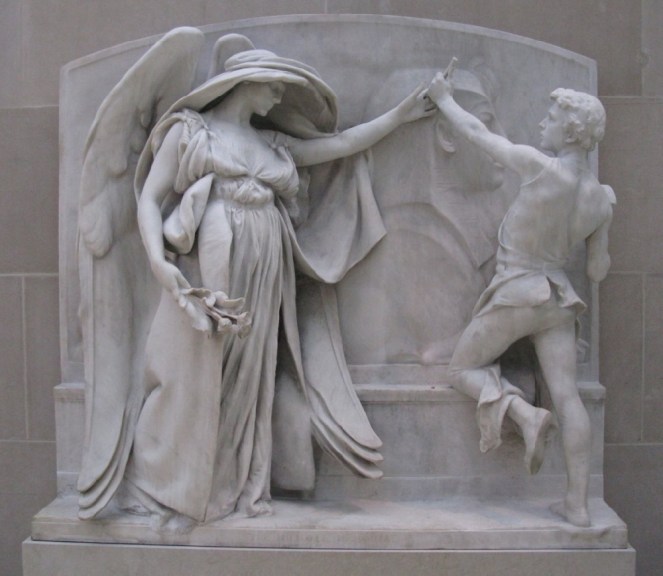
And then March 19, 2020, I post up the Milmore Memorial, as all of a sudden we are aware that the Angel of Death, bearing her poppies, will be stopping many of us mid-gesture.
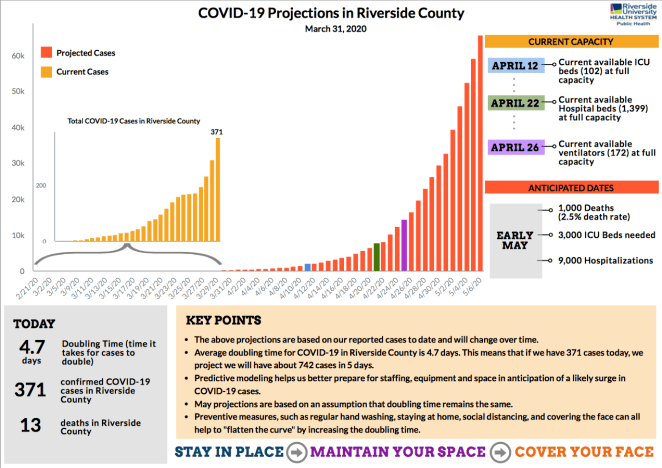
March 31, 2020 • This becomes my nightly reading. Covid is real, even though we hardly know what it is.
All these musings were inspired by three things: a few random “Where were you in March 2020?” Instagram posts, my friend Laurel sending me a picture of her Small World quilt, newly hand-quilted and finished that very night, and an article titled “Three Years into Covid, We Still Don’t Know How to Talk About It,” by Jon Mooallem and published in the New York Times, the place that was kind of the horrific epicenter to the quake that still rattles the United States.
“The [NYC Covid-19 Oral History, Narrative and Memory Archive] makes clear that, with respect to Covid — with respect to so much — we are a society of anecdotes without a narrative. The only way to understand what happened, and what’s still happening, is to acknowledge that it depends on whom you ask. People’s experiences were affected by their race, ethnicity, wealth, occupations, whether they had children at home. But they also turned on more arbitrary factors, or even dumb luck, like if someone happened to be living with a sort-of-annoying roommate in March 2020…. A man compared the pandemic to a game of musical chairs: The virus shut off the music; you were stuck where you were stuck.
Now, it’s as though we’ve been staring into a fun-house mirror for a long time and our vision is correcting — but it’s correcting imperfectly, so that we may not pick up on all the bulges and dents. We are awash in what [Ryan] Hagen referred to as an “onslaught of narrative repair,” scattershot attempts to clarify or justify our experiences, assignments of blame, misunderstandings and misinformation flying in all directions. It will play out and reverberate for years or decades.”
I don’t have any brilliant thing to add to this article (which, you should read, all the way to the end, even though it has a slow start), but it made me realize that we’d all been through this incredible experience — or experiences (as everyone’s was so individual) — and unlike those in the article, I realized quilters (who by our very natures are the type to sit inside away from everyone and sew) might have their own dialogue to add.
“At first, the pandemic seemed to create potential for some big and benevolent restructuring of American life. But it mostly didn’t happen. Instead, she said, we seemed to treat the pandemic as a short-term hiccup, no matter how long it kept dragging on, and basically waited it out. “We didn’t strive to change society,” she told me. “We strived to get through our day.” Marooned in anomie and instability, we built little, rickety bridges to some other, slightly more stable place. “It’s amazing that something this dramatic could happen, with well over a million people dead and a public health threat of massive proportions, and it really didn’t make all that much difference,” Swidler said. “Maybe one thing it shows us is that the general drive to normalize things is incredibly powerful, to master uncertainty by feeling certain enough.”
(see above for citation)
I got through my covid days by quilting, and it was instructive to look back through the pages of this record, to see how I tried to “build little rickety bridges to some other, slightly more stable place.” I generally was very lucky: a lovely home, with lots of supplies, a supportive husband, and an ability to isolate away until the vaccine came (for me) in January 2021, a relief and a welcome day. Maybe quilting is well-suited to helping us cope with our “drive to normalize things” — cutting patches, sewing them together, using the well-established tools of social media to keep us connected on one level, even though all the social aspects: guild meetings, classes, retreats, and sewing groups went by the way.
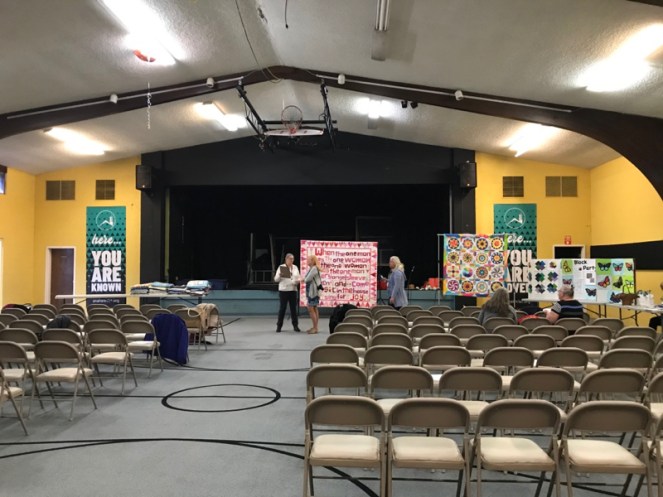
Orange County Quilt Guild March 2020, before the meeting started
Their use of the word anomie is intriguing, and loosely, it can be defined as “normlessness,” meaning “that the underlying rules are just not clear…Anomie sets in when a society’s values, routines and customs are losing their validity but new norms have not yet solidified. “The scale is upset,” [the early French author] Durkheim wrote, “but a new scale cannot be immediately improvised. …The limits are unknown between the possible and the impossible.”
When Laurel sent me her photo Thursday night, she bridged a time from 2015, when Jen Kingwell’s pattern was published in QuiltMania, to September 2019, when Paula James (@the_secret_sewer) and Nicola Kelly (@nicola_picola_) challenged us all in to finish these quilts, leading a quilt-a-long on Instagram. I finished mine in time to post with Jen Kingwell (top of the post) just before we were all slammed.
A well-known bridge on California’s I-15
I like to think of our quilts as those bridges, helping find our way back to civility, to health, and even to mask making (our batik fabrics were champs!). I hope we continue to figure out how to write and think about what we all went through, sharing our individual experiences with acceptance and kindness. And I hope we keep quilting!
I ran across some quilt baby pictures the other day.
And a tangent: Chaucer was on to something when he wrote “The life so short, the craft so long to learn.” I’ll explain, but first you should know that we’re cleaning out, preparing for some home renovation. Or as I like to call it, #kitcheneggedon, where we are moving our entire kitchen into boxes or onto shelves, and our refrigerator out into the garage, which meant that two of our four file cabinets had to go. It was time, really, to figure out what we’d crammed into those moving metal drawers so long ago. We filled one giant curb-side recycle bin, borrowed our neighbor’s and filled his, and I was still going strong. Glance, toss, glance, toss, glance….Whoa.
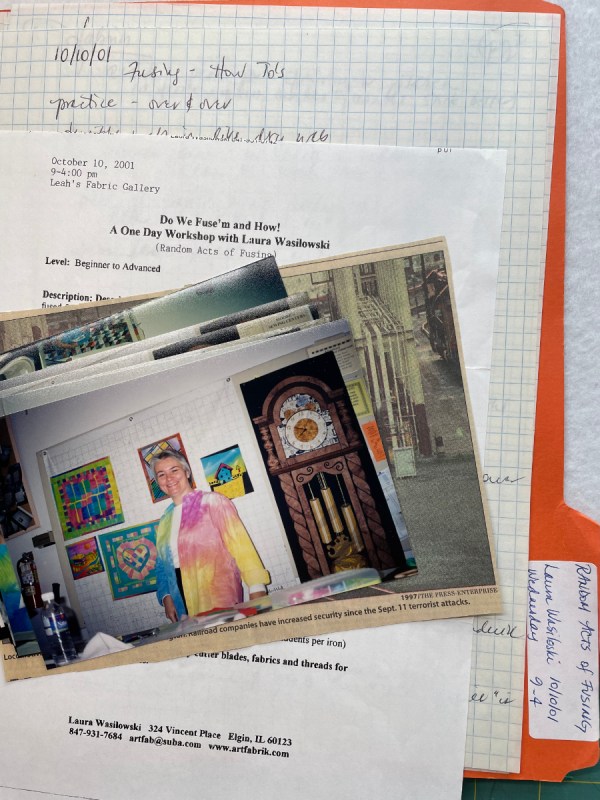
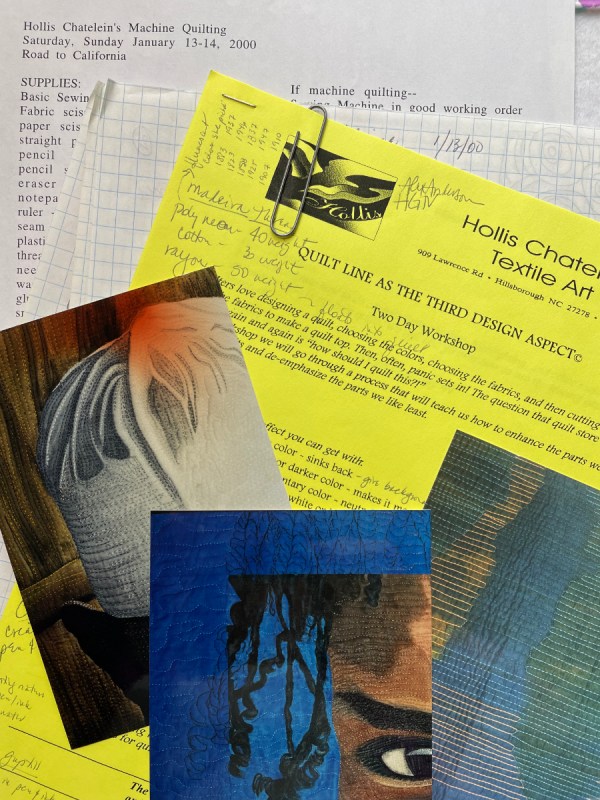
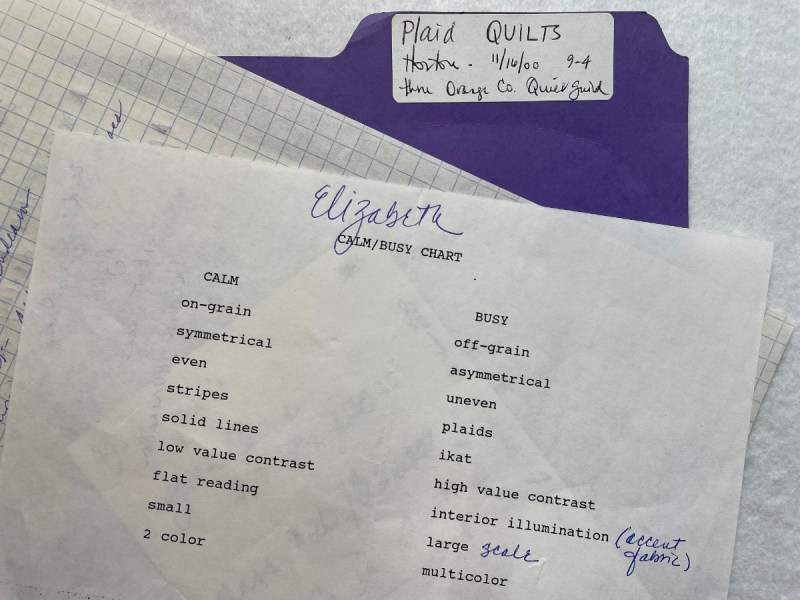
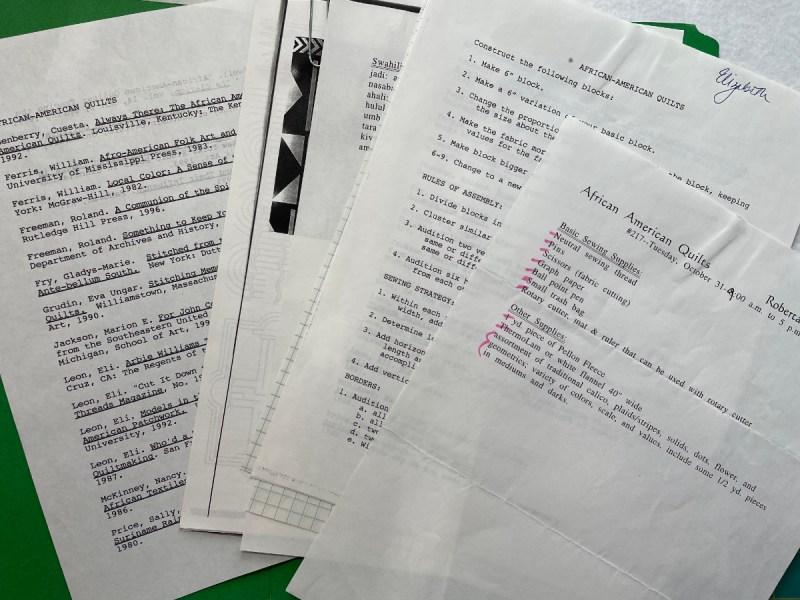
Several files stopped me dead in my tracks, as they were from the first series of classes I ever took, a veritable record of my how some of my quilts were hatched (hence, Quilt Baby Pictures for the title of this post).
• An embellishment class which sample I promptly tossed. The redeeming factor were finding two beading needles in the class kit, which I needed. • Two Laura Wasilowski classes: one on fusing, where we learned the Chicago School of Fusing fight song and that her first iron lasted 25 years, and a second where I made a reversible jacket (which I wore for years). • Debbie Caffrey Mystery Class in which I had fun, but when I took another Mystery Class some years later (teacher shall remain anonymous) it put me off that format forever. • A two-day Jane Sassaman class through Orange County Quilt Guild’s summer Camp Watch-A-Patcher, where she kept encouraging me to go wilder, bigger, more colorful. She’s genius. • And a Hollis Chatelein class about close quilting in quilts, a vanguard in that style of quilting.
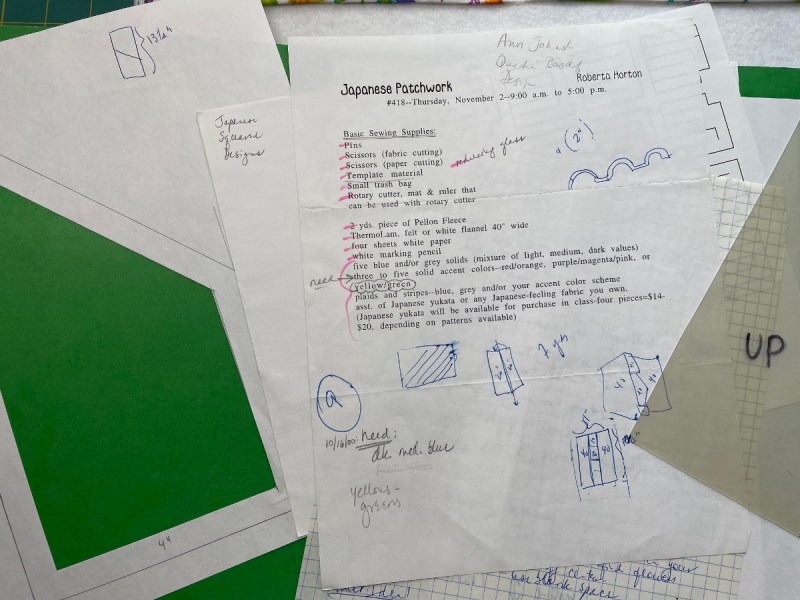
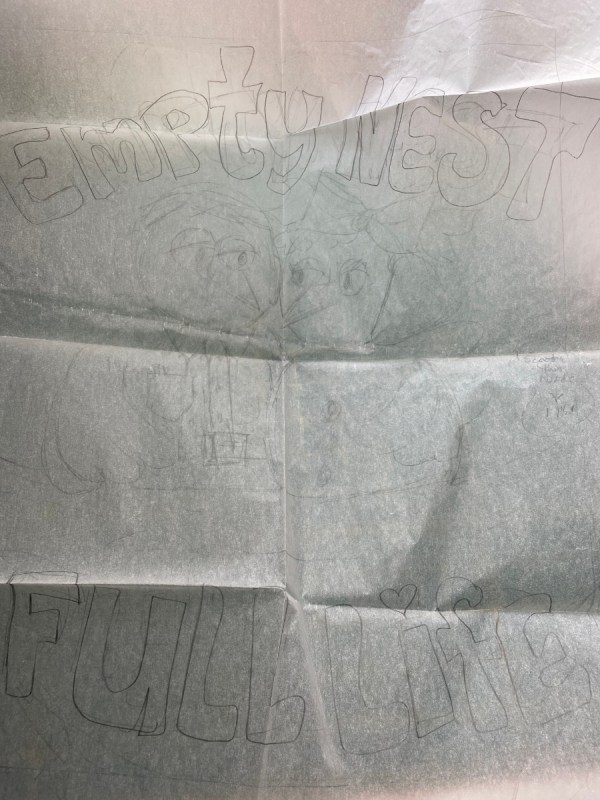
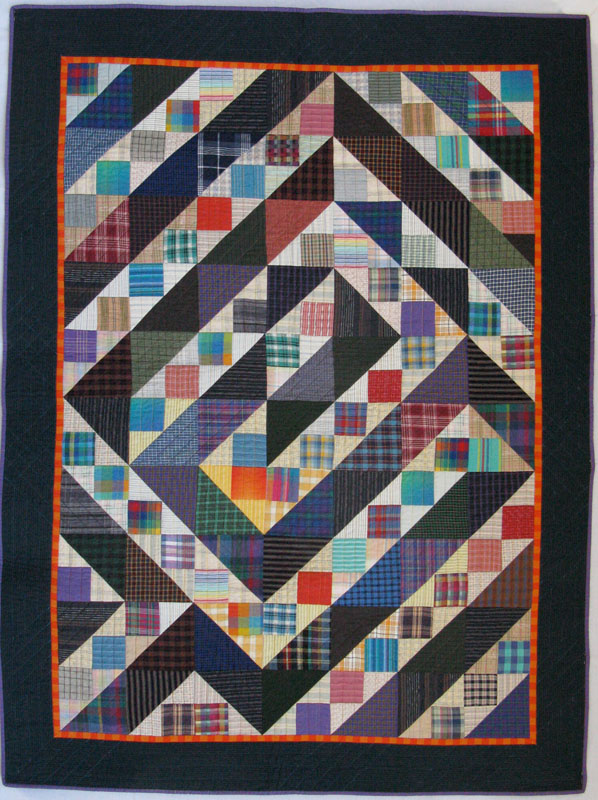
• I found three classes in my files from Roberta Horton, a personal quilting hero of mine. I did what she called an African-American quilt (or Utility Quilt), a Japanese Quilt, and a Plaid quilt. • I also took a class from Mary Lou Weidman, where I designed a quilt in honor of my last child leaving home, in honor of our empty nest. The blob on the right is the full-size sketch of the quilt:
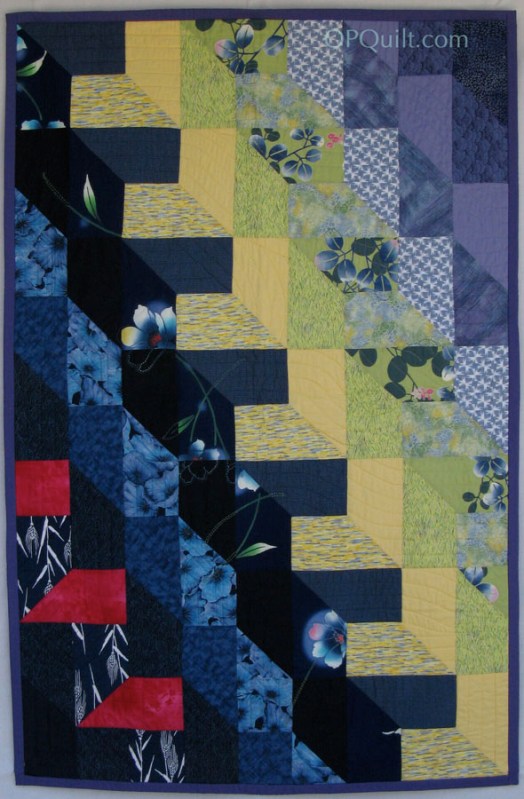
Empty Nest, Full Life • Quilt #56 in the Quilt IndexNihondaira, #53 in the Quilt Index
This is the quilt made with the Japanese yukata fabrics; we were encouraged to take our smallish square of yukata fabric, design a shape and assemble it, while merging and borrowing it, and extending the design through sashiko or embroidery. Roberta’s classes always gave me more than I expected.
This is from a class by Jan Krentz, because I so wanted to make a Lone Star Quilt, and she knew how. I used fabric my husband had brought me from Zimbabwe (yes, he’s a keeper) and I’ve not written about it on this blog. It was named Fiat Lux, because I finished it about the time I earned my undergraduate degree after 28 years of slogging. The motto of the University of California is “Fiat Lux,” so I adopted that for the title.
Fiat Lux, Quilt #57 in the Quilts Index
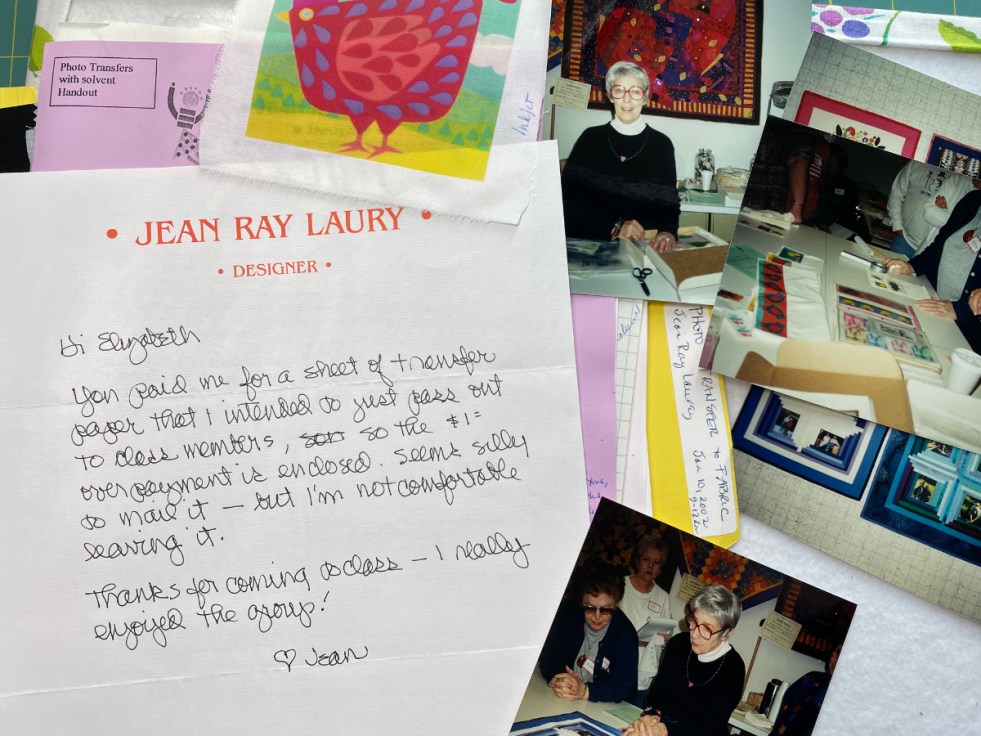
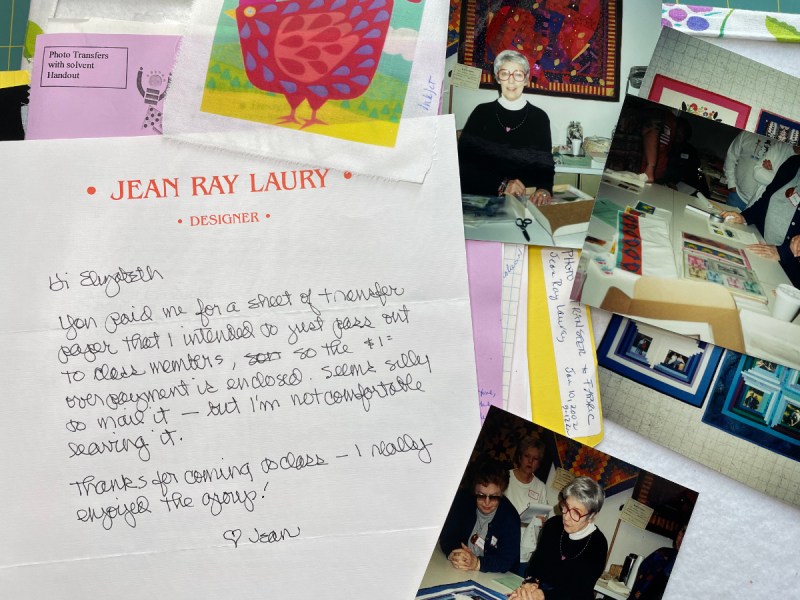
I found file folders for the Joen Wolfrom class I mentioned in the last post, as well as a few others, but the file that amazed me most of all was the one that held the papers from a class with Jean Ray Laury, the grandmother of the graphic arts quilts (in my mind).
I even saved a letter she’d written to me, returning the dollar I paid for some class supplies that she ended up giving out for free. Now that she is gone, it’s a treasure newly re-discovered, once long-lost in some random file cabinet (now gone) in my garage.
While it was a treat to find all these “baby quilt photos” I’m more than happy that I actually “raised the baby” and got it launched into the world. No, there will probably never be an embellished quilt — the interest just isn’t there to place sparklies and sequins all over a quilt. But those needles will come in handy when I have to restore the beads Carol put on her block for my Ladies quilt. Yes, I’m a fan of taking quilt classes. Only once have I come out of a class feeling like it was a waste of time (and I’ll never reveal which class it was).