Quilt Shows

Road to California-I

I started going to this show about 20 years ago, give or take a year or two, when it started out across the street in the Marriott hotel, so I know its history.  It was an offshoot from a local fabric shop and in those early years most of the displays were home-grown, local quilt artists and so you went to see people you know.  The woman who ran the show put on a good game, with lots of good vendors; she had a knack.

About 3 or 4 years ago (or so the scuttlebutt goes) she hired a new person to help her hang the show, run the displays, and since that time I’ve seen it tilt heavily to overly quilted quilts with lots of spangles and sparkles.  This year, I’d have to say that the show has hit a new low, and I started referring to it as Road to Las Vegas.  This is not to dismiss the workmanship of the quilts that were displayed.  The technical skill and stitch quality of the top prize-winning quilts cannot be disputed.  What can be disputed is whether I liked it, or the ladies next to me liked it, or if  using a million crystals (Swarovski or not) or ten miles of embroidery thread enhances a quilt or if I found the quilt show interesting, or inspirational, or motivational (as in: I want to make that quilt!).  Enough yakking.  Here goes.

The title of this is the Magical Mermaids Castle, [sic] by Claudia Pfeil from Germany.  The workmanship is exquisite, with quilting no more than 1/4″ apart, and embellished to within an inch of its life with those aforementioned 40,000 crystals.  Shimmer.  Shine.  Sparkle.

She obviously has spent a long time on this.

I turned off the flash so the quilting lines would stand out, so sorry that it’s blurry.  When I walked through with Cindy, from Live a Colorful Life (more on our meeting up, later), she had tried some of the crystal work and noted that it must have taken this quilter “hours and hours.”

The back.

Back, detail.  Obviously this quilt is about what you can do with a longarm, what you can do with embellishment.  I finally heard a term that described what these types of quilts are: “show quilts.”  That term came from a quilter, shown below, who was standing beside her quilt, talking about it, and she said she tried to make at least two “show quilts” a year.

It was hanging on a side aisle, the shot angle is a bit skewed (sorry).  The title is Witches Brew [sic] and it is a clever quilt, made by Cathy Wiggins from Macon, North Carolina.  In the accompanying sign, she tells the story of her quilt, plus adds “There is [sic] over 250 hours of hand-embroidery on the scroll.”  I liked how the scroll was like a hand-written recipe, with things crossed out and changed.

NOTE: I keep writing [sic], which means “this is how I found it in the original source.”  I don’t know whether it was the quilter, or the people who printed the signs, but there were lots and lots of typographical/grammar errors everywhere.

Witches Brew, detail

William and Tony’s Magical World is pieced and quilted by their mother, Kristen Vierra and it also shimmers and shines.

Magical World, detail

The Director’s Choice blue ribbon went to Sherrie Reynolds of Laramie Wyoming for her quilt America, Let It Shine.  An absolutely stunner of a quilt, I had her pose by it–she was there a lot, standing by her quilt like a proud Mama (and she should have been proud–it was beautiful).

This is the only shot I could get of the quilt without someone beside/in front of it.  It’s a simpler design in some ways, with a central medallion and detailed borders, but she also used embellishment extensively, as well as a tremendous amount of quilting.

Back of the quilt, held up by the white-gloved hostess.  This shows you the amount of quilting that was on it.

Border detail

Detail, word strip.  The sign reads “5121 Swarovski Crystals represent the words of the Constitution, Star Spangled Banner, Pledge of Allegiance and the age of America. The 13 colonies are represented by using 13 points on outer blue rays and red triangles. The 50 states are represented with the ring of 50 stars.”  And my favorite words of all; “free motion quilted on a Bernina 1001,” or a home-sewing machine.  So, no long-arm, but as you can see, she has a lot of skill in her FMQ.

I remember reading that this got high honors in Houston and it got high honors here as well.  It is heavily (and I mean HEAVILY) quilted with gilt and regular threads, with lots of embellishment.  I should point out that the award winners are at the front of the exhibition hall all in a row, with signs by each one, as they are in other shows.  So, I’m showing them in a cluster as well.

Detail, lower left corner

Backside of lower left corner, showing that there is more thread than fabric showing here.

Detail of the cherry blossoms–all done with thread.  So essentially this is a three-ply thread painting.  Whether or not you like it depends on your own sensibilities, but there is certainly a LOT of work in this quilt.  The title is Harmony Within, and it’s a tribute to marriage by Sue McCarty from Roy, Utah.  Below is another thread design, based on a photograph.

This is a depiction of a potter from the Santa Clara Pueblo, New Mexico, as was her mother before her, and it titled Grace. It’s made by Jennifer Day, from Santa Fe, New Mexico, who printed the enlarged photograph on fabric and then went to town, quilting it and covering the face and hands with thread, using sixty-six colors and one-and-one-half miles of thread total.

Detail.  They put tape across each section of the display so it’s hard to get a full-on quality shot, but I think you can see how densely she “painted” with thread.  It’s remarkable how she was able to shade and color the face with all those threads.

Yes, those women really are striding into the scene of helping to put up a quilt show, somewhere in Australia.  She created the figures separately and they are attached to some black tulle netting for support.  Clever, I thought.  Titled Color Comes to the Back of Beyond, it was based on a painting by Pauline McPharlaine.  The makers are Pam Holland, Jan Munzberg, Pauline McPharlaine, and Jeanette Coombs (all from Aldgate, Australia) and was quilted by Pam Holland, the true heroine, for making the quilting integral to the quilt.  I stood at found detail after detail, in this not-so-large quilt.

At first I thought those were dropped glass-headed pins, but they were in other places in the quilt as well, so I decided they must be itty-bitty flowers.  Do you like thread-painted quilts?  The jury is still out for me, but I did like this one.  What you can’t see very well is the texture of this quilt–it really has a lovely quality to it that makes you want to touch it (I didn’t!).

Two more Big Fancy Quilts, then more in the next post.

Deruta, by Suzanne Marshall of Clayton, Missouri. She notes that Deruta is a town in Italy well-known for its hand-painted pottery (yep–I’ve been there!), and that her quilt was inspired by some plates she has with beasts on them.

What’s hard to see about this in the photographs is that she apparently has couched a thicker thread all along the edges of her applique pieces, giving them a harder edge.  Quite remarkable technique and skill.

Calling all you hexie lovers!!  Cheryl See of Ashburn Virginia has made a quilt for you to emulate!  Titled Star Struck, it has 12, 256 hand-pieced hexagons in this quilt. It was stunning, as you can see.  Here are some detailed photos (below):

What’s interesting also is how she used the printed fabric hexies to blend and smooth to the solid-fabric hexagons, which act as borders and as outlines.  And guess what?  No sparkles anywhere!  You CAN make a quilt without quilting it to death or turning it into a Las Vegas Showgirl! More, next time.

Quilt Shows

Road to California 2012–Preamble

Yessirree! Road to California welcomes you–with a typo.  (Maybe only English teacher types would notice?  Certainly the lady I showed at the official booth had no idea what was wrong with the sign, and I have to admit it’s the first time I’d seen a verb with an apostrophe).

My friend Leisa picked me up early, and we were there in the show by 9:40 (we had to wait for the end of the line to arrive so we could get in after them).  After going to this show for umpteen years, we’ve seen a lot of changes and have perfected our plans.  I always head to the quilt show first, and she likes to give the booths a once-over before doing that.  Really the best time to see the quilts in the show is around 4-6 p.m., when all the busloads of shoppers have gone home and it’s cleared out, but I didn’t know if I would last that long.

I don’t like to show too many quilts until the event is over, so watch for upcoming posts, if you’re interested.  But I will show you some of the things I bought–surely there’s no harm in that.

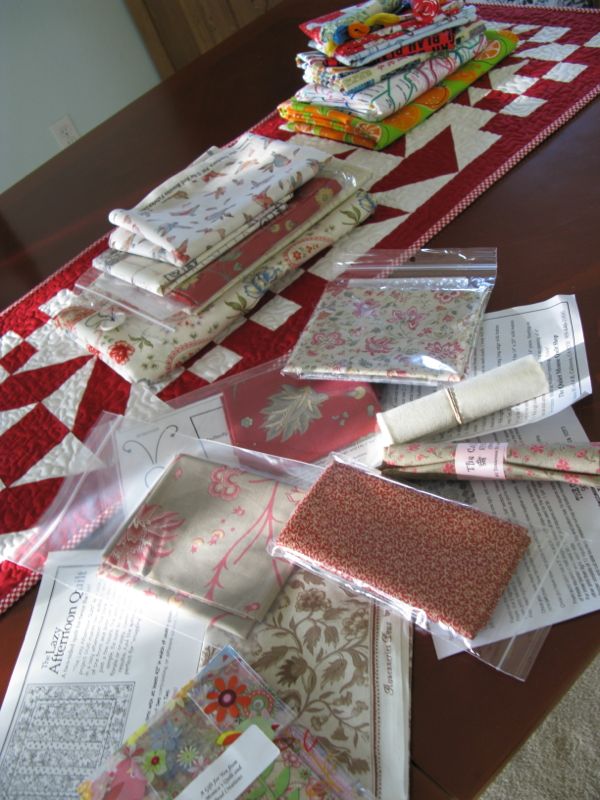
Flying Geese ruler, Kaffe’s latest violets (in multiple colorways), print fabric, notecard, a set of leather handles for a tote bag and a pattern.  When I told my mother that I could fit everything I bought into my one tote, she said “You must not have been feeling well.”  I was a little under the weather due to complications with the recent surgery, and I felt shopping was like trying to eat dessert after a Thanksgiving feast–you want it, but your heart’s just not in it.  No one had the typewriter fabric I was hoping to find.  Bummer.  And I avoided too-crowded booths (gimp girl, here).  I loved seeing all the quilts that the vendors had decorated their booths with.  Hold onto that thought because I’m coming back to it in my wrap-up at the end.

We had a great day, yummy lunch (box lunches from California Pizza Kitchen) and saw lots of interesting things, but by 3:00 I was ready to go.  So we hopped in the car for the ride home.  Many thanks to Leisa for taking me there!

100 Quilts · Family Quilts

Doll Quilt

The girls watch a movie under their new quilt

Last night I pulled out some Moda Candy Bar stacks, fed up as I was with convalescing.  Sometimes you just have to sew something.

I was thinking about that Sticks and Stones pattern, so cut some of the 2 1/2 x 5″ strips into half, then sewed them onto the existing strips.  I tried to count so it would come out somewhat even.

I decided to flip them: every other row would have the “stone” part on the bottom.  I sewed them together, trying to be careful of my gimpy leg (which I’m tired of being careful about.  Let’s just say I am not a very good sick person.).

After sewing the top together, I did the pillowcase method of layering backing (face up), top (face down), then the batting, then sewing around the edges.  I clipped the corner at a diagonal to get rid of the excess, then turned it and stitched the opening closed.  Quilting just off the seam vertically, with a couple of crosswise quilting lines finished it off.

One doll quilt for a granddaughter–done.  I have six granddaughters still in doll-playing mode.  Five more to go.  But not until I recover a little more, according to the doctor today.  Lay around more, he says.  Rest–stay on the bed.  So I guess I’ll do as the dolls above are doing and watch a few more movies.

Or better yet — I’ll go and read all your fabulous WIP projects on today’s linky page, hosted by Lee of Freshly Pieced Fabrics.  See?  I feel better already, knowing I have an adventure waiting for me.  Many thanks to Lee for hosting us all on WIP Wednesday.

Quilts

Practical Applications of Quilting

Whenever my husband and I clean out the garage and are trying to put everything back, I can see where boxes will fit. . . and where they will not.  My husband is a brain, really smart, but I think that my years of working with pieces of fabric, shapes, sizes, corners — all that quilty stuff — allows my eye to notice how things fit together.

Another time, when I was a long-term sub, the 9th grade students needed some help with basic math and geometry.  Since by this time the lesson plans had long run out from the regular teacher, I developed a series of lesson plans that were ordered around quilt patterns.  I gave a lesson on a few shapes, then turned them loose with their pencils, rulers, colored paper and one piece of black paper to use as their foundation.  The results were dramatic and wonderful; I found out later these “quilt blocks” were left up all year long, even after my sub job ended.  I chalked it up to the enduring power of quilts.

So I was thrilled to receive a flyer from a biologist friend of mine, touting a lecture given at the University of Alberta, Canada: “Quilts as Mathematical Objects.”  The above quilt was on the flyer, and was made by Gerda de Vries. She describes herself this way: “I work as Professor in the Department of Mathematical and Statistical Sciences at the University of Alberta.  I am an applied mathematician, specializing in mathematical biology.  I am interested in understanding and explaining physiological processes through the development and analysis of mathematical models.”  So she invents a rule, applies it to her quilt design and carries it through.

This one’s titled “Cyclic Permutations (Study in Red, Black and White #1).”  The rule on this one that each triangle has a certain number of pieces, with the colors laid out in a particular order.  If you study it you can start to see the “rules” she applies.  I started listening to her lecture, “Quilts as Mathematical Objects” available on iTunes, via iTunes U (type in the title in your iTunes–she gave it at McGill University) and can hardly wait to finish.  I only wish I could have been there to see the visuals–which is what matters to us quilters.

She also does traditional quilting, as evidenced by this beautiful example.  She writes on her website that “I have a soft spot for ethnic fabrics.  This quilt highlights my collection of fabrics from the Netherlands.  Most are reproduction fabrics purchased at specialty stores; others were donated by relatives.  Traditionally, these fabrics were used in costumes (shirts, aprons), as well as home furnishings (bed sheets, mattress covers, curtains).  Also featured are a variety of so-called farmers’ handkerchiefs with traditional patters, purchased at town markets throughout the country.  I took particular delight in the construction of this quilt by fussy-cutting most of the fabric pieces.”

I think sometimes we operate in an insular world, in our own little quilty bubble, or at least I do, so it’s interesting for me to think about practical applications of our skills as quilters.  Perhaps if we relish in the color of quilts, we extrapolate that to our clothing, or our home dec.  Perhaps if we like the intricacies of quilting–matching up corners/seams/pieces just right, we will have perfectly ordered drawers and cupboards.  Or perhaps, as in the example of Ms. de Vries, we make our vocation (the thing that pays the bills) coordinate with our avocation (what we love to do) in creating beautiful and interesting quilts.