Quilts

Summer Report

What I Did This Summer
(And can it already be over??)

Kneaders Crab Sandwich

1. Went to Utah and ate a Crab Sandwich at a Kneaders Sandwich Shop

Beachy Maddy

2.  Went to the beach with my grandkids and two of my kids

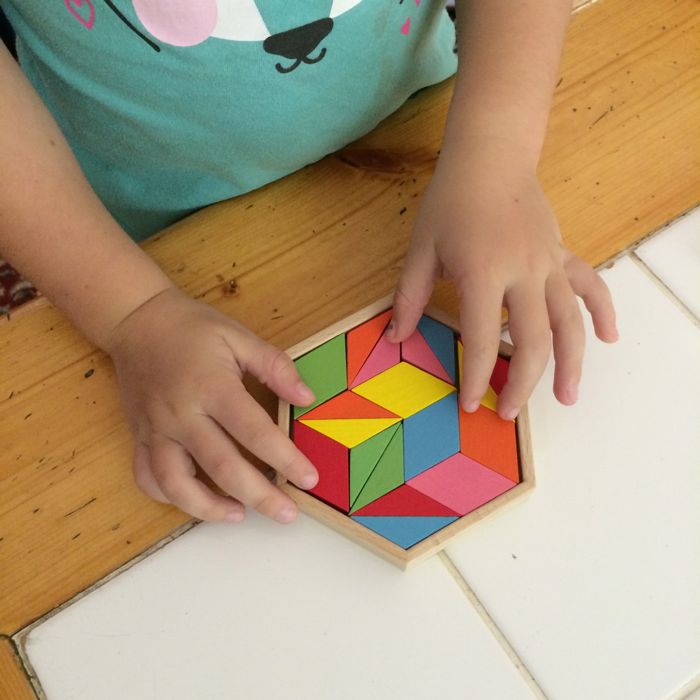
puzzle

3. Entertained grandchildren with puzzles

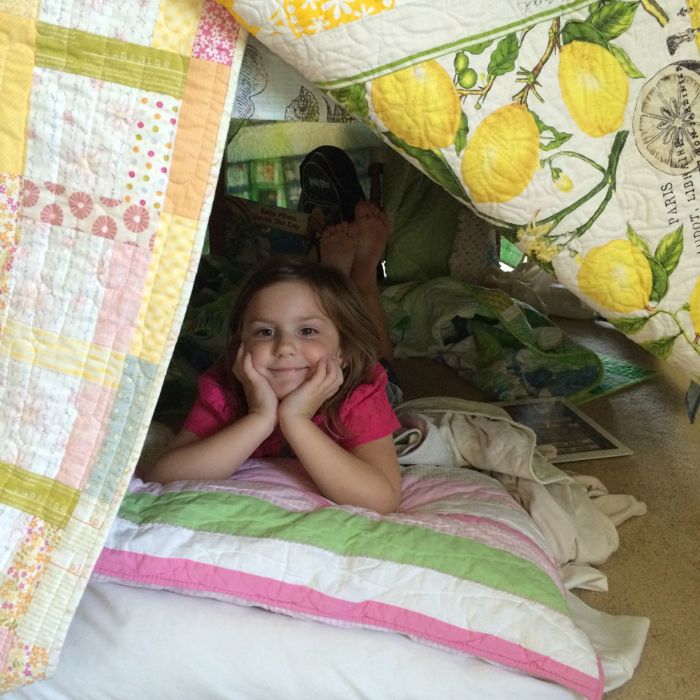
Quilt Fort

4. Entertained grandchildren with forts made out of quilts (luckily I have a few)

Summer Guest Room

5. Put the lighter summer look in the guest bedroom, loving how it makes Kaleidoscope shine
(on the end of the bed is my friendship quilt, which includes signatures from all my granddaughters)

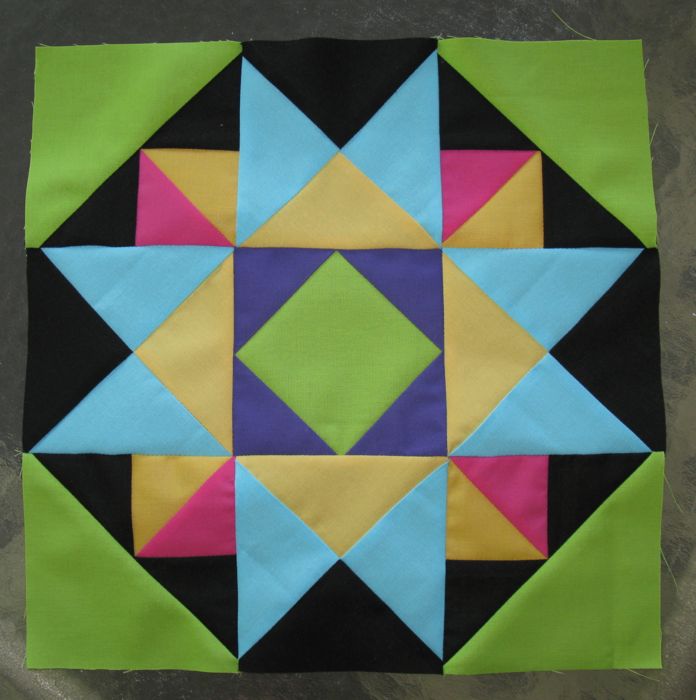
MCM July Bee Block

6.  Made a starry block for Susan for the Mid-Century Modern Bee in July

MCM August Bee Block

7.  Made my August Mid-Century Bee block for Mary

Pineapple Bee Bocks So Far

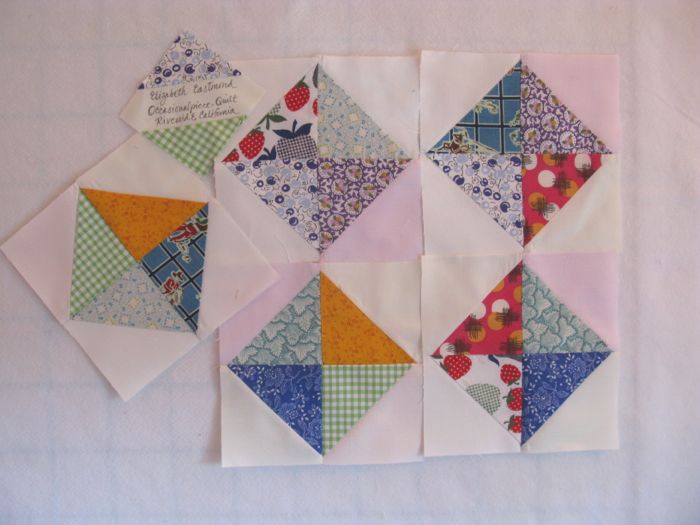
8. Been arranging the blocks that come in from my turn at the Always Bee Learning Bee.  Everyone must be on vacation, because they are dribbling in, little by little.  But I love to see them all together!

Zagreb Cathedral

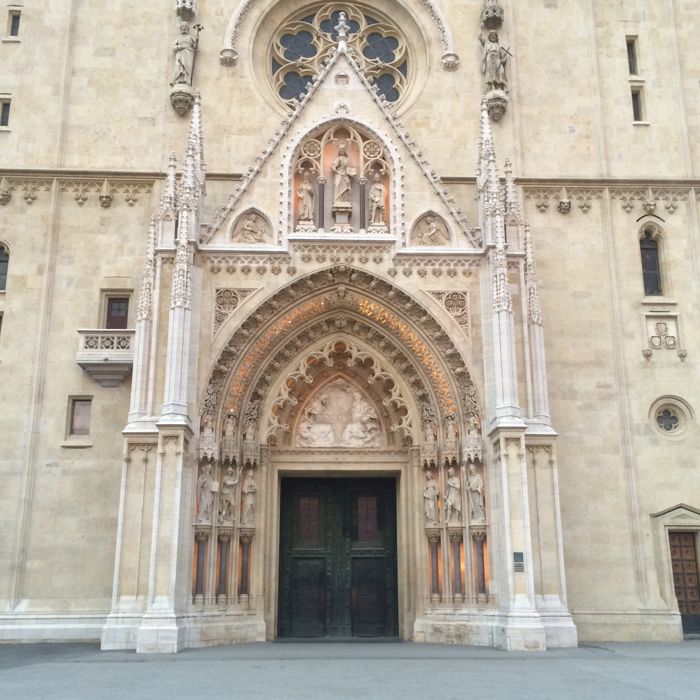
9. Went to Zagreb (and Ljubljana and Dubrovnik–all in Slovenia and Croatia). . .

Budapest2

. . . and Budapest, Hungary.

Giveaway Banner

10. Hosted a giveaway!

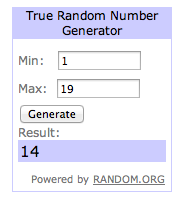
I did the Random Number Generator thing and got #3, but Susan said she already had that book so not to consider her.

Book Giveaway

So I did it again, and Carly was the winner.  I’ll be in touch by email.

But I can’t let this go by without telling you all how thoughtful and interesting your comments were.  I like how you read each other’s and answered each other; I love seeing community in our quilty world.  It made me remember that I’m also inspired by quotes and sayings, as well as nature and other quilters.  I love how Harlan said that when the creative juices are clicking, “something new and needed is created.”  I appreciated Anne’s parsing out the difference between flat-out copying vs. being inspired by someone’s work.  All of you brought excellent ideas to the conversation and I wish I could give you all a prize.  You are all the best.  Hope you also had a good summer!

Quilts

Inspiration. . . and a Giveaway!

{@IPTCcontent.headline}

Nancy Crow Crosses Info

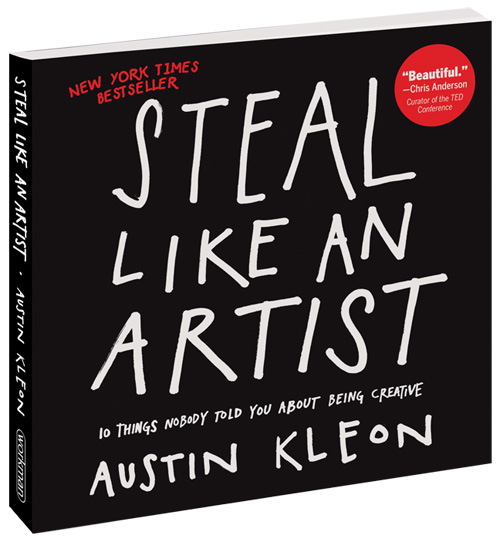
In the book I just finished reading, Steal Like An Artist by Austin Kleon, he writes that “Nothing is original.”  He quotes Jonathan Lethem who notes that “when people call something ‘original,’ nine out of ten times they just don’t know the references or the original sources involved.”  And in our quilt world, I see this all the time manifest in the copyright squabbles, the this-is-my-original-pattern-syndrome and it’s only a variation of a log cabin, the insistence by some in the modern quilt movement that they dreamed it all up — this modernist stuff, without any regard for where the idea first surfaced. . . and then resurfaced.  When I see this stunning quilt by Nancy Crow, made when many young quilters’ parents had not even started dating, I think, as did Kleon when he quoted the Bible, “There is nothing new under the sun.”

But Kleon goes on to say that this idea fills him with hope, rather than despair:  “As the French writer Andre Gide put it, ‘Everything that needs to be said has already been said.  But since no one was listening, everything must be said again.”  Kleon encourages us to note where our influences come from.  I say, if you don’t know about some of the earlier quilters, try heading to the International Quilt Study Center and Museum and browse for a while.  Take a look at these early masters and be inspired.

Steal-Like-an-Artist-Kleon

To inspire you, I’m giving away a copy of Austin Kleon’s book, a small little treasure, perfect for some end-of-summer reading.  To win a copy, leave me a comment below and include a source of inspiration, whether it be another quilter, a photograph, an image, nature or something else–something or someone that provokes or triggers your spark of creativity.  Rather than just saying “nature,”  or “Michael James,” try to be specific, such as “the moment the sun drops to the horizon” or “Michael James’ ‘Aurora’ in his early work”  so that we can learn from each other.

I’ll announce the winner on my next post, and send you a gift card from Amazon so you can order it yourself; for this reason, it will work for international as well as domestic. Have fun, everyone!  This post will close on Saturday morning.

˚˚˚˚˚˚˚˚˚˚˚˚˚˚˚˚˚˚˚˚˚˚˚˚˚˚˚˚˚˚˚˚˚˚˚˚˚˚˚˚

My blogging software runs ads on this blog so I can blog for free.  I do not control the content, nor do I endorse these ads.

EPP · Shine: The Circles Quilt

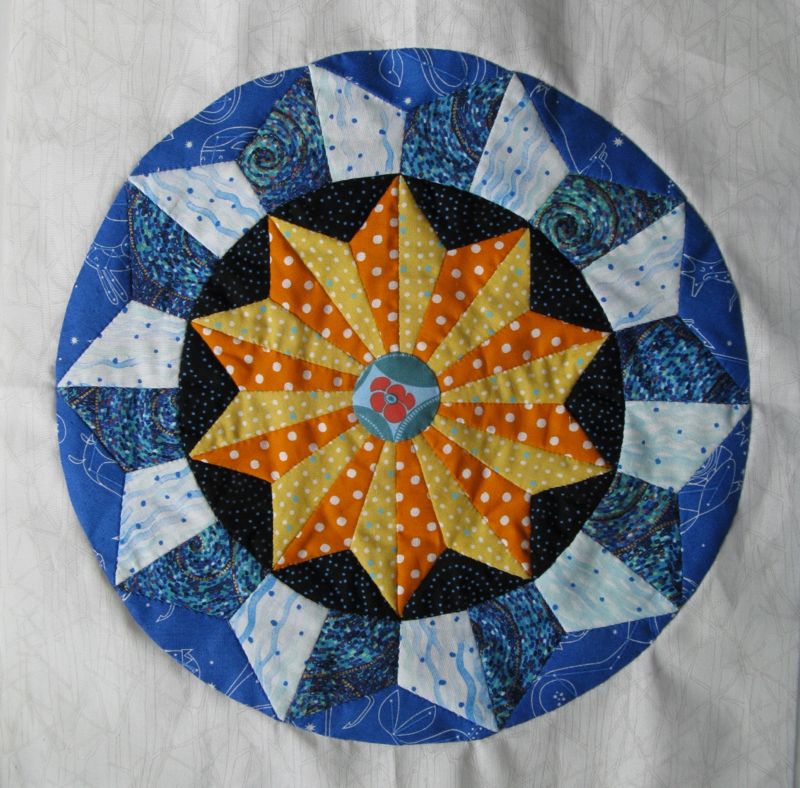
Circles Block #3, EPP Sew-A-Long

Circles EPP Button

This month the block is a tad more difficult, but my primary motto on these things is “I Make The Mistakes So You Don’t Have To.”  Here we go.

Circles Block Three EPP

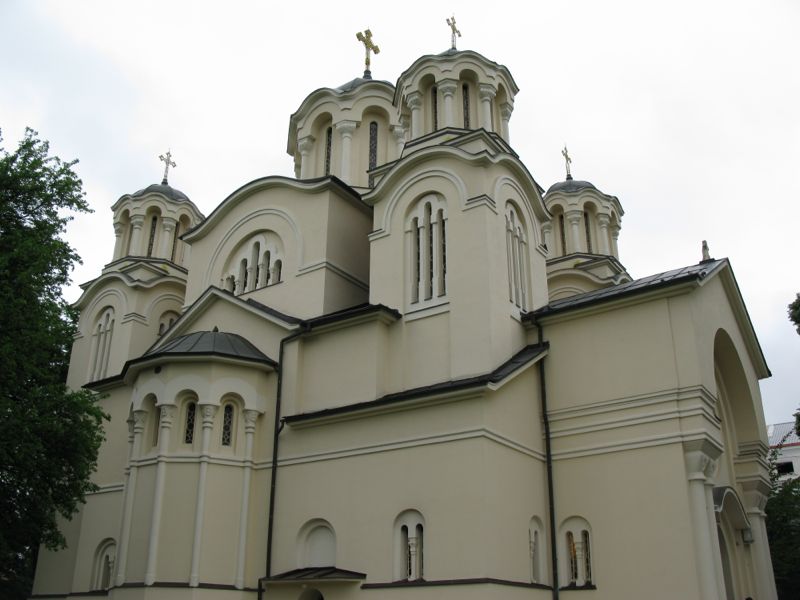
And where did the inspiration for this block, titled “Ljubljana” come from?

Ljubljana Serbian Church

From the Serbian Orthodox Church in Ljubljana, Slovenia, which is beautifully painted on the inside (see blurry photo below), and has rich colors and lots and lots of circles.  We recently visited that country, and my husband was under strict instructions to photograph any and all circles, so we gathered quite a few ideas.
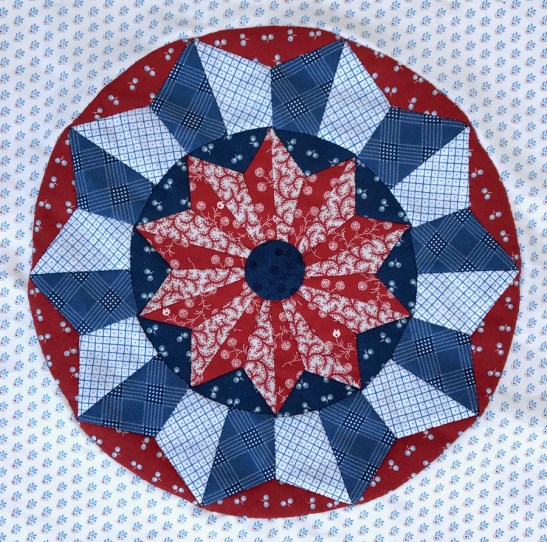
rwb_block3

The free patterns are now returning (Red, White and Blue version is above).  I request that you not distribute them, but send people here to this website to get them.  Click to download a PDF file: 

SHINE Block 3 pattern_opquilt

Please remember to set your printer settings to 100% and check the little scale square included on the pattern.  It should measure 1″ in size. Illustrations of patterns below will vary from the newer version.

I print out the number of sheets I need for each, then staple the stack of 3 or 4 or 5 together all over in the spaces.  ALL OVER, staples everywhere in between the pieces.  Then I can cut them out as a group without the paper shifting.

Please read through the entire post before beginning, as I give out helpful tips and tricks.

Fabric Selection

Choose your fabrics for your circle by laying them out so you can see the combinations up against each other.
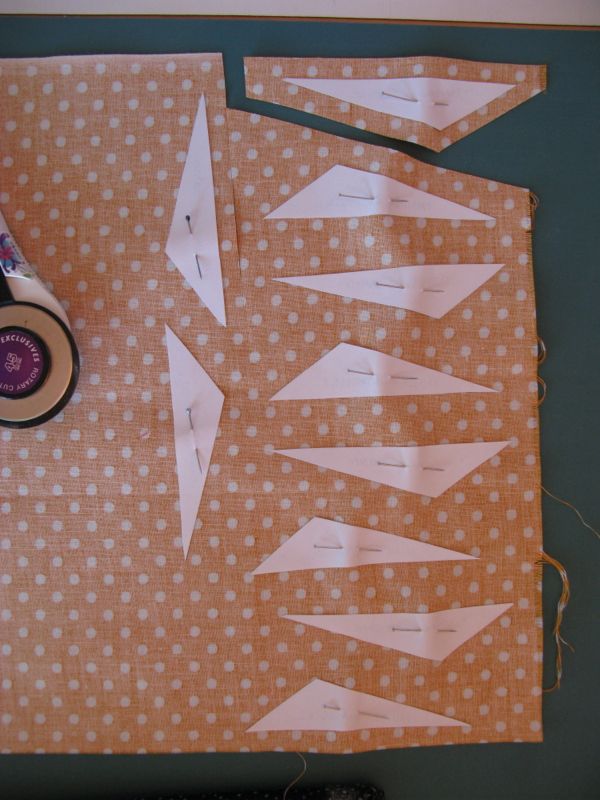
Laying out Inner Diamonds

If the pieces have a certain direction or shape and I want to reproduce the picture above exactly, place the paper with the printing FACE DOWN on the fabric, then pin.

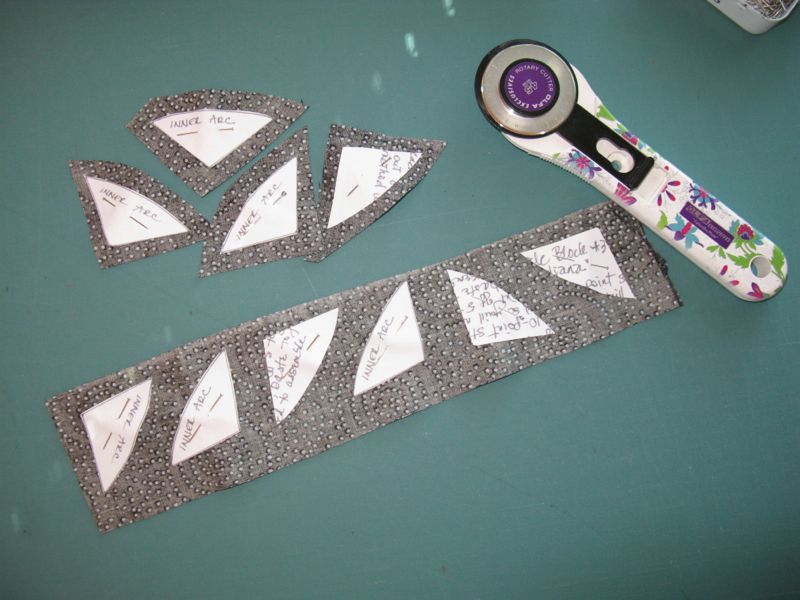
Layout Inner Arcs

If the pieces don’t matter (like the symmetrical small arc, above), you can place the pieces either printing UP or printing DOWN, or a mix.  I don’t care, nor should you. Notice that I just curve around them with my rotary cutter, as you don’t have to be so precise on that quarter-inch seam allowance for English Paper Piecing (EPP).  Just get sort of close to that quarter-inch, but not less than.  I pin through each of my pieces, then I fold over the seam allowances a side at a time and baste them down with that icky thread from the back of my sewing box.  (I’ve got to use it up somehow.)  I make sure the beginning knot and the ending tail are on TOP of the piece, not on the paper side.  This is good stuff to do while you watch  television.
Process 3_EPP

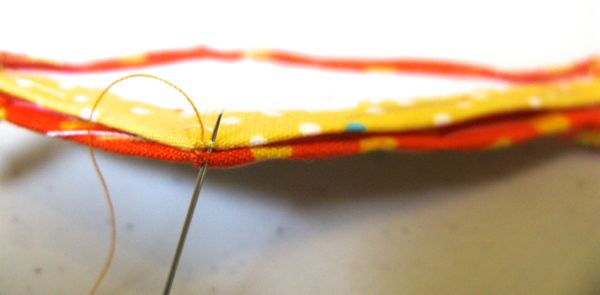
The basic idea of EPP is to sew your basted pieces together.  Begin by matching up a corner.  I slide my needle into the corner between the paper and the fabric seam allowance so my knot is buried inside.

Process 4_EPP

EPP is basically just a teeny overcast stitch.  Take only a thread or two on each side when sewing the sides of your shape together.

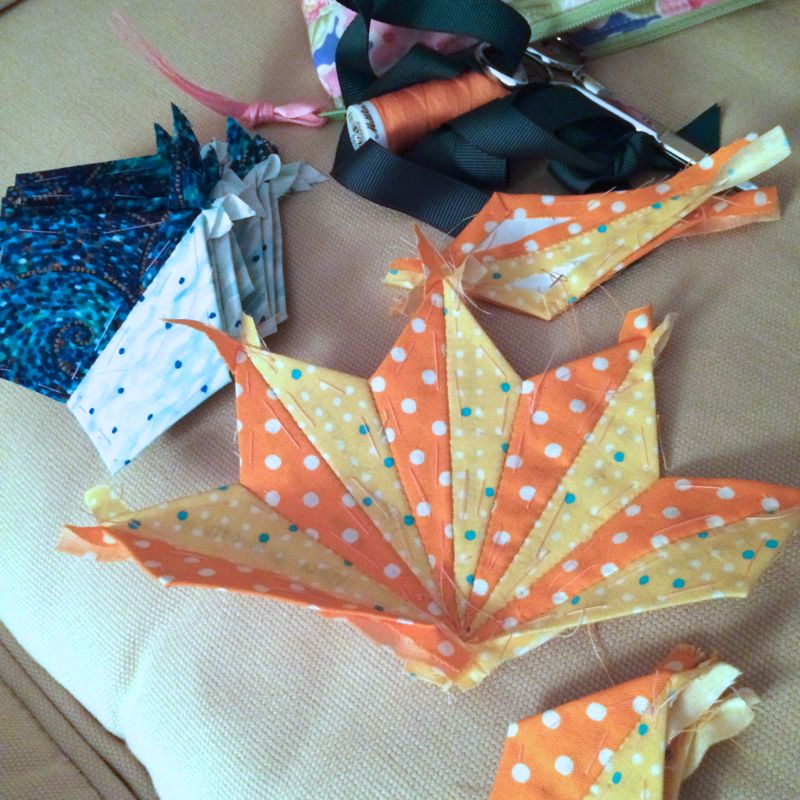
EPP3 Assembling

I sewed the first center together half-diamond shape by half-diamond shape.  (More on that first thing, later.)  Then sew all the shapes together.

But let me tell you about a cheater trick that will be helpful.

Take Two Center_EPP3

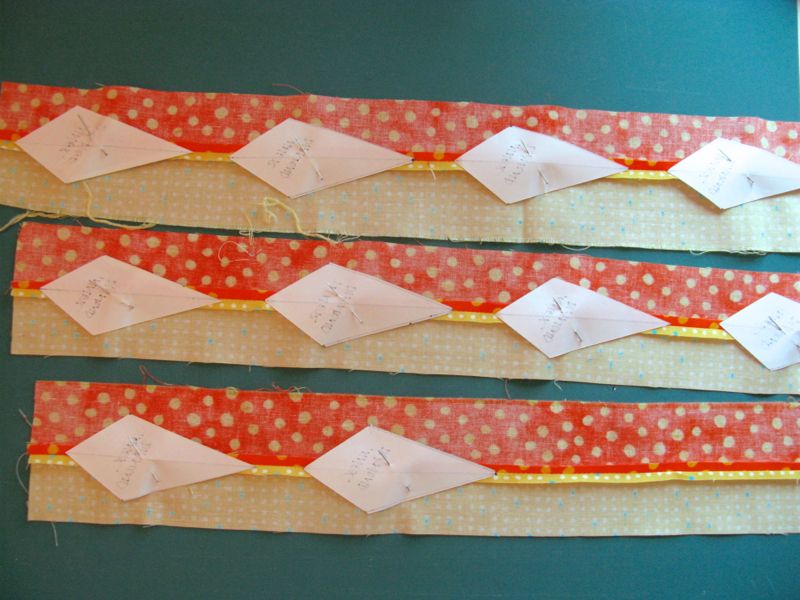
First seam together on your sewing machine the two fabrics for the diamond, then cut apart into segments (below).

Take TwoA_EPP3

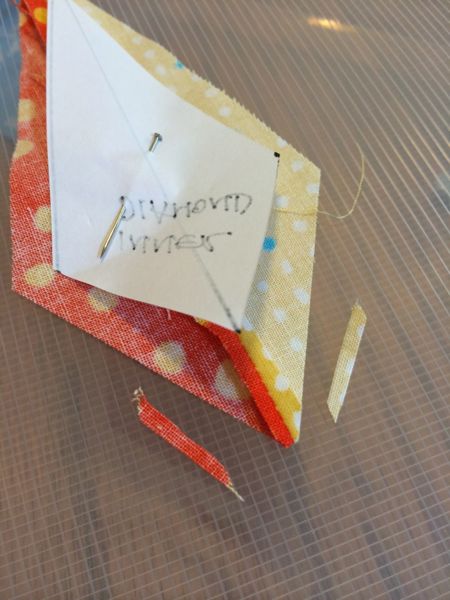
Trimming SeamAllowances_EPP3

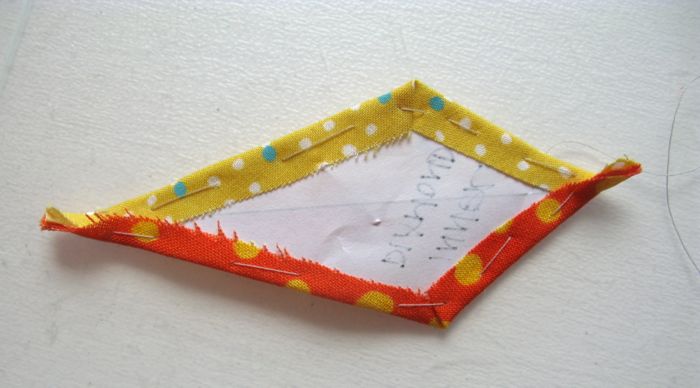
Before basting the fabric onto your paper shape, trim down the edges of the seam allowances beyond the edge of the paper.  I hope that doesn’t sound confusing; see above for illustration. Those two little slivers came from the seam allowances.  I’m just trying to get bulk out of the process and this won’t affect the structural integrity any.

EPP3_Basted Piece

It’s okay to let the corners extend.  No need to hammer everything down.
Take Two Center2_EPP3

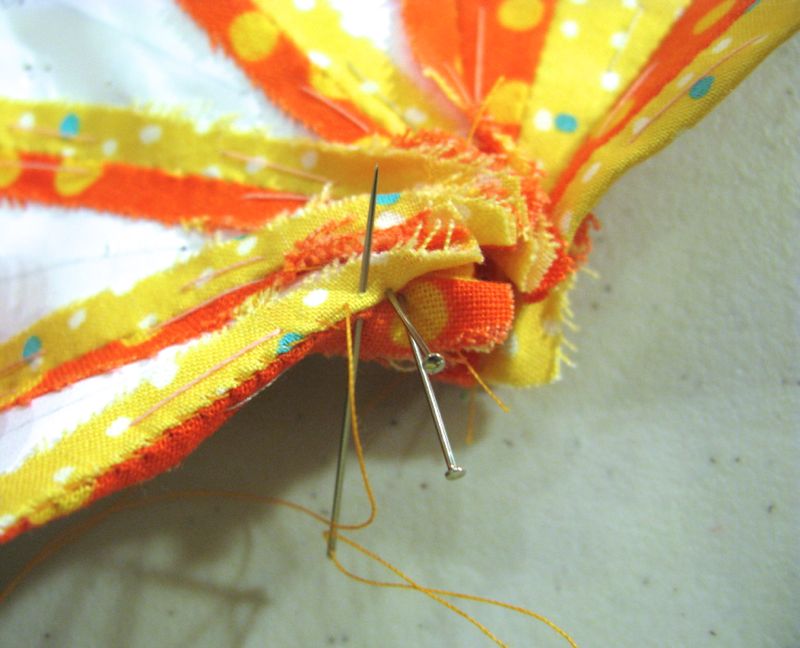
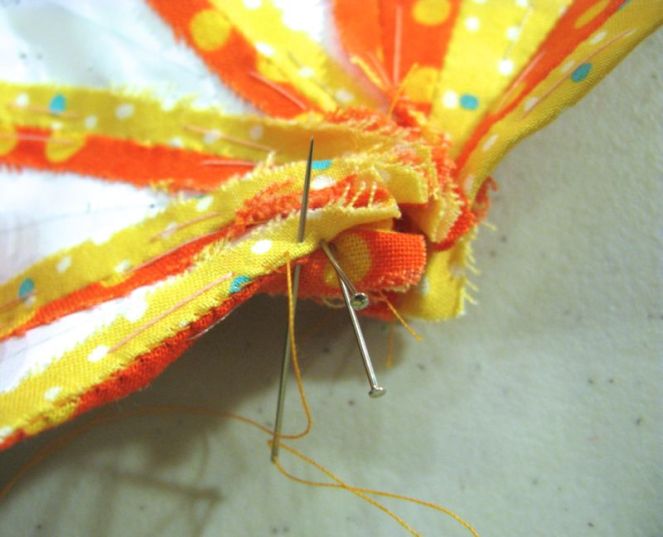
Use pins as you need to to get control as the pieces get narrower.  I always take a double stitch at the end of my seam, then take the needle through the loop and draw it tight to secure.
Take Two Center3_EPP3

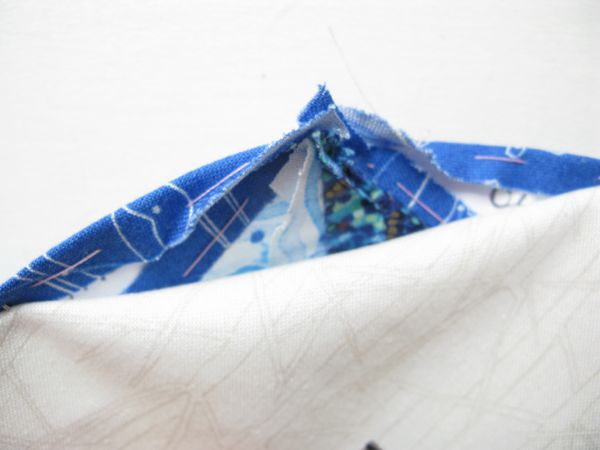
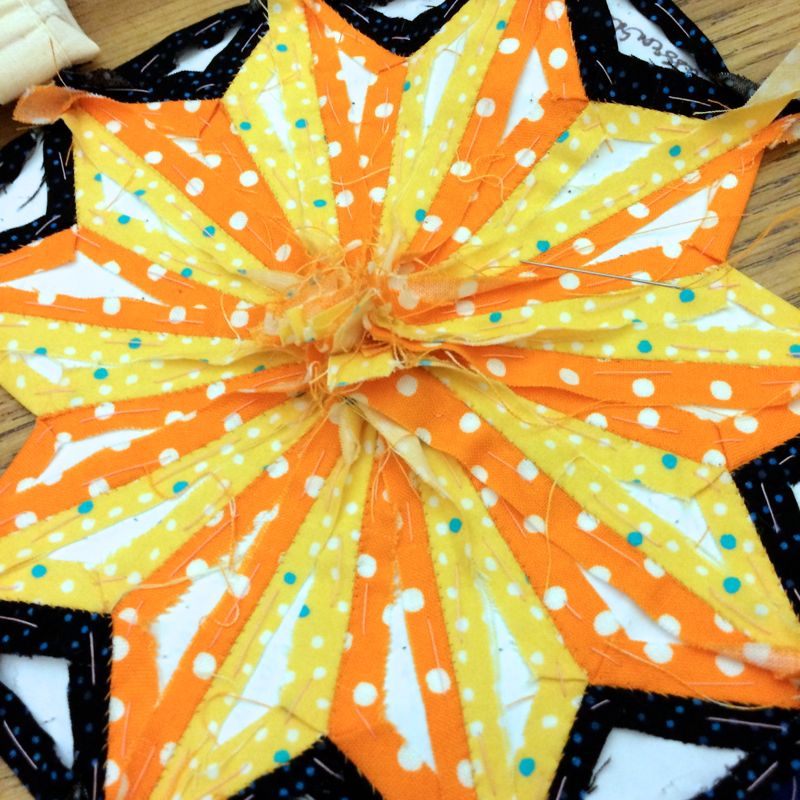
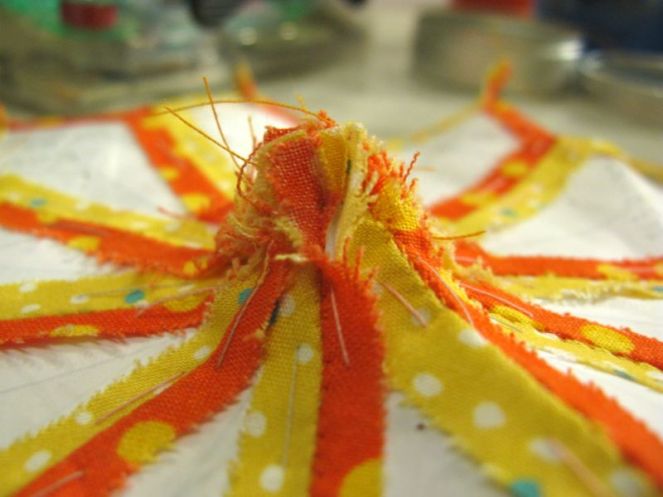
Yes, it will look like a volcano but we’ll be taking care of that later, so no worries.  I then sew the dark smaller arcs onto the circle of diamonds.
EPP3_Outer Ring

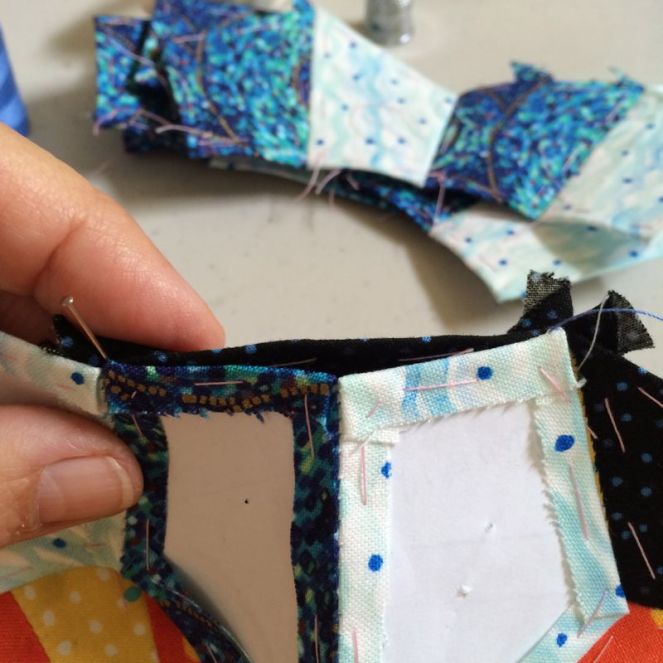
I stitch the left and the right sides together into groups of two. I have done this next part two ways.  One way is to sew groups of two onto the inner circle (you see them above in the background), then afterwards stitch the sides of those together.  Another way is to sew all the two-part shapes into a large circle, then attach that.  I use pins to keep the intersections lined up.

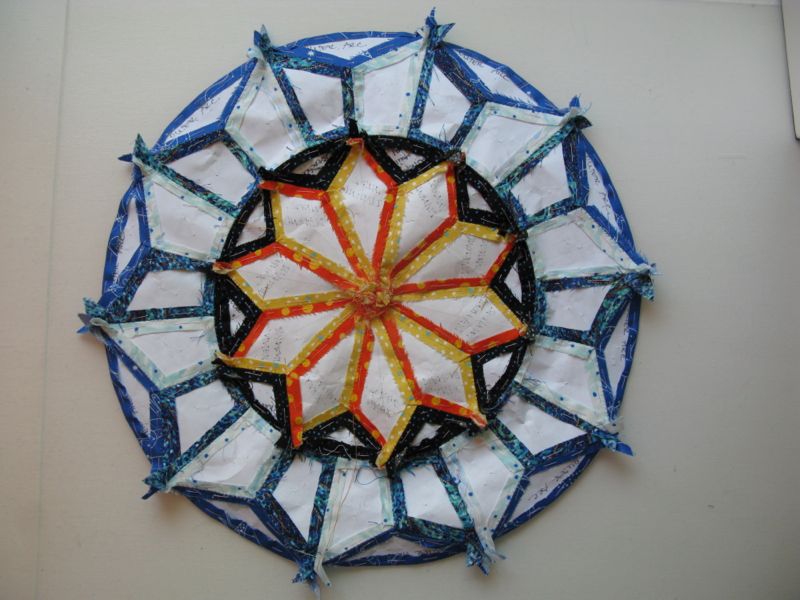
BAckside of Large Circles Block#3Everything sewn together, from the back.  I’m sure you noticed that this time I didn’t include the four corner pieces on the pattern.  I decided to try putting this on the backing a different way.  Take out all but the outer arc of papers.  Take out the papers by releasing the basting threads from the front, then popping out the papers from the back. You can see it in the photo below.
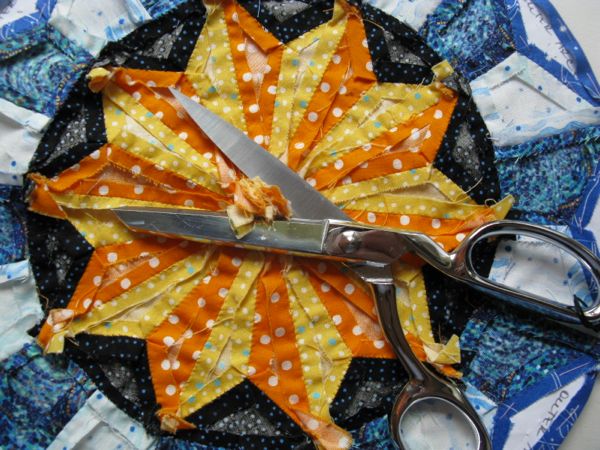
EPP3 Cutting Center Bump

Then, cut off your volcano top, or, as we call it around my sewing group — getting rid of the training bra effect.

EPP3 Cutting Center Bump2

Then trim out the center a little bit more.  Just not too much. I just want it to lay flat.
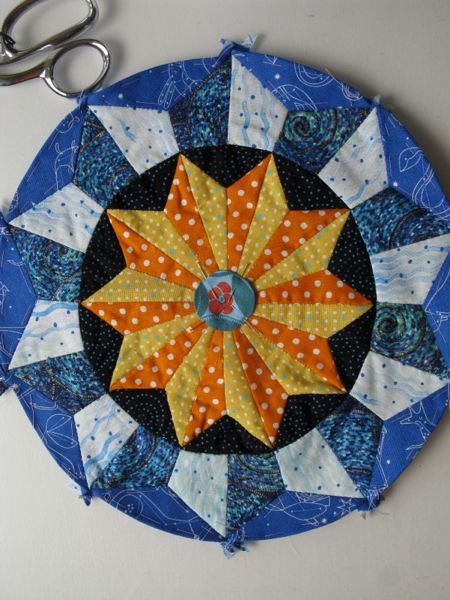
EPP 3 Circles Block Center Added

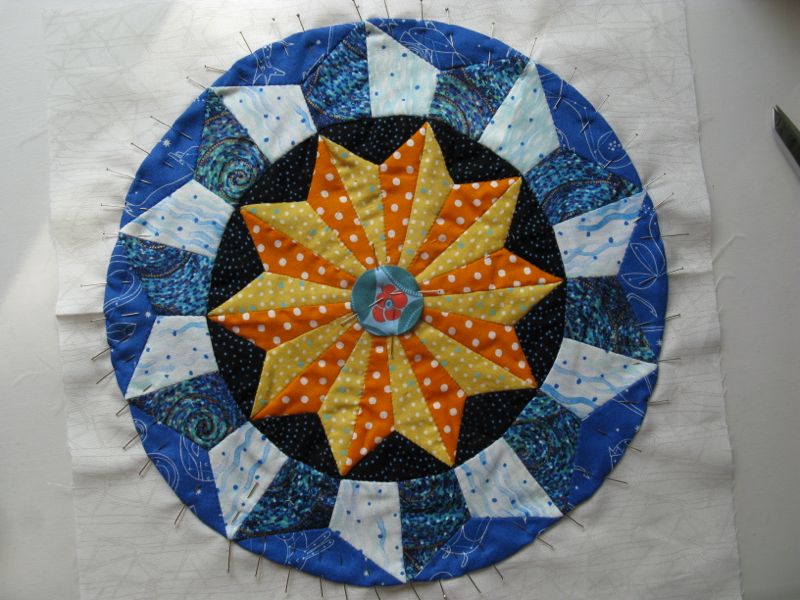
Pin your little circle on for the center.

EPP3 Adding Background

Fold a 15″  square of background fabric into quarters, then press to leave lines for placement.  Start pinning the circle to the backing, using the pressed lines to get it on straight and even.  This background square is a bit oversized and will be trimmed down in the finishing steps.

EPP3 Trimming on outer circle

As you get to that place where all the seams come together, trim down the seam allowances like you did with the diamonds, getting rid of bulk to help the edge to lay flat. I pop out the arc papers one by one as I go, but you can also take them out later (stay tuned).  Proceed carefully, trimming and pinning, and smoothing out the edge to create a nice circle.
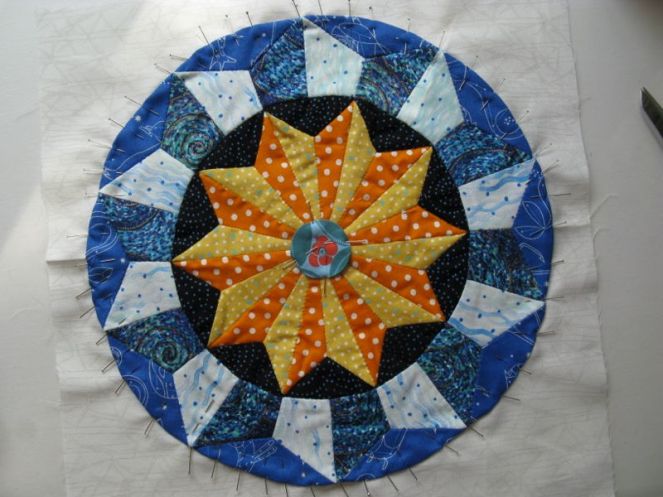
EPP3 All pinned down to background

Using an appliqué stitch, attach the circle to the backing.
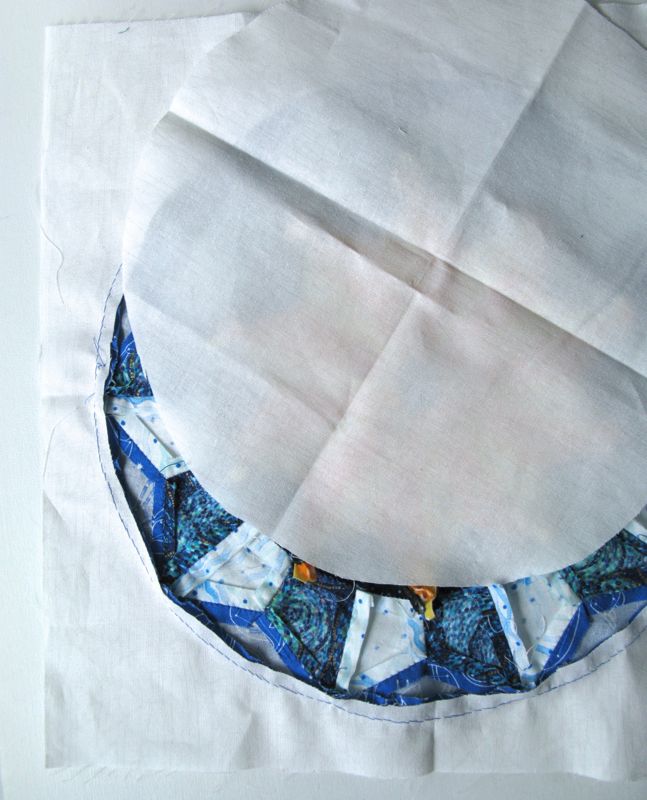
EPP3 Trimming out back

After stitching the circle on, trim out the backing, leaving a quarter-inch seam allowance, then take out any remaining papers.

EPP3 Center Circle Appliqued

Using a smaller-than-usual stitch, appliqué on the center.
EPP3 Center Circle More Trimming

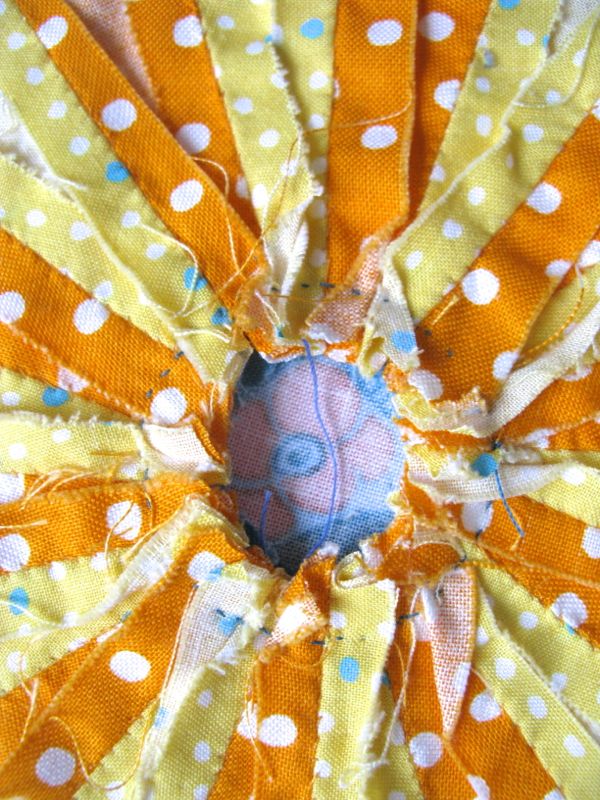
Then turn it over and carefully cut away more of those volcano-y seam allowances, again leaving a quarter-inch seam allowance.  Press everything lightly, using steam.  There are a lot of pieces and a lot of grain lines to deal with, so you don’t want to kill the fabrics with too much handling, although the block is very sturdy.

Circles Block Three EPP

You’re done! And congratulations, it’s just as beautiful as the one in Slovenia.

~~~~~~~~~~~~~~~~~~~~~~~~~~~~~~~~~~~~~~~~~~~~~~~~~~~~~~~
And now I’m going to tell about all the mistakes and problems I had, just so you know that I test sew each block before putting up the pattern.  If you have found places that need tweaking, please leave a comment and I’ll work on it.
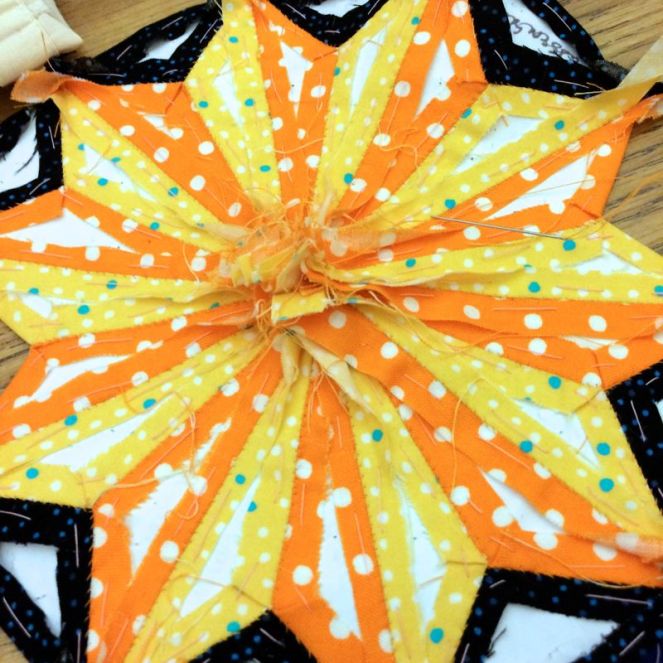
Backside of First Draft_EPP3

I have actually sewn the block twice.  Here’s how the first one’s center ended–with a definite volcano center.  Actually more like a chrysanthemum, I think.  So I thought it was my pattern, or the way I did things, so I remade the yellow/orange diamonds, as described above, by seaming the fabrics together first.

Still Such a Mess_EPP3

I tried to smooth it out by twirling it with my thumb. Yeah, what a mess.
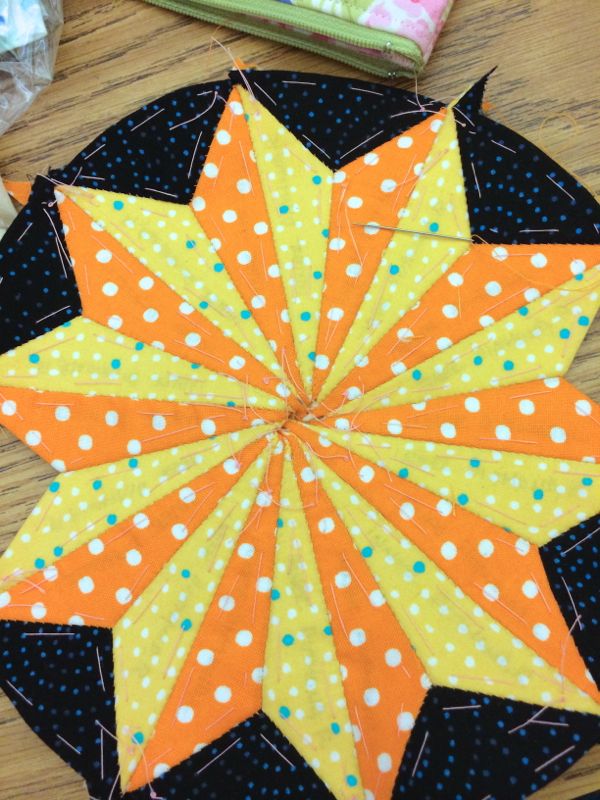
Oh What a Mess EPP_3Still a mess even though I sewed on the outer arcs.  What was needed was a design change, like adding the center circle to the design.  Even though the fine artists in Slovenia can paint the center of the circle to a distinct point doesn’t mean that fabric will allow us to do that.

So I took off all the outer little dark arcs, and started again.  Here comes the next mistake.  I got it all done, and cut the square for the backing and just about died when I saw that the hand-sewn EPP circle was tooooo big for the backing.  AAAGH!

EPP3B Circles Block Drawing

I went back to the pattern and measured, and sure enough, I’d drawn it too large. The yellow lines are the new re-drawn lines. I re-drew the pattern, re-cut all the outer pieces and arcs and started again, but used the first series of yellow/orange center diamonds, as I didn’t want to take apart the completed Ljublana Circle Block.
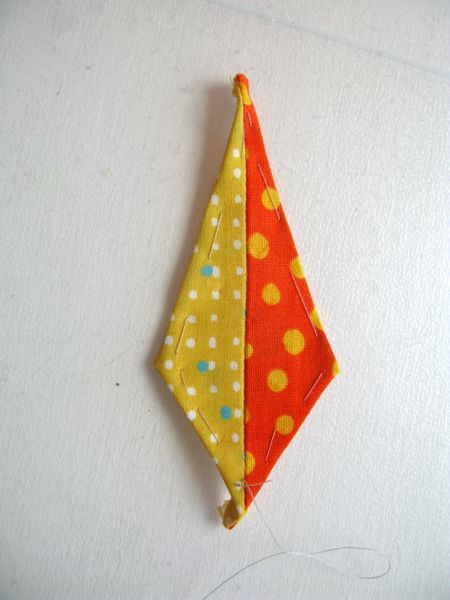
EPP3_Basted Piece Front

That’s when I hit on the idea of seaming the two colors together first to cut down on bulk.
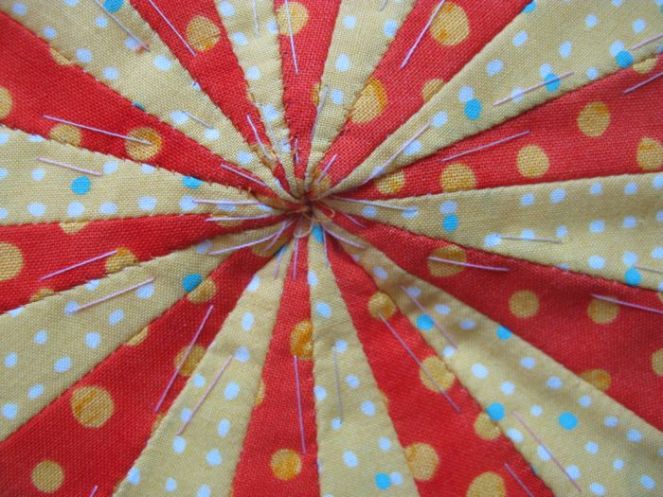
EPP3B Better Center

But I still had that hump in the middle.  Still have to make a design change with the center circle.

Auditioning Center Decor2_EPP3

Auditioning Center Decor1_EPP3

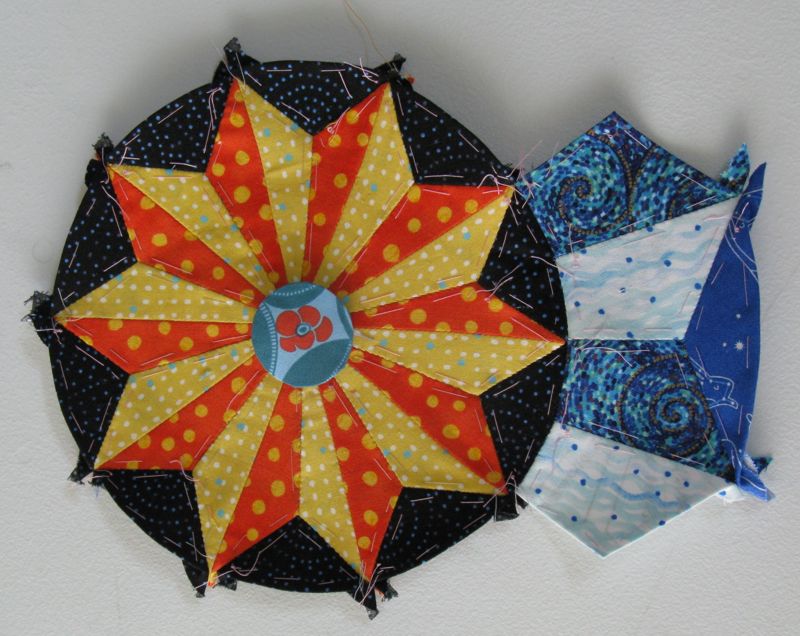
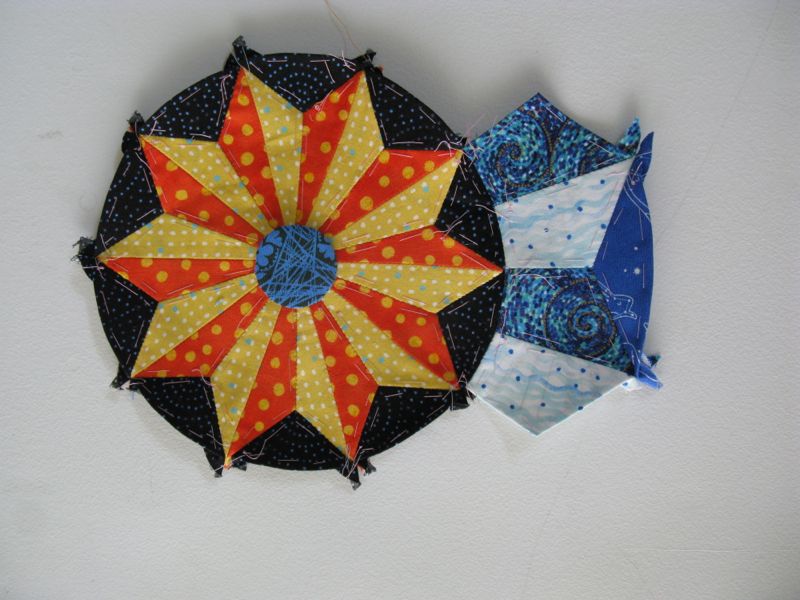
Here I’m auditioning center circles for the other block that was too big.  I like the top one in person, but the bottom one in a photograph.  I ended up recutting and sewing the correct size block so still have the large circle to make into a pillow or to put on the back.  You, too, can audition center circles once you are finished to see the different looks they give to your block.

I hope my story of my mistakes and do-overs hasn’t confused you.  The accurate pattern is up there in PDF.  If you are following along, send me a photo of your finished blocks and I’ll throw them up here for everyone to admire.  I know this one has a lot of moving parts, but once I got the quirks out, and used the shortcut for the diamonds, it went quickly.  Have fun!

Quilts

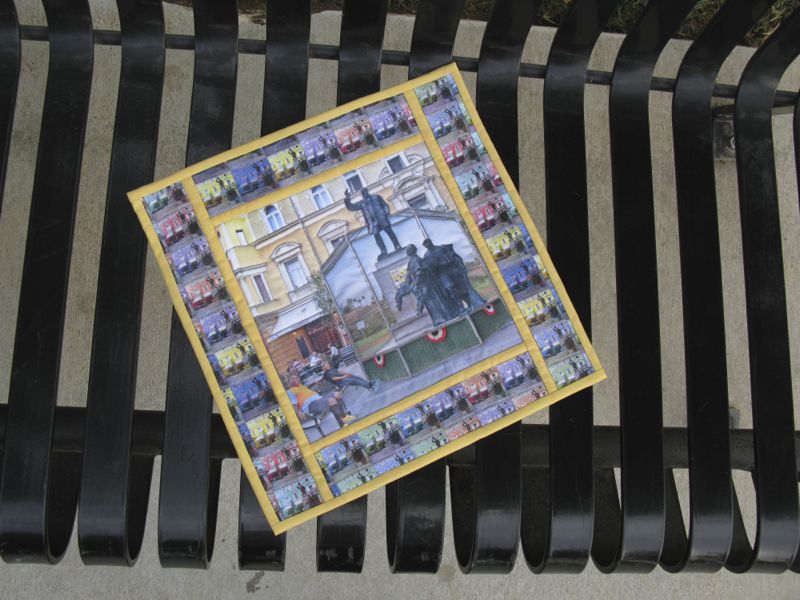
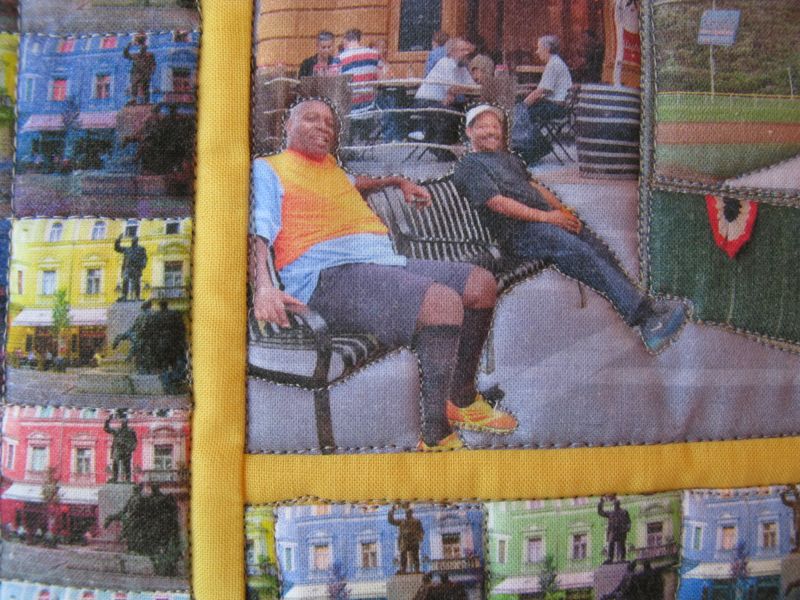
Deconstruction of Ted and Maurice at Lorinc Pap Ter, an Art Quilt

On the Bench at the Park

This post is a deconstruction of the techniques I used to create Ted and Maurice at Lorinc Pap Ter, a small (12″ square) art quilt for the Four-in-Art Quilt group.  Our challenge this quarter was Contrast, under the overall yearly theme of Urban.  Often an idea will come to me, but sometimes I start with the technique.  I knew I wanted to drag out those bottles of Bubble Jet Set and Bubble Jet Rinse that I’d ordered some time ago, and find out if this whole process was difficult or easy.  It was easy.

Bubble Jet Set is a type of mordant that binds to your fabric and allows the ink from your inkjet printer to adhere more easily.  I’ve printed on fabric for years, but haven’t ever prepared the fabrics.  I first started by reading a lot of blog posts, and I’ll post the links at the end.  The one website that described the process best was Caryl Bryer Fallert-Gentry’s (Bryerpatch.com), and I followed her instructions.

Bubble Jet Set

I bought a shallow plastic container at Target, about 4 inches deep with a latch-type lid, as I wanted to store the prepared fabric in there afterwards.  I cut my fabric about 9 inches by 12 inches, grabbed the container and the Bubble Jet Set (I only needed that one at this time) and went down to the kitchen sink.  I put on dishwashing gloves, as suggested, then laid the first piece of fabric in the bottom of the container.  I sparingly glopped some BubbleJet Set (BJS) onto the fabric, smoothing it out until it was thoroughly moistened.  I placed a dry piece of fabric on top of that, again, smoothing until it looked like it had picked up most of the excess BJS, then glopped a little more.  I’m being quite stingy with the BJS, actually, but do want to make sure that the fabric is sufficiently soaked.  I repeated this until all four sheets were saturated.

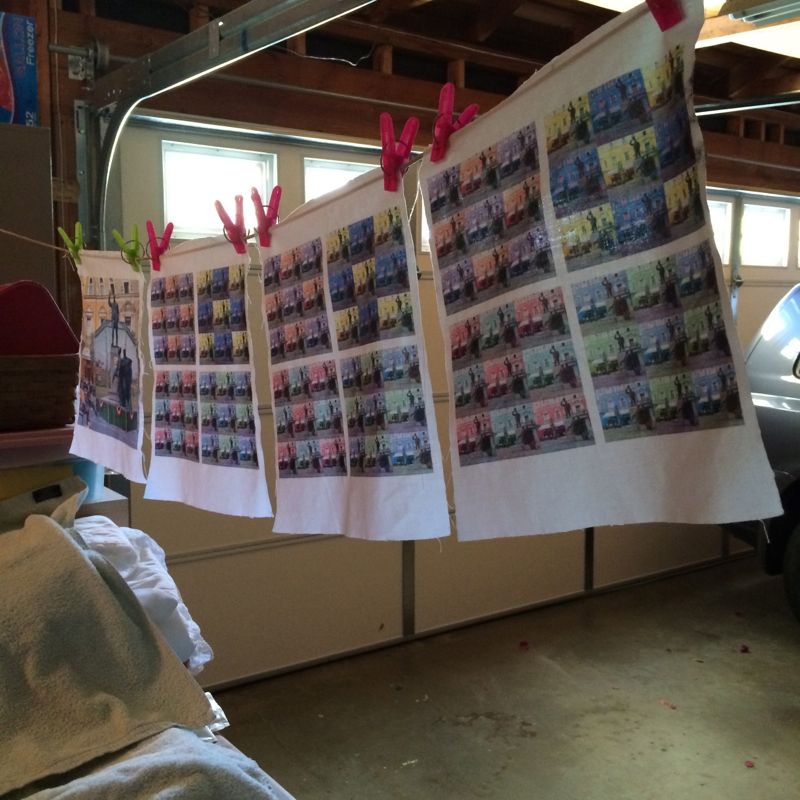
Prepared Fabric DryingI lay down some towels underneath my improvised clothesline in the garage (some say you can put containers to catch the extra drips, but I didn’t have that much excess) and hung up my sheets of fabric until dry.  In our summer heat, it only took about an hour.  Meanwhile, I washed and thoroughly dried my container, and when the fabric was dry, put them in the container until I could get to them.  I read one blog where the crafter cautioned about letting too much time pass between treatment and printing. I had a space of about 4 days, and that was fine.

In yesterday’s post, I talked about how I created my art conceptually, but what I did technically was begin with a good photo of the square in Budapest.  I overlaid the baseball backstop photo, sized it, then took it down to 20% transparency, and used the Eraser tool to start erasing a space to let the statuary shine through.  I could have created a Path and selected it, but sometimes I think the Erase Tool does just fine.  I did change out the size of brush I was using, from 1 pixel in some places to 75 pixels in other places.  I did the same with Ted and Maurice, first flipping them around so they faced the other way, as that’s where I had some space to put them.  I merged the layers, as I know from experience that when printing on fabric, it’s wise to pump up the Saturation of colors (enhancing the image without making it garish), and to Lighten/Brighten the entire image.

Four Squares of 9Patch

For the border pieces, I sized each combination of colors to four inches, then pasted them into one document so I could print all the colors at once, first flattening, then then increasing the Contrast/Saturation and then adjusting the darkness through the Lighten/Brighten menu.

Trimming Fabric

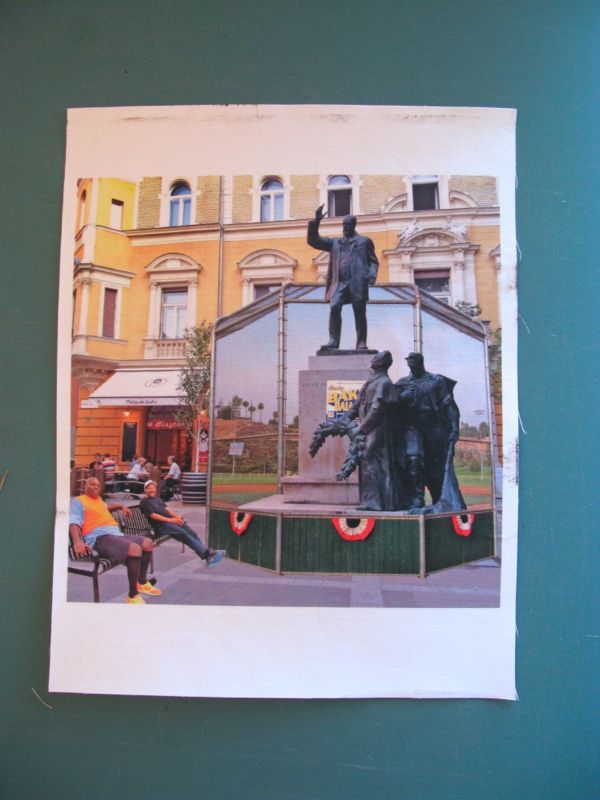
When I was ready to print, I backed the prepared fabric in freezer paper, ironing it thoroughly but using NO steam at all — I wanted the freezer paper to really bond with the fabric.  I trimmed it to exactly 8 1/2″ by 11″ inches, and used a High Quality photo setting to print.

Image Printed on Cloth 4-in-art_1

It worked like a charm!  I let it set for the recommended 30 minutes then peeled off the freezer paper.  I let it set some more to let it thoroughly dry–a caution I read on many blogs.
Bubble Jet Set Rinsing

I put four capfuls of Bubble Jet Set Rinse in my container, then added about a gallon of water (about 3 inches) and set the first printed sheet in the water.  I kept it agitating the whole time of two minutes, as you see above.  I held up the sheet to let it drain and in the other sink, I rinsed the sheet well and laid it out on towels that I had set on the counter.  I did the same process with all the other prints, agitating them (apparently to keep the dye from the printing to re-settle back onto the fabric — they cautioned several times to keep it flat, and to not let it crease!).

Leftover Rinse Water

This was the color of the rinse water after I did all four sheets.  The Bubble Jet Set Rinse is a mild detergent formulated to remove excess dye.  In my reading, many said that Synthrapol would work also, but I had this so I used it.

Blotting Printed Sheets

I blotted the sheets gently, pressing out the excess moisture.  I did not wring or crumple the printed fabrics at all, working to keep them flat.

Sheet to Dry in Garage

I hung them in the garage again to let them dry, again taking only a short time.  I was pretty happy with the results.  The colors were vibrant and the fabric was soft and I knew it was washable, although there are cautions about what type of detergent you use.  I never wash my art quilts so it wasn’t a concern, but if you plan on doing so, here are some good websites with information on their experience with using BJS:

http://vickiwelsh.typepad.com/field_trips_in_fiber/2009/04/bubble-jet-rinse-whats-the-point.html

http://quiltbug.com/articles/bubble-jet-set.htm

http://www.bryerpatch.com/faq/bjs_q&a_page.htm

http://www.cjenkinscompany.com/Frequently_Asked_Questions_s/25.htm

The C J Jenkins Company manufactures the Bubble Jet Set, and I thought their page on printers was helpful, although I swear by my EPSON with their Archival Inks.

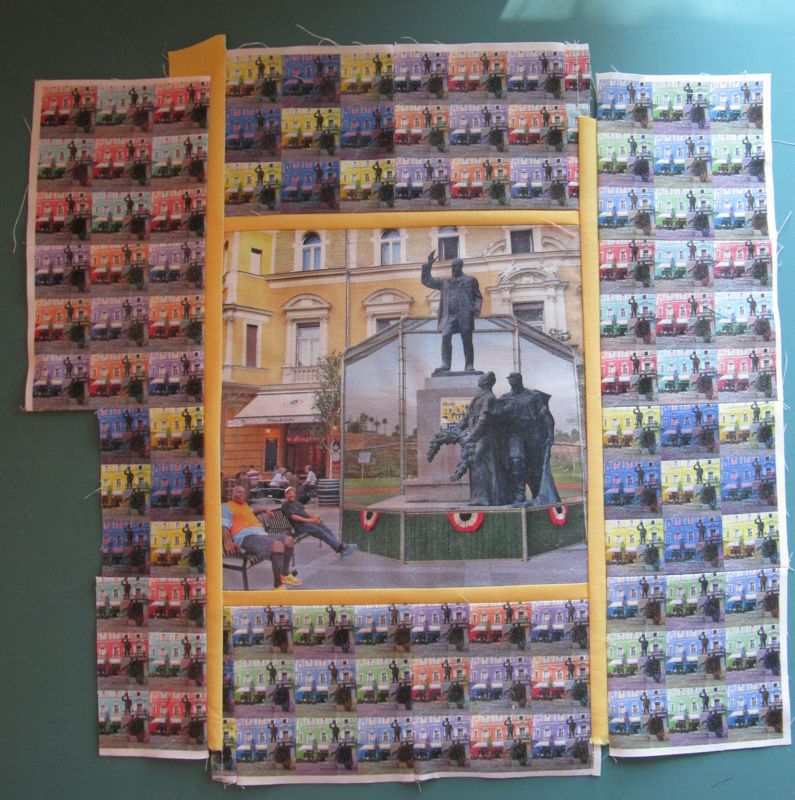
First Layout of Printed Sheets

After this, the construction was pretty straight forward, although I had to do some cutting and stitching to get the dimensions correct around the central image.

Sashing Printed Sheeets

I sashed the central image because I felt it might get lost in the tiny square borders.

Quilted 4-in-art_Aug2014

I quilted it, using matching threads (mostly lots and lots of gray).  Detail below.  I didn’t want to “over-quilt” this, but did want to emphasize the various elements.

Lorinc Pap Ter_detail front

Lorinc Pap Ter_front

And that’s it!  I’m pretty happy with how the BJS and BJR turned out, and glad that I had this little art quilt to nudge me into trying that preparing-fabric technique.

Circles EPP Button

Next up? The third block in my Circles English Paper Piecing Sew-Along.  I’ve remade this thing twice, so I’m ready to put it up and move on to the next block.  See the above tab if you haven’t started yet.

˚˚˚˚˚˚˚˚˚˚˚˚˚˚˚˚˚˚˚˚˚˚˚˚˚˚˚˚˚˚˚˚˚˚˚˚˚˚

My blogging software places ads here so I can use this site for free.  I do not control the content of these ads.