300 Quilts · New York Beauties

New York Beauties • Block 12 • Hopeful

Are we there yet? millions of traveling children must have asked, as the miles piled up. And maybe you are asking if we are done yet with these New York Beauties blocks. Not yet, the happy mother from the seat said. Or maybe after traveling in the arid West with no air conditioning, she wasn’t quite so happy. My sister, Susan Rugh, wrote this book about the golden age of traveling across America — all of us in cars, but probably no seat belts. I love showing off her work (available here).
The schedule of our blocks is up on this page, and we are getting there. Really we are. But I chose to do a more intricate one this time around, which leaves mostly easier blocks at the end. Actually, Hopeful, is one of my more favorite blocks, as I like the twisting effect around one of the outer bands. And that red sun-like center is actually not quite so red, but most cameras struggle to photograph red colors, if you hadn’t noticed.

I like to start with building the semi-circles of rays. This post will give you tips and tricks for making this this block (pattern available here). Cut out around the outer black dashed lines, and then figure out your colors. You can see my penciled-in numbers on the rays (C1 and C2 have a soft green background; B1 and B2 have a white background, so no numbering there).

This girl watches over all my Foundation Paper Piecing. I learned in a class from Verushka Zarate (she is coming to Road 2025!) and I made this girl in that class. Underneath her you can see I’ve clipped swatches and numbered them, from 1 to 7, and then I went a little further and cut ray shapes (I only need three of each) and pinned them below. You can pin a length of fabric underneath, if you don’t want to cut a shape of fabric.

Take time to fold them both on the line, and then reverse direction on the line (hope that makes sense).

I iron down the first bit, then lay the second fabric underneath, making sure to keep the fold like this for a second. I’m checking to make sure that Section 8 will fit on the underneath white fabric. It will.

I sewed that, trimmed it, pressed it, and now moving on to Section 9, again making sure that the blue behind is as large as the next section.

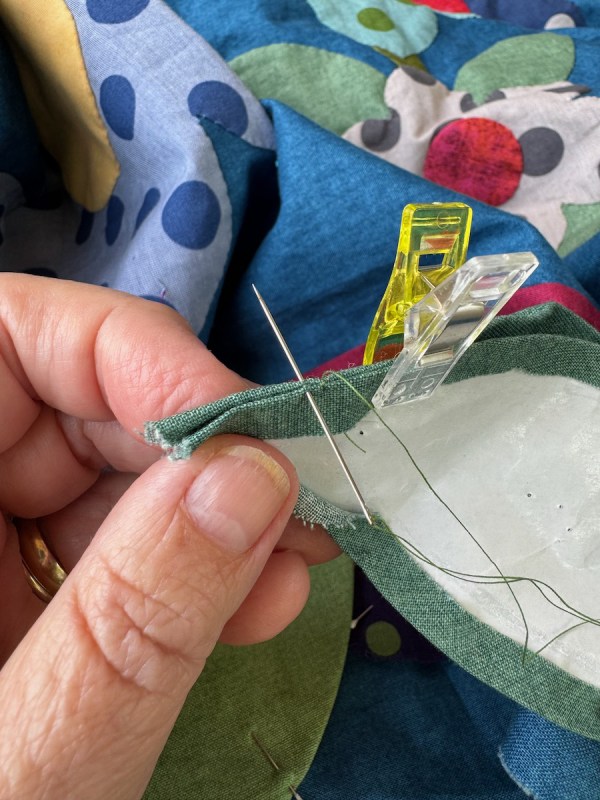
Reminder: stitch along the folded edge of the freezer paper.

Here I’m doing the larger rays, and the same process is the same: fold back the freezer paper so you can see the needed shape. I went ahead cut some ray shapes the needed size before I started, but I most often will just put a hunk of fabric back there.

I usually sew a couple of these sections at a time.

With all the sections sewn (1) they look kind of globby, but trimming them up (2) makes them look neat. I’m prepping in image 3 to join them together, carefully and s l o w l y pulling back the freezer paper. If you rip it off quickly, you are liable to pop your seams. Pin the units together (4) and you are rolling.

Yeah. Whoops.

I used the wrong color. Those who read this blog know that I would probably just leave it, as in the final quilt, it won’t be noticed. But leaving it now…on the first block…while you all are watching? No.

I picked the section apart and cut an exact replica in the correct fabric, weird angles and all.

Better.

And with that, block 12, Hopeful, is completed. Please make three.

There are many more tricks for freezer paper sewing on the other blog posts about these blocks. You can find them listed in order on my New York Beauties page, above. Apparently I’m supposed to make two of these blocks in June; I guess I got in a rush. One more is coming and it’s Block 5: Blooming.

And yes, you are allowed to second-guess yourself on your colors, but you are not encouraged to get stuck. I’d probably make that center sun part a little pinker, than redder, but as you can see in the image below…it’s really just fine.

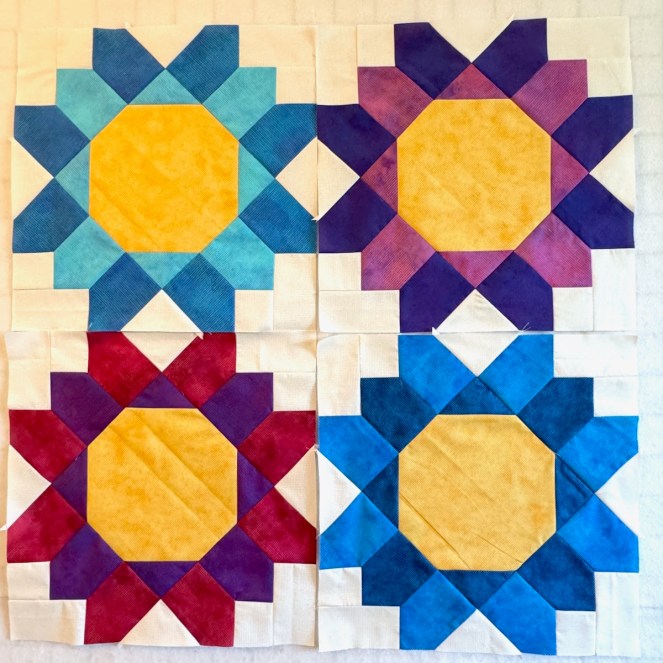
Eight blocks finished.
Four to go.
And one bonus, if you want to make one.

New York Beauties
Creating · Patterns by Elizabeth of OPQuilt

Invention/Re-invention

I received the sweetest letter this week from Laurie, who makes regular quilts as well as paints barn quilts. She chose my Home, Sweet Home pattern to make her design, and thoughtfully included a photo of her barnquilt, featuring the local councilwoman, Ruby. Ruby, according to Laurie, “has made it her mission in life to spearhead a Community Outreach program to bring residents together for the betterment of our community.” This barn quilt was presented to her on her birthday. The website for Laurie’s group is Chatt Hills Barn Quilt Trail, if you are interested. Click on Tour the Trail to see them all. Can’t wait until mine is up there with all the others–thank you, Laurie!

Here’s a rendition of the front of the pattern, with all its variations. I usually just make one, and oh, maybe another, and every once in a while I’ll go back into a pattern and rework the clockworks at the center to either improve the pattern, or make it into a more comprehensive pattern.

This is the one I’m working on now. For ages, it’s been a simple pattern/block, but when Anne sent me a photo of her Poppies quilt, I knew the potential was much much greater for this little block:

My sketch:

The software I use, Affinity Designer, added a few new tools so I could color in the blocks with “fabrics,” helping me visualize what it might look like. I woke up one morning, thinking of a fat-quarter short stack of red/white toiles I had, as well as stack of French blue fabrics, and spent some time drawing this out.

I have been struggling with this, though, because how do I draft a pattern out of this idea?

A block with several parts, cut in half on the diagonal, with seam allowance added on one side?

The quarter block was even messier.

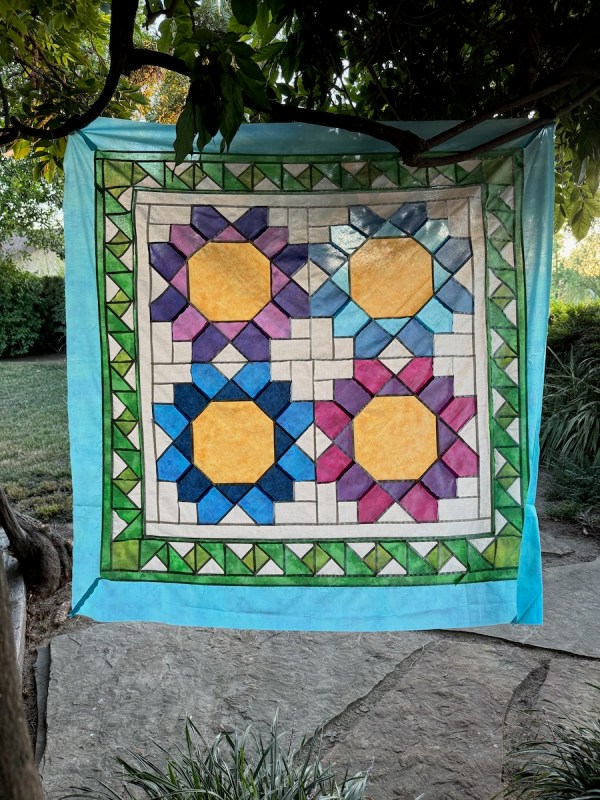
So I have resigned myself to just making a stack of blocks and then cutting them. I finished this week and am now playing the take-a-photo-rearrange-the-blocks game.

I have a small space for sewing, but it works for me, even though it can get a bit out of control on occasion.

I can already see I need to make one more to replace one that just isn’t going to work. I put these here so you can see I’m just like everyone you know: I stay up later at night, cut fabric, make a mess, try to herd cats (so to speak) while trying to put it together, all the while wondering– do I really want to re-do this pattern? It’s just that Anne’s is so inspiring. Sigh. You can find more of her brilliant work here: SpringLeaf Studios on ETSY.

Finally satisfied — or just ready to be done — I started sewing the blocks together. Anne has already warned me about those borders.

Another pattern that started out just a pattern for a block, then morphed:

And another:

Is it because re-invention is sometimes easier than invention? I love all the traditional blocks, but think some could lend themselves to new treatments, just like when we replace the window coverings. Or choose a new hairdo, which I’m currently struggling with now.

Hot Tip: It’s easier to search in DuckDuckGo for a new haircut than in Google. Google’s search engines have some infamy now in techie circles as being too bogged down, too tied to ads and AI murkiness to deliver decent search results. I agree. There are some other tricks to getting past the inundation of ads on Google, but we are all still battling with the greed of our Digital Overlords on social media (which is why I still write a blog, and why I don’t have ads).

Today I read in a Washington Post article (link should allow you to read) about how our Master Overlord Google is training its Artificial Intelligence (AI) on any and all artists’ works online. Many artists are taking them down from Instagram, because the Master Overlord Meta (formerly Facebook) is also training its AI on what’s on Facebook, Instagram and other social media. Cara, the app, seems to be the landing site for many. Here’s WordPress’ statement on their AI policy, which is the software I use to write this website: clear as mud for non-techies.

Okay, that’s all pretty depressing: I guess eventually we’ll have AI fabrics and AI quilts and there will be nothing original or new. And all our designs (that take days to convert into a pattern) will be subsumed in the Great Quilt AI.

Sigh. Time to download Cara?

In other, hopefully happier, news, I received my latest batch of Painter’s Palette Solids in the mail, so I can proceed with another block of the New York Beauties. And I’m working on some reverse appliqué for this one, made out of Grunge fabrics:

This reminds me of Italy ‘s color-drenched houses. But back in Southern California, the summer heat has arrived, the air conditioner will soon be pressed into service, and maybe, just maybe, we’ll get some decent tomatoes this year before they all burn up.

Happy Summer Sewing!

Gridsters · Patterns by Elizabeth of OPQuilt

Mercato Square • new pattern

Mercato = market = me thinking about Italy, and really how fun the market squares are wherever you are, but especially in Italy. Okay, and maybe in France. Couple this with needing a block for my turn in the Gridster Bee, and after some searching and trying different ideas out (I think I wrote and erased a few bee Google Spreadsheets) but now! Finally! I’ve settled on this:

As always when I try out a new pattern, I try for different looks:

How about Christmas?

How about colorful?

And then I tried merging some pieces, for Blues, a smaller 24″ quilt with a pop. There are a few more options on the pattern. But I wanted to get back to trying freezer paper-piecing on this one. But then I thought, what if someone doesn’t want to try that? So in the main pattern there are three different ways to make the block: paper-pieced (I used freezer paper), traditional templates, and then rotary cutting. In Blues, there are two ways to get it together. We aim to please.

But first, fabric.

I wrote this about a gazillion times, working to get all the info in there. Like, should be pattern pieces be right-side up? Or did it matter? (It matters if you are using print fabrics, but not solids.)

I also tried it with freezer-paper again, as I’m really liking this method. I took about a quadrillion photos to illustrate this post, then decided your eyes would glaze over, if they haven’t already. So here’s the basics in a free PDF handout:

Click on the button to download. Click on the title to get a sneak peek.

There are places I press the seams to the dark, making it easier to put them together (as they will nestle).

There are times I think the seams should be pressed open, so there is no see-through. (Doesn’t that look fancy?)

I believe in pinning.

And there are times you should not sew the seam at all, like taking a little break right at the center, moving the seam allowances to the front as you approach that center, and then lifting the needle/presser foot, hopping over the center by one or two stitches. Sweep the seam allowances to the back, then continue. When you are finished sewing the seam, clip the loop of sewing thread at that place.

Mrs. Quinn kept me company. I heartily recommend this book.

I made these in quadrants, trimming them up as I went. One done.

BIG HEADS UP! If you are making this for the Gridster Bee, make sure your outside reds are “pointing” the right direction. In my version the outside edge red pieces point counter-clockwise. It might be easy to get them going the wrong way.

Two done, this one in a different method (templates), and fabric.

Overall, I still prefer the freezer paper method.
The first time I tried that method, I was quite wobbly.
Second time, just sorta’ wobbly.
Third time, breezed through it.
This time? So easy: I loved it.
I have other posts on using freezer paper for foundation paper-piecing, but for this one, don’t forget to download the handout (above).

Cousins. I thought I wanted my bee-mates to make it scrappy, but then a package arrived and my Past Self had ordered 4 1/2 yards of Painters Palette Solids in Poppy Red from Keepsake Quilting.

Guess I’m doing Solids.

And this is why I like Painters Palette: I washed all four-and-a-half yards of the red in the washer with one color catcher sheet, and you can see the barest, faintest shimmer in a couple of places. I pre-washed because I was curious; generally I don’t pre-wash my Painters Palette solids, as I know they are pretty colorfast.

Gridster Beemates, keep reading after the end as I’ll have some tips for you.

There are 25 blocks in the larger quilt, so my bee-mates will make two each and I’ll get started on the rest. And a note to my bee-mates: I’ll send out the fabric a couple of months early.

Look for it, and have fun making!

To the members of the Gridster Bee: I’m sending you each a quarter yard of Poppy Red and White.

I worked out the layouts using the dimensions of the fabric, so you can get TWO blocks out of what I’m sending. (I marked the fold of the fabric on the right.)

Admittedly this is a layout for templates. If you want to use the Foundation Paper Piecing (freezer paper, or otherwise), it might be helpful to think in terms of strips:

Remember that because this is a solid fabric, and there is no right or wrong side, you can flip the fabric around as is needed. No, there is not TONS of fabric, but there is plenty. If you can’t get the two blocks out of what I’ve sent, send me back the scraps, if you wouldn’t mind, and I’ll combine and get them all finished. I’m trying to get all the blocks out of one dye lot of Poppy Red, which is why I’m calculating this all out.

And if you are a newbie quilter, take it one step at a time. I’ve tried to provide lots of materials and handouts. If you are just *done* after one block, that is fine. Send it, along with your signature block and the scraps, and I’ll take it from there.

Thank you so much for making for me in September–

New York Beauties · Something to Think About

Vespers, NYBeauties Block 10

Is it a hard-to-make block? Not at all.

But it kinda broke my brain a little.

This picture illustrates my vexation. On the left, and using the color swatches in the top row, is Version 1 of this block. Not happy with how the ombre effect worked out, I tried Version 2 of this block (on the right), using the color swatches in the bottom row. So, first, color broke my brain.

Color

I’d envisioned this block to be a representation of that time in the evening when everything is settling down, with glowing shades of pink and yellow and deeply colored purple. On the left in the background of the rays, you can see that range of hues goes just so far. Then there is a huge color jump from the light pinks to that dark coral at the far left. Likewise in Version 2 on the right, there is a progression from soft yellows to corals and pinks, then another color jump at the end. I faced that sort of thing ages ago when I made Annularity. I ended up making two of these quilts:

Do you spot the anomaly in color? It’s at the very bottom, the warm-lavender diamond just to the left of center. That quilt went to Paintbrush Studio, because it was made from their first drop of their solids line. In the version on the right, made for myself, I pulled the exact blue-lavender color from another solids line that I needed to make the transition flow smoothly.

This is because we live in a world with limitations. And fabric colors, especially in solids, are one of those things. The fabric line, my favorite — Painter’s Palette by Paintbrush Studios — has since fixed that awkward color jump and they now have a perfect blue-lavender.

But now there’s a jump in the pinky coral tones. But I’m really giving this fabric line a workout: I’m creating color in my Affinity Designer program, using sliders and sampling colors from photos to get the exact color that I want in my designs. But the fabric manufacturers are working with cloth, dye, finishes, and budgets and no, they can’t make every color. (This is why I believe some people dye their own fabrics — just to get that precise color they want. But I decided long ago not to go down that road.) If this really bugs me, I may just buy it from another line, but I will be sure to prewash it twice to try and mimic what I have (both for colorfastness — the PPSolids are incredibly colorfast) and to shrink up the weave a little (PPSolids have a tight weave with a nice hand, or feel, to the cloth). Who am I kidding? I’ll just use what I’ve got.

Technique

And the other reason I was struggling is technique, or “how I sewed it.” In that Version 1, above, if you use your critical eye you can see that the narrow green band seems more “lumpy” that the one on the right. When I was majoring in Clothing and Textiles at Brigham Young University (a major no longer offered), we had to make a wool suit. Our teacher had worked in the industry and precision was her specialty. I resewed the lower front corner of my jacket with its sloping curve from center front to hem probably four times, but in the end she still gave me a B. She wrote on my grading sheet that she knew I worked hard on it, but it still wasn’t as smooth as needed.

It wasn’t necessarily my skillset that wasn’t up to succeeding, it was my technique. I needed to slow down. We all are familiar with this feeling when we finish the center of a quilt and then its borders. Borders? And we throw on just something, and then it’s quilting, and then it’s the binding, which apparently many people don’t like. They just want to Be Done.

So I slowed way down in my sewing of the narrow bands on the Version 2 block. Pressing carefully, using a different order of construction, improving my technique as I went.

This is not a hard block. So choose your colors carefully, use your best techniques in sewing, and it will go well. That’s all I wanted to say on this, but I do include my tips and tricks for the block and sewing it together below.

This is what my cutting table usually looks like, however I crop out the mess when I post photos, to keep the distraction level down. There’s a free pattern for Block One in my PayHip shop, where you can also pick up the patterns for all the blocks. Don’t forget to look at the other posts about this quilt, all found on the Master New York Beauties page.

Thanks for reading, and good luck with your colors and technique, in whatever you are stitching–

Tips and Tricks for Block 10: Vespers

Many other of the New York Beauties posts give you specific instructions on how to make that ray section; feel free to look at them for more help. We now pick it up after the parts are ready to be assembled. Please read all the way through before beginning.

Arrange the pieces so you’ll pin the INSIDE curve of the rays to the OUTSIDE edge of the narrow curved band. The Cereus block (9) discusses this. Divide the ray section and the small upper band into four sections, marking with pins, or finger pressing. Pin.

Sew a scrap, and at the edge, line up the two pieces to sew. I use a clay tool (the handle is nice and big) but you can also use a stiletto. Keeping the right-hand edges aligned, S L O W L Y stitch 1/4-inch away from the edge, easing in the fullness as you go. Remove pins as you go. To be truthful, It’s easier to put the concave on the bottom (the curving-out piece), but I think I flipped it for this photograph. The post on Cereus shows what I mean.

Press the band away from the rays.

Now we’ll attach the corner quarter-circle. Again, divide the edge into fourths. And made sure you are sewing the INSIDE edge of the narrow curved band to the outside curved edge of the quarter-circle.

All pinned up. The purple (convex side) will be placed next to the feed dogs:

Again, I use a scrap to get started. I nudge those two edges on the right together with my clay tool and sew in a quarter-inch seam, slowly.

I like dimension in my blocks, so that seam is pressed under the quarter-circle. (I’m sure you’ve noticed the pieced wedge in the center. My order from Keepsake Quilting hadn’t arrived when I was making this sample.)

Readying the next joining: outer narrow band to the lower edge of the rays.

Preparing the last seam: narrow band to outside corner. All those curved edges have bias, with the grain on the outer edges because I cut them like this:

All finished. In every step I took my time, keeping a good technique and not rushing.

Trimming is keeping several balls in the air at once, juggling them all.

  • First thing to check: your center. Make sure that diagonal line is as close to center of that center ray as you can get.
  • Next, go for the bright green arrows, seeing if you can get the outer edge of that band as close to 9 1/4″ as you can. On both sides.
  • Last, and only if you can, the bright blue arrows are asking you to see if the inner narrow band measurements are the same. Or similar.

Then trim off the excess. I designed the pattern so you would have some “play” on that outer edge.

Okay, that’s all for this block. Make 3. Will I use both blocks? Probably. In our lively quilt, I don’t think anyone will object:

I put them both up in our progress chart, and they are fine. This is all to say that if you make one and want to make a shift in colors of the same block, it will be fine. There’s another double-colored block up there now!