A long time ago I lived in Washington, DC for a year, and our quilt guild (Mt. Vernon, a chapter of Quilts Unlimited of Virginia) was pretty active. We met in the community center, next door to the Variety Store (which had great fabrics) and someone organized a tour to the Smithsonian quilt archives in the National History Museum.
They took us downstairs into a room with tons of these large, flat drawers, and a docent pulled them out one-by-one to show us these historical quilts. This was in the days before our phone cameras, which take great photos effortlessly, so many of my photos are sub-standard. But a few fun things stood out for me, from that tour.
Gloriously colored applique, using ombre-shaded fabrics.
The teensiest logs in this stellar Log Cabin quilt (the use of the plaids interspersed with solids and other plaids is brilliant, I think).
Stars that are each their own character.
And this quilt, which looked like it was English paper-pieced out of felt, but it was wool from Civil War uniforms, carefully cut and pieced, and made by a soldier.
Red, White, and Blue giveaway info is at the end of this post. Many thanks to all who entered!
If my grandchildren come to visit me long enough, we can crank out a quilt. Last time it was Keagan’s. This time, it was Riley’s. I discovered last time that simpler quilts are best, so I started leafing through my BLOCK Magazines from Missouri Star, until I happened on her pattern titled Slice of Life, found in Volume 1, Issue 4. You can get a download here.
Riley picked out blue and green prints from my stash (using your stash is also a good thing to do) and he ironed while I cut. He arranged the squares on the wall into groups of nine.
Originally the book called for “layer cake” squares, which if you have a layer cake (or have the pre-cut sizes memorized), you are set, but I don’t. I get grumpy when patterns call only for precuts, and don’t tell you what the actual dimensions are, so I’m telling you that I cut squares that were 10-1/2″ square. [Yes, I know they are bigger than a layer cake.] I narrowed the sashing, cutting it at 2″ (sewn in it will measure 1-1/2″ wide). You make three of these giant nine-patches, then cut them apart like this.
I cheated a bit, and folded the giant 9-patch into fourths, and took a bare sliver of fabric off the fold when I cut–kind of like when the local quilt shop cuts fat quarters. Then we arranged these new designs up on the wall.
Sometimes Riley took a break with his little sister.
I sewed the giant pieces together, but sometimes Riley did. I pinned it a LOT when it was his turn at the sewing machine, also teaching him not to sew over pins.
Everyone helped pin baste the quilt on the kitchen counter. We would pin a large section, then shift the quilt.
Everyone helped quilt, even the littlest sister, as well as my daughter, mother to these three charmers.
Binding was next, again from the stash. Late that afternoon, they went to the beach and my husband and I headed up the mountains to our church’s camp for the young women. I sewed on the binding all the way up, and while we waited for the program to start. I finished it.
Backing is Marimekko fabric.
He couldn’t think of a title, so I wrote a couple of details on the back. I think this is the section that Riley quilted–I think it’s great that he helped in all phases. This is Quilt #184 on my 200 Quilts List.
The youngest of these grandchildren is eight years old, so I imagine her turn will be next! Baby Blues comic strip ran these this week, and I thought it fitting (although the sisters do quite well, too!)
Congratulations to Nancy S. who won the bundle of Painter’s Palette Solids! I’ve been in touch with her via email and will get the bundle sent out to her. I had the best time reading over all the comments about fireworks, from those who had a first date watching them (that happened to me, too, early in our courtship) to those who watched barges-full launch them into the air. Thank you all for your wonderful responses!!
(This is for those who mentioned that they watched them over the Washington Monument.
I did too.)
Welcome to Day 4 of the Patriotic Palette Blog Hop, hosted by Paintbrush Studios and Painter’s Palette Solids!
Red, White, and Blue Star • Quilt #183
25″ square, made from Painter’s Palette Solids
A couple of weeks ago, the fine people who make Painter’s Palette Solids sent me some fabric and asked if I would make something. At the end of this post, there is a giveaway so you can win your own stack of red, white and blue fabrics.
I’m part of a series of posts showing items you can make with just three reds, three blues and some white. Here is the complete list and the days that they are presenting:
The project I chose was a quick and easy mini-quilt, which finishes at 25″ square, and is perfect for a table top when you want to give a little patriotic flare to the kitchen. I’ve written up a free pattern, available in my Craftsy shop for download (see button to the right), but the instructions are here if you need any tips and help with construction.
I was sent fat quarters in three shades of red, three shades of blue and a fat quarter of white. The white needs special cutting: cut the long borders first (see chart on pattern), then the squares for the half-square triangles. You may have enough the other way, but do it this way to be safe. I also was tight on the medium blue, as I used it for the binding, too. You’ll need to provide your own backing (about 3/4 yard, or pieced scraps).
I basically constructed this as a nine-patch, a favorite thing of mine to do with minis. I started by sewing four bright red triangles on the edges of the blue square, then pressed them all away from the center. I squared this unit to 7 1/2″. (This quilt is forgiving if yours is slightly smaller.) I squared all my nine units to the same 7 1/2″ as then I wouldn’t have to square up (or true up, depending on how you refer to it) the finished quilt top.
Next was the construction on this corner, sewing the medium and dark red triangles together to make a square, then sewing on the dark blue triangles to make a larger triangle.
Sew on the medium blue triangle to make it a square; true it up to 7-1/2″ inches.
Now make the rest of the blocks: sew the triangles together as shown, then seam those together to make a square. I always press to the side, if you are wondering. Only rarely do I press open, so avoid that.
Lay out all your squares (as shown above, left), then sew them together like a nine-patch (upper right). Measure the square; the sides should measure 21-1/2″. Trim your long white border rectangles to measure. Sew the darkest red blocks on each of two of the white rectangle borders.
Sew two white borders: one on top of the quilt and one of the bottom. Press. Then sew on the borders with the squares attached; press. Admire your quilt top.
Let’s get quilting!
Here’s a picture of the quilt in the sunshine, showing my quilting stitches. I always have the hardest time coming up with what to quilt where; yours may vary. The “bandstand swag” arcs on the outside were a happy accident.
This was all done on my Sweet Sixteen machine, but that functions like a domestic sewing machine. I did do ruler work (which is probably easier on my machine than a domestic) but it can be done on your regular sewing machine. Just make sure you have a thick enough hopping foot and thick rulers designed for this task (not your cutting rulers!); put grippy stuff on the bottom of your rulers, as you’ll use them to help you move the fabric under your needle.
Happy Fourth of July!
If you haven’t heard me tell you about Painter’s Palette Solids, made by Paintbrush Studio, you must be a new reader. It is my FAVORITE solid: it’s easy to work with, has a nice hand, deals well when I need to unpick and re-stitch (I had to do that with the quilting, but you can’t see it, right?). It’s a fairly new fabric to the market, but many brick-and-mortar shops, as well as online shops, are starting to carry it.
As is my custom when sewing for Painter’s Palette, I give away my scraps when I finish a project, so that some fortunate quilter can give this fabric a try. BUT! Paintbrush Studios has generously offered up a stack of the fabrics I used in this quilt — seven fat quarters — so you can make your own (giveaway is for domestic/US only).
To enter, leave me a comment telling me if you like fireworks, and why (or your most memorable). I’m not talking the little things that are lit up down on street level, but those glorious bursting displays of color and light. It will get us all in the mood for Independence Day.
I’ll activate the Husband Random Number Generator and pick a winner, to be contacted by email.
Giveaway closed. Winner has been notified and will be announced in next post. Thank you all!
I made this for an exchange at my Guild Night, but then my daughter and her family came into town and I didn’t go, so now I have my own little quilt.
It has its own stand, and it’s easy-peasy to make.
First, buy one of these. They used to be more durable, but this is cheap-cheap-cheap and it works.
Make yourself a sailboat. I pieced the sail on the left first before sewing it into the mini-mini-quilt. Here’s the templates in a PDF file (be sure to set your printer to 100% before printing): Tiny Sailboat And if you like to foundation paper-piece, here it is again: Tiny Sailboat PaperPiece Pattern
If you are using the foundation paper-piece, cut the pattern into three pieces, as shown by the red lines, being sure to mark it somehow with seam allowances. (I use a colored pencil and draw it along the line before cutting it apart to remind me it is NOT a cutting line, but a seam line.)
The little sailboat finishes at 6 1/2″ by 8″ which isn’t big enough for the frame. I added the sunshiney fabric on three sides, seaming a bit of “ocean” fabric on the sides to keep the horizon line. I also added ocean fabric to the bottom, so now my little boat is afloat.
Quilt as desired (curvy waves in the ocean, straight lines outlining the sailboat and sails, and stippling in the sunshine), then trim to the above size: 8-3/4″ by 10-1/2.”
Make the sleeve: Hem one short edge of a piece of fabric cut to 8-3/4″ by 9-1/2″ and place it wrong-sides-down on the back of your mini-mini quilt. Pin in a couple of places.
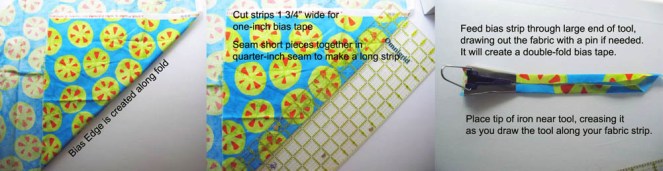
Cut strips of binding 1 1/4″ wide, seaming if necessary to get the desired length. Stitch the binding from the front, right-sides-together, then turn the back, tucking under the raw edge. Hand-stitch closed.
Our guild does these a couple of times a year, creating a changeable scene for your home. I’ve previously hung minis on a wall, but I’m really liking this quilt-on-a-stand idea.