Carrefour Quilt Show · European Patchwork Meeting · Quilt Shows · Quilts

Carrefour IV: Shin-Hee Chin, Tara Glastonbury, and Janet O’Dell

This post covers:

• Venue 7: Église Ste. Madeleine, with Shin-Hee Chin
• Venue 8: 86 Wilson, with Tara Glastonbury
• Venue 9: Chapelle St. Joseph, with Janet O’Dell

I have a main Carrefour Quilt Show page that lists all the posts of all the meetings I’ve gone to, and includes the posts from this year too. If I haven’t mentioned it before, you might enjoy these posts more if seen on a desktop computer or even a tablet. Cell phones re-format the layout and can sometimes do strange things to how it looks on the screen.

If you are interested in going to Carrefour, I wrote two posts for them about our travel, and how we put the trip together. You can find them here and here. Their main website is HERE, where you can subscribe to their newsletter (scroll to the bottom).

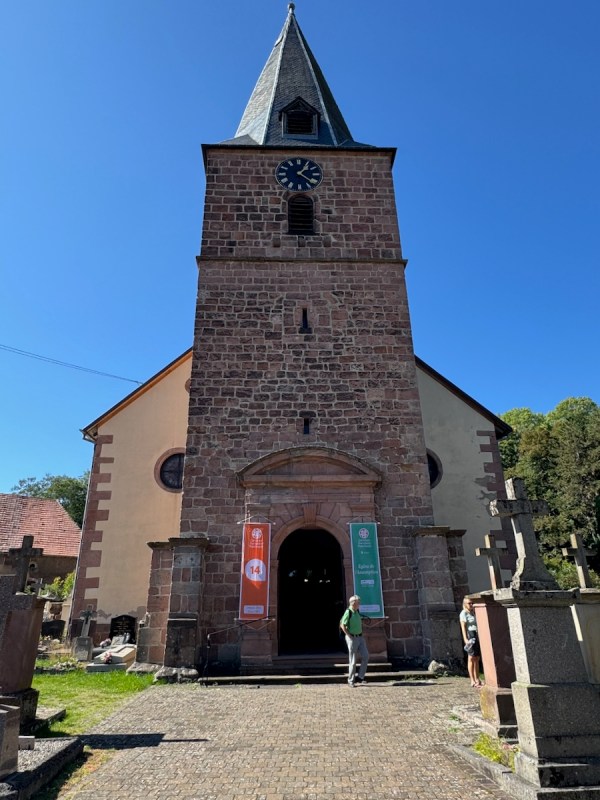
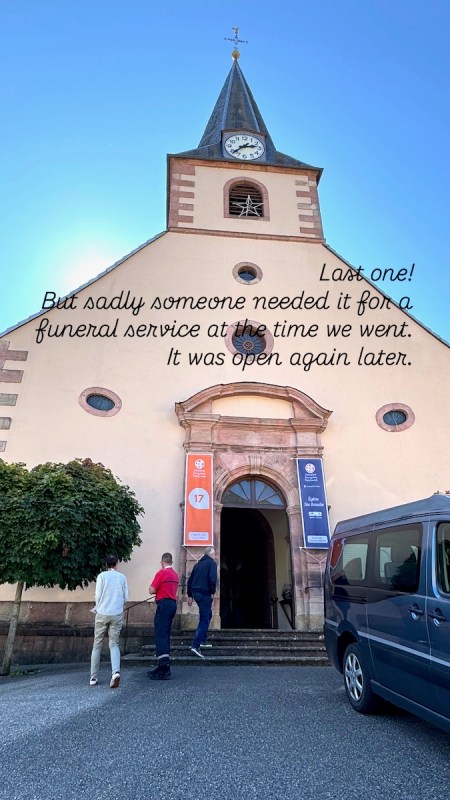
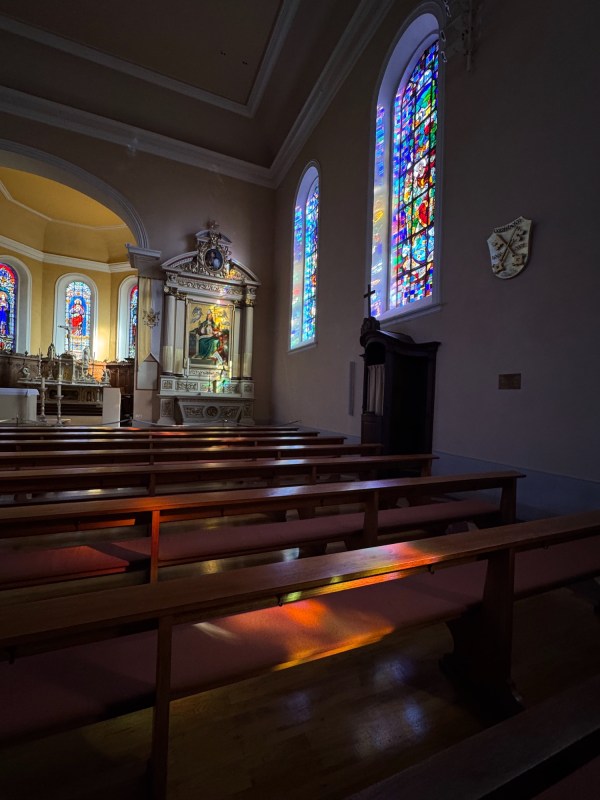
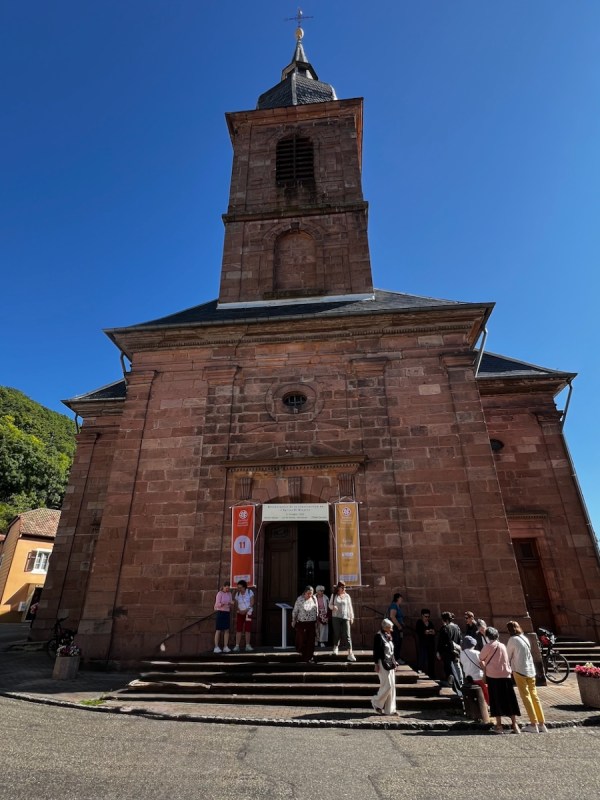
Venue 7 is the St. Madeleine Church.

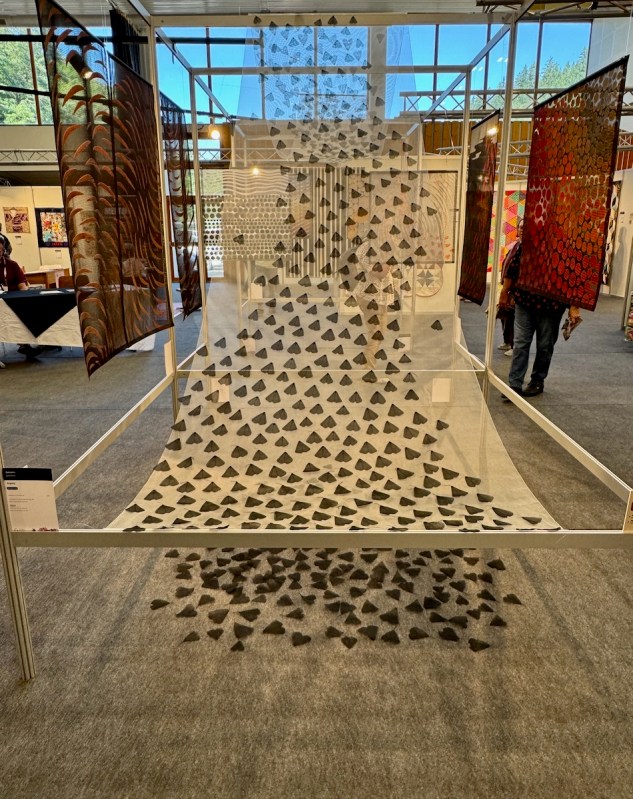
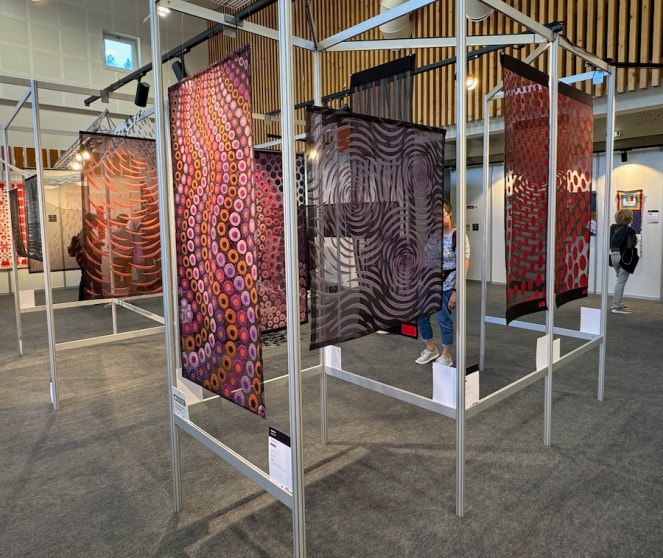
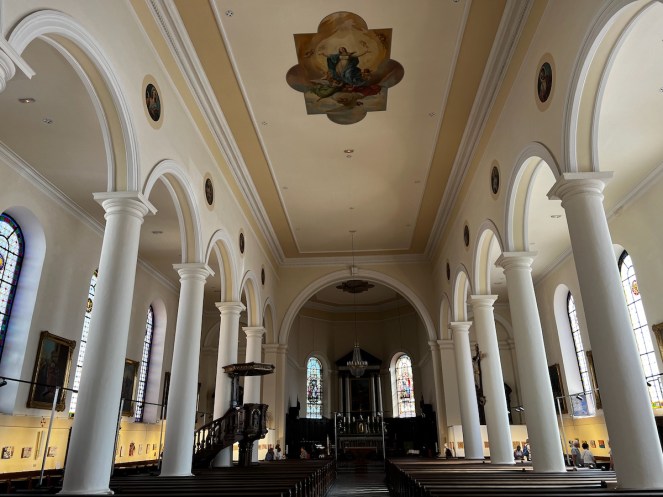
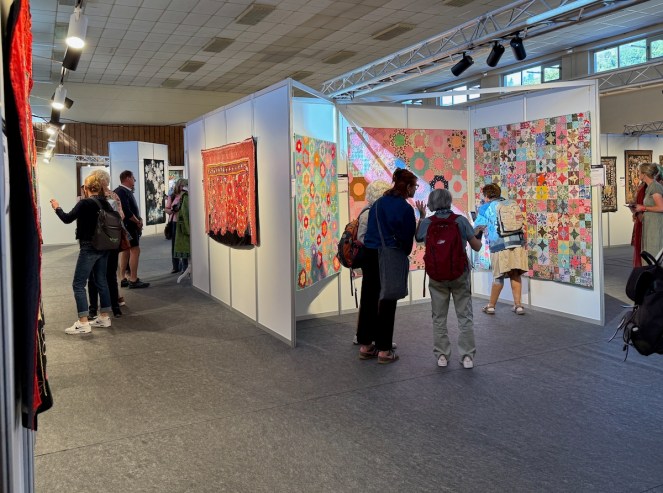
Inside, the organizers set up a metal scaffolding framework to see the quilts. The lights are strong and the quilts are well-lit (sometimes with shadows, but we tried to work around them). I appreciated the effort they made for us to see the quilts. Sometimes, we’d have to walk down the bench to see details, which is what you see going on here with people moving in, then back out to the main aisle.

Okay, here we go with Shin-hee Chin.

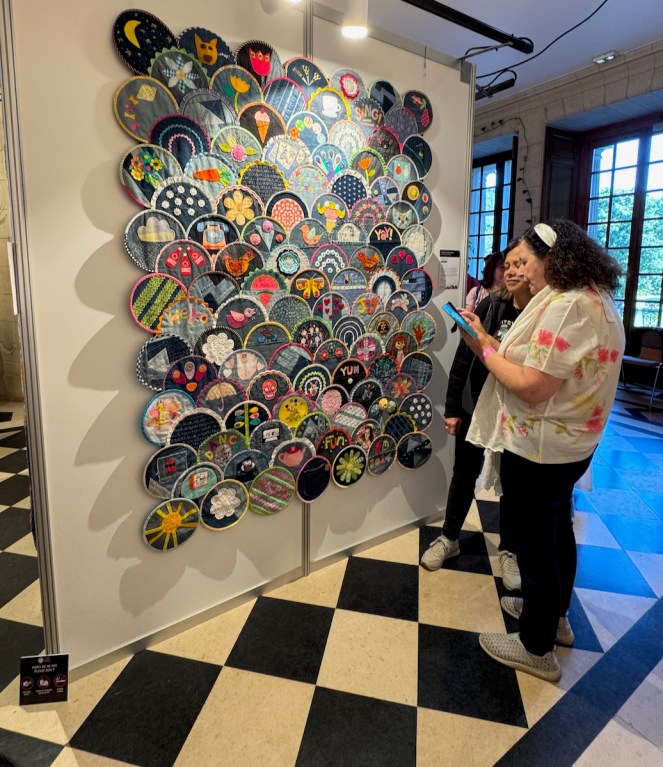
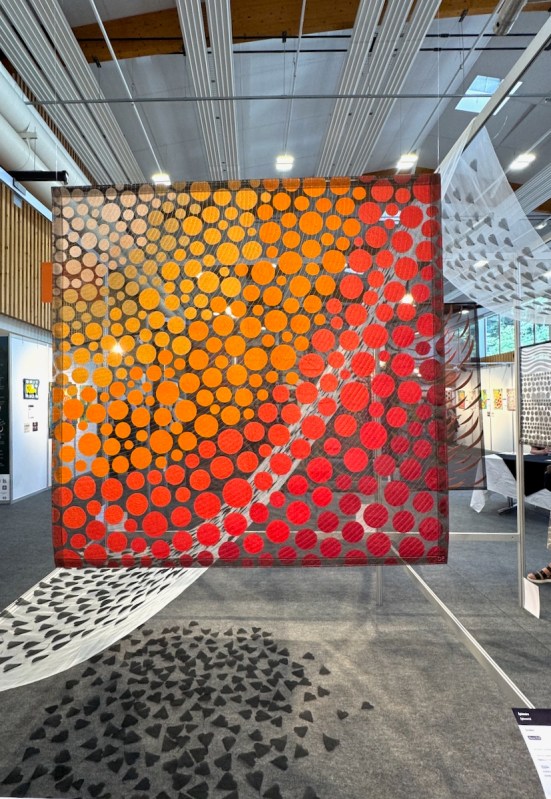
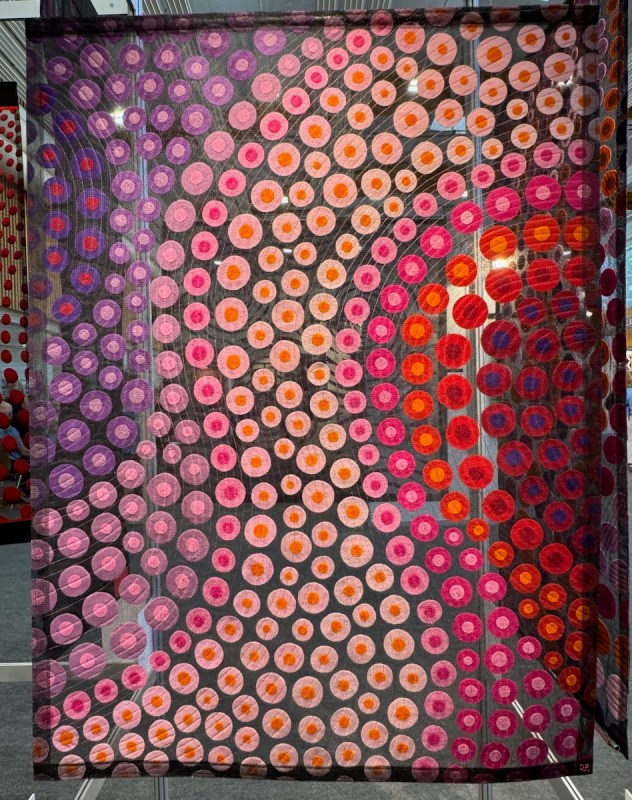
She was born in Seoul, and earned her BFA/MFA from Hongik University and an MA in Fiber Arts from Cal State Long Beach, in California. She is now a professor at Tabor College (Kansas), where “her work explores identity, hybridity, and belonging through feminist traditions and spirituality” (from catalogue). The catalogue goes on to say that her work also “honors the deep bond between humanity and nature. Through meditative hand stitching, she reflects on our share facility and interconnectedness. Each stitch connects with nature’s rhythms, creating texture and depth to celebrate the patterns that sustain life.”

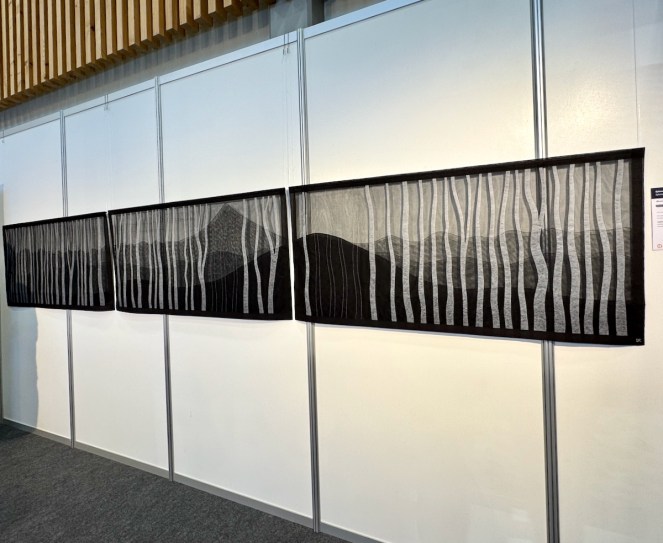
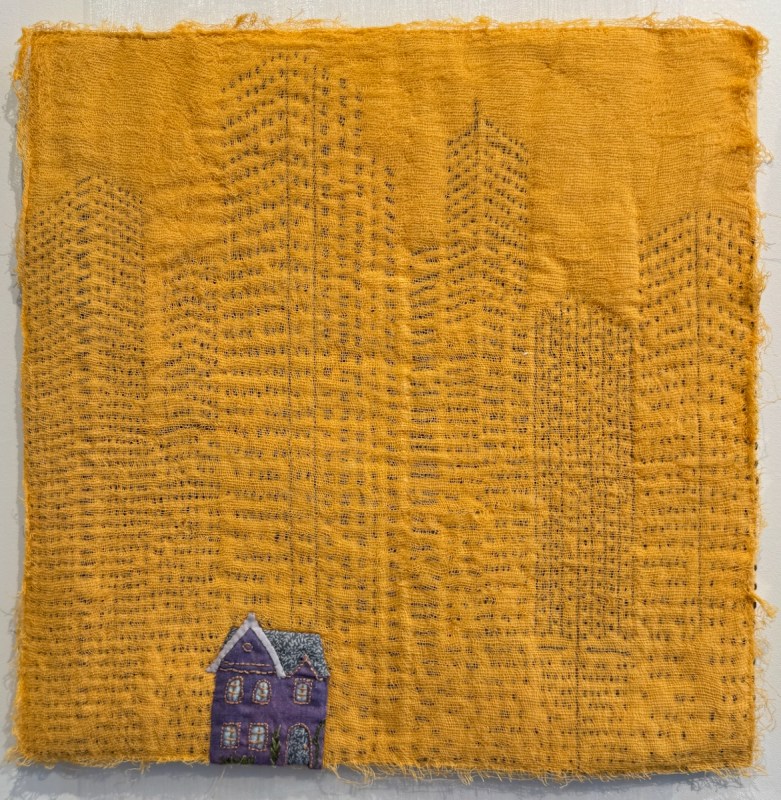
Now here’s the surprise. Perhaps you glimpsed through the threads a different quilt.

She uses quilts and blankets as the basis for her thread work. This caught me by surprise, and at first I didn’t know how to think about it. We quilters get our knickers in a twist if people make coats, etc out of old quilts. How do we feel about someone obliterating the quilt with their own work? Well, generally that is one reason that I come here: to have my eyes opened to what else is going on in the quilting world. I just needed to accept this artist on her terms, and look at her work. We all have seen quilts at guilds and local shows that surely might be well-suited to a second life (I’m looking at you, pre-printed panels!), and what an impressive life they would have with this quilt and fiber artist.

(Click to enlarge the photos.)

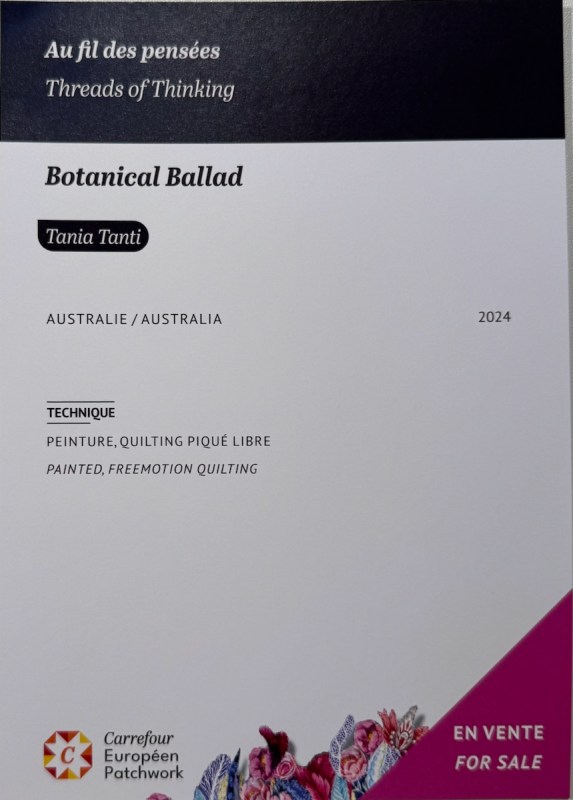
Confession: somewhere along here, I lost track of which quilt belonged this title card (sorry).

Fronts of quilts…

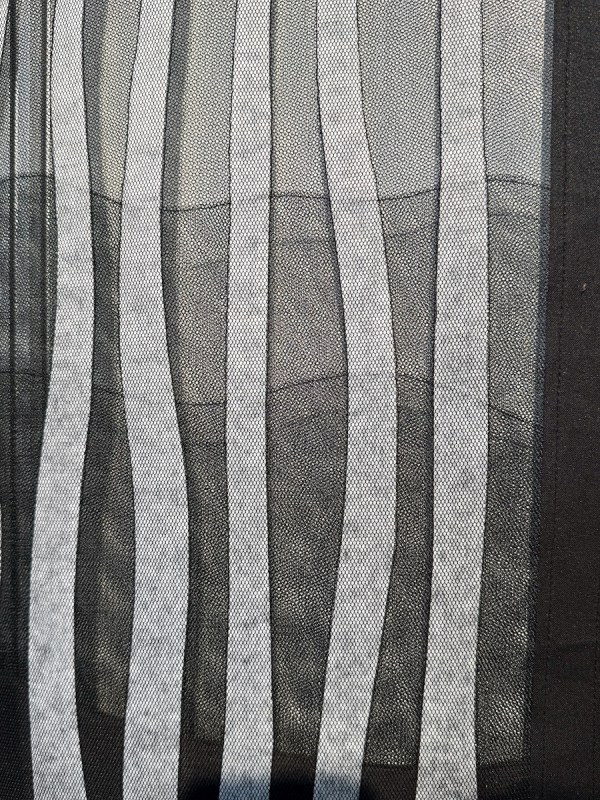
…and the backs of the quilts.

A quilt from her nature series, a collection up on her website. One of the reasons I was interested in this was because her materials: a thick thread with little squares attached, which I’ve seen knitters use to make decorative scarves.

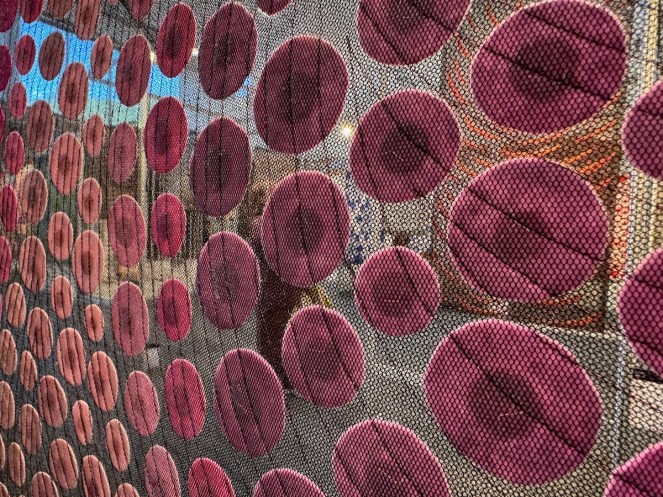
Her work appears literal, like — yes, this is a reflection of tree branches — but then you get closer, and the thread stitches and tangles add another dimension.

The tiled floor, of course.

Last look: the interplay of the church’s stained glass with Chin’s threaded images.

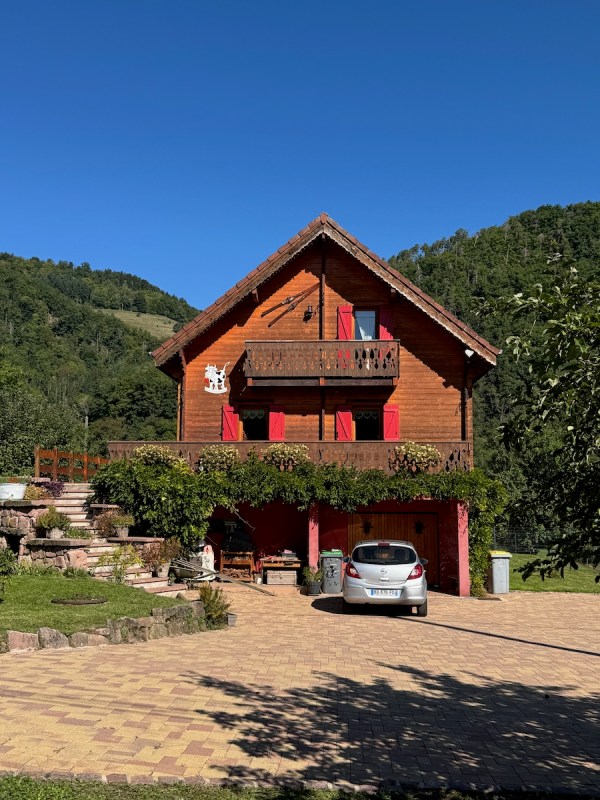
As we walked to the next site, we loved the brilliant yellow against the wood-carving on this small house.

We notice the quilts in all the windows around town. We’re headed to Venue called 86 Wilson, which is really just a street address. It’s where Tara Glastonbury is exhibiting, another quilter from Australia.

The view across the street.

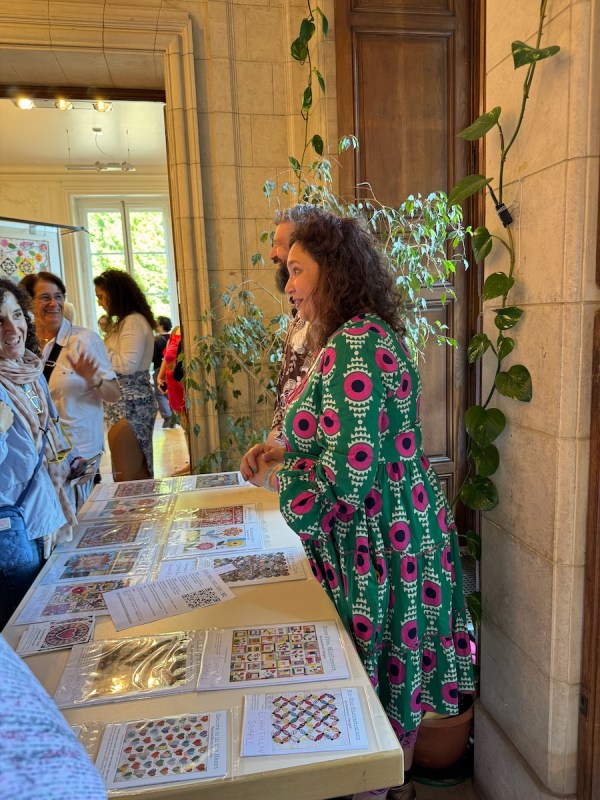
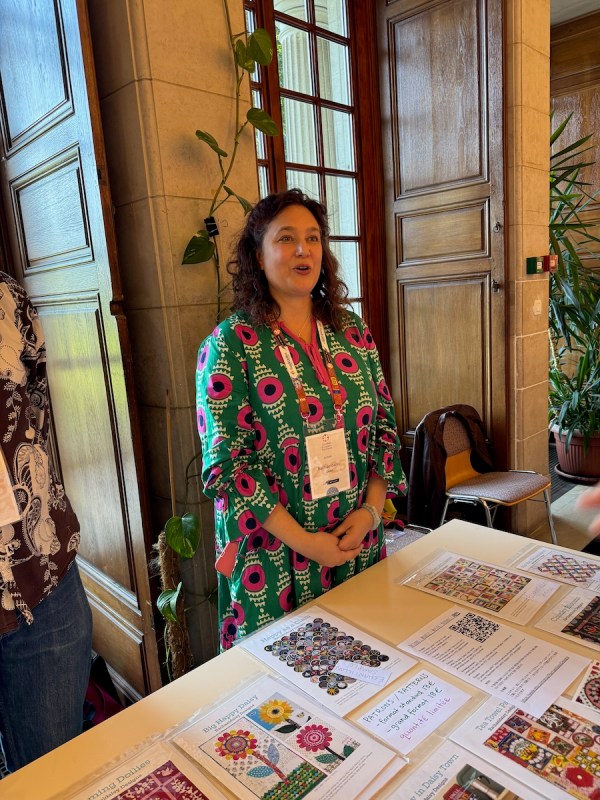
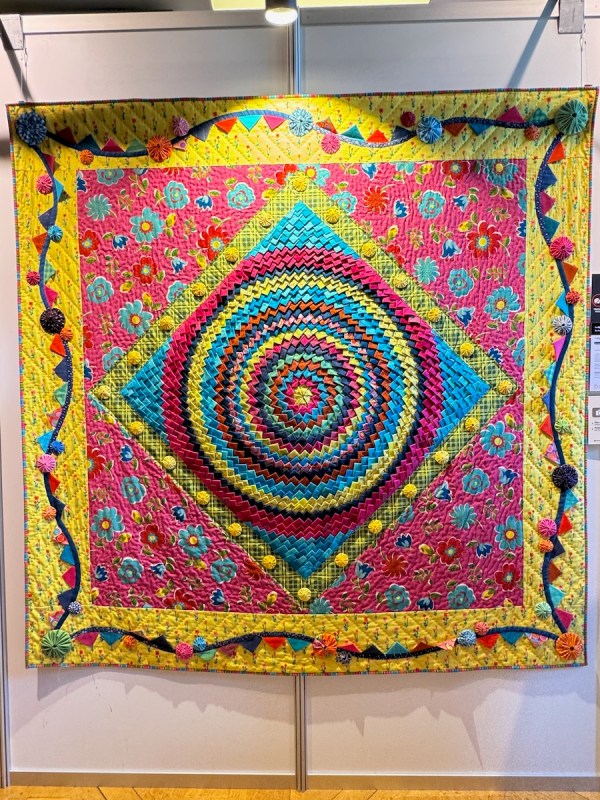
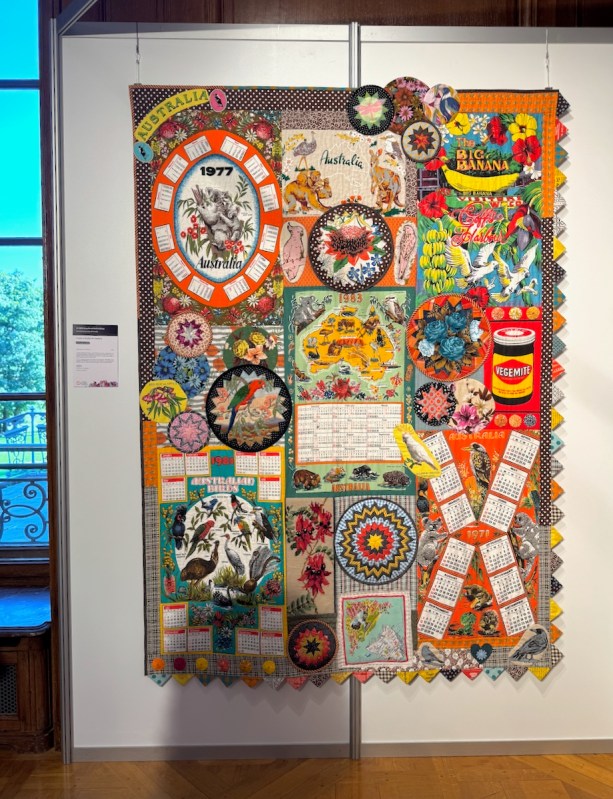
Now do you recognize her work? She has a pattern line, as she has “a background in graphic design, and a long history in textile crafts” (from catalog). She titled her exhibit “Balancing Act,” as it “explores her evolution as a design-led modern quilter through her use of bold color and striking geometry.”

Tara and her mother sat inside, just a bit away from the front door, in front of a sunny window lighting the space. She had copies of her newsletter and patterns (yes, I bought one). The atmosphere was genial and happy.

I struggled to get the right color balance, because the lights cast a really warm light.

I love that she had tote bags that echoed her quilts.

Two quilts that I don’t have title cards for are below, but you can find them in her pattern shop.

I love that she “jazzed up” her Log Cabin with some triangles.

See her card (below) for a truer representation of the colors. It’s such a terrific design.

Tara’s penultimate quilt:

She uses small pieces of fabric in an interesting way. Scrappy-not-scrappy, but more ordered.

Last one from Tara:

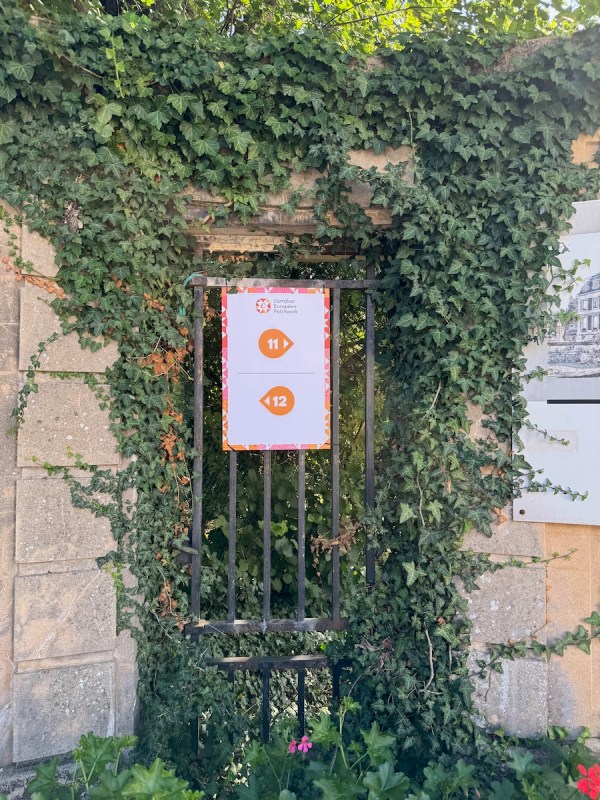
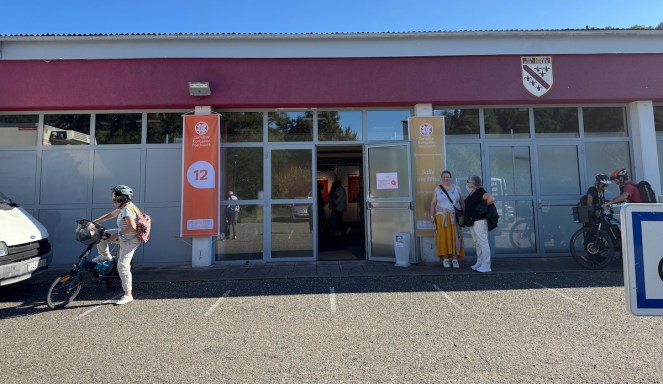
We jumped in the car and drove to Venue 12, passing another house with a carved wood exterior. We’re skipping Venue 11 for now, as it’s not on the way. After finding a parking place around the corner, we arrived.

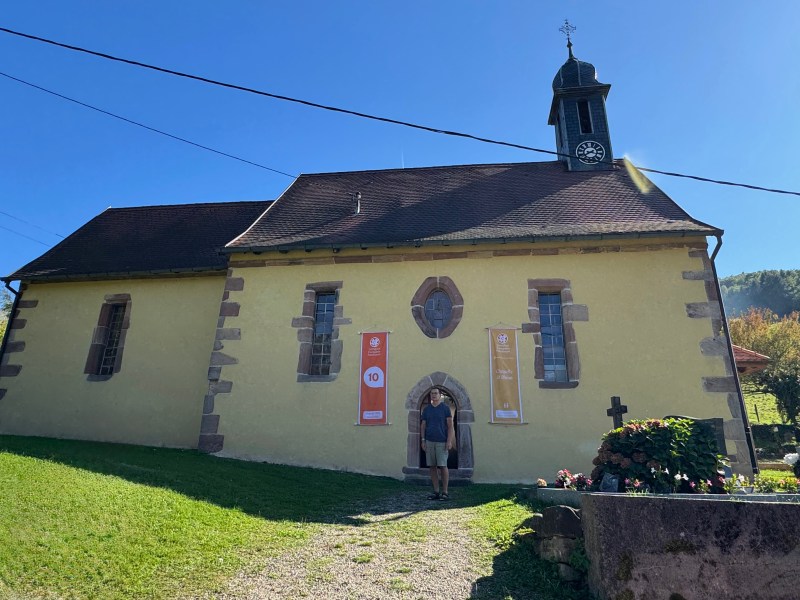
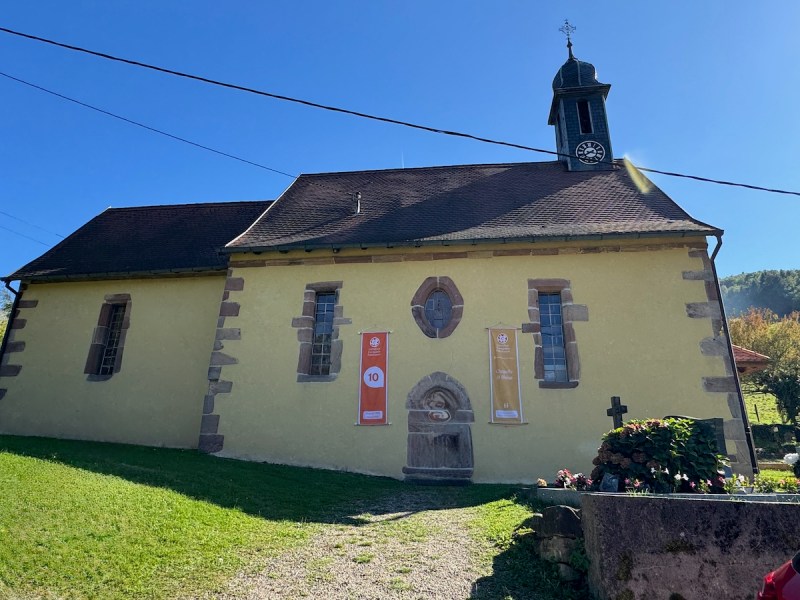
Venue 9 is a tiny little church where we saw the European Bobbin Spool Invitational Quilts last year. What will it be this year? Again (you’ve heard me say it before), I am always just blown away by the diversity of quilts and quilters at this quilt show — it really pulls me out of the US manufacturers/quilters/design loop and makes me think and appreciate the diversity we have. I hope these posts help you see your quilting and creativity with new eyes, or maybe spark a new idea.

Photo of stained-glass taken by my husband. As always, we both took lots of photos, so many of the images in these Carrefour posts are his.

This time, we will meet our great-grandmothers of quilting.

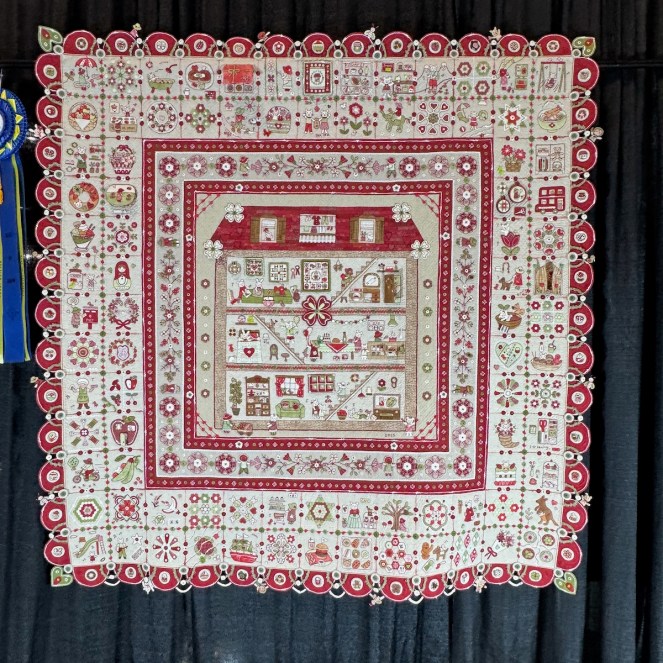
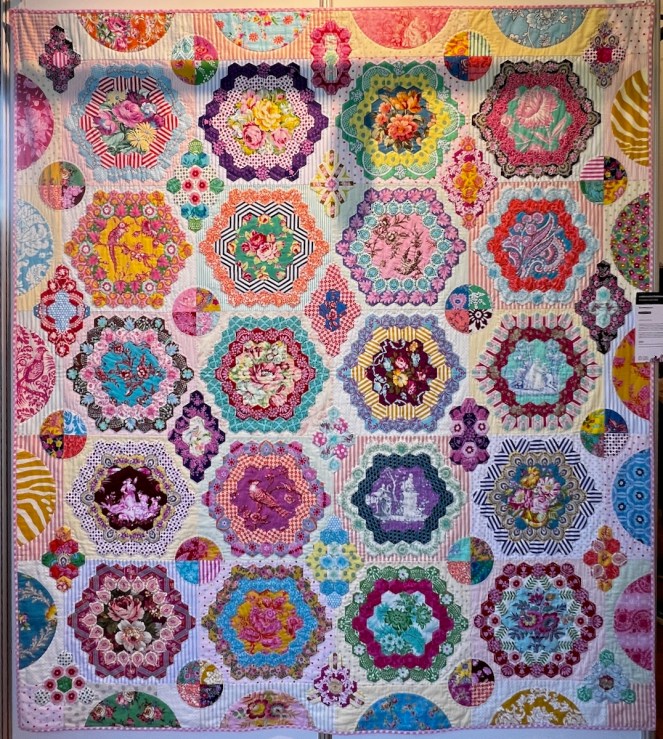
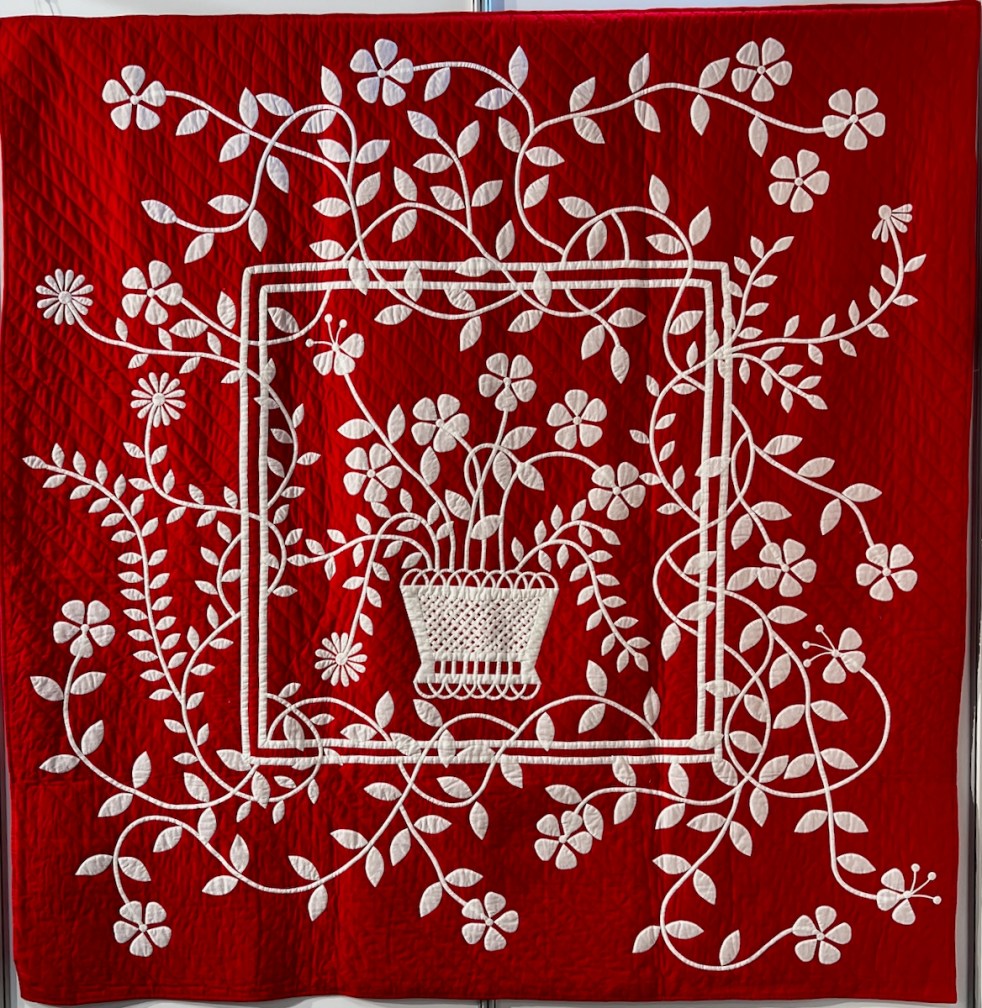
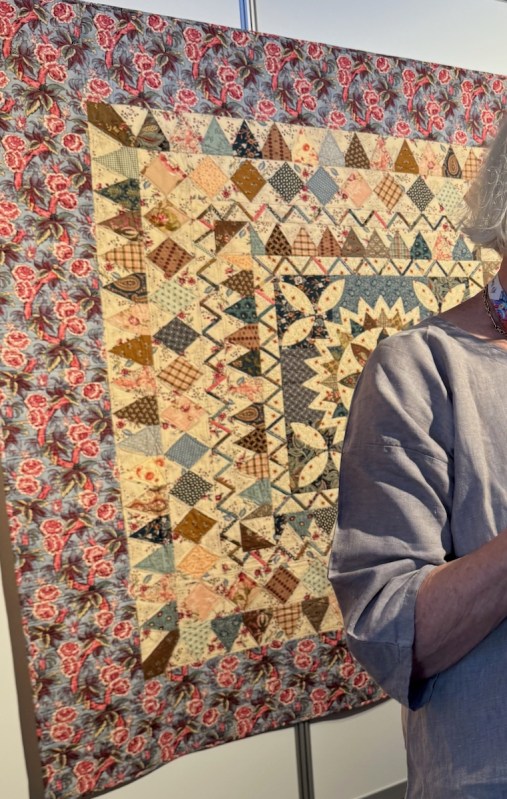
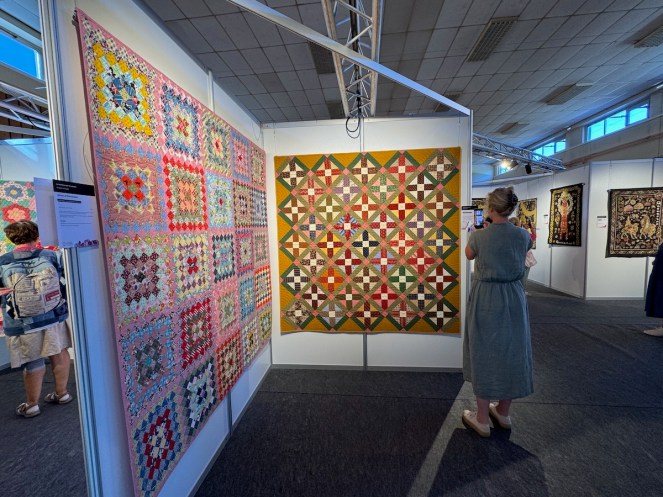
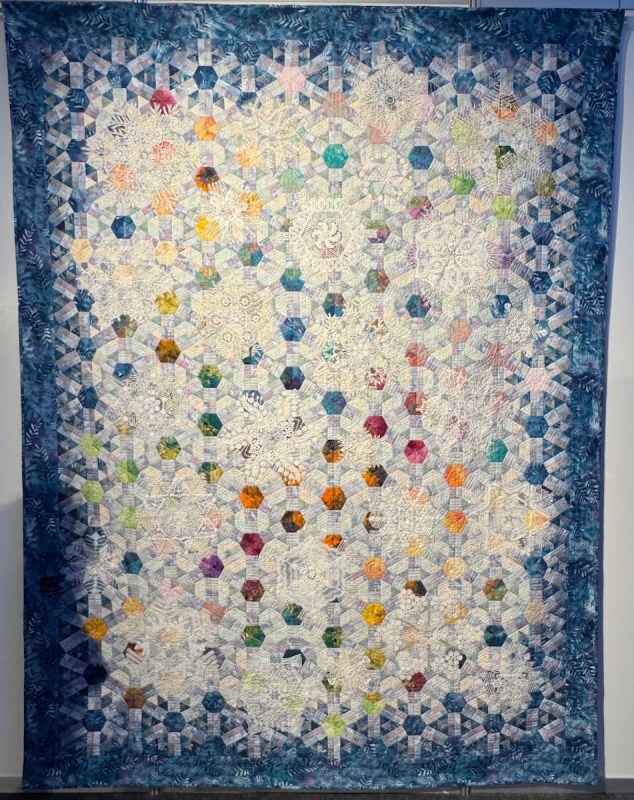
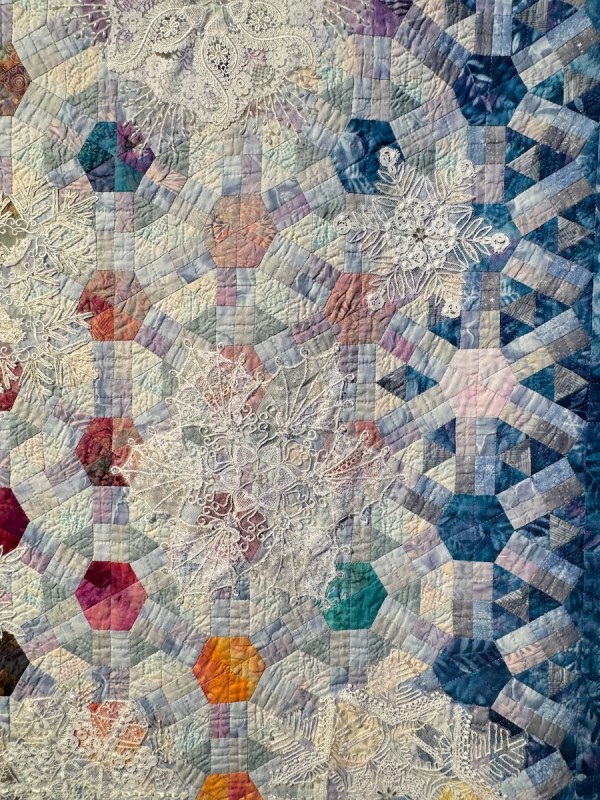
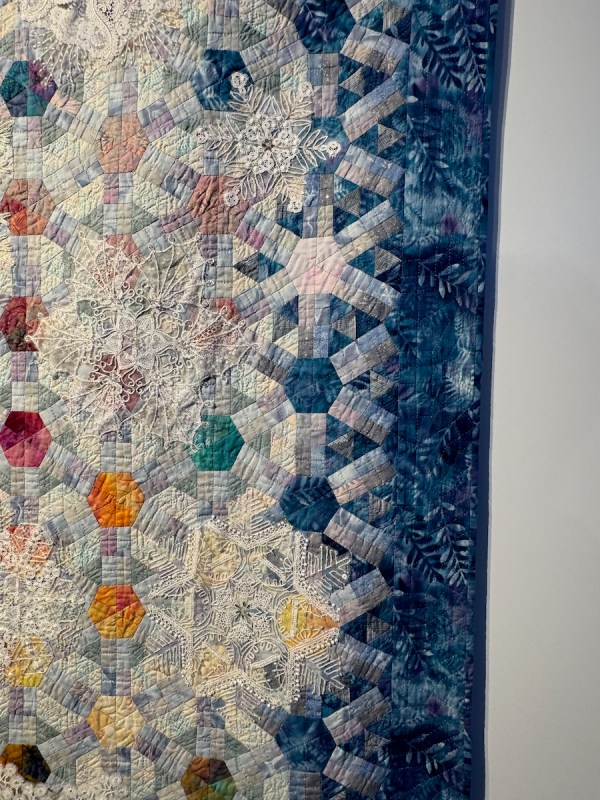
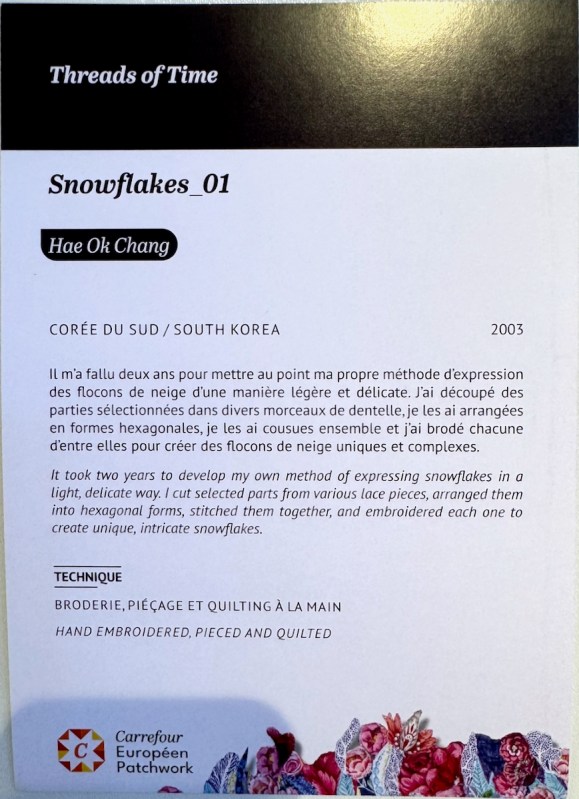
Not in the flesh, but in the work they left behind, courtesy of quilt collector Janet O’Dell, from Australia. She (as the catalogue says) “is a keen collector of antique quilts. Her collection of hexagon and medallion quilts has been built up over the past 25 years from a variety of sources. All have been chosen because they appeal to her personal taste.”

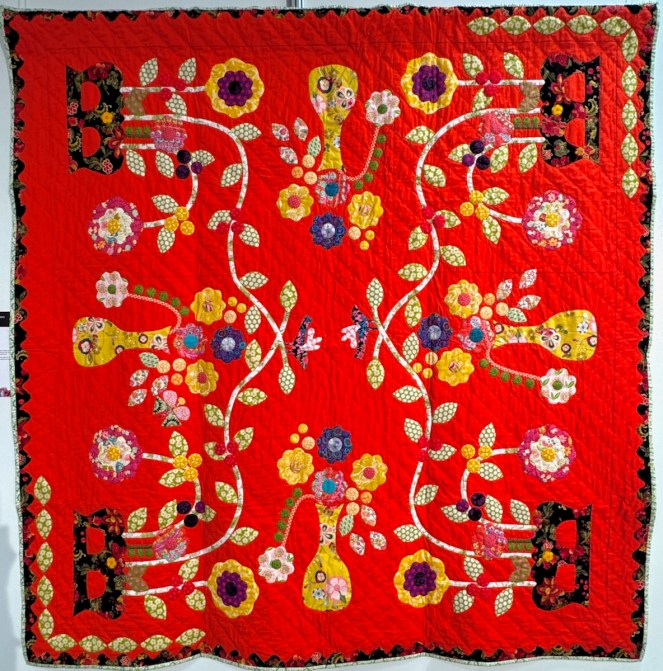
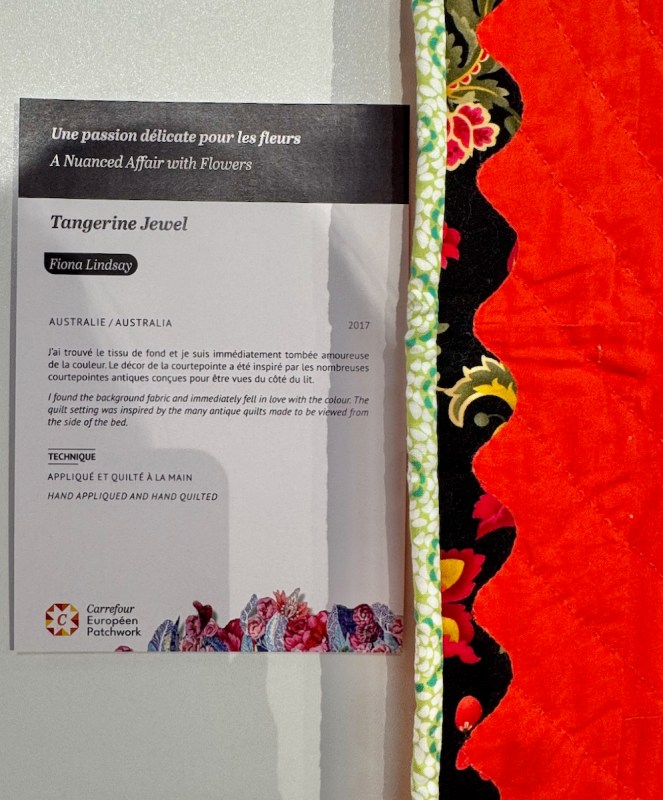
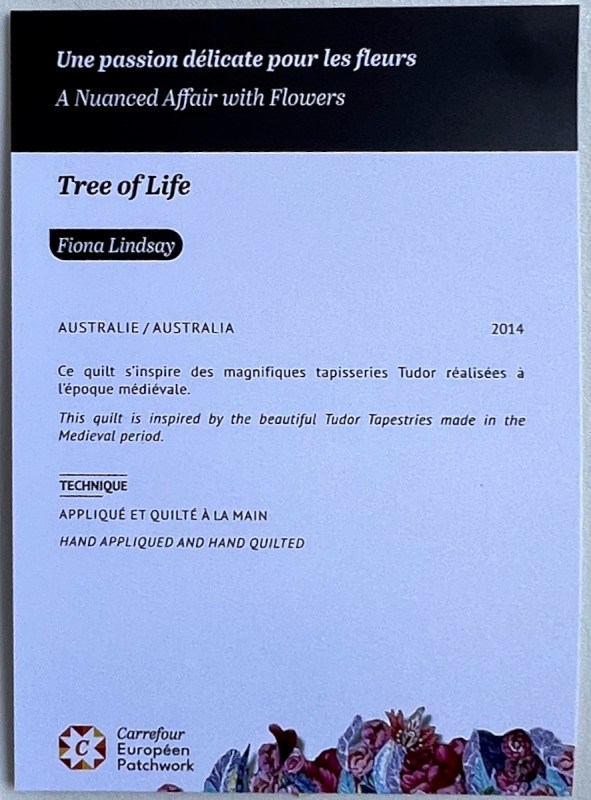
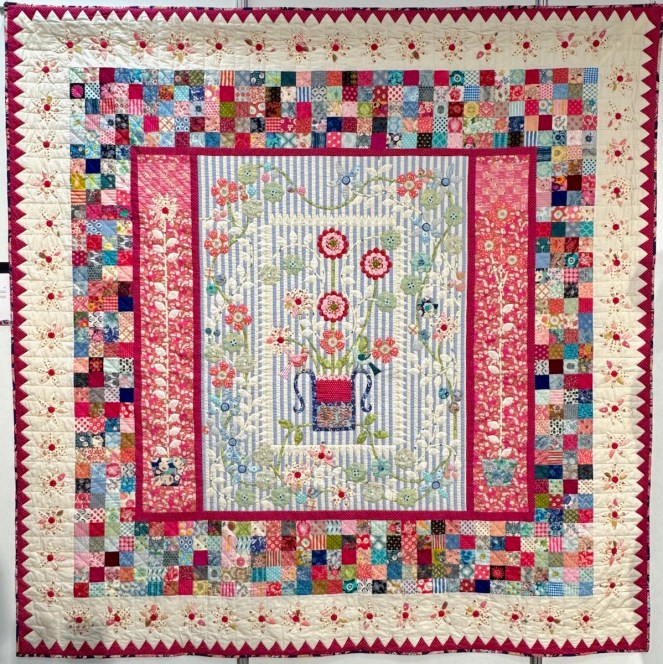
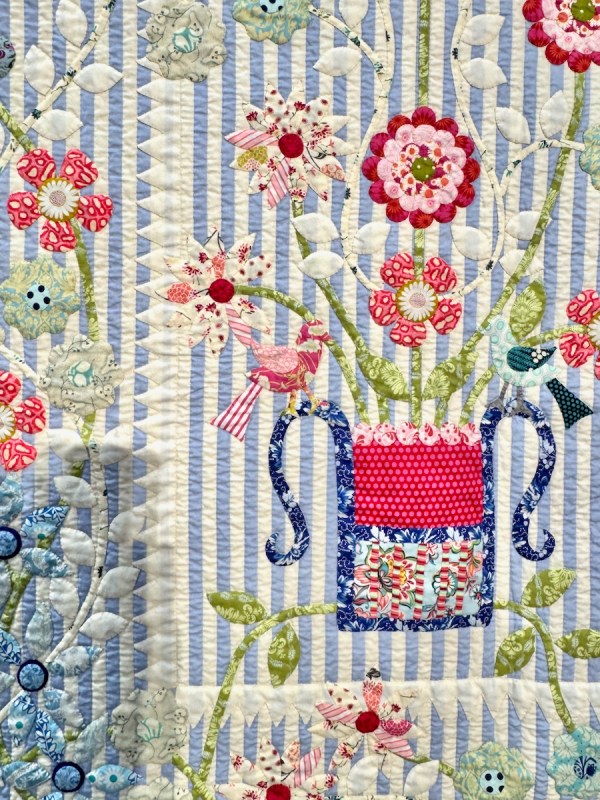
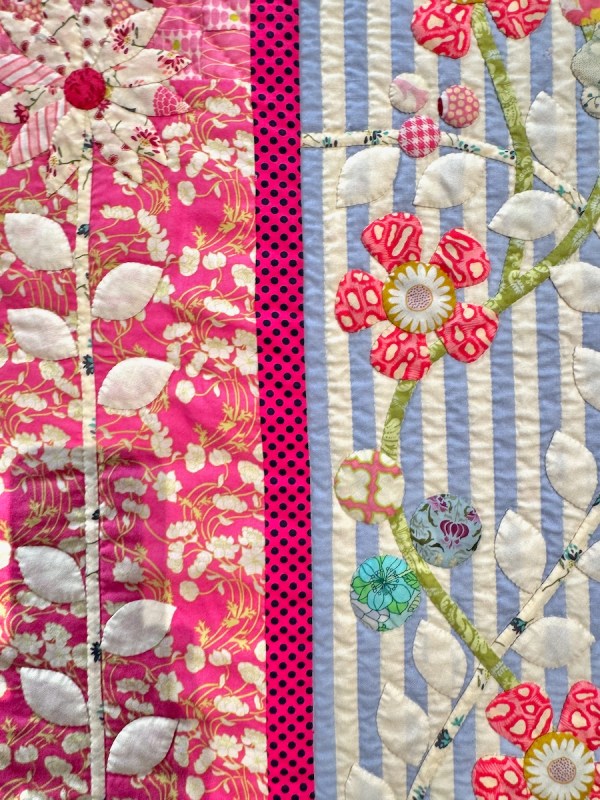
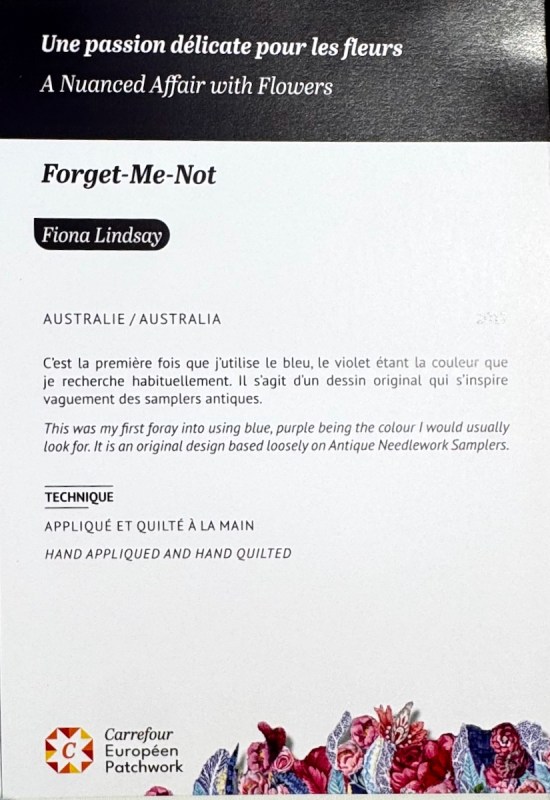
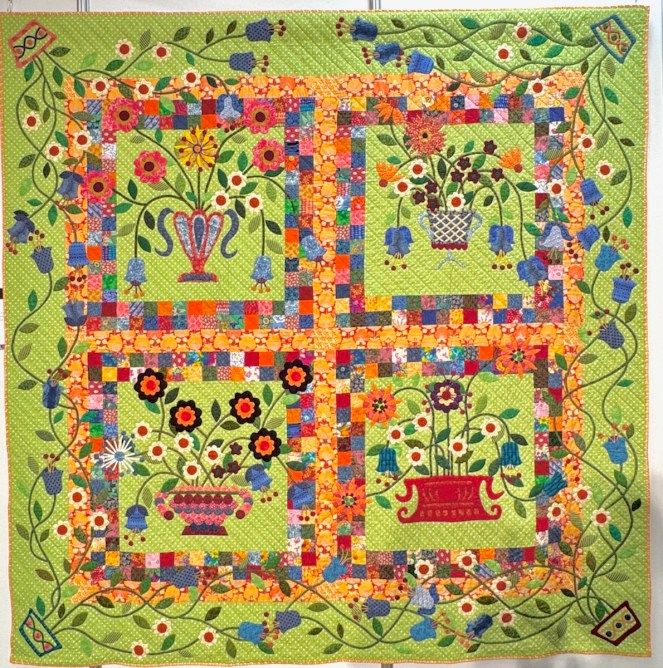
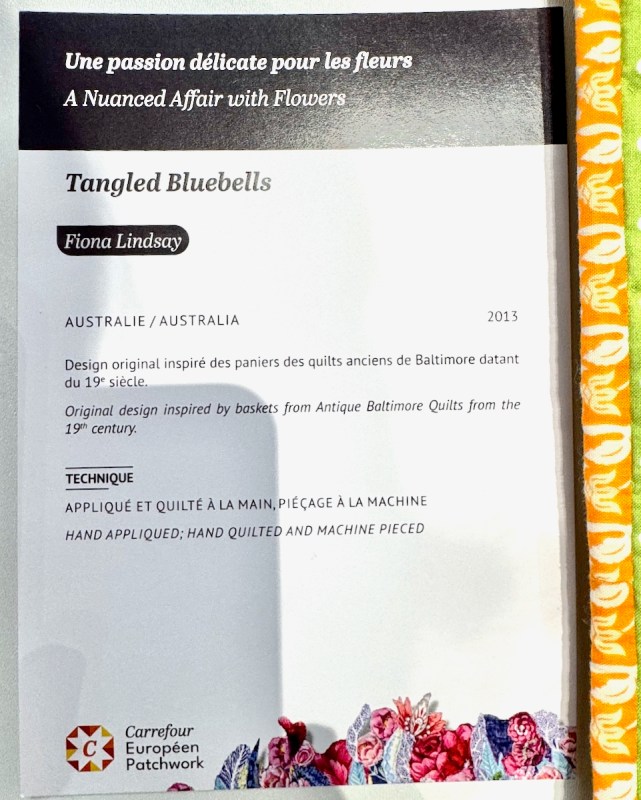
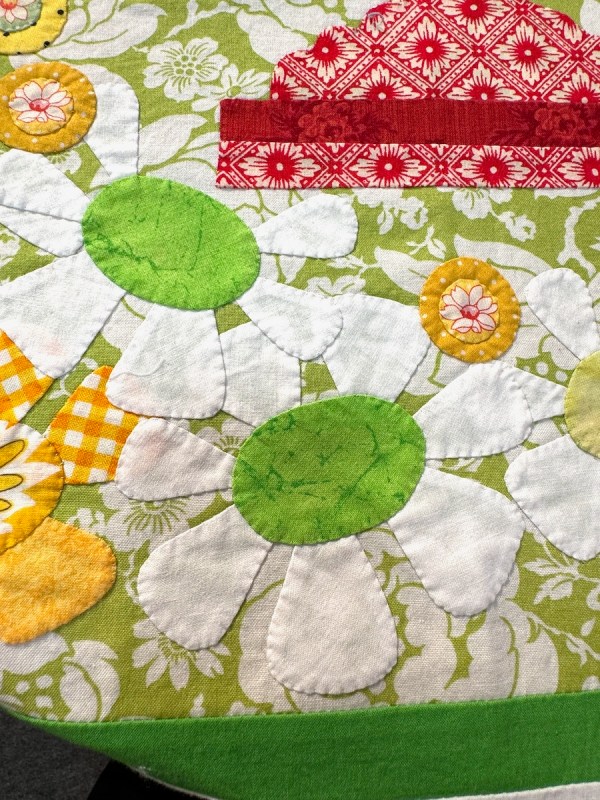
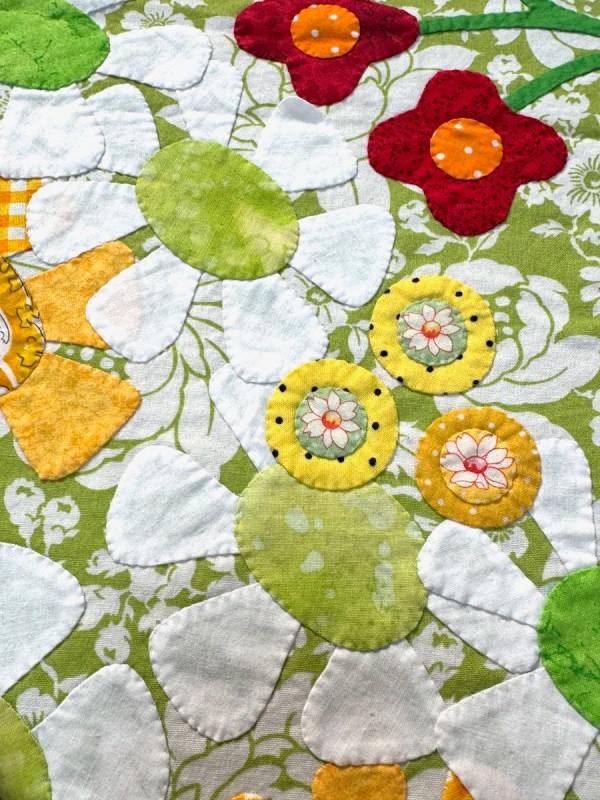
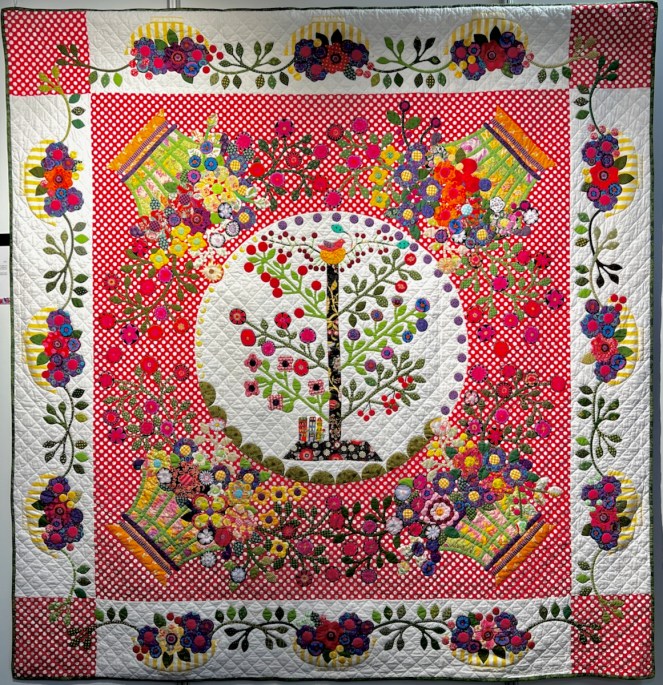
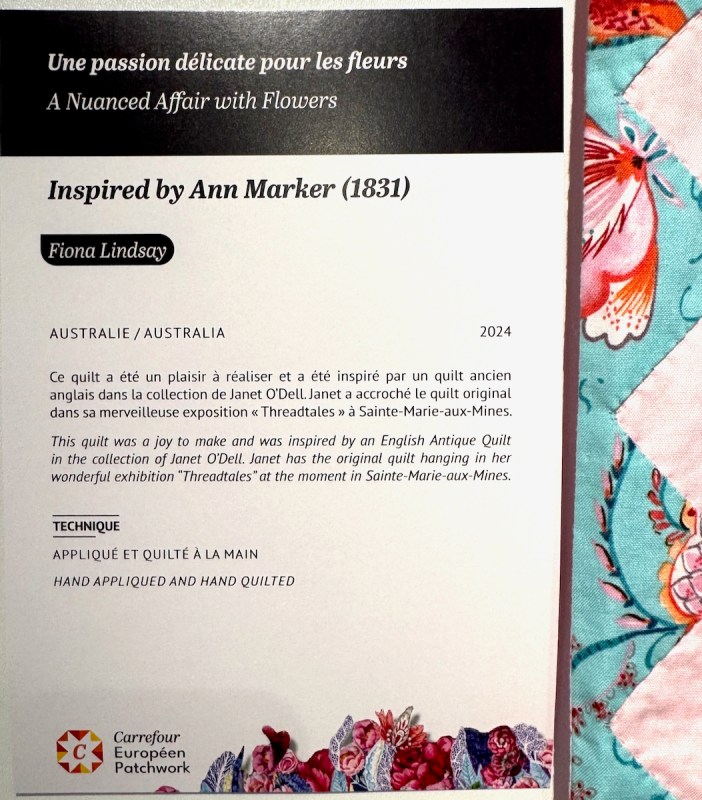
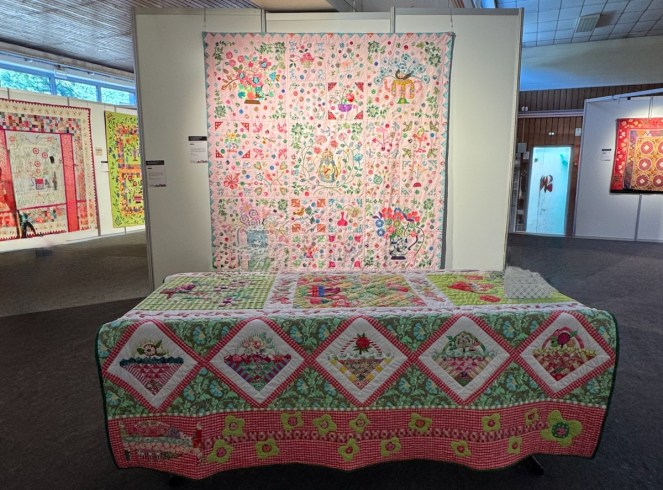
And the one quilt that I will flood here with photos and which I loved-loved-loved, I did not get a photo of the title card. Interestingly enough, it was inspiration for another quilt in Venue 12, from Fiona Lindsay (a future post). Okay, back to Janet O’Dell’s quilts.

Here’s the one I loved and I’ll intersperse my comments with the photos. Just keep remembering. These are OLD.

So, the Big Picture, to closer-up, and then to these hearts with their worn spots.

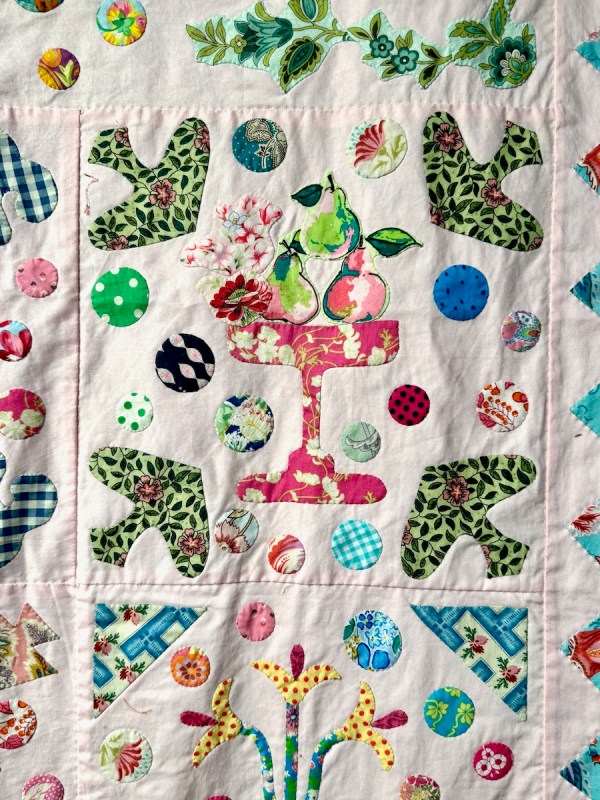
This block, with its free-form cut “corners” of minty blue-green, the broderie perse flower in the center, and those random circles was another favorite. It was interesting being in that space, with these very old quilts. People were quietly moving around them, and then taking a minute to sit and gaze. In so many other venues, we are dashing to take it all in, but here, sitting with the quilts was the point.

Okay, maybe I was just tired.

Or maybe I was fascinated with their technique on their appliqué stitch, each bit of thread taking a bite over the top of the shape, so different than how I do it now: trying to come out on the fold so you don’t see my bits of thread.

And the back — it didn’t appear to have any batting at all in the quilt, so they must have just done the stitching over two layers of fabric, then did a “quilt-as-you-go” to get those flat-fold seams on the back? I’m not usually that over-the-moon about antique quilts, but for some reason I really liked these.

I read a piece this past week about how difficult it is for us to go back in time and really know how people 100 years ago thought or felt or processed image or feelings — or, since most of these quilts were from around 1830, nearly 200 years ago. And we are so “feeling-centric” these days that we even use the term in all our phrases, such as I felt you might like this — or–I felt badly for you, and so on. Did fatigue register the same way for them, or were they always tired (thinking of their housework)? Did that feeling we all have of a lovely quilt finish, register on this quilter the same way? I’d like to think that this woman, as she put the last stitch on that now-worn red zig-zag binding and unfurled it onto the bed, had a sense of satisfaction over the many years it took to stitch.

(If any reader sees this post, and has any information about this quilt, please leave me a comment. Thanks.)

Love that border print! Click to enlarge the title, which is Wood Hey, from the country of Wales. It was made in 1833 and displayed at the National Eistedfodd of Wales in 1933. It’s hand-pieced, with appliqué and is unquilted.

In case you can’t read the title: Sailing Ship & Manor House, from Pays de Galles in Wales, c. 1833. Check out the sailing ship, below.

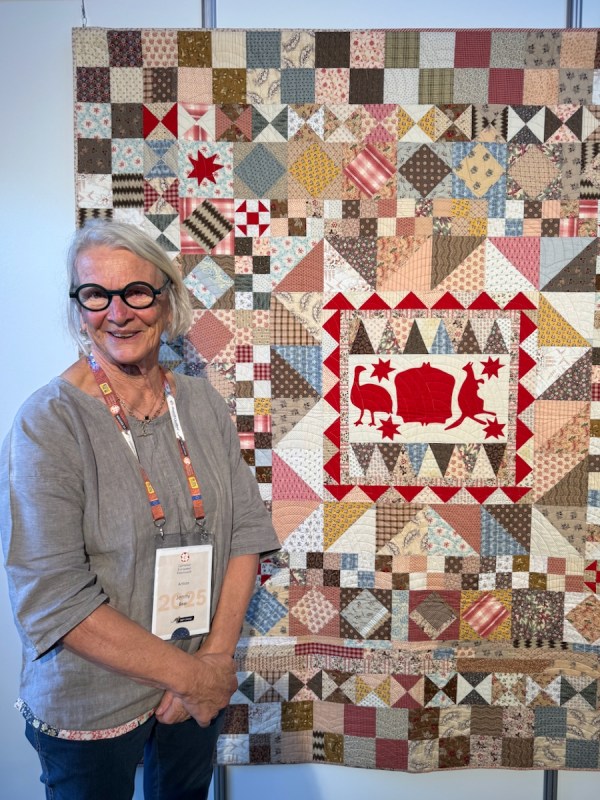
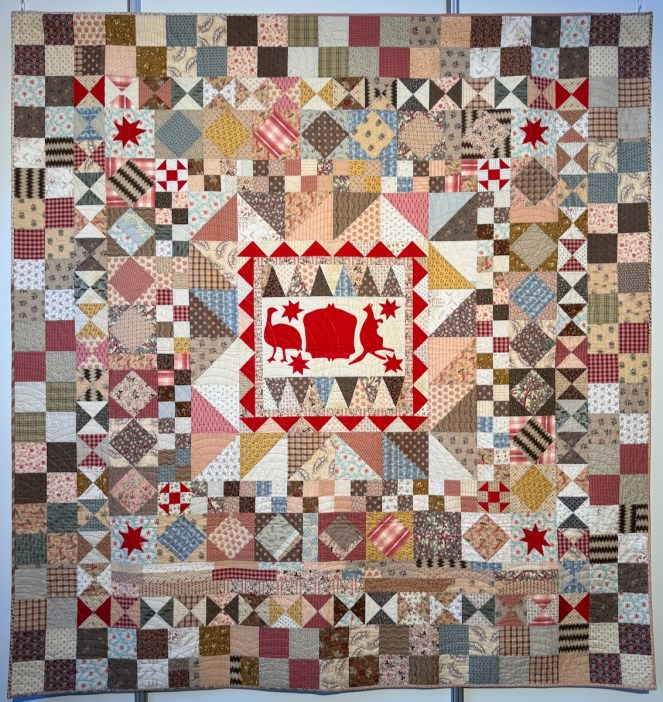
This quilt was another stunning example of applique, and I love the title: Animal, Vegetable, & Mineral. It’s appliqué and unquilted and was made c. 1842 in England.

Check out this type of appliqué! Criss-cross, a type of tailor’s stitch; I learned this in my clothing and textile classes when I was a freshman, and have rarely used it since. There is a smaller bite of fabric on one side, and then the needle travels before taking the next stitch, and you are stitching backwards, from left to right. I don’t know what the “official” name is, I just know we used it to tack down our wool jacket facings.

It appears they went over a raw edge. I’ve seen variations of this animal-vegetable-mineral quilt pop up every once in a while. Lovely to see it here. Note the pieced backing, even though it “reads” as a whole piece of fabric. Would we add “digital” to the categories? And how would we depict that…with images of our hardware?

So, a form of offset nine-patches? With a spacer?

Normal quilt show pose.

That is a lot of quilting!

Who was M.A.R? and what was the world like in 1818? (You do realize this quilt is over 200 years old, right?) Some notable events (just to get you in her head, and which maybe she never knew about?) are listed below.

Historical Events when this quilt was made:

  • Official reopening of the White House
  • Netherlands and England sign treaty against illegal slave handling
  • First steam-vessel to sail Great Lakes launched
  • 49th parallel forms as border between U.S. and Canada
  • 1st known Christmas carol (“Silent Night, Holy Night”) sung (Austria)
  • Handel’s Messiah, U.S. premieres in Boston

I love the name of this. Apparently BallyGawley is a town in Ireland, north of Dublin, so perhaps the quilt came from there?

Last one for this post.

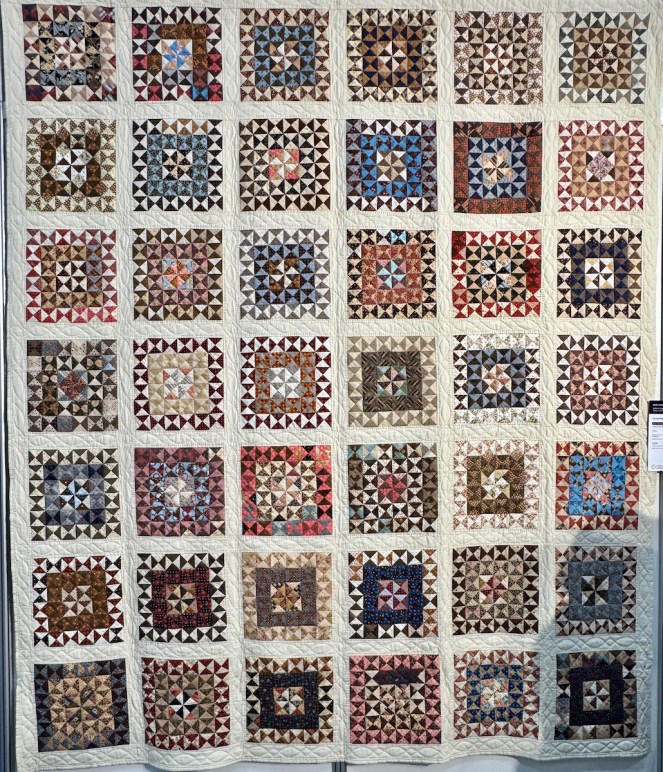
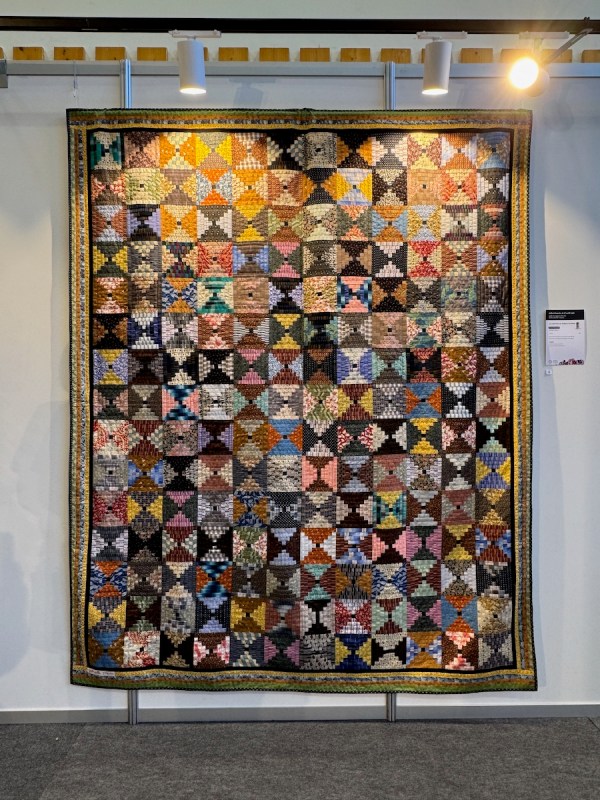
This is Broken Dishes Square, and from the United States, c. 1830. It is hand-pieced and unquilted, in the medallion style. These fabrics are so interesting, so busy and I love the bands of color in between each section of the triangles. Some woman spent hours and hours piecing this quilt.

I’m really grateful that the organizers of Carrefour Patchwork Show arranged with Janet O’Dell to have these brought to the show. As always, this show has something interesting around every corner!
Like this replica of the Eiffel Tower, stuck in some sort of a construction yard. We saw it last year in two pieces, so we’re happy it was put together this year.

More Carrefour Patchwork Show posts to come!
Carrefour Quilt Show · Quilt Shows

Carrefour Quilt Show 2025: Intro and Part I

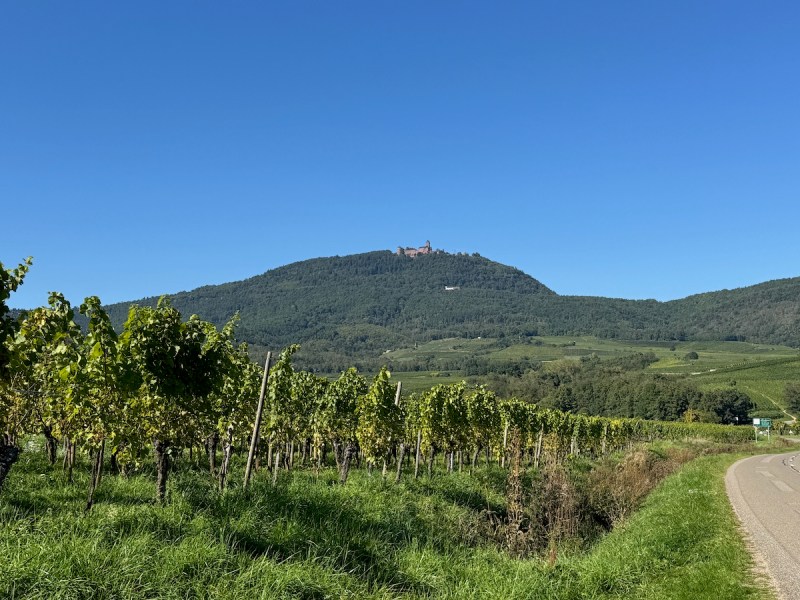
I’ve now been to the Carrefour Quilt Show in the Alsace area of France three times, and this is start of my third write-up of that amazing experience. The Carrefour Show is like none other: set in four small towns in France (some with castles, like the above photo), in the Val D’Argent, or Silver Valley, where silver was once mined.

The show draws from all over Europe and the quilts are as varied as the quilters in all these different nations. I am often surprised by what I see. I am never disappointed.

This post covers:

  • Espace Commercial
  • Venue 1: Theater with its traditional antique quilts
  • Venue 2: Carrefour Contest, one of three exhibits in that space

I have a main page where I link all the posts, so you can see the ones from before, as well, and see why I have loved going back over the years. Of course, my husband Dave is hugely enthusiastic, too, and he took many of these photos. This year we were able to spend the better part of two days there, and took a zillion photos. That means that when I post — which I will do sporadically over the next while — there will be lots of beautiful quilts to see.

We lodged this time in Colmar, a lovely town that feels medieval, but has all the comforts (like pumpkins with words).

As always, in many places there are reminders of the Great War (WWII) like a tank in the park which we passed by as we walked to get our rental car. We picked that up early on Thursday morning, September 18th, the day the quilt show started, and drove past the castle in the first photo into the Val D’Argent, stopping for some breakfast croissants on the way (it *is* France, after all!).

After being caught in the traffic, we parked near this very old building (1912), picked up our tickets and walked up into the town, seeing store windows all decorated up with quilts (I know it’s hard to see):

Espace Commercial (Shopping and Vendors)

I knew what I wanted to do first: Shopping Area.

Vendor tents are set up along the pathway to the souvenir stand:

Stickers, pen, exhibit book…they don’t have a bag this year, so in we go to the Espace Commercial.

Click to enlarge any photo.

1-My favorite bag place: ABCDaires. I’ve already made the little orange bag in the far corner (see below).

2- Christine, from Chifonie Studio has really lovely jewelry, made from art clay. She also has lots of buttons, and fun decorative pins.

3- Torneria Germans Castels sells wooden things from Germany. This booth had so many cute wooden buttons and fixings.

4- Le Atelier D’Eoie had so many cute things in their booth (they were so friendly, I took two photos of them). I bought a kit for a stuffed animal and a small quilt.

The other photos are crowd shots; I only took photos where I had permission. Here’s the thing: could I have found some of these things in the US? Possible. But I hadn’t ever seen them before and loved how European everything was (duh) and it — as Marie Kondo would say — sparked joy. (And I just love those orange pouches!)

I also loved the booksellers, and I bought a book in French, because why not? Last year I made a purse from a Japanese book, translated into French and it came out just fine. If you click on that link, you can also see a pouch made from the kits from ABCDaires.

On the side of the Espace Commercial, they had these two wooden cutouts: the one of the left celebrating thirty years of the Carrefour Patchwork Show, and the one on the right, a figure that denotes the Alsace region, and is seen everywhere. Okay. To the quilts!
Venue 1: Theater in Sainte Marie-aux-Mines

In case I didn’t mention it, the main town is Sainte Marie-aux-Mines, and that is where we will start. This year, it was all on the bottom floor and the display was traditional, Amish quilts.

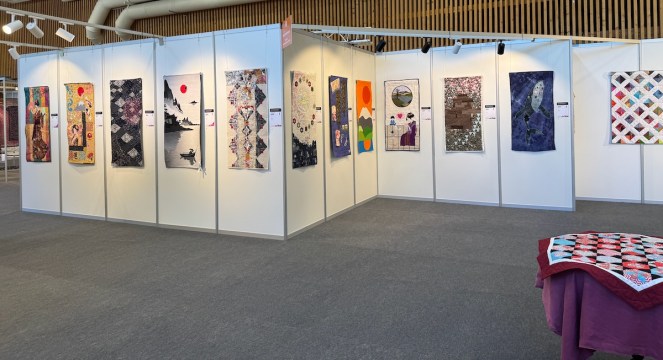
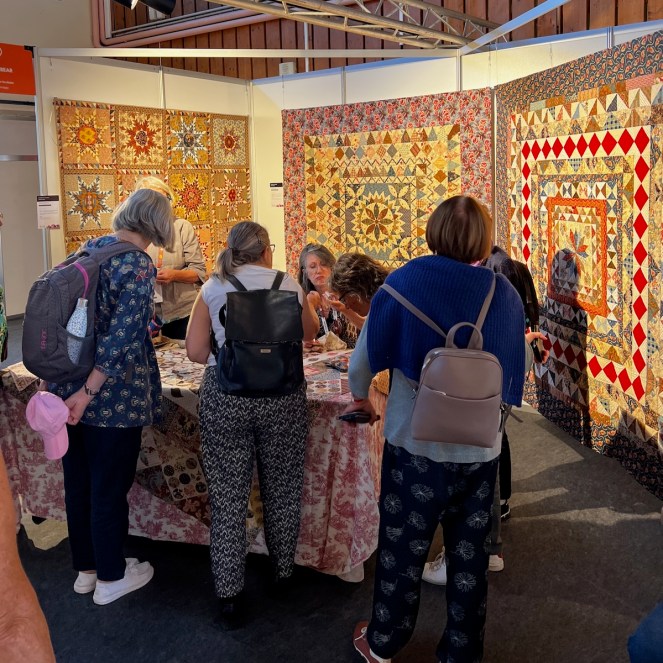
The Carrefour organizers bring in scaffolding and partitions to hang the quilts, as it really is set in an old theater. Below is a series of photographs; click to enlarge. I did try to get title cards for every quilt.

Click to enlarge any photo.

Now a slide show. Click on arrows to advance; unfortunately, you cannot click to enlarge the slideshow photos.

After we finished with the downstairs, we went up…we love this staircase!

Peeking through the glass in the locked doors of the balcony, my husband took this photo of the exhibit below.

Venue 2: Osmont Pavilion

The section of the Pavillion where the quilts are hung is one large space, and the quilts “divide” it up. The contest theme this year was Avant Garde, and here is a slide show, with title cards. (Click on arrows to advance; unfortunately, you cannot click to enlarge the slideshow photos.)

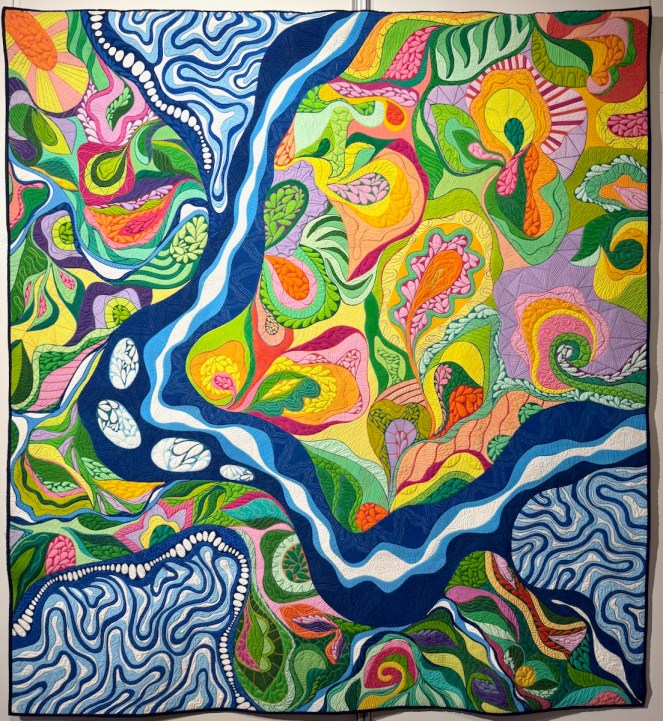
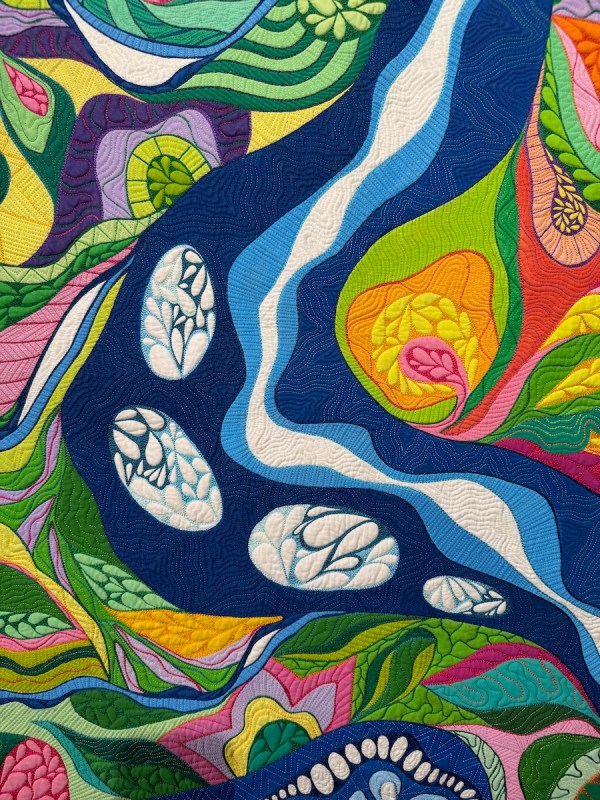
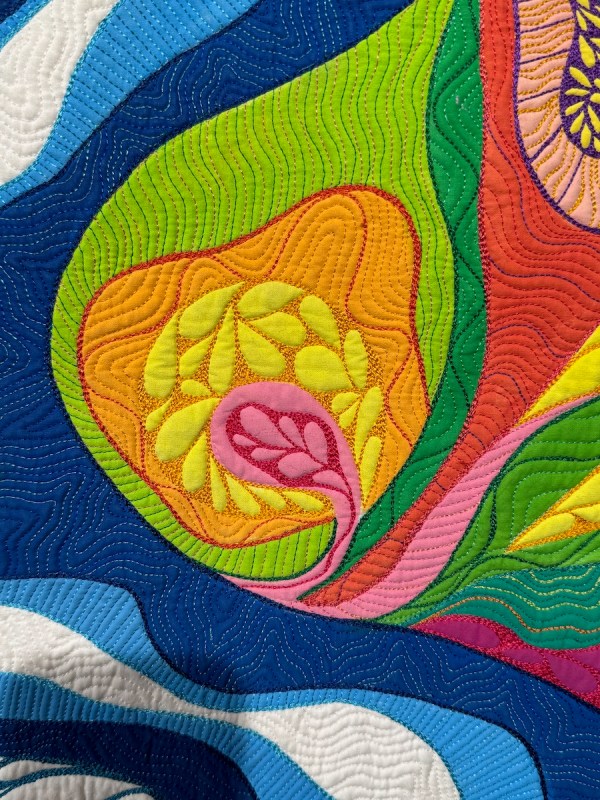
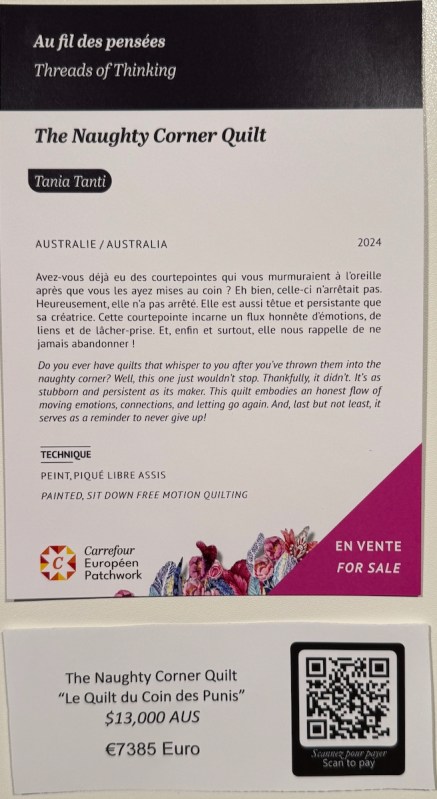
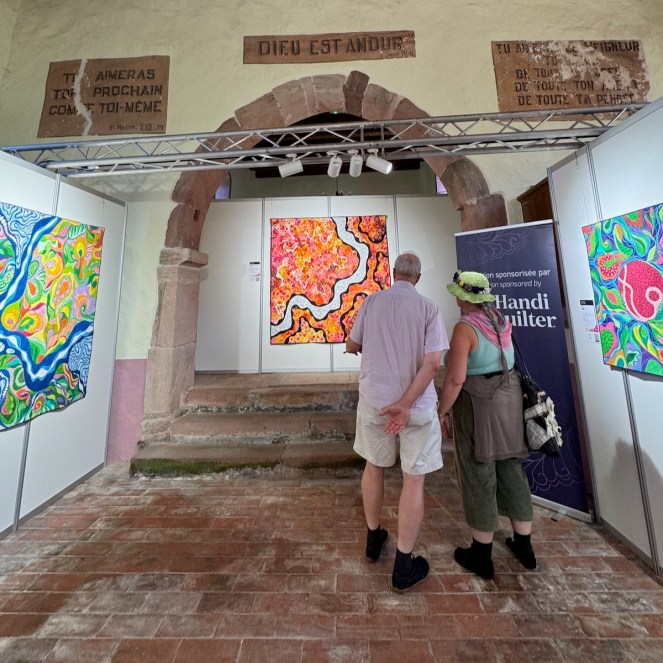
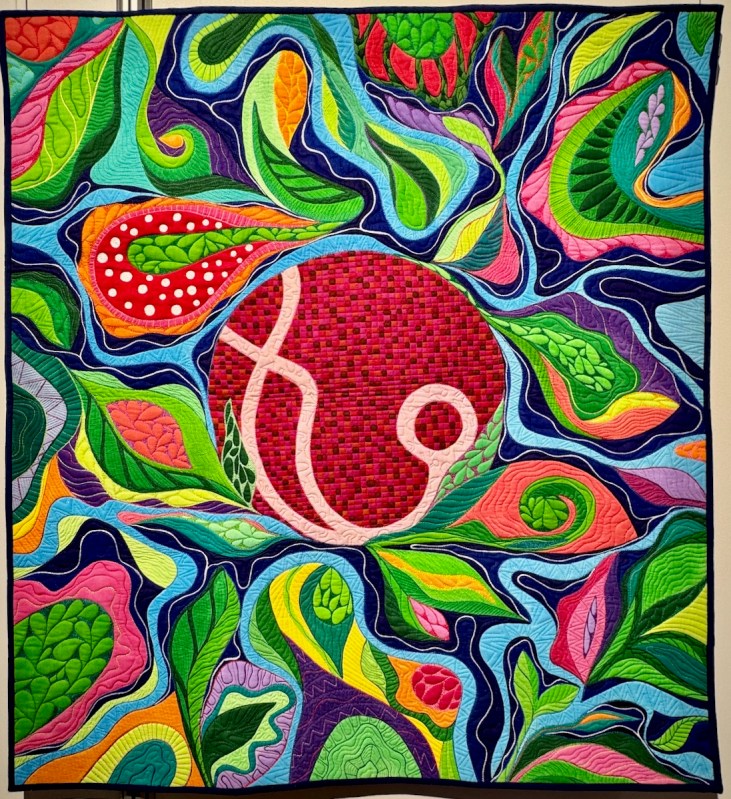
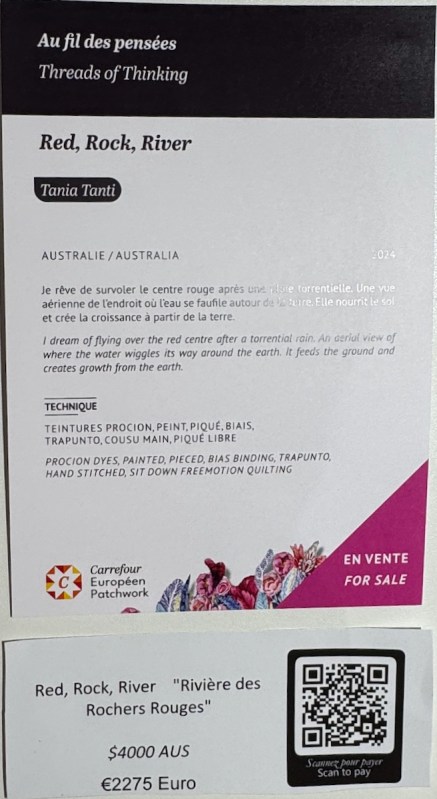
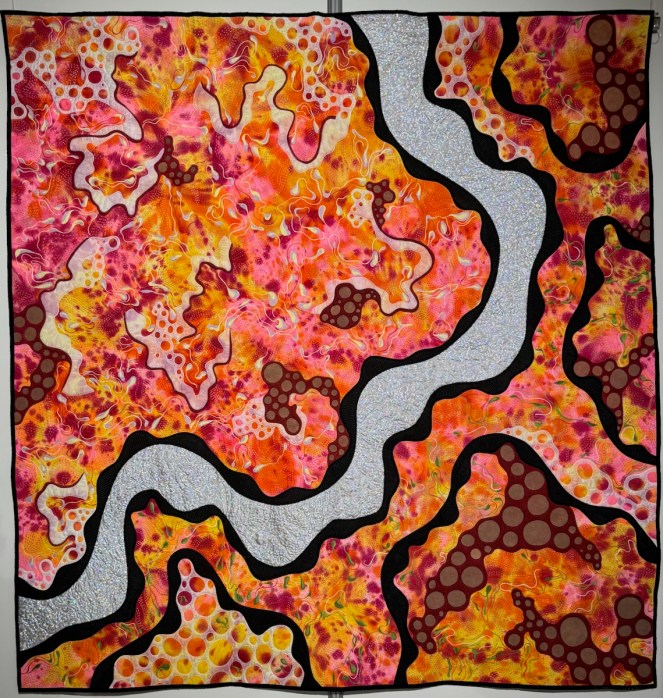
We’ll see more of Tania Tanti’s work in another post, as she was a featured artist, but I wanted to say that nothing on this quilt is pieced. She starts with a white piece of cloth and paints her shapes, then quilts them. Details below; click to enlarge.

I found this one to be intriguing, and moving, as it is a tribute to her husband.

I showed you the cut-out close-up first, then the total quilt.

(I did mean to put all these in the slideshow: technical difficulties!)

The quilting on this was so close together, and it sculpted the cloth, moving the eye over the surface.

A tumble of houses, a view to the landscape.

Olga Stang’s work, Monet’s Pond, intrigued me, because of the construction of all those little two-sided squares.

Then they look to have been laid on another cloth, and folded to mimic petals, or vegetation on the Monet’s lily pond. Tiny beads are placed at the intersections.

She believes we’ll all be doing more recycling in the future, and if it turns out like this, it will be a good goal.

As always, I owe a lot of these photographs, as well as the ability to take this trip, to my husband Dave; I’m most grateful to him. There are two more exhibits in this venue, but that will be on the next posting about Carrefour. I’m just now starting to process, to revisit the photographs, to think about my visit. Watch for the next one!

Quilt Shows · Quilts

Quilt Show 2025 Springville Art Museum

I like making these little “postcards” with names from the map. The Mesa is that long dark stripe of rock on the lower right side of the photo, moving away from the road. Yes, we took another roadtrip, as mentioned in the last post, where I talked about making dresses to wear to the wedding.

But this post isn’t about the wedding, although it was lovely. It’s about the Springville Art Museum’s Quilt Show for 2025.

I met my friend Lisa at the show, and at my request, she took me first to her award-winning quilt. She pieced the top and quilted it — a stunning beauty of a New York Beauty quilt. I had been a judge at an earlier show, so I was aware of how hard it was to get a ribbon — and she did get one! I’ll post some of the quilts from the quilt show, but first I want to start with a posthumous display of Carol Ford’s quilts, a special exhibit at the museum.

Summer Sampler, by Carol Ford Quilted by Virginia Gore

The Spirit of Alaska (2013)
Made by Carol Ford

Quilted by Virginia Gore

Carol writes: “I spent a lot of time in Alaska, and I love batik fabrics. Everything about this quilt reminds of the color and beauty that I have seen there. This was one of the most difficult quilts that I have made…I think that the quilting truly brought this quilt to life.”

Ice Bear (2017), by Carol Ford. Quilted by Virginia Gore
She writes that she and her daughter went to “Manitoba, Canada to photograph polar bears. We stayed at Churchill Wild Lodge, which is one of the National Georgraphic’s most remote lodges in the world.”

Carol Ford’s My Garden Patch (2014); quilted by Virginia Gore

We turned a corner from the huge room of quilts, and launched into the main quilt show. I loved the dazzle dazzle below of Danielle Adams’ Land That I Love (she quilted it herself):

Mariam Gunderson both made and quilted her Various Blocks in Shades of Blue. That’s quite the border: all the quilt has beautiful stitching.

Christine Ricks made Tessella or Big Tess (2025), and it was quilted by Tamera Ellis. This one really stood out among the more traditional quilts in its gallery.

It’s a Beautiful Day in the Neighborhood (2023) was made by Tracie Buys, and quilted by Connie Atkisson. She combined two patterns — houses and children holding hands — to make this quilt. She writes “A neighborhood is a group of many different individuals that are from different cultures and backgrounds, and we should celebrate those differences.”

I wondered if I’d find a temperature quilt. Loriann Fish’s My 50th Year (2025) is a celebration of a half-century of living. Began the first of June 2024, she ended it in May of 2025, with a color key in the lower right corner of the quilt.

A map of the museum layout.

So many beautiful quilts to show, but in this gallery, the Hafen-Dallin gallery, I chose this one:

Squircle Square, by Machelle Preston. Quilted by Konda Luckau.

While I just loved the design of these many squircles, it was the movement of color and value that really sang. Machelle Preston writes “My friend Karlene found a cute rainbow quilt on a modern blog. We both decided to make the quilt. I did my “squircle” squares hand-appliquéd, while she did her squares machine-appliequéd.”

Here’s her friend’s quilt:

Squircle (2024), by Karlene Riggs.
Quilted by Konda Luckau.

Karlene writes:
“I got the idea for this from a QuiltCon quilt I saw online, but which had no pattern. All the “squircle” fabrics were from my dot collection. The backgrounds were mostly solids. I decided to use all the stitches I could from my sewing machines!”

My La Passacaglia (2023) by Jeri Holley. Quilted by Mindy Powell, who did a stunning job on the outside borders.

I knew you’d want to see a close-up of this!

“This quilt was the result of an online class with Brigette Heitland. After putting it all together, I found it looked like a train […with] all the bright colors. This was made by Jeanette Ivie, and titled Modern Train (2024). Quilting by Sharon Rawlings.

Autumn Baskets (2025) by Myrt Gehring; quilted by Carole Liffereth
This has a combination of wool and cotton in the center section (bordered by the blue).

Esther Avila’s My Color Theory (2025). She writes in her title card that “I had lots of solid fabric scraps and sewed them all in strips to make squares, then cut diagonally twice…I love the little stripe of black and white. It gives the right touch.”

Thought you’d like this interplay of modern, traditional (Bee Happy, a Lori Holt design) and my friend Lisa’s masterpiece. That’s combination of quilts is one reason why I like this show. Our show at home tends to group all things alike, as in All the Landscapes, All the Animals, All the Moderns and so on. I prefer the novelty of discovery, which you can only have if there is a change-up.

We went upstairs, where they were having a retrospective of their decades of Spring Salons. All the art was amazing. Click through on this link to read about it. They have a listing of all the art, if you have some time.

The Quilters (2023)
Kathleen Bateman Peterson

This was upstairs, and of course I wanted to bring it home with me.

It reminded me of another painting I’d seen the day before, in the Church History Museum. Titled Sisters, it is by Beth Jepson. In our church we call each other “Sister” and “Brother” (as in Sister Eastmond.) So this painting is about all of us women, working together.

The artist writes: “I love the diversity of sisters, old and young, beginner and expert, working together to create a piece of art that is functional and often gifted in charity.”

I put a few pieces of art up on my Instagram, if you are interested, but you can also head to the website for the Church History Museum to see the rest in this exhibit.

Finally: the Wedding Wrap-up

All these were catered by my daughter, Barbara. Click on the little arrows at the side to advance the show.

  • 1–Desserts table, from the side
  • 2–Crew in the kitchen finishing the last minute prep
  • 2–Macaron tower
  • 3–Cake pops (bride’s colors were sage, tan, black)
  • 4–Key Lime Pie cups
  • 5–Our children and I (I don’t know where my husband was at that point); Father of the Bride is on the right.
  • 6–Father-Daughter dance, which made me weep
  • 7–The happy couple, listening to the speeches

Okay, my dress. Well, about 3 days before the wedding and after I’d sewn three wearable toiles and was about ready to start on a fourth, I got the news that grandparents were supposed to be in solids. Dark solids. Sigh.

So I wore a black skirt and a turquoise jacket, nice and proper and cooperative.

But I changed into the dress below for the reception.

The fabric is Shape Sorter in Blue, by Eloise Renouf of Cloud 9 Fabrics. I purchased the wide back which has a silky feeling to it. This was taken after a couple days of rest, standing in my blue kitchen. A happy backdrop.

May you celebrate your quilting talents, great art, weddings for those you love, dresses that you don’t wear, and arriving home safely after a long ride home–

Sacred Mending, by Paige Crosland Anderson
Dimensions: 48 x 64 x 12 In.
Medium: Acrylic and oil

Title card: Painted quilt patterns with names like “All Hands Around,” “Worlds Without End,” “Straight Furrough,” “Jacob’s Ladder,” and “Winding Ways” fit within this altarpiece. The patterns represent the ways individuals reach—for help, for purpose, and for repair.

Quilt Shows · Quilts

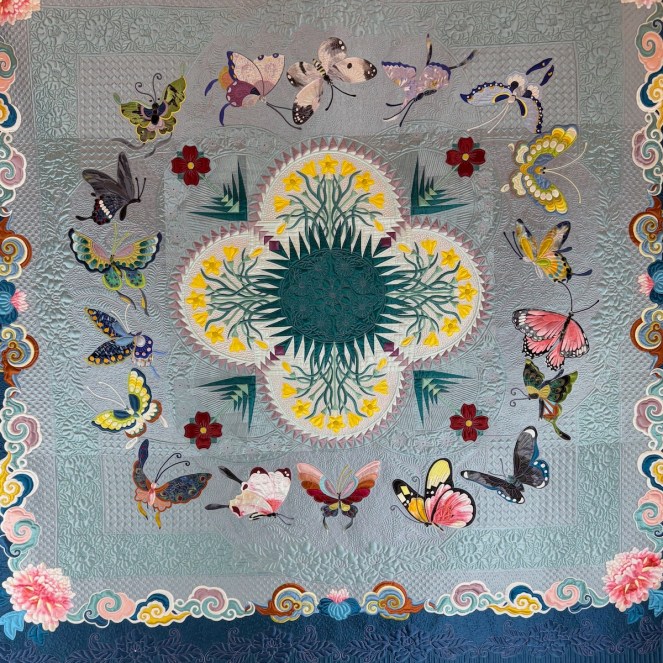
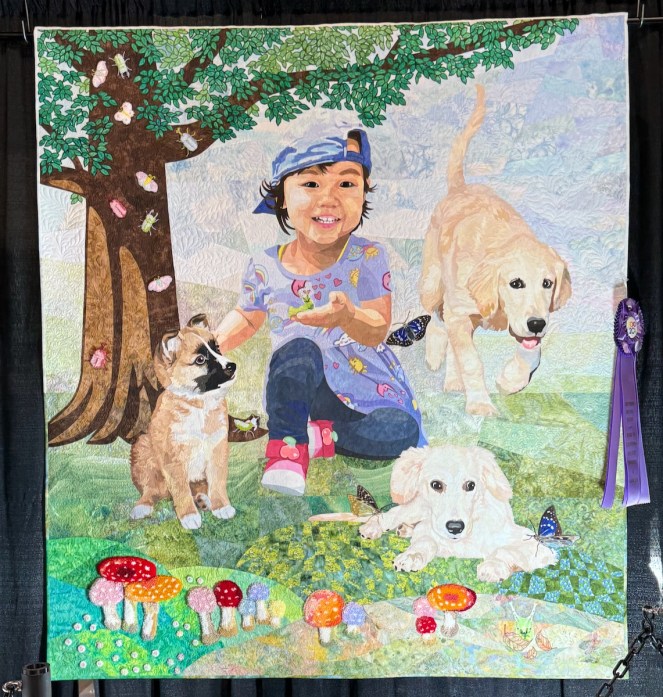
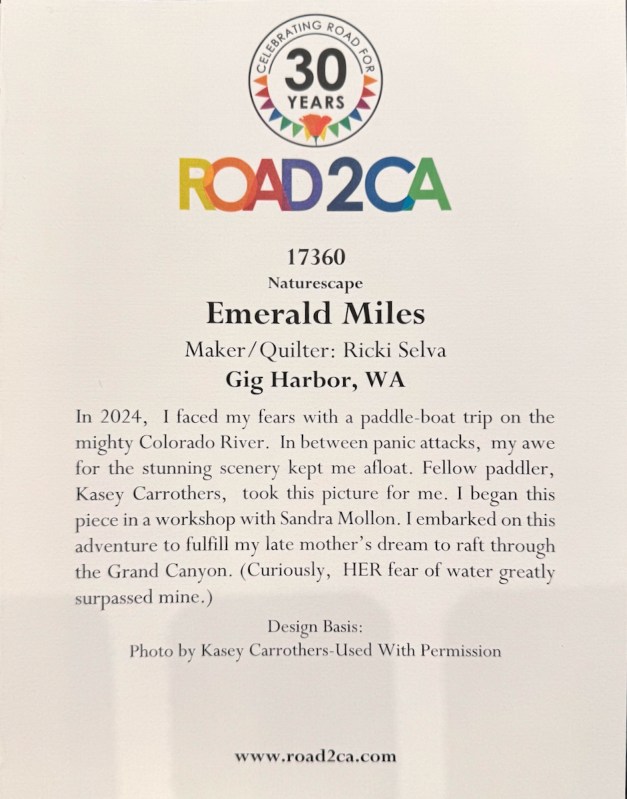
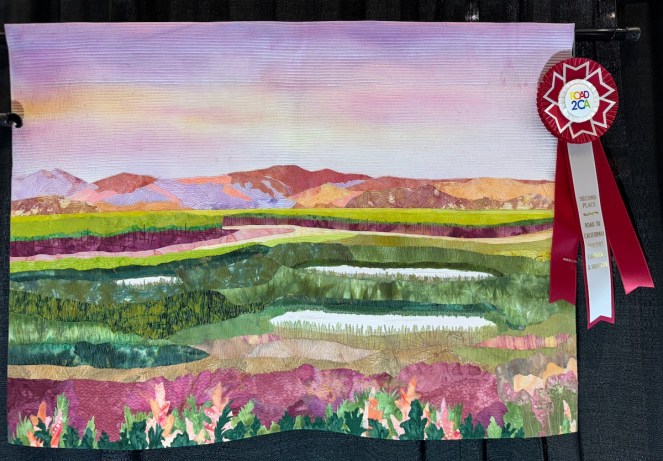
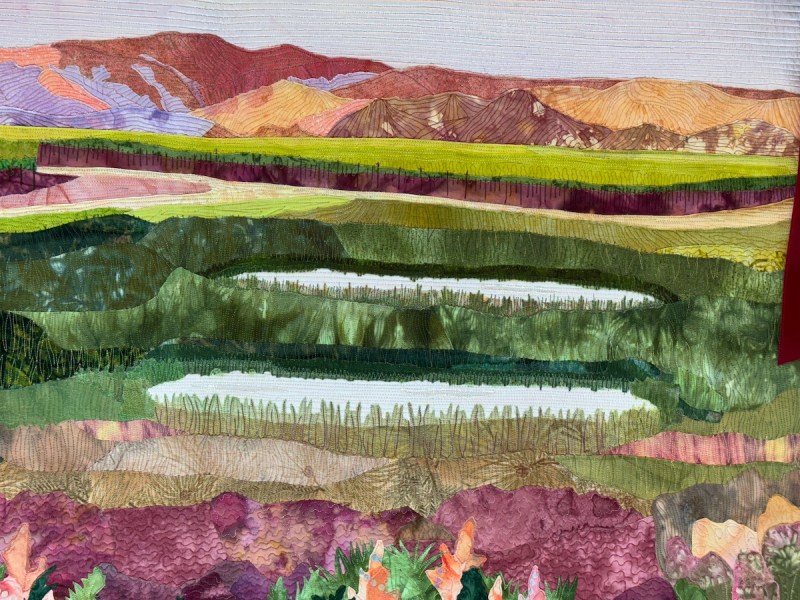
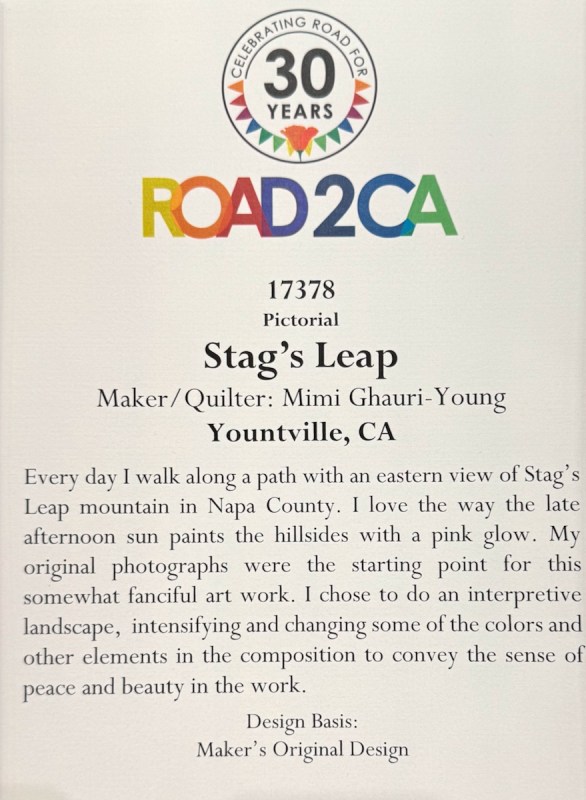
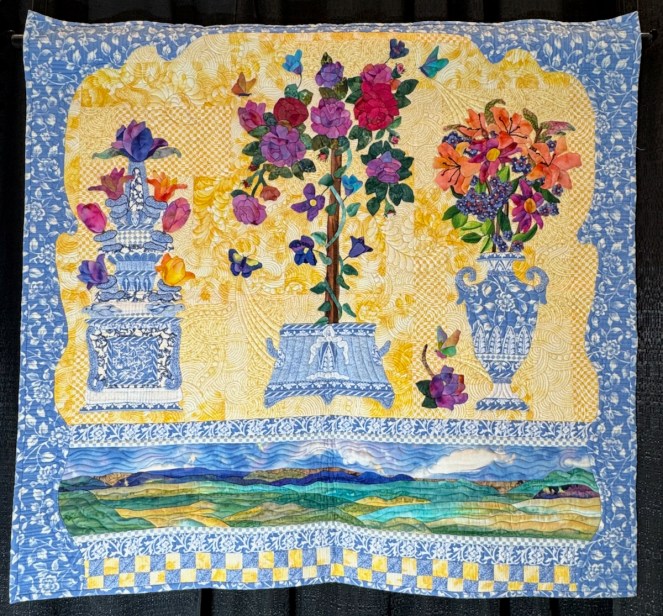
Road to California 2025

This is in two parts: the top is the bits and pieces.
The bottom are the quilts. Yes, they are all in one post, so get your popcorn and let’s get scrolling.

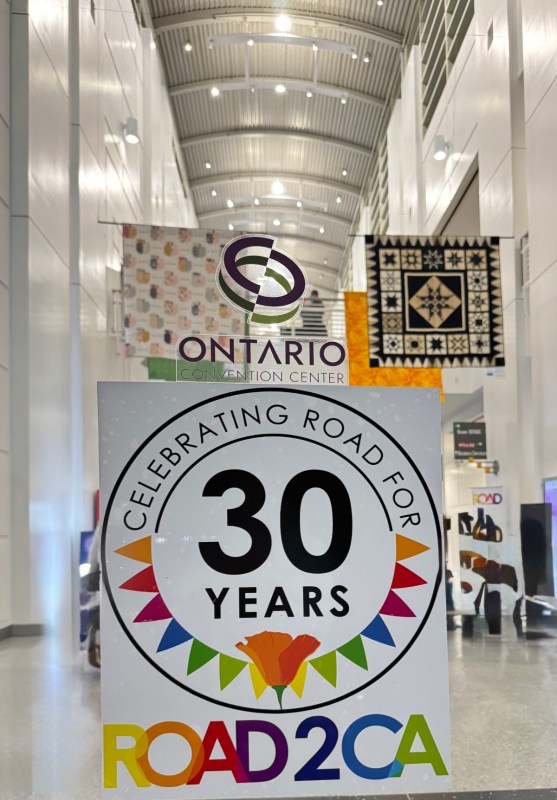
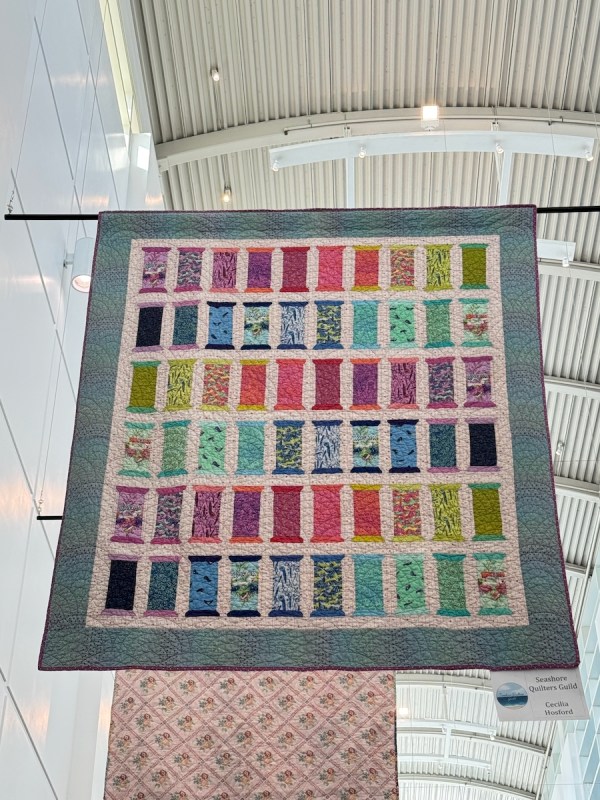
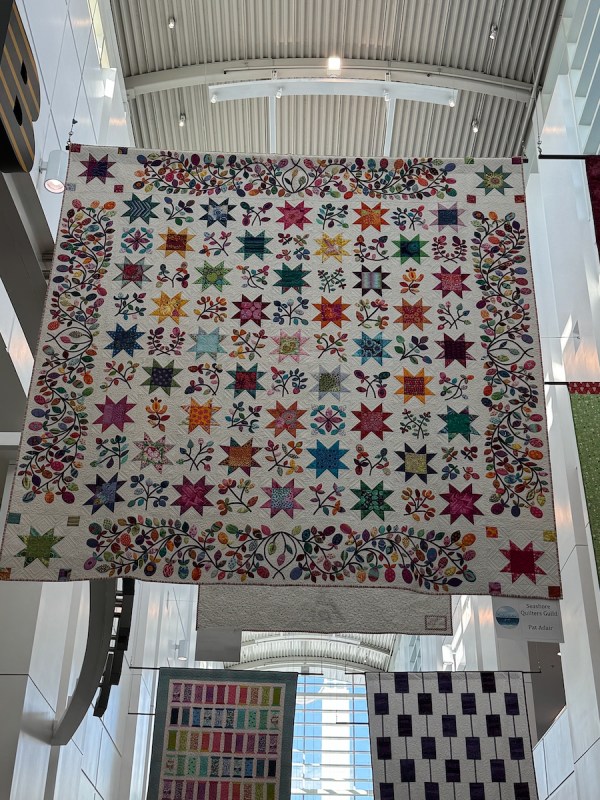
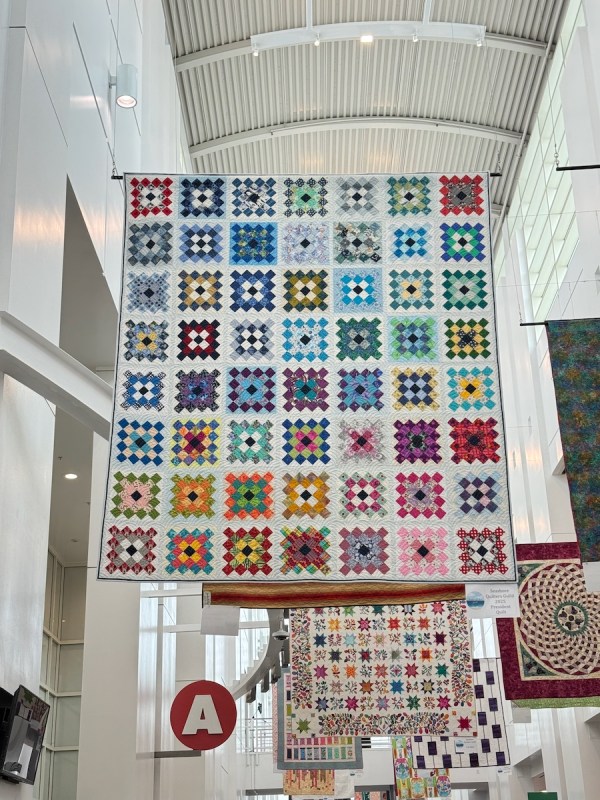
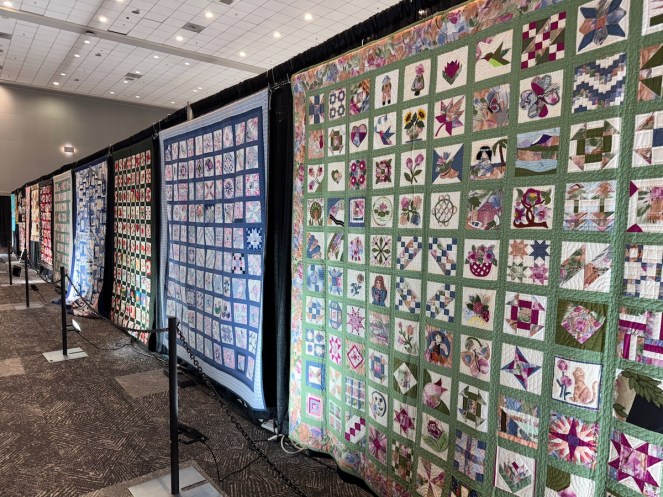
Road to California, for me, always begins with this hallway lined with hanging quilts. So many different styles and colors, all from one Guild that is chosen at random from those who enter their names. This was at about 8:30 am. on Tuesday morning, January 21st, and I was there to take the Blackwork Embroidery class from Kathie Kerler.

Her sample is on the lower left. Mine is on the lower right. The room temperature went from freezing-your-hands-stiff to overheated-hot-flash territory. (They did caution us to dress in layers.) My seat mate, Chris, had open her little bag (upper center). I said to her, “That’s my pattern!” Yep, it was my Mini Double-Pocket bag, and we had a good chat–fun to see one out in the wild. I also admired the hoop stands in our class — it seems it would be much easier with one of those.

Souvenirs! I always buy some jewelry from Merry of the Button Box. Contact me if you want her email address. I picked up a few bits of fabric and that freebie yellow stitch-saying bag, posed here once I got home again.

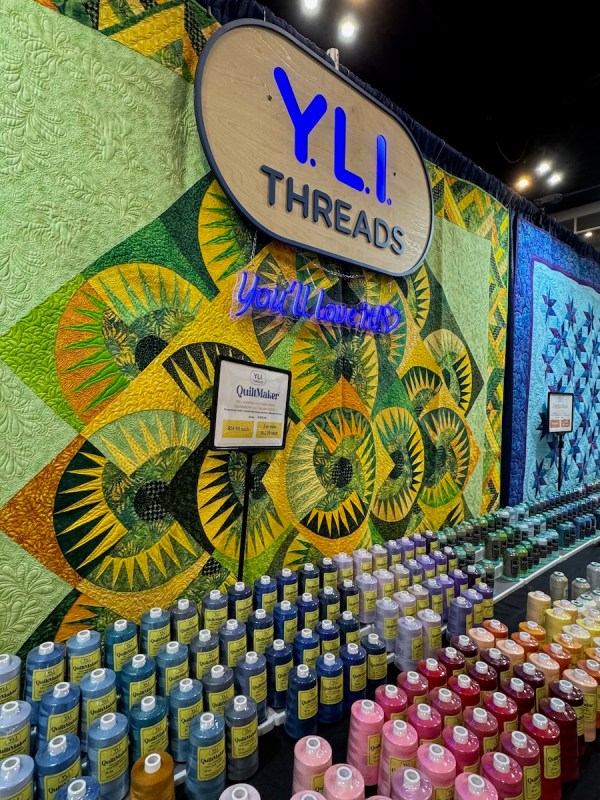
Bob is back, now with YLI Threads (You’ll Love It says Bob), and I was happy to see him, and meet his new wife and chat with them. Quilt shows are ideal for that, especially if you get in before the tour busses and the vendors are just killing time until customers show up.

I bought just a few (haha) colors of their line Elite to try out. It’s a thread similar to Bob’s old Magnifico, which is my all-time favorite thread for quilting. I also picked up some piecing thread; yes, lately I’ve been using polyester thread (fairly fine, at 50 weight) as it cuts down on the lint build-up in my machine. I’ll report in later, after I test them.

Now on to the quilts. I stayed for Preview Night on Tuesday, then went back Thursday morning, before I wimped out and headed home. If you are on BlueSky social media, I have a video of us all lining up next to the scooter carts before it opened — it was a crush! And if you are on BlueSky, please follow me, so we can build our quilting community (#quiltsky) over there.

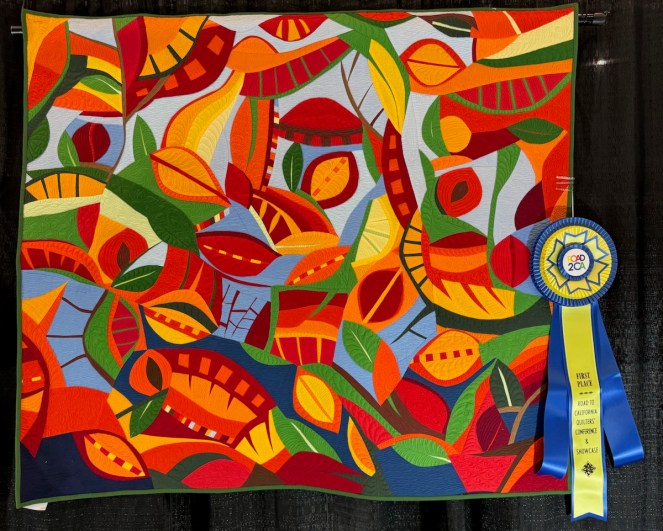
One of the quilts I always look for, or have for the past 20+ years, is the alphabet quilt from Janet Stone.

She is a master of details and I had fun figuring out that the flowers and the blocks all began with the same letter, indexed around the outside edges of the quilt. Here are some detail shots:

I’ll miss seeing this series. Wonder what she has going on next?

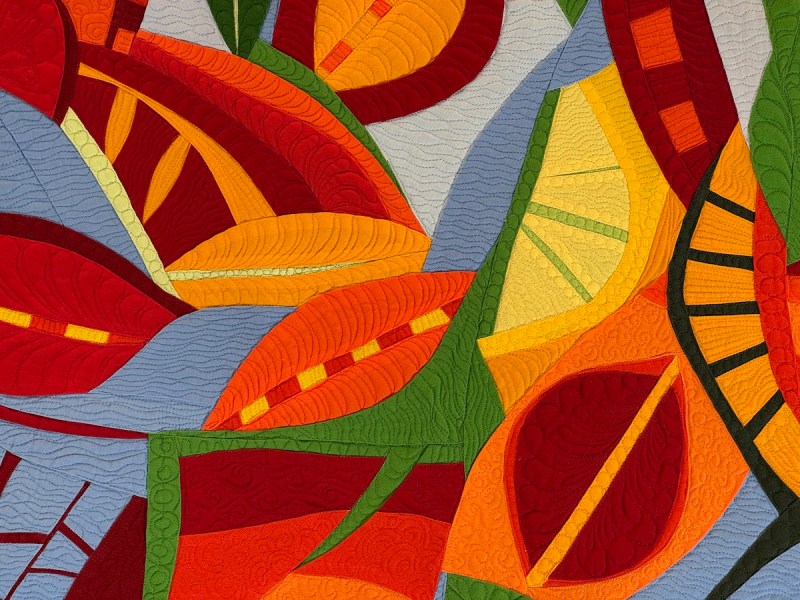
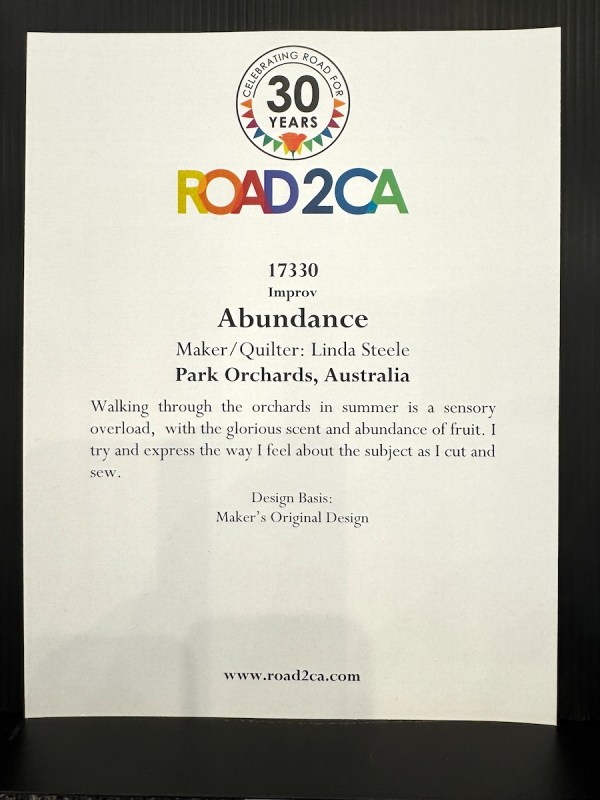
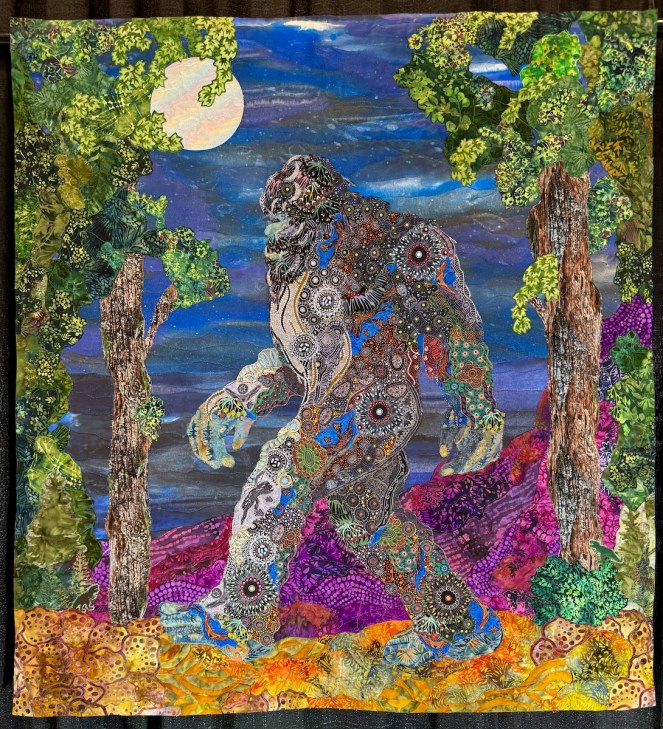
I found the show this year to be subdued, but still — happy to have it here. It feels like they’ve cut down drastically on the number of single-person entry quilts, and they are all crammed together, perhaps evidence that it is expensive to host a show like this? For each quilt, I’ve generally taken three photos: the quilt, a detail and the title card. Click on any of the photos to enlarge.

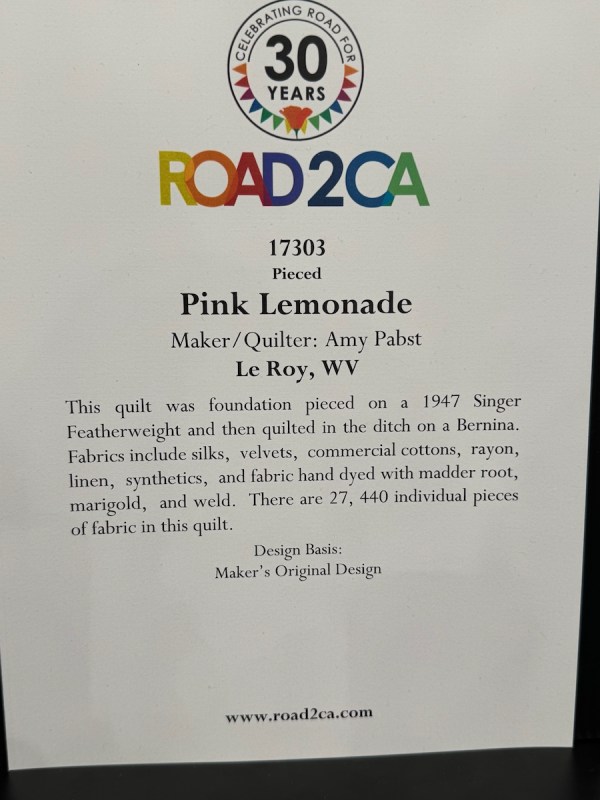
Amy Pabst is a genius at teensy quilting. Each of those log cabin “logs” is about like a matchstick.

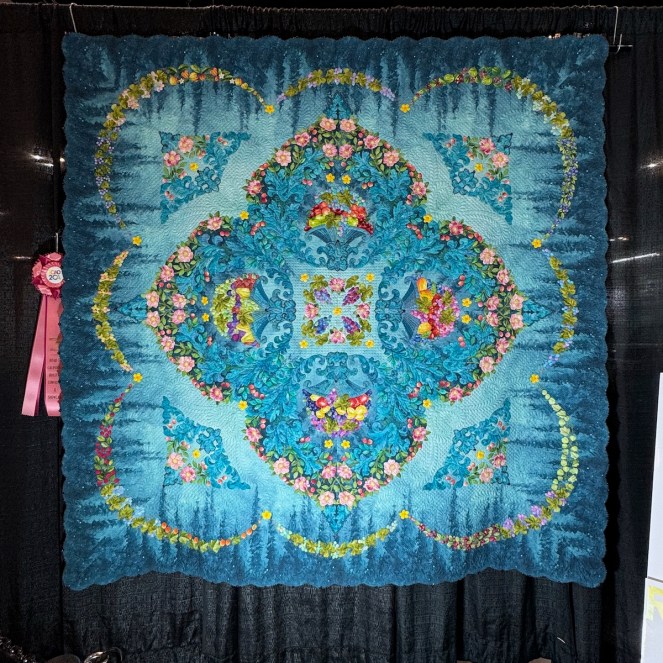
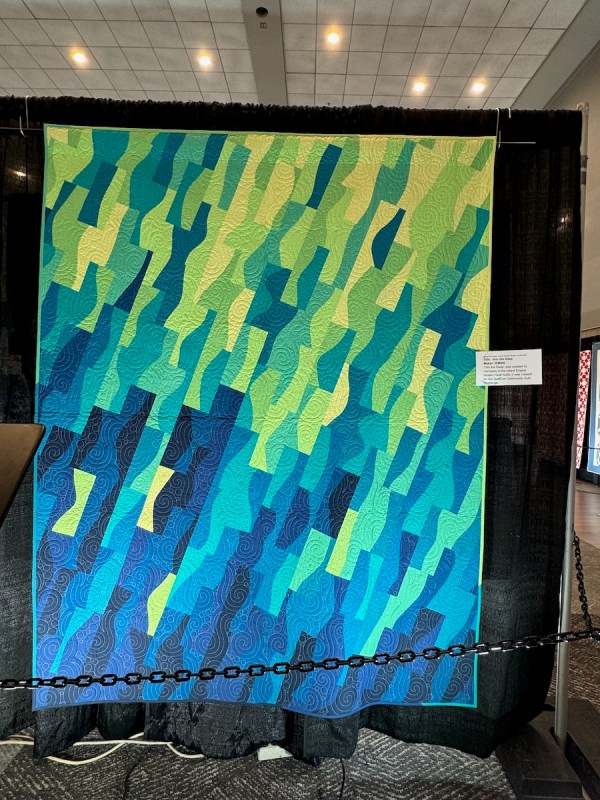
This one was just beautiful.

One of the challenges for photography is the way the quilt show is lit: spots directly underneath the quilts, and NO LIGHTS ON IN THE HALL!! Call you believe it? There’s a pianist on an electronic piano playing lovely music and the first impression is wow. But then you try to actually look at the quilts, and nearly everyone around me is complaining. Or leaving quickly, which was my experience. I usually like to really study and look at the quilts, but seriously? In the dark? It’s fancy, but not functional. Okay, enough whining but now you understand why this is dark on the top and light on the bottom, and that’s even after several different filters being applied at home in my photo-editing program. (I did my best.)

These colors!!

Loved the trapunto flowers.

Although the title card is in Spanish, it’s a tribute to her town. On the back, she’d created her family tree (not shown).

Tough to see this beautifully created quilt (black on black in darkness…).

You can purchase this quilt…

Amazing detail in both the piecing, appliqué and the quilting.

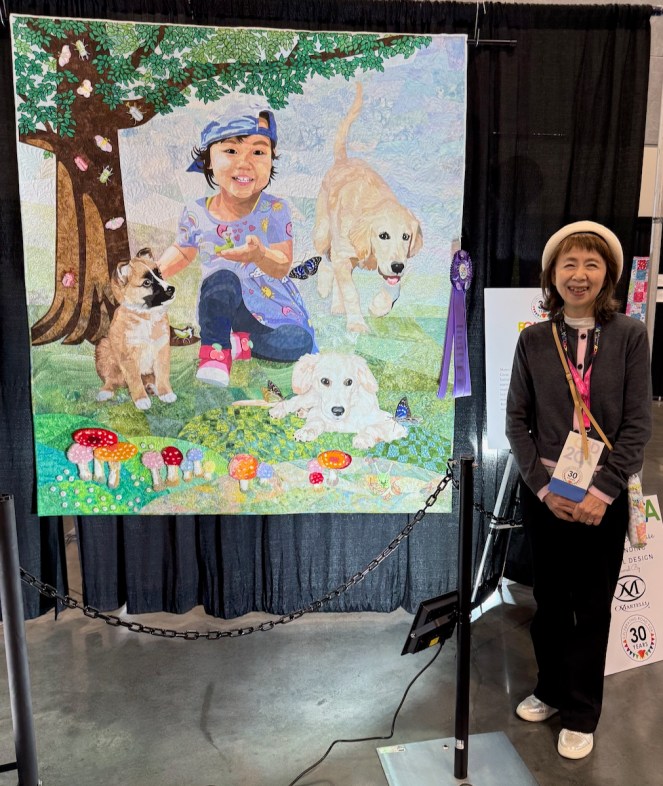
This quilter was standing nearby, but too shy to pose for a photo.

Especially good to remember on this freighted week of Inauguration. My classmate and I carefully talked around the events, trying to figure out if we were a match in current events thinking. We were (whew!). She lived near the fires and told me that her in-laws’ home had burned to the ground with almost no warning. So much damage and so many lives affected by this disaster. [Note: when I came out Tuesday night at 8 p.m. to head home, the whole area smelled like smoke, and I immediately wondered: another fire somewhere?]

A simply drawn landscape, but it was just lovely.

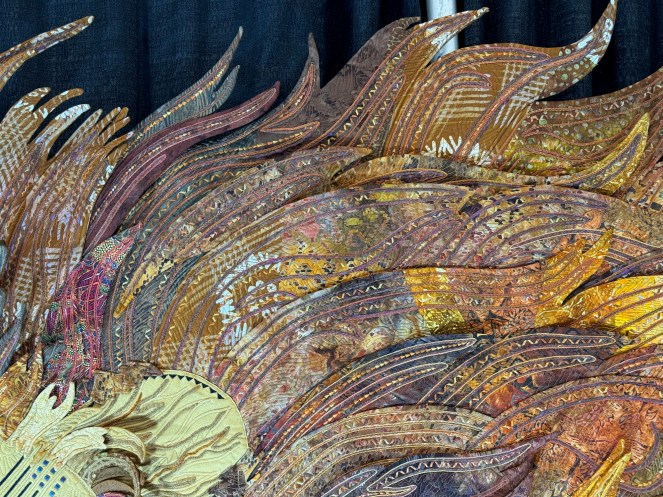
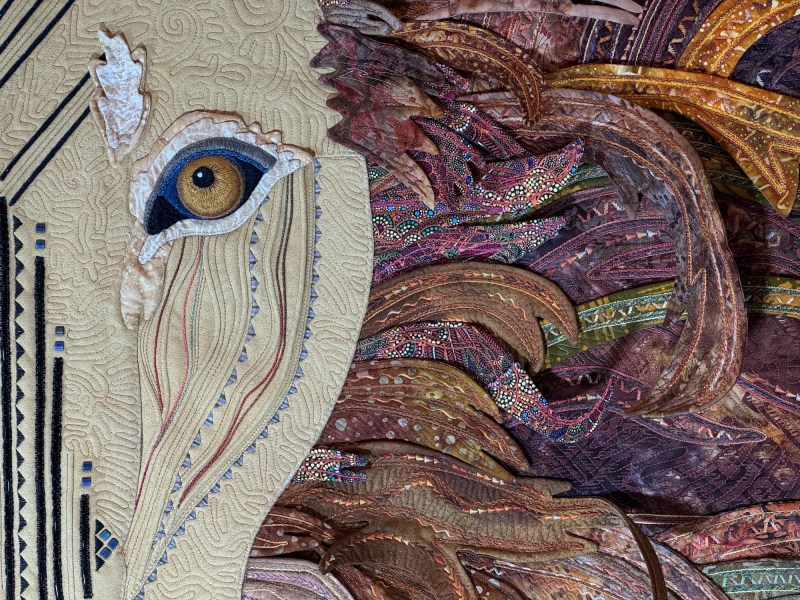
Giraffes! How fun is that?

So that’s the second quilt of Ben Darby in the show — both were beautiful!

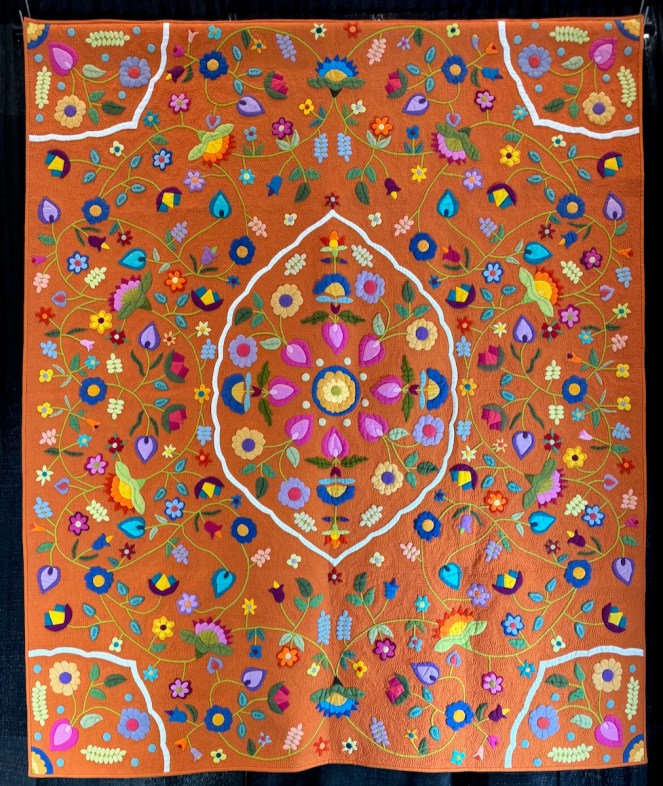
Since I should be quilting on my very own New York Beauties quilt, this one below caught my eye.

Just stunning!

One guild had a series of quilts, 100 Days of Tula Blocks, and Tina Curran made this one, in red, white and blue.

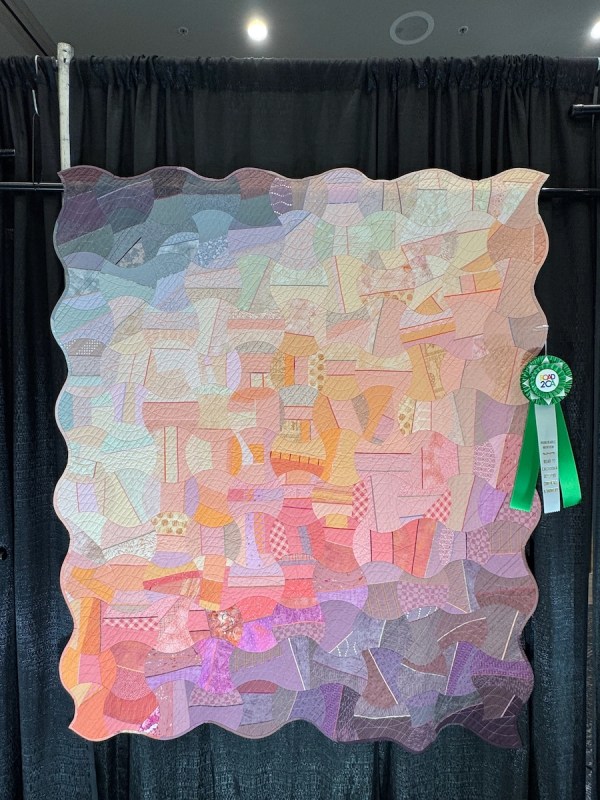
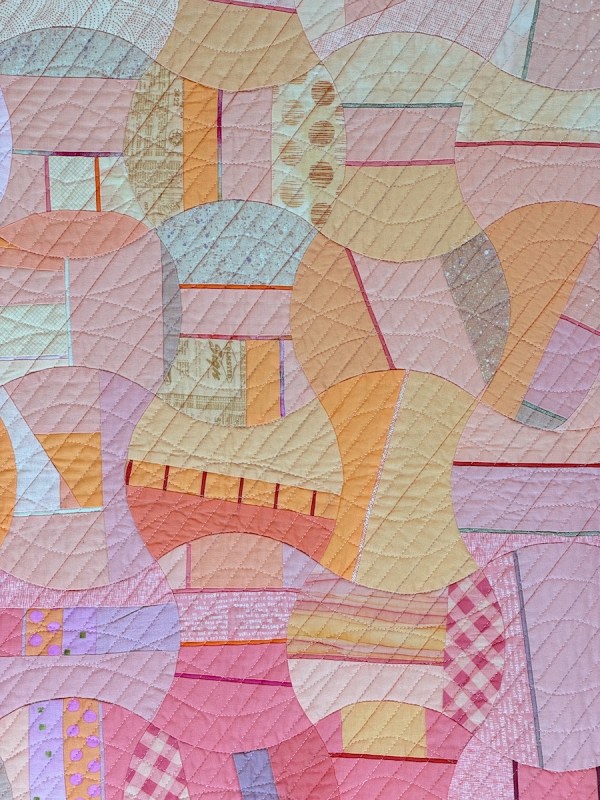
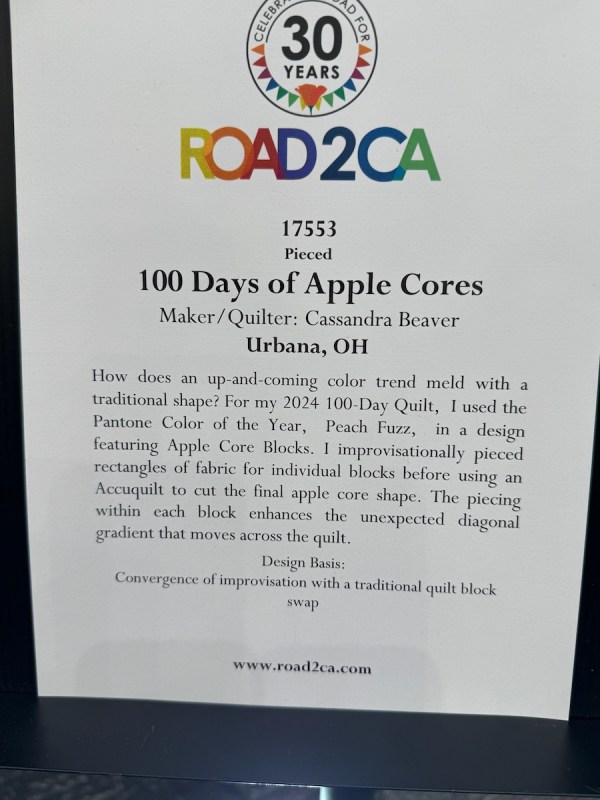
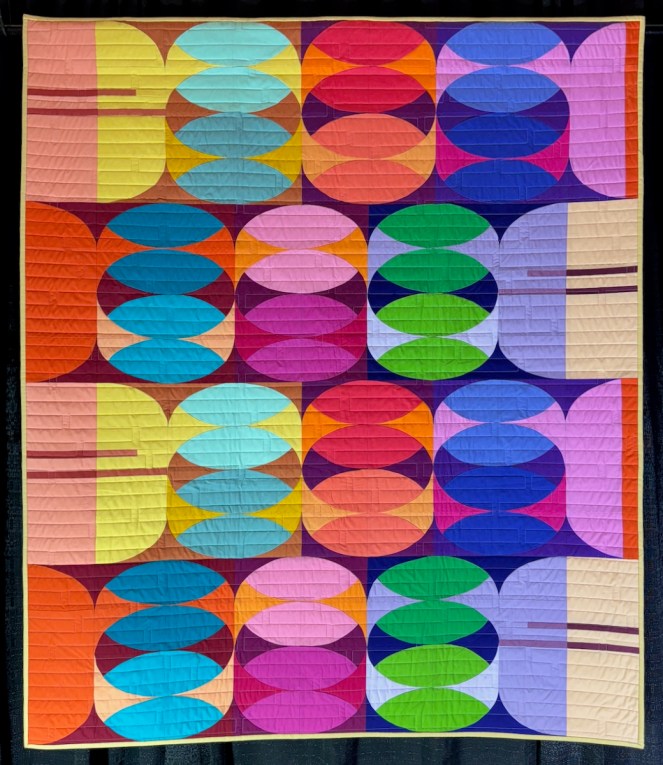
Sometimes it’s interesting to see how the quilts are displayed. I showed you this so you could see how tightly they were hung. But Cassandra Beaver always has an interesting quilt to show.

Click to enlarge title card. Really fun quilt, full of bright color. This was a from a grouping in the hallway outside, another guild showing off their quilts.

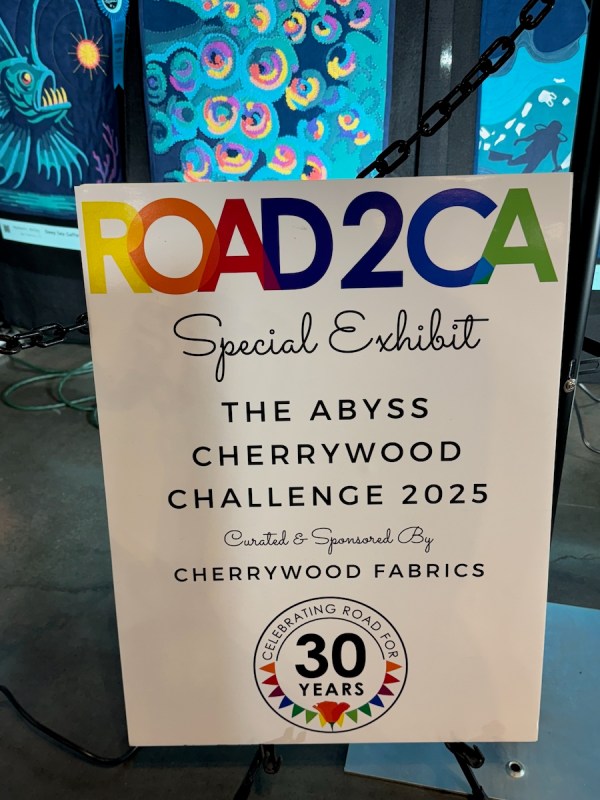
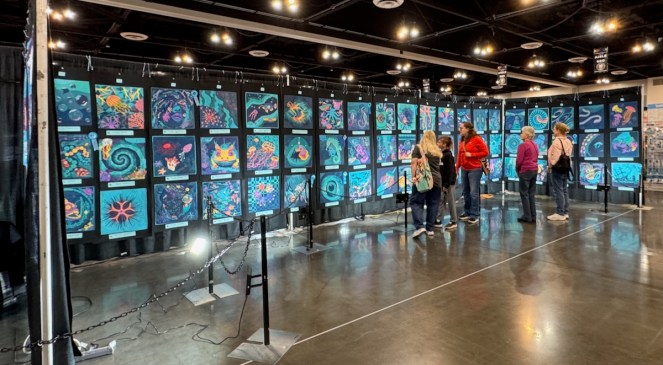
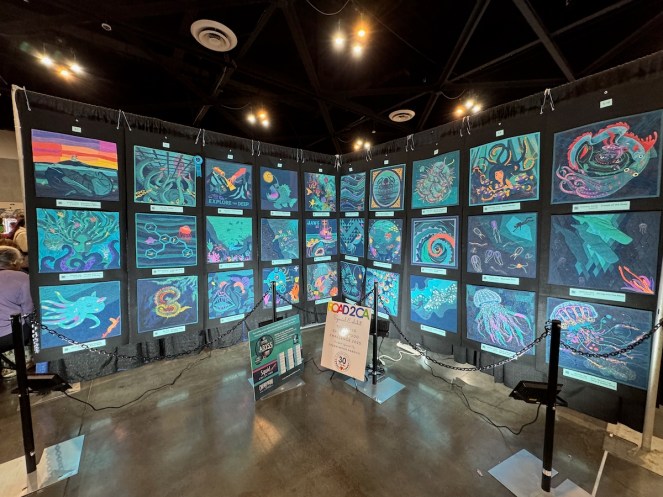
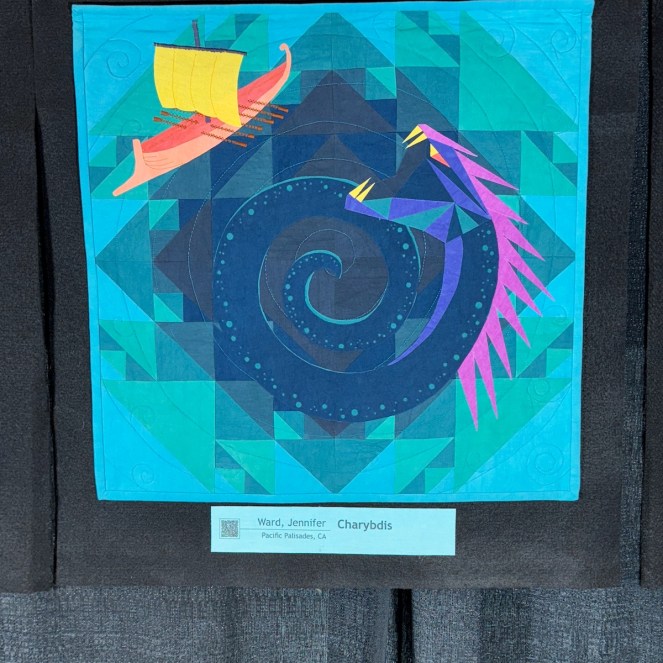
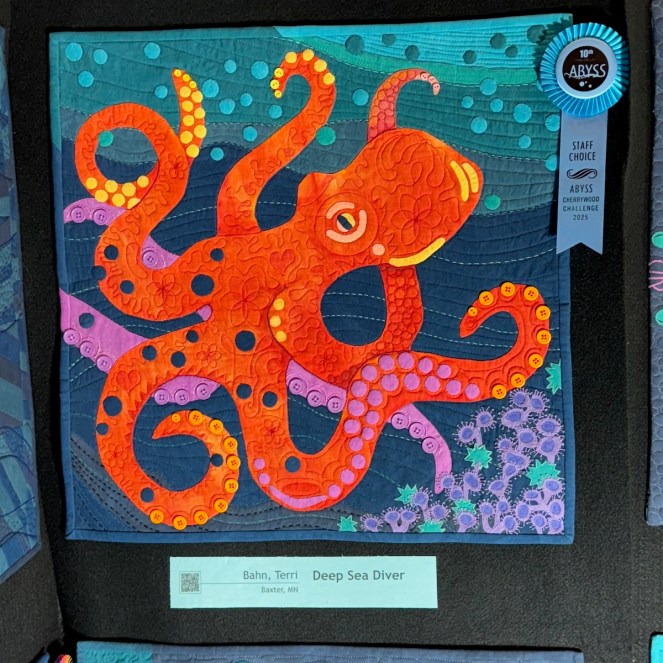
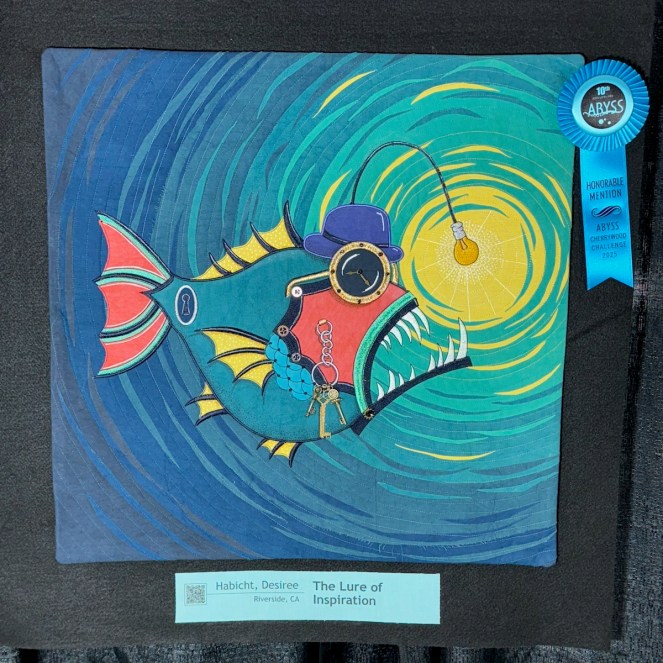
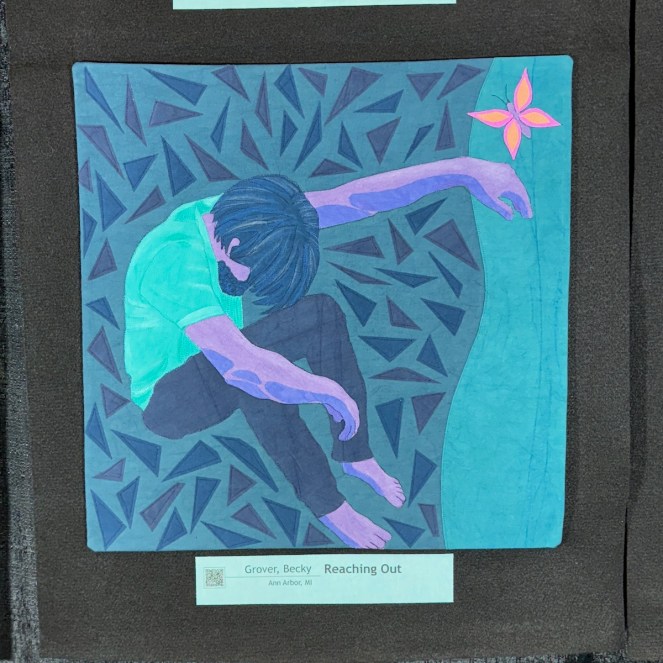
Cherrywood had a huge display, all along the final back row in this exhibit hall. I think you can tell how dim the lighting was in this photo.

Lots of Flanders Fields themes, and since we’d just been to Normandy, they resonated.

Verushka Zarate’s masterpieces were in a special gallery at the front of the vendor’s hall, where they put all the fancy ones. If you’ve never seen one in person, I hope you get a chance sometime. I took her class at QuiltCon Phoenix, the first year after we came back from covid, and I credit her for teaching me once and for once and for all how to do paper piecing.

Here she is with her boys. Again, if you are on BlueSky, here’s a wee video of the entire series of quilts.

Obviously there are many more quilts and lots of vendors, so come on out to California next January and see us.

The show closes tomorrow, and it will be all over for another year….but we’ll be back!