This is what it looks like: four to page. Print it out on cardstock, cut it apart and pass them out with your quilts.
I did have an old Quilt Care Card, but when my sister Susan needed one for the quilt she was making, I rustled up a new one. Much better.
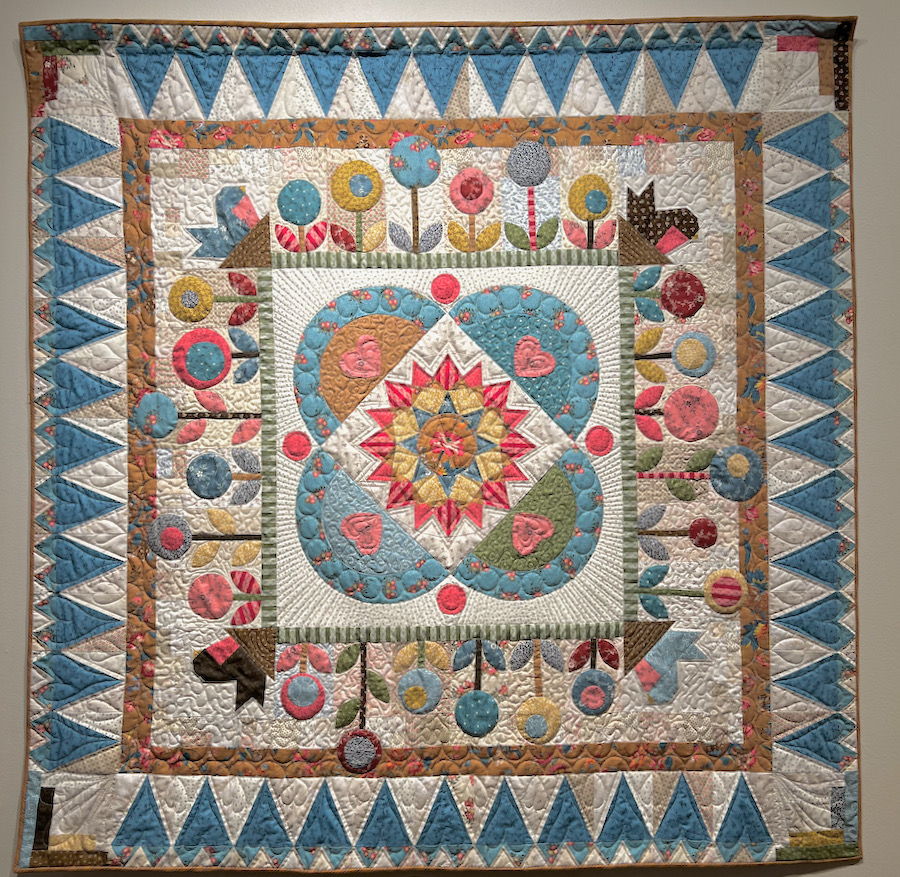
As a person who often wishes she’d studied graphic design (our as they sometimes reference it: surface design) in college, I’ve been amazed by all the graphics I saw on our nightly broadcasts of the Olympics. I want to do something with them all, like making a heart block seen above. Or that very cool half-circle in segments. Another color way is below:
Here’s some links to gaze at, if you’d like seeing some of the graphics in motion:
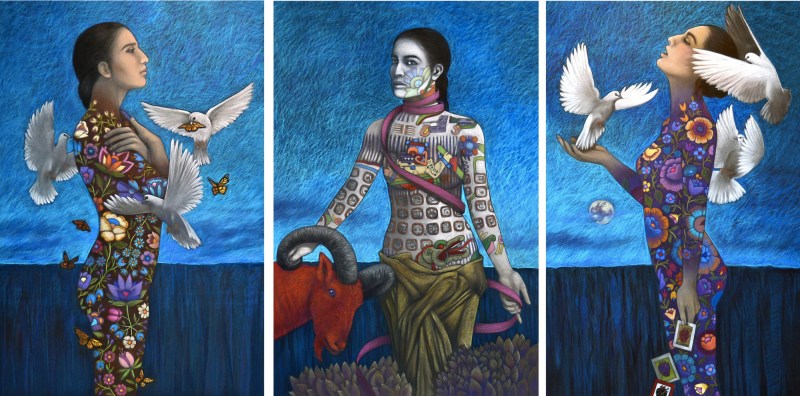
Dreams Between the Earth and Sky, 2018 by Judithe Hernández from here
We went over to The Cheech [museum] last week, on the last day of Judith Hernández’s exhibit, most done in pastel chalks. So many intrigued me, but the two ladies on either side of this triptych were “clad” in the embroidered designs from huipils, a typical dress.
Here’s a snapshot of the huipil I brought back from Guatemala in 2019, when I visited my sister Cynthia (she has since returned from her church mission), and she took me to so many interesting places that involved needles, thread, looms, cloth. I could have stayed a week, but we only had a weekend.
Here we are, clowning around in a woven shawl. Don’t worry; I bought a couple.)
Three women, one of them just crowned Queen of her Village, all wearing huipils (woven and embroidered tops).
Patchwork quilt made of woven scraps, with some embroideries here and there. Somewhere I have about 10 of these parches, tucked away (of course). This entire post has more information if you are interested.
But back to the tryptich, above.
In the linked video, Hernández explains the iconography of the red ram in the center image. It’s that thing that seems to come around and interrupt the smooth flow of whatever you are doing. Of course, I’m paraphrasing. I’m all too aware of red rams in my life, in the life of friends far away, in our families. I loved that this idea was put into a visual image.
My husband and I walked on the beach this last week, as we had a mini-celebration for our anniversary. The waves drawing out the different grains of sand into patterns fascinated me.
Celebrate the bits and pieces of surface design you run across in your lives–
Post Script:
One can never have too much paper or too many pencils. The pencil above is a quilt clapper made by Modern American Vintage, with the loot from the Field Notes most recent sale: I’m a sucker for small notebooks. The pencil below is a Blackwing, purchased last year. It glows 🙂 in the dark!
Pizzazz! designed and quilted by Ruth Davis — an original pattern!
Never a Blue Heart Made and quilted by Lisa Johnson (pattern here)
Sheryl Gillilan designed and quilted this quilt, titled, It’s All a Game!
The Boys on the Block Designed, made and quilted by Marian Eason
Afternoon Delight Made by Patsy Wall; Quilted by Kim Peterson
Winter Bouquets Made by Katherine Porter; Quilted by Emmy Evans
At first glance, I thought the flowers were broderie perse, but it’s all appliqué!
Ann Larsen started Nature’s Chorus in 1999 and finished about 30 of the blocks. During the pandemic she finished it. Quilted by Shelly Dahl.
I loved the simplicity and elegance of this design, with outstanding quilting.
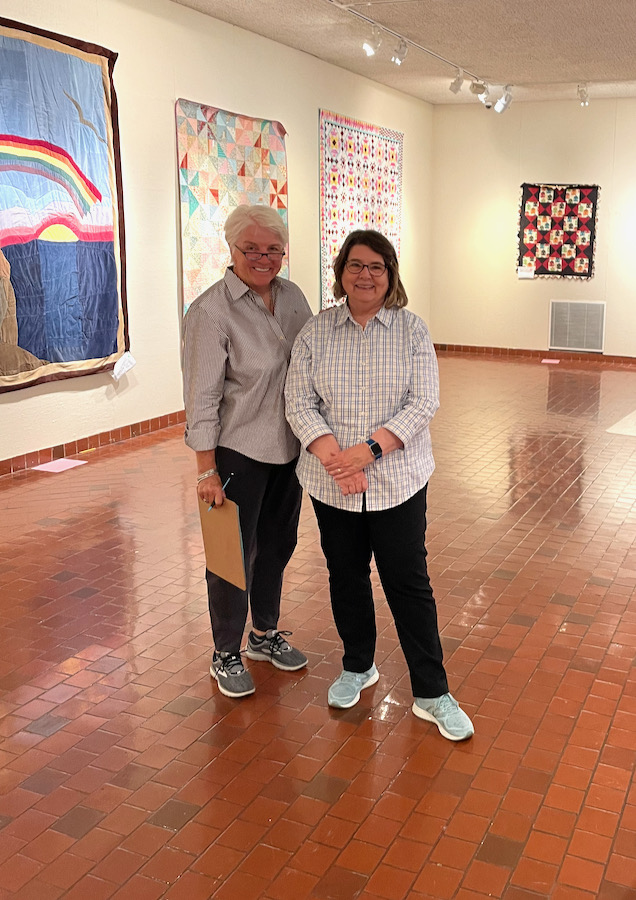
Pamela (a fellow judge) and Wendy (Chair of Quilt Committee) on the day the show opened. (Lisa’s quilt is in the background.)
Julie Saville first created the borders of her quilt Star Garden, then did the center. She also did the quilting.
I could have looked at this one for hours–sorry about the images. Photographing in high contrast light (like spotlights on quilts) often does funny things. It was stellar, though!
Florence Evans’ Bow Wow Chow Mein Made by Evans; Quilted by Quilts on the Corner
Improv Curves, Made and Quilted by Marian Murdock
Effervescence • Made and Quilted by Sheryl D. Gillilan
I loved this quilt, with all its blues and aquas (my colors!). It is titled Straits of Mackinac and was made by Lani Brower (my second scribe) in a Bonnie Hunter class on Mackinac Island, Michigan. Peggy Cameron did the quilting.
Just a handful more quilts for this post.
Diversity – Unity – Harmony (Mobius Radial Quilt) Made and Quilted by Luanne Olson
I hope you can see what a wide variety of quilts there are in this show!
Andrea Erekson made and quilted Happy Golden Days
Katherine Porter’s Fan Flower • Quilted by Virgina Gore
There were quite a few more quilts, but next year you’ll just have to go and see for yourself. Thank you, Springville Art Museum and the Utah Valley Quilt Guild!
Or really, it started with an email from the Quilt Show Committee asking me if I would consider judging one of my favorite small shows: the Springville Art Museum Show. The quilt show is put on by the museum, but the Utah Valley Quilt Guild provides the bulk of the volunteers, the manpower to get it all put together. According to Wendy, the chair of the Quilt Show Committee, I would be there all day, and they would provide lunch (which was delicious!). It was a 9-5 job, in other words.
Yes, I was a bit nervous never having done this before, so I did pretty extensive reading before I went, carrying copies of the NQS guidelines, and other references I found. In reviewing them the night before, I thought: “After nearly five decades of quilting, I either know this…or I don’t.”
What I wasn’t always aware of was how to compare quilts that are quite dissimilar in style, execution, materials, etc. According to NQS guidelines, it often comes down to the number of design decisions made by the maker. I let that be a guide as I worked through the quilts.
Wendy (shown here at the end of the day when she was relaxed) was my first scribe, and Lani (on the right) was my “interim scribe” when Wendy went to assemble lunch for us all. In the morning, I met my other two judges, Pamela and Chris (our bios are at the bottom of this page), along with our the other scribes. The Museum Curator, Emily, and Wendy gave us instructions.
Each quilt was to be judged twice, but each judge was to only judge a portion of the quilts (roughly 60). We would look at the quilt, check off the items on the scoring sheet, leave a comment or two about the overall impression of the quilt, then the scribe would leave the paper upside-down under the quilt, to be picked up later.
The scoring sheet had the usual items dealing with construction, design, quality, straightness, buckling or cupping of edges, tension of stitches, and so forth. Having participated in larger shows, I was suprised that they didn’t have two categories for machine: stationary head or moving head (long-arm), but instead lumped them all together (I will compose an email to the curator, later). And I was surprised about the fixation with binding on the score sheet — was it straight? was it even? was it filled? I dutifully did my inspection, but thought this was a minor detail overall. I’d heard about this from others, but still roll my eyes a bit.
The fun part was getting to put my hands all over the quilts. I kept them clean, washing them often, but it was necessary to determine — in one case — whether the tiny circles were appliquéd or painted onto the quilt (painted). I had to pull at design motifs to figure out if it was a panel or appliquéd (panel), and check other various parts of the quilt.
I’d read the phrase in my studying, “If you can see it, the judge can see it.” Yes we can. I spent a lot of time picking off threads only to find they were attached, like this one, above. We had about an average of 3-4 minutes per quilt. I’d read that some shows are judged “flat” and other shows are judged “hung.” Ours was obviously hung, so we couldn’t really examine the top corners, but could do the rest of the quilt pretty well. I spent a lot of time running my fingers down the bindings, picking up corners to check for construction.
My scribe dutifully wrote what I dictated. I soon learned that I was better about commenting about the design right off the bat, then could address the “needs improvement” comment after I’d gotten up close and personal. I think that what I said about those first few quilts were a bit clunky, and wish I could go back and re-do some of them, but we had pretty hard and fast deadlines, so I pressed on.
All three of us.
In later afternoon, after we had all judged the quilts, the real discussion began back at the table. We needed to fill out the top winners, settle our differences about what quilts should be elevated to awards, and choose our own Judge’s Choice. I thought we worked really well together as a team.
There were three major awards, with Best of Show being one of them. Then a few more Awards of Excellence, then Honorable Mentions, along with Sponsor Awards, Museum Awards and others. We had a lot of norming of the score sheets to do, which meant running off to see the quilts yet again, discussing them among ourselves. I liked this part of the best, as I felt we each had different tastes and approaches and this gave a good evaluation of which quilts should get an award. I could point out details in the quilts I’d judged, and they could point out details in the quilts they’d closely looked at. Finally our awards lists were complete and we handed them in…early!
Here I am holding my Judge’s Choice ribbon in front of the quilt I chose. There were some specifications for what we chose, but generally we had free rein. Notice the two judging sheets on the floor (we each had a different color), and the paper pinned to the corner of the quilt with the barest amount of info: no names, no stories of the quilt. It was just us and the quilts that day.
I was surprised that they gave me an honorarium, so I promptly went across the street to Corn Wagon Quilts (one of the sponsors) and went shopping. The Circle of a Quilter’s Life, right? I spent the night at my sister’s house in Provo, and over dinner, she dutifully listened while I talked about my experiences. She also had listened to me years before, after I’d gone to Quilt Market; I’m glad she was there.
So, in the end, did I “know it?”Confidently, I can say yes. Do I want to judge another show? Yes. Do I want to judge a show like Quilt Market or Paducah? Heaven’s no! But many small regional and guild shows need judges, and I feel I could do this. Like every quilter, I’ve made a lot of stitching mistakes in my life which brings one kind of education, but being able to go to — and participate in — some of the shows such as Quilt Market, Houston, Atlanta, PIQF, Road to California and other large national/international shows has given me another kind. After participating all these years, I was happy to be able to give back.
If you haven’t entered a Guild Show, or a regional or national show yet, give it a try. They can only say no, and you might be surprised about getting in!
Happy making–
Next post: Many quilts from Springville. Sneak Peek:
Bisa Butler recently mounted her first museum exhibition at the Art Institure of Chicago and “surmounted biases in the contemporary art world against both people of color and fiber arts” as Deborah Brehmer puts it in an article in Hyperallergic. This recent article was sent to my by my artist sister, Christine Petty, a screenprinter, who, when her studio was shut down, made her way through the pandemic by learning the art of natural dying, and diving into the world of seeds, flowers and yards of softly hued cloth. My sister and I talk art, the drive to make art, and color. I’ve been sent links to Butler’s art from several sources, but the link from my sister sent me to the blog so I could share it all with you.
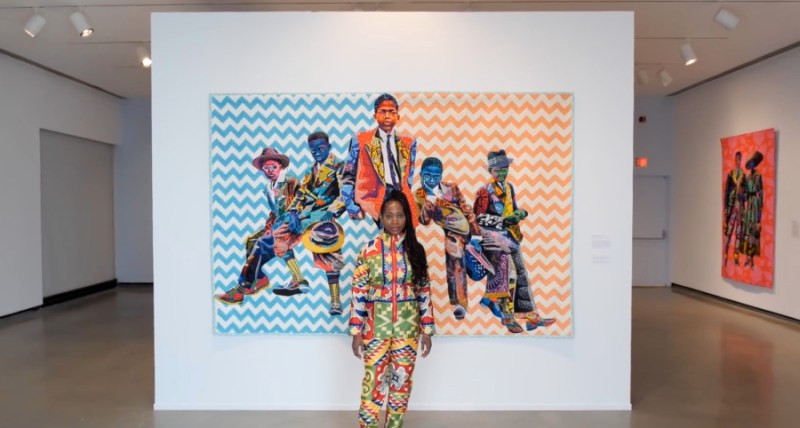
I created The Safety Patrol while in my last year of teaching high school and simultaneously preparing to debut my artwork with the Claire Oliver Gallery. I was constantly thinking about my career change and at the same time having strong feelings about my students. It was during this time that Trayvon Martin was killed while walking home from the store by a vigilante. Trayvon’s killer had just been acquitted under the Stand Your Ground law in Florida, and I was distraught. I couldn’t reconcile my emotions about the future well-being of my children and my students in a society where their lives are expendable.
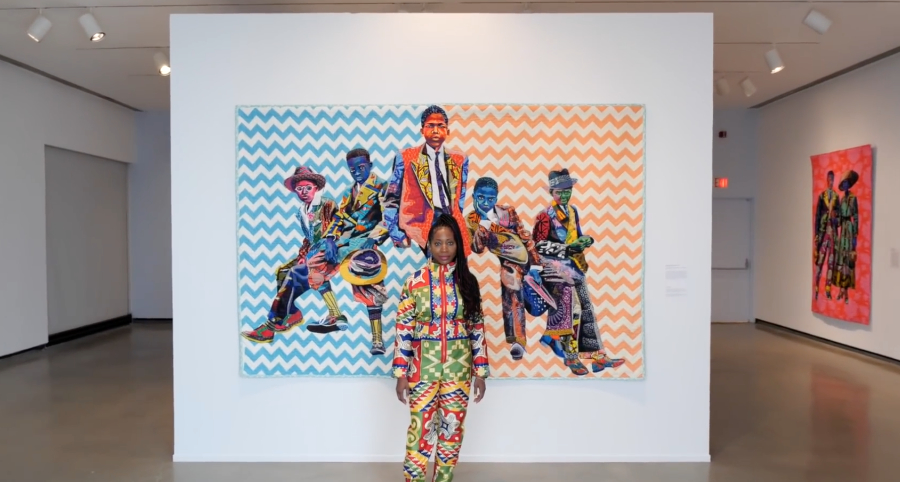
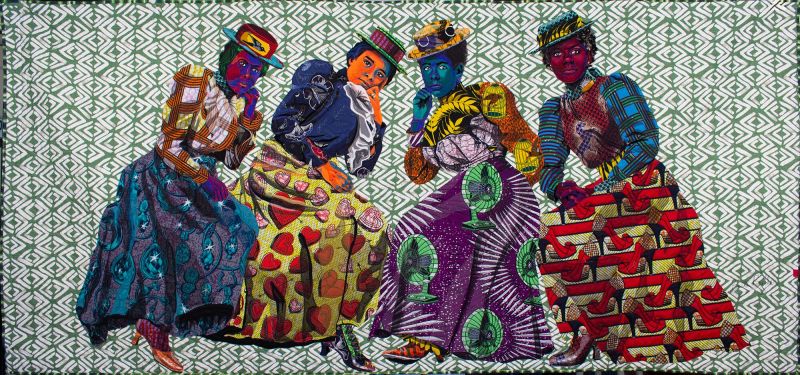
Many quilters use color in their work. But Bisa Butler’s floating figures are drenched in color, not only from multiple layers of fabrics, but also by the use type of fabric: African Dutch Wax prints, which bring not only color, but texture. She artfully cuts and combines her fabrics and includes bits such as the key around the young girl’s neck and the patrol boy’s belt made of carefully fussy-cut kente cloth.
The skirt on the left: earrings, and the skirt on the right: high heels, chosen by Butler in honor of Michelle Obama’s trip to Ghana.
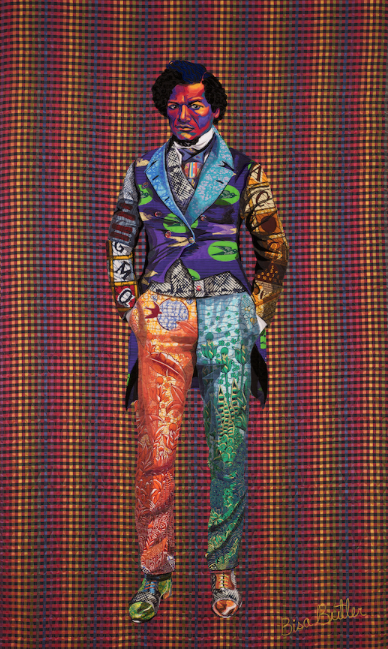
Bisa Butler, The Storm, The Whirlwind, and The Earthquake, a portrait of Frederick Douglass, from here
In this article in Juxtapoz Magazine (another article worth reading), her migration to cloth from paint is described:
“as an art student at Howard University, she began using fabric to avoid paint, which made her nauseous while pregnant. But she realized something deeper was at play, her actual dissonance with paint. “I could follow the rules technically but I didn’t have the voice. The paint didn’t connect to me.” Butler was introduced to textiles by her mother and grandmother, both dressmakers, who taught her how to make her own clothes. “Fabric was of my family, so using kente related to my heritage. When I made the portrait of my grandfather whom I’d never met, I realized I needed to use all African fabrics, and I used my grandmother’s fabrics that were old because I wanted to assert that this man lived before,” she said.
Reading the Juxtapoz article, I was fascinated by the history and meanings of the Dutch Wax prints and kente cloth, especially the names given to the pieces in Douglas’ portrait, or those in the I Know Why the Caged Bird Sings, above.
In the Hyperallergic Magazine article, Brehmer notices some women who gather around one of the quilts:
“I watched a group of three white women take in a piece called “Survivor” (2018), which addresses female genital mutilation. They discussed the technical aspects of quilting. One explained what a “long-arm” sewing machine is. They shared observations regarding the meandering lines of stitching and the way Butler layers transparent lace, silk, and tulle over opaque fabrics to create depth and shadows. They were in awe of the technical mastery of the work.”
Brehmer has noticed how we quilters often interact with many quilts as we notice the technical aspects: “How did she quilt this?” “Is there a pattern?” “Where can I buy that fabric?” I’ve seen it happen at quilt shows and so have you, when we get so involved with “how did the quilter make this” that we forget to notice (in Butler’s case) the joy, the history, the placing of historical figures in our time, asking us to put human lives and needs and challenges at the center of of our gaze. We want to own or borrow that particular quilt artist’s approach and those questions come from that impulse, I’m convinced. While my quilts will never be on par with Butler’s, and my subject matter is — oh, so different — I can learn from how she comes to the work. I can learn to let art climb in and infuse the making with joy and meaning, and yes, with color.
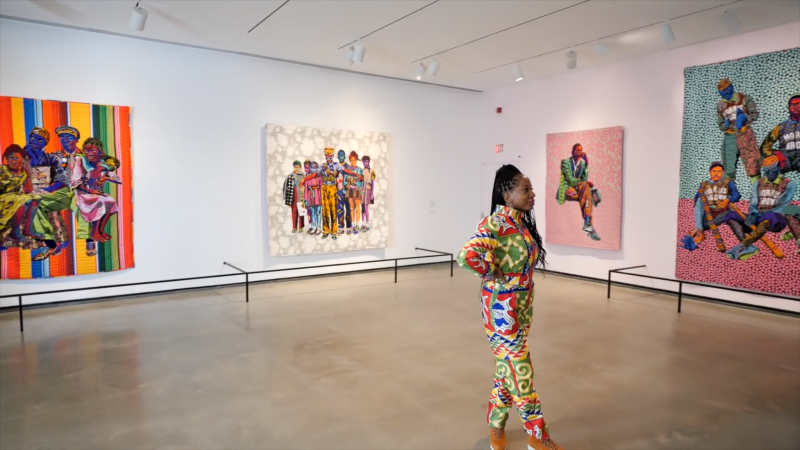
On the Art Institute site, in a short video interview with Butler, we see her studio, get a sense of how she works, and listen to talk about her education and guiding principles in her art. I pulled the images above from that video, and loved the two above of her obvious delight in seeing this exhibit of quilts, of textiles, of history, of her vision in such a storied place as the Art Institute. I think we are all familiar with the Gee’s Bend and Amish quilts, both earlier exhibits in major national museums. I view this exhibit as another break-through show, intended to showcase the art and craft of quilts.















 OccasionalPiece--Quilt!