Quilts · Tutorial · WIP

Snapshot: Constructing the Double Polaroid Blocks

First, let me say a thank you to Lee of Freshly Pieced Fabrics, who is hosting WIP Wednesday for us.  Click *here* to return to her blog and see other fabulous Works-in-Progress.
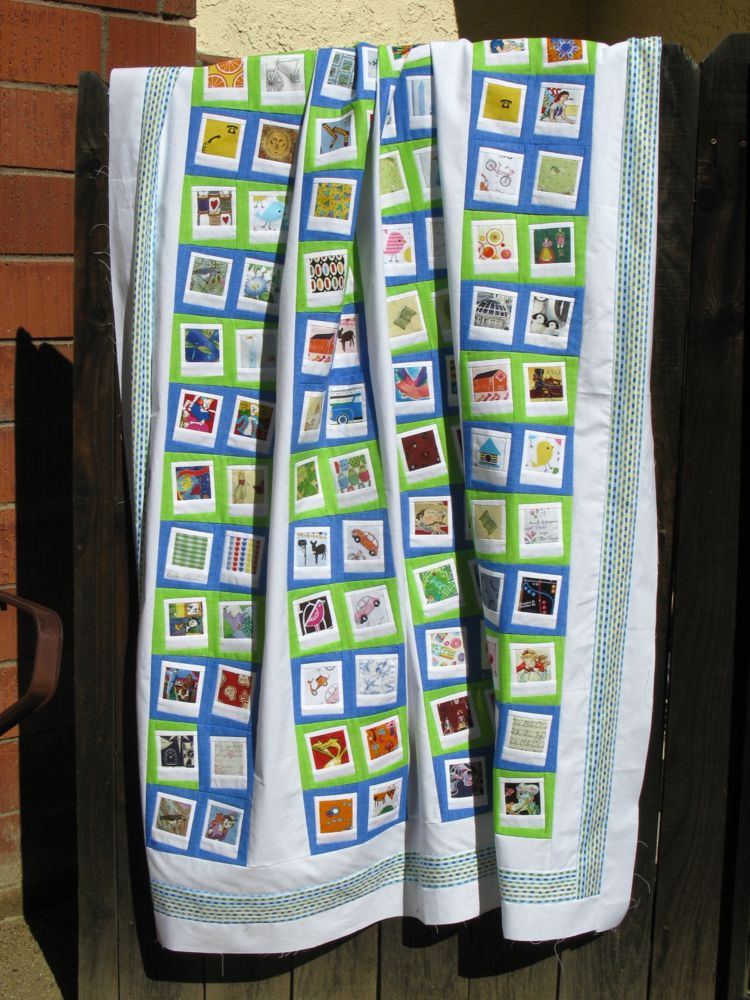
If you missed yesterday’s post about Snapshot, my latest quilt (above), scroll down as there is information for fabric requirements and a basic How-To for Polaroid Blocks.

The first picture (top) is Snapshot in a beauty pose.  This one (above) is the one where she’s in under the fluorescent lights in her doctor’s office, wearing only a flimsy gown that opens in the back.  You know the feeling.  But we need to examine the quilt to see how it’s put together, so I thought you needed a clinical kind of picture. Here you can see some of the variety in the tilting, and in stacking the blocks.  I had some scraps of fabric at the end and late one night made the one at the bottom left into two colors. (I should go to bed earlier, I think.)

I did these in sets.  You’ll end up making about 4 sets, alternating the blue fabric with the green fabric (only use one color at a time), as each stack is made up of 13 blocks.  However, I made a few more of each color, because I doubled up on some colors for variety (you can see it above where there are two blue blocks together).  So make 4 1/2 sets.
For each set of 13 double blocks, you’ll need:
8 strips of either blue or green (don’t mix), cut  1 and 1/2″ wide
2 strips of either blue of green (don’t mix), cut 1 and 1/4″ wide
26 Polaroid blocks, in pairs of two (take some time to match up the ones you want together)
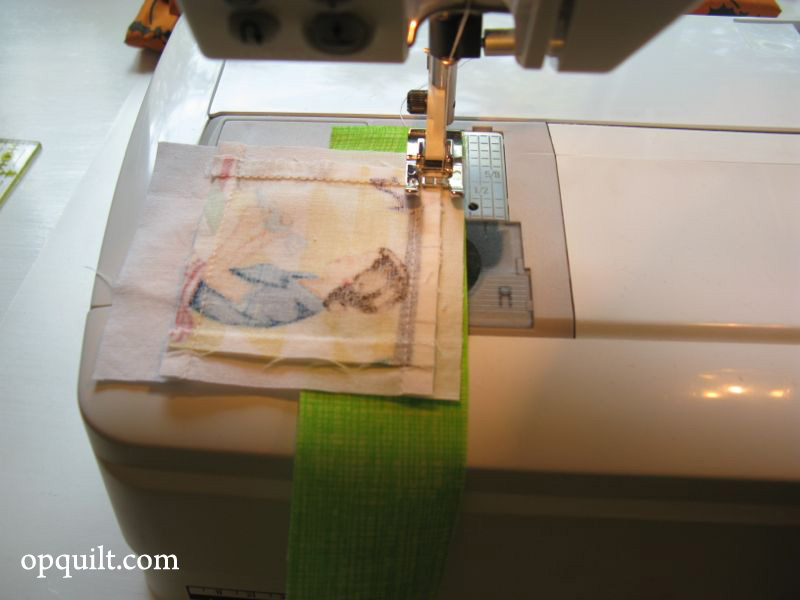
Start by sewing the Polaroid blocks to to the wider  (1 and 1/2″) strip, placing Polaroids face down.  You are sewing this to the TOP of the blocks.

Lay out the strip of blocks and cut the blocks apart.  With scissors.  Remember those?  We finished up our discussion of The Shallows: What the Internet is Doing to Your Brains in class, and the last section talked about tools; when we adapt and adopt a tool, it become an extension of us and we may leave older tools behind if the new one suits us better.  So if you feel like the rotary cutter is an extension of your hand, you may need to practice using scissors again.  Kidding.

Press the fabric away from the block, like this:
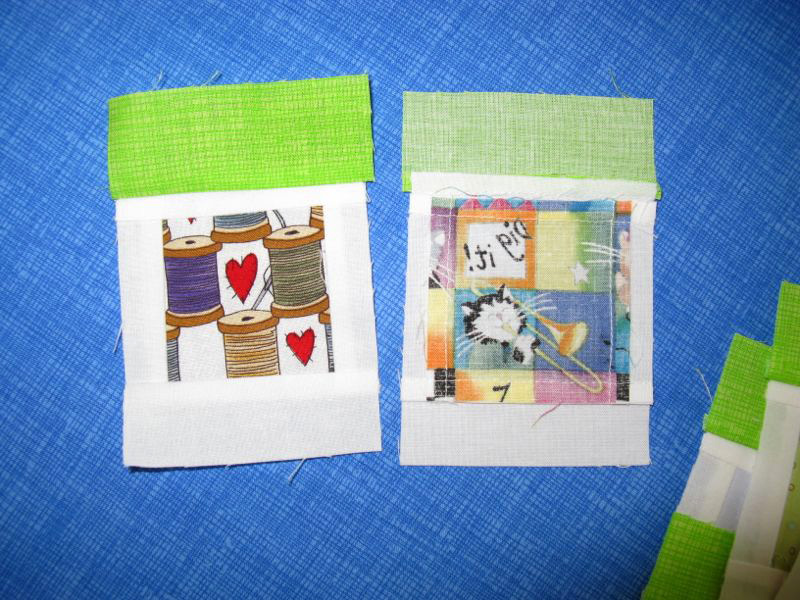
Now sew another wide strip on the bottom of your Polaroids.

Here’s four blocks, with the top and bottom borders sewn.  Again, you are using the 1 and 1/2″ width fabric.
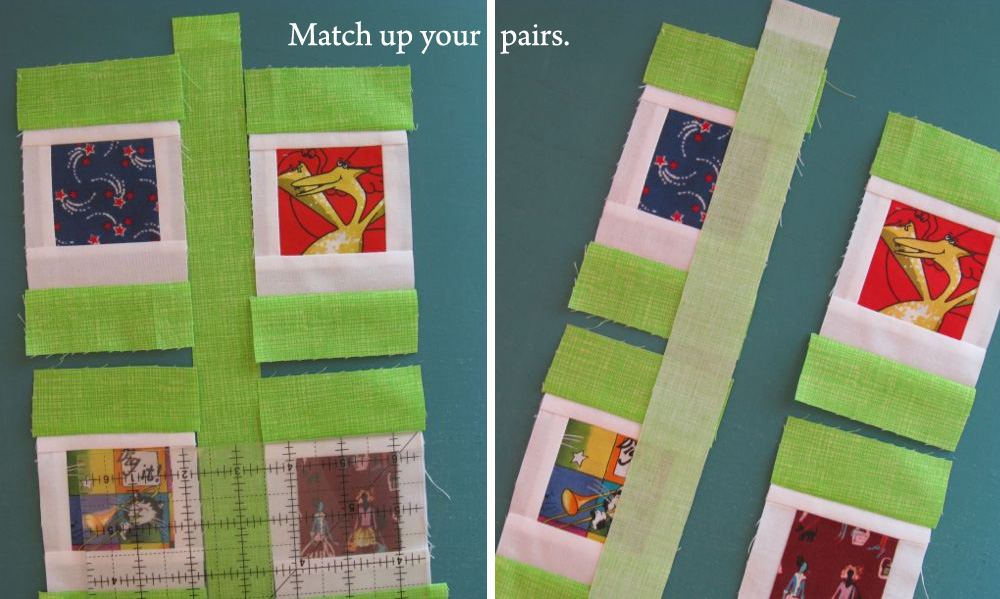
Lay out a strip of the narrower fabric (1 and 1/4″) and place your blocks side by side, matching up your pairs.  Separate them by about 1/4″ at the bottom.   I pinned them so it would be easier to transfer to the sewing machine.  Sew the first set (one side) onto the center strip. You should be able to get about 7 Polaroids per strip.

As you sew on the first set, pay attention matching the edge of the Polaroid block to the edge of the center strip, letting those little bits of borders stick out.  You can cut them off in an earlier stage if you need to, but I did mine after sewing them.

NOW trim off the little edges if they bug you.  For sure, trim off the big overhangs!  Just lay out the strip as shown, and cut the overhangs off, even with the long strip.  DO NOT CUT THEM APART!!!   Let me repeat.  DO NOT CUT THEM APART!!

Now, take your “right leaning” and “left leaning” PDF printouts from the last post, and set one of them at a time on the table while you do the next step.  I made all the greens to lean to the LEFT. All my blues lean to the RIGHT.  It feels backwards, but here we go.  I used the picture to get in my mind which Polaroid should be 1/4″ up and which one should be 1/4″ (or the width of that top border) down as I’m lining them up along that center strip.

Notice in this high-quality illustration that the blocks lean to the right.  To accomplish this, you have to offset them when you sew them to the center strip.  The left block is “lower” on the strip, and the block on the right side is “higher.”  This is why I used two colors: to keep things straight.
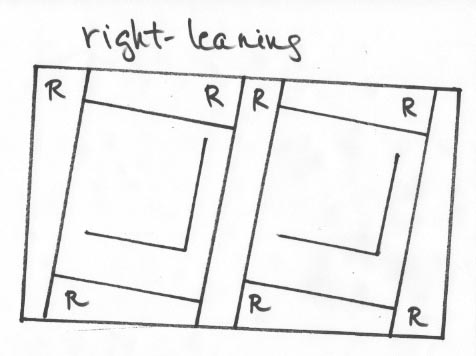
But my greens tilt the OTHER way, so I used the “left leaning” diagram to help me.

(Diagram in action!)

Again, to get the tilt, you need to jog the one on the top down about one-fourth inch.  What I did was line up the edge of the green border  with the top of my center picture in my Polaroid block.  (I know this sounds confusing, so just look at the pictures.) This will give you that offset you need in order to tilt your block.  Do this with the remainder of your pairs.  Pin, then stitch.

When working with the blue, I reversed the sewing, stitching the blocks on the right-hand side of the center strip first, then the left.
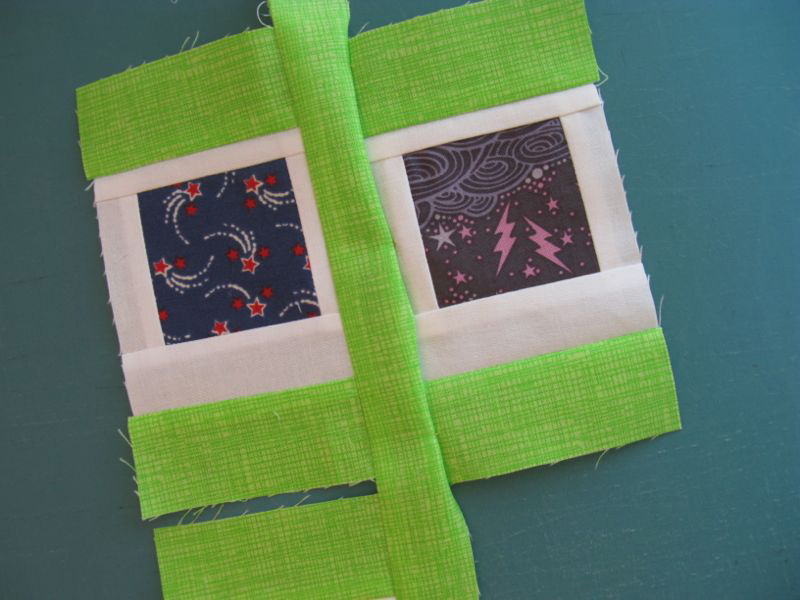
Here it is sewn.  You can really see the slipped alignment here.  Press this seam toward the center strip.  See two steps down, for the why of pressing.
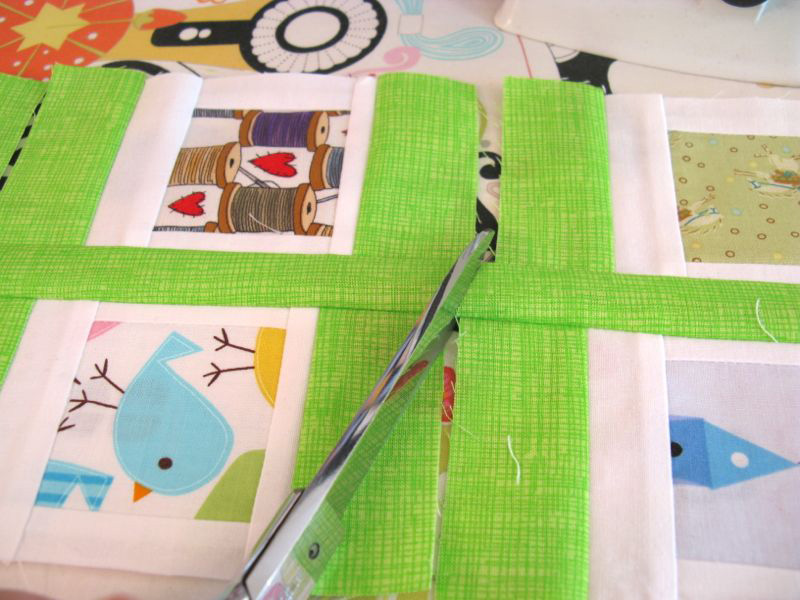
Cut these blocks apart now; the cut will be angled to fit the skewed alignment.

Here’s one that’s been cut apart after sewing.  Here you can see the shift.

And in comparing these two blocks (the one directly above and the one below), you can see the difference the pressing makes.  The pressed edges can either make a block look like it’s resting on the top or like it’s “sunken” into the strips surrounding it.  I wanted my Polaroids to have that look of being bordered by strips, not the strips “supporting” and “lifting” up the Polaroids.  So that’s why all the pressing directions indicate which way to press the seams.
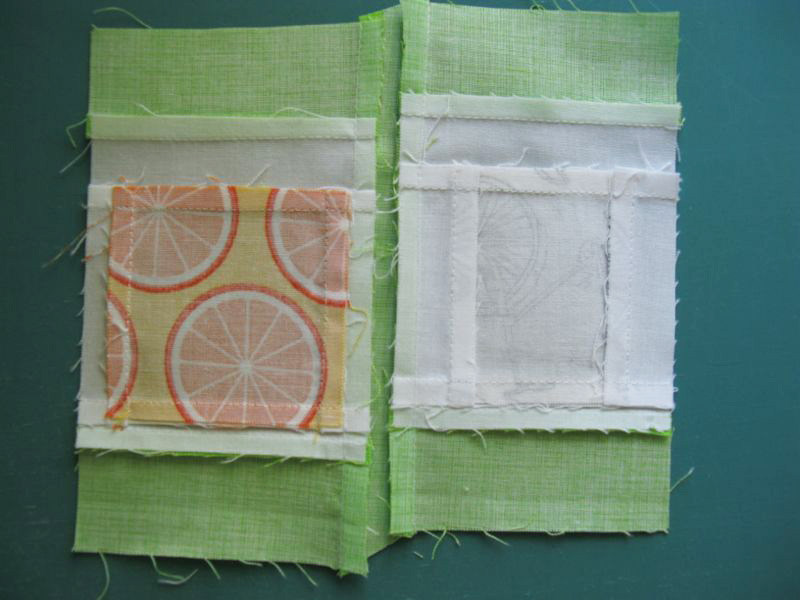
Here you can see the different pressing.  All right Goldilocks, you are through the deep scary forest and just about to claim that pot of gold at the end of the rainbow.

Using the wider (1 1/4″) strip again, sew the outer borders onto both sides of your block assemblage. Cut apart.

You should have 13 blocks that look like this.  Now comes more fun, more forest.

Get out that PDF picture again.  Lay it at the top while you trim your blocks.  The size you want to trim to is 4 1/2″ by 7 1/2″.
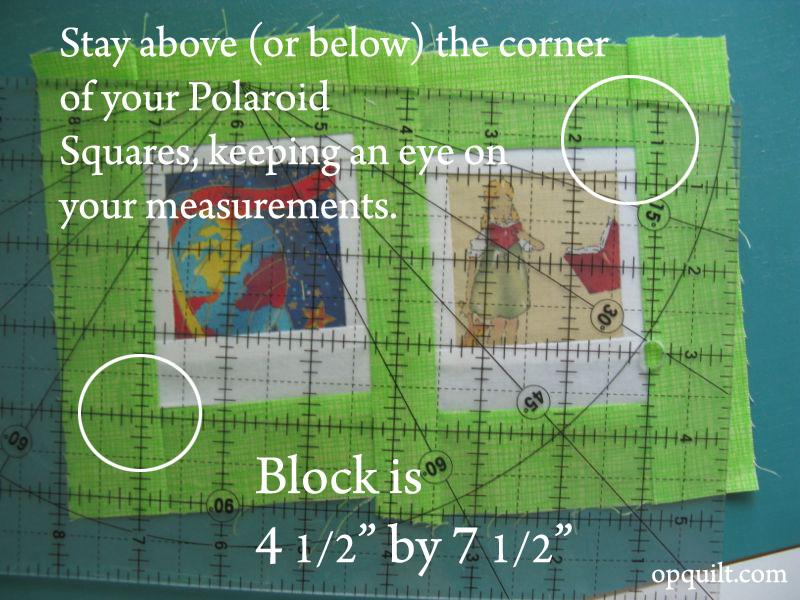
You need to tilt your ruler a bit, making sure you leave at least 1/2″ space between the edge of your white Polaroid interior block and the planned cutting line on the outside edge of your ruler.  (This is why you make extra blocks, if you get my drift.)  I tried to vary my cuts, because I think one of the charm of these Polaroid blocks is their wonkiness when set into their frames, much like a child would paste vacation photos into an album.  So sometimes I was just over 1/2″ from that edge, and other times I was closer to 3/4″.

Keep at eye on that 4 1/2 line, as well as the 7 1/2″ line.  Be a juggler, keeping all these things in mind as you go for your first cut, slicing off the top of the block.  Then flip it around, putting the cut edge at the bottom.
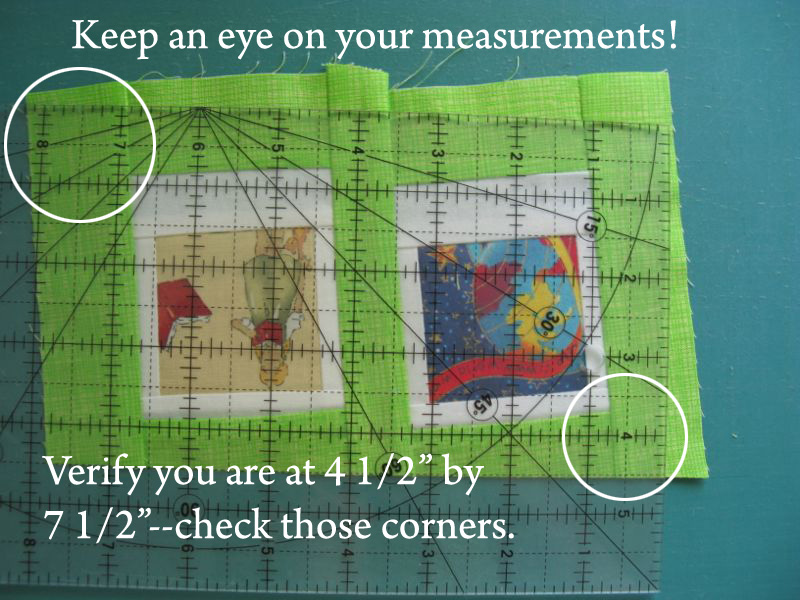
Lay the 4 1/2″ line of your ruler at the bottom, lining up your freshly cut edge.  Check your measurements.  You want the bottom lined up, but you also have to check that the block is centered so when you cut off that right side, you’ll have an evenly centered  7 1/2″ block.  If you are good to go, slice off that right-hand side.
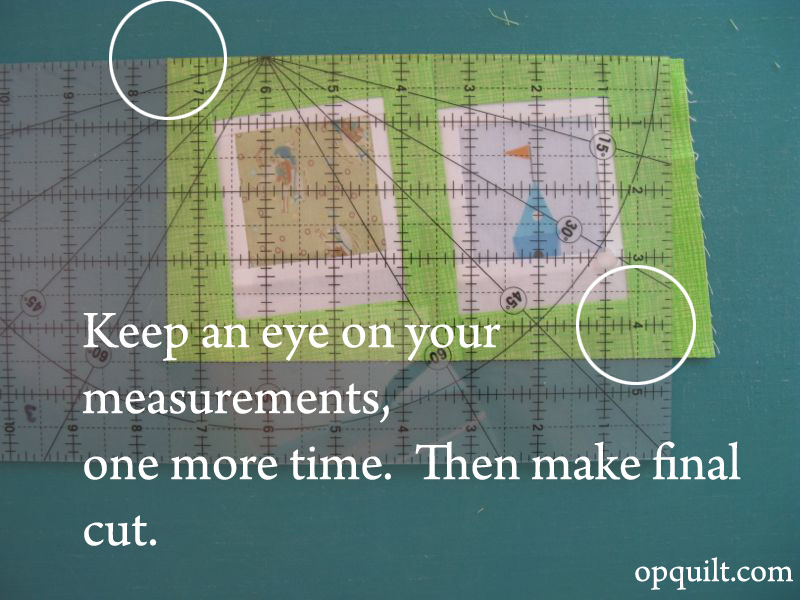
At first, I flipped it around again, as I’d only have to pay attention to one last side (shown above).  But after a while I became confident enough to slice off the top, >flip<, slice off the right and top edges again, then >flip< cut the last edge off.  Which is what I’m doing in the picture above.

I took this photo mid-cutting to show you how the block can feel skitty-wampus when you look at the first two cuts.  But then you slice off the two side edges and you are Through The Forest Again!  In the arrangement of my quilt, I used 28 blue double-Polaroid blocks and 24 green.  Make enough that you have some to play around with, and if you like decorations on the back of your quilts, include some for that too.

NEXT POST:  Putting the quilt top together, and one day closer to my surprise giveaway.
Creating · Tutorial

Portuguese Tile Quilt

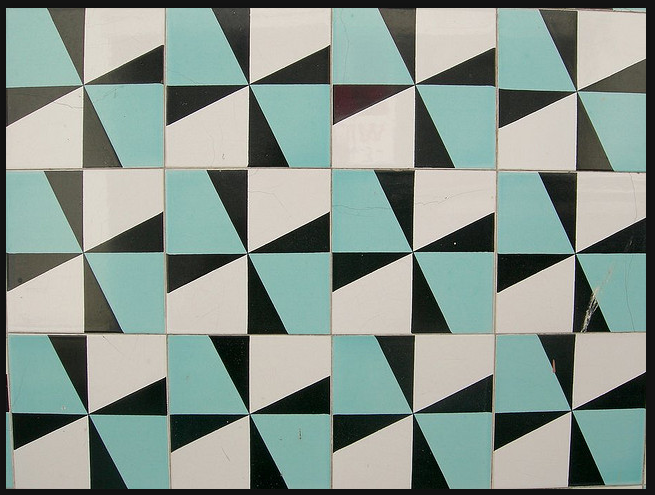
I started with this picture of some tiles from Portugal.

Then I mocked up a quilt in my Quilt-Pro 5 program.  I mapped it out with 8″ squares, set 6 across in 6 rows, with a 4″ border, yielding a 56″ square quilt.

I’m using the Madrona Road fabric, as I’m always wading into my outdated stash to try a new quilt, and wanted to take this new line for a test drive.  Because of the barn and the truck, I thought back to my days of Amish quilting and went with black for that windmill blade, just like the tile in Portugal, shown above.  Besides every quilt needs some contrast and this line reads to me, for the most part, as in the middle-intensity value range, a favorite of mine and nearly every other quilter.  (I have to work to get the darks and the lights into my stash.)

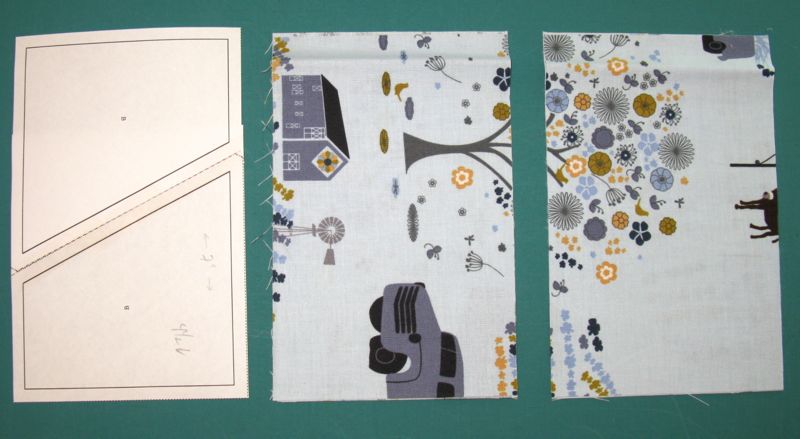
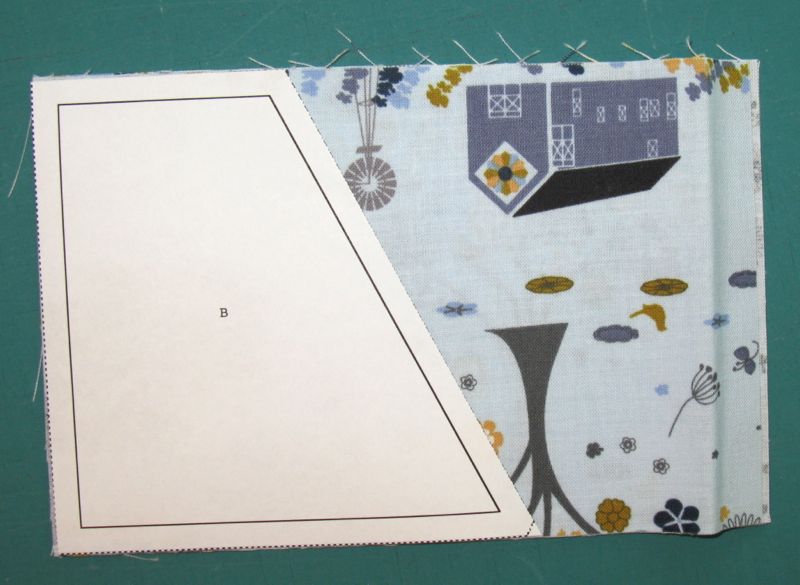
To cut out the large pieces, I laid out my fabric RIGHT SIDES UP, and cut a rectangle that was 7″ by 4 1/2″, then lay the template on the rectangle (see picture below), and sliced it into two. Here’s the template: PortugueseTileWindmilltemplateSM.

Print it out so you’ll have the pieces to use as a guide for cutting.  (Okay, full disclosure.  I at first didn’t lay the fabric RIGHT SIDE UP, and have quite a few pieces that are backwards, ensuring that I’ll be making this again. So try not to screw up like I did.)

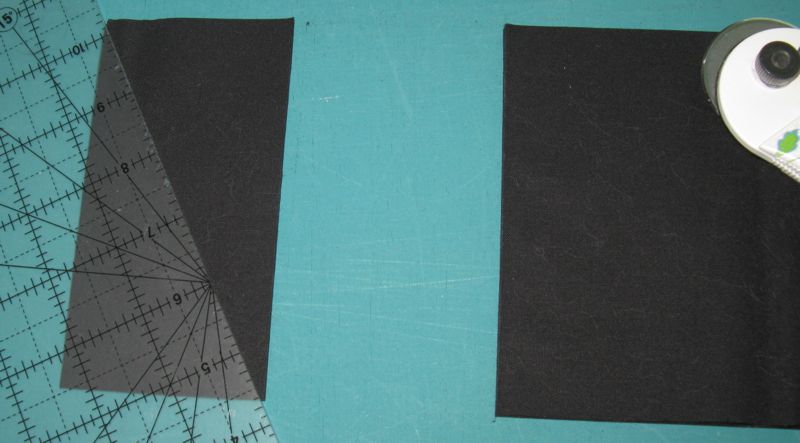
I could have either cut all the black pieces according to a template, or figured out a way to make it easier.  I went with the second.  Cut a rectangle 5 3/8″ by 2 3/4″ and then slice it from corner-to-corner, diagonally.  You will have dog ears you’ll have to cut off, if that’s a consideration for you.

Cut 72 pieces of the blue line, 72 pieces of the pink/orange fabrics and 144 black triangles (that’s 72 rectangles, cut in two).

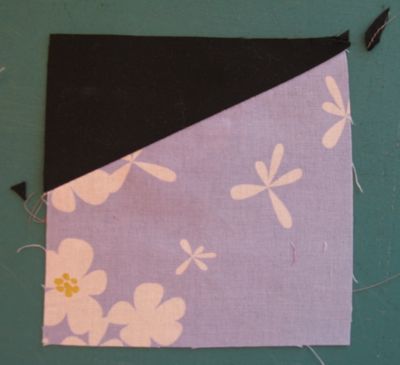
Lay a triangle across the larger piece.  To get it lined up, put the black on top, with the left point sticking 1/4″ out over the edge.  Don’t worry about that right-hand side longer point.  Stitch.  Press towards the black.

Now lop off those points, by truing this block up to 4 1/2″ square (see below).

I’ve laid them out on my  pin wall.  I don’t have enough of them to do the REAL work of laying them out, because I’m headed downstairs to make some corn-shrimp-coconut soup for dinner, but I’m thinking I do want to mix up the different types of fabric within the pink/orange group and the blue group.

Thanks for you nice atta’ boy comments yesterday.  I took to catch up on the speeches from the Democratic Convention (remember, I’d assigned the watching of these to my students, so feel like I need to keep up), and cut and sewed my cloth.  It’s amazing the difference a day makes.  I liked what Betty said, that this exhaustion must be in the zeitgeist or something.  But after a break of a day, I may even feel like grading, knowing I have this little project to come back to throughout the day.

100 Quilts · Quilts · Tutorial

Village Houses: Joybells Ring in Heaven’s Street

When I was at our sewing group, Lisa brought out her “house” quilt, the earliest group quilt that we’d attempted together.  You saw hers.  Here’s mine:

Quilt #28

We had the common fabrics to use of the fairy print (on navy) and the pink striped (shown in some of the houses).

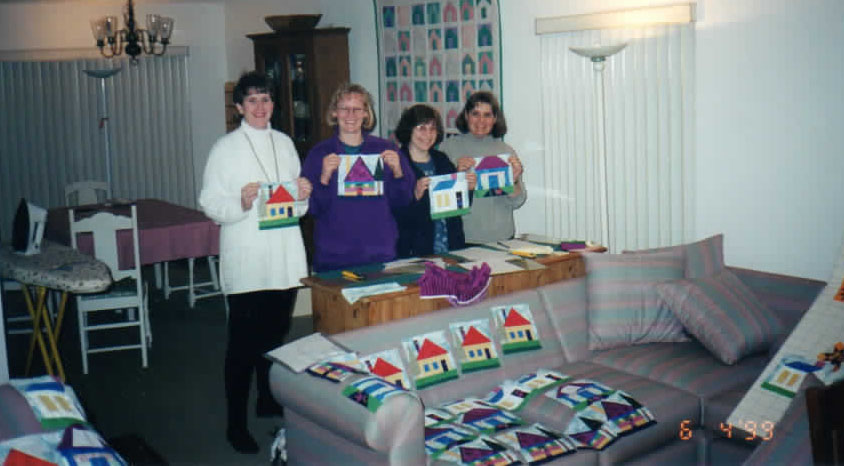
And here we are: Tracy, Lisa, Susan (who has moved away) and me, all holding up our quilt squares.  I love how they are all laid around the sofa everywhere.  And I love seeing that houses quilt in the background (#14 on my 100 quilts list, made 10 years earlier in 1988).

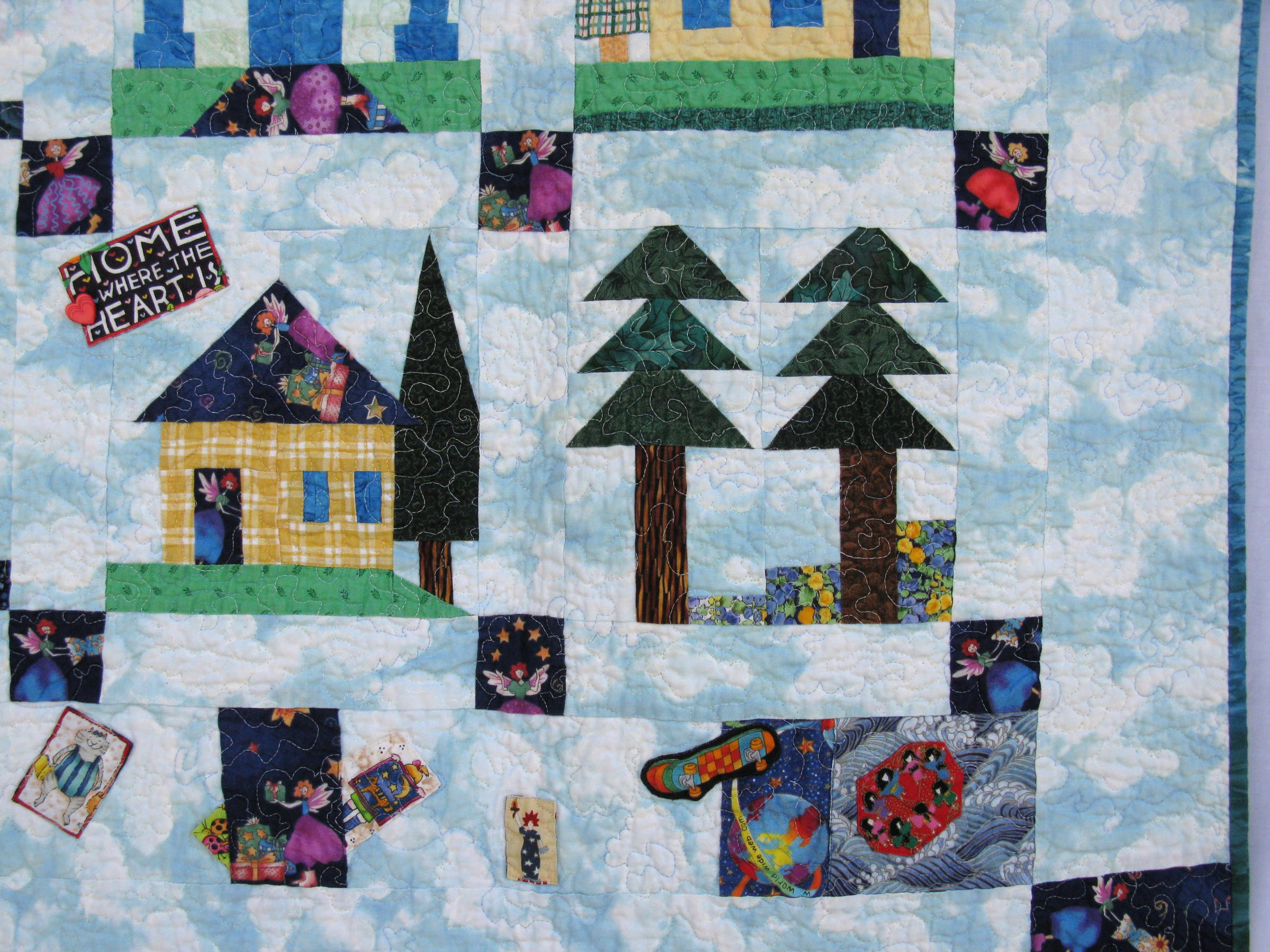
Detail.  I wanted it to have bits and pieces of a neighborhood so I included those things in each deep border above and below the houses.  I guess at the time it had significance, as I notice some World Wide Web fabric there (the earth globe above).  The internet was just getting popular then — seems like a millenium ago.

This one’s my house.  I guess my fairy was tired and lay down on the front walkway.
I entered into Road to California in 2000; here’s what I wrote on the entry form:

As I was designing all the houses, I tried to include a wide variety of styles, to illustrate the diversity of a street in Heaven, a celestial neighborhood that would be knit together in love and faith. In the upper and lower borders, I placed activities that the people in the houses might do: getting together with friends, outdoor activities, celebrating holidays, and of course, quilting.  The name of this quilt comes from an old saying that explains that when a child is given a home, “Joy-bells ring in Heaven’s street.”

You know those things you buy at quilt shows, like the panel above.  Whenever are you going to use them, if not for backs?

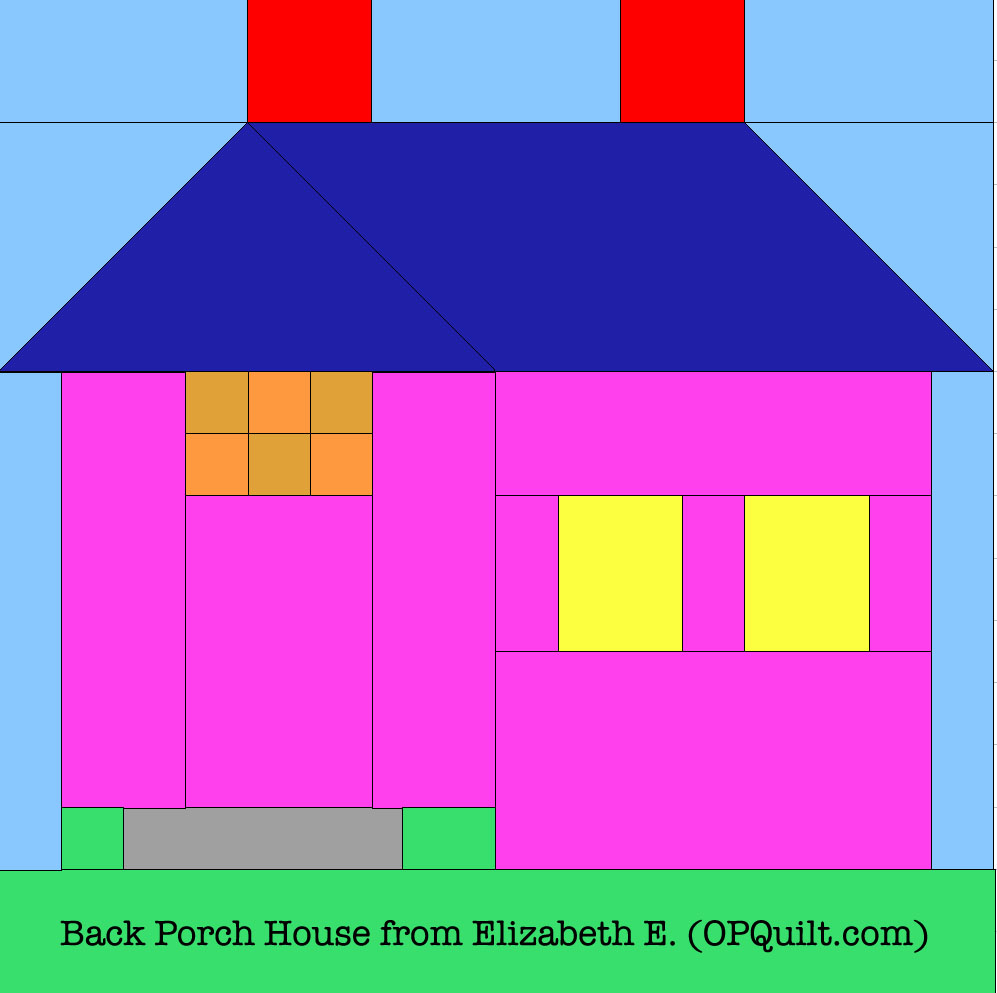
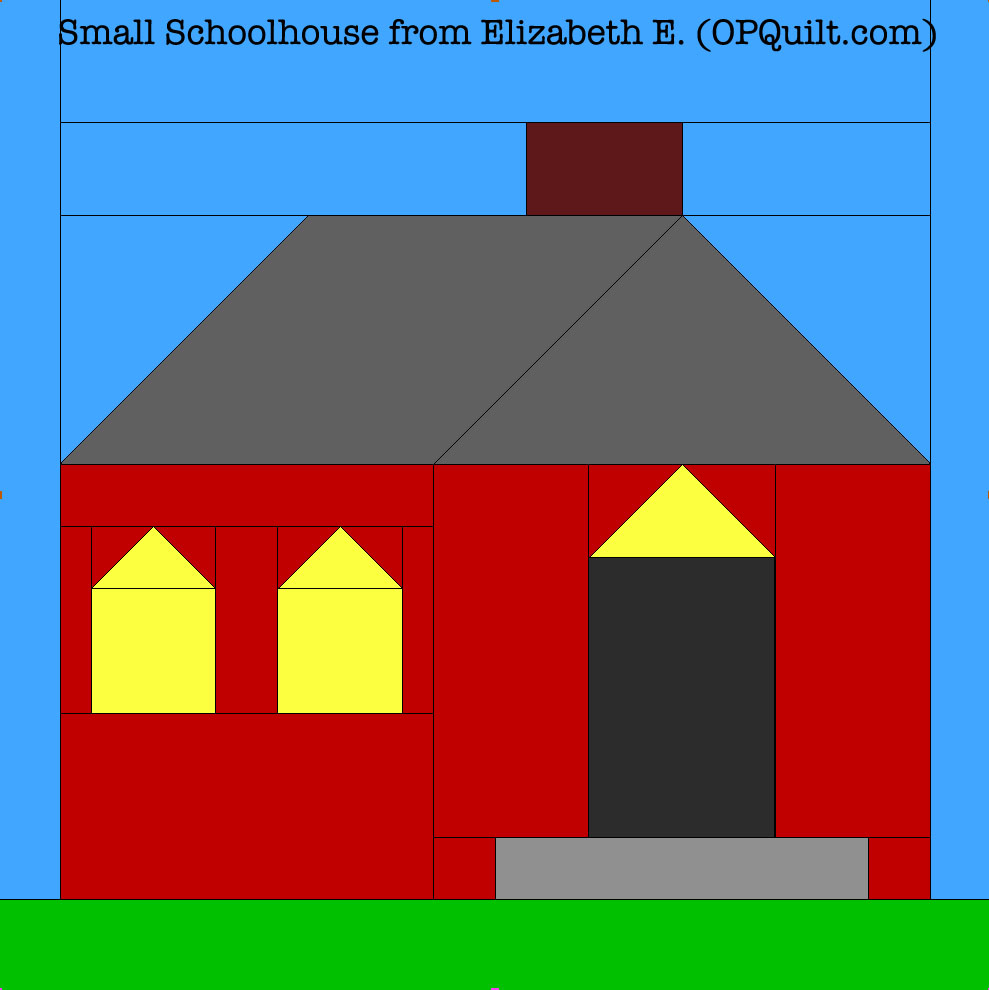
Okay, here’s a few of the houses.  The links underneath each illustration are templates for each house.  They are PDF download files, but I’d ask you to remember that since I was a novice at this software at that time, they aren’t perfect.  Some have a lot of pieces, others are more streamlined.  A mix is best, if you’re making a village.

1930s Prairie House ESE

BackPorchHouseESE

HouseintheVillageESE

RiversideAveHouseESE

SmallSchoolhouseESE

StLouisHouseESE

Classes · Tutorial

June Flowers/Tulip Tutorial

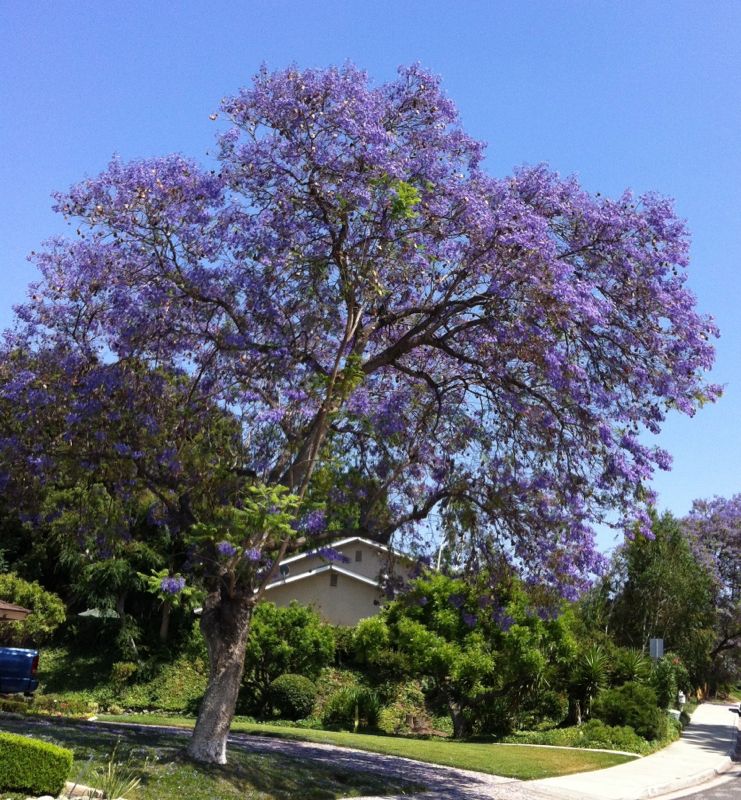
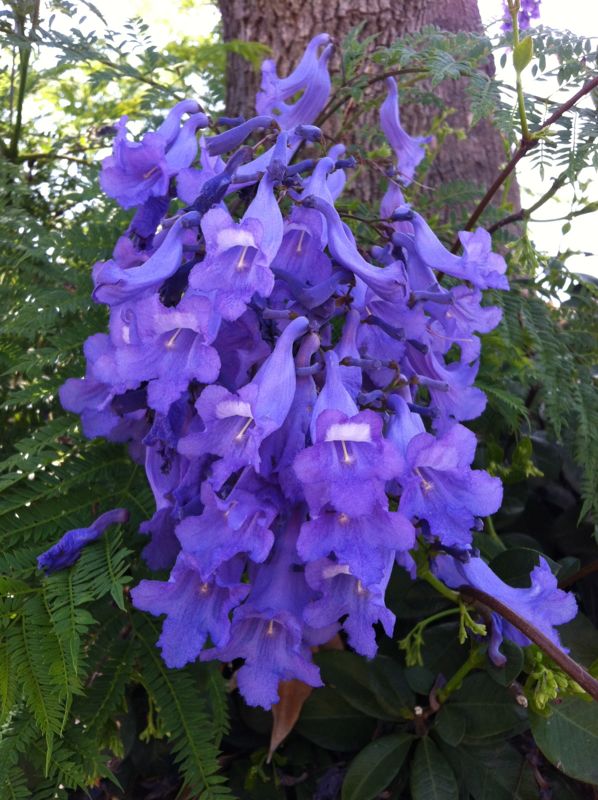
Every June the jacaranda trees put on their bluey-purple-periwinkle display of flowers, and we all wander around wondering how we got to be lucky.

And like clockwork, every June they dominate my photos — exquisitely colored blossoms on hills, around bends while the rest of the year these trees blend into the landscape.

And I’m heading to a class with Becky Goldsmith (the designer of the quilt I did last year: Come A-Round) and we’re doing a flower in class, so I chose a night-blooming plant for color inspiration for fabrics to pull.  This comes from the Sherwin-Williams paint website “Chip It,” where you load up a URL of a photo and they provide their colors.  I just like how it looks, and it helped me pull from my stash.

So when it came time to decide on a block for the Far-Flung Bee, that was easy: a flower.  I also wanted something of simple construction (9-patch) because of my fabric requrements–I wanted some fabrics with text to be incorporated into the blossom.

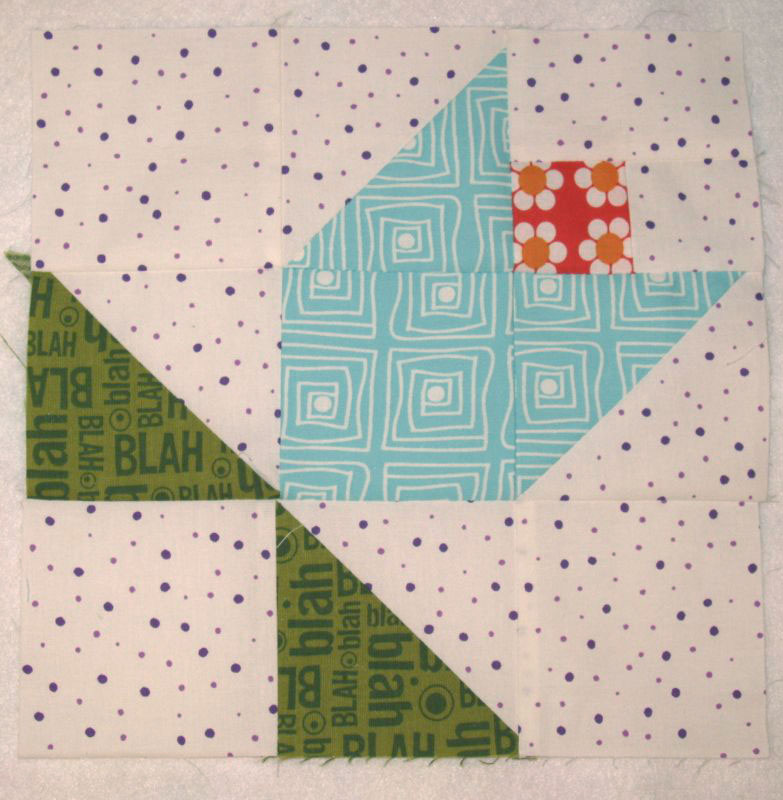
Here are two versions of that tulip/flower block, and the text fabric is used two different ways; one is in the background fabrics and the other is included in parts of the flower.  That green fabric saying Blah Blah Blah is a treasure for me as my friends Bert and Rhonda sent it to cheer me after my surgery in December.  I’ll always think of them when I use those fabrics (thanks, guys!).  So here’s how to do it.

For one 9-inch flower block:
Cut four 3 1/2″ squares–3 from the background fabric, 1 from the flower fabric
Cut four 3 7/8″ squares–2 from the background fabric, 1 from the flower fabric, 1 from the leaf fabric
Cut one 2″ by 3 1/2″ rectangle from the background fabric
Cut two 2″ squares–1 from the background fabric and 1 from the stamen fabric

Working with the 3 7/8″ squares ONLY, place one background square on each of the flower and leaf blocks.  Draw a diagonal line from corner to corner, or if you have the Quick Quarter tool (shown above), draw a line on either side.  You’ll stitch just inside this line (towards the center), or if you have drawn a single diagonal line, you’ll stitch a SCANT quarter-inch seam on either side of your drawn line.

Cut from corner to corner, inbetween your stitching.

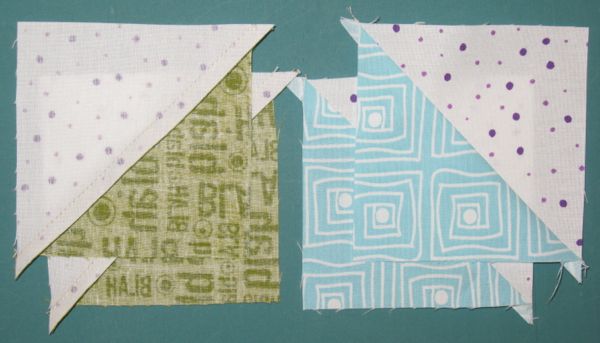
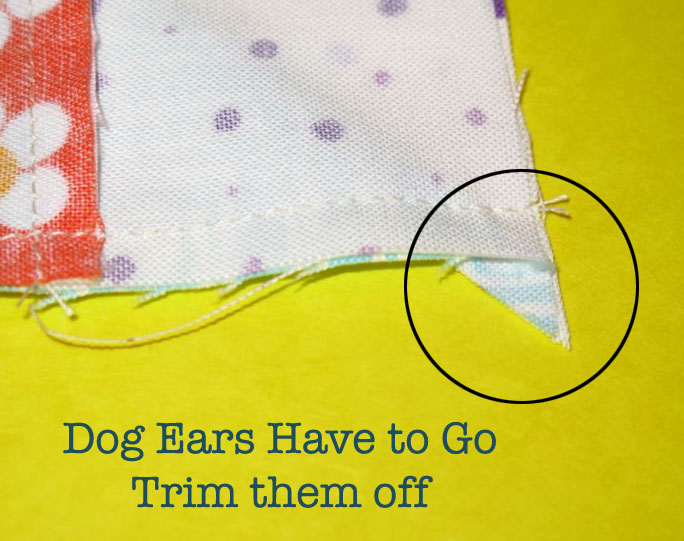
Press the seam allowance away from the background triangle, as shown.  Notice those dog ears on the corners? We’ll cut them off later.

Working with the 2″ square blocks and the one rectangle now.  Seam the stamen fabric block to other 2″ background fabric block.  If you’re like me and getting up and down to the ironing board gets tiresome, just finger press that seam towards the stamen fabric.  Then seam the rectangle onto this unit.  Okay, now go to the ironing board and press that flat.

Lay everything out. Smile, because it looks cute. AND it’s fast!  Seam them together in rows, working across the block.  Keep track of which direction that bottom leaf goes.  I did it wrong twice.

Now it’s time to trim off those dog ears.  (I actually trim them as I seam the pieces together, not waiting until a final moment, but this is just a reminder to get them off now).  I use that old fashioned tool that works so well: scissors. Snip snip snip while holding it over the trash can.

  I’ve flipped it over to show the directions for pressing.  Basically you want to have the seams going in opposite directions so they’ll “nestle” together when you go to sew the rows.  Lay it out again, the sew the final seams, joining the rows.  Double check that bottom row twice, so you don’t sew it in wrong (like I did).

You’re finished with one block.  Eat Your Vegetables, by laying a ruler over it and truing up the block to 9 1/2″.  It will sew down to a finished 9″ block in your quilt.

Here’s a mock-up of one layout, using 1″ sashing and corner squares.  I’ve also thought that since it’s based on an easy nine-patch block, that a grouping could be made of half-sized (4 1/2″ finished) blocks that could be interspersed for a more random look.  That’s for another day.

Enjoy your spring flowers!