Quilts · Something to Think About

One Life • Many Lives

ESE twoyrold

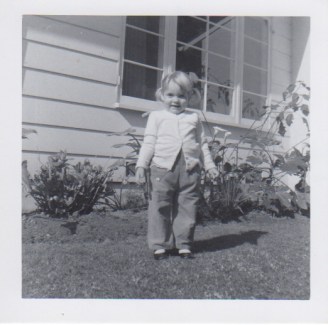
This has to do with quilting, but it doesn’t start out that way.  It starts out this way, with a two-year old girl posed on her family’s front lawn.

Then all of a sudden, I was a young mother, then a mother of three-soon-to-be-four children, then a grandmother.  When I was that young mother, I took a class on how to make a quilt.  I was a Clothing and Textile major in college, so I knew how to sew, but I thought there was something extra you had to know to make a quilt.  And with one young child at home, I had absolutely no extra time (or so I thought then) but figured I could squeeze it in somewhere.  Between then and when the fourth child was born, I made about eight quilts: each child had a baby quilt, I had a quilt for the bed, and I’d even made a baby quilt for my sister and one I sold in a consignment shop.

Mothering was that life.  That was what I chose and on balance, the kids seem to have turned out all right. But somewhere in that life as mother, I also chose a life as a Mary Kay Lady and a seamstress– I was always sewing, making all the outfits the children and I wore.  And somewhere after I finished my undergraduate education (I was on the 28-year plan), the number of quilts I made took off like a rocket, blogging happened, rotary cutting happened; things just changed.  Again.

I’ve been thinking about this because of two experiences:
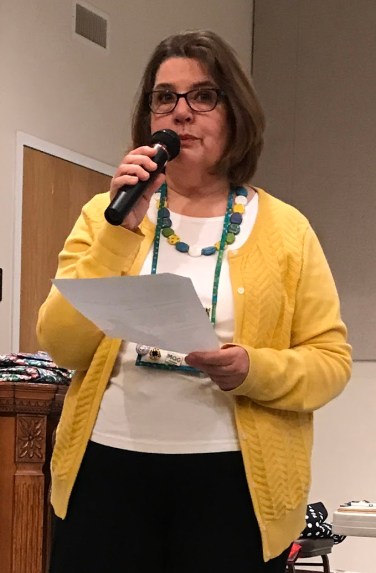
ESE at Trunk Show

The first was the presenting of my quilts at a trunk show at my local guild.  I reviewed all my quilts, and each represented some life I lived at the time of the making of that quilt, from the simplest beginning quilt (a small whole cloth quilt with the knots on top) to the recent finish of The Circles Quilt, with all the blocks I designed.  It was a satisfying evening and I was happy to share some of my life’s work.

The second was when I flew home last week after visiting my mother for her birthday, and I stitched improv appliqué blocks while on the plane.  The young man next to me was reading DeLillo’s White Noise, a book I had read in grad school.  The title fit the book perfectly, and that was about the only comment I could make when he and I visited.  I realized he saw this grandma-person stitching away and that was the only life of mine he could see.  But, I wanted to say, I’ve had so many other lives!

So if all my lives were strung together as pearls on a necklace, what might I see?  Would I see only the failures, the quilts I gave away, the moment I lost it and yelled at a child?  Would I see the classes I had to drop, the cosmetic saleslady I could never be?  Or would I focus more on the pearls burnished from the striving and from the use: a creative life, a life with laughter, traveling and family. A life with happiness, because in addition to all that, I get to walk into my sewing room every day, thread a needle and get to making.

tiny nine patches

Quilts · Something to Think About

Three Mini Quilts and a Few Thoughts on Deliberate Practice


RoadFriendsHouse
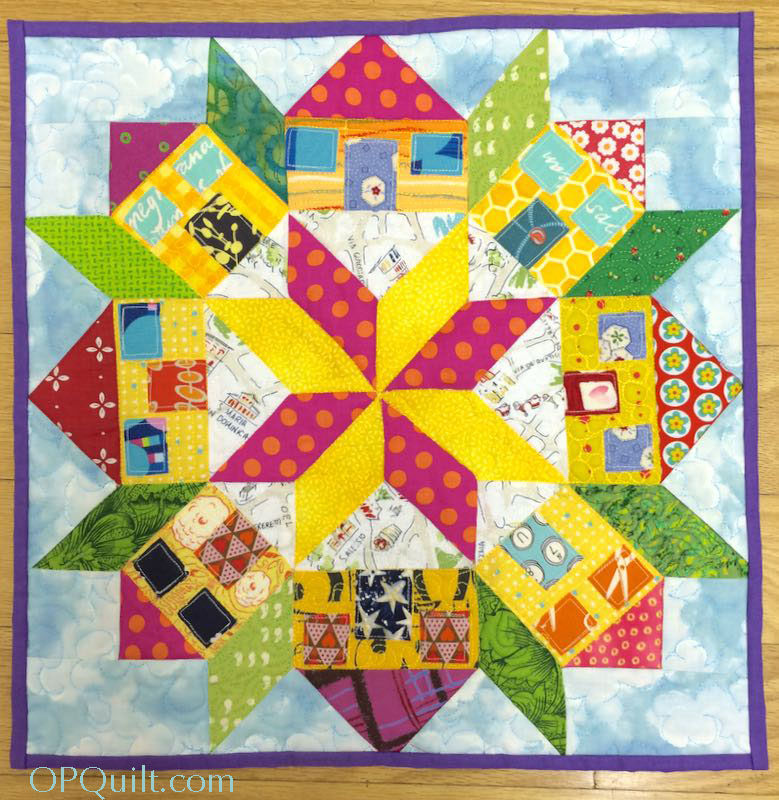
The Road to a Friend’s House is Never Long, Quilt #159

I started this July 2015, and you know what happened to me shortly after that, so it was nice to get it fixed up and quilted, because I’d had a purpose in mind: a gift for a friend.

RoadFriendsHouse_back

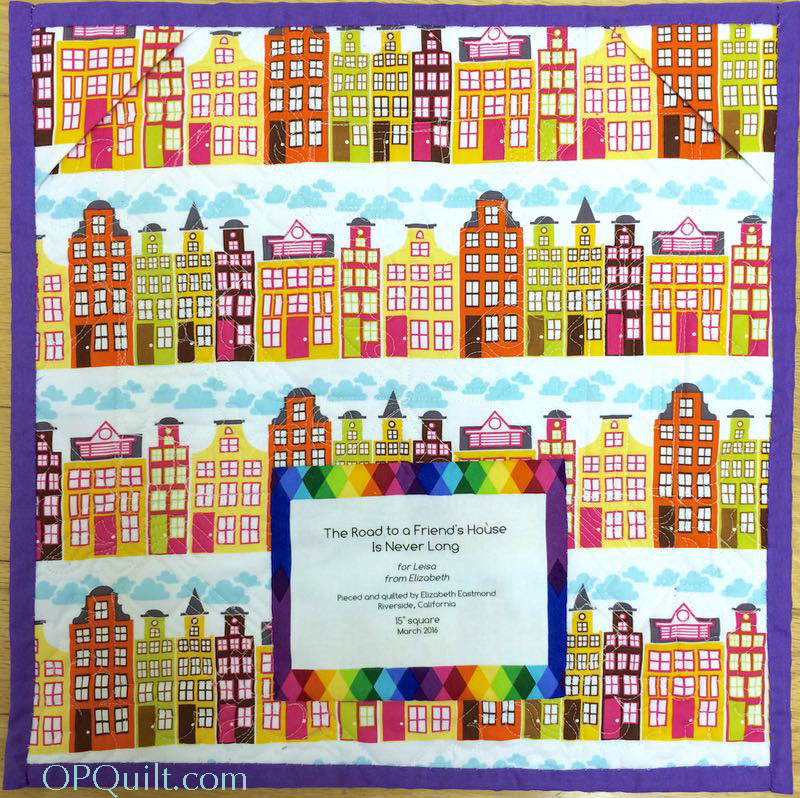
Leisa likes it!  Pattern coming soon.  I used the new Northcott labels I bought at QuiltCon.  I just cut them apart, backed them with freezer paper, and ran them through my printer; see the complete how to under the tab “Tutorials,” above.

Thread Doodles_front
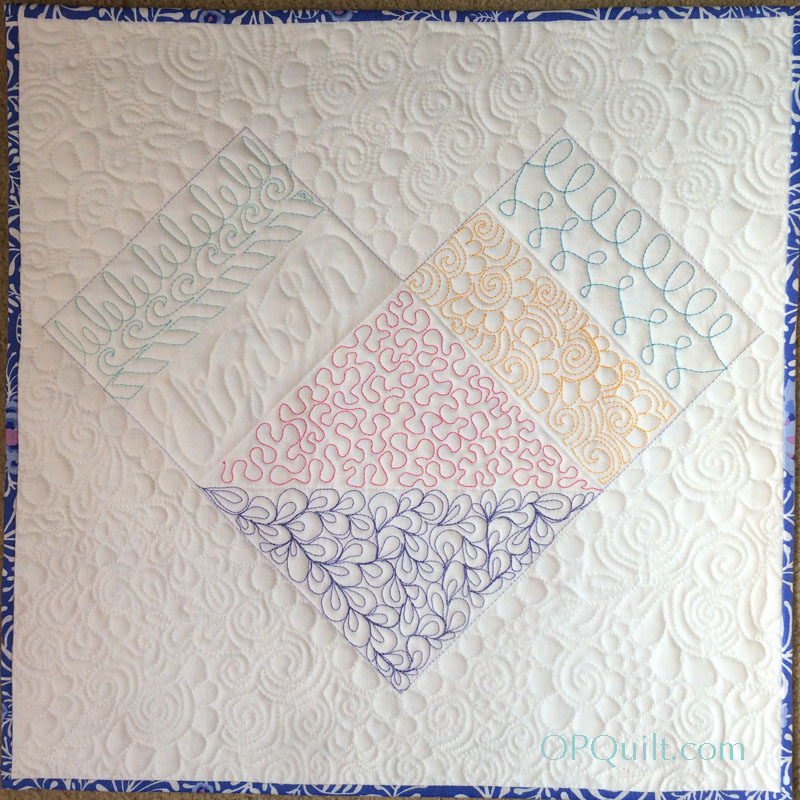
Thread Doodles, Quilt #160

And then there’s this one, a mini quilt made as a class sample for the Free Motion Quilting Class I’m teaching in late summer at Quilter’s Cocoon.  I had to think of a way for the students to practice their stitches, yet display what they’d learned in a pleasing way.  As soon as they master one of these stitches, I’ll have them stitch it onto their own class sample.  They may want to finish it all up that day, or may want to add to it as they get better.  Thread Doodles_back

I’m big on naming my quilts.  Another Northcott label.  After they are printed, I cut a square of lightweight interfacing and fuse it to the back the “light” section of the label so I won’t see the fabric underneath.

Electra Magnetic_front
Electra Magnetic, Quilt #161

I seem to be finishing up quite a few things lately, a nice change from the months November to February, where I felt swamped all the time, unable to seemingly get to anything.  Do you have times like that–like you see everything around you and just can’t get to it at all?  Where you are climbing, climbing Mt. NeverFinish and wish you could find the summit?  That’s why these minis feel like a success story to me.  Electra Magnetic_back

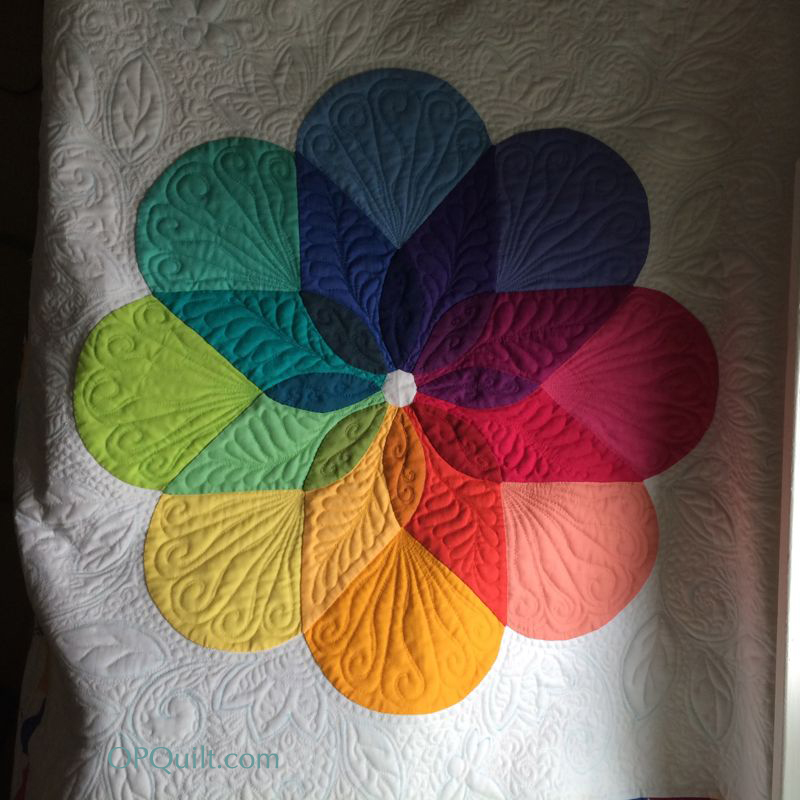
So, with all my rainbow-type quilts this past year, I’ve about run out of names.  Combine that with the funny comment I got on one of my quilts that they thought it looked like Hal the computer from the Space Odyssey 2001.  This quilt might also suffer from that comparison, so I thought I’d go with it.  The electromagnetic spectrum is all the colors, from those that we can see to those that we can’t; they call it “wavelengths, both visible and invisible.”  Okey, dokey.  So I feminized that idea and came up with Electra Magnetic, mother of Hal.

I’m still working on these patterns, and should have them out shortly.  Well, maybe not this week;  I’ll let you know.

But let not’s stop there today.  I have Brain Pickings in my Bloglovin’ Feed, and occasionally they hit a streak of book reviews on topics that interest me, and recently they did a review of Ursula LeGuin’s latest revision of her masterpiece on creative writing, Steering the Craft.  Brain Pickings references her written piece “How do you make something good?” and notes that:

LeGuin Quote1

Isn’t that also what quilters deal with?  We can make a decent quilt from stuff from the garage sale or someone’s basement (with that embedded fusty smell), but why not go for better ingredients?  We are surrounded by loads of high quality quilt fabric.  Perhaps instead of focusing on accruing endless supplies of this good fabric, why not focus on being good?  That means getting in those oft-cited 10,000 hours of practice, but as Joshua Foer noted, sometimes just making and making doesn’t bring us to the place of making something good.  Foer Quote 1

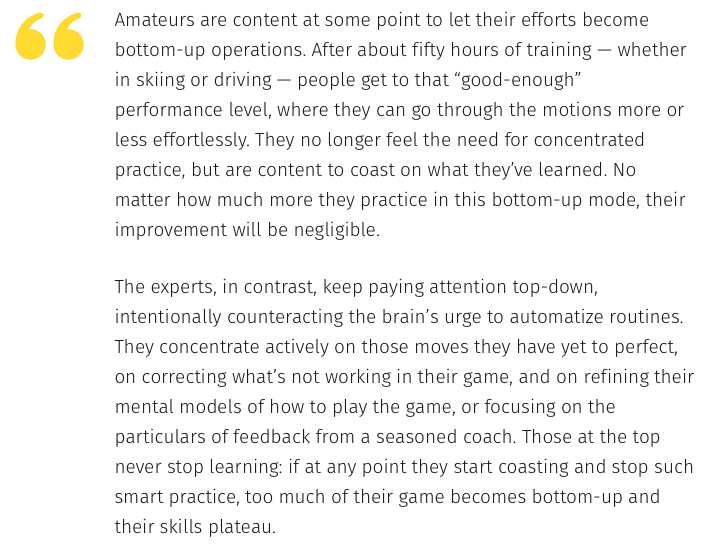
According to Joshua Foer, this is called hitting what is called the “OK plateau.”  That’s when we are just going through the rote mechanics of quilting, making quilts of only rectangles, or traditional fixed patterns in a loop that’s known as thinking from “bottom-up,” where we are good-enough, automated, rote practices to get our work done.  Yes, even those modern improv quilts with their fluid patterns can get stale.  Daniel Goleman notes how we can get stuck here:

Goleman Quote1

Foer also emphasizes this point: our deliberate practicing must be hard for us in order to engage that higher focus of creativity.  I, like many of you, can cut and stitch until I’m so bored I can’t slice one more piece of fabric or sew one more HST.  I’m falling right in line with studies that indicate that about four hours of concentrated deliberate practice is about the most amount of time we can do anything well.  At that point, we have to take a break and do other things.  Perhaps that’s why we are sometimes distracted by a new quilt, or a new design, or a new piece of fabric, as we try to restore our ability to refocus.  Perhaps we just need a break, in order to deliberately practice well.   But what I learned from these authors is that when I do come back to my quilting, I must “counteract the brain’s urge to automatize” and actively concentrate on what I’m doing.

So take a break, read that magazine, scroll through your IG feed, and then get back to it with a determination to make it good, make it better, and to fully engage.

Quilts

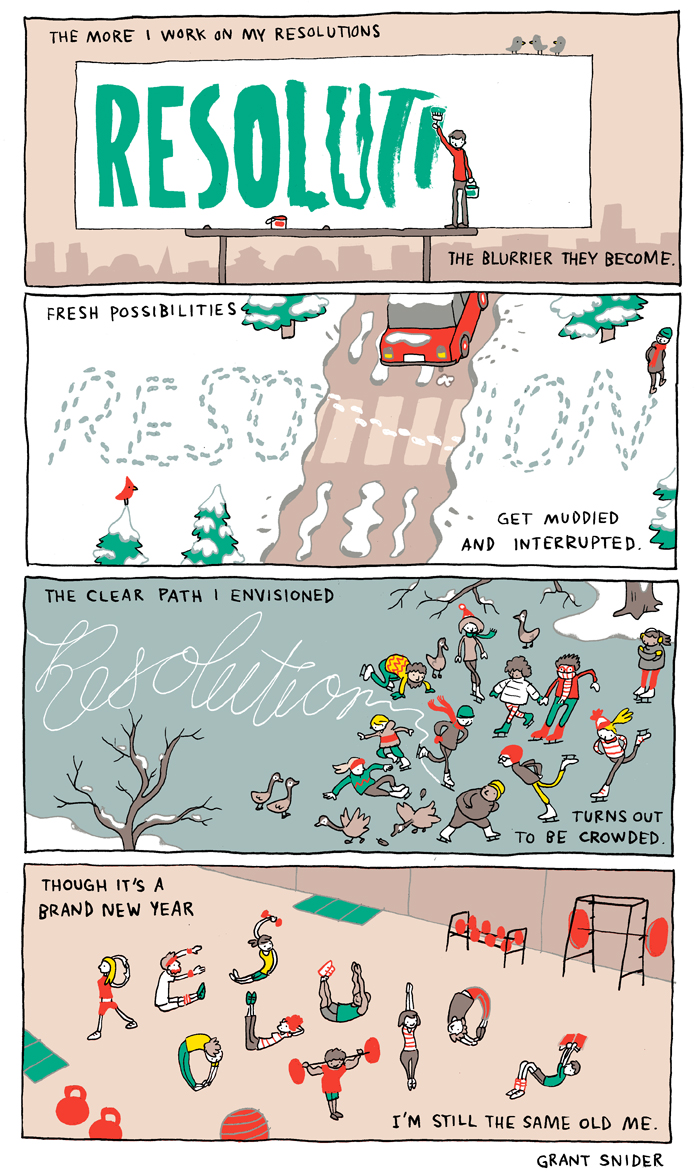
Resolutions vs. Being the Best Self I Can Be

resolutions-web

from *here*

 I read this article, “Resolving to Create a New You”  in the New York Times last week.  I cut it out, kept it by my sewing machine and read it all week long.  I read it again today and finally, finally, I think I understand it (the author, Ruth Chang, is a professor of philosophy at Rutgers University).  It helped that I listened to Ms. Chang’s TED Talk about  “How to Make Hard Choices” (take the time–it’s enlightening).

SeptDec2014 Goals

Resolutions, even those quilting resolutions of Finish A-Longs and their sort, have a problem because basically we are trying to (as Ms. Chang put it) “to steel our wills to do what we already know we should be doing.”  Yes, I know I should finish Quilt XYZ and yes, I still make myself a list of quilts every quarter and hang them on my cupboard door.  Sometimes they are helpful, like when I don’t feel like doing much.  It can give a goal and a direction.  But I have two quilts I have had on that list every quarter for the past two years.  They are hard quilts.  I don’t quite remember what I want to do with the “Good Luck Quilt,” one that I dreamed up but now have no idea what I mean, nor do I know what I want to make with the fabric that I spontaneously bought in a stack from an online quilt shop one summer’s day (and which I call “The Mexcian Day of the Dead Quilt”).  Each quilt has its appealing qualities.  Each is a quagmire.  And every quarter I resolve to finish them.

Layer Cakes Jelly Rolls

Ms. Chang says instead of looking at resolutions as just another set of  Things To Do, we should view these as opportunities “to create ourselves anew.”  Each of those hard choices between two sets of alternatives, gives us a chance to “make ourselves the authors of our own lives. Instead of being led by the nose by what we imagine to be facts of the world, we should instead recognize that sometimes the world is silent about what we should do.”  Nobody cares if I ever start my Good Luck Quilt.  Or cut into that layer cake or jelly roll.  And even if you do make it and post it on some blog and someone has rounded up prizes for what you finish, you aren’t winning a prize because a quilt has taught you a new skill.  You aren’t winning a prize because you spent more time on the borders that you did on the quilt (like my current tortuous creative project).  You are only winning a prize because you finished something and your name was selected by Mr. Random Number Generator. And if you ask me,  an online app that can “lead us around by the nose” is probably NOT the best way to develop yourself as a quilter.

Instead, Ms. Chang suggests, by making hard choices, “we not only create value for ourselves but we also (re)create ourselves. . . . to reflect on what kind of person we can commit to being when making those choices.”  So whether it be challenging yourself in a new quilting endeavor, or resolving to become the kind of person who would rather go on a walk than eat a brownie, or the kind of person who can set aside the digital screens of her life in order to concentrate on the small people near her, if we can commit to that task, generating our OWN reasons for choosing that direction, we “make ourselves the authors of our own lives.”   We won’t just make another “Scrap Vomit” quilt because everyone else is.  While we might choose to use up our scraps, we’ll do it in a way that suits us, that refines us, that contributes a little bit of something to the inside of us.

She ends her article by saying: “So in this new year, let’s not do the same old, same old; let’s not resolve to work harder at being the selves that we already are. Instead, let’s resolve to make ourselves into the selves that we can commit to being.”

Dive into the quilt quagmire and make that hard quilt.  It may take you three months or three years, but you will have become a different and better self for having tried it and finished.  Use that pattern in the drawer, but make it up in fabrics you envision.  Go ahead and make a quilt that mimics the one online, but make it better.  Make it different.

Make it yours.

Colorwheel Blossom_inner quilting