Quilt Shows

Pacific International Quilt Festival • 2019

But first!

CitrusBelt_1.jpg

I’ll be speaking and giving a workshop locally, at the Citrus Belt Quilters Guild.  The lecture, titled Abecedary of Quilts, will be on Friday morning, October 25th.  The Workshop, which is a Two-for-One class (Home, Sweet Home and Merrion Square) will be Thursday, October 24th.  This is my last local presentation, and the last for this year; I’m excited to meet all the quilters at the Citrus Belt Guild!

GillianTravisTownscapes

Now on to PIQF: Pacific International Quilt Festival.  I’d been reading Gillian Travis’ blog for some time, enjoying her small quilts, generated from her photographs from her travels abroad.  When Susan took her class at Road, and recommended it, I wrote to Gillian, asking if she ever taught in the States (she’s British).  Why yes, she replied.  I’m teaching at PIQF.  I hopped on the computer and registered for her class.

GillianTravis_1
GillianTravis_1

One of the first quilts she showed us in class, was the one above, based on a visit to Burano, Italy.  I had similar photos, and was really excited to make this (the above is a composite of several photos).

GillianTravis_3
GillianTravis_3
GillianTravis_3b
GillianTravis_4

Gillian provided patterns for us to work on smaller versions of Burano, or smaller version of a Yorkshire Village.  I chose Burano, and above you see my progression from tracing to placing to fusing down.  I got so far as to fuse it to my background (the blue in the upper left corner), and right now, it’s still folded up in my bag, still unpacked.  I’m looking forward to unfurling it and getting back to work on it.  We pinned our class’ versions up on the wall:

Some even got to making the white frames around the windows.

PIQF Lecture1I really enjoyed this class, and was happy to move from there, to her lecture that night, where we enjoyed more visions of her work and her stories.  My friend Leisa and I also attended two more evening events: David Taylor’s lecture on Wednesday night, and the Fashion Show of Creative Garments on Friday night (photos are up on IG), which we both really enjoyed (especially the narration by Rachel Clark).

PIQF_fashion show.jpg
PIQF_LeisaTracy

Leisa (L) and Tracy (R): we went around on Thursday and looked at the show together.  And how about that PINK ribbon, behind their heads.  Now there’s one I could covet.

PIQF_Pink Ribbon
PIQF_TracyCox5

Here’s the one that everyone wants: a blue ribbon.

PIQF_TracyCox1

And Tracy won this for her quilt Sew She Did, which she designed, pieced and quilted. Congratulations, Tracy!

PIQF_TracyCox2
PIQF_TracyCox4

A closeup of one of the blocks.

PIQF_Annularity

On Saturday morning, I went and said good-bye to my two quilts that were in the show.  Annularity (above) was in a nice placing, all by itself in good lighting.

PIQF_Ladybird

Ladybird (above) also was placed well, with okay lighting.  I talked to one woman who gave me a full (and lovely) critique of what was going on in my quilt.  It was nice to talk shop with a complete stranger.  I also saw (and got a photo with) Roberta Horton, who really launched me from beginning quilter to serious quilter.  I’d taken classes with her at Houston, and I was a complete fangirl when meeting her.

As someone who has traveled to Houston, QuiltCon, Road to California, Palm Springs, and Virginia shows, the last two Mancuso Brothers shows, as well as to Long Beach, I have to say that some venues have real difficulty with lighting (all the Mancuso shows and the Long Beach).  The entire show felt like it was in a greenish cast, and not nearly bright enough.  My husband told me he could see it in the photos I posted on Instagram.  That first night, halfway through, everything all of a sudden went brighter, and I realized they hadn’t “warmed up” the lights.  So none of the photos I took at the beginning are any good.

PIQF_TanyaBrown.jpg

One of my quilt heroines, Tanya Brown, whose work I have followed for many years, had Cranky Claus hanging in the show, along with Life Nouveau, but they were horribly placed.  She gets into Houston every time, so I was suprised where they’d hung her quilts.  It made me belive that maybe the organizers/hangers didn’t know who she was?  My friend Lisa has helped hang Road to California for several years, and I know the effort that show goes to in displaying each quilt to its best. Their lighting is very good, as well.

The other issue I had was that some quilts got hung that shouldn’t have been: poorly designed, poorly made, odd choice of materials or subject.  When speaking with one of the Mancusos, I asked how many quilts were submitted: “Roughly 450.”  How many quilts are accepted? “Those that meet our standards.” (evasive) I pressed on, asking, How many quilts are rejected? “2-5%.”  So then you hang nearly everything. He mumbled something about that standards business again, but I had my answer.  I did smile when I saw that their webpage listing their award winners didn’t use the photographs from their contest venue. (I saw most all of these.)

I decided I would focus on the fact that my quilts hung in the same show as Tanya Brown and Tracy Cox, rather than my quilts hung in the same show as the fleece-lamé-fur-shells beginner’s quilt, above.  I was there once, at the place where this quilter was, and for many years, every entry of mine into quilt shows was rejected. I appreciate it when the judges a) limit the number of entries, and b) jury the quilts into the show.  It appears that this year at PIQF there was very little jurying going on, which makes for an uneven show quality.

Last Whine: when are these older shows going to come into the modern age and put Instagram names on the placards?  QuiltCon has done this for years, and it makes it easy to tag people when posting. Okay, on to the fun.

Tannenbaum.jpg

One highlight was going to the show Friday late afternoon when everyone had cleared out.  We had the vendors to ourselves, and got to spend some time talking with booth vendors. We may have purchased the pre-cut kit to make Tannenbaum, but also vowed not to pressure ourselves to get it done for 2019.

We also participated in the Bernina giveaways, the vendor mall (where I saw some old favorite booths — hi Cecile!), and met and chatted with new quilters.  We enjoyed the evening lectures/fashion show and came away with new projects to sew, as well as good memories.  I need to go and unpack and sort and pre-wash my bright tangerines and indigo blues (I was on the hunt for these fabrics) and decide what to do with my length of kantha fabric, but I wanted to get a post up quickly, while it’s still fresh in my mind.

Happy Quilting!

European Patchwork Meeting · Quilts

European Patchwork Meeting • Final Post

All posts in order are on the European Patchwork (Carrefour) page.

This has a billion pictures, so get ready to scroll.  I need to wrap this up and bring my head back to what I’m doing in real life.  This is the final post of my visit to the European Patchwork Meeting in the Alsace region of France, this past September.  I have a main page that lists all the posts, in case you come at this from a side street on the web.

This quilt show, or meeting, was held in four different towns in France, and I’ll wrap up the first town, Sainte Marie Aux Mines, then move to St. Croix Aux Mines, and finally Liepvre.  We didn’t make it to the last town, Rombach le Franc, but Jodie Zolliger, who lives in Europe, has written several great posts about what she saw, including the Amish exhibit.  If you are interested, feel free to click over to her blog to catch more.

The Amish exhibit was beautifully laid out in this venue, and as I mentioned, Jodie wrote a great post about it, with better titles and information than I gathered.

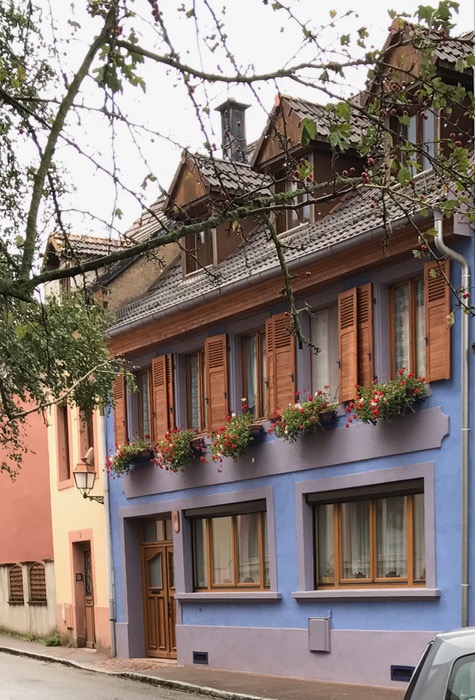
EPM_streetside

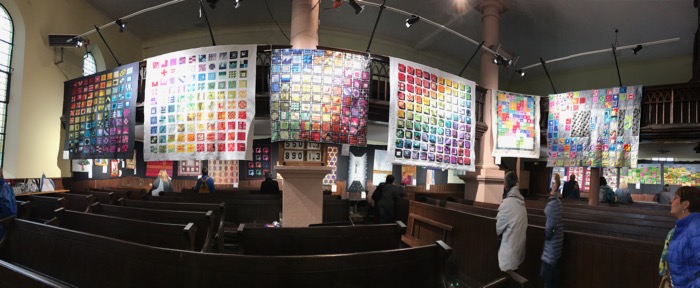
We walked down to the Temple Reforme, where the Val Patch Association, the local guild, had an exhibit titled “La Maison,” or Home.  All of the quilts in that exhibit centered around the theme of home, showing slices of daily life.

EPM_Guild1

I took a panoramic of the colorful quilts across one side of the church. EPM_Guild3EPM_Guild2

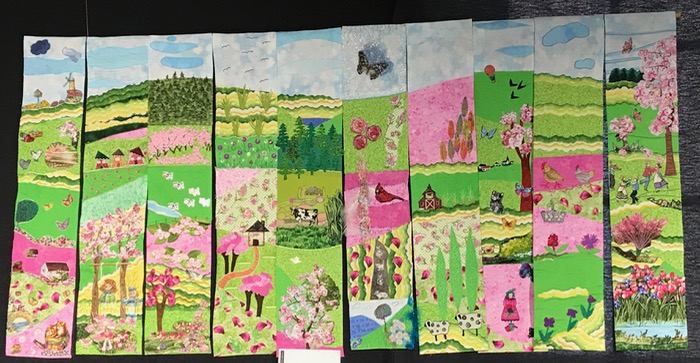
But fell in love with these panels, made by several members.  Jodie has a great post on this one, too.

EPM_SCM1

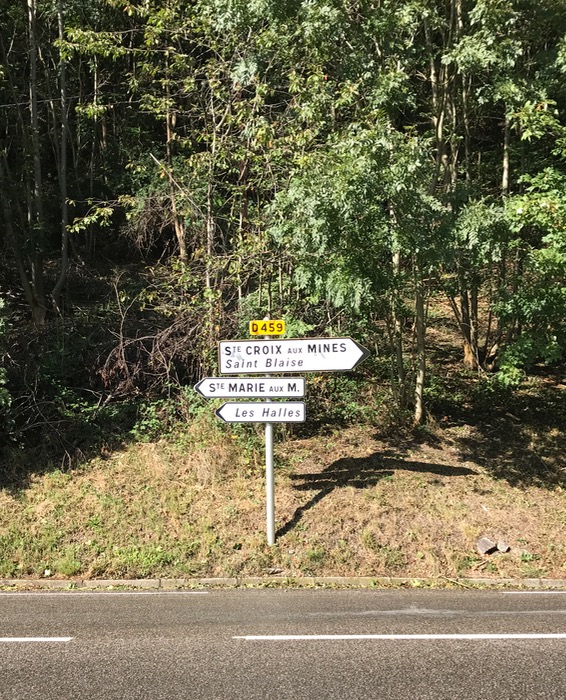
Off we go to the next town.

EPM_SCM2
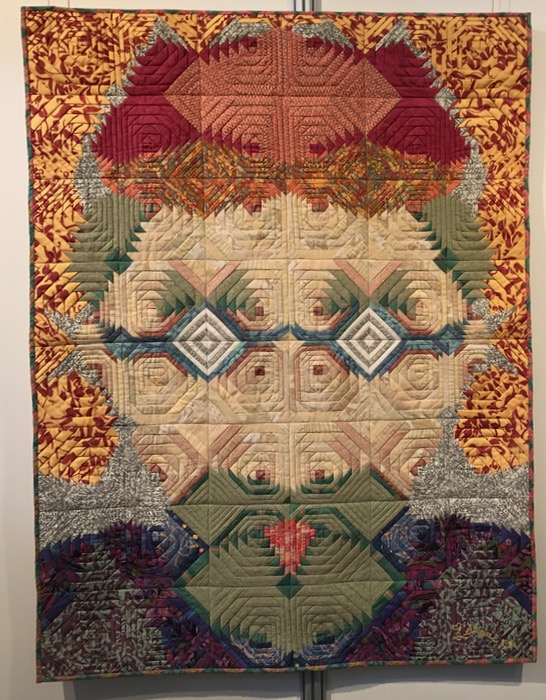
Pilot, 1995 • 100cm x 126 cm

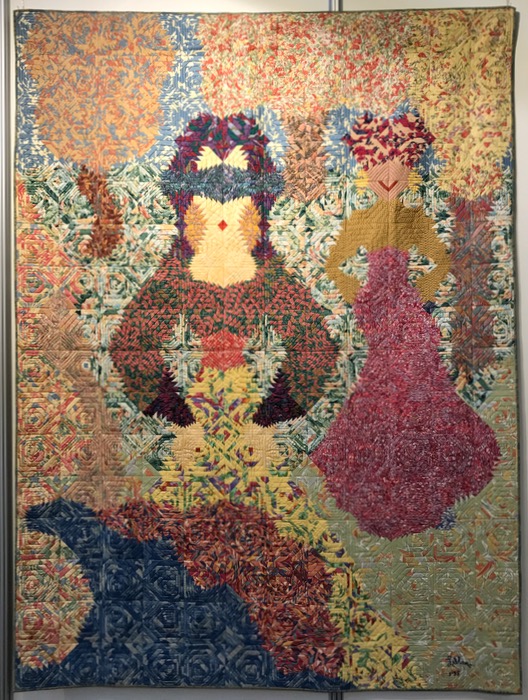
I selected to head to the Espace Expositions first, to see the Beauville Company’s exhibition of prints from their archives, but was entranced by the skilled and exquisite use of log cabin construction by Andrée Leblanc in her quilts.   I am listing the sizes of the quilts in centimeters, as noted on their title signs.  (100 centimeters is roughly equal to 39 inches.)

EPM_SCM2a
Pilot, detail

It was pretty amazing to me how she’s used the width of the strips to create her portraits and pictures.  Again, the lighting was superb.

EPM_SCM3
Professor, 1996 • 76 cm x 100 cm

I laughed at this one, because my husband is a professor (but he doesn’t look like someone out of 10th century Russia, or what I thought this man looked like).  Detail of the glasses, below.

EPM_SCM3a

EPM_SCM4
Oasis, 2011 • 103 cm x 103 cm

While this isn’t a figurative portrait, the use of these fabrics was so interesting–not ones you’d associate with creating a design of any kind.  Detail, below.

EPM_SCM4a

EPM_SCM6
Colin-Maillard, 1995 • 110 cm x 220 cm
EPM_SCM6a
Colin-Maillard, detail showing fabrics
EPM_SCM7

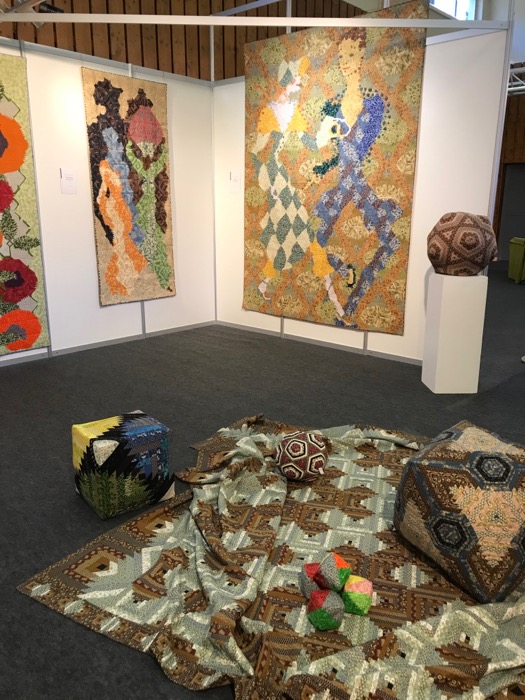
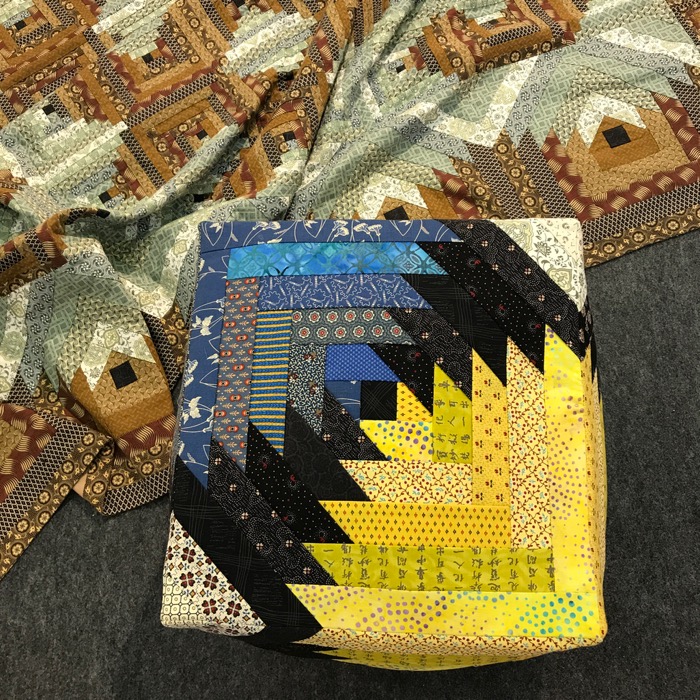
I like how they’d put other constructions of hers in a tableau on the floor.  She had many quilts there.

EPM_SCM8

EPM_SCM10
Grand-Pere
EPM_SCM9

She was always busy talking to people at her table, so I could only get this sideways shot of her.  Her website shows many different parts of her creativity. [update June 2025: the link is broken as she does not appear to have a website anymore.]

EPM_LiepreMuller

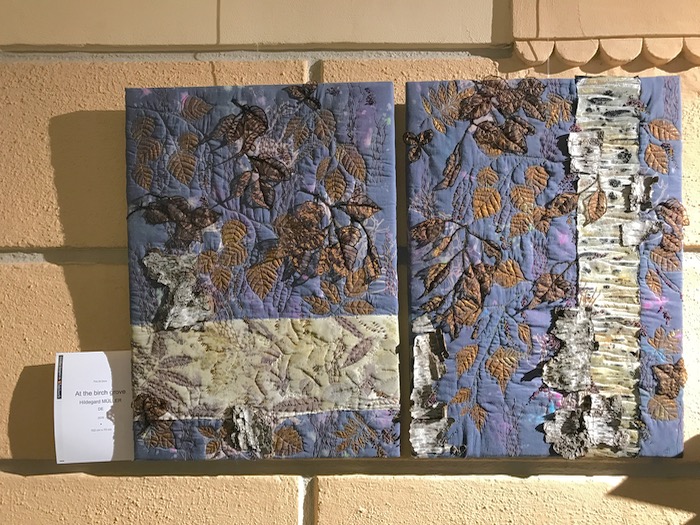
We headed down the road, again, to Liepvre (and try as I might, I cannot get my blogging program to allow the accents over their words, so I apologize–it keeps kicking them out when it spellchecks), to the Eglise de l’Assomption where an exhibit of Hildegard Muller (Germany) was hung.  The lighting was very “contrasty” so I did a little photoshopping on these to render them closer to what I saw.

EPM_LiepreMuller1
At the birch grove, 2016 • 102 cm x 70 cm
EPM_LiepreMuller1a

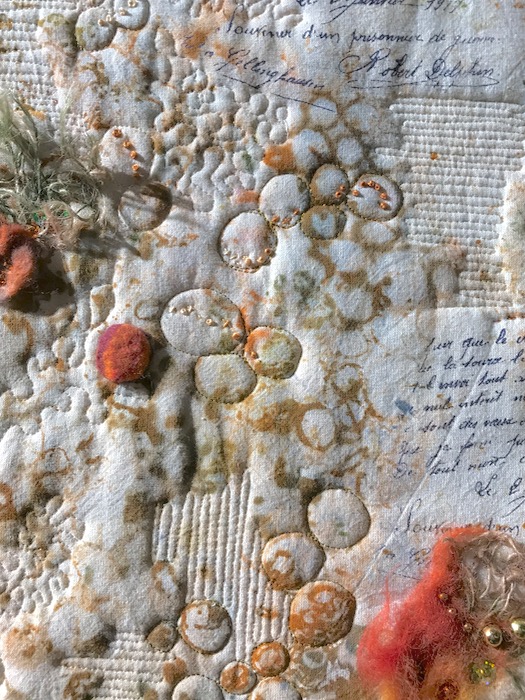
Detail.  She hand-dyed her fabrics and then let her mind find the scene that was in the cloth, or so she told me later, when I asked.  However, other times, she had an idea in mind when she was dying the cloth, and made it that way.

EPM_LiepreMuller2
Love in wartimes, 2015 • 102 cm x 70 cm
EPM_LiepreMuller2a
Detail.
EPM_LiepreMuller3
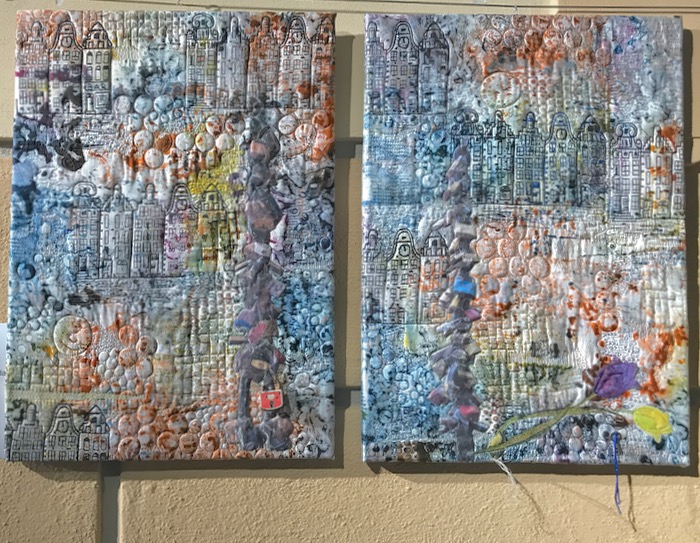
Dreams of Amsterdam, 2014 • 102 cm x 70 cm
EPM_LiepreMuller3a
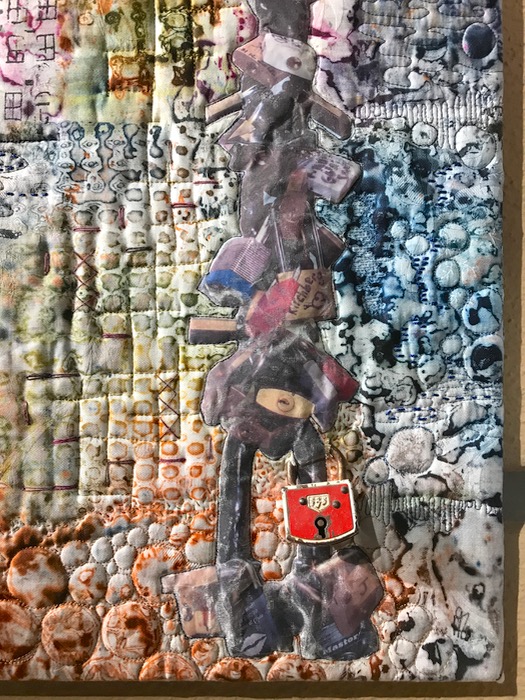
Dreams of Amsterdam, detail.
EPM_LiepreMuller4
Imagination
EPM_French1

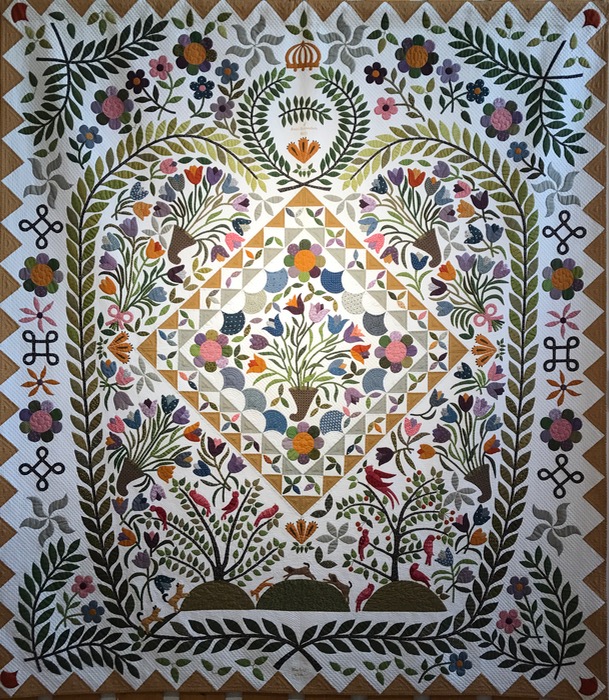
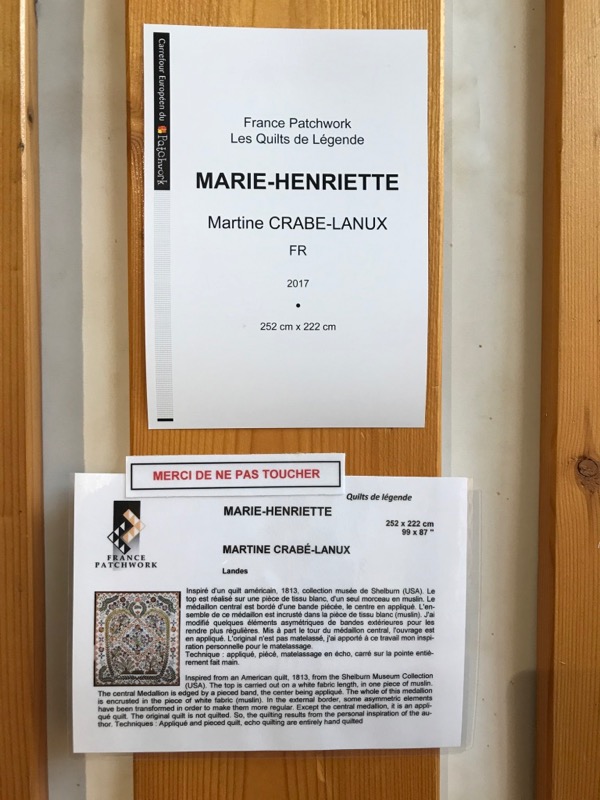
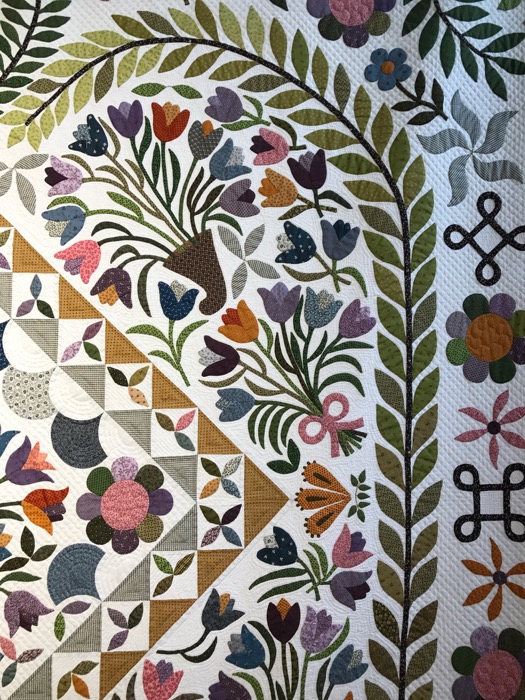
We walked from their to the Exhibition Hall to catch a couple of exhibits; we had to choose as we didn’t have time to see them all. So many of the quilts in this building were perfectly done, all Best-of-Show-type quilts.  The one above took my breath away, so I have a few details shots of it.  I loved that it was an imitation of one in the Shelbourne Museum — another way our patchwork influence crosses the ocean.  The title of the quilt was Marie-Henriette, and was made by Martine Crabe-Lanux.

EPM_French1c
EPM_French1a
EPM_French1b
EPM_French2

The Twinkle-Stars Remake Quilt by Helga Huisman Hildebrand was also in the “France Patchwork” association section.  There were several countries represented in this hall.

EPM_French3

Another France Patchwork quilt, titled Bleus, and made by Maria Vuilleumier.

EPM_French3a

She also had one done in gray, black and white strips, but that one was called Insomnie, or Insomnia.  (Because I’m trying to wrap this up, I’ve heavily edited what I’m posting.)

EPM_GermanSign

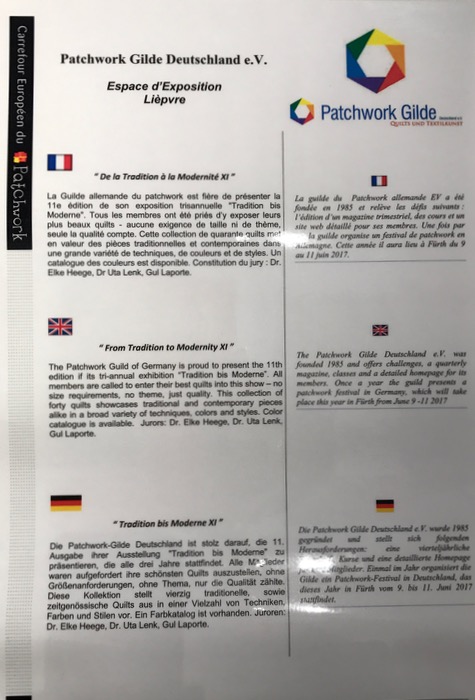
Last section, last group of quilts is from the Patchwork Gilde of Germany.  These quilts blew me away.  Every year they have an exhibition and members are asked to enter what they’ve been working on (more info on the placard, below).  This grouping was titled “From Tradition to Modernity 21.”  Because your scrolling fingers are probably worn out at this point, I’ll post the title and the maker on the quilt; some titles are in German.

EPM_GermanPlacard

EPM_German1
Komposition, by Christa Ebert • 110 x 142 cm
EPM_German1a
Detail, Komposition
EPM_German2
Frau Hansen Klaverquilt, by Uta Rodemerk • 183 cm square
EPM_German3
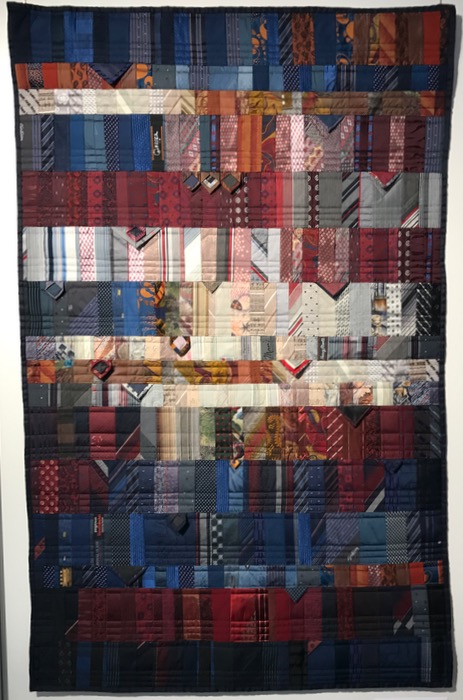
Mannerschmuck in Frauenhand, by Sabine Koch
EPM_German3a
Mannerschmuck in Frauenhand, detail

Okay, as near as Google could translate it, I think this means “Men’s Jewelry in Women’s Hand,” which I thought was really clever given that these are neckties.

EPM_German4
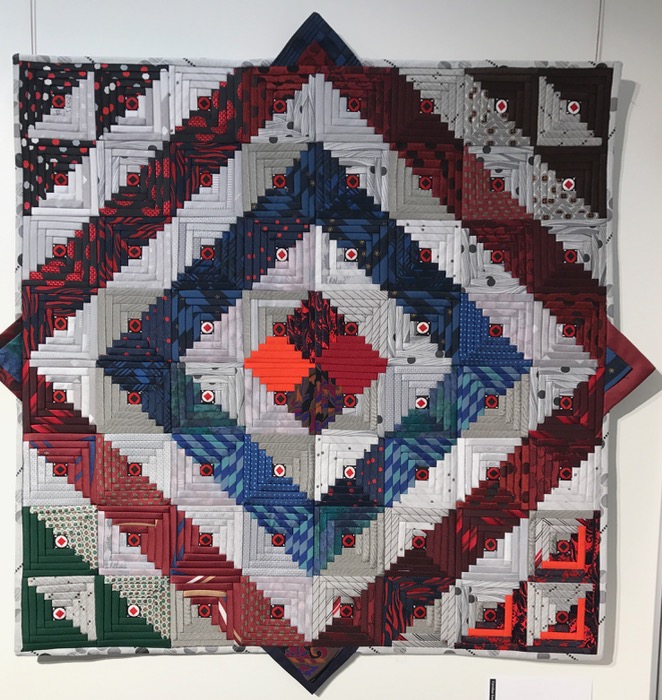
Ausrangiert-neu sortiert, by Inge Bohl of Germany

Discarded, rearranged is how Google Translate interprets this title.

EPM_German5
Zerbrochene Illusionen, by Lilo Hartmann

Zerbrochene Illusionen means Broken Illusions, as translated by Google Translate.

EPM_German5a
Zerbrochene Illusionen, detail
EPM_German6
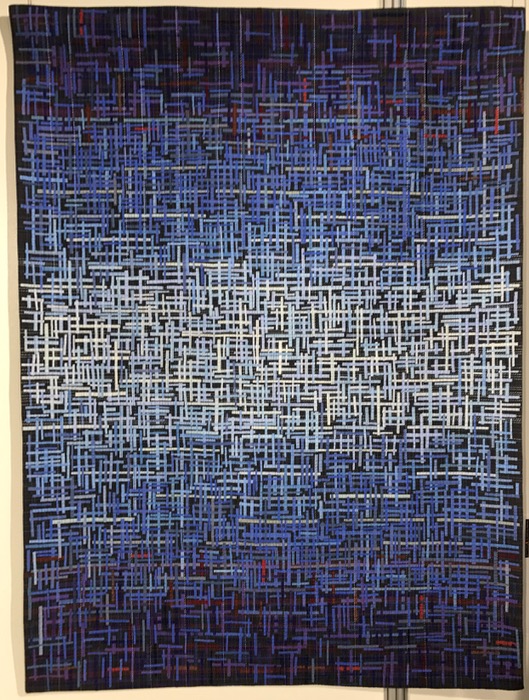
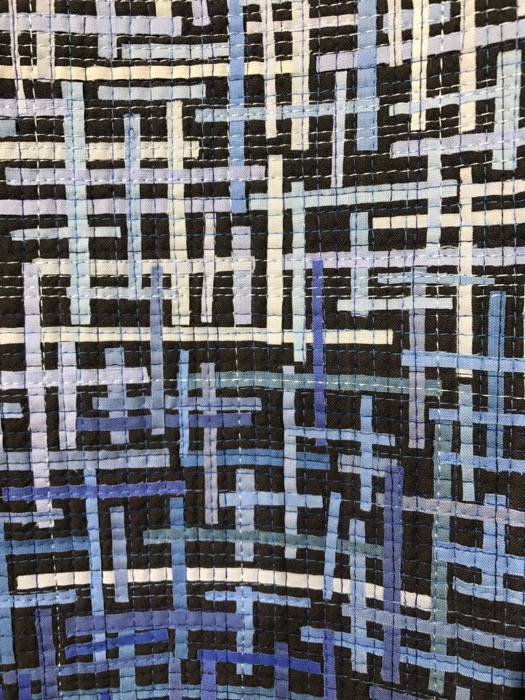
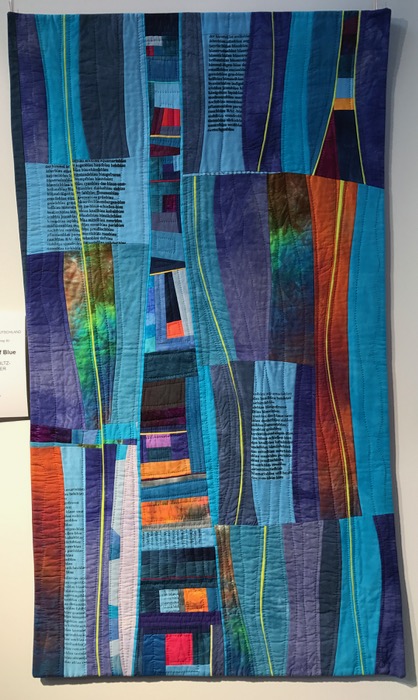
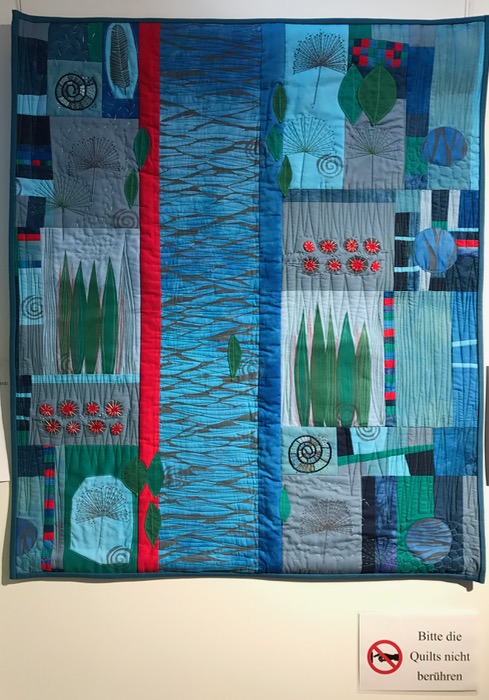
The Power of Blue, by Gabriele Schultz-Herzberger • 75 x 132 cm
EPM_German7
Flussaufwarts, by Susanne Fellmann-Horsch
EPM_German7a
Flussaufwarts, detail
EPM_German8
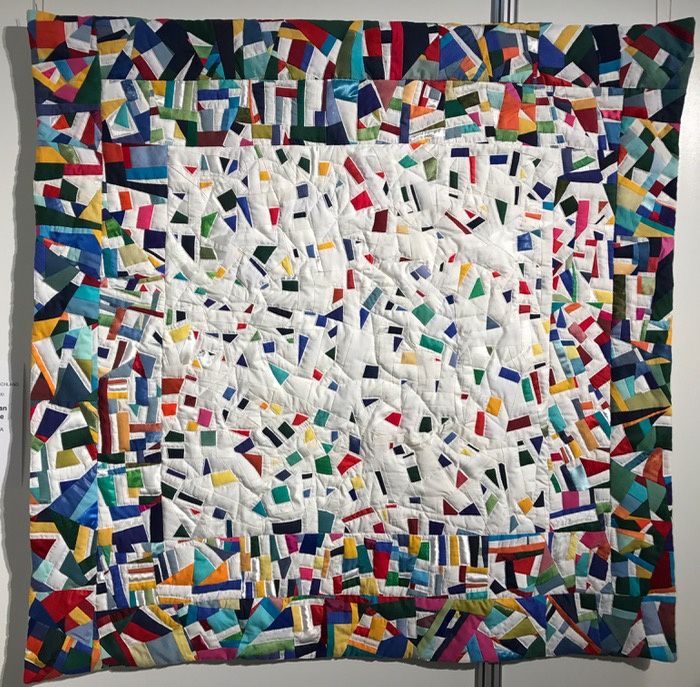
Crazy Canadian Square Dance, by Barber Reschka • 108 x 107 cm
EPM_German9
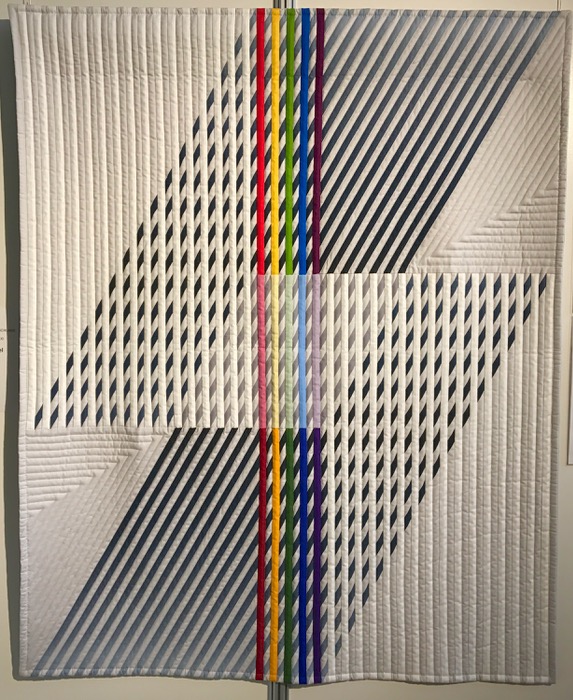
Schattenspiel, by Monika Flake • 107 x 131 cm
EPM_German9a
Schattenspiel, detail.
EPM_German10
In GrossmuttersNahkastchen gekramt, by Christine Naumann • 78 x 86 cm
EPM_German10a
In GrossmuttersNahkastchen gekramt, detail.
EPM_German11
So what do you do about it? by Maire-Christine Chammas • 108 x 147 cm

Very cool quilting.

EPM_German12
Vogelwild III, by Tina Mast • 129 cm x 94 cm

I was told that she teaches art at the local university.  This was stunning.

EPM_German13
Leaves, by Christine Brandstetter • 99 x 132 cm

I talked for a few short minutes to the Uta Lenk, who was the International Representative of the German Patchwork Guild, and she said they would welcome the chance to exhibit at American shows.  I know our local show, Road to California, often has exhibits come from other places, and I would love to see these there.  I almost joined the German guild, but realized that all their materials would be in German, and alas, I wouldn’t be able to read them, but I did buy a pin.

All in all, going to the European Patchwork Meeting taught me that while we Americans fanned the flames of patchwork, the idea of three layers held together somehow, has taken wings, and taken off.  If I were to go again, I’d leave at least two days for the show, and perhaps stay somewhere closer (we stayed the first night in Mulhouse, about an hour away) and in Turckheim the second night (35 minutes away).  It’s near Colmar, and there is much to see in that town, as well.  And…bring an empty suitcase!
eQuilt Universe · European Patchwork Meeting · Quilt Shows · Quilts

Quilt Show Contest • or • Concours International du Carrefour Européen du Patchwork 2017

All posts in order are on the European Patchwork (Carrefour) page.

How’s that for a title?  This post is all about the official competition of the Patchwork Meeting, and I have a sampling of the quilts in the contest.  I purchased the Catalogue from the organizers and it was interesting that it is printed in three languages: French, German and English (yippee!).  The contest theme this year was “Journey to the End of the World” and all the quilts were to be 35″ wide by 47″ inches tall.  This was the first indication that it would be a different type of competition than I had been used to seeing in the States.

Patchwork Mtg_car1
Car in main parking lot

I realized quickly that this would represent all different nationalities, cultures, countries, skill levels (generally really high) and all types of construction.  I chose to notice not only their interpretation of the theme, but also the how and the why they chose to use the materials and techniques they did, always hoping to learn something new.  These quilts are in no particular order.  You can note the winners by the small rosettes in the lower right corner.

ConcoursPatchwork_1

Tatiana Varshavskaya’s In the Beginning.  She is from Hungary.
Her artist’s statement wrote from the perspective on a three-year old, with “continents to conquer, horizons to overcome.  Free, without anchors or restraints, you venture forever in the infinity of childhood’s imagination.”  She finishes by writing “You are three years old, and sail to the unknown with a paper boat.”

ConcoursPatchwork_2

Small Boat, Small Trip, by Sandra Van Velzen of The Netherlands.  She writes “Not so long ago the length of your trip depended on the size of your means of transport.  Nowadays planes and the internet seem to make the world smaller and the trip longer.”

ConcoursPatchwork_3

Gabriele Yoeller, from Germany, created Finistere evoking “France, Bretange…where the sun goes down and the land ends.  Even the Romans called this land: ‘Finis terrae.’ Before you: only water.  Is there something else?  New worlds…or a monster?”

ConcoursPatchwork_4

A quilter from Spain, Eva Arrelano Martin created Into the Deep, an “homage to the effort of thousands of workers who spent and sometimes lost their lives in the their trip into the [great cavity] of the world.”

ConcoursPatchwork_5

Two Americans, Jim Smith & Andy Brunhammer made “June 19th,” celebrating Andy’s birthday  Their artists’ statement notes that “We are both long-term HIV-survivors, and our end of the world has always been just around the corner.  We chose Kaieteur Falls in Guyana [where Jim’s father grew up] as the background. . . Our arm is reaching out with the cascading red ribbon symbolizing the flow or our blood.  The clusters of pills are our life-force.”

ConcoursPatchwork_6

Esodo, by Angela Minaudo of Italy says that “The work represents the journey of those who run from the land in search of a better life, towards other lands, other worlds, towards the end of their world and often toward the end of their lives.”  Esodo means “exodus.”

ConcoursPatchwork_7

A Japanese quilter, Chiaki Yagishita, made Japon.  Her statement read “I think ‘creation’ and ‘infinity’ equals ‘silence.’  There is ‘silence’ in Japan and it is beautiful. This work expresses ‘Japanese blue’ [or] ‘the silent world.’ “

ConcoursPatchwork_8

Anneliese Jaros, from Austria made 101 Views of Vesuvius (my translation of her title).  She wrote that she loves the Gulf of Naples, and Mt. Vesuvius.  “The eruptions of the volcano in the course of history have been the end of the world to many…Parts of the letters [by Pliny the Younger] describing the eruptions are printed in Latin on cotton, which are then overlaid by my own photos of contemporary views of the mountain.”  I tried to capture the detail of the overlay, below.

ConcoursPatchwork_8a
ConcoursPatchwork_10

Au pays des atomes translates to “In the Country of Atoms,” and is a quilt by French quilter Françoise Buzzi-Morel.  She write that atoms “are able to reach the end of the world…beyond any human limits.  And in one precise order, they geometrically follow parallels, cubes, circles and lines.”

ConcoursPatchwork_9

Another French quilter, Eriko Krzyzaniak, made Emmenez-moi au pays des merveilles, or “Take me to Wonderland.”  The colors of blue and gold were inspired by the icon of the Virgen Rynecka in the Church of Our Lady in Prague.  “The drawing,” she writes, “was inspired but the poetry “The Little Flute Player,” by G. Brassens.  It was the starting point of my ‘Wonderland.’ “
I snapped two more photos showing the detail of her work (below).

ConcoursPatchwork_9a
ConcoursPatchwork_9b
ConcoursPatchwork_15

Rita Dijkstra, from The Netherlands, did a rendition of Mount Fitz Roy (her title).  She describes it for us: “The road on the quilt leads to Mount Fitz Roy on the border of Argentina and Chile (Patagonia)….For me Patagonia stands for the end of the world.  The only way you can travel more south from this point, is by taking a boat to the South Pole.”

ConcoursPatchwork_12

No return was made by Anne Lillhom, from The Netherlands.  She writes “From birth to death, we go through different stages.  We have good and less good things happening in life, days with more colors and days with less colors.  We have periods in life where life goes up and days where it goes down…Nobody knows what the life journey will bring us, the only that is for sure is….there is NO RETURN.  We simply have to follow the path.”

Details, below.

ConcoursPatchwork_12a
ConcoursPatchwork_11

Michèle Samter of Switzerland made Excitement of a big city, her tribute to Singapore.  She writes that “The vibrating performance of all the lights in different colors from high-rise buildings and traffic all night long evokes [a] feeling [of having been to the end of the world]….The contrast between my home in Switzerland and this other city, which never seems to sleep, had a great impact on me.”

ConcoursPatchwork_13

Incredible Voyage to the End of the World is by Dalia Eliraz, who is from Israel.  She writes: “The Arctic tern’s [long] trip from Arctic to Antarctic and back is the furthest animal migration.  Over 30 years, it will travel the equivalent of 3 roundtrips from Earth to Moon.  My quilt is inspired by this super-migration bird, as a metaphor of human behavior [when] motivated by determination to achieve a life goal or purpose….whether it is love, academic ambition, artistic aspirations or nesting…”

ConcoursPatchwork_14

Dreamland, by Elly Van Steebeek (from the Netherlands)
She writes: “There is a place, [far] from home with a beautiful blue sky, singing birds, flowing rivers and dark rocks. And after a spectacular sunset there is total darkness, only a whispering wind and the sound of the busy.  This is the land of my dreams!”

ConcoursPatchwork_16

This is Edith Leidi, from Italy, and I was so excited to meet her, I forgot to take a photo of the complete quilt.  The title is Stargate. What’s next?  and I loved what she wrote: “My idea was born in the swimming pool.  I was watching my husband’s hand diving in the water, so I created my stargate.  The hand passes through it while the body remains on the other side.  There is another hand in the universe, that is going to meet the first one.  But…from where does it come?”
Detail, below.

ConcoursPatchwork_16a
ConcoursPatchwork_17

Gabrielle Paquin from France (who also had her own exhibit at the Patchwork Meeting) created Voyage en orbite.  She says “The Earth [has] become too little for its population.  It is necessary to find some exits in Space….we must in a future time go away for a journey…tempory of definitively.”

ConcoursPatchwork_18

This quilt was on the front of their brochure for the Meeting, so we saw it everywhere.  Chang Misun, of South Korea, created Pieces of memories.  She says: “I think my way of life is like an endless trip.  Pieces of past life and future life come together…[some] especially clear and some others are dim.  Pieces of all memories were expressed in the works.”

ConcoursPatchwork_19

Maryte Collard, of Lithuania, made Song of the Linen.  Writing about returning to Lithuania, she notes that it “always feels like the trip backwards in time” due to the ancient language and that is was the “last European country to accept Christianity.”  Because of this “traces of ancient customs still remain in daily life….Flax has been a traditional Lithuanian fiber for several thousand years.  It has a special place in my heart and it sings to me the song about the trip to the end of the world.”
Detail, below.

ConcoursPatchwork_19a

Catalogue of Patchwork Meeting 2017
taken from *here*

Watch me breeze through the complete catalogue, which I couldn’t figure out how to upload, which shows a few more quilts.  Below is a photo of the giant poster, showing all our venues.  The one above was above the L’Espace Commercial.

Patchwork Mtg_venues SMAM

It was raining that day, but none of our wet umbrellas were allowed in the exhibits.  Since I’d lost one already to an umbrella stand, I wasn’t anxious to repeat the experience, so I whipped out my souvenir Patchwork Bag, and we stuffed the umbrellas in there as we walked around.  Everyone was happy.

Patchwork Mtg_car2

More posts coming. The original post, with links, is found *here.*

Quilts

QuiltCon/Quilt Show Fun

Road Booths1I’ve been entering quilt shows since about the time I moved here to Southern California.  The closest one was Road to California, and in those days, I always was accepted.  Schooling interrupted my quilting, and when I got back to my craft, the ground had shifted underneath me.  I couldn’t get my quilts accepted any more.

I felt pretty badly about this the first time it happened, especially since the quilts I saw at the show seemed to be all spangle and sparkle and glitz and flash, along with quilting that was perfection, due to the advent of the longarm-quilted piece.  To say I was discouraged would be an understatement.

Grading Research Papers

I kept trying, and kept getting rejected. It felt a lot like grad school, where I’d write up my short story, or poem, and take it into workshop and they’d get out their figurative knives, blades, guns and other weapons and slash my pieces to bits, then shoot holes in them.  I think I cried all the way home that first time, but it got easier to separate myself from my work, and take the critiques in stride.  Some were helpful.  Some were NOT helpful.  I had to know that my writing still had value and worth, and to keep going.  It was the work that mattered.

Fast forward to this week, watching the feed blow up on Instagram as people cooed or moaned about their acceptances/rejections to QuiltCon.  Whether the organizers like it or not, they have created a couple of problems and I was watching the fallout happen in realtime, in people-time, as comments started flying.  The problems most prevalent appeared to be:

Sign Quilt Show

1) Too many entries.  This came about because there was no limit on how many quilts could be entered.  I haven’t checked every show, but the ones I’m familiar with limit how many quilts you can enter.  Because QuiltCon had 1300+ entries, and maybe only space for 400 quilts, well. . . you do the math.  But the odd thing was this line in the rejection letter (yes, I got rejected on all three of my quilts): “Please do not be discouraged. We received more than 1,350 quilt submissions and the jurors had to make many difficult decisions.”

This was weird how they commented on the recipient’s emotional state and then flipped it around so that the person being rejected should feel sorry for the jurors and their difficult work of wading through over a thousand quilts in order to chose the ones they wanted for their show.  Just the facts are necessary: “You didn’t get in.  It was a good effort.  Try again next time.”

TarrSnapshots
Timna Tarr’s Valley Snapshots

2) The perception that there is a mysterious criteria that determines who gets in and who doesn’t.  The key word is “perception.”  And the perception, judging by what I read on IG, is that this mysterious set of rules is not given out to mere mortals, but only those in the inner circle, the claque, the clique, the friends and buddies of those running the show.  I can hear the snorting going on now.  Yep.  But this problem persists because the modern quilt movement can’t figure out what it thinks is a modern quilt enough to be able to describe it, or communicate it to the masses.  People like me.  And then they hold a contest in which we are all supposed to submit, which feels very much like going to the top of a busy freeway overpass and throwing our quilts over the edge, watching them sink down into the morass.

On top of that, there seems to be an overabundance of graphic artists at the helm, or with some graphic arts training.  Might this not mean that the graphic punch, that visual snap, the elements of high contrast off the grid have become ascendent?  Maybe.  Then put that into the judging/juror criteria and disseminate it.

When I entered, I was surprised to see there were really no categories to select into.  Yes, there are categories, but I didn’t get to nominate my entries into any of those; the assumption is that those on the other end of my internet connection will do that for me, further confusing the experience.  So I don’t know if my quilt was judged against other similar quilts, or if it was thrown into the pool of 1300+ entires, with bleary-eyed jurors watching quilt after quilt pass by their eyes, until the whole thing collapses into Let’s Get This Done, sort of like I feel when I’ve graded too many papers in a row.  I have total empathy with the jurors, but perhaps there are some solutions that might rectify this difficult situation. I hope they find them.  And I hope the show I’m about to see in Austin in February will put aside some of my concerns and be a great experience.  I am happy for those who got in, and can’t wait to see the quilts.

Sol LeWitt's Patchwork Primer_finalone of my rejected quilts

But in the end, what matters?  Are you only as good as your last rejected quilt?  Or are you the sum total of your work, the cutting, the sewing, the creating?  Given the number of times I’ve been rejected, I could have melted into a puddle on my floor.  But my training in grad school, although sometimes painful, gave me stories like this one:  a famous author used to mutter to himself “I’ll show them this time,” every time he started a new novel.  And the knowledge that I am more than just my latest quilt.  And that I won’t melt if someone tells me “no,” although it feels really good when they tell me “yes.”

colorwheel blossom beauty shotanother rejected quilt, soon to appear here on the blog for the first time–stay tuned!

One lovely side effect of all this sturm und drag (storm and stress) is that I have loved the reading on the #quiltconreject and the #rejectedbyquiltcon hashtags on Instagram.  I’ve been introduced to some fine new quilters, and fallen in love some new works from familiar quilters. It’s been quite the wild ride.

JosephCampbellBigQuestion

Yes, the modern quilt movement may or may not survive the problems I mentioned above.  But it’s not really my concern.  My concern is to get going on the next quilt, to say a hearty yes to this creative adventure.