BlockBase+ · Free Quilt Pattern · Patterns by Elizabeth of OPQuilt

Too Hot to Think • Blockchain Quiltblock Freebie

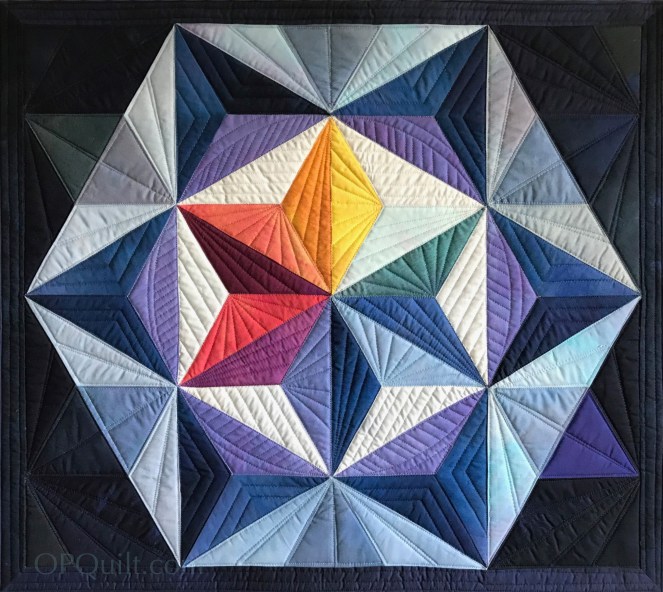
It’s too hot to think, but here’s a fun sketch from a traditional block, originally called Boise (Brackman 2306). The periodical, Hearth and Home, which published this block, was in operation from 1885 to the 1930s.

The block, exploded.

The 7″ block, set on alternating verticals. All of these can be found in BlockBase+ which is software that is basically the Brackman Encyclopedia of Pieced Quilt Patterns. I modified this in my design software, Affinity Designer by Serif, a reasonable cost design software (NO, you don’t have to buy Illustrator. YES you should buy BlockBase+.)

And I think we should give the quilt a name. I know it’s the capitol of the state of Idaho, but I’d like to give it a more contemporary name: Blockchain. What does that mean? Since I just donated to Wikipedia (you should too), here’s their definition:

blockchain is a type of Digital Ledger Technology (DLT) that consists of growing list of records, called blocks, that are securely linked together using cryptography.

So couldn’t we define a quilt as “a growing list of blocks that are securely linked together with thread”? I think so. I was amused to see that a lot of the images used to depict the idea of blockchain are some of our traditional quilt blocks, like baby’s tumbling block, among others.

If you’d like the 8-inch version, I’ve got that for you here, as a free download. I didn’t monkey around with it too much, so it’s rather a no-frills set of templates (remember, it’s too hot), but you can see how nicely the templates are generated for you by Blockbase+. [Okay, I did do a bit of monkeying…]

Download the free PDF file for an 8″ block here:

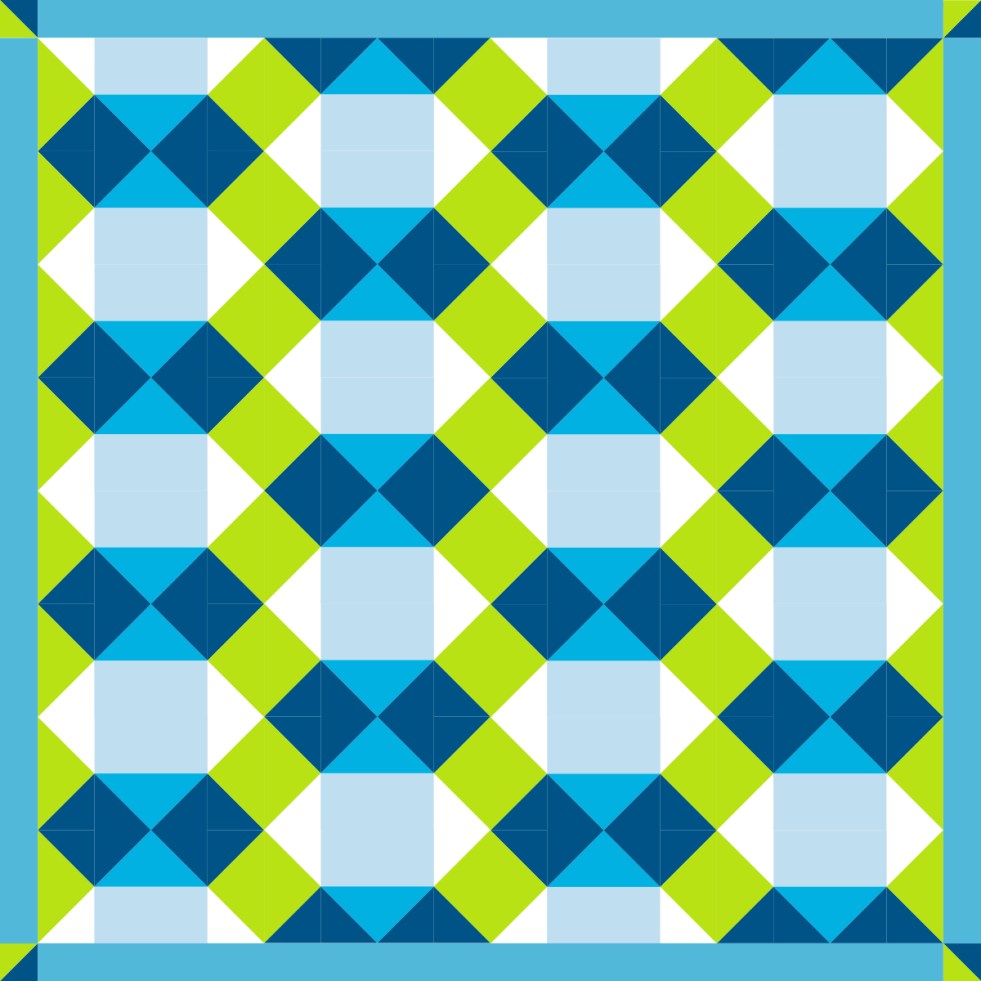
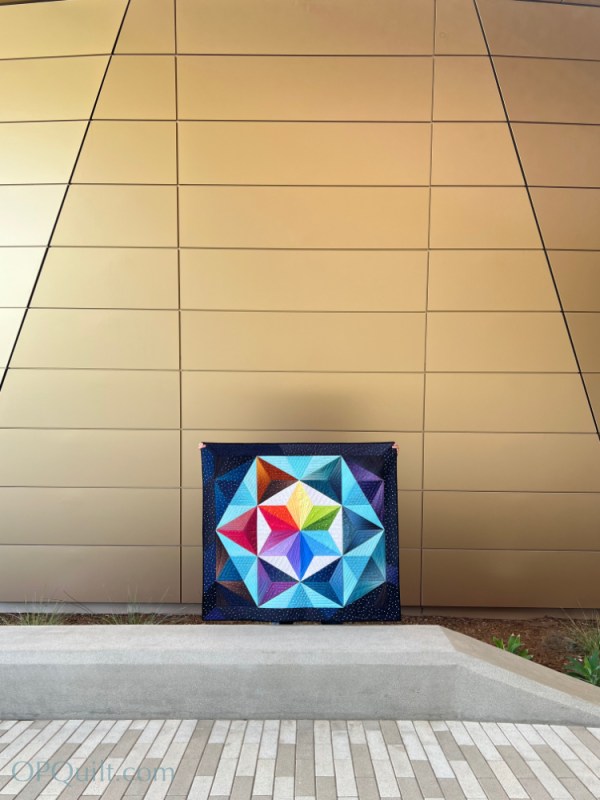
Here’s the 12-inch version, which finishes at 52″ square, with those 2″ borders and cornerstones. To get this layout, I did four columns of the Blockchain block, doing half-blocks at the top and bottom of columns 2 and 4. I’m sorry I didn’t include the 12″ size block, but it’s hot, and we are about to head to our traditional Labor Day Cookout: a trip to In and Out Burger, where they do the grilling for me.

from here

Happy Labor Day Weekend!

300 Quilts · Patterns by Elizabeth of OPQuilt

Secret Garden • Quilt Finish

What is it about Kaffe Fassett fabrics that pulls us in? The rich hues and full range of shades? The interesting patterns, many from old wallpapers and fabrics? I have a couple of stacks of his fabrics and it’s always a delight when I can pull them out from my shelves and start playing.

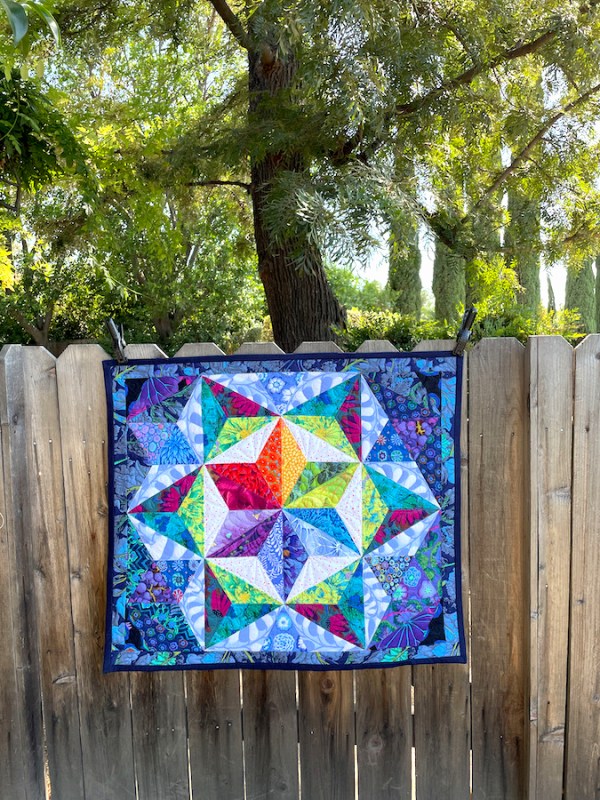
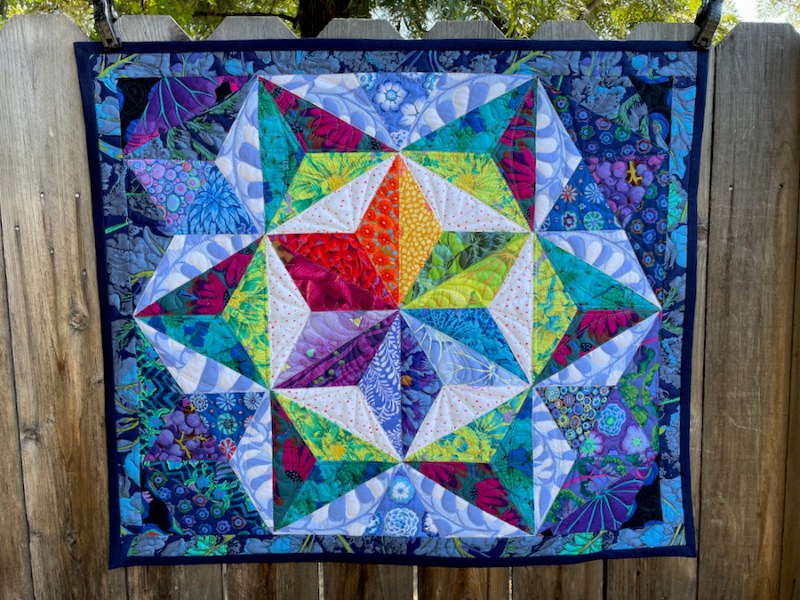
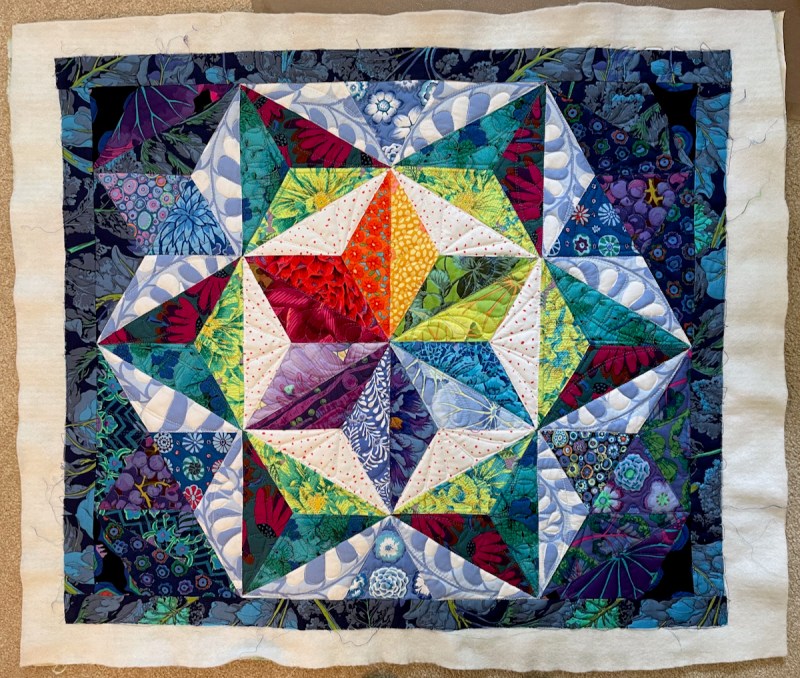
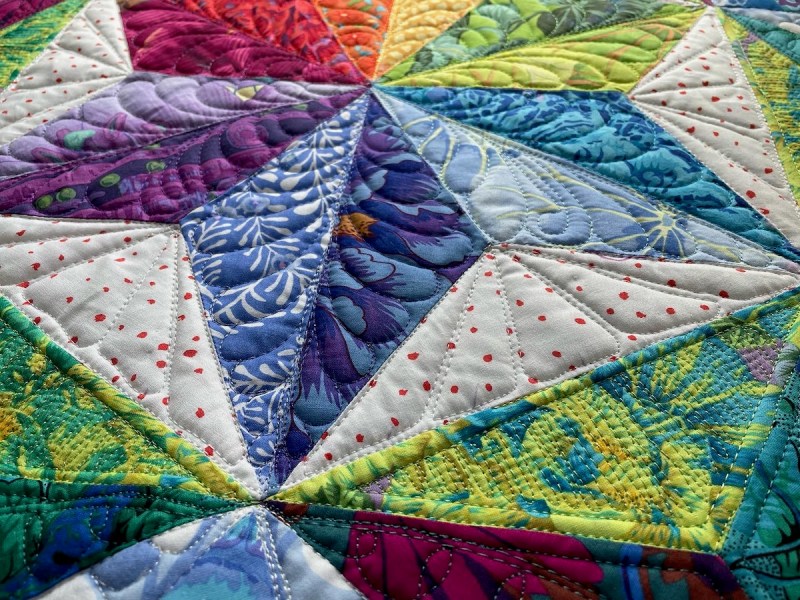
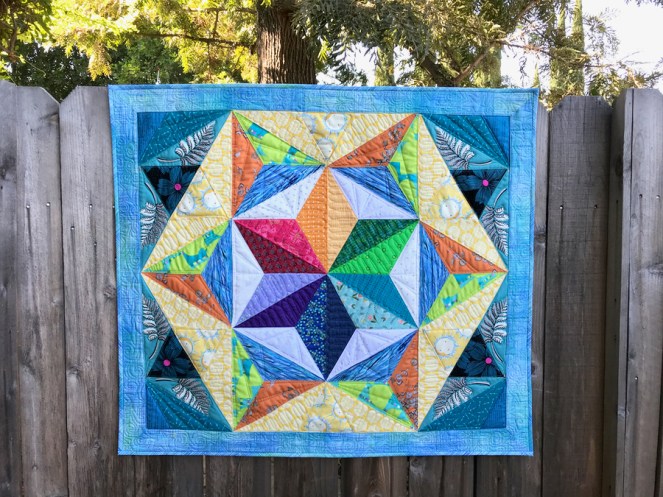
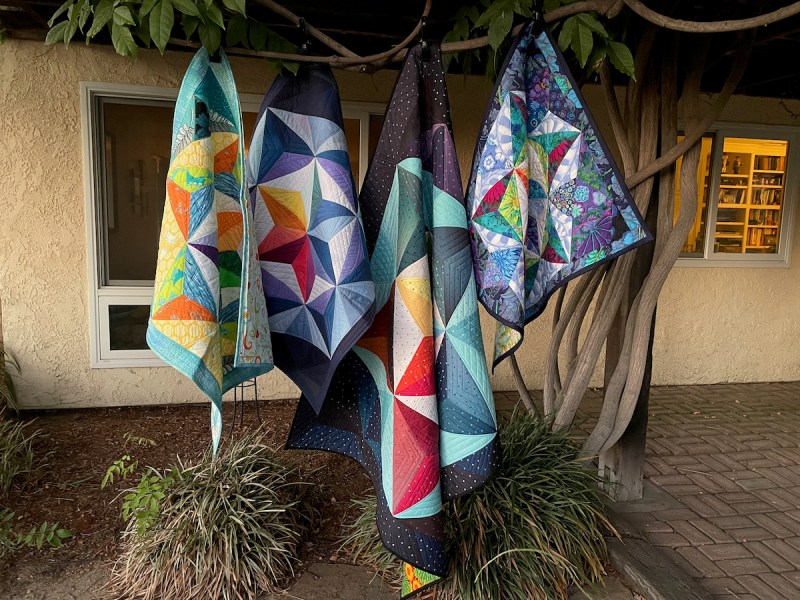
Secret Garden, quilt number 235, is the original size of my Triad Harmony pattern, measuring 28 1/2″ by 31 1/2″ and was made for a class sample, since my friend Susan loved Kaffe fabrics. She was the program chair and had me teach this class for their Guild.

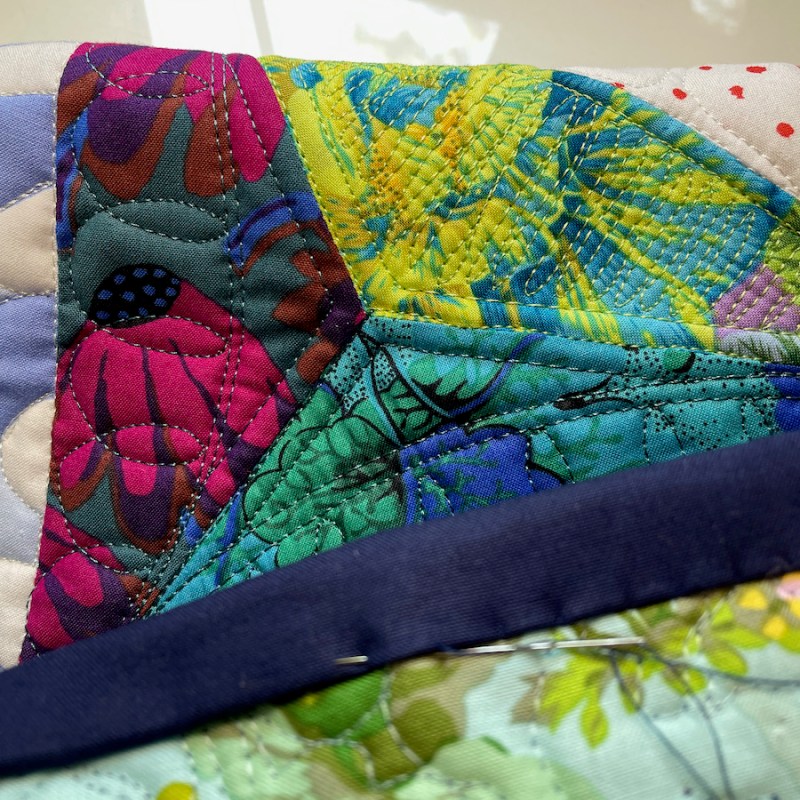
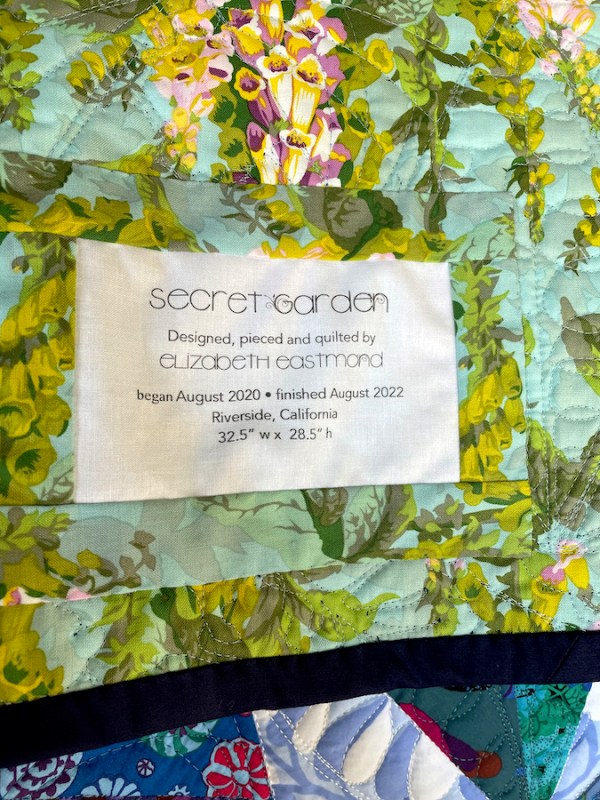
After several weeks of lallygagging around — or so it felt — this week I put on the binding and the label:

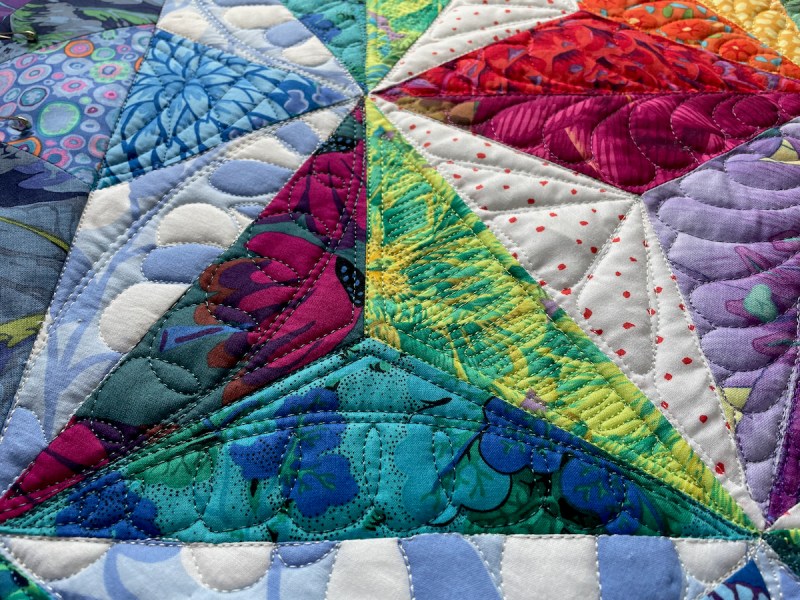
The quilting goes fast with this size! (Click any image to enlarge.)

It also helped to get back into a Guido Brunetti Mystery, after a long time away.

Here’s another scrappy version.

And a bigger version, Eris.

And the first in the series in Jennifer Sampou’s ombré fabrics. I put them all together in a reel on Instagram. (See my tip in my next post for how I deal with that app.)

Triad Harmony and her sisters. One more is coming…

New York Beauties · Patterns by Elizabeth of OPQuilt

New York Beauties Block 3: Radiate

Third Wednesday of June means the third block of New York Beauties, and since I love that orange band out there and it reminded me of the glory days of being a teenager and feeling the warm sun on my face, I called it Radiate.

Stats: It will measure 9-inch when finished. Remember to print it off so that the size gauge of 1″ is one-inch square.

Honey, I shrunk the rays.
But then I added the band, so all is good. Are you getting the hang of this? I’ve written a longer post about how I manage foundation paper-piecing (FPP) if you aren’t. Keep reading.

You know the drill by now: overlap and tape or glue at pink dotted line to make the larger arc.

And then do the rays, Piece C. I cut off the little bit of overlap on the top piece and throw it away.

Remember in Block Two how I cut out a rough shape of the ray? I did the same thing here.

Checking colors. I also did a half-ombre on this set of rays — from lighter pink on the outside rays to darker pink in the middle. I like how the blocks all play together nicely with the shaded areas leading the eye around the circles.

More checking colors. The arcs are just pinned up for the Radiate Block.

Rays block, before the haircut — er, trimming. You can see the gradation of the pinks here. I also tried to color them slightly on the pattern; hope that helps. I pressed this, trimmed it, then set it aside.

I started from the center, sewing the coral-orangey-red quarter circle to the yellow band. I always press marks at the center, and half-way to the center on both pieces to help with pinning. I have more success with the concave piece on top, and the convex piece on the bottom.

Here’s a drawing for you, if you need it like I always do. The green arc actually has both a concave surface (where it faces the yellow quarter-circle), and a convex surface (on the right side of the arc).

In the top photo, you can see my press marks to help in sewing the arcs evenly onto the matching convex surfaces.

And in the bottom photo, three are finished. I’m working on the fourth one now, and I think I can probably share how I think about the weird-o parts of FPP. The first time I did this ever, it was a nightmare: limited fabric, doing it for someone else, and too much for a novice to tackle. I was terrified about running out of my beemate’s fabric because I was always sewing and cutting it backwards.

Verushka (and you might really really want to take her class–so many good things and I think she explains them well) taught us to fold the next segment backwards, gauge the size of the fabric piece you’ll need, then proceed from there. I’m am using segments from Block Four in these illustrations, and I know so so many of you are Total Pros and will find these tips sophmoric or useless. (Then just move on…it’s for the rest of us.)

There are two basic rulers used in FPP. One is Add-A-Quarter-Inch and it’s yellow. The other is Add-An-Eighth-Inch and it’s the green one, above. This green one has the sweetest edge, right there by the red arrow. It’s really thin, so it helps in folding (this step). Align that thin edge with the line for the next seam. In this case, we are working on the blue triangle.

Keeping it in place, fold the paper back over the edge, and put a good crease in it.

Remove the ruler. I know you are probably rolling your eyes at this step, but it’s just in case you are sewing at night and your brain is fried.

Notice the position of everything: the completed rays are to my left. I work left to right, and concentrate on keeping this oriented this way. Also notice–that triangle marked in green (the blue ray) is what I’m focusing on. If you compare FPP Tip #2 with FPP #4, you can see I’ve brought in a blue fabric triangle and laid it in the approximate position I’ll need to sew that seam (*marked in Tip #3 with a red arrow*).

Now I’m going to show you this step from another set of rays–a little bigger so you can see more easily.

A bigger triangle, same green outline. If you can see behind the deep purple seam allowance, I’ve positioned a lavender piece of fabric, which is cut larger than I need, but in the approximate shape. (Remember how I always trace the ray, but a bit bigger? This is that piece of fabric.)

Okay, back to the small rays.

I’m holding it up to the light (this is where some people use a light table, which is a great idea).

Now here, in 6a, You can see the oversized blue triangle piece behind the FPP assembly (marked in blue). I try to line up the side edge about 1/4″ away from where the seamline will be (red arrow). Some people like to trim this edge to 1/4″ before lining it up. I’ve done that. But when I’m working with small bits and am on a roll, it’s another step. Your call.

Pin the fabric in place, or just hold on to it tightly. Unfold back your paper, exposing the marked seamline. Stitch with a 2.0 stitch if you are using vellum, or something a bit tinier if you are using computer/copy paper.

DON’T GO ANYWHERE OR PRESS ANYTHING YET!

Head to the cutting table. Fold back the paper one more time. Reach for the yellow Add-A-Quarter-Inch-Seam ruler. Lay the inner edge (yellow arrow) bumped up against the folded edge. Lay your rotary cutter against the outer edge (red arrow) and slice off the excess.

Please notice that I still keep the orientation the same: the active place is on my right. The completed and sewn section is on my left. (Verushka has a great way of describing it to help you remember. I am forever indebted to her!)

Now you can go to the ironing board. Unfold the paper (again), and smooth the fabric over. Press from the “right” side. Remember that everything looks reversed now, but this is the weird-o-ness of foundation paper piecing. You’ll start this whole process again, this time with a lavender triangle/ray.

I’ve become much faster at this, and if you are not already a pro, you’ll get get faster, too, as you go through these New York Beauties.

Final Tip

After working on these blocks, it suddenly occurred to me that after I made each arc of rays, and trimmed them up…I didn’t need the paper in there anymore. So I peeled it off before sewing the ray-arcs to the plain arcs. I referenced this a little bit in the last block, where I tore off the paper at the seam allowance. Generally, in FPP, you only need the paper where the seam lines will be lining up. Generally. But in these NYBeauties, the paper just got in the way. Without the paper, I can use a more reasonable stitch length, and the fabrics will work together. Try it and decide if you like it.

Because it’s June and Why Not? Try making Blocks One and Two. Now, with this post, you have three (and a peek at Block Four). I love all the sweet notes you write–if you feel like following this blog, that is also a nice thank you. I post weekly (but this June, it’s like bi-weekly). I’m also on Instagram, if that’s more your style.

Our hashtag on Instagram is #newyorkbeautiesquilt so let’s post and tag and share our beautiful blocks!

The New York Beauties Quilt pattern is available for download in my PayHip Shop.

Take a breath…and keep quilting!

Patterns by Elizabeth of OPQuilt

New York Beauties Block 2: Cool Rays

Second Wednesday in June means the second block of my New York Beauties and since it has a lot of green in it, I went with Cool Rays. I used variegated greens from dark to light in between the rays, just for fun. Because this series is about having fun, right?

STATS: 9-inch blocks, finished Yes, the rays are a bit wonky on some blocks. The perfect is the enemy of the good, as I used to tell my Freshman English classes.

I made the rays on this block twice, because I neglected to follow this one rule:

Yeah, duh. I printed out the first one at 97%. Close, but not close enough. It was a nice set of rays, too.

Fun times: the spliced outer corner pattern from Wild Sunflower (block #1) is the same for all the blocks, so I just used it again.

Splicing action needed.

Nice work. I had a question from a reader about the paper I use. It’s vellum, and from what she wrote back, it may be hard to find in a ream. I’ve seen it in smaller packages, so hopefully if you want that, you can find it.

Auditioning fabrics. Notice the range of greens. I tried to color them on the pattern from lighter to darker, too.

I took a scrap of my paper, traced off the two different sizes of my rays very loosely, and used that as a template to cut out fabrics. Since I’m using solids, there is no right or wrong side.

Progress. I always work from left to right.

Cut your arc on the bias, to give it a chance for ease around that outer edge.

I cut out two arcs because I didn’t know which one I would like. No, they aren’t sewn in yet, just draped.

I press in four creases and pin. I also do better if the convex is on the bottom and the concave is on the top, although I keep trying it the other way, which leads to use of the seam ripper. You can pin as much as you want to. No rules.

Ta-Done!

I took them outside to play.

My New York Beauties pattern, which includes this block, is available for download in my PayHip Shop.

And remember, it’s June! We are having fun!

Just breathe…and keep quilting!