Efficiency is ruining your happiness.
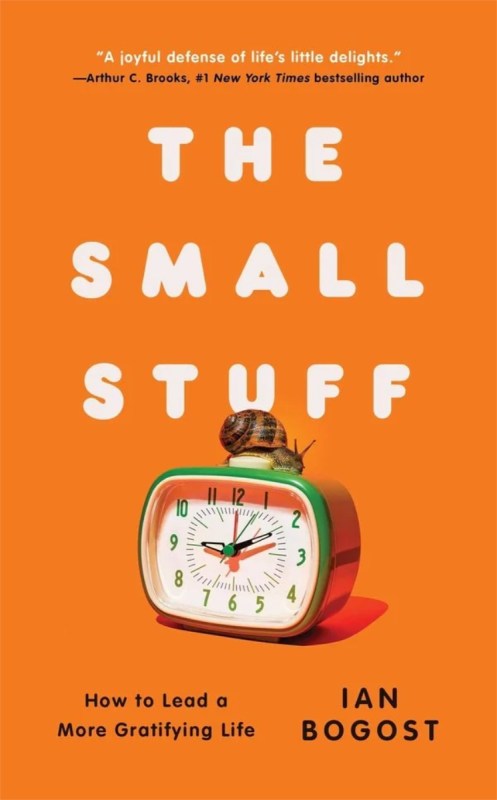
Or so says Atlantic podcaster Charlie Warzel about Ian Bogost’s new book, “The Small Stuff: How to Lead a More Gratifying Life, and why the tiny rituals, sensory pleasures, and routine interactions we tend to overlook may be the very things that make us feel connected—to one another, to the world around us, and to ourselves.” (gift link to podcast transcript).
Writer Ian Bogost “makes the case that some of our societal obsessions—self-optimization, career satisfaction, this constant fixation on whether we are adequately happy or not—those are all aimed at the Big Stuff. But our lives are actually dominated by the Small Stuff: the [messing] around that gives texture to our days. This, he argues, is good news, because the Small Stuff is abundant, and it’s actually much easier to notice, to control. And doing so can bring us a sense of genuine gratification, the kind that so many of our technologies just automate away” (source above).
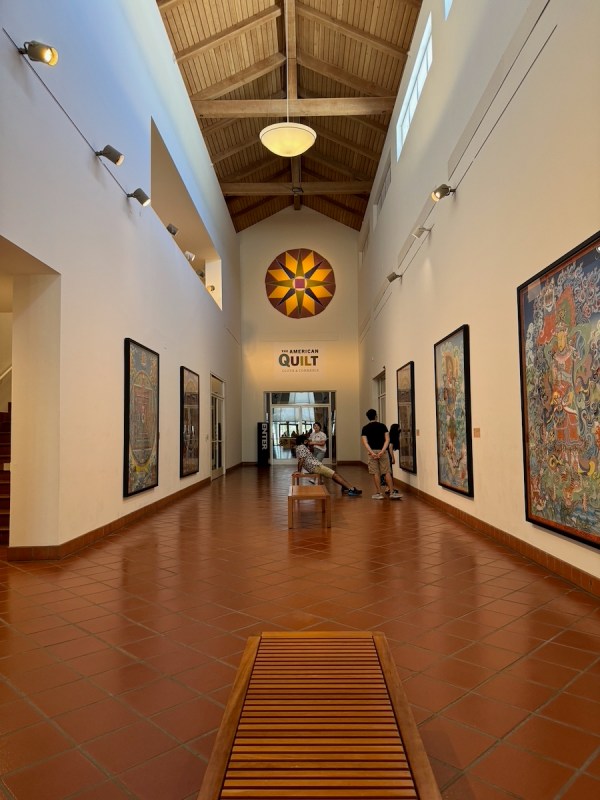
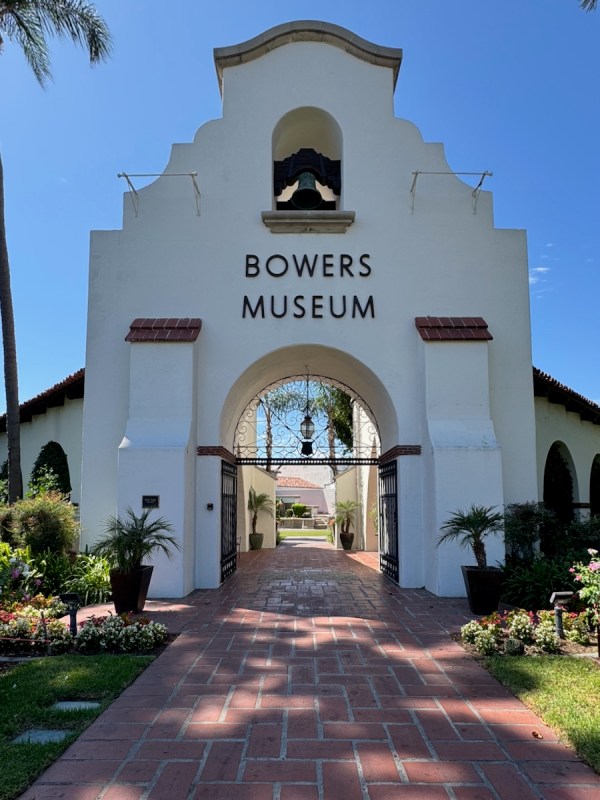
As I’ve been feeling disconnected in more ways than one, I was intrigued. So when I went to an exhibit at the Bowers Museum in Santa Ana with these ideas swirling in my brain, I decided to slow down, to look, to notice, to see the Small Stuff in the quilts.
If you are like me, you usually hit a quilt show, camera in hand and have a rhythm: take the big photo of the quilt, take the detail shot, take a snapshot of the title card and move along. While I started that way, I made a decision to not be so efficient. To notice the details.
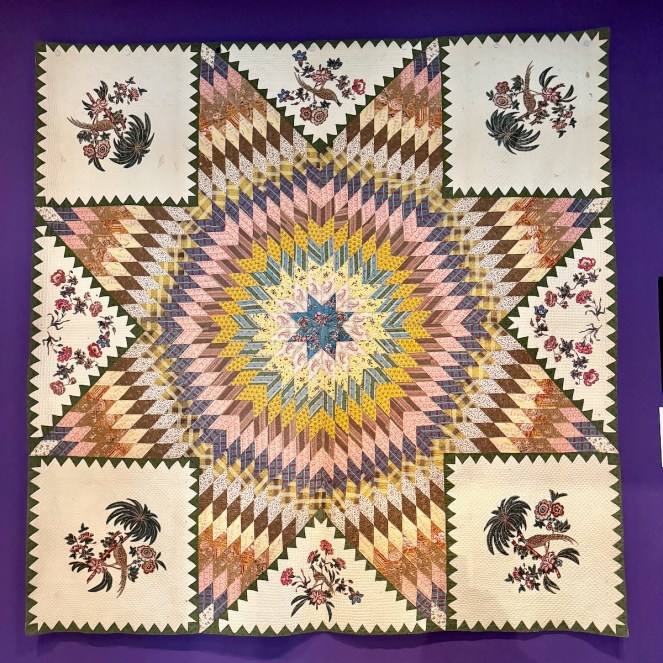
The title card points out that in this quilt from the 1820s-1830s, the use of broderie perse, or the appliquéd chintz cut-outs, may have been a technique to manage the expense of printed cotton, grown and made in America, but then shipped to England to be printed…and then shipped back again to the United States.
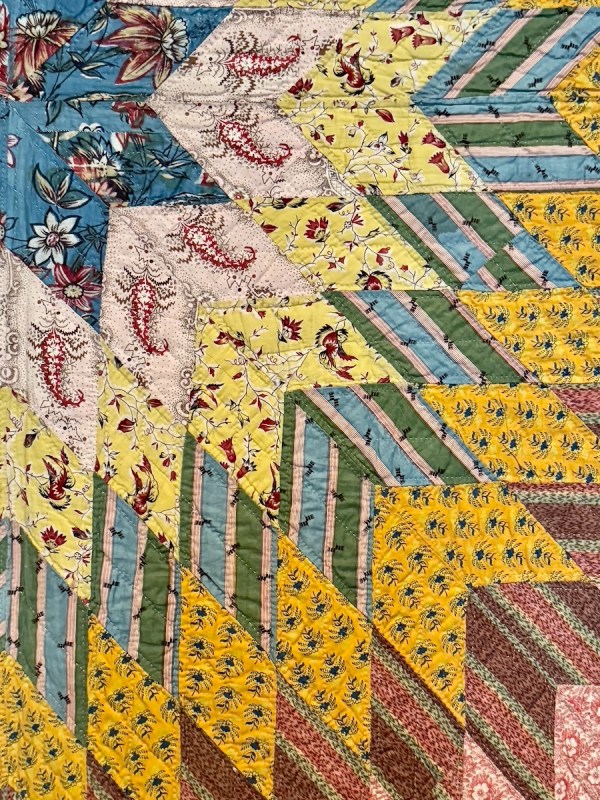
The lights were dim in the galleries, so the resolution on some of these photos is very low. But I was fascinated by these two yellows against that Prussian blue center.
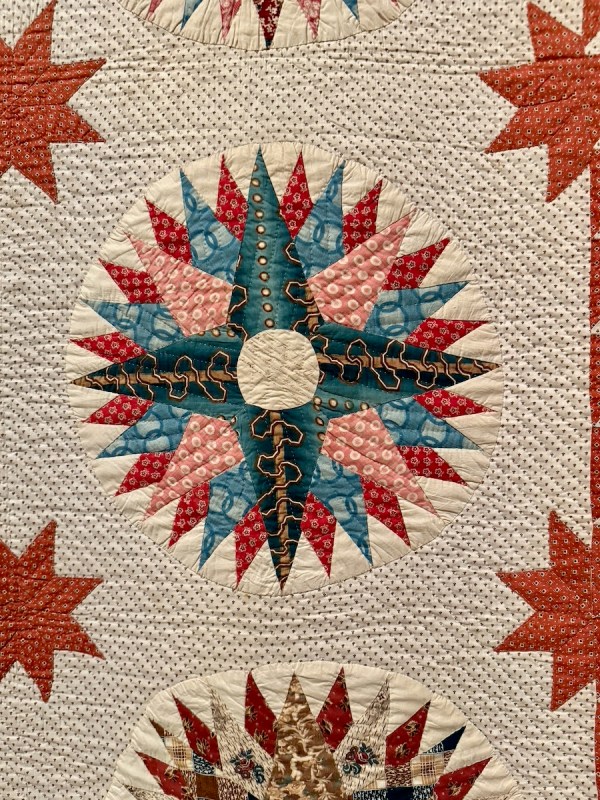
Here, in another medallion quilt, is that color again.
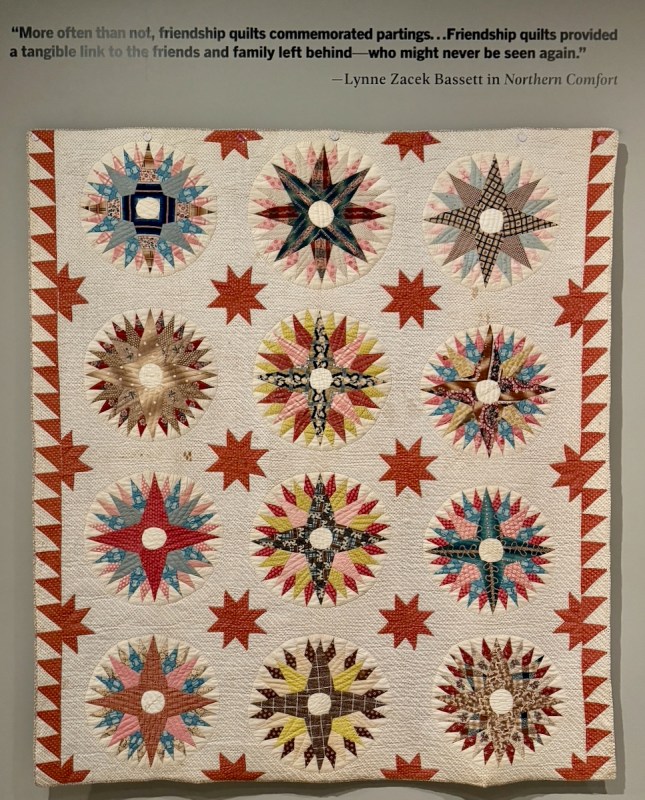
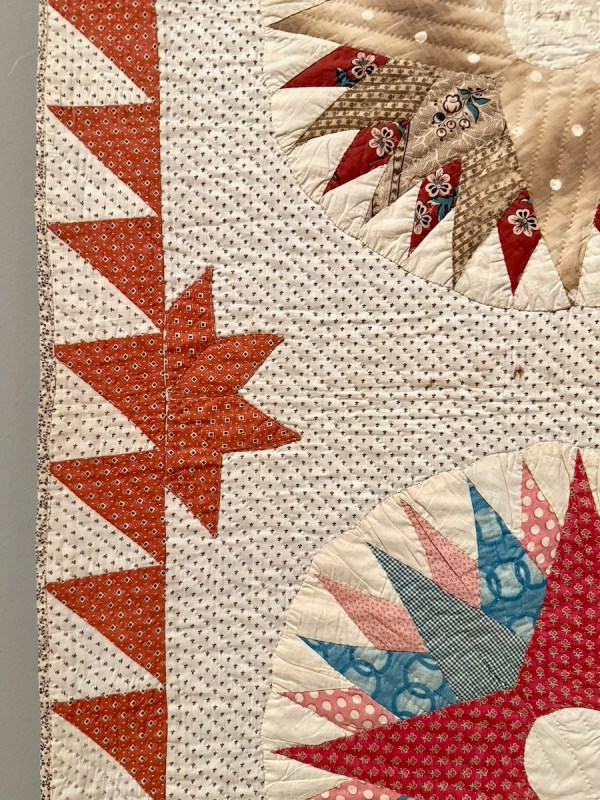
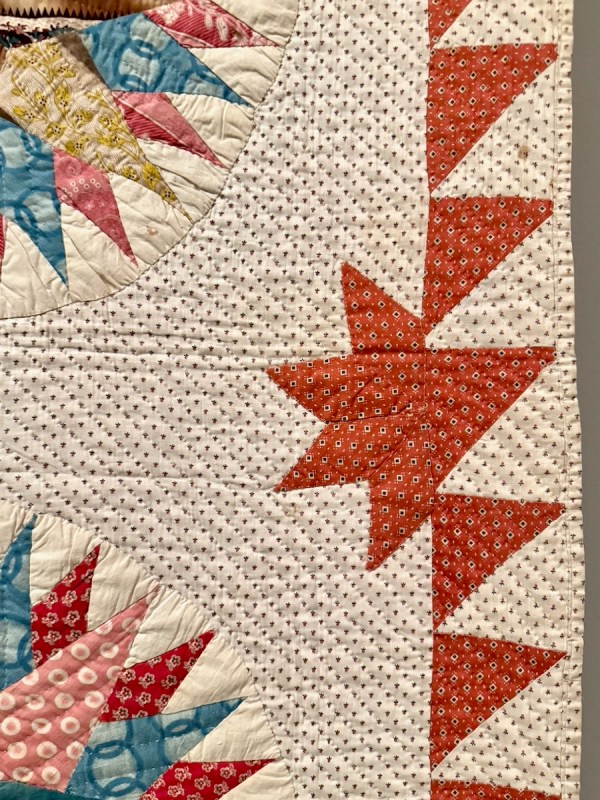
On the right side of the quilt, the binding matches the background. But not on the left.
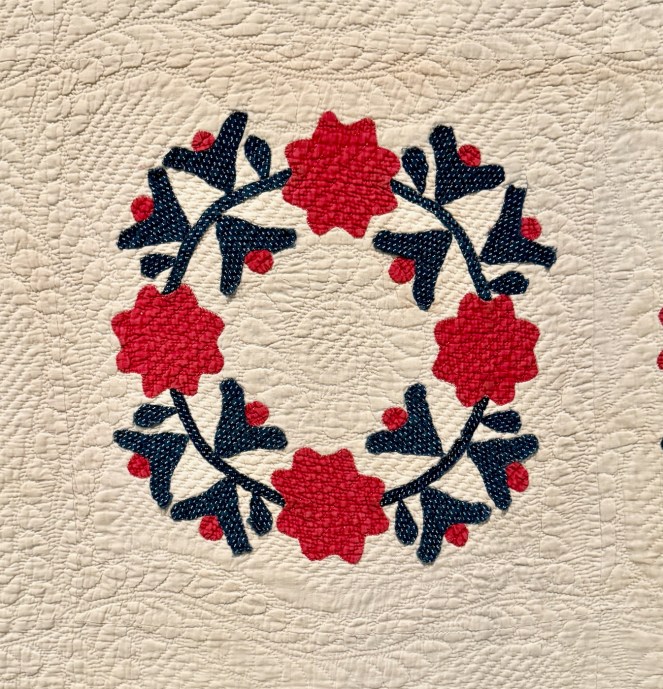
This Rose Wreath quilt has Turkey red fabric, so named because the process for obtaining the color from madder root was originally developed in the region of Turkey. As I have noted in other writing on this website, we really don’t know how people in the past constructed and lived their lives except in the broadest strokes and outlines. Were they excited to have this red? Did they pre-wash like we do? (probably)
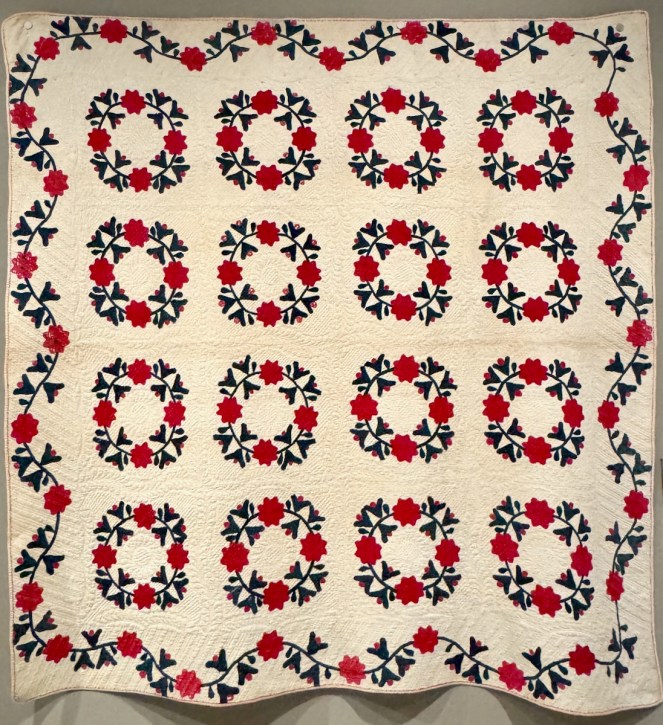
(Sorry for the blurry shot — the low light was a challenge, but I knew it helped preserve the quilts and fabrics.)
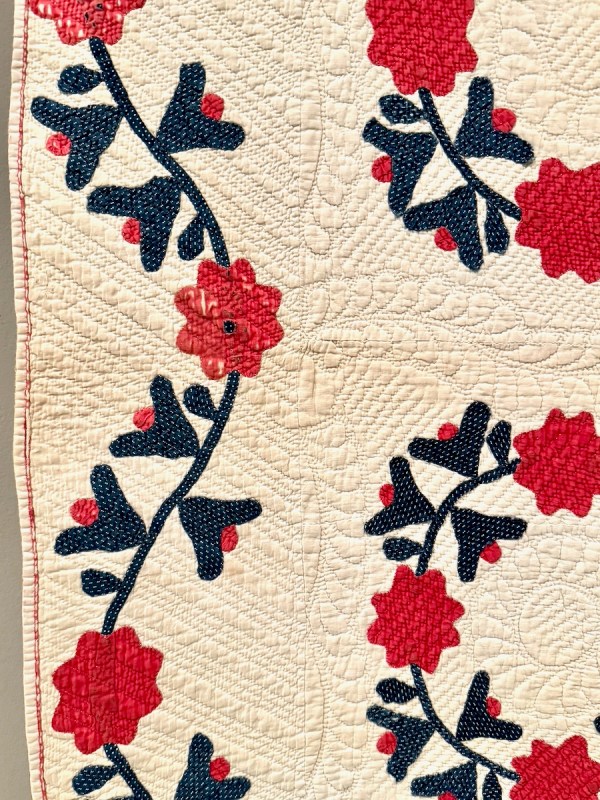
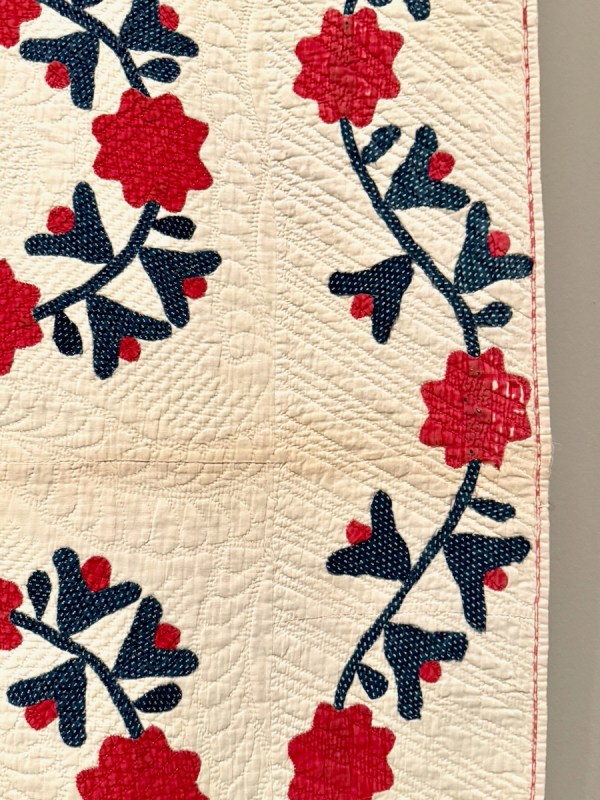
These vines, on opposite sides of the quilt, were not symmetrical, but instead echoed each other, curving in exactly the same way. Usually we see those vines mirrored. One hallmark of Turkey red is that it leaves the cotton fibers more vulnerable to abrasion and wear, as you can see here on the edges of the quilt.
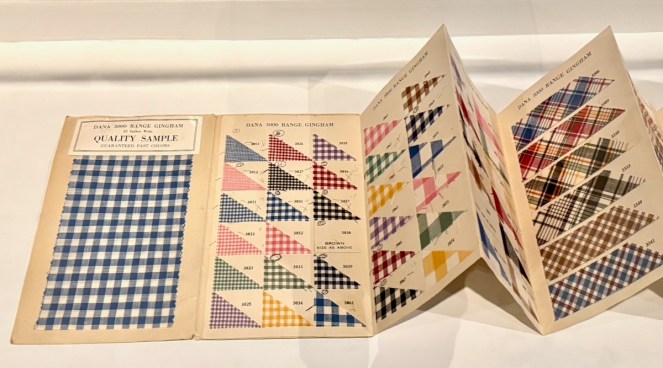
Around the perimeter were some displays; one included this Mail Order Fabric Sample card, from Montgomery Ward & Co, c. 1926. Okay, that’s a century ago.
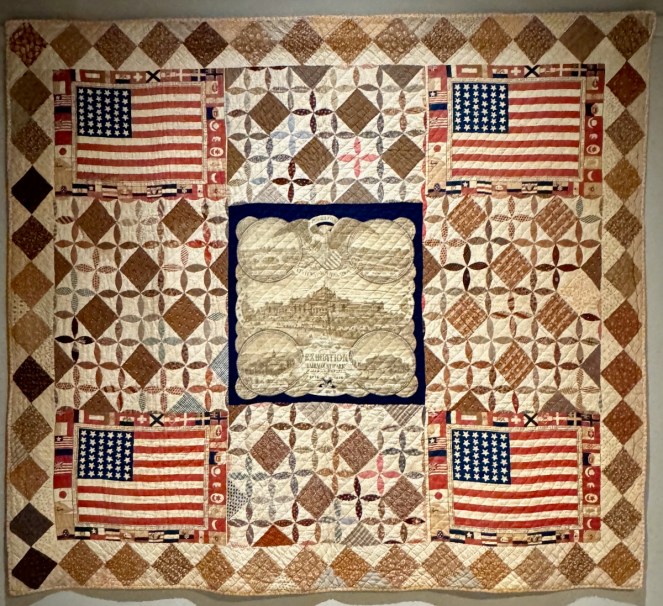
Centennial Handkerchief Quilt, by Sarah Angelina Andrews Whitman and Gertrude Spurr Whiman, c. 1883.
I loved the combination of quilt patterns: the handkerchiefs and panel in the center, the orange peel blocks interspersed with squares on the diagonal, with squares set diagonally around the border. According the title card, “Sarah Whitman collected the handkerchiefs during her visit to the Philadelphia Centennial Exposition, and made the quilt with her young daughter’s help a few years later.”
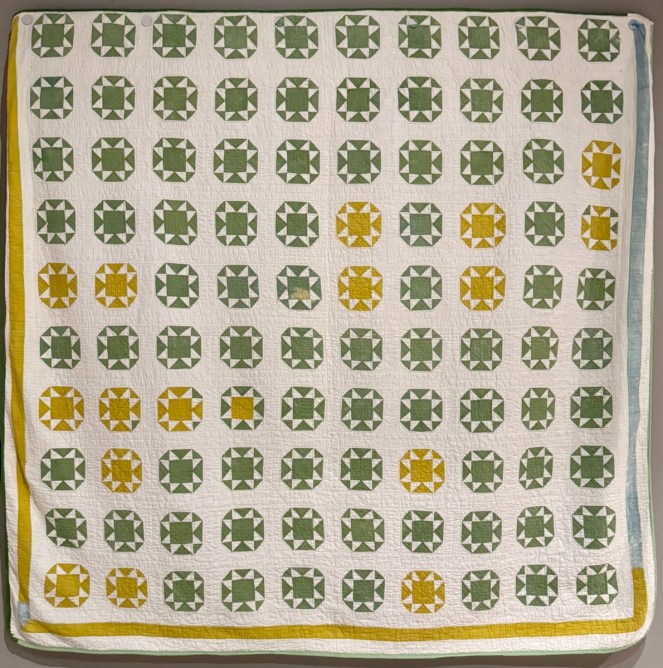
This one really caught my eye with all the variety of colors on the sawtooth blocks. My mind was whirling with possibilities that the quilter had tried, but was disappointed to read that they were all originally the same color (but two different fabrics). The title card says that “laundering the quilt in an alkaline detergent at some later point caused the blue dye to fade from only some of the green fabrics, leaving the yellow behind.” I still think it’s very cool, but I wonder how the quilter felt. The quilt is from somewhere between 1840-1910. And check out that outside border — I suppose that had the Detergent Blues, too.
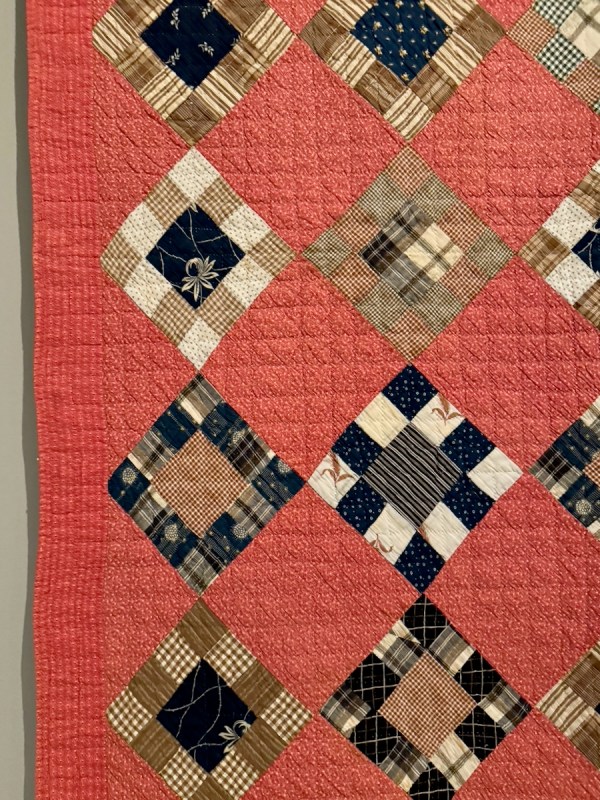
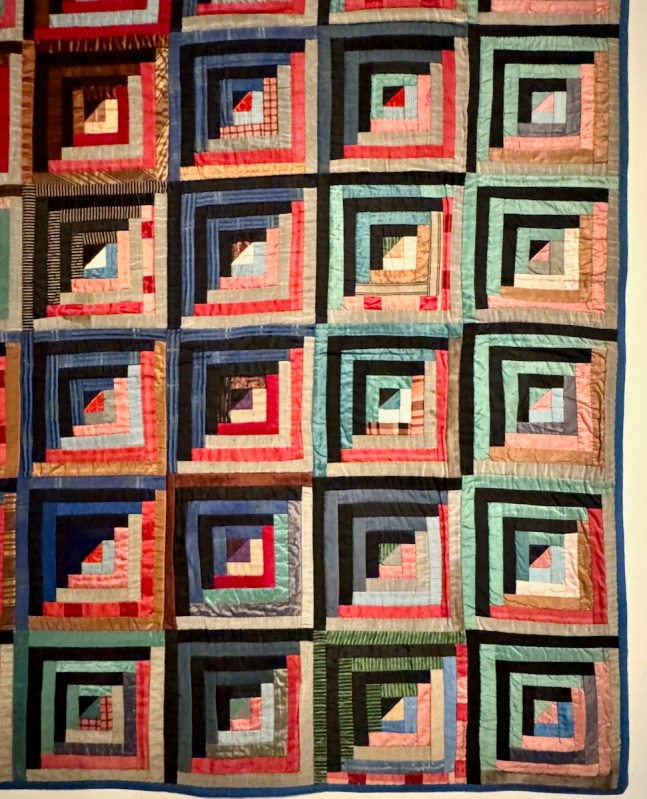
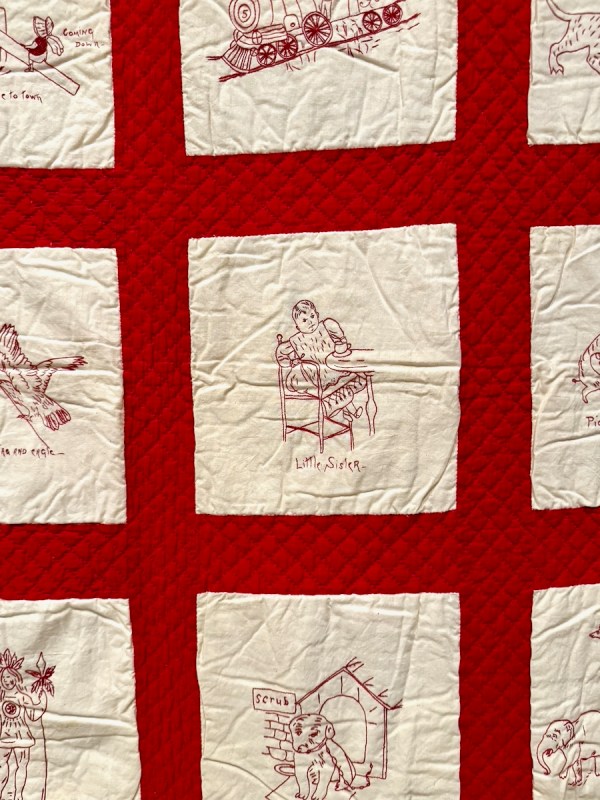
Details from 1) Square within Squares quilt, c. 1980; 2) Log Cabin Quilt, 1880s (made in silk and wool); and 3) Redwork Quilt (1890-1910).
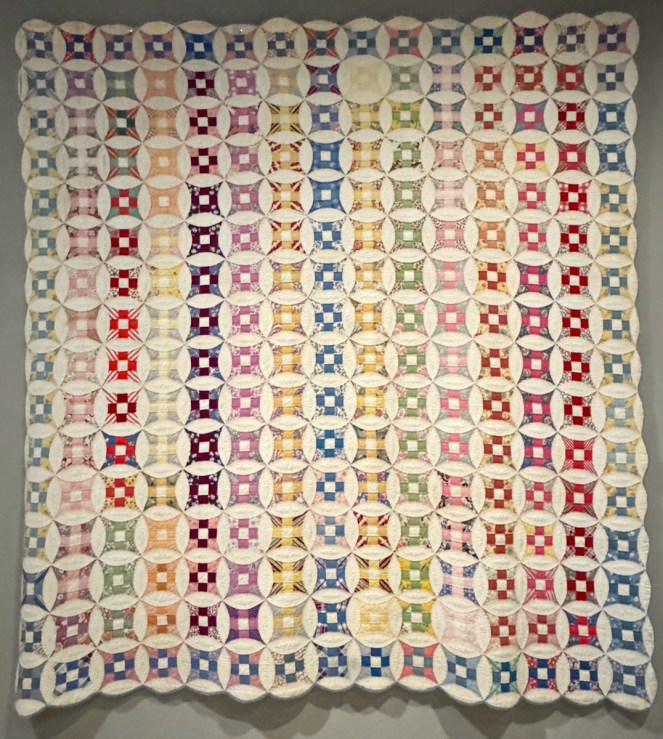
The nine-patch is a favorite block of mine, but this one was quite “glorified,” if by that you mean “making someone or something seem more important or better than they are.”
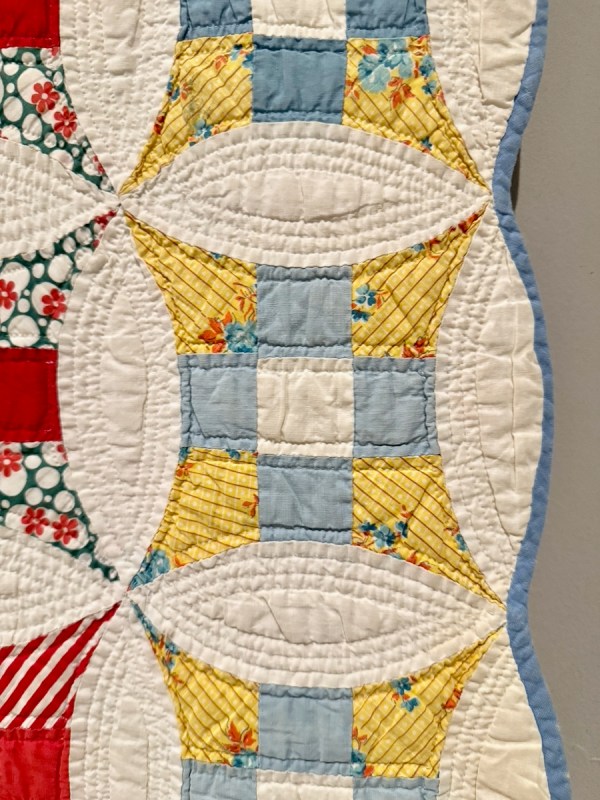
What interested me here was how those pointy outer corners were laid on the bias, as shown by the diagonal lines in this print (well, one wasn’t, but the rest were). Was that a design choice, or because it would be easier to piece the curve on the bias?
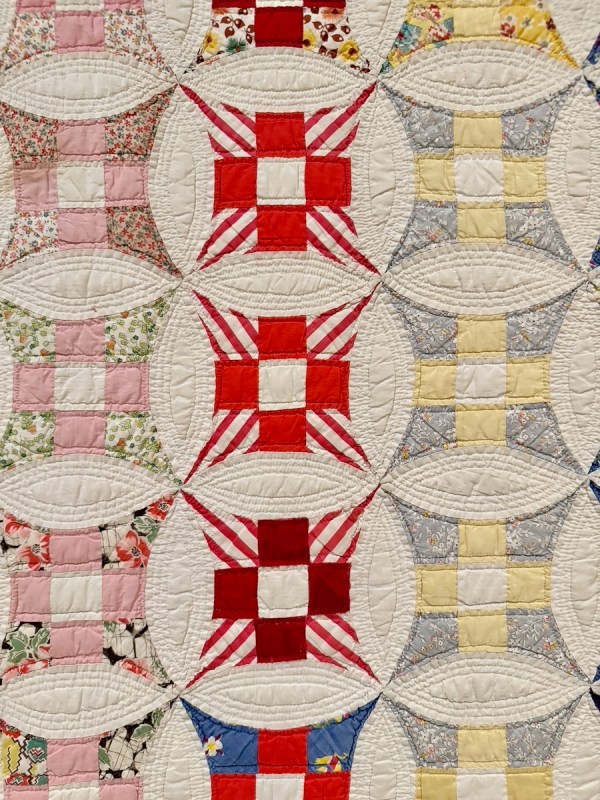
Here it is again. I think the bold stripes lend some pizazz to the 1930s prints.
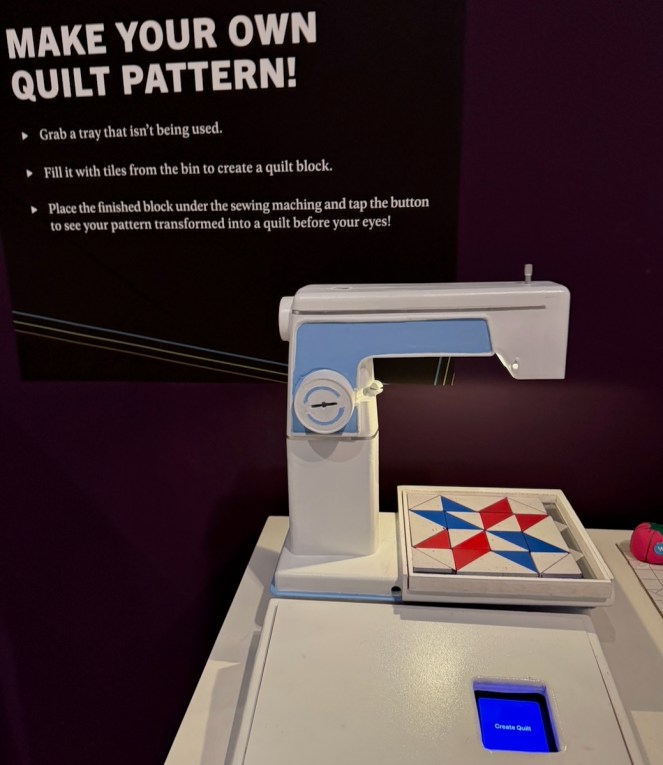
Keeping in line with the idea of messing around and enjoying it as I go, I decided to play their Make a Quilt Pattern game.
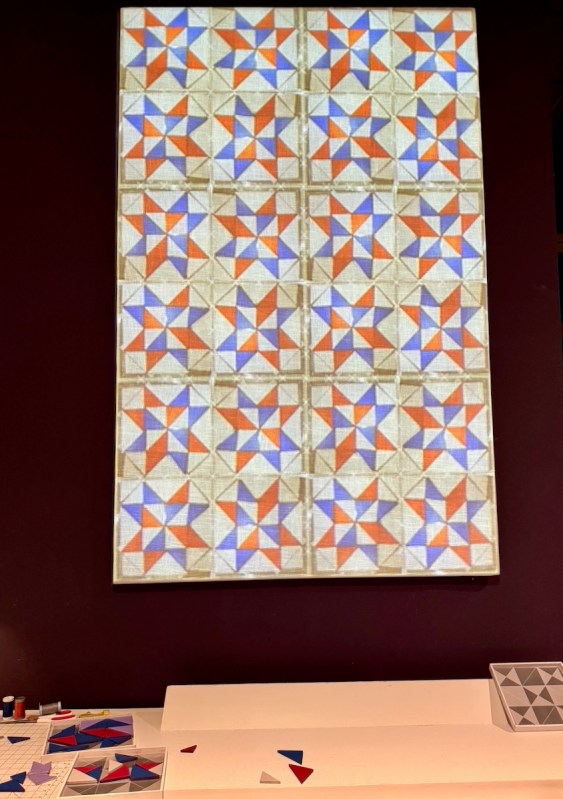
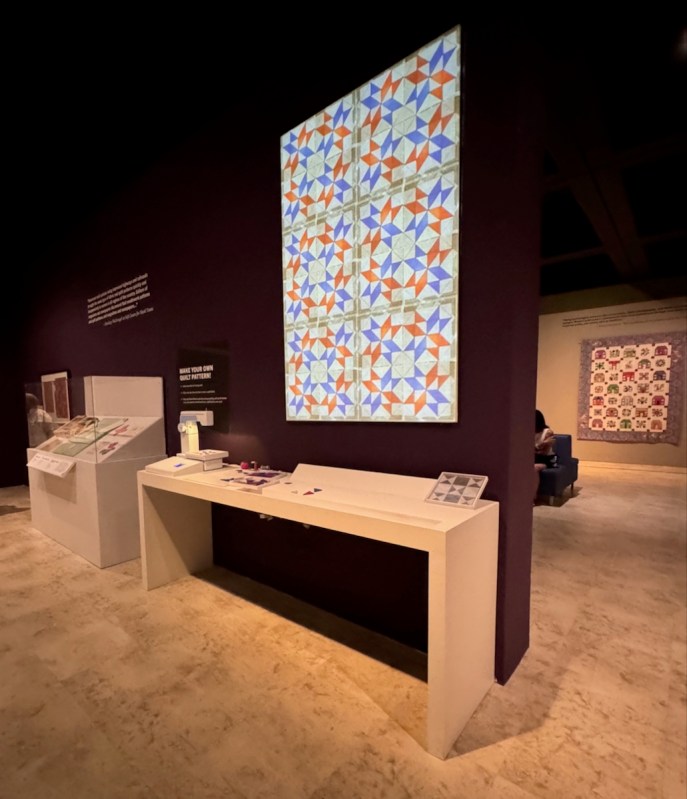
I did the first one on the left, then discovered I could switch a couple of the sawtooth points and get the second (shown here on an angle).
The last room was filled with more contemporary quilts. The exhibit, The American Quilt: Cloth and Commerce, runs through August 30th, if you are in the area. More information can be found on their website.
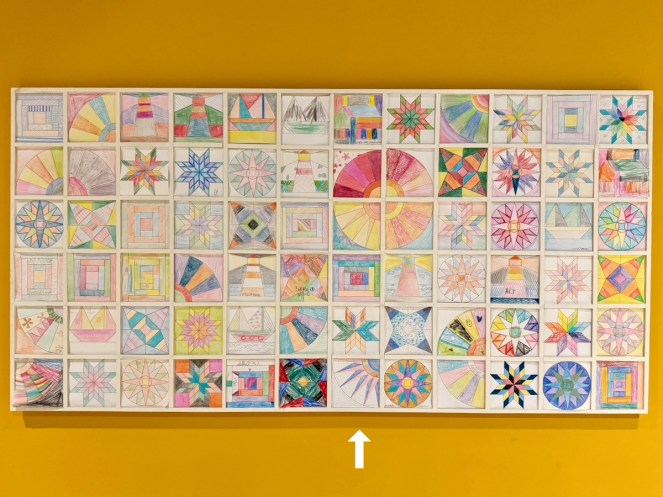
In one corner of the last room, you could color in a block and slap it up into their frames. I chose the “Fan Block,” then said, to heck with Fans, and went to town as if it were a New York Beauty, drawing lines to make it more interesting (mine is just above the arrow). I was in my element:
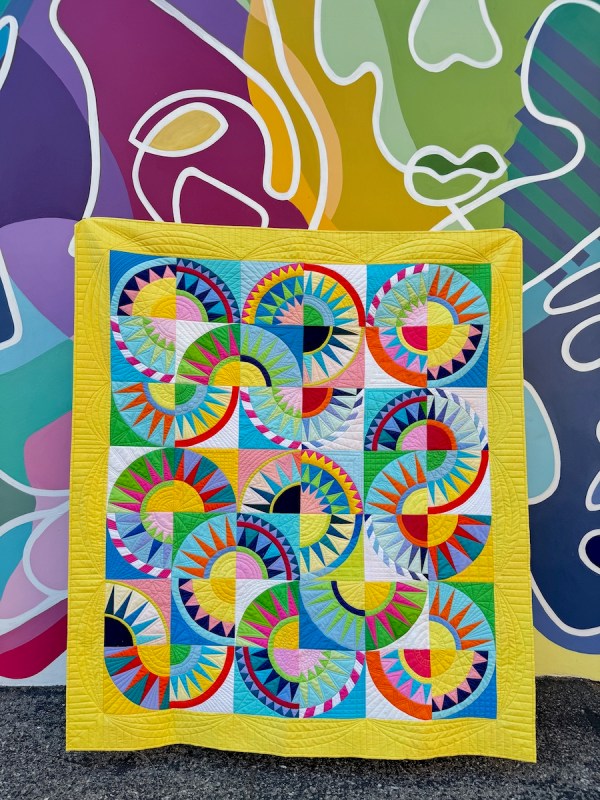
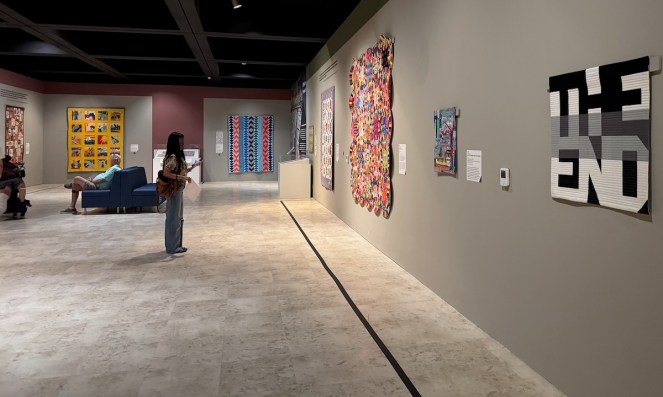
THE END is by Janet Tranbarger, a well-known local quilter.
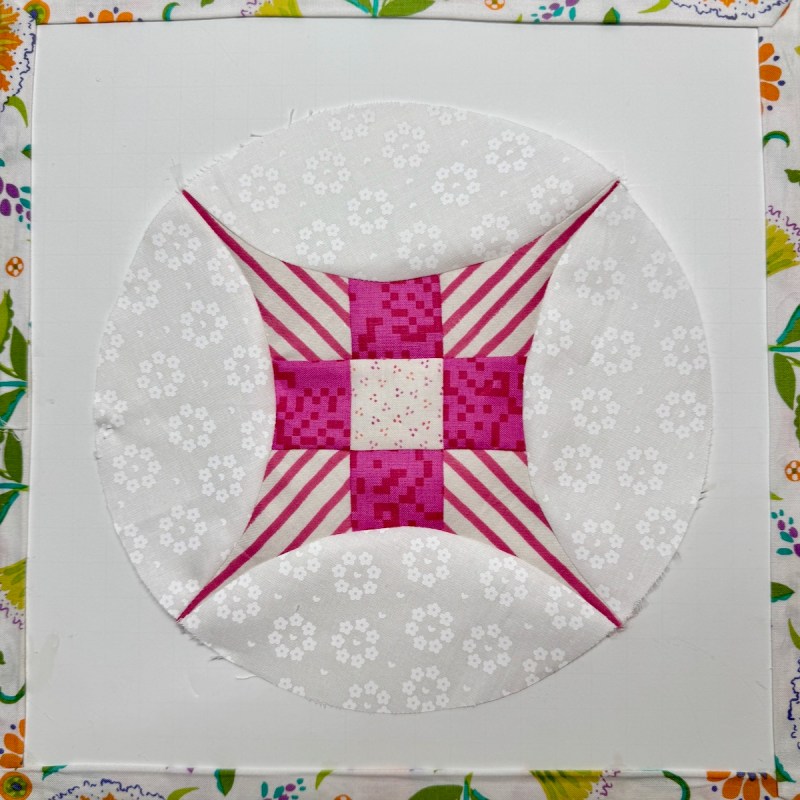
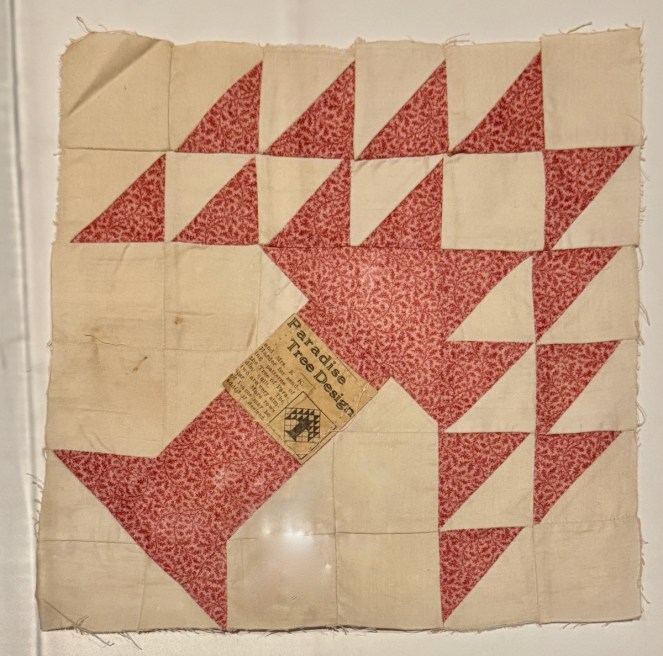
So I found the glorified nine-patch block in the Brackman, and one of its names is Circle upon Circle. I tried it out. This one finishes at 8 1/2″ inches. I’ve got a larger version I want to try (12″) but for now, here’s a free download from my day of doing Small Stuff.
To be truthful, I have no idea how you would put this thing together. Maybe try it as an EPP? Or just be really clever about how you’d sew on the ovals to the fancy nine-patches? Whatever, it’s free to download, if you want it.
Last two quilts:
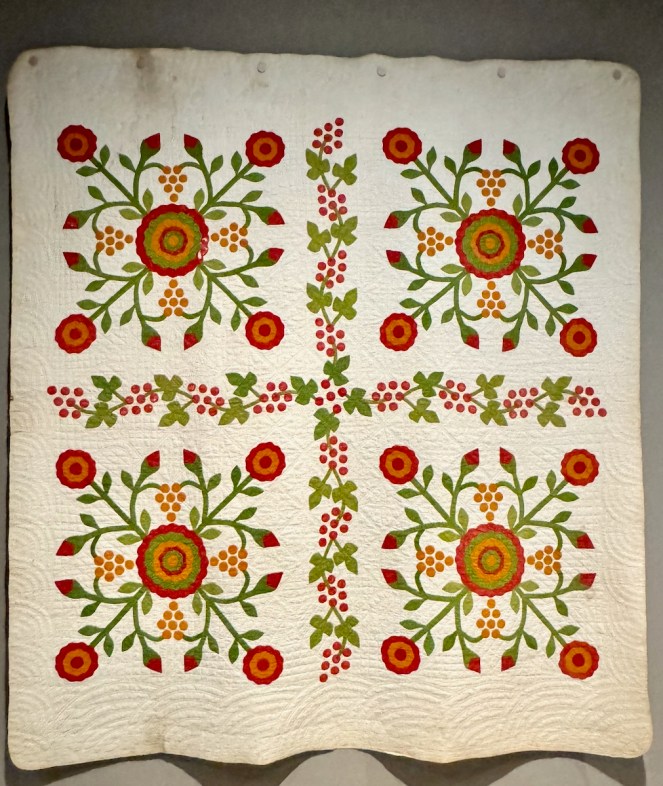
The title card said this is made of three different dyed fabrics: 1) “poison green,” an arsenic-based dye; 2) “Turkey red;” 3) and “cheddar,” a dye created with chromate pigment which yields a bright orange similar to the color of the cheese.
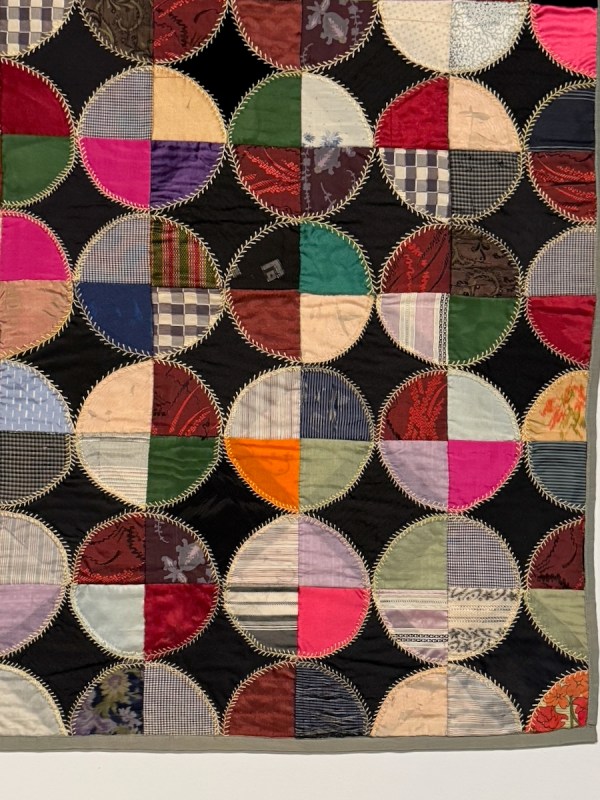
The title card noted that “The Treaty of Versailles, which was signed in 1919 to end World War I, included a clause that required Germany to share synthetic dye secrets with the Allied Powers as part of war reparations….The brightly colored patchwork in this quilt indicates that it was likely made after these dyes had become more prevalent in American fabrics.”
I couldn’t get close enough to see for sure, but I’m betting those stitches around the outside edges of the snowballs are done by machine. I’m also guessing that they “snowballed” quarter-circles onto black squares, then sewed them together. You can see some of the disjoint seams here and there.
Final word, from author Ian Bogost (I’d recommend listening to the whole podcast, or reading the transcript):
“So the idea is that we have become disconnected from our sensory lives. That’s sort of the thesis of the book. And this happened slowly over years and decades. It happened in part because of technology, but not entirely because of technology. And we kind of didn’t notice that that was happening. And we maybe, we blamed smartphones instead of a whole host of other factors. But the result is that we feel disconnected, you know? Like, decoupled from the world that we live in, from the physical world.
And that connection, that sensory connection where you engage with the world with your senses, which is what I call gratification: We’ve lost a lot of that. We forgot about it. We were too busy optimizing, planning for the future, trying to make our lives more purposeful or happier, that we forgot how to be gratified. And that’s what I think we should reclaim.”
I did my best to reclaim some Small Stuff, to forget the bigger issues that led me find refuge in this lovely museum, and to get lost in the world of quilts.