Heart's Garden · Something to Think About

Adding To Do Items onto a To Do List

So many organizational systems do not account for a trip to the fabric store, where immediately I have to reshuffle, re-prioritize not only my To Do List, but also my sewing room. I have five red tabs in my Get To Work Book and they read To Do 1, To Do 2 and so on to the fifth one. I have half-filled lists in my quilting planner. A lot is crossed off using my yellow highlighter, but when your organizational lists get out of control, how do you organize and get things done?

Research: I read this article which suggests compiling four different types of lists: Master, Monthly, Weekly, Daily (he describes them on the site). Lisa Jackson recommends a service called WorkFlowy under the post title of A Tool for Organizing Your Brain. Bette has declared this the Year of Focus and has organized segments of the year dedicated to her sewing goals. Sherri of A Quilting Life has a good planner for quilting goals.

And here’s my classic Goals List from over two decades ago. I should frame this–what an ambitious woman I used to be! (I’ve abandoned housework, physical fitness goals and scrapbooks — but did complete most of the quilts in the list. I also got the children raised.)

As we’ve noticed, our lives have shifted underneath us. We kept going, but perhaps our outlook changed, our friendships dwindled or expanded. I liked Brad Stulberg’s article, where he writes:

“Many of us felt seen when, last April, the organizational psychologist Adam Grant wrote of languishing, “a sense of stagnation and emptiness … as if you’re muddling through your days, looking at your life through a foggy windshield.” There was a relief in having a name for our experience, and a kind of solace in realizing that we weren’t alone in experiencing it. But now, nearly a year later, as with just about everything related to Covid, we’re sick of languishing too.”

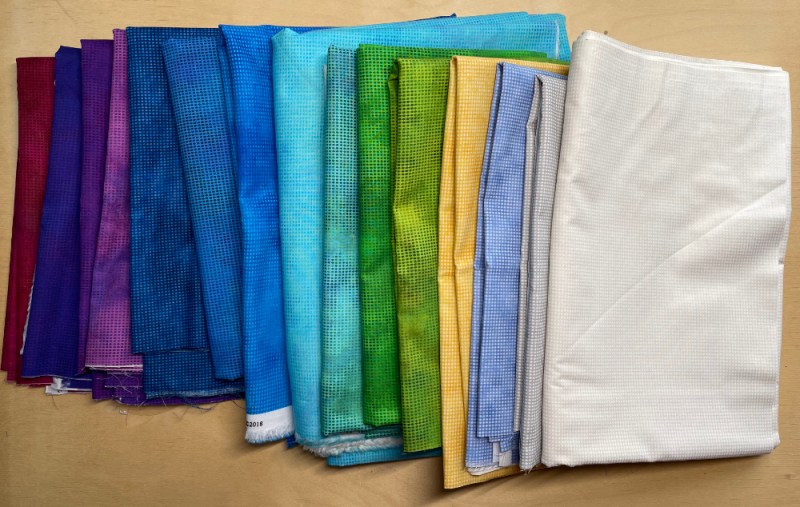
Perhaps that’s why when I went to QuiltCon in February, I tried to find things to give me a spark. I loved my two classes from Cassandra Beaver and Verushka Zarate, and enjoyed the lectures. It was fun to see people again in the wild, but there were some interesting moments of confusion in identifying people because we were all masked. And perhaps that’s why — when I went into a real-live quilt shop in Phoenix, and maybe because they gave QuiltCon-ers 20% off, I snapped up a range of beautiful colored semi-solids. Some one in line asked me what I was going to do with all those, all I say was, “We’re supposed to have a plan before we buy?”
Perhaps I was exhibiting Stulberg’s mention of “behavioral activation…based on the idea that action can create motivation, especially when you’re in a rut.” He writes:

“The challenge with behavioral activation is mustering enough energy to start acting on the things that matter to you: Make that phone call, schedule that walk with friends, write that email, get off social media and start on the creative project you’ve been procrastinating on. This may sound simple, but when you are languishing, simple does not mean easy.

“But a mind-set shift can be a powerful tool. When you feel down, unmotivated or apathetic, you can give yourself permission to feel those feelings but not dwell on them or take them as destiny. Instead, you shift the focus to getting started with what you have planned in front of you, taking your feelings, whatever they may be, along for the ride. Doing so gives you the best chance at improving your mood.”

So To Do lists can sometimes become exercises in bloodless planning, an attempt to get organized (which is why my planner often has blank spaces). But walking into a fabric shop now becomes behavioral activation. That, we can all get behind.

So my To Do lists are more random. This was going to be my year of Focus, a la Bette, but then I started the Heart’s Garden Mystery Quilt-A-Long, which I had all sketched out. And which I totally scrubbed after Step One and rebuilt it anew. Which was no where on my Yearly To Do List. Here’s my first sketch:

Yep. Pretty hideous, excepting those EPP circles. I even got the birds around the border, but they look more like quail, than sparrows or finches. I’ve been working on writing up Part 3, which is coming next week, and part of that is making birds over and over, as I perfect the pattern:

blue and yellow blocks, for Ukraine (from Hearts Garden pattern)

So I write — and cross off — “sparrows” on my To Do List, and wander back into the sewing room for some pleasant Behavioral Activation. I wish the same for you.

Happy Quilting!

Quilts · Something to Think About

The Calendar is my Friend. Repeat.

Too Much Social Media.jpg

I read this cartoon, from Stephan Pastis, some time ago, and I’ve saved it as it seems like it hits a bit too close to home with that wasting time on social media thing.  But rather than harp on that tired subject again — social media is ruining our lives — I’d rather take it a different direction, and talk about the one thing that helped me manage my social media as it relates to quilting: I made friends with my paper calendar.

In blogging, I used to just write blog posts at random: if I had made a quilt, or ran across something cool to share, I did.  But once another blogger said she scheduled her blog posts, I realized that she thought about them, worked out when she wanted to them to show up. In other words, she used that old-fashioned tool of calendaring her posts.

Calendar_1

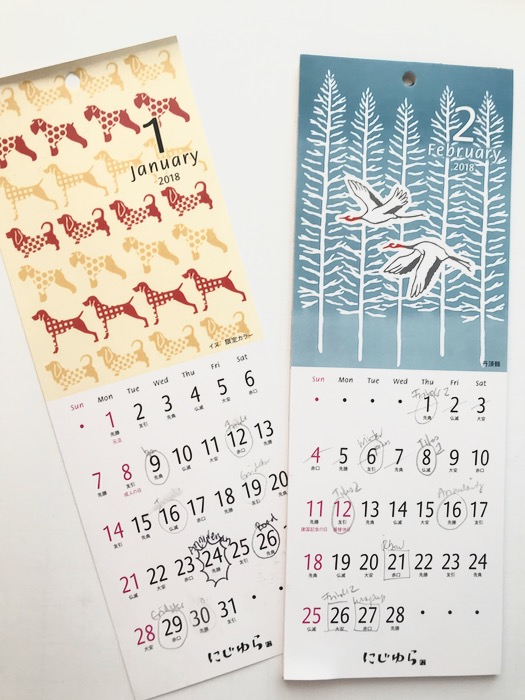
I use a small desktop calendar, and circle the date and pencil (not pen) in a code word, so I know what’s happening.  It helps me space out things (not always successful on this, but I’m working on it).

I came home from QuiltCon, vowing to work smarter, determined to change up how I used my favorite calendaring book, the Get To Work Book.  Too often I was using it as a journal — you know, writing down the things I did, or needed to do, and crossing them out in yellow marker when they were completed.  Yeah, even if I’d just written them down.

Calendar_2

These are the project pages at the back of each month.  Post QuiltCon, I dumped wrote everything that was in my head down on paper.  I then took time to break it down into tasks, slipping a few onto every week of the month. Has it helped?  Somewhat.  I know now what I have to work on. I  don’t know about you, but I tend retreat to social media when I am bored, or perhaps, overwhelmed.   I can also be easily distracted by the wonderful eye-candy on Instagram (but in some ways that’s another topic for another day.)


In his article, “Warren Buffett’s ‘2 List’ Strategy: How to Maximize Your Focus and Master Your Priorities,” James Clear makes the point that even though many things are good to do, if they are not your top priorities, they will distract you from what’s most important, and from what should be given your best and undivided attention.

He notes that “Every behavior has a cost. Even neutral behaviors aren’t really neutral. They take up time, energy, and space that could be put toward better behaviors or more important tasks.”

Some other tips:

  • Simplify your media.  If you do Facebook, get off of Twitter or Snapchat.  Leo Babuta writes: “You can be a part of a social network and not participate all day long…I’ve consciously decided that I’d prefer to be creating rather than always connected to the social stream.” (from Zen Habits)
  • Notifications (from FB, IG, etc.) are a huge time sink.  Bubata recommends turning them off: “Don’t be notified everytime people post things or reply to you or follow you or email you or comment on your blog.”
  • I also liked the tip from Elizabeth Grace Saunders in the article “Front Load Your Week,” when she says “To minimize stress, spend less time worrying about planning exactly how long every activity will take you to do and more time front-loading your calendar by putting your most important activities with deadlines early in the day and early in the week. For example, something due on Friday should start appearing in your schedule by Tuesday afternoon…Front-loading gives you the ability to stay on top of projects that take longer than expected without getting stressed or working into the wee hours of the night.”
  • To follow up with that, front load your day.  Know when your best energy level is, and stack up tasks for that time.
  • My favorite focusing device is to ask myself:  “What do I want to have completed at the end of this day?”  That question alone has propelled me through me many a foggy moment.
  • Humans come first.  My husband is El Numero Uno, then my family, then friends.  After my husband, the order is flexible.
  • I am also a human.  (Obviously I have several firsts, but it all works out.)  By saying that I am a human, I need to be aware of how I feel after sitting scrunched over, reading my small screen. I need to be aware of how good a walk feels, even if it’s in the middle of the day, and only around the block. I need to be aware of how I feel when I can’t get anything done, because I’ve spent too long reading on the web, instead of getting to my work.  I need to be aware of how good it feels to have my life ordered, and not frantic.

Some regular tasks help me order my month, such as:


Gridsters March 2018
Marsha’s block for the Gridster Bee, March 2018

Sewing Obligations, such as blocks for my mates in the Gridster Bee.  I like jumping on it and getting it done at the beginning of the month (see tip about front-loading, above–I like to front-load my months, too!).

Calendar_3

Turning the calendar to a new month.  I believe that with all my digital calendars, at times I lose sight of how time can be structured and used.  Bringing forward that new page reminds me to check my project lists, re-order priorities, bring on new tasks.

It’s not harmful to be involved in social media as many interesting and significant discoveries, as well as new friends, can be made this way.  Some nights, when I’m too tired for sewing tasks, I like to read blogs.  I use Feedly and Bloglovin’ to help keep my reading organized and to follow up with people on Instagram, and Facebook.  It’s enjoyable to see what everyone else is doing.

Do you have tips for staying focused?  If you care to share, please leave them below in a comment.


Quilts

Straighten Up and Sew Right

Sad Seamtress(from *here*)

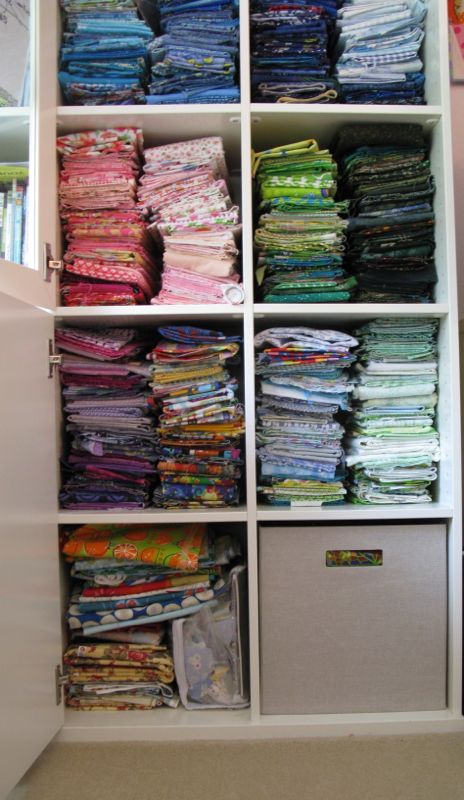
It had been nearly a month since I’d threaded the needle of my sewing machine and sent it to humming, and I felt like the sad seamstress in the photo, above, pining away.  I wanted to get to the machine and have a good sewing session and have something to show for it.  As one Instagrammer said, “My sewjo is missing.”  But I wasn’t idle.  First, I had a root canal, which ought to occupy anyone for a few days.  And I also cleaned out the stash a bit, filling two large mall shopping bags with swatches of fabric to let my quilting group, the Good Heart Quilters, rummage through before donating the rest to our quilt guild.  And here’s some photos to prove I have tidy cupboards, before I start messing it up again:

Straightened Up 1

 I like to organize mine by color and value (light-to-dark).

Straightened Up 2

The lower half of the cabinet.  Inside the pull-out box are browns and blacks–easier on the back this way.  I keep the Kaffe Fassets in another place, and I also have a stack of cream/tans and a stack of “low volumes” (neutrals or pastels), and stack of predominantly white/light background fabrics.

Molly Qee xfour

Here’s a close-up of my Molly Qee collection (the characters with the crowns).  They are hard to find in the States.  I started my collection when my sister Christine and I happened into a collectibles shop in Lyon, France.

More Shelf Stuff

And on the other shelf are other doodads.  My husband gives me the little Japanese dolls (ningyō).  And those fabric-covered binders are all my journals, began when I was a young woman of twenty-one years old.  Since the advent of email and cheap phone calls, I’ve stopped writing them, but I love having them around (they hold all my secrets!).

Pink Selvage BlockSo after a busy month, I pulled out the machine and got started.  I decided to ease my way in slowly, making a selvage block.

Basic Selvage Block Foundation

When I begin, I use my standby translucent paper, cutting, then pasting a strip on one side so it measures 10 1/2″ square. Then I draw lines on it to keep the selvages on straight.  Do I cut all my selvages off when I buy fabric?  No.  I like having them on to keep track of the newer stuff in case I need more.  Most of these selvages happen when I’m going through older fabrics that are in my stash (like those to be donated), of which I know I’ll never need the information again.  Then I slice it off, leaving about one-inch to 1-1/2″ of the fabric on top of the selvage so I have Lots of Options.

Pieced Selvage Strip

I get started by cutting two 4 1/2″ blocks, then slice them on the diagonal to make up the four triangles you see in the center above.  I pin them down, then start sewing on the selvages, placing the selvage edge 1/4″ in from the raw edge of the triangle, as shown.  Sew closely along the edge.  I like it best when the first selvage next to the color is the same, or nearly all the same, so I look for a longish piece. I think it just helps set the stage.  Sometimes I piece selvages to get the printed symbols and the words closer together (above) and other times I just let it be.   Then it’s random, random, random after that, some thinner strips, some thicker strips.  Some people like to trim the fringey pieces, but I just leave it that way.  Sometimes after I sew on a strip of selvage, I’ll go in and trim down the underneath piece just to keep it tidy.

Selvage Block Colors

Sometimes I get things off balance, like in the pink block way above (too much deep maroony-pink in the lower left) but then I figure I’m teaching myself how to let go a bit and just enjoy the process.  And I do.  I now have five colors of four 10″ (finished) blocks, so the block will be twenty inches square after all four parts are sewn together.  This is going to be one big quilt, but I’m in no hurry.

To close with, here’s a quote from The Rise, by Sarah Lewis (the book I wrote about in the Creativity post):

“Perhaps we have grown impatient with the incomplete. We are part of a generation that, as the African proverb goes, wants to eat dinner in the morning, that longs for the immediate, fully prepared for consumption. Yet the strength to linger over the long-left unfinished reminds us that something inexhaustible in us is empowered by striving, that we sense unnaturalness in blunt ends of journeys, of lineage. And that power comes from where we least expect to find it.”

Go tackle something incomplete, and enjoy the power of taking another look at something that in our hands, has had a long journey.