
Whenever my husband and I clean out the garage and are trying to put everything back, I can see where boxes will fit. . . and where they will not. My husband is a brain, really smart, but I think that my years of working with pieces of fabric, shapes, sizes, corners — all that quilty stuff — allows my eye to notice how things fit together.
Another time, when I was a long-term sub, the 9th grade students needed some help with basic math and geometry. Since by this time the lesson plans had long run out from the regular teacher, I developed a series of lesson plans that were ordered around quilt patterns. I gave a lesson on a few shapes, then turned them loose with their pencils, rulers, colored paper and one piece of black paper to use as their foundation. The results were dramatic and wonderful; I found out later these “quilt blocks” were left up all year long, even after my sub job ended. I chalked it up to the enduring power of quilts.
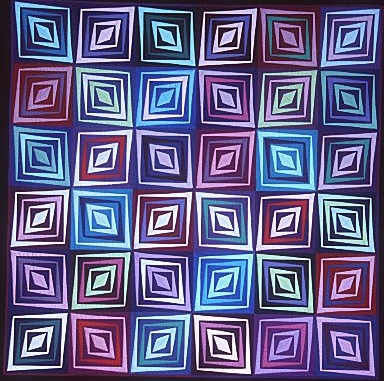
So I was thrilled to receive a flyer from a biologist friend of mine, touting a lecture given at the University of Alberta, Canada: “Quilts as Mathematical Objects.” The above quilt was on the flyer, and was made by Gerda de Vries. She describes herself this way: “I work as Professor in the Department of Mathematical and Statistical Sciences at the University of Alberta. I am an applied mathematician, specializing in mathematical biology. I am interested in understanding and explaining physiological processes through the development and analysis of mathematical models.” So she invents a rule, applies it to her quilt design and carries it through.
 This one’s titled “Cyclic Permutations (Study in Red, Black and White #1).” The rule on this one that each triangle has a certain number of pieces, with the colors laid out in a particular order. If you study it you can start to see the “rules” she applies. I started listening to her lecture, “Quilts as Mathematical Objects” available on iTunes, via iTunes U (type in the title in your iTunes–she gave it at McGill University) and can hardly wait to finish. I only wish I could have been there to see the visuals–which is what matters to us quilters.
 She also does traditional quilting, as evidenced by this beautiful example. She writes on her website that “I have a soft spot for ethnic fabrics. This quilt highlights my collection of fabrics from the Netherlands. Most are reproduction fabrics purchased at specialty stores; others were donated by relatives. Traditionally, these fabrics were used in costumes (shirts, aprons), as well as home furnishings (bed sheets, mattress covers, curtains). Also featured are a variety of so-called farmers’ handkerchiefs with traditional patters, purchased at town markets throughout the country. I took particular delight in the construction of this quilt by fussy-cutting most of the fabric pieces.”
I think sometimes we operate in an insular world, in our own little quilty bubble, or at least I do, so it’s interesting for me to think about practical applications of our skills as quilters. Perhaps if we relish in the color of quilts, we extrapolate that to our clothing, or our home dec. Perhaps if we like the intricacies of quilting–matching up corners/seams/pieces just right, we will have perfectly ordered drawers and cupboards. Or perhaps, as in the example of Ms. de Vries, we make our vocation (the thing that pays the bills) coordinate with our avocation (what we love to do) in creating beautiful and interesting quilts.




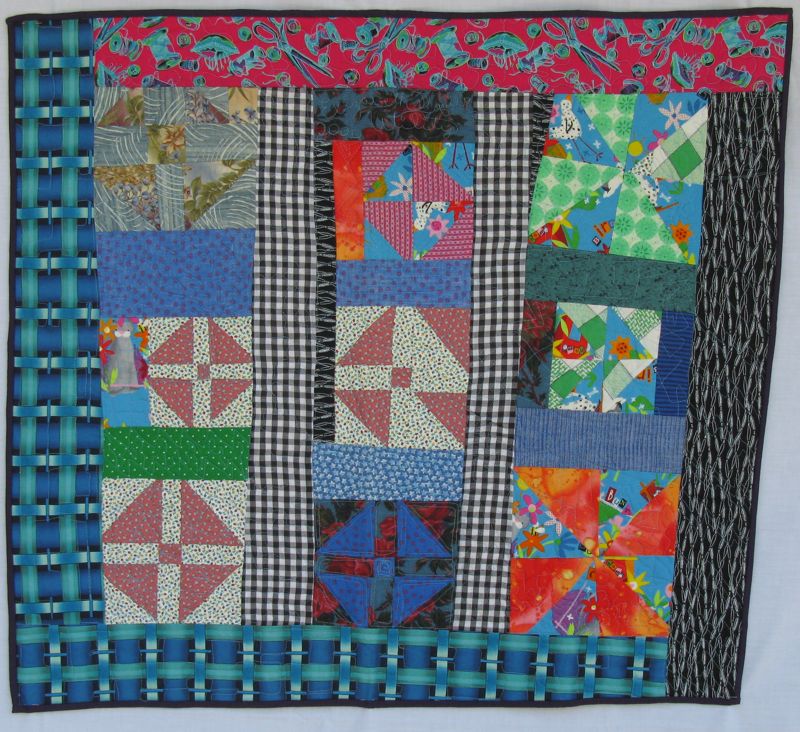


 OccasionalPiece--Quilt!