200 Quilts

Childhood’s Wide Avenues, deconstructed

Childhoods Wide Avenues Art Quilt_front

Thank you all for your lovely comments yesterday and for visiting the rest of the Four-In-Art quilts.  The reveal day is one of my favorite days of all the blog writing I do, as it’s such a shared experience.  Today I’ll talk about the technique and the how of the quilt, but first, a little clothing and textiles lesson about four sheer fabrics:
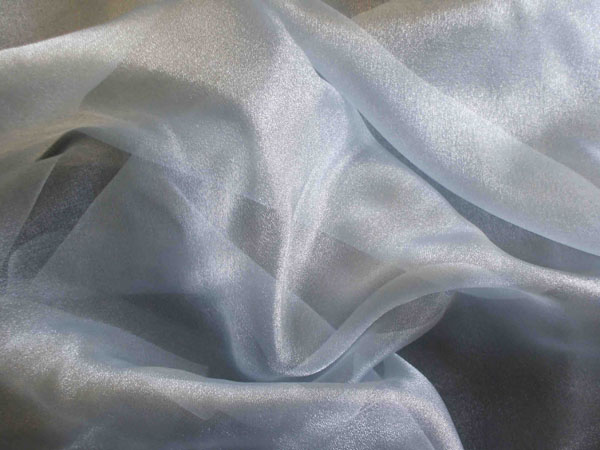
Organza

Organza is a thin, plain weave, sheer fabric traditionally made from silk. Many modern organzas are woven with synthetic filament fibers such as polyester or nylon.  The Casa Collection of sheers at JoAnn Fabrics is an light-reflecting organza, and it is light and soft with lots of drapability.

organzabags

You usually encounter this fabric as jewelry, or wedding favor bags.
OLYMPUS DIGITAL CAMERA

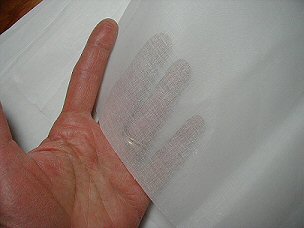
Organdy is a balanced plain weave. Because of its stiffness and fiber content, it is very prone to wrinkling. Organza is the filament yarn counterpart to organdy, meaning it has very thin fibers in the weave, and is used often for interfacing in lightweight clothing construction, or as petticoats or slips for formal wear or wedding dresses. (All images pulled from web.)
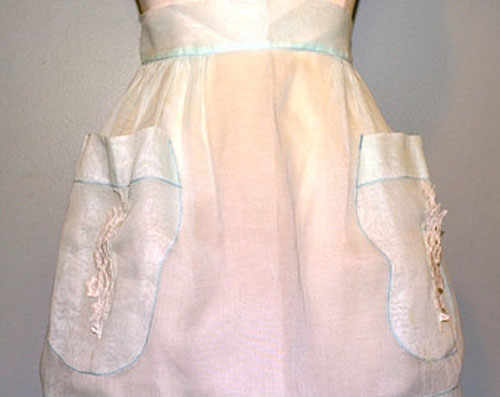
organdy apron

You’ve probably seen it in your grandmother’s or great-grandmother’s aprons–a crisp, sheer construction.

Chiffon

Chiffon is a lightweight, balanced plain-woven sheer fabric woven of crepe (high-twist) yarns. The twist in the crepe yarns puckers the fabric slightly in both directions after weaving, giving it some stretch and a slightly rough feel. Chiffon is made from cotton, silk or synthetic fiber, and under a magnifying glass it resembles a fine net or mesh which gives chiffon some see-through properties, but it is more filmy in its appearance than organza.

Tulle is a lightweight, very fine netting, made of various fibers, including silk, nylon, and rayon. Tulle is most commonly used for veils, gowns (particularly wedding gowns), and ballet tutus.

Lesson over, and this is why I brought those up first: I was a bit stumped on this quilt, feeling like I had no idea where to go.  I keep an art quilt journal just for these projects, and began writing down my impressions (see yesterday’s post) and drawing a few possible ideas.  Once I knew the general direction of where this quilt would go, I wanted to think about a new technique to try, and I wrote down “use tulle,” as I had seen very successful use of this as an overlay to keep teensy pieces in place during appliqué, used to great success by Karen Eckmeier.  But in this smaller piece I thought the texture of the tulle might be a distraction, so decided to explore some alternatives.  I purchased chiffon and organza in both white and ivory/off-white.

Now I had the materials I needed, I began.
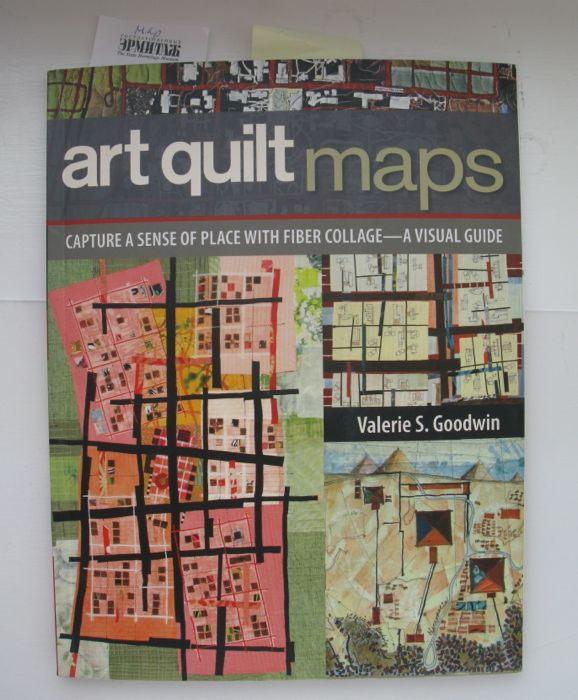
Art Quilt Maps book

Quite a few of us had seen Valerie Goodwin’s book on art quilt maps; I enjoyed it, but the bigger takeaway for me was to build up the background with texture, in terms of the visual space and use of fabric.
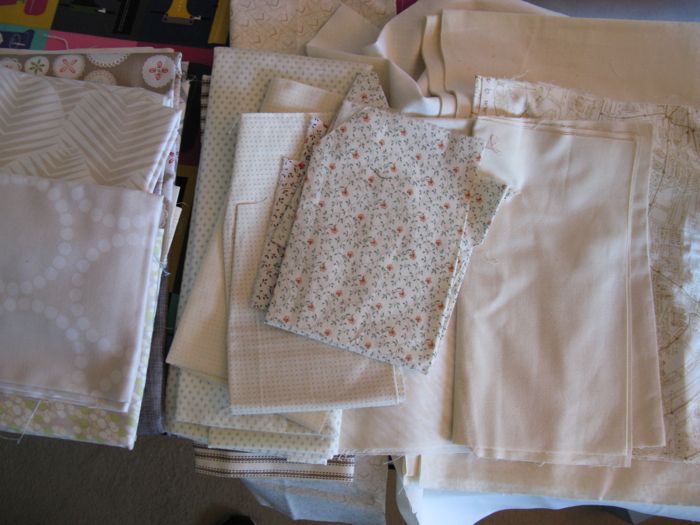
CWA_1Choosing Fabrics

So I pulled all my neutral fabrics (the current vogue term is “low-volume”) and laid them out.  Because this was the background, I rejected any that were to figured or obvious in the print.  I randomly cut out oblongs, squares and rectangles and laid them out over my base muslin.  In my art quilt journal, I had sketched out a few possibilities of layout, and I knew I wanted a clearer left-hand margin of the background for photos.

I auditioned my two colors of chiffon, and my two colors of organza, and decided on an off-white organza as the sheer overlay.

CWA_2 drawing grid

Slipping a piece of paper under the organza so the pen marks wouldn’t transfer to the fabrics, I sketched in my wide avenues, free-handing it (look ma, no rulers!).
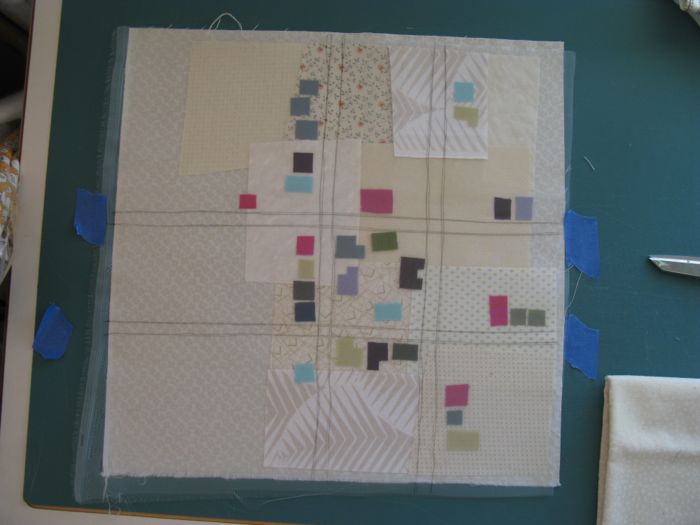
CWA_3 adding houses

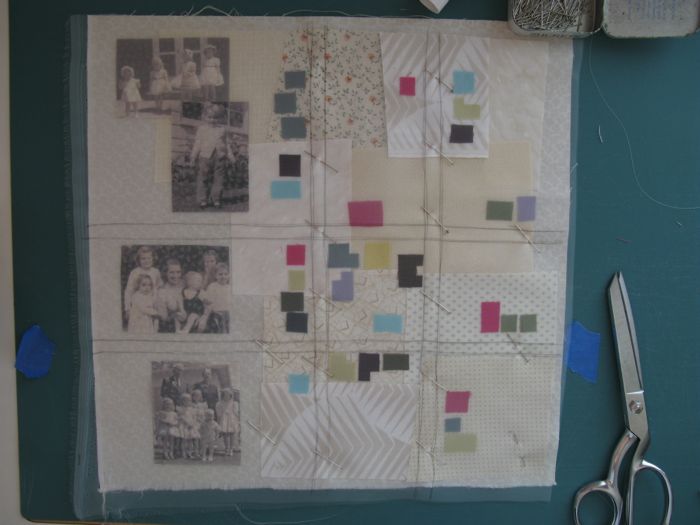
I cut itsy-bitsy little houses, but trying for a variety of shapes.  I carefully laid them under the organza, along the avenues.  I was temped to draw in streets and lanes, but decided that, for this particular theme, it would only be distracting.  The houses kept moving every time I added a few, so I got out my glue stick and stuck them to the background fabrics, which also had a few dabs of glue to keep them in place.  You can see I used masking tape to anchor the organza to the composition.

CWA_4 adding family

I printed out some family photos, using the usual method (freezer paper-backed fabric, taped to a piece of paper and fed through my trusty Epson inkjet printer), and started to add them.  This was the first try.  I kept moving them around until I got what I wanted, trimming some edges to make it fit, visually.
CWA_4a

I used straight pins everywhere to secure the organza, and then took it to the machine.  Because they are such a small size, it’s easy to manipulate them under the machine.
CWA_7 detail front

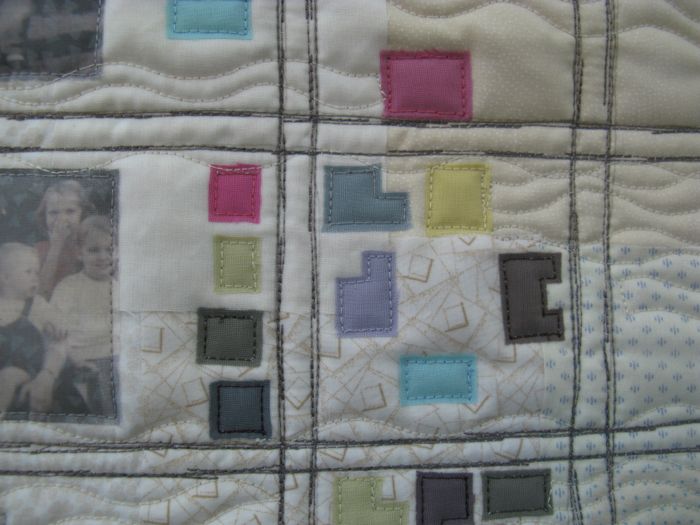
First I used a dark gray and “drew” in the avenues, using the reverse button on my machine to simulate how it might look if hand-drawn.  I went over those several times.  Then I outlined all the houses, using matching thread.

CWA_5 quilted

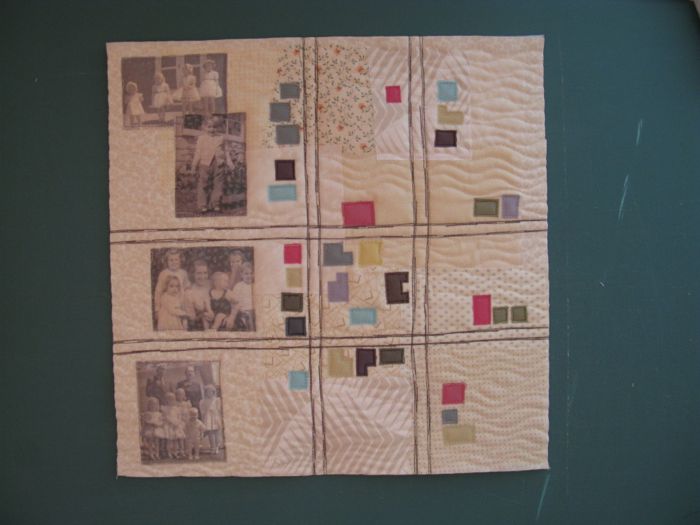
I quilted in wavy lines that to me represented the flow and movement of the landscape–it could be slight hills, or the movement of grasses, or whatever, but I didn’t want straight lines.  Once quilted, the organza overlay began to act and feel like that thick coating that some topographical maps have, and this change in texture was an interesting surprise.
CWA_6 trimmed

Trimmed up.  I auditioned several bindings–and no binding–but decided to go with a stripe, to further echo the idea of roads.

Childhoods Wide Avenues Quilt_back wo label

For the backing I chose a taupe-cream fabric which depicts the streets of Paris. . .

ChildhoodWideAvenues Art Quilt_label

. . . then added the label.  This is our fifth quilt as Four-In-Art quilters, but I chose to delineate our new series: Urban.

I’m pretty happy with this little quilt, and it joined the others in the Nature series, above my sewing room window in my own little art gallery.  I hope, if you haven’t already, will click back to yesterday’s post and go and view all the other quilters’ creations.  You’ll see some similarities in our quilts, even though we are geographically located all over North America. And perhaps the interesting differences in our vision of this theme come from the different places we live.

The Map As Art

I’m currently reading this book as an adjunct to our study of urban landscapes, and in the introduction the author, Katherine Harmon, notes that maps “can act as shorthand for ready metaphors: seeking location and experiencing dislocation, bringing order to chaos, exploring ratios of scale, charting new terrains.”

In this context of all of the above, I look forward to working with the new theme revealed by Leanne yesterday: Structures.
200 Quilts · Four-in-Art · Quilts

Childhood’s Wide Avenues

4-in-art_3

Childhoods Wide Avenues Art Quilt_front

Childhood’s Wide Avenues is a quilt about memory, of fixing in time a place and a feeling.  I grew up in the mountain west, in Provo, Utah, a town laid out in a grid of wide avenues, criss-crossed with streets that seemed to me to be wide as the sky, although I’m sure if I went back there now, they would be reduced in size and dimension.  But that feeling that I could ride my bike to the top of the street near our house and see all the way down to my elementary school, or across the valley, or to the other side of the world has remained in my memory.

The possibilities were infinite.

ChildhoodWideAvenues Art Quilt_label

A few weeks ago, as I was thinking about this quilt and how to express the theme of Urban/Maps, I found myself traveling down another very wide avenue through the middle of a town very unlike where I grew up: San Bernardino, California.  But the boulevard was so wide and so straight and I could see it head in a straight line for miles, up into the foothills, that I felt as if I had been transported in an instant back to an earlier place and time.  But it seemed impossible, until I learned that Mormon pioneers, a branch off the same tree that laid out Provo, had also laid out the wide avenues of this town two states away, in the early 1850s.  Asked to settle this place far from their original homes in the Utah valley, they laid out a grid of wide avenues, and gave them names like Salt Lake Street,  Kirtland Street, Nauvoo Street, and Utah Street.  These have all been renamed, but those early pioneers left their stamp on the valley not only by naming the cemetery Pioneer Cemetery, but by etching long, wide avenues into the landscape.

CWA_8 Me

I had heard about memory being triggered by sounds, and by smells, but never had experienced memory being triggered by a sense of space, of a geographical series of landmarks making headway into my childhood memories.  For days afterward, I thought of the family I grew up in, and found pictures to place on my quilt that evoked a sense of that time (that’s me, above).

CWA_7 detail front

Who populates these fictional houses on my quilt?  The large pink house is my parents’ and the block below contains houses for my husband and I, and our four children and their families, while the blocks surrounding that central block are where my sisters and brothers might live. And because all of their spouses will want their own families, I scattered the grid of avenues with more houses, so that the circle of family would have place and space.  A dream, of course, as none of our children, nor any of my family live near us.  But in my world, in my memory, we are all there: gathering Easter eggs on the front lawn, jumping in piles of leaves, finding tarantulas in the fissures in the hillside, cracking open walnuts, and smelling the lilacs at the end of the driveway — lovely, amber-colored scenes.

Tomorrow I’ll deconstruct the quilt, describing the technical side of how I put it together.  But for now, more quilts depicting this theme of Urban/Maps can be found at:

Leannemap

Leanne of She Can Quilt

RachelHouse1

Rachel of The Life of Riley

BettyMap

Betty from her Flickr site

AmandaMap

Amanda of What the Bobbin?

NancyMap

Nancy of Patchwork Breeze

Annemap

Anne of SpringLeaf Studios

CarlaMap

Carla of Lollyquiltz

˚˚˚˚˚˚˚˚˚˚˚˚˚˚˚˚˚˚˚˚˚˚˚˚˚˚˚˚˚˚˚˚˚˚˚˚˚˚˚˚˚

FinishALong Button

This is a finished goal on my Quarter Three of the 2013 Finish-A-Long, hosted by Leanne of She Can Quilt.

It is also Quilt # 124 on my 200 Quilts List.

Four-in-Art · Quilts · Something to Think About

Map Musings

4-in-art_3Since the quarterly reveal date for our Four-In-Art is coming up in a couple of days, I thought it was high time to sit down and think about this new overall theme of Urban, and the specific quarterly theme of Maps.

Front Page TM

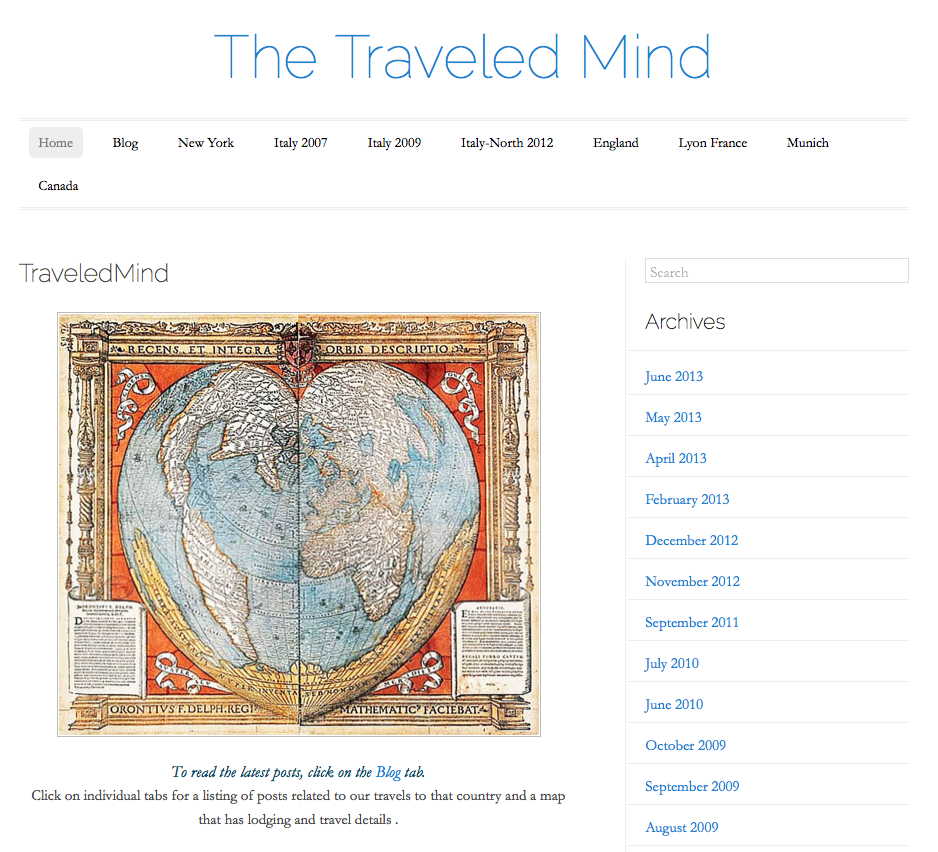
While we love the old maps, shown above on the front page of our family’s  travel blog, we all depend on recently updated maps to find our way around.  I read somewhere (and of course I can’t find it now,) that at some point in history, maps were kept only for those who had money or a position, guaranteeing them power over the masses who toiled in medieval fields.  For to hold a map, and to read it, is to understand your place in the world and how you relate to it.

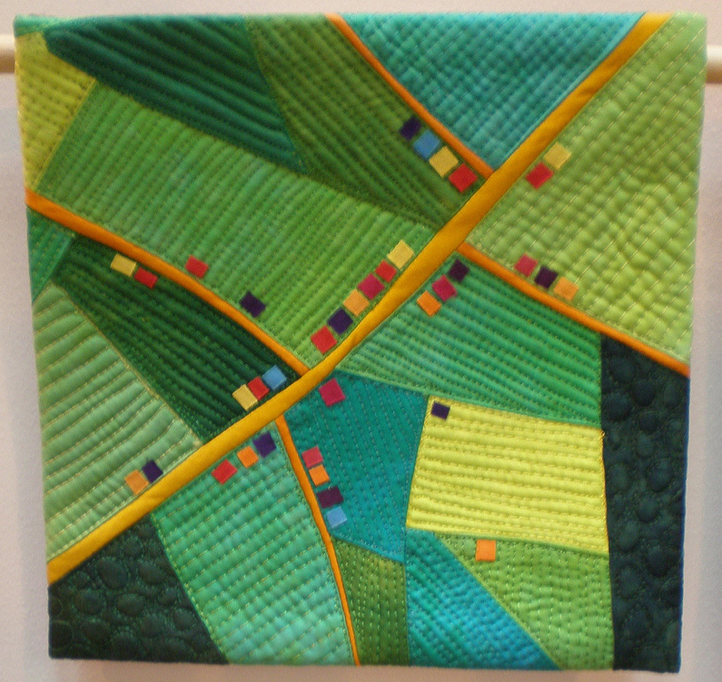
SM Aerial Map Quilt

(Alicia Merritt, Green and Pleasant Land)

In a section of  Nicholas Carr’s book The Shallows: What the Internet is Doing to Our Brains, he writes about how maps develop:

“We progress from the infant’s egocentric, purely sensory perception of the world to the young adult’s more abstract and objective analysis of experience.”  Children’s drawings of maps advance as 1) simple topographical relationships are presented, without regard for perspective or distances, then 2) intellectural realism evolves connecting what is known with the proportional relationships, then 3) a visual realism appears.

Carr recounts that first maps were rudimentary, then realistic, then scientific in both precision and abstraction.  In addition, maps expressed ideas: ” ‘The intellectural process of transforming experience in space to abstraction of space is a revolution in modes of thinking,’ writes Vincent Virga, an expert on cartography affiliated with the Library of Congress.”

TV Map of USA

While no one under the age of 40 will remember this, once it was common when someone was coming to your house, for them to call you with the question, “How do I get to your house?”  Then we’d detail for them the streets to turn on and the landmarks to notice so they could arrive at our home.  Then came MapQuest, then Google Maps, then maps on our phones where can follow the little blue dots, then the aggravation with Apple’s Maps, proving again that he who holds an accurate map has real power.

Nighttime Map over USA

While this is a blurry shot of a city from an airplane, the first maps were of the heavens–of stars and planets and their movement.

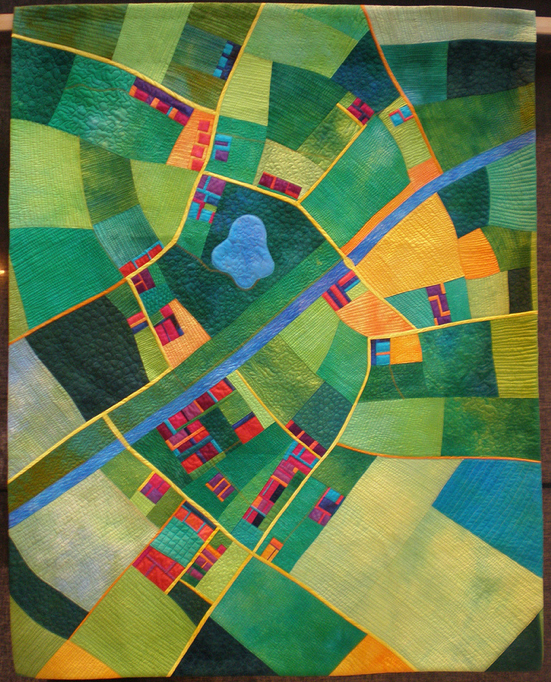
LG Aerial Map Quilt

(Alicia Merrett, Canal Country)

Only later did it invert, so that maps became aerial views of the earth and its landmarks.

Creative Class Workers by Census Map(from the Santa Monica Patch: type in your USA city and see what you see)

Thiebaud Levee FarmWayne Theibaud, Levee Farms

Land Patterns from the air

Don’t we all have multiples of this photo on our cameras?  Aren’t we all amazed by the patterns on our earth, invisible to us as we drive/move/walk around at ground level?

Capturing a View National Portrait Gallery

(view towards the Archives, taken from the National Portrait Gallery, Washington, D.C.)

Maps can also be a window on our lives.

ESE Life Map 1a

I once had a class do Life Maps, where they depicted an aspect of their life, wrote a paper about it, and presented the map to the class.  This was my sample map of my education.  In writing in my art journal last night about maps, I began to realize that maps could also freeze time, evoke a memory.  Unlike my other Four-in-Arters, who seem to be charging ahead, I’ve been at a loss about what to make, how to proceed.  But after sitting down and writing about it, gathering pictures of maps and ideas, I am now creating my own map of where to go with this project.

*******

We are welcoming four new members this year, so the logo, which originally meant four artists, now has — at the suggestion of one of our group — changed to mean the four quarterly challenges we make. We reveal a new over-arching theme in August, then in November, February, April and August we make quilts around that theme, with smaller “subset themes” to guide us.  We hope you’ll come back on November 1st to take a quilt art tour, as the eight of us interpret our current theme of Urban/Maps.

Four-in-Art · Quilts

Four-in-Art: Maps

The Four-in-Art group has chosen Urban as our overarching theme for this next year of quilts.  We will reveal quilts on the first of November in 2013, and February, May and August of 2014.

Our challenge for November 2013 is Maps, so it was with great interest that I viewed the exhibit sponsored by Quilts on the Wall, hanging at the Long Beach Quilt Show.  Their theme was also “maps.”

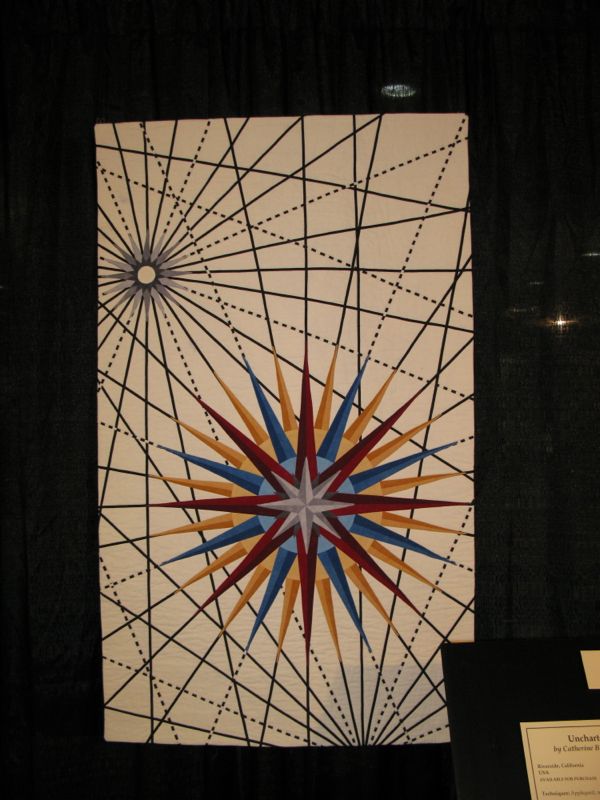
Maps12_Baltgalvis

Uncharted, by Catherine Baltgalvis
Based on an antique chart with traditional compass symbols

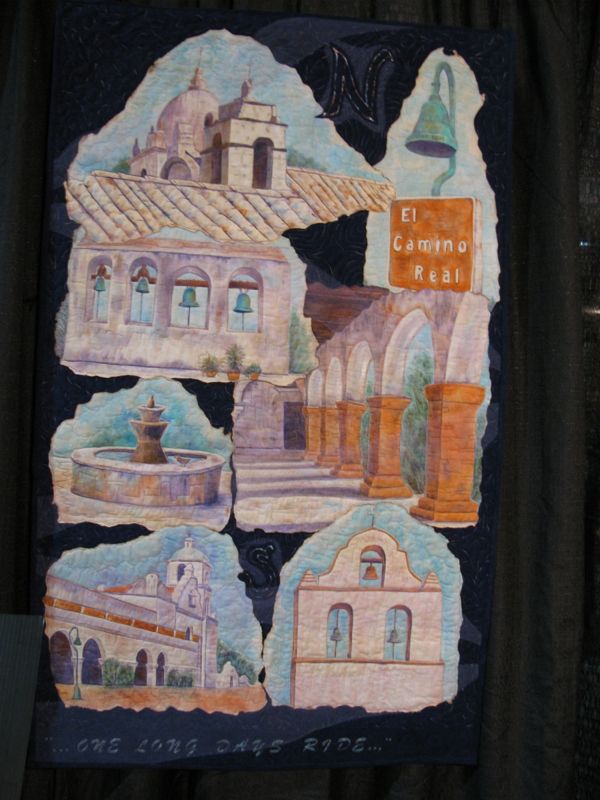
Maps 12_Wintemute

El Camino Real, by Eileen Wintemute
Views of the early California Missions, found by traveling “The Royal Road”

Maps8_Wright

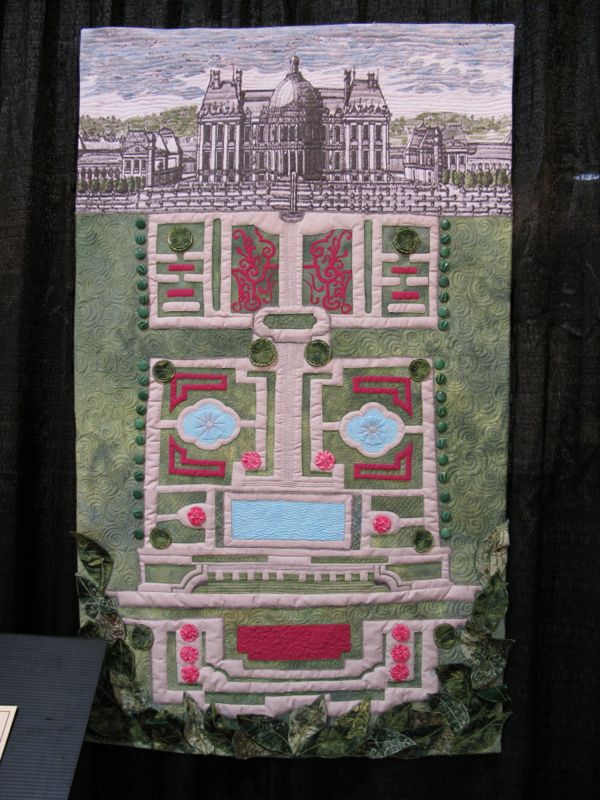
A La Carte, by Shirley Wright
A garden plan for Vaux-Le-Viconte, a great chateau in France, built in the late 1650s

Some map quilts might be literal, as in the renditions above, from a garden to a quilt paying homage to traditional compass symbols.

Maps3_Bisagna

Gone, by Laura Bisagna
An aerial map of her street, showing the houses claimed by wildfires

Other map quilts might show traditional maps, like the one above, but reveal pieces of the heart, like when Bisagna was evacuated from her home during a run of California wildfires.  She searched aerial photos, trying to discover any news about her house.  And through one of these photos, she realized that her “house was indeed gone,” as she wrote in her artist’s statement.

Maps4_Villars

Tour de Apple Valley, by Carolyn Villars depicts a 50-mile race completed by her daughter-in-law, the map in the background showing the route taken.

Maps6_Anderson

Linda Anderson created this exquisite map of the “Mother Road,” or Route 66 in her quilt One Man’s Dream.  While I couldn’t discover from her statement whether or not her husband had actually traveled the road, I think the bas relief of the white quilting is effective not only as a map, but also as a background for the motorcycling figure.

Maps5_Guerrero

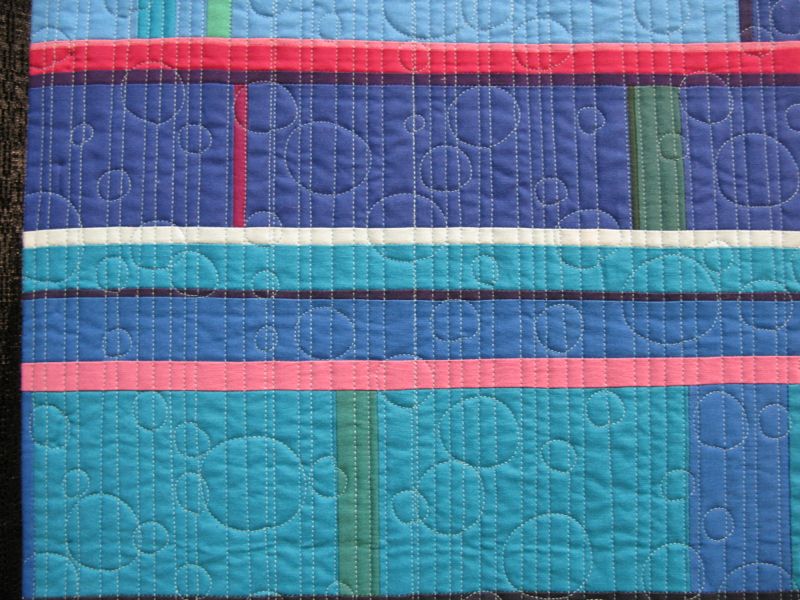
“This quilt (Ice Core) was inspired by ice cores that are used to map climate change” wrote Annette Guerrero, the maker.

Maps5a

I loved the secondary layer of quilting over the color bands.

Maps15_Friedman

Body Map in Honor of  DaVinci’s Vetruvian Man, by Linda Friedman, pays homage to the classic map of the human form by Leonardo Da Vinci.

Maps14_PCharity

I loved this rendition by Patricia Charity of the romantic era of travel, of steamships and steam trains and great adventures.  She titled it It’s the Journey, for in those days, getting from point A to point B was a huge part of travel.
Maps10_Markley

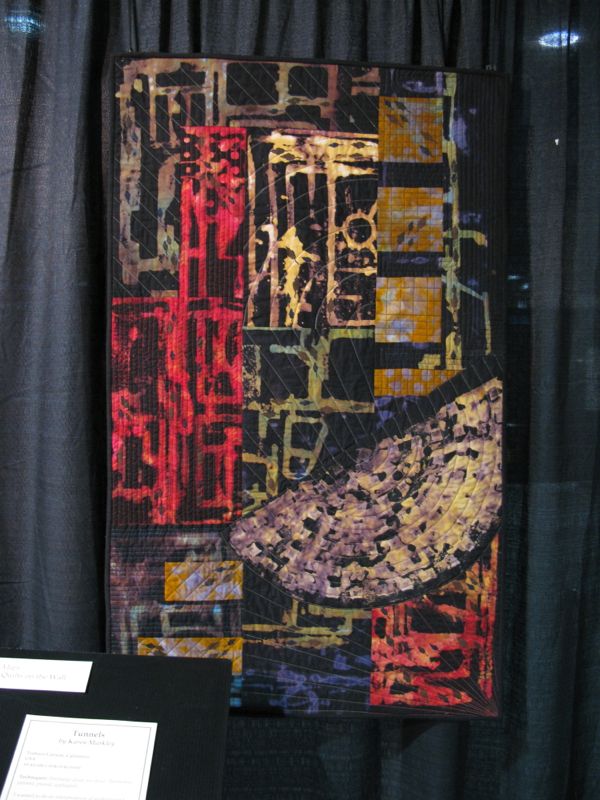
Karen Markley wanted to make a map of subterranean tunnels, such as those that contain subways, water and electrical lines, in her quilt titled Tunnels. This quilt is less representative and more evocative of what a person might find under their feet.
Maps11_Shibley

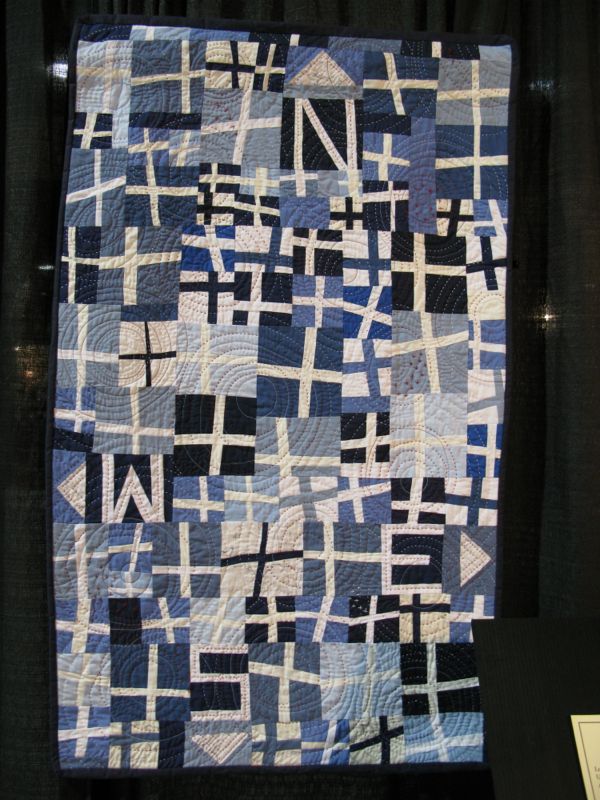
Beth Shibley’s Finding North is a rendition of a “modern compass,” and includes bits of maps that her husband used while hiking the Pacific Crest Trail.

Maps1_Connolley

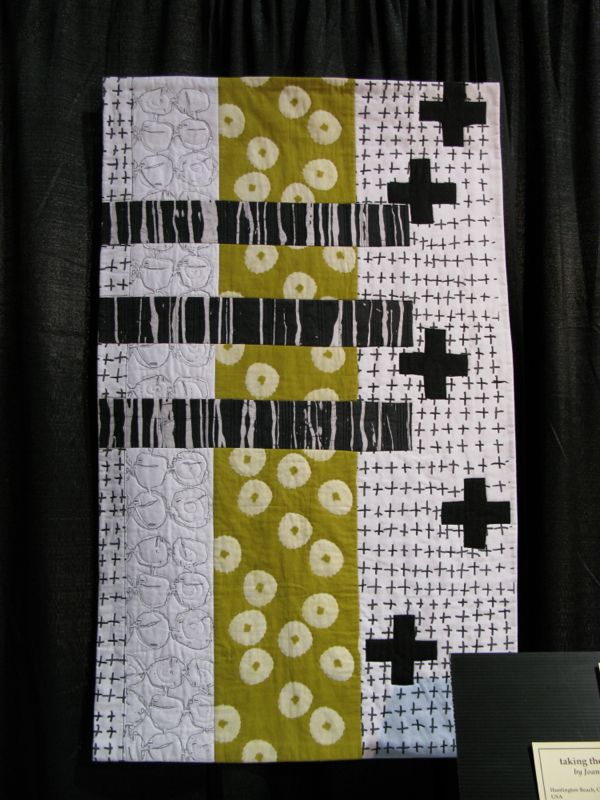
taking the back roads, by Joanell Connolly was so interesting to look at.  While you might decide that the crosses imitate a vast cemetery or that the white circular shapes might represent trees as if drawn by an architect, Connolly gives no indication of what her map might represent, only saying “when life gives you a choice. . .”

Maps2_Nilson

How many times have I peered out of an airplane window, snapping pictures of irrigation circles with my phone?  This aerial photograph by Tom Lamb, inspired Carol Nilsen to create Layered Marks From the Sky, a map of a runway and taxiway at nearby John Wayne Airport in Southern California.  But it’s not just the landscape she’s mapped in her quilt, but “the routes of a millions of people aboard thousands of aircraft.”

Maps13_Griffith

Last three map quilts.

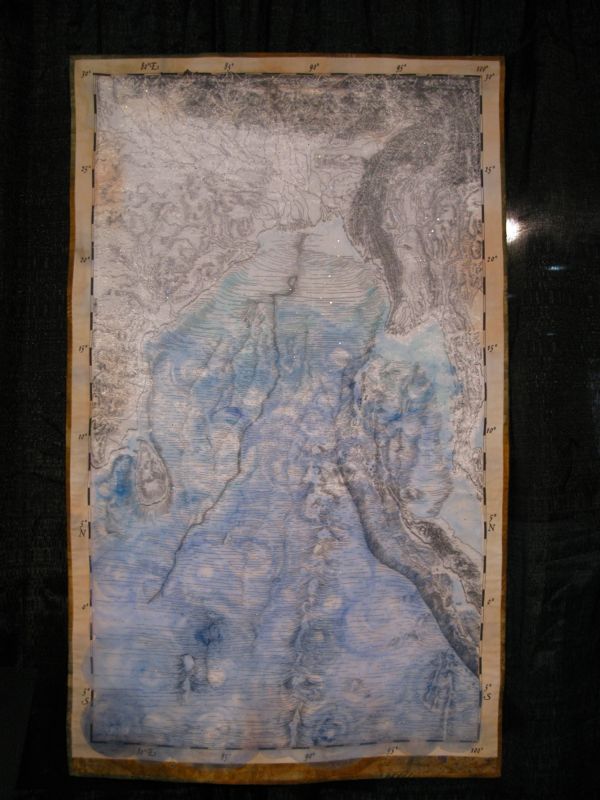
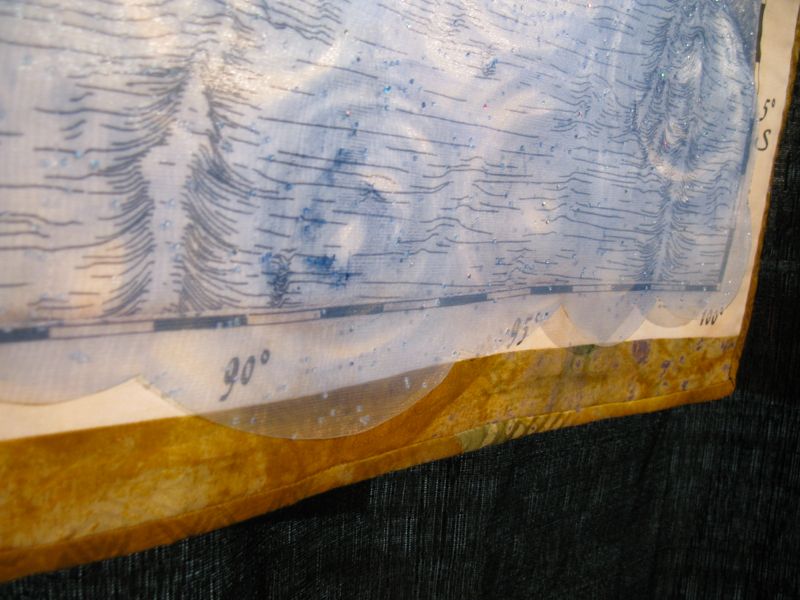
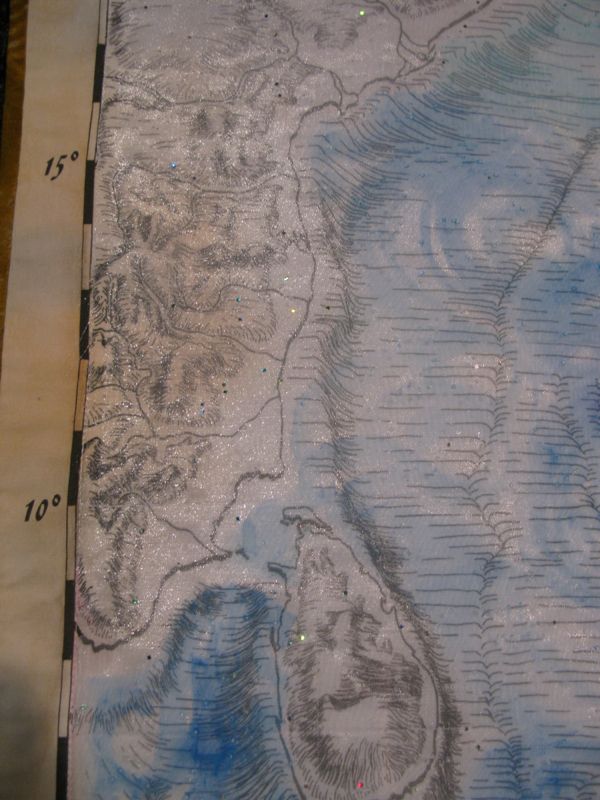
Somewhere Between Science and Fantasy, a quilt by Jo Griffith had a chifffon overlayer on a drawn, or printed, background.  Two closeups are below.

Maps13a_Griffith

Maps13b_Griffith

Maps9_Charity

Bit Map, by David Charity.  All the puns you need.  Close up below.

Maps9a_Charity

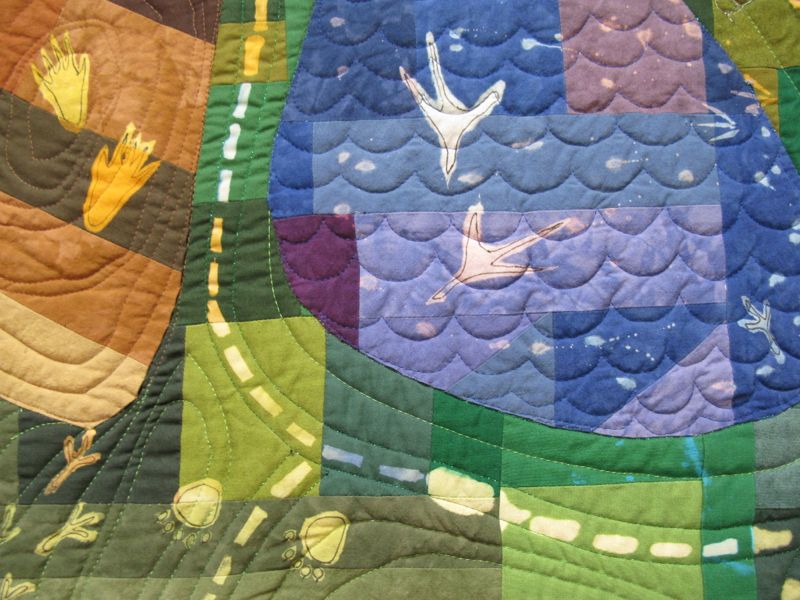
Maps7_TabarGaits of Lake Hodges, by Mary Tabar

Not only is this a map of a lake, but also the “gaits” of the critters who frequent there.

Maps7a_Tabar

I’ll leave you with Tabar’s thoughts:
“Every trail starts with a map.  A map helps us navigate our desires.”

I look forward to our group’s challenge quilt, coming this November.