Creating · Quilts

SewDay with Judy

Last week we had Quilt Night at our house, and yesterday (since all the tables and ironing stations were still set up), a friend came over to quilt since she couldn’t make Quilt Night.  We were working with the same stash of fabrics from Fabricworm (I love their bundles!); Judy purchased two in order to make quilts for her granddaughters and I liked it so well, I got one to make a Bento Quilt.

I’d been admiring Bento Box quilts for a long time, and when we were in Nova Scotia–Cape Breton’s small town of Mabou–I purchased a pattern at Fiddle Stitches, a quilt shop there in town.  Good memories while I stitch.  Here’s a slide show of our day of sewing.  I may yet cross off all my quilting tasks off my summer To Do List.

This slideshow requires JavaScript.

Some explanations:

Judy was making rail fence blocks.  We dangled little bits of her sets off the end of the table so she could initially keep track of what strips she had used, but later on, didn’t need them.  I thought they looked like a bunch of jewelry dangling there.

We made a mess of every surface in my living room: extra table, dining room table, piano–you name it.

When I was a young mother I used to read my children a poem about rainy days from a Richard Scarry Book.  The illustration had the children making blanket tents, arranging toys, emptying cupboards, while the rain pelted the windows.
Substitute “sewing days” in for rainy days, and you have:

On sewing days we stay indoors,
We have a lot of fun.
But there is so much work to do
When sewing days are done!

Creating · Quilts

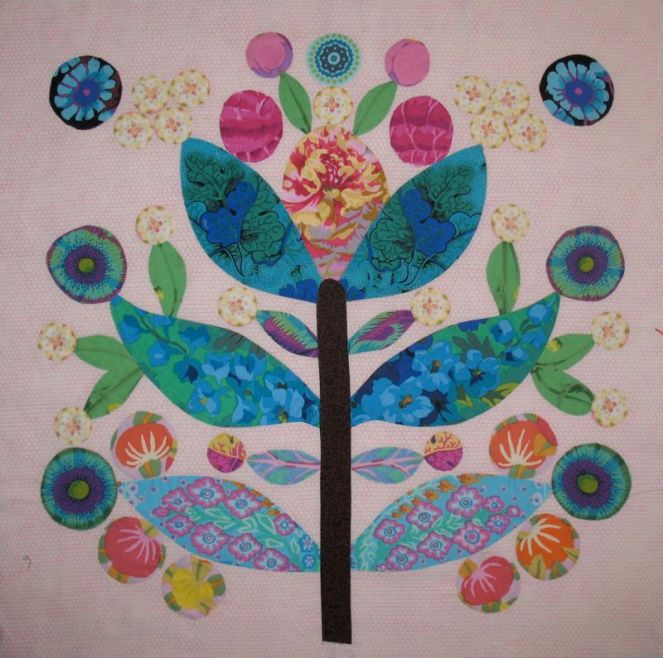
Lollypop Trees Block Two

Before.

After!

Thoughts so far:

My block number one is Kim McClean’s block number two , as numbered in her pattern. My block number two is her number three.

It took me about a day to pull all the fabrics together.  Some have said–on the Glorious Applique blog (which features Lollypop Trees)–that taking the first dive into cutting up the fabric is difficult.  I recently have come to the place where I’ve realized that saving “for the best” must come to an end.  What am I saving all these Fassett fabrics for if not to cut up like Swiss cheese and use?

It took me the better part of a day to stitch down the pieces.

I think those little yellow flowers on the green shoots look like cactus flowers.  Well, maybe it’s the green shoots that evoke this.

I’m tired of applique.  Today a friend comes and we do patchwork!

The book I listened to is The Weird Sisters.

I recommend it highly.

Creating · Quilts

Lollypop Tree–Block One

One down!  Who Knows How Many to go!

How I did the machine applique:


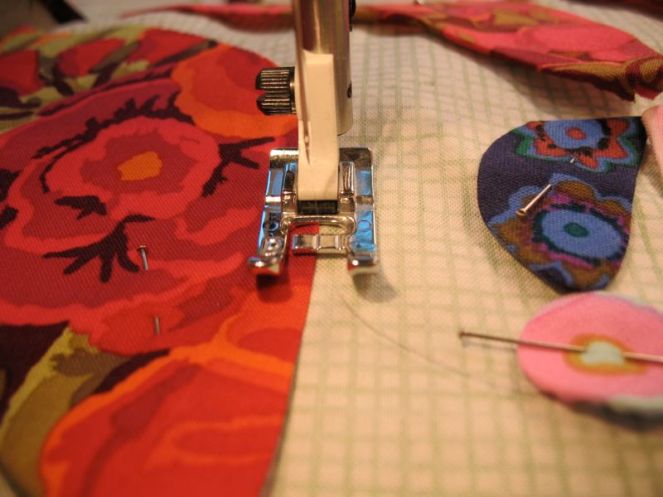
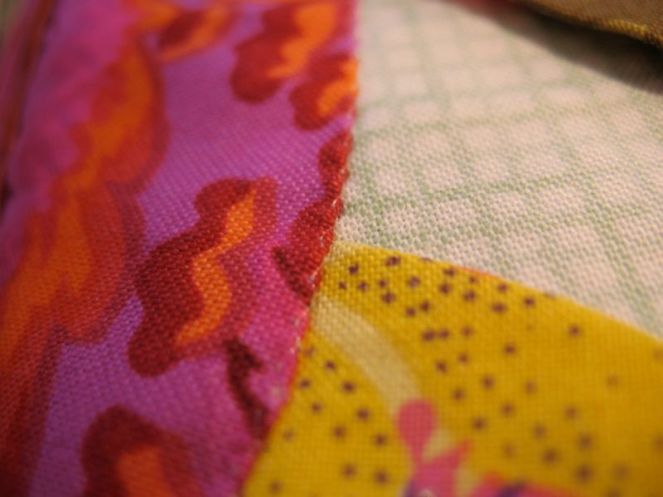
You saw the earlier post on preparing the pieces: freezer paper lightly glued to the back of the fabric with a regular glue stick, the edges pressed over onto the waxy side, tamping them into place.  I got out a stiletto to assist me wherever the going got tough: where there was a tuck, or a sharp corner that normally, with the edge of hand needle-turn applique, would be smoothed out.  I lined up my piece with the center notch of my presser foot, and with a narrow zig-zag (1.0) and smallish stitch length (1.5 on a Husqvarna), went sort of slowly.

Remember that I’m a beginner.

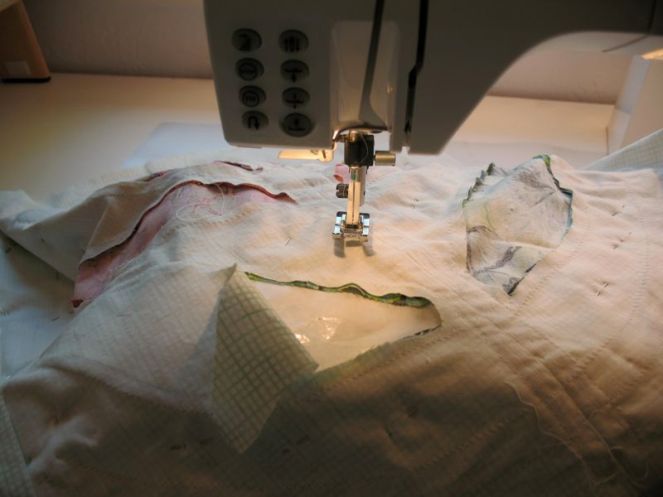
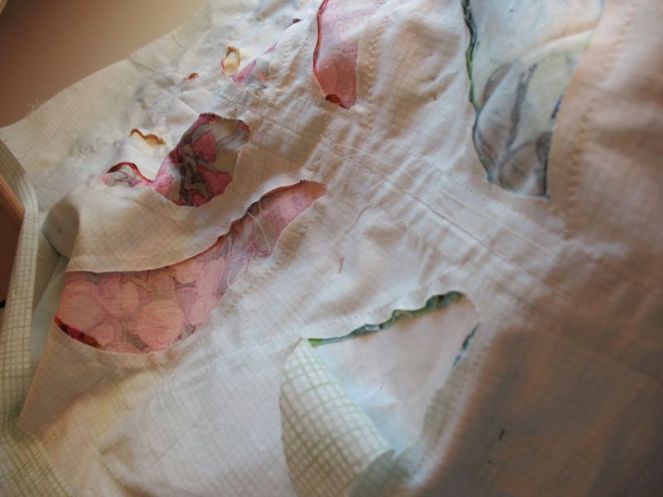
Then I cut out the back of the pieces with the freezer paper (mostly the large and interestingly shaped pieces), leaving a 1/4-inch seam allowance. The glossy surface you see is the waxy side of the freezer paper.  Kind of pull–a bit–the edge of the applique to “break” the seal of the bond between the fabric and freezer paper, then place your scissors (closed) or your finger under the freezer paper and snap it out.

I took the paper out, finished cutting, then pressed it all, face-down on the ironing board.

I’m still stewing about whether or not I want to do hand-applique.  We’re in the middle of watching Foyle’s War, a BBC-TV production, and there’s something so relaxing about hand work and television.  But I also know that while I really like this pattern, I don’t want to spend the rest of my life making it, and I’m not that fast of an appliquer.

Fret. Fret. Fret.  I hope I’m not the only one in  Quilt Land who stews about these kinds of decisions–should I do it this way, or that? Use this technique or that?

100 Quilts

Red, White & Blue Quilt

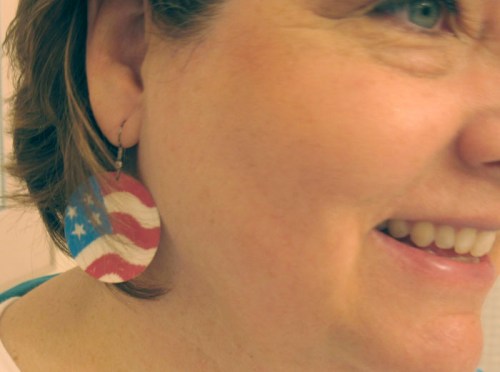
On Memorial Day, I put on the earrings I’d purchased in Washington, DC ages and ages ago on the 4th of July.

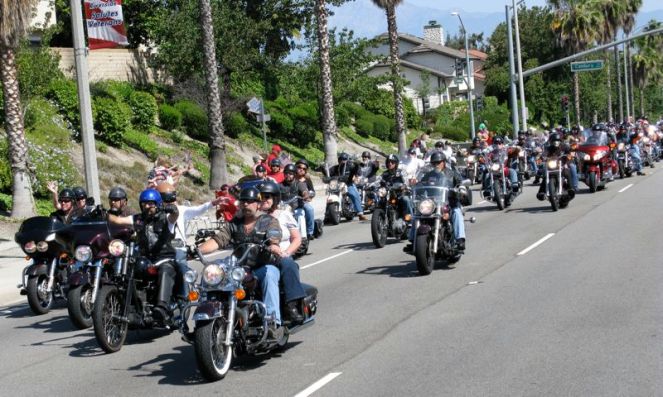
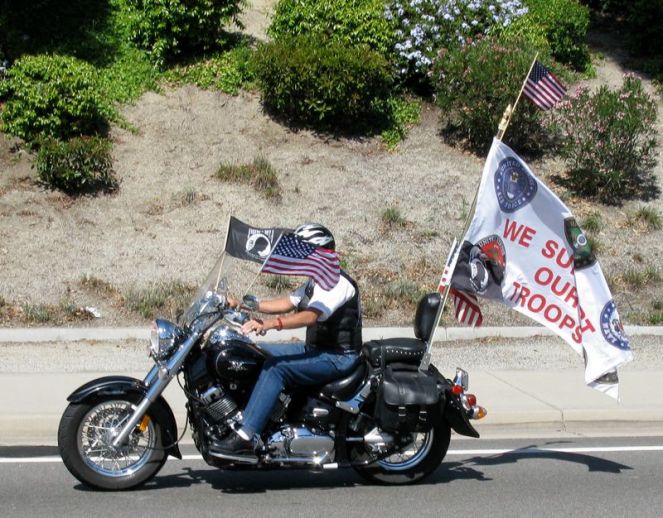
And we walk over to our main boulevard, about half a mile from our house, flags in hand and cheer on the West Coast Rolling Thunder, a compliment to the Rolling Thunder in Washington, DC on Memorial Day Weekend.  This year they anticpated about 9,000 participants–it lasted about an hour.

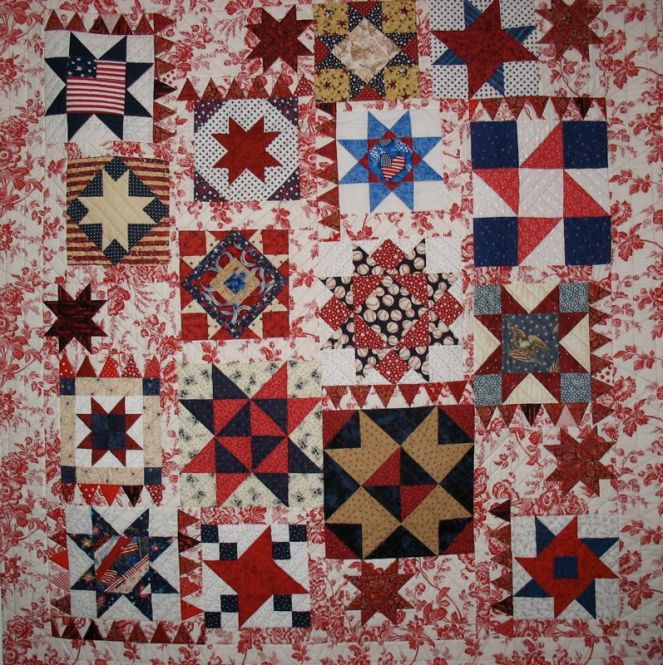
We waved and cheered and then I came home and put up my Red, White and Blue Quilt, made some years ago with my Quilt Night group–before we were zombie-fied.

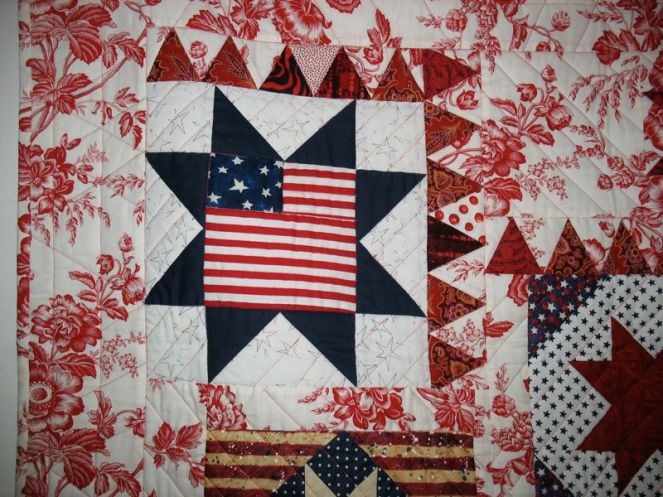
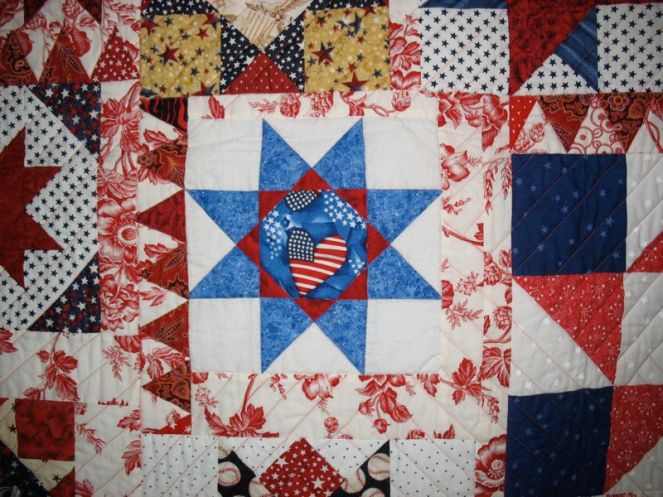
We each made a block.  The requirements were red, white and blue and it had to be some sort of a star.  We were loose on the definitions, as you can see.  I had heard Margaret Miller talk the year before at Camp Watch-a-Patcher in Orange County, and she said you can tilt a quilt more towards one look or another by how you sash it and border it.  Because I wanted to push this more towards the red and whites, I chose this toile and made more tiny triangle points and densely colored red stars to pull it that direction.

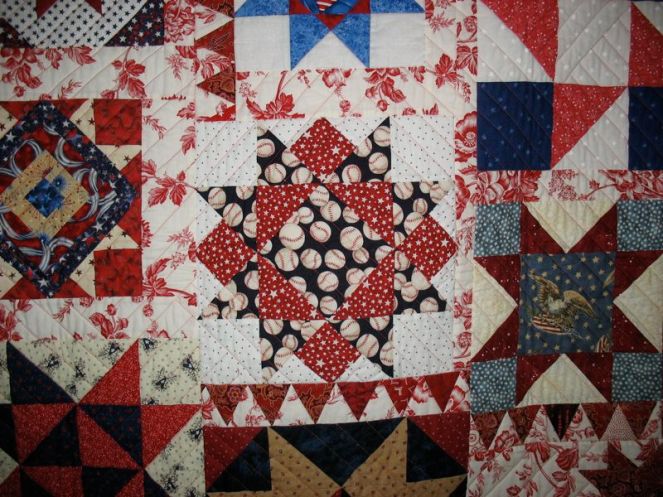
One afternoon, I laid a few of the blocks out for my husband on our bedroom floor and asked him what he thought about them.  He pointed to this one and said he didn’t like it very much.  Well. . . that was the one I made–trying to work the theme of American baseball into our red, white and blue quilt.  (You can see the eagle that Lisa fussy cut for our centers on the block to the right.)  I laughed, then made another one.

He liked this flag block a lot better.

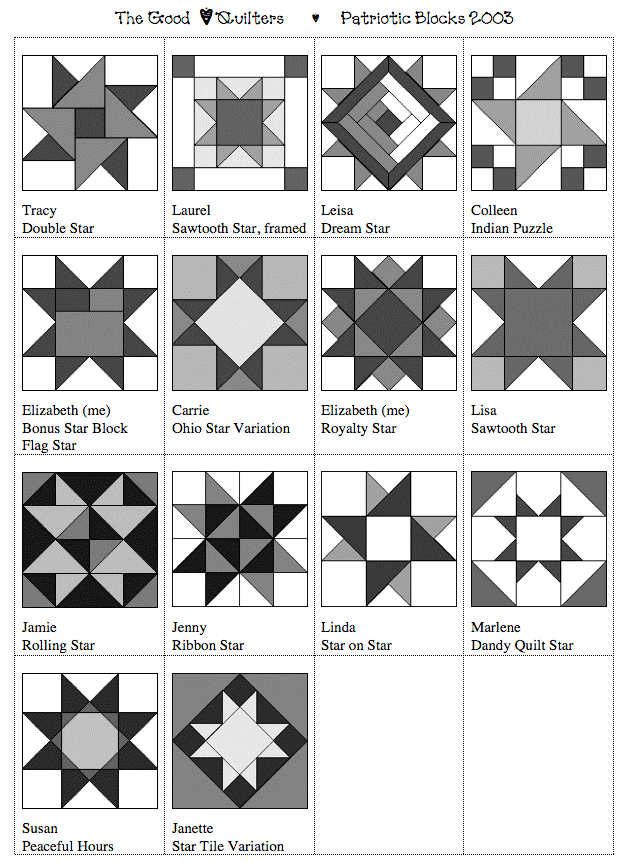
I also like this block, made by Susan, titled Peaceful Hours.  She now lives in Idaho, and I think of her every time I see this block.  That’s the beauty of group quilts: when you look at them, they remind you of your friends.  We used to call ourselves The Good Heart Quilters, but now we just call it “Quilt Night.”

I made up this Master List so I could remember everyone and what they’d contributed.  I also did the quilting, lines one inch apart and switching directions when I thought it was a good time to do so.

We also didn’t put size restrictions (that’s evident) and I like the fact that this made for a more free-form arrangement of the blocks.  I have Quilt Pro quilt software, so after the blocks were chosen, I put them into the program and worked them up for this handout.