Books · Finishing School Friday

Back Among the Lollypop Forest: Blocks 5 and 9

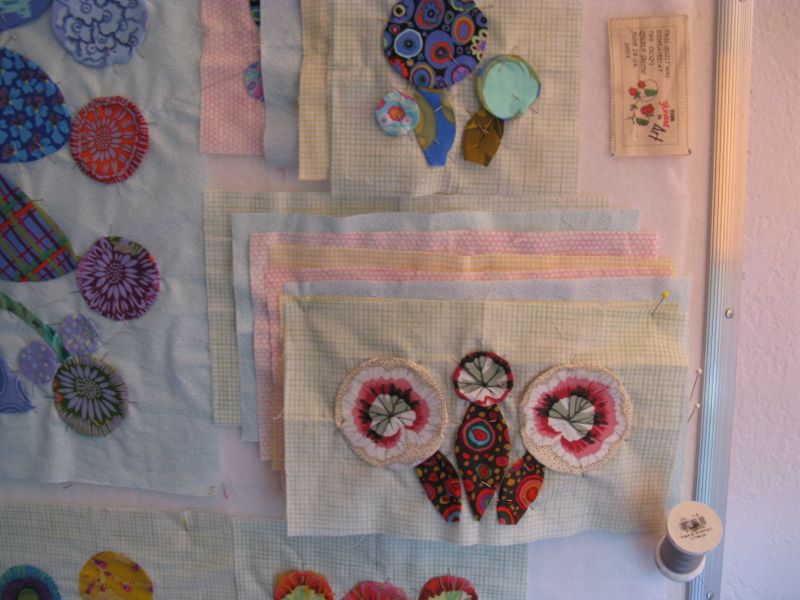
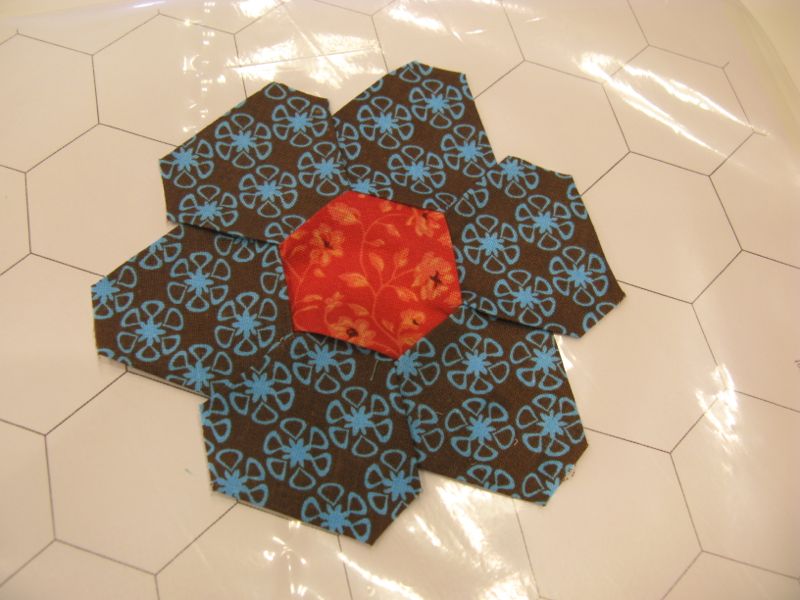
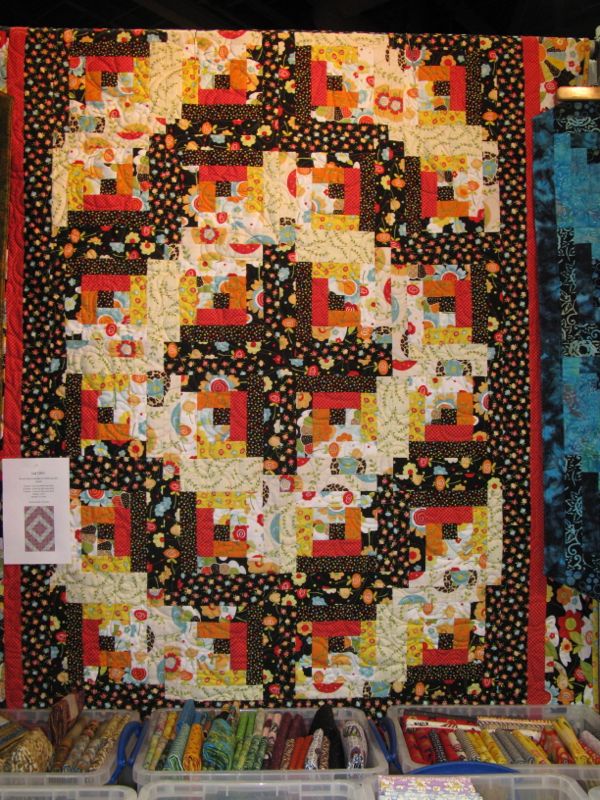
I like this part of the Lollypop Tree blocks the best: laying out the color scheme in those great big petals.

The part I like the least, in the cutting and choosing category, is the little circles all around.  I chose Block Five to start back in again, because there only a few circles and they were all jumbo.

Block Ten, as labeled in the pattern, has a few more circles. (I call this my block nine.) But two down, seven to go.  I’ve got to stop now and get the binding on the gingham quilt (which STILL doesn’t have a proper name) in order to tuck away a few loose ends before the arrival of Barbara and grandchildren.  I went to JoAnn’s yesterday and bought two more boxes of applique pins.  Since my goal this summer is to get these blocks all cut and pinned, and it’s taking one box for two blocks, I may be running there again–or else I’ll resort to the wicked long pins which stab you a lot when you’ve got it under the machine–or maybe pin with the stabbers, then change out.  Playing it by ear.

And what book propelled me through these last couple of days?

On Canaan’s Side, by Sebastian Barry.

A lovely quote: “Bill is gone. What is the sound of an eighty-nine-year-old heart breaking? It might not be much more than silence, and certainly a small slight sound.”  Narrated by an elderly woman, it is her story, and the story of the people she loved.  I listened to this intently as not only is the story interesting and well-told, the language and imagery is inventive and descriptive.

I thought of my own mother, and the people she’s said good-bye to.  And her mother, and then her grandmother, who came over from England, leaving that land behind forever.  I guess all of our lives could be an interesting novel, if only the right author told our story.  And this story is told by exactly the right author.

I loved listening to it, as the narrator gave shade and color to the characters, perfectly intoning the Irish inflection, as well as the Greek shopkeeper in the later section.  It’s not a long novel to listen to–only 7+ hours–a relief after the last one I listened to, which was fifteen-plus hours (with irritating piano music off and on).

Classes · Creating

Becky Goldsmith/Quilt Class

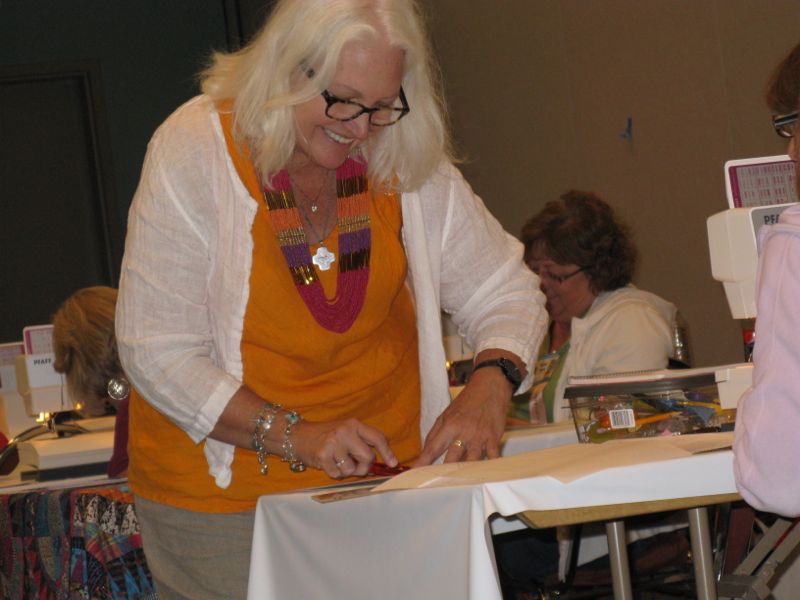
I had asked to be put on the waiting list of Becky Goldsmith’s class, hosted and organized by Orange Grove Quilters Guild, and by some incredible stroke of luck, I was in!.  I arose at 5 a.m., and was out the door by 6:45 for the long schlep across Orange County; traffic was thick, but not brutal at the early hour of 7:30ish.  I was among the first there, and watched as Becky Goldsmith of Piece O’Cake Designs set up.  She is very prepared.  She also set out an array of tools and notions and books and patterns for us to choose from.  I picked up a few new tools and a couple of Piece O’Cake books.

After she was set up, she indicated that now was a good time for photographs, and she was gracious admiring about the quilt I’d made from one of her patterns.  I’ve taken loads of classes from many of the more renowned quilt masters, and what I appreciate most is when they know how to tamp down the ardor from fans, while acknowledging the fan herself.  I found Becky to one of those excellent teachers who are intent on teaching, not on ego-stoking and I knew it was going to be a good day of learning.

We were learning a type of appliqué that was on top of the appliqué piece, with clearly visible stitches that would act as almost an embroidery of sorts.
I took several pictures, but only this one was not blurry.  You can see the stitches here, a technique she calls “Applique with Attitude,” and for which the Piece O’Cake team has written a book.  I had been contacted by Marie from the guild about the spot in my class, and she had recommended a place for me to order some of my supplies.  I was really grateful for that, as I felt well-prepared even though I only found out the week before.
One of the techniques she covered were tracing the design onto a vinyl overlay so as to place the pieces accurately.

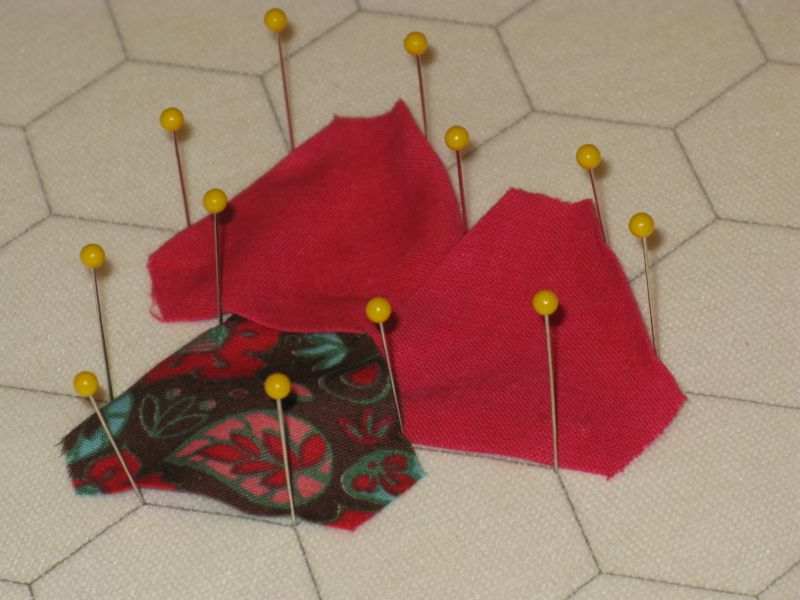
I didn’t take a picture of every step, but another tip was the idea of how to pin: we should use the shorter appliqué pins in order to really anchor our appliqué pieces down for stitching.  She taught us a fine technique for marking (place your fabric on a sandpaper board, or fine-grit sandpaper, so it doesn’t shift, then mark a strong line).  At each step, she helped me refine what I knew about appliqué.

Some really speedy quilter in class finished up their class sample.  I know you are thinking what?  Just a tulip?  But in between we were taught about why we should wash our fabrics, not use spray starch, the importance of good and useful tools, the use of color, the idea of varying our quilts, and of not using a ruler to cut–allowing a bit of wonkiness to slip into our art.  I took eight pages of notes, and we only had about a 20 minute break for lunch!

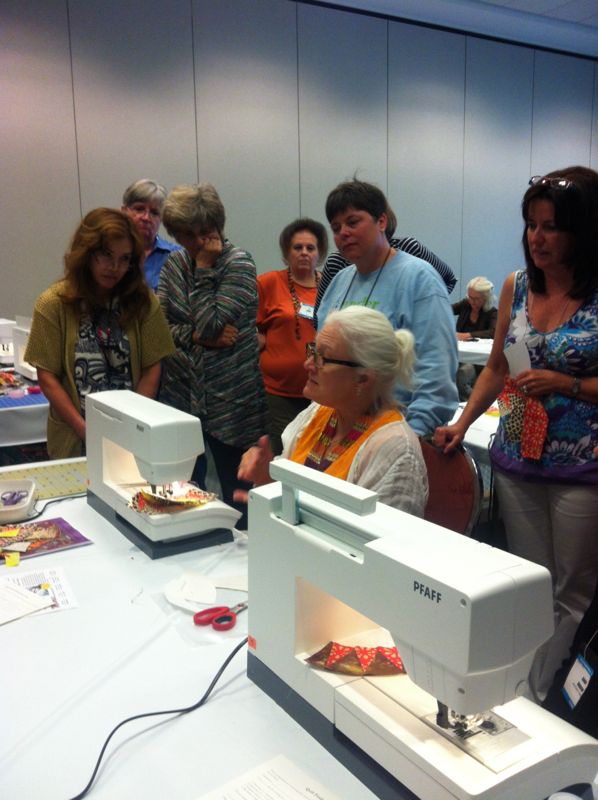
She gathered us round to point out differences in ways of doing things, and I must say as a sidelight, I was really impressed with this guild and this class; such lovely ladies and they made me–a stranger–feel very welcome in their midst.

I liked the little vignette of this quilter’s station.  About all those balls of color: we were using perle cotton for our Applique with Attitude and I look forward to fall when I spend less time in major quilt projects and more time hand-sewing to finish this up.

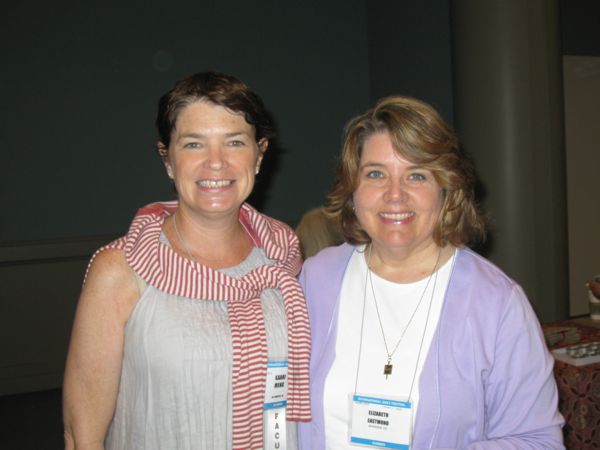
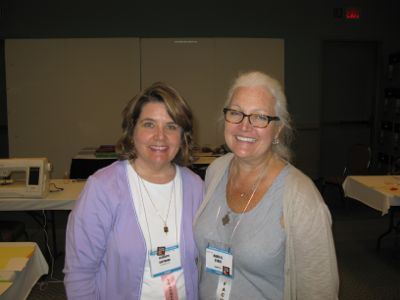
Then it was picture time.

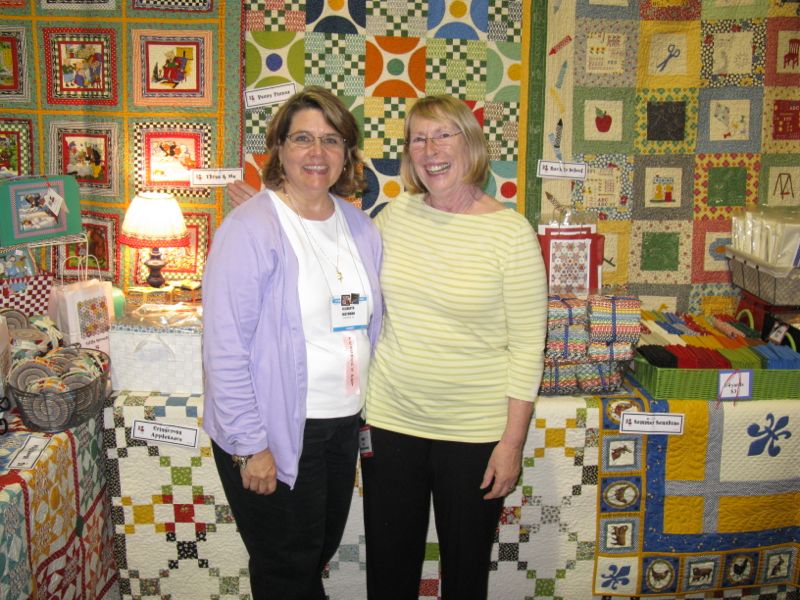
That’s Marie on the left, Linda (I think?) on the right.

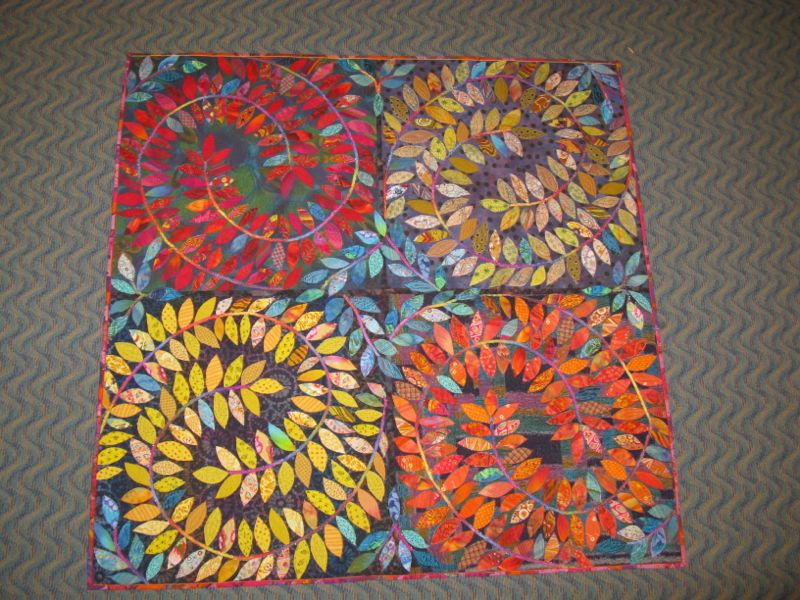
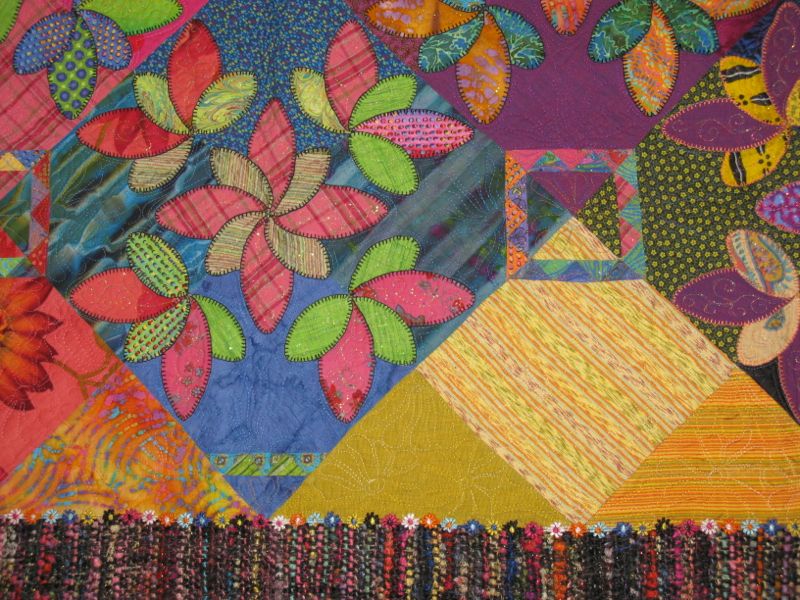
Another quilt of appliqué.  I found it really interesting when she talked about how she laid out her quilts.  While it’s not easy to see, nearly every block background in this quilt is different. She said she cuts out her backgrounds, smooths them up on her pin wall.  Then she cut the shapes out of her fabrics (sometimes cutting up to 10 different fabrics, if the first one doesn’t work) and lays them over the backgrounds.  She then moves to sashing, then borders, making sure the colors balance and work well together, harmonizing but interesting.  By the way, I love the border treatment.

Not the best lighting for a quilt, but I’m trying to capture the varied colors and shapes.  I like it when the flowers “break the border” of the block, continuing the eye in movement across the quilt.

The label contains the title, info about the maker, date, her address (blurred out for privacy) and the fiber content.  Both labels were of the same type on these quilts.  I don’t know if you noticed that she also appliquéd her initials and the year on the front of the red quilt (above).

During class, a folder circulated and we all wrote a short note to Becky Goldsmith.  I’d never seen this done before and I thought it was quite sweet. And speaking of sweets. . .

. . . people brought little snacks to share, again reinforcing my belief that this was a really neat group of quilters!  I had a great day, leaving right at the end of class to make it home in time for a reception at the outgoing university dean’s house.  We were a little late, but I was able to take the class and still make it.

I found this quote by Daniel J. Keys:

Accomplished artists are those who have proved themselves to be the best at what they do. ‘Master’ is the title often given to such a person, and rightly so: They’ve established themselves as worthy of the title through many years of study, and devotion of their lives to their craft.

I have taken many quilt classes in order to learn from the masters of the quilt world.  Only a few times have I been disappointed; nearly always I have learned something.  I have my favorites, and I have to say the Becky Goldsmith is in that group.  A most enjoyable day!

WIP

Early Summer WIP Check-in

Many thanks to Lee for hosting us on WIP Wednesday.  Click here to return to her blog and see other projects begun this early summer day (even though Summer Solstice hasn’t arrive officially).

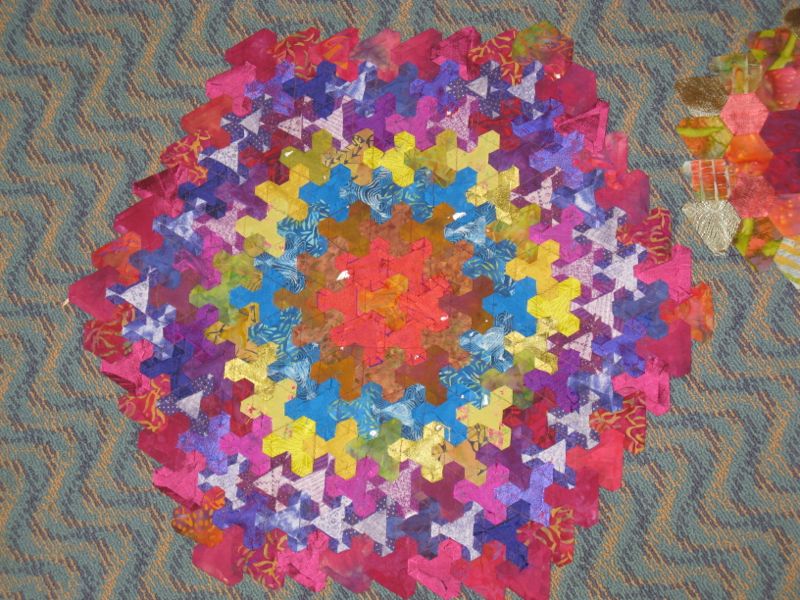
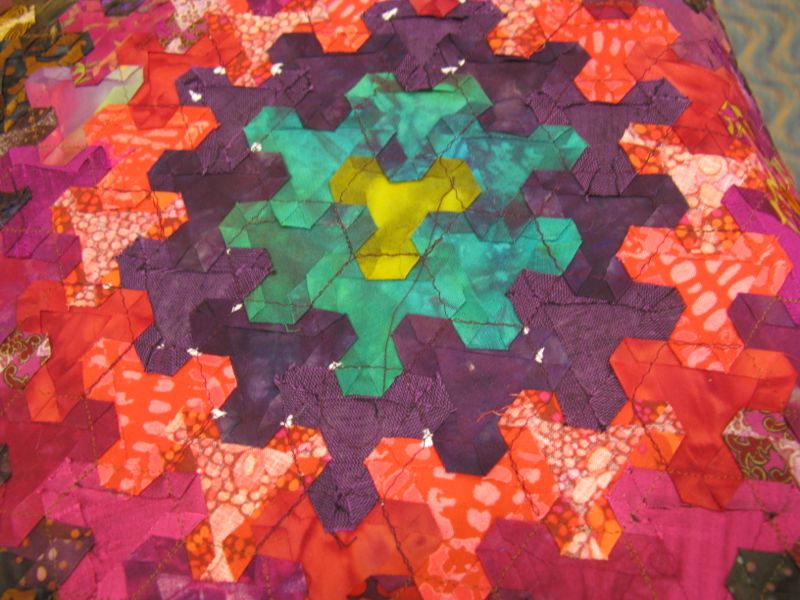
Summer’s starting and the air is hot, the birds chirp-chirping early in the morning, the days longer.  I just need my energy to last longer because I’m working on the Lollypop Trees again.  My goal is to get all the fabrics cut out and pinned down, as I hope to sew on them all Fall and have the quilt blocks finished by early next year.  This is a long-term quilt, not quick.  Duh. I’ve traced off the patterns onto freezer paper and cut them all out and am now starting in on Block Five.

Working also on Bee blocks–two a month throughout summer.  I just sent off my first two!

Binding for the Gingham Quilt, to be revealed on July 4th, along with a few others.  Check the tab above, Project Gingham, for whose block or four or mini-quilt or quilt we’ll see that day.

Took a class from Becky Goldsmith yesterday, and now I have the class sample from her class to finish up.  I had a great time with the ladies of the Orange Grove Quilters Guild.  Add one more WIP to the list.

Rolls?  Yes, one of my BIG Works in Progress is a luncheon for 70 on the last Monday in June.  I made up a batch of these Buttermilk rolls to try them out for the sandwiches in the box lunch: delicious.  Now to make four more batches.  A sandwich on a homemade roll instead of a croissant–I think that’s a fair trade.  It’s for the first day of  camp for the young women in our area, so they asked me to put together the box lunches and get them ready to go by 7:00 a.m. to go up the mountain to camp.

But all forward progress will probably stop on most sewing when my daughter Barbara and her children arrive for a couple of weeks.  It will be fun to see them!

Classes · Tutorial

June Flowers/Tulip Tutorial

Every June the jacaranda trees put on their bluey-purple-periwinkle display of flowers, and we all wander around wondering how we got to be lucky.

And like clockwork, every June they dominate my photos — exquisitely colored blossoms on hills, around bends while the rest of the year these trees blend into the landscape.

And I’m heading to a class with Becky Goldsmith (the designer of the quilt I did last year: Come A-Round) and we’re doing a flower in class, so I chose a night-blooming plant for color inspiration for fabrics to pull.  This comes from the Sherwin-Williams paint website “Chip It,” where you load up a URL of a photo and they provide their colors.  I just like how it looks, and it helped me pull from my stash.

So when it came time to decide on a block for the Far-Flung Bee, that was easy: a flower.  I also wanted something of simple construction (9-patch) because of my fabric requrements–I wanted some fabrics with text to be incorporated into the blossom.

Here are two versions of that tulip/flower block, and the text fabric is used two different ways; one is in the background fabrics and the other is included in parts of the flower.  That green fabric saying Blah Blah Blah is a treasure for me as my friends Bert and Rhonda sent it to cheer me after my surgery in December.  I’ll always think of them when I use those fabrics (thanks, guys!).  So here’s how to do it.

For one 9-inch flower block:
Cut four 3 1/2″ squares–3 from the background fabric, 1 from the flower fabric
Cut four 3 7/8″ squares–2 from the background fabric, 1 from the flower fabric, 1 from the leaf fabric
Cut one 2″ by 3 1/2″ rectangle from the background fabric
Cut two 2″ squares–1 from the background fabric and 1 from the stamen fabric

Working with the 3 7/8″ squares ONLY, place one background square on each of the flower and leaf blocks.  Draw a diagonal line from corner to corner, or if you have the Quick Quarter tool (shown above), draw a line on either side.  You’ll stitch just inside this line (towards the center), or if you have drawn a single diagonal line, you’ll stitch a SCANT quarter-inch seam on either side of your drawn line.

Cut from corner to corner, inbetween your stitching.

Press the seam allowance away from the background triangle, as shown.  Notice those dog ears on the corners? We’ll cut them off later.

Working with the 2″ square blocks and the one rectangle now.  Seam the stamen fabric block to other 2″ background fabric block.  If you’re like me and getting up and down to the ironing board gets tiresome, just finger press that seam towards the stamen fabric.  Then seam the rectangle onto this unit.  Okay, now go to the ironing board and press that flat.

Lay everything out. Smile, because it looks cute. AND it’s fast!  Seam them together in rows, working across the block.  Keep track of which direction that bottom leaf goes.  I did it wrong twice.

Now it’s time to trim off those dog ears.  (I actually trim them as I seam the pieces together, not waiting until a final moment, but this is just a reminder to get them off now).  I use that old fashioned tool that works so well: scissors. Snip snip snip while holding it over the trash can.

  I’ve flipped it over to show the directions for pressing.  Basically you want to have the seams going in opposite directions so they’ll “nestle” together when you go to sew the rows.  Lay it out again, the sew the final seams, joining the rows.  Double check that bottom row twice, so you don’t sew it in wrong (like I did).

You’re finished with one block.  Eat Your Vegetables, by laying a ruler over it and truing up the block to 9 1/2″.  It will sew down to a finished 9″ block in your quilt.

Here’s a mock-up of one layout, using 1″ sashing and corner squares.  I’ve also thought that since it’s based on an easy nine-patch block, that a grouping could be made of half-sized (4 1/2″ finished) blocks that could be interspersed for a more random look.  That’s for another day.

Enjoy your spring flowers!