Quilt Shows

Long Beach–Final Post

It’s the final post because it’s time to move on, maybe moan about the first week of school where my classroom was 83 degrees.  Whose idea is it to begin school in the middle of August, anyway?  Okay, enough moaning.  Here is the final set of quilts.

I wrote some time ago about the Masters Books, and my lucky day arrived, for they had sample albums related to the published works.  The quilts could jump off the page and I could touch and see and figure out how they did things.

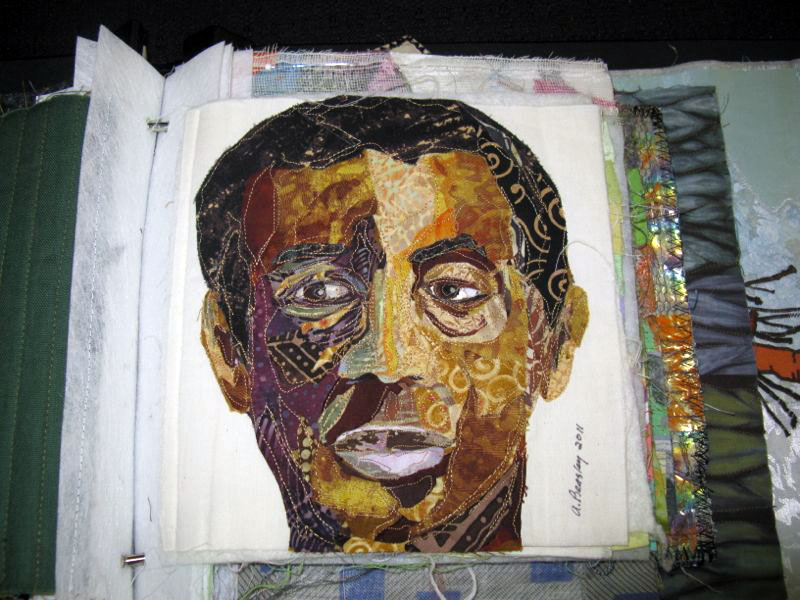
Alice Beasley’s wonderful portrait.

On the left, are some pieces of fabric that Beasley used, and on the right, Beatrice Lanter’s sample.
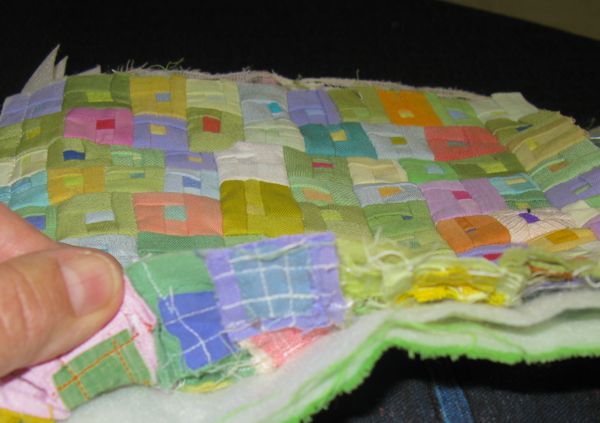
There’s my thumb on her sample, just so you can appreciate the scale.  Teensy-weensy little squares.
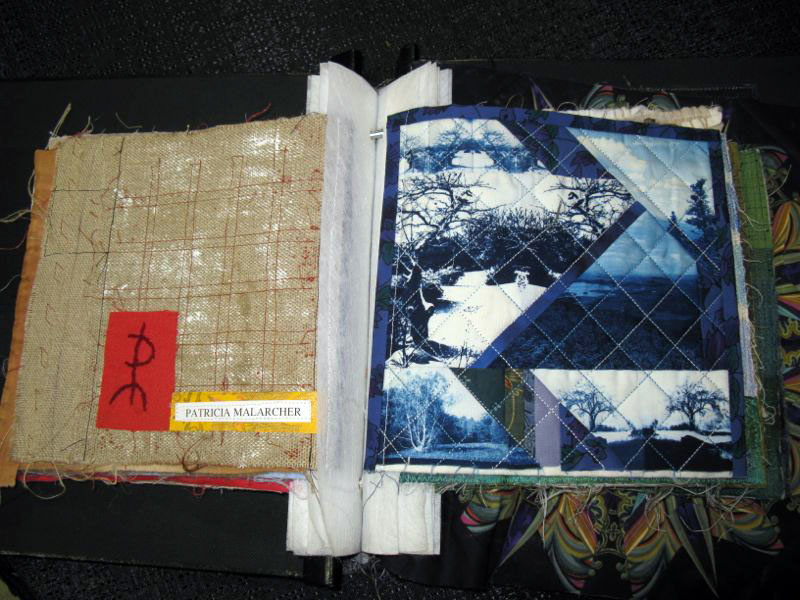
This sample on the right is from my favorites: Gayle Fraas and Duncan Slade.  If this post weren’t so photo-heavy, I’d paste in some more of their work, but use the link above to the Masters Book to see more.

ConText, by Pat Kroth
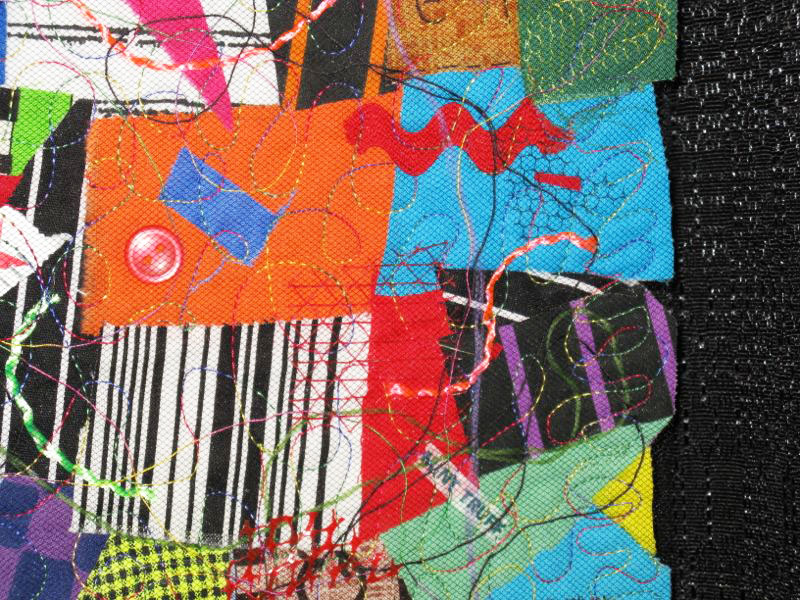
I keep thinking that little white strip of text looks like the flag in a Hershey’s kiss candy.  Maybe it was time to break for lunch, which I did.  While eating a (lame) salad (the food at the convention center is in dire need of an overhaul!), I received a text that my son had gotten a job!  So the title of this quilt, based on the idea of texting, had resonance for me.

Ladybug Garden, by Collen Harvey in the Hoffman Challenge series of quilts.

Detail of the quilting and fabric use.

This quilt is from where my mind was feeble and I completely forgot to get info about it.  If anyone knows, leave a comment and I’ll update.  It’s a shame not to acknowledge such an interesting quilt.  Please forgive.
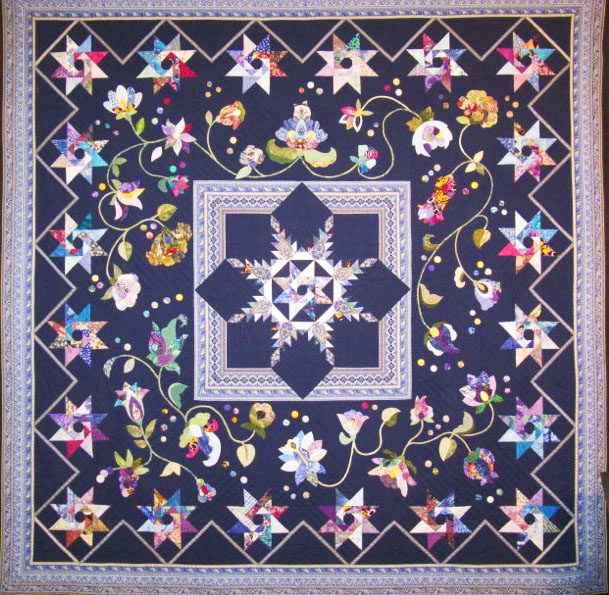
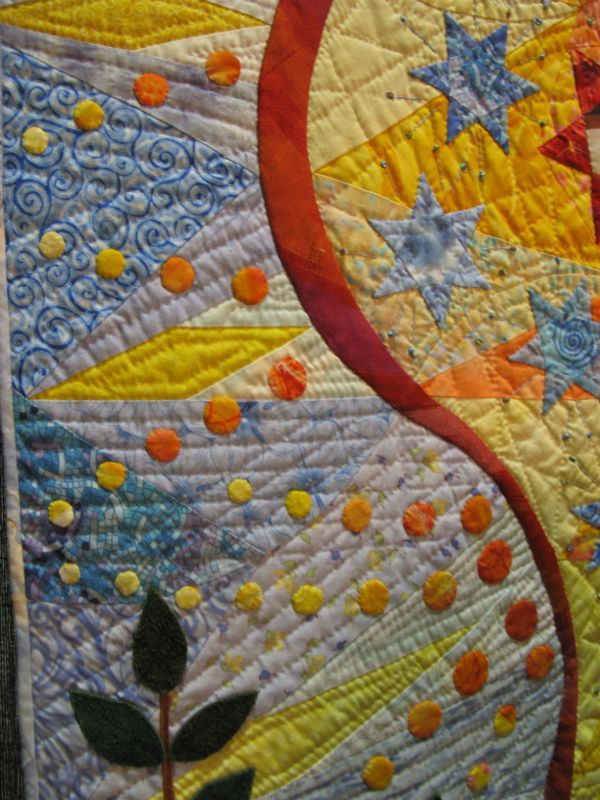
My Friends Made Me Do It, AKA Starlight Garden, by Betty Brister
She has great friends, if this is the result.  Detail below.
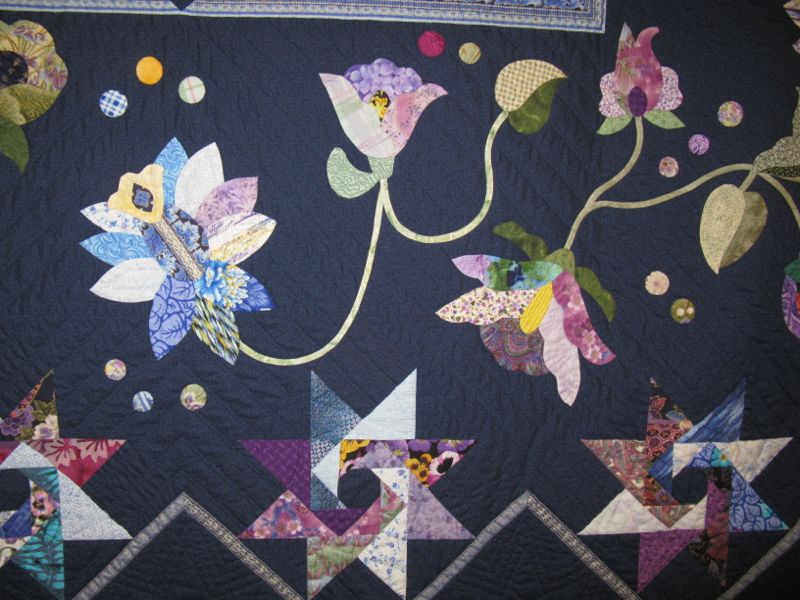
In her artist’s statement, it comments on the supple stems and perfect circles. Here’s a detail version of those.
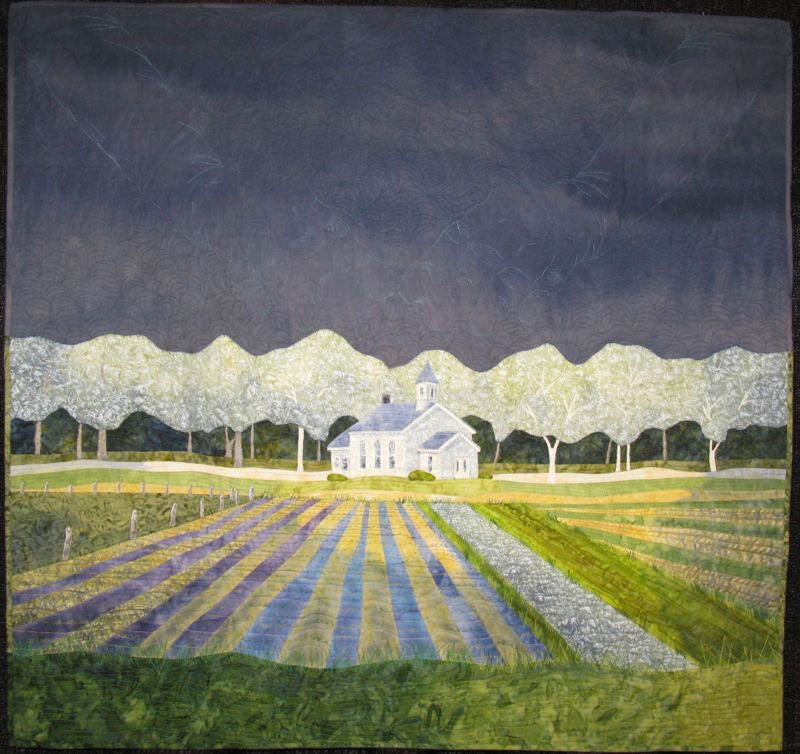
M. C. Bunte was driving across the Indiana countryside during an approaching storm.  As she watched, a shaft of sun lit up a small church and the surrounding trees.  In this quilt, Shelter in the Time of Storm, she felt it was a message that even when “situations appear threatening, hope — God’s protection for the spirit — exists.”

She had quilted what looks like text into the fields of crops, but I can’t decipher what it says.

Pamela Druhen created this exquisite small quilt that just pulled me in like some of the larger, showier quilts can not.  She used the techniques of dye-painting, free-motion embroidery and free motion quilting to create Vas-Y, which according to her artist’s statement means “Let’s go!” in French (since it is a French bicycle).

Detail of Vas-Y.

This quilt, titled Totally Insane, is from the Nearly Insane book by Liz Lois.  The maker, Loretta Duffy, wanted to recreate the 1879 Salinda Rupp quilt that, according to her artist’s statement, is composed of 98 blocks.  Working with such small pieces, like block #18, which contained 229 tiny pieces, was quite a challenge, but nothing compared to the satisfaction of seeing the completed work.”   I’d be totally insane, too, if I tried this.
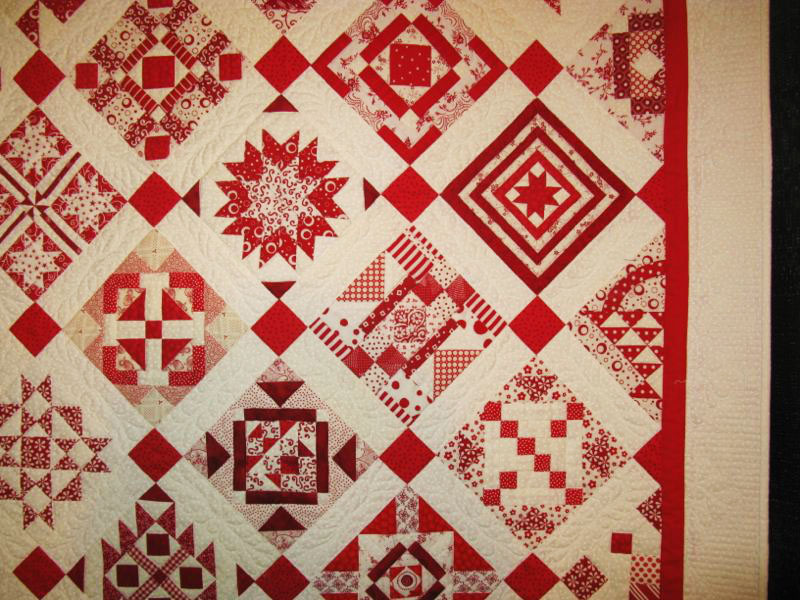
I don’t know which one had 229 pieces, but all of them are heavily pieced blocks.  It was an amazing quilt and always had a crowd around it.
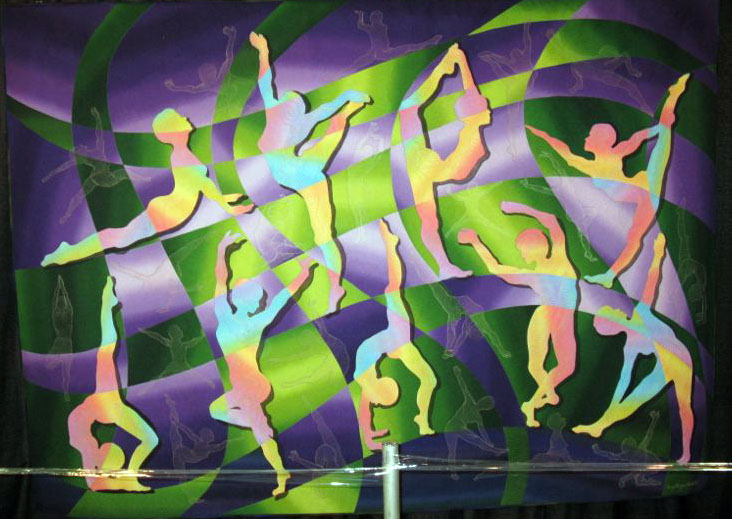
Carol Bryer Fallert became famous for her impeccably pieced flying geese in loop and swoops and swirls over the face of her quilts.  She continues her pristine piecing in Checks & Balances, which is machine pieces, machine quilted and painted.

Did I mention she was known for her machine quilting, too?  Amazing.  Those cloth shadows really make the figures feel dimensional.
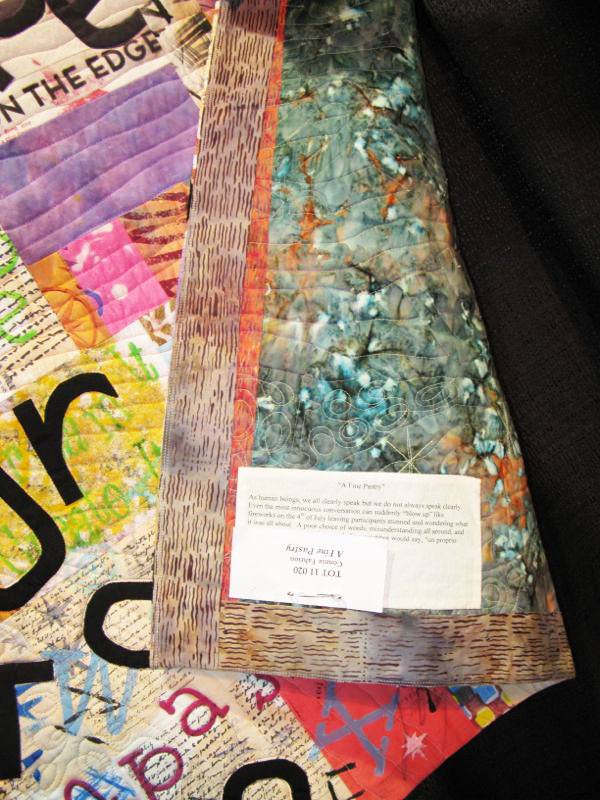
First, notice the interesting binding — it’s turned to the back, leaving a clean edge on the front.

Since Connie Fahrion’s quilt has a lot going on (but it was wonderful to look at in person) I think her choice of the clean edge was masterful.  She says the design source for A Fine Pastry came from “the desire to depict how it feels to be part of a communication gone wrong. . . . A poor choice of works, misunderstanding all around and, voila! you have created, as my Italian neighbor would say, ‘un proprio pasticcio’ — a fine pastry.”
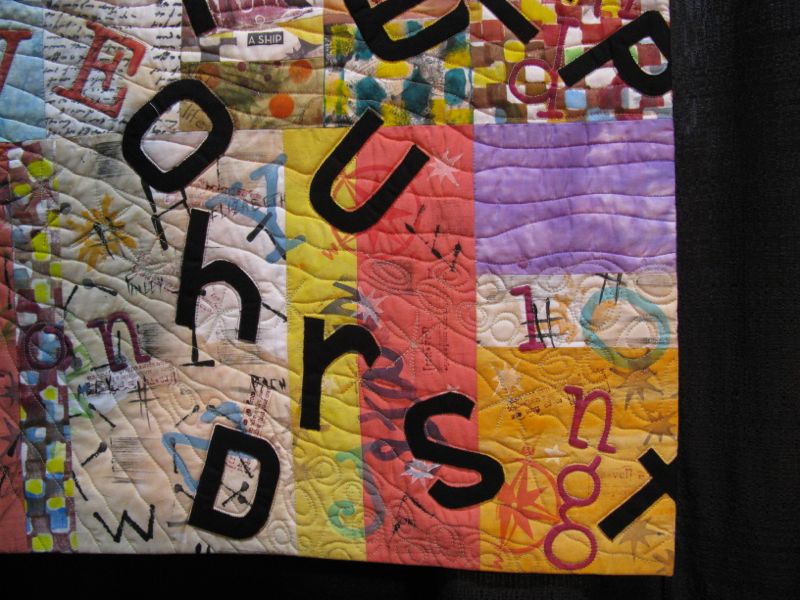
I’m a sucker for text in art.  Yessirree.

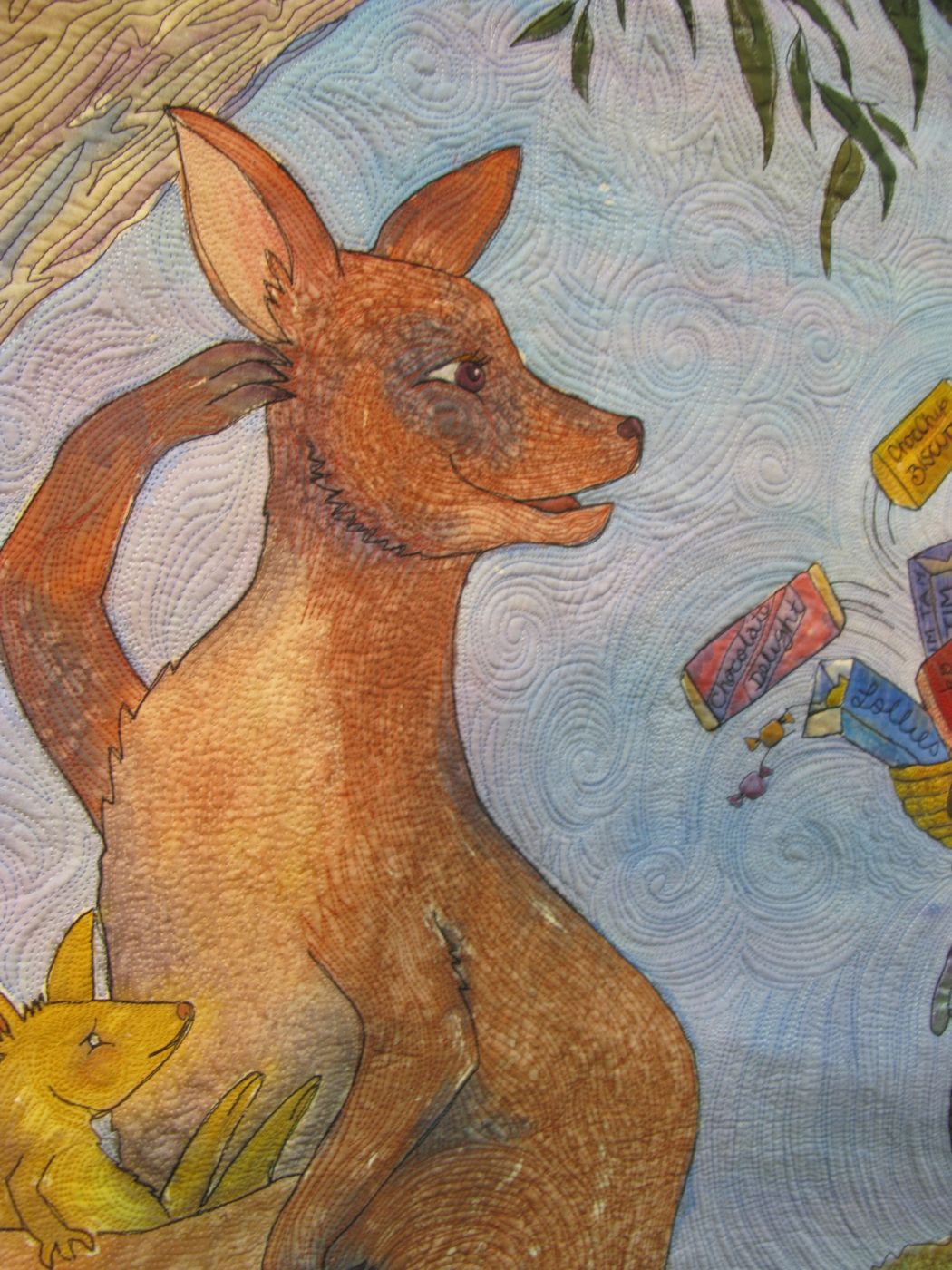
Since I’m the kind of person who always wants to know “how did you do that?” I tend to focus on technique.  Sometimes this frustrates, like when I’d like to create a text quilt like the one above and I don’t feel I have the artistic chops to do something like that, but other times my interest in technique lets me appreciate a quilt like this one by Helen Godden, titled Good Onya Sonya Onya Bike!  This hand painted, whole cloth quilt allows the free motion quilting to really shine.
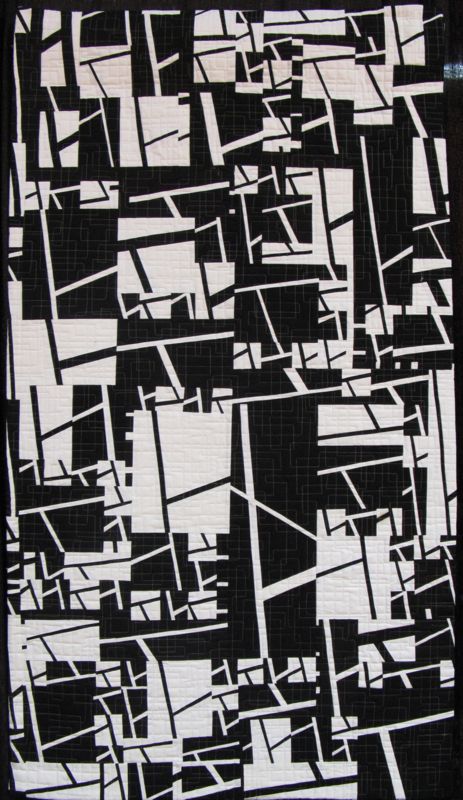
Annette Guerrero in her quilt, Gridlock, used a two-line motif in the shape of a modified T to create her quilt.  From the smallest to the largest piece, you can see the T-construction.
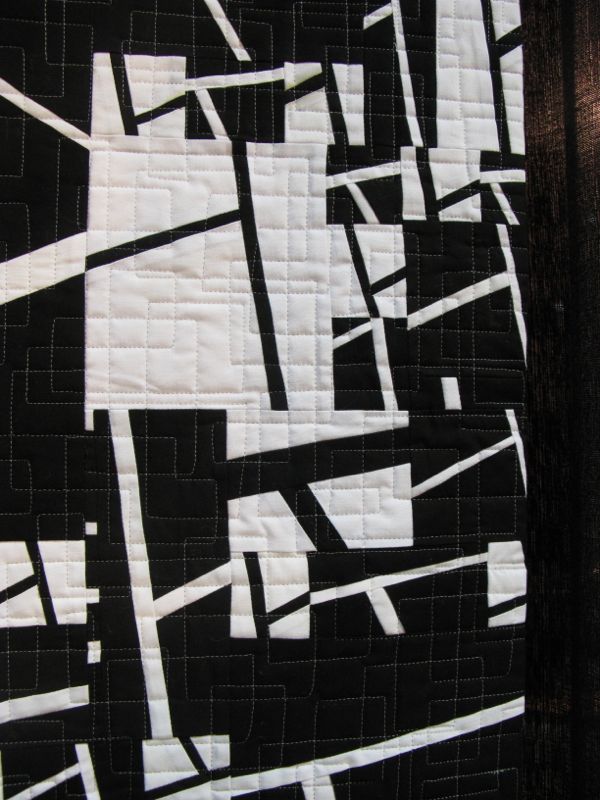
Cool quilting, too, carrying out the theme of the grid.

Mrs. Lindberg’s Neighborhood, by Martha Lindberg.
Apparently she designed this quilt, then started a house swap with some friends, inspired by a quilt she saw at the Dallas Texas Quilt Show.  Her friends’ blocks, and her own houses, populate this neighborhood.

Nice quilts we weren’t supposed to photograph.  Or maybe it was okay to photograph them, but I was too tired to get all the info about them.  Even though you might feel like you’ve seen every quilt in the exhibit, trust me. . . there were a lot I didn’t put in these posts.

Danielle Reddick, from Picton, Ontario, Canada was inspired by the fields in rural Prince Edward County to make Sunflower Heart for Alice, in honor of her daughter’s 21st birthday.

I’m including two detail shots because it’s not until you look at for a while that you realize you are seeing cut-up cast-off shirts.  Note the button-front, above, and the pockets, below.
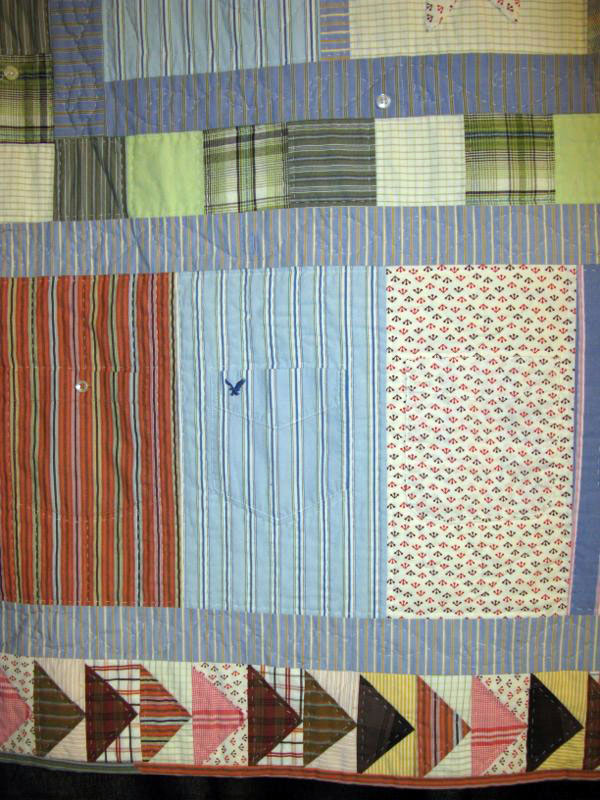
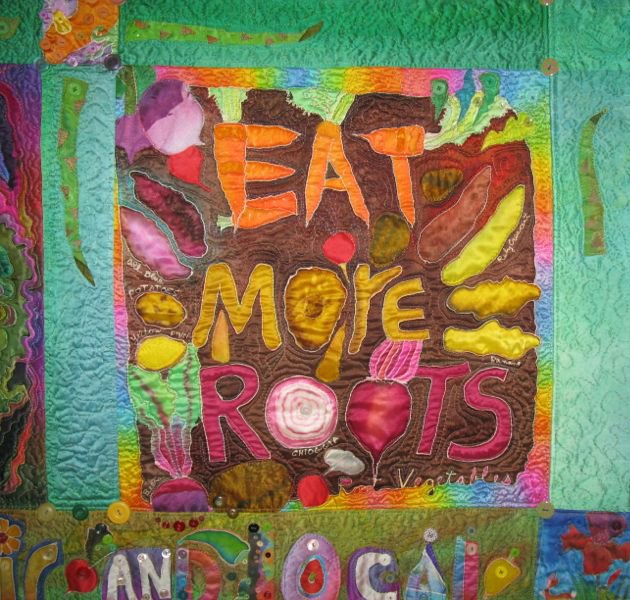
Eat Your Vegies, by Judith Roderick, a long time vegetarian.

I love her quilt even though she misspelled “vegies.”  It’s veggies, if you are going to abbreviate it, but I have to admit that’s one of my “fingernails-scraping-on-the-chalkboard” words.  I hate it.  But I love this quilt!
Springtime in the Garden, by Mary Schneider, uses raw edge machine appliqué along with hand appliqué to create this sublime field of flowers.  She made some changes to a pattern, to put her own stamp of originality on this creation. (I wished she’d given us the source of her inspiration, though.)

Pretty sure there was an exhibit on text, as there does seem to be quite a few quilts using letters and words in the design.  This one, The Word Gets Around, by Louisa Smith, uses commercial fabrics that she manipulated by painting, dyeing and overdoing to obtain the colors she wanted.  Her idea for the quilt came from the fact that “our lives are surrounded by text. . . [in] newspapers, advertising and street signs.”

The backside of her quilt.

Gaudi Star, by Lisa Walton  Influenced by the architecture of Anton Gaudi in Barcelona, Spain.

This is one of those quilts where the the parts are greater than the sum.  The parts (above) are fascinating, both in the use of shape and color and the screen printing which she did. Really beautiful, up close.
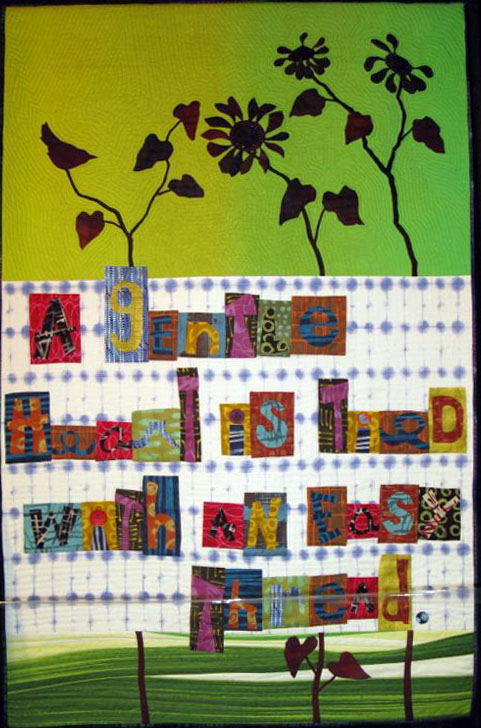
Terry Waldron is a favorite quilter of mine, a local gal who has had some fame and success, but still found time to write me a congratulatory note when she saw my quilt hanging in a show.  So I thought it good to end these few posts with not only a lovely quilt, but a lovely quilter.  The title of her quilt is A Gentle Heart, based on George Herbert’s statement, “A gentle heart is tied with an easy thread.”

This quilt is hand appliqued, hand beaded and machine quilted.

What do you feel like after you leave a quilt show?  A lot of times my wallet and my hands hurt from gathering up treasures from the vendor malls.  But aside from that, are you inspired?  Overwhelmed?  On overload?  Me, too.  And then it’s time to climb back into our lives, into the reality that we don’t have enough time or energy to make all those quilts we dream about, so we just choose what we can and make what we can.

But it’s always great when a quilt show comes around.
Quilt Shows

Long Beach Quilt Show: Log Cabins

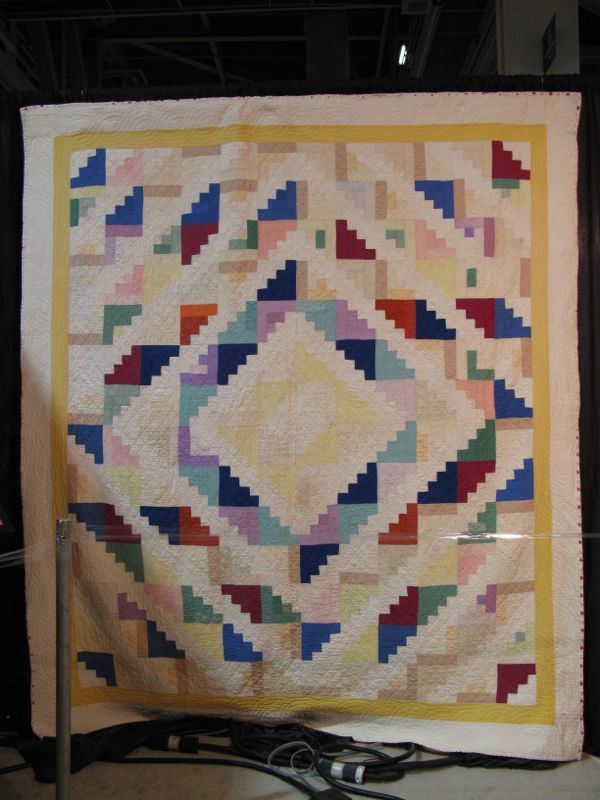
I’m just sneaking in a little slide show here before I finish up the Long Beach quilt posting.  This collection of quilts belongs to Claire McKarns, who has been “collecting, buying and seeling antique quilts for 30 years.”  Most of the makers are unknown, but they date from the late 1800s on up into this century.  A special note to one of my favorites (shown below, but above the slide show).

I especially like that modern touch of high voltage cables and plugs decorating the bottom border of the quilt.  Enjoy the slide show.

This slideshow requires JavaScript.

Some information on the names and the patterns are found *here* and *here* (you can also search the web for more).

Quilt Shows

Long Beach, Part 3

Let’s see if I can roll these out for you.  I’m watching the Closing Ceremonies of the Olympics and all this music has me typing quickly.

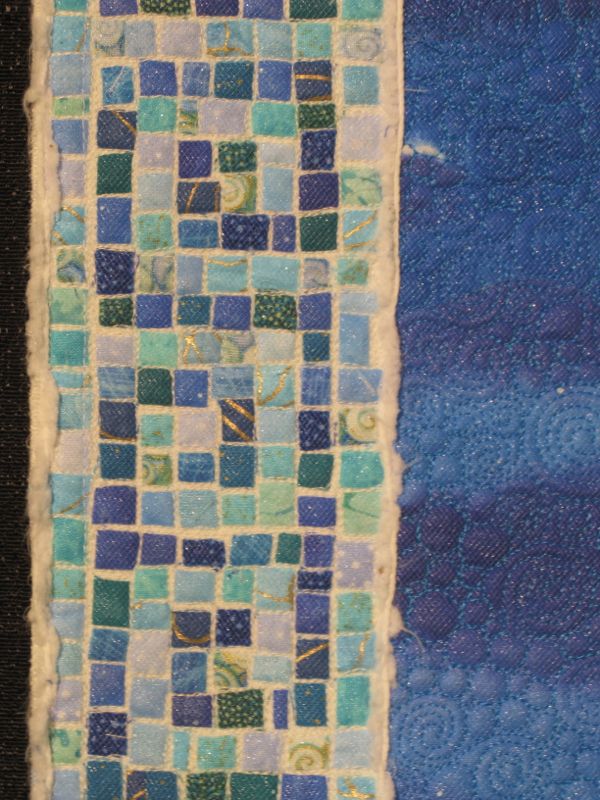
Karen Eckmeier’s quilt, Aegean Memories, was a masterpiece of tiny pieces, yet it really evoked the Greek Isles, fresh in her memory from a recent visit.  She used collage, paint, machine quilting and couching to make this.

She used the applique-under-tulle netting approach that she did in her other quilt (Black, White, READ).  I think this would be a really good way to control all all those tiny pieces.

Detail.  Maybe this is where she used the paint?  But no, all those little squares look like scraps of cloth.

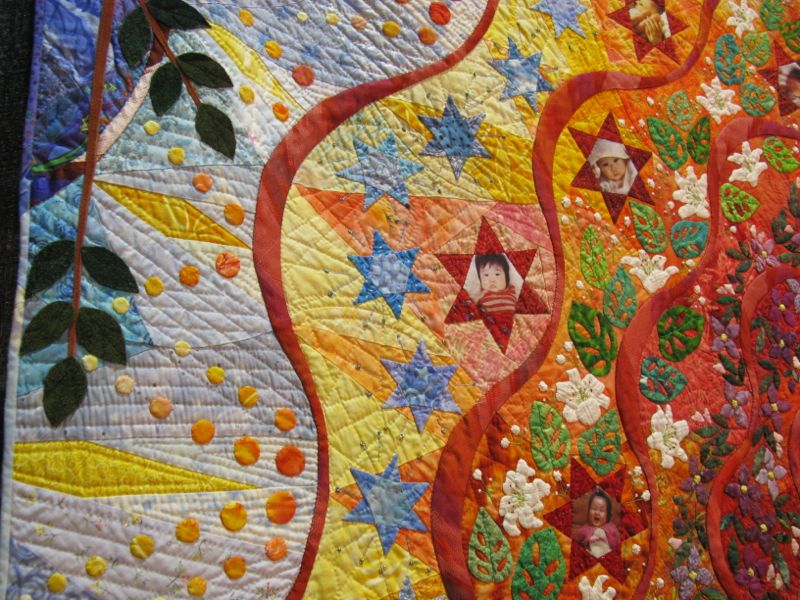
Harumi Asada had her first granddaughter (her son’s daughter) and she made Happy Birthday to commemorate that first year.  There are growth records, pictures of the baby throughout this first year and flowers flowers flowers!  I was happy to get a nine-patch quilt made when my grandchildren were born.  This was really a stunner.

Here you can see a couple of the baby’s photos at different stages of that first year.

All those circles!  My Karen Buckley circle templates would have gotten a workout. I turned off the flash to show the hand quilting, but it does produce a slightly soft focus.

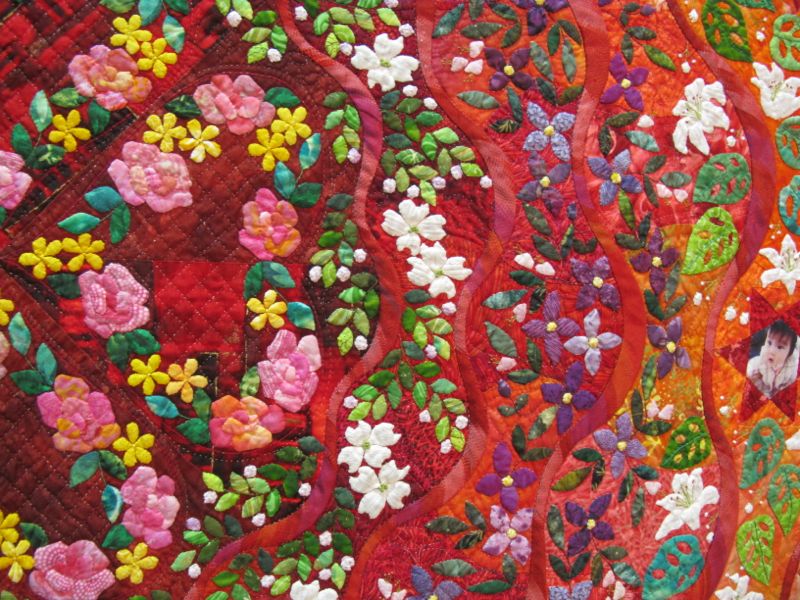
Here’s some of aforementioned flowers.  All hand appliqued.

But this wasn’t the only Asada quilt.

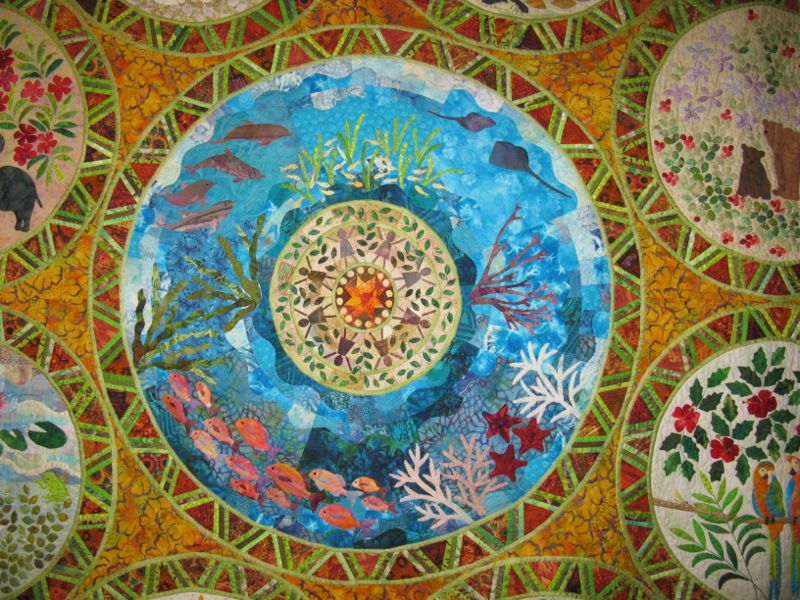
In this quilt, Harmony in Nature, she wanted to express that all living things are linked.  She made it for a conference on biodiversity in Nagoya, Japan.

I could have taken billions of photos, but mostly I just stood with my jaw dropped and sighing at her exquisite details.  This is the central medallion of a large quilt — close to a queen size.

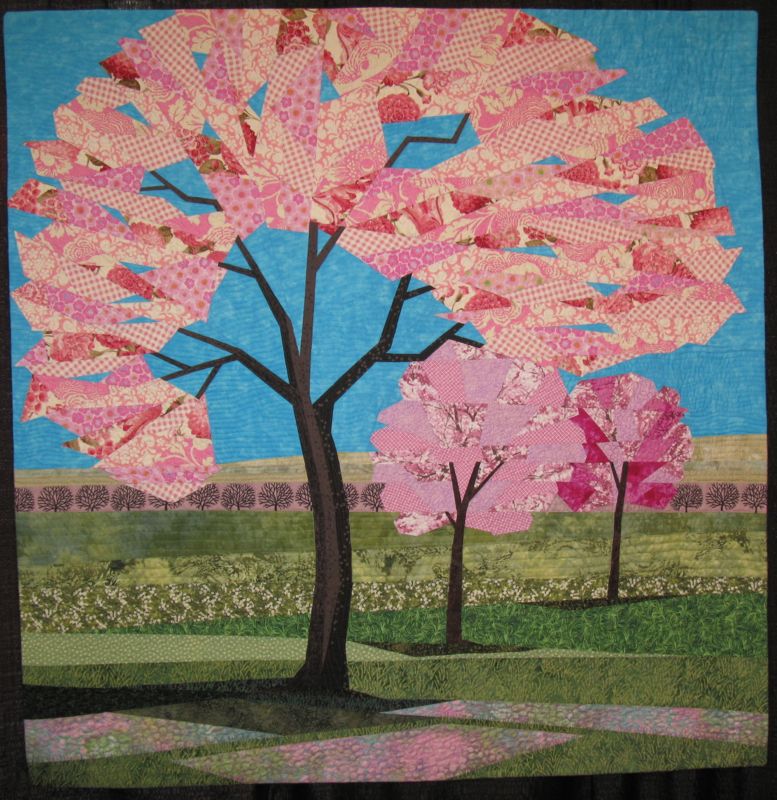
Since I spent a year in Washington, DC, I fell in love with this depiction of when cherry trees bloom. The title is Spring Blossoms by Terry Aske.  If you look in the background, you can see a row of trees, as well as the soft carpet of pink blossoms under the tree–so very typical of what the blossoming trees are like.  Aske, however, is from the West Coast of Canada.  I guess cherry blossoms are a universal.

An excellent use of floral fabrics to suggest the individual blossoms.

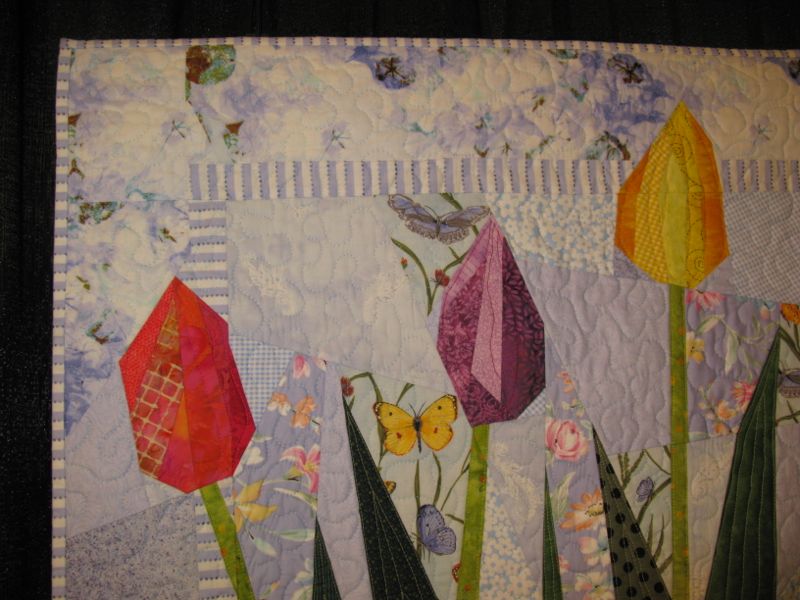
Here’s another quilt from Terry Aske, titled Spring Beauties.  It’s those stripes that pull me in, as well as the plaid leaves.  Such inventive use of fabric to depict a “local patch of tulips.”

And look at this “border”– outlined, subtly, with the use of the striped fabric again, and the background flowing over into that border area.

Cricket on the Radio, by Elizabeth Bren.

Sometimes simple quilts can be very effective.

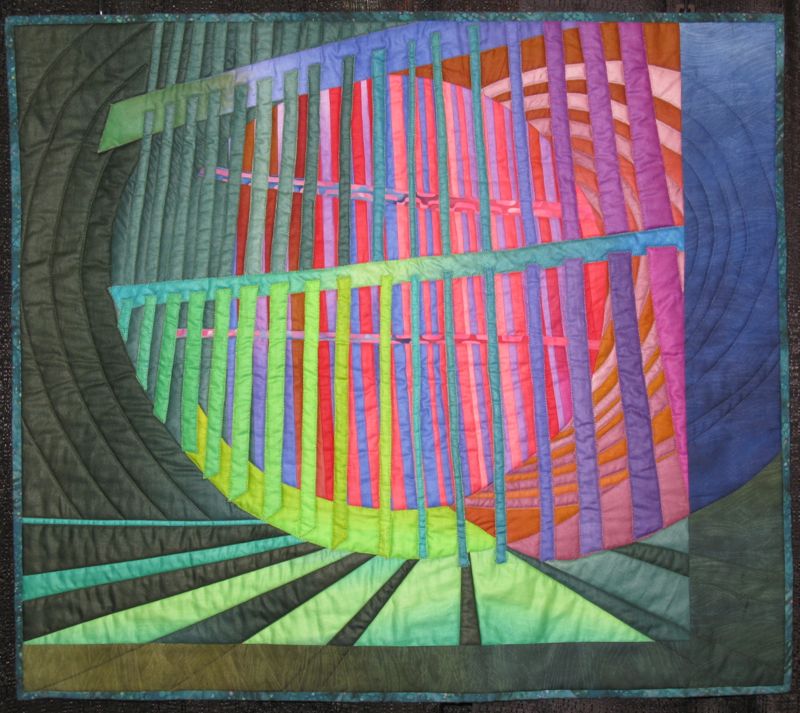
NASA Wind Tunnel, by Linda T. Cooper.  Highly graphic use of shape and color.

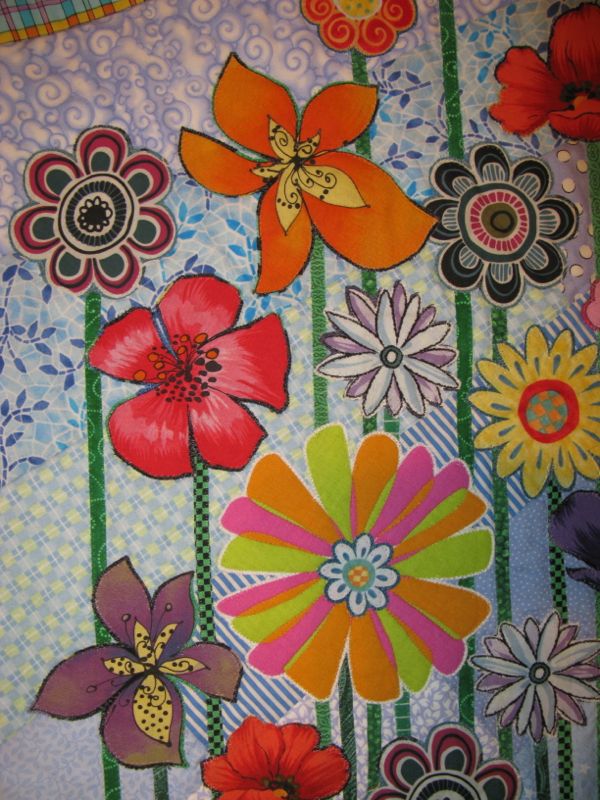
Another Whimsical Garden, by Tina Curran

Fused flowers, but they are all different and wonderful.

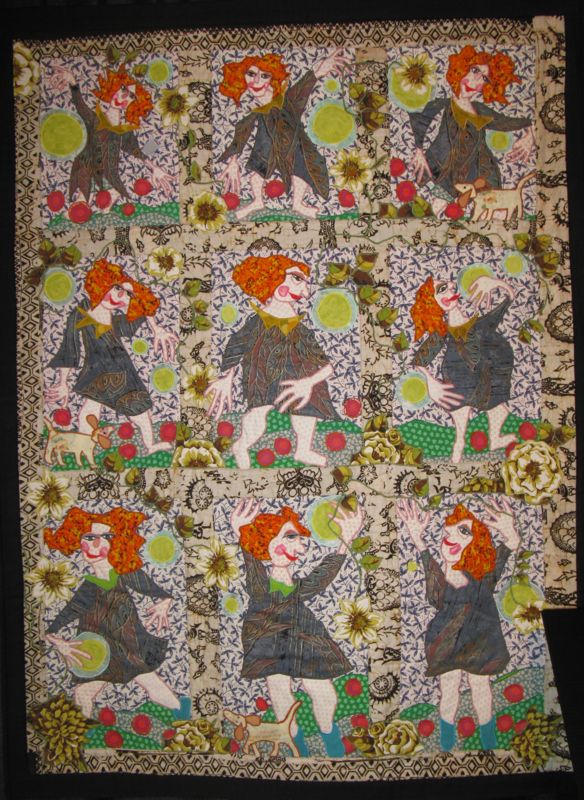
Bodil Gardner must be a favorite of those who put on the show, because I’ve seen her quilts multiple times.  Always interesting, though, with her free-form shapes and almost troll-like faces and bodies. This one’s titled Nine girls a dancing.

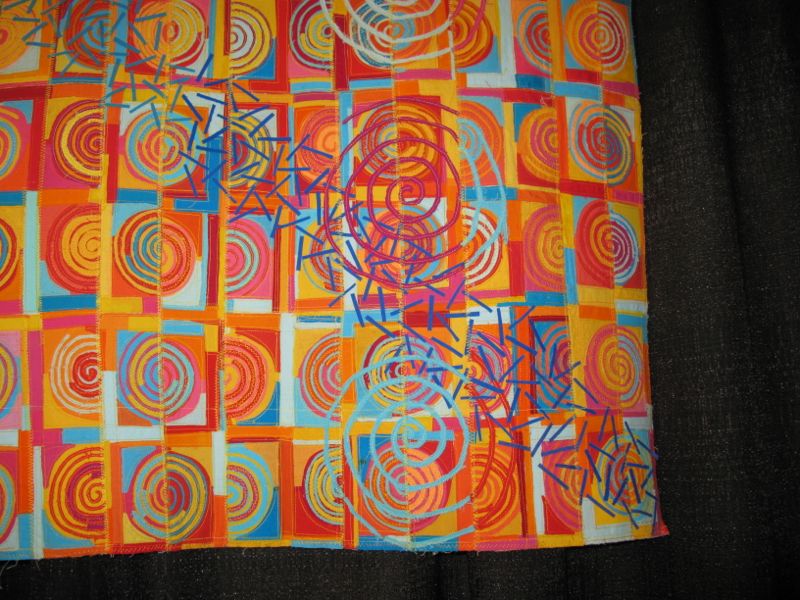
Spiral Fever, by Jane Lloyd

Spiral Fever, detail.  She says she likes to work in a series, and the ideas for the next quilt come to her while working on her current project.

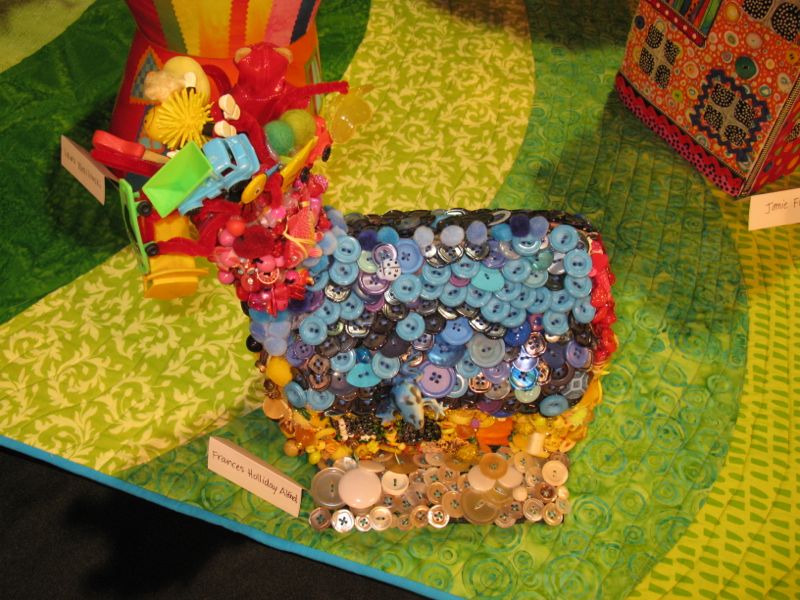
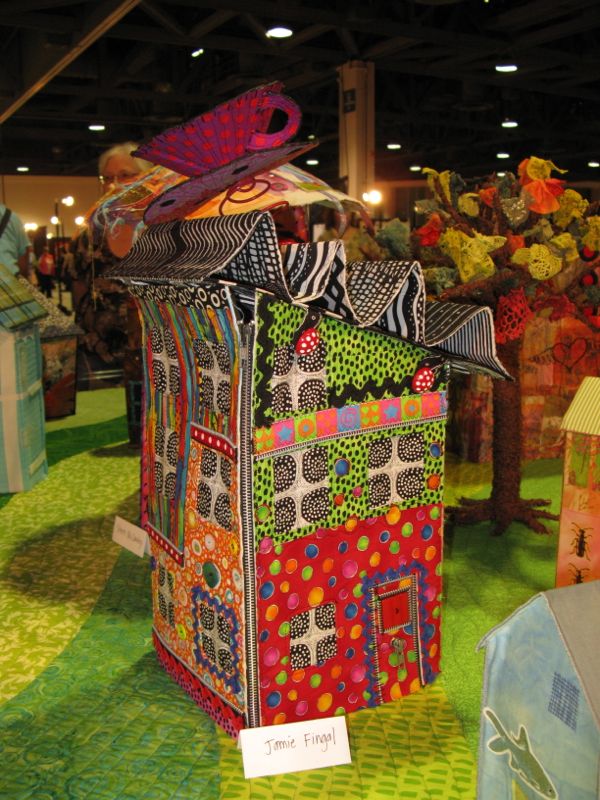
In the center of one of the areas, they had this display of a little village of houses, organized by Kathy York.

I’m convinced some of these quilt artists never sleep.

And now it’s time for the Ugly Quilt Award.  Again, this is only my very subjective opinion (and certainly some of mine could qualify.)  To protect the innocent, no names are revealed.

It’s not necessarily the head-on shot that reveals its place as the winner this time.

It’s the side view (and I realize it’s a pretty ugly photo, but again–the lights here are challenging), that shows the 3-D effect of purple pipe cleaners.  I know nothing about the quilt artist and I do have to applaud her inventiveness, but maybe some things just shouldn’t be tried.

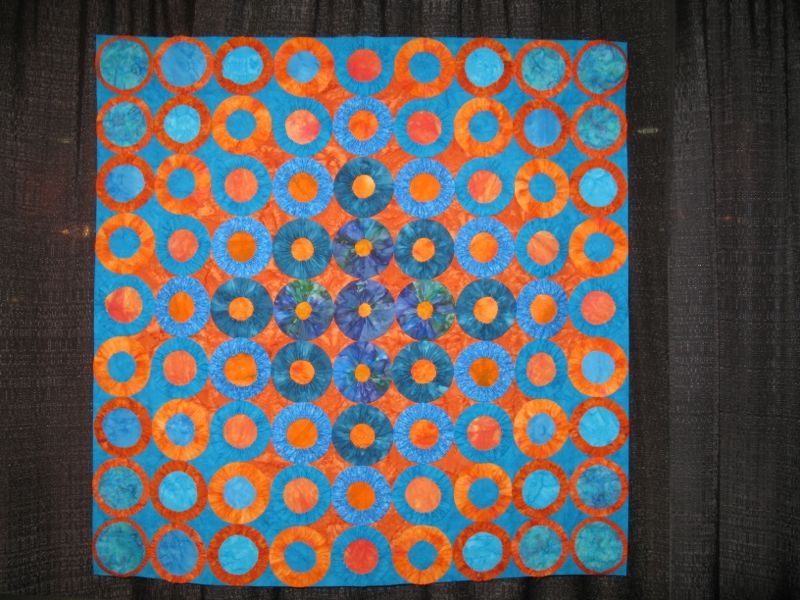
YoYo2: Trip Around the World, by Helen Remick

Native Market, by Phyllis Cullen and Annie’s Star Art quilt group members. This is one of those quilts where they take a photograph and cut it into pieces (in this case, twelve) and each member interprets the section s/he has.  I like how they sliced this one into irregular pieces, rather than the usual strips.

Native Market, detail.

Watt & Shand # 6 is by Sue Reno, who was documenting the conversion of an old department store into a convention center and hotel in Lancaster, Pennsylvania.  These images  are from her own photographs of the reconstruction.

Reflections, Glass Walls, La Defense, Paris, France var. 3 by Barbara Schneider.

This quilt was in the quilt show booklet, as it is such an interesting quilt.  It is dyed, overdyed, painted, collaged, fused and machine stitched in order to show “the contrast between the patterns in the glass and the structural gridwork” (artist’s statement).  The quilt below is another variation in her series, but I couldn’t find the title in my notes.

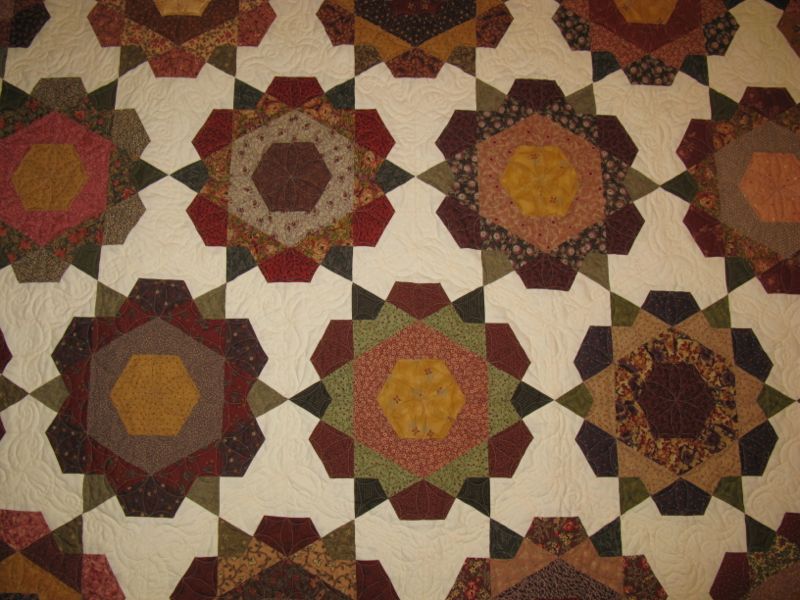
This one’s for all the hexie fans out there.  This is the popular rose block that is being constructed by many quilters, using hexagons (or parts of hexagons) in the English Paper Piecing method of construction.  The title of this is Rose Garden and it is made by Ardie Skjod and quilted by Dorothy Burnett.  She used a pattern from an Australian magazine, designed by Dale Ritson.

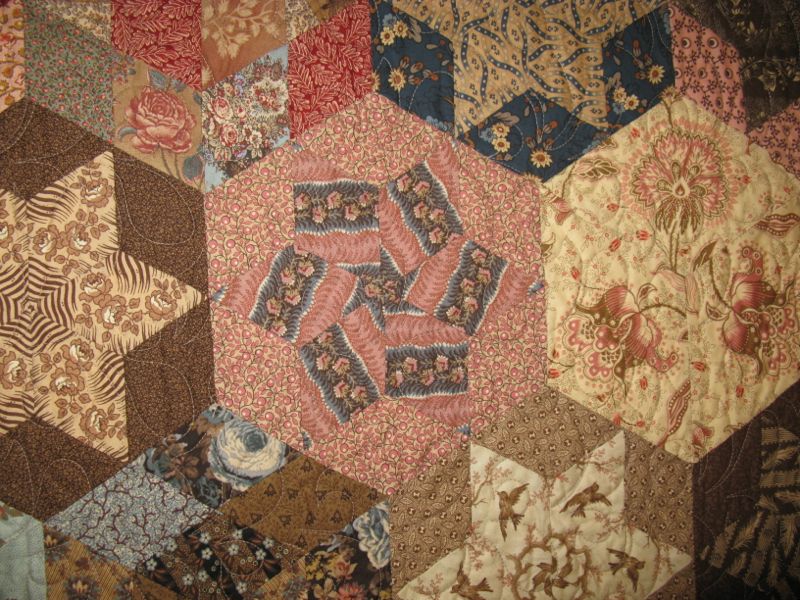
Here’s another one by the same quilter, Ardie Skjod, but this one is quilted by Debbie Blair.  Star Garden is inspired by a photograph she saw in an old magazine, but designed it herself.

I had to zoom in on that one block, as the use of the stripe really skewed it visually for me, but I think it makes the quilt more interesting.  Some blocks look like Tumbling Blocks and some have those diamond stars, but all of them are a large hexagon.  It didn’t say if this was hand-pieced.

Springtime in the City, by Cynthia St. Charles.  Her city of inspiration? New York City.  This quilt is hand-painted, block printed and machine quilted.  It’s really quite full of beautiful springtime colors.

Detail.

Portraits of Flora, by Timna Tarr originally started out to be done in taupes and neutrals, but then her “love of color took over.”  The circles are hand appliqued onto a square, and these squares were pieced together to make the quilt.

I hope you don’t find these detail shots tedious.  Used to be in the OLD days of blogging, you could click on a photo and it would enlarge, but now I find that lots of blogs limit the size, so a detail shot is needed in order to see what’s going on in the quilt.

Her tight quilting made the circles pop into a bas relief.

Baskets Made With Love, by Connie J. Watkins.

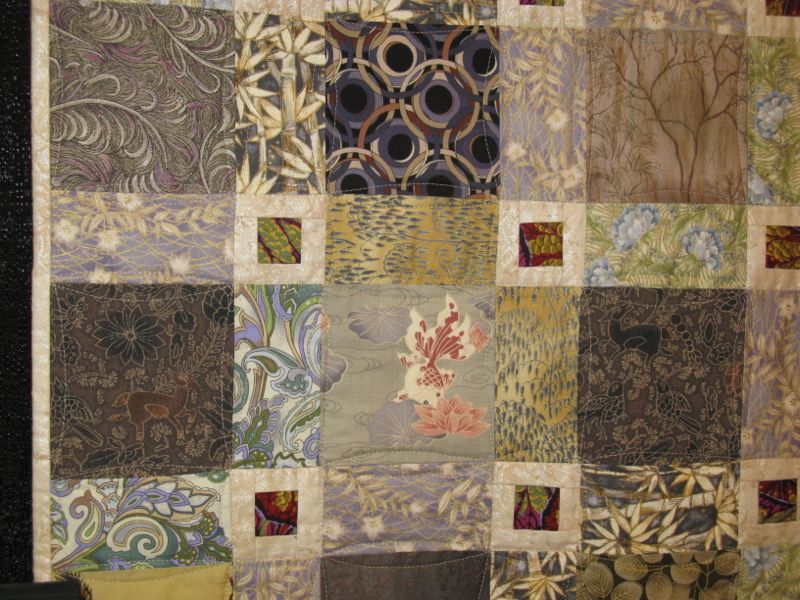
I haven’t figured out yet how these quilts come to be displayed — is there some entry form I don’t know about?  Are these quilts from another show merely transported into the Long Beach festival?  It might be interesting to know as we Southern Californians don’t see a lot of coloration like the browns palette in the quilt above, which speaks to the idea of “importation.”

One more post and then I’m done.  School begins today so I really need to get going on that, but to close, here’s what I finished during the Olympics:

Finishing School Friday · Something to Think About

Summer’s Fading Fast

I read a post from someone in the Midwest this morning, and the blogger said she could start to feel the turn in the air, that telltale sign that summer was fading and fall was around the corner.  Here in Southern California, where today’s high should be 106, we forecast “fall” by the calendar.  In other words, if school is starting, it must be autumn.

School starts on Monday for me.  I have a mess on the dining room table, unable to move it upstairs because of my mess in the studio from the Lollypop Trees.

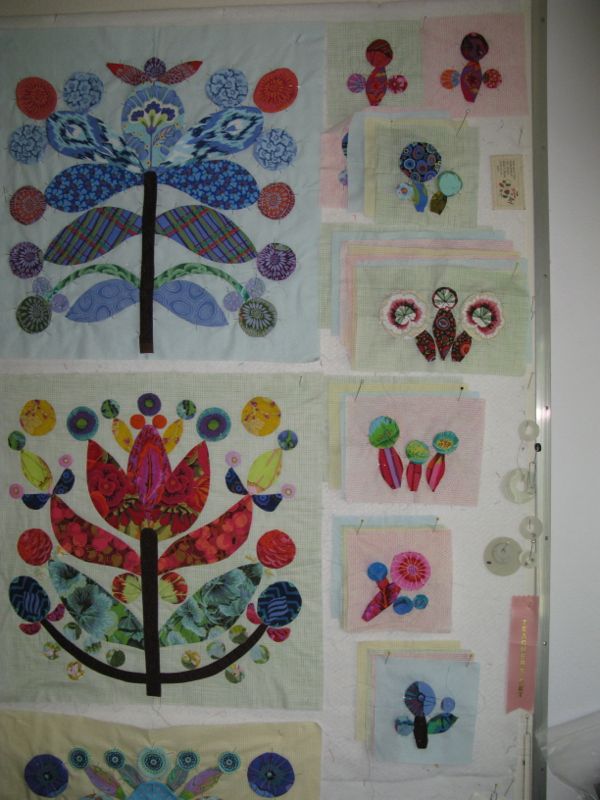
My main goal this summer was to get all of the lollies cut, shaped and pinned up on their background squares.  Done.

Then I went a little further and created all the border blocks, arranged here alongside the big lollypop trees.  Done.

And since I was picking up all the mess from off the floor and from around my cutting area, I cut the squares and rectangles needed for the sashing and borders.  Done.

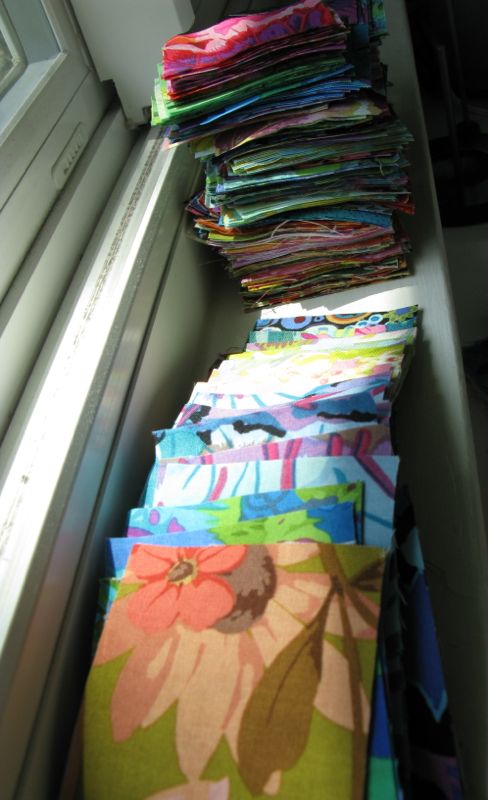
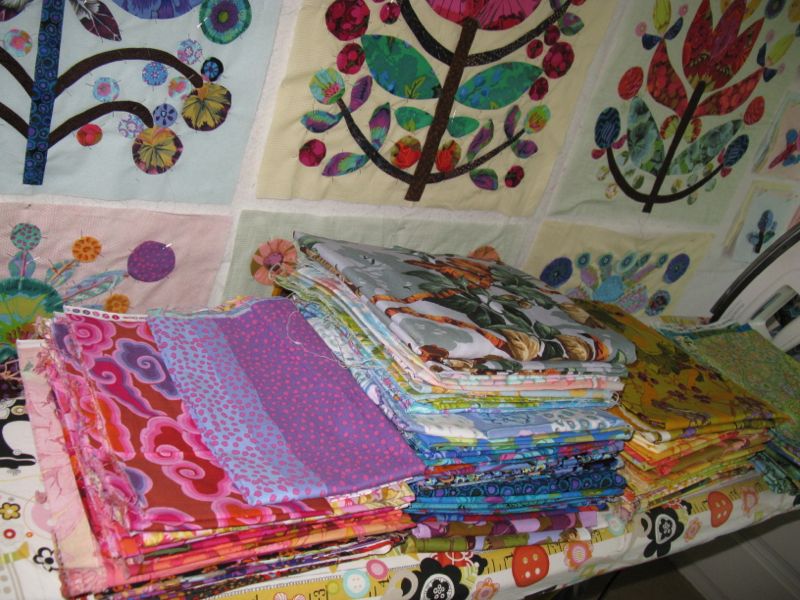
Then I folded all the fabrics up into squares, stacked them by color and shoehorned placed them onto my fabric shelves. Done.

I’ll dust, squirt, vacuum, and sigh as I tuck away the mat, rotary cutter and sewing machine, as I prepare to bring up the laptop, textbooks, papers, attaché case and supplies from downstairs and move them up.

It’s been a good summer.  I had an 8-day visit from my daughter and her three children and we made a series of curtains for eight windows in her house.  My husband and I went to New York for a week, where my son and his wife joined us for a day, a night and a day in the Big Apple.  My daughter and her husband and three kids came back again for a week before their school started.  My sister and her husband started the treatments in Los Angeles for his cancer, and they came to stay with us a couple of nights.  We went into LA a couple of days for laundry and moral support.  I listened to three books, trying to keep up with my mother, and read three more in-the-hand books.

I sewed the blocks for my Summer Treat Quilt.  I conquered the Lollypop Trees–now to sew on them all fall.  We had great gingham fun with lovely and interesting and fine participation from excellent quilters.  Good conversations, late on a summer’s evening led to me finding last year’s sparklers from the 4th of July and my grandchildren writing their names in white-hot sparks in the air.  We made SomeMores over the barbecue.  My son and his three boys came up for a day of swimming, running, visiting and two meals.  My brother, his wife and family stopped over one night on their way to a coastal site for their week’s vacation.  I went to a Quilt Festival/Convention and learned how to make a bracelet and a New York Beauty Block.

As I look over the things I thought I wanted to do and the things I did, there are some differences.  It’s easy to fret about those tasks left undone — no Cross-X blocks made, no basket quilt started.  I can look at other lists I’ve made (I have a classic full-page To Do List from 1993 that has over 65 items on it organized into 8 different categories and neatly typed up) and realize that some will be crossed off, while some will never come to fruition.  My lists as I’ve grown older have become simpler, allowing for things like a trip to the frozen yogurt shop instead of the finishing up of a quilt task, or like taking the time to read to the last page of a novel instead of reworking a binding’s corners.

But after all, it is summer, and what else are summers for than to let the tasks drift like a folded paper boat out on the stream of time, watching it bob and weave and sail out of view?  I can pick up my rotary blade another day, but maybe there won’t be time to stand by a grandchild while they write their sparklered name in dark summer air, or feel the ocean tug the sand from under their feet, enjoying the delicious feeling of being pulled off balance by tides, by time.  By a summer’s moment.

Happy Summer’s End to you all.