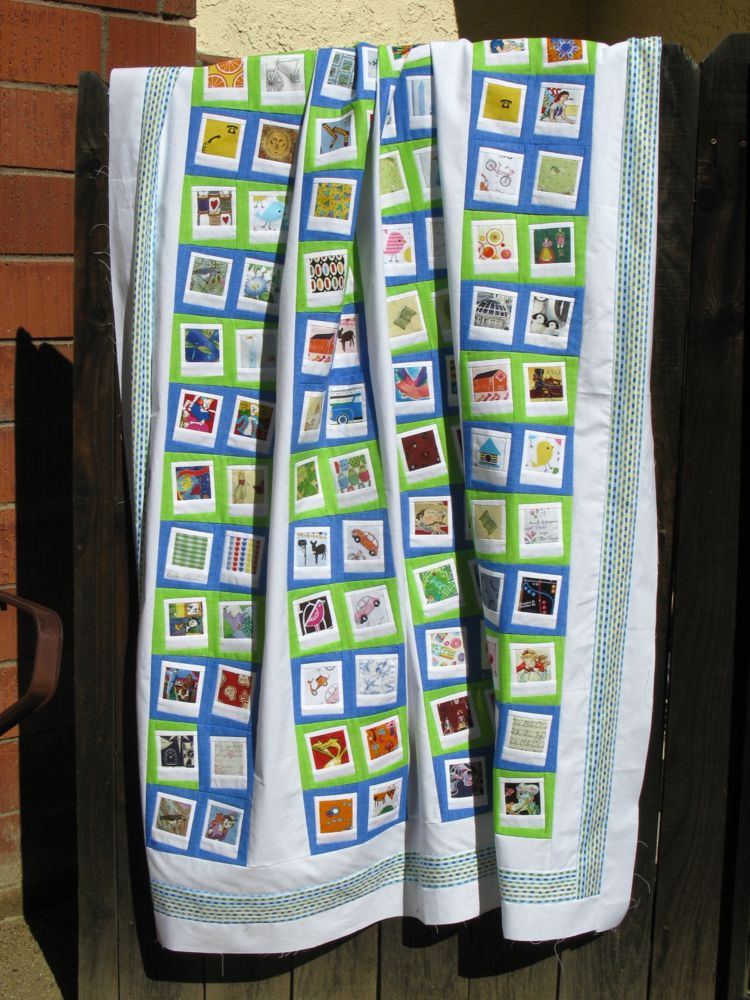
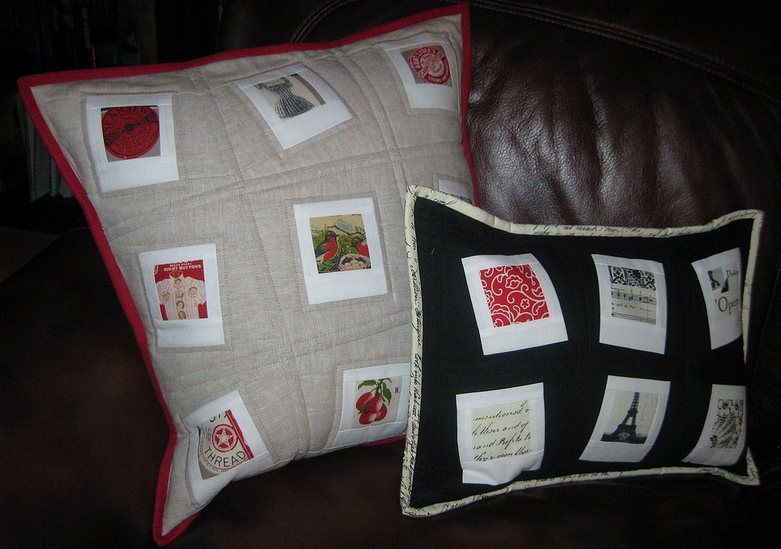
Here’s my Snapshot Quilt, in the requisite rustic pose drooping over a gate with rusty wheelbarrow. Go yard work for great props.
This is the third and final post in my tutorial of how to make the Snapshot Quilt, constructed from lots of Polaroid blocks. And at the end, my little giveaway. I have three sets of 10 blocks each to giveaway, but hey! you must be a serious Polaroid-er to get them. Leave me a comment telling me what you’ll do with them–have you started your collection? Do you have a few and want more? Do you have plans for them? And for fun, tell me about your favorite vacation photo, since this quilt is, after all, a tribute to vacation photos everywhere.
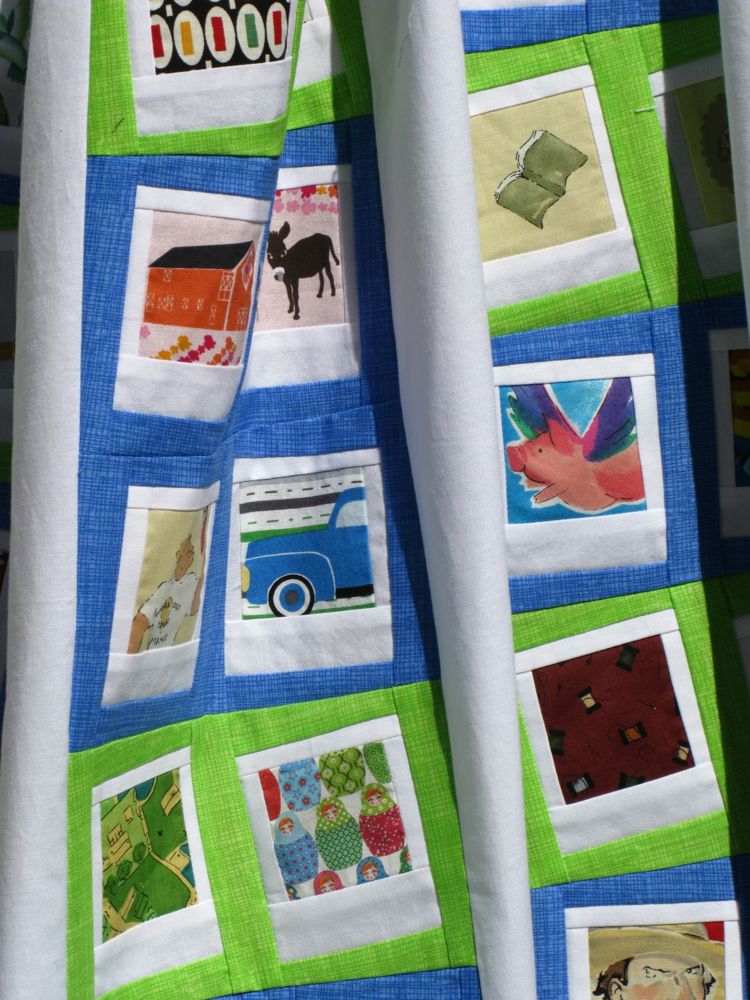
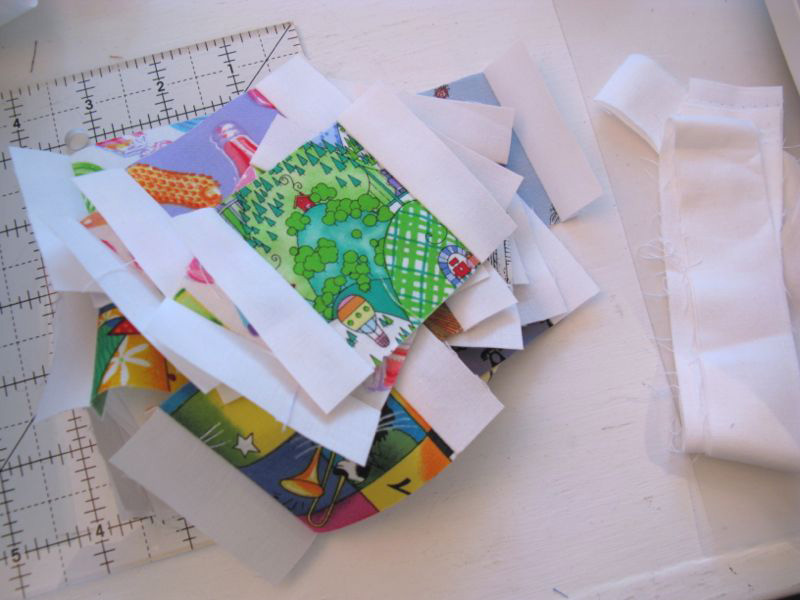
Here’s a close-up of some of the Polaroids. I received the truck Polaroid in the swap. Love it!

And that German-looking couple on the right was cut from my Barbie-doll dress.

Now back to work. I have made a PDF to help guide you with cutting, and it includes the basic bones of the quilt. Download it: PolaroidQuilt
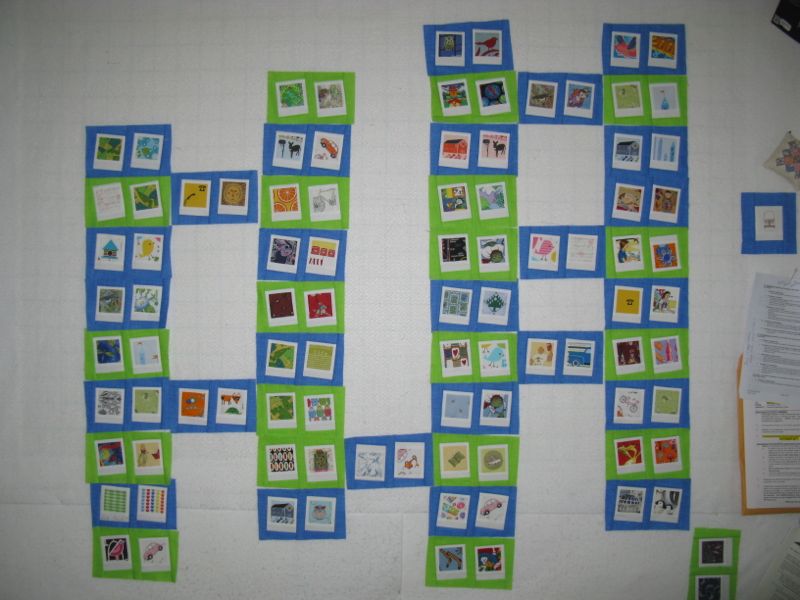
Start throwing up blocks onto your pin wall. This was my first attempt. I knew I wanted a stacked coins effect, but was playing around with inserting blocks into the middle of the stacks. Meh.

Second try. I like this one better, but not keen about the four blue blocks across the top, so I switched them around. Check the previous post for the doctors-office-view of the quilt, which shows how I ended up arranging all my blocks. I also checked to make sure that there wasn’t a glob of orangey-red blocks, or too many of one type or color.

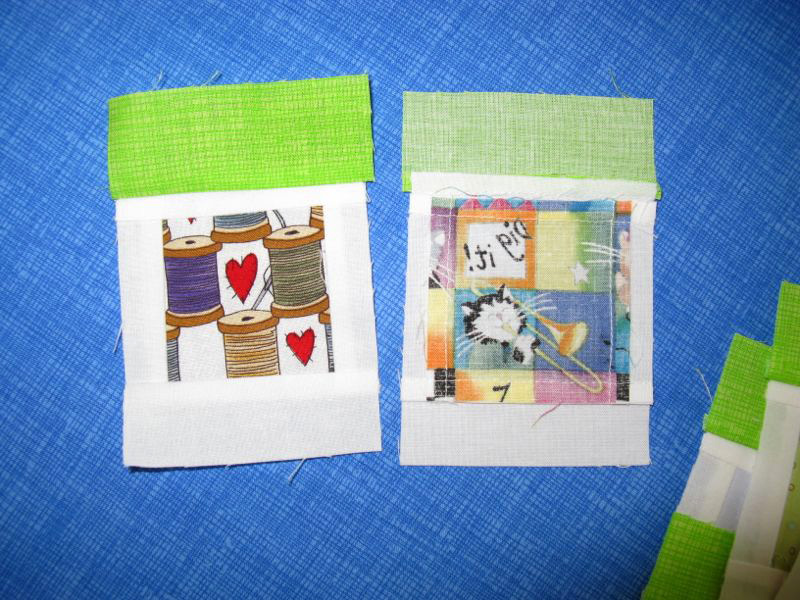
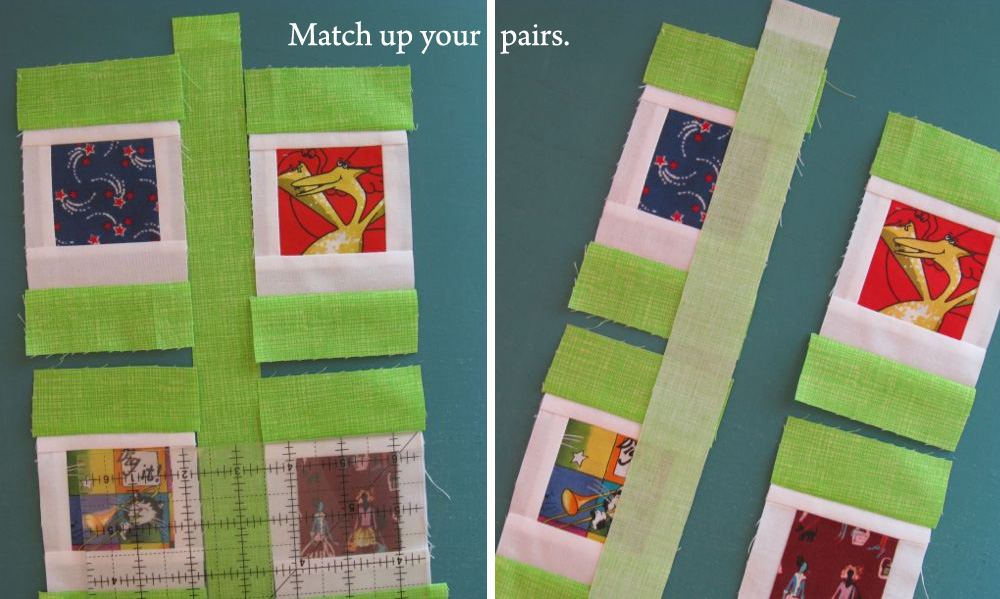
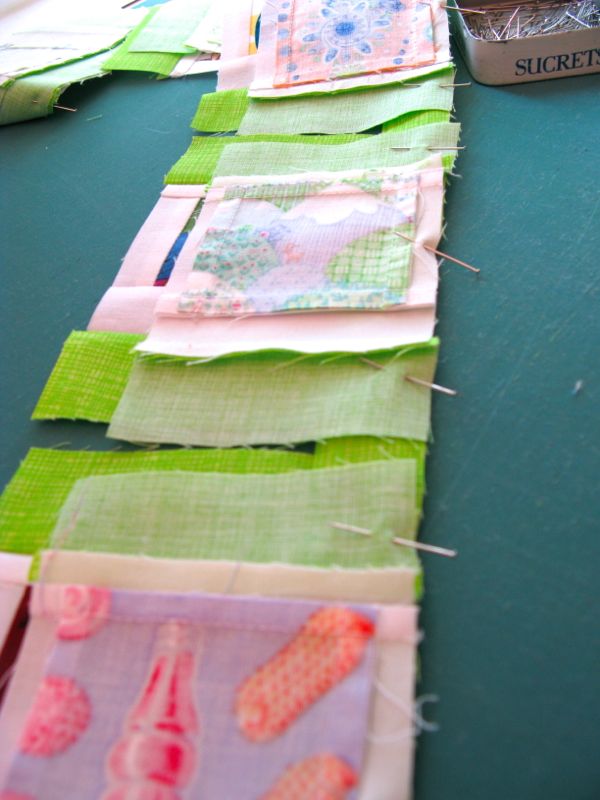
After getting the blocks the way you like them, sew them together. My row tags, made from embroidery holders, indicate which row it is, and which is the top. I pinned them all together in a row, then stitched them.
Cutting the white internal strips and borders:
Internal rows are 4 x 52″ (w/o s.a.) so cut three strips that are 4-1/2″ by 52-1/2″. I’d STRONGLY advise cutting them on grain, that is, cut them parallel to the selvages of your white fabric. All these double-Polaroid blocks are slightly on the bias, so they need the strong stable edges of an on-grain piece of fabric.
Borders (seam allowance included):
Border #1, top/bottom: cut two pieces 2-1/2″ x 40-1/2″; for the sides, cut two pieces 2-1/2″ x 56-1/2″” long
Border #2 (print), top/bottom: cut two pieces 2-1/2″ x 44-1/2″; for the sides: cut two pieces 2-1/2″ x 60-1/2″” long
Border #3, top/bottom: cut two pieces 2-1/2″ x 48-1/2″; for the sides, cut two pieces 2-1/2″ x 64-1/2″” long
NOTE: I’d cut the border pieces slightly longer, to give allowance here and there for ease needed when sewing on borders.
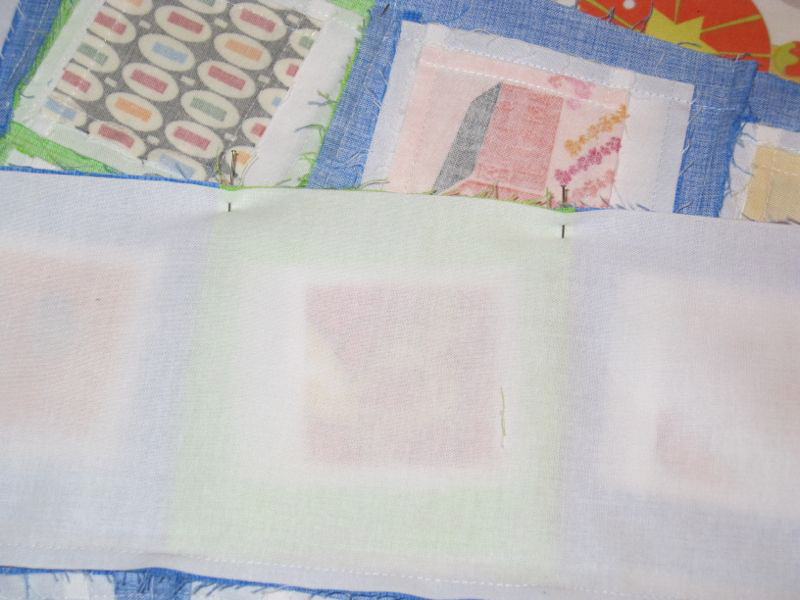
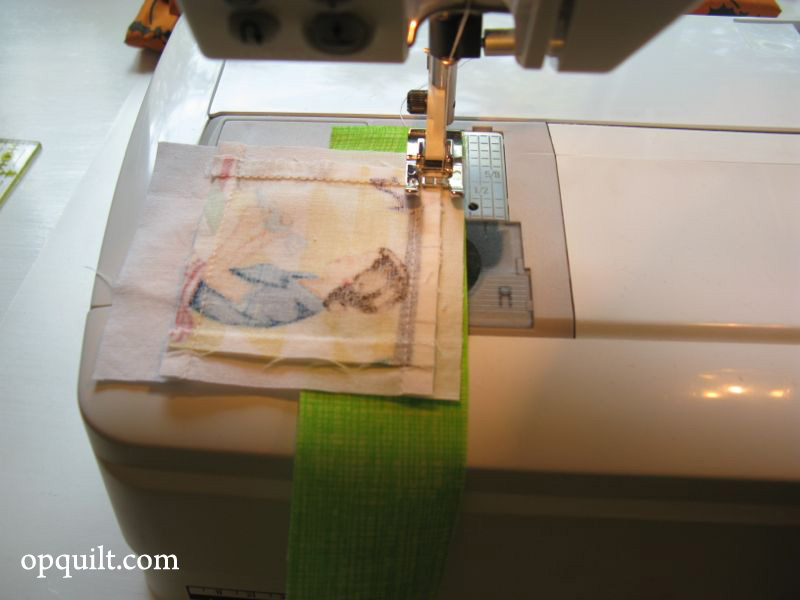
Matching centers and edges, ease the stacked quilt blocks onto the white on-grain strip of white fabric. Repeat until four rows of stacked quilt blocks and three strips of white fabric are sewn together. I sewed the seam with the quilt blocks to the throat plate of my sewing machine, allowing the motion of the feed dogs to help ease in any extra fabric.
Sew on the first top border, then the bottom. Then, matching centers and edges, sew on the side borders as you did above, keeping the white strip UP and the quilt block stack to the feed dogs. Press seams toward quilt blocks.
Attach the print borders next in this order: top, bottom, side, side. I was exacting on the lengths and matching edges and centers, but I should have given a little more ease to the side borders. It’s a challenge sometimes, as you don’t want to get the borders too small so that the quilt “bows” with a curved edge, but you also don’t want it so loosey-goosey that it ripples. Pin and check, is my advice. Then press the seams toward the print fabric.
Lastly, attach the last white borders in the same order: top, bottom, side, side. Press toward the second (print) border.
You’re done!
How do I plan to quilt this? I’m thinking I’d first stabilize those long stacks with either stitching in the ditch white white thread, or a quarter-inch away into the white. I’d like to outline along the Polaroids to make them pop. The white sections call out for some sort of overall pattern, like this pattern from Leah Day of Free-Motion Quilting, Bow-tie Parade:

Go and visit Leah’s site for lots of ideas and a stimulating blog. I love reading her posts. I do plan to bind this with more of that print shown in my border.
Now! Leave a message if you are interested in scooping up some of my Polaroid blocks, and mention what you’ll do with them–have you started your collection? Do you have a few and want more? Do you have plans for them? And for fun, tell me about your favorite vacation photo, since this quilt is, after all, a tribute to vacation photos everywhere.
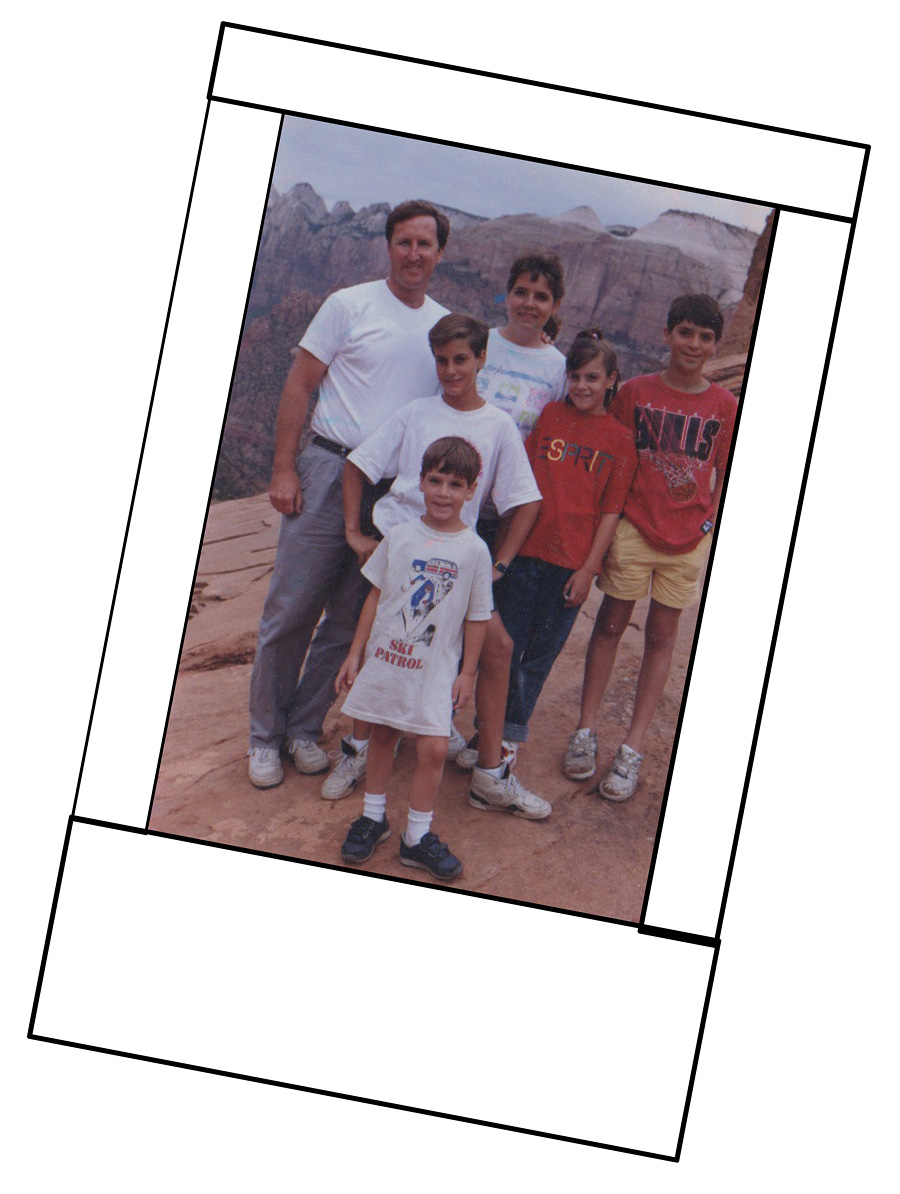
Mine favorite vacation photo is from when Dave and I were newly married (under a year) and we took all the kids to Zion National Park. We are standing there in the middle of red rock country in our slightly dirty T-shirts, a group of 2 adults and 4 children who were on their way to becoming a family. Now let me hear about yours.
UPDATE: Congrats to the winners of the Polaroid Blocks: Mary, Cindy and Marilyn. I’ll look forward to seeing what they do with their blocks, so send those photos over to my email when that future finish day arrives.